Modern Language Association hits back at Israel over Palestine entry denials
Press TV – January 12, 2014
The Modern Language Association (MLA) has approved a resolution that condemns the Israeli regime for denying scholars entry to Palestine.
MLA’s delegate committee passed the resolution on Saturday in reaction to travel and admission restrictions imposed on scholars and academic institutions by the Tel Aviv regime.
The resolution also calls on the US Department of State to “contest Israel’s denials of entry to the West Bank by US academics who have been invited to teach, confer, or do research at Palestinian universities.”
The advocators of the resolution criticize the Israeli regime for rights abuses.
The MLA argued that such acts pose a serious threat to academic freedom, urging Tel Aviv to stop the trend.
The resolution will be further reviewed by the MLA executive committee next month.
The MLA resolution came after the American Studies Association voted to support a boycott of Israeli universities.
Three Academic associations have so far supported the boycott, which calls on American schools and academic groups to ban collaboration with Israeli institutions, but individual Israeli scholars who do not represent Tel Aviv would still be able to attend academic events in the United States.

Sharon may be dead, but his apartheid legacy taints us all
By Sabrien Amrov | MEMO | January 11, 2014
The shadow of the ex-Israeli Prime Minister Ariel Sharon, who has died aged 85, has always had a peculiar place in my life. He was in part the trigger of my interest in the Palestine-Israel conflict.
I recall sitting in the living room in Montreal on an autumnal September day watching the news with my family as the camera zoomed-in on an elderly, black-suited man with sunglasses. Striding across the courtyard of Al-Aqsa Mosque, he was shepherding a large group of armed men.
“What is he doing,” I asked my dad. “Who is he?”
“That’s Sharon,” he replied. “Apparently, he wants to take a walk on Temple Mount.” He said the last bit begrudgingly.
“But why all those soldiers?” I enquired, through a confused 11-year-old’s eyes.
“Because that is Sharon, and he wants a war,” replied my father in a tone that suggested that the questions should stop there.
I found out later that reports had confirmed that the 11th prime minister of Israel was, in fact, accompanied by more than 1,000 Israeli troops and paramilitary police for a promenade on what Jews calls the Temple Mount and which Muslims call the Noble Sanctuary of Al-Aqsa, home to Al-Aqsa Mosque and the Dome of the Rock Mosque.
What began as an altercation between Palestinians and Israeli security forces in Al-Aqsa’s grounds escalated quickly into the Second Intifada (uprising) that saw, a couple of days later, the murder of 12-year-old Mohamad Al-Durah as his father tried to shelter him from the Israeli soldiers determined to kill the boy. Al-Durah, who died in the arms of his father, became the emblem of the Second Intifada. From 2000 to 2005, it was a bloody debut to the new millennium in the Occupied Palestinian Territories. The death toll was estimated at 3,000 Palestinians and 1,000 Israelis; all the while, Sharon insisted that all he had wanted was a peaceful stroll on the Temple Mount.
That was my introduction to Sharon; surely, though, there was more to this man.
When politicians die oceans of words usually pour out in memoriam, describing the person as a saint or a sinner. When Nelson Mandela died in December 2013, few dared to utter anything negative about him; a notable exception was Canadian Prime Minister Stephen Harper. On the other hand, when Serbia’s Slobodan Milosevic died in his prison cell in The Hague, not many people shed a tear or had much nice to say about him. There are those who died in such confusing and ambiguous circumstances that no one wants to be the first to comment before the autopsy tests are over (and even then there was doubt), as was the case with the late President Yasser Arafat. Sharon is an interesting case because, due to a number of false alarms, commentators were debating how best to remember him once he’d gone.
However, such binaries are counterproductive. For one thing, they tend to depoliticise and de-contextualise the legacy of these public figures: “Mandela was a nice person”; “Saddam was a bad person”; “Arafat betrayed Palestine”. Generic lines such as these fail to provide substantive information to help us understand how and why these personalities mattered and what should be retained from their trajectory to move forward into progressive politics. Second, there is no need to dive into binaries when history provides us with a bookshelf on the life of the late Prime Minister of Israel.
The general and the statesman
Before entering politics, Sharon was regarded as a high-calibre military man. He built a reputation as one of the most experienced and shrewd generals Israel had known. He went by the nicknames “King of Israel” and “Lion of God” (which is in fact, the literal translation of his name). Some of his accomplishments include his role as the mastermind behind numerous operations in which many Palestinian civilians were killed. For example, during the 1982 Israeli invasion of Lebanon, the massacre in the Sabra and Shatila refugee camps showcased how sharp and effective Sharon had become in the execution of Palestinians.
There is still no accurate figure for the number of people killed in the massacre. The official Israeli investigation under the Kahan Commission concluded that between 700 and 800 people were murdered. Journalist Robert Fisk, who was one of the first people on the scene after the massacre, concluded that 1,700 people lost their lives. Meanwhile, the Palestinian Red Crescent estimate was more than 2,000. The research of Amnon Kapeliouk, an Israeli journalist and author of “Sabra and Shatila: Inquiry into a Massacre”, puts the figure between 3,000 and 3,500 dead.
Twenty years later, in April 2002, Sharon also ordered the killings in the Jenin refugee camp in the occupied West Bank. According to the Badil Resource Centre: “…by the time the military assault ended on 11 April it was estimated that more than 50 Palestinians had been killed. Around 10 per cent of the camp, including hundreds of refugee shelters, had been completely levelled.”
No media were allowed inside during the Israeli attack. It was only after 2 weeks that local and international human rights organisations, including Amnesty International and Human Rights Watch, were allowed inside Jenin. They soon uncovered evidence of serious breaches of international humanitarian and human rights law, including war crimes. With international pressure, the UN Security Council adopted Resolution 1405, 19 April 2002, calling for an international investigation into the invasion.
In fact, that same year, Ariel Sharon was facing possible war crime prosecutions in Belgium for both Sabra and Shatila and the Jenin massacres under the country’s 1993 law that gives the courts ”universal jurisdiction” to charge individuals over crimes against humanity or war crimes committed anywhere.
Sharon’s track record as a military man who gets the job done pre-dates the state of Israel. Aged 14, he was a member of the Haganah, the Jewish militia which became the “Israel Defence Forces”. At 20, he headed an infantry company in the Alexandroni Brigade during the 1948 War, where Israeli forces drove an estimated 700,000 Palestinians from their land, in what would today be called an act of ethnic cleansing. In August 1953, as commander of the 101 Unit, Sharon led an attack on Al-Bureig refugee camp south of Gaza, killing over 50 people. He repeated the same exercise in several other villages including the infamous Qibya village massacre. In his book “The Iron Wall: Israel and the Arab World since 1948”, Israeli historian Avi Shlaim described the massacre thus: “Sharon’s order was to penetrate Qibya, blow up houses and inflict heavy casualties on its inhabitants. His success in carrying out the order surpassed all expectations. The full and macabre story of what happened at Qibya was revealed only during the morning after the attack. The village had been reduced to rubble: forty-five houses had been blown up, and sixty-nine civilians, two thirds of them women and children, had been killed.”
Later on, in 1972, under the Galilee Protocols, Ariel Sharon “drove off some ten thousand farmers and Bedouins, bulldozed or dynamited their houses, pulled down their tents, destroyed their crops and filled in their wells” to prepare the ground for the establishment of six kibbutzim, 9 villages and the city of Yamit.
As a commander, Sharon knew how to suck the life out of a village effectively. In most operations, he would not only call the shots, but would also join his troops and participate fully.
As for his political career, in mainstream international relations Sharon is often thanked for pushing forward the unilateral withdrawal of Israeli settlers from Gaza in 2004-2005, which was seen as a great sacrifice and difficult decision for the prime minister to make such “a sign of good will for peace”. Ironically, since the withdrawal, the residents of Gaza have been paying the price under the Israeli-imposed siege of the Strip that has reached an all-time low this year. In fact, Sharon’s coma has been concurrent with the threat of the Palestinians in Gaza. He may have been in a vegetative state, but the people in Gaza must continue to resist the illegal blockade.
Another noteworthy contribution of Sharon the politician is the approval and management of the Apartheid Wall. Started in 2001 it now runs across the West Bank like a snake, separating towns and houses and neighbours from each other, providing resources on one side and collective punishment on the other.
Finally, Sharon has an interesting record of voting against or abstaining from diplomatic initiatives for peace in the region, leaving little leverage to suggest that Sharon was a man of peace. In 1979, in the Begin government, he voted against a peace treaty with Egypt and in 1994 he abstained from the vote for a peace agreement with Jordan. He also voted against a withdrawal of Israeli troops from Southern Lebanon in 1985. During the Madrid peace conference in 1991, he opposed the participation of Israel on the basis that it was not worth the trouble. He did the same with the Oslo agreement in 1993, voting against it in the Knesset.
The individual and the system
Now that he is gone, there is not much left to say about Ariel Sharon. To be fair, he has been gone for quite some time in all but name, but the effect of his deeds carry on. More importantly, we must realise that Sharon is only one face – albeit all-encompassing of the same persistent calamity: Israeli apartheid and colonisation. Perhaps for many Israelis, Sharon served his nation in good and bad times: he wore the suits and ties as well as the military uniforms; he shook hands with politicians and aimed artillery at civilians; and he did this in the name and for the sake of a Zionist state that believes it can strip another people of their rights and integrity for the sake of its own existence. As his track record demonstrates, leaders like Sharon reinforce injustice and oppression for the sake of statehood. They do not undertake these actions alone; they are part of an apparatus that imposes the normalisation of power dynamics based on militarisation, colonisation and apartheid, and expect the world to either follow suit or keep quiet about it.
Thirteen years on, as I see the man that provoked followers at Al-Aqsa Mosque and ignited the Second Intifada pass away after being incapacitated for almost a decade, I can only say the following: Sharon is dead but Israeli apartheid isn’t. That ought to be the focus of discussion about his life and contributions towards “peace”. That ought to be the concern of people interested in ending the conflict on realistic and just terms.
Sabrien Amrov is a Research Assistant, Levant Politics, Foreign Policy Division Foundation for Political, Economic and Social Research (SETA) in Ankara, Turkey
Related article
Greenwald Responds to Critics, Rejects Conspiracism
By Kevin Ryan | Dig Within | January 12, 2014
The story of NSA whistleblower Edward Snowden has dominated the mainstream news for the last seven months. During that time, questions about Snowden and his disclosures have framed the national discussion about domestic surveillance. Those disclosures have not resulted in any changes to U.S. domestic surveillance practices to date. Instead, the U.S. Justice Department has re-certified the programs in question as Americans discuss media talking points like—Is Snowden a traitor or a hero? A growing number of people are looking behind that media-generated framework, however, and are beginning to wonder if the right questions are even being asked.
What we know about Edward Snowden is that he was a Special Forces recruit in the U.S. Army, an NSA employee, an NSA contractor for at least two different companies, and a CIA employee under cover. All of this occurred in a span of only a few years and he was able to command six-figure salaries despite having no education beyond a high school equivalency certification. Of the many positions he held in a period of approximately six years, the most long-lived appears to have been his work with the CIA where this 20-something spy was, in his own words, a “senior advisor.”
When asked about his background and motivations, Snowden said, “I’m just another guy.” He went on to say that his leaking of NSA secrets was what we needed to know, implying that it was all we needed to know, about NSA spying. “This is the truth… This is what’s happening,” he said. The remainder of the story has been presented in stories like those by The New York Times, which paint Snowden in an increasingly favorable light. The Times, which was called a mouthpiece for the Obama Administration by Glenn Greenwald, the reporter chosen by Snowden to reveal his story, has come out calling for clemency for Snowden.
However, the questions about the evolving Snowden story have grown rapidly and continue to present challenges to citizens who are alert to the prevalence of corporate media propaganda. How many stolen documents are there and who has access to them? Why have only a tiny fraction of the documents been released seven months after they were first disclosed by Snowden? Why has Glenn Greenwald made a deal with the owner of Paypal Corporation—the company whose former executives now produce the technologies used for domestic spying?
Emotions and Responses
The biggest hurdle to understanding the Snowden story has been the emotional reaction to asking questions about it. Those who have dared to question the story have been met with ridicule and misplaced condemnation.
Author Naomi Wolf asked some straightforward questions about Snowden’s slick introduction in comparison to other whistleblower stories. Her questions elicited derision from pundits, some even suggesting that if Wolf didn’t buy into Snowden then she must be an NSA operative.
Whistleblower Sibel Edmonds’ questions were met with ad hominem attacks from Greenwald. Writing that Edmonds was “too stupid and/or crazy to know,“ Greenwald summarily excused the founder of the National Security Whistleblowers Coalition from further dialogue on the issue.
My recent article resulted in mild hysteria from a few who believe that no aspect of the Snowden story should ever be questioned, regardless of how that story evolves in the mainstream media. One such reaction resulted in a hit piece based on the false premise that I was calling Snowden a liar. The author called for a public apology until he realized that it was his own error that required an apology (cue crickets).
Thankfully, Greenwald has offered a few answers at his blog. Unfortunately, the emotional nature of those responses raises more questions. What’s more, the growing rancor and distrust regarding this story is resulting in citizens losing sight of the actual NSA crimes being committed and our decreasing ability to stop or prosecute them.
Greenwald’s answers appeared at his blog in two installments, one in December and another in January. In those posts he goes on at length about the fact that reporters work for money. Although Edmonds has made the point that whistleblowing should not be a profit-making venture for anyone, in general no one denies that reporters work for money. And if Greenwald gets fabulously rich from all of it, that doesn’t bother me. What bothers me is that Greenwald still hasn’t answered some of the more important questions. For example, has he made any kind of deal with government or corporate representatives with regard to this story or the release of material from Snowden? What are his views on the coincidence that several of Pierre Omidyar’s former Paypal colleagues are strong supporters of NSA spying and are the people developing the technologies for that spying?
Another unanswered question is a simple one. How many documents are there? Estimates have ranged from thousands to nearly two million. Only Greenwald and Laura Poitras have the entire cache, according to Greenwald. But portions of the stolen documents have been distributed to many mainstream news organizations and “tens of thousands of these documents are in the possession of The New York Times, The Guardian, ProPublica, and The Washington Post.” A subset of more than 50,000 of them, focused specifically on the GCHQ (the British version of the NSA), were shared by The Guardian with The Times and ProPublica. Therefore we’re talking about a very large, but still very uncertain, number of documents. Since Greenwald has reported that Snowden “read and very carefully processed every document that he gave us,” curious citizens might wonder how that was possible.
That being said, Greenwald has offered answers to a few of the questions and we can discuss them.
Why are the documents being released so slowly? Greenwald provided the following answers in his blog posts.
- Releasing the documents all at once would “violently breach … our agreement with our source.”
- “Large media institutions, even the ones with the best journalistic intentions, have all sorts of constraints – financial, legal, cultural – that produce fear and timidity, and that has sometimes slowed down or diluted our ability to publish the way we wanted to.”
- There exist “very real legal risks for everyone involved in this process, beginning with Snowden, who already faces 30 years in prison and is currently protected only by 9 more months of temporary asylum in Russia. Everyone involved in the publication of these materials has already undertaken substantial legal risk.”
- “These documents are complex. Sometimes they take a good deal of reporting to fill in some of the gaps.”
- The documents might contain the names of people who are surfing for pornography or are suspected of being terrorists, or they might contain “raw chats” or other specific internet activity, and these things might threaten the reputations or lives of those people. The documents might also help teach (less ethical?) states how to spy on their own citizens.
The first of these answers is the strongest. The public does not have access to the agreement and the implication is that future whistleblowers might be dissuaded from coming forward if they thought that they could not trust the people to whom they reveal information.
The second answer points more to the problem than the answer. Large media institutions are often vehicles for propaganda (remember the aluminum tubes) and that is why these kinds of questions arise in the first place.
The third answer is understandable but weak. Nobody should expect whistleblowing to be safe.
The last two answers are not believable considering what we know about answers Greenwald has given to other questions, and the distribution of the documents. For example, Greenwald knows enough about all the documents that he can definitely say that Paypal and its past and present executives are not implicated. And someone knew enough about the documents that they could be distributed to different major media corporations, presumably without carelessness, so these documents are not total unknowns. Can Greenwald tell us how the documents were categorized or sorted before distribution to the media outlets and how that was done to avoid the risks he emphasizes on his blog now?
Ultimately, the answer to why the documents have not been released boils down to that it is part of the agreement with Edward Snowden. Will Greenwald release his agreement with Snowden to verify that? Does the agreement apply to all the media outlets to which documents have been distributed? Who decided that these establishment mouthpiece media outlets were suddenly so honorable and would not report the information haphazardly or for the benefit of the powers that control them?
Conspiracy Theories
Greenwald’s December response indicated that he felt the questions about why the documents were not being released right away were good questions. He wrote, “I respect that critique” and even stated that he would ask the same questions. As an attorney, Greenwald might have wondered if withholding documents about ongoing crimes is a crime in itself.
Now, however, Greenwald labels those who question why the documents are being held back as “conspiracy theorists.” In Greenwald’s response, he rants about “people who cook up conspiracy theories” and how “deranged those theories are.” These comments reflect the position of Greenwald’s new media partner Jeremy Scahill with regard to questions about the official account for the 9/11 attacks. Scahill has publicly said that he believes questions about 9/11 are “insulting to the people who died on 9/11.” Scahill claims to be educated on such questions but apparently still doesn’t know that it was the 9/11 victims’ families who initiated such questioning and who continue to lead the search for answers.
The irony is that Greenwald was, just prior to becoming the mouthpiece of our New York Times-supported whistleblower hero, a major conspiracy theorist with regard to terrorism. In fact, Greenwald has espoused some of the most interesting conspiracy theories regarding U.S. government involvement in the manufacture of false terrorism.
In a series of articles at Salon, Greenwald went into great detail on the FBI’s ongoing efforts to manufacture terrorism. In one case, he wrote that the FBI “created a plot [and] it then persuaded/manipulated/entrapped [a hapless loner] to join, essentially turning him into a Terrorist; and then patted itself on the back once it arrested him for having thwarted a ‘Terrorist plot’ which, from start to finish, was entirely the FBI’s own concoction.”
If that’s not a conspiracy theory, I don’t know what is.
Greenwald went on to write that, “Time and again, the FBI concocts a Terrorist attack, infiltrates Muslim communities in order to find recruits, persuades them to perpetrate the attack, supplies them with the money, weapons and know-how they need to carry it out—only to heroically jump in at the last moment, arrest the would-be perpetrators whom the FBI converted, and save a grateful nation from the plot manufactured by the FBI.”
According to Greenwald this vast FBI plot is intended “to justify this Endless War on civil liberties (and Terror).” At the time, in 2010 and 2011, Greenwald was astounded by the lack of skepticism about the completely uncritical reporting on terrorist stories that were used to justify the War on Terror. Today he is astounded by the growing skepticism about the completely uncritical reporting on the Snowden story. Apparently the difference, and his newfound reliance on the Conspiracy Theorists™ slur, has to do with him being a central character in this story.
Overall, the government’s handling of questions about domestic surveillance has been very similar to its handling of questions about 9/11. It’s all about The Terrorists and things that would never be allowed in other circumstances, like lying to Congress and withholding documents, are perfectly OK. The Anglo-American establishment media control the flow of information and questions are not allowed. Those daring to question are met with ridicule. Heroes and demons are offered up to focus the story on personalities instead of facts. What’s different here?
Related articles
US tested biological weapons in Japan’s Okinawa in the 60s – report
RT | January 12, 2014
The American army conducted experiments with biological weapons aimed at destroying rice crops on the Japanese island of Okinawa in the 60s, Kyodo news agency reports. The alleged target of the tests was the China and Southeast Asia region.
Citing classified US documents, Japanese news agency Kyodo said the US military carried out experiments on their sovereign territory between 1961 and 1962. At this time Japan’s southern island of Okinawa was still under post-WWII, US jurisdiction. The US did similar tests in Taiwan and the American mainland, notes Kyodo.
The American army experimented with rice blast fungus – a plant pathogen – which infects rice crops with disastrous effects. The pathogen latches onto the rice plant as a spore and produces lesions and spots all over the rice plant and then reproduces.
A single lesion can generate a thousand spores in one night alone, while an entire cycle – lasting about a week – can have a devastating effect on rice crops.
Kyodo reports that tests were conducted over a dozen times, and mentions test sites, Nago and Shuri, in Okinawa. The US army reported some success in their experiments and the gathering of “useful data”.
“Field tests for stem rust of wheat and rice blast disease were begun at several sites in the (US) Midwest and south and in Okinawa with partial success in the accumulation of useful data,” wrote Kyodo, citing its documents.
The US government discarded all its biological weapons in 1969 and discontinued testing, after a leak of chemical weapons made 20 American soldiers stationed on the island sick. Moreover, residents had to be evacuated from the surrounding area and were reported to still be suffering the effects of the toxins two years after the leak.
In response to public outrage, the US government was forced to launch Operation Red Hat – a mission to remove all the biological weapons stored on Okinawa.
Six years later in 1975, Washington signed the international convention against production and possession of biological weapons.
Okinawa came back under Japanese jurisdiction in 1972, but the US still keeps a military presence of around 50,000 troops on the island.
Their presence is a constant source of tension with local populations due to crimes committed by servicemen, disruptions caused by military flights and land use by the US military.
South African organisations call for Israel to be excluded from diamond processing
MEMO | June 5, 2013
Human rights groups, trade unions and several other major civil society organisations have called for the Kimberley Process Certification Scheme to exclude Israel. The international diamond regulatory body is meeting in South Africa and is chaired currently by Pretoria’s former ambassador to Washington, Mr Welile Nhlapo.
Organisations including South Africa’s National Union of Mineworkers (NUM); the country’s largest trade union federation, COSATU; the SACP; YCL; South African Students Congress (SASCO); Congress of South African Students (COSAS), the Coalition for a Free Palestine and BDS South Africa are behind the call.
A statement issued at a press conference held at COSATU’s Head Office in Johannesburg pointed out that the KPCS presents an opportunity for South African officials to show “moral vision and political leadership” by excluding Israel. “The billions of dollars’ worth of diamonds exported via Israel are,” said the coalition, “a major source of revenue for the Israeli military, which stands accused of war crimes.” Such a move would have local benefits too, it added, by “bringing home” many lucrative diamond processing jobs to South Africa. Income from diamond processing carried out in Israel also, alleges the coalition, helps to develop military hardware such as pilotless drones.
Speaking to Business Day newspaper, Southern Africa Resource Watch director Claude Kabemba commented that most diamond-linked conflicts had been resolved, and the Kimberley Process now had to expand its mandate and monitor the entire diamond chain: “The Kimberley Process has played an important role over the past decade in resolving conflicts linked to the diamond trade but there is no doubt that it has to be reformed… [by] expanding the definition of conflict to include human rights abuses linked to diamond extraction perpetrated by governments and companies; and expanding downstream monitoring so that the process covers not just the rough diamond trade but also the international movement and polishing of diamonds.”
The statement from South Africa’s civil society groups called on the Kimberley Process to:
- Exclude Israel from the Kimberley Process Certification Scheme (KPCS) due to Israel’s human rights abuses against the indigenous Palestinians;
- Expand the Kimberley Process to include cut and polished diamonds in addition to rough diamonds; and
- End all exports of rough diamonds to Israel immediately.
A member of South Africa’s Boycott, Divestment and Sanctions (BDS) campaign said that a boycott of Israeli “blood diamonds”, and specifically the banning of diamond-polishing in the country, is a win-win solution for all. “Consumers will have a clear conscience that their diamonds are not funding, assisting or in any way involved with the illegal Israeli occupation of Palestine,” insisted Mbuyiseni Ndlozi, “and more jobs will be created locally for our people by bringing this diamond processing back home instead of it being done in Israel.” While opponents of the Israel boycott often try to claim that the boycott will harm South Africans, added Ndlozi, this is a case where it only benefits them.
The Kimberley Process was launched 10 years ago to address the trade in conflict diamonds and to ensure that diamond purchases were not financing violence by rebel movements seeking to undermine legitimate governments. It has 54 participants, representing 90 countries, and its members account for about 99.8 per cent of the global production of rough diamonds. The KPCS is coming under increasing pressure to exclude Israel due to the Israeli government’s involvement in human rights abuses against the Palestinians.
Related articles


French fox in African hen house
Press TV – January 11, 2014
The French finally got what they wanted in the restive Central African Republic – regime change.
Interim President Michel Djotodia and his Prime Minister Nicolas Tiengaye have resigned and the former French colony is now set to form a new government under the watchful eye of Paris.
Western media portray French conduct in the Central African Republic (CAR) as a benevolent force. “We are there to save lives,” said French President Francois Hollande recently.
This is like lauding a fox in a hen house. The reality is that violence and suffering have largely stemmed as a direct result of illegal French interference in that African country.
What’s more, we also can say that the violence has been deliberately provoked by the French as a cover for their real objective – regime change.
Djotodia was forced to step down after he was politically ambushed by other Francophile African leaders at a special conference convened at the end of the week in neighboring Chad.
Before the summit, French diplomats had been briefing the media and other African states that Djotodia “had to go”. The French tried to cover their tracks by saying “we are not here to give our thumbs up or down” but that is exactly what they were doing – giving the thumbs down.
French President Francois Hollande and his Foreign Minister Laurent Fabius have been carping about the CAR leader for weeks and undermining his authority. Obviously, the French wanted rid of Djotodia and his administration – and now they have gotten their illicit way. Lest we forget such interference in the sovereign affairs of another state is illegal.
Notably, just before the conference opened on Thursday in Chad, Djotodia rejected rumors of his impending resignation. In less than 24 hours, he then quit, evidently under duress.
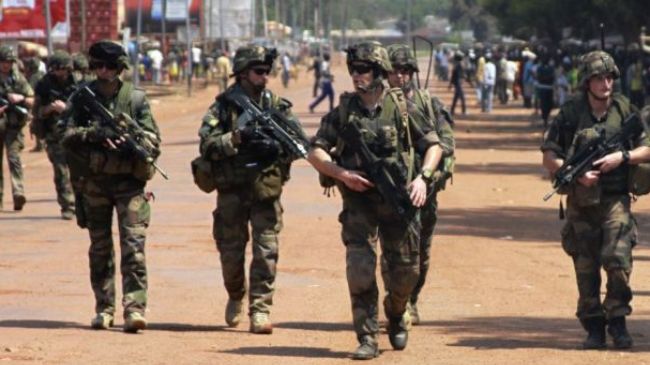
Within minutes of Djotodia’s sacking on Friday, and even before he had returned from Chad, French military tanks had surrounded the presidential palace in the CAR capital Bangui. French Defence Minister Jean-Yves Le Drian also issued a call for Djotodia to be “replaced as soon as possible”.
Chadian President Idriss Déby had been one of the most vocal African leaders calling for Djotodia to quit. Déby, who is described as “a strong French ally” (in other words, “puppet”), was doing France’s bidding and giving an African voice to a directive from Paris, a directive which amounts to a coup d’état.
The Western media narrative, led by France, is that Djotodia “had not done enough to curb the violence” gripping the CAR. More than 1,000 people have been killed in recent weeks in sectarian clashes between Muslims and Christians. Roughly a quarter of the country’s five million population have been displaced in the fighting.
Djotodia came to power last year after Muslim rebels known as Seleka deposed the Christian president Francois Bozizé in March. Bozizé was notorious for corruption and had come to power through a French-backed military coup 11 years ago.
With major French commercial interests in the resource-rich country, in particular uranium mining, it seems that France was vexed about the new transitional government led by Michel Djotodia – the first Muslim leader of the mainly Christian country.
Djotodia’s interim administration was legally constituted last April and it was overseeing a transition with elections scheduled at the end of this year.
However, that did not seem good enough to allay the French, who wanted to exert tighter control over the political process within the CAR in order to secure favorable conditions for its commercial interests.
This is the real basis for the French military invasion, not the humanitarian pretext that the Hollande government has been trumpeting.
Last month, chaos and violence in the African country surged after France sent in its troops – allegedly to provide “humanitarian protection” in a situation where there had been no serious violence, apart from French government scaremongering of “imminent genocide”.
French military were dispatched to the CAR on December 2, three days before a French-drafted resolution was passed at the United Nations Security Council authorizing the intervention.
More French troops arrived on December 5, 2013, and only since then have the sectarian clashes in Bangui city and across the country escalated.
The conclusion is inescapable. The humanitarian crisis in the CAR was precipitated by French involvement, not prevented. A major factor for the violence is that the French military moved to unilaterally disarm the Seleka rebels while ignoring Christian vigilante groups known as Anti-Balaka.
The latter were, in effect, given a free hand to maraud Muslim communities and businesses with deadly consequences.
It is therefore obtuse and mendacious for the French government and its African clients to blame Michel Djotodia for not controlling security in his country.
The real culprit for the bloodshed and pandemonium that jolted the CAR is French interference in that country– interference that was illegal and was cynically disguised as “humanitarian.”
There are deep fears that violence against Muslim communities will increase further now that Michel Djotodia has been forced from office.
The Christian Anti-Balaka militias will feel emboldened by the French political interference. Many believe that the Anti-Balaka is being orchestrated by the former French puppet Bozizé from his exile in France.
Tragically, this is just the latest episode of misery for the Central African Republic caused by French neo-imperialist predation.
Since gaining so-called independence from France in 1960, the French have launched more covert coups and countercoups in that country than in any other former African colony.
The CAR remains politically and economically underdeveloped – despite its teeming natural wealth – precisely because of systematic French predatory exploitation.
Poverty in the Central African Republic, as in many other African countries, is a direct result of French policy, primarily due to the “franc afrique” monetary system set up at the time of independence.
This systematic poverty enables France to exploit raw materials and the people mercilessly. And when the racket comes a bit unstuck, the French send in their troops to “restore order”.
What the international community, such as the Non-Aligned Movement of over 100 nations, should be doing is to call for the prosecution of France, not applauding this fox in a hen house.
Ways to watch Press TV
Press TV – January 12, 2014
Following a move by the European satellite provider Eutelsat SA to take Press TV off the air in a flagrant violation of freedom of speech, Press TV viewers can continue to watch the news channel via the following satellites or by visiting the following websites:
You can watch Press TV by visiting the following websites:
Press TV watch live services (Worldwide)
OHTV Box (internet Set-top box) (Worldwide)
Livestation (internet platform. Supports PC MAC, Linux and all tablet PCs and smartphones)
You could also view our broadcast in Europe through the following satellites:
Optus D2 (152E)
12581
22500
3/4
H
DVB-S,QPSK,MPEG-2
ST 2 (88E)
11051
30000
1/2
V
DVB-S2,8PSK,MPEG-4
Paksat 1R (38E)
4060
23000
5/6
H
DVB-S,QPSK,MPEG-2
Badr 5 (26E)
11881
27500
5/6
H
DVB-S2,8PSK,MPEG-4
Badr 5 (26E)
12303
27500
3/4
H
DVB-S,QPSK,MPEG-2
Badr 4 (26E)
12054
27500
3/4
V
DVB-S,QPSK,MPEG-2
Nilesat 201 A (7W)
11823
27500
5/6
V
DVB-S,QPSK,MPEG-2
Arabsat 5C (20E)
3964
30000
2/3
V
DVB-S2,8PSK,MPEG-4
Arabsat 5C (20E) (HD)
3913
12911
5/6
V
DVB-S2,8PSK,MPEG-4
Express AM44 (11W)
11109
9479
3/4
H
DVB-S2,QPSK,MPEG-2
Thaicom 5 (78.5 E)
3575
6500
3/4
H
DVB-S2,QPSK,MPEG-2
Related Interviews:


Democrats plead with Obama to abandon Social Security cut
By Alexander Bolton – The Hill – 01/11/14
Democratic senators are pleading with President Obama to abandon his proposal to trim Social Security benefits before it becomes a liability for them in the midterm elections.
The president proposed a new formula for calculating benefits in his budget last year, in hopes that the olive branch to Republicans would persuade them to back tax increases in a broader fiscal deal. But Democratic lawmakers say Obama should shelve the idea now that they are facing a difficult midterm election where they need to turn out the liberal base to preserve their Senate majority.
“I’m not sure why we should be making concessions when the Republicans show absolutely no willingness to do the same,” said Sen. Chris Murphy (D-Conn.).
Democrats acknowledge it may be awkward for Obama to rescind his proposal, but say it would unwise of him to repeat the offer in the budget that is due out next month.
“I think it’s difficult for the president to pull it back after he already floated it but I would love to see it shelved until Republicans show they’re actually going to do something on their side of the ledger,” Murphy said.
Obama proposed nearly $1 trillion in spending cuts in his budget, including a switch to using the Chained Consumer Price Index (CPI), which liberal policy experts estimate could cost seniors thousands of dollars in benefits over their lifetimes.
The Center on Budget and Policy Priorities, a liberal think tank, projected that most future beneficiaries would see a 2 percent reduction in benefits during the course of retirement.
Supporters of chained CPI argue it is a more accurate measure of inflation, and say the reduction in federal spending would ease the deficit over time.
Obama said he made the proposal to get Republicans to the negotiating table, but the move rankled Democrats on both sides of the Capitol.
Sen. Bernie Sanders (Vt.), a liberal independent who caucuses with Democrats, said lawmakers have told White House chief of staff Denis McDonough to drop chained CPI from this year’s budget proposal.
“We have talked to his chief of staff and made that very clear,” said Sanders, who is co-founder of the Defending Social Security Caucus.
Congressional Democrats grumbled last year that Republicans never seriously entertained the thought of ending tax breaks for wealthy individuals and corporations.
“I certainly hope that the president has learned a lesson from this whole process,” Sanders said. “To be honest with you, I just can’t imagine what staff people gave him the disastrous advice to propose a chain CPI, which from both a public policy point of view and political point of view is totally absurd.”
“He should recognize that was a mistake. It should not be in his budget at all,” said Sen. Tom Harkin (D-Iowa), chairman of the Health, Education, Labor and Pensions Committee.
Harkin said some centrists in the caucus support chained CPI, but they are in the distinct minority.
One of those centrists is Sen. Mark Warner (D-Va.), who is running for reelection this year and facing a possible challenge from Ed Gillespie, the former chairman of the Republican National Committee.
Warner said in an interview that he is still hopeful of a broader deal to reduce the deficit. He said Democrats should keep chained CPI on the table if they expect Republicans to compromise on taxes.
Liberal Democrats say cutting Social Security benefits, even what centrists view as moderate cuts, is broadly unpopular across age groups. They say there mere proposal of reductions would amount to a self-inflicted political wound that would come back to haunt their party in the midterm election.
“It’s a very controversial issue at a difficult time for the senior community,” said Sen. Dianne Feinstein (D-Calif.), who declined to express support or opposition to the proposal.
A Pew Research poll released this month showed Republican voters are more enthusiastic than Democrats about the November election.
The survey found 63 percent of Republicans were looking forward to the election, while only 53 percent of Democrats felt the same way. Pollsters found a similar enthusiasm gap in January of 2010, before Republicans captured control of the House and picked up Senate seats.
In recent weeks, political handicappers have upped the chances of Republicans capturing the Senate in November.
White House and Senate Democratic strategists have tried to rekindle the enthusiasm of Democratic base voters by focusing on income inequality. Senate Democrats have made extending unemployment benefits and raising minimum wage two of their top agenda items this year.
Robert Borosage, co-director of Campaign for America’s Future, a liberal advocacy group, said it would be a serious blunder if Obama gave Republicans an opening to accuse his party of pushing Social Security cuts.
“I think it’s very counterproductive and not just with the base,” Borosage said.
Borosage noted that Republicans reaped a disproportionate share of the senior vote in the 2010 GOP wave election but have steadily lost their edge among that age group in recent years.
He noted that Republicans bashed Obama and Democrats in 2012 for cutting Medicare to raise money for the Affordable Care Act, even though House GOP Chairman Paul Ryan (R-Wis.) kept those cuts in his own budget proposals.
“The last thing you want to do in terms of the politics is allow Republicans to go across the country and say the president wants to cut Social Security before the election,” he said.
Obama is officially scheduled to release his budget next month, but is likely to delay the fiscal blueprint until March or April, as he did last year.
Lights, Camera… Covert Action: The Deep Politics of Hollywood
By Matthew Alford and Robbie Graham | Global Research | January 21, 2009
Here we build a prima facae case supporting the idea that Hollywood continues to be a target for infiltration and subversion by a variety of state agencies, in particular the CIA. Academic debates on cinematic propaganda are almost entirely retrospective, and whilst a number of commentators have drawn attention to Hollywood’s longstanding and open relationship with the Pentagon, little of substance has been written about the more clandestine influences working through Hollywood in the post-9/11 world. As such, our work delves into the field of what Peter Dale Scott calls “deep politics”; namely, activities which cannot currently be fully understood due to the covert influence of shadowy power players.
The Latest Picture
A variety of state agencies have liaison offices in Hollywood today, from the FBI, to NASA and the Secret Service. Few of these agencies, though, have much to offer in exchange for favourable storylines, and so their influence in Hollywood is minimal. The major exception here is the Department of Defense, which has an ‘open’ but barely publicized relationship with Tinsel Town, whereby, in exchange for advice, men and invaluable equipment, such as aircraft carriers and helicopters, the Pentagon routinely demands flattering script alterations. Examples of this policy include changing the true identity of a heroic military character in Black Hawk Down (2001) due to his real-life status as a child rapist; the removal of a joke about “losing Vietnam” from the James Bond film Tomorrow Never Dies (1997), and cutting images of Marines taking gold teeth from dead Japanese soldiers in Windtalkers (2002). Instances such as these are innumerable, and the Pentagon has granted its coveted “full cooperation” to a long list of contemporary pictures including Top Gun (1986), True Lies (1994), Executive Decision (1996), Air Force One (1997), The Sum of All Fears (2002), Transformers (2007), Iron Man (2008), as well as TV series such as JAG (1995-2005).
Such government activity, whilst morally dubious and barely advertised, has at least occurred within the public domain. This much cannot be said of the CIA’s dealings with Hollywood, which, until recently, went largely unacknowledged by the Agency. In 1996, the CIA announced with little fanfare the dry remit of its newly established Media Liaison Office, headed by veteran operative Chase Brandon. As part of its new stance, the CIA would now openly collaborate on Hollywood productions, supposedly in a strictly ‘advisory’ capacity.
The Agency’s decision to work publicly with Hollywood was preceded by the 1991 “Task Force Report on Greater CIA Openness,” compiled by CIA Director Robert Gates’ newly appointed ‘Openness Task Force,’ which secretly debated –ironically– whether the Agency should be less secretive. The report acknowledges that the CIA “now has relationships with reporters from every major wire service, newspaper, news weekly, and television network in the nation,” and the authors of the report note that this helped them “turn some ‘intelligence failure’ stories into ‘intelligence success’ stories, and has contributed to the accuracy of countless others.” It goes on to reveal that the CIA has in the past “persuaded reporters to postpone, change, hold, or even scrap stories that could have adversely affected national security interests…”
These admissions add weight to several reports and Congressional hearings from the 1970s which indicated that the CIA once maintained a deep-rooted and covert presence in national and international media, informally dubbed “Operation Mockingbird.” In its 1991 report, the CIA acknowledged that it had, in fact, “reviewed some film scripts about the Agency, documentary and fictional, at the request of filmmakers seeking guidance on accuracy and authenticity.” But the report is at pains to state that, although the CIA has “facilitated the filming of a few scenes on Agency premises,” it does “not seek to play a role in filmmaking ventures.” But it seems highly implausible that the CIA, whilst maintaining a decades-long presence in media and academia, would have shown no interest in the hugely influential Cinema industry.
Indeed, it should come as no surprise that the CIA has been involved in a number of recent blockbusters and TV series.The 2001 CBS TV series, The Agency, executive produced by Wolfgang Petersen (Das Boot, Air Force One) was actually co-written by ex-CIA agent and Marine Bazzel Baz, with additional ex-CIA agents working as consultants. The CIA gladly opened its doors to the production, and facilitated both external and internal shots of its Langley headquarters as the camera gazed lovingly at the CIA seal. This arrangement was comparable to the Feds’ efforts on the popular TV series The FBI (1965-74) which was shaped by the Bureau in cooperation with ABC and which thanked J. Edgar Hoover in the credits of each episode. Similarly, The Agency glorified the actions of US spooks as they fought predictable villains including the Russian military, Arab and German terrorists, Columbian drug dealers, and Iraqis. One episode even shows the CIA saving the life of Fidel Castro; ironically, since the CIA in real life had made repeated attempts to assassinate the Cuban President. Promos for the show traded on 9/11, which had occurred just prior to its premiere, with tag lines like “Now, more than ever, we need the CIA.”
A TV movie, In the Company of Spies (1999) starring Tom Berenger depicted a retired CIA operative returning to duty to save captured Agency officers held by North Korea. The CIA was so enthusiastic about this product that it hosted its presentation, cooperated during production, facilitated filming at Langley, and provided fifty off-duty officers as extras, according to its website.
Espionage novelist Tom Clancy has enjoyed an especially close relationship with the CIA. In 1984, Clancy was invited to Langley after writing The Hunt for Red October, which was later turned into the 1990 film. The Agency invited him again when he was working on Patriot Games (1992), and the movie adaptation was, in turn,granted access to Langley facilities. More recently, The Sum of All Fears (2002) depicted the CIA as tracking down terrorists who detonate a nuclear weapon on US soil. For this production, CIA director George Tenet gave the filmmakers a personal tour of the Langley HQ; the film’s star, Ben Affleck also consulted with Agency analysts, and Chase Brandon served as on-set advisor.
Media sources indicate that the CIA also worked on the Anthony Hopkins/Chris Rock feature Bad Company (2002) and the Jerry Bruckheimer blockbuster Enemy of the State (2001). However, no details whatsoever about these appear to be in the public domain. Similarly, Spy Game director Tony Scott’s DVD commentary for said film indicates that he visited Langley whilst in pre-production but, according to one report, endorsement appeared to have been withheld after Chase Brandon read the final draft of the script.
More details than usual emerged about CIA involvement in the Tom Hanks movie Charlie Wilsons War (2007) and Robert De Niro’s The Good Shepherd (2006) – but not many. Milt Beardon had traveled to the Moscow Film Festival with De Niro and claims the pair then “disappeared and hung out with the mob and KGB crowd for a while. I introduced him to generals and colonels, the old guys I had been locked with for so many years.” De Niro later tagged along with Beardon to Pakistan. “We wandered around the North-West Frontier Province,” Bearden recalls, “crossed the bridge [to Afghanistan] I built years ago, hung out with a bunch of guys firing off machine guns and drinking tea.” Still, The Good Shepherd didn’t fulfill the CIA’s earnest hopes of being the CIA equivalent of Flags of Our Fathers (2006), which the Agency’s official historian says it should have been – all in the interests of what he calls a “culture of truth.”
Charlie Wilson’s War depicted the United States’ covert efforts to supply arms to Afghanistan to fight the Soviet Union in the 1980s which had the real-life consequence of America’s old ally turned against it in the form of al-Qaeda (as Crile explains in the book of the film). However, Beardon, who was the CIA agent who supplied the weapons, worked as consultant on the film and said prior to its release that it “will put aside the notion that because we did that, we had 9/11.” CIA involvement in the film therefore appears to have paid dividends.
The real reasons for the CIA adopting an “advisory” role on all of these productions are thrown into sharp relief by a solitary comment from former Associate General Counsel to the CIA, Paul Kelbaugh. In 2007, whilst at a College in Virginia, Kelbaugh delivered a lecture on the CIA’s relationship with Hollywood, at which a local journalist was present. The journalist (who now wishes to remain anonymous) wrote a review of the lecture which related Kelbaugh’s discussion of the 2003 thriller The Recruit, starring Al Pacino. The review noted that, according to Kelbaugh, a CIA agent was on set for the duration of the shoot under the guise of a consultant, but that his real job was to misdirect the filmmakers: “We didn’t want Hollywood getting too close to the truth,” the journalist quoted Kelbaugh as saying.
Peculiarly, in a strongly-worded email to the authors, Kelbaugh emphatically denied having made the public statement and claimed that he remembered “very specific discussions with senior [CIA] management that no one was ever to misrepresent to affect [film] content – EVER.” The journalist considers Kelbaugh’s denial “weird,” and told us that “after the story came out, he [Kelbaugh] emailed me and loved it… I think maybe it’s just that because [the lecture] was ‘just in Lynchburg’ he was okay with it – you know, like, no one in Lynchburg is really going to pay much attention to it, I guess. Maybe that’s why he said it, and maybe that’s why he’s denying it now.” The journalist stands by the original report, and Kelbaugh has pointedly refused to engage us in further discussion on the matter.
Early Screening
Clandestine agencies have a long history of interference in the cinema industry. Letters discovered in the Eisenhower Presidential Library from the secret agent Luigi G. Luraschi (identified by British academic John Eldridge), the Paramount executive who worked for the CIA’s Psychological Strategy Board (PSB), reveal just how far the CIA was able to reach into the film industry in the early days of the Cold War, despite its claims that it sought no such influence. For instance, Luraschi reported that he had secured the agreement of several casting directors to subtly plant “well dressed negroes” into films, including “a dignified negro butler” who has lines “indicating he is a free man” in Sangaree (1953) and in a golf club scene in the Dean Martin/Jerry Lewis vehicle The Caddy (1953). Elsewhere, CIA arranged the removal of key scenes from the film Arrowhead (1953), which questioned America’s treatment of Apache Indians, including a sequence where a tribe is forcibly shipped and tagged by the US Army. Such changes were not part of a ham-fisted campaign to instill what we now call “political correctness” in the populace. Rather, they were specifically enacted to hamper the Soviets’ ability to exploit its enemy’s poor record in race relations and served to create a peculiarly anodyne impression of America, which was, at that time, still mired in an era of racial segregation.
Other efforts were made. The PSB tried –unsuccessfully– to commission Frank Capra to direct Why We Fight the Cold War and to provide details to filmmakers about conditions in the USSR in the hope that they would use them in their movies. More successfully, in 1950, the CIA –along with other secretive organizations like the Office of Policy Coordination (OPC) and aided by the PSB– bought the rights to and invested in the cartoon of George Orwell’s Animal Farm (1954), which was given an anti-Soviet spin to satisfy its covert investors. Author Daniel Leab has pointed to the fact it took decades for the rumours about CIA involvement in Animal Farm to be properly documented; this, he observes, “Speaks volumes about the ability of a government agency to keep its activities covert.”
Additionally, the production of the Michael Redgrave feature Nineteen-Eighty Four (1956) was in turn overseen by the American Committee for Cultural Freedom, which was supervised by the CIA. Key points in the movie were altered to demonise the Soviets.
The CIA also tampered with the 1958 film version of The Quiet American, provoking the author, Graham Greene, to denounce the film. US Air Force Colonel Edward Lansdale, the CIA operative behind Operation Mongoose (the CIA sabotage and assassination campaign against Cuba) had entered into production correspondence with director Joseph L. Mankiewicz, who accepted his ideas. These included a change to the final scene in which we learn that Redgrave’s anti-hero has been hoodwinked by the Communists into murdering the suspicious American, who turns out not to be a bomb-maker as we had been led to believe, but instead a manufacturer of children’s toys.
Behind the Scenes
It would be a mistake to regard the CIA as unique in its involvement in Hollywood. The industry is in fact fundamentally open to manipulation by a range of state agencies. In 2000, it emerged that the White House’s drug war officers had spent tens of millions of dollars paying the major US networks to inject anti-drug plots into the scripts of primetime series such as ER, The Practice, Sabrina the Teenage Witch and Chicago Hope. Despite criticism for this blatant propagandizing, the government continued to employ this method of spreading its message on drugs.
The White House went to Tinsel Town again the following year when, on November 11, 2001 a meeting was held in Hollywood between President Bush’s then Deputy Chief of Staff, Karl Rove, and representatives of each of the major Hollywood studios to discuss how the film industry might contribute to the ‘War on Terror.’ Jack Valenti, president of the Motion Picture Association of America said with a straight face that, “content was off the table”, but Rove had clearly outlined a series of requests. It is hard to gauge the consequences of the meeting, but a Rambo sequel, for instance, was certainly discussed, and duly produced. Similarly, several series with national security themes emerged within a short time of the meeting including She Spies (2002-2004) and Threat Matrix (2003).
The meeting was, in fact, just one in a series between Hollywood and the White House from October to December, 2001. On October 17, in response to 9/11, the White House announced the formation of its “Arts and Entertainment Task Force,” and by November, Valenti had assumed leadership of Hollywood’s new role in the ‘War on Terror’. As a direct result of meetings, Congress sought advice from Hollywood insiders on how to shape an effective wartime message to America and to the world. In November 2001, John Romano, writer-producer of the popular US TV series Third Watch, advised the House International Relations Committee that the content of Hollywood productions was a key part of shaping foreign perceptions of America.
On December 5, 2001, the powerful Academy of Television Arts & Sciences convened its own panel entitled “Hollywood Goes to War?” to discuss what the industry might do in response to 9/11. Representing the government at the meeting were Mark McKinnon, a White House advisor, and the Pentagon’s chief entertainment liaison, Phil Strub. Also in attendance, among others, were Jeff Zucker, President of NBC Entertainment, and Aaron Sorkin, creator and writer of the White House drama The West Wing (1999-2006). Immediately after, Sorkin and his team set about producing a special episode of the show dealing with a massive terrorist threat to America entitled “Isaac and Ishmael”. The episode was given top priority and was successfully completed and aired within just ten days of the meeting. The product championed the superiority of American values whilst brimming with rage against the Islamist jihadists.
The interlocking of Hollywood and national security apparatuses remains as tight as ever: ex-CIA agent Bob Baer told us, “There’s a symbiosis between the CIA and Hollywood” and revealed that former CIA director George Tenet is currently, “out in Hollywood, talking to studios.” Baer’s claims are given weight by the Sun Valley meetings, annual get-togethers in Idaho’s Sun Valley in which several hundred of the biggest names in American media –including every major Hollywood studio executive– convene to discuss collective media strategy for the coming year. Against the idyllic backdrop of expansive golf courses, pine forests and clear fishing lakes, deals are struck, contracts are signed, and the face of the American media is quietly altered. The press has yet to be granted permission to report on these corporate media gatherings and so the exact nature of what is discussed at the events has never been publicly disclosed. It is known, however, that Tenet was keynote speaker at Sun Valley in 2003 (whilst still CIA head) and again in 2005.
Conclusions
Many would recoil at the thought of modern Hollywood cinema being used as a propagandist tool, but the facts seem to speak for themselves. Do agencies such as the CIA have the power, like the Pentagon, to affect movie content by providing much-sought-after expertise, locations and other benefits? Or are they able to affect script changes through simple persuasion, or even coercion? Do they continue to carry out covert actions in Hollywood as they did so extensively in the 1950s, and, beyond cinema, might covert government influence play some part in the creation of national security messages in TV series such as 24 and Alias (the star of the latter, Jennifer Garner, even made an unpaid recruitment video for the CIA)? The notion that covert agencies aspire to be more open is hard to take seriously when they provide such scant information about their role within the media, even regarding activities from decades past. The spy may have come in from the cold, but he continues to shelter in the shadows of the movie theatre.
For the First Time, Half of Members of Congress are Millionaires… Democrats Worth more than Republicans
By Noel Brinkerhoff | AllGov | January 11, 2014
Members of Congress continued to get richer last year, resulting in more than 50% of lawmakers possessing a net worth of $1 million or more—something that’s never happened before in congressional history.
Of 534 current members of Congress, at least 268 were millionaires, according the Center for Responsive Politics’ review of financial disclosure reports filed last year.
The median net worth for the 530 lawmakers who were in Congress as of the May 2013 filing deadline was $1,008,767—up from $966,000 during the previous year.
The center also found that Democrats overall were a little wealthier than Republicans in Congress, $1.04 million versus $1 million. Both groups saw their collective net worth go up, from $990,000 for Democrats and $907,000 for Republicans in the previous year.
Democrats in the House were richer than their GOP counterparts, $929,000 versus $884,000. House Republicans, however, could boast having the richest member: Darrell Issa of California, who has had this distinction in other years. The Viper car-alarm magnate has a net worth of $464 million.
In the Senate, the GOP caucus was noticeably wealthier than the Democratic caucus, $2.9 million versus $1.7 million.
Senate Democrats experienced a steep drop in their median net worth from $2.4 million in 2011, due in part to the loss of two multimillionaires: John Kerry of Massachusetts (net worth $248 million) and Frank Lautenberg of New Jersey ($87.5 million). Nonetheless, the four richest senators are still Democrats: Mark Warner of Virginia ($257 million), Richard Blumenthal of Connecticut ($104 million), Jay Rockefeller of West Virginia ($101 million) and Diane Feinstein of California ($68 million).
The center noted: “Members of Congress have long been far wealthier than the typical American, but the fact that now a majority of members—albeit just a hair over 50 percent—are millionaires represents a watershed moment at a time when lawmakers are debating issues like unemployment benefits, food stamps and the minimum wage, which affect people with far fewer resources, as well as considering an overhaul of the tax code.”
To Learn More:
Millionaires’ Club: For First Time, Most Lawmakers are Worth $1 Million-Plus (OpenSecrets.org)
Half of Congress Members Are Millionaires, Report Says (by Eric Lipton, New York Times)
2012 Personal Financial Disclosures
The Rich Get Richer…and So Does Congress (by Noel Brinkerhoff, AllGov)
Wealth Gap between Congress and Other Americans Widens to 9 to 1 (by Noel Brinkerhoff and David Wallechinsky, AllGov)
Saudi Arabia: A Retrograde Rentier Dictatorship and Global Terrorism
By James Petras | January 10, 2014
Saudi Arabia has all the vices and none of the virtues of an oil rich state like Venezuela. The country is governed by a family dictatorship which tolerates no opposition and severely punishes human rights advocates and political dissidents. Hundreds of billions in oil revenues are controlled by the royal despotism and fuel speculative investments the world over. The ruling elite relies on the purchase of Western arms and US military bases for protection. The wealth of productive nations is syphoned to enrich the conspicuous consumption of the Saudi ruling family. The ruling elite finances the most fanatical, retrograde, misogynist version of Islam, “Wahhabi” a sect of Sunni Islam.
Faced with internal dissent from repressed subjects and religious minorities, the Saudi dictatorship perceives threats and dangers from all sides: overseas, secular, nationalists and Shia ruling governments; internally, moderate Sunni nationalists, democrats and feminists; within the royalist cliques, traditionalists and modernizers. In response it has turned toward financing, training and arming an international network of Islamic terrorists who are directed toward attacking, invading and destroying regimes opposed to the Saudi clerical-dictatorial regime.
The mastermind of the Saudi terror network is Bandar bin Sultan, who has longstanding and deep ties to high level US political, military and intelligence officials. Bandar was trained and indoctrinated at Maxwell Air Force Base and Johns Hopkins University and served as Saudi Ambassador to the US for over two decades (1983-2005). Between 2005-2011 he was Secretary of the National Security Council and in 2012 he was appointed as Director General of the Saudi Intelligence Agency. Early on, Bandar became deeply immersed in clandestine terror operations working in liaison with the CIA. Among his numerous “dirty operations” with the CIA during the 1980s, Bandar channelled $32 million dollars to the Nicaragua Contra’s engaged in a terror campaign to overthrow the revolutionary Sandinista government in Nicaragua. During his tenure as ambassador he was actively engaged in protecting Saudi royalty with ties to the 9/11/01 bombing of the Triple Towers and the Pentagon. Suspicion that Bandar and his allies in the Royal family had prior knowledge of the bombings by Saudi terrorists (11 of the 19), is suggested by the sudden flight of Saudi Royalty following the terrorist act. US intelligence documents regarding the Saudi-Bandar connection are under Congressional review.
With a wealth of experience and training in running clandestine terrorist operations, derived from his two decades of collaboration with the US intelligence agencies, Bandar was in a position to organize his own global terror network in defense of the isolated retrograde and vulnerable Saudi despotic monarchy.
Bandar’s Terror Network
Bandar bin Sultan has transformed Saudi Arabia from an inward-looking, tribal based regime totally dependent on US military power for its survival, to a major regional center of a vast terror network, an active financial backer of right-wing military dictatorships (Egypt) and client regimes (Yemen) and military intervenor in the Gulf region (Bahrain). Bandar has financed and armed a vast array of clandestine terror operations, utilizing Islamic affiliates of Al Qaeda, the Saudi controlled Wahhabi sect as well as numerous other Sunni armed groups. Bandar is a “pragmatic” terrorist operator: repressing Al Qaeda adversaries in Saudi Arabia and financing Al Qaeda terrorists in Iraq, Syria, Afghanistan and elsewhere. While Bandar was a long-term asset of the US intelligence services, he has, more recently, taken an ‘independent course’ where the regional interests of the despotic state diverge from those of the US. In the same vein, while Saudi Arabia has a longstanding enmity toward Israel, Bandar has developed a “covert understanding” and working relationship with the Netanyahu regime, around their common enmity toward Iran and more specifically in opposition to the interim agreement between the Obama-Rohani regime.
Bandar has intervened directly or via proxies in reshaping political alignments, destabilizing adversaries and bolstering and expanding the political reach of the Saudi dictatorship from North Africa to South Asia, from the Russian Caucuses to the Horn of Africa, sometimes in concert with Western imperialism, other times projecting Saudi hegemonic aspirations.
North Africa: Tunisia, Morocco, Libya, and Egypt
Bandar has poured billions of dollars to bolster the right-wing pro-Islamic regimes in Tunisia and Morocco, ensuring that the mass pro-democracy movements would be repressed, marginalized and demobilized. Islamic extremists receiving Saudi financial support are encouraged to back the “moderate” Islamists in government by assassinating secular democratic leaders and socialist trade union leaders in opposition. Bandar’s policies largely coincide with those of the US and France in Tunisia and Morocco; but not in Libya and Egypt.
Saudi financial backing for Islamist terrorists and Al Qaeda affiliates against Libyan President Gadhafi were in-line with the NATO air war. However divergences emerged in the aftermath: the NATO backed client regime made up of neo-liberal ex-pats faced off against Saudi backed Al Qaeda and Islamist terror gangs and assorted tribal gunmen and marauders. Bandar funded Islamic extremists in Libya were bankrolled to extend their military operations to Syria, where the Saudi regime was organizing a vast military operation to overthrow the Assad regime. The internecine conflict between NATO and Saudi armed groups in Libya, spilled over and led to the Islamist murder of the US Ambassador and CIA operatives in Benghazi. Having overthrown Gadhafi, Bandar virtually abandoned interest in the ensuing blood bath and chaos provoked by his armed assets. They in turn, became self-financing – robbing banks, pilfering oil and emptying local treasuries – relatively “independent” of Bandar’s control.
In Egypt, Bandar developed, in coordination with Israel (but for different reasons), a strategy of undermining the relatively independent, democratically elected Muslim Brotherhood regime of Mohammed Morsi. Bandar and the Saudi dictatorship financially backed the military coup and dictatorship of General Sisi. The US strategy of a power-sharing agreement between the Muslim Brotherhood and the military regime, combining popular electoral legitimacy and the pro-Israel-pro NATO military was sabotaged. With a $15 billion aid package and promises of more to come, Bandar provided the Egyptian military a financial lifeline and economic immunity from any international financial reprisals. None were taken of any consequences. The military crushed the Brotherhood, jailed and threatened to execute its elected leaders. It outlawed sectors of the liberal-left opposition which it had used as cannon fodder to justify its seizure of power. In backing the military coup, Bandar eliminated a rival, democratically elected Islamic regime which stood in contrast to the Saudi despotism. He secured a like-minded dictatorial regime in a key Arab country, even though the military rulers are more secular, pro-Western, pro-Israel and less anti-Assad than the Brotherhood regime. Bandar’s success in greasing the wheels for the Egyptian coup secured a political ally but faces an uncertain future.
The revival of a new anti-dictatorial mass movement would also target the Saudi connection. Moreover Bandar undercut and weakened Gulf State unity: Qatar had financed the Morsi regime and was out $5 billion dollars it had extended to the previous regime.
Bandar’s terror network is most evident in his long-term large scale financing, arming, training and transport of tens of thousands of Islamic terrorist “volunteers” from the US, Europe, the Middle East, the Caucuses, North Africa and elsewhere. Al Qaeda terrorists in Saudi Arabia became “martyrs of Islam” in Syria. Dozens of Islamic armed gangs in Syria competed for Saudi arms and funds. Training bases with US and European instructors and Saudi financing were established in Jordan, Pakistan and Turkey. Bandar financed the major ‘rebel’ Islamic terrorist armed group, the Islamic State of Iraq and the Levant, for cross border operations.
With Hezbollah supporting Assad, Bandar directed money and arms to the Abdullah Azzam Brigades in Lebanon to bomb South Beirut, the Iranian embassy and Tripoli. Bandar directed $3 billion to the Lebanese military with the idea of fomenting a new civil war between it and Hezbollah. In co-ordination with France and the US, but with far greater funding and greater latitude to recruit Islamic terrorist, Bandar assumed the leading role and became the principle director of a three front military and diplomatic offensive against Syria, Hezbollah and Iran. For Bandar, an Islamic takeover in Syria would lead to an Islamic Syrian invasion in support of Al Qaeda in Lebanon to defeat Hezbollah in hopes of isolating Iran. Teheran would then become the target of a Saudi-Israeli-US offensive. Bandar’s strategy is more fantasy then reality.
Bandar Diverges from Washington: the Offensive in Iraq and Iran
Saudi Arabia has been an extremely useful but sometimes out of control client of Washington. This is especially the case since Bandar has taken over as Intelligence chief: a long-time asset of the CIA he has also, at times, taken the liberty to extract “favors” for his services, especially when those “favors” enhance his upward advance within the Saudi power structure. Hence, for example, his ability to secure AWACs despite AIPAC opposition earned him merit points. As did Bandar’s ability to secure the departure of several hundred Saudi ‘royalty’ with ties to the 9/11 bombers, despite a high level national security lockdown in the aftermath of the bombing.
While there were episodic transgressions in the past, Bandar moved on to more serious divergences from US policy. He went ahead, building his own terror network, directed toward maximizing Saudi hegemony – even where it conflicted with US proxies, clients and clandestine operatives.
While the US is committed to backing the right-wing Maliki regime in Iraq, Bandar is providing political, military and financial backing to the Sunni terrorist “Islamic State of Iraq and Syria”. When the US negotiated the “interim agreement” with Iran Bandar voiced his opposition and “bought” support. Saudi signed off on a billion dollar arms agreement during French President Hollande’s visit, in exchange for greater sanctions on Iran. Bandar also expressed support for Israel’s use of the Zionist power configuration to influence the Congress, to sabotage US negotiations with Iran.
Bandar has moved beyond his original submission to US intelligence handlers. His close ties with past and present US and EU presidents and political influence have encouraged him to engage in “Big Power adventures.” He met with Russian President Putin to convince him to drop his support for Syria, offering a carrot or a stick: a multi-billion dollar arms sale for compliance and a threat to unleash Chechen terrorists to undermine the Sochi Olympics. He has turned Erdogan from a NATO ally supporting ‘moderate’ armed opponents to Bashar Assad, into embracing the Saudi backed ‘Islamic State of Iraq and Syria”, a terrorist Al Qaeda affiliate. Bandar has “overlooked” Erdogan’s “opportunist” efforts to sign off oil deals with Iran and Iraq, his continuing military arrangements with NATO and his past backing of the defunct Morsi regime in Egypt, in order to secure Erdogan’s support for the easy transit of large numbers of Saudi trained terrorists to Syria and probably Lebanon.
Bandar has strengthened ties with the armed Taliban in Afghanistan and Pakistan, arming and financing their armed resistance against the US, as well as offering the US a site for a ‘negotiated departure’.
Bandar is probably supporting and arming Uighur Muslim terrorists in western China, and Chechens and Caucasian Islamic terrorists in Russia, even as the Saudi’s expand their oil agreements with China and cooperate with Russia’s Gazprom.
The only region where the Saudi’s have exercised direct military intervention is in the Gulf min-state of Bahrain, where Saudi troops crushed the pro-democracy movement challenging the local despot.
Bandar: Global Terror on Dubious Domestic Foundations
Bandar has embarked on an extraordinary transformation of Saudi foreign policy and enhanced its global influence. All to the worst. Like Israel, when a reactionary ruler comes to power and overturns the democratic order, Saudi arrives on the scene with bags of dollars to buttress the regime. Whenever an Islamic terror network emerges to subvert a nationalist, secular or Shia regime, it can count on Saudi funds and arms. What some Western scribes euphemistically describe as “tenuous effort to liberalize and modernize” the retrograde Saudi regime, is really a military upgrade of its overseas terrorist activity. Bandar uses modern techniques of terror to impose the Saudi model of reactionary rule on neighboring and distant regimes with Muslim populations.
The problem is that Bandar’s “adventurous” large scale overseas operations conflict with some of the ruling Royal family’s “introspective” style of rule. They want to be left alone to accrue hundreds of billions collecting petrol rents, to invest in high-end properties around the world, and to quietly patronize high end call girls in Washington, London and Beirut while posing as pious guardians of Medina, Mecca, and the Holy sites. So far Bandar has not been challenged, because he has been careful to pay his respects to the ruling monarch and his inner circle. He has bought and brought Western and Eastern prime ministers, presidents, and other respectable notables to Riyadh to sign deals and pay compliments to the delight of the reigning despot. Yet his solicitous behavior to overseas Al Qaeda operations, his encouraging Saudi extremists to go overseas and engage in terrorist wars, disturbs monarchical circles. They worry that Saudi trained, armed and knowledgeable terrorists — dubbed as “holy warriors” — may return from Syria, Russia, and Iraq and bomb the King’s palaces. Moreover, overseas regimes targeted by Bandar’s terror network may retaliate: Russia or Iran, Syrians, Egyptians, Pakistanis, Iraqis may just sponsor their own instruments of retaliation. Despite the hundreds of billions spent on arms purchases, the Saudi regime is very vulnerable on all levels. Apart from tribal legions, the billionaire elite have little popular support and even less legitimacy. It depends on overseas migrant labor, foreign “experts” and US military forces. The Saudi elite is also despised by the most religious of the Wahhabi clergy for allowing “infidels” on sacred terrain. While Bandar extends Saudi power abroad, the domestic foundations of rule are narrowing. While he defies US policymakers in Syria, Iran and Afghanistan, the regime depends on the US Air Force and Seventh Fleet to protect it from a growing array of adversarial regimes.
Bandar, with his inflated ego, may believe that he is a “Saladin” building a new Islamic empire, but in reality, by waving one finger his patron monarch can lead to his rapid dismissal. One too many provocative civilian bombings by his Islamic terrorist beneficiaries can lead to an international crises leading to Saudi Arabia becoming the target of world opprobrium.
In reality, Bandar bin Sultan is the protégé and successor of Bin Laden; he has deepened and systematized global terrorism. Bandar’s terror network has murdered far more innocent victims than Bin Laden. That, of course, is to be expected; after all he has billions of dollars from the Saudi treasury, training from the CIA and the handshake of Netanyahu!
Ashrawi: Recognizing Israel as ‘Jewish state’ would legalize ‘racism’
Ma’an – 11/01/2014
BETHLEHEM – Israel’s pressure on Palestinians to recognize it as a Jewish state is an attempt to legalize “racism,” a PLO official said Saturday.
PLO Executive Committee Member Hanan Ashrawi said defining Israel as a Jewish state would signify that any Jewish person would have the right to return to Palestine, while Palestinians would lose that right.
Ashrawi told Ma’an that Israel wants to “create a narrative that denies the Palestinian presence, rights, and continuity on the historic Palestinian lands.”
A “Jewish state” recognition would exempt Israel from its responsibility toward the Palestinian refugees who were forcibly displaced from their homes in 1948, she said.
Similarly, a former Palestinian member of the Israeli Knesset said that recognizing Israel as such a state would “annul the Palestinian narrative about the Nakba.”
It would abolish the right of the refugees to return, said Talab al-Sani.
During US-mediated peace talks with the Palestinians, Prime Minister Benjamin Netanyahu has repeatedly cited recognition of Israel as a Jewish state as a precondition for peace.
It is the “minimal requirement for peace,” Netanyahu told the Saban Forum on Middle East policy in Washington on Dec. 8.
There would be peace, Netanyahu said, if “there were no longer any Palestinian national claims on the Jewish state — no right of return … no residual claims of any kind. And that, the Palestinians have so far been unwilling to give.”
More than 760,000 Palestinians — estimated today to number 4.8 million including their descendants — were forced into exile or driven out of their homes in the conflict surrounding Israel’s creation in 1948.
Palestinian officials have repeatedly said that recognizing the concept of Israel as a “Jewish state” is unnecessary and threatens the rights of nearly 1.3 million Palestinian citizens of Israel who remained in their homes during the displacement of the majority of the Palestinian population during the 1948 war.
The right of Palestinian refugees to return to their land is enshrined in article 11 of UN resolution 194.
The internationally recognized Palestinian territories of which the West Bank and East Jerusalem form a part have been occupied by the Israeli military since 1967.
Related article

Featured Video
Your Enslavement Begins in Gaza: The ‘Board of Peace’
or go to
Aletho News Archives – Video-Images
From the Archives
The US: The Century of Lost Wars
By James Petras | Global Research | September 12, 2018
Introduction
Despite having the biggest military budget in the world, five times larger than the next six countries, the largest number of military bases – over 180 – in the world and the most expensive military industrial complex, the US has failed to win a single war in the 21st century.
In this paper we will enumerate the wars and proceed to analyze why, despite the powerful material basis for wars, it has led to failures. … continue
Blog Roll
 Aletho News
- Iran to US: Sanctions and war failed; try diplomacy and respect
- China supplies Iran with radar, surveillance tech to track US stealth aircraft: Report
- Zelensky rejects territorial concessions to Russia
- German leader of EU’s largest faction sounds the alarm of possibility of right-wing forces coming to power in France, Poland
- Putin: Developing Russia’s nuclear forces ‘absolute priority’
- Hungary Blocks 20th Package of Anti-Russia Sanctions, $106B Loan to Ukraine – Szijjarto
- NATO Must Return to 1997 Borders for Peace in Ukraine – Finnish Politician
- Your Enslavement Begins in Gaza: The ‘Board of Peace’
- Israeli FOIA Data Reveals Massive Heart Injury Spike in Children Immediately After mRNA Shot Rollout
- What is Zionism? And what is anti-Zionism?
- If Americans Knew
- Average of five Palestinians killed by Israel every day in Gaza since ceasefire – Not a ceasefire Day 136
- Palestinian church leaders admonish Christian Zionist Mike Huckabee – Not a ceasefire Day 135
- Ominous messaging from Trump’s “Board of Peace” – Not a ceasefire Day 134
- ‘Christians Out’: Jerusalem Church Tagged With Hate Graffiti, Police Investigating
- Israeli Settlers Kill American Teen
- ‘We returned from hell’: Palestinian journalists recount torture in Israeli prisons
- No mercy for Gaza in Ramadan – Not a ceasefire Day 133
- The Israeli Government Installed and Maintained Security System at Epstein Apartment
- Tucker Carlson interrogated in Israel, has passport seized after interviewing US ambassador
- 6,000 Amputees in Gaza Face Impossible Recovery amid Israeli War Ultimatum
- No Tricks Zone
- New Research Reaffirms Clouds, Aerosols, And Surface Solar Radiation Are ‘Driving The Climate System’
- Germany: Electric Car Catches Fire At Charging Station, Sets Off Local “Inferno”, Widespread Damage
- New Study: Canada’s New Brunswick Was 1°C Warmer Than Today During The Medieval Warm Period
- Coal Power Back In Trend As Globe Tries To Keep Pace With Growing Demand For Power
- New Study: A 4°C Warmer Beaufort Sea Had ‘No Sea Ice’ 11,700 – 8200 Years Ago
- Unfudging The Data: Dutch Meteorological Institute Reinstates Early 20th Centruy Heat Waves It Had Erased Earlier
- German Gas Crisis…Chancellor Merz Allegedly Bans Gas Debate Ahead of Elections!
- Pollen Reconstructions Show The Last Glacial’s Warming Events Were Global, 10x Greater Than Modern
- Germany’s Natural Gas Storage Level Dwindles To Just 28%… Increasingly Critical
- New Study Rebuts The Assumption That Anthropogenic CO2 Molecules Have ‘Special’ Properties
 Aletho News