CIA Probed for Possibly Spying on Congress
ACLU | March 5, 2014
WASHINGTON – The CIA’s inspector general is investigating whether the agency may have been monitoring the computer usage of Senate Intelligence Committee staff members, according to articles today by The New York Times and McClatchy. The inspector general’s office has reportedly referred the matter to the Justice Department for criminal investigation.
Christopher Anders, senior legislative counsel with the American Civil Liberties Union, had this reaction:
“If it turns out that the CIA was spying on the Senate committee that oversees the agency, it would be an outrageous violation of separation of powers. The CIA is prohibited from spying in the United States itself, and there can be few greater violations of that rule than spying on congressional staff carrying out the constitutional duty of being a check on the CIA’s powers. CIA surveillance of Congress would be another sign that the intelligence community has come to believe that they are above the law, and should get only deference from the other branches of government, not the meaningful oversight that’s required by the Constitution. Checks and balances, especially for agencies like the CIA and NSA that have many secret operations, are essential for democratic government. At the very least, these reports should spur the committee to vote quickly for the declassification and release of its full report into the CIA’s torture program so the American people can see what it is that the CIA is so eager to hide.”
In December 2012, the committee adopted a 6,000-page report on the CIA’s Bush-era rendition, secret detention, and torture program. The report concluded that abusive methods were ineffective, and the CIA wrote an extensive response, countering many of the Senate report’s conclusions. There is also a secret CIA report commissioned by former CIA Director Leon Panetta, which is reportedly consistent with the Senate report findings and contradicts the CIA’s response to the Senate report. All three reports are classified.
Related articles

Remove children of suspected radical Muslims: Boris
Press TV – March 5, 2014
London Mayor Boris Johnson says Muslim children with suspected radical parents must be removed from their families, causing controversy amongst the city’s Muslim community.
The London mayor made the remarks in his weekly Daily Telegraph column published on Monday.
He alleged that some Muslim children were being “taught crazy stuff” similar to the views expressed by the two men who killed British soldier Lee Rigby on a south-east London street in May 2013.
In a later interview however, when asked if the children of the UK’s far-right British National Party (BNP) activists should also be removed from their families, Johnson said this should be done in “extreme” cases.
The Muslim Council of Britain warned that Johnson’s remarks risked provoking anti-Muslim sentiment across the UK.
“The people responsible for the murder of Lee Rigby were not sons of radical extremists, nor were those who committed previous atrocities. To tackle their extremism we need to look beyond the need to generate easy headlines,” the council said.
Britain’s largest force, the Metropolitan Police, recorded 500 anti-Muslim crime cases across the country in 2013.
Attacks against Muslims have soared in the UK since the murder of Rigby by Michael Adebolajo and Michael Adebowale, who reportedly killed the soldier in “retaliation for the deaths of Muslims in Afghanistan at the hands of British troops.”
US Administration Considering Targeted Sanctions against Members of Venezuelan Government
By Jake Johnston | CEPR Americas Blog | March 4, 2014
Members of Congress and the Obama administration have consistently placed the blame for the violence stemming from protests on the Venezuelan government, while overlooking or ignoring violent incidents by opposition protesters, including the decapitation of motorcycle riders, the burning of government buildings and metro stations, attacks against state media companies, and the killing of individuals seeking to dismantle barricades, including a National Guard officer. Officials have referred instead to “systematic” human rights abuses and government repression, without citing evidence.
Based on these assertions, momentum is building to implement sanctions on members of the Venezuelan government. U.S. Rep. Debbie Wasserman Schultz (D-FL) told the press on Monday that, “There should be sanctions on individuals. … The administration is looking at those.” Wasserman Schultz, the Democratic National Committee chairwoman, cited a “high-level” State Department official that she had recently spoken to.
That the administration is considering sanctions comes on the heels of demands from members of congress that the Obama administration go further in its application of pressure on the Venezuelan government. After introducing legislation “supporting the people of Venezuela as they protest peacefully for democracy,” Rep. Ileana Ros-Lehtinen (R-FL) stated that:
“But this resolution can only be the first step to hold Maduro and his fellow regime thugs accountable for their violent response and their abuses of the Venezuelan people’s liberties and human rights. I have already begun circulating a letter amongst my colleagues in the House, addressed to President Obama, asking him to take immediate actions against Maduro and other Venezuelan officials who are responsible for violations of their people’s human rights. We are calling for the President to enact immediate sanctions against these officials, under authorities granted to him under the International Emergency Economic Powers Act (IEEPA), including denying them visas to enter the United States, blocking their property and freezing their assets in the U.S., as well as prohibiting them from making any financial transactions in the U.S.”
Ros-Lehtinen also plans to introduce a bill that would require the administration to take these steps. The moves from the House of Representatives have been echoed in the Senate, where the Senate Foreign Relations Committee Chairman Bob Menendez (D-NJ) and U.S. Senators Marco Rubio (R-FL), Dick Durbin (D-IL) and Ted Cruz (R-TX) have introduced a resolution calling for sanctions. Menendez stated:
“Now is the time to pursue a course of targeted sanctions by denying and revoking visas, and freezing the assets of Venezuelan officials complicit in the deaths of peaceful protestors. Human rights violators should be held accountable for the crimes they committed and their presence should not be welcome in our nation. Venezuelans today are denied basic rights, freedoms, and the ability to peacefully protest the dire economic circumstances caused by President Maduro and his government. We stand with the Venezuelan people and the brave opposition leaders in their pursuit to build a more hopeful Venezuela that embraces a bright future while discarding a failed past.”
Marco Rubio even made the case for sanctions on NBC News’ “Meet The Press,” telling host David Gregory that, “I would like to see specific U.S. sanctions against individuals in the Maduro government that are systematically participating in the violation of human rights and anti-democratic actions.” Florida Governor Rick Scott has also called for sanctions. Although neither the House nor the Senate have passed these resolutions calling for sanctions, Secretary of State John Kerry told reporters last week that, “with respect to Venezuela, Congress has urged sanctions.”
The call for sanctions has also been trumpeted by the press, with Miami Herald columnist Andres Oppenheimer saying that if Venezuela does not respond to “international diplomatic pressures,” then the Congress “should revoke the U.S. visas of Venezuelan government and military leaders.” Further, Otto Reich, the former U.S. Ambassador to Venezuela and Assistant Secretary of State for Western Hemisphere Affairs at the time of the U.S.-backed coup of 2002, wrote an opinion piece for the National Review titled “It’s Time for Sanctions in Venezuela.”
None of the members of congress nor any of the resolutions mention the fact that of the 18 tragic deaths in Venezuela since the protests began, many were not protestors, but individuals removing barricades and motorcyclists killed by wires strung across streets, or by crashing into barricades. In one case, a member of the Venezuelan National Guard was shot and killed. The Senate resolution makes no call for both sides to refrain from violence nor does it condemn the violent actions of some from the protest movement, however it does deplore “the use of excessive and unlawful force against peaceful demonstrators in Venezuela and the inexcusable use of violence…to intimidate the country’s political opposition.”
While, undoubtedly, excessive force has been used by members of the Venezuelan security forces, over 10 individuals have been arrested for these actions and further investigations are under way. According to the Attorney General (AG) of Venezuela, there are currently 27 investigations into violations of human rights. The AG, Luisa Ortega Diaz, stated that her office “will not tolerate violations of human rights under any circumstance and that any official turns out to be responsible will be sanctioned as established by the laws of Venezuela.” Far from censoring information or trying to hide the extent of the arrests or of those killed in the last few weeks, Diaz has provided regular updates to the press and has kept the public informed about the status of investigations.
Kiev snipers hired by Maidan leaders – leaked EU’s Ashton phone tape
Update: Estonian Foreign Ministry confirms authenticity of leaked call on Kiev snipers
RT | March 5, 2014
The snipers who shot at protesters and police in Kiev were allegedly hired by Maidan leaders, according to a leaked phone conversation between the EU foreign affairs chief Catherine Ashton and Estonian foreign affairs minister, which has emerged online.
“There is now stronger and stronger understanding that behind the snipers, it was not Yanukovich, but it was somebody from the new coalition,” Paet said during the conversation.
“I think we do want to investigate. I mean, I didn’t pick that up, that’s interesting. Gosh,” Ashton answered.
The call took place after Estonia’s Foreign Minister Urmas Paet visited Kiev on February 25 at the peak of clashes between the pro-EU protesters and security forces in the Ukrainian capital.
Paet also recalled his conversation with a doctor who treated those shot by snipers in Kiev. She said that both protesters and police were shot at by the same people.
“And second, what was quite disturbing, this same Olga [Bogomolets] told as well that all the evidence shows that the people who were killed by snipers from both sides, among policemen and then people from the streets, that they were the same snipers killing people from both sides,” the Estonian FM stressed.
Ashton reacted to the information by saying: “Well, yeah…that’s, that’s terrible.”
“So that she then also showed me some photos she said that as a medical doctor she can say that it is the same handwriting, the same type of bullets, and it’s really disturbing that now the new coalition, that they don’t want to investigate what exactly happened,” Paet said.
The Estonian FM has described the whole sniper issue as “disturbing” and added, “it already discredits from the very beginning” the new Ukrainian power.
His overall impressions of what he saw during his one-day trip to Kiev are “sad,” Paet said during the conversation.
He stressed that the Ukrainian people don’t trust the Maidan leaders, with all the opposition politicians slated to join the new government “having dirty past.”
The file was reportedly uploaded to the web by officers of Security Service of Ukraine (SBU) loyal to ousted President Viktor Yanukovich who hacked Paet’s and Ashton’s phones.
94 people were killed and another 900 injured during the standoff between police and protesters at Maidan Saquare in Kiev last month.
US hires Israeli company to retrofit Mexico border wall
By Chloé Benoist | Al-Akhbar | March 5, 2014
An Israeli military contractor, whose surveillance technology is used along Israel’s apartheid wall constructed in the Palestinian West Bank, has been chosen by the United States to provide similar services on the southern border with Mexico, Israeli media reported on Wednesday.
Elbit Systems announced on Sunday that the US Department of Homeland Security Customs and Border Protection (CBP) had awarded its subsidiary a $145 million contract to deploy border surveillance technology in southern Arizona, Reuters reported.
But according to Bloomberg analyst Brian Friel, quoted by Israeli newspaper Haaretz, the one-year contract could expand to a broader $1 billion deal if the US Congress passes stringent immigration legislation.
Elbit Systems is set to install watch towers along the border with sensors for spotting, tracking, and classifying data, along with command and control centers.
Republican Senator John McCain of Arizona hailed the deal as a “step in the right direction.”
“Arizonans have been waiting more than a decade for the Department of Homeland Security to place the needed technology along our border to support the Border Patrol and fully secure our southern border,” he said in a statement.
“If this technology is developed, integrated and fielded correctly, these Integrated Fixed Towers in southern Arizona, coupled with the tremendous work of the Border Patrol, will give our agents the ability to detect, evaluate, and respond to all illegal entries crossing our border.”
A government contractor said the choice of an Israeli firm was justified by of its “advanced” experience in maintaining separation barriers.
“It is odd to go offshore for this work, but in extraordinary circumstances, one really wants to employ the best,” Haaretz quoted Mark Amtower, a partner at Amtower & Co, as saying.
Elbit Systems is one of the primary military suppliers of the Israel’s occupation forces. Its Hermes 450 attack drone has been used extensively in the besieged Gaza Strip, as well as in Lebanon during the 2006 war.
The company is also responsible for surveillance technology along the apartheid wall erected by Israel within the West Bank. Only 15 percent of the separation barrier is built along the so-called 1949 Green Line, which is recognized by the international community as the border of Israel proper, UN figures show, with most of it jutting into the occupied West Bank.
The 440-kilometer long barrier is considered illegal under international law.
Among its many international contracts, Elbit contributed in 2013 to a $40 million expansive Internet surveillance program for the Nigerian government.
Elbit Systems has officially pledged on its website to “contribute to the enhancement of quality of life and the environment of the communities in which we live and work.”
But this contribution mainly consists of supporting Israeli occupation forces through the “Adopt a Combat Unit” program.
Elbit is targeted by the pro-Palestinian boycott, divestment and sanctions (BDS) movement for “directly contribut[ing] to violations of international humanitarian law.”
The Stop the Wall campaign has called Elbit a “symbol” which“thrives on and fuels war, repression and control in Palestine and around the globe.”
“Elbit offers its experience in ghettoizing and killing Palestinians to repress other people,” the campaign wrote of the company’s international projects.
“Because Elbit Systems is knowingly participating in and aiding Israeli war crimes and Israeli occupation of the Palestinian people, investors in and partners of the security firm are, by extension, accessories to Israel’s many violations of international law and human rights standards.”
OSCE military observer mission en route to Crimea
RT | March 5, 2014
The Organization for Security and Co-operation in Europe (OSCE) is sending a delegation which includes representatives from the US and 14 other nations to observe the situation in Crimea amid tensions in Ukraine, according to a US official.
Daniel Baer, the chief US delegate to the OSCE, told the Associated Press that each country is sending two individuals, bringing the total number of observers to 30. Baer added that the military observer mission is set to leave within 24 hours and hinted that other countries main still join.
The OSCE comprises of Russia, the US, all European countries, and some central Asian nations. It is based on consensus, meaning that the majority of the monitoring missions need full approval by all nations – including OSCE member Russia. According to Baer, Ukraine used the provision to ask other countries to send unarmed military monitors.
OSCE officials were already in Ukraine on Tuesday and making their way to Crimea, Baer said. The officials specialize in minority rights and freedom of the media.
The delegation has a week-long mandate that can be extended if Ukraine requests it. One of its main focuses is to concentrate on the potential of a military conflict between Russia and Ukraine.
Baer also added that the the military observer mission is a “broad-based monitoring effort” that will try to prevent a possible “military incursion” and encourage dialogue. The observers will keep an eye out for “areas where there has been tension or uncertainty has arisen over lack of clarity over military movements.”
RT news producer Lida Vasilevskaya reported on Tuesday evening that the OSCE delegation had arrived in Simferopol, Ukraine, but said they were not giving any comments to the media.
Tensions in Crimea became heated after the Ukrainian parliament voted to repeal a law which gave regional status to the Russian language. Authorities in Crimea requested Moscow’s assistance and Crimean authorities denounced the coup-imposed government in Kiev, declaring that all Ukrainian law enforcement and military deployed in the peninsula must take orders from them. The majority of troops in Crimea switched sides in favor of local authorities.
More than half of the Crimean population are ethnically Russian and use only the Russian language for their communication. The residents have announced they will hold a referendum on March 30 to determine the fate of the Ukrainian autonomous region.
Russian President Vladimir Putin clarified the country’s stance on Ukraine in an interview on Tuesday. He stated that Russia will not go to war with the people of Ukraine, but will use its troops to protect citizens if radicals with clout in Kiev try to use violence against Ukrainian civilians – particularly ethnic Russians.
Putin, who was given a mandate by the Russian Senate to send troops in order to protect the Russian-speaking population in Ukraine, said there is no need for such action yet.
Putin cited the actions of radical activists in Ukraine – including the chaining of a governor to a stage as public humiliation and the killing of a technician during an opposition siege of the Party of Regions headquarters – as justification for Russia to be concerned for the lives and well-being of people in eastern and southern Ukraine.
Incidents like those are why Russia reserves the option of troop deployment.
“If we see this lawlessness starting in eastern regions, if the people ask us for help – in addition to a plea from a legitimate president, which we already have – then we reserve the right to use all the means we possess to protect those citizens. And we consider it quite legitimate,” Putin said.
Russia’s representative to the UN, Vitaly Churkin, also said on Tuesday that the deal surrounding the Black Sea Fleet allows Russia to station a contingent of up to 25,000 troops in Ukraine.
According to the initial agreement, the Russian Black Sea Fleet was to stay in Crimea until 2017, but the deal was later prolonged for another 25 years.
Related article
Russia’s 25,000-troop allowance & other facts you may not know about Crimea
RT | March 4, 2014
Ukraine’s statement at the UN that ‘16,000 Russian soldiers had been deployed’ across Crimea sparked a MSM feeding frenzy that steadfastly ignored any hard facts that got in their way.
Especially unwelcome is the fact that the so-called ‘invasion force’ has been there for 15 years already.
The media many trust described in hysterical tones how the Autonomous Republic of Crimea was under a full-scale Russian invasion with headlines like: “Ukraine says Russia sent 16,000 troops to Crimea”, “Ukraine crisis deepens as Russia sends more troops into Crimea,” as well as “What can Obama do about Russia’s invasion of Crimea?”
Facts, and ardent statements by top Russian diplomats were totally ignored by the western ‘war press.’
Russian UN Ambassador Vitaly Churkin pointed to the longstanding 25,000 troop allowance while FM Sergey Lavrov stressed the Russian military “strictly executes the agreements which stipulate the Russian fleet’s presence in Ukraine, and follows the stance and claims coming from the legitimate authority in Ukraine and in this case the legitimate authority of the Autonomous Republic Crimea as well.”
So here they are, the facts:
1) A Russian naval presence in Crimea dates to 1783 when the port city of Sevastopol was founded by Russian Prince Grigory Potemkin. Crimea was part of Russia until Nikita Khruschev gave it to Ukraine in 1954.
2) In 1997, amid the wreckage of the USSR, Russia & Ukraine signed a Partition Treaty determining the fate of the military bases and vessels in Crimea. The deal sparked widespread officer ‘defections’ to Russia and was ratified by the Russian & Ukrainian parliaments in 1999. Russia received 81.7 percent of the fleet’s ships after paying the Ukrainian government US$526.5 million.
3) The deal allowed the Russian Black Sea Fleet to stay in Crimea until 2017. This was extended by another 25 years to 2042 with a 5-year extension option in 2010.
4) Moscow annually writes off $97.75 million of Kiev’s debt for the right to use Ukrainian waters and radio frequencies, and to compensate for the Black Sea Fleet’s environmental impact.
5) The Russian navy is allowed up to
– 25,000 troops,
– 24 artillery systems with a caliber smaller than 100 mm,
– 132 armored vehicles, and
– 22 military planes, on Crimean territory.
6) Five Russian naval units are stationed in the port city of Sevastopol, in compliance with the treaty:
– The 30th Surface Ship Division formed by the 11th Antisubmarine Ship Brigade. Comprises the Black Sea Fleet’s flagship guard missile cruiser Moskva as well as Kerch, Ochakov, Smetlivy, Ladny, and Pytlivy vessels, and the 197th Landing Ship Brigade, consisting of seven large amphibious vessels;
– The 41st Missile Boat Brigade includes the 166th Fast Attack Craft Division, consisting of Bora and Samum hovercrafts as well as small missile ships Mirazh and Shtil, and 295th missile Boat Division;
– The 247th Separate Submarine Division, consisting of two diesel submarines – B-871 Alrosa and B-380 Svyatoy Knyaz Georgy;
– The 68th Harbor Defense Ship Brigade formed by 4 vessels of the 400th Antisubmarine Ship Battalion and 418 Mine Hunting Ship Division respectively.;
– The 422nd Separate Hydrographic Ship Division boasts the Cheleken, Stvor, Donuzlav and GS-402 survey vessels and hydrographic boats.
7) Russia has two airbases in Crimea, in Kacha and Gvardeysky.
8) Russian coastal forces in Ukraine consist of the 1096th Separate Anti-Aircraft Missile Regiment in Sevastopol and the 810th Marine Brigade, which hosts around 2,000 marines.
Authorities in the Ukrainian Autonomous Republic of Crimea – where over half the population is Russian – requested Moscow’s assistance after the self-proclaimed government in Kiev introduced a law abolishing the use of languages other than Ukrainian in official circumstances.
Last week, Russia’s Federation Council unanimously approved President Vladimir Putin’s request to send the country’s military forces to Ukraine to ensure peace and order in the region “until the socio-political situation in the country is stabilized.”
However, the final say about deploying troops lies with Putin, who hasn’t yet made such a decision, stressing that deploying military force would be a last resort.
Russia to retaliate for US sanctions over Ukraine
Press TV – March 4, 2014
Russia says it will retaliate against any possible sanctions that the United States may impose on Moscow over its involvement in Ukraine.
In a statement released on Tuesday, the Russian Foreign Ministry said that Moscow would have to respond in such situations that are provoked by “Washington’s rash and irresponsible actions.”
“We have frequently explained to the Americans… why unilateral sanctions do not fit the standards of civilized relations between states,” Foreign Ministry spokesman Alexander Lukashevich said.
Lukashevich also added that such response would not be necessarily symmetrical.
Russian Foreign Minister Sergei Lavrov on Monday criticized the West’s threats of “sanctions and boycotts” against the country.
At the opening session of the UN Human Rights Council in Geneva, Lavrov said those who speak of sanctions are the ones that “ultimately polarized Ukrainian society.”
Earlier, the US and the European Union had warned Moscow of the consequences of its military action in Ukraine.
Lavrov also said that the presence of Russian troops in Ukraine’s Crimean peninsula is necessary to protect the country’s citizens.
“We are talking here about protection of our citizens and compatriots, about protection of the most fundamental of the human rights—the right to live and nothing more,” he noted.
The US Senate and the Obama administration are discussing possible measures against the Russian government such as a halt to military cooperation, and economic sanctions in addition to moves against individual Russians, including visa bans and asset freezes.
Debunking the myth of Nazi mosquito-borne biological weapons
By Jean Pascal Zanders | The Trench | March 4, 2014
Starting at the end of January, several press items reported on an academic article published in the December edition of the quarterly magazine Endeavour. Based on documents from the Dachau concentration camp, Dr Klaus Reinhardt, a biologist at the University of Tübingen uncovered that Nazi scientists wanted to use mosquitos as insect vector for the delivery of malaria plasmodium protozoans. According to the article abstract:
In January 1942, Heinrich Himmler, head of the Schutzstaffel (SS) and police in Nazi Germany, ordered the creation of an entomological institute to study the physiology and control of insects that inflict harm to humans. Founded in the grounds of the concentration camp at Dachau, it has been the focus of previous research, notably into the question of whether it was involved in biological warfare research. This article examines research protocols by the appointed leader Eduard May, presented here for the first time, which confirm the existence of an offensive biological warfare research programme in Nazi Germany.
In 1999, while at SIPRI, I oversaw the publication of a volume in the Chemical & Biological Warfare Studies series edited by Erhard Geissler and John Ellis van Courtland Moon on Biological and Toxin Weapons: Research, Development and Use from the Middle Ages to 1945. Geissler, now a retired professor in molecular biology and genetics, wrote the chapter on Germany’s biological warfare programmes before and during World War 2. He basically debunked the myth that the SS was conducting a secret offensive biological warfare programme against Hitler’s explicit orders not to investigate such weapons.
Reinhardt claims to have recently uncovered fresh documents from Dachau and suggests that the earlier assessments of Germany’s offensive BW activities are wrong. Being familiar with Geissler’s investigations — particularly with the 900-page mastodont, emphatically entitled Biologische Waffen – nicht in Hitlers Arsenalen — and other historical research on the origins of offensive biological warfare programmes on the eve of and during World War 2, I was mildly sceptical of the new claims. While the possibility of finding new archival material always exists, contradicting a central conclusion of extensive historical research is quite a different matter. An article in National Geographic summarised Reinhardt’s findings, but also noted that they are controversial among researchers. His conclusions were therefore not as absolute as some press items were suggesting, I therefore assumed.
Yesterday, however, Erhard Geissler posted a blog commentary, calling the findings ‘disinformation’ :
Despite the thrilling headline Reinhardt in his article does not provide any new material regarding the dual-use activities performed in the Entomological Institute of the Waffen-SS beyond that what was already published. The low-scale experiments performed by Eduard May in September 1944 on the survival of food-deprived mosquitoes, can hardly assessed as confirmation of “the existence of an offensive biological warfare research programme in Nazi Germany”. Besides that, the main body of Reinhardts paper including its concluding paragraph does not pick up the alleged BW preparations but deals with the “enigmatic figure” of its director, Eduard May.
Geissler concludes:
Up to today there is no evidence of offensive biological warfare research in Germany after the unsuccessful attempts of German biosabotage in WWI. It is a pitty that the misleading heading of Reinhardt‘s article similar to other disinformation campaigns are favored by some media’s apparent craving for a breaking story that often supersedes thorough investigation.
This is pretty categorical debunking of research findings. To be continued?
Jean Pascal Zanders (Belgium) has worked on questions of chemical and biological weapon (CBW) armament and disarmament since 1986. He was CBW Project Leader at the Stockholm International Peace Research Institute (SIPRI), Director of the BioWeapons Prevention Project and Senior Research Fellow responsible for disarmament, arms control and non-proliferation questions at the European Union Institute for Security Studies.
Progress in Iran Nuclear Talks Depends on the Israeli Government Coming Clean on its Nuclear Disinformation Campaigns
By Dr. Yousaf Butt | Arms Control Law | March 4, 2014
One of the sticking points in the on-going Iran nuclear negotiations is the fate of the so-called “Possible Military Dimensions” (aka “Alleged Studies”) file. This is a compendium of allegations against Iran’s nuclear program – largely gathered by third-party intelligence agencies – that the IAEA would like Iran to respond to. Not only are the allegations largely outside the IAEA legal authority and expertise (because they do not directly deal with nuclear material diversion), but Iran has not been allowed to see much of this secret evidence that is being used against it. Such a process is, of course, not consistent with normal Western legal practice. Iran has responded to what little it has been shown of the PMD file by saying that the evidence thus far shown is fabricated.
Though this Iranian response is often cast as Iran “not cooperating with the IAEA” (or “refusing to discuss the matter”), another possibility must be considered: that Iran is correct. That is, that at least some the evidence has indeed been cooked-up by an adversarial Intelligence service (or by an agent recruited by such an Intelligence service).
A wonderful new book by Gudrun Harrer on the IAEA inspections in Iraq sheds some light on which countries could be involved in fabricating and planting such fake nuclear “evidence”. On p. 185 of the book, it is confirmed that Israel provided the IAEA with false information on Laser Isotope Separation activities in Iraq. The reference for this information is the author’s interview with David Albright of ISIS (see at this insert the relevant scanned pages from the book):
Israel has, of course, long been suspected of being behind some of the forged and suspect evidence against Iran: the neutron initiators, AP graphs, etc., but until now it was hard to definitely pin the blame on that country. Thanks to David Albright at ISIS, we now know that Israel has been guilty of planting disinformation with the IAEA in the past.
The German intelligence agency has also discredited much of the secret evidence against Iran.
Having myself analyzed some of what is (evidently) in this PMD file – with Dr. Ferenc Dalnoki-Veress of the James Martin Center for Nonproliferation Studies – I can say that the evidence is certainly of poor quality and/or an amateurish forgery. It does not look like anything a state-level research scientist would produce. There are large and conspicuous mathematical and physical errors in the material.
Similarly, Robert Kelley has assessed that at least some of the evidence purporting to show weaponization research work continuing past 2004 is less than compelling:
[The] evidence, according to the IAEA, tells us Iran embarked on a four-year program, starting around 2006, to validate the design of a device to produce a burst of neutrons that could initiate a fission chain reaction. Though I cannot say for sure what source the agency is relying on, I can say for certain that this project was earlier at the center of what appeared to be a misinformation campaign…. Mohamed ElBaradei, who was then the agency’s director general, rejected the information because there was no chain of custody for the paper, no clear source, document markings, date of issue or anything else that could establish its authenticity…
David Albright’s confirmation of Israeli nuclear disinformation goes hand-in-glove with statements from former IAEA director, and Nobel Prize winner, Mohammed ElBaradei. In his biography, ElBaradei says that the documents that the IAEA had about the alleged neutron initiators in Iran circa 2008 were given to the Agency by Israel. He further states that Israel gave him permission to show the evidence to Iran.
So the question is, why has the IAEA not cooperated with Iran in evaluating material like they did with Iraq circa 1995, in the incident mentioned by Harrer?
Iran could be genuinely helpful if they were allowed to see the original evidence and comment on it. When the IAEA worked with Iraq to evaluate documents, the Iraqis helpfully pointed out mistakes that the IAEA could independently confirm. Isn’t that the example we would like to see with Iran?
Being charged with secret evidence also goes against every notion of Western justice. The IAEA either needs to drop the PMD file, or amend their procedures.
Unfortunately, it is quite likely that the Israeli government is once again carrying out nuclear disinformation, possibly in collaboration with the MEK, an Iranian terrorist – in some nations, formerly terrorist – organization opposed to the current Iranian regime.
Over the past weekend, it was also confirmed that Israel masterminded the assassinations of Iranian nuclear scientists. These assassinations, too, perhaps were carried out with local MEK collaboration. If the Israeli government is capable of assassinating civilian Iranian scientists, would fabricating nuclear intel on Iran trouble their consciences? Presumably not. Especially as they have done it in the past, according to David Albright at ISIS.
Before further pursuing Iran on the PMD file – which may contain substantial forged evidence – it would make sense to ask Israel to come clean about any fabricated intelligence it may have planted with the IAEA. It is quite possible that some of the PMD file is not fake. Israel’s assistance and cooperation in identifying what is fake and what is not would be most helpful. If David Albright of ISIS has further insight into this – as he did in the Iraqi case – his involvement would also, of course, be very welcome.
It is becoming increasingly difficult to give credibility to hyperbolic Israeli statements about Iran’s underhandedness in pursuing its nuclear program, when Israel itself has been underhanded in pursuing clandestine disinformation campaigns against NPT states, while itself remaining resolutely outside the NPT.
There are several points for the IAEA to consider in light of these recent developments:
1. Should the IAEA reject all evidence from Israel against Iran and other adversarial states now?
2. Should the IAEA, generally, not accept intelligence from non-NPT states?
3. The IAEA should show Iran any evidence it wants an Iranian response on. Anything less is not consistent with Western notions of justice. Furthermore such cooperation could unveil the origin of any possible forgeries in the PMD file.
4. The IAEA and the US should ask Israel to come clean on any fabricated “evidence” it may have inserted into the PMD file.
5. As I have suggested previously, it would be best to simply drop the PMD file as it relates to decade old unauthenticated allegations of possible research. It is not even clear that what is in the PMD file – even if true – would be a violation of the NPT or the safeguards agreement.
6. If the IAEA really wants to pursue the content of the PMD in a legal way they can initiate special inspections or undertake arbitration as provided for in the CSA. The IAEA does not even have the technical expertise in-house to undertake investigations of missiles, warheads etc. which are mentioned in the PMD file.
7. Since Iran is now in compliance with its safeguards agreement, Iran’s nuclear file – currently hung-up in the Security Council – should return to the IAEA. The referral to the Security Council was unorthodox and politicized to begin with, and there is no rationale for Iran’s nuclear file to remain there post-2008. (Footnote 38 of the latest IAEA report on Iran makes clear that the remaining issues are not IAEA safeguards issues but extraneous UNSC ones).
8. This also means that the UNSC nuclear-related sanctions on Iran should now be dropped. In fact, they ought to have been dropped in 2008.
David Albright must be commended for his helpful insight into fabricated Israeli intelligence in Iraq, and hopefully can assist in tracking down similar disinformation in the case of Iran.
Relatedly, we must thank him and ISIS also for showing the international community expensive satellite pictures of Parchin, in which one can see that west of the paving activity, the site is untouched, and so the IAEA could get environmental samples there (if they even needed those). This undercuts ISIS’ own conclusion that the site has been magically “sanitized” by paving. Normally, of course, the IAEA would take such swipe samples from within the buildings where any suspect U naturally collects: in the corners and at the places where the walls meet the floor.
The technical weaknesses in ISIS’ and IAEA’s approach to Parchin were previously commented on.
The IAEA’s technically unsound obsession with environmental sampling at Parchin may also mean they are confusing the site at Marivan (where open-air implosion tests may have taken place) with the site at Parchin (where implosions in a chamber are alleged).
From the May 2008 Board report, referring to the Marivan site:
A.2. High Explosives Testing
[………….]
Document 3: Five page document in English describing experimentation undertaken with a complex multipoint initiation system to detonate a substantial amount of high explosive in hemispherical geometry and to monitor the development of the detonation wave in that high explosive using a considerable number of diagnostic probes.
And the alleged weapons’ studies annex Nov 2011:
43. Information provided to the Agency by the same Member State referred to in the previous paragraph describes the multipoint initiation concept referred to above as being used by Iran in at least one large scale experiment in 2003 to initiate a high explosive charge in the form of a hemispherical shell. [……] Further information provided to the Agency by the same Member State indicates that the large scale high explosive experiments were conducted by Iran in the region of Marivan.
So what is the point of carrying out environmental sampling at Parchin (where chamber experiments are alleged) and not at Marivan where open-air experiments were allegedly done? Is the IAEA – and ISIS – confused between Marivan and Parchin?
The IAEA’s unprofessionalism in vetting the content of the PMD file, and in the obsession over Parchin (which the IAEA visited twice already) vs. Marivan smacks of an agenda to target Iran rather than any sound technical analysis. It is likely to blow up the Iran nuclear deal for no good reason. Iran has cooperated with the IAEA on the PMD file by saying that the material it was shown was fabricated – this may be true. Now Israel should also cooperate and come clean about what forged material – or material from compromised sources like “Curveball” – may be within this file. David Albright, with his past knowledge and evident expertise in fabricated Israeli intelligence should also step up to the plate.
And, certainly, Iran should be shown any evidence it is being asked to answer to by the IAEA. The Agency should also spend about half an hour and check whether the site it is interested in for environmental sampling is Marivan or Parchin. Environmental sampling at Parchin makes little sense. At Parchin, swipes would be taken from within the buildings since chamber-based implosions are alleged. While it is at it, the IAEA should also review the technical basis of their conclusions on Syria.
It is hard to take the Agency seriously when it persists in being blatantly unprofessional.
Dr Jim Walsh, a research associate at MIT, has an excellent suggestion about what to do with Iran’s “PMD” file – as paraphrased by Mark Hibbs: “If the nuclear activities were in the past, I don’t care. It’s dead, and it’s regretful, but let’s do a deal with Iran that moves forward.”
But before we do that, the IAEA should ask Israel to come clean about its potential role in fabricating some of the “evidence” within the PMD file.
Given its historical misuse, the IAEA should also re-visit whether it will continue to accept intelligence from third-parties, especially non-NPT member states.
Dr. Yousaf Butt, a nuclear physicist, is Director of the Emerging Technologies Program at the Cultural Intelligence Institute, a non-profit organization dedicated to promoting fact-based cultural awareness among individuals, institutions, and governments. The views expressed here are his own.
Their history and ours: the first world war that won’t be commemorated in 2014
By Neil Faulkner | No Glory in War | January 5, 2014
Military historian Max Hastings and education minister Michael Gove say we should should blame the Germans for World War I and celebrate the victory for ‘freedom’ and ‘democracy’. Archaeologist Neil Faulkner disagrees.
Max Hastings has his new book on 1914 out already (Catastrophe: Europe goes to war, 1914). In it he pulls no punches. Even the dustcover proclaims the forthright revisionist message.
‘He [the author] finds the evidence overwhelming that Austria and Germany must accept the principal blame for the outbreak. While what followed was a vast tragedy, he argues passionately against the ‘poets ‘view’ that the war was not worth winning. It was vital to the freedom of Europe, he says, that the Kaiser’s Germany should be defeated.’
UK secretary of state for education, Michael Gove, writing in the Daily Mail, takes the same view:
The First World War may have been a uniquely horrific war, but it was also plainly a just war… The ruthless social Darwinism of the German elites, the pitiless approach they took to occupation, their aggressively expansionist war aims and their scorn for the international order all made resistance more than justified.
So there you have it. Just as the rulers of Britain and France argued at the time, it was all Germany’s fault. Never mind that Britain had the largest empire in the world, ruling over one-fifth of the world’s land mass and one-quarter of its people. Never mind that Britain’s navy was almost the twice the size of Germany’s. Never mind that Britain had formed a military alliance with Russia and France, leaving Germany’s rulers feeling corralled and threatened in an arms race they were losing.
This is not to exonerate the Kaiser. It is simply to say that he was no worse than the rulers of Britain and France. All were imperialists and warmongers. All were prepared to plunge the world into an industrialised war for the power and profit of a few. The vast majority of humanity – the vast majority of the people these rulers were supposed to represent – had no interest in the war. The conscripted workers and peasants of Europe were the victims of a millionaires’ war.
‘No poet,’ says Hastings, ‘ever identified a route by which the British, French, and Belgian people could have escaped the conflict, save by accepting the Kaiser’s domination of Europe.’ This claim appears in a Daily Mail article in June this year headlined Sucking up to the Germans is no way to remember our Great War heroes, Mr Cameron‘.
But this is nonsense. There was a Europe-wide movement against war. Just days before Germany’s declaration of war there were 100,000 anti-war demonstrators on the streets of Berlin. Across Germany, during four days of mass protest in the final days of peace, there had been no fewer than 288 anti-war demonstrations involving up to three-quarters of a million people.
Across Europe that last summer of peace, as millions of people took action against their own rulers, there was a widespread mood of internationalism and solidarity. But when the leaders of all the mainstream parties lined up in support of the war effort, they reinforced a tide of jingoism that the killed the anti-war movement and swept the people of Europe into internecine carnage.
But that mood would resurface, and when it did, beginning in 1917, it would be charged with bitterness at the slaughter and impoverishment, becoming a giant wave of revolution crashing across the continent, ending the war, toppling tyrants, and shaking the foundations of the entire social order.
‘Far from dying in vain,’ continues Hastings, ‘those who perished … between 1914 and 1918 made as important a contribution to our privileged, peaceful lives today as did their sons in World War II.’
And Michael Gove agrees:
‘For all our mistakes as a nation, Britain’s role in the world has also been marked by nobility and courage. Indeed, the more we reflect on every aspect of the war, the more cause there is for us to appreciate what we owe to our forebears and their traditions.’
These are extraordinary claims. The British and the French used their victory in 1918 to re-divide the world, helping themselves to German colonies, hacking off chunks of German territory in Europe, and imposing crippling reparations payments on the German people.
Meantime, to control their enlarged empires in Africa, Asia, and the Middle East, they gunned down protestors demanding democracy and independence. This imperialist carve-up – ‘a peace to end all peace’ – created the preconditions for the Second World War two decades later.
The cost of the First World War was 15 million dead. The cost of the sequel was 60 million dead. More human beings have been killed by war in the last century than in the whole of the rest of human history put together.
The immense potential of industrial society to provide the goods and service we all need has, again and again, been turned into its opposite: means of destruction and waste on an unprecedented scale.
This is not something to be rationalised into a choice between ‘good’ empires and ‘bad’ empires; a choice between ‘democratic’ Britain and France as against ‘autocratic’ and ‘expansionist’ Germany. This is to trivialise historical events, reducing them to little more than a banal discussion about who sent the final ultimatum, who mobilised first, who fired the first shot.
Max Hastings and Michael Gove want us to side with one empire against another. He wants us to wave a Union Jack, celebrate a British victory, and promote the lie that the 15 million dead of the First World War were ‘a necessary sacrifice’.
What is required is an analysis that roots tragedies like the First World War, and all the other imperialist conflicts of the last century, in the madness of a world divided into competing corporations and warring nation-states.
No Glory – the real History of the First World War
Neil Faulkner’s new pamphlet published by No Glory in War
More details and how to buy…
Neil Faulkner is a First World War archaeologist and editor of Military History Monthly. He is one of the founders of the No Glory in War campaign.
Related articles


Fukushima Three Years On
By JANETTE D. SHERMAN, MD and JOSEPH MANGANO | CounterPunch | March 4, 2014
The third anniversary of the Fukushima meltdown will occur on March 11th.
The news is that Prime Minister Shinzo Abe and major Japanese corporations want to re-open the 50 other nuclear power plants that closed when Fukushima blew up, calling them a friendly economic source of cheap power. Will this end up with business as usual?
We were recently asked if we thought that Fukushima could ever be cleaned up. We have to say “no,” based upon what we know of the biology, chemistry and physics of nuclear power and isotopes and the history of nuclear development.
Chernobyl melted down in 1986 and is still releasing radioisotopes. Not all life systems were examined around Chernobyl, but of those that were – wild and domestic animals, birds, insects, plants, fungi, fish, trees, and humans, all were damaged, many permanently, thus what happens to animals and plants with short-term life spans is predictive of those with longer ones. Worldwide, some 985,000 “excess” deaths resulted from the Chernobyl fallout in the first 19 years after the meltdown. In Belarus, north of Chernobyl, which received concentrated fallout; only 20% of children are deemed to be “healthy” although previously 80% were considered well. How can a country function without healthy and productive citizens?
Notable in the U. S. is the Hanford Nuclear Site in Washington State, built some 70+ years ago by 60,000 laborers, and currently leaching radioisotopes into the Columbia River. DuPont was the original contractor, but since, multiple corporations, each paid mllions of dollars and have yet to contain the leaking radioactivity. Every nuclear site is also a major industrial operation, contaminated not only with radioactive materials, but multiple toxic chemicals, such as solvents and heavy metals.
In 1941, the folk singer, Woody Guthrie was hired by the US government’s Department of the Interior to promote the benefits of building the Grand Coulee and Bonneville dams to harness the power of the Columbia River, and to generate electricity and supplement irrigation. It is unlikely that Guthrie learned that the dams were to provide electricity to the Hanford nuclear site, then under construction to produce plutonium for bombs.
He sang:
“Roll on, Columbia roll on
Roll on, Columbia roll on
Your power is turning our darkness to dawn
So roll on Columbia, roll on.”
Rather than turning darkness to dawn, we released nuclear weapons that made the cities of Hiroshima and Nagasaki “Brighter Than a Thousand Suns” – the title of Robert Jungk’s prophetic book.
Guthrie’s monthly salary was $266 – compare that to the yearly $2 billion it is costing taxpayers now.
From 1946 until 1958, the U. S. tested 67 nuclear weapons in the Marshall Islands, the most famous of which is Bikini Island. Stillbirths, miscarriages and thyroid gland defects were detected early in the islanders. 60 years on, decontamination of Rongelap, a small island, that lies about 180 km east of Bikini Atoll, continues. Only about 0.15 square kilometer of land has been decontaminated, or just 2 percent of the island’s area, at a cost of $40 million so far. In 1956, the Atomic Energy Commission regarded the Marshall Islands as “by far the most contaminated place in the world”.
Within the U. S., the Nevada Test Site, and countless other sites remain contaminated. The most recently reported releases occurred in Feb. 2014 at the Department of Energy’s Waste Isolation Pilot Plant (WIPP) near Carlsbad, NM. Detected in the air were of plutonium-239/240 and americium-241, transuranic elements strongly linked to cancer. So far, thirteen federal contract workers have measured levels of internal radioisotope contamination. The release spread contaminants through more than 3,000 feet of tunnels, up a 2150-foot tall exhaust shaft, out into the environment, and to an air monitoring station approximately 3,000 feet northwest of the exhaust shaft.
Fukushima is still leaking large quantities of Cs-137 and Sr-90 into the Pacific Ocean, where all forms of marine life will absorb them – from algae to seaweed, to fish, to sea mammals and ultimately to humans who consume the contaminated sea life.
Our recently released peer-reviewed paper confirms hypothyroidism in newborns in California, whose mothers were pregnant during the early releases from Fukushima. Thyroid abnormalities were detected early in Marshall Islanders and in Belarus residents of Gomel located near Chernobyl. Radioactive iodine, known to interfere with thyroid function entered the U. S. from Fukushima in late March, shortly after the meltdowns, and was carried by dairy products resulting in damage to the unborn.
It takes ten half-lives for an isotope to decay. Sr-90 and Cs-137 have half-lives of approximately 30 years, which means three centuries will occur before the initial releases are gone, and the releases have not stopped.
There are some 26 nuclear reactors in the United States with the same design as those at Fukushima, and they pose a significant risk to people and the environment. The Indian Point Nuclear Power Reactors are located some 35 miles from mid-town Manhattan, with 18 million people living within 50 miles of the site. What would be the environmental, human and economic costs if the Indian Point reactors were to fail?
The current estimated price tag to “clean up” the TEPCO mess at Fukushima is $500 billion (that’s billion, with a “B.” For us who have trouble thinking of such numbers, it will take 96,451 years to spend $10.00 per minute.
Unless we close the existing nuclear power plants and build no new ones, we are destined to repeat the on-going stories of Fukushima, Chernobyl, Three Mile Island in Pennsylvania, and the myriad other sites that have already caused untold environmental, health, social, and economic costs. So will it be sanity or business as usual?
Perhaps it was Albert Einstein who defined insanity as doing the same thing over and over and expecting a different result. We must choose a sane path away from nuclear energy. Business as usual is Insane.
Janette D. Sherman, M. D. is the author of Life’s Delicate Balance: Causes and Prevention of Breast Cancer and Chemical Exposure and Disease, and is a specialist in internal medicine and toxicology. She edited the book Chernobyl: Consequences of the Catastrophe for People and Nature, written by A. V. Yablokov, V. B., Nesterenko and A. V. Nesterenko, published by the New York Academy of Sciences in 2009. Her primary interest is the prevention of illness through public education. She can be reached at: toxdoc.js@verizon.net and www.janettesherman.com
Joseph Mangano, MPH MBA, is the author of Mad Science (pub. 2012) as well and many articles on the effects of nuclear power. He is an epidemiologist, and Executive Director of the Radiation and Public Health Project and can be reached at: (www.radiation.org).
Footnotes
Jungk, Robert, Brighter than a Thousand Suns, Harcourt, Brace, New York. 369 pp., C. 1956. (worth getting second-hand.)
Mangano, J, Sherman, J., Busby, C. Changes in confirmed plus borderline cases of congenital hypothyroidism in California as a function of environmental fallout from the Fukushima nuclear meltdown. Open J. of Pediatrics. 2013, 3:370-376 http://dx.doi.org/10.4236/ojped.2013.34067 (http://www.scirp.org/journal/ojped/)
Mangano, J. J., Sherman, J. D. Elevated airborne beta levels in Pacific/ West Coast U. S. States and trends of hypothyroidism among newborns after the Fukushima nuclear meltdown. Open J. of Pediatrics, 3:1-9, March 2013
http://wwwscript.org/journal/ojped/
Yablokov, Alexey V., Nesterenko, Vassily B., Nesterenko, Alexey V., Sherman-Nevinger, Janette D., Consulting Editor. Chernobyl – Consequences of the Catastrophe for People and Nature. Annals of the New York Academy of Sciences. Vol 1171, 2009. Available at: orders@grekoprinting.com
Featured Video
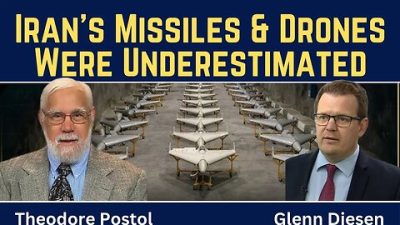
Theodore Postol: Iran’s Missiles & Drones Were Underestimated
or go to
Aletho News Archives – Video-Images
From the Archives
What is the Israeli Lobby in Australia Doing in Interfaith Dialogue?
By Ali Kazak | Dissident Voice | October 11, 2015
For years Israel and its lobby around the world have been trying to normalise their relations with Arabs and Muslims without solving the Palestine Question.
One of the methods they resorted to in the last few years is using human rights and community organizations such as interfaith dialogue and Multiculturalism to achieve this objective and to: isolate the Palestinians, marginalise the Palestine question, end Israel’s isolation, and prevent criticism of Israel, knowing that these organisations will be the first to stand against Israel’s violations, racial and religious discrimination.
The group responsible for this task in Australia is The Australia/Israel & Jewish Affairs Council (AIJAC); its Director of International & Community Affairs, Jeremy Jones is in charge of lobbying religious community organizations, specifically Muslims and Christians. Consequently he convened the Faith Communities for Reconciliation, founding participant in the Australian Partnership of Religious Organisations and the Australian National Dialogue of Christians, Muslims & Jews.
AIJAC is a private political propaganda group. It is recognised as the main Israeli lobby in Australia. It coordinates its activities and works intimately with the Israeli embassy in Canberra and different institutions in Israel. It is privately funded by some Jewish businessmen. It monitors closely Australian politicians, the media, ethnic and religious groups, (especially Arabs and Muslims), unions and academics on their stands towards Israel and the Palestine question. … continue
Blog Roll
 Aletho News
- The killing of three Indonesian soldiers in Lebanon should remind Jakarta that Israel does not want peace
- Defeated and delusional: Netanyahu’s remarks reveal $80bn war failure, says analyst
- Iran’s friends are about to make life much more difficult for Israel and the US
- The war of liberation of the Arab and Islamic peoples expands across the Gulf
- Envoy warns UN on Trump’s threat to ‘obliterate’ Iran’s civilian infrastructure
- The Larak Corridor: Iran’s Rial Gate With No US, No Israel, and No Way Around
- ‘Economic terrorism’: Steel facilities hit again in US-Israeli strike
- ‘War Crime’: Iran condemns attacks on Arak, Ardakan nuclear sites
- Two-thirds of Americans want quick end to Iran war even if goals unmet
- Trump to Give “Important Update on Iran” Wednesday in Prime-Time Speech
- If Americans Knew
- Gaza families reunite years after babies evacuated amid Israel’s war
- International Rescue Committee warns Gaza’s children face grave protection risks
- Iran’s Alleged 47-Year War on America: Debunking the 1,050 American Deaths Canard
- Israel wants US to bomb more of Iran’s civilian structures (113,000 is not enough) – Not a ceasefire Day 173
- Ann Coulter Rips Into Fox News for Iran War Coverage
- Joe Kent Urges Americans To Call White House and Congress To Object To Sending Troops Into Iran
- DNC Resolution to Reject AIPAC Funding Puts Democratic Leaders in the Hot Seat
- Swedish foundation to build 400 schools as over 650,000 Gaza children remain without education for 2 years
- Israeli army admits photshopping image of slain Lebanese journalist
- This is how Israel is systematically killing health workers under the cover of war in Lebanon
- No Tricks Zone
- New Study Finds Warming Saves Lives…Cold Temperatures 12 Times More Deadly Than Excess Heat
- German Science Blog Accuses PIK Climate Institute Of Hallucinating Climate Tipping Points
- Devastating Assessment Of Comirnaty Vaccine By Former Senior Pfizer Europe Toxicologist
- New Study: CO2 Is ‘Effectively Negligible’ As An Explanatory Climate Change Factor Since 2000
- Former Pfizer Toxicologist Dr. Helmut Sterz Tells Bundestag Hearing Pfizer Vaccine Should Have Never Been Approved
- Energy Expert: Germany’s Nuclear Phaseout Was A “500 Billion Euro Mistake”
- New Research: South Australia’s Mid-Holocene Sea Surface Temperatures Were 4°C Warmer Than Today
- Storing Green Energy To Last Germany 10 Days Would Require A 60-Million Tonne Battery
- New Studies: UK Sea Levels Were 4 Meters Higher Than Today During The Mid-Holocene
- Destructive Green New Deal: German Energy And Metal Group Warns Of Drastic Crisis
 Aletho News