Ukrainian warships voluntarily leave Sevastopol: sources
RT | March 2, 2014
About 10 Ukrainian Black Sea Fleet ships have left the naval base in Sevastopol, with several vessels now heading to Odessa, administrative sources have said. The ships left the base voluntarily but some of them broke down and returned, they claimed.
Over the last 24 hours, “about 10 [war]ships and vessels of the Ukrainian Black Sea Fleet have left the Sevastopol base,” a source in the government of the Autonomous Republic of Crimea told Interfax on Sunday.
“Naturally, no one has compelled them to do so,” the government source added.
The administration of the Crimean autonomy has nothing to do with the moves of the Ukrainian ships, an administrative source also told RIA Novosti.
Several vessels have since returned to the base in Sevastopol “because of malfunctions,” the source said.
Meanwhile, former Ukrainian troops were due to swear allegiance to the Crimean authorities in Sevastopol at 5pm local time (15:00 GMT). An unnamed official source earlier told RIA Novosti that “the majority of the Ukrainian armed forces deployed in Crimea” have passed to the side of the region. The transition was made “without a single shot fired,” the source said.
Ukrainian state agencies have been categorically denying both the claims of Ukrainian soldiers switching sides en masse and, earlier, reports of warships leaving Sevastopol.
However, the governor of southern Ukrainian Odessa Region told local media that several Ukrainian ships are sailing to the city of Odessa and it is being decided where they will dock.
A Russian media report on Saturday claimed that Ukraine’s Navy flagship, the Hetman Sahaidachny frigate has refused to follow orders from Kiev, came over to Russia’s side and was returning home from the Gulf of Aden flying the Russian naval flag. Various Ukrainian media denied the report as “false” and “propaganda,” but gave only a Facebook statement of a former Navy officer turned journalist in support of the rebuttal.
This comes as the newly appointed Navy Chief rear admiral Denis Berezovsky has sworn allegiance to the people of Crimea, according to RIA Novosti.
“I, Berezovsky Denis, swear allegiance to the Crimean people and pledge to protect it, as required by the [army] regulations,” Berezovsky said.
Hours after the announcement, the self-proclaimed government in Kiev dismissed the Navy Chief and launched a treason case against him.

Argo, Temperature, and OHC
By Willis Eschenbach | Whats Up With That? | March 2, 2014
I’ve been thinking about the Argo floats and the data they’ve collected. There are about 4,000 Argo floats in the ocean. Most of the time they are asleep, a thousand metres below the surface. Every 10 days they wake up and slowly rise to the surface, taking temperature measurements as they go. When they reach the surface, they radio their data back to headquarters, slip beneath the waves, sink down to a thousand metres and go back to sleep …
At this point, we have decent Argo data since about 2005. I’m using the Argo dataset 2005-2012, which has been gridded. Here, to open the bidding, are the ocean surface temperatures for the period.

Figure 1. Oceanic surface temperatures, 2005-2012. Argo data.
Dang, I like that … so what else can the Argo data show us?
Well, it can show us the changes in the average temperature down to 2000 metres. Figure 2 shows that result:
 Figure 2. Average temperature, surface down to 2,000 metres depth. Temperatures are volume-weighted.
The average temperature of the top 2000 metres is six degrees C (43°F). Chilly.
We can also take a look at how much the ocean has warmed and cooled, and where. Here are the trends in the surface temperature:
 Figure 3. Decadal change in ocean surface temperatures.
Once again we see the surprising stability of the system. Some areas of the ocean have warmed at 2° per decade, some have cooled at -1.5° per decade. But overall? The warming is trivially small, 0.03°C per decade.
Next, here is the corresponding map for the average temperatures down to 2,000 metres:
 Figure 4. Decadal change in average temperatures 0—2000 metres. Temperatures are volume-averaged.
Note that although the amounts of the changes are smaller, the trends at the surface are geographically similar to the trends down to 2000 metres.
Figure 5 shows the global average trends in the top 2,000 metres of the ocean. I have expressed the changes in another unit, 10^22 joules, rather than in °C, to show it as variations in ocean heat content.
 Figure 5. Global ocean heat content anomaly (10^22 joules). Same data as in Figure 4, expressed in different units.
The trend in this data (6.9 ± 0.6 e+22 joules per decade) agrees quite well with the trend in the Levitus OHC data, which is about 7.4 ± 0.8 e+22 joules per decade.
Anyhow, that’s the state of play so far. The top two kilometers of the ocean are warming at 0.02°C per decade … can’t say I’m worried by that.
Related articles


IAEA rejects Israel’s anti-Iran nuclear rhetoric
Press TV – March 1, 2014
The International Atomic Energy Agency (IAEA) has rejected Israel’s demand to release an alleged report about the Iranian nuclear energy work, saying there is no report that may indicate any diversion in Tehran’s program.
“The IAEA has not prepared any report containing new information relating to possible military dimensions of Iran’s nuclear program,” spokeswoman Gill Tudor said on Friday.
The remarks came after Israel demanded that the UN nuclear watchdog agency go public with all information it has regarding the Iranian nuclear energy work.
The demand was made following a Thursday report by Reuters alleging that the agency had held off an update over the Iranian nuclear energy program last year due to concerns that it may undermine nuclear talks with Tehran.
“The agency’s reports on Iran to its Board of Governors are factual and impartial. Their content is not influenced by political considerations,” Tudor added.
Iran has repeatedly emphasized that its nuclear energy program is meant for civilian purposes.
Officials in Tehran have already called on the IAEA to come clean on anything it has regarding the suspicions over the diversion of the Iranian nuclear energy program.
However, the agency has so far found no diversion in Iran’s nuclear program to publicize it.
Iran is in talks with the five permanent members of the UN Security Council — Russia, China, France, the UK and the US — plus Germany to fully resolve the decade-old dispute over the Tehran’s nuclear energy program.
The two sides inked an interim nuclear deal in Geneva, Switzerland, on November 24, 2013. The Geneva deal took effect on January 20. The two sides are now in pursuit of a final comprehensive deal.
Israel’s allegations against Iran come as the Tel Aviv regime, which is widely believed to be the only possessor of nuclear arms in the Middle East, reportedly maintains between 200 and 400 atomic warheads.
Furthermore, the Israeli regime has never allowed any inspection of its nuclear facilities and continues to defy international calls to join the nuclear Non-Proliferation Treaty.
Related article
UN finds no evidence Iran seeks nuclear arms: Rouhani
Al-Akhbar | March 2, 2014
President Hassan Rouhani said Sunday that despite “thousands of hours” of inspection, the UN’s atomic watchdog has found no evidence of military objectives in Iran’s nuclear drive.
His remarks came on the eve of an International Atomic Energy Agency board of governors meeting in Vienna, on the sidelines of which Iran will hold expert-level talks with world powers.
Western powers “all know that nuclear science in Iran follows a peaceful path”, Rouhani said in a speech broadcast on state television.
“The agency has conducted thousands of hours of inspection, and announced it has not found any diversion from the peaceful use (of nuclear technology) to military purposes.”
In its latest report on Iran in late February, the IAEA said Iran was sticking to a nuclear freeze it agreed under a November interim deal with world powers.
The watchdog’s report came a month after the deal came into force.
Iran and the so-called P5+1 group of world powers are seeking to reach a lasting accord that would allay Western suspicions that Tehran’s nuclear activities mask military objectives.
As part of such a comprehensive deal, the six seek to pressure Iran over its ballistic missile program, which could theoretically provide Tehran with a device to deliver a nuclear warhead, should it choose to build one. Iran has consistently denied any claims that it seeks to militarize it’s nuclear program.
Rouhani on Sunday defended the program, saying it has “always been defensive in nature, and will always remain so”.
On Saturday, Rouhani had called for calm amid provocative rhetoric from Iranian hardliners.
“Sometimes one does not seek war but talks as if one does, and this is seen as a threat to other parties. This is an unnecessary provocation,” he told military personnel and defense ministry officials.
“The Islamic Republic of Iran’s foreign policy is based on detente and building trust,” he added.
Since taking office in August, Rouhani has vowed to rebuild strained relations with the West.
(AFP, Al-Akhbar)
Related article

Putin Tells Obama Russia Will Act In Case of Ukraine Violence
RIA Novosti | March 2, 2014
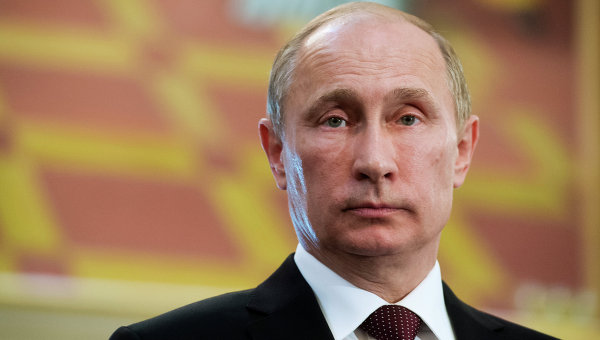
MOSCOW – Russian leader Vladimir Putin told US President Barack Obama in a telephone conversation Sunday that Moscow reserved the right to protect its own interests and those of Russian speakers in the event of violence breaking out in eastern Ukraine and Crimea.
The Kremlin press service said Putin responded to Obama’s expression of concern over possible Russian plans to deploy troops in Ukraine by drawing attention “to the provocative, criminal acts of ultranationalist elements being effectively encouraged by authorities in Kiev.”
Putin said that there was a real threat to the life of many Russians on Ukraine’s territory, the press service said.
Russia’s upper house of parliament voted Saturday to approve military action on Ukraine, citing the same motivations as those mentioned by Putin.
There is already a substantial Russian military presence in southern Ukraine, courtesy of the leased Black Sea Fleet naval base in the Crimean Peninsula.
Large movements of Russian troops have been reported around the peninsula, which is in defiance of express instructions from Ukrainian authorities this week for Russian soldiers to remain confined to their quarters.
In the 90-minute conversation with Putin, Obama condemned Russia’s military intervention, calling it a “clear violation of Ukrainian sovereignty and territorial integrity” and describing it as a breach of international law.
The US leader urged Russia to minimize tension by pulling back troops to bases in Crimea and refrain from any involvement in affairs anywhere else in Ukraine.
In a gesture aimed at signaling the degree of its distress over the course of events, the White House said it is suspending planned participation in preparatory meetings for a G-8 summit due to be held in June in the southern Russian city of Sochi, which last month hosted the Winter Olympics.
“Going forward, Russia’s continued violation of international law will lead to greater political and economic isolation,” the White House said in a read-out of the conversation between Obama and Putin.
Crimea is home to a large ethnic Russian community, which has reacted with alarm to what it sees as the aggressively nationalistic government that has taken hold since last month’s ouster of President Yanukovych. Eastern Ukraine, which was another political stronghold for Yanukovych, also has a substantial Russian-speaking population and saw many anti-government protests Saturday.
Obama said that the United States understood the need to protect the ethnic Russian minority in Ukraine and that it would push Kiev to ensure their rights weren’t hindered.
“The Ukrainian government has made clear its commitment to protect the rights of all Ukrainians and to abide by Ukraine’s international commitments, and we will continue to urge them to do so,” the White House said in the readout.
Russia’s Federal Migration Service said it has noted a sharp spike in applications from Ukrainian citizens seeking refuge.
The head of the migration service’s citizenship department, Valentina Kazakova, said 143,000 people had applied for asylum in the last two weeks of February alone.
“People are afraid for the fate of those close to them and are asking not just for protection, but also to help them receive fast-tracked Russian citizenship,” Kazakova said. “A large number of applications are from members of Ukrainian law enforcement bodies and government officials fearing reprisals from radically disposed groups.”
What the Hell is Obama Thinking?
Worst Man for the Job
By Daniel Patrick Welch – 3/01/2014
Nothing is quite as nauseating as watching the hypocrisy and hubris with which President Obama ‘warns’ the Russian president not to ‘interfere’ in Ukraine, telling the Russians there would be ‘costs to pay.’ It’s a surreal move, echoed by his equally creepy and out-of-touch consigliore and chief “diplomat,” the morally bankrupt John Kerry. Astonishing in its audacity and lack of regard for history, truth or facts, this bellicose blather seems aimed only at the idiots over whom he presides, the fools and tools in congress and the press, and his bought-and-paid-for lackeys in European capitals.
Outside the bubble, the sabre rattling is alarming and threatening. Having stood the issue completely on its head, No Drama Obama ignores how it looks to Russia, China and anyone with a skeptical mind. It is so jarring that it leaves only two options: is he crazy or does he really want war? That’s why the Russian Senate, offended to the core, asked President Putin to recall the US ambassador over Obama’s remarks.
How oblivious or arrogant do you have to be to spend $5 billion dollars destabilizing a country (the actual total is undoubtedly much higher), have your diplomats caught on tape planning a coup, bring a gang of fascist thugs to power on Russia’s doorstep–whose first order of business is to outlaw the Russian language, conduct a purge of opposing parties, threaten the Russian-speaking population, threaten to restore Ukraine’s nuclear status and provoke and threaten Russia non-stop… and have the *balls* to lecture anyone about interfering? Oh, add to the pot that you have done the same exact thing in several other countries in the past few years alone. It simply boggles the mind.
Continue poking Putin by suggesting he is being a “bully” when he moves to protect the Russian naval base, protect Russians, and listen to the wishes of the elected government of the region who ask for his support, as as new protests erupted across eastern Ukraine rejecting the putschists in Kiev, with Russian flags being raised over government buildings and protesters brandished signs saying “In Russia We Have Brothers. In Europe We Are Slaves” and “Where We Are, It is Also Russia.” This is called an ‘invasion’ by the people who bought and organized a fascist coup. Bizarro World.
But why do I focus on Obama? After all, he is little more than an irrelevant placeholder president, a sort of ventriloquist’s dummy for the vested interests and forces that put him where he is. Furthermore, I am not a fan of any Great Man theory of history that implies superhuman powers to people instead of historical forces. Accordingly, I don’t really go in for ad hominem attacks, which seems to be the only stock-in-trade of the western media, whose searing, eternal question seems to be who is the next Hitler.
Maybe it’s because I’m in the grip of the question the rest of the world is pondering: is he crazy or does he really want war? I can’t get past wondering whether he is sleepwalking through his presidency, having given over control of his administration to a foreign policy apparatus gone wild–or if he indeed believes the hypocritical warmongering crap that escapes his mouth. In short, Either he eats babies for breakfast or he has no clue that he is being led by the nose by psychopaths.
It’s important because in either case he is perhaps the most dangerous man who has ever held the office. His chief flaw is *exactly* the puzzle piece that is *least* amenable to being a leader at this historical juncture. It is a horrific perfect storm, and one that has allowed him to blunder disastrously close to World War III on at least two occasions.
The measure of the man has always told us he was an extremely glib politician. On watching an early speech of his, my wife was shocked at what all the fuss was about, and actually quoted King Herod out loud to the TV: “Take him away/ He’s got *nothing* to say!” Yeah, she’s funny like that. But still, glibness isn’t always hollowness. We got more of a glimpse when he joked casually about sending drones after any boys who had designs on his precious daughters. Later, referring to the boys he actual did mow down with his drones, he joked to aides–equally casually, we assume–that he never thought he ‘would wind up being so good at killing people.’
But the clincher for me is one memory which still haunts me from campaign 2008: a late rally in some Florida dump where Clinton explained (actually apologizing for going off script) that Obama was The Guy because he had said to the council of elders behind closed doors–you tell me what’s the right thing to do and I’ll sell it. At the time I did a double take, and it raised the hairs on the back of my neck. This is not a leader, a president, or even a thinker at all, but a glorified and willing Pitchman-in-Chief, a sort of real life Clayton Bigsby selling an ideology he is too blind to see.
It was a bit of the mask slipping… and it was incredibly ominous. I felt it and said so to my wife at the time, but she had checked out long before. Never thought he was anything more than a charlatan and a whore – from the first time she heard him, actually. Damn, I envy her clarity sometimes. It’s like they made a clone of Truman in a test tube, only this time not a hick… scary. Jimmy Burns led Truman around on a leash, and this misplaced trust in Wise Men led to war crimes such as Hiroshima and Nagasaki, among others.
In another famous example, Kennedy stupidly let the Bay of Pigs invasion proceed, as he was advised by ‘wiser men’ who told him it was already in the pipeline. However, he wisely vetoed air support, realizing that is was a stupid plan laid out by zealots. Obama has neither the balls nor the intelligence to pull off any such thing. There was a flicker over Syria in August, but it appears to have been a mirage brought on by Russian missiles and wiser generals. He has the fatal flaw which makes all smart men stupid: heeding the counsel of fools and those with their own secret agenda masquerading as Wise Men.
The zealots who have his ear have been in power for a long time, and they are the kind of fanatics who avoid scrutiny in public and accountability even to themselves, so stupid or proud that they still see chasing the Russians out of Afghanistan as their greatest triumph, and take no responsibility for having created, from the ground up, the very concept of militarized global jihad.
Even cutting him the most possible slack, he listens to them–and that makes him delusional, a hollow man issuing idle threats. As logic dictates, it is the US who should be worrying about costs, starting with billions to set the coup in motion. That will turn out to have been a pittance.
He is now a dangerous man being counseled by dangerous men. Just today, listening to his smug, arrogant self humiliate a heckler, someone trying to shout a tiny bit of truth through the noise, is truly chilling. The trouble is, Obama may not be lying. He really doesn’t know what the guy is talking about, and doesn’t know that this is the plan–at what may be the most dangerous moment in history–and will go along with whichever three loudest advisers tell him is the right thing. The saddest and scariest part is that he doesn’t even seem to know it–a true button pusher. Soulless.
But this is a measure of the man. At a friendly, fundraising event, with full control and no opposition, he could have said anything he wanted, could have made some sensible retort. Instead he chose to be mean and demeaning, calling the guy a drunk and implying that he is crazy. So now I have to add Bad Man to my list. No lie lives forever, and some day his uppance will come, as Stewie Griffin says. He richly deserves the place he has earned in history, and I have lost interest in splitting hairs: enabler, dupe or antichrist–take your pick.
Writer, singer, linguist and activist Daniel Patrick Welch lives and writes in Salem, Massachusetts, with his wife, Julia Nambalirwa-Lugudde. Translations of articles are available in in up to 30 languages.
John Holdren’s Epic Fail
Watts Up With That? | March 1, 2014
From http://1.usa.gov/1mRYomm (PDF) I have converted the text for presentation here with Dr. Pielke’s response.
Dr. Roger Pielke responds:
I’m flattered that the White House has posted up an attack on me. Here is my response:
http://rogerpielkejr.blogspot.com/2014/03/john-holdrens-epic-fail.html
Please share far and wide.
Holdren’s letter is first, followed by Pielke’s response below.
============================================================
Drought and Global Climate Change: An Analysis of Statements by Roger Pielke Jr
By John P. Holdren – February 28, 2014
Introduction
In the question and answer period following my February 25 testimony on the Administration’s Climate Action Plan before the Oversight Subcommittee of the U.S. Senate’s Committee on Environment and Public Works, Senator Jeff Sessions (R-AL) suggested that I had misled the American people with comments I made to reporters on February 13, linking recent severe droughts in the American West to global climate change. To support this proposition, Senator Sessions quoted from testimony before the Environment and Public Works Committee the previous July by Dr. Roger Pielke, Jr., a University of Colorado political scientist. Specifically, the Senator read the following passages from Dr. Pielke’s written testimony:
It is misleading, and just plain incorrect, to claim that disasters associated with hurricanes, tornadoes, floods or droughts have increased on climate timescales either in the United States or globally.
Drought has “for the most part, become shorter, less, frequent, and cover a smaller portion of the U.S. over the last century”. Globally, “there has been little change in drought over the past 60 years.”
Footnotes in the testimony attribute the two statements in quotation marks within the second passage to the US Climate Change Science Program’s 2008 report on extremes in North America and a 2012 paper by Sheffield et al. in the journal Nature, respectively.
I replied that the indicated comments by Dr. Pielke, and similar ones attributed by Senator Sessions to Dr. Roy Spencer of the University of Alabama, were not representative of main- stream views on this topic in the climate-science community; and I promised to provide for the record a more complete response with relevant scientific references.
Dr. Pielke also commented directly, in a number of tweets on February 14 and thereafter, on my February 13 statements to reporters about the California drought, and he elaborated on the tweets for a blog post on The Daily Caller site (also on February 14). In what follows, I will address the relevant statements in those venues, as well. He argued there, specifically, that my statements on drought “directly contradicted scientific reports”, and in support of that assertion, he offered the same statements from his July testimony that were quoted by Senator Sessions (see above). He also added this:
The United Nations Intergovernmental Panel on Climate Change found that there is “not enough evidence at present to suggest more than low confidence in a global-scale observed trend in drought.”
In the rest of this response, I will show, first, that the indicated quote from the US Climate Change Science Program (CCSP) about U.S. droughts is missing a crucial adjacent sentence in the CCSP report, which supports my position about drought in the American West. I will also show that Dr. Pielke’s statements about global drought trends, while irrelevant to my comments about drought in California and the Colorado River Basin, are seriously misleading, as well, concerning what is actually in the UN Panel’s latest report and what is in the current scientific literature.
Drought trends in the American West
My comments to reporters on February 13, to which Dr. Pielke referred in his February 14 tweet and to which Senator Sessions referred in the February 25 hearing, were provided just ahead of President Obama’s visit to the drought-stricken California Central Valley and were explicitly about the drought situation in California and elsewhere in the West.
That being so, any reference to the CCSP 2008 report in this context should include not just the sentence highlighted in Dr. Pielke’s testimony but also the sentence that follows immediately in the relevant passage from that document and which relates specifically to the American West. Here are the two sentences in their entirety (http://downloads.globalchange.gov/sap/sap3- 3/Brochure-CCSP-3-3.pdf):
Similarly, long-term trends (1925-2003) of hydrologic droughts based on model derived soil moisture and runoff show that droughts have, for the most part, become shorter, less frequent, and cover a smaller portion of the U.S. over the last century (Andreadis and Lettenmaier, 2006). The main exception is the Southwest and parts of the interior of the West, where increased temperature has led to rising drought trends (Groisman et al., 2004; Andreadis and Lettenmaier, 2006).
Linking Drought to Climate Change
In my recent comments about observed and projected increases in drought in the American West, I mentioned four relatively well understood mechanisms by which climate change can play a role in drought. (I have always been careful to note that, scientifically, we cannot say that climate change caused a particular drought, but only that it is expected to increase the frequency, intensity, and duration of drought in some regions―and that such changes are being observed.)
The four mechanisms are:
1. In a warming world, a larger fraction of total precipitation falls in downpours, which means a larger fraction is lost to storm runoff (as opposed to being absorbed in soil).
2. In mountain regions that are warming, as most are, a larger fraction of precipitation falls as rain rather than as snow, which means lower stream flows in spring and summer.
3. What snowpack there is melts earlier in a warming world, further reducing flows later in the year.
4. Where temperatures are higher, losses of water from soil and reservoirs due to evaporation are likewise higher than they would otherwise be.
Regarding the first mechanism, the 2013 report of the IPCC’s Working Group I, The Science Basis (http://www.climatechange2013.org/images/report/WG1AR5_TS_FINAL.pdf, p 110), deems it “likely” (probability greater than 66%) that an increase in heavy precipitation events is already detectable in observational records since 1950 for more land areas than not, and that further changes in this direction are “likely over many land areas” in the early 21st century and “very likely over most of the mid-latitude land masses” by the late 21st century The second, third, and fourth mechanisms reflect elementary physics and are hardly subject to dispute (but see also additional references provided at the end of this comment).
As I have also noted in recent public comments, additional mechanisms have been identified by which changes in atmospheric circulation patterns that may be a result of global warming could be affecting droughts in the American West. There are some measurements and some analyses
suggesting that these mechanisms are operating, but the evidence is less than conclusive, and some respectable analysts attribute the indicated circulation changes to natural variability. The uncertainty about these mechanisms should not be allowed to become a distraction obscuring the more robust understandings about climate change and regional drought summarized above.
Global Drought Patterns
Drought is by nature a regional phenomenon. In a world that is warming on the average, there will be more evaporation and therefore more precipitation; that is, a warming world will also get wetter, on the average. In speaking of global trends in drought, then, the meaningful questions are (a) whether the frequency, intensity, and duration of droughts are changing in most or all of the regions historically prone to drought and (b) whether the total area prone to drought is changing.
Any careful reading of the 2013 IPCC report and other recent scientific literature about on the subject reveals that droughts have been worsening in some regions in recent decades while lessening in other regions, and that the IPCC’s “low confidence” about a global trend relates mainly to the question of total area prone to drought and a lack of sufficient measurements to settle it. Here is the key passage from the Technical Summary from IPCC WGI’s 2013 report (http://www.climatechange2013.org/images/report/WG1AR5_TS_FINAL.pdf, p 112):
Compelling arguments both for and against significant increases in the land area affected by drought and/or dryness since the mid-20th century have resulted in a low confidence assessment of observed and attributable large-scale trends. This is due primarily to a lack and quality of direct observations, dependencies of inferred trends on the index choice, geographical inconsistencies in the trends and difficulties in distinguishing decadal scale variability from long term trends.
The table that accompanies the above passage from the IPCC’s report―captioned “Extreme weather and climate events: global-scale assessment of recent observed changes, human contribution to the changes, and projected further changes for the early (2016-2035) and late (2081-2100) 21st century”―has the following entries for “Increases in intensity and/or duration of drought”: under changes observed since 1950, “low confidence on a global scale, likely changes in some regions” [emphasis added]; and under projected changes for the late 21st century, “likely (medium confidence) on a regional to global scale”.
Dr. Pielke’s citation of a 2012 paper from Nature by Sheffield et al., entitled “Little change in global drought over the past 60 years”, is likewise misleading. That paper’s abstract begins as follows:
Drought is expected to increase in frequency and severity in the future as a result of climate change, mainly as a consequence of decreases in regional precipitation but also because of increasing evaporation driven by global warming1-3. Previous assessments of historic changes in drought over the late twentieth and early twenty-first centuries indicate that this may already be happening globally. In particular, calculations of the Palmer Drought Severity Index (PDSI) show a decrease in moisture globally since the 1970s with a commensurate increase in the area of drought that is attributed, in part, to global warming4-5.
The paper goes on to argue that the PDSI, which has been relied upon for drought characteriza- tion since the 1960s, is too simple a measure and may (the authors’ word) have led to over- estimation of global drought trends in previous climate-change assessments―including the IPCC’s previous (2007) assessment, which found that “More intense and longer droughts have been observed over wider areas since the 1970s, particularly in the tropics and subtropics.”
The authors argue for use of a more complex index of drought, which, however, requires more data and more sophisticated models to apply. Their application of it with the available data shows a smaller global drought trend than calculated using the usual PDSI, but they conclude that better data are needed. The conclusion of the Sheffield et al. paper has proven controversial, with some critics pointing to the inadequacy of existing observations to support the more complex index and others arguing that a more rigorous application of the new approach leads to results similar to those previously obtained using the PDSI.
A measure of the differences of view on the topic is available in a paper entitled “Increasing drought under global warming in observations and models”, published in Nature Climate Change at about the same time as Sheffield et al. by a leading drought expert at the National Center for Climate Research, Dr. Aiguo Dai. Dr. Dai’s abstract begins and ends as follows:
Historical records of precipitation, streamflow, and drought indices all show increased aridity since 1950 over many land areas1,2. Analyses of model-simulated soil moisture3, 4, drought indices1,5,6, and precipitation minus evaporation7 suggest increased risk of drought in the twenty-first century. … I conclude that the observed global aridity changes up to 2010 are consistent with model predictions, which suggest severe and widespread droughts in the next 30-90 years over many land areas resulting from either decreased precipitation and/or increased evaporation.
The disagreement between the Sheffield et al. and Dai camps appears to have been responsible for the IPCC’s downgrading to “low confidence”, in its 2013 report, the assessment of an upward trend in global drought in its 2007 Fourth Assessment and its 2012 Special Report on Extreme Events (http://www.ipcc-wg2.gov/SREX/) .
Interestingly, a number of senior parties to the debate―including Drs. Sheffield and Dai―have recently collaborated on a co-authored paper, published in the January 2014 issue of Nature Climate Change, entitled “Global warming and changes in drought”. In this new paper, the authors identify the reasons for their previous disagreements; agree on the need for additional data to better separate natural variability from human-caused trends; and agree on the following closing paragraph (quoted here in full):
Changes in the global water cycle in response to the warming over the twenty-first century will not be uniform. The contrast in precipitation between wet and dry regions and between wet and dry seasons will probably increase, although there may be regional exceptions.
Climate change is adding heat to the climate system and on land much of that heat goes into drying. A natural drought should therefore set in quicker, become more intense, and may last longer. Droughts may be more extensive as a result. Indeed, human-induced warming effects accumulate on land during periods of drought because the ‘air conditioning effects’ of water are absent. Climate change may not manufacture droughts, but it could exacerbate them and it will probably expand their domain in the subtropical dry zone.
Additional References (with particularly relevant direct quotes in italics)
Christopher R. Schwalm et al., Reduction of carbon uptake during turn of the century drought in western North America, Nature Geoscience, vol. 5, August 2012, pp 551-556.
The severity and incidence of climatic extremes, including drought, have increased as a result of climate warming. … The turn of the century drought in western North America was the most severe drought over the past 800 years, significantly reducing the modest carbon sink normally present in this region. Projections indicate that drought events of this length and severity will be commonplace through the end of the twenty-first century.
Gregory T. Pederson et al., The unusual nature of recent snowpack declines in the North American Cordillera, Science, vol. 333, 15 July 2011, pp 332-335.
Over the past millennium, late 20th century snowpack reductions are almost unprecedented in magnitude across the northern Rocky Mountains and in their north-south synchrony across the cordillera. Both the snowpack declines and their synchrony result from unparalleled springtime warming that is due to positive reinforcement of the anthropogenic warming by decadal variability. The increasing role of warming on large-scale snowpack variability and trends foreshadows fundamental impacts on streamflow and water supplies across the western United States.
Gregory T. Pederson et al., Regional patterns and proximal causes of the recent snowpack decline in the Rocky Mountains, US, Geophysical Research Letters, vol. 40, 16 May 2013, pp 1811-1816.
The post-1980 synchronous snow decline reduced snow cover at low to middle elevations by
~20% and partly explains earlier and reduced streamflow and both longer and more active fire seasons. Climatologies of Rocky Mountain snowpack are shown to be seasonally and regionally complex, with Pacific decadal variability positively reinforcing the anthropogenic warming trend.
Michael Wehner et al., Projections of future drought in the continental United States and Mexico, Journal of Hydrometeorology, vol. 12, December 2011, pp 1359-1377.
All models, regardless of their ability to simulate the base-period drought statistics, project significant future increases in drought frequency, severity, and extent over the course of the 21st century under the SRES A1B emissions scenario. Using all 19 models, the average state in the last decade of the twenty-first century is projected under the SRES A1B forcing scenario to be conditions currently considered severe drought (PDSI<-3) over much of the continental United States and extreme drought (PDSI<-4) over much of Mexico.
D. R. Cayan et al., Future dryness in the southwest US and the hydrology of the early 21st century drought, Proceedings of the National Academy of Sciences, vol. 107, December 14, 2010, pp 21271-21276.
Although the recent drought may have significant contributions from natural variability, it is notable that hydrological changes in the region over the last 50 years cannot be fully explained by natural variability, and instead show the signature of anthropogenic climate change.
E. P. Maurer et al., Detection, attribution, and sensitivity of trends toward earlier streamflow in the Sierra Nevada, Journal of Geophysical Research, vol. 112, 2007, doi:10.1029/2006JD08088.
The warming experienced in recent decades has caused measurable shifts toward earlier streamflow timing in California. Under future warming, further shifts in streamflow timing are projected for the rivers draining the western Sierra Nevada, including the four considered in this study. These shifts and their projected increases through the end of the 21st century will have dramatic impacts on California’s managed water system.
H. G. Hidalgo et al., Detection and attribution of streamflow timing changes to climate change in the western United States, Journal of Climate, vol. 22, issue 13, 2009, pp 3838-3855, doi: 10.1175/2009JCLI2740.1.
The advance in streamflow timing in the western United States appears to arise, to some measure, from anthropogenic warming. Thus the observed changes appear to be the early phase of changes expected under climate change. This finding presages grave consequences for the water supply, water management, and ecology of the region. In particular, more winter and spring flooding and drier summers are expected as well as less winter snow (more rain) and earlier snowmelt.
==============================================================
John Holdren’s Epic Fail
By Roger Pielke, Jr. – 3/01/2014

Last week in a Congressional hearing, John Holdren, the president’s science advisor, characterized me as being outside the “scientific mainstream” with respect to my views on extreme events and climate change. Specifically, Holdren was responding directly to views that I provided in Senate testimony that I gave last July (and here in PDF).
To accuse an academic of holding views that lie outside the scientific mainstream is the sort of delegitimizing talk that is of course common on blogs in the climate wars. But it is rare for political appointee in any capacity — the president’s science advisor no less — to accuse an individual academic of holding views are are not simply wrong, but in fact scientifically illegitimate. Very strong stuff.
Given the seriousness of Holdren’s charges and the possibility of negative professional repercussions via email I asked him to elaborate on his characterization, to which he replied quite quickly that he would do so in the form of a promised follow-up to the Senate subcommittee.
Here is what I sent him:
Dear John-
I hope this note finds you well. I am writing in response to your characterization of me before the Senate Environment and Public Works Committee’s Subcommittee on Oversight yesterday, in which you said that my views lie “outside the scientific mainstream.”
This is a very serious charge to make in Congressional testimony about a colleague’s work, even more so when it comes from the science advisor to the president.
The context of your comments about me was an exchange that you had with Senator Sessions over my recent testimony to the full EPW Committee on the subject of extreme events. You no doubt have seen my testimony (having characterized it yesterday) and which is available here:
http://sciencepolicy.colorado.edu/admin/publication_files/2013.20.pdf
Your characterization of my views as lying “outside the scientific mainstream” is odd because the views that I expressed in my testimony are entirely consonant with those of the IPCC (2012, 2013) and those of the US government’s USGCRP. Indeed, much of my testimony involved reviewing the recent findings of IPCC SREX and AR5 WG1. My scientific views are also supported by dozens of peer reviewed papers which I have authored and which have been cited thousands of times, including by all three working groups of the IPCC. My views are thus nothing if not at the center of the “scientific mainstream.”
I am writing to request from you the professional courtesy of clarifying your statement. If you do indeed believe that my views are “outside the scientific mainstream” could you substantiate that claim with evidence related specifically to my testimony which you characterized pejoratively? Alternatively, if you misspoke, I’d request that you set the record straight to the committee.
I welcome your response at your earliest opportunity.
Today he has shared with me a 6-page single space response which he provided to the Senate subcommittee titled “Critique of Pielke Jr. Statements on Drought.” Here I take a look at Holdren’s response.
In a nutshell, Holdren’s response is sloppy and reflects extremely poorly on him. Far from showing that I am outside the scientific mainstream, Holdren’s follow-up casts doubt on whether he has even read my Senate testimony. Holdren’s justification for seeking to use his position as a political appointee to delegitimize me personally reflects poorly on his position and office, and his response simply reinforces that view.
His response, (which you can see here in full in PDF) focuses entirely on drought — whereas my testimony focused on hurricanes, floods, tornadoes and drought. But before he gets to drought, Holdren gets off to a bad start in his response when he shifts the focus away from my testimony and to some article in a website called “The Daily Caller” (which is apparently some minor conservative or Tea Party website, and the article appears to be this one).
Holdren writes:
Dr. Pielke also commented directly, in a number of tweets on February 14 and thereafter, on my February 13 statements to reporters about the California drought, and he elaborated on the tweets for a blog post on The Daily Caller site (also on February 14). In what follows, I will address the relevant statements in those venues, as well. He argued there, specifically, that my statements on drought “directly contradicted scientific reports”, and in support of that assertion, he offered the same statements from his July testimony that were quoted by Senator Sessions.
Let me be quite clear — I did not write anything for “The Daily Caller” nor did I speak or otherwise communicate to anyone there. The quote that Holdren attributes to me – “directly contradicted scientific reports” — is actually written by “The Daily Caller.” Why that blog has any relevance to my standing in the “scientific mainstream” eludes me, but whatever. This sort of sloppiness is inexcusable.
Leaving the silly misdirection aside — common on blogs but unbecoming of the science advisor to the most powerful man on the planet — let’s next take a look at Holdren’s substantive complaints about my recent Senate testimony.
As a starting point, let me reproduce in its entirety the section of my Senate testimony (here in PDF) which discussed drought.
Drought
What the IPCC SREX (2012) says:
- “There is medium confidence that since the 1950s some regions of the world have experienced a trend to more intense and longer droughts, in particular in southern Europe and West Africa, but in some regions droughts have become less frequent, less intense, or shorter, for example, in central North America and northwestern Australia.”
- For the US the CCSP (2008)20 says: “droughts have, for the most part, become shorter, less frequent, and cover a smaller portion of the U. S. over the last century.”21
What the data says:
8. Drought has “for the most part, become shorter, less frequent, and cover a smaller portion of the U. S. over the last century.”22
Figure 8. Figure 2.6 from CCSP (2008) has this caption: “The area (in percent) of area in severe to extreme drought as measured by the Palmer Drought Severity Index for the United States (red) from 1900 to present and for North America (blue) from 1950 to present.”Note: Writing in Nature Senevirnate (2012) argues with respect to global trends that, “there is no necessary correlation between temperature changes and long-term drought variations, which should warn us against using any simplifications regarding their relationship.”23
Footnotes:
20 CCSP, 2008: Weather and Climate Extremes in a Changing Climate. Regions of Focus: North America, Hawaii, Caribbean, and U.S. Pacific Islands. A Report by the U.S. Climate Change Science Program and the Subcommittee on Global Change Research. [Thomas R. Karl, Gerald A. Meehl, Christopher D. Miller, Susan J. Hassol, Anne M. Waple, and William L. Murray (eds.)]. Department of Commerce, NOAA’s National Climatic Data Center, Washington, D.C., USA, 164 pp.
21 CCSP (2008) notes that “the main exception is the Southwest and parts of the interior of the West, where increased temperature has led to rising drought trends.”
22 This quote comes from the US Climate Change Science Program’s 2008 report on extremes in North America.
23 http://www.nature.com/nature/journal/v491/n7424/full/491338a.htm

Let’s now look at Holdren’s critique which he claims places me “outside the scientific mainstream.”
Holdren Complaint #1: ”I will show, first, that the indicated quote [RP: This one: ““droughts have, for the most part, become shorter, less frequent, and cover a smaller portion of the U. S. over the last century.”21”] from the US Climate Change Science Program (CCSP) about U.S. droughts is missing a crucial adjacent sentence in the CCSP report, which supports my position about drought in the American West. . . That being so, any reference to the CCSP 2008 report in this context should include not just the sentence highlighted in Dr. Pielke’s testimony but also the sentence that follows immediately in the relevant passage from that document and which relates specifically to the American West.”
What is that sentence is question from the CCSP 2008 report that Holdren thinks I should have included in my testimony? He says it is this one:
“The main exception is the Southwest and parts of the interior of the West, where increased temperature has led to rising drought trends.”
Readers (not even careful readers) can easily see Footnote 21 from my testimony, which states:
CCSP (2008) notes that “the main exception is the Southwest and parts of the interior of the West, where increased temperature has led to rising drought trends.”
Um, hello? Is this really coming from the president’s science advisor?
Holdren is flat-out wrong to accuse me of omitting a key statement from my testimony. Again, remarkable, inexcusable sloppiness.
Holdren’s reply next includes a section on drought and climate change which offers no critique of my testimony, and which needs no response from me.
Holdren Complaint #2: Holdren implies that I neglected to note the IPCC’s reference to the fact that drought is a regional phenomena: “Any careful reading of the 2013 IPCC report and other recent scientific literature about on the subject reveals that droughts have been worsening in some regions in recent decades while lessening in other regions.”
Again, even a cursory reading of what I quoted from the IPCC shows that Holdren’s complaint does not stand up. Here is the full quote that I included in my testimony from the IPCC on drought:
“There is medium confidence that since the 1950s some regions of the world have experienced a trend to more intense and longer droughts, in particular in southern Europe and West Africa, but in some regions droughts have become less frequent, less intense, or shorter, for example, in central North America and northwestern Australia.”
Again, hello? Seriously?
Holdren Complaint #3: Near as I can tell Holdren is upset that I cited a paper from Nature that he does not like, writing, “Dr. Pielke’s citation of a 2012 paper from Nature by Sheffield et al., entitled “Little change in global drought over the past 60 years”, is likewise misleading.”
He points to a January 2014 paper in Nature Climate Change as offering a rebuttal to Sheffield et al. (2012).
The first point to note in response is that my citing of a paper which appears in Nature does not provide evidence of my being “outside the scientific mainstream” no matter how much Holdren disagrees with the paper. Academics in the “scientific mainstream” cite peer-reviewed papers, sometimes even those in Nature. Second, my testimony was delivered in July, 2013 and the paper he cites as a rebuttal was submitted in August, 2013 and only published in early 2014. I can hardly be faulted for not citing a paper which had not yet appeared. Third, that 2014 paper that Holdren likes better actually supports the IPCC conclusions on drought and my characterization of them in my Senate testimony.The authors write:
How is drought changing as the climate changes? Several recent papers in the scientific literature have focused on this question but the answer remains blurred.
The bottom line here is that this is an extremely poor showing by the president’s science advisor. It is fine for experts to openly disagree. But when a political appointee uses his position not just to disagree on science or policy but to seek to delegitimize a colleague, he has gone too far.
Resolving Nuclear Arms Claims Hinges on Iran’s Demand for Documents
By Gareth Porter | IPS | March 2, 2014
The Barack Obama administration has demanded that Iran resolve “past and present concerns” about the “possible military dimensions” of its nuclear program as a condition for signing a comprehensive nuclear agreement with Tehran.
Administration officials have suggested that Iran must satisfy the International Atomic Energy Agency (IAEA) regarding the allegations in the agency’s report that it has had a covert nuclear weapons program in the past.
But the record of negotiations between Iran and the IAEA shows Tehran has been ready for the past two years to provide detailed responses to all the charges of an Iranian nuclear weapons work, and that the problem has been the refusal of the IAEA to share with Iran the documentary evidence on which those allegations have been based.
The real obstacle to providing those documents, however, has long been a U.S. policy of refusing to share the documents on the assumption that Iran must confess to having had a weaponization program.
The head of Iran’s Atomic Energy Organisation, Ali Akbar Salehi, declared February 12, “The authenticity of each allegation should be proven first, then the person who submitted it to the agency should give us the genuine document. When we are assured of the authenticity, then we can talk to the agency.”
Neither the IAEA nor the Obama administration has responded publicly to Salehi’s statement. In response to a query from IPS, the spokesperson for the National Security Council, Bernadette Meehan, said the NSC officials would have no comment on the Iranian demand for access to the documents.
The spokesperson for IAEA Director Yukiya Amano did not answer a request from IPS Thursday for the agency’s comment.
But a draft text of an agreement being negotiated between the IAEA and Iran dated February 20, 2012, shows that the only difference between the two sides on resolving issues about allegations of Iranian nuclear weapons work was Iran’s demand to have the documents on which the allegations are based.
The draft text, which was later published on the website of the Arms Control Association, reflects Iran’s deletions and additions to the original IAEA proposal. It calls for Iran to provide a “conclusive technical assessment” of a set of six “topics”, which included 12 distinct charges in the report in a particular order that the IAEA desired.
Iran and the IAEA agreed that Iran would provide a “conclusive technical assessment” on a list of 10 issues in a particular order. The only topics that Iran proposed to delete from the list were “management structure” and “Procurement activities”, which did not involve charges of specifically nuclear weapons work.
The two sides had agreed in the draft that the IAEA would provide a “detailed explanation of its concerns”. But they had failed to agree on provision of documents to Iran by the IAEA. The IAEA had proposed language that the agency would provide Iran with the relevant documents only “where appropriate”. Iran was insisting on deletion of that qualifying phrase from the draft.
The first priority on the list of topics to which both sides had agreed in the draft was “Parchin” – referring to the claim of intelligence from an unnamed state that Iran had installed a large cylinder at the Parchin military reservation.
A November 2011 IAEA report suggested the cylinder was intended for testing nuclear weapons designs and had been built with the assistance of a “foreign expert”. Iran also agreed to respond in detail on the issue of the “foreign expert”, who has been identified as Vyacheslav Danilenko, a Ukrainian specialist on nanodiamonds.
The evidence associated with that claim and others published in the 2011 report shows that they were based on intelligence reports and documents given to the IAEA by Israel in 2008-09. Former IAEA Director General Mohamed ElBaradei referred to a series of documents provided by Israel in his 2012 memoirs.
Iran also agreed to respond in detail to allegations that Iran had sought to integrate a nuclear weapon into the reentry vehicle of the Shahab-3 missile, and that it had developed high explosives as a “detonator” for a nuclear weapon.
Both alleged activities had been depicted or described in documents reported in the U.S. news media in 2005-06 as having come from a covert Iranian nuclear weapons program.
Those documents, about whose authenticity ElBaradei and other senior IAEA officials have publicly expressed serious doubts, have now been revealed as having been given to Western intelligence by an anti-regime Iranian terrorist organization.
Former senior German foreign office official Karsten Voigt revealed in an interview last year for a newly published book by this writer that senior officials of the German intelligence agency BND had told him in November 2004 that the BND had gotten the entire collection of documents from a member of the Mujahedin-e-Khalq (MEK) who had been one of their sources, and that they did not consider the source to be reliable.
The MEK, considered by the United States and European states as a terrorist organization, had been used by Saddam Hussein’s regime to support the war against Iran and by Israel to issue intelligence and propaganda that Mossad did not want attributed to it.
ElBaradei, who retired from the IAEA in November 2009, had declared repeatedly that sharing the documents was necessary to ensure “due process” in resolving the issue, but the United States had prevented him from doing so.
In his final statement to the Board of Governors on September 7, 2009 he appealed to “those who provided the information related to the alleged weaponization studies to share with Iran as much information as possible.”
A former IAEA official, who asked not to be identified, told IPS that the United States had allowed only a very limited number of documents to be shown to Iran in the form of Power Point slides projected on a screen.
A May 2008 IAEA report described a number of documents purported to be from the Iranian weapons program but said that the IAEA “was not in possession of the documents and was therefore unfortunately unable to make them available to Iran.”
Around 100 pages of documents were given by the United States to the agency to share with Iran, the former official said, but none of the documents described in the report were among them.
The U.S. policy of denying Iranian access to the documents continued during the Obama administration, as shown by a U.S. diplomatic cable from Vienna dated April 29, 2009 and released by WikiLeaks. At a P5+1 technical meeting, both U.S. and IAEA officials were quoted as implying that the objective of the policy was to press Iran to confess to the activities portrayed in the papers.
U.S. officials said that a failure by Iran to “disclose any past weaponization-related work” would “suggest Iran wishes to hide and pursue its past work, perhaps to keep a future weapons option”.
IAEA Safeguards Chief Olli Heinonen made it clear that no copies of the relevant documents charging Iran with weaponization would be provided to Iran and complained that Iran had continued to claim that the documents were fabricated.
In its report of November 14, 2013, the IAEA said it had received more information – presumably from Israel – that “corroborates the analysis” in its 2011 report.
The past unwillingness of the Obama administration to entertain the possibility that the documents provided by the MEK were fabricated or to allow Iran the opportunity to prove that through close analysis of the documents, and the IAEA’s continued commitment to the weaponization information it has published suggest that the issue of past claims will be just as contentious as the technical issues to be negotiated, if not more so.
Gareth Porter, an investigative historian and journalist specializing in U.S. national security policy, received the UK-based Gellhorn Prize for journalism for 2011 for articles on the U.S. war in Afghanistan. His new book “Manufactured Crisis: the Untold Story of the Iran Nuclear Scare”, was published Feb. 14.
Costs which Obama is about to pay for Ukraine
By Andre Fomine | Oriental Review | March 1, 2014
Yesterday the United States lost the propaganda war on Ukraine. President Obama made a reluctant and senseless statement which Washington Post entitled “There will be costs”.
He pronounced standard phrases like “the Ukrainian people deserve the opportunity to determine their own future”, proposed that Russia be a “part of an international community’s effort to support the stability and success of a united Ukraine”, lamented over the alleged “violation of Ukraine’s sovereignty and territorial integrity” and assured that “the United States supports his government’s efforts and stands for the sovereignty, territorial integrity and democratic future of Ukraine”.
It looks like the United States administration was not mentally prepared for the development of the Ukrainian crisis. The synchronized actions of the new Crimean authorities and the press-conference of the expelled president Victor Yanukovych in Rostov-on-Don gave undeniable judicial advantage to the opposite side in Ukraine who are not ready to acknowledge the illegitimate “government” elected by the rowdy Euro-mob in Kiev three days ago. The United States has no tangible tools to destabilize Crimea, de facto controlled by the Ukrainian anti-putschist resistance forces, while the judicial status of Victor Yanukovych (whatever we think about him as a person and political figure) is indubitable.
Since the very beginning of the crisis in Ukraine it was clear that the US goal was not imposing a pro-American government in Kiev, but rather making Ukraine a sticking point for Russia-European relations. The bloody events on Independence Square were organized in order to pull Russia into the vortex of the chaos in Ukraine. The Washington strategists thought that Moscow would become recklessly involved in the dirty games with Poland, Hungary and Romania over “federalization of Ukraine” and the street battles against the fascist thugs in Kiev.
On Saturday the Kremlin unexpectedly broke its skillful political pause after last night’s attempted assault on the Crimea Interior Ministry in Simferopol by unidentified special units sent from Kiev. Until that moment the Russian ‘inaction’ was much more powerful than thousands of nervous actions in Kiev and statements from Washington. The Russian move is going to be even more impressive.
Among all “interested parties” in the Ukrainian crisis, Russia is the only global power that has demonstrated its ability to act within the framework of international law and to take responsible and sovereign decisions.
Ironically, today’s Crimea is probably the only region where the Constitution of Ukraine is still strictly implemented. The referendum on the issue of the wide autonomy, announced to be held on March 30, 2014, was initiated in full compliance with the national law. The Russian military presence in Crimea is also regulated by the 1997 Russian-Ukrainian agreement on the Russian Navy base in Sevastopol. The new Crimean government, unlike the central one in Kiev, was appointed by the local legislative body as a result of a properly performed legal procedure.
So Moscow’s message to President Obama is simple. We are the real guarantors of Ukrainian sovereignty. We are protecting the life of its incumbent president, elected by the people of Ukraine at the free and competitive poll in 2010, from the direct personal threat from illegitimate “new authorities”. For the last three months, unlike you, we were not interfering in the internal political process in Ukraine while your Assistant Secretary of State was handing buns to the “peaceful protesters” in Kiev and talking smut about your European dialogue partners. We followed the letter and spirit of the international law whether we liked it or not. And today we are giving hope to millions of the Russian Ukrainians who categorically reject banderist authorities in Kiev. We are defending their right to determine their future. Therefore you will be brought to account for the billions of dollars invested for years long into the chimera project of the Orange revolution in Ukraine, which in its second incarnation turned Brown. You will be charged for months of explicit incitements for riots and civilian disobedience to legitimate authorities in Ukraine, committed by your officials and congressmen. And you will be responsible for the recognition of the shady Kiev “cabinet”, not only lacking any public support in Ukraine, but also any real resources to secure minimal level of life and the rule of law in this 45-million strong nation, lost in a non-existent “transition”, invented by your insolvent foreign policy consultants. These are the costs you are about to pay in Ukraine, President Obama.
How International Financial Elites Change Governments to Implement Austerity
By ISMAEL HOSSEIN-ZADEH | CounterPunch | February 28, 2014
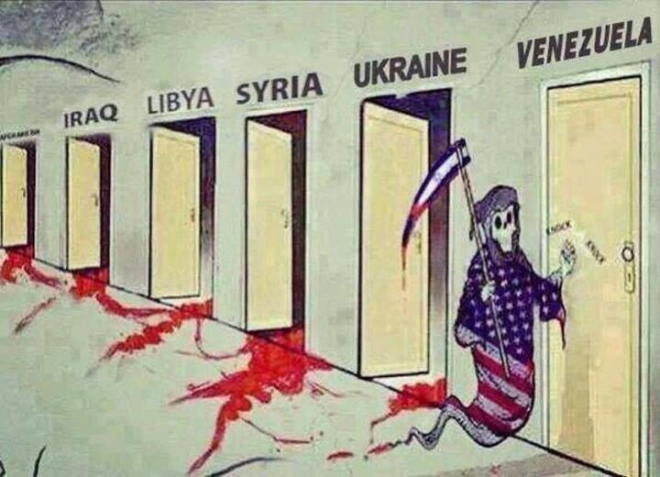
Many countries around the world are plagued by all kinds of armed rebellions, economic sanctions, civil wars, “democratic” coup d’états and/or wars of “regime change.” These include Ukraine, Venezuela, Syria, Thailand, Iran, Afghanistan, Iraq, Egypt, Yemen, Somalia and Lebanon. Even in the core capitalist countries the overwhelming majority of citizens are subjected to brutal wars of economic austerity.
While not new, social convulsions seem to have become more numerous in recent years. They have become especially more frequent since the mysterious 9-11 attacks on the World Trade Center in 2001 and the 2008 financial collapse in the United States, which soon led to similar financial implosions and economic crises in Europe and beyond.
Despite their many differences, these social turbulences share two common features. The first is that they are largely induced, nurtured and orchestrated from outside, that is, by the Unites States and its allies—of course, in collaboration with their class allies from inside. And the second is that, contrary to the long-established historical pattern of social revolutions, where the desperate and disenfranchised masses rebelled against the ruing elites, in most of the recent struggles it is the elites that have instigated insurgencies and civil wars against the masses. The two features are, of course, integrally intertwined: essentially reflecting the shared interests and collaborative schemes of the international plutocracies against the global 99%.
Fighting to Make Austerity Economics Universal
The official rationale (offered by the U.S. and its allies) that the goal of supporting anti-government opposition forces in places such as Syria, Ukraine and Venezuela is to spread democracy no longer holds any validity; it can easily be dismissed as a harebrained pretext to export neoliberalism and spread austerity economics. Abundant and irrefutable evidence shows that in places where the majority of citizens voted for and elected governments that were not to the liking of Western powers, these powers mobilized their local allies and hired all kinds of mercenary forces in order to overthrow the duly elected governments, thereby quashing the majority vote.
Such blatant interventions to overturn the elections that resulted from the majority vote include the promotion of the Orange Revolution in Ukraine (2004 and 2014), Rose Revolution in Georgia (2003), Cedar Revolution in Lebanon (2005), Tulip Revolution in Kyrgyzstan (2005) and the Green Revolution in Iran (2009). They also include the relentless agitation against the duly elected governments of the late Hugo Chavez and now his successor Nicolás Maduro in Venezuela, as well as the rejection (and effective annulment) of the duly elected Hamas government in Palestine.
So, the real driving forces behind wars of regime change need to be sought elsewhere; specifically, in the imperatives of expansion and accumulation of capital on a global level. Socialist, social-democratic, populist or nationalist leaders who do not embrace neoliberal economic policies, and who may be wary of having their markets wide open to unbridled foreign capital, would be targeted for replacement with pliant leaders, or client states. This is, of course, not a new explanation of economic imperialism; it is as old as the internationalization of trade and investment.
What is relatively new, and seems to be the main driving force behind the recent wars of regime change, is that, as the U.S. and other major capitalist powers have lately embarked on austerity economic policies at home they also expect and, indeed, demand that other countries follow suit. In other words, it is no longer enough for a country to open its markets to investment and trade with Western economic powers. It seems equally important to these powers that that country also dismantle its public welfare programs and implement austerity measures of neoliberalism.
For example, after resisting imperialist pressures for years, the late Libyan leader Muammar al-Gaddafi eventually relented in 1993, and granted major oil and other transnational corporations of Western powers lucrative investment and trade deals. Under pressure, he even dismantled his country’s nuclear technology altogether in the hope that this would please them to “leave him” alone, so to speak. None of the concessions he made, however, proved satisfactory to the U.S. and its allies, as his regime was violently overthrown in 2011and he was literally butchered by the thuggish gangs that were trained and armed by Western powers.
Why? Because the U.S. and its allies expected more; they wanted him to follow the economic guidelines of the “experts” of global finance, that is, of the U.S. and European economic “advisors,” of the International Monetary Fund and of the World Trade Organization—in short, to dismantle his country’s rather robust state welfare programs and to restructure its economy after the model of neoliberalism.
The criminal treatment of al-Gaddafi can help explain why imperialist powers have also been scheming to overthrow the populist/socialist regimes of the late Hugo Chavez and his successor in Venezuela, of the Castro brothers in Cuba, of Rafael Correa Delgado in Ecuador, of Bashar Al-assad in Syria and of Evo Morales in Bolivia. It also helps explain why they overthrew the popularly elected nationalist governments of Mohammad Mossadeq in Iran, of Jacobo Arbenz in Guatemala, of Kusno Sukarno in Indonesia, of Salvador Allende in Chile, of Sandinistas in Nicaragua, of Jean-Bertrand Aristide in Haiti and of Manuel Zelaya in Honduras.
The imperialist agenda of overthrowing al-Gaddafi and other “insubordinate” proponents of welfare state programs abroad is essentially part of the same evil agenda of dismantling such programs at home. While the form, the context and the means of destruction may be different, the thrust of the relentless attacks on the living conditions of the Libyan, Iranian, Venezuelan or Cuban peoples are essentially the same as the equally brutal attacks on the living conditions of the poor and working people in the US, UK, France and other degenerate capitalist countries. In a subtle way they are all part of an ongoing unilateral class warfare on a global scale. Whether they are carried out by military means and bombardments or through the apparently “non-violent” processes of judicial or legislative means does not make a substantial difference as far as their impact on people’s lives and livelihoods is concerned.
The powerful plutocratic establishment in the core capitalist countries does not seem to feel comfortable to dismantle New Deal economics, Social Democratic reforms and welfare state programs in these countries while people in smaller, less-developed countries such as (al-Gaddafi’s) Libya, Venezuela or Cuba enjoy strong, state-sponsored social safety net programs. Plutocracy’s intolerance of “regimented” economies stems from a fear that strong state-sponsored economic safely net programs elsewhere may serve as “bad” models that could be demanded by citizens in the core capitalist countries.
In a moment of honesty, former U.S. President Harry Truman is reported as having expressed (in 1947) the unstated mission of the United States to globalize its economic system in the following words: “The whole world should adopt the American system. The American system can survive in America only if it becomes a world system” [1].
In a similar fashion, Lord Cecil Rhodes, who conquered much of Africa for the British Empire, is reported to have suggested during the heydays of the Empire that the simplest way to achieve peace was for England to convert and add the rest of the world (except the United States, Germany and few other Western powers of the time) to its colonies.
The Mafia equivalent of Truman’s or Rhodes’ statements would be something like this: “You do it our way, or we break your leg.”
The mindset behind Truman’s blunt statement that the rest of the world “should adopt the American system” has indeed served as something akin to a sacred mission that has guided the foreign policy of the United States ever since it supplanted the British authority as the major world power.
It explains, for example, the real and the main reason behind the Cold War hostilities between the U.S. and its allies, on the one side, and the Soviet Union and its allies, on the other. While the “threat of communism” has been the official rationale for the start and escalation of those hostilities, there is convincing evidence that not only Joseph Stalin and his successors in the Soviet Union had no plans to wage war against the United States or its allies but that, in fact, they played a restraining role to contain independent revolutionary movements worldwide. “It is often forgotten,” points out Sidney Lens, “that for a few years after the war, he [Stalin] assumed an exceedingly moderate posture. . . . His nation had lost 25 million people in the war, was desperately in need of aid for rebuilding, and continued for a long time to nurture hopes of coexistence. Far from being revolutionary, Stalin in those years put the damper on revolution wherever he could” [2]. To accommodate the United States and other Western powers in the hope of peaceful coexistence, Stalin often advised, and sometimes ordered, the pro-Moscow communist/leftist parties in Europe and elsewhere in the world to refrain from revolutionary policies that might jeopardize the hoped-for chances of coexistence.
The goal or mission of converting other economies to the U.S.-style capitalism also helps explain why the United States has engaged in so many military operations and engineered so many coup d’états and regime changes around the world. The Federation of American Scientists has recorded a list of U.S. foreign military engagements which shows that in the first decade after the collapse of the Berlin Wall (1989-99) the U.S. engaged in 134 such operations, the majority of which are altogether unknown to the American public [3].
Global financial elites change “unaccommodating” regimes not only in the less developed countries but also in the core capitalist countries. They accomplish this not so much by military means as by utilizing two very subtle but powerful means: (a) artificial, money-driven elections, peddled as “democracy in action”; and (b) powerful financial institutions and think tanks such as the International Monetary Fund (IMF), central banks and bond/credit rating agencies like Moody’s, Standard & Poor’s and Fitch Group. An unfavorable rating report by these agencies on the credit status of a country can create havoc on that country’s economic, financial and currency position in world markets, thereby dooming its government to collapse and replacement. This is how during the ongoing financial turbulence of recent years a number of governments have been changed in places like Greece and Italy—no need for the traditional or military style regime change, the “soft-power” financial coup d’état engineered by the IMF and/or rating agencies would serve the purpose even more effectively.
Class War on a Global Scale
As noted, all the schemes and wars of regime change, whether by the traditional military means or by the “soft” power of the global financial juggernaut, essentially represent one thing: a disguised class war on a global level, a relentless worldwide economic war by the one percent financial-economic oligarchy against the rest of the world population.
Class struggle in an economically-tiered society is of course not new. What is relatively new in the recent years’ war of the 1% against the 99% is its escalated pace, its widespread scale and its globally orchestrated character. While neoliberal austerity attacks on the living conditions of the public in the core capitalist countries began (formally) with the supply-side economics of President Ronald Reagan and Prime Minister Margaret Thatcher more than three decades ago, the brutality of such attacks have become much more severe in the context of the current financial/economic crisis, which began with the 2008 financial crash in the United States.
Taking advantage of the crash (as an economic shock therapy, as Naomi Klein put it), the financial oligarchy and their proxies in the governments of the core capitalist countries have been carrying out a systematic economic coup d’état against the people the ravages of which include the following:
• Transfer of tens of trillions of dollars from the public to the financial oligarchy through merciless austerity cuts;
• Extensive privatization of public assets and services, including irreplaceable historical monuments, priceless cultural landmarks, and vital social services such as healthcare, education and water supply;
• Substitution of corporate/banking welfare policies for people’s welfare programs;
• Allocation of the lion’s share of government’s monetary largesse (and of credit creation in general) to speculative investment instead of real investment;
• Systematic undermining of the retirement security of millions of workers (both white and blue collar) and civil servants;
• Ever more blatant control of economic and/or financial policies by the representatives of the financial oligarchy.
Combined, these policies have significantly aggravated the already lopsided income/wealth distribution in these countries. The massive cuts in social spending have resulted in an enormous transfer of economic resources from the bottom up. The transfer has, indeed, more than made up for the 2008 losses of the financial speculators. In the U.S., for example, the wealthiest one percent now own 40 percent of the entire country’s wealth; while the bottom 80 percent own only seven percent. Likewise, the richest one percent now take home 24 percent of the country’s total income, compared to only nine percent four decades ago [4].
This shows that, as pointed out earlier, while neoliberal attacks on the 99% in the core capitalist countries may not seem as violent as those raging, for example, in Venezuela, Syria or Ukraine, the financial impact of such attacks on the living conditions of the 99% is not any less devastating.
Plutocrats of the World Are United
Policies of regime change are usually designed and carried out as collaborative schemes by cross-border plutocracies, that is, by the financial oligarchies of the imperialist countries in partnership with their native counterparts in the less-developed countries.
In addition to constant behind-the-scenes strategizing, representatives of transnational capital and their proxies in capitalist governments also routinely meet at international conferences in order to synchronize their cross-border business and financial policies—a major focus of which in recent years has been to implement global austerity measures and entrench neoliberal policies worldwide. These include the World Economic Forum in Davos, Switzerland, the World Bank and IMF annual meetings, the Periodic G20 meetings, the Aspen Institute’s Ideas Festival, The Bilderberg Group annual geopolitics forum, and the Herb Allen’s Sun Valley gathering of media moguls—to name only a handful of the many such international policy gatherings.
Through its global strategies and operations, transnational capital has broken free from national constraints and commitments at home and successfully shifted the correlation of class forces and social alliances worldwide. Today’s elites of global capitalism “are becoming a trans-global community of peers who have more in common with one another than with their countrymen back home,” writes Chrystia Freeland, Global Editor of Reuters, who travels with the elites to many parts of the world. “Whether they maintain primary residences in New York or Hong Kong, Moscow or Mumbai, today’s super-rich are increasingly a nation unto themselves,” she adds [5].
Implications for Globalization from Below
What conclusions can the 99% draw from this? What can the working people and other grassroots do to protect their jobs, their sources of livelihood, their communities and their environment? What can communities of ordinary people do to undermine the strategies of the global 1% that block life-sustaining progressive social and economic reforms?
In the same fashion that, in their fight against the working people, the elites of the international capitalist class are not bound by territoriality or national boundaries, so does the working class need to coordinate its response internationally.
A logical, first step deterrent to transnational capital’s strategy of blackmailing labor and communities through threats such as destroying or exporting jobs by moving their business elsewhere would be to remove the lures that induce plant relocation, capital flight or outsourcing. Making labor costs of production comparable on an international level would be crucial for this purpose. This would entail taking the necessary steps toward the international establishment of wage and benefits, that is, of labor cost parity within the same company and the same trade, subject to (a) the cost of living, and (b) productivity in each country.
A strategy of this sort would replace the current downward competition between workers in various countries with coordinated bargaining and joint policies for mutual interests and problem-solving on a global level. While this may sound radical, it is not any more radical than what the transnational 1% is doing: coordinating their anti-99% strategies on a global scale. If at an earlier stage of capitalist development “workers of the world unite” seemed an outlandish dream of the leading labor champion Karl Marx, internationalization of capital, the abundance of material resources and developments in technology, which has greatly facilitated cross-border organizing and coordination of actions by the 99%, has now made that dream an urgent necessity.
As capital and labor are the cornerstones of capitalist production, their respective organizations and institutions evolve more or less apace, over time and space. Thus, when production was local, so was labor: carpenters, shoemakers, bricklayers, and other craftsmen organized primarily in their local communities. But as capitalist production became national, so did trade unions. Now that capitalist production has become global, labor organizations too need to become international in order to safeguard their and their communities’ rights against the profit-driven whims of the footloose and fancy-free transnational capital.
Many would argue that these are not propitious times to speak of radical alternatives to capitalism. The present state of the sociopolitical landscape of our societies appears to support such feelings of pessimism. The high levels of unemployment in most countries of the world and the resulting international labor rivalry, combined with the austerity offensive of neoliberalism on a global level, have thrown the working class and other grassroots on the defensive. The steady drift of the European socialist, Social Democratic, and labor parties/governments toward the U.S.–style market economies and the erosion of their traditional ideology, power, and prestige have led to workers’ confusion there. The collapse of the Soviet Union, however much some socialists have always distanced themselves from that system, haunts the specter of socialism, and is likely to do so for some time to come. These developments have understandably led to workers’ and other grassroots’ confusion and disorientation globally.
None of these, however, mean that there is no way out of the status quo. Capitalism is not only “destructive,” it is also “regenerative,” as Karl Marx put. As it captures world markets, universalizes the reign of capital, and disrupts the living conditions for many, it simultaneously sows the seeds of its own transformation. On the one hand, it creates common problems and shared concerns for the majority of the world population; on the other, it creates the material conditions and the technology that facilitate communication and cooperation among this majority of world citizens for joint actions and alternative solutions.
When the majority of world population, the global 99%, will come to the realization and determination to actually appropriate and utilize the existing technology and material resources for a better organization and management of the world economy, no one can tell. But the potential and the long term trajectory of global socioeconomic developments point in that direction. The distance between now and then, between our immediate frustrations and the superior but elusive civilization of our desire, can be traversed only if we take the necessary steps toward that end [6].
Ismael Hossein-zadeh is Professor Emeritus of Economics, Drake University, Des Moines, Iowa. He is the author of The Political Economy of U.S. Militarism (Palgrave – Macmillan 2007), the Soviet Non-capitalist Development: The Case of Nasser’s Egypt (Praeger Publishers 1989), and most recently, Beyond Mainstream Explanations of the Financial Crisis (forthcoming from Routledge, April 29, 2014).
Ukrainian Democracy: A Barrier to Washington’s Goals
What Do Ukrainians Really Want?
By Nick Alexandrov | CounterPunch | February 28, 2014
When Ukraine is the topic, the major U.S. media outlets agree: “Europe and the United States have made a priority of fostering democracy in the former Soviet republics,” David M. Herszenhorn wrote in the New York Times. The Washington Post asserted that Ukraine is “a country that has been struggling to become a genuine democracy” with help from Western powers, who keep it “from becoming an autocratic Kremlin colony, like neighboring Belarus.” “Ukraine is the crossroads between a free and an authoritarian Europe,” the Wall Street Journal concurred, while Yale professor Timothy Snyder urged, in a CNN piece, Europe and America to back the Ukrainian protesters—“a chance to support democracy,” he emphasized. Marvelous. But in the real world, Ukrainian democracy is not merely something Washington has failed to support, but is actually incompatible with U.S. governmental aims.
U.S. officials are quite open about their opposition to Ukrainian self-determination and well-aware how unpopular Washington’s preferred policies are. Nearly a decade ago, for example, the U.S. House of Representatives’ Subcommittee on Europe met for a hearing on “Ukraine’s Future and U.S. Interests.” Rep. Doug Bereuter (R-NE) opened the session, noting that “a recent survey conducted by a center for economic and political research suggests that up to 40 percent of Ukrainians believe that relations with Russia should be a priority.” Meanwhile, “28 percent gave preference to the EU,” and “2 percent said that relations with the U.S. should be a foreign policy priority. Another survey suggested that almost two-thirds of the population would consider supporting a political union with Russia,” Bereuter concluded. “So,” he went on, “I think that United States policy must remain focused” on incorporating Ukraine “into European and Euro-Atlantic structures.” Rep. Robert Wexler (D-FL) spoke next, reiterating that U.S. policy should “further Ukraine’s integration in Euro-Atlantic institutions;” Steven Pifer, the former Ambassador to Ukraine, drove the point home, outlining “the United States Government’s vision for Ukraine”: “increasingly close ties to Europe and Euro-Atlantic institutions.” This vision persisted over the following decade. The Atlantic Council’s Damon Wilson, speaking before the U.S. Senate’s Subcommittee on European Affairs—the topic was “Ukraine at a Crossroads”—in February 2012, explained that “Ukraine’s genuine European integration” remained a major objective.
And recent commentary and news coverage depicts European integration as something most Ukrainians desire. In early February, Secretary of State Kerry, at the Munich Security Conference, remarked that Ukrainians should be permitted “to associate with partners who will help them realize their aspirations”—Europe and the U.S. obviously being the partners, integration to be deepened via what the Times’ Herszenhorn referred to as “sweeping political and trade agreements” that Ukrainian President Viktor Yanukovych “refused to sign” last November, resulting in “a broken promise between a leader and his citizens,” and then the uprisings. Now Al Jazeera reports that the acting president, Oleksander Turchinov, has “made clear that Kiev’s European integration would be a priority,” thereby giving Ukrainians what we’re told they want.
But British and U.S. governmental studies reveal the Ukrainian public is ambivalent about European integration. Britain’s Foreign and Commonwealth Office, for example, funded a “scoping study” through the British Embassy in Kyiv a year ago, titled “A blueprint for enhancing understanding of and support for the EU-Ukraine Association Agreement [AA] including DCFTA [Deep and Comprehensive Free Trade Area] in Ukraine.” The AA was one of the key “sweeping political and trade agreements” Yanukovych refused to sign. British officials, in their report, stressed that “support for the AA is not overwhelming amongst the population at large,” observing that “opinion polls show that about 30% of respondents are in favour of European integration, 30% for the Customs Union [Moscow-led integration], and about 30% are undecided.” This bleak situation called for a propaganda offensive, or “a national public awareness ‘Campaign of Arguments,’” as the British dubbed it, which was to “be aimed at the general public as its primary target audience.” British advisers urged PR teams “to formulate advertising slogans, global and targeted messages,” and to play up “the European civilizational model” and other benefits the AA allegedly would bring. This “civilizational model” today entails “massive attacks on public services, wages, pensions, trade unions, and social rights” under imposed “draconian austerity policies,” Asbjørn Wahl wrote in January’s Monthly Review—a reality the British indoctrination scheme’s outline studiously avoided, it’s hardly worth mentioning.
The propaganda barrage may have been successful to some extent. But as the year progressed, the U.S. government had a hard time finding evidence of overwhelming Ukrainian support for European integration. The International Republican Institute (IRI), for example, polled Ukrainians last September: “If Ukraine was able to enter only one international economic union, with whom should it be?” Forty-two percent of respondents chose the EU, while 37% preferred the Russian Customs Union. IRI then asked, “How would you evaluate your attitude towards the following entities?” Fifty percent of respondents felt “warm” towards Russia; 41% felt “warm” towards Europe—and just 26% were fond of the U.S. IRI figures resembled those USAID published in a December 2013 report. Its authors found it “interesting to note that Ukrainians are split on whether the country should join the European Union or the Customs Union. Thirty-seven percent would like Ukraine to take steps to join the European Union, 33% prefer the Customs Union and 15% say Ukraine should join neither of these blocs.” Furthermore, “34% say that Ukraine should have closer economic relations with Russia, 35% say it should have closer economic relations with Europe and 17% say it should have good relations with both.” A Kyiv International Institute of Sociology poll reinforced these findings: “Ukraine is split practically 50/50 over the accession to the European Union or the Customs Union,” Interfax-Ukraine summarized the study’s conclusions.
Reviewing this data forces us to ask: Who is Washington’s chief enemy in Ukraine? Is it Russia, bent on killing Ukraine’s budding democracy? Is it the tyrant Yanukovych? The U.S. policy record points to a different conclusion, one a Johns Hopkins Center for Transatlantic Relations study—included in the official transcription of the Senate’s 2012 “Ukraine at a Crossroads” hearing—discusses in the context of Ukraine’s potential NATO membership. “The main obstacle” to Ukraine’s joining the organization “is not Russian opposition,” its authors emphasized, “but low public support for membership in Ukraine itself.” Again: on this and other issues, the Ukrainian people are “the main obstacle” to U.S. foreign policy aims. We should bear this fact in mind as the crisis deepens in Eastern Europe.
Nick Alexandrov lives in Washington, DC.
Gunmen from Kiev attempted to seize Crimea’s Interior Ministry overnight – Russia
RT | March 1, 2014
Unknown armed men from Kiev have tried to seize the Crimean Interior Ministry overnight, Russia’s Foreign Ministry said in a statement. It’s as Crimea’s PM urges Russia to help cope with the crisis, ensuring “peace and calm” in the region.
“Thanks to the decisive action of self-defense squads, the attempt to seize the building of the Interior Ministry was derailed. This attempt confirms the intention of prominent political circles in Kiev to destabilize the situation on the peninsula,” the statement added.
“We believe it is extremely irresponsible to further pressure the already tense situation in the Crimea,” the ministry stated stressing its concerns over the latest developments in the region.
Earlier, Crimea’s Prime Minister Sergey Aksyonov declared that firearms have been used in the clashes in the region, Itar-Tass news agency reported. The PM said the local Ministers’ Council and Supreme Court came under an attack.
He said he would temporarily manage all national security forces in the region, including police, emergency services and the Interior Ministry.
“All chiefs of staff should follow my orders. As for those who disagree, I ask them to leave the service,” Aksyonov said in an urgent statement to the region’s security forces.
Aksyonov said he had asked Russia’s President Vladimir Putin to “help ensure peace and calm on the territory of the autonomous region.” The request, the premier said, was due to “the understanding of the responsibility for the life and safety of the residents.”
Russian MPs urge Putin to react to Crimea crisis
A source in the Kremlin administration replied, “Russia won’t ignore that address,” Russian news agencies reported. Later in the day, both chambers of the Russian parliament asked Putin to take measures to ensure stability in Crimea.
“The Duma Council adopted an appeal to the president of Russia, in which parliamentarians are calling on the president to take measures to stabilize the situation in Crimea and use all available means to protect the people of Crimea from tyranny and violence,” said Lower House speaker Sergey Naryshkin.
The State Duma also said that currently it is impossible to conduct legitimate and democratic elections in Ukraine due to actions of “radical forces.”
The Upper Chamber of the Russian Parliament admitted a limited number of Russian troops could be brought to Crimea to ensure safety, speaker Valentina Matvienko said.
“It’s possible in this situation, complying with a request by the Crimean government, even to bring a limited contingent of our troops to ensure the safety of the Back Sea Fleet and the Russian citizens living on the Crimea territory. The decision is for the president, the chief military commander, to make of course. But today, taking the situation into account, even that variant can’t be excluded. We need to protect the people,” Matvienko said.
In their turn, Ukraine’s self-proclaimed authorities urged Moscow to “withdraw troops and comply with bilateral agreements” and “resolve the crisis peacefully and politically,” interim President Arseny Yatsenyuk said.
This comes despite Russia’s repeated statements that all military operations in the region fall within in the framework of the agreement that concerns the Russian naval base in the Black Sea.
Although Western politicians and the media have expressed concern over Russia’s alleged involvement in Crimea, they have not been able to produce any solid evidence. A US State Department spokeswoman told a press conference they have no confirmation of “intervention” in Crimea.
So far, Moscow and the Crimean authorities have agreed to guard objects belonging to the Russian Black Sea Fleet, whose main base is located in Sevastopol, according to RIA Novosti.
Crimeans began protesting after the new self-proclaimed government in Kiev introduced a law abolishing the use of other languages in official circumstances in Ukraine. More than half the Crimean population are Russian and use only this language for their communication. The residents have announced they are going to hold a referendum on March 30 to determine the fate of the Ukrainian autonomous region.
Featured Video
Prof. Ted Postol: US–Iran War? Israel’s Fatal Gamble
or go to
Aletho News Archives – Video-Images
From the Archives
Neocon Max Boot: Legal and illegal aliens need to enlist in the US army and die for Israel
By Jonas E. Alexis | Veterans Today | October 16, 2107
In 1973 Irving Kristol, the godfather of the Neoconservative movement, made a stunning statement which is still relevant to understanding the Israeli influence in US foreign policy. Kristol said:
“Senator McGovern is very sincere when he says that he will try to cut the military budget by 30%. And this is to drive a knife in the heart of Israel… Jews don’t like big military budgets. But it is now an interest of the Jews to have a large and powerful military establishment in the United States…
“American Jews who care about the survival of the state of Israel have to say, no, we don’t want to cut the military budget, it is important to keep that military budget big, so that we can defend Israel.”
Read the statement again very carefully. A big military budget, said Kristol, is only good for Israel, not America or much of the Western World. In other words, precious American soldiers who go to the Middle East to fight so-called terrorism are just working for Israel, not for America.
So, whenever the Neocons use words such as “democracy” or “freedom,” they are essentially conning decent Americans to support Israel’s perpetual wars. … continue
Blog Roll
 Aletho News
- Friedrich Merz’s Push to End Online Anonymity Has a Troubling Subtext
- Macron: French citizens fighting for Israel cannot be labeled ‘genociders’
- US eyes Gaza security force drawn from armed gangs
- The Only Motive Behind The ‘Imminent’ U.S. War With Iran Is The Zionist Lobby
- Trump eyes 350-acre US military base housing 5,000 troops in Gaza
- Israel Pushing US Toward a Big and Damaging War With Iran – Ex-Pentagon Analyst
- Meet The Liberal Zionist And Ukraine War Supporter Advising AOC On Foreign Policy
- Buck Dancing for Zion: Kenya’s and Nigeria’s Growing Love Affair With Israel
- Israel installed, oversaw security system at Barak-Epstein residence in New York: Report
- ‘Britain’s Index of Repression’ documents 964 incidents of anti-Palestinian crackdown
- If Americans Knew
- Tucker Carlson interrogated in Israel, has passport seized after interviewing US ambassador
- 6,000 Amputees in Gaza Face Impossible Recovery amid Israeli War Ultimatum
- The Lancet: Gaza death toll far higher than reported – Not a ceasefire Day 132
- Compliant aid: Who are the Israel-approved NGOs scaling up in Gaza?
- Why won’t Trump’s “Board of Peace” bring peace? – Not a ceasefire Day 131
- Help end the injustice against Shadi
- Israel’s Favorite American President
- Israel’s “Yellow Line” Is a Death Trap for Palestinians. We Drove Into It.
- Why Israel’s expanding occupation in Syria presents a critical legal test
- Gaza is not a natural disaster. It is the victim of genocide enabled by global inaction
- No Tricks Zone
- Coal Power Back In Trend As Globe Tries To Keep Pace With Growing Demand For Power
- New Study: A 4°C Warmer Beaufort Sea Had ‘No Sea Ice’ 11,700 – 8200 Years Ago
- Unfudging The Data: Dutch Meteorological Institute Reinstates Early 20th Centruy Heat Waves It Had Erased Earlier
- German Gas Crisis…Chancellor Merz Allegedly Bans Gas Debate Ahead of Elections!
- Pollen Reconstructions Show The Last Glacial’s Warming Events Were Global, 10x Greater Than Modern
- Germany’s Natural Gas Storage Level Dwindles To Just 28%… Increasingly Critical
- New Study Rebuts The Assumption That Anthropogenic CO2 Molecules Have ‘Special’ Properties
- Climate Scientist Who Predicted End Of “Heavy Frost And Snow” Now Refuses Media Inquiries
- Polar Bear Numbers Rising And Health Improving In Areas With The Most Rapid Sea Ice Decline
- One Reason Only For Germany’s Heating Gas Crisis: Its Hardcore-Dumbass Energy Policy
 Aletho News