Crimean self-defense squads enter Belbek airbase
RT | March 22, 2014
Crimean self-defense forces have surrounded Belbek airbase near Sevastopol after Ukrainian troops inside refused to lay down their arms and leave the base in accordance to the Crimean prime minister’s order.
The self-defense squads are now in control of the airbase while the Ukrainian troops have been given an opportunity to leave, Dmitry Osipenko, a journalist for Sevastopol news website ForPost who was present at the scene, told RT.
The commander of the airbase, Yuliy Mamchur, has been escorted to negotiations with Crimean authorities.
“After they refused [to leave the base] the Sevastopol self-defense troops tried to enter the territory of the base,” while gunfire was heard at the scene. “According to my information nobody was injured, but I’m not sure,” said Osipenko.
Osipenko claimed the gunfire was coming from the side of the Ukrainian troops. However, it is unclear who was shooting. “The self-defense forces hid behind cars and then a car rammed the gate [of the airbase],” he said.
He stated that apart from the self-defense squads, Sevastopol Cossaks were present.
The move follows the March 16 all-Crimean referendum which resulted in over 96 percent of voters opting for the autonomous republic to join Russia. Eighty-three percent of the Crimeans took part in the vote. The decision was sparked by bloody protests in Kiev that resulted in the ousting of President Viktor Yanukovich and fears that the unrest might spread to Crimea.
Russia finalized the legal process of taking Crimea under its sovereignty on Friday, with President Vladimir Putin signing a law amending the Russian constitution to reflect the transition.
‘We are being abandoned’
Though Crimea is no longer part of Ukraine, Kiev authorities have not yet officially ordered Ukrainian troops to leave their bases in Crimea.
Ukrainian military troops stationed at Belbek criticized their leadership for abandoning them in a post on the airbase’s blog.
“We are being abandoned – most sadly by our own government,” it reads. “The most dangerous enemy appeared to be our leadership and our government.”
“Today I’ve found an interview with Acting Minister of Defense [Igor] Tenyukh where he says he maintains contact with all troops on the territory of the Autonomous Republic of Crimea, that all relevant orders were given and the situation is under control. There were only two orders – ‘remain in place’ and ‘[you are ] allowed to use weapons.’ That’s it!”
“What is expected [of us] in case of an assault?” the military asked. ”There were no clear answers given to us.”
Meanwhile, most US financial assistance to Ukraine will focus on the formation and maintenance of the new military – the National Guard, said a source from the Ukrainian Ministry of Defense, as cited by Itar-Tass.
“Kiev is not planning to fund the army or navy which are in a deplorable state,” the source said.
The National Guard, the custodian of the coup-imposed government, is already in formation and will be comprised of 60,000 men and women from former and current Ukrainian troops and volunteers from Maidan self-defense squads. It will be appointed by the parliament upon the recommendation of the acting president.

Why the Kuala Lumpur Tribunal’s genocide verdict against Israel sets a key precedent
By Nadezhda Kevorkova | RT | December 4, 2013
Until now, Israel has been getting away with anything it likes. A series of revolutions and counter-revolutions in the Arabic world has driven it into chaos, and seems to have pushed the Palestinian issue off the international agenda for good.
And yet Malaysia, a predominantly Muslim country, has now called a tribunal for war crimes and produced a genocide ruling – against whom?
Not against Assad, as one might have expected, but against Israel, the state that considers itself to be beyond the jurisdiction of any court or tribunal.
In Hamlet, the message that the king killed his brother to marry his widow and seize the throne is delivered by the murdered king’s spirit – which literally means by someone who cannot testify in court. As a result, Prince Hamlet spends a long time tormenting himself about whether he should believe the spirit and avenge his father. After that, he undertakes a smart move – asking a troupe of actors to stage a play reenacting his father’s murder, while he watches the murderer’s reaction. At the end of the play, everyone dies, but Hamlet has gotten his revenge.
That’s how people’s justice usually works – it takes a long time, it’s messy and ultimately useless from a rational viewpoint. It would have been much more rational for Prince Hamlet to pay due honor to the new king and his new wife, Hamlet’s mother, pray for his deceased father, marry Ophelia and have lots of children, then inherit the throne in due time and just keep on living…
The spectators watch how the prince’s world and values are shattered to the ground. The father’s spirit has its word. The actors have played out their play, and the murderer has been betrayed by his reaction.
For the first time, an international war crimes tribunal has charged the State of Israel of genocide, an unprecedented event, as so far no international court or tribunal has ever delivered a verdict against Israel to date.
The International Tribunal convened in Kuala Lumpur, Malaysia. Israel refused to send any representatives. The Kuala Lumpur War Crimes Tribunal has no official ties to the UN and acknowledges that it has not authority to deliver punishment. Opinions differ on the subject of its jurisdiction, and the only sanction it has in its power is to enter the name and title of the party found guilty in the Tribunal’s registry and announce it publicly to the world. In 2011, the tribunal found George Bush and Tony Blair guilty of crimes against peace, crimes against humanity, and genocide as a result of their roles in the Iraq War.
It seems that one could just as well ignore this tribunal; much like Israel ignores the condemning UN resolutions, protests, severed diplomatic relationships and all other kinds of protests against the military actions and acts of violence applied against the Palestinians on a daily basis. However, a detailed trial like this indicates that the mechanism has been set in motion, which will have consequences for the entire world, not just for Israel or the Middle East.
The International Tribunal is part of the Kuala Lumpur Commission on War Crimes; however, these two institutions are not part of Malaysia’s judicial system, even though they employ judges and prosecutors of Malaysian background. Israel has no agreements signed with this or any other international court. Yet the Tribunal acts on the basis of the UN Convention on the Prevention and Punishment of the Crime of Genocide of 1948, which was signed and ratified by Israel. And this very signature, Israel’s membership in the UN and the fact that Israel owes its very existence to the UN and to the condemnation of genocide against Jews in the course of World War II – all this at the very least gives us the right to challenge and discuss whether Israel’s own actions could fall into the category of genocide.
Interestingly, the USA has been refusing to sign this document for 37 years, having reasonable fears that many lawyers would want to charge the USA itself with genocide of the Indians and African slaves, as well as the Japanese, the Koreans, the Vietnamese and many others. Israel, in its turn, did not foresee that the very convention it pushed the world to adopt after the war will one day be used against it. The very formation of the State of Israel was made possible by the agreement of the victorious powers to acknowledge that Jews were victims of genocide carried out by Nazi Germany and that only having a nation state of its own can guarantee them proper protection.
“The victims of genocide became themselves the source of it.” This is how Hedi Epstein sees the essence of the ruling against Israel. A German Jew who survived WWII, she lost her parents to a concentration camp. Epstein was a prosecution witness in the Nuremberg Trials. And in 1982, she learned that the Israeli Army occupied Lebanon and provoked mass executions in the Sabra and Shatila Palestinian refugee camps. From that moment on, Epstein and hundreds of other Jews embarked on an anti-military and anti-Zionist campaign. However, Israel has refused to listen to their voices. They were labeled “self-hating” Jews and banned from the country which, incidentally, announced itself to be the homeland of all Jews in the world. Israel remained deaf to their warning that the Jews who survived genocide do not wish Israel to be committing genocidal crimes against the Palestinian people in their name.
Israel was convinced that the US would never cease to provide it with military and political assistance, so it had nothing to worry about. The Jewish “weirdos” are free to organize as many useless marches and “freedom flotillas” as they wish; no one will dare to find Israel guilty.
And now Israel has received its first wake-up call.
The hearings on the genocide lawsuit started in August 2013. But the news soon faded into the background as the media extensively covered the mass shooting of hundreds of Egyptians who disagreed with President Morsi’s arrest and the growing tensions around Syria due to a possible American missile strike.
On November 20-25, the final stage of the proceedings took place, initiated by a group of Palestinians, who reported a number of incidents.
The first one involved Israeli soldiers who killed 29 members of the extended Samouni family in the Zeitoun neighborhood of the Gaza Strip during the 22-day Operation Cast Lead in 2008 and 2009.
This is the most notorious crime against Palestinians over the last few years. Judge Goldstone incorporated it into his report, which he submitted to the UN after the operation was over.
The Samounis were a large family of peaceful farmers. None of them had ever participated in armed resistance. They were some of the few Palestinians who got on well with the Israeli settlers and they were frustrated by the removal of the settlements from the Gaza Strip.
In January 2009, an Israeli helicopter landed on their field. A few gunmen demanded that the Samounis turn in the Hamas militants to them. The next thing they did was bring the whole family under one roof and shoot them down dead, including the infants. Those who survived were found under the bodies of their relatives.
One of the survivors was the children’s mother. She repeatedly tried to get a criminal case started in various courts of law, but failed to get any compensation or apologies from Israel.
The second story revolved around the mass shooting of women and children in the Sabra and Shatila camps in Lebanon in 1982.
Other incidents included:
– lethal firing of teargas canisters and rubber bullets by Israeli Defense Forces that resulted in the deaths of unarmed civilians during the Intifada campaigns and subsequent protests;
– intensive, indiscriminate aerial bombing and artillery shelling of civilian quarters in the Gaza Strip in 2008;
– a university student who was shot without warning at a peaceful protest by an Israeli sniper, firing a fragmentary bullet that caused extensive and permanent damage to his internal organs;
– a Christian resident of the West Bank who was repeatedly imprisoned and tortured on grounds of subversion;
– a female resident of Nablus who suffered mental anxiety due to her imprisonment and subsequent social ostracism;
– a Palestinian physician who conducted studies on the psychological trauma inflicted, particularly on children, as result of constant intimidation, massive violence and state terror during and following the second Intifada; and
– Expert witness Paola Manduca, an Italian chemist and toxicologist, who found extreme levels of toxic contamination of the soil and water across the Gaza Strip, caused by Israeli weapons made of heavy metals and cancer-causing compounds.
The Tribunal found the State of Israel guilty of genocide of the Palestinian people in each of these cases, blaming former general Amos Yaron for the Sabra and Shatila massacre.
The Tribunal’s verdict reads as follows:
“The Tribunal is satisfied, beyond reasonable doubt, that the first defendant, [General] Amos Yaron, is guilty of crimes against humanity and genocide, and the second defendant, the State of Israel, is guilty of genocide.”
Even though the Israeli authorities ignored the summons, several highly experienced lawyers were appointed by the Tribunal to represent Israel.
So far we can only see separate elements without fully comprehending the full picture. There are several things worth noting here.
Israel’s case wasn’t brought before the International Criminal Court (ICC) in The Hague; in fact, it wasn’t a European court at all. In Europe, the guilt for failing to save the Jews from genocide 70 years ago is still alive and associated with Israel. Hearing this case in the Malaysian tribunal sends a message to the whole world that Israel should be treated like any other state, like Rwanda, Serbia, Libya or Cambodia.
The fact that the Kuala Lumpur War Crimes Tribunal condemned Israel is hardly surprising – Malaysia actively supports the Palestinians. In early 2013 the Malaysian prime minister visited the Gaza Strip – there aren’t many political leaders who can afford to make such a provocative step.
Malaysian Islam is similar to that of the Muslim Brotherhood, an organization that suffered such a crushing political defeat in Egypt. Malaysia’s ex-leader, Mahathir Mohamad, is a very influential figure in the Muslim world, especially among Muslim Brotherhood supporters, specifically in the part of the Muslim establishment that’s close to Britain.
Malaysia is even more determined to get revenge for the damage the Muslim Brotherhood sustained than Turkey, so this influential political faction dealt their opponents a glancing, but painful blow. It’s the first time an international tribunal convicted not individual generals, but the State of Israel of genocide. Israel’s main weapon has been turned against it.
It’s also important to note that a year ago Henry Kissinger, a key figure in US politics and architect of the Middle East peace deal, unexpectedly said that he perused a report by 16 American intelligence agencies which arrived at the conclusion that in 10 years’ time there will be no more Israel. The report itself, as well as Kissinger’s comment, can only be viewed as proof that a certain section of the American political elite intends to finish Project Israel. Otherwise, they would’ve kept the report under wraps and started working on a plan to save Israel. And most importantly, if saving Israel was on their agenda, no tribunal would be hearing this case.
Moreover, most of the Israel’s supporters wanted to believe that almost three years of revolutions in the Arab world and two years of fighting in Syria have pushed the Palestinian issue to the sidelines. Israel rejoiced that the focus shifted from the Palestinian issue, which united everyone, to the Syrian conflict, which became a bone of contention for the entire world.
Contrary to Israel’s expectations of two months ago, the Tribunal is not trying Assad for crimes against the Syrian people. Instead, it is trying Israel for genocide of the Palestinians. All of a sudden, Israel has lost its momentum. The Palestinians are back in the political spotlight, and the trap designed to lure Assad has turned into a trap for Israel.
Last but not least, many pundits rushed to argue that both the rise to power of the Muslim Brotherhood and their fall is all the doing of the US. The veteran commentators would say that those who are to blame for the toppling of the Muslim Brotherhood in Egypt will not go unpunished by the US and UK. The Israeli agents had put too much effort into cajoling major governments to support the Sisi-led coup to oust Mubarak and ignore the 3,000 deaths caused by the junta and the lies of the world media about the Muslim Brotherhood allegedly burning down the Coptic churches. Encouraged by the UK and Obama, full of arrogance and reluctance to reach any kind of compromise, Israel paved its own way to the genocide verdict.
Right now, Israel’s supporters are acting as though the Kuala Lumpur verdict can be neglected. But it won’t be long before they realize how dramatic the situation actually is: were the court to be situated in Europe, Israel would have lobbied its way out of the trial. But it did not reach as far as Kuala Lumpur. The precedent has been set.
Nadezhda Kevorkova is a war correspondent who has covered the events of the Arab Spring, military and religious conflicts around the world, and the anti-globalization movement.
Venice votes in online poll to split from Italy
Press TV – March 22, 2014
People in Venice and its surrounding region have voted in an online poll to split from the rest of Italy and establish their own independent state.
More than two million residents of the Veneto region participated in the week-long survey, with 89 percent voting in favor of secession from Italy.
The online vote, organized by local pro-independence parties, is not legally binding but is only meant to muster support for a bill calling for a referendum.
The Indipendenza Veneta party behind the bill says the separatist campaign is driven by the Italian government’s alleged inability to stem corruption, protect Venice’s citizens from a debilitating recession and control waste water in the poorer south.
Supporters say the new Republic of Veneto would be inspired by the ancient Venetian Republic, which existed from the seventh century until its fall to Napoleon in 1797.
Critics argue that an attempt to break away from Italy could be unconstitutional.
A Step Toward Justice in the Long “War on Terror”: Uruguay Offers to Welcome Guantanamo Detainees
By Benjamin Dangl | Toward Freedom | March 21, 2014
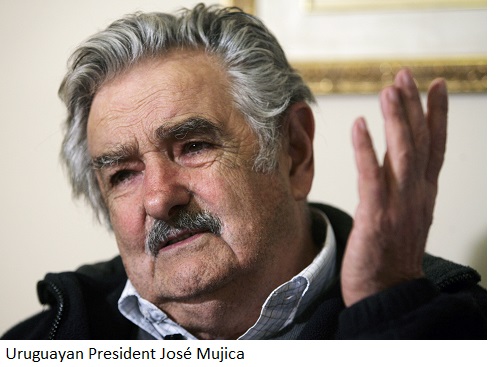 Under the Presidency of José “Pepe” Mujica, Uruguay has made a number of international headlines in recent years for progressive moves such as legalizing same sex marriage, abortion and marijuana cultivation and trade, as well as withdrawing its troops from Haiti. This week, Mujica offered to welcome detainees from the US’s detention center at its base in Guantánamo Bay, Cuba.
The Uruguayan president accepted a proposal from the Obama administration to host the detainees. “They are coming as refugees and there will be a place for them in Uruguay if they want to bring their families,” Mujica explained. “If they want to make their nests and work in Uruguay, they can remain in the country.”
“I was imprisoned for many years and I know how it is,” he said. The left-leaning president is a former revolutionary guerilla who was jailed for 14 years before and during Uruguay’s 1973-1985 dictatorship. After his release, he ended his guerilla activities and entered politics, becoming the Minister of Agriculture in 2005 under the Tabaré Vázquez administration, and was elected to the presidency in 2010.
Mujica, who has been touted as the “world’s poorest president” due to his frugal lifestyle and the fact that he donates about 90% of his presidential salary to charities and social programs, still lives on a flower farm with his wife outside the capital, and drives a beat up Volkswagen Beetle to work. Earlier this year, he was nominated for the Nobel Peace Prize for his progressive marijuana legalization program and views against excessive consumerism. His newest move against the human rights abuses of the “war on terror” has put him back in the global spotlight.
Standing Against a Symbol of the “War on Terror”
The detention center at the US base in Guantánamo Bay has long been a symbol of the human rights abuses that have come to define the so-called “war on terror.” After 9/11, the George W. Bush administration began using the facility to detain suspected terrorists. It quickly became notorious as a site of inhumane treatment, torture, and lawlessness; a decade later, many of the detainees have been held without charges or a trial.
Roughly 800 men and boys have been kept in Guantánamo as part of the US’s terror suspect roundup. Now only 154 remain, and the Obama administration, with support from Congress, is trying to make good on its promise to shut the detention center down. As part of those moves, Washington is seeking new countries to host the released detainees.
Uruguay is the first Latin American nation to accept Obama’s offer to welcome former prisoners onto its soil. Since Obama’s election, 38 Guantánamo detainees have been released to their home countries, and 43 have been resettled in 17 other countries. According to Human Rights Watch, the US wants to send detainees to countries that can provide the security the US seeks under the terms of the transfer. Uruguayan press reports that the transfer would likely involve five detainees who would have to stay within Uruguay for at least two years.
While Mujica and the US Ambassador are clear that the plans surrounding the transfer are not finalized, Mujica’s reasons for hosting the men are a sign that Uruguay is taking important steps toward justice against Washington’s long-standing “war on terror.”
For years, countless activists, governments and human rights groups have called for the closure of the US detention center in Guantánamo Bay. Last July, activist Andrés Conteris, who has worked for decades on human rights issues in Latin America,went on a hunger strike for over three months in solidarity with hunger-striking prisoners in Guantánamo Bay.
The strike denounced the inhumane and unlawful treatment of the detainees; numerous cases of physical, psychological, religious and medical torture against prisoners have been widely reported over the years. It is this treatment that President Mujica is standing against in his welcoming of the detainees.
“Given Pepe Mujica’s experience with long-term torture,” Conteris explained to me, referencing Mujica’s own imprisonment, “this gesture offering to resettle Guantánamo prisoners in Uruguay not only expresses his country’s commitment to human rights, but it shows a personal connection this president has with those suffering inhuman treatment perpetrated by military forces.”
***
Benjamin Dangl has worked as a journalist throughout Latin America, covering social movements and politics in the region for over a decade. He is the author of the books Dancing with Dynamite: Social Movements and States in Latin America, and The Price of Fire: Resource Wars and Social Movements in Bolivia. Dangl is currently a doctoral candidate in Latin American History at McGill University, and edits UpsideDownWorld.org, a website on activism and politics in Latin America, and TowardFreedom.com, a progressive perspective on world events. Email: BenDangl(at)gmail(dot)com.
Related articles


An Extremely Newsworthy Op-Ed in Venezuela, or So One would Think
By Joe Emersberger | Zblogs | March 21, 2014
An op-ed in Ultimas Noticias (20/3/14), Venezuela’s largest circulating newspaper, stated that “One can’t keep playing around with Maduro’s assassin government and its insincere calls for peace”.
It goes on to state that Maduro’s government will go down in history as one of the most murderous and dictatorial ever, and makes a thinly veiled call for its unconstitutional ouster.
How does a vehemently anti-government op-ed like this appear in Venezuela’s largest newspaper when Reporters Without Borders (RSF) ranks Venezuela 116 out of 179 in its “freedom of expression” index?
The international corporate press eagerly bolsters RSF’s assessment and prominently reports any allegation of censorship by the Maduro government, as it did with the Chavez government. But if international reporters have integrity, and believe their own coverage, shouldn’t this op-ed be deemed extremely newsworthy? Doesn’t the appearance of this op-ed reveal a spectacular act of courage on the part of both the author and Ultimas Noticias ? In fact, it doesn’t.
The author of the op-ed appears regularly in Ultimas Noticas as do similar authors like [prominent opposition politician] Antonio Ledezma. The op-ed is noteworthy only because it exposes the remarkable dishonesty of RSF and the international corporate media.
Ultimas Noticas also a published an investigative report in February that led to the arrests of government agents implicated in the killing of a protester. In May of last year, it published that transcript of a private conversation in which a prominent government supporter, Mario Silva, talked about corruption within government ranks and named prominent allies of Maduro’s government.
You can literally read Ultimas Noticas on any random day and find reporting and op-eds that completely demolish the lies peddled by RSF and international media about the state of press freedom in Venezuela.
Foreign reporters in Venezuela who are honest and not ideologically hostile to the Maduro government, may indeed face resource constraints that prevent them from seeking out some stories that contradict the prevailing distortions. Wealthy, urban based, English speaking government opponents have many ways to make their stories and opinions readily and economically available to foreign journalists. However, that can’t excuse failing to inform readers about what regularly appears in an outlet like Ultimas Noticias. If most people in English speaking countries believe that the media is far less free in Venezuela than in their own countries, it actually highlights the deplorable state of press freedom in their own.
Land of the Free
the Americas have a noble, exceptional, honorable history
so we are told
such opportunity
the workers, the immigrants, who were cheap insurance against challenges to legitimacy, land title, labor bankruptcy and invasion
make them build the infrastructure
make them pay
make them love labor, exploitation and oppression
wrap it in a flag
imply a promise
never throw a bone
make them work for it
make them bow at the alter of class devotion
it’s no mistake, that word patriot
“defends his country and its interests with devotion”
devotion: to give all ones time and resources, to sacrifice
to devote: a vow, a formal, solemn promise
vow: a 13th century solemn promise to god
latin devoveo, a self-sacrifice, an offering, a curse
curse? a solemn utterance intended to invoke a supernatural power to inflict harm or punishment on someone or something?
devote yourself to me, as god requires, or you will be punished!
sounds like a curse
patriot, a concept that did not exist before the 16th century
just in time
for ships and colonizers, slaves, indentured servants and immigrants
as many an 3 of 4 whites in American colonies in the 18th century were indentured
privately held personal property, chattel
cheap insurance against recalcitrant native peoples and slaves
recalcitrant: having an obstinately uncooperative attitude toward authority or discipline
may it be so
indentured servants: they, and their descendants can be sold and inherited
“If we forget what we did, we won’t know who we are” – Ronald Reagan
Islamophobia, the Israel lobby and the Western media
By Paul J. Balles | August 3, 2009
Most of us have had fears of one kind or another. Some fears are quite rational. If someone threatens you, and you have reason to believe that person will carry out his threat, your fear is rational. Not all fears are rational.
Have you ever been short of breath, shaking, nauseated and light-headed within elevators, closed rooms or crowded places? Experienced a panic attack in a high-rise building? Do you have an irrational fear of germs? Of strangers or foreigners? Of shadows? Of thunder or lightening? Of spiders? Of public speaking? Afraid of flying?
If you’ve experienced any of these, you’re suffering from a type of irrational fear called a phobia. These are some of the most common phobias. People suffer from literally hundreds of phobias.
A relatively recent irrational phobia that hasn’t even appeared on all the lists is Islamophobia – fear of Islam.
Kofi Annan told a UN conference on Islamophobia in 2004: “When the world is compelled to coin a new term to take account of increasingly widespread bigotry, that is a sad and troubling development. Such is the case with Islamophobia.”
In 1996, the Runnymede Trust established the Commission on British Muslims and Islamophobia. The term was defined by the trust as “an outlook or world-view involving an unfounded dread and dislike of Muslims, which results in practices of exclusion and discrimination”.
The Runnymede report identified eight perceptions related to Islamophobia:
- Islam is seen as a monolithic bloc, static and unresponsive to change.
- It is seen as separate and “other”. It does not have values in common with other cultures, is not affected by them and does not influence them.
- It is seen as inferior to the West. It is seen as barbaric, irrational, primitive, and sexist.
- It is seen as violent, aggressive, threatening, supportive of terrorism and engaged in a clash of civilizations.
- It is seen as a political ideology, used for political or military advantage.
- Criticisms made of “the West” by Muslims are rejected out of hand.
- Hostility towards Islam is used to justify discriminatory practices towards Muslims and exclusion of Muslims from mainstream society.
- Anti-Muslim hostility is seen as natural and normal.
Of course, Muslims and others who have lived in Muslim countries know how absurd these perceptions are. Why, after more than a decade, do Westerners still believe these false assumptions about Islam? What are the sources of the baseless fears feeding these perceptions?
Many of the distorted impressions come from Zionist propaganda:
- Israel’s use of words like disputed territory rather than occupied, redeeming for stealing land, terrorists rather than resistance fighters for Palestinians, anti-Semites for critics of Israel (self-hating Jews if the critics are Jewish).
- American Israel Public Affairs Committee (AIPAC) bulletins and lobbying – AIPAC’s only purpose is to ensure American support for Israel. No matter what Israel does, it cannot do any wrong.
- American Jewish Committee (AJC) newsletters – despite efforts by Jewish organizations to stifle criticism of Israel and objections to Zionism, anti-Zionism is not anti-Semitism. Not all Jews are Semites. Most Arabs are.
- ZOA – Zionist Organization of America.
Western brainwashing comes from the media:
- Articles by writers like Daniel Pipes, (who claims an Islamist goal is to take over the United States and replace the constitution with the Koran).
- Anti-Arab, anti-black radio broadcasts by Rush Limbaugh and Arab-hater Ann Coulter.
- TV influence of Fox News anchors, like Bill O’Reilly, labelling Arabs as anti-Semites and terrorists.
- Hollywood films have been vilifying Arabs for more than 50 years.
As Ralph Waldo Emerson wrote, “Fear always springs from ignorance.”
Paul J. Balles is a retired American university professor and freelance writer who has lived in the Middle East for many years. For more information, see http://www.pballes.com.
Mexico’s Oil Belongs to Its Citizens, Not the Global 1%

Thousands of people march in Mexico City in protest of the privatization of Mexico’s oil industry. Photo by flickr user eneas, March 18, 2013.
By Yoshua Okón | Creative Time Reports | March 18, 2014
Mexico City, Mexico – Oil in Mexico is much more than a symbol of national pride. For the past 75 years it has been an enormous source of income for developing Mexico’s infrastructure and improving social welfare. When, on this day in 1938, President Lázaro Cárdenas expropriated U.S.- and U.K.-owned oil companies, he allowed Mexico to achieve relative independence and modest prosperity. The nationalization of oil saved Mexico from becoming a paralyzed, essentially colonized country like Guatemala, which has a major mining industry that is almost entirely foreign-owned.
Petróleos Mexicanos (PEMEX), the state-owned company with exclusive access to Mexico’s oil, is one of the most lucrative companies in the world. In 2012 it declared profits of over 900 billion pesos (or $70 billion), earnings comparable to those of American oil and gas giants like ExxonMobil and Chevron. More importantly, PEMEX has historically distributed its profits among the Mexican population more equitably than any other industry in the country. Sixty percent of Mexico’s spending on social welfare comes from oil income. Among the things this income currently pays for are education, health care and programs to fight extreme poverty. Every Mexican citizen owns PEMEX, and the profits the company generates have made palpable differences in all of our lives.
Lucrative as it is, PEMEX could make and distribute much greater revenues if it were not so corrupt, inefficient and archaic. We have long known of grave problems with the oil industry and union, such as losses in refining and production. (Output has fallen 25 percent since 2004.) If PEMEX isn’t brought up to date in the next few years, there is a serious danger that the company will collapse. But instead of reforming the institution, the current government has exploited PEMEX’s deficiencies under the guise of reform to fiercely promote a very different agenda: the privatization of oil in Mexico.
Far from modernizing PEMEX, eliminating corruption or directing more income to Mexico’s citizens, the so-called energy reform passed by Congress and signed into law by President Enrique Peña Nieto in December will radically shift the distribution of oil profits from the public to a few private investors. The bill modified Mexico’s constitution to allow private oil companies to compete with PEMEX in every aspect of oil production. Underground oil reserves will still belong to Mexico, but since all profits derived from production will go to corporations, these reforms effectively constitute a privatization. Yet the president never admitted to this underlying agenda in the lead-up to the bill’s passage; his administration has altogether avoided using the word “privatization,” in favor of vague references to “modernization” and “the need for private investment.” This lack of honesty has generated tremendous confusion among the Mexican population, greatly debilitating potential opposition to the bill.
As Peña Nieto and his Institutional Revolutionary Party (PRI) prepare a new set of bills that will implement the changes to oil laws, a multimillion-dollar publicity campaign of disinformation initiated last year by his administration still saturates the mass media, diverting the debate on “energy reform” by reducing it to obvious questions: Is reform necessary? Is PEMEX efficient? Do we need progress and modernization? As a result, we have skipped over the most pressing and fundamental questions: What should the nature of this reform be? How will profits be distributed? What measures are in place to fight the corruption that causes us to lose so much of our oil income? In order to modernize, do we have to abandon the idea that Mexican oil belongs to the people of Mexico?
The recent history of PEMEX is a story of deliberate sabotage. PEMEX managers have enabled politicians to keep a portion of the company’s profits for decades, laying the groundwork for privatization by making corruption seem like the natural result of a nationalized industry. But the underlying problem has always been and still is political corruption, not a lack of private investment. Consider Romero Deschamps, the leader of PEMEX’s union since 1989, who is accused of stealing an estimated 3 billion pesos’ worth of the union’s assets and of having illegally created secret “private” companies that undertake contract work for PEMEX. In spite of the abundant proof of his guilt, Deschamps is currently a senator for the ruling PRI. Peña Nieto claims that stamping out such criminality is one of the primary objectives of the current “reform,” but his policy for overhauling the industry doesn’t contain a single strategy aimed at fighting corruption.
The majority of the proposed structural changes to PEMEX aren’t even necessary for the task of modernizing Mexico’s oil industry. PEMEX already has access to cutting-edge technologies since private oil companies can operate in Mexico and have been doing so (for example, PEMEX is currently contracting the services of Halliburton and OHL). Whether or not PEMEX should contract private companies is irrelevant; what matters are the terms on which it partners with the private sector. The fact that the Peña Nieto administration is permitting profit-sharing contracts—which have historically been imposed on poor countries, with disastrous results—rather than limiting partnerships to licensing permits that would pave the way for increased efficiency without signing away the democratic ownership of resources, is another clear indicator of the underlying agendas behind the “energy reform.” As former PEMEX director general Adrián Lajous has argued, profit-sharing contracts render private companies unaccountable, leaving the state, its resources and its people vulnerable.
Peña Nieto presents his “reform” as the magic solution to PEMEX’s problems, as if the neoliberal dream of privatization without regulation were synonymous with social justice, economic well-being and democracy. But the facts paint a very different picture. Since neoliberal policies surged in the 1980s and former president Carlos Salinas de Gortari signed NAFTA into law in 1994, a weakened state, incapable of protecting the environment and the rights of its poorest people, has created the perfect conditions for political and corporate corruption. We live every day with the consequences of Carlos Slim’s acquisition of Telmex, the telecommunications company that Salinas privatized in 1990. Because there is little regulation, prices are high and service is poor, and Slim is now one of the richest men in the world. Another dark legacy of Salinas is his privatization of the banking sector and creation of Fobaproa, an agency intended to prevent banks from going bankrupt. After Mexico’s 1994 economic crisis, the institution of Fobaproa meant that the public paid off banks’ massive debts. High-ranking politicians and businessmen have pocketed extraordinary profits, while everyday people have borne greater economic burdens, with each move to privatize. The result is a spectacular growth in inequality. More than 53 million people in Mexico today—nearly half the country—live in poverty, and 11.5 million Mexicans live in extreme poverty. Meanwhile, the eleven richest men in the country have accumulated roughly 11 percent of the GDP.
We cannot undertake true energy reform in Mexico without first undertaking political reforms that would decisively and effectively tackle corruption. Sadly, because it does nothing to change political structures and curb corruption, the current legislative process is taking us further away from democratic values and constitutes a huge step in the wrong direction. Approved by politicians who never consulted voters, the bill passed in December opens the field for companies that are known the world over for their abusive practices and for co-opting politicians (ExxonMobil, Shell, BP, OHL) to operate in Mexico without regulation or restriction. In the words of the historian Lorenzo Meyer Cossío, we are opening the door to “mercenaries.” The Mexican government expects its citizens to place ownership of our hydrocarbons in private hands, without our agreement and in exchange for minimal revenue. But modernization does not require that we give up our resources. Improvement shouldn’t entail changing the basic principle that natural resources belong to us all.
The “energy reform” currently under way is a huge step toward greater inequality, environmental devastation and the loss of economic and political independence for Mexico. It is one example of the neoliberal fantasy of unregulated capitalism that has landed us in our present situation, in which the 85 richest people in the world hold the same amount of wealth as the 3.5 billion poorest. We are living through the greatest inequality in the history of humanity and unprecedented ecological destruction. To combat this urgent situation, we need to strengthen fragile regulatory structures by creating independent, democratically owned institutions. By instead dismantling the few supportive social structures left, Peña Nieto’s government is pushing Mexico to a dangerous place. Against a backdrop of extreme poverty and social injustice, the PRI’s “reforms” will, sooner or later, lead to revolt.
Translated by Georgia Phillips-Amos.
This piece was made possible, in part, by the Andy Warhol Foundation for the Visual Arts.
Visa, MasterCard Freeze Cards at Sanctioned Russian Banks
RIA Novosti | March 21, 2014
MOSCOW – US-based Visa Inc. and MasterCard Inc. have stopped processing payments by cardholders at Russian banks targeted by the United States for financial sanctions on Thursday, a number of Russian banks said Friday.
The news signaled the first impact on ordinary Russian citizens by a series of Western sanctions against Russia over the ongoing situation in Ukraine, the greatest geopolitical showdown between Russia and the West since the end of the Cold War.
Earlier sanctions had been restricted to targeting high-level officials.
Several banks reported that customer cards were being declined for payment and that they had received no advance notification of the changes. Customer deposits remained unaffected.
Visa confirmed Friday that it had blocked cards issued by four Russian banks for use on its payment network for online or retail purchases.
Visa said the list of the banks facing sanctions announced by the US Treasury on Thursday includes Rossiya Bank, SMP Bank, Sobinbank and Investcapitalbank, the latter two being part of Rossiya Bank.
“The management of Rossiya Bank understands the difficulties experienced by clients in this situation, and assures them that everything possible is being done to help,” Rossiya Bank said in a statement on its website.
The bank added that customers could still withdraw cash from the bank’s ATMs without difficulties, as well as those owned by partner banks.
Sobinbank said that its call centers had been swamped by customers who were abroad and suddenly found their cards were not working.
SMP Bank is majority owned by brothers Arkady and Boris Rotenberg, who were both named on the US sanctions list.
“All other operations, including the issuance of deposits and making payments remain unaffected and without any restrictions,” SMP Bank said in a statement, adding that it has no assets in the United States.
The US and EU announced asset freezes and travel bans targeting a number of Russian officials close to Putin on Monday, following a referendum in Crimea that saw voters overwhelmingly support reunification with Russia after 60 years as part of Ukraine.
Those lists were expanded – including the addition of Rossiya Bank to the US list – following the ratification of the reunification treaty by Russia’s lower house of parliament Thursday.
Russian President Vladimir Putin warned earlier this month that sanctions against Russia threatened to cause mutual damage in the modern, integrated global economy.
Leaders in Crimea refused to recognize the legitimacy of the government in Kiev that came to power amid often violent protests last month, instead seeking reunification with Russia.
The Origins of the Israel Lobby in the US
By Alison Weir | CounterPunch | March 21, 2014
The immediate precursor to today’s pro-Israel lobby began in 1939[i] under the leadership of Rabbi Abba Hillel Silver, originally from Lithuania. He created the American Zionist Emergency Council (AZEC), which by 1943 had acquired a budget of half a million dollars at a time when a nickel bought a loaf of bread.[ii]
In addition to this money, Zionists [adherents of “political Zionism,” a movement to create a Jewish state in Palestine] had become influential in creating a fundraising umbrella organization, the United Jewish Appeal, in 1939[iii], giving them access to the organization’s gargantuan financial resources: $14 million in 1941, $150 million by 1948. This was four times more than Americans contributed to the Red Cross and was the equivalent of approximately $1.5 billion today.[iv]
With its extraordinary funding, AZEC embarked on a campaign to target every sector of American society, ordering that local committees be set up in every Jewish community in the nation [for decades the larger majority of Jewish Americans had been either non-Zionists or actively anti-Zionist]. In the words of AZEC organizer Sy Kenen, it launched “a political and public relations offensive to capture the support of Congressmen, clergy, editors, professors, business and labor.”[v]
AZEC instructed activists to “make direct contact with your local Congressman or Senator“ and to go after union members, wives and parents of servicemen, and Jewish war veterans. AZEC provided activists with form letters to use and schedules of anti-Zionist lecture tours to oppose and disrupt.
A measure of its power came in 1945 when Silver disliked a British move that would be harmful to Zionists. AZEC booked Madison Square Garden, ordered advertisements, and mailed 250,000 announcements – the first day. By the second day they had organized demonstrations in 30 cities, a letter-writing campaign, and convinced 27 U.S. Senators to give speeches.[vi]
Grassroots Zionist action groups were organized with more than 400 local committees under 76 state and regional branches. AZEC funded books, articles and academic studies; millions of pamphlets were distributed. There were massive petition and letter writing campaigns. AZEC targeted college presidents and deans, managing to get more than 150 to sign one petition.[vii]
Rabbi Elmer Berger, executive director of the American Council for Judaism, which opposed Zionism in the 1940s and ‘50s, writes in his memoirs that there was a “ubiquitous propaganda campaign reaching just about every point of political leverage in the country.”[viii]
The Zionist Organization of America bragged of the “immensity of our operations and their diversity” in its 48th Annual Report, stating, “We reach into every department of American life…”[ix]
Berger and other anti-Zionist Jewish Americans tried to organize against “the deception and cynicism with which the Zionist machine operated,” but failed to obtain anywhere near their level of funding. Among other things, would-be dissenters were afraid of “the savagery of personal attacks” anti-Zionists endured.[x]
Berger writes that when he and a colleague opposed a Zionist resolution in Congress, Emanuel Celler, a New York Democrat who was to serve in Congress for almost 50 years, told them: “They ought to take you b…s out and shoot you.”[xi]
When it was unclear that President Harry Truman would support Zionism, Cellar and a committee of Zionists told him that they had persuaded Dewey to support the Zionist policy and demanded that Truman also take this stand. Cellar reportedly pounded on Truman‘s table and said that if Truman did not do so, “We’ll run you out of town.”[xii]
Jacob Javits, another well-known senator, this time Republican, told a Zionist women’s group: “We’ll fight to death and make a Jewish State in Palestine if it’s the last thing that we do.”[xiii]
Richard Stevens, author of American Zionism and U.S. Foreign Policy, 1942-1947, reports that Zionists infiltrated the boards of several Jewish schools that they felt didn’t sufficiently promote the Zionist cause. When this didn’t work, Stevens writes, they would start their own pro-Zionist schools.[xiv]
Stevens writes that in 1943-44 the ZOA distributed over a million leaflets and pamphlets to public libraries, chaplains, community centers, educators, ministers, writers and “others who might further the Zionist cause.”[xv]
Alfred Lilienthal, who had worked in the State Department, served in the U.S. Army in the Middle East from 1943-45, and became a member of the anti-Zionist American Council for Judaism, reports that Zionist monthly sales of books totaled between 3,000 and 4,000 throughout 1944-45.
Richard Stevens reports that Zionists subsidized books by non-Jewish authors that supported the Zionist agenda. They would then promote these books jointly with commercial publishers. Several of them became best sellers.[xvi]
Zionists manufacture Christian support
AZEC founder Silver and other Zionists played a significant role in creating Christian support for Zionism.
Secret Zionist funds, eventually reaching $150,000 in 1946, were used to revive an elitist Protestant group, the American Palestine Committee. This group had originally been founded in 1932 by Emanuel Neumann, a member of the Executive of the Zionist Organization. The objective was to organize a group of prominent (mainly non-Jewish) Americans in moral and political support of Zionism. Frankfurter was one of the main speakers at its launch.[xvii]
Silver‘s headquarters issued a directive saying, “In every community an American Christian Palestine Committee must be immediately organized.”[xviii]
Author Peter Grose reports that the Christian committee’s operations “were hardly autonomous. Zionist headquarters thought nothing of placing newspaper advertisements on the clergymen’s behalf without bothering to consult them in advance, until one of the committee’s leaders meekly asked at least for prior notice before public statements were made in their name.”[xix]
AZEC formed another group among clergymen, the Christian Council on Palestine. An internal AZEC memo stated that the aim of both groups was to “crystallize the sympathy of Christian America for our cause.”[xx]
By the end of World War II the Christian Council on Palestine had grown to 3,000 members and the American Palestine Committee boasted a membership of 6,500 public figures, including senators, congressmen, cabinet members, governors, state officers, mayors, jurists, clergymen, educators, writers, publishers, and civic and industrial leaders.
Historian Richard Stevens explains that Christian support was largely gained by exploiting their wish to help people in need. Steven writes that Zionists would proclaim “the tragic plight of refugees fleeing from persecution and finding no home,” thus linking the refugee problem with Palestine as allegedly the only solution.[xxi]
Stevens writes that the reason for this strategy was clear: “… while many Americans might not support the creation of a Jewish state, traditional American humanitarianism could be exploited in favor of the Zionist cause through the refugee problems.”[xxii]
Few if any of these Christian supporters had any idea that the creation of the Jewish state would entail a massive expulsion of hundreds of thousands of non-Jews, who made up the large majority of Palestine‘s population, creating a new and much longer lasting refugee problem.
Nor did they learn that during and after Israel’s founding 1947-49 war, Zionist forces attacked a number of Christian sites. Donald Neff, former Time Magazine Jerusalem bureau chief and author of five books on  Israel-Palestine, reports in detail on Zionist attacks on Christian sites in May 1948, the month of Israel’s birth.
Neff tells us that a group of Christian leaders complained that month that Zionists had killed and wounded hundreds of people, including children, refugees and clergy, at Christian churches and humanitarian institutions.
For example, the group charged that “‘many children were killed or wounded’ by Jewish shells on the Convent of Orthodox Copts…; eight refugees were killed and about 120 wounded at the Orthodox Armenian Convent…; and that Father Pierre Somi, secretary to the Bishop, had been killed and two wounded at the Orthodox Syrian Church of St. Mark.”
“The group’s statement said Arab forces had abided by their promise to respect Christian institutions, but that the Jews had forcefully occupied Christian structures and been indiscriminate in shelling churches,” reports Neff. He quotes a Catholic priest: “‘Jewish soldiers broke down the doors of my church and robbed many precious and sacred objects. Then they threw the statues of Christ down into a nearby garden.’ [The priest] added that Jewish leaders had reassured that religious buildings would be respected, ‘but their deeds do not correspond to their words.’”[xxiii]
After Zionist soldiers invaded and looted a convent in Tiberias, the U.S. Consulate sent a bitter dispatch back to the State Department complaining of “the Jewish attitude in Jerusalem towards Christian institutions.”[xxiv]
An American Christian Biblical scholar concurred, reporting that a friend in Jerusalem had been told, “When we get control you can take your dead Christ and go home.”[xxv]
Zionist Colonization Efforts in Palestine
In order to reach their goal of a Jewish state in Palestine, Zionists needed to clear the land of Muslim and Christian inhabitants and replace them with Jewish immigrants.
This was a tall order, as Muslims and Christians accounted for more than 95 percent of the population of Palestine.[xxvi] Zionists planned to try first to buy up the land until the previous inhabitants had emigrated; failing this, they would use violence to force them out. This dual strategy was discussed in various written documents cited by numerous Palestinian and Israeli historians.[xxvii]
As this colonial project grew, the indigenous Palestinians reacted with occasional bouts of violence; Zionists had anticipated this since people usually resist being expelled from their land.
When the buyout effort was able to obtain only a few percent of the land, Zionists created a number of terrorist groups to fight against both the Palestinians and the British. Terrorist and future Israeli Prime Minister Menachem Begin later bragged that Zionists had brought terrorism both to the Middle East and to the world at large.[xxviii]
By the eve of the creation of Israel, the Zionist immigration and buyout project had increased the Jewish population of Palestine to 30 percent[xxix] and land ownership from 1 percent to approximately 6-7 percent.[xxx]
This was in 1947, when the British at last announced that they would end their control of Palestine. Britain turned the territory’s fate over to the United Nations.
Since a founding principle of the UN was “self-determination of peoples,” one would have expected to the UN to support fair, democratic elections in which inhabitants could create their own independent country.[xxxi]
Instead, Zionists pushed for a General Assembly resolution to give them a disproportionate 55 percent of Palestine.[xxxii][xxxiii] (While they rarely announced this publicly, their plan, stated in journal entries and letters, was to later take the rest of Palestine.[xxxiv])
U.S. Officials oppose creation of Israel
The U.S. State Department opposed this partition plan strenuously, considering Zionism contrary to both fundamental American principles and U.S. interests.
For example, the director of the State Department‘s Office of Near Eastern and African Affairs consistently recommended against supporting a Jewish state in Palestine. The director, named Loy Henderson, warned that the creation of such a state would go against locals’ wishes, imperil U.S. interests and violate democratic principles.
Henderson emphasized that the U.S. would lose moral standing in the world if it supported Zionism:
“At the present time the United States has a moral prestige in the Near and Middle East unequaled by that of any other great power. We would lose that prestige and would be likely for many years to be considered as a betrayer of the high principles which we ourselves have enunciated during the period of the [second world] war.”[xxxv]
When Zionists pushed the partition plan in the UN, Henderson recommended strongly against supporting their proposal, saying that such a partition would have to be implemented by force and was “not based on any principle.” He warned that partition “would guarantee that the Palestine problem would be permanent and still more complicated in the future…”
Henderson elaborated further on how plans to partition Palestine would violate American and UN principles:
“…[Proposals for partition] are in definite contravention to various principles laid down in the [UN] Charter as well as to principles on which American concepts of Government are based. These proposals, for instance, ignore such principles as self-determination and majority rule. They recognize the principle of a theocratic racial state and even go so far in several instances as to discriminate on grounds of religion and race…”[xxxvi]
Zionists attacked Henderson virulently, calling him “anti-Semitic,” demanding his resignation, and threatening his family. They pressured the State Department to transfer him elsewhere; one analyst describes this as “the historic game of musical chairs” in which officials who recommended Middle East policies “consistent with the nation’s interests” were moved on.[xxxvii]
In 1948 Truman sent Henderson to the slopes of the Himalayas, as Ambassador to Nepal (then officially under India).[xxxviii] (In recent years, at times virtually every State Department country desk has been directed by a Zionist.)[xxxix]
But Henderson was far from alone in making his recommendations. He wrote that his views were not only those of the entire Near East Division but were shared by “nearly every member of the Foreign Service or of the [State] Department who has worked to any appreciable extent on Near Eastern problems.”[xl]
He wasn’t exaggerating. Official after official and agency after agency opposed Zionism.
In 1947 the CIA reported that Zionist leadership was pursuing objectives that would endanger both Jews and “the strategic interests of the Western powers in the Near and Middle East.”[xli]
Ambassador Henry F. Grady, who has been called “America’s top diplomatic soldier for a critical period of the Cold War,” headed a 1946 commission aimed at coming up with a solution for Palestine. Grady later wrote about the Zionist lobby and its damaging effect on U.S. national interests.
“I have had a good deal of experience with lobbies but this group started where those of my experience had ended,” wrote Grady. “I have headed a number of government missions but in no other have I ever experienced so much disloyalty…. [I]n the United States, since there is no political force to counterbalance Zionism, its campaigns are apt to be decisive.”[xlii]
Grady concluded that without Zionist pressure, the U.S. would not have had “the ill-will with the Arab states, which are of such strategic importance in our ‘cold war’ with the soviets.”[xliii]
Former Undersecretary of State Dean Acheson also opposed Zionism. Acheson‘s biographer writes that Acheson “worried that the West would pay a high price for Israel.” Another author, John Mulhall, records Acheson‘s warning of the danger for U.S. interests:
“… to transform [Palestine] into a Jewish State capable of receiving a million or more immigrants would vastly exacerbate the political problem and imperil not only American but all Western interests in the Near East.”[xliv]
The Joint Chiefs of Staff reported in late 1947, “A decision to partition Palestine, if the decision were supported by the United States, would prejudice United States strategic interests in the Near and Middle East” to the point that “United States influence in the area would be curtailed to that which could be maintained by military force.”[xlv]
The Joint Chiefs issued at least sixteen papers on the Palestine issue following World War II. They were particularly concerned that the Zionist goal was to involve the U.S.
One 1948 paper predicted that “the Zionist strategy will seek to involve [the United States] in a continuously widening and deepening series of operations intended to secure maximum Jewish objectives.”[xlvi]
The CIA stated that Zionist leadership was pursuing objectives that would endanger both Jews and “the strategic interests of the Western powers in the Near and Middle East.”[xlvii]
The head of the State Department‘s Division of Near Eastern Affairs, Gordon P. Merriam, warned against the partition plan on moral grounds:
“U.S. support for partition of Palestine as a solution to that problem can be justified only on the basis of Arab and Jewish consent. Otherwise we should violate the principle of self-determination which has been written into the Atlantic Charter, the declaration of the United Nations, and the United Nations Charter – a principle that is deeply embedded in our foreign policy. Even a United Nations determination in favor of partition would be, in the absence of such consent, a stultification and violation of UN‘s own charter.” [xlviii]
Merriam added that without consent, “bloodshed and chaos” would follow, a tragically accurate prediction.
An internal State Department memorandum accurately predicted how Israel would be born through armed aggression masked as defense:
“… the Jews will be the actual aggressors against the Arabs. However, the Jews will claim that they are merely defending the boundaries of a state which were traced by the UN.… In the event of such Arab outside aid the Jews will come running to the Security Council with the claim that their state is the object of armed aggression and will use every means to obscure the fact that it is their own armed aggression against the Arabs inside which is the cause of Arab counter-attack.”[xlix]
And American Vice Consul William J. Porter foresaw one last outcome of the “partition“ plan: that no Arab state would actually ever come to be in Palestine.[l]
This essay is excerpted from Alison Weir’s Against Our Better Judgment: How the US was Used to Create Israel.
Alison Weir is the president of the Council for the National Interest and executive director of If Americans Knew.
Citations for this excerpt, which also contain additional information, are available in the book. Discounted bulk orders can be obtained by writing orders@ifamericansknew.org
Notes.
[i] “American Zionist Movement (AZM),” Jewish Virtual Library, 2008,
http://www.jewishvirtuallibrary.org/jsource/judaica/ejud_0002_0002_0_00978.html.
[ii] Neff, Pillars, 23.
The executive secretary of AZEC was a man named Isaiah Kenen, who went on to found today’s American Israel Public Affairs Committee (AIPAC), rated as one of the most powerful lobbying organization in the U.S. Grant Smith, in his book Declassified Deceptions: the Secret History of Isaiah L. Kenen and the Rise of the American Israel Public Affairs Committee (Washington, D.C.: Institute for Research: Middle Eastern Policy, 2007) describes Kenen‘s activities in detail, particularly how he worked to elude U.S. legal requirements that he register as a foreign agent.
[iii] Elmer Berger, Memoirs of an Anti-Zionist Jew (Beirut: Institute for Palestine Studies, 1978), 9.
Originally there had been two organizations, the United Palestine Appeal (the main Zionist fund-raising effort in the U.S.) and the American Jewish Joint Distribution Committee, which was dominated by non-Zionists and which raised more money. Its purpose was to “provide assistance to Jews in the countries in which they lived, hoping to facilitate their eventual integration into those societies.” Berger reports, “Never at a loss for maneuver – or dissembling– however, the Zionist manager persuaded the ‘big givers’ that a ‘united campaign’ would be more efficient than the competing, double campaigns,” and they managed to push through the creation of the United Jewish Appeal.
[iv] Christison, Perceptions, 73; Wilson, Decision on Palestine, 134.
Wilson reports that Zionists, wishing to pressure the U.S. government to support partition and end its arms embargo, raised $35 million (the equivalent of $349 million today) in just two weeks for the United Jewish Appeal in just two weeks.
[v] Neff, Pillars, 23; Tivnan, The Lobby, 24.
[vi] Tivnan, The Lobby, 24
[vii] Neff, Pillars, 23.
[viii] Berger, Memoirs, 11.
In 1947 the American Council for Judaism submitted a 27-page memorandum to the UN opposing Zionism. ACJ President Lessing J. Rosenwald railed against what he termed Zionists’ “anti-Semitic racialist lie that Jews the world over were a separate, national body.”
Smith, Declassified Deceptions, 29.
[ix] Stevens, American Zionism, 101.
[x] Berger, Memoirs, 17.
[xi] Berger, Memoirs, 22.
[xii] Wright, Zionist Cover-up, 25.
Wright was General staff G-2 Middle East specialist, Washington, 1945-46; Bureau Near East-South Asian-African Affairs Department of State, since 1946, country specialist 1946-47, advisor U.N. affairs, 1947-50, advisor on intelligence 1950-55. He retired from the State Department in 1966.
[xiii] Lilienthal, What Price Israel, 63.
[xiv] Stevens, American Zionism, 24.
[xv] Stevens, American Zionism, 22.
[xvi] Stevens, American Zionism, 22-23.
[xvii] Neff, Pillars, 23.
Herbert Hoover, “Message to the American Palestine Committee, January 17, 1932,” The American Presidency Project,
http://www.presidency.ucsb.edu/ws/?pid=23121.
Patai, ed. “American Palestine Committee,” Encyclopaedia of Zionism and Israel, accessed January 1, 2014, http://www.iahushua.com/Zion/zionhol10.html.
[xviii] Neff, Pillars, 23-24.
[xix] Grose, Mind of America, 173.
[xx] Neff, Pillars, 23-24.
[xxi] Stevens, American Zionism, 28.
[xxii] Stevens, American Zionism, 28.
Joseph M. Canfield, The Incredible Scofield and His Book (Vallecito, CA: Ross House Books, 2004).
Researchers may wish to explore an interesting though speculative discussion about what might have been an earlier effort by Zionists to influence Christians. Many years before AZEC targeted Christians, an annotated version of the bible known as the Scofield Reference Bible had been published, which pushed what was a previously somewhat fringe “dispensationalist“ theology calling for the Jewish “return” to Palestine.
Some analysts have raised questions about Cyrus Scofield and how and why the Oxford University Press published his book. Scofield, a Texas preacher who had been something of a shyster and criminal and had abandoned his first wife and children (when his wife then filed for divorce, the court ruled in her favor, noting that Scofield was “…not a fit person to have custody of the children”). (Canfield, Incredible Scofield, 113) He mysteriously became a member of an exclusive New York men’s club in 1901. Biographer Joseph Canfield comments:
“The admission of Scofield to the Lotus Club, which could not have been sought by Scofield, strengthens the suspicion that has cropped up before, that someone was directing the career of C. I. Scofield.” (Canfield, Incredible Scofield, 220)
Canfield suggests that Wall Street lawyer Samuel Untermyer, who was also a member of the Lotus Club, may have played a role in Scofield‘s project, writing that “Scofield‘s theology was most helpful in getting Fundamentalist Christians to back the international interest in one of Untermyer‘s pet projects – the Zionist Movement.” (Canfield, Incredible Scofield, 219)
Professor David Lutz, in “Unjust War Theory: Christian Zionism and the Road to Jerusalem,” writes: “Untermyer used Scofield, a Kansas city lawyer with no formal training in theology, to inject Zionist ideas into American Protestantism. Untermyer and other wealthy and influential Zionists whom he introduced to Scofield promoted and funded the latter’s career, including travel in Europe.”
David Lutz, “Unjust War Theory: Christian Zionism and the Road to Jerusalem,” in Neo-Conned! Again: Hypocrisy, Lawlessness, and the Rape of Iraq, ed. D. Liam O’Huallachain and J. Forrest Sharpe (Vienna, VA: Light in the Darkness Publications, 2005), 127-169.
According to the Untermyer Gardens Conservancy website, Untermyer “was a partner in the law firm of Guggenheimer, Untermyer & Marshall, and was the first lawyer in America to earn a one million dollar fee on a single case. He was also an astute investor, and became extremely wealthy.
He was instrumental in the establishment of the Federal Reserve System, was an influential Democrat and a close ally of Woodrow Wilson.
The bio continues: “Samuel Untermyer was one of the most prominent Jews of his day in America. He was a prominent Zionist, and was President of the Keren Hayesod. In addition, he was the national leader of an unsuccessful movement in the early 1930’s for a worldwide boycott of Germany, and called for the destruction of Hitler‘s regime.”
“Samuel Untermyer,” Untermyer Gardens Conservancy, accessed January 1, 2014,
http://www.untermyergardens.org/samuel-untermyer.html.
Irish journalist Maidhc Ó Cathail suggests that “absent such powerful connections, it is hard to imagine ‘this peer among scalawags’ ever getting a contract with Oxford University Press to publish his bible.”
Maidhc O Cathail, “Zionism‘s Un-Christian Bible,” Middle East Online, November 25, 1999,
[xxiii] Donald Neff, “Christians Discriminated Against By Israel,” in Fifty Years of Israel (Michigan: American Educational Trust, 1998).
[xxiv] Stephen Green, Taking Sides: America’s Secret Relations with a Militant Israel (Brattleboro: Amana, 1988), 20.
[xxv] Millar Burrows, Palestine Is Our Business (Philadelphia: Westminster, 1949), 116.
[xxvi] See citation 7.
[xxvii] Ilan Pappé, The Ethnic Cleansing of Palestine (Oxford: Oneworld, 2007).
Masalha Nur, Expulsion of the Palestinians: The Concept of “Transfer” in Zionist Political Thought, 1882-1948, 4th Ed. (Washington, DC: Inst. for Palestine Studies, 2001).
Mazin Qumsiyeh, Sharing the Land of Canaan: Human Rights and the Israeli-Palestinian Struggle (London: Pluto, 2004).
Mazin Qumsiyeh, “Palestinian Refugees Right to Return and Repatriation” in Sharing the Land of Canaan (London: Pluto, 2004). Online at
[xxviii] Russell Warren Howe, “Fighting the ‘soldiers of Occupation’ From WWII to the Intifada,” in Seeing the Light: Personal Encounters with the Middle East and Islam, Ed. Richard H. Curtiss and Janet McMahon (Washington, D.C.: American Educational Trust, 1997), 38-39.
Warren and his film crew were filming an interview with Begin in 1974. “The red light had come on, under the lens. Without preamble, I turned my shoulder to the camera, stared straight into Begin’s eyes, and asked: ‘How does it feel, in the light of all that’s going on, to be the father of terrorism in the Middle East?’ ‘In the Middle East?’ he bellowed, in his thick, cartoon accent. ‘In all the world.’”
[xxix] McCarthy, Population of Palestine, 35.
[xxx] British Mandatory Commission, A Survey of Palestine: Prepared in December 1945 and January 1946 for the Information of the Anglo-American Committee of Inquiry (Washington, D.C.: Institute for Palestine Studies, 1991), 243-267.
This gives Jewish ownership in 1945 as approximately six percent.
A UN map showing percentages of each district can be seen at http://domino.un.org/maps/m0094.jpg.
Israeli author Baruch Kimmerling gives the landownership in 1947 as seven percent.
Robert J. Brym, review of Zionism and Territory: The Socio-Territorial Dimensions of Zionist Politics, by Baruch Kimmerling, The Canadian Journal of Sociology 11, no. 1 (1986), 80.
It is interesting to note that the Arab position was largely based on democratic principles. At a British conference on Palestine in 1946, Arabs presented a proposal “calling for the termination of the Mandate and the independence of Palestine as a unitary state, with a provisional governing council composed of seven Arabs and three Jews.” (Wilson, Decision on Palestine, 97)
[xxxi] “Charter of the United Nations: Chapter I, Purposes and Principles.” UN News Center, accessed January 1, 2014, http://www.un.org/en/documents/charter/chapter1.shtml.
[xxxii] “United Nations General Assembly Resolution 181,” The Avalon Project, accessed January 1, 2014, http://www.yale.edu/lawweb/avalon/un/res181.htm.
“UN Partition Plan,” BBC News, November 29, 2001, http://news.bbc.co.uk/2/hi/in_depth/middle_east/israel_and_the_palestinians/key_documents/1681322.stm.
For a US equivalent, see:
“UN Partition Applied To US,” Palestine Remembered, September 10, 2001,
[xxxiii] Neff, Pillars, 41.
[xxxiv] Noam Chomsky, The Fateful Triangle: The United States, Israel and the Palestinians (Boston: South End, 1983), 161.
“In internal discussion in 1938 [David Ben-Gurion] stated that ‘after we become a strong force, as a result of the creation of a state, we shall abolish partition and expand into the whole of Palestine.’”
[xxxv] Neff, Pillars, 30-31.
[xxxvi] Neff, Pillars, 46-47.
[xxxvii] Berger, Memoirs, 21.
Berger writes that in a personal conversation with him, Henderson had said:
“I hope you and your associates will persevere. And my reason for wishing this is perhaps less related to what I consider American interests in the Middle East than what I fear I see on the domestic scene. The United States is a great power. Somehow it will surmount even its most foolish policy errors in the Middle East. But in the process there is a great danger of creating divisiveness and anti-Semitism among our own people. And if this danger materializes to a serious extent, we have seen in Germany and in Europe that the ability of a nation to survive the consequences is in serious question.”
[xxxviii] Richard D. McKinzie, “Oral History Interview with Edwin M. Wright,” Truman Library, Wooster, OH, July 26, 1974,
http://www.trumanlibrary.org/oralhist/wright.htm.
“Mr. Henderson was, therefore, told, ‘You’ve got to leave the State Department or the Zionists are going to keep after us.’ The State Department suggested he be sent as an ambassador to Turkey. The Zionists had a clearance process going and they said, ‘No, that’s too near the Middle East, we want to get him completely away from the Middle East.’ The result was that they sent him as ambassador to India to get him out of the area completely.”
[xxxix] Revealed during conversation with State Department associate.
[xl] Neff, Pillars, 46; Wilson, Decision, 117; Wright, Zionist Cover-up, 21.
[xli] Green, Taking Sides, 20.
[xlii] Henry Grady, “Chapter 9,” Adventures in Diplomacy (unpublished manuscript), (Washington D.C.: Truman Library, n.d.), 170. Online at
Henry Francis Grady and John T. McNay, The Memoirs of Ambassador Henry F. Grady: from the Great War to the Cold War (Columbia, MO: University of Missouri, 2009). Online at
[xliii] Grady, Adventures, 166.
Benzion Netanyahu, a Zionist who travelled to the US from Palestine to propagandize Americans and father of future Israeli Prime Minister Binyamin Netanyahu, tried – unsuccessfully – to use the Cold War as a rationale for the U.S. to support Israel. Netanyahu believed that “arguments appealing to American fears of Soviet expansion” would be the best way to win over U.S. officials. He used this argument in 1947 in meetings with Loy Henderson and General Dwight Eisenhower, but found no takers, (though Eisenhower arranged for him to meet with someone else). (Medoff, Militant Zionism, 146)
[xliv] Mulhall, America, 130.
Robert L. Beisner, Dean Acheson: a Life in the Cold War (Oxford: Oxford UP, 2006), 215.
[xlv] Mark Perry, “Petraeus wasn’t the first,” Foreign Policy, April 2, 2010,
http://mideast.foreignpolicy.com/posts/2010/04/01/petraeus_wasnt_the_first.
[xlvi] Perry, “Petraeus wasn’t the first.”
The paper speculated that the eventual goal was sovereignty over “Eretz Israel,” which included Transjordan and parts of Lebanon and Syria.
[xlvii] Green, Taking Sides, 20.
[xlviii] Neff, Pillars, 42-43.
[xlix] Neff, Pillars, 65. Citation: “Draft Memorandum by the Director of the Office of United Nations Affairs (Rusk) to the Under Secretary of State (Lovett),” Secret, Washington May 4, 1948, FRUS 1948, pp. 894-95.
[l] Wilson, Decision on Palestine, 131.
Related articles


Featured Video
America Racing to Strategic Defeat in Iran
or go to
Aletho News Archives – Video-Images
From the Archives
Should Europeans ‘Thank’ the Americans for Destroying Nord Stream?
By Robert Bridge | Strategic Culture Foundation | September 29, 2022
With an investigation continuing into the destruction of the Nord Stream gas pipeline that provided energy supplies to Europe from Russia, there appears to be just one prime suspect, and that should surprise nobody.
Following the sabotage of the Nord Stream 1 and 2 gas pipelines, former Polish Foreign Minister Radoslaw Sikorski already seemed to know the identity of the perpetrator when he tweeted out: “Thank you, USA.”
At first glance, it seemed that Sikorski was speaking sarcastically, berating Washington for carrying out an attack that will have severe repercussions for the people of Europe. After all, how could anyone see any good coming from the termination of Europe’s primary source of gas reserves with winter just around the corner? It was Sikorski’s homeland of Poland, after all, that urged its citizens to collect firewood in the face of dwindling gas reserves.
In fact, the Polish diplomat was speaking one-hundred percent literally… continue
Blog Roll
 Aletho News
- Growing insecurity, soaring prices fuel protests in north as regime bans evacuation: Sources
- Iran denies responsibility for ‘depraved’ attack on Kuwait desalination plant
- Bring The Troops Back. End This War Now!
- Can we please stop calling Israel the ‘only democracy in the Middle East’ now?
- US should start removing its troops from Germany, proposes AfD co-leader Chrupalla
- Iran Red Crescent: 600 educational centers attacked in US-Israeli ‘war crimes’
- Russian Oil Tanker Arrives in Cuba Amid U.S. Blockade
- America Racing to Strategic Defeat in Iran: Lt Col Daniel Davis
- FTC Warns Visa, Mastercard, PayPal, Stripe Over Political Debanking
- Russian tanker approaches Cuba despite US oil blockade
- If Americans Knew
- As Iran targets US military bases, will they be relocated to Israel? Not a ceasefire Day 171
- Will Trump Go Kamikaze?
- Is the University of Florida Shutting Down College Republicans over Israel Criticism?
- Jewish extremist arrested over alleged plot to firebomb Palestinian activist Nerdeen Kiswani’s home
- More than half of Palestinian child detainees have no charges
- The More Murderous Israel Gets, The More We Hear About “Antisemitism”
- Land Day and the Palestinian struggle after 30 months of genocide
- The Iran War Is About Palestine
- Israeli soldiers echo settler ideology, talk of revenge after targeting Palestinians and detaining CNN crew in the West Bank
- Israeli Policies Threaten Future of Christian Schools in Jerusalem
- No Tricks Zone
- New Study Finds Warming Saves Lives…Cold Temperatures 12 Times More Deadly Than Excess Heat
- German Science Blog Accuses PIK Climate Institute Of Hallucinating Climate Tipping Points
- Devastating Assessment Of Comirnaty Vaccine By Former Senior Pfizer Europe Toxicologist
- New Study: CO2 Is ‘Effectively Negligible’ As An Explanatory Climate Change Factor Since 2000
- Former Pfizer Toxicologist Dr. Helmut Sterz Tells Bundestag Hearing Pfizer Vaccine Should Have Never Been Approved
- Energy Expert: Germany’s Nuclear Phaseout Was A “500 Billion Euro Mistake”
- New Research: South Australia’s Mid-Holocene Sea Surface Temperatures Were 4°C Warmer Than Today
- Storing Green Energy To Last Germany 10 Days Would Require A 60-Million Tonne Battery
- New Studies: UK Sea Levels Were 4 Meters Higher Than Today During The Mid-Holocene
- Destructive Green New Deal: German Energy And Metal Group Warns Of Drastic Crisis
 Aletho News
