The Zionist Lobby Under Fire in Oz
By Brian McKinlay | CounterPunch | April 11, 2014
Australians have been witness to a remarkable conflict in recent days in which their former Foreign Minister Bob Carr denounced the Jewish Lobby and his former Prime Minister Julia Gillard, over the whole series of questions re Australian policy and the demands of Israel and the local Jewish Lobby.
Nothing quite like it has ever been seen or heard before in Australia.
Carr has just published his dairy as Foreign Minister during 2013.
He came to that office in the last year of a sorely troubled Labor Government inheriting the job from Kevin Rudd,a former Prime Minister who took over the Foreign Minister’s portfolio after he, Rudd, was deposed as P.M, but then resigned after more turmoil in the Labor Party.
Carr was no newcomer. Once Premier for 10 years of NSW, the largest state, and seen as a smooth operator if fairly right-wing in his policies and his views, he was seen by many as a likely winner in the new job, in a Government in deep trouble.
A scholar of note, he has written much on one of his favourite topics, American History, with a very good book on the origins of the American Republic.
He came to the Senate, after several years in retirement, as the Government of Julia Gillard lurched from crisis to crisis. It was a job he craved and he got a seat in the Senate and then joined Gillard’s cabinet, where much was expected of him.
The crisis came in the last months of Gillard’s term when the question of Palestinian membership of UNESCO came up for consideration. Gillard was a notorious Zionist from the very inception of her 3-year term, and she was well know for her great support, without any conditions, for Israel. She had links with the Israeli Embassy in Canberra and the Zionist Lobby which also had a fifth column inside the Labor Party, which too has, like it’s US counterpart the Democrats, always had links with the Jewish Lobby.
When Deputy Prime Minister after 2007 Gillard went with a delegation to Israel as guest of a Melbourne Jewish millionaire who organises such events and who provided a job for her hairdresser partner as a salesman for his property empire.
She made no effort while there to visit or see the conditions of the Palestinian people… and one may surmise that her Israeli hosts would have seen to that aspect of her visit. In 2010 she replaced the disastrous Rudd as PM in a” palace coup”, and narrowly won power in a closely divided Parliament.
Her support for Israel never faltered, but when Carr became Foreign Minister in 2013 he had a wider view of the whole Middle East.
We know now that the conflict between Gillard and Carr arose over Israeli matters and appropriate policies in the UN.
Carr was told not to make any criticism of the Settlements on the West Bank, which he wished to do, and when the UNESCO issue arose, he was told to vote (as always) with the USA and Israel. Carr knew the widespread support of Europeans elsewhere in the Asian region for seating the Palestinians in UNESCO. Gillard insisted that he vote with Israel.
Carr demurred and challenged Gillard and then took the matter to the Labor Party Caucus… all members of the federal parliament were then to vote on the matter. Gillard was angry, and a bitter conflict developed.
Carr won out when a majority of the Labor Caucus voted for an Australian abstention in the UN. Carr would have preferred a YES vote but this was a compromise that Gillard, even as P.M. was forced to except she still wanted a NO vote against Palestinian admission, but failed to carry the party.
The Jewish Lobby was outraged and condemned the decision, and Carr for bringing it on. Carr went ahead and abstained, and the vote admitted the Palestinians with a huge margin anyway. The rift between Gillard and Carr was never healed.
Now after the Labor Government’s defeat, Carr is once again in retirement, and his published diary tells the whole story re UNESCO, and the power of the Zionists over Gillard, albeit she was their willing ally.
Not surprisingly he has infuriated the Jewish Lobby and Carr has been denounced in the harshest terms by the very Zionists who run the Lobby, who have described him as “Gillard’s worst appointment” and as “Australia’s worst Foreign Minister.” Carr is known as a tolerant and outgoing man, but none-the-less a Lobby critic has described him as a “bigot”, all in line with the usual Zionist tactics in such cases.
He has replied in kind, saying the Lobby was virtually contracted by Gillard to run Australia’s Middle East policies.
Carr a robust politician has fired back with a furious blast to the Lobby, saying it’s very right-wing and intrusive, and the battle rages now in the media. The Lobby must regret all this as for the first time a senior Labor politician has let the cat out of the bag, re the Lobby.
It will be difficult to get it in that bag again.
There is no word on all this from ex-PM Gillard. She, at the moment, is in Israel.
Brian McKinlay is an Australian Labor Historian who lives in Melbourne and has written widely on Australian history, notably of the Labor Movement, being the author of a 3- volume documentary history of Australian Labor and trade union and radical groups.
Israel lobby seeks to ruin Iran N-talks: Analyst
Press TV – April 11, 2014
A political analyst says the Israeli lobby is seeking to scuttle efforts aimed at reaching a final comprehensive deal between Iran and the P5+1 over the Islamic Republic’s nuclear energy program, Press TV reports.
In an interview on Thursday, Fo’ad Izadi, a professor at the University of Tehran, pointed to the nuclear talks between Iran and the P5+1 and said the Israeli lobby is hell bent on spoiling attempts at reaching a final agreement. “The Israeli lobby has been working very hard to sabotage this agreement and the people in the US Congress are under a lot of pressure to pass new sanctions laws and create difficulties for this process,” he said.
The analyst also rejected the idea that the ant-Iran sanctions have brought the country to the negotiating table over its nuclear work.
“It would be a mistake for the other side to think that Iran is negotiating because of sanctions. Iran has shown for the last thirty-some years that it has some objectives in terms of its foreign policy, in terms of its scientific advances and Iran will not give up its rights under pressure,” he said.
Full article: http://www.presstv.ir/detail/2014/04/…
Harper Zionists seek to boost Canada thought crime law
By Brandon Martinez | Press TV | April 11, 2014
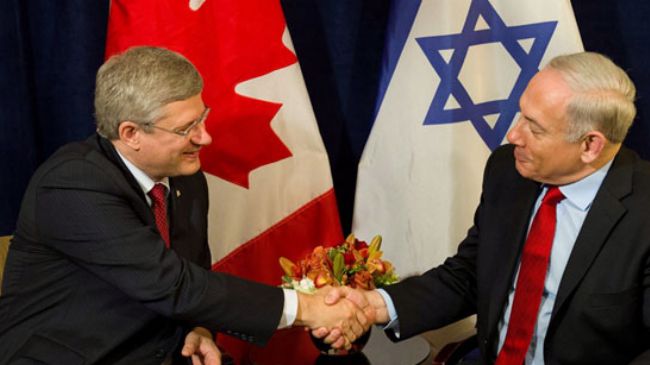
The Zionist ruling clique of Canada, through their front-man Stephen Harper, is seeking to beef up the already-existing Orwellian “hate propaganda” law which has been primarily used to curtail criticism of Zionists and Israel.
The conspicuous change is buried in the Harper government’s proposed cyberbullying law, Bill C-13.
The existing law in Canada’s criminal code makes it illegal to “promote hatred” (whatever that means) of people “distinguished by colour, race, religion, ethnic origin or sexual orientation,” explained The Chronicle Herald, but Bill C-13 intends to expand that category to include age, sex, mental or physical disability, and most disturbingly, “national origin.” In other words, you cannot criticize anyone for any reason at all!
This means, say, if you condemn Israelis for their inhumane treatment of Palestinians, you could find yourself in court facing down the self-appointed thought police and commissars of political correctness.
The … law against “hate speech” is illegitimate and ridiculous to begin with. The idea of allowing a government to legislate against opinions and feelings is patently absurd – it is pulled right out of George Orwell’s dystopian classic 1984.
British Columbia native Arthur Topham has felt the wrath of Canada’s censorious establishment. In November 2012, at the instigation of the Zionist society of B’nai B’rith, Topham was charged with a ‘hate crime’ for publishing anti-Zionist articles on his website Radical Press.
One of the items on Topham’s site that made the Zionists convulse and contort with unrestrained anger and rage was a satire called Israel Must Perish. The text was nothing more than a spoof of a 1941 book authored by a Zionist … named Theodore Kaufman entitled Germany Must Perish! In that text Kaufman called for “a final solution” of German extinction. Topham merely substituted the words “German,” “Germany” and “Nazi” with “Israel,” “Jew” and “Zionist” throughout the text. Despite writing a clearly-worded preface explaining the satirical nature of the text, Topham was arrested by the RCMP and now faces the possibility of spending up to two years behind bars for violating Zionist sensibilities.
Many will recall the sad saga of German-Canadian publisher Ernst Zundel. In the mid-1980s Zundel was charged with “spreading false news” after he published a book, Did Six Million Really Die?, which questioned some aspects of the official “holocaust” story. In the ensuing show trial, Zundel and his team of revisionist historians as well as his indefatigable defence lawyer Douglas Christie brought the holocaust lobby to its knees with facts and information refuting many claims made by Zionists about Germany’s WW2 concentration camps.
Over the span of three decades, Zundel was dragged from courtroom to courtroom, from jail cell to jail cell, merely for expressing a viewpoint deemed verboten by the … Zionist establishment – the self-appointed architects of public discourse, the self-declared arbiters of truth and morality, the self-proclaimed “chosen people” whose faults are unseen and whose character is unimpeachable.
Zundel, a self-described pacifist with no criminal record, was physically assaulted on numerous occasions by Jewish Defence League thugs. His Toronto home, which also housed his publishing and graphic arts businesses, was bombed and torched by Zionist terrorists. He received death threats on a daily basis from members of the “chosen race of God,” but the Toronto Police did almost nothing to prevent any of it and was entirely uninterested in pursuing the criminals and thugs responsible for the campaign of terror against Zundel and his associates.
Zundel’s story is a testament to the power and control of Jewish extremists in Canada, whose agenda is anything but altruistic and whose disposition is more racist than the Klan.
In the “New World Order” being imposed on us by self-interested, ethnocentric megalomaniacs, no man has the right to explore, investigate and come to his own conclusions about history — that is the sole responsibility of the tyrannical monarchs of the NWO, who tell us what and how to think; free thought be damned.
Brandon Martinez is a freelance writer and journalist from Canada whose area of expertise is foreign policy, international affairs and 20th and 21st century history. His writing is focused on issues such as Zionism, Israel-Palestine, American and Canadian foreign policy, war, terrorism and deception in media and politics. Readers can contact him at martinezperspective@hotmail.com.
Remember Tamiflu? Big Profits for Roche, but Little Help for Users
By Danny Biederman and Noel Brinkerhoff | AllGov | April 11, 2014
Governments spent heavily on Tamiflu starting last decade when public health officials warned of deadly influenzas. But the billion-dollar investment produced only healthy outcomes for the balance sheets of the drug’s manufacturer, Roche.
This conclusion was reached by British researchers who said they could not substantiate claims by Roche and GlaxoSmithKline (which makes a rival flu drug) Relenza, that their products helped people fight off flu effects.
The British government—anticipating the potential death of 750,000 of its citizens in the event of a bird flu outbreak—spent more than $700 million stockpiling 40 million doses of Tamiflu, while the U.S. government forked out $1.3 billion on a massive antiviral reserve that includes the drug. Tamiflu is also listed by the World Health Organization as an “essential medicine.” Yet the researchers found few if any benefits from the two drugs and, in fact, discovered that they produce negative side effects (“psychiatric…renal…and metabolic adverse events”) which were previously dismissed or never acknowledged.
All the money spent by governments around the world on those stockpiles “have been thrown down the drain,” Carl Heneghan, a lead investigator of the study and a professor of evidence-based medicine at Britain’s Oxford University, told Reuters. This is because accurate data about the drugs has long been withheld from government regulators, the medical community and the public.
Five years ago, Tamiflu sales reached nearly $3 billion, in large part because of the H1N1 flu pandemic scare. The Cochrane Collaboration and the British Medical Journal fought for four years to gain access to Roche’s Tamiflu data. Once they succeeded, they conducted a joint analysis.
Roche officials dismissed the researchers’ findings, saying the drug firm “fundamentally disagrees with the overall conclusions” of the study.
“We firmly stand by the quality and integrity of our data, reflected in decisions reached by 100 regulators across the world and subsequent real-world evidence demonstrating that Tamiflu is an effective medicine in the treatment and prevention of influenza,” the company said in a prepared statement.
“Remember, the idea of a drug is that the benefits should exceed the harms,” noted Heneghan. “So if you can’t find any benefits, that accentuates the harms.”
“Why did no-one else demand this level of scrutiny before spending such huge sums on one drug?” Journal editor Fiona Godlee said to Reuters. “The whole story gives an extraordinary picture of the entrenched flaws in the current system of drug regulation and drug evaluation.”
To Learn More:
Researchers, Regulators and Roche row over Stockpiled Drug Tamiflu (by Kate Kelland, Reuters)
Tamiflu: Millions Wasted on Flu Drug, Claims Major Report (by James Gallagher, BBC News)
Neuraminidase Inhibitors for Preventing and Treating Influenza in Healthy Adults and Children (by Tom Jefferson, Mark A. Jones, Peter Doshi, Chris B. Del Mar, Rokuro Hama, Matthew J. Thompson, Elizabeth A. Spencer, Igho Onakpoya, Kamal R. Mahtani, David Nunan, Jeremy Howick, and Carl J. Heneghan; Cochrane Review) (abstract)
Swine Flu Stirred Profits, but Fewer Deaths than Predicted (by Noel Brinkerhoff, AllGov)
Profiting from Swine Flu (by Noel Brinkerhoff, AllGov)
Putin: ‘We urgently need to stabilize Ukraine’s economy’
President Vladimir Putin’s letter to leaders of European countries
ITAR-TASS | April 10, 2014
Ukraine’s economy in the past several months has been plummeting. Its industrial and construction sectors have also been declining sharply. Its budget deficit is mounting. The condition of its currency system is becoming more and more deplorable. The negative trade balance is accompanied by the flight of capital from the country. Ukraine’s economy is steadfastly heading towards a default, a halt in production and skyrocketing unemployment.
Russia and the EU member states are Ukraine’s major trading partners. Proceeding from this, at the Russia-EU Summit at the end of January, we came to an agreement with our European partners to hold consultations on the subject of developing Ukraine’s economy, bearing in mind the interests of Ukraine and our countries while forming integration alliances with Ukraine’s participation. However, all attempts on Russia’s part to begin real consultations failed to produce any results.
Instead of consultations, we hear appeals to lower contractual prices on Russian natural gas – prices which are allegedly of a “political” nature. One gets the impression that the European partners want to unilaterally blame Russia for the consequences of Ukraine’s economic crisis.
Right from day one of Ukraine’s existence as an independent state, Russia has supported the stability of the Ukrainian economy by supplying it with natural gas at cut-rate prices. In January 2009, with the participation of the then-premier Yulia Tymoshenko, a purchase-and-sale contract on supplying natural gas for the period of 2009-2019 was signed. The contract regulated questions concerning the delivery of and payment for the product, and it also provided guarantees for its uninterrupted transit through the territory of Ukraine. What is more, Russia has been fulfilling the contract according to the letter and spirit of the document. Incidentally, Ukrainian Minister of Fuel and Energy at that time was Yuriy Prodan, who today holds a similar post in Kiev’s government.
The total volume of natural gas delivered to Ukraine, as stipulated in the contract during the period of 2009-2014 (first quarter), stands at 147.2 billion cubic meters. Here, I would like to emphasize that the price formula that had been set down in the contract had NOT been altered since that moment. And Ukraine, right up till August 2013, made regular payments for the natural gas in accordance with that formula.
However, the fact that after signing that contract, Russia granted Ukraine a whole string of unprecedented privileges and discounts on the price of natural gas, is quite another matter. This applies to the discount stemming from the 2010 Kharkiv Agreement, which was provided as advance payment for the future lease payments for the presence of the (Russian) Black Sea Fleet after 2017. This also refers to discounts on the prices for natural gas purchased by Ukraine’s chemical companies. This also concerns the discount granted in December 2013 for the duration of three months due to the critical state of Ukraine’s economy. Beginning with 2009, the total sum of these discounts stands at 17 billion US dollars. To this, we should add another 18.4 billion US dollars incurred by the Ukrainian side as a minimal take-or-pay fine.
In this manner, during the past four years, Russia has been subsidizing Ukraine’s economy by offering slashed natural gas prices worth 35.4 billion US dollars. In addition, in December 2013, Russia granted Ukraine a loan of 3 billion US dollars. These very significant sums were directed towards maintaining the stability and creditability of the Ukrainian economy and preservation of jobs. No other country provided such support except Russia.
What about the European partners? Instead of offering Ukraine real support, there is talk about a declaration of intent. There are only promises that are not backed by any real actions. The European Union is using Ukraine’s economy as a source of raw foodstuffs, metal and mineral resources, and at the same time, as a market for selling its highly-processed ready-made commodities (machine engineering and chemicals), thereby creating a deficit in Ukraine’s trade balance amounting to more than 10 billion US dollars. This comes to almost two-thirds of Ukraine’s overall deficit for 2013.
To a large extent, the crisis in Ukraine’s economy has been precipitated by the unbalanced trade with the EU member states, and this, in turn has had a sharply negative impact on Ukraine’s fulfillment of its contractual obligations to pay for deliveries of natural gas supplied by Russia. Gazprom neither has intentions except for those stipulated in the 2009 contract nor plans to set any additional conditions. This also concerns the contractual price for natural gas, which is calculated in strict accordance with the agreed formula. However, Russia cannot and should not unilaterally bear the burden of supporting Ukraine’s economy by way of providing discounts and forgiving debts, and in fact, using these subsidies to cover Ukraine’s deficit in its trade with the EU member states.
The debt of NAK Naftogaz Ukraine for delivered gas has been growing monthly this year. In November-December 2013 this debt stood at 1.451,5 billion US dollars; in February 2014 it increased by a further 260.3 million and in March by another 526.1 million US dollars. Here I would like to draw your attention to the fact that in March there was still a discount price applied, i.e., 268.5 US dollars per 1,000 cubic meters of gas. And even at that price, Ukraine did not pay a single dollar.
In such conditions, in accordance with Articles 5.15, 5.8 and 5.3 of the contract, Gazprom is compelled to switch over to advance payment for gas delivery, and in the event of further violation of the conditions of payment, will completely or partially cease gas deliveries. In other words, only the volume of natural gas will be delivered to Ukraine as was paid for one month in advance of delivery.
Undoubtedly, this is an extreme measure. We fully realize that this increases the risk of siphoning off natural gas passing through Ukraine’s territory and heading to European consumers. We also realize that this may make it difficult for Ukraine to accumulate sufficient gas reserves for use in the autumn and winter period. In order to guarantee uninterrupted transit, it will be necessary, in the nearest future, to supply 11.5 billion cubic meters of gas that will be pumped into Ukraine’s underground storage facilities, and this will require a payment of about 5 billion US dollars.
However, the fact that our European partners have unilaterally withdrawn from the concerted efforts to resolve the Ukrainian crisis, and even from holding consultations with the Russian side, leaves Russia no alternative.
There can be only one way out of the situation that has developed. We believe it is vital to hold, without delay, consultations at the level of ministers of economics, finances and energy in order to work out concerted actions to stabilize Ukraine’s economy and to ensure delivery and transit of Russian natural gas in accordance with the terms and conditions set down in the contract. We must lose no time in beginning to coordinate concrete steps. It is towards this end that we appeal to our European partners.
It goes without saying that Russia is prepared to participate in the effort to stabilize and restore Ukraine’s economy. However, not in a unilateral way, but on equal conditions with our European partners. It is also essential to take into account the actual investments, contributions and expenditures that Russia has shouldered by itself alone for such a long time in supporting Ukraine. As we see it, only such an approach would be fair and balanced, and only such an approach can lead to success.
Human Rights Watch Should Stick to the Facts on Venezuela
By Mark Weisbrot | CEPR Americas Blog | April 10, 2014
Despite the fact that the New York Times had to run a correction on February 26 for claiming that Globovisión in Venezuela was “[t]he only television station that regularly broadcast voices critical of the government,” Daniel Wilkinson of Human Rights Watch (HRW) repeats the same error in the New York Review of Books yesterday, writing that:
Two of the four private stations voluntarily dropped their critical coverage; a third was forced off the air; and the fourth was hounded by administrative sanctions and criminal charges until the owner sold it last year to investors reportedly linked to the governments, who have dramatically curtailed its critical content.
In fact, the stations he claims have “dropped their critical coverage,” Venevisión and Televen, regularly run coverage that is critical of the government, as documented here.
Since the claim that these stations have “dropped their critical coverage” is demonstrably false, the NYRB, like the New York Times, should run a correction.
The fourth station he refers to is Globovisión. During the run-up to last April’s presidential elections, according to a Carter Center study, Globovisión gave nine times as much coverage to opposition presidential candidate Henrique Capriles as to governing party candidate Nicolás Maduro. Readers who are familiar with right-wing TV in the United States will note that this would not be possible for Fox News, for example, to get away with. So, if Globovisión “dramatically curtailed” its anti-government bias – Wilkinson offers no data — because it was bought by someone who wanted to practice mainstream journalism, the station could still have a lot of room to trash the government.
In fact, on February 17, in the heat of the recent protests, Globovisión ran an interview with opposition leader María Corina Machado in which she denounced the government for a series of alleged crimes and argued that people had the right to overthrow it. This casts a bit of a shadow over Wilkinson’s further claim that “while some news programs have interviewed opposition leaders and government critics, they do so under the legal and political constraints imposed by the government.”
It’s too bad that Wilkinson ignored or perhaps didn’t read the Carter Center’s report on the Venezuelan media during the vigorously contested 2013 presidential election campaign. The data from the report, taking into account audience share, indicate that TV media coverage was pretty evenly split between the two candidates. This contradicts the exaggerated picture that he paints in this article of an “authoritarian” government seeking to “control how the news gets reported on Venezuelan TV.”
The 2,800-word article – which provides few links or sources to back up dozens of allegations – contains a number of exaggerations and inaccuracies. For example, in describing the protests he writes that “Most of these have been peaceful, though in many places protesters have barricaded streets, and some have thrown rocks and Molotov cocktails.” This contradicts daily news reports in the major international media. Some of the large daytime marches have been peaceful, but every night for nearly two months there have been violent protests where the participants throw rocks and Molotov cocktails at security forces and sometimes neighbors who try to clear or pass through barricades. Not to mention the occasional shootings by protesters. He doesn’t mention it, but half of the 39 fatalities he refers to have apparently been caused by protesters.
Now, don’t get me wrong. It is the job of human rights groups to denounce and expose all human rights abuses committed by governments (and non-state actors too), and I would not criticize a human rights organization for being too harsh on any government. And if Wilkinson wants to ignore or pretend he can’t see that this is another attempt to overthrow a democratically elected government taking place, that’s his prerogative too. But why the gross exaggerations and false statements? Aren’t there enough things to complain about without making things up?
HRW can get away with outrageous double standards if they want. They barely lifted a finger when a U.S.-backed coup overthrew the democratically-elected government of Haiti in 2004. The perpetrators of the coup killed thousands of people, and officials of the constitutional government were put in jail. This did not raise a tiny fraction of the concern at HRW as compared to the “independence of the judiciary” in Venezuela, which of course was not more independent before their enemy Chávez was elected.
In 2008, more than 100 scholars and experts signed a letter documenting and “highlighting exaggerations and inaccuracies” in a “politically motivated” report by HRW on Venezuela. It is clear that HRW did not take any steps to correct their bias or carelessness with the facts. That is a shame. Of course, there is no political price to pay in the U.S. for exaggerating or making false statements about a government that Washington wants to destabilize. But it does not serve the cause of human rights; and it undermines the good work that HRW does in other countries when they are seen as a partisan ally of a U.S.-backed attempt at “regime change.”
Really they should stick to the facts.
Israeli police brutality caught on video
Press TV – April 10, 2014
An online video has emerged, showing Israeli police forces battering a Palestinian before attacking a protesting bystander.
Ali Talhami suffered a broken arm and ribs after police officers repeatedly slammed a police car door on him, the Israeli daily Haaretz reported on Thursday.
The video shows a police officer forcing Talhami into the police van with blows and then walking over to Majdi Dabah, who was standing nearby, before throwing him at the vehicle.
Talhami was subjected to the acts of violence for refusing to pay up a heavy fine imposed on him by an inspector for leaving a refrigerator outside his store in East al-Quds (Jerusalem).
“I explained the refrigerator was outside because we were returning it to the company, but the inspector started swearing at me,” Talhami said, adding that he was then attacked by a police officer accompanying the inspector before other police officers arrived and joined in on the beating.
“After we reached the police station, they continued beating me,” said Talhami.
“The policeman started beating Ali, and I told him not to,” Dabah said. “So he pushed me with my head into the window and then knocked me to the ground and beat me.”
“My shoulder was dislocated and my head hurts,” Dabah said.
Arrests and stolen land in Osarin village
International Solidarity Movement | April 10, 2014
Osarin, Occupied Palestine – In the last month, the Israeli army has arrested 10 boys under the age of 16 from Osarin village. As of today, they all remain in the prison.
This is the latest in a long line of tactics employed by the Israeli military to intimidate the people of Osarin and the surrounding villages. According to a member of the village’s local council, the Israeli army approached the village around six months ago demanding that Osarin and three other neighboring villages sell three dunams (3,000 square meters) of land to the Israeli government. The threat was that if they did not comply the army would simply take the land. Despite this pressure, the people of the village collectively chose to refuse and have had to live with the consequences of this choice ever since.
The land the army asked for originally was intended to build three watchtowers, one of which would be just outside Osarin. The other two would be near the villages of Yatma and Qabalan, who also had demands from the Israeli army to sell their land. In total the army was trying to obtain 320 dunams of important farmland, containing olive trees, other crops and grazing areas from the three villages.
The village’s decision to refuse was met with a new plan by the army to build a wall on either side of the main road (route 505), running adjacent to the village, all the way to Za’tara checkpoint. This would be roughly 10km in length and would unsurprisingly require the confiscation of land on either side of the road, which belongs to the village of Osarin. The reasoning for this intrusion into Palestinian land was allegations that boys from the village had been throwing stones onto the main road, where settlers from the illegal settlements pass by in their cars and sometimes on foot. In fact, the Israeli army used these allegations to call a meeting with four villages, one of which was Osarin, the others being Beita, Beit Furik and Madama. In this meeting the army told the representatives from the villages that unless the alleged stone throwing ceased they would make all four of the villages into closed military zones. In other words, force out the inhabitants of all four villages and make it impossible for them to return.
While the Israeli army demands that children stop throwing stones, they are also at the same time increasing attacks on the civilian population of Osarin. During these periods physical force has been used, including punching individuals with no just cause and firing live ammunition into the air to intimidate the local population. Also during these incursions, the roads are closed around the village even when ambulances need to either enter or leave the village, endangering lives in the process.
The village has attempted to go through the court system to block the Israeli authorities’ plans for the area, but has lost each court battle numerous times. This is despite the fact that the village is located in Area B (Palestine Authority and Israeli control) and therefore any seizure of land, including for the purposes of military building construction, is illegal. The area has long been an area of high activity for the Israeli military, where in November 2013 witnesses report that military training took place involving up to 1,000 Israeli soldiers. During the week-long action villagers were told to stay in at night, creating a curfew, and at times local groups of boys were used to provide training with how to deal with stone throwing.
When a local representative was asked if he felt matters had gotten worse in terms of Israeli military interference and intimidation, his answer was an unequivocal yes. The construction of the wall along either side of Route 505 has yet to begin but will most probably commence in the near future. In the meantime, arrests of children and physical violence towards the villagers continue.
Iran must be ready to walk from P5+1
By Finian Cunningham | Press TV | April 9, 2014
Iran should not sweat it over the P5+1 nuclear talks. Any final agreement is simple.
It must recognize Iran’s inalienable right to peaceful nuclear technology, including the operation of uranium enrichment and all existing related facilities in the country. In return for Iranian guarantees over its legitimate nuclear activities, the US and its European allies must cancel the onerous burden of economic sanctions. That is the essence of any deal. And any other add-on issues are irrelevant.
Indeed, Western attempts to alter the framework of a final nuclear deal must be slapped down; or if insisted upon, Iran should reserve the right to walk away from the talks.
Negotiations this week in the Austrian capital Vienna were said to be “constructive”. Next month, discussions move on to a final accord that could pave the way for lifting of sanctions.
The stakes are high for Iran. Of course, Iran wants to see a prompt end to the Western-imposed sanctions regime that has caused economic and social hardship for its people. The morality and legality of such indiscriminate punishment is highly dubious, to say the least, and their continued imposition is a cause of much indignation.
But a final agreement must be based on the essential details: Iran’s inalienable right to civilian nuclear technology; an agreed system of verification; and immediate cancellation of economic sanctions.
If the Western states, in particular the US, Britain and France, begin to add on conditions to those essential details, Iran must not be browbeaten or seduced into making concessions for the sake of concluding a final accord.
Ominously, we saw this duplicitous Western tendency to move the goalposts this week when US Secretary of State John Kerry told a Senate hearing in Washington that sanctions relief for Iran was contingent not just on Iranian guarantees over nuclear weapons, but also on allegations of Iranian involvement in international terrorism and violation of human rights.
Kerry’s comments follow on the move last week by the European Parliament to censure Iran over alleged human rights abuses. It seemed more than mere coincidence that both the US and EU expressions pre-empted the latest round of P5+1 negotiations in Vienna this week.
It is, to be sure, patently ridiculous for the Americans and Europeans to raise issues of human rights and terrorism given their own outrageous transgressions. Just this week we hear of more reports that Washington is to step up supplies of heavy weapons to terrorists running amok in Syria – the same Western-backed terrorists who are implicated in the use of chemical weapons to kill hundreds of civilians in a callous propaganda stunt.
This also follows increasing evidence last week of a decade of American torture – assisted by European collusion – of hundreds of detainees at the Guantanamo Bay concentration camp and countless other US black sites around the globe.
And as far as the Europeans are concerned, this week sees the plight of 12 million Roma people being highlighted for gross mistreatment by governments across the entire 28-nation bloc.
Regardless of the integrity of purported American and European concerns – terrorism and human rights – what needs to be recognized is that the ostensible issues are completely irrelevant to the nuclear dispute and a final accord. These issues are being added on in an ad hoc fashion, which suggests that the P5+1 nuclear impasse is being set up for procrastination on Western terms.
As Iranian Professor Mohammad Marandi told Press TV this week in a debate forum, the issue of alleged human rights violations is being used as a ploy to pressure Iran into making concessions over its nuclear rights. The Western logic would seem to be: if you want a P5+1 deal and an end to trade sanctions, then we want in return closure of this or that nuclear facility (in contravention of Iran’s legal rights), otherwise we are going to keep raising obstacles such as allegations of human rights abuses and international terrorism.
This is a completely unacceptable Western formula for moving the goalposts on its duplicitous terms. It will mean a never-ending impasse aimed at harassing Iran with more and more threats, including threats of war.
The essence of a long overdue nuclear accord with Iran is for the arrogant Western powers to start treating Iran as an equal, in which Iran is able to avail of its inalienable rights as a signatory to the Non-Proliferation Treaty – without condition or exception.
If Western states insist on adding on irrelevant – as well as hypocritical and spurious – issues it is a damning sign of their incorrigible bad faith. In that event, Iran must be prepared to walk away from the P5+1 process.
However, that is not necessarily a reckless option. Given the growing importance of international trade involving Russia, China and other emerging economies – that is, trade without the bankrupt Western states – Iran might find itself better off anyway not having to waste time and energy on these malignant has-been powers.
Iran needs to stay cool, not sweat it, and to turn the tables on the arrogant players by asserting its own rightful demands.
The Deterioration of Egypt
By RAMSEY CLARK and ABDEEN JABARA | CounterPunch | April 10, 2014
We recently visited Egypt leading a delegation of lawyers to observe the situation of human rights in that country. We were troubled by what we saw and heard. We are also troubled by the United States’ support for a government installed by a military coup.
The United States and more than 160 States have agreed to respect and ensure the right to participate in one’s government, for example, by agreeing to article 25 of the International Covenant of Civil and Political Rights. Nevertheless, as this right came under serious attack in Egypt, the United States continues to support the Egyptian military as it imposes its will on the Egyptian people. This support should stop until and unless the freely and fairly elected government is restored.
The military coup that took place in Egypt on 3 July 2013 is a serious violation of the right to participate in one’s democracy. It is a violation of the rights of the majority voters in Egypt’s presidential and parliamentary elections in 2011 and 2012.
The serious deterioration of human rights in Egypt in the aftermath of the military coup is largely due to the military coup leaders’ unwillingness to allow any significant expressions of dissent and the military coup leaders’ failure to respect the will of the Egyptian people.
During our visit to Cairo we heard reliably allegations of massive, widespread and serious violations of the right to fair trial, to an independent judiciary, to security of person, to the prohibition of torture, and about a policy of violent assaults on women. The level of these abuses is unprecedented in Egypt, a country with which we are familiar for almost half a century.
Grave concerns were expressed by lawyers about the integrity of the courts. The trial of Egypt’s first elected President Mohamed Morsi by the military is a case in point. The procedures that exist in the Egyptian Constitution for trying their President have been ignored. This has resulted in President Morsi being tried by an illegal court that appears to have been created merely to justify removing him from office.
The military coup leaders have been unrelenting in their attack on the peaceful supporters of the Muslim Brotherhood.
In December 2013 the military coup leaders declared the Muslim Brotherhood an illegal entity. They did this despite the fact that the Freedom and Justice Party with which it is associated, won more support than any other party in Egypt’s free and fair parliamentary and presidential elections. This action violates the right to free speech, assembly and association.
Recently, an Egyptian court, functioning under the military coup, sentenced more than 400 supporters of the Muslim Brotherhood to death for the killing of a single policeman. At the same time, thousands of Egyptians remain arbitrarily detained and without fair trial.
The dismal state of human rights in Egypt, which we witnessed first hand, should be a concern for us all. The United States should stand with the Egyptian people and not with the leaders of a military coup.
Ramsey Clark was the 66th Attorney-General of the United States.
Abdeen Jabara, Frm. President of the Arab-American Anti-Discrimination Committee and Board Member of the Center for Constitutional Rights.
NATO/ISAF’s ‘parting gift’ to Afghan children
Interventions Watch | April 10, 2014
A new report from The Washington Post highlights the increasing number of Afghan children who are being killed by unexploded ordinance on abandoned NATO/ISAF firing ranges.
The report says that ‘of the casualties recorded by the United Nations, 88 percent were children’, with ‘most of the victims . . . taking their animals to graze, collecting firewood or searching for scrap metal’.
A bare minimum of 77 people have been killed in this fashion since 2012, but the number is likely higher.
This was the experience of a couple of Afghan families:
‘Last month, Jawad’s father, Sayed Sadeq, heard a boom and ran onto the range. He spotted his son’s bloodied torso.
“The left side of his body was torn up. I could see his heart. His legs were missing,” the father said.
One of the boys, it appeared, had stepped on a 40mm grenade, designed to kill anyone within five yards. Both teens died.
“If the Americans believe in human rights, how can they let this happen?” Sadeq said’.
—
‘Two months after his family moved to Bagram, Abdul Wakhil, 12, walked around the area looking for firewood and unknowingly entered the range. Thirty feet from the main road, he stepped on an explosive.
One of his legs was blown off. The other was amputated at a Kabul hospital.
He doesn’t have prosthetics or a wheelchair, so he has to be carried everywhere.
“What can he do without legs?” said his brother, Abdul Mateen, 25. “His future is hopeless.”
The Occupiers have promised to clean up the ranges, although some military officials have expressed doubt as to the feasibility of this, given a lack of manpower.
The article also states that ‘because Afghanistan is not a signatory to the U.N. Convention on Certain Conventional Weapons, U.S. officials say they are not legally obligated to clear any of the unexploded ordnance’.
The Occupying powers have also ‘refused to construct fencing’ around the ranges, saying that this ‘would be prohibitively expensive and probably ineffective’.
Let us not forget that the life of an Afghan civilian can be worth as little as $210 to the Occupying forces, so paying the ‘compensation’ for any deaths could well turn out to be more cost effective than constructing thousands of square miles of barriers (that grim calculus aside, Afghans losing access to tens of thousands of square miles of their own land, simply because the Occupiers wanted to use it to test the weapons which had previously been used to kill them with, would be a Kafkaesque injustice indeed).
But at this moment in time, it appears that even if – and that’s a big and very doubtful ‘if’ – the Occupying forces do completely withdraw from Afghanistan by the end of 2014, they will continue to kill and maim Afghan children long into the future.
Featured Video
Dr. Tony Martin – The Jewish Role in the African Slave Trade
or go to
Aletho News Archives – Video-Images
In Memoriam
James Petras, In Memoriam
 02.13.2026
Professor James Petras, 89, world-renowned sociologist, public intellectual, and scholar of Latin American politics and global economics, died peacefully on January 17, 2026, in Seattle, WA, surrounded by family.
A prolific scholar and activist, he devoted his life to challenging power, imperialism, and inequality. … continue
Blog Roll
 Aletho News
- Israel ready to strike Iran-backed armed groups – media
- Behind US war drums against Iran: No goals, no plan, no off-ramp
- With Ukraine blamed for cutting oil flows to Hungary, Croatia also refuses to transfer Russian oil in violation of EU law
- Friedrich Merz’s Push to End Online Anonymity Has a Troubling Subtext
- Macron: French citizens fighting for Israel cannot be labeled ‘genociders’
- US eyes Gaza security force drawn from armed gangs
- The Only Motive Behind The ‘Imminent’ U.S. War With Iran Is The Zionist Lobby
- Trump eyes 350-acre US military base housing 5,000 troops in Gaza
- Israel Pushing US Toward a Big and Damaging War With Iran – Ex-Pentagon Analyst
- Meet The Liberal Zionist And Ukraine War Supporter Advising AOC On Foreign Policy
- If Americans Knew
- ‘Christians Out’: Jerusalem Church Tagged With Hate Graffiti, Police Investigating
- Israeli Settlers Kill American Teen
- ‘We returned from hell’: Palestinian journalists recount torture in Israeli prisons
- No mercy for Gaza in Ramadan – Not a ceasefire Day 133
- The Israeli Government Installed and Maintained Security System at Epstein Apartment
- Tucker Carlson interrogated in Israel, has passport seized after interviewing US ambassador
- 6,000 Amputees in Gaza Face Impossible Recovery amid Israeli War Ultimatum
- The Lancet: Gaza death toll far higher than reported – Not a ceasefire Day 132
- Compliant aid: Who are the Israel-approved NGOs scaling up in Gaza?
- Why won’t Trump’s “Board of Peace” bring peace? – Not a ceasefire Day 131
- No Tricks Zone
- Coal Power Back In Trend As Globe Tries To Keep Pace With Growing Demand For Power
- New Study: A 4°C Warmer Beaufort Sea Had ‘No Sea Ice’ 11,700 – 8200 Years Ago
- Unfudging The Data: Dutch Meteorological Institute Reinstates Early 20th Centruy Heat Waves It Had Erased Earlier
- German Gas Crisis…Chancellor Merz Allegedly Bans Gas Debate Ahead of Elections!
- Pollen Reconstructions Show The Last Glacial’s Warming Events Were Global, 10x Greater Than Modern
- Germany’s Natural Gas Storage Level Dwindles To Just 28%… Increasingly Critical
- New Study Rebuts The Assumption That Anthropogenic CO2 Molecules Have ‘Special’ Properties
- Climate Scientist Who Predicted End Of “Heavy Frost And Snow” Now Refuses Media Inquiries
- Polar Bear Numbers Rising And Health Improving In Areas With The Most Rapid Sea Ice Decline
- One Reason Only For Germany’s Heating Gas Crisis: Its Hardcore-Dumbass Energy Policy
 Aletho News