US VP’s son joins Ukrainian gas group board
RT | May 13, 2014
 Hunter Biden, son of US Vice President Joe Biden, will join the board of directors of Burisma Holdings, Ukraine’s largest private gas producer. The statement comes amid Ukraine’s growing gas crisis.
“Hunter Biden will be in charge of the Holdings’ legal unit and will provide support for the Company among international organizations,” said the company’s official statement.
Biden, commenting on his appointment, said that his assistance in consulting Burisma Holdings “on matters of transparency, corporate governance and responsibility, international expansion and other priorities will contribute to the economy and benefit the people of Ukraine.”
“Burisma’s track record of innovations and industry leadership in the field of natural gas means that it can be a strong driver of a strong economy in Ukraine,” he added.
The appointment announcement comes on the same day as Russia’s gas giant, Gazprom, switched to a prepayment system with Ukraine and sent Naftogaz, Ukraine’s gas and oil company, a $1.66 billion gas bill for June supplies. Kiev must pay the bill by June 2, otherwise, it may risk a halt in natural gas supplies on June 3, Gazprom CEO Aleksey Miller said.
Ukraine, currently has about 9 billion cubic meters of gas in storage, and by the winter needs 18.5bcm to keep factories open and households warm, Gazprom Deputy Chief Executive Vitaly Markelov said on Tuesday. In 2013, Ukraine bought 27.7 billion cubic meters from Gazprom.
Under the present terms, Kiev has to pay $485 per 1,000 cubic meters. The price was raised in April from $268.50, when Russia withdrew all discounts it provided for Ukraine after the crisis-torn country failed to pay for gas. According to Gazprom’s CEO, Kiev already owes the company more than $3.5 billion.
Kiev has rejected the new price as “politically motivated” and has been refusing to pay back the debt until Gazprom cancels the “unjustified and unacceptable hike.”
Meanwhile, the US may use the critical energy situation in the country to promote its shale energy in Ukraine.
Hunter Biden, 44, is a partner at Rosemont Seneca Partners, business development and policy advisory firm, and is counsel to Boies, Schiller, Flexner, a New York based-law firm. He is also an adjunct professor on Georgetown University’s Master’s Program in the School of Foreign Service.
Biden is on the Chairman’s Advisory Board for the National Democratic Institute, and is also a director for the Center for National Policy and the US Global Leadership Coalition, an influential, broad-based organization formed by a coalition of 400 American businesses and NGOs, senior national security and foreign policy experts.
Meanwhile, former US President Bill Clinton appointed him an Executive Director of E-Commerce Policy Coordination under Secretary of Commerce William Daley. Biden was also honorary co-chair of the 2008 Obama-Biden Inaugural Committee.
Hunter Biden is also known in the political world. He is on the boards of the World Food Program USA, and the Truman National Security Project, a US organization, based in Washington, D.C, that recruits, trains, and positions specialists across America.
Burisma Holdings, a private oil and gas company in Ukraine which was set up back in 2002 and has grown rapidly since. Its licenses cover the Ukraine’s three key hydrocarbon basins, including Dnieper-Donets, Carpathian and Azov-Kuban.
In 2013, daily gas production amounted to 11.6 thousand BOE (barrel of oil equivalent), a unit of energy based on the approximate energy released by burning one barrel (158.98 liters of crude oil), or 1.8 million cubic meters of natural gas. The company sells these volumes in the domestic market, both via traders and directly to consumers.
Russia disappointed over additional EU sanctions
RT | May 13, 2014
Moscow expressed disappointment over the EU’s newly imposed sanctions against Russia, stressing that it is not worthy of the European Union.
“Instead of trying to solve the situation through de-escalation, disarmament of the Right Sector, improvement of dialogue between Kiev’s authorities and Ukrainian regions, EU colleagues are demonstrating a one-sided and one-dimensional policy, not worthy of the European Union,” Itar-Tass quoted Deputy Foreign Minister Sergey Ryabkov as saying.
Further sanctions were introduced on Monday following the results of referendums that have been announced in Donetsk and Lugansk Regions, showing the majority of voters support self-rule, amid an intensified military operation by Kiev which resulted in several deaths.
EU foreign ministers have expanded their sanctions over Russia’s actions in Ukraine, adding two Crimean companies and 13 people to the bloc’s blacklist, EU diplomats stated.
The sanctions will come into effect Tuesday. Earlier, 48 Russians and Ukrainians were targeted by EU asset freezes and visa bans over Crimea joining Russia in March.
Among the individuals banned entry to the EU are the chief prosecutor of Crimea and Internet sensation Natalia Poklonskaya and her colleague from Sevastopol, Igor Shevchenko. Also the list includes influential individuals such as the deputy head of the presidential administration, Vyacheslav Volodin, the Commander of airborne troops Vladimir Shamanov, State Duma deputy Vladimir Pligin, Crimean administration chiefs and six pro-autonomy activists in eastern Ukraine, reported Itar-Tass.
Following the referendum results, Donetsk People’s Republic has proclaimed itself a sovereign state and has asked Moscow to consider its accession into Russia, the Republic’s council said.
Russia is taking its time before reacting to Donetsk People’s Republic’s plea while calling for dialogue between Kiev and the eastern regions.
Moscow not in rush to respond Donetsk People’s Republic’s plea of accession
RT | May 12, 2014
Russia is taking its time before reacting to Donetsk People’s Republic’s plea to consider its accession into Russia while calling for dialogue between Kiev and the eastern regions.
The Russian president’s spokesman Dmitry Peskov has told Kommersant newspaper Russia does not yet have a response to the plea.
Earlier on Monday the Kremlin’s press service issued a statement, saying: “Moscow respects the will of the people in Donetsk and Lugansk and hopes that the practical realization of the outcome of the referendums will be carried out in a civilized manner.”
It stressed the necessity of a “dialogue between representatives of Kiev, Donetsk and Lugansk.”
On Monday, Donetsk People’s Republic proclaimed itself a sovereign state and asked Moscow to consider its accession into Russia, the Republic’s council said.
Earlier in the day, the results of referendums were announced in Donetsk and Lugansk Regions, showing the majority of voters support self-rule, amid an intensified military operation by Kiev which resulted in several deaths.
Experts on the issue have weighed in with their view on Russia’s response.
International legal expert Alexander Mercouris told RT that Moscow’s reaction was consistent with its previous policy on Ukraine.
“Moscow is following what has been its consistent policy right from the start, right from the moment when the coup took place in Kiev in February, which has been pressing for negotiations between Kiev and the actual true democratic representatives of the eastern regions in order to achieve constitutional change,” Mercouris told RT. “I do not think Moscow’s position has changed. But I think Moscow’s position may change in the future.”
International relations expert and senior lecturer at Moscow State University Mark Sleboda also told to RT that he does not view Moscow’s reaction as contradicting its previous stance.
“Moscow’s reaction to the referendum – they of course recommended that it be postponed, and they had a somewhat tepid reaction to it. But at the same time they did not completely disown it either,” Sleboda said.
“The first statement out of Moscow this morning that it looked forward to a dialogue between Donetsk, Lugansk and Kiev to resolve the situation and implement the people’s will was a very strong indication that Russia is still really trying for dialogue with Kiev,” Sleboda added.
Professor of History and Politics in Berlin Ronald Suni noted that Russia’s slow response will indeed provide room for international dialogue, which may help the situation.
“Vladimir Putin and his advisors decided a few days ago that we’ve got to pull back, that we’ve got to slow things down. That all these people acting in their own interest, out of their own emotions and passions could lead to some very dangerous situations – civil war or international war,” Suni told RT.
“So, why not postpone the referendum, which of course the locals did not want to do, recognize the May 25 elections, which part of Ukraine probably won’t do, and pull troops back from the frontier, which Putin did. Even so, these actions have not led to a response, on both sides it would allow for some kind of international negotiation,” he added.
Mercouris also explained the referendum results are a valid statement of opinion. “Yes, they were organized in great haste, in civil war, revolutionary conditions, but even people who are present, who are hostile to these referendums, from the Western media now accept that these are in fact representative of the powerful mass movement,” he said.
Sleboda stated that when examining Donetsk and Lugansk referendums, one must pay attention to three things. “One, the extremely large turnout, which is nearly impossible to deny. The overwhelming landslide victory – since the vote was essentially public with the glass ballot boxes and the Western journalists who served in place of international monitors, we could say, who clearly informally polled on the ground the strength of support for the independence vote.”
“And three, we have to remember that this did indeed happen under the barrel of a gun – but not the barrel of the gun of the self-defense forces, but under the barrel of the gun of this Kiev regime who was actually killing voters as they tried to vote against it on the referendum day,” he argued.
Nigeria accepts Israeli help in search for kidnapped school girls
MEMO | May 12, 2014
Nigeria’s President Goodluck Jonathan has accepted an Israeli offer to help search for 223 kidnapped school girls by the extremist Boko Haram group, Israel’s Prime Minister Benjamin Netanyahu’s office announced yesterday.
Netanyahu is reported to have told the Nigerian president: “Israel expresses deep shock at the crime against the girls. We are ready to help in finding the girls and fighting the cruel terrorism inflicted on you.”
The statement gave no further details on the nature of assistance provided.
A foreign ministry spokesman said he does not know of any cooperation efforts in the present time.
Israel and Nigeria have a defence agreement whereby Israel supplied Nigeria with drones in September and joined other countries to advise Kenya to confront Islamic militants who attacked a trading centre in Nairobi.
In a statement, the Nigerian president’s office said: “President Jonathan has accepted an Israeli offer by Prime Minister Netanyahu to send a team of Israeli counter-terrorism experts to contribute to the ongoing search operations. Nigeria would be pleased to have Israel’s globally acknowledged anti-terrorism expertise deployed to support its ongoing operations.”
A total of 276 girls were abducted by Boko Haram on April 14 from the northeast of the country, which has a sizeable Christian community. Some 223 are still missing.
~~~
See also:
- ‘Boko Haram’ doesn’t really mean ‘Western education is a sin’
- How Nigerian police also detained women and children as weapon of war
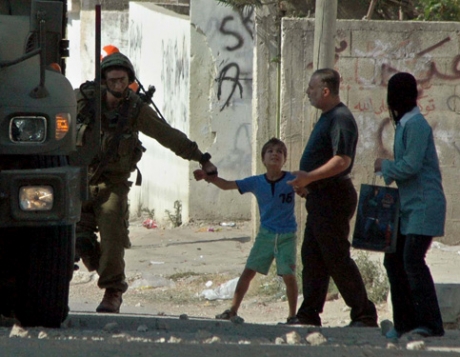
Israel jails 20% of Palestinian children in solitary confinement: monitor
Al-Akhbar | May 12, 2014
Israel is placing increasing numbers of arrested Palestinian children in solitary confinement, an international children’s rights group said in a report issued Monday.
The report came just months after Israel’s army, under international pressure to introduce reforms, agreed to test alternative treatment for children it detains in the West Bank.
In more than one in five cases recorded by Defense for Children International (DCI) in 2013, children detained for questioning by the army reported “undergoing solitary confinement,” it said in a statement.
This was a two-percent rise on 2012 figures, it added.
“Use of isolation against Palestinian children as an interrogation tool is a growing trend,” said Ayed Abu Eqtaish of DCI in the occupied Palestinian territories.
“This is a violation of children’s rights and the international community must demand justice and accountability,” he said.
“Globally, children and juvenile offenders are often held in isolation either as a disciplinary measure or to separate them from adult populations,” DCI said.
“The use of solitary confinement by Israeli authorities does not appear to be related to any disciplinary, protective, or medical rationale.”
DCI’s research included 98 sworn affidavits from Palestinian children aged 12 to 17.
In October, the UN children’s fund (UNICEF) said Israel had agreed to test alternative treatment for Palestinian children arrested in the West Bank.
These included issuing summons instead of arresting children at their homes in violent, overnight raids that often lead into street battles with locals who confront the occupation forces.
But UNICEF said that “ongoing” violations by the army were rife and included physical violence and verbal abuse.
Over the past decade, Israeli forces have arrested, interrogated and prosecuted around 7,000 children between 12 and 17, mostly boys, UNICEF found, noting the rate was equivalent to “an average of two children each day.”
(AFP, Al-Akhbar)
Syria says France, Germany to bar expats from voting
Al-Akhbar | May 12, 2014
The foreign ministry said Monday that France and Germany intend to prevent Syrians living in their countries from voting in Syria’s presidential election, expected to return President Bashar al-Assad to power.
Germany and France are “preventing Syrians living in their territory from voting,” the foreign ministry said.
“France… is carrying out a hostile press campaign” against next month’s election, it said in a statement carried by state news agency SANA.
“It has officially informed our embassy in Paris of its opposition to the holding of the vote on French territory, including the Syrian embassy.”
French foreign ministry spokesman Romain Nadal implicitly confirmed the decision.
“The organization of foreign elections on French soil is covered by the Vienna Convention on Consular Relations of April 24, 1963,” he told AFP.
“As we are authorized by this convention, French authorities have the right to oppose the holding of this election anywhere on French territory.”
He reiterated France’s demand for a “political solution” to conflict in Syria as well as a transition process and Assad’s departure from office.
“Bashar al-Assad, who is responsible for the death of 150,000 people, cannot represent the future of the Syrian people,” Nadal said.
The foreign ministry said Germany had “joined the countries trying to block the presidential elections in Syria.”
It accused Berlin of “supporting, funding and arming terrorist groups in a bid to destroy Syria,” referring to the anti-Assad opposition.
“It is not surprising that these countries have taken the decision to prevent Syrian citizens living in their territory from exercising their constitutional right to vote in the embassies of their country,” the ministry added.
Damascus has set the presidential election for June 3, with expatriate voting to take place on May 28.
(AFP)
Syrian rebels could swap 1,500 families for prisoners, food
Al-Akhbar | May 12, 2014
Syrian rebels have agreed to free 1,500 families in exchange for food and the release of jailed opponents of President Bashar al-Assad, a newspaper close to his government said Monday.
The reported agreement involves the release of families held by rebels in Adra, a pro-government town northeast of Damascus controlled by rebels and under siege by army troops.
Under the deal, food supplies would be allowed into Adra, and an unspecified number of people held in government jails would be set free, in exchange for the release of the 1,500 families held in the town, said Al-Watan.
In a first phase and as a gesture of goodwill, “a family of eight people would be released in exchange for food for civilians in Adra,” said the newspaper.
Afterwards, “the exchange would involve the release of one family held hostage in Adra per each detainee released” from government jails, it reported.
While the edges of Adra are under government control, the interior of the town is in rebel hands.
It is strategically located on the northeastern entrance to Damascus, and has in the past been used as a launching pad for attacks on the edges of the capital.
When the rebels took Adra in mid-December, they prevented thousands of people — many of them from Syria’s Alawi and Christian minorities — from leaving.
An activist in Adra told AFP via the Internet he could not confirm whether any deal was in the making, but he said the humanitarian situation for people in the town was dire.
“A kilo of rice is sold here at $8. Today, a little child died as a result of the food shortages,” said Abul Baraa.
The deal reported by Al-Watan was being discussed with religious leaders in Douma, a rebel bastion near Adra.
National Reconciliation Minister Ali Haidar told AFP: “I don’t want to discuss this question with the press before the talks are completed.”
At the end of December, at the height of the fighting around Adra, the government said it had evacuated more than 5,000 residents who had been blocked from leaving by rebels, according to state news agency SANA.
The rebels control Adra’s workers’ city, once home to workers of all religious groups who traveled to the Damascus outskirts for work. The army is still in control of the rest of Adra.
(AFP, Al-Akhbar)
France refuses to block Mistral warship deal with Russia
RT | May 12, 2014
The French government has said that it will go ahead with 1.2 billion euro ($1.6 billion) contract to supply Russia with two Mistral helicopter carriers because cancelling the deal would harm Paris more than Moscow.
In the wake of the crisis in Ukraine, the United States had been pressing France as well as Britain and Germany to take a tougher line against Russia and cancel the Mistral contract.
But France refuses to link the helicopter carrier deal to the US/EU debate over tougher sanctions against Russia.
A French government official travelling with President Francoise Hollande in Azerbaijan Sunday, who asked not be named, told reporters that the contract was too big to cancel and that if France didn’t fulfill the order it would be hit with penalties.
“The Mistrals are not part of the third level of sanctions. They will be delivered. The contract has been paid and there would be financial penalties for not delivering it.
“It would be France that is penalized. It’s too easy to say France has to give up on the sale of the ships. We have done our part,” the official said.
President Hollande also said earlier on Saturday that the contract will go ahead.
“This contract was signed in 2011, it will be carried out. For the moment it is not in question,” President Hollande said on Saturday during a visit to German Chancellor Angela Merkel’s electoral district.
The Russian defense ministry warned Paris in March that it would have to repay the cost of the contract plus additional penalties if it cancelled the deal.
EU foreign ministers met in Brussels Monday and expanded their sanctions over Russia’s stance on the Ukrainian crisis, adding two Crimean companies and 13 people to the bloc’s blacklist, EU diplomats said.
They have threatened a further widening of sanction if the Ukrainian presidential elections do not go ahead on May 25.
US Secretary of State Victoria Nuland expressed concern over the deal on May 8 after US lawmakers had demanded more pressure be put on France to stop the contract.
“We have regularly and consistently expressed our concerns about this sale, even before we had the latest Russian actions, and we will continue to do so,” Nuland told the House Foreign Affairs Committee.
US Secretary of State John Kerry is due to meet the French Foreign Minister Laurent Fabius in Washington Tuesday and President Barak Obama is expected to raise the issue during a visit to France next month to commemorate the D-Day Normandy landings.
US officials have suggested France could sell the ships to another buyer or sell them without the advanced technology, although it is not at all clear at this late stage who the other buyer could be.
The French deal was Moscow’s first foreign arms purchase since the end of the Cold War and was hailed by then President Nicholas Sarkozy has an important step forward in French-Russian relations. The contract has created some 1,000 jobs in French shipyards.
The first of the two ships, the Vladivostok, is due to be delivered by November this year and the second, called Sevastopol, will arrive in St Petersburg for further fitting out with Russian weapons systems in November 2015 and will join the Pacific fleet in the second half of 2016.
The Mistral can carry up to 16 attack helicopters such as Russia’s Kamov Ka-50/52, more than 40 tanks or 70 motor vehicles and up to 700 troops. The ships for Russia have been modified from the version used by the French navy to operate in northern altitudes and ice covered seas.
The Russian navy will fit the ships with air defense systems and rapid fire artillery guns to allow them to go on combat missions with fewer escort vessels.
Donetsk People’s Republic asks Moscow to consider its accession with Russia
RT | May 12, 2014
Donetsk People’s Republic has proclaimed itself a sovereign state and has asked Moscow to consider its accession with Russia, the Republic’s council said.
“We, the people of Donetsk, based on results of the May 11 referendum and the declaration of sovereignty of the Donetsk People’s Republic, declare that from now on DPR is now a sovereign state,” Republic Co-Chairman Denis Pushilin said.
Earlier on Monday the results of referendums were announced in Donetsk and Lugansk Regions, showing the majority of voters support self-rule, amid an intensified military operation by Kiev which resulted in several deaths.
Almost 90 percent of voters in Donetsk Region have endorsed political independence from Kiev, the head of the Central Election Commission of the self-proclaimed ‘Donetsk People’s Republic’, Roman Lyagin, announced.
“Counting the ballots proved to be surprisingly easy – the number of people who said ‘no’ was relatively small and there appeared to be only a tiny proportion of spoiled ballots, so we managed to carry out counting quite fast. The figures are as follows: 89.07 percent voted ‘for’, 10.19 percent voted ‘against’ and 0.74 percent of ballots were rendered ineligible,” Lyagin told journalists.
In Lugansk Region 96.2 percent of voters supported the region’s self-rule, according to the final figures announced by the local election commission.
DETAILS TO FOLLOW
Referendum results in Donetsk and Lugansk Regions show landslide support for self-rule
RT | May 11, 2014
The results of referendums have been announced in Donetsk and Lugansk Regions, showing the majority of voters support self-rule, amid an intensified military operation by Kiev which resulted in several deaths.
Almost 90 percent of voters in Donetsk Region have endorsed political independence from Kiev, the head of the Central Election Commission of the self-proclaimed ‘Donetsk People’s Republic’, Roman Lyagin, announced.
“Counting the ballots proved to be surprisingly easy – the number of people who said ‘no’ was relatively small and there appeared to be only a tiny proportion of spoiled ballots, so we managed to carry out counting quite fast. The figures are as follows: 89.07 percent voted ‘for’, 10.19 percent voted ‘against’ and 0.74 percent of ballots were rendered ineligible,” Lyagin told journalists.
In Lugansk Region 96.2 percent of voters supported the region’s self-rule, according to the final figures announced by the local election commission.
Despite fears that amid Kiev’s intensified military crackdown – which killed at least two civilians on referendum day – the turnout will be low, in both of the region it was unexpectedly high. In Donetsk it reached 74.87%, while in Lugansk the central election commission says 75% of eligible voters came to the polling stations.
With such a huge turnout, the referendums have been recognized as valid by both election commissions.
The acting president of Ukraine, Aleksandr Turchinov, has condemned as a “farce” referendums in the Donetsk and Lugansk regions.
“This propaganda farce won’t have any legal consequences, except for criminal charges for its organizers,” Turchinov said, Interfax reported.
The referendums, according to Turchinov, were inspired by Russia to “totally destabilize the situation in Ukraine, disrupt the presidential election and overthrow the Ukrainian government.”
Calling the regional voting on self-determination illegal, Kiev sent its recently formed paramilitary forces to Donetsk and Lugansk regions on Sunday, in an apparent move to disrupt referendums.
As armored military vehicles blocked passage to polling stations, voting in four towns across Lugansk region was disrupted. In the Donetsk town of Krasnoarmeysk, the National Guard shot at a crowd and killed two civilians who were protesting their attempt to seize a polling station.
The people’s governor of the Donetsk Region, Pavel Gubarev, told journalists on Sunday that Donetsk and Lugansk will emerge as new legal entities as a result of the referendum.
“The referendum for us is about creating a new state paradigm,” he said.
Vyacheslav Ponomaryov, the people’s mayor of Slavyansk, Donetsk Region, where some of the heaviest fighting between Ukrainian troops and self-defense activists took place, said the next step following the referendum would be developing closer ties with Russia.
“Russia is our brotherly nation, [we hope for] full interaction with Russia, including entering the Customs Union,” Ponomaryov said.
One of the organizers of the referendum in Lugansk, Vasily Nikitin, told journalists that the region will appeal to the United Nations to recognize its independence, RIA Novosti reports. Nikitin also said Lugansk was not going to take part in the Ukrainian presidential election on May 25.
Moscow hopes the results of the referendums in eastern Ukraine will instigate dialogue between Kiev and the regions that voted in favor of self-rule, according to the Kremlin’s press-service.
“Moscow respects the will of the people in Donetsk and Lugansk and hopes that the practical realization of the outcome of the referendums will be carried out in a civilized manner, without resorting to violence, through dialogue between representatives of Kiev, Donetsk and Lugansk,” the statement reads.
The Kremlin says it welcomes all mediation efforts, including those by the OSCE.
Spokesman for the president, Dmitry Peskov earlier explained that Putin “did not urge, but recommended” that the votes be postponed. However, the spokesman says that “even considering the authority of the Russian president,” it was difficult for Donetsk and Lugansk authorities to follow his recommendation amid Kiev’s ongoing military crackdown.
Both the EU and US have dismissed the ballots in eastern Ukraine as illegal.
“If these referenda go forward, they will violate international law and the territorial integrity of Ukraine. The United States will not recognize the results of these illegal referenda,” US State Department spokesperson Jen Psaki said in a statement late on Saturday.
The European Union came up with a similar comment, adding that the referendums ran counter to the Geneva agreement on de-escalation reached by Ukraine, Russia, the EU and the United States last month.
“The so-called referenda in … parts of Lugansk and Donetsk Regions were illegal and we do not recognize the outcome. Those who organized the referenda have no democratic legitimacy,” Maja Kocijancic, a spokeswoman for EU foreign policy chief Catherine Ashton, said in emailed comments to Reuters.
Despite the rejection of the referendums by Kiev and most Western countries, it won’t be so easy to ignore the results, international affairs expert Serdja Trifkovich believes.
“After the referendum it will no longer be possible for the regime in Kiev to say that they do not want to negotiate with the so-called terrorists,” Trifkovich told RT. “They will be forced to acknowledge internally that they are facing the level of agreement among the people in the eastern regions that will prove it rather difficult to deal with by force.”
Featured Video

Daniel Davis: U.S. Military Options & War Narrative Collapse
or go to
Aletho News Archives – Video-Images
Book Excerpt
“Vaccines Do Not Cause Autism!” The Science is Settled. Right?
ICAN urges the IACC to actually study infant vaccines and autism
 By Aaron Siri | Injecting Freedom | March 16, 2026
On behalf of ICAN, we just sent a copy of chapter 11 of Vaccines, Amen to the newly appointed members of the federal Interagency Autism Coordinating Committee (IACC).
If you haven’t already read this chapter, you can read the whole thing in the attached letter. I trust that after you read it, you’ll see why the statement “vaccines do not cause autism” is a belief, not science!

IACC Public Comment Letter
1.53MB ∙ PDF file
Includes chapter 11 of Vaccines, Amen
Blog Roll
 Aletho News
- Washington’s War on Cuba Is Older Than You Think
- Daniel Davis: U.S. Military Options & War Narrative Collapse
- Protesters call on Brussels university to cut partnership with Israeli defense-linked firm
- Weapons makers cash in on Trump’s Iran war
- Why Trump’s anti-Iran naval coalition in Strait of Hormuz is doomed to fail
- IRGC says regional energy sites linked to US will be reduced to ashes
- Qatar condemns ‘dangerous’ Israeli attack on gas field
- Iran made ‘unexpectedly substantial’ offer during Geneva talks, US envoys ‘dragged’ Trump into war: Report
- Russia condemns Israel’s attack near Bushehr plant, files complaint
- Russia Strongly Condemns Actions Aimed at Harming Health of Iranian Leadership – Kremlin
- If Americans Knew
- How ignorance, misunderstanding and obfuscation ended Iran nuclear talks
- Israeli media reports grotesque settler attack in West Bank
- UK security adviser attended US-Iran talks and judged deal was within reach
- Tucker Carlson says ‘neocons’ will try to destroy Joe Kent over resignation
- Lebanon death toll exceeds 900, another assassination in Iran, bombing in Gaza – Not a ceasefire Day 159
- Trump’s counterterrorism chief, whose own wife was killed by ISIS, quits over Iran War saying Tehran posed ‘no imminent threat’
- Here’s what US could fund instead of Bibi’s war on Iran
- Israel Killed Over a Dozen Lebanese Paramedics in Three Days, Now Claiming That Ambulances Are “Hezbollah” Targets
- War on Iran: These are the heritage sites devastated by US and Israeli attacks
- Four news stories from Israeli media that illustrate Israeli “justice”
- No Tricks Zone
- Energy Expert: Germany’s Nuclear Phaseout Was A “500 Billion Euro Mistake”
- New Research: South Australia’s Mid-Holocene Sea Surface Temperatures Were 4°C Warmer Than Today
- Storing Green Energy To Last Germany 10 Days Would Require A 60-Million Tonne Battery
- New Studies: UK Sea Levels Were 4 Meters Higher Than Today During The Mid-Holocene
- Destructive Green New Deal: German Energy And Metal Group Warns Of Drastic Crisis
- New Study Documents A 20-Year Pause In Arctic Sea Ice Decline – Driven By Internal Variability
- Wake-up Call: Survey Shows Majority Of Germans Now Favor Postponing Climate Targets!
- Televised! Leading German Political Candidate Tells Schoolchildren CO2 Makes Sun Hotter!
- New Study: A Century Warming Of 1.1°C Is ‘Commonplace’ And ‘Not Unusual’ During This Interglacial
- New Study: ‘Internal Noise’ And Volcanic Forcing Can Trigger 10-15°C Warming Within Decades
 Aletho News