Ni’lin, Occupied Palestine – A Red Crescent paramedic, present at the Ni’lin demonstration last week, spoke to ISM about the protest last Friday, 6th June. He explained that the demonstration began as the protesters marched towards the apartheid wall, with Israeli soldiers firing tear gas canisters and rubber-coated steel bullets.
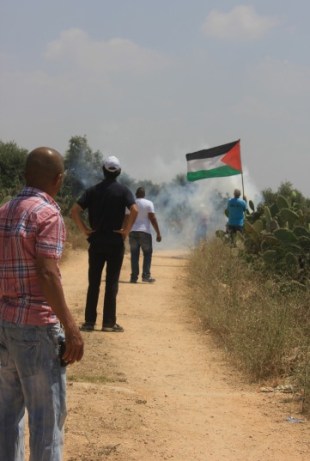 After just 15 minutes, a 41-year-old Palestinian protester was shot in the leg with a 0.22 live ammunition bullet. The soldiers had been hiding in the olive trees next to the apartheid wall and were unseen by the demonstrators. When a Red Crescent volunteer tried to give the wounded protester medical treatment, after placing a bandage on the bleeding wound, he was attacked by the Israeli soldiers. The soldiers kicked the volunteer and used their guns to beat his face, after the demonstration he was taken to the hospital to receive treatment.
The 41-year-old who was shot by the Israeli military was then arrested and held for two hours, before being ‘handed back’ to the Red Crescent ambulance at the Ni’lin checkpoint. He had received some medical treatment from the Israeli paramedics, but this wasn’t immediate, and he also had wounds, including a cut on his head that required one stitch, where the Israeli forces had beaten him while he was arrested.
The protester is now slowly recovering, the 0.22 bullet fractured his tibia [a bone in his lower leg], and it will be another month before he is healed.
The demonstration yesterday was fortunately less violent, there were no injuries or arrests. However, before the protest could begin, the military moved a long way out from the apartheid wall, pushing the demonstrators deep into their own olive trees. The military fired many tear gas grenades and canisters and some of the protesters suffered from tear gas inhalation, requiring support from Red Crescent paramedics. At least twice during the demonstration, Israeli forces fired tear gas canisters directly at protesters, both highly dangerous and in contravention to Israeli military procedure, which is shooting them up into an arch to lower the impacted velocity.
Ni’lin began demonstrating in 2008, against the apartheid wall’s construction. The protests continued after the wall was completed, and since 2008, five villagers from Ni’lin have been murdered by Israeli forces.
June 14, 2014
Posted by aletho |
Ethnic Cleansing, Racism, Zionism, Subjugation - Torture | Human rights, Palestine, West Bank, Zionism |
Leave a comment
Ukrainian Prime Minister Arseny Yatsenyuk has ordered a halt to natural gas imports from Russia from June 16 after the two countries failed to resolve their gas price dispute, the Ukrainian government said Friday.
“By its deliberate unilateral refusal to settle the conflict, Russia has been undermining the energy security of Ukraine and the European Union,” Yatsenyuk was quoted by the government press agency.
Yatsenyuk had also instructed the country’s Justice Ministry and state-run energy company Naftogaz to complete preparations to file a lawsuit with the Stockholm arbitration court over the dispute, the press service said in a statement.
Moreover, he asked the National Regulatory Commission to set “economically justified” tariffs for the transit of Russian gas through Ukrainian territory, it said.
Earlier in the day, Naftogaz Chairman Andrey Kobolev said Kiev was ready to compromise with Russia on gas issues, offering to pay a “compromise temporary price” of $326 per 1,000 cubic meters for Russian gas deliveries for the next 18 months.
Moscow currently charges Ukraine $485, but Kiev claims a fair price would be $268.
The two sides have been locked in dispute for three years over a 2009 contract, under which they agreed to tie the price of gas to the international spot price for oil.
Maenwhile, the Russian Foreign Ministry sent a note of protest to Ukraine over alleged border violation by Ukrainian soldiers, an official statement said Friday.
“The state border was violated by armed units, as infantry fighting vehicles crossed the border. An attempt was made to defy Russian border guards’ orders,” Kremlin spokesman Dmitry Peskov said on Friday.
An infantry fighting vehicle of Ukrainian armed forces crossed the Russian state border in the Rostov region of southwestern Russia earlier in the day, according to the Itar-Tass news agency. Russian border guards detained the vehicle and its crewmen retreated. No arms was used and no casualties reported.
An investigation is underway although Kiev is yet to respond to the Russian reports.
June 14, 2014
Posted by aletho |
Economics | European Union, Russia, Ukraine |
Leave a comment
Although I can understand the relentless anti-union crusade being waged by free market fundamentalists who wish to: (1) weaken the American labor movement, and (2) do away with the public school system (because there are hundreds of millions of dollars to be made by “privatizing” education), I am stunned by the public’s willingness to accept what is, on its face, a monumentally stupid argument.
While no one ever hears of American colleges and universities being accused of producing consistently “bad” accountants or bad pharmacists or bad historians or bad computer programmers or bad anthropologists, apparently, those same colleges and universities have turned out a disproportionately high number of “bad” teachers.
Even though these idealistic men and women busted their humps earning their college degrees and teaching credentials (which, by law, are required to teach in a public school, but are not required by private schools), once they entered the classroom and began plying their trade, they turned out to be a bunch of incompetents and slackers.
Of course, the explanation given by the anti-labor, privatization propagandists is that these teachers came out of their colleges and universities in satisfactory shape, but turned “bad” as soon as they became union members, because the teachers’ union, as we all know, was put on earth to protect bad teachers. Yep, as a former union president myself, I can attest that there’s nothing we union honchos admire more than a shitty worker.
Here’s something to think about: Airline pilots, flight attendants, mechanics, firefighters, nurses, actors, writers, directors, coal miners, and that woman who plays oboe in the symphony orchestra are union members. They are good at their jobs. Being represented by a union didn’t turn them into bad workers.
Southwest Airlines is the most unionized carrier in the industry and, last time I checked, it was among the most profitable. If you want to accept the outrageous falsehood—the outright lie—that union members are bad workers, that’s your privilege, but unless you have a death wish, I suggest you stay off airplanes.
Here’s something else: Some of the best school districts in the country are heavily unionized. Something else: Demonstrating that the whole thing is mainly socio-economic, schools in stable areas perform better than schools in poor, distressed areas, and unions have nothing to do with it. And something else: Non-union teachers across the country get fired at about the same rate as union teachers. It’s true. Why don’t more non-union teachers get fired? Because they don’t deserve be fired.
Has anyone who did poorly in school ever blamed the teacher for their lack of success? Has anyone ever said, “Man, I would’ve been a kick-ass student if only my teachers had been capable of teaching me”? I’ve never heard one person say that. Instead, they either blame their parents for not having assisted or “pushed” them enough, or blame themselves for simply not having put in the necessary work.
Again, this whole assault on the teaching profession is a hoax. It’s designed to beat down the unions and convince people that “private education” is the way to go. And in order to win, they need to convince a critical mass of parents that the only reason their little Johnny or Judy isn’t performing like a budding genius is because of “bad” teachers. That people believe it is a shame.
David Macaray is a labor columnist and author (“It’s Never Been Easy: Essays on Modern Labor, 2nd Edition). Dmacaray@earthlink.net
June 13, 2014
Posted by aletho |
Deception, Economics, Solidarity and Activism | United States |
Leave a comment
GAZA CITY – Palestinian journalists on Thursday urged the newly-formed national unity government to respond to Israel’s decision to prohibit the printing and distribution of Gaza-based newspapers in the West Bank.
“Do we need an Israeli presidential decree to be able to print newspapers in territories controlled by the Palestinian Authority?” editor-in-chief of al-Risalah newspaper wrote on Thursday in exasperation over the lack of PA response.
On May 28, Israeli soldiers raided the Ramallah offices of the PA-affiliated al-Ayyam newspaper, telling managers that Israel would not allow them to distribute the Hamas-affiliated Falastin, Al-Risalah, and Al-Istiqlal newspapers in the West Bank.
The Israeli raid undermined an inter-Palestinian deal that aimed to ensure freedom of press by facilitating the sale of Gaza newspapers in the West Bank and vice-versa.
Political analyst Wisam Afifa criticized the Palestinian national consensus government for its unwillingness to stand up to Israel’s attack on Palestinian free speech.
“We consider that by remaining silent, the government actually accepts the Israeli decision to ban the printing of Gaza newspapers,” he told Ma’an.
He highlighted that managers of the Gaza newspapers had contacted the Palestinian government spokesperson Eyhab Bseso over the issue, but nothing had been done.
“So far, there has been no comment on the prohibition, and we expect a serious and real response to these violations, especially from President Abbas,” added Afifa.
Similarly, the editor-in-chief of al-Istiqlal newspaper criticized the Palestinian Authority and the national consensus government for not taking any action against Israel’s decision to ban Gaza newspapers in the West Bank.
Tawfiq al-Sayyid Salim has said that he views the Israeli decision to ban Gaza newspapers as a humiliation to President Abbas himself, belittling his authority.
In December, the Foreign Press Association accused the Israeli army of “deliberately targeting” journalists after soldiers fired rubber bullets and threw stun grenades at photojournalists clearly identified as press.
The Tel Aviv-based group, which represents journalists of all foreign media, said troops had directly targeted a group of photographers covering clashes at the Qalandia checkpoint between Jerusalem and Ramallah.
A 2013 report by Palestinian Center for Development and Media Freedoms counted 151 violations of Palestinian freedom of speech by Israeli authorities, including incidents of “physical assault, detention, arrest, prevention from coverage, travel bans, interrogation, threat, raiding, closing and blocking, trial, and confiscation of equipment.”
The report also mentioned 78 violations by Palestinian authorities, primarily in the Gaza Strip, though these numbers are believed to be improving particularly since the the agreement to form a national unity government was made at the end of April.
June 13, 2014
Posted by aletho |
Civil Liberties, Ethnic Cleansing, Racism, Zionism, Full Spectrum Dominance | Human rights, Israel, Palestine, West Bank, Zionism |
Leave a comment

RAMALLAH – Three journalists were injured and dozens suffered from excessive tear gas inhalation as Israeli forces dispersed a weekly protest in Bilin village near Ramallah.
Israeli forces fired rubber-coated steel bullets, stun grenades, and tear gas at protesters as they neared their lands near the wall, injuring photographer Abbas al-Momini with a rubber-coated steel bullet in the pelvis, and Palestine TV cameraman Shamekh Jagoub and photographer Haitham Khatib with tear-gas canisters in the abdomen.
Participants raised Palestinian flags and posters of prisoners as they marched throughout the village chanting songs for unity and in support of prisoners.
Protesters wore prisoner uniforms and played football in front of the prison.


June 13, 2014
Posted by aletho |
Ethnic Cleansing, Racism, Zionism, Full Spectrum Dominance, Subjugation - Torture | Human rights, Palestine, West Bank, Zionism |
Leave a comment
Dr. Caleb Rossiter was “terminated” via email as an “Associate Fellow” from the progressive group Institute for Policy Studies (IPS), following his May 4th, 2014 Wall Street Journal OpEd titled “Sacrificing Africa for Climate Change,” in which he called man-made global warming an “unproved science.” Rossiter also championed the expansion of carbon based energy in Africa. Dr. Rossiter is an adjunct professor at American University. Rossiter, who has taught courses in climate statistics, holds a PhD in policy analysis and a masters degree in mathematics.
In an exclusive interview with Climate Depot, Dr. Rossiter explained: “If people ever say that fears of censorship for ‘climate change’ views are overblown, have them take a look at this: Just two days after I published a piece in the Wall Street Journal calling for Africa to be allowed the ‘all of the above’ energy strategy we have in the U.S., the Institute for Policy Studies terminated my 23-year relationship with them… because my analysis and theirs ‘diverge.’”
“I have tried to get [IPS] to discuss and explain their rejection of my analysis,’ Rossiter told Climate Depot. “When I countered a claim of ‘rapidly accelerating’ temperature change with the [UN] IPCC’s own data’, showing the nearly 20-year temperature pause — the best response I ever got was ‘Caleb, I don’t have time for this.’”
Climate Depot has obtained a copy of a May 7, 2014 email that John Cavanagh, the director of IPS since 1998, sent to Rossiter with the subject “Ending IPS Associate Fellowship.”
“Dear Caleb, We would like to inform you that we are terminating your position as an Associate Fellow of the Institute for Policy Studies,” Cavanagh wrote in the opening sentence of the email.
“Unfortunately, we now feel that your views on key issues, including climate science, climate justice, and many aspects of U.S. policy to Africa, diverge so significantly from ours that a productive working relationship is untenable. The other project directors of IPS feel the same,” Cavanagh explained.
“We thank you for that work and wish you the best in your future endeavors,” Cavanagh and his IPS associate Emira Woods added.
On May 13, 2013, Rossiter wrote a blog titled on his website further detailing his climate views. The article was titled: “The Debate is finally over on ‘Global Warming’ – Because Nobody will Debate.” He wrote: “I have assigned hundreds of climate articles as I taught and learned about the physics of climate, the construction of climate models, and the statistical evidence of extreme weather.”
“My blood simply boils too hot when I read the blather, daily, about climate catastrophe. It is so well-meaning, and so misguided,” Rossiter explained.
Rossiter also ripped President Barack Obama’s climate claims in his blog post: “Obama has long been delusional on this issue, speaking of a coming catastrophe and seeing himself as King Canute, stopping the rise in sea-level. But he really went off the chain in his state of the union address this year. ‘For the sake of our children and our future’ he issued an appeal to authority with no authority behind it.”
Rosstier’s May 4, 2014 Wall Street Journal OpEd also pulled no punches. Rossiter, who holds a masters in mathematics, wrote: “I started to suspect that the climate-change data were dubious a decade ago while teaching statistics. Computer models used by the U.N. Intergovernmental Panel on Climate Change to determine the cause of the six-tenths of one degree Fahrenheit rise in global temperature from 1980 to 2000 could not statistically separate fossil-fueled and natural trends.”
His Wall Street Journal OpEd continued: “The left wants to stop industrialization—even if the hypothesis of catastrophic, man-made global warming is false.” He added: “Western policies seem more interested in carbon-dioxide levels than in life expectancy.”
“Each American accounts for 20 times the emissions of each African. We are not rationing our electricity. Why should Africa, which needs electricity for the sort of income-producing enterprises and infrastructure that help improve life expectancy? The average in Africa is 59 years—in America it’s 79,” he explained.
“How terrible to think that so many people in the West would rather block such success stories in the name of unproved science,” he concluded his WSJ OpEd.
Rossiter’s and IPS seemed a natural fit, given Rossiter’s long history as an anti-war activist. IPS describes itself as “a community of public scholars and organizers linking peace, justice, and the environment in the U.S. and globally. We work with social movements to promote true democracy and challenge concentrated wealth, corporate influence, and military power.
But Rosstier’s credentials as a long-time progressive could not trump his growing climate skepticism or his unabashed promotion of carbon based fuels for Africa.
Rossiter’s website describes himself as “a progressive activist who has spent four decades fighting against and writing about the U.S. foreign policy of supporting repressive governments in the formerly colonized countries.”
“I’ve spent my life on the foreign-policy left. I opposed the Vietnam War, U.S. intervention in Central America in the 1980s and our invasion of Iraq. I have headed a group trying to block U.S. arms and training for “friendly” dictators, and I have written books about how U.S. policy in the developing world is neocolonial,” Rossiter wrote in the Wall Street Journal on May 4.
Rossiter’s Wall Street Journal OpEd continued: “The left wants to stop industrialization—even if the hypothesis of catastrophic, man-made global warming is false. John Feffer, my colleague at the Institute for Policy Studies, wrote in the Dec. 8, 2009, Huffington Post that ‘even if the mercury weren’t rising’ we should bring ‘the developing world into the postindustrial age in a sustainable manner.’ He sees the ‘climate crisis [as] precisely the giant lever with which we can, following Archimedes, move the world in a greener, more equitable direction.”
“Then, as now, the computer models simply built in the assumption that fossil fuels are the culprit when temperatures rise, even though a similar warming took place from 1900 to 1940, before fossil fuels could have caused it. The IPCC also claims that the warming, whatever its cause, has slightly increased the length of droughts, the frequency of floods, the intensity of storms, and the rising of sea levels, projecting that these impacts will accelerate disastrously. Yet even the IPCC acknowledges that the average global temperature today remains unchanged since 2000, and did not rise one degree as the models predicted.
…
“But it is as an Africanist, rather than a statistician, that I object most strongly to ‘climate justice.’ Where is the justice for Africans when universities divest from energy companies and thus weaken their ability to explore for resources in Africa? Where is the justice when the U.S. discourages World Bank funding for electricity-generation projects in Africa that involve fossil fuels, and when the European Union places a ‘global warming’ tax on cargo flights importing perishable African goods?”
June 13, 2014
Posted by aletho |
Corruption, Economics, Ethnic Cleansing, Racism, Zionism, Science and Pseudo-Science, Timeless or most popular |
Leave a comment
For the second time this year, government auditors have issued a report critical of the Obama administration’s projections for preserving the nation’s stockpile of nuclear weapons.
In both instances, the cost estimates put forth by the departments of Defense and Energy have been described as far too low, in part because key expenses were not budgeted. The latest audit, performed by the Government Accountability Office (GAO), supported some of the findings of the Congressional Budget Office (CBO), which concluded six months ago that the administration was off—by hundreds of billions of dollars—in estimating the future needs of maintaining the arsenal.
The Pentagon has claimed outlays will be about $264 billion. But the CBO put the figure closer to $570 billion and perhaps as much as $1 trillion over the next 30 years.
The GAO did not offer its own estimate for maintaining the weapons. But it did question the Defense Department’s claim that modernizing all ballistic missiles and bombers would require only $64 billion over the next 10 years.
In the case of the Minuteman III missile, which has served as the backbone of the nation’s land-based nuclear deterrent since the 1970s, GAO auditors found the administration left out all future funding for replacing these weapons, saying the program was “not yet defined.” As for a new bomber, the Air Force said those costs were “too sensitive” to include in the report.
At the Energy Department (DOE), which oversees all nuclear weapons research, the GAO found that officials had low-balled the cost of modernizing certain warheads for ballistic and cruise missiles.
The agency also reported that DOE had assumed billions of dollars in cost savings from efficiency efforts without determining where the savings would come from, and that Energy officials had left out the cost of revamping or replacing several nuclear-weapons laboratories.
To Learn More:
Federal Auditors Say Obama Administration Underestimates Nuclear Weapons Costs (by R. Jeffrey Smith, Center for Public Integrity)
Ten-Year Budget Estimates for Modernization Omit Key Efforts, and Assumptions and Limitations Are Not Fully Transparent (Government Accountability Office)
Obama Administration Underestimated Cost of Maintaining Nuclear Weapons by $140 Billion (by Noel Brinkerhoff and Danny Biederman, AllGov)
June 13, 2014
Posted by aletho |
Deception, Economics, Militarism, Progressive Hypocrite | Obama, United States |
Leave a comment
Surely, what’s happening now in Iraq and Syria must serve as a final wake-up call that we have been led into a horrific situation in the Middle East by a powerful Lobby driven by the interests of one tribe and one tribe alone.
Back in 1982, Oded Yinon an Israeli journalist formerly attached to the Israeli Foreign Ministry, published a document titled ‘A Strategy for Israel in the Nineteen Eighties.’ This Israeli commentator suggested that for Israel to maintain its regional superiority, it must fragment its surrounding Arab states into smaller units. The document, later labelled as ‘Yinon Plan’, implied that Arabs and Muslims killing each other in endless sectarian wars was, in effect, Israel’s insurance policy.
Of course, regardless of the Yinon Plan’s prophesies, one might still argue that this has nothing to do with Jewish lobbying, politics or institutions but is just one more Israeli strategic proposal except that it is impossible to ignore that the Neocon school of thought that pushed the English-speaking Empire into Iraq was largely a Jewish Diaspora, Zionist clan. It’s also no secret that the 2nd Gulf War was fought to serve Israeli interests – breaking into sectarian units what then seemed to be the last pocket of Arab resistance to Israel.
Similarly, it is well established that when Tony Blair decided to launch that criminal war, Lord Levy was the chief fundraiser for his Government while, in the British media, Jewish Chronicle writers David Aaronovitch and Nick Cohen were busy beating the drums for war. And again, it was the exact same Jewish Lobby that was pushing for intervention in Syria, calling for the USA and NATO to fight alongside those same Jihadi forces that today threaten the last decade’s American ‘achievements’ in Iraq.
Unfortunately, Yinon’s disciples are more common than you might expect. In France, it was the infamous Jewish ‘philosopher’ Bernard Henri Levy who boasted on TV that ‘as a Jew’ campaigning for NATO intervention, he liberated Libya.
As we can see, a dedicated number of Jewish Zionist activists, commentators and intellectuals have worked relentlessly in many countries pushing for exactly the same cause – the breaking up of Arab and Muslim states into smaller, sectarian units.
But is it just the Zionists who are engaging in such tactics? Not at all.
In fact, the Jewish so-called Left serves the exact same cause, but instead of fragmenting Arabs and Muslims into Shia, Sunnis, Alawites and Kurds they strive to break them into sexually oriented identity groups (Lesbian, Queer, Gays, Heterosexual etc.)
Recently I learned from Sarah Schulman, a NY Jewish Lesbian activist that in her search for funding for a young ‘Palestinian Queer’ USA tour, she was advised to approach George Soros’ Open Society institute. The following account may leave you flabbergasted, as it did me:
A former ACT UP staffer who worked for the Open Society Institute, George Soros’ foundation, suggested that I file an application there for funding for the tour. When I did so it turned out that the person on the other end had known me from when we both attended Hunter [College] High School in New York in the 1970s. He forwarded the application to the Institutes’s office in Amman, Jordan, and I had an amazing one-hour conversation with Hanan Rabani, its director of the Women’s and Gender program for the Middle East region. Hanan told me that this tour would give great visibility to autonomous queer organizations in the region. That it would inspire queer Arabs—especially in Egypt and Iran… for that reason, she said, funding for the tour should come from the Amman office” (Sarah Schulman -Israel/Palestine and the Queer International p. 108).
The message is clear, The Open Society Institutes (OSI) wires Soros’s money to Jordan, Palestine and then back to the USA in order to “inspire queer Arabs in Egypt and Iran (sic).”
What we see here is clear evidence of a blatant intervention by George Soros and his institute in an attempt to break Arabs and Muslims and shape their culture. So, while the right-wing Jewish Lobby pushes the Arabs into ethnic sectarian wars, their tribal counterparts within George Soros’ OSI institute, do exactly the same — attempt to break the Arab and Muslims by means of marginal and identity politics.
It is no secret that, as far as recent developments in Iraq are concerned, America, Britain and the West are totally unprepared. So surely, the time is long overdue when we must identify the forces and ideologies within Western society that are pushing us into more and more global conflicts. And all we can hope for is that America, Britain and France may think twice before they spend trillions of their taxpayers’ money in following the Yinon Plan to fight ruinous, foreign wars imposed upon them by The Lobby.
June 13, 2014
Posted by aletho |
Ethnic Cleansing, Racism, Zionism, Timeless or most popular, Wars for Israel | A Strategy for Israel in the Nineteen Eighties, Afghanistan, Bernard Henri Lévy, Iran, Iraq, Israel, Libya, Oded Yinon, Syria, UK, United States, Zionism |
Leave a comment
TEHRAN — Iranian Foreign Minister Javad Zarif has revealed for the first time that Iran has made a detailed proposal to the P5+1 group of states aimed at ensuring that no stockpile of low-enriched uranium would be available for “breakout” through enrichment to weapons grade levels.
In an exclusive interview with IPS, Zarif described an Iranian plan, presented at the meetings with the P5+1 last month in Vienna, that would exclude weapons grade enrichment. “The parameters of the proposal would be set to continue Iran’s enrichment but to provide the necessary guarantees that it would not enrich to anything over five percent,” said Zarif.
The proposal, which was later published by the Iranian government, included a series of “technical guarantees” against nuclear weapons proliferation.
The plan would involve the immediate conversion of each batch of low-enriched uranium to an oxide powder that would then be used to make fuel assemblies for Iran’s Bushehr reactor, according to Zarif.
Because Iran does not have the capability to manufacture fuel assemblies for Bushehr, the proposal implies that the oxide power would be sent to Russia, at least for several years, rather than remaining in Iran.
The previously undisclosed Iranian plan is part of a broader negotiating stance that insists on the need for a large increase in the number of centrifuges it would have in the future – a demand that the United States and its negotiating partners have rejected.
Obama administration officials have made it clear that they are insisting on very steep reductions in the number of centrifuges, based on the argument that Iran cannot be allowed to have the capability to enrich enough uranium to weapons grade for a single nuclear bomb in less than six to 12 months.
Zarif said he could not discuss the details of the Iranian proposal, because it is “still being negotiated”.
But he described it as involving a complete cycle “from conversion to yellowcake, to UF6, to enriched uranium, back to oxide powder, and back to fuel rods,” all of which would be “designed specifically to meet the requirements of the Bushehr reactor.”
Zarif revealed that the Iranian plan for guaranteeing that Iran could not have a nuclear weapons capability is very similar to the proposal that Iran made to a meeting with the European three (U.K., France and Germany) in Paris in March 2005.
The proposal, which was later published by the Iranian government, included a series of “technical guarantees” against nuclear weapons proliferation. It describes one of those guarantees as “immediate conversion of all enriched uranium to fuel rods to preclude even the technical possibility of further enrichment.”
The U.S.-educated Zarif said he had developed that 2005 proposal himself when he was Iranian Ambassador to the United Nations, after he had consulted with a number of American nuclear scientists on ways to reassure the Europeans and the U.S. that Iran could not enrich enough uranium to weapons grade for a nuclear bomb.
“I asked them what would provide the necessary confidence,” said Zarif. “They gave me a number of elements, which I put in a package and sent to Tehran, and they took it to Paris.”
Frank N. Von Hippel, former assistant director for national security in the White House Office of Science and Technology and now a professor at Princeton University, confirmed in an e-mail that he had been part of a small group of American scientists and others who had met with Zarif to discuss the problem of how to provide assurances that Iran’s civil nuclear programme would not be used to support a nuclear weapons programme.
Von Hippel said his recollection was that the group had suggested “not building up a stockpile but rather shipping [the low-enriched uranium] to Russia to make fuel for the Bushehr reactor.”
Peter Jenkins, then the U.K. permanent representative to the International Atomic Energy Agency, participated in the Mar. 23, 2005 meeting at which the Iranian plan was presented.
“All of us were impressed by the proposal,” he recalled in a 2012 interview. The Europeans did not accept it as the basis for negotiation, however, because the George W. Bush administration had insisted that Iran not be allowed to have any enrichment whatsoever, according to European diplomats involved in that earlier phase of negotiations.
Zarif rejected the Obama administration’s position that Iran should obtain whatever reactor fuel it needs for Bushehr or any future reactors from Russia or other foreign sources rather than relying on its own enrichment capabilities. “People should not tell us you have to rely on us,” he said. “It is 30 years too late.”
He was referring to Iran’s experience with its reliance during the early 1980s on a French-based uranium enrichment consortium called Eurodif in which it had a financial stake acquired during the Shah’s regime that entitled Iran to 10 percent of the enriched uranium produced by the consortium.
After the Islamic Republic resumed the nuclear programme begun by the Shah, however, the French government prevented Eurodif from supplying any enriched uranium for nuclear fuel for the nuclear reactor at Bushehr in the early 1980s.
The U.S. State Department acknowledged in 1984 that it had not only ended its own nuclear cooperation with Iran but had “asked other nuclear suppliers not to engage in nuclear cooperation with Iran, especially while the Iran-Iraq war continues.”
The foreign minister ruled out the acceptance of the P5+1 proposal in the last round of negotiations, which reportedly would limit the number of Iranian centrifuges to a fraction of its present total of 19,000.
“We’re not going to redefine our practical needs,” he said, referring to the language in the Joint Plan of Action agreed to last November calling for agreement on an Iranian enrichment programme whose “parameters” would reflect Iran’s “practical needs”.
But the foreign minister indicated that Iran was “prepared within the scope of those practical needs to work on timing, to work on various technical details….”
Zarif criticised statements by former and present U.S. officials to the news media as well in the negotiations referring to demands that the number of Iranian centrifuges must be geared to the need to extend the time required for “breakout” to 6 to 12 months.
Some of the statements made to the press, including those by former State Department proliferation official Robert Einhorn, as well as some of those made in the negotiations “amount to posturing”, Zarif said, adding that they “amount to creating expectations that can never be met.”
“It will be much more productive if everyone involved refrains from shaping the debate in a way that [it] will be out of control,” said Zarif.
Zarif said the U.S. insistence on Iran’s ending of all enrichment at its Fordow facility, which is located in a tunnel under a mountain, is based on “the argument that you can’t have this facility, because otherwise we can’t bomb it.”
The implied assertion of the right to bomb Iranian facilities “strikes the wrong chord in the Iranian psyche and produces exactly the opposite reaction,” he said.
Zarif challenged the view reflected in Western news coverage that the Rouhani government is under strong political pressure to produce results in the talks that would remove the worst sanctions.
The last round of talks in Vienna, which were unsuccessful “has been the easiest time at home,” he said, and “the toughest time” for him as he had to explain “each positive result to a population that is extremely skeptical of the West’s intentions.” If he rejected a deal, Zarif said, he would receive a “hero’s welcome.”
June 13, 2014
Posted by aletho |
Timeless or most popular | Iran, Sanctions against Iran |
Leave a comment
Russian officials on Thursday reiterated what they have long held as a mantra of the Kremlin’s foreign policy regarding the Middle East – the US invasion of Iraq created a downward spiral for the whole region.
Alluding to the war for regime change – under the pretext of finding weapons of mass destruction – launched by the US and its allies in March 2003, Russian Foreign Minister Sergei Lavrov said that, “the situation in Iraq has been deteriorating at an exponential rate”.
Earlier this week, and following months of continued territorial gains, fighters belonging to a coalition of Islamist militant groups operating under the banner of the Islamic State of Iraq and the Levant (ISIL) seized the ethnically mixed city of Mosul in Iraq’s northern Nineveh province.
They then followed up by expanding their attacks south and west, seizing Tikrit – the town where executed President Saddam Hussein lived as a child – in Salahudin Province and pushing toward the ancient city of Samarra.
They vowed to advance toward Baghdad and bring the government of Prime Minister Nouri Al-Maliki down.
Army troops and security forces abandoned their posts at government installations and tore off their uniforms, witnesses said.
With their fighters entrenched in Mosul and most of Nineveh, the former Al-Qaeda affiliates – who have maintained a brutal campaign against the forces of President Bashar Al-Assad in neighbouring Syria – now effectively control a third of Iraq.
“Iraq’s unity has been called into question … Terrorism is rampant there because the occupation forces paid virtually no attention to the internal political processes, and did not facilitate national dialogue, but pursued their own interests exclusively,” Lavrov said in comments carried by the Russian Interfax agency.
“We warned long ago that the adventurism the Americans and the British started there would not end well,” he added.
In June 2013, Russia warned the US of promoting “unconvincing” data on Syria’s alleged chemical weapons use, and thereby repeating the same errors in the build-up to the invasion of Iraq in 2003.
Russia has since 2003 said the invasion and occupation of Iraq was a mistake that would haunt the West.
On Thursday, Lavrov did not exclude the UK from his criticism.
“The events that are taking place in Iraq are an illustration of a complete failure of the venture started by the US and the UK that allowed it to spiral out of control completely.”
“We express our solidarity with the Iraqi authorities, the Iraqi people who should restore peace and security in their country, but the actions of our Western partners raise a lot of questions,” Lavrov told reporters.
June 12, 2014
Posted by aletho |
Militarism | Iraq, ISIL, Syria, United States |
Leave a comment
NATO leaders are currently acting out a deliberate charade in Europe, designed to reconstruct an Iron Curtain between Russia and the West.
With astonishing unanimity, NATO leaders feign surprise at events they planned months in advance. Events that they deliberately triggered are being misrepresented as sudden, astonishing, unjustified “Russian aggression”. The United States and the European Union undertook an aggressive provocation in Ukraine that they knew would force Russia to react defensively, one way or another.
They could not be sure exactly how Russian president Vladimir Putin would react when he saw that the United States was manipulating political conflict in Ukraine to install a pro-Western government intent on joining NATO. This was not a mere matter of a “sphere of influence” in Russia’s “near abroad”, but a matter of life and death to the Russian Navy, as well as a grave national security threat on Russia’s border.
A trap was thereby set for Putin. He was damned if he did, and damned if he didn’t. He could underreact, and betray Russia’s basic national interests, allowing NATO to advance its hostile forces to an ideal attack position.
Or he could overreact, by sending Russian forces to invade Ukraine. The West was ready for this, prepared to scream that Putin was “the new Hitler”, poised to overrun poor, helpless Europe, which could only be saved (again) by the generous Americans.
In reality, the Russian defensive move was a very reasonable middle course. Thanks to the fact that the overwhelming majority of Crimeans felt Russian, having been Russian citizens until Khrushchev frivolously bestowed the territory on Ukraine in 1954, a peaceful democratic solution was found. Crimeans voted for their return to Russia in a referendum which was perfectly legal according to international law, although in violation of the Ukrainian constitution, which was by then in tatters having just been violated by the overthrow of the country’s duly elected president, Victor Yanukovych, facilitated by violent militias. The change of status of Crimea was achieved without bloodshed, by the ballot box.
Nevertheless, the cries of indignation from the West were every bit as hysterically hostile as if Putin had overreacted and subjected Ukraine to a U.S.-style bombing campaign, or invaded the country outright – which they may have expected him to do.
U.S. Secretary of State John Kerry led the chorus of self-righteous indignation, accusing Russia of the sort of thing his own government is in the habit of doing. “You just don’t invade another country on phony pretext in order to assert your interests. This is an act of aggression that is completely trumped up in terms of its pretext”, Kerry pontificated. “It’s really 19th century behavior in the 21st century”. Instead of laughing at this hypocrisy, U.S. media, politicians and punditry zealously took up the theme of Putin’s unacceptable expansionist aggression. The Europeans followed with a weak, obedient echo.
It Was All Planned at Yalta
In September 2013, one of Ukraine’s richest oligarchs, Viktor Pinchuk, paid for an elite strategic conference on Ukraine’s future that was held in the same Palace in Yalta, Crimea, where Roosevelt, Stalin and Churchill met to decide the future of Europe in 1945. The Economist, one of the elite media reporting on what it called a “display of fierce diplomacy”, stated that: “The future of Ukraine, a country of 48m people, and of Europe was being decided in real time.” The participants included Bill and Hillary Clinton, former CIA head General David Petraeus, former U.S. Treasury secretary Lawrence Summers, former World Bank head Robert Zoellick, Swedish foreign minister Carl Bildt, Shimon Peres, Tony Blair, Gerhard Schröder, Dominique Strauss-Kahn, Mario Monti, Lithuanian president Dalia Grybauskaite, and Poland’s influential foreign minister Radek Sikorski. Both President Viktor Yanukovych, deposed five months later, and his recently elected successor Petro Poroshenko were present. Former U.S. energy secretary Bill Richardson was there to talk about the shale-gas revolution which the United States hopes to use to weaken Russia by substituting fracking for Russia’s natural gas reserves. The center of discussion was the “Deep and Comprehensive Free Trade Agreement” (DCFTA) between Ukraine and the European Union, and the prospect of Ukraine’s integration with the West. The general tone was euphoria over the prospect of breaking Ukraine’s ties with Russia in favor of the West.
Conspiracy against Russia? Not at all. Unlike Bilderberg, the proceedings were not secret. Facing a dozen or so American VIPs and a large sampling of the European political elite was a Putin adviser named Sergei Glazyev, who made Russia’s position perfectly clear.
Glazyev injected a note of political and economic realism into the conference. Forbes reported at the time on the “stark difference” between the Russian and Western views “not over the advisability of Ukraine’s integration with the EU but over its likely impact.” In contrast to Western euphoria, the Russian view was based on “very specific and pointed economic criticisms” about the Trade Agreement’s impact on Ukraine’s economy, noting that Ukraine was running an enormous foreign accounts deficit, funded with foreign borrowing, and that the resulting substantial increase in Western imports could only swell the deficit. Ukraine “will either default on its debts or require a sizable bailout”.
The Forbes reporter concluded that “the Russian position is far closer to the truth than the happy talk coming from Brussels and Kiev.”
As for the political impact, Glazyev pointed out that the Russian-speaking minority in Eastern Ukraine might move to split the country in protest against cutting ties with Russia, and that Russia would be legally entitled to support them, according to The Times of London.
In short, while planning to incorporate Ukraine into the Western sphere, Western leaders were perfectly aware that this move would entail serious problems with Russian-speaking Ukrainians, and with Russia itself. Rather than seeking to work out a compromise, Western leaders decided to forge ahead and to blame Russia for whatever would go wrong. What went wrong first was that Yanukovych got cold feet faced with the economic collapse implied by the Trade Agreement with the European Union. He postponed signing, hoping for a better deal. Since none of this was explained clearly to the Ukrainian public, outraged protests ensued, which were rapidly exploited by the United States… against Russia.
Ukraine as Bridge… Or Achilles Heel
Ukraine, a term meaning borderland, is a country without clearly fixed historical borders that has been stretched too far to the East and too far to the West. The Soviet Union was responsible for this, but the Soviet Union no longer exists, and the result is a country without a unified identity and which emerges as a problem for itself and for its neighbors.
It was extended too far East, incorporating territory that might as well have been Russian, as part of a general policy to distinguish the USSR from the Tsarist empire, enlarging Ukraine at the expense of its Russian component and demonstrating that the Soviet Union was really a union among equal socialist republics. So long as the whole Soviet Union was run by the Communist leadership, these borders didn’t matter too much.
It was extended too far West at the end of World War II. The victorious Soviet Union extended Ukraine’s border to include Western regions, dominated by the city variously named Lviv, Lwow, Lemberg or Lvov, depending on whether it belonged to Lithuania, Poland, the Habsburg Empire or the USSR, a region which was a hotbed of anti-Russian sentiments. This was no doubt conceived as a defensive move, to neutralize hostile elements, but it created the fundamentally divided nation that today constitutes the perfect troubled waters for hostile fishing.
The Forbes report cited above pointed out that: “For most of the past five years, Ukraine was basically playing a double game, telling the EU that it was interested in signing the DCFTA while telling the Russians that it was interested in joining the customs union.” Either Yanukovych could not make up his mind, or was trying to squeeze the best deal out of both sides, or was seeking the highest bidder. In any case, he was never “Moscow’s man”, and his downfall owes a lot no doubt to his own role in playing both ends against the middle. His was a dangerous game of pitting greater powers against each other.
It is safe to say that what was needed was something that so far seems totally lacking in Ukraine: a leadership that recognizes the divided nature of the country and works diplomatically to find a solution that satisfies both the local populations and their historic ties with the Catholic West and with Russia. In short, Ukraine could be a bridge between East and West – and this, incidentally, has been precisely the Russian position. The Russian position has not been to split Ukraine, much less to conquer it, but to facilitate the country’s role as bridge. This would involve a degree of federalism, of local government, which so far is entirely lacking in the country, with local governors selected not by election but by the central government in Kiev. A federal Ukraine could both develop relations with the EU and maintain its vital (and profitable) economic relations with Russia.
But this arrangement calls for Western readiness to cooperate with Russia. The United States has plainly vetoed this possibility, preferring to exploit the crisis to brand Russia “the enemy”.
Plan A and Plan B
U.S. policy, already evident at the September 2013 Yalta meeting, was carried out on the ground by Victoria Nuland, former advisor to Dick Cheney, deputy ambassador to NATO, spokeswoman for Hillary Clinton, wife of neocon theorist Robert Kagan. Her leading role in the Ukraine events proves that the neo-con influence in the State Department, established under Bush II, was retained by Obama, whose only visible contribution to foreign policy change has been the presence of a man of African descent in the presidency, calculated to impress the world with U.S. multicultural virtue. Like most other recent presidents, Obama is there as a temporary salesman for policies made and executed by others.
As Victoria Nuland boasted in Washington, since the dissolution of the Soviet Union in 1991, the United States has spent five billion dollars to gain political influence in Ukraine (this is called “promoting democracy”). This investment is not “for oil”, or for any immediate economic advantage. The primary motives are geopolitical, because Ukraine is Russia’s Achilles’ heel, the territory with the greatest potential for causing trouble to Russia.
What called public attention to Victoria Nuland’s role in the Ukrainian crisis was her use of a naughty word, when she told the U.S. ambassador, “Fuck the EU”. But the fuss over her bad language veiled her bad intentions. The issue was who should take power away from the elected president Viktor Yanukovych. German Chancellor Angela Merkel’s party been promoting former boxer Vitaly Klitschko as its candidate. Nuland’s rude rebuff signified that the United States, not Germany or the EU, was to choose the next leader, and that was not Klitschko but “Yats”. And indeed it was Yats, Arseniy Yatsenyuk , a second-string US-sponsored technocrat known for his enthusiasm for IMF austerity policies and NATO membership, who got the job. This put a U.S. sponsored government, enforced in the streets by fascist militia with little electoral clout but plenty of armed meanness, in a position to manage the May 25 elections, from which the Russophone East was largely excluded.
Plan A for the Victoria Nuland putsch was probably to install, rapidly, a government in Kiev that would join NATO, thus formally setting the stage for the United States to take possession of Russia’s indispensable Black Sea naval base at Sebastopol in Crimea. Reincorporating Crimea into Russia was Putin’s necessary defensive move to prevent this.
But the Nuland gambit was in fact a win-win ploy. If Russia failed to defend itself, it risked losing its entire southern fleet – a total national disaster. On the other hand, if Russia reacted, as was most likely, the US thereby won a political victory that was perhaps its main objective. Putin’s totally defensive move is portrayed by the Western mainstream media, echoing political leaders, as unprovoked “Russian expansionism”, which the propaganda machine compares to Hitler grabbing Czechoslovakia and Poland.
Thus a blatant Western provocation, using Ukrainian political confusion against a fundamentally defensive Russia, has astonishingly succeeded in producing a total change in the artificial Zeitgeist produced by Western mass media. Suddenly, we are told that the “freedom-loving West” is faced with the threat of “aggressive Russian expansionism”. Some years ago, Soviet leaders gave away the store under the illusion that peaceful renunciation on their part could lead to a friendly partnership with the West, and especially with the United States. But those in the United States who never wanted to end the Cold War are having their revenge. Never mind “communism”; if, instead of advocating the dictatorship of the proletariat, Russia’s current leader is simply old-fashioned in certain ways, Western media can fabricate a monster out of that. The United States needs an enemy to save the world from.
The Protection Racket Returns
But first of all, the United States needs Russia as an enemy in order to “save Europe”, which is another way to say, in order to continue to dominate Europe. Washington policy-makers seemed to be worried that Obama’s swing to Asia and neglect of Europe might weaken U.S. control of its NATO allies. The May 25 European Parliament elections revealed a large measure of disaffection with the European Union. This disaffection, notably in France, is linked to a growing realization that the EU, far from being a potential alternative to the United States, is in reality a mechanism that locks European countries into U.S.-defined globalization, economic decline and U.S. foreign policy, wars and all.
Ukraine is not the only entity that has been overextended. So has the EU. With 28 members of diverse language, culture, history and mentality, the EU is unable to agree on any foreign policy other than the one Washington imposes. The extension of the EU to former Eastern European satellites has totally broken whatever deep consensus might have been possible among the countries of the original Economic Community: France, Germany, Italy and the Benelux states. Poland and the Baltic States see EU membership as useful, but their hearts are in America – where many of their most influential leaders have been educated and trained. Washington is able to exploit the anti-communist, anti-Russian and even pro-Nazi nostalgia of northeastern Europe to raise the false cry of “the Russians are coming!” in order to obstruct the growing economic partnership between the old EU, notably Germany, and Russia.
Russia is no threat. But to vociferous Russophobes in the Baltic States, Western Ukraine and Poland, the very existence of Russia is a threat. Encouraged by the United States and NATO, this endemic hostility is the political basis for the new “iron curtain” meant to achieve the aim spelled out in 1997 by Zbigniew Brzezinski in The Grand Chessboard: keeping the Eurasian continent divided in order to perpetuate U.S. world hegemony. The old Cold War served that purpose, cementing U.S. military presence and political influence in Western Europe. A new Cold War can prevent U.S. influence from being diluted by good relations between Western Europe and Russia.
Obama has come to Europe ostentatiously promising to “protect” Europe by basing more troops in regions as close as possible to Russia, while at the same time ordering Russia to withdraw its own troops, on its own territory, still farther away from troubled Ukraine. This appears designed to humiliate Putin and deprive him of political support at home, at a time when protests are rising in Eastern Ukraine against the Russian leader for abandoning them to killers sent from Kiev.
To tighten the U.S. grip on Europe, the United States is using the artificial crisis to demand that its indebted allies spend more on “defense”, notably by purchasing U.S. weapons systems. Although the U.S. is still far from being able to meet Europe’s energy needs from the new U.S. fracking boom, this prospect is being hailed as a substitute for Russia’s natural gas sales – stigmatized as a “way of exercising political pressure”, something of which hypothetic U.S. energy sales are presumed to be innocent. Pressure is being brought against Bulgaria and even Serbia to block construction of the South Stream pipeline that would bring Russian gas into the Balkans and southern Europe.
From D-Day to Dooms Day
Today, June 6, the seventieth anniversary of the D-Day landing is being played in Normandy as a gigantic celebration of American domination, with Obama heading an all-star cast of European leaders. The last of the aged surviving soldiers and aviators present are like the ghosts of a more innocent age when the United States was only at the start of its new career as world master. They were real, but the rest is a charade. French television is awash with the tears of young villagers in Normandy who have been taught that the United States is some sort of Guardian Angel, which sent its boys to die on the shores of Normandy out of pure love for France. This idealized image of the past is implicitly projected on the future. In seventy years, the Cold War, a dominant propaganda narrative and above all Hollywood have convinced the French, and most of the West, that D-Day was the turning point that won World War II and saved Europe from Nazi Germany.
Vladimir Putin came to the celebration, and has been elaborately shunned by Obama, self-appointed arbiter of Virtue. The Russians are paying tribute to the D-Day operation which liberated France from Nazi occupation, but they – and historians – know what most of the West has forgotten: that the Wehrmacht was decisively defeated not by the Normandy landing, but by the Red Army. If the vast bulk of German forces had not been pinned down fighting a losing war on the Eastern front, nobody would celebrate D-Day as it is being celebrated today.
Putin is widely credited as being “the best chess player”, who won the first round of the Ukrainian crisis. He has no doubt done the best he could, faced with the crisis foisted on him. But the U.S. has whole ranks of pawns which Putin does not have. And this is not only a chess game, but chess combined with poker combined with Russian roulette. The United States is ready to take risks that the more prudent Russian leaders prefer to avoid… as long as possible.
Perhaps the most extraordinary aspect of the current charade is the servility of the “old” Europeans. Apparently abandoning all Europe’s accumulated wisdom, drawn from its wars and tragedies, and even oblivious to their own best interests, today’s European leaders seem ready to follow their American protectors to another D-Day … D for Doom.
Can the presence of a peace-seeking Russian leader in Normandy make a difference? All it would take would be for mass media to tell the truth, and for Europe to produce reasonably wise and courageous leaders, for the whole fake war machine to lose its luster, and for truth to begin to dawn. A peaceful Europe is still possible, but for how long?
Diana Johnstone is the author of Fools’ Crusade: Yugoslavia, NATO, and Western Delusions. She can be reached at diana.johnstone@wanadoo.fr
June 12, 2014
Posted by aletho |
Militarism, Timeless or most popular | European Union, Germany, NATO, Russia, Ukraine, United States |
Leave a comment
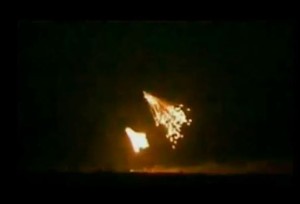
Moscow is demanding an immediate UN probe into Kiev’s use of outlawed incendiary bombs in Ukraine’s rebelling southeastern regions. Moscow will present a draft resolution to the UN Security Council, urging the observation of the OSCE roadmap for Ukraine.
The calls come after yesterday’s use of banned incendiary bombs in the village of Semenovka near the Ukraine’s eastern city of Slavyansk. Eyewitnesses to the bombings reported the use of white phosphor bombs on Wednesday night. The Russian RIA Novosty quotes the local self-defense headquarters on Thursday, saying that Semenkova came under an attack that apparently involved fire bombs. The bombs exploded right above the village and split into smoldering fragments, reported eyewitnesses.
The use of phosphor bombs is internationally banned. The burning substance can’t be extinguished and burns through flesh and bones if a person has been hit by the substance. The Itar-Tass news agency quotes Russia’s Foreign Minister Sergey Lavrov as saying:
“We have ordered to our Ambassador to UN Vitaly Churkin to present to the Security Council a draft resolution on the situation in Ukraine, as we are very concerned by the lack of any progress in the efforts to stop the violence, to stop the war, beginning from the end of the punitive operation”.
“In this resolution we have focused on the fact it is necessary to insist the Ukrainian side began implementing the OSCE roadmap, based on the Geneva statement of April 17, and which was presented after the talks with Russia’s President Vladimir Putin, … It is a very important moment, as, we see, there are clear attempts to distance from the balanced and fair character of the approaches in the roadmap, and there are attempts to promote certain unilateral plans, which would ignore interests of Ukraine’s southeast.”
Lavrov stressed that only an equal-rights dialog, a complete consideration of interests of all of Ukraine’s regions without exceptions, and a dialog that also includes discussions about constitutional reform, may result in stability and an improvement of the situation in Ukraine.
The draft resolution expresses Russia’s concerns about the continuing violence and the killing of civilians, the destruction of infrastructure, residential areas, as well as attacks against convoys. Lavrov added that Russia does not speak about sending peace keepers and that Moscow still believes President Poroshenko has credibility.
Moscow does, however, demand an immediate and full investigation into the use of incendiary bombs and other prohibited weapons in Ukraine. Lavrov stressed “We are concerned to hear reports that the Ukrainian military forces use incendiary bombs and some other indiscriminate weapons. These reports should be investigated, immediately”.
June 12, 2014
Posted by aletho |
Militarism, War Crimes | Russia, Semenovka, Slavyansk, Ukraine, UNUNSC |
Leave a comment
 After just 15 minutes, a 41-year-old Palestinian protester was shot in the leg with a 0.22 live ammunition bullet. The soldiers had been hiding in the olive trees next to the apartheid wall and were unseen by the demonstrators. When a Red Crescent volunteer tried to give the wounded protester medical treatment, after placing a bandage on the bleeding wound, he was attacked by the Israeli soldiers. The soldiers kicked the volunteer and used their guns to beat his face, after the demonstration he was taken to the hospital to receive treatment.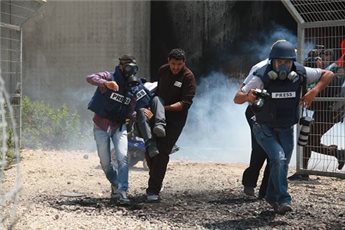


 By Aaron Siri | Injecting Freedom | March 16, 2026
 Aletho News
 Aletho News