Fukushima’s Fallout Continues
By John LaForge | Duluth Reader | June 19, 2014
US papers don’t often report on the radiation disaster continuing at Fukushima-Daiichi in Northeast Japan.
But on June 17 the New York Times noted: “Inside the complex, there are three wrecked reactor cores, twisted masses of hundreds of tons of highly radioactive uranium, plutonium, cesium and strontium. After the meltdown[s], which followed a tsunami and earthquake in 2011, most of the material in the reactors re-solidified, in difficult shapes and in confined spaces, wrapped around and through the structural parts of the reactors and the buildings. Or at least, that is what the engineers think. Nobody really knows, because nobody has yet examined many of the most important parts of the wreckage. Though three and a half years have passed, it is still too dangerous to climb inside for a look, and sending in a camera would risk more leaks.”
The Great Eastern Japan Earthquake and tsunami caused a Station Black Out at Fukushima the total loss of power used to run cooling mechanisms and the consequent melting of fuel rods dispersed massive amounts of radiation to the air and to the Pacific.
The Tokyo Electric Power Co (Tepco), owners of the Fukushima wreckage, has said it would take 40 years to clean up the disaster. Tepco’s number was probably pulled out of the thin air, because owners of the undamaged Kewaunee reactor in Wisconsin, which shut down last April, said decommissioning of Kewaunee would take 40 years.
Radiation Tripled in Pacific Albacore Tuna since Triple Meltdowns
Radioactive cesium-137 levels in Pacific albacore tuna have tripled since the triple meltdowns at Fukushima-Daiichi in Japan, according to a study published in Environmental Science and Technology.
Delvan Neville, lead author of the study and a graduate research assistant in the Department of Nuclear Engineering and Radiation Health Physics at Oregon State University, told the Statesman Journal Apr. 28, “You can’t say there is absolutely zero risk because any radiation is assumed to carry at least some small risk.”
Jason Phillips, a co-author of the report, said 26 of the large Pacific fish were analyzed from 2008 to 2012. “If we were going to see it [cesium-137] in something, we would see it in albacore or other high-level predators.”
Dr. Steve Starr, Director of Clinical Laboratory Science Program, University of Missouri-Columbia, noted in a recent lecture, “Cesium 137 tends to bio-accumulate in plants and animals, which means it cannot be excreted faster than it is being ingested. Thus, as it accumulates, it increases in its concentration in the plants or animals that are routinely ingesting it. Cesium-137 also tends to bio-magnify as it moves up the food chain. This means it becomes progressively more concentrated in predator species.”
As US Agency Hushed-up Dangers to US Reactors, Reactors’ Owner Tepco Under-reported Radiation Exposures
NBC News reported Mar. 10 that internal emails by staff at the Nuclear Regulatory Commission prove the agency deliberately down-played known earthquake and tsunami vulnerabilities at aging US reactors in the early days of the Fukushima catastrophe. NBC said the emails, “show that the campaign to reassure the public about America’s nuclear industry came as the agency’s [NRC’s] own experts were questioning US safety standards and scrambling to determine whether new rules were needed to ensure that the meltdown[s] occurring at the Japanese [site] could not occur here.”
NBC said the emails reveal the NRC’s “efforts to protect the industry it is supposed to regulate.” The news network went as far as to say, “Dating back to the Three Mile Island nuclear crisis in 1979, many nuclear watchdogs and critics have said that the NRC acts first to protect the industry, and its own reputation.”
The Nuclear Regulatory Commission was helped in misleading the public by Tepco, which repeatedly underestimated internal radiation exposures of its workers involved in immediate emergency response, according to Japan’s Health, Labor and Welfare Ministry, Asahi Shimbun reported.
Last July, the Ministry reviewed exposure data on around workers and revealed that reported exposure levels for 452 out of 1,300 workers surveyed were too low. After that announcement, the Ministry looked at records of the remaining 6,200 workers, and in late March it announced 142 additional cases of under-reporting.
TEPCO did not have whole-body radiation counters when the radiation disaster began, so true contamination measurements were not possible.
Contaminated Soil and Cemeteries May be Moved from Fukushima
Japan’s federal government announced in late May that it will move thousands of tons of radioactively contaminated soil scraped from school yards and elsewhere during decontamination efforts outside Fukushima Prefecture “within 30 years” after first keeping it in storage in the heavily-contaminated prefecture.
New federal law will be needed to allow Japan’s Environmental Safety Corporation to operate the “temporary” dumps.
In a macabre aspect of compensating for areas made radioactively uninhabitable by fallout from the meltdowns, Japan is considering paying for new cemeteries and reburying the remains of people now buried in radioactive exclusion zones.
Food Not Monitored for Radiation Causing Internal Contamination
The Japan Times reported June 17, that “eating unchecked homegrown vegetables and wild game from radiation-tainted areas on a regular basis can lead to high levels of internal radiation exposure.”
According to a study published in the US online science journal PLOS ONE, “Levels of radioactive cesium detected in the bodies of the study’s participants declined once they stopped eating highly contaminated food.” The study’s authors called for increasing public awareness of radiation-risky foods especially “at a time when public interest appears to be dwindling.”
Soil from the seafloor collected about 6 kilometers from the wrecked reactors contains as much 2,700 Becquerels of cesium-137 per kilogram, according to Japan’s Nuclear Regulation Authority June 14.
In Aug. 2012, Tepco reported an all-time record 25,800 Becquerel’s-per-kilogram in two fish known as greenling caught in 20 kilometers of the stricken reactors. “There may be radiation hot spots on the seabed,” a TEPCO official said then.
The wrecked reactors spewed enormous, unprecedented volumes of radioactive materials into the Pacific Ocean where cesium levels near Fukushima ballooned to an astonishing 50 million times pre-disaster levels (and continue to do so, 3.5 years after it began).
The agency said that it is difficult to assess the figure because there is no standard against which evaluations can be made, but that its research would continue.
Note to Japan’s NRA: for a baseline standard, check seabed levels of cesium off any area free of nuclear reactor effluent.
John LaForge is a co-director of Nukewatch in Wisconsin and edits its Quarterly.
Israeli forces demolish structures, road pavement in South Hebron Hills

Photo by Operation Dove
Operation Dove | June 20, 2014
Khallet Forem, Occupied Palestine – On June 18th, the Israeli army, along with border police officers and DCO (District Coordination Office) officers entered in the Palestinian village of Khallet Forem, in South Hebron Hills, and demolished seven houses, a bathroom, and a shelter.
No demolition orders were delivered for these structures.
According to Palestinian witnesses, a woman was injured by the soldiers during the operation.
The seven houses, the shelter, and the bathroom were owned by the Abu Dahar family. These demolitions involved at least 26 people, 12 of them are children.
In the same day, Israeli forces demolished the main road of Ar Rifa’Iyya Ad Deirat and built a roadblock in order to prevent the access from that road to the bypass road 356.
According to PHROC (The Palestinian Human Rights Organizations Council), the recent wave of demolitions, arrests, attacks, killings, and total closure of large parts of the West Bank following the disappearance of three Israeli settlers is a form of collective punishment against the Palestinian people. This is in direct violation of Article 33 of the Fourth Geneva Convention that forbid reprisals against protected persons and their property, as well as collective punishment.
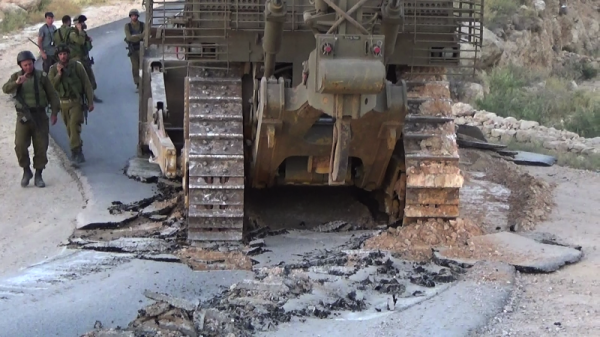
Photo by Operation Dove
Recent Israeli airstrikes targeted Gaza infrastructure
Palestine Information Center – 20/06/2014
 GAZA – The Palestinian interior ministry said that the recent Israeli aerial attacks on the Gaza Strip directly targeted its infrastructure, factories and workshops.
A spokesperson for the ministry stated that an Israeli warplane bombed a dairy plant in Gaza City at dawn today.
Israel escalated its aerial attacks on Gaza over the past few days in Gaza Strip, which rendered many civilians wounded amid persistent international and Arab silence.
For its part, the Palestinian education ministry strongly condemned Israel’s repeated bombing of educational institutions, asserting that 10 schools sustained damage during recent Israeli air raids on Gaza.
Palestinian dies of heart attack as Israeli troops raid home
Ma’an – 21/06/2014
 SALFIT – An elderly Palestinian man died early Saturday of heart attack during a heated argument with Israeli troops who broke into his house in the village of Haris in Salfit district in the northern West Bank.
Palestinian security sources said Israeli soldiers refused to allow family members of Jamil Ali Abed Jabir to take him to hospital for treatment after he suffered a heart attack and eventually died at home. The victim was in his 60s.
The sources explained that dozens of Israeli soldiers stormed Haris village, ransacked several homes and assaulted residents.
Jawad Muhammad Dawood suffered a hand fracture after Israeli troops brutally attacked him and his brother Jawdat during a raid on their home. In addition, seven family members inhaled tear gas after Israeli forces fired a canister in their home.
No detentions were reported in the village.
L-3 and Garret supplying equipment for Gaza checkpoint
By Tom Anderson and Therezia Cooper | Corporate Watch | June 20, 2014
The Beit Hanoun (Erez) crossing is the only crossing for people who want to go directly from Gaza into the 1948 borders of Israel. People wishing to cross must apply for a permit and only a small number of permits are granted. Privileged people such as foreign journalists (who are not overly critical of Israel), NGO workers, business people and politicians are often granted permits. Other people have to go through the Rafah crossing from southern Gaza into Egypt.
The Beit Hanoun crossing is subject to frequent closures by the Israeli authorities. The terminal has been closed since the kidnapping of three Israeli teenagers in the West Bank on 12 June. This closure amounts to an act of collective punishment against everyone in Gaza by the Israeli state.
The crossing is also the only way for hundreds of sick patients to obtain treatment. Israeli military attacks have destroyed vital services in Gaza, while the Israeli siege has prevented life saving equipment from reaching services in the Strip. See Corporate Watch’s recent briefing, Besieging health services in Gaza: a profitable business, to find out more about the effects of the siege on health in Gaza.
Corporate Watch did not apply for permission to cross through the Beit Hanoun crossing as we didn’t think that it would be granted. However, we did ask an NGO worker who was crossing to take a look at the equipment used in the terminal. The NGO worker, who wished to remain anonymous told us: “Coming from Israel, you first go through a private Israeli security firm check where your permit number is confirmed so that you can enter the terminal, then in the terminal you go through another Israeli security ‘border patrol’ check. Once through that you go on a long walk to the Palestinian Authority checkpoint where you’re registered, then you get into a taxi and drive just a minute to the Hamas checkpoint where another permit by the local government is checked. That’s the process for getting into Gaza.”
He told us “I saw the machine’s makes: ProVision on the full body scans, Garret on the metal detectors.”
Garrett are a security equipment supplier. In 2013 Corporate Watch reported that Garrett scanning equipment was being used by the police in the occupied West Bank. Garrett equipment is used by HM Court ‘Service’ in the UK. In our view, BDS campaigners should pressure HMCS to end its contract with Garrett because of its supply of security equipment used to enforce the unlawful siege of Gaza.
The PROVision scanners are manufactured by L-3. L-3 is a provider of military and security products and services. According to Who Profits it supplied body scanners to the Beit Hanoun terminal via Hashmira Israel, a security company owned by British-Danish company G4S.
Netanyahu: We expect Abbas to dissolve unity government
Ma’an – 20/06/2014
 BETHLEHEM – Israeli Prime Minister Benjamin Netanyahu said on Thursday that he expected the Palestinian national unity of government to dissolve and the the Israeli government was moving closer to finding three Israeli youths missing for the last week.
The comments, which came during a press conference in the southern West Bank city of Hebron that has been besieged by Israeli forces since the kidnapping, signal renewed pressure on the Palestinian Authority to end a unity deal agreed on between Fatah and Hamas in late April.
“I expect (Palestinian) president (Mahmoud) Abbas to dissolve the union with this murderous terror organisation. I think that’s important for our common future,” he said.
Netanyahu also reasserted that Hamas kidnapped the three young men, even though the Israeli government has yet to provide any evidence of the accusation.
“They were kidnapped by Hamas, we had no doubt of that. It’s absolutely certain,” he said, adding that the public needed to have “patience” as the Israeli forces continued their search.
Over 300 Palestinians have been arrested and more than 800 houses searched in the last week as Israeli forces have carried out a wide-ranging search across the West Bank in pursuit of the the youths.
Israeli forces have also raided charities and all organizations related to Hamas in anyway in the West Bank, arresting former and current Palestinian members of parliament and many others in what some have begun to view as an excuse to round up Hamas members.
Russia brings WTO complaint over ‘illegal’ US sanctions – Medvedev
RT | June 20, 2014
Moscow intends to present a complaint to the World Trade Organization (WTO) claiming ‘politically motivated’ US sanctions that target local companies are hurting Russian external trade and violate WTO rules, Prime Minister Dmitry Medvedev said on Friday.
“Unilateral politically motivated sanctions are illegal from the point of view of classic international legislation, they do not meet public order requirements as they ignore WTO’s statute mechanism of constraint,” the Prime Minister told an audience at the St. Petersburg International Legal Forum.
In their latest round of sanctions, the US has tried to target Russia’s economy by forbidding business with certain organisations, as well as asset freezes on individuals believed to be close to Russian President Vladimir Putin.
“Such sanctions violate WTO rules, including the most favored nation status, as they show discrimination to service providers and suppliers from another country and violate restrictions of the second article of the WTO’s General Agreement on Trade in Services,” Medvedev said.
Europe, though hesitantly, has followed the US sanction march and produced its own Russian business blacklist.
Bilateral net trade between the two former Cold War enemies is relatively small – at $38 billion in 2013, but Russia is more worried about continuing good trade relations with Europe, which amounted to $330 billion last year.
Medvedev said the US sanctions will affect Russia’s external trade, adding he understood that challenging the sanctions at the WTO “will be difficult because the US has both doctrinal and practical authority in the organization.”
Russia, the world’s sixth largest economy, became the 156th member of the WTO in August 2012, the last of the G20 nations to join.
The 159 member WTO group account for 97 percent of global trade.
Syria’s Press Conference the United Nations Doesn’t Want You To See
Global Research News | June 20, 2014
Yesterday at 11am, the Syrian Mission to the United Nations convened a press conference featuring people from the US who observed the recent elections.
Five minutes into the opening comments of Syrian Ambassador Bashar Al-Jaafari, the UN webcast cut off. The thousands of journalists, political analysts, and others who view UN webcasts each day from all over the world were denied the ability to watch the press conference, and hear what was said.
This is not the first time this has happened when Bashar Jaafari is speaking. This occurred on June 7th earlier this year, and on numerous occasions throughout 2013. Reporters at Inner City Press reported that this is not accidental, but was ordered by Michele DuBach, Acting Deputy Director-News & Media Operations.
This comes in the context of other UN harassment of Syria. UN Secretary-General Ban Ki Moon has met with Ahmad Jarba, a leader of violent insurgent groups in Syria, but has refused to meet with Bashar Jaafari. Though Syria pays over $1 million to the UN each year, it is not being treated as an equal member state.
Watch the important, UN Press Conference about Syria, that someone obviously doesn’t want you, or anyone else, to see:
Americans’ confidence in TV news at record low: Survey
Press TV – June 20, 2014
 A new survey shows the American people’s confidence in TV news is at a record low.
Of all the Americans surveyed, only 18 percent expressed either a “great deal” or “quite a lot” of confidence in US television news, a Gallup poll found.
“Now I am going to read you a list of institutions in American society. Please tell me how much confidence you, yourself, have in each one–a great deal, quite a lot, some or very little?” the Gallup survey asked the participants. One of the institutions listed is “television news.”
Gallup has been asking the same question every year since 1993.
The latest poll was conducted June 5-8. Only 10 percent said they had “a great deal” of confidence in TV news and 8 percent said they had “quite a lot” of confidence.
The second lowest results were in 2012, when 21 percent said they had a great deal or quite a lot of confidence in television news. In 2013, the percentage of people who trusted US TV news was a bit higher — 23 percent.
Some 46 percent of Americans said they had confidence in TV news in 1993, the first year Gallup started asking Americans’ opinion on this topic.
Gallup interviewed a random sample of 1,027 adults in all 50 states and the District of Columbia for the survey. The poll has a margin of error of +/- 4 percentage points.
Mideast crises West bid to protect Israel interests: Jaafari
Press TV – June 19, 2014
Syria’s Permanent Representative to the United Nations Bashar Ja’afari says the current tumult in the Middle East, including the crisis in his country, is a scheme by the West to safeguard Israel’s interests, Press TV reports.
“This is a geopolitical plan that is not only targeting Syria exclusively, although Syria is very important for either the success or failure of this plan, but it is targeting the whole area,” said Ja’afari Wednesday in an exclusive interview with Press TV in New York.
He said the main goal of the Western plot “is to secure for a long time the interests of Israel and preventing the establishment of Palestinian state in Palestine.”
“So they need to open up a new front, a kind of deviation, from the focus on the Arab-Israeli conflict and the Palestinian question to another focus which might be a war between Muslims and Muslims,” he added.
He further underlined that the West intends to incite divisions among Muslims under the false notion of a Sunni-Shia conflict to provoke wars between Muslim countries in the region.
The Syrian envoy went on to reiterate that the huge participation of Syrian voters in the country’s presidential election served as big “NO” message to foreign interference in their country’s internal affairs.
“Our message would be a friendly message… [that] we want to have friends and we want to have normal, bilateral relationship with everybody. We do not interfere into the American domestic affairs. Please don’t interfere into our own domestic affairs.”
According to official figures, President Bashar al-Assad won nearly 90 percent of the votes cast in Syria’s presidential race. Syria’s Supreme Constitutional Court announced that over 73 percent of the 15.8 million eligible voters had taken part in the election.
Featured Video

Iran Is Not Our Enemy
or go to
Aletho News Archives – Video-Images
Book Excerpt
“Vaccines Do Not Cause Autism!” The Science is Settled. Right?
ICAN urges the IACC to actually study infant vaccines and autism
 By Aaron Siri | Injecting Freedom | March 16, 2026
On behalf of ICAN, we just sent a copy of chapter 11 of Vaccines, Amen to the newly appointed members of the federal Interagency Autism Coordinating Committee (IACC).
If you haven’t already read this chapter, you can read the whole thing in the attached letter. I trust that after you read it, you’ll see why the statement “vaccines do not cause autism” is a belief, not science!

IACC Public Comment Letter
1.53MB ∙ PDF file
Includes chapter 11 of Vaccines, Amen
Blog Roll
 Aletho News
- Iran made ‘unexpectedly substantial’ offer during Geneva talks, US envoys ‘dragged’ Trump into war: Report
- Russia condemns Israel’s attack near Bushehr plant, files complaint
- Russia Strongly Condemns Actions Aimed at Harming Health of Iranian Leadership – Kremlin
- Israeli Journalist Demands Tucker Carlson and Candace Owens Be Placed in WWII-Style Internment Camps
- No Liability, No Studies, No Accountability: The Vaccine System Aaron Siri Exposed in Federal Court
- No time for losers: Why the war meant to save Israel may destroy it
- Top US Counterterrorism Official Resigns in Protest of Operation Against Iran
- Just Get Out! Now!
- Unpacking glaring contradictions in US-Zionist justifications for war against Iran
- Iranian model of warfare bleeds US dry while Persian Gulf states watch and learn: Analyst
- If Americans Knew
- Lebanon death toll exceeds 900, another assassination in Iran, bombing in Gaza – Not a ceasefire Day 159
- Trump’s counterterrorism chief, whose own wife was killed by ISIS, quits over Iran War saying Tehran posed ‘no imminent threat’
- Here’s what US could fund instead of Bibi’s war on Iran
- Israel Killed Over a Dozen Lebanese Paramedics in Three Days, Now Claiming That Ambulances Are “Hezbollah” Targets
- War on Iran: These are the heritage sites devastated by US and Israeli attacks
- Four news stories from Israeli media that illustrate Israeli “justice”
- CIA Prepares Criminal Referral of Tucker Carlson, as Israel and Its Loyalists Demand His Arrest
- Top US counterterror advisor resigns in protest of “war manufactured by Israel” – Not a ceasefire Day 157
- ‘I Liked the House’: When Israeli Soldiers Turn Palestinian Homes into Barracks
- ‘They Were All I Had’: Lebanese Father Buries Parents, 4 Daughters Killed by Israeli Bombing
- No Tricks Zone
- New Research: South Australia’s Mid-Holocene Sea Surface Temperatures Were 4°C Warmer Than Today
- Storing Green Energy To Last Germany 10 Days Would Require A 60-Million Tonne Battery
- New Studies: UK Sea Levels Were 4 Meters Higher Than Today During The Mid-Holocene
- Destructive Green New Deal: German Energy And Metal Group Warns Of Drastic Crisis
- New Study Documents A 20-Year Pause In Arctic Sea Ice Decline – Driven By Internal Variability
- Wake-up Call: Survey Shows Majority Of Germans Now Favor Postponing Climate Targets!
- Televised! Leading German Political Candidate Tells Schoolchildren CO2 Makes Sun Hotter!
- New Study: A Century Warming Of 1.1°C Is ‘Commonplace’ And ‘Not Unusual’ During This Interglacial
- New Study: ‘Internal Noise’ And Volcanic Forcing Can Trigger 10-15°C Warming Within Decades
- Glaciers Worldwide Are Suddendly Surging, Experts Blame Warming!
 Aletho News