The Gaza greenhouse effect
The Hasbara Buster | December 1, 2009
Every now and then the subject of the greenhouses left behind by Israeli settlers eradicated from Gaza is brought up by Israel apologists as proof of several things. It is claimed that Gazans don’t suffer from malnutrition: if they did, they wouldn’t have destroyed the greenhouses when the Israelis left. Therefore, there’s nothing wrong with Israel’s blockade of Gaza, because it doesn’t actually harm them. It is also claimed that the destruction of the greenhouses proves how hateful Gazans are: they prioritized wiping out every vestige of Jewish presence over keeping a valuable source of nutrients and income. Finally, it is asserted that a people that got the result of heavy investment and destroyed it can’t be trusted ro run anything, much less a state.
Much of this is bullshit, and the part that isn’t is highly distorted.
When Israel decided its unilateral withdrawal from Gaza, the settlers expected to be paid handosmely for the productive infrastructure they had created. Of course this was a display of chutzpah, because it had been heavy state subsidizing that had allowed them to create that infrastructure in the first place. As Haaretz noted:
The Gaza settlers had been inundated by perks from all directions. They received subsidized lands, subsidized water, assured wages from the public sector, “risk bonuses” and lower tax on their higher wages, subsidized daycare, cheap Arab labor, what didn’t they get. The benefits they received touched on every area of their lives and they became accustomed to higher standards they can’t forgo even now.
As the date of the withdrawal approached with no deal in sight, however, the settlers began to destroy the greenhouses. The New York Times reported:
About half the greenhouses in the Israeli settlements in Gaza have already been dismantled by their owners, who have given up waiting to see if the government was going to come up with extra payment as an inducement to leave them behind, say senior officials working on the coordination of this summer’s Israeli pullout from Gaza.(…)
Of the roughly 1,000 acres of agricultural land that were under greenhouses in the 21 Israeli settlements in Gaza, only 500 acres remain – creating significant doubts that the greenhouses could be handed over to the Palestinians as “a living business,” the goal cited by the Israeli coordinator of the pullout, Eival Giladi.
Finally, a last-minute effort by American Jewish philantropists raised $14 million and the remainder of the greenhouses was bought and turned over to the Palestinians.
However, since there had been no coordination with the Palestinians, there was no security plan to protect the greenhouses from looters. AP reported:
Palestinians looted dozens of greenhouses on Tuesday, walking off with irrigation hoses, water pumps and plastic sheeting in a blow to fledgling efforts to reconstruct the Gaza Strip.(…)
Palestinian police stood by helplessly Tuesday as looters carted off materials from greenhouses in several settlements, and commanders complained they did not have enough manpower to protect the prized assets. In some instances, there was no security and in others, police even joined the looters, witnesses said.
“We need at least another 70 soldiers. This is just a joke,” said Taysir Haddad, one of 22 security guards assigned to Neve Dekalim, formerly the largest Jewish settlement in Gaza. “We’ve tried to stop as many people as we can, but they’re like locusts.”
As can be seen, the theft was carried out by individuals, and in no way was it encouraged by the Palestinian Authority. Quite on the contrary, there was a conscious PA effort to prevent the lootings, which was however hindered by lack of resources.
Two reflections arise from the stories above.
On the one hand, it’s true that some of the greenhouses were destroyed by Palestinian individuals. There’s nothing remarkable about that. Beggars can’t be choosers, as the saying goes, and looting is what normally happens when two conditions are met: 1) an impoverished populace; and 2) a situation of lack of control by an established authority. Gazans stole the hardware and materials contained in the greenhouses not in a drive to erase the Jews’ memory from the territory, but to satisfy their personal needs. There was a rationale to their theft.
The destruction of part of the greenhouses by the settlers, however, can only be explained by animosity. They spent time, effort and probably even money to dismantle the facilities so that the Palestinians wouldn’t be able to use them. There’s a big difference between he who damages property in order to derive a benefit and he who damages it only to harm another person.
Many other related points could be made. For instance, that even in the Zionists’ twisted logic the looting of the facilities would justify the ban on vegetable imports into Gaza, but not that on livestock (cows can’t be raised in greenhouses). Or that the 350 Arab villages that disappeared from Israel’s map were not looted by vandals; they were razed by the State in a clear drive to eliminate any trace of Arabness from their respective landscapes. But without getting into those intricacies, and just focusing on the destruction of the greenhouses by both Jews and Palestinians, it’s clear who was moved by necessity and who by hate.
Venezuela Participates in BRICS Gathering, New Agreements Reached
By Ewan Robertson | Venezuelanalysis | July 20, 2014
Mérida – Venezuela participated in the gathering of the BRICS emerging powers and Latin American regional blocs in Brazil this week, where new agreements were hailed as beginning the creation of a new global financial architecture.
Several multilateral meetings were held in the city of Fortaleza, including the 6th BRICS (Brazil, Russia, India, China and South Africa) Summit, and meetings between China and the Union of South American Nations (UNASUR) and the Community of Latin American and Caribbean States (CELAC).
During the BRICS summit, the five emerging economies created a new development bank and a multilateral reserve fund, each of which will potentially hold US $100 billion of pooled capital. The reserve fund will be used to support members of the bloc against adverse economic conditions or external impacts.
The creation of the new institutions is partly motivated by dissatisfaction with the terms of the financial hegemony exercised by the U.S. and its European allies through the IMF and World Bank.
“The strength of our project has positive potential: we want the global [financial] system to be fairer and more equal,” said Brazilian president Dilma Roussef to media.
On Wednesday and Thursday China met with the UNASUR and CELAC blocs in order to explore strategies through which the Asian power could deepen its involvement in Latin America.
In the meeting with UNASUR countries it was discussed how BRICS and UNASUR could create more ties. After the meeting, Venezuelan president Nicolas Maduro reported that it had been proposed that the new BRICS Development Bank and UNASUR’s Bank of the South adopt a common strategy in the regional and global economies.
“The [new] financial institutions have the same objectives: the construction of a new financial architecture that benefits economic development in conditions of equity for our countries; where speculative financial capital is ended, where the looting of our economies is ended, and productive investment which creates employment and wealth is promoted,” he said to Telesur on Wednesday.
The Venezuelan president also argued that closer relations between BRICS and Latin America represented a “win win alliance” and “the birth of the multi-polar world”.
“In the past we were dominated powers, and now we are emerging countries and blocs,” he said.
The BRICS bloc has become a key trading partner for Venezuela. Commerce with the bloc increased by 72% from 2006 – 2013.
Meanwhile, agreements reached on Thursday between China and the CELAC bloc, which brings together all countries in the Americas apart from the U.S. and Canada, included the establishment of a $1 billion investment fund for infrastructure projects in Latin America, and a Chinese offer of scholarships for 6,000 Latin American students.
Other funds potentially worth $15 billion to support Latin American development were also discussed.
Latin America has become an important source of Chinese investment and exports, while South American powers have increasingly turned to China as a source of financing, technology transfer, and destination to export primary materials.
A top level delegation led by Chinese President Xi Jinping is currently touring the continent to further deepen China’s economic involvement in Latin America, with visits including Brazil, Argentina, and Venezuela, where Xi Jinping arrives today.
Bilateral agreements
Venezuela also held several bilateral meetings in Fortaleza, including with China and Colombia.
The South American OPEC nation agreed to import a further 1,500 Chinese-made Yutong buses for the expansion of its public transport system. A Yutong factory is being built in Venezuela to begin domestic production of the vehicles, which will open next year.
The Venezuelan and Chinese central banks also reached an agreement to share information on statistical methodologies, monetary policy, and funding mechanisms. Both parties called the accord a “breakthrough” for enhancing economic ties.
Since 2001 the two countries have constructed what has been labeled as a “strategic alliance”. A high level bilateral session initiates in Caracas today with the arrival of Chinese president Xi Jinping.
Airline Horror Spurs New Rush to Judgment
By Robert Parry | Consortium News | July 19, 2014
Despite doubts within the U.S. intelligence community, the Obama administration and the mainstream U.S. news media are charging off toward another rush to judgment blaming Ukrainian rebels and the Russian government for the shoot-down of a Malaysia Airlines plane, much as occurred last summer regarding a still-mysterious sarin gas attack in Syria.
In both cases, rather than let independent investigators sort out the facts, President Barack Obama’s ever-aggressive State Department and the major U.S. media simply accepted that the designated villains of those two crises – Bashar al-Assad in Syria and Russian President Vladimir Putin on Ukraine – were the guilty parties. Yet, some U.S. intelligence analysts dissented from both snap conventional wisdoms.
Regarding the shoot-down of the Malaysian jetliner on Thursday, I’m told that some CIA analysts cite U.S. satellite reconnaissance photos suggesting that the anti-aircraft missile that brought down Flight 17 was fired by Ukrainian troops from a government battery, not by ethnic Russian rebels who have been resisting the regime in Kiev since elected President Viktor Yanukovych was overthrown on Feb. 22.
According to a source briefed on the tentative findings, the soldiers manning the battery appeared to be wearing Ukrainian uniforms and may have been drinking, since what looked like beer bottles were scattered around the site. But the source added that the information was still incomplete and the analysts did not rule out the possibility of rebel responsibility.
A contrary emphasis has been given to the Washington Post and other mainstream U.S. outlets. On Saturday, the Post reported that “on Friday, U.S. officials said a preliminary intelligence assessment indicated the airliner was blown up by an SA-11 surface-to-air missile fired by the separatists.” But the objectivity of the Obama administration, which has staunchly supported the coup regime, is in question as are the precise reasons for its judgments.
Even before the Feb. 22 coup, senior administration officials, including Assistant Secretary of State Victoria Nuland and U.S. Ambassador to Ukraine Geoffrey Pyatt, were openly encouraging protesters seeking the overthrow of Yanukovych. Nuland went so far as to pass out cookies to the demonstrators and discuss with Pyatt who should be appointed once Yanukovych was removed.
After Yanukovych and his officials were forced to flee in the face of mass protests and violent attacks by neo-Nazi militias, the State Department was quick to declare the new government “legitimate” and welcomed Nuland’s favorite, Arseniy Yatsenyuk, as the new prime minister.
As events have unfolded since then, including Crimea’s secession to join Russia and bloody attacks directed at ethnic Russians in Odessa and elsewhere, the Obama administration has consistently taken the side of the Kiev regime and bashed Moscow.
And, since Thursday, when the Malaysian plane was shot down killing 298 people, the Ukrainian government and the Obama administration have pointed the finger of blame at the rebels and the Russian government, albeit without the benefit of a serious investigation that is only now beginning.
One of the administration’s points has been that the Buk anti-aircraft missile system, which was apparently used to shoot down the plane, was “Russian made.” But the point is rather silly since nearly all Ukrainian military weaponry is “Russian made.” Ukraine, after all, was part of the Soviet Union until 1991 and has continued to use mostly Russian military equipment.
It’s also not clear how the U.S. government ascertained that the missile was an SA-11 as opposed to other versions of the Buk missile system.
Slanting the Case
Virtually everything that U.S. officials have said appears designed to tilt suspicions toward the Russians and the rebels – and away from government forces. Referring ominously to the sophistication of the SA-11, U.S. Ambassador to the United Nations Samantha Power declared, “We cannot rule out Russian technical assistance.” But that phrasing supposedly means that the administration can’t rule it in either.
Still, in reading between the lines of the mainstream U.S. press accounts, it’s possible to see where some of the gaps are regarding the supposed Russian hand in Thursday’s tragedy. For instance, the Post’s Craig Whitlock reported that Air Force Gen. Philip M. Breedlove, U.S. commander of NATO forces in Europe, said last month that “We have not seen any of the [Russian] air-defense vehicles across the border yet.”
Since these Buk missile systems are large and must be transported on trucks, it would be difficult to conceal their presence from U.S. aerial surveillance which has been concentrating intensely on the Ukraine-Russia border in recent months.
The Post also reported that “Rear Adm. John Kirby, the Pentagon press secretary, said defense officials could not point to specific evidence that an SA-11 surface-to-air missile system had been transported from Russia into eastern Ukraine.”
In other words, the mystery is still not solved. It may be that the rebels – facing heavy bombardment from the Ukrainian air force – convinced the Russians to provide more advanced anti-aircraft weapons than the shoulder-fired missiles that the rebels have used to bring down some Ukrainian military planes.
It’s possible, too, that a rebel detachment mistook the civilian airliner for a military plane or even that someone in the Russian military launched the fateful rocket at the plane heading toward Russian airspace.
But both the Russian government and the rebels dispute those scenarios. The rebels say they don’t have missiles that can reach the 33,000-foot altitude of the Malaysian airliner. Besides denying a hand in the tragedy, the Russians claim that the Ukrainian military did have Buk anti-aircraft systems in eastern Ukraine and that the radar of one battery was active on the day of the crash.
The Russian Defense Ministry stated that “The Russian equipment detected throughout July 17 the activity of a Kupol radar, deployed as part of a Buk-M1 battery near Styla [a village some 30 kilometers south of Donetsk],” according to an RT report.
So, the other alternative remains in play, that a Ukrainian military unit – possibly a poorly supervised bunch – fired the missile intentionally or by accident. Why the Ukrainian military would intentionally have aimed at a plane flying eastward toward Russia is hard to comprehend, however.
A Propaganda Replay?
But perhaps the larger point is that both the Obama administration and the U.S. press corps should stop this pattern of rushing to judgments. It’s as if they’re obsessed with waging “information warfare” – i.e., justifying hostilities toward some adversarial nation – rather than responsibly informing the American people.
We saw this phenomenon in 2002-03 as nearly the entire Washington press corps clambered onboard President George W. Bush’s propaganda bandwagon into an aggressive war against Iraq. That pattern almost repeated itself last summer when a similar rush to judgment occurred around a sarin gas attack outside Damascus, Syria, on Aug. 21.
Though the evidence was murky, there was a stampede to assume that the Assad government was behind the attack. While blaming the Syrian army, the U.S. press ignored the possibility that the attack was a provocation committed by radical jihadist rebels who were hoping that U.S. air power could turn the tide of the war in their favor.
Rather than carefully weigh the complex evidence, the State Department and Secretary of State John Kerry tried to spur President Obama into a quick decision to bomb Syrian government targets. Kerry delivered a belligerent speech on Aug. 30 and the administration released what it called a “Government Assessment” supposedly proving the case.
But this four-page white paper contained no verifiable evidence supporting its accusations and it soon became clear that the report had excluded dissents that some U.S. intelligence analysts would have attached to a more formal paper prepared by the intelligence community.
Despite the war hysteria then gripping Official Washington, President Obama rejected war at the last moment and – with the help of Russian President Putin – was able to negotiate a resolution of the crisis in which Assad surrendered Syria’s chemical weapons while still denying a hand in the sarin gas attack.
The mainstream U.S. press, especially the New York Times, and some non-governmental organizations, such as Human Rights Watch, continued pushing the theme of the Syrian government’s guilt. HRW and the Times teamed up for a major story that purported to show the flight paths of two sarin-laden missiles vectoring back to a Syrian military base 9.5 kilometers away.
For a time, this report was treated as the slam-dunk evidence proving the case against Assad, until it turned out that only one of the rockets carried sarin and the maximum range of the one that did have sarin was only about two kilometers.
Despite knowing these weaknesses in the case, President Obama stood by his State Department hawks by reading a speech to the UN General Assembly on Sept. 24 in which he declared: “It’s an insult to human reason and to the legitimacy of this institution to suggest that anyone other than the regime carried out this attack.”
In watching Obama’s address, I was struck by how casually he lied. He knew better than almost anyone that some of his senior intelligence analysts were among those doubting the Syrian government’s guilt. Yet, he suggested that anyone who wasn’t onboard the propaganda train was crazy.
Since then, investigative journalist Seymour Hersh has revealed other evidence indicating that the sarin attack may indeed have been a rebel provocation meant to push Obama over the “red line” that he had drawn about not tolerating chemical weapons use.
Now, we are seeing a repeat performance in which Obama understands the doubts about the identity of who fired the missile that brought down the Malaysian airliner but is pushing the suspicions in a way designed to whip up animosity toward Russia and President Putin.
Obama may think this is a smart play because he can posture as tough when many of his political enemies portray him as weak. He also buys himself some P.R. protection in case it turns out that the ethnic Russian rebels and/or the Russian military do share the blame for the tragedy. He can claim to have been out front in making the accusations.
But there is a dangerous downside to creating a public hysteria about nuclear-armed Russia. As we have seen already in Ukraine, events can spiral out of control in unpredictable ways.
Assistant Secretary Nuland and other State Department hawks probably thought they were building their careers when they encouraged the Feb. 22 coup – and they may well be right about advancing their status in Official Washington at least. But they also thawed out long-frozen animosities between the “ethnically pure” Ukrainians in the west and the ethnic Russians in the east.
Those tensions – many dating back to World War II and before – have now become searing hatreds with hundreds of dead on both sides. The nasty, little Ukrainian civil war also made Thursday’s horror possible.
But even greater calamities could lie ahead if the State Department’s “anti-diplomats” succeed in reigniting the Cold War. The crash of Malaysian Airlines Flight 17 should be a warning about the dangers of international brinkmanship.
~
Investigative reporter Robert Parry broke many of the Iran-Contra stories for The Associated Press and Newsweek in the 1980s. You can buy his new book, America’s Stolen Narrative, either in print here or as an e-book (from Amazon and barnesandnoble.com).
Mofaz proposes role for Saudi Arabia and UAE to disarm Gaza
Arabi21 | July 20, 2014
As Israel continues to prosecute its criminal war against the people of the Gaza Strip, its leaders in Tel Aviv are counting more and more on the Arab regimes to confront the Palestinian resistance and reduce its effectiveness. Former Defence Minister and Chief of Staff of the Israeli army, General Shaul Mofaz, has called for a role to be “allocated” for Saudi Arabia and the UAE to disarm Hamas and other resistance groups.
Speaking on Israel’s Channel 10, Mofaz explained that it would be impossible for its army to demilitarise the Strip by force even if it were to re-occupy it completely. As such, he claimed, the matter requires a comprehensive diplomatic, political and economic plan for such an objective to be achieved.
He pointed out that there is an urgent need to convince the people of Gaza of the necessity to collaborate in implementing such a plan. This would require offering the carrot, represented by a generous financial reward, to convince them to cooperate with any international or regional effort that could contribute to achieving this goal. He noted that both Saudi Arabia and the UAE could, in the present circumstance, play an important role in providing the finances for this reward.
Meanwhile, a prominent Israeli military commentator has called for an official investigation into the political, military and intelligence failures of Israel’s war on the coastal territory. This follows growing indications that the Zionist state is not achieving its objectives.
In an article in Maariv newspaper on Saturday, Ran Edelist said that there is cause to suspect that the assessment of the internal security intelligence agency, Shin Bet, on the basis of which the Netanyahu government took the decision to go to war in Gaza, might have been influenced by the ideological motives of its leaders. Edelist pointed out that Shin Bet head Yoram Cohen belongs to the religious Zionist movement, and his deputy, who is referred to as “R”, is a settler known for his ideological extremism. They produced the recommendations for the government regarding Hamas from an extremist viewpoint rather than from an objective professional position, he claimed. Edelist accused Prime Minister Benjamin Netanyahu of ordering the campaign against Gaza in the hope of improving his political status and reducing opposition to him within his own Likud Party. There are growing calls for his resignation.
According to Audi Siegel, the political affairs commentator on Channel 2 TV, the only solution for the Gaza predicament is for Israel to recognise Gaza as an independent entity and deal with all the consequences. Also writing in Maariv, Siegel said that it has become evident that Israel’s ability to control the resistance in Gaza and destroy the Hamas movement is zero. He noted that all the assumptions upon which Israel made the decision to launch a war on Gaza have collapsed.
Siegel said that recognising the Hamas government in Gaza might improve the security environment for Israel. If not, he added, it would possible to garner international support to justify any military step Israel might then take against the territory.
Members of UAE ‘aid convoy’ revealed as intelligence agents
MEMO | July 20, 2014
Forty members of the UAE “aid convoy” which entered the Gaza Strip last week have been revealed as intelligence agents. They were, it is believed, trying to collect information about Hamas and its infrastructure in the besieged territory.
According to one informed source, a local Palestinian recognised one of the agents as a soldier in the UAE armed forces. He contacted the security forces in Gaza who took the agent in for questioning.
Other members of the “aid convoy” then made contact with officials in the United Arab Emirates. In turn, they asked disgraced Fatah official Mohamed Dahlan, who now lives in and is sponsored by the UAE government, to try to secure a safe and swift exit for the agents.
“Dahlan called one of his followers from Fatah who spoke with Hamas officials and they agreed to let the convoy leave immediately,” the source said.
Palestinians in Gaza were surprised by the sudden exit of the UAE personnel on Saturday. The field hospital that they had ostensibly arrived to set-up was left uncompleted.
Commentators say that suspicions should have been aroused when the convoy was allowed by the Egyptians to enter Gaza through the Rafah crossing, as no other convoys have been allowed to enter since the start of the Israeli attack and invasion. Media reports on Saturday said that the Egyptian army has banned and attacked three international aid convoys trying to enter the enclave.
Egypt has closed Rafah and does not allow wounded Palestinians to travel abroad for treatment or let much-needed medicine and medical equipment to be taken into Gaza.
Palestinian resistance proposes ceasefire agreement
Palestine Information Center – 19/07/2014
GAZA – Palestinian resistance factions have proposed a ceasefire initiative presented with Qatari and Turkish support.
The ceasefire initiative includes an end to all armed hostilities, an end to Gaza siege, and the release of all Palestinian detainees who were recently arrested in the West Bank. The initiative states that the ceasefire must be reached under US supervision.
The initiative was delivered by Qatar to US Secretary of State John Kerry who in turn conveyed it to Israel.
The ceasefire initiative includes:
1. Mutual and immediate cessation of fire.
2. Mutual cessation of military and security operations.
3. Total lifting of the siege of Gaza and opening the border crossings for goods and people and allowing in food, industrial, fuel and construction supplies, expanding the maritime fishing zone to 12 miles, in addition to removing the buffer zone and implementing reconstruction projects.
4. Full commitment to the prisoners’ swap deal reached on 1/10/2011 under Egyptian mediation, and the release of all the Palestinians detained since 12 June 2014 mainly Palestinian Legislative Council Speaker Dr. Aziz Dweik, in addition to the reopening of public institutions and improving the conditions of Palestinian prisoners.
The ceasefire implementation mechanism:
1. Determination of a zero hour for implementation of all requirements of the ceasefire.
2. Full commitment to the ceasefire under US supervision.
3. Mutual cessation within 6 hours of its announcement.
Hamas commends withdrawal of Ecuadorian ambassador from Tel-Aviv
MEMO | July 19, 2014
The Palestinian Islamic movement Hamas hailed on Friday the Ecuadorian decision to withdraw his country’s ambassador to Tel-Aviv in protest against Israeli aggression on Gaza.
Speaking to the Palestinian newspaper Al-Resalah, Hamas spokesman Fawzi Barhoum said: “This is a very advanced position, to which the countries in the region have not arrived at.”
Barhoum described the withdrawal of the ambassador as a “courageous” decision.
Ecuador’s Foreign Minister Ricardo Patino said the Ecuadorian government condemned the Israeli invasion on the Gaza Strip.
“We condemn the Israeli military incursion into Palestinian territory, we require cessation of operations and indiscriminate attacks against civilians,” Patino said.
Barhoum also called for the UN Security Council to pass a resolution to lift the eight-year siege on Gaza and stop Israeli aggression on Gaza, which has continued for 13 days.
Ecuador announced Thursday that it was calling in its ambassador to Israel, according to La Informacion and El Universo.
El-Wafa hospital staff attempted to retrieve medicine
International Solidarity Movement| July 19, 2014
Gaza, Occupied Palestine – Hospital staff and international activists, from the U.S., Sweden, and the UK, attempted to travel to the recently bombed el-Wafa hospital, in an attempt to retrieve salvageable medical supplies.
When they arrived at the hospital it was, “still smoking from the attack this morning.” Stated U.S. International Solidarity Movement (ISM) activist, Joe Catron. The staff and activists were forced to retreat.
Charlie Andreasson, Swedish (ISM) activist, states, “We were waiting to get clearance from the Red Cross to go back to el-Wafa. This is urgent because without medicine, the patients cannot receive proper treatment, and coordination through the Red Cross has not been possible. ”
Previous attempts by the Red Crescent to enter the Shajaiya neighbourhood to retrieve wounded people from this area were met with live ammunition from the Israeli army. El-Wafa hospital is just outside of Shajaiya.
On July 17th, the Israeli military fired rockets and shelled the hospital, forcing patients to be evacuated to Al Sahaba medical complex.
Basman Alashi, executive director of el-Wafa hospital told ISM, “Due to the emergency evacuation we were forced to move quickly, and had to leave behind important medication, supplies are now running low.”
The embassies of the international activists were informed by the ISM, and asked to do everything in their power to fulfill their responsibility to ensure that Israel respects international law and does not target this delegation of Palestinian and international human rights defenders.
The staff and internationals may try to retrieve supplies again, for now it was impossible.
Egypt halts Gaza-bound aid convoy
Press TV – July 19, 2014
A Gaza-bound Egyptian convoy carrying humanitarian aid for the war-ravaged, besieged Palestinian enclave has been halted by the country’s security forces in Sinai.
Activists travelling with the convoy on Saturday afternoon said the vehicles carrying humanitarian supplies to the people in the Israeli-blockaded territory had been stopped at a Sinai checkpoint by Egyptian forces and not allowed to pass due to alleged “security reasons,” Ahram Online reported.
The development comes as Gaza is entering the twelfth day of an Israeli military onslaught that has left more than 312 Palestinians dead, including many women and children.
The report further cites Egyptian political activist Zizo Abdo as saying that the convoy was halted at Balooza checkpoint, the first military checkpoint in North Sinai.
Abdo also stated that the convoy consists of 11 buses and a medical convoy, totaling over 550 people including students, workers, and various political figures.
According to the report, if the convoy is allowed to pass through the checkpoint, it is set to pass through Sinai’s al-Arish city, an already troubled area where Egyptian security forces are battling an anti-state militancy that has surged since the military ouster of the country’s first freely elected president Mohamed Morsi in July 2013.
After al-Arish, the convoy will move directly to the Rafah border crossing.
Egypt’s authorities have largely kept the critical border crossing for the besieged Palestinians living in Gaza shut over the past year, claiming security concerns over the surge of militancy in the Sinai region.
However, the crossing has been opened a few times since the start of the massive Israeli offensive as an “exceptional” measure to transport injured Palestinians to Egyptian hospitals and deliver Egyptian as well as Arab aid to Gaza.
Similar Egyptian convoys were able to cross into Gaza during the Israeli assault on the strip in 2012.
NBC reinstates Mohyeldin to salvage image
By Jonathon Cook | The Blog from Nazareth | July 19, 2014
Some good overnight news, to which readers have alerted me: Ayman Mohyeldin has been reinstated by NBC as their Gaza correspondent. This is an interesting sign of changing times: NBC, it seems, is waging a rearguard action, feeling the need to restore its credentials for editorial independence. Once it would have been taken for granted that a large media organisation was free and fearless; now increasingly it is not.
What was so revealing about NBC’s original move was that no serious reason was given by the TV executives for Mohyeldin’s removal from Gaza; and their grounds for reinstating him are equally opaque. That is because their decision can only be explained in cynical, political terms, as a response to, or pre-emption of, the Israel lobby and its chums in Washington’s corridors of power.
It is true that there are cynical journalists, but most genuinely believe they are independent and free to say what they like – even when the evidence screams at them that the opposite is true. But media executives, who should really be called what they are – money men and women – are the ones who make the key decisions. And they are entirely cynical about editorial policies. They are interested solely in revenues, access and remaining credible with and useful to powerful interest groups, including the massive corporations that run the media.
Journalists have a bad habit of ignoring the reality that these corporate titans run their news organisations, and they manage it by not examining their bosses’ motives, or their own, too deeply.
But Mohyeldin’s removal will have caused them problems. There were no possible editorial grounds for pulling him from Gaza. The executives offered a vague pretext – “security” – but then exposed the deceitfulness of their reasoning by bringing in another reporter to replace him.
This was doubtless too much for the journalists at NBC, who were threatened by the thought that their outlet might not be quite the bastion of free speech they need to believe it is. And that doubt will only have been reinforced by the popular campaign to bring Mohyeldin back.
In these circumstances, NBC’s original decision threatened to expose to many of its journalists and viewers the hoax of a free western press. That, I suspect, is why Mohyeldin was hurriedly reinstated. NBC’s executives understood that the illusion needed to be restored.
But, as I say, this is a sign of progress. These media corporations can no longer take for granted that we will continue believing they are committed to the truth or acting honourably.
US Senate Unanimously Passes Resolution Supporting Israeli Assault on Gaza
By Chris Carlson | International Middle East Media Center | July 18, 2014
 Following a similar resolution passed last week by the U.S. House, the U.S. Senate voted Thursday night to support Israel’s ongoing invasion of the Gaza Strip.
No dissenting vote was cast, and no mention was made of the hundreds of Palestinian civilians, most of whom are women and children, that have been killed by Israel in the past ten days.
Senate Resolution 498 was authored by Bob Menendez (D-NJ) and Lindsey Graham (R-SC), with additional support by Ben Cardin (D-MD) and Rand Paul (R-KY).
Paul is urging the Senate to pass his own bill, S. 2265, which would end all U.S. foreign aid to the Palestinian Authority until Hamas is barred from the new Palestinian unity government, among other stipulations.
The resolution was passed on the very same night Israel launched its current ground offensive into the Gaza Strip.
The United States and Israel, this past week, signed an agreement under which $429 million of American taxpayers’ money “will be transferred immediately to Israel” to further fund the Iron Dome missile system, which has recently come under scrutiny by prize winning Israeli defense and aerospace engineering expert Dr. Moti Shefer.
Israel targets more hospitals in Gaza assault
Ma’an – 18/07/2014
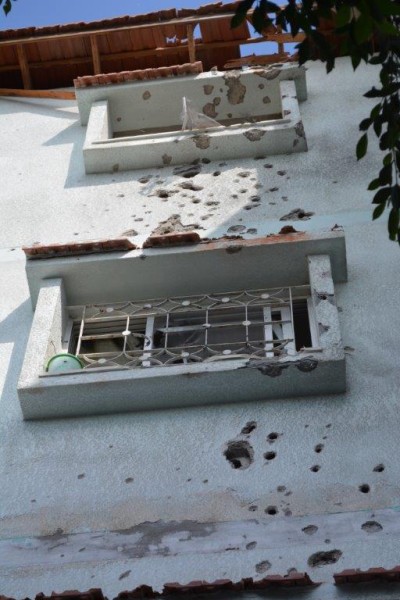 GAZA CITY – Israel shelled the Beit Hanoun hospital in northern Gaza on Friday, damaging the top floors and causing panic among patients and staff, employees said.
A nurse in the hospital told Ma’an that Israel fired a drone missile at the roof and third floor, damaging water supplies.
The area of the hospital targeted contained a ward for children, a reception area, and the offices of several doctors.
The building was evacuated immediately following the attack, with no injuries reported.
The attack comes as Israeli tanks fired shells at the al-Wafa hospital in Gaza City late Thursday, the facility’s director said.
“Israeli tanks are shelling the hospital, they have hit several of the floors, and several nurses have been injured,” director Basman Alashi told AFP.
“There is no place safe in Gaza! If a hospital is not safe, where is?” he said.
The hospital in Gaza’s Shujaiyeh district has come under Israeli fire several times before, and the Israeli military has called on Alashi and other doctors to evacuate it.
The Al-Quds hospital was also hit overnight Thursday by Israeli forces, causing a fire to break out which damaged several departments of the building.
On Saturday, thirty-year-old Ola Washahi and 47-year-old Suha Abu Saada were killed when an Israeli rocket hit a care home for Palestinians with special needs in Beit Lahiya.
The facility’s director, Jamila Alaywa, was unable to contain her fury as she described the tragedy that had befallen the center she set up in 1994.
“Both Ola and Suha had severe mental and physical handicaps, and had been living at the center since it was founded,” she told AFP.
“They didn’t understand what was happening and they were so frightened,” Alaywa said.
“They fired the rocket and it hit us without any warning. There was no warning strike with an empty rocket,” she said.
Photo by Charlie Andreasson, ISM
Featured Video
Prof. Ted Postol: Iran Already Achieved Nuclear Deterrence Against Israel
or go to
Aletho News Archives – Video-Images
From the Archives
How the occupied mentality syndrome works
Saudi Arabia on the American chessboard – Part 3
By B. J. Sabri | American Herald Tribune | June 27, 2016
Read part 2: “The occupied mentality Syndrome“
Previously I argued whether Saudi Arabia’s repeated involvements in U.S. interventions and wars stem from free national will or in response to a specific condition. For starters, in Saudi Arabia there is no national will. In Saudi Arabia, the national will is the will of the Al Saud clan. Still, when a major Arab state allies itself with a superpower that committed unspeakable crimes against humanity in almost every Arab country, then something is wrong. This fact alone should compel us to examine the U.S.-Saudi relation for one exceptional reason. As a result of the U.S.-Saudi wars, hundreds of thousands of people in Afghanistan, Iraq, Iran, Libya, Syria, Yemen, and Somalia have lost their lives. Millions became displaced in their own homelands. And millions more rendered refugees.
Attributing the Saudi policies to the bonds of “partnership” with the U.S. is frivolous. There are no bonds between these two thugs except those of business, military deals, secret plots, and wars. Proving this point, bonds such as these have no space for the American and Saudi peoples to share significant cultural or societal exchanges. If partnership is not the reason for the Saudi contribution to the U.S. strategy of empire and imperialism, then another reason must exist.
This leads to three possibilities. … continue
Blog Roll
 Aletho News
- Al Mayadeen voices solidarity with Dr. Marandi amid death threats
- US dismantling international law in its war against Iran while claiming ‘false’ victory: Legal scholar
- One martyr, 5 injuries in US attack on Iraqi border crossing with Iran
- ‘This war is Israel’s war’: World facing ‘security breakdown’, says Qalibaf
- IRGC decries attack on US embassy in Riyadh, says executed by ‘Israel’
- Iran blasts EU hypocrisy as EU invokes international law over Hormuz
- There is no military solution to Strait of Hormuz
- NATO’s structural collapse – the outcome of deviation from reality
- Poll finds world views China better than US
- One Of America’s Leading Neo-Cons Has Turned Against The Iran War And Israel
- If Americans Knew
- US loses planes over Iran, Israel downgrades Lebanon war goals – Daily Update
- Israel Is Blocking Palestinians from Easter at Church Where Jesus Resurrected
- Plot to assassinate Palestinian activist follows harassment campaign promoted by Zionist groups and elected officials
- Prominent New York synagogue hosts presentation on why U.S. Jews should support the ethnic cleansing of Gaza
- Tapper vs. Piker: Is the CNN Anchor Auditioning for David Ellison?
- Shouldn’t Democrats Be Able to Condemn Genocide?
- Israel-US kill negotiators, destroy civilian structures, but Iran’s military capabilities still largely intact – Daily Update
- ‘War crime’: Global condemnation as Israeli ministers celebrate death penalty law targeting Palestinian prisoners
- 7 Ways Israel Is Turning Lebanon Into Gaza
- World’s Leading Football Bodies Under Fire Over Israel Policies
- No Tricks Zone
- An Inconvenient Tree: Uncovered In Alps… Europe Much Warmer Than Today 6000 Years Ago
- New Study Reports A 60% Slowdown In Greenland’s Ice Loss Rate In The Last Decade
- Low Intensity Tornado Wrecks Major Solar Farm, Creating A Potential Toxic Dump
- New Study Finds Warming Saves Lives…Cold Temperatures 12 Times More Deadly Than Excess Heat
- German Science Blog Accuses PIK Climate Institute Of Hallucinating Climate Tipping Points
- Devastating Assessment Of Comirnaty Vaccine By Former Senior Pfizer Europe Toxicologist
- New Study: CO2 Is ‘Effectively Negligible’ As An Explanatory Climate Change Factor Since 2000
- Former Pfizer Toxicologist Dr. Helmut Sterz Tells Bundestag Hearing Pfizer Vaccine Should Have Never Been Approved
- Energy Expert: Germany’s Nuclear Phaseout Was A “500 Billion Euro Mistake”
- New Research: South Australia’s Mid-Holocene Sea Surface Temperatures Were 4°C Warmer Than Today
 Aletho News