Ukraine to use science funding for weapons production – Poroshenko
RT | July 9, 2014
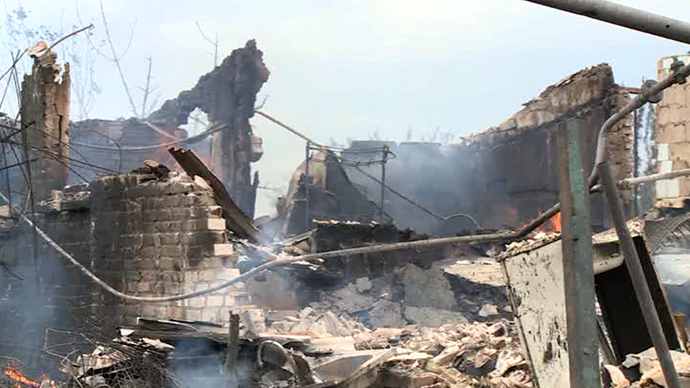 Ukrainian President Petro Poroshenko said he will reduce the country’s “useless” science programs to finance the production of drones and precision weapons.
“There will be no more spending of billions of people’s money, taxpayers’ money on useless research programs, which were used as a tool for theft,” said a statement published on the president’s website early on Wednesday.
“Today, Ukrainian production will be busy making precision weapons systems, Ukrainian drones, everything Ukrainian army needs, starting with bullet proof vests and ending with thermographic cameras,” he said.
The president added that the army’s experience in fighting against self-defense forces in the east of the country will be used when making production decisions.
The Ukrainian military has been fighting against anti-Kiev forces in the east since April.
Some of the latest developments include Ukrainian President Petro Poroshenko confirming plans to “liberate” the eastern cities of Lugansk and Donetsk, the two biggest towns in the country’s east controlled by self-defense forces.
Last week, the army shelled the village of Kondrashovka, killing 12 civilians including a five-year-old.
Israel deploys dehumanizing rhetoric to justify mass assault on Palestinians
By Chloé Benoist | Al-Akhbar | July 9, 2014
As Israeli forces began their assault on the Gaza Strip, Israel’s leaders and media ramped up a rhetoric offensive, using dehumanizing discourse to garner support for deadly military action in the besieged Palestinian territory.
Operation “Protective Edge” – Israel’s latest military offensive to be given a name with nurturing undertones after “My Brother’s Keeper” and “Pillar of Defense” – has already killed at least 43 Palestinians and bombarded more than 400 locations in the Gaza Strip in less than 48 hours.
An estimated 200 rockets have been fired from Gaza since Tuesday, but there have been no recorded Israeli casualties.
Despite the intensity of the Israeli assault on Gaza, Israel’s politicians are framing the military operation as one they entered against their will.
“We are not eager for battle, but the security of our citizens and children takes precedence over all else,” Israeli Prime Minister Benjamin Netanyahu said on Tuesday.
An Israeli official quoted by The Jerusalem Post lamented that Palestinian Authority President Mahmoud Abbas could not “influence his Hamas partners to exercise restraint and stop kidnapping and murdering Israeli teenagers and sending rocket barrages into Israel.”
“That sort of restraint would have prevented the current crisis,” he added.
The implication of these statements are that Hamas has forced Israel into launching a full-scale military operation against them, conveniently ignoring the recent crackdown on the West Bank after the disappearance of three Israeli youths, which Israel blamed on Hamas without providing evidence to back its claims.
In an op-ed titled ‘Send Gaza to the Stone Age’ published on Wednesday, Israel Hayom’s Editor-in-Chief Amos Regev praised the Israeli government for “the levelheadedness, restraint and sound judgment it exhibited before ordering the Israel Defense Forces [sic] to launch Operation Protective Edge,” calling for a ground operation in Gaza to be “carried out with determination and clenched lips, with the knowledge that this is a war of no choice.”
Israel, its leaders would have you believe, is reluctantly entering an open conflict out of a sense of duty, once again indulging in the self-victimizing rhetoric that all Israeli military actions are defensive or retaliatory.
Israel’s enemy, once again, is Hamas, and Zionist political figures have stepped up their eliminationist discourse.
Israeli Defense Minister Moshe Yaalon called for the destruction of Hamas.
“We are continuing to carry out attacks that are exacting a heavy price from Hamas,” Yaalon said. “We are destroying its arms, terrorist infrastructure, command and control systems, institutions, government buildings, terrorists’ homes, and we are killing terrorists in the organizational high command.”
Other politicians echoed the sentiment.
“A sovereign state cannot allow for a bunch of terrorists to run its life; we must cut off the head of the snake and for every Hamas man to know that his blood is upon his head,” Shas party leader Aryeh Deri tweeted on Wednesday.
Deputy Defense Minister Danny Danon took it one step further, calling on Israel Wednesday to cut off fuel and electricity supplies to the Gaza Strip.
“It is inconceivable that on the one hand we fight Hamas and on the other we provide fuel and electricity that are used to transport missiles that are fired at us,” Danon said. “We are in a campaign against Hamas, which is firing missiles at Israel’s citizens.”
Neither Yaalon, Deri or Danon have acknowledged the human cost of such actions on Gaza, an enclave already suffering because of the crushing Israeli siege and already struggling with fuel and electricity shortages. Nor did they mention the loss of civilian life which is the inevitable consequence of wide military actions in such a densely populated territory.
Israeli leadership, however, has repeatedly emphasized the plight of Israeli civilians. Israeli news outlets have dutifully reported every siren sounded in Israeli towns since the beginning of Operation “Protective Edge” and lamented the closure of some Israeli summer camps.
Cara Lebenzon, a blogger for The Times of Israel penned a post berating those who have spoken out against Israel’s attacks, saying “I would actually argue we are TOO nice to Hamas and the people of Gaza. I’ve never heard of a single country on earth that supplies their mortal enemies with water, goods and electricity on a daily basis, have you?” For these folk, Palestinians are not people entitled to basic human rights, and an assault on Gaza is not only warranted, but long overdue.
Meanwhile, the Israeli Occupation Forces (IOF) have bombarded Twitter with stylized graphics trying to garner sympathy for the fearful Israeli population who must run to bomb shelters — conveniently ignoring Palestinians’ lack of shelters during its deadly air raids.
The IOF has also shared an image which it claims is representative of Hamas’ own visual campaign to convince civilians stand in as human shields. The graphic, available only on IOF social media platforms, could have been created by the IOF’s own design team, purportedly standing as “proof” of Hamas’ treachery instead of showing actual existing Hamas posters.
The argument about Hamas forcing people to stand as human shields is one Israel regularly trots out, despite the fact that such claims have been dismantled in the past, and that the IOF is itself guilty of using such tactics repeatedly.
But the “human shield” argument is a convenient excuse for Israeli forces to continue with tactics that they know full well will lead to many civilian casualties while rejecting any responsibility for these deaths. Palestinians living in Gaza are not granted the luxury of being considered innocent civilians in Israeli rhetoric; dead Palestinian men, women and children are all guilty of standing in the way of Israeli weapons, despite the fact that there is nowhere to run in the open-air prison that is Gaza.
Dehumanization of Palestinians and demonization of the Palestinian struggle are essential tools of the Israeli military machine in order to continue justifying expansive military action while maintaining its discourse of victimization.
Follow all the latest updates on Israel’s assault on the Gaza Strip.
Same old, same old: New Ukraine prosecutor wants Maidan activists dispersed
RT | July 9, 2014
Hundreds of activists on Kiev’s Maidan must leave and free seized buildings, Ukraine’s prosecutor general has said. He urged law enforcers to intervene and did not rule out forceful eviction from Independence Square, if activists show resistance.
Security forces will be authorized to take measures if activists do not leave the city center “today, tomorrow or in the near future,” Vitaly Yarema, the prosecutor general, said at a briefing on Wednesday.
“I am appealing to the interior minister and the head of the [Ukrainian Security Service] SBU to take urgent measures. I demand that captured buildings be immediately vacated,” Yarema said. He added that in case those demands are not met, “criminal responsibility will follow” as the seizing of buildings is a crime.
“They want to turn the symbol of the revolution into a caricature,” he added.
Kiev’s Independence Square was the main protester hotspots where pro-EU activists have been demonstrating since November 21, 2013. While the majority of activists left, there are up to 1,000 people still on Maidan, according to Kiev’s newly-elected mayor, Vitaly Klitschko.
The prosecutor general said that law-enforcement bodies should take measures to restore order in the capital’s central districts as crime there was getting worse.
There are 19 buildings, including administrative offices and hotels, which remain under the protesters’ control. According to Yarema’s information, nearly 500 activists are living in the seized offices.
“Instead of protecting the country, defending its independence in the East or working for the country’s benefit, imposters are engaged in direct extortion and banditry,” he said.
On Wednesday, it was reported that over 60 pieces of art worth $185,000 had gone missing from the Ukrainian Museum of National History, which is in the Ukrainian house, international exhibition and convention center. This building is currently in the control of the activists
When asked about the possibility of using force while evicting the so-called euromaidan encampment, Yarema replied: “The option of force is possible. If there is armed resistance, police officers have the right to use their weapons.”
At the same time, he assured journalists that “there will be no confrontation” and people would only be detained if they offer resistance to police.
Responding to the prosecutor general’s demands, Vitaly Klitschko said the use of force is “an extreme” measure, which he had never considered.
“The forcible dispersal of Maidan, I am sure, can only be an extreme step. I do not consider this and never have. I am sure that we need to communicate so that people leave,” he said.
Klitschko agreed that activists should leave so at least traffic could be restored along the city’s main Khreschatyk Street.
He stressed that he has been receiving “a large number” complaints filed by Kiev residents because the “blockade of the main artery of the center of Kiev, Khreschatyk, is paralyzing the work of the entire city.”
Moreover, gunshots and explosions can be heard coming from the encampment from time to time.
Kiev’s authorities have suggested that Maidan activists leave the city’s main square and move to some location outside Kiev. However, this proposal was rejected.
Klitschko said that a joint decision on “eviction of Maidan” will be taken in the coming weeks.
Elected Kiev’s mayor back in May, Klitschko has so far failed to reach any agreement with activists occupying Maidan.
One of Klitschko first public statements after securing his post was a call for them to leave.
“The key goal of the Maidan – ousting the dictator – has been reached, so the barricades should be dismantled,” he said back in May.
However, Klitschko’s call provoked mass protests as activists criticized Klitshchko for not taking into account their opinion on whether Maidan should be dismantled or not.
They threatened to start “a third Maidan” (following the 2004 protest during the “orange revolution” and the second one in November 2013-February 2014), unless the order to dismantle the barricades in the Ukrainian capital is rescinded.
That was when Vitaly Klitschko quickly changed his rhetoric, saying that Maidan should itself determine its future.
The Israel Lobby and French Politics
By Evan Jones | CounterPunch | July 9, 2014
Pascal Boniface is a specialist in what the French call ‘geopolitics’. His output has been prodigious, traversing a wide variety of subjects. His latest book was published in May, titled: La France malade du conflit israélo-palestinien. For his literary efforts in this arena, Boniface has moved from respected commentator to being persona non grata in the mainstream media.
This story begins in 2001. Boniface was an adviser to the Parti Socialiste, with the PS then in a cohabitation government under RPR President Jacques Chirac and PS Prime Minister Lionel Jospin. In April 2001, he wrote an opinion for PS officials. The Party’s approach to Israel is based on realpolitik rather than on ethical principles, and it was time for a reappraisal.
Boniface published an article to the same effect in Le Monde in August 2001, which led to a response and rebuke by the then Israeli ambassador. Boniface then became fair game for the Israel lobby (my term – Boniface assiduously avoids it). Boniface was accused, via selective quotation, of urging the PS to cynically cater to the French Arab/Muslim community, more numerous than the Jewish community, to gain electoral advantage. As recently as January 2014, Alain Finkielkraut (rabble-rouser on the ‘Islamist’ problem in France) denounced Boniface on the same grounds.
The 1300 word 2001 note is reproduced in Boniface’s latest book. In a prefatory note to the reproduction, Boniface notes: “How many times have I not heard that one can’t move on the Middle East because of the ‘Jewish vote’ (sic) which of course does not exist but which nevertheless is largely taken on board by the elected of all sides.” Again, “It is not because there are more Arabs than Jews that it is necessary to condemn the Israeli Occupation; it is rather because the Occupation is illegal and illegitimate, contrary to universal principles and to the right of peoples to govern themselves.”
In the note itself, Boniface opines: “The intellectual terrorism that consists of accusing of anti-Semitism those who don’t accept the politics of Israeli governments (as opposed to the state of Israel), profitable in the short term, will prove to be disastrous in the end.” Paraphrasing Boniface: ‘… it will act to reinforce and expand an irritation with the French Jewish community, and increasingly isolate it at the national level.’ Boniface concludes:
“It is better to lose an election than to lose one’s soul. But in putting on the same level the government of Israel and the Palestinians, one risks simply to lose both. Does the support of Sharon [then Prime Minister] warrant a loss in 2002? It is high time that the PS … faces the reality of a situation more and more abnormal, more and more perceived as such, and which besides does not serve … the interests in the medium and long term of the Israeli people and of the French Jewish community.”
As Boniface highlights in 2014, “This note, alas, retains its topicality.”
Then comes 9/11 in September. There is the second Intifada in Palestine. Boniface wanted an internal debate in the PS, but is accused of anti-Semitism. The glib denunciation of terrorism brings with it a prohibition against the questioning of its causes.
Not content to be silenced, Boniface wrote a book in 2003, titled Est-il permis de critique Israël ?. Boniface was rejected by seven publishing houses before finding a publisher. In 2011, Boniface published a book titled Les Intellectuels Faussaires (The Counterfeit Intellectuals). In that book he called to account eight prominent individuals, not for their views (virulently pro-Israel, Neo-cons, Islamophobes) but because he claims, with evidence, that they persistently bend the truth. Yet they all regularly appear on the French mainstream media as expert commentators. The point here is that the 2011 book was rejected by fourteen publishers; add those who Boniface knew would be a waste of time approaching. Belatedly, Boniface found a willing small-scale publisher for Faussaires, and it has sold well in spite of a blackout in outlets that Boniface had expected some coverage.
Boniface also notes that Michel Bôle-Richard, recognized journalist at Le Monde, experienced a rejection for his manuscript Israël, le nouvel apartheid by ten publishing houses before he found a small-scale publisher in 2013. Boniface’s La France malade was rejected by the house that published his 2003 book. By default, it has been published by a small-scale Catholic press, Éditions Salvator. As Boniface notes, ‘this is symptomatic of the climate in France and precisely why this book had to be written’. It’s noteworthy that much of the non-mainstream media, including Marianne, Le Canard Enchainé and Mediapart, steers clear of the issue.
Boniface’s book is not about the Israel-Palestine conflict. Rather, it is about the parlous influence of the domestic Israel lobby on French politics and French society more broadly. Boniface claims that one can criticize any government in the world (one can even mercilessly attack the reigning French President), but not that of Israel.
After 2001, the PS was pressured to excommunicate him. Two regional presses ceased to publish his articles. There were attempts to discredit his organization – the Institut de Relations Internationales et Stratégiques – and to have him removed. He has been slurred as an anti-Semite.
At the peak of French Jewish organizations is the Conseil Représentatif des Institutions Juives de France. CRIF’s formal dominant concern is the combating of anti-Semitism. At its annual dinner, its President cites the yearly total of recorded anti-Semitic incidents, berating the assembled political elite (‘the turn up of Ministers rivals that of the 14th July’) who don’t dare to reply.
There are indeed recurring anti-Semitic events, and there was a noticeable surge for several years in the early 2000s. Prime Minister Jospin was blamed for not keeping a lid on troublemakers (read Arab/Muslim) from the banlieues. The Socialists were ousted in 2002 and CRIF became a vocal advocate for and supporter of the new Interior Minister Nicholas Sarkozy’s domestic hard-line against civil disorder.
But Jospin was ‘guilty’ of more. One of the PS’s most ardent supporters of Israel, Jospin visited Israel and the Occupied Territories in 1999. Experiencing the latter first hand, his government’s policy towards Sharon-led Israel becomes less ardent. For CRIF, France’s less than a 100% plus pro-Israel stance puts French Jews at greater risk, so CRIF maintains as its imperative to influence both foreign and domestic policy. After the Merah murders of (amongst others) three Jewish children and an adult at a Toulouse school in 2012, CRIF was still laying blame on Jospin. As Boniface notes, CRIF perennially attempts to influence France’s policies but refrains from attempting to influence Israel’s policies.
When the publisher of Boniface’s 2003 book rejected the latest proposal (originally planned as a revised edition of the earlier book), the excuse was that it was over-laden with statistics. Statistics there are (helped by French infatuation with surveys and polling), and they ground Boniface’s cause.
Boniface highlights a change in attitudes after the 1960s. Anti-Semitism was still observably prevalent in the 1960s (would you accept Jews as in-laws?, a Jewish President?, etc.) but has since been consistently in decline. At the same time, popular support for Israel has experienced consistent decline. Until 1967, support for Israel, as the ‘underdog’, in France was high. Gradually attitudes have changed. Israel’s invasion of Lebanon in 1982 is a turning point. Increasingly the manifestations of conflict – the intifadas, the failures at Camp David and later of Oslo – are blamed on Israel. Increasingly, the sympathy is more in favor of the occupied rather than the occupier.
In 2003, a European-wide survey produced the result that the greatest percentage of those surveyed thought that, of all countries, Israel was a threat to world peace – ahead of the US, Iran and North Korea, and so on. If the facts are ugly then bury them. There has been no subsequent comparable survey.
With anti-Semitism down and dislike for Israeli government policies up, the main agenda of CRIF has been to become a ‘second ambassador’ for Israel under cover of the supposed omnipresent pall of anti-Semitism in France. Other organizations like the Bureau national de vigilance contre l’anti-sémitisme (BNVCA) and the Union des étudiants juifs de France (UEJF) are part of the Israel cheer squad.
Boniface cites CRIF President Roger Cukierman in 2005: “Teachers have a demanding task to teach our children … the art of living together, the history of religions, of slavery, of anti-Semitism. A labor of truth is also essential to inscribe Zionism, this movement of emancipation, amongst the great epics of human history, and not as a repulsive fantasy.” And CRIF President Richard Prasquier in 2011: “Today Jews are attacked for their support of Israel, for Israel has become the ‘Jew’ amongst nations.” After 2008, following the ascendancy of Prasquier to the CRIF presidency, CRIF institutionalizes the organization of trips to Israel by French opinion leaders, and the reception in France of Israeli personalities.
Boniface finds it odious that anti-Semitism should be ‘instrumentalized’ to protect Israeli governments regardless of their actions. There is the blanket attempt at censorship of all events and materials that open Israel’s policies to examination.
Representative is a planned gathering in January 2011 at the prestigious École normale supérieure of 300 people to debate the ‘boycott’ question. Among the participants were the Israeli militant peacenik Nurit Peled, who lost her daughter in a suicide bombing, and the formidable Stéphane Hessel. The ENS’s director cancelled the booking under direct pressure. The higher education Minister and bureaucracy were also lobbied, in turn putting pressure on the ENS.
In February 2010, Sarkozy’s Justice Minister Michèle Alliot-Marie issued a directive criminalizing those calling for a boycott of Israeli products. The formal reason given was that such a boycott militates against the freedom of commerce. The directive imposes a jail sentence and a heavy fine, and the Justice Minister instructed prosecutors that it is to be vigorously applied. Even the magistrature has criticized the directive, noting that its claimed dependence on a 2004 anti-discrimination law is inadmissible, and that it involves ‘a juridical assault of rare violence’ against a historic means of combating crimes of state. The directive remains in force under the Hollande Presidency.
The most striking reflection of the wholesale censorship agenda of the Israel lobby is the abuse of Jewish critics of Israel.
April 2010, under the banner Jcall.edu, a group of respected European Jews criticize the Occupation in defense of a more secure Israel, urging ‘two peoples, two states’ – they are attacked. March 2012, Jacob Cohen, Jewish critic of Israel, is physically menaced by the Ligue de défense juive (LDJ) during the launch of his book. November 2012, the mayoralty of the 19th arrondisement is attacked by the BNVCA for supporting an exhibition on the Negev Bedouins. Its sponsors, the Union juive française pour la paix (UJFP), are characterized as fronts for Palestinian propaganda. December 2012, Israeli Michel Warschawski is awarded the ‘prix des droits de l’homme de la République française’ – he is demonized. Other prominent Jewish intellectuals – Franco-Israeli Charles Enderlin, Rony Brauman, Edgar Morin, Esther Benbassa, members of the UJPF – are demonized.
July 2014, three young Jewish Israelis have been murdered. Charles Enderlin reports from Israel. The television channel France 2 mis-edits Enderlin’s reportage of ‘three young Israelis’ as ‘young colonists’. Widely respected for his sober reporting, Enderlin has been subsequently subject to a volley of abuse – thus: ‘it’s time to organise a commando to bump off this schmuck’.
April 2012, at the first Congress of friends of Israel. Israeli Ofer Bronchtein, President of the Forum international pour la paix, arrives as an official invitee. The LDJ attack him; the organisers, including CRIF, ask him to leave. Bronchtein later noted:
“If I had been attacked by anti-Semites in the street, numerous Jewish organisations would have quickly called for a demonstration at the Bastille. When it is fascist Jewish organisations that attack me, everybody remains silent …”
February 2013, Stéphane Hessel dies. Hessel’s life is an exemplar of courage and moral integrity; in his advanced years, this life was brought to our attention with the publication of his Indignez-vous ! in 2010. Hessel, part Jewish, was a strong critic of the Occupation and of the 2008-09 Gaza massacre. His death is met with bile from the lobby. CRIF labelled him a flawed thinker from whom they had little to learn and a doddery naïf giving comfort to the evil of others. A blogger on JssNews ranted: ‘Hessel! The guy who stinks the most. Not only his armpits but his inquisitorial fingers regarding the Jews of Israel.’ The LDJ celebrated – ‘Hessel the anti-Semite is dead! Champagne! [with multiple exclamation marks].’
Peculiarly in France, there is the LDJ. Its counterparts banned in Israel and the US (albeit not in Canada), the LDJ represents the strong-arm end of the Israel lobby. CRIF looks the other way. Boniface notes that it has been treated leniently to date by the authorities; is it necessary to wait for a death to confront its menace? On the recent murder of the three young Israelis, an LDJ tweet proffers: ‘The murders are all committed by the apostles of Islam. No Arabs, no murders! LDJ will respond rapidly and forcefully.’
As a de facto ambassador for Israel, the lobby has long attempted to influence French foreign policy. Boniface notes that in 1953 the new Israeli ambassador was met by Jewish representatives with the claim that ‘we are French citizens and you are the envoy of a foreign state’. That was then.
At successive annual dinners, CRIF has called for France to acknowledge Jerusalem as Israel’s ‘eternal’ capital, and to incorporate Israel as a member state in the Francophonie (with the associated financial benefits and cultural leverage). On those fronts, CRIF has been unsuccessful. But it has had success on the broader front.
The turning point comes with President Chirac’s refusal to sanction the coalition of the willing in its criminal rush to invade Iraq in March 2003. The lobby is not amused. Now why would that be? In whose interests did the invasion and occupation occur? Chirac’s reluctance is met with a concerted strategy of the French lobby in combination with the US Israel lobby and US government officials to undermine the French position. Thus the ‘French bashing’ campaign – not generated spontaneously by the offended American masses after all. In his 2008 book, then CRIF President Roger Cukierman notes his gratitude for the power of the US lobby, and its capacity to even pressure the French leadership over Iraq.
Boniface claims that Chirac falls into line as early as May 2003. There is the establishment of high level links between France and Israel. After that … Sharon is welcomed to France in July 2005. France denies acknowledgement of the Hamas electoral victory in January 2006. France demurs on Israel’s invasion of Lebanon in 2006 (in spite of the historic ties between Beirut and Paris). France remains ‘prudent’ regarding Israel’s Operation Cast Lead against Gaza in late 2008 and the murderous assault on the Turkish-led flotilla in May 2010. France did vote ‘yes’ to a Palestinian state at the UN in November 2012, but in general French foreign policy has become captive to Israeli imperatives, thanks in particular to the domestic lobby.
* * *
In February 2006 a young Jew Ilam Halimi is tortured and murdered. The shocking event becomes a cause célèbre in the media. Halimi’s killer was an anti-Semite. The killer’s hapless gang members receive various sentences, but parts of the Jewish community complain of their inadequacy, want a retrial and lobby the Élysée. The Halimi murder has since been memorialized with a school prize for the guarding against anti-Semitism, and several films are being produced. At about the same time an auto worker had been murdered for money (as was Halimi). The latter murder received only a couple of lines in the press.
Boniface produces summary statistics that highlight the violent underbelly in French society. A shocking count of conjugal murders, large-scale infanticide and rampant child abuse. Tens of thousands of attacks on police and public sector workers. A string of shocking gang attacks with death threats against members of the Asian and Turkish communities – those presumed to keep much liquid cash in their homes. Boniface notes that the anti-Semitic attacks (some misinterpreted in their character) need to be put into perspective.
And then there’s the Arab/Muslim communities. A survey was desirably undertaken in schools to combat racism. A student innocently notes that any tendency to display anti-Semitism is met with a huge apparatus of condemnation. (The 2002 Lellouche Law raised the penalties for racism and explicitly for anti-Semitism.) On the other hand, noted the student, tendencies to racist discrimination against blacks or Arabs are ignored or treated lightly.
There is, as Boniface expresses it, deux poids, deux mesures – two weights, two measures. It is widely felt and widely resented. TWTM could be the motif of Boniface’s book.
Arabs and blacks often refrain from reporting abuse or assaults with the prospect that the authorities will not pursue the complaint. Women wearing the veil are perennially harassed and physically attacked. A young pregnant woman is punched in the stomach; she loses her child. There is perennial use of the term ‘dirty Arab’. Arabs and blacks are perennially harassed by police because of their appearance and presumed ethnicity. Islamophobia escalates, with implicit support from CRIF and from pro-Israel celebrities such as Alain Finkielkraut. (Finkielkraut was recently beamed up to the celestial Académie française; his detractors were labelled anti-Semites.)
Salutary is the perennial humiliation experienced by Mustapha Kessous, journalist for Le Monde. Boniface notes that Kessous ‘possesses a perfect mastery of social conventions and of the French language’. Not sufficient it appears. On a cycle or in a car he is stopped by police who ask of him if he has stolen it. He visits a hospital but is asked, ‘where is the journalist’? He attends court and is taken to be the defendant, and so on.
In 2005, a Franco-Palestinian Salah Hamouri was arrested at a checkpoint and eventually indicted on a trumped up charge of involvement in the murder of a rabbi. In 2008 he took a ‘plea bargain’ and was given 7 years in jail. He was released in 2011 in the group exchange with the release of French IDF soldier Gilad Shalit. In France, Shalit is treated with reverence, though a voluntary enrolee of an occupying force. Hamouri’s plight has been treated with indifference. TWTM.
In March 2010, Said Bourarach, an Arab security guard at a shop in Bobigny, is murdered by a group of young men, Jewish and known to the police. They get off, meanwhile alleging that the murdered guard had thrown anti-Semitic insults. In December 2013, young Jews beat up an Arab waiter for having posted a quenelle (an anti-authority hand gesture ridiculously claimed to be replicating a Nazi stance and thus anti-Semite) on a social network. The event received no coverage.
TWTM. The media is partly responsible. The authorities in their manifest partisanry are partly responsible. The lobby is heavily responsible.
Boniface is, rightly, obsessed with the promise of universalism formally rooted in Republican France. He objects to the undermining of this imperative by those who defend indefensible policies of Israeli governments and who divert and distort politics in France towards that end.
For his pains, Boniface is denigrated and marginalized. Evidently, he declines to accept defeat. Hence La France malade …
Evan Jones is a retired political economist from the University of Sydney. He can be reached at:evan.jones@sydney.edu.au
Jeffrey Goldberg Is an Idiot (No, ISIS Hasn’t Captured Saddam’s Hidden WMD)
By Jon Schwarz | A Tiny Revolution | July 8, 2014
Jeffrey Goldberg of the Atlantic, one of the biggest promoters of the Iraq war in American journalism, was anxious to share this news today:
ISIS seizes Saddam’s formerly nonexistent chemical weapons: http://bigstory.ap.org/article/iraq-says-terrorists-seize-chemical-weapons-site …
The link goes to an AP story with this news:
Iraq has informed the United Nations that the Islamic State extremist group has taken control of a vast former chemical weapons facility northwest of Baghdad where 2,500 chemical rockets filled with the deadly nerve agent sarin or their remnants were stored along with other chemical warfare agents.Iraq’s U.N. Ambassador Mohamed Ali Alhakim… singled out the capture of bunkers 13 and 41 in the sprawling complex, which according to a 2004 U.N. report also contained the toxic agent sodium cyanide, which is a precursor for the chemical warfare agent tabun, and artillery shells contaminated with mustard gas.
It was unclear from Goldberg’s tweet alone whether this was simply a stupid joke — or whether Goldberg genuinely believed this shows we’ve discovered Saddam’s hidden stockpile of chemical weapons, thus proving George W. Bush (and Jeffrey Goldberg) right at long last.
However, Goldberg then retweeted three other people (this, this and this) who seem to believe it was the latter; i.e., that we’ve now learned Iraq did have WMD. So apparently Goldberg believes this as well.
Here’s what’s actually going on:
Al Muthanna was a large Iraqi production facility for chemical weapons in the 1980s, and was heavily bombed during the 1991 Gulf War. After the Gulf War Iraq was required to declare all its chemical weapons to the UN and hand them over for destruction, and al Muthanna became the main collection and destruction site. According to the CIA’s 2004 Iraq Survey Group report, “30,000 pieces of ordnance, 480,000 liters of chemical agents, and more than 2 million liters of chemical precursors” were incinerated or neutralized there.
So why were there any materials left in bunkers 13 and 41 (the ones mentioned today by Iraq)? First, because bunker 13 was damaged by the Gulf War bombing, making it too dangerous to remove the chemical weapons inside; and second, because the UN needed a place to put various kinds of contaminated materials (drained shells, equipment from the incinerator, etc.) that was difficult to destroy, and bunker 41 had not been bombed, so they stuck it all in there.
Then the UN did this:
Bunker #13 and # 41 were closed by sealing all entrances before the end of CDG [Chemical Destruction Group] mission. Each seal consisted of two brick walls with a 5cm layer of tar between them. Then a third brick wall at a distance of one metre from the second wall was built and the space between them was filled with reinforced concrete. Altogether, such a seal was over 1.5 m thick. The hole in the roof of the bunker #13 was also sealed with reinforced concrete.
So yes, there were still chemical weapons in Iraq when we invaded in 2003. But no, today’s news doesn’t prove “Iraq had WMD.” Everyone on earth had known what was in these bunkers for 20 years, and Saddam had no way of accessing it.
Moreover, even if Saddam had gotten his hands on it everything had likely decayed so quickly that by the mid-nineties or earlier it would have been useless. By now it’s certainly more of a danger to ISIS than anyone else, and then probably only if they drink it.
All of this information is available to anyone with an internet connection and the slightest interest in this subject. That apparently does not include Jeffrey “I’ve Had My Entire Cerebrum Removed” Goldberg.
Cultures of hate
Israelis, not Palestinians, Excel at Vengeance
By Jonathan Cook | Dissident Voice | July 9, 2014
Shock and anger have engulfed Israeli and Palestinian societies since they learned last week of the barbarous murder of children from their communities. Hours after three Israeli teenagers’ bodies were located, long after their abduction, a Palestinian youth, Mohammed Abu Khdeir, was kidnapped, beaten and burned to death, apparently as revenge.
These horrifying events should serve as a lesson in the obscene futility of vengeance. As a relative of one of the murdered children observed: “There is no difference between blood and blood.”
Sadly, that was not the message implicit in much of last week’s coverage. On social media, a juxtaposition of pictures from the same day’s New York Times showed how easy it is to forget not only that our blood is the same but that grief is too.
A headline about Israelis’ “heartbreak” was illustrated movingly by the families of the three Israeli teenagers huddled together, overwhelmed by their loss. A report on the killing of 16-year-old Abu Khdeir, on the other hand, was accompanied by an image of masked youths throwing stones.
These contrasting depictions of mourning were entirely misleading. True, Palestinian youngsters have been violently protesting in Jerusalem and communities in Israel since Abu Khdeir was buried. But so have groups of Israeli Jews. They have rampaged through Jerusalem and parts of Israel, calling out “Death to the Arabs” and attacking anyone who looks Palestinian.
Nonetheless, Abraham Foxman, the head of the Anti-Defamation League, a US Jewish organisation that claims to fight bigotry, was peddling an equally divisive message. In the Huffington Post he wrote of a Palestinian “culture of hatred”.
According to Foxman, Palestinian and Israeli societies are fundamentally different. Palestinian discontent is “fanned and incited into hatred by a widespread, unfettered support for violence against Jews and Israel”.
He was echoing a sentiment common in Israel, and famously voiced in the late 1960s by the then prime minister, Golda Meir. She suggested that even harder than forgiving the Arab enemy for killing Israel’s sons would be “to forgive them for having forced us to kill their sons”.
In a bout of similar self-righteousness, many Israelis berate Palestinian parents for putting their children in danger’s way by allowing them to throw stones at Israeli security forces. The implication is that Palestinians – as a result of either culture or religion – value life less than Israelis.
Strangely, Israelis rarely question the implication of the decision taken by one in 10 of their number to live in illegal colonies on stolen Palestinian land. The settlers choose to put themselves and their children on the front lines too, even though they have far more choices than Palestinians about where to live.
In fact, neither Israelis nor Palestinians can claim to be above a culture of hate. As long as Israel’s belligerent occupation continues, their lives together in one small patch of the Middle East will continue to be predicated on bouts of violent confrontation.
But that does not mean Israeli and Palestinian culpability is equal. The reality is that Israelis, unlike Palestinians, have a sovereign state that represents them and protects them with a strong army.
Last week, the Israeli army announced that it had arrested several soldiers who posted online photographs of themselves vowing revenge against “Arabs” – part of a flood of calls for vengeance on ¬Hebrew social media. The arrests played well with Israel’s image as a country that enforces the rule of law, but they concealed deeper truths.
The first is that the Israelis thirsting for reprisals are simply echoing their politicians and religious leaders whose statements for vengeance surpassed even the ugly grandstanding of Hamas, which had praised the Israeli teenagers’ abduction.
Prime minister Benjamin Netanyahu led the way, citing a famous line of Hebrew poetry: “The devil himself has not yet created vengeance for the blood of a small child.” His economics minister, Naftali Bennett, urged Israel to “go mad”, while a former legislator vowed that Israel would turn Ramadan into a “month of darkness”. An influential and supposedly moderate rabbi hoped for “an army of avengers”.
Last week, left wing Israelis rallied in Tel Aviv to castigate the Netanyahu government for “incitement to violence”. But even this underestimated the problem.
Israeli leaders’ threats are not simply stoking an ugly mood on the street. The huge muscle of the Israeli security apparatus is flexing at their behest too. That was given graphic illustration in video footage of armed police in Jerusalem relentlessly kicking and punching a child – a 15-year-old American relative of Abu Khdeir – as he lay cuffed and helpless on the ground.
The cabinet is plotting a more subtle revenge. It plans to build new settlements – violence against Palestinian life on the little slivers of territory left to them – specifically to honour the three teenagers. Guarded by the army, settlers have already set up a new encampment in the West Bank.
The army, meanwhile, launched a series of strikes on Gaza, culminating in a new large-scale attack dubbed Operation Protective Edge. It has also revived a policy of demolishing the homes of relatives of Palestinian terror suspects. Backed by the courts, soldiers blew up the family homes of two men it accused of being behind the teenagers’ abduction.
As Human Rights Watch warned, Israel’s recent actions – mass arrests; armed raids; the killing of Palestinians, including minors; lockdowns of cities, house demolitions; and air strikes – amounted to “collective punishment”, international law’s euphemism for revenge, against Palestinians.
In the face of the enduring violence of Israel’s occupation, and the licence it provides soldiers to humiliate and oppress, ordinary Palestinians have a stark choice: to submit or resist. Ordinary Israelis, on the other hand, do not need to seek revenge on their own account. The Israeli state, military and courts are there every day doing it for them.
Updated – Protests around the world respond to assault on Palestine
Samidoun: Palestinian Prisoner Solidarity Network
 Protests are being organized in cities around the world to respond to the ongoing assault on Palestine and the Palestinian people, including the murders of Palestinians (including 16-year-old Muhammad Abu Khdeir, murdered brutally by Israeli settlers), the bombing of Gaza, the mass arrests of over 600, and the raids, attacks, tear-gassing, invasions and closure that Palestinians are being subjected to. If a rally you know of is not listed, please email samidoun@samidoun.ca to have it posted!
Updated August 7th
Click Here for Latest Update
Fort Wayne, IN, US
Thursday, August 7
5:30 PM
Allen County Courthouse
More info: https://www.facebook.com/events/823285487689263
Ann Arbor, MI, US
Thursday, August 7
7:00 PM
City Hall Council Chamber
Windsor, Ontario, Canada
Friday, August 8
4:30 PM
Huron Church and College
More info: https://www.facebook.com/events/1450666935220518/
Liege, Belgium
Friday, August 8
5:00 PM
Place du Marche
More info: https://www.facebook.com/events/279130732290848/
Toulouse, France
Friday, August 8
6:00 PM
Place du Capitole
More info: https://www.facebook.com/photo.php?fbid=1651587495067080&set=gm.681860725222422&type=1
Brussels, Belgium
Friday, August 8
12:30 PM
Israeli Embassy
Charleroi, Belgium
Friday, August 8
6:00 PM
Hotel de Ville, place Charles II
San Francisco, CA, US
Friday, August 8
5:15 PM
Montgomery and Market St
All Women and Trans Folks Welcome
Richmond, VA, US
Friday, August 8
4:00 PM
West Broad and Belvidere
More info: https://www.facebook.com/events/251423911733048/
Dublin, Ireland
Friday, August 8
6:00 PM
Dolphin’s Barn Bridge
Atlanta, Georgia
Friday, August 8
6:00 PM
1100 Spring Street -Israeli Consulate
More info: https://www.facebook.com/events/254345961427431/
Adelaide, Australia
Friday, August 8
5:00 PM
Adelaide Parliament
Grand Rapids, MI, US
Friday, August 8
4:00 PM
Federal Courthouse
More info: https://www.facebook.com/events/493862610749604/
London, UK
Friday, August 8
3:00 PM
G4S Headquarters
More info: https://www.facebook.com/events/749192728471429/
Wilmington, DE, US
Friday, August 8
3:30 PM
Senator Coons’ Office, 1105 N Market
More info: https://www.facebook.com/events/1519275064971962/
New York, NY, US
Friday, August 8
12:00 PM
42nd St & 2nd Avenue
More info: https://www.facebook.com/events/556829777762222/
Amiens, France
Saturday, August 9
Bordeaux, France
Saturday, August 9
3:00 PM
La Victoire
More info: https://www.facebook.com/events/1441012499519868/
New York, NY, US
Saturday, August 9
1:00 PM
Columbus Circle
More info: https://www.facebook.com/events/744268822285936/
Seattle, WA, US
Saturday, August 9
12:00 PM
Westlake Center
More info: https://www.facebook.com/events/665212870225672/
London, UK
Saturday, August 9
More info: http://stopwar.org.uk/events/august-9-national-demonstration-for-gaza-no-excuses-be-there#.U9x8sPmSxqX
Toronto, Ontario, Canada
Saturday, August 9
2:00 PM
Yonge-Dundas Square
More info: https://www.facebook.com/events/835465126471293/
Albany, NY, US
Saturday, August 9
1:00 PM
NY State Capital Building
More info: https://www.facebook.com/events/617078228390029/
Hamilton, Ontario, Canada
Saturday, August 9
1:00 PM
More info: https://www.facebook.com/events/746332655428881/
Cape Town, South Africa
Saturday, August 9
11:00 AM
Keizersgracht to the Parliament
More info: https://www.facebook.com/events/262165200657949/
Edinburgh, Scotland
Saturday, August 9
2:00 PM
The Mound
More info: https://www.facebook.com/events/1440297699590901/
Washington, DC
Saturday, August 9
2:00 PM
White House
More info: https://www.facebook.com/events/1461155427474072/
Dublin, Ireland
Saturday, August 9
2:00 PM
The Spire
London, Ontario, Canada
Saturday, August 9
7:00 PM
Victoria Park
More info: https://www.facebook.com/events/759801407403864/
Lyon, France
Saturday, August 9
3:00 PM
Place des terreaux
More info: https://www.facebook.com/events/310113679166393/
Vancouver, Canada, unceded Coast Salish Territories
Saturday, August 9
2:00 PM
Broadway and Commercial
Ottawa, Ontario
Saturday, August 9
1:00 PM
Gather at the Human Rights Monument (Elgin and Lisgar) for a rally and march
More info: https://www.facebook.com/events/334075753433247/
Nanaimo, BC, Canada
Saturday, August 9
12:00 PM
Diana Krall Plaza
More info: https://www.facebook.com/events/347620755389398
Bergen, Norway
Saturday, August 9
2:00 PM
Festplassen
More info: https://www.facebook.com/events/693715900700338/
New Delhi, India
Saturday, August 9
2:00 PM
Israeli Embassy
More info: https://www.facebook.com/events/278657995653273/
Melbourne, Australia
Saturday, August 9
1:00 PM
State Library
Sydney, Australia
Saturday, August 9
1:00 PM
Sydney Town Hall
Brisbane, Australia
Saturday, August 9
11:00 AM
King George Square
Perth, Australia
Saturday, August 9
11:00 AM
Murray Street Mall
Edmonton, Alberta, Canada
Saturday, August 9
TBA
More info: https://www.facebook.com/psnedmonton
Richmond, VA, US
Saturday, August 9
12:00 PM
West Broad and Belvidere
More info: https://www.facebook.com/events/251423911733048/
Victoria, BC, Canada
Sunday, August 9
12:00 PM
BC Legislature
More info: https://www.facebook.com/photo.php?fbid=10152169306840938&set=gm.558408540929917&type=1&relevant_count=1
Winnipeg, Manitoba, Canada
Saturday, August 9
2:30 PM
Manitoba Legislative Building
More info: https://www.facebook.com/events/755322694509356/
Paris, France
Saturday, August 9
3:00 PM
Denfert-Rochereau
More info: https://www.facebook.com/events/255815984614125/
Annecy, France
Saturday, August 9
3:00 PM
Prefecture d’Annecy
More info: https://www.facebook.com/events/489117987891714/
Berlin, Germany
Saturday August 9
3:00 PM
Axel Springer Haus
More info: https://www.facebook.com/events/789194934466038
Utrecht, Netherlands
Sunday, August 10
2:00 PM
More info: https://www.facebook.com/events/1438437706436760/
Mississauga, Ontario, Canada
Sunday, August 10
4:00 -8:00 PM
Celebration Square
More info: https://www.facebook.com/events/1480697442177557/
Chicago, IL, US
Sunday, August 10
3:00 PM
Michigan and Congress
More info: https://www.facebook.com/events/272726909597065/
Montreal, Quebec
Sunday, August 10
12:00 PM
Place Emilie-Gamelin
More info: https://www.facebook.com/events/538906192875894/
Los Angeles, CA, US
Sunday, August 10
1:00 PM
Federal Building, 1100 Wilshire
More info: https://www.facebook.com/events/1482387852007381/
Toronto, Ontario, Canada
Sunday, August 10
2:30 PM
Israeli Consulate
More info: https://www.facebook.com/events/335278933294901/
Chesapeake, VA, US
Sunday, August 10
2:00 PM
Greenbrier and Volvo Parkways
More info: https://www.facebook.com/events/269496266573029/
New York, NY, US
Sunday, August 10
3:00 PM
Barclay Center
More info: https://www.facebook.com/events/553918528067591/
Reading, UK
Sunday, August 10
2:00 PM
Broad St Mall
Chico, CA, US
Sunday, August 10
7:30 PM
Chico City Plaza
More info: chicopalestineaction@gmail.com
Brussels, Belgium
Sunday, August 10
2:00 PM
Gare du Nord
More info: https://www.facebook.com/events/594013084048788/
Canberra, Australia
Sunday, August 10
1:00 PM
Israeli Embassy
Mississauga, Ontario, Canada
Monday, August 11
6:00 PM – 10:00 PM
Verdi Banquet Hall, 3550 Derry Rd
More info: https://www.facebook.com/events/1527960680759082/
Cartagena, Spain
Monday, August 11
8:30 PM
Plaza De Espana
Belfast, Ireland
Monday, August 11
6:30 PM
Asda, West Belfast
Boston, MA, US
Monday, August 11
5:30 PM
Boston City Hall Plaza
More info: https://www.facebook.com/events/812176275483913/
Honolulu, Hawai’i
Wednesday, August 13
Time TBA
John F Kennedy Theatre UH Manoa
More info: https://www.facebook.com/events/905240319490522/
Phoenix, AZ, US
Thursday, August 14
7:00 PM
Chandler City Hall
More info: https://www.facebook.com/events/341067046040908/
Oakland, CA, US
Saturday, August 16
5:00 AM
West Oakland BART (Block the Boat)
More info: https://www.facebook.com/events/1447374682195857/
Sunderland, UK
Saturday, August 16
2:30 PM
High Street West (outside Marks & Spencer)
Tipperary, Ireland
Saturday, August 16
2:00 PM
Market Square
More info: https://www.facebook.com/events/270012553206031/
Hamtramck, MI, US
Saturday, August 16
12:00 PM
Caniff St and Joseph Campau
More info: https://www.facebook.com/events/457504094391468/
New Zealand
Saturday, August 16
National Day of Action
Cities/Times TBA
More info: https://www.facebook.com/events/495318450613242/
Auckland, New Zealand
Saturday, August 16
2:00 PM
Aotea Square
More info: https://www.facebook.com/events/495318450613242/
Hamilton, New Zealand
Saturday, August 16
1:00 PM
Garden Place
More info: https://www.facebook.com/events/495318450613242/
Christchurch, New Zealand
Saturday, August 16
2:30 PM
More info: https://www.facebook.com/events/273837992801892/
Ottawa, Ontario, Canada
Saturday, August 17
1:00 PM
MAECD, 125 Sussex Drive
More info: https://www.facebook.com/events/313783498789402/
Brussels, Belgium
Sunday, August 17
2:00 PM
North Station – Gare du Nord
Manchester, UK
Sunday, August 17
5:00 PM
Piccadilly Square
Utrecht, Netherlands
Sunday, August 17
3:00 PM
More info: https://www.facebook.com/events/513126548787621/
Southampton, UK
Saturday, August 23
3:30 PM
Peace Fountain
More info: https://www.facebook.com/events/1452880238327546/
New Cases by the EU General Court Striking Down Iran Sanctions Listings
By Dan Joyner | Arms Control law | July 7, 2014
I just wanted to draw attention to several cases recently decided by the EU General Court in which EU sanctions against designated individuals and businesses allegedly connected to Iran’s nuclear program have been annulled. These are just the latest in a growing line of cases in both the EU General Court and the European Court of Justice reaching similar decisions regarding EU sanctions targeting Iran’s nuclear program, which are essentially attempts to implement UN Security Council sanctions against Iran. I’ve written about this issue before on a couple of occasions. The EU Sanctions Blog has a great run down of the three recent cases here, here and here. I’m particularly pleased to note that the Sharif University of Technology was represented in its case by my friend Matthew Happold. See the text of the court’s judgment in this case here. Congratulations to Matt and to the University.
In terms of the legal merits of these cases, they really are just a continuation of the same bases on which earlier cases in this line have been decided. Basically the EU courts are requiring the EU and state governments to provide evidence on which the sanctions are based, and the governments involved are refusing to do so. Thus, as a basic matter of due process, the court has decided that the sanctions cannot stand on a lack of proffered evidence. A very sound holding in my view.
Hopefully, of course, the current round of P5+1 negotiations with Iran will produce a comprehensive agreement before the July 20 deadline, and this will lead to these EU sanctions being repealed, as part of a normalization of relations between Iran and the West. I think it is reasonable to expect that both the UN Security Council and the EU will be willing and able to withdraw the sanctions they have imposed against Iran over the past ten years, pursuant to such a comprehensive diplomatic agreement (as long as the US administration chooses to at least not veto such a decision by the UNSC). I have just about zero confidence, however, that the US government will be able to implement meaningful sanctions relief promised under such a comprehensive agreement. As I’ve said before, I think the biggest impediment to implementing a comprehensive agreement between Iran and the West over Iran’s nuclear program is the US Congress.
Chomsky, BDS And The Jewish Left Paradigm
By Gilad Atzmon | July 8, 2014
In his latest article in The Nation, Noam Chomsky selectively cherry picks the facts that fit his preferred narrative, while ignoring and disguising relevant details that contradict his thesis. One would expect an academic of Chomsky’s stature to perform at a much higher standard of intellectual integrity.
Reviewing Chomsky’s latest criticism of the BDS reveals that the MIT linguist borders on deception. It is especially fascinating to examine Chomsky’s tactics in light of the current violent events in Israel/Palestine.
Chomsky writes, “The opening call of the BDS movement, by a group of Palestinian intellectuals in 2005, demanded that Israel fully comply with international law by “(1) Ending its occupation and colonization of all Arab lands occupied in June 1967 and dismantling the Wall.”
This is simply not true. In July 2005 BDS’ first goal read rather differently – “(1). Ending its occupation and colonization of all Arab lands and dismantling the Wall.”
In 2005 the first BDS goal didn’t include any reference to 1967 as Noam Chomsky suggests. It expressed opposition to the Israeli occupation of the entire land of historic Palestine. This goal was very upsetting for Jews and especially distressful to members of the Jewish Left. For them, the meaning was obvious; it implied that the Zionist project was a pure land grab. Then, at some unknown date around 2010 and without any protocol that suggested a formal decision, the goal changed as if by ‘magic’ and the words “occupied in June 1967” were added.
Attempts to discover who, within the BDS movement, had made the change didn’t reveal any answers. We do know, however, that the change followed growing pressure from Jewish anti Zionists within the BDS movement. We also know that the change occurred when BDS formed a dependence on EU money and Wall Street financers such as George Soros. I would like to believe that Chomsky, who is a meticulous researcher who doesn’t miss details, is well aware of this change in BDS’ Goal statement. However, it may as well be possible that I am totally wrong and Chomsky was not aware of this BDS saga at the time he wrote his article.
But what is really the difference between the original 2005 BDS goal that called for an end to the occupation of ‘all Arab lands’ and the amended call that specified opposition to land occupied in 1967 only?
The answer is clear. BDS was initially a forceful political tool aimed at delegitimizing Israel, but has now become an instrument of the Jewish Left used to legitimize the existence of the Jews only State. The recent considerable success of BDS in organizing a boycott of products from the settlements proves this point. By targeting the settlements, it implicitly legitimizes the pre 1967 Jewish State in accordance with the Left Zionist perception that the gist of the Arab/Israeli problem stems from the ‘occupation.’ The message of the Israeli Left is as simple as it is wrong: once the occupation ends, peace will prevail. But is that really the case? As shown below, recent events in Israel/Palestine prove the opposite. The violent clashes between the IDF and Arab Israeli citizens this week are well within the borders of pre 1967 Israel.
It seems that the success of Jewish ‘anti’ Zionists’ in bending the BDS into submission served to increase the appetite of Jews-only groups. It was only a question of time until they asked for more Palestinians concessions. In his article in ‘The Nation,’ Chomsky pursued just such a call. He criticized the third goal of the BDS, “(3) Respecting, protecting, and promoting the rights of Palestinian refugees to return to their homes and properties as stipulated in UN Resolution 194.”
Admittedly, the third BDS goal is uniquely weak. It ‘respects, ‘protects’ and ‘promotes’ the rights of Palestinian refugees to return to their homes. If I were a Palestinian refugee living in a camp for more than six decades, I would expect my ‘grassroots’ BDS movement to demand my absolute ethical ‘right to return’ to my land instead of weakly ‘respecting’ or ‘promoting’ it.
Chomsky, however, advocates the opposite goal. He tells the Palestinians – forget about your return, just move on. In his Nation piece Chomsky recommends that the BDS abolish the third goal. “Insistence on (3) is a virtual guarantee of failure….this could lead to a ‘no-state solution’ – the optimal one, in my view, and in the real world no less plausible than the ‘one-state solution’ that is commonly, but mistakenly, discussed as an alternative to the international consensus.” To clarify the deliberately obscure, Noam Chomsky advises the Palestinians to dump the core of their cause. And why? Because of an alleged ‘international consensus.’
This obsession with ‘legalism’, ‘international law‘ and ‘consensus’ while ignoring ethics, morality and justice is typical of the materialist thinking inherent in Left and progressive schools of thought. It is, once again, the commissar advocating the ‘correct’ political ‘action’ instead of adopting a humanist discourse driven by an authentic sense of justice and truthfulness.
We should remind Chomsky, the master of detail, that Israel actually holds the world record in ignoring international law, dismissing human rights and scorning UN resolutions. Israel chooses instead to invest its energy buying political influence in the west through its forceful lobbies. And no surprise, the same Chomsky who now recommends that the Palestinians abandon their aspirations to return was also the first to criticize Mearsheimer and Walt’s work on the Israeli Lobby and its immense influence.
The message to the Palestinian Western activists who worked for years to build a dialogue with the Jewish Left is simple and devastating – you went to bed with the wrong people. Trust in the Jewish left killed your resistance and seems to have killed whatever is left of your cause. Chomsky, on the other hand, may not be the sophisticated mind that some people believe he is, but he is at least dedicated to his cause – Chomsky is a light Zionist by admission. He promotes and operates within Jews only political cells. Chomsky is consistent. However, the Palestinians who for years enlisted his support were tricked into betraying their own cause and their people’s interests.
Recent events in Israel and Palestine prove beyond doubt that that Left Zionist paradigm has been thoroughly misleading. The clashes this week are taking place within Israeli territory in Jerusalem, the Galilee and Negev, not in the occupied territories, and the violence has little to do with the ‘occupation.’
The Award-winning Palestinian novelist Sayed Kashua, probably the best Hebrew writer and for many years a symbol of Arab/Israeli co-existence, expressed this realisation better than anyone else. Kashua concluded last week that co-existence is “a lie.” Following the bloodthirsty calls for revenge coming from all quarters of Israeli society Kashua wrote about the continued prospect of living together – “this is really the end, it’s finished.” For Kashua, an Israeli Palestinian the Nakba II is now, he wants to leave Jerusalem and never return. He has been ethnically cleansed by the Jewish State.
The verdict is clear. The occupation is not the problem; it is just a symptom of the problem. The Jewish state is a problem and it is a serious problem. The Jewish Lobby is an even greater problem and it is a global one. And as it seems, even the Jewish Left a la Chomsky is also a grave problem. At the very least it has been an obstacle that prevented the Palestinians from grasping the real context of their struggle.
Whitewashing Venezuela’s Right Wing
In the heated media war over Venezuela, studies produced by well-funded NGOs (usually with ties to powerful states) have been regularly cited by the western corporate media to paint a grim picture of the country.
A Venezuela report released by the International Crisis Group (ICG) in May might give some people the impression that it is an even handed account done by authors committed to decreasing political violence in Venezuela. The report makes a few good recommendations, but it actually reveals that the ICG’s commitment to whitewashing right wing extremists is much stronger than any commitment to sensible analysis or to reducing political violence.
In the crucial section of the report where it discusses protest related violence, the ICG claims that there is only “weak evidence” that any opposition supporters ever used firearms:
In contrast to the abundant evidence linking security forces and pro-government civilians to deaths and injuries, it is unclear whether some in the opposition used firearms. In any case, the evidence on this is weak. The only deaths that appear clearly linked to the protesters are those involving accidents caused by barricades, including the use of barbed wire or other obstacles.
As far as the ICG is concerned, the bodies of several police and other pro government people shot to death while attempting to clear barricades in opposition strongholds are “weak evidence” of firearm use by anyone in the opposition. It might be argued that “concrete proof” of the exact individuals who shot every one of those victims is lacking. However saying that anti-government protesters are not very strongly implicated in the shootings of any government supporters or police is beyond preposterous.
In an attempt to make the evidence appear weak, the ICG mentions one incident in which a journalist working for a right wing business newspaper, El Universal, claims that a government supporter shot and killed a policeman at an opposition barricade. This kind of counter claim had also been made by government officials about some opposition protesters who have been shot (some government officials claiming the shots were fired by other opposition people), but the ICG wouldn’t dare use these claims to conclude that there is only “weak evidence” that government supporters had ever used firearms. In fact, the ICG discusses the death of opposition protester Génesis Carmona without ever mentioning government claims that she had been shot by another protester. Such inconsistent and biased standards for assessing evidence cannot possibly lead to a reliable version of events.
In addition to various opposition aligned sources, the ICG defers to the New York City based Human Rights Watch (HRW) to assess responsibility for violence. HRW was very recently sent a letter signed by two Nobel Peace Prize laureates Adolfo Pérez Esquivel and Mairead Maguire; former UN Assistant Secretary General Hans von Sponeck; current UN Special Rapporteur on Human Rights in the Palestinian Territories Richard Falk; and over 100 scholars all requesting that it take steps to close the revolving door between it and the US government. The letter noted:
In a 2012 letter to President Chávez, HRW criticized the country’s candidacy for the UN Human Rights Council, alleging that Venezuela had fallen “far short of acceptable standards” and questioning its “ability to serve as a credible voice on human rights.” At no point has U.S. membership in the same council merited censure from HRW, despite Washington’s secret, global assassination program, its preservation of renditions, and its illegal detention of individuals at Guantánamo Bay.
Ken Roth, head of HRW, once referred to Venezuela and a few other ALBA countries as the “most abusive” in Latin America – an insane remark as he should know by merely sampling his own organization’s reports about Colombia. Daniel Wilkinson, another HRW official, went so far as to lie about the Venezuelan TV media in an op-ed published in the New York Review of Books. HRW’s responses to the 2002 coup in Venezuela and as well as the 2004 coup in Haiti were disgraceful. By now, anyone who uncritically cites HRW about any country at odds with the US is, at best, uninformed about HRW’s track record.
The ICG’s report makes no mention of numerous falsified images the opposition has spread through social media to bolster its allegations of repression. Even a corporate outlet like Reuters made mention of this tactic but the ICG ignored it. The ICG also cites the anti-government newspaper El National various times – a newspaper whose dishonesty is so flagrant it has sometimes dismayed opposition people. An atrocious record doesn’t “weaken” El Nacional articles as evidence in the view of the ICG or provoke any statement of caution.
Attempts to put the 2004 recall referendum results under a cloud
The ICG report made the astounding remark that the opposition merely lacked “concrete proof” of fraud in the 2004 recall referendum that was won by Hugo Chavez. The report stated:
Concrete proof [of fraud] was not presented, though a peer-reviewed statistical analysis of the results later found significant anomalies. Maria M. Febres and Bernardo Márquez, “A Statistical Approach to Assess Referendum Results: The Venezuelan Recall Referendum 2004”, International Statistical Review, vol. 74, no. 3 (2006), p. 379. Jennifer McCoy, Carter Center election observation head in Venezuela, found the anomalies had not affected the referendum outcome.
In fact, elaborate statistical arguments – one of them based on “anomalies” in the distribution of votes – were made immediately after the referendum took place, not years later as the ICG implies. The Carter Center hired a team of very specialized statisticians – not simply Jennifer McCoy as the ICG very sloppily suggests – whose only job was to assess those arguments. The statisticians explained why the arguments did not substantiate allegations of fraud. The oppositions’ various “statistical analyses” received expert scrutiny that decided something far more important than acceptability for publication (which is what peer-review committees decide for journals) and that required extensive review of the arguments made by both sides. One of the key points made by the Carter Center’s statisticians was that there was no credible explanation how the government could have perpetrated fraud such that the random audit of the results would have failed to expose it.
The government’s victory in the 2004 referendum was subjected to a remarkably severe test. One of the key monitors, the Carter Center, is deeply tied to the US establishment which has been very hostile to Chavista administrations. In spite of all that, the ICG still pretends that there is reasonable doubt about the results. That will encourage the members of the opposition who allege that Chavista victories are stolen no matter how overwhelming the evidence is against them.
It’s unsurprising, given the ICG’s willingness to smear the 2004 referendum which was very far from close, that it also published a hopelessly one-sided account of the dispute surrounding the vastly closer presidential election of April 2013. The ICG absolved the opposition in advance for any act of violence by stating that the government must “clarify” the validity of the results or face “violent consequences”. In reality, the Election Day audit of the results, as CEPR has reported, already proved that the odds of a Capriles victory were less than one in 25 thousand trillion. The audit was, nevertheless, expanded.
It is quite clear to anyone who has been paying attention that opposition claims of electoral fraud are not driven by the facts but by the level of support they expect from the US government, foreign media and groups like the ICG.
Speaking the opposition’s language
In section IX of the report the ICG contrasts the “left leaning regimes” of the Bolivarian Alliance for our America (ALBA) with “those representing more market-friendly, centre and right-leaning governments”. On the left the ICG describes “regimes” while elsewhere on the political spectrum it describes “governments”.
Some political scientists use the word “regime” in a neutral way, but it is most commonly used to describe an oppressive and undemocratic government. I can find no example of the ICG ever referring to US government as a “regime” despite its abysmal human rights record and money-dominated political process. However it is very easy to find ICG reports replete with the word “regime” to describe states that the US government opposes.
The ICG also adopts the use of the word “coletivo” to mean an armed government supporter. It acknowledges that this is highly partisan usage by noting that it “is a term that covers pro-government community organisations of various kinds, most of them non-violent. But it has come to be used in particular for armed groups of the revolutionary left that have proliferated under chavista governments.”
In short, the opposition media (whom the ICG attempts to hide through the use of passive voice “has come to be used”) has demonized the word “colectivo” and the ICG reflexively follows suit.
Tamara Pearson, a proud colectivo member who has been living and working in Venezuela for several years, remarked about the media vilification campaign:
Where previously everything, even the drought or the actions of big business, were Chavez’s fault, now it must be “the collectives”. Now that Chavez is gone and the opposition still hasn’t got its electoral victory, they have realised it’s not enough to call the current president a “dictator” and belittle him because of his lack of formal university education, they need to demonise the active and organising people too. Because they aren’t going away.
A few good suggestions completely undermined
The ICG said that “the opposition can, and should, drop calls for the Maduro administration to step down “. This is a sound suggestion, no doubt, but one that is hypocritical and ineffective coming from the ICG. Whitewashing opposition violence and impugning clean elections, as the ICG does, is a propaganda gift to the “regime change” crowd.
The ICG recommends that Venezuela’s “international partners” should “help de-escalate the violence by sending clear messages that only peaceful methods will be tolerated.” UNASUR, and even the OAS which has traditionally towed Washington’s line, have already sent that message. The ICG is sending the opposite message.
Written for teleSUR English, which will launch on July 24
Israeli universities establish committee to fight “growing” BDS campaign
MEMO | July 8, 2014
Israeli universities have established a new joint committee to fight the academic boycott campaign, described by Hebrew University president Menahem Ben-Sasson as an “increasingly growing phenomenon”.
The forum was announced Tuesday by the Committee of University Heads, a body representing the country’s seven research universities on matters such as budgeting and wages, and currently chaired by Ben-Sasson.
The committee will be headed by Zvi Ziegler, an academic at The Technion – Israel Institute of Technology and active in opposing boycotts since at least 2006. Its activities will include mapping out “the scope of the threat, gathering information on future potential boycotts as well as coordinating with relevant parties and institutions in Israel and abroad to minimize the damage”.
Ziegler stressed the importance of intelligence-gathering in fighting BDS, saying that “foreknowledge of boycott endeavours” would help “thwart the initiative before it stews”. He also said the committee would seek “information regarding cases of discrimination against Israeli researchers”.
According to The Jerusalem Post, while academic boycotts have so far “surfaced primarily in the humanities disciplines” there “remains great concern among Israeli universities and officials that the phenomenon will spread to encompass the sciences”.
Israeli-Palestinian MKs cower to Netanyahu’s calls to end the protests
By Jamal Sweid | Al-Akhbar | July 8, 2014
The sight of protests and burning garbage containers bothered some Israeli-Palestinian MKs in the Israeli Knesset, who made a call to “stop the violence and put an end to the protests.” Along with several party leaders and municipality officials, they responded to Netanyahu’s calls to pacify the street despite popular demands.
Haifa – The charred body of Mohammed Abu Khudair from Jerusalem, which was left outside of Deir Yassin, brings back memories of the massacre in the same village which took place in 1948. The slaughter symbolized Israel’s brutality in the Palestinian psyche, causing popular unrest from Jerusalem to the occupied territories.
Clashes erupted in the occupied capital’s neighborhoods before Abu Khudair’s body was recovered and continued after his funeral. They quickly spread to the cities of 1948 occupied Palestine, but remained subject to a relative media blackout in an effort to contain them.
However, with the continued and escalating clashes in Jerusalem, the demonstrations in the cities and towns near Haifa turned into real clashes. They spread north to Umm al-Fahm and Wadi Ara, whose main road – considered a main artery linking central occupied Palestine with its north – was blocked.
On Saturday, confrontations between Palestinian youths and the occupation police extended to Nazareth in northern occupied Palestine. The streets of Nazareth seemed to be witnessing a war. By Sunday night, Israeli police were deployed in the remaining villages and cities of Galilee, such as Shafa Amr, Tamra, Arraba, Kfar Manda, and others.
This brought back memories of al-Aqsa [second] intifada in the minds of Israelis, who fell into a state of confusion following the end of the 48-hour ceasefire in the Gaza Strip. This forced them to extend the deadline as they looked for a solution in what they call [in reference to Gaza] the “soft spot,” which threatened to evolve into a full-blown intifada and spread to the West Bank.
As a result of this pressure, the conflict between Israeli Prime Minister Benjamin Netanyahu and his Foreign Affairs Minister Avigdor Lieberman became public. “Throwing rocks at soldiers and the police in the state of Israel will not be allowed,” Netanyahu warned in a strongly worded statement addressed to Palestinians with Israeli citizenship. He requested from “leaders of the Arab community in Israel” to “restore the calm to its previous state.”
Netanyahu’s orders were implemented immediately. Successive statements were issued by Arab parties and movements calling for calm in the streets. They denounced what they termed “violence and destruction of public property.”
While there was no evidence of a single assault by demonstrators against public utilities, some Israeli-Palestinian Knesset members strongly denounced setting garbage containers on fire. Similarly, Nazareth Mayor Ali Salam described the confrontations as “rioting carried out by thugs,” calling for “calm and an end to the vandalism.”
On the other hand, head of the national committee of the High Follow-up Committee for Arab Citizens of Israel, Mazen Ghanayem, called on Netanyahu to take measures against “members of the mini-cabinet who incite against the Arab public in Israel.” He was referring to ministers such as Lieberman during a meeting with Justice Minister Tzipi Livni, who promised to inform the cabinet of financial troubles faced by Arab local authorities.
Commenting on the situation, secretary of the Popular Committee for Solidarity with the Leadership and People of the Interior, Wasfi Abdul-Ghani, described such calls as “attempts to silence the streets.” However, he was confident about “the awareness of our youth and our people and their ability to separate the wheat from the chaff.”
The Palestinian reaction “was in condemnation of the heinous crime and to prevent the occupation authorities from covering up the scene as usual when it comes to crimes by settler gangs,” Abdul-Ghani explained to Al-Akhbar. “The reaction was spontaneous and not supported by the [Palestinian National] Authority or the leaders of the interior of all backgrounds.”
The anger in the streets seemed to embarrass Arab officials in the national committee and the various parties. Their statements seemed shy and awkward, squeezed between public fury and Netanyahu’s threats.
The recent events over the weekend led to hundreds detained and large numbers of people injured. No martyrs have fallen yet, due to fears by Israeli police that this would ignite an intifada. However, the Israeli government as a whole is demanding that Arab leadership stifle any popular mobilization, preventing from spreading and continuing.
In an attempt to calm the situation, Israeli radio mentioned that Netanyahu had called Hussein Abu Khudair, Mohammed’s father, and expressed “his shock and the shock of Israeli citizens for the abominable killing of his son.” Netanyahu promised to prosecute the killers and “rejects their brutal behavior.”
Abu Khudair commented on the news, telling the media the he “received dozens of calls from foreigners and Israelis,” but was not aware that the Israeli prime minister was one of them. He was surprised to see the story in the news. However, he rejected Netanyahu’s condolences since “he is the one giving the orders to kill Palestinians.”
Featured Video
Prof. Ted Postol: Iran Already Achieved Nuclear Deterrence Against Israel
or go to
Aletho News Archives – Video-Images
From the Archives
How the occupied mentality syndrome works
Saudi Arabia on the American chessboard – Part 3
By B. J. Sabri | American Herald Tribune | June 27, 2016
Read part 2: “The occupied mentality Syndrome“
Previously I argued whether Saudi Arabia’s repeated involvements in U.S. interventions and wars stem from free national will or in response to a specific condition. For starters, in Saudi Arabia there is no national will. In Saudi Arabia, the national will is the will of the Al Saud clan. Still, when a major Arab state allies itself with a superpower that committed unspeakable crimes against humanity in almost every Arab country, then something is wrong. This fact alone should compel us to examine the U.S.-Saudi relation for one exceptional reason. As a result of the U.S.-Saudi wars, hundreds of thousands of people in Afghanistan, Iraq, Iran, Libya, Syria, Yemen, and Somalia have lost their lives. Millions became displaced in their own homelands. And millions more rendered refugees.
Attributing the Saudi policies to the bonds of “partnership” with the U.S. is frivolous. There are no bonds between these two thugs except those of business, military deals, secret plots, and wars. Proving this point, bonds such as these have no space for the American and Saudi peoples to share significant cultural or societal exchanges. If partnership is not the reason for the Saudi contribution to the U.S. strategy of empire and imperialism, then another reason must exist.
This leads to three possibilities. … continue
Blog Roll
 Aletho News
- NIAID/NIH and USDA Fund Bioengineered Chimeric Influenza Viruses Built Using Pandemic H1N1 Components: Journal ‘Science Advances’
- Hezbollah hits Israeli warship off Lebanon’s coast, sets it aflame
- Iran slams US strikes on B1 bridge, Mahshahr petrochemical plants as ‘blatant acts of state terrorism’
- In letter to UN chief, Araghchi warns of dire consequences of US-Israeli attacks on Iran’s nuclear facilities
- Why the CIA conspiracy to invade Iran with Kurdish militias failed
- Why Are Upbeat US Claims About Mission to Rescue Pilot ‘Highly Questionable’?
- Aircraft destroyed during US ‘rescue’ of downed F-15 pilot cost more than $100 million each
- Washington University removes professor who condemned US-Israeli war on Iran
- Russia Warns of Retaliation as UK Authorizes Seizure of Vessels
- Serbia thwarts plot to bomb Russia-Hungary gas pipeline – Vucic
- If Americans Knew
- In Iran, Israel-US take aim at “reason, research, and freedom of thought” – Daily Update
- US loses planes over Iran, Israel downgrades Lebanon war goals – Daily Update
- Israel Is Blocking Palestinians from Easter at Church Where Jesus Resurrected
- Plot to assassinate Palestinian activist follows harassment campaign promoted by Zionist groups and elected officials
- Prominent New York synagogue hosts presentation on why U.S. Jews should support the ethnic cleansing of Gaza
- Tapper vs. Piker: Is the CNN Anchor Auditioning for David Ellison?
- Shouldn’t Democrats Be Able to Condemn Genocide?
- Israel-US kill negotiators, destroy civilian structures, but Iran’s military capabilities still largely intact – Daily Update
- ‘War crime’: Global condemnation as Israeli ministers celebrate death penalty law targeting Palestinian prisoners
- 7 Ways Israel Is Turning Lebanon Into Gaza
- No Tricks Zone
- An Inconvenient Tree: Uncovered In Alps… Europe Much Warmer Than Today 6000 Years Ago
- New Study Reports A 60% Slowdown In Greenland’s Ice Loss Rate In The Last Decade
- Low Intensity Tornado Wrecks Major Solar Farm, Creating A Potential Toxic Dump
- New Study Finds Warming Saves Lives…Cold Temperatures 12 Times More Deadly Than Excess Heat
- German Science Blog Accuses PIK Climate Institute Of Hallucinating Climate Tipping Points
- Devastating Assessment Of Comirnaty Vaccine By Former Senior Pfizer Europe Toxicologist
- New Study: CO2 Is ‘Effectively Negligible’ As An Explanatory Climate Change Factor Since 2000
- Former Pfizer Toxicologist Dr. Helmut Sterz Tells Bundestag Hearing Pfizer Vaccine Should Have Never Been Approved
- Energy Expert: Germany’s Nuclear Phaseout Was A “500 Billion Euro Mistake”
- New Research: South Australia’s Mid-Holocene Sea Surface Temperatures Were 4°C Warmer Than Today
 Aletho News