Are US Banks Still ‘Too Big to Fail’?
By Michael Winship | Consortium News | August 5, 2014
Analyzing a government report is like eating and digesting a meal — better to take it slowly than gobble quickly and suffer the possible consequences. Example: last Thursday’s report from the Government Accountability Office (GAO) on whether or not large financial institutions were still perceived as “too big to fail.”
The immediate takeaway by many in the media, government and investment community was that the need for a taxpayer subsidy like the bailouts of 2008 “may have declined or reversed in recent years” and, in the words of Mary J. Miller, the Treasury Department’s under secretary for domestic finance, “We believe these results reflect increased market recognition of what should now be evident – Dodd-Frank ended ‘too big to fail’ as a matter of law.”
But with just a little time to digest the GAO’s findings, much of the response has shifted to, “Not so fast.”
On the day of the report’s release, Sen. Sherrod Brown, D-Ohio, who, with Sen. David Vitter, R-Louisiana, requested the GAO analysis and co-sponsors the Terminating Bailouts for Taxpayer Fairness Act, held hearings.
Stanford University economist Anat Admati, a recent guest on Moyers & Company, testified that, “The main problem with the guarantees is they reinforce and create perverse incentives and intensify the conflicts of interest between the banks and the rest of society. … Requiring that banks fund themselves so that those who benefit from the upside of risk bear more of its downside brings about more safety and corrects distortions.”
In The New York Times, columnist Gretchen Morgenson writes, “Six years after the financial crisis, it’s clear that some institutions remain too complex and interconnected to be unwound quickly and efficiently if they get into trouble.
“It is also clear that this status confers financial benefits on those institutions. Stated simply, there is an enormous value in a bank’s ability to tap the taxpayer for a bailout rather than being forced to go through bankruptcy.”
Morgenson adds, “Were we to return to panic mode, the value of the implied taxpayer backing would rocket. The threat of high-taxpayer bailouts remains very much with us.”
Financial professionals echo her concern. Camden Fine, president and CEO of the Independent Community Bankers of America, notes in American Banker (not without self-interest) that while the size of big bank subsidies may have “diminished since the crisis … the larger point is that the biggest and riskiest financial firms still have a competitive advantage in the marketplace. They can still access subsidized funding more cheaply than smaller financial firms because creditors believe the government would bail them out in the event of a crisis. No matter how you cut it, a subsidy is a subsidy. And this subsidy is one that puts the American taxpayer on the hook. …
“Meanwhile, the largest financial institutions are only getting bigger. According to our analysis of call report data from the Federal Deposit Insurance Corp., since the end of 2009, the assets of the six largest financial institutions have grown each year. Their total assets rose from $6.41 trillion in 2009 to $7.22 trillion in 2014 — a total increase of $800 billion. The top six banks are also responsible for more than half of the $2 trillion increase in total U.S. banking assets in the years since 2009.”
In those same pages, Mayra Rodriguez Valladares, managing principal at a capital markets and financial regulatory consulting firm, is concerned that there are “signs that banks have failed to learn from the detrimental effects of the global credit crisis and pleas from bank regulators. This year, large banks are loosening their credit underwriting standards and are extending leveraged loans to companies. …
“Additionally, large banks continue to exhibit incredibly weak operational risk management. Operational risk is the threat of a breach in the day-to-day running of a business because of people, processes, systems, and external events. Since big banks have yet to make ethics a top priority, not a day goes by that one does not see examples of operational risk. Market rate manipulations and incorrect foreclosure procedures continue to plague banks and their reputation.”
She concludes, “As the U.S. economy continues to grow and the financial crisis is relegated to the dustbin of history, big banks are taking bigger chances. The challenge for regulators now is to remember that when the party gets going, it is difficult to stop the champagne flowing.”
Gretchen Morgenson’s colleague at the Times, Paul Krugman, has a more positive point of view, while asking the crucial question, “How do you rescue a banking system without rewarding bad behavior? …
“The answer is that the government should seize troubled institutions when it bails them out, so that they can be kept running without rewarding stockholders or bondholders who don’t need rescue. In 2008 and 2009, however, it wasn’t clear that the Treasury Department had the necessary legal authority to do that. So Dodd-Frank filled that gap, giving regulators Ordinary Liquidation Authority, also known as resolution authority, so that in the next crisis we can save ‘systemically important’ banks and other institutions without bailing out the bankers.”
The GAO report, he writes, “suggests that reform has done at least part of what it was supposed to do… Wall Street and its allies wouldn’t be screaming so loudly, and spending so much money in an effort to gut [Dodd-Frank], if it weren’t an important step in the right direction.”
Nonetheless, as Senators Brown and Vitter stated, “Today’s report confirms that in times of crisis, the largest megabanks receive an advantage over Main Street financial institutions. Wall Street lobbyists may try to spin that the advantage has lessened. But if the Army Corps of Engineers came out with a study that said a levee system works pretty well when it’s sunny — but couldn’t be trusted in a hurricane — we would take that as evidence we need to act.”
Michael Winship is the Emmy Award-winning senior writer of Moyers & Company and BillMoyers.com, and a senior writing fellow at the policy and advocacy group Demos.
What the NML vs Argentina case means for the world
By Oscar Ugarteche | ALAI | July 29, 2014
At the end of June, 2014, a New York Second District Judge ruled in favour of a hedge fund, NML Capital, and against the Republic of Argentina. The issue at stake was if a hedge fund that bought debt paper three years after a debt restructuring, had or not the right to collect on the same terms as the rest of creditors. The ruling was, yes it has. The problem is that in the original debt restructuring creditors received new instruments with a strong haircut that made the payback possible for Argentina, while the old instruments do not have any debt reduction. In this way, the profitability of the hedge funds in buying, in 2008, those old unwanted instruments of a debt rescheduled in 2005, and unpaid since 2001, will be of 1,600%. The way the hedge fund works is through buying, at a very heavy discount, the debt paper that was not included in the rescheduling, and then suing the Argentine Government for full payment of capital plus all the interest due. Interest comes free when debt paper is under impaired value credit category. Elliott Associates, major shareholder of NML Ltd., has made a reputation for cornering Governments in times of need and getting away with it. Panama was the first one, Congo, Peru, Argentina amongst others. Their argument is that these lawsuits discipline the debtors.
The international relevance of this sort of activity is that it brings to the fore the nature and presence of US law and rulings in international finance. Most US dollar-denominated debt is issued under US law and subject to the Southern district courts of New York City, those near Wall Street. This means that if Botswana borrows from Uganda in US dollars, it is almost certain those contracts will be written under NY law. The ramifications of this are that any legal action between those two countries will be subject to New York law, with the implication that New York law becomes world law and is applied worldwide, becoming a mechanism of coercion. The enforcement of payment in the ruling is executed through bank account or asset embargoes. For example, in 2012 the Argentine frigate Libertad was seized in a port in Ghana under orders from the New York judge. She was released after some months under a ruling from the UN International Tribunal for the Law of the Sea because she holds diplomatic immunity.
The last ruling includes non-dollar denominated instruments signed under British and other laws, with the argument that the payment due to one creditor is equally due to all. Ecuador, a debtor that defaulted and bought its debt at a 70% discount in 2008 decided in May 2014 to buy back 80% of the held out debt plus interest and got it over with.[1] The huge return on investment for unpaid bondholders was less of a problem for Ecuador than the likelihood of having its accounts frozen after the new loans were disbursed, given it is a dollar denominated economy.[2]
Vulture Funds
Vulture funds are hedge funds specialised in buying debt paper from problem debtors who have solved or are in the process of solving a default problem. They jump over their prey, the struggling country, purchase his debt instruments not included in the final debt restructuring arrangement at a small percentage of face value and sue the country for full payment including interest. If the country is undergoing duress, the fund is perfectly happy to subject her citizen’s to more hardship in exchange for a huge profit. This is possible because debt papers before 2001 did not have collective action clauses (CAC) yet, which means that if most creditors agreed to a debt workout solution, this included only those who joined voluntarily. With a CAC, if a large portion of the creditors are in favour of a workout, all instruments are included.
The lack of CAC was made evident when Elliott sued Peru[3] in the 1990s and won the case in 2000. Peru had undergone the longest sovereign default in history, from 1984 to 1994, and came out with a debt restructuring that included a sharp haircut and new Brady bonds. Only four instruments were left at Swiss Bank Corp., the Peruvian manager of the Brady deal, belonging to Banco Popular, a bankrupt bank closed in 1992. These four instruments were sold by Swiss Bank, the agent for Peru’s debt, to Elliott not to Peru, after the Brady deal had been signed in what appeared to be a breach of contract on Swiss bank’s side. Elliott then sued Peru and apparently got a helping hand from a Peruvian lawyer who happened to be an official at the Ministry of Finance in 1994. There was much information passed in 1994 from the Ministry of Finance to the creditors leading to the trial of Finance Minister Camet, responsible for this operation. He died in 2013 serving prison term at home for this and other cases.
Elliott sued Peru for 100% of capital. It had paid 5% of the face price of the papers. On top it sued it for unpaid interest since 1984. The profitability on the Peruvian operation was 1,600%. Peru’s case was made using the Champerty Doctrine that says that no debt purchased with the sole purpose of harming a debtor should be taken into account by the US judiciary. Investors who become creditors through the purchase of debt instruments at a time when the debtor is undergoing hardship should not be taken into legal consideration. Nevertheless, the New York judge ruled against Peru. Amongst the group of investors was a former US ambassador to Peru. It remains unclear if the former ambassador was there on his own right or as a representative of the US State Department. The Peruvian Government lost the case and the appeal and as a result all Society for Worldwide Interbank Financial Telecommunication (SWIFT) dollar transactions were blocked. After that, Elliott sued Peru in the Belgian courts that ruled in favour of Elliott and prevented the use of Brussels based Euroclear.[4] It then proceeded to use Clearstream in Luxembourg, but knowing this would also be blocked. The argument of the Belgian Court was pari passu, all creditors should be treated equally.
The Argentine operation[5]
NML associates, a subsidiary used by Elliott to do the Argentine operation, purchased 50 million dollars of debt paper that had not entered the restructuring scheme in 2005 and has sued for 1,500 million USD. The holders of those unrestructured papers sold them to NML in 2008 after the 2005 swap was arranged and before the 2010 swap was finalised. They then started the legal proceedings that have lasted six years until finally the judiciary ruled in favour of NML. The Argentine debt is held with creditors in many jurisdictions and not all are subject to US law, theoretically. Equally there are dollar and non-dollar denominated instruments and agent banks operating outside the US. The ruling however starts from a peculiar reading of the principle of pari passu, equal payments must be made to all creditors either if they restructured or if they did not, regardless of the law applied in their contract. The Trustee in charge of making the payments is Bank of New York who must abide by this ruling and comply with the law.
This ruling essentially takes away the incentive to restructure sovereign debts normally done on the basis of debt reductions. Worse, it places legal creditors who underwent the restructuring procedure on the same basis as highly speculative investors who operate on bad faith buying the debt after the swaps are finalised, in the spirit of Champerty. The gravest consequence is that a New York ruling is converted into a global ruling for any Argentine assets held by anyone anywhere. An explanation was given that the ruling is not meant to be a precedent[6] which means the ruling was done as a specific punishment reminding the ruling of the Court of the Hague against Austria in 1931 when it decided it wanted to form a customs union with Germany. Then as now, if it is not a precedent, it is a punishment. The question is why.
Ways forward
Argentina’s position is that it is the right of a sovereign debtor to restructure its debt. It believes in the principle of non-intervention in foreign states and does not admit legal actions executed outside the natural range of the justice of the United States. In so doing it believes it is defending the property rights of the holders of Argentine bonds, especially those whose right is not governed by justice of the United States. But also of those who entered willingly and in good faith in the swap agreements of 2005 and 2010 and who this ruling has declared, for all purposes, invalid. Argentina is opening the fight by depositing the money at the Bank of New York so bondholders will collect. As the money belongs to the bondholders, they should be able to do so. This is the sense of a communique published in the international press in July, 2014, a week after the ruling was made public.
The vultures, being what they are, have a press campaign stating that Argentina does not want to pay any of its debt nor comply with US law. Argentina, on its side, has informed the clients it will pay through Euroclear which should protect them from the US international payment embargo, as book entry accounts in Euroclear enjoy unconditional immunity from attachment.
Finally
The international support given to Argentina is an expression of what is globally perceived as being an unjust ruling from a court that should not have extraterritorial functions over currencies and assets that are not US assets. The capture of a payment for Cuban cigars traded between Germany and Denmark under US law is an expression of the extraterritorial use of US law, which is unacceptable.[7] If the international system is going to evolve it must go in the direction of international law and international courts and not in the direction of local law with a local court with global ramifications. This implies a new financial architecture which, following the lines of the BRICS in terms of financial reforms, could mean the creation of a clearing house and greater use of non-dollar means of payments in international transactions. The creation of an international financial law process in the United Nations sphere, similar to that being developed for international trade law (UNCITRAL), is vital. This should come together with the development of the concept of international tribunals for debt arbitration in order to obtain reasonable debt workouts of sovereign defaults following the principles of fair and transparent arbitration that should begin with a debt audit, keeping the Champerty principle in mind.
There are major flaws in the international financial architecture that allow the supreme court of the leading debtor country in the world to rule over the lives of millions of people in another land in an unjust, unfair and non-transparent manner. The ruling affects the position of other bondholders in non-dollar denominated instruments issued under other legal domains and opens the possibility of embargoes worldwide. It also opens up the possibility of disavowing the debt to international bondholders, following the same logic in reverse.
The practice of extorting money from troubled nations in favour of a minuscule group of investors who purchase debt paper after debt negotiations with the rightful creditors are finished, with the sole purpose of extorting an unfair profit from it, is sanctioned by US law. This is called the Champerty Doctrine. This sort of practice was outlawed in New York by Judiciary Law §489 http://codes.lp.findlaw.com/nycode/JUD/15/489#sthash.TroVCUs0.dpuf. The rulings from the New York courts, however, seem to favour the vultures and the application of the rulings worldwide has dire consequences on the debtor.
The lesson from the NML-Argentina case is that non-OECD countries in the future should not issue debt instruments in US dollars nor be subject to New York law and courts, given the risk expressed above. Given the world power structure change, BRICS should continue to develop a new international financial architecture. International trade should equally not be settled in US dollars and a new non-OECD international clearing house should be started to prevent harassments from dubious US rulings. International capital is not going to give up its power to extort wealth from distressed countries.
Newcastle and Fortaleza, 15 July, 2014.
– Oscar Ugarteche, Peruvian economist, is the Coordinador del Observatorio Económico de América Latina (OBELA), Instituto de Investigaciones Económicas de la UNAM, México – http://www.obela.org. Member of SNI/Conacyt and president of ALAI http://www.alainet.org
[1] “Ecuador Sells $2 Billion in to Bond Market,” Bloomberg, 17 June, 2014, at http://www.bloomberg.com/news/2014-06-17/ecuador-plans-bond-market-return-today-five-years-after-default.html
[2] “Argentina’s Woes don’t Chill Ecuador’s New York Bond Sales”, Bloomberg, June 24, 2014 at http://www.bloomberg.com/news/2014-06-24/argentina-s-chilling-effect-on-new-york-debunked-by-ecuador-sale.html
[3] Congreso del Perú. Comisión Investigadora de la Corrupción. Caso Elliott. Junio, 2003. Fallo judicial. http://www.congreso.gob.pe/historico/ciccor/anexos/CASO%20ELLIOT%20ASSOCIATES%20LLP%20TOMO%20II.pdf
[4] Rodrigo Olivares-Caminal, “The Pari Passu Interpretation in the Elliott Case. A Brilliant Strategy but an awful (mid long term) outcome”, Hoftsra Law Review, 2011, Vol. 40, pp. 39-63.
http://www.hofstralawreview.org/wp-content/uploads/2013/09/BB.4.Olivares-Caminal.final_.pdf
[5]Conversations with various Argentine officials over the February to June 2014 period.
[6] “Don’t worry about an Elliott vs Argentina precedent”, January 11, 2013, http://blogs.reuters.com/felix-salmon/2013/01/11/dont-worry-about-an-elliott-vs-argentina-precedent/
[7] “US snubs out legal cigar transaction.” Copenhagen Post, February 27, 2012. http://cphpost.dk/news/us-snubs-out-legal-cigar-transaction.898.html
Wall Street Journal Uses Bogus Numbers to Smear Argentine President
By Jake Johnston and Mark Weisbrot | Center for Economic and Policy Research | August 6, 2014
Last week the Wall Street Journal had a front page article on the net worth of Argentina’s first family since 2003, the year Néstor Kirchner was elected president. Based on financial disclosures with Argentina’s Anti-Corruption Office, the Wall Street Journal reported that, “the couple’s net worth rose from $2.5 million to $17.7 million” between 2003 and 2010. Implying that such returns must involve some sort of corruption, the Journal writes, a “lot of people in Argentina want to know where that money came from.”
But there is a serious problem with the way the data are presented here. The Journal is reporting the Kirchners’ net worth in dollars, without adjusting for local inflation. This makes the increase look much bigger than it is, since Argentina had cumulative inflation of nearly 200 percent during these years, according to private estimates.

If the Wall Street Journal had taken inflation into account then the Kirchner’s net worth would have looked quite different. From $2.5 million in 2003, the Kirchners’ real net worth increased to around $6.1 million in 2010.
Simply adjusting for inflation takes away more than three-quarters of the Kirchners’ gain. Should the Journal have known this and adjusted for inflation? The question answers itself. We won’t speculate about anyone’s motives.
But inflation is not the only thing to take into account. The Argentine economy also grew very fast during this period, and was coming out of a depression in which asset prices were severely depressed. So when readers see this kind of an increase in nominal dollars, they are also not thinking about how much nominal asset prices in general increased in the Argentine economy during this time. A fair comparison for the increase in the Kirchners’ wealth would be to ask, how did they do as compared to someone who just put their money in the Argentine stock market in 2003 and left it there during these years?
In nominal pesos, using the Wall Street Journal analysis, the Kirchners’ net worth increased from 7.4 million pesos to nearly 70 million pesos between 2003 and 2010, an average annual increase of 37.7 percent in nominal (not inflation-adjusted) terms. The Argentine stock market, known as the Merval, increased at an average annual rate of 31.1 percent – in nominal terms — between 2003 and 2010. So, the Kirchners beat the market, but not by all that much. Where is the news here?
The importance of this kind of misrepresentation should not be underestimated. Many people will see the numbers at the top of the page, and in the graph accompanying the article, and assume that the Kirchners must have done something illegal in order to accumulate these gains. They will not have the inclination or time to do the research necessary to discover what is wrong with these numbers. The Journal, considered a credible news source, will be used by the opposition media – which is most of the media in Argentina – to accuse the president of corruption. Many people are cynical, and they will believe the accusations.
US missile cruiser enters Black Sea again ‘to promote peace’
RT | August 7, 2014
US missile cruiser Vella Gulf has entered the Black Sea in what the American Navy described as a move to “to promote peace and stability in the region.” Moscow has considered any such acts as “offensive.”
The Ticonderoga-class guided-missile cruiser USS Vella Gulf (CG 72) entered the Black Sea on Wednesday as part of the effort to “strengthen the collective security of NATO allies and partners in the region,” according to a statement by the US 6th Fleet.
“The US Navy’s forward presence in Europe allows us to work with our allies and partners to develop and improve ready maritime forces capable of maintaining regional security,” the statement reads.
The multi-mission cruiser Vella Gulf is 173 meters long, carries up to 400 crewmembers aboard and can achieve a speed of over 30 knots. The vessel’s weapons include SM-2 surface-to-air missiles, Harpoon anti-ship missiles, Tomahawk cruise missiles, torpedoes, Phalanx Close-in Weapons Systems for self-defense against aircraft and missiles, and five-inch, rapid fire guns.
It’s not the first time this year that Vella Gulf is sent on a mission in the Black Sea. It was moored in the port of Constanta, Romania from late May till mid-June.
In July, the US missile cruiser spent a week in the Black Sea, joining six other vessels for NATO’s naval drills.
The vessel can’t stay in the area for long and has to come and go instead, as the Montreux Convention, a US-authorized treaty from 1936, bars outside countries from keeping warships in the Black Sea for more than 21 days.
Despite the limits set by the convention, NATO has managed to increase its presence in the region in the wake of the Ukrainian crisis by constantly rotating warships there. Moscow has never approved of what it sees as the military alliance’s muscle-flexing in its backyard.
Vladimir Putin has promised Russia will respond to NATO’s expansion towards its borders.
“No matter what our Western counterparts tell us, we can see what’s going on,” Putin said at an emergency Security Council meeting in late July. “As it stands, NATO is blatantly building up its forces in Eastern Europe, including the Black Sea and the Baltic Sea areas. Its operational and combat training activities are gaining in scale.”
Putin stated that NATO’s military build-up near Russia’s border is not just for defense, but is an “offensive weapon” and an “element of the US offensive system deployed outside the mainland.”
Earlier, Russia responded to NATO’s military drill in the Black sea by launching its own war games in the region on the same day.
As part of the NATO build-up at the Russian border, the alliances warships have also intensified patrols in the Baltic Sea, and jet fighters have likewise stepped up their air patrols.
Thousands of NATO troops held exercises in Latvia in June.
In July, NATO’s Europe commander General Philip Breedlove, reportedly, came up with the idea of stockpiling a base in Poland with enough weapons, ammunition and other supplies to support, if needed, a rapid deployment of thousands of troops against Russia.
OSCE: No Russian violations on Ukrainian border
RT | August 7, 2014
The OSCE monitoring mission on the Russian-Ukrainian border has registered no violations of international law by the Russian side during its week-long stay at the Gukovo and Donetsk checkpoints, mission head Paul Picard said.
During his press conference, Picard was asked to comment on Western claims that Russia is shelling Ukrainian territory and has starting deployment troops to the country.
“In these two border crossings we haven’t seen such happenings,” he replied.
The observers were assessing two checkpoints – Gukovo and Donetsk – on the border with Ukraine’s Lugansk Region, which are separated from each other by around 30km.
Gukovo checkpoint is currently closed from the Ukrainian side, but traffic at the Donetsk border crossing is “high,” Picard stressed.
“About 80 percent of traffic comes from Ukraine to Russia. We heard from people that there’s a queue of hundreds of car and a kilometer of people standing in line to the checkpoint,” he said.
According to Picard, the people – who are trying to cross the Russian border from Ukraine – have their children and huge bags with them, and don’t look remotely like tourists.
The observer also confirmed that several Ukrainian shells have landed on the Russian territory during the last week.
“There was fighting on Ukrainian side south of [Gukovo] border crossing point and… two shells fell on the territory of the border crossing and two fell in the field,” he said.
Picard thanked the Russian border guards for “providing required security measures” for the OSCE mission.
He said there are currently eight OSCE employees working at Gukovo and Donetsk, but the arrival of the rest of the group is expected on Friday.
In all, there’ll be 15 observers, a head observer and three administrative staff, which will allow the mission “to work 24/7,” Picard said.
Brazil to increase Russia meat exports after US sanctions
The BRICS Post | August 7, 2014
Russia’s BRICS partner, Brazil has said it would step up to fill in the void of chicken imports to Russia after Russian President Vladimir Putin signed a decree banning certain food imports from countries that have sanctioned Russia over the Ukraine crisis.
Russian news agency Ria Novosti quoted a Brazilian official as saying the Latin American economy could increase chicken exports to Russia by 150,000 tons. Brazil, the world’s largest chicken exporter currently exports 60,000 tons of chicken to Russia. US exports of poultry to Russia are expected to be affected after Russia hit back at the US in a tit-for-tat move.
Head of the Brazilian Poultry Association Francisco Turra said the numbers of poultry plants licensed to send chicken to Russia will grow from the current figure of 20 as US and Canadian chicken and pork industries brace for a heavy blow to business after Putin’s announcement of the anti-sanction decree on Wednesday.
Brazilian firms like chicken exporter BRF SA and meatpacker JBS SA stand to majorly benefit from the move.
The Dilma Rousseff government in Brazil was quick to respond to Putin’s strong criticism of the EU’s latest round of sanctions against Russian businesses by offering to step up dairy and meat exports to Russia.
Russia’s agricultural watchdog, Rosselkhoznadzor, is expected to hold discussions on increasing exports from Latin American countries on Thursday.
Earlier on Wednesday, Putin signed a decree prohibiting “import into the territory of the Russian Federation of certain agricultural products, raw materials and foodstuffs originating in the state, has decided to impose economic sanctions against Russian legal entities and (or) physical individual or party to this decision”, said a Kremlin statement.
Russian Prime Minister Dmitry Medvedev said on Thursday fruit, vegetables, meat, fish, milk and dairy imports from the US, EU, Australia and Norway would be banned for the stipulated one-year period according to the decree signed by President Putin yesterday.
Brazil and other BRICS countries had last month rallied against the economic sanctions imposed by the West on Moscow.
“We condemn unilateral military interventions and economic sanctions in violation of international law and universally recognized norms of international relations. Bearing this in mind, we emphasize the unique importance of the indivisible nature of security, and that no State should strengthen its security at the expense of the security of others,” said the joint declaration at the end of the BRICS leaders plenary meet in Fortaleza in July.
Another Professor Punished for Anti-Israel Views
By Corey Robin | August 6, 2014
Until two weeks ago, Steven Salaita was heading to a job at the University of Illinois as a professor of American Indian Studies. He had already resigned from his position at Virginia Tech; everything seemed sewn up. Now the chancellor of the University of Illinois has overturned Salaita’s appointment and rescinded the offer. Because of Israel.
The sources familiar with the university’s decision say that concern grew over the tone of his comments on Twitter about Israel’s policies in Gaza….
For instance, there is this tweet: “At this point, if Netanyahu appeared on TV with a necklace made from the teeth of Palestinian children, would anybody be surprised? #Gaza.” Or this one: “By eagerly conflating Jewishness and Israel, Zionists are partly responsible when people say antisemitic shit in response to Israeli terror.” Or this one: “Zionists, take responsibility: if your dream of an ethnocratic Israel is worth the murder of children, just fucking own it already.”
In recent weeks, bloggers and others have started to draw attention to Salaita’s comments on Twitter. But as recently as July 22 (before the job offer was revoked), a university spokeswoman defended Salaita’s comments on Twitter and elsewhere. A spokeswoman told The News-Gazette for an article about Salaita that “faculty have a wide range of scholarly and political views, and we recognize the freedom-of-speech rights of all of our employees.”
I’ve written about a number of these types of cases over the past few years, but few have touched me the way this one has. For three reasons.
First, Steven is a friend on Facebook, and we follow each other on Twitter. I don’t know him personally but I’ve valued his unapologetic defense of the rights of Palestinians. Often he posts articles and information from which I’ve learned quite a bit.
Second, I have no doubt that an easily rattled administrator would find some of my public writings on Israel and Palestine to have crossed a line. If you’re in favor of Salaita being punished, you should be in favor of me being punished. And not just me. On Twitter, many of us—not just on this issue but a variety of issues, and not just on the left, but also on the right—speak in a way that can jar or shock a tender sensibility. We swear, we accuse, we say no, in thunder. That’s the medium. Though I’ve never really thought twice about it, it’s fairly chilling to think that a university official might now be combing through my tweets to see if I had said anything that would warrant me being deemed ineligible for a job. Or worse, since I have tenure, that an administrator might be doing that to any and every potential job candidate.
Third, Cary Nelson, who was once the president of the American Association of University Professors, has weighed in in defense of this decision by the University of Illinois Chancellor.
“I think the chancellor made the right decision,” he said via email. “I know of no other senior faculty member tweeting such venomous statements — and certainly not in such an obsessively driven way. There are scores of over-the-top Salaita tweets. I also do not know of another search committee that had to confront a case where the subject matter of academic publications overlaps with a loathsome and foul-mouthed presence in social media. I doubt if the search committee felt equipped to deal with the implications for the campus and its students. I’m glad the chancellor did what had to be done.”
Asked if he feared that the withdrawal of the job offer could represent a scholar being punished for his unpopular political views, Nelson said he did not think that was the case. “If Salaita had limited himself to expressing his hostility to Israel in academic publications subjected to peer review, I believe the appointment would have gone through without difficulty,” he said. Nelson added that harsh criticism of Israel is widespread among faculty members. “Salaita’s extremist and uncivil views stand alone. There is nothing ‘unpopular’ on this campus about hostility to Israel.”
Once upon a time I wrote an essay for an anthology Nelson edited on unions in academia. When I was the leader of the grad union drive at Yale, he came to campus and spoke out on our behalf. I thought of him as not only a champion of academic freedom but as an especially acerbic—some might even say uncivil—commentator willing to throw a few elbows at his fellow academics. One time, he even compared a fellow English professor to a vampire bat, and proceeded to make fun of his bodily movements and facial gestures. In an academic publication subject to peer review.
But in recent years Nelson has become an outspoken defender of the State of Israel and a critic of the BDS movement. A man who once called for the boycott of a university now thinks boycotts of universities are a grave threat to academic freedom. A man who serially violates the norms of academic civility—urging fellow academics to “give key administrators no peace. Place chanting pickets outside their homes. Disrupt every meeting they attend with sardonic or inspiring public theater”—now invokes those same norms against a critic of Israel. A man who once wrote that “claims about collegiality are being used to stifle campus debate, to punish faculty, and to silence the free exchange of opinion by the imposition of corporate-style conformity,” now complains about an anti-Zionist professor’s “foul-mouthed presence in social media.” A man who once called the movement against hostile environments and in favor of sensitive speech on campus “Orwellian,” now frets over a student of Salaita’s fearing she “would be academically at risk in expressing pro-Israeli views in class.”
I bring this up not to pick on Nelson, but to ask him, and all of you, a simple question: Should Nelson be deemed ineligible for another job at a university simply because of these statements he has written? Should l be deemed ineligible for another job at a university simply because of some “foul-mouthed,” perhaps even intemperate, tweets that I’m sure I have written?
But I bring up Nelson’s case for another reason. And that is that his hypocrisy is not merely his own. It is a symptom of the effects of Zionism on academic freedom, how pro-Israel forces have consistently attempted to shut down debate on this issue, how they “distort all that is right.” Nelson’s U-Turn demonstrates that we’re heading down a very dangerous road. I strongly urge all of you to put on the brakes.
In the meantime, do something for Steven Salaita. Write a note to University of Illinois Chancellor Phyllis Wise (best to email her at both chancellor@illinois.edu and pmischo@illinois.edu), urging her to rescind her rescission. As always, be polite, but be firm. Don’t assume this is a done deal; in my experience, it often is not. We’ve managed through our efforts, on multiple occasions, to get nervous administrators to walk away from the ledge.
Update (3:30 pm)
Here is a third email to add to your list; it’s actually a direct email to the chancellor. It is pmwise@illinois.edu. Also, when you write your email, please cc Robert Warrior of the American Indian Studies department at the University of Illinois. His email is rwarrior@illinois.edu. Also cc the department: ais@illinois.edu.
Update (7:30 pm)
Via my sister comes this quote from Chancellor Wise, on January 30, 2014:
Of all places, a university should be home to diverse ideas and differing perspectives, where robust – and even intense – debate and disagreement are welcomed. How do we foster such an atmosphere? Only through an unwavering and unrelenting commitment to building truly diverse communities of students and scholars.
Rachel Maddow, Rand Paul and Israel
By Michael Arria | CounterPunch | August 6, 2014
The beef between Kentucky Senator Rand Paul and MSNBC host Rachel Maddow has been going on for four years now. It was famously kicked off during Paul’s Senate campaign when Maddow began grilling him about his position on the Civil Rights Act of 1964. Paul’s strict devotion to the free-market had led him to the conclusion that, maybe, some of its business regulations were unjust. “Libertarians are like that,” wrote, the late, Alexander Cockburn, at the time. “On some big and important things they’re admirable and staunch. Many of them, on some big and important things, are rancid.” Later, in the same piece, Cockburn explained the allure of Maddow’s takedown, “It’s the easiest thing in the world for a grandstanding liberal to push a libertarian into a corner…Liberals love grandstanding about what are, in practice, distractions. You think the Civil Rights Act of 1964 is going to come up for review in the US Senate?
MSNBC remains intrigued by the story, as evidenced by Paul’s recent appearance on The Cycle, where co-host Ari Melber recently asked if his views on the Act had evolved. “What I would say to be fair to myself, because I like to be fair to myself, is that I’ve always been in favor of the Civil Rights Act,” claimed Paul. “People need to get over themselves writing all this stuff that I’ve changed my mind on the Civil Rights Act. Have I ever had a philosophical discussion about all aspects of it? Yeah, and I learned my lesson: To come on MSNBC and have a philosophical discussion, the liberals will come out of the woodwork and go crazy and say you’re against the Civil Rights Act, and you’re some terrible racist. And I take great objection to that, because, in Congress, I think there is nobody else trying harder to get people back their voting rights, to get people back and make the criminal justice system fair. So I take great offense to people who want to portray me as something that I’m not.”
Paul makes some valid points here, although there’s a wider issue: do the policies he advocates address the systemic issues of economic racism? This question is, probably, worth debating on a show like Maddow’s, but she fired back in a different vein.
“You cannot base a presidential campaign on something that is not true about [himself] or try to cover up something that you have said now that you don’t like the way that sounds,” Maddow explained in a rant about Paul’s MSNBC comments. “Nobody expects you to be perfect, but nobody expects you to be a petulant person who lies and is constantly threatening imagined adversaries about it,” she concluded.
This is pretty blatant for Maddow criticism, as she generally likes to attack GOP politicians in a much more jovial manner. It’s clear that she has a real problem with Paul and, perhaps, believes he supports racist policies. This is actually true, but Maddow doesn’t have to travel back fifty years to find them. She need look no further than a recent National Review op-ed in which Paul criticized the Obama administration for not being sufficiently pro-Israel. “I think it is clear by now: Israel has shown remarkable restraint. It possesses a military with clear superiority over that of its Palestinian neighbors, yet it does not respond to threat after threat, provocation after provocation, with the type of force that would decisively end their conflict.”
This “remarkable restraint” has shocked the world, for the past few weeks, as over 1,900 Palestinians have been killed; most of them civilians and many of them children. The backdrop of this brutal attack is an illegal occupation and a system of segregation that many, throughout the world, view as apartheid. Maddow’s producer, Steve Benen, criticized Paul, via MSNBC blog post, for flip-flopping on the subject of Israel. In 2011, Paul actually made a number of comments suggesting that the US cut aid to Israel. “The senator could take this opportunity to explain how and why his position has changed,” wrote Benen. “Maybe he could say he’s learned more about foreign policy over the last few years and this knowledge has caused him to reevaluate some of his previous positions.”
To Benen’s mind, Paul’s flip-flop is the crucial issue, not his indefensible position. This, naturally, begs the question: does Rachel Maddow refuse to criticize Paul’s stance on Israel because she agrees with him?
~
Michael Arria is the author of the new CounterPunch book, Medium Blue: The Politics of MSNBC.
10-year-old child shot in chest with live ammunition
International Solidarity Movement | August 6, 2014
Hebron, Occupied Palestine – In al-Khalil (Hebron) on Sunday August 3rd, a 10-year-old Palestinian boy was walking to his home near the illegal settlement of Kiryat Arba when the Israeli military shot him in the chest with live ammunition.

The following day, ISM volunteers went to visit the young boy in al-Mezan hospital. The young boy was in critical condition, and although doctors were able to save his life, the bullet remains in his left lung, as it is too dangerous to remove it.

His father told the ISM volunteers that a relative of the boy witnessed the shooting and that it had been a man in a soldiers’ uniform that shot him, without any visible motive. His father also pointed out that even if there had been a motive, such as if the boy would have been throwing stones, nothing could have justified this shot, which was clearly aimed at the heart of this 10-year-old child.
A funeral for a soldier that died in Gaza was held in the Tel Rumeida area of al-Khalil between 1 AM and 3 AM last Sunday evening. The area was under heavy military presence, shop owners were forced to close down their shops early and Palestinians living in the area received orders stay in their homes and turn the lights off. Doctors at al-Mezan hospital have reported that in recent weeks there has been an increase in the number of bullet wounds resulting from live ammunition. Many of these wounds have been in the chest and abdomen, seemingly aimed to kill.
Will there be accountability for Brits fighting in Israel?
By Shazia Arshad | MEMO | August 6, 2014
The Israeli army is currently waging a cold blooded campaign against the Gaza Strip, the third of its kind in less than six years. As thousands of Palestinians are killed and injured by Israeli forces, attention is slowly but surely turning towards those who are committing some of the most cruel and gruesome acts of war.
After Operation Cast Lead (2008-2009) there were attempts to use universal jurisdiction to bring about the arrest of senior Israeli officials visiting the UK who were accused of war crimes. Although the laws on universal jurisdiction were changed by the current British government, inevitably the spotlight remains on the illegality of the IDFs actions during the course of war.
During this war, however, the spotlight has shone upon a slightly different element, those British nationals who are serving in the IDF. In recent months there has been much scrutiny of British nationals who have left the UK for Syria. A letter to the Home Secretary and MP for Hayes and Harlington, John McDonnell, highlighted that 20 British nationals have had their citizenship withdrawn as a result of their activities in Syria. Media reports have suggested that hundreds of British nationals were going to Syria to take part in activities against Assad as the civil war in Syria continues to rage on some three years later. As these reports filtered out, the British government voiced concerns that upon their return these British nationals would be radicalised and become involved in extremism. This is not the first time that government officials have linked foreign affairs to extremism in the UK, but almost exclusively the conversations about extremism in the UK have consistently focused on the Muslim community.
Yet what these conversations have missed is another potential force for radicalisation. This has been missed because this radicalisation will not be of Muslims by Muslims nor at the hand of Muslims; in short it is because that spell happens in Israel.
The IDF do not actively recruit foreign nationals in the UK, yet despite this figures from Channel 4 News suggest that at least 100 Brits are currently active in the Israeli army. The Israeli army do not provide figures for the number of foreign recruits they currently have and whilst British MPs have quizzed the government on this, ministers have been unable to report back on the exact numbers. Indeed, when Lord Ahmed of Rotherham asked the then minister about this in 2009, the minister reported that this information would only be available from the Israeli government.
However, back in 2010 the Independent newspaper reported that a new organisation, Aish Malach, had been established to help foreign nationals enlist in the army. Most can join through a programme known as Mahal, which allows a person who is Jewish or of Jewish ancestry to join the army; they need not be a citizen of Israel in order to do so.
With or without structured recruitment programmes young British Jewish recruits are keen to sign up to the IDF. When the Guardian covered this in 2006, they spoke to a British recruit who said that he was joining, along with other recruits, to show his love and support for Israel. And it seems according to one report in the New Statesman that this indoctrination into support for the IDF starts early, with 16 and 17 year-olds joining the Marva programme, which echoes the training of the IDF soldiers in order to encourage the young participants to empathise with the army. These young British recruits are encouraged to join by youth groups such as the RSY Netzer and the Federation of Zionist Youth. Many of these participants did go on to join the IDF.
Whilst many of these recruits do go on to take Israeli citizenship with many becoming dual nationals, this is not the case for all recruits. Some recruits choose not to take on citizenship and remain British nationals only. Whether or not they have citizenship, these foreign recruits take on a full role in the army and serve in the same way as any other recruit in the IDF. And this inevitably means that they will take part in those same actions which the British public have watched unfold in Gaza over recent weeks resulting in the death of nearly 2,000 Palestinians.
The current conflict in Gaza has undoubtedly seen a breach of international law and it would be no stretch of the imagination to assume that war crimes had not been committed. As Palestinian officials met with International Criminal Court prosecutors, a group of senior British lawyers wrote to the ICC urging them to investigate noting that the ICC had a duty to do so given the UN’s recognition of Palestine. And if Israel is found guilty of war crimes at the ICC, then it follows that Israeli officials would have to be held to account over their actions. And under the Fourth Geneva Convention, Britain would have a duty to ensure that it plays its role in ensuring that justice is served.
With British nationals active in the IDF, there is no doubt that some of these recruits will have taken part in the current campaign in Gaza. As Foreign Office Minister, Lord Malloch Brown, noted after Operation Cast Lead: “anybody who has broken the fourth protocol of the Geneva Convention deserves to meet justice in some court or another.” The minister also said that it would not be right to draw a distinction between “British nationals and others”. Should British nationals return to the UK having partaken in such crimes it should be inevitable that justice would follow. In reality, it is unlikely that any such action would be taken by British courts against British IDF soldiers.
Whilst there have been no moves to prevent Brits enlisting in the IDF, there is a law which states it is an offence for a British national to enlist in a foreign army and should they do so it would be an offence “punishable by fine and imprisonment.” The law however has been barely used and became almost redundant when British nationals left the UK to join the struggles during the Spanish civil war. With no laws to effectively prevent Brits joining the IDF, British nationals remain vulnerable to arrest – if they choose to leave the country and take up arms with the Israeli army, who have been killing and wounding civilians in Gaza they are culpable of committing crimes against a besieged civilian population, almost certainly illegal under international law.
Britain has always been troubled by its role in the Middle East and the effect of its foreign policy on communities at home in the UK. When the current government launched its report into British nationals fighting in Syria, the focus was on how to prevent radicalisation of the Muslim communities in the UK. Those Brits arrested after returning from Syria have been accused of partaking in terrorist activity, but those Brits in the IDF are no less guilty of that. The only difference being that the the Israeli army’s actions are state sanctioned and as of yet have not been condemned by the British government.
When British Foreign Office Minister Baroness Warsi resigned she noted that the UK needs to end its complicity by looking to bring about an arms embargo. Deputy Prime Minister Nick Clegg went on to call for a suspension of arms export licenses within hours of Warsi’s resignation, but if the UK is to fully end its complicity in Israeli war crimes, it needs to look closely at the actions of its citizens who are taking part in the IDFs assault of the Palestinian people.
Russia to ban all US agricultural products, EU fruit & vegetable imports – watchdog
RT | August 6, 2014
Moscow plans to ban all US agricultural products, including poultry, as well as EU fruit and vegetable imports in response to Western sanctions imposed on Russia over the Ukrainian crisis, according to the country’s agricultural watchdog.
All agricultural goods produced in the US and imported into Russia will be halted for one year, the assistant to the head of Rosselkhoznadzor, Aleksey Alekseenko, told RIA Novosti.
The list of banned products will be published on Thursday, he added.
Gaza’s children will not forget
By Roqayah Chamseddine | Al-Akhbar | August 6, 2014
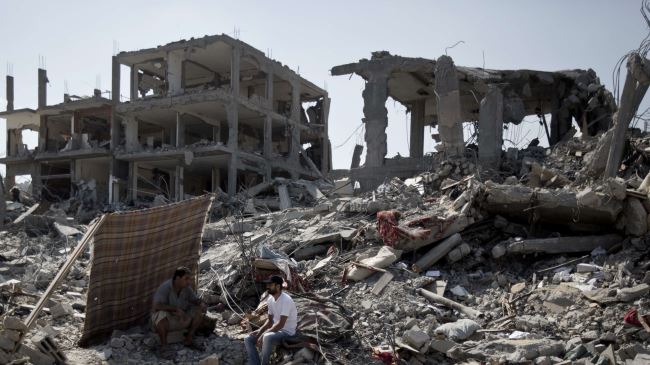 As Israel withdraws its ground forces from Gaza “to defensive positions” outside the Gaza Strip there are already obscene calls for Israel to re-engage so that Israel may “finish the job” and “go all the way” by demilitarizing Gaza, purging the 360 sq. km strip of its native Arab inhabitants and reoccupying it. Nearly 1,900 Palestinians have been killed and at least 500,000, who are already refugees, have been internally displaced once more as a result of 29 days of implacable Israeli attacks. Parts of Gaza have been emptied, with entire neighborhoods eradicated as though they had never existed. From space the Gaza Strip was captured veiled in black, with Israel’s indiscriminate bombardment glowing bright — the widespread pockets of shelling luminous amongst the darkness, like blazing sulfur. If this is what was witnessed from space imagine what horrors the people of Gaza will see on earth as the dust settles.
Citizens of Gaza’s southern town of Khuza’a who fled unwavering bombing campaigns describe harrowing scenes of bodies lining the streets, children being kept in ice cream freezers as morgues could no longer accommodate the dead, and tell of being deliberately targeted by Israel, some narrowly escaping with their lives.
In one incident, reported by 15-year-old Akram al-Najjar to Human Rights Watch, after Israeli soldiers found more than 100 people huddled together in one house, they were all forced out: “The first one to walk out of the house was Shahid al-Najjar. He had his hands up, but the soldiers shot him. He was shot in the jaw and badly injured, but he survived. Two of the people in the house spoke Hebrew and asked the soldiers why they shot him, and the soldiers said that the rest of the men had to take our clothes off before we walked out.”
In another eye-witness account in Khuza’a, the Israeli military had trapped at least 32 people in a home and then prevented the Red Cross from evacuating them before then shelling the area. After they moved to a neighbor’s house they sought refuge in the basement where they found families already inside. “By that point we were 120 people, 10 men and the rest women and children,” Kamel al-Najjar told Human Rights Watch. After dawn, without warning, Israel struck the house, killing three people and wounding 15 others.
The toll this war had on Gaza’s children has been “catastrophic” according to the United Nations. At least 429 children have been killed in this latest Israeli onslaught, and those who have not been buried have had their innocence entombed, another casualty in this war against all things daring to live and resist in Gaza. “I watched the missile falling on my home. My home burned. It burned all my toys, clothes and my room. I think I will not survive,” a nine-year-old girl from Rafah told a UNRWA counselor.
Gaza’s children were robbed of hundreds of blissful mornings, from witnessing the sun rising to kiss the earth as they sit restless, listening to the reassuring pulse of their parents’ voices, tasting the sugar of happiness from their smiles. Some will no longer feel their mother’s soothing arms rock them still into the night, nor see the inspiring glimmer of hope, like constellations, dancing in their father’s eyes, nor will they hear stories told by their grandparents of golden sunsets in Palestine bleeding into mornings — and when the homes are rebuilt there will be corners of emptiness inside that had once been filled to the brim with the laughter of a sibling or cousin, as they sat amongst flat bread and plates of labneh, za’atar and olive oil.
Israel has forced the children of Gaza to lay flowers atop headstones, and watch helplessly as coffins that are filled with not only their most beloved family members, teachers, neighbors, and friends but also their most treasured memories, lullabies, lessons learned and those that will never come, descend into the belly of the earth. Their lips will memorize and form prayers for the dead and the stars that defied the siege, that flickered freely high above them, will be snatched from their skies. In so many interviews after countless attacks we hear Palestinians, both young and old, say: “Israel has stolen everything beautiful in our lives,” and Israel’s barbarity continues to reaffirm this sentiment.
Yet despite the blood soaking the dirt beneath the feet of mourners, despite this cataclysmic butchery and theft, Palestinians continue to resist. Israel has attempted with all of its militaristic might to remove not only the Palestinian will to resist but to extract Gaza, the land and the identity, from the Palestinian character as a whole, by way of the siege — but it is a part of Palestine as much as one’s heart is a part of the body.
Gaza is Palestine. So long as a single voice remains in Gaza calling for resistance, for an end to the siege and the greater occupation, come what may, Israel will answer for the destruction of villages, the arbitrary detention of children, the normalization of indefinite detention without charge or trial for political prisoners, the detainment of asylum seekers, the racism that has become part and parcel of the occupation. Israel will answer for its culture of impunity.
The children of Gaza will not forget the people and the land that Israel has snatched from them and so long as a single flag stands amongst the rubble, so long as a single voice cries for justice, despite the sounds of drones buzzing up above, the people of Palestine shall endure.
Roqayah Chamseddine is a Sydney based Lebanese-American journalist and commentator. She tweets @roqchams and writes ‘Letters From the Underground.‘
Featured Video
American Military Failure in Afghanistan
or go to
Aletho News Archives – Video-Images
Frlom the Archives
Iran War: United States Military Versus Israel Firsters
By James Petras | November 27, 2007
Why must Jewish organizations be and be seen as the loudest drum-beaters of all? Why can we not bring ourselves to say that military intervention is not on the table at all? Why not stash it under the table, out of sight and mount instead a diplomatic assault? – Leonard Fein, Forward
Introduction
As the White House and Congress escalate their economic sanctions and military threats against Iran, top military commanders and Pentagon officials have launched a counter-offensive, opposing a new Middle East War. While some commentators and journalists, like Chris Hedges (Truthdig, November 13, 2007), privy to this high stakes inter-elite conflict, attribute this to a White House cabal led by Vice President Cheney, a more stringent and accurate assessment puts the Zionist Power Configuration (ZPC) in the center of the Iran war debate.
There is a great deal riding in this conflict – the future of the American empire as well as the balance of power in the Middle East. Equally important is the future of the US military and our already heavily constrained democratic freedoms. The outcome of the continuous and deepening confrontation between top US military officials and the Israel Firsters over US foreign policy in the Middle East has raised fundamental questions over self-determination, colonization, civilian primacy and military political intervention, empire or republic. These and related issues are far from being of academic interest only; they concern the future of the United States. … continue
Blog Roll
 Aletho News
- Who Is closer to collapse?
- A War that Backfired: Why the US-Israeli Campaign Is Strengthening Iran
- How Zionist Control Is Hurting US Interests
- Iran warns it may target US missile launch sites in UAE cities
- American Military Failure in Afghanistan
- Friendly Skies of Georgia: Are Israeli-Linked Drones Launching False Flags from Georgian Territory?
- The Three Big Lies about Mammography Screening
- Ukrainian Embassy in Beirut sheltering top Mossad agent
- Palestinian family displaced after settlers violently attack them in Humsa, Jordan Valley
- The EU never learns – except for the wrong lessons
- If Americans Knew
- No let-up in attacks on Gaza as Israel takes on Iran, Lebanon – Not a ceasefire Day 155
- ‘Of Course’: IDF Drops Case Against Soldiers Accused of Raping Palestinian Prisoner
- Don’t Fall for the Regime Change Talk. Israel Is ‘Mowing the Lawn’ in Iran
- Will Israel and the US wreck the Gulf States along with Iran?
- US so far burned through ‘years’ of munitions in Iran war: Report
- How the Israeli Tail Wags the American Dog
- Outdated intel likely led to deadly U.S. strike on Iranian elementary school, sources say
- Pentagon insider says high U.S official Douglas Feith reported to Netanyahu
- In fond memory of Walid Khalidi, the historian of Palestine
- 6 more Americans killed, as Israel ‘mows the lawn’ in Iran – Not a ceasefire Day 154
- No Tricks Zone
- Storing Green Energy To Last Germany 10 Days Would Require A 60-Million Tonne Battery
- New Studies: UK Sea Levels Were 4 Meters Higher Than Today During The Mid-Holocene
- Destructive Green New Deal: German Energy And Metal Group Warns Of Drastic Crisis
- New Study Documents A 20-Year Pause In Arctic Sea Ice Decline – Driven By Internal Variability
- Wake-up Call: Survey Shows Majority Of Germans Now Favor Postponing Climate Targets!
- Televised! Leading German Political Candidate Tells Schoolchildren CO2 Makes Sun Hotter!
- New Study: A Century Warming Of 1.1°C Is ‘Commonplace’ And ‘Not Unusual’ During This Interglacial
- New Study: ‘Internal Noise’ And Volcanic Forcing Can Trigger 10-15°C Warming Within Decades
- Glaciers Worldwide Are Suddendly Surging, Experts Blame Warming!
- Surprising Discovery: Sahara Is Greening…Billions Of Trees Where Once Thought To Be Barren
 Aletho News