Majority of Israelis: The force used by the army in Gaza was not excessive
MEMO | August 20, 2014
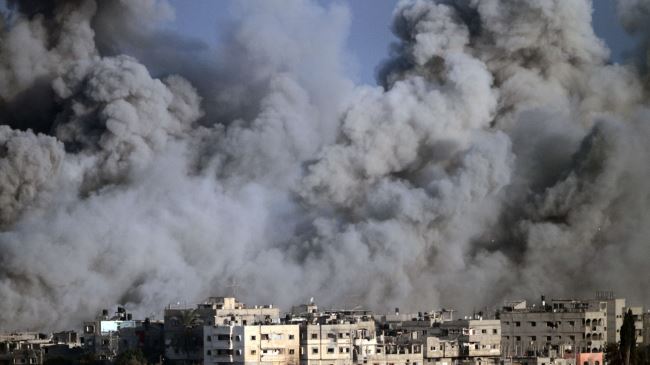
An overwhelming majority of Jewish Israelis think that the Israeli army used either the “appropriate” level of force or “too little firepower” during its latest aggression, dubbed “Operation Protective Edge”, in the Gaza Strip. A majority also expressed their support for the government’s restrictions on the freedom of expression during the war, as well as for the mediation efforts led by the post-coup government in Egypt.
According to the latest poll for the Peace Index, which is conducted by the Israel Democracy Institute and the University of Tel Aviv, 48 per cent of Israeli Jews believe that the force used by the army was appropriate, while 45 per cent actually think that too little force was used. Only 6 per cent said that Israel used excessive force against the Palestinians.
The Israeli government barred Israeli reporters from entering into Gaza to cover the war, thus Israelis were not exposed to the horrors taking place in the Strip. Israeli strikes have left more than 2,000 dead and 10,000 wounded, in addition to causing massive destruction to civil infrastructure, homes and businesses, leaving many without a place to sleep or work.
On another note, 97 per cent of the Jewish Israeli respondents said that the performance of the Israeli army during the operation was “was very or moderately good”, while only 3 per cent rated the army’s performance as “as not so good or poor”.
58 per cent said they were in favour of limiting the freedom of expression during times of war, while 39 per cent believe that these restrictions are unnecessary.
92 per cent of the Jewish population said the aggression on Gaza was “justified” while 58 per cent said that Israel should not respond to any of Hamas’s demands for a ceasefire and instead should continue fighting until the Palestinian resistance movement surrenders.
Some 44 per cent believe that Israel has achieved most of its goals as a result of the war on Gaza, while 48 per cent said that only some of the goals set for the operation have been achieved and 6 per cent said that Israel did not achieve anything from this operation.
As for the Arab Israeli citizens, 65 per cent believe that no goals have been achieved.
Regarding the mediation efforts in Cairo, 60 per cent of Israeli Jews trust Egypt’s President Abdel Fatah Al-Sisi “to act as a fair mediator”, with only 38 per cent not trusting him.
On the other hand, 55 per cent of Israeli Arabs do not trust President Al-Sisi, while 31 per cent trust him to mediate the conflict.
Watchdog groups slam Ferguson police ‘harassment’ of reporters
RT | August 20, 2014
As tensions continue to simmer following nine days of street protests in Ferguson, Missouri, where a teenager was shot dead by a police officer, two watchdog groups have slammed the heavy-handed police tactics.
To compound the physical and mental strain of reporting on the weeks-long protests in Ferguson, where the public is desperate for justice after a white police officer shot black teenager Michael Brown to death, journalists themselves are finding themselves the target of police tear gas, rubber bullets and flash bang grenades.
However, Robert Mahoney, Deputy Director of the Committee to Protect Journalists (CPJ), said the police tactics would not prevent reporters from doing their jobs.
“Ferguson is an international story and journalists are going to cover it. They have a right to do so without fearing for their safety or liberty,” Mahoney said. “The harassment and detention of reporters must stop. From senior commanders on down, the word must go out to security forces to let journalists do their job.”
CPJ also released a guide for journalists on how to stay safe while covering events in Ferguson.
Jasmine Heiss, an observer with Amnesty International, expressed concern over reports that journalists were being tear-gassed while performing their jobs.
“Just last night I’ve heard several journalists and community say that either gas was thrown at them while they were reporting, or, in the case of the community members that gas was thrown into residential neighborhoods while they were walking,” Heiss told RT.
“Increasingly repressive tactics [are] being used to curtail free speech,” she added.
Six journalists were detained by police while covering the protests on Monday and early Tuesday, compelling the American Society of News Editors to describe the incidences as a “top-down effort to restrict the fundamental First Amendment rights of the public and the press.”
According to CNN, 11 journalists have been arrested in the course of the protests, which have thrown a glaring spotlight on US race relations, not to mention military-style police equipment and tactics now being deployed on the streets of America.
Police were caught on video firing a tear gas canister that exploded directly in front of an Al Jazeera America crew, causing the reporters to discard their camera equipment and flee the fumes.
In another heated encounter, a police officer is actually caught on video telling journalists, “I’m going to f***ing kill you!”
Meanwhile, social media accounts have exploded with real-time proof of the “severe press intimidation,” as the Huffington Post described the heavy-handed tactics, where Ferguson police fired at journalists with rubber bullets and flash bang grenades, in some cases preventing media from leaving their vehicles for fear of being targeted.
German reporter Ansgar Graw and his colleague Frank Hermann were detained by police for taking photos of a burned-out gas station, close to the spot where Michael Brown was killed.
“I tried to take some pictures at a spot where before I think were taken several thousand photos of the same spot, and some police officers tried to shoot me and my colleague from Germany…but it was on Monday at 2 o’clock, it was perfect…there was no threat, no tensions were in the air,” he told RT.
The journalist said the police told them they could photograph, but they had to continue walking otherwise they would be arrested. Despite complying with the police orders, Graw said they were still detained.
Holder’s Agency in Ferguson

emptywheel | August 19, 2014
Eric Holder just published an op-ed in the St. Louis Post Dispatch, apparently aiming to generate confidence in DOJ’s investigation into Darren Wilson’s killing of Mike Brown.
It starts with 3 sentences describing Brown’s killing — with no mention of Wilson, or even that a cop killed Brown.
Since the Aug. 9 shooting death of Michael Brown, the nation and the world have witnessed the unrest that has gripped Ferguson, Mo. At the core of these demonstrations is a demand for answers about the circumstances of this young man’s death and a broader concern about the state of our criminal justice system.
At a time when so much may seem uncertain, the people of Ferguson can have confidence that the Justice Department intends to learn — in a fair and thorough manner — exactly what happened.
A disembodied shooting killed Brown in this telling; violence did not.
Holder then spends several paragraphs discussing both the investigation itself, as well as the actions of the Civil Rights Division before he turns – in the course of one paragraph — to the protests. Here, violence is described as violence.
We understand the need for an independent investigation, and we hope that the independence and thoroughness of our investigation will bring some measure of calm to the tensions in Ferguson. In order to begin the healing process, however, we must first see an end to the acts of violence in the streets of Ferguson. Although these acts have been committed by a very small minority — and, in many cases, by individuals from outside Ferguson — they seriously undermine, rather than advance, the cause of justice. And they interrupt the deeper conversation that the legitimate demonstrators are trying to advance.
The implication, of course, is that the violence comes exclusively from that “very small minority,” not the cops shooting rubber bullets from their tanks.
I find the next paragraph truly remarkable.
The Justice Department will defend the right of protesters to peacefully demonstrate and for the media to cover a story that must be told. But violence cannot be condoned. I urge the citizens of Ferguson who have been peacefully exercising their First Amendment rights to join with law enforcement in condemning the actions of looters, vandals and others seeking to inflame tensions and sow discord.
The Justice Department — the Agency Eric Holder leads, the 40 FBI Agents and Civil Rights prosecutors Holder described — has done nothing visible thus far to defend the First Amendment.
And then, Holder says, “violence cannot be condoned.” A bizarre passive sentence with no agent. By whom? Who cannot condone violence?!?!
And he uses it to urge “the citizens of Ferguson who have been peacefully exercising their First Amendment rights” — many of whom have been arrested, bullied, tear gassed, some of whom have formed chains to protect businesses — to “join with law enforcement,” the same law enforcement that has been bullying them. Holder asks these citizens — who presumably are the ones he says cannot condone violence — to join the cops who have been engaging in violence to condemn others who have also been engaging in violence. Those “others” inflame tensions and sow discord. The cops don’t, according to this telling.
It takes a good paragraph and a half before Holder says the cops must restore trust. Only unlike the “citizens” of Ferguson, Holder does not urge the cops directly to do … anything. He just describes what should happen, he doesn’t command it to happen.
At the same time, good law enforcement requires forging bonds of trust between the police and the public. This trust is all-important, but it is also fragile. It requires that force be used in appropriate ways. Enforcement priorities and arrest patterns must not lead to disparate treatment under the law, even if such treatment is unintended. And police forces should reflect the diversity of the communities they serve.
Note what else happens? That violence — unmentioned in Mike Brown’s actual shooting, but explicitly described when “those others” did it — here becomes “force.” Something distinct from the violence of looters.
Darren Wilson’s shooting of Mike Brown? Not described as violence — not even described as the act of a known man. The looters’ looting? They’re engaged in “violence.” And finally, the cops, whom Holder doesn’t dare urge to tone things down? They are exercising “force,” not “violence.”
I get there are legal reasons why he did this — notably, this permits him to endorse findings that Wilson used “force” out of fear for his own safety! But the grammar and vocabulary of this op-ed insists on the state’s monopoly on violence that it has been abusing for 10 days.
Latvia urges Europe to stop ‘war of sanctions’ before it ruins world economies
RT | August 19, 2014
The “right steps” politicians in the West and Russia are now taking against each other are very similar to what was happening before World War I, Latvian MEP Andrejs Mamikinsh warned EC President Jose Manuel Barroso in a letter Tuesday.
It’s crucial to stop reciprocal sanctions before they throw people into poverty and ruin the economies altogether, the European Parliament member wrote.
“In 2014 exactly 100 years have passed since the beginning of World War I that killed millions of people and left Europe in ruins. On the eve of that war similar processes occurred when countries took “the right” steps against each other and eventually were not able to stop. It is doubtful that in the end of that war anyone remembered for what good intentions it had started,” Mamikinsh wrote in his letter.
These would be ordinary people, not politicians, who’ll be hit first and hardest by a so called “risky poker” played by politicians in the West and Russia, the Latvian MEP, added.
Latvia is expected to suffer the most from the tit for tat sanctions imposed by the West and Russia, Mamikinsh said.
Further escalation of a “sanctions war” would erode about 10 percent of Latvian GDP, which means thousands of people could be left out of work with shrinking living standards.
Bulgaria halts South Stream gas pipeline project for second time
RT | August 18, 2014
All operations on Russia’s Gazprom-led project South Stream have been suspended, as they do not meet the requirements of the European Commission, Bulgaria’s Ministry of Economy and Energy said on its website.
“Minister of Economy and Energy Vasil Shtonov has ordered Bulgaria’s Energy Holding to halt any actions in regards of the project,” the ministry said. This specifically means entering into new contracts.
There has been mounting pressure from the EU to put the project on hold, and now the European Commission will be consulted each step of the way to make sure it complies with EU law.
European ‘anti-monopoly’ laws prohibits the same company to both own and operate the pipeline. However, Gazprom and Bulgaria had previously struck a bilateral agreement regarding that aspect of the project.

This is the second time Bulgaria has called for a suspension of the South Stream project. In early June, the country’s Prime Minister Plamen Oresharski ordered the initial halt.
Bulgaria is the first country traversed by the pipeline on land, after a section that runs beneath the Black Sea from Russia. The branch that begins in Bulgaria is planned to continue through Serbia, Hungary, Slovenia and Austria.
Other participating countries have confirmed their commitment to the South Stream’s construction.
Gazprom’s $45 billion South Stream project, slated to open in 2018 and deliver 64 billion cubic meters of natural gas to Europe, is a strategy by Russia meant to bypass politically unstable Ukraine as a transit country, and help ensure the reliability of gas supplies to Europe.
No ammunition moved through Russia-Ukraine border – OSCE monitors
RT | August 19, 2014
OSCE observers stationed at two Russian border checkpoints, the Ukrainian counterparts of which are controlled by the Ukrainian military, have not witnessed any movements of weapons across the border.
The monitors did witness young people “dressed in military style” moving across the border into Ukraine, Paul Picard, acting chief observer of the OSCE Mission, told journalists. However, all of them were unarmed.
There were also no instances of military vehicles crossing the border in some two weeks which the observers spent at Gukovo and Donetsk checkpoints, he added.
He added that the OSCE did its part in assisting the international effort to check a Russian humanitarian aid convoy before it would be allowed into Ukraine, but said the organization has little impact here, because the progress with the convoy depends on Russian and Ukrainian authorities and the International Committee of the Red Cross.
The presence of the observers on the Russian side of the border was part of an agreement aimed at deescalating the conflict in eastern Ukraine. They were invited amid Kiev’s claims that Russia supplies arms and military vehicles to the armed militia fighting against the Ukrainian troops in Donetsk and Lugansk Regions.
The monitors were supposed to be deployed after a ceasefire by Kiev, but Moscow agreed to host them unconditionally as a gesture of goodwill.
Kiev must publish record of MH17 communications with traffic control – Russia
RT | August 19, 2014
Kiev should make public the records of communications between the Ukrainian air traffic control and the Malaysian Airlines flight 17 in the hours before it was shot down over Ukraine’s turbulent east, Russia’s UN envoy said.
The issue was among several Russia raised at a UN Security Council meeting, which was called by Russia to discuss the progress of the investigation into the tragic incident, which killed 298 people in July, Vitaly Churkin said. Moscow sees the shortage of proper evidence known to the public so far as wrong.
“As far as we know, [UN’s civil aviation watchdog] ICAO is being kept on the sidelines of the investigation, which has been conducted for some time,” Churkin said.
Churkin added that Jeffrey Feltman, UN Under-Secretary-General for Political Affairs, who is to visit Kiev soon, would ask the Ukrainian government about the communications records between air traffic controllers and the plane.
“We have agreed that he would vent this issue among others,” Churkin said. “How are the Ukrainians playing their part in the international investigation? What comes to mind: they must provide the records of communications of their air traffic controllers so that we could understand why they directed the Malaysian plane into the conflict zone.”
A preliminary report into the downing of MH17 is expected later this month. According to Britain’s envoy to the UN, Mark Lyall Grant, the report would not be classified. After its publication some two months would be given to all parties interested to make their comments on the document.
The investigation into the downing of the Malaysian Boeing-777 plane was hampered by continued hostilities in the area of the crash site, as Ukrainian troops and rebel forces failed to provide a lasting ceasefire there. Both sides blamed each other for this, with either side accusing the other of trying to cover-up the crime.
Reactions from leading experts on latest UN Commission on Gaza
By Shazia Arshad | MEMO | August 18, 2014
The United Nations Human Rights Council announced last week the formation of a commission to investigate the most recent Israeli attack on Gaza, Operation Protective Edge. The panel will be headed by William Schabas, a Canadian professor of international law. The UN has said that the panel will be investigating human rights violations and potential war crimes. Whilst Israel has described the panel as a “kangaroo court”, Hamas has welcomed the setup of the commission. Hamas’ spokesman Sami Abu Zuhri said, “Hamas welcomes the decision to form an investigation committee into the war crimes committed by the occupation [Israel] against Gaza and it urges that it begin work as soon as possible.”
The commission has already met with some controversy though with the appointment of its leading lawyer William Schabas. Schabas has been described by some critics as anti-Israel. An advert run in the New York Times describes him as not only anti-Israel but a “friend of Ahmadinejad”. It seems the most irking thing about his appointment was Schabas’ former involvement in the Russell Tribunal on Palestine which concluded that Israel has committed well documented violations of international law. Schabas countered the argument that he is anti-Israel by citing that he has been on the board of the Israel Law Review.
This in turn has raised some concerns; one leading lawyer, Francis A Boyle a former legal adviser to the Palestinian Liberation Organisation told MEMO that Schabas’ appointment could be of concern to the Palestinians given his role on the Israel Law Review Board. Either way Schabas’ appointment is causing waves and his role in the Commission will almost certainly be under inspection. Boyle’s concerns however were not limited to the experts involved, he went on to say that “will be an exercise an (sic) damage control and damage limitation on behalf of Israel and very well could be used to hurt the Palestinians.”
The commissions’ findings might be hard to predict, but one thing that has been widely commented on during the assault on Gaza has been the disproportionate action by Israel. Killing almost 2,000 civilians and injuring nearly 10,000 the effect on the Gaza Strip would be intolerable by any standards. And with the Strip facing its third war in six years, it has come under increasing humanitarian strain, having barely had a chance to recover before being hit again.
With even members of the British government such as Deputy Prime Minister Nick Clegg saying “is difficult to deny that Israel’s military action appears disproportionate and, combined with the Gaza blockade, is resulting in the collective suffering of the Palestinian people”, it is clear that the Gazans have had to pay a heavy price as a result of Israel’s actions. Over the last six years this heavy price has been a burden without any justice for the Palestinian people.
After Operation Cast Lead a UN Fact Finding Mission was established to investigate the events that had taken place in Gaza. The Goldstone Report essentially accused Israel of war crimes and possible crimes against humanity. Israel rejected the findings of the report and though the report received a great deal of international backing its findings were not implemented. During that fact finding mission Israel refused to engage with the UN Fact Finding team. Almost immediately after the UN’s announcement that they would be establishing this most recent commission Israel dismissed it as being biased against Israel.
If recent history is anything to go by, it is not surprising that there are some concerns from leading experts that this commission could face difficulties during its investigation. Leading international law expert, John Dugard told the Middle East Monitor that though he had full confidence in the mission he hoped that Israel would co-operate but he “fear(ed) that it would not”. Dugard also raised concerns about Egypt’s role, ” I hope Egypt will allow the Mission access to Gaza as it did with both Arab League Fact Finding Mission and Human Rights Council Mission in 2009″. He also went on to say the he hoped European states would keep an open mind but noted that this was “too much to expect of the USA”.
It’s not just Israel’s reaction and response to the mission that observers will be monitoring. The UKs position during the conflicts in Gaza has come under intense scrutiny. After the Goldstone report, the UK’s response to it was heavily criticised. With Israel forcefully lobbying UN members to vote against the Goldstone report, the UK chose not to vote. Despite increasing pressure from MPs in the UK, the then Labour government took the decision not to vote either way on the report – although it did not officially abstain from voting.
This time around the UK’s action will be even more closely watched, especially as leading politicians take a strong stance against Israel’s actions. One top politician, Baroness Warsi resigned over the UK’s policy on Gaza. Lord David Steele, a former leader of the Liberal Democrats, expressed his support for the commission when he told MEMO “I just hope that more international attention will be paid to this report than was the case with the Goldstone report.”
The National Lawyers Guild also welcomed the commission and told MEMO that they were pleased that the UNHRC had launched an investigation into Israel’s “criminal behaviour”. But they too echoed concerns about the history of the Goldstone report itself saying, “we expect that any objective investigation would – like the Goldstone Report -condemn the Israeli assault and recommend prosecution of its military and political leaders.”
“We further expect that Israel, shielded by the United States, would once again ignore the report. To end Israel’s impunity its leaders must be investigated and prosecuted in the International Criminal Court for war crimes, genocide and crimes against humanity, alongside US leaders who aided and abetted them. We are sending a letter to that effect to the ICC Prosecutor.”
Calling for the International Criminal Court to investigate will in itself prove to be difficult. Reports on Monday suggested that the ICC was under pressure not to open an investigation into war crimes in Gaza as a result of pressure from the US. These reports argue that Fatou Bensouda, ICC chief prosecutor, will not put forward an investigation unless the Palestinians submit a new request. A former request from 2009 will not be accepted.
If the ICC does investigate this would push this commission’s results much further than the Goldstone report. Hina Jilani, one of the members of the Goldstone fact finding mission, told MEMO that “mechanisms for accountability were created at the international level to ensure the respect for the rule of law, when it is evident that national governments are either unwilling or unable to hold genuine accountability. If the international community shies away from the use of these mechanisms, it becomes complicit in the denial of justice to the victims.”
Commenting on the commission Jilani said, “the newly established Commission of Inquiry on Gaza established by the Human Rights Council at its Special Session on 23 July 2014 is certainly welcome. However, its efforts can only be fruitful if accountability of those responsible for any violations they find, is ensured. That would not be possible unless the international community has an unequivocal resolve to end impunity as well as tolerance for any acts that violate international law, especially those causing deliberate harm to civilians at times of war.”
Leading UN figures have already raised concerns, the UN Secretary –General Ban Ki-moon said that Israel had been guilty of violations of international law and Navi Pillay UN High Commissioner for Human Rights said that Israel had deliberately defied international law. Jilani said that “no one must be allowed to sabotage or divert efforts towards peace. Nor must these be de-linked from imperatives of accountability and justice. The rule of law must prevail and impunity for international crimes and gross violations of international law must end. The 2009 report of the Gaza Fact Finding Mission had observed that, “justice and respect for the rule of law are the indispensable basis for peace.”
Israeli ship blockade continues in California
Al-Akhbar | August 19, 2014
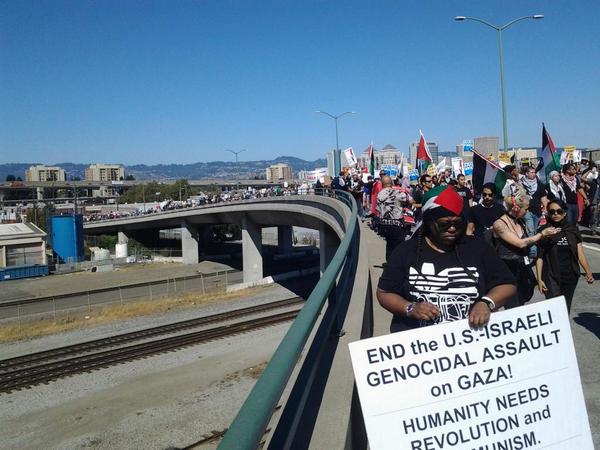
US activists blocked an Israeli cargo ship from unloading at a California port for the third day in a row in protest of the recent Israeli assault on Gaza, organizers of the action reported late Monday.
The vessel, owned and operated by Israeli company Zim Shipping Services, has been trying to unload Israeli cargo in the port of Oakland since Saturday.
Thousands of protesters prevented the ship from unloading on Saturday, with the cooperation of dock workers who refused to unload the boat.
The ship has failed to unload its cargo despite attempting various tactics, including delaying its arrival time until the early morning hours. About a dozen activists continued to hold off the ship early Monday morning, according to activist sources.
One activist who spoke to Al Jazeera said the organizers were thinking of making the block a regular action, as Israeli ships arrive in the port every Saturday.
The blockade is supported by the International Longshoremen and Warehousemen Unions, a group which also stood against the South African apartheid regime in 1984.
The Liberal Zionist Dilemma
By Lawrence Davidson | To the Point Analyses | August 19, 2014
Part I – The Liberal Ideal
Liberalism, framed as a socio-political ideal, argues that human beings are good and social progress achievable. It is a “glass half-full” outlook. Within this paradigm all individuals, not just members of a specific religion, race or nationality, should have political and civil rights. Here also neither the state nor the law is an end in itself. They are instruments for the creation and maintainance of a environment meant to promote freedom while minimizing social inequalities. Holding this ideal does not preclude identifying with a particular ethnic or religious group. It does, however, preclude any claim of exclusive rights for such groups to the detriment of others.
Within the Western environment many Jews held to this liberal ideal. They saw it as in their interest to work toward an environment of universally applied political and civil rights while minimizing social inequality. For instance, by the mid-twentieth century in the United States, many Jewish organizations were allied with African Americans in their struggle for civil rights and equality. However, this proved to be a complex alliance and it ultimately broke down. Its demise marked a waning of organized American Jewish liberal activism. What had happened?
Part of the answer became apparent after the Arab-Israeli war of 1967. At that time many civil rights leaders in the U.S. noticed that Israel was not, after all, a very liberal society. It was designed exclusively for one group and discriminated against those who were not members of that group. When this became a subject of concern and debate within the civil rights community, many Jewish organizations broke with the movement and its struggle. How about Jewish liberal individuals? They were now confronted with one of three choices: (1) retain a principled adherence to the liberal ideal and cease their uncritical support of the Zionist state, (2) renounce the liberal ideal and continue their whole-hearted support for illiberal Israel, or (3) become quiet in public while fretting in private about the evolving racist nature of Israel. It seems many of them took the third option.
Part II – An Old Dilemma
Given this history it is simply wrong to think of the present dilemma faced by Jewish liberals over Israeli behavior as something new. So-called liberal Zionists such as Peter Beinart, Amos Oz, Ari Shavit and Jonathan Freedland have certainly known for decades that the notion of civil and political rights for Jews and non-Jews equally was not an aim of the Zionist movement and therefore stood little chance of shaping the behavior of the Israeli state. Yet here we are, following three massive invasions of Gaza and its inhumane blockade, repeated massacres of Palestinian civilians going back at least as far as Israel’s “war of independence,” decades of continuous land theft and illegal settlement, and more than sixty years of an Israeli-inspired police state environment on the West Bank, confronting a suddenly newsworthy liberal Zionist dilemma.
One argument given to explain this belated display of liberal Zionist angst is that only recently have such individuals decided that the two-state solution is in real jeopardy. As this argument goes, as long as a two-state solution was possible, liberal Zionists could hope for the realization of both Jewish and Palestinian political and civil rights within their respective two states. But this explanation is misleading. It is incorrect to think of the two-state solution as only recently at death’s door. In truth, if this solution was ever alive and possible (which is questionable), it was killed off the moment Menachem Begin lied to President Jimmy Carter about the granting of progressive “autonomy” to the Palestinians. That was 1979. That otherwise quite knowledgeable Zionists as those mentioned above did not know this is hard to believe.
So why is this liberal dilemma an issue now? A more accurate answer might lie with changing public opinion. It has only been in the last ten years or so that the Zionist storyline on the Israeli-Palestine conflict has lost its monopoly. In that same time frame the boycott movement has also become a worldwide affair. As Israel’s illiberal character becomes more public, option 3 noted above becomes harder to maintain. As Jonathan Freedman tells us in his New York Review of Books article, “The Liberal Zionists,” these folks are now attacked from all sides. The Zionist movement is, if you will, circling their wagons and no longer finds liberal complaints tolerable, even in private. They want everyone out there saluting the Israeli flag.
The Israeli author and columnist Ari Shavit shows us where these extreme nationalist pressures will likely lead those still trying to square the circle of liberalism and Zionism. In his recent book My Promised Land he writes, “The choice is stark, either reject Zionism [the Zionist State of Israel] because of Lydda [an example of the massacre of civilians by Israeli forces], or accept Zionism [the Zionist state] along with Lydda. … If need be, I will stand by the damned. Because I know that if it wasn’t for them, the state of Israel would not have been born. … They did the dirty, filthy work that enables my people, myself, my daughter and my sons to live.” So much for the liberal ideal.
Part III – Facing Contradiction
In truth the term “liberal Zionist” has never made much sense. The only way to explain its survival is to consider the survival of the Zionist storyline itself – the story of Israel as a democracy upholding the Western model in the Middle East. As long as one believed that this was true, one could dismiss Israeli brutality as just occasional slippage from progressive political and civil principles supposedly underlying the state. Within this context, there could be liberal Zionists privately decrying occasional Israeli bad behavior. But the Zionist storyline was not true. We never were dealing with just occasional slippage but rather with the inherent brutality of a state with policies and practices designed to bring about racist ends (a nation exclusively for one group) – while conjuring up a remarkably durable cover story that it was, after all, a liberal democracy. The Israeli right, as well as the Palestinians, always knew the cover story was a sham. Now, with the recent Gaza slaughter, much of the rest of the world does too. That public unveiling, along with the Zionist demands for uncritical loyalty, leaves the liberals in a wholly untenable situation.
You simply cannot adhere to the principle of universal civil and political rights and, at the same time, support a Zionist state. To do so is to involve oneself in a contradiction. The liberals are being forced to face this fact. And, as this happens, they will have to make a real choice: cease being Zionist or cease adhering to the liberal ideal. I suspect that, along with Ari Shavit, most of them will decide to “stand with the damned.”
Robin Williams, Mental Health, and Social Insanity
By Michael Smith | Legalienate | August 17, 2014
“We are made miserable . . . not just by the strength of our beliefs, but by the weight of hard and all-too real situations, as they bear downward, robbing us of control . . . unhappiness treated by clinicians has much more to do with the sufferer’s situation than with anything about themselves, and for those with few privileges, this unhappiness is pretty well beyond the reach of therapeutic or any other conversation.” – Paul Moloney “The Therapy Industry”
Robin Williams’s body was scarcely cold when liberal commentators began using the tragedy of his death as publicity for suicide hotlines and professional mental health intervention in general. He had long-standing depression, we were told, and his “mental illness” was manifest in his decision to take his own life. Depression sufferers were urged to “be honest” and avail themselves of the services of professional therapists and counselors.
Days later Williams’s widow informed the world that her husband had been diagnosed with Parkinson’s disease, a degenerative disorder that even people with no prior history of depression can find impossible to face. Parkinson’s is chronic, and its symptoms worsen over time, leading to body tremors, muscle stiffness, and the loss of coordinated movement. No one knows why the disease develops, and it is incurable.
We do not know what went through Williams’s mind, of course, but it is not difficult to entertain the idea that the lifelong actor made an understandable decision to take an early exit from life’s stage rather than suffer the appalling loss of body control that the disease entails for its sufferers. Surely there is something more than “mental illness” involved in the desire to avoid such a fate.
Even if Williams’s well-known depression, which long-predated his Parkinson’s diagnosis, was involved in his decision to end his life, the liberal notion that we can and ought to rely on mental health professionals to guide us to health and sanity is more than a little suspect. There is no evidence that this group suffers lower rates of depression than the rest of the population, nor any that any kind of therapy has a cure for it. In fact, the evidence suggests that the mental health profession plays a crucial role in perpetuating a status quo within which depression is said to be growing by leaps and bounds.
Psychoanalyst Joel Kovel demonstrated in the early 1980s that psychotherapy and counseling had become indispensable parts of the capitalist economy, especially in the United States, where turning socially induced misery into false questions of self-improvement long ago reached the status of a quasi-religious movement. Subsequent to Kovel’s published insights came the “diseasing” and drugging of hyper-active American schoolchildren due to what eventually came to be known as “ADHD.” In more recent years, we have seen how “happiness psychology,” particularly the work of conservative academic and writer Martin Seligman, a former chairman of the American Psychological Association and adviser to the U.S. military, informed the Bush Administration’s torture program at Guantanamo Bay. All of this should make us quite skeptical about claims that therapy and counseling have the answer to our mental woes.
Having said that, the challenge of effectively treating mental disorders is surely formidable. According to surveys and clinical data, rates of depression in the U.S. have increased ten-fold since the 1950s, although it must be admitted that individuals of quite divergent symptoms are routinely classified under this broad umbrella, calling into question the validity of the category itself. However, even if some of the increase is due to an increased tendency to define common dissatisfaction as illness, it seems likely that at least some of the increase is genuine, given soaring inequality and an attendant increase in chronic illness, social isolation and reported loneliness, and suicide, especially during the periods of economic crisis that have become a nearly constant feature of U.S. capitalism in recent years.
Contrary to therapeutic claims that a “positive” attitude is the key to mental health, a growing body of evidence supports the claim that the principal influence on people’s mental health is their circumstances, both past and present. We can now say with some assurance that the larger and more obvious the gaps between rich and poor in developed societies – and the more exploitive the relations required to maintain and expand them – the greater the likelihood of violent conflict, mutual distrust, and degraded health, both mental and physical. Features of a particular location in the social hierarchy such as prestige, conditions of work, material circumstances, and wealth largely determine one’s likelihood of enjoying mental and physical health or illness. And to the extent that one belongs to a stigmatized, exploited group, and especially if one is poor, the more likely one is to experience life’s hardest blows – more often, more painfully, and with fewer joyful experiences to compensate for them.
Conventional counseling and therapy isn’t even focused on this problem, much less is it offering a solution to it. Because of its conviction that attitude is everything, conventional approaches put the onus of responsibility on the poor for their poverty. Thus they are given parenting training and other judgmental interventions when what they really need is decent housing, food, recreation, medical care, and above all, money. The assumption is that the poor deserve to be poor owing to their allegedly deficient character, made manifest in poor impulse control, hypersexuality, and a general lack of integrity. If it weren’t for these defects, the theory goes, the poor would be contented members of the middle class. This is one of the most damaging features of therapy, because it teaches exploited people that they are deficient or substandard instead of abused. Unfortunately, the crude stereotypes blaming the poor for their plight are promoted by a wide spectrum of members of the so-called “helping” profession: community leaders, social work educators, and quite a few academic researchers. If this is “help,” what might hindrance be?
Therapists and counselors with a genuine interest in finding a cure for mental illness would do well to investigate the income inequalities hypothesis of population health. Based on the common sense assumption that high levels of inequality are unhealthy (directly for the poor, indirectly for the rich), the thesis is that for modern industrialized countries, the average health, well-being, and longevity of the population depends not on the level of absolute poverty that exists, but on the spread of wealth, and especially on the gap between rich and poor.
As income differentials widen, the theory goes, people start to feel more competitive, and begin to look on others with increasing suspicion and distrust. Wariness, envy, shame, fear, and anger become more pronounced and take on a self-perpetuating thrust, undermining the basis for affectionate and caring relationships. A life of perpetual insecurity (which former Fed Chairman Alan Greenspan declared in Congressional testimony was the principal reason for the 1990s boom years) and perceived threat triggers the release of cortisol and other “stress” hormones into the bloodstream, lowering our capacity to fight infection and ward off heart disease and other degenerative conditions. It should be emphasized that the theory maintains that this harms even the rich, who, amidst increasingly unjust conditions, have less and less opportunity to enjoy their wealth in ease. The public health implications are substantial: an increase of 7% in the share of income going to the bottom half of the population allegedly yields two additional years of life expectancy. [Note: The U.S. has the most unequal distribution of wealth in the developed world. According to the most recent survey by the Federal Reserve, the top decile own 71% of the country’s wealth, while the bottom half claims just one percent.]
One of the more intriguing mental health research findings undermines the “positive attitude” theorists. It shows that moderately depressed people have a more accurate perception of their abilities and their capacity to control events than do “healthy” people. A 2002 study found that mildly depressed women were more likely to live longer than non-depressed or severely depressed women. A longitudinal study of more than 1000 California schoolchildren concluded that optimism was more likely to lead to premature death – possibly because the optimists took more risks. Another study among pre-teenagers found that kids who were more realistic about their standing among their peers were less likely to get depressed than those who had illusions about their popularity. And a 2001 study co-authored by the guru of happiness psychology himself – Martin Seligman – found that among older people pessimists were less likely to fall into depression following a negative life event such as the death of a family member than were optimists.
These findings should provoke a complete reorientation of, not just the helping professions, but the entire society. After all, psychologists have long convinced us that we are all “CEOs” of self, rationally testing our ideas against reality, and that we become disturbed to the extent that we cannot accept the verdict that reality delivers. In short, to the extent that our ideas are unrealistic we are mentally ill, which should mean that President Obama, the Supreme Court, top executives on Wall Street, and virtually the entire Congress are certifiable lunatics.
But of course it doesn’t mean that. WE who cannot make our peace with a social order dedicated to plunder and destruction are mentally suspect, because responsible adulthood entails setting aside the childish notion that the world can be transformed into something within which a decent person would want to live, in order to concentrate on the supremely important matter of reproducing an increasingly imperiled social order dedicated to getting and spending. This is the reigning definition of sanity in our times. God help anyone who insists that social and political reality, not personal attitudes and reactions, is what needs to be adjusted.
Sources:
Barbara Ehrenreich, “Bright-Sided – How The Relentless Promotion of Positive Thinking Has Undermined America,” (Metropolitan Books, 2009)
Paul Moloney, “The Therapy Industry – The Irresistible Rise of the Talking Cure, and Why It Doesn’t Work,” (Pluto Press, 2013)
Thomas Piketty, “Capital in the Twenty-First Century,” (Harvard University Press, 2014)
Featured Video
Marandi: Threat of Seizing Kharg Island & the Use of Nuclear Weapons
or go to
Aletho News Archives – Video-Images
Frlom the Archives
Provoking a Path to Persia
The Saban Center’s prescient paper on war with Iran
By Maidhc Ó Cathail | October 20, 2011
In June 2009, the Saban Center for Middle East Policy published “Which Path to Persia?—Options for a New American Strategy toward Iran.” Writing in a tone strikingly reminiscent of the Project for a New American Century’s infamous pre-9/11 paper “Rebuilding America’s Defenses,” the six co-authors noted that, “It seems highly unlikely that the United States would mount an invasion without any provocation or other buildup.” For a think tank specifically established by media mogul Haim Saban to protect Israel, this could prove to be a formidable obstacle impeding their desired march—of U.S. troops—to Tehran.
“In fact, if the United States were to decide that to garner greater international support, galvanize U.S. domestic support, and/or provide a legal justification for an invasion, it would be best to wait for an Iranian provocation, then the time frame for an invasion might stretch out indefinitely,” Saban’s think-tankers ruefully observed.
“With only one real exception, since the 1978 revolution, the Islamic Republic has never willingly provoked an American military response, although it certainly has taken actions that could have done so if Washington had been looking for a fight. Thus it is not impossible that Tehran might take some action that would justify an American invasion. And it is certainly the case that if Washington sought such a provocation, it could take actions that might make it more likely that Tehran would do so (although being too obvious about this could nullify the provocation). However, since it would be up to Iran to make the provocative move, which Iran has been wary of doing most times in the past, the United States would never know for sure when it would get the requisite Iranian provocation. In fact, it might never come at all.”
Seemingly undeterred by Iran’s frustrating unwillingness to provide the requisite provocation, the analysts continued to examine this option… continue
Blog Roll
 Aletho News
- Ukrainian Embassy in Beirut sheltering top Mossad agent
- Palestinian family displaced after settlers violently attack them in Humsa, Jordan Valley
- The EU never learns – except for the wrong lessons
- Iran attacks on UAE leaves RSF militia high and dry
- Hosting Washington’s war: Bahrain faces the consequences
- The US fell for its own Iran propaganda
- Seyed M. Marandi: Threat of Seizing Kharg Island & the Use of Nuclear Weapons
- Is there even an off ramp?
- Michael von der Schulenburg: Europe’s Self-Defeating Iran War Policy
- Sorry, The New Republic, Climate Change Isn’t Causing Somali Migration. Blame Civil Strife and Poverty.
- If Americans Knew
- ‘Of Course’: IDF Drops Case Against Soldiers Accused of Raping Palestinian Prisoner
- Don’t Fall for the Regime Change Talk. Israel Is ‘Mowing the Lawn’ in Iran
- Will Israel and the US wreck the Gulf States along with Iran?
- US so far burned through ‘years’ of munitions in Iran war: Report
- How the Israeli Tail Wags the American Dog
- Outdated intel likely led to deadly U.S. strike on Iranian elementary school, sources say
- Pentagon insider says high U.S official Douglas Feith reported to Netanyahu
- In fond memory of Walid Khalidi, the historian of Palestine
- 6 more Americans killed, as Israel ‘mows the lawn’ in Iran – Not a ceasefire Day 154
- Are we on the precipice of World War III?
- No Tricks Zone
- New Studies: UK Sea Levels Were 4 Meters Higher Than Today During The Mid-Holocene
- Destructive Green New Deal: German Energy And Metal Group Warns Of Drastic Crisis
- New Study Documents A 20-Year Pause In Arctic Sea Ice Decline – Driven By Internal Variability
- Wake-up Call: Survey Shows Majority Of Germans Now Favor Postponing Climate Targets!
- Televised! Leading German Political Candidate Tells Schoolchildren CO2 Makes Sun Hotter!
- New Study: A Century Warming Of 1.1°C Is ‘Commonplace’ And ‘Not Unusual’ During This Interglacial
- New Study: ‘Internal Noise’ And Volcanic Forcing Can Trigger 10-15°C Warming Within Decades
- Glaciers Worldwide Are Suddendly Surging, Experts Blame Warming!
- Surprising Discovery: Sahara Is Greening…Billions Of Trees Where Once Thought To Be Barren
- New Research Reaffirms Clouds, Aerosols, And Surface Solar Radiation Are ‘Driving The Climate System’
 Aletho News