Israeli foreign ministry causes crisis with New Zealand
MEMO | September 10, 2014
The Israeli President Reuven Rivlin accused the foreign ministry of sabotaging Israel’s relations with New Zealand as an important friendly nation.
New Zealand’s new ambassador to Israel is supposed to present his credentials to the Israeli president tomorrow but this will not happen because the country’s foreign ministry rejected the diplomat due because he also sought accreditation with the Palestinian Authority.
Rivlin accused the foreign ministry of creating a crisis with one of the friendly governments with Israel.
Israeli newspaper Yedioth Ahronoth noted the importance of the issue because New Zealand is a candidate for the position of alternate member of the Security Council.
The newspaper added that the foreign ministry opposes dual representation of the ambassador in Israel and the Palestinian Authority under the pretext of fear that other foreign countries may do the same which would make “the PA’s status equal to the status of Israel”. Previous ambassadors openly moved between Jerusalem and Ramallah.
The newspaper said that the only “sin” committed by the new ambassador from New Zealand, Jonathan Carr, was that he sent a letter to the Ministry of Foreign Affairs in which he said he intends to visit Ramallah.
New Zealand was surprised by Israel’s decision and Prime Minister John Key said that the Israeli position is contrary to what had been followed, and that he refuses to submit to Israel’s dictation. He also asked the new ambassador to stay in Ankara, Turkey.
Rivlin cannot force Foreign Minister Avigdor Lieberman to reverse the decision.
Israeli war damaged 60 per cent of manufacturing capability in Gaza
MEMO | September 9, 2014
The Israeli war destroyed around 500 economic facilities that form 60 per cent of the manufacturing capability in the Gaza Strip, the Palestinian Ministry of Economy said.
Speaking to the Palestinian news agency Safa, the ministry’s spokesman Azmi Abdul Rahman said that the Israeli occupation premeditatedly targeted hundreds of the industrial, commercial and service facilities.
The commercial facilities included small shops and that paralysed the economy during the Israeli war. He stressed that the effect of the economic paralysis would last until the facilities were reconstructed.
Abdul Rahman said that specialist professional staff are working on evaluating the losses in the Strip; estimating that reconstruction of the economic facilities needs at least one year.
He said initial evaluations showed that the indirect losses exceeded $440 million.
UN: Israel Used UNRWA School For Military Operations
IMEMC News & Agencies | September 10, 2014
Israeli forces, during the recent offensive on the the Gaza Strip, used one of UNRWA’s schools in the region as a military base, according to a UN offical.
Leila Zerrougui, Special Representative of the Security-General for Children and Armed Conflict, declared on Monday that the Israeli military bombed 244 schools, 75 of which were run by UNRWA.
While not disclosing the specific location of the school, it was revealed that one of these UNRWA schools was used an Israeli military base, according to the PNN.
Speaking of the aftermath of the assault on besieged Gaza, Ms. Zerrougui stated that, of the children wounded during the conflict, one third now suffer from full disability.
Nearly 600 Palestinian children suffered violent deaths as a result of injuries inflicted by Israeli strikes from the ground, air and sea.
Related: 69% of Gaza Schools Damaged by Israeli Assaults
See also: 08/23/14 Israel Retracts False Claim Regarding Alleged Hamas Rocket Base
As Kerry visits Iraq, Sadr warns of cooperation with “occupiers”
Al-Akhbar | September 10, 2014
Cleric Muqtada al-Sadr, head of a powerful movement in Iraq, said on Wednesday during a visit by US Secretary of State John Kerry that Iraq should not cooperate with “occupiers.”
“We wish for Iraq to cooperate with the neighboring countries and its allies, but not with the occupiers,” said Sadr, whose opinions hold sway over tens of thousands of militants.
Kerry, who arrived in Baghdad on Wednesday in a bid to build a coalition against Islamic State in Iraq and Syria (ISIS) in Iraq and Syria, met Iraq’s new Prime Minister Haider Abadi and said he was impressed by the premier’s plans to rebuild the Iraqi military and push broad political reforms.
Speaking in front of reporters, Kerry told Abadi he was “encouraged” by the premier’s plans for the “reconstituting” of the military and “your commitment to broad reforms that are necessary in Iraq to bring every segment of Iraqi society to the table.”
Abadi called for the international community to help Iraq fight ISIS, urging them “to act immediately to stop the spread of this cancer.”
“Of course our role is to defend our country, but the international community is responsible for protecting Iraq and protecting Iraqis and the whole region,” Abadi said at the close of his meeting with Kerry.
Abadi said there was “a role for the international community, for the United Nations” in tackling the threat of ISIS in neighboring Syria.
During Kerry’s visit, three car bombs exploded in a neighborhood in eastern Baghdad, killing 19 people and wounding at least 52 others, officials said.
They said a suicide car bombing followed by a car bomb struck near a police checkpoint in a crowded area of eastern Baghdad.
Kerry due in Saudi Arabia “to battle extremism”
Kerry will meet with ministers from 10 Arab States and Turkey in Saudi Arabia on Thursday to hold talks on joint action against ISIS.
The talks coincide with an address from President Barack Obama at the White House, where he will outline the US’ strategy to confront ISIS and address criticism that he has been slow to respond to a wave of atrocities that has shocked the world.
Britain also announced on Tuesday that it will ship $2.6 million (two million euros) worth of weapons to Kurdish forces in Iraq, to help roll back the militants’ lightning advances.
Kerry’s arrival in the region on Wednesday comes as Washington hailed the formation of the new government in Baghdad.
Iraq’s campaign to claw back territory it lost in the north and west of Baghdad in June, and US efforts to engage neighboring governments in the fightback, have been complicated by regional politics.
Saudi Arabia and the five other Gulf Arab states have had deeply strained relations with the government in Baghdad, with each side blaming the other for the jihadists’ gains.
But their foreign ministers will be among those attending Thursday’s talks in the Saudi city of Jeddah, along with top diplomats from Egypt, Jordan, Lebanon, Turkey and Iraq itself.
They will address “terrorism in the region, extremist organizations behind it and means of fighting them,” Saudi state media said.
The Arab League, which has stopped short of explicitly backing ongoing US air strikes against ISIS, also drummed up regional support for the fight.
Ahead of his visit, Kerry vowed to build “the broadest possible coalition of partners around the globe to confront, degrade and ultimately defeat (ISIS).”
“Almost every single country has a role to play in eliminating the (ISIS) threat and the evil that it represents,” he said.
Notably absent from Jeddah will be Russia, the Syrian government – which has not been consulted over possible US airstrikes on its soil – and Iran.
ISIS has taken advantage of the conflict to seize a big chunk of northeastern Syria in fighting with government forces, rival rebel groups and Kurdish militia.
Damascus views itself as a bulwark against the militants, but Washington has ruled out any cooperation.
Washington launched airstrikes against jihadists in Iraq on August 8.
Obama is prepared to authorize air strikes in Syria against ISIS, The New York Times and the Washington Post reported late Tuesday.
An opinion poll published on Tuesday suggested Americans are hawkish towards ISIS, with nearly three-quarters favoring ongoing airstrikes against the group in Iraq while 65 percent would approve extending operations into Syria.
But critics opposed to US involvement in the conflict with ISIS have pointed out that Washington in partnership with its Gulf allies, including Saudi Arabia, played a role in the formation and expansion of extremist groups like ISIS by arming, financing and politically empowering armed opposition groups in Syria.
On Monday, a study by the London-based small-arms research organization Conflict Armament Research revealed that ISIS jihadists appear to be using US military issue arms and weapons supplied to the so-called moderate rebels in Syria by Saudi Arabia.
The report said the jihadists disposed of “significant quantities” of US-made small arms including M-16 assault rifles and included photos showing the markings “Property of US Govt.”
It also found that anti-tank rockets used by ISIS in Syria were “identical to M79 rockets transferred by Saudi Arabia to forces operating under the Free Syrian Army umbrella in 2013.”
The Pentagon said on Tuesday that more strikes had been carried out over the previous two days near western Iraq’s massive Haditha dam as part of operations against ISIS forces.
After months of wrangling, Iraq’s new Prime Minister Haidar al-Abadi finally formed a government on Monday that Washington said had “the potential to unite all of Iraq’s diverse communities.”
Kerry described the new government as a “major milestone” after the divisive rule of Abadi’s predecessor, Nouri al-Maliki.
Iran – alongside the United States, the key outside power in Iraq – said it hoped the change of government in Baghdad would help turn the tide against ISIS.
“I hope that during your new mandate, complete calm will return to your country,” President Hassan Rouhani said.
In reality, the new government does not constitute quite the sea-change hailed by Washington, as the divisive Maliki becomes one of three vice presidents.
In other developments, French President Francois Hollande will visit Iraq on Friday ahead of hosting a conference in Paris on security in the country next Monday, his office said.
(AFP, Reuters, Al-Akhbar)
Arrest Kissinger for both 9/11s
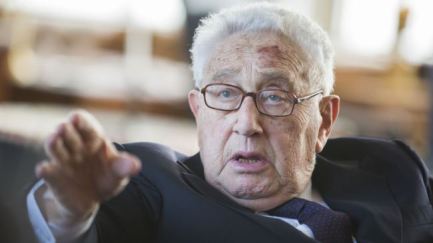
Former US National Security Advisor and Secretary of State Henry Kissinger
By Kevin Barrett | Press TV | September 10, 2014
The anniversary of the September 11th attacks on New York and Washington would be a propitious day to arrest Henry Kissinger for crimes against humanity.
For while Kissinger is guilty of many war crimes, including the slaughter of millions of Vietnamese, it was on September 11th that he committed two of his most memorable outrages: The murder of Chilean President Salvador Allende and installation of the torture-loving Pinochet junta in 1973; and the explosive demolition of the World Trade Center, and massacre of nearly 3,000 people in New York and Washington in 2001.
Kissinger was undeniably the mastermind of the first 9/11. As President Nixon’s National Security Advisor in 1973, and the head of the “40 Committee” that oversaw US covert operations, Kissinger designed the coup that overthrew and murdered Allende. That operation was “Made in USA” and financed with American taxpayers’ money. Kissinger’s operatives paid lavish bribes to corrupt Chilean military officers including Pinochet, essentially hiring them to murder Allende and thousands of other honest, democracy-loving Chileans.
Kissinger’s complicity in the torture and murder of thousands of Chileans, and the destruction of democracy in Chile, is no secret. Kissinger actually confessed his intentions toward Chile on June 20th, 1970 when he famously said, “I don’t see why we need to stand by and watch a country go communist because of the irresponsibility of its own people.” (In fact, Allende was a democratic socialist, not a communist; his sin, in Kissinger’s eyes, was believing that Chile should control its own economy and resources.)
During the past two decades, many countries’ judicial officials have tried to prosecute Kissinger for the first 9/11. In 1998, Kissinger’s Chilean stooge, General Pinochet, was arrested – and spent the rest of his life under real and virtual house arrest, fighting prosecutions for crimes against humanity before he died in 2006.
Prosecutors in Chile, Argentina, Spain and France have subpoenaed Kissinger. Chilean judge Juan Guzman submitted 30 questions to Kissinger about his relationship with Pinochet but Kissinger refused to answer them. At one point Kissinger had to flee France to avoid arrest.
Though at various times he has been a wanted man in various countries, somehow Kissinger is still walking around free…and planning new war crimes. Since the coup of September 11th, 2001, Kissinger has been a leading advocate of the neoconservative plan to destroy “seven countries in five years” as Gen. Wesley Clark revealed.
Though they invaded Iraq and Afghanistan first, and then destabilized Somalia, Sudan, Libya, and Syria – all of which took longer than the planned five years – the neocons’ biggest and most important post-9/11 target has always been Iran. During the past decade Kissinger has been feuding with his fellow mummified ex-National Security Advisor, Zbigniew Brzezinski, about whether the US should attack Iran for Israel. While Brzezinski has been arguing against attacking Iran, Kissinger and his stable of Israel-loving neoconservatives have been beating the drums for war on Tehran.
Kissinger’s anti-Iran extremism was on display Saturday when he told National Public Radio that Iran is a bigger threat than ISIL. What he didn’t say is that by “threat” he meant threat to Israel, not the USA.
Kissinger’s close association with the fanatically pro-Israel, anti-Iran neoconservatives since September 11th, 2001 has surprised some observers, who traditionally viewed the former National Security Advisor as a realist rather than an ideologue.
Why did Kissinger turn neocon? Some speculate that as his mind deteriorates he is rediscovering his tribal roots and experiencing a Zionist second childhood. Evidence supporting this view includes his petulant statement to the New York Post that “In ten years there will be no more Israel.” Apparently Kissinger has fallen victim to the kind of Zionist existential anguish that lies at the root of the radicalism of such neocons as Paul Wolfowitz, Richard Perle, Scooter Libby, Douglas Feith, Dov Zakheim, and others of that ilk.
But there may be another reason for Kissinger’s succumbing to what Gilad Atzmon calls Pre-Traumatic Stress Disorder. That reason, in a nutshell, is Kissinger’s complicity in the neoconservative coup d’état of September 11th, 2001. By helping design the 9/11 shock-and-awe psychological warfare operation, Kissinger appears to have indelibly wedded his own fate to that of the neoconservative September criminals.
How do we know Kissinger was involved in the 9/11-anthrax operation? Because President Bush, acting under orders of Dick Cheney and the 9/11 perpetrator cabal, appointed Kissinger to head the 9/11 Coverup Commission. Only a person with intimate knowledge of what needed to be covered up, as well as a strong grasp on the crumbling “19 hijackers led by a dying man in a cave” cover story, could have been entrusted to head the Commission.
Since Kissinger was a known war criminal, mass murderer, and Machievellian conspirator who had orchestrated at least one September 11th coup d’état, the victims’ family members protested his appointment as Executive Director of the 9/11 Cover-up Commission. Due to public pressure, Bush was forced to fire Kissinger and replace him with another likely planner of the 9/11-anthrax operation, Philip Zelikow.
Unlike Kissinger, Zelikow was a relatively unknown war criminal. The architect of the Bush Doctrine of disguising the supreme crime of aggressive war under the “pre-emptive” euphemism, Zelikow is a self-described expert in “the creation and maintenance of public myths.” One of the likely creators of the 9/11 myth, Zelikow wrote the 9/11 Commission Report in chapter-by-chapter outline in March, 2003, before the Commission had even convened. That early draft, which is virtually identical with the Report’s final draft, was probably based on a Hollywood-style script for the 9/11-anthrax events written by Zelikow, Kissinger and others to serve as a playbook for the covert operatives who perpetrated the attacks.
During and immediately after the 9/11-anthrax false flag operation, Kissinger sat on the Defense Policy Board under key 9/11 suspect Richard “Prince of Darkness” Perle, a leading PNACer who demanded a “New Pearl Harbor” in September 2000 – and got one exactly one year later. As Perle’s senior advisor, Kissinger would have been one of the most significant architects of the 9/11-anthrax operation and subsequent cover-up.
Like Perle, who boasts of his satanic nickname “Prince of Darkness,” Kissinger revels in criminality and evil: “The illegal we do immediately. The unconstitutional takes a little longer.”
9/11-anthrax wasn’t just unconstitutional; it entailed the destruction of the Constitution in an American Reichstag Fire. It took Kissinger and his neoconservative and Israeli allies years to plan; and they have spent the past 13 years covering their tracks by “fleeing forward” into a widening circle of wars.
If the 9/11 wars ever end, and the post-2001 state of emergency is lifted, the September criminals could face prosecution. No wonder Kissinger and his neocon pals are demanding war with Iran and Russia – either one of which could likely escalate into World War III.
To save the planet, we need to arrest Henry Kissinger for his September 11th crimes: those of 2001 as well as 1973.
The American fear-mongering machine is about to scare us back into war again
Thanks to a say-anything media, hawkish politicians and an Orwellian administration, a war-weary public is terrified. Are there any red lines anymore – or just launch buttons?

Photograph: Bixentro / Flickr via Creative Commons
By Trevor Timm | The Guardian | September 10, 2014
Did you know that the US government’s counterterrorism chief Matthew Olson said last week that there’s no “there’s no credible information” that the Islamic State (Isis) is planning an attack on America and that there’s “no indication at this point of a cell of foreign fighters operating in the United States”? Or that, as the Associated Press reported, “The FBI and Homeland Security Department say there are no specific or credible terror threats to the US homeland from the Islamic State militant group”?
Probably not, because as the nation barrels towards yet another war in the Middle East and President Obama prepares to address that nation on the “offensive phase” of his military plan Wednesday night, mainstream media pundits and the usual uber-hawk politicians are busy trying to out-hyperbole each other over the threat Isis poses to Americans. … continue
ISISophobia or “The Mooslims Are Coming”
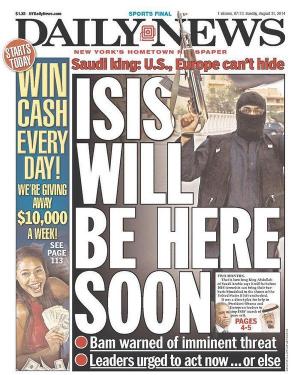
Why would the NY Daily News or any publication believe an anonymous Saudi source concerning any subject?
By Richard Silverstein | Tikun Olam | September 9, 2014
ISIS has become the scare du jour of world politics. While ISIS is a profoundly disturbing phenomenon for which the world should develop some sort of response, the problem is that the Islamist movement has become a useful foil for many varied political interests from Israel to the U.S. Islamophobes among the Euro-nationalist far-right and the U.S. Tea Party have latched onto ISIS as their political gravy train. Bibi Netanyahu, ever alert to memes he can exploit to promote Israel’s interests, made the memorable, and profoundly mendacious statement: “Hamas is ISIS and ISIS is Hamas.” Senator Bill Nelson, who has a huge elderly Jewish constituency and is allied closely with the Israel Lobby, said this today:
“Any group that sets them [sic] up as a religious caliphate and says that they will not stop until the black flag of ISIS is flying over the White House — I take that pretty seriously,” he said.
No ISIS leader has ever made such a statement. But Nelson appears to be watching FoxNews, because it claimed ISIS said so. The fact that a major national political leader would air such nonsense is disturbing. There is enough to hate about ISIS without making things up out of whole cloth.
Then we have the tried and true Wall Street Journal, always good for a bit of Islamophobic hysteria. This is the headline for Ryan Crocker’s op-ed: Islamic State Is Getting Stronger, and It’s Targeting America. The neo-cons are on the warpath demanding that we “eviscerate” ISIS, that we engage in some sort of a counter-jihad. Which is just what both the world and America need, yet another war against Islam in the Mideast.
Similarly, Israeli media have reported that a freed French journalist held hostage by ISIS identified the Belgian museum attacker as an adherent of ISIS. While the journalist, who worked for the right-wing French daily Le Point, did say Mehdi Nemmouche tortured and abused him and others while he was held in custody, he never made any statement about the alleged terrorist’s affiliations. So when Nemmouche left Syria was he affiliated with ISIS? Why did he leave? Had he broken with ISIS? Had ISIS broken with him? And if so, why?
The implication of this Israeli reporting was that the attack which killed two Israeli intelligence agents may’ve been the work of ISIS. In fact, no one knows whether Nemmouche was acting on his own or on behalf of another Islamist group. Any speculation to the contrary is just that.
Open Democracy has published an incisive piece raising uncomfortable similarities between ISIS and Israel’s religion-derived claims of authority and sovereignty.
All this leads to the next logical question: what threat does ISIS really pose to U.S. national interests? If it doesn’t pose such a threat, then what should our response to it be? Does it threaten other interests or values that are important to us? And what will be the outcome of any form of intervention we choose to take? … Full article
A Palestinian Exception to the First Amendment
By Corey Robin | September 9, 2014
Steven Salaita spoke today at the University of Illinois at Urbana-Champaign. According to the YMCA, where the event was held, some 400 students, faculty, staff, and supporters turned up.
Salaita opened with a statement. Here are some excerpts:
My name is Steven Salaita. I am a professor with an accomplished scholarly record; I have been a fair and devoted teacher to hundreds of undergraduate and graduate students; I have been a valued and open-minded colleague to numerous faculty across disciplines and universities. My ideas and my identity are far more substantive and complex than the recent characterizations based on a selected handful of my Twitter posts.
…
Two weeks before my start date, and without any warning, I received a summary letter from University Chancellor Phyllis Wise informing me that my position was terminated, but with no explanation or opportunity to challenge her unilateral decision. As a result, my family has no income, no health insurance, and no home of our own. Our young son has been left without a preschool. I have lost the great achievement of a scholarly career – lifetime tenure, with its promised protections of academic freedom.
…
Even more troubling are the documented revelations that the decision to terminate me is a result of pressure from wealthy donors – individuals who expressly dislike my political views. As the Center for Constitutional Rights and other groups have been tracking, this is part of a nationwide, concerted effort by wealthy and well-organized groups to attack pro-Palestinian students and faculty and silence their speech. This risks creating a Palestinian exception to the First Amendment and to academic freedom.
…
I am here to reaffirm my commitment to teaching and to a position with the American Indian Studies program at UIUC. I reiterate the demand that the University recognize the importance of respecting the faculty’s hiring decision and reinstate me. It is my sincere hope that I can – as a member of this academic institution – engage with the entire University community in a constructive conversation about the substance of my viewpoints on Palestinian human rights and about the values of academic freedom.
For me, the best part of his press conference was the Q and A with the media, which begins at 40:50 in the video below. I would encourage everyone to watch it because it gives you the best sense of Salaita the man, the thinker, and the teacher. As I’ve said, I don’t know Salaita personally, except through our interactions on Facebook and Twitter. I’ve never met him or heard him speak. I haven’t read his academic writings. But listening to and watching him field questions, it became clear to me why the American Indian Studies department was so eager to hire him.
My favorite exchange occurs at 43:30. Someone in the media asks him why he would want to still come and teach at UIUC. Looking around the room, which is filled with students, Salaita says:
The question is—and if I’m summarizing it incorrectly let me know—some people are wondering why I would want to work here after all of this has happened and whether it might be uncomfortable. The answer is… the answer is in this room.
Perfect.
One other point to note. At 55:00, one of Salaita’s attorneys is asked about what the litigation process would look like. The attorney replies:
There’s no question that if there is litigation there will be an intensive document retrieval process that will involve trying to get at the heart of exactly what the motivation was for this decision. We think, based on what is already known, the university is going to have some very hard arguments. But we will learn a lot. We will also be able to take depositions. And that is an opportunity to sit people down and ask them about their role in this process, their decision-making and other things. Again, Professor Salaita’s goal is not to have to go down that road. But he is prepared to do so if necessary.
I’ve long felt that one of the things that has to make the university nervous is the prospect of litigation. Yes, the university has tons of money and lawyers. But it also has interests. And one of those interests is protecting the privacy of its donors. I can’t for the life of me believe that the university really wants to risk the rage and rancor of donors having their names dragged into the harsh glare of the public spotlight. Once this case gets into court—and most experts, regardless of which side they fall, believe that Salaita has a good chance of getting into court—there will be discovery motions that will turn up all sorts of paper. What we’ve seen already is damning and embarrassing. But think about what could be coming down the pike: not only emails to and fro, but also records of phone calls, transcripts of meetings, and more. Even if the university were to win the case, they’d have to lose a lot in order to do so.
In other news, Chancellor Wise was interviewed by the Chicago Tribune.
On Monday, Wise acknowledged in an interview that she wished she had “been more consultative” before rescinding Salaita’s job offer, and said it could have led her to a different decision. She said the situation has been “challenging.”
She also said there was “no possibility” that he would work at the U. of I.
“I wish I had not consulted with just a few people and then written the letter to Professor Salaita,” Wise said. “I don’t know what the consultation would have led me to do.”
This is now the third time that Wise has said that she regrets not consulting with other voices on the campus. But this is the first time that she’s positively stated that not only did her firing of Salaita not reflect her own position, but also that she might have reached a different decision than the one she reached had she consulted other voices. Which is precisely the argument that so many of us have been making about whose voices Wise did and did not heed in this process. It almost seems as if she’s trying to give Salaita evidence for his case.
Last, Katherine Franke, who’s been leading the legal academic community on this issue, and Kristofer Petersen-Overton, a PhD candidate in political science at the CUNY Graduate Center, appeared today on Democracy Now.
I urge you to listen to the interview, in particular the part that begins at 47:00. There Kris, whom I know personally, speaks about his experience as an adjunct at Brooklyn College, where he was hired by my department to teach a course on Middle East politics for the spring of 2011 and then fired before the course began. Sound familiar? The reason he was fired? Pro-Israel forces objected to something he had written. Sound familiar? Here’s what one of the leaders of those forces, NYS Assemblyman Dov Hikind, said at the time about an academic paper Kris had written on suicide bombers:
Hikind, a staunch ally of Israel, sent a letter on Monday to Karen Gould, the college’s president, with a copy to CUNY Chancellor Matthew Goldstein, in which he questioned the adjunct’s appointment. Calling Petersen-Overton “an overt supporter of terrorism,” Hikind said he was “better suited for a teaching position at the Islamic University of Gaza.”
Hikind, who said he earned his master’s degree in political science from Brooklyn College, told Inside Higher Ed that he reached these conclusions after spending “countless hours” reading the newly hired adjunct’s work. This included, chiefly, his unpublished paper, “Inventing the Martyr: Struggle, Sacrifice and the Signification of Palestinian National Identity,” in which he examines martyrdom as it “embodies ideals of struggle and sacrifice” in the context of national identity. Hikind said such works reflect an effort to “understand” suicide bombers. “There’s nothing to understand about someone who murders women and children,” he said. “You condemn.”
Kris didn’t say anything about anti-Semitism becoming honorable, he didn’t say anything about settlers going missing, he didn’t say anything about necklaces of teeth. His crime was trying “to understand about someone who murders women and children.” As Dostoevsky did in Crime and Punishment. That was enough to get him fired.
This is why I come to this whole Salaita affair with a bit of skepticism about the tweets. It’s skepticism born of my own personal experience with four controversial fights over Israel/Palestine. If it’s not the tweets, it’s the grad student paper trying to understand suicide bombers. If it’s not the grad student paper trying to understand suicide bombers, it’s the Pulitzer-Prize-winning playwright who cannot receive an honorary degree because he’s voiced criticism of Israel. If it’s not the Pulitzer-Prize-winning playwright who cannot receive an honorary degree because he’s voiced criticism of Israel, it’s the New York City Council threatening CUNY’s funding because the political science department at Brooklyn College is co-sponsoring—not endorsing, not organizing, not funding, but co-sponsoring—a panel on BDS. If it’s not the New York City Council threatening CUNY’s funding because the political science department at Brooklyn College is co-sponsoring a panel on BDS, it’s the NYS Legislature threatening a college’s funding if it financially supports individual faculty membership in the American Studies Association, which supports the academic boycott of Israel.
Every time it’s the same goddam story: supporters of Israel, increasingly anxious over the way the conversation about Israel is going in this country, flexing their muscles to muzzle a voice, to stop a debate. (Just today Buzzfeed is reporting that AIPAC is looking for ways to pass federal legislation to stop BDS in its tracks.) A Palestinian exception to the First Amendment?
Thankfully, in Kris’s case, we were able to rally a national campaign of prominent academics, particularly in political science, to support his reinstatement. We made his case a national story. Sound familiar?
And here’s the best part, dear reader: We won.
Since I came onto the interwebs, I’ve been involved in five fights over the place of Israel/Palestine in academe: the Petersen-Overton fight, which we won; the Tony Kushner fight, which we won; the BDS at Brooklyn College fight, which we won, the NYS Assembly fight, which we won, and now the Salaita affair.
There is a Palestinian exception to the First Amendment. And we’re fighting to end it. Because that’s the way the First Amendment has always advanced in this country: not simply through reasoned argument, but through struggle.
Hamas Rocket Launches Don’t Explain Israel’s Gaza Destruction
By Gareth Porter | IPS | September 9, 2014
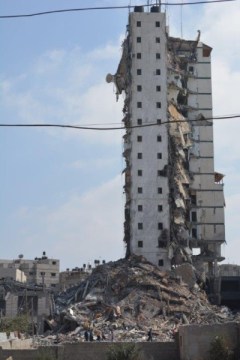 Israel and its supporters abroad have parried accusations of indiscriminate destruction and mass killing of civilians in Gaza by arguing that they were consequences of strikes aimed at protecting Israeli civilians from rockets that were being launched from very near civilian structures.
That defence has already found its way into domestic U.S. politics. A possible contender for the Democratic nomination for president, Sen. Elizabeth Warren, defended her vote for more military aid for Israel during the Israeli assault on Gaza by citing the rocket launch defence.
“[W]hen Hamas puts its rocket launchers next to hospitals, next to schools, they’re using their civilian population to protect their military assets,” said Warren. “And I believe Israel has a right, at that point, to defend itself.”
But although some Hamas rockets were launched near homes or other civilian structures, military developments on both sides have rendered that defence of Israeli attacks on civilian targets invalid.
The rocket launchers for Hamas’s homemade Qassam missiles consist of simple tripods that can be removed in seconds, and the extensive Hamas tunnel network has given it underground launching sites as well as storage facilities for its larger, longer-range Grad and M-75 missiles.
On the other side, the Israeli Air Force possesses air-to-ground missiles that are so accurate that they can destroy a very small target without any damage to civilian structure even if it is very close.
A video released by the Israel Defense Forces (IDF) in a report on Hamas’s “illegal use of civilian infrastructure” last month shows an attack – obviously by an Israeli drone — on an underground rocket launcher only a few metres away from a mosque causing no damage whatever to the mosque.
These technological changes take away any justification for flattening civilian buildings even if a rocket launch site is nearby. In fact, however, the evidence now available indicates that Hamas launch sites are not that close to hospitals, schools and mosques.
The IDF sought in mid-July to use the rocket launcher defence to explain the damage to Al Wafa Rehabilitation and Geriatic Hospital in eastern Gaza City from 15 rockets, which forced the staff to evacuate its patients. An IDF spokesman said the military had “no choice” because rockets had been launched from very near the hospital.
Clearly revealing that the rocket launch justification for the attack was a ruse, however, the spokesman revealed to Allison Degler of Mondoweiss that the alleged launch site was 100 metres from the hospital. That would have been far more space than was needed to strike the launch site without any damage to the hospital whatever.
A report released by the IDF August 19 included an aerial view of Al Wafa Hospital with two alleged rocket launching sites marked at locations that appeared to be much farther from the hospital than the 100 metres claimed by the IDF spokesman.
The IDF nevertheless went so far as to declare on July 21, “Hamas fires rockets from Wafa hospital in the Gaza neighborhood of Shujaiya.”
When the IDF destroyed Al Wafa hospital completely by airstrikes on July 23, it abandoned the pretense that the reason was a Hamas rocket launch site. Instead it released a video purporting to show firing at IDF troops from the hospital.
It turned out, however, the video clips of the firing had been shot during Operation Cast Lead in 2009, not in 2014.
The IDF has continued to suggest that its destruction of public civilian facilities was forced on it by rocket launches from within those facilities. At the end of the Operation Protective Edge the IDF spokesman’s office claimed that 597 rockets had been launched from civilian facilities, of which 160 were allegedly fired from schools, 50 from hospitals, and 160 from mosques.
But those figures were by produced only by pretending that launching sites some distance from the facilities in question were on the premises of the facilities.
An IDF “declassified report” released August 19, aimed at showing that civilian facilities were serving as military infrastructure for Hamas, includes no evidence of any rocket launches on the grounds of any civilian facility.
A very blurry 20-second video appears to show a rocket launch from what is identified as “Abu Nur” school. But it, too, is deceptive. A black streak rises from the area of the school for a little more than a second of the video, but for the entire length of the video two voices declare repeatedly that they saw three rockets launched “from within the school”.
Careful viewing of the footage reveals, however, that the apparent launch comes from outside the wall of the three-story school building rather than from within it.
In three other cases of alleged rocket launches from schools, the IDF provides no visual evidence – only large red dots drawn on an aerial view of the schools.
During the Operation Protective Edge, the IDF openly targeted mosques, claiming they are military targets, demolishing 73 mosques and partially destroying 205 more.
The August 19 IDF report refers to a “rocket cache and gathering point for militants hidden in a mosque” in Nuseirat. But despite frequent repetitions of the notion that Hamas routinely stores rockets in mosques, the IDF has not produced photographic evidence of rocket storage in a single mosque.
Nor has the IDF made public any video evidence of secondary explosions from the destruction of mosques. In a tacit admission that such evidence is lacking, the report instead cites an instance of a “concealed entrance” to a Hamas tunnel located between a mosque and a school.
The most extensive destruction of civilian structures in Operation Protective Edge was the complete leveling of large parts of entire neighbourhoods in the Shujaiya district of Gaza City on July 19. After the United Nations published a map showing the complete destruction of those areas of Shujaiya, the IDF published its own map on August 4 aimed at justifying the destruction.
The map shows that the IDF can’t claim the proximity of Hamas rocket launching sites as the justification for the leveling of many residential blocks in Shujaiya. The Israeli military had identified every home in the devastated neighbourhoods on its map as a “hideout” for Hamas or Islamic Jihad fighters.
The IDF obviously did not have actual intelligence on each of those homes that had been reduced to rubble. The massive designation of houses as “hideouts” indicates the Israelis believed Palestinian fighters were hiding in some of them.
Although the red dots on the IDF map identifying rocket launch sites are too big to estimate accurately the distance between them and the closest houses, only a few such dots appear to be as close as one city block to a house in one of the areas of massive destruction. And all but a few of the homes destroyed are much farther than a block from the alleged launching sites.
An account of the Shujaiya destruction by journalist Mark Perry based on a July 21 U.S. Defence Department report recalls that the IDF fired 7,000 artillery shells at residential areas in the district the night of July 19, including 4,500 shells in the space of just seven minutes.
Such massive and indiscriminate destruction of civilian structures is strictly prohibited by the international laws of war. Israeli officials have frequently said the purpose of IDF military operations in both Lebanon and Gaza was to “deter” their adversaries in the future by imposing heavy costs on the civilian population.
Featured Video
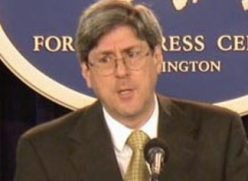
Pentagon insider says high US official Douglas Feith reported to Netanyahu
or go to
Aletho News Archives – Video-Images
Frlom the Archives
Who’s to blame for the Iraq war?
A not-so-trivial quiz
By Maidhc Ó Cathail | 14 March 2010
Maidhc Ó Cathail names and shames the top 19 politicians, academics and policy makers – all con men and all Zionist Jews – who lied and conspired to steer the US toward aggression against the Iraqi people. … continue
Blog Roll
 Aletho News
- Iranian model of warfare bleeds US dry while Persian Gulf states watch and learn: Analyst
- IRGC orders ‘defeated’ US to evacuate industrial facilities in region
- Hegseth’s call for ‘no mercy’ to Iranians deemed war crime
- Iran War Exposes Limits of US Military Power – Journalist
- Even The Neo-Cons Admit The Iran War Is Failing
- Inside the Caucasus Drone Corridor Fueling Tensions With Iran
- ‘Not our war’: Trump’s naval coalition to reopen Strait of Hormuz dead in the water
- Iran declares support centers for USS Gerald R. Ford legitimate targets
- Moscow issues warning over Trump’s Golden Dome plan
- Brussels wants ‘our sons to die for Ukraine’ – Orban
- If Americans Knew
- ‘I Liked the House’: When Israeli Soldiers Turn Palestinian Homes into Barracks
- ‘They Were All I Had’: Lebanese Father Buries Parents, 4 Daughters Killed by Israeli Bombing
- Israel and its supporters are causing attacks on Jewish institutions. Case in point: Michigan synagogue tragedy.
- These are the casualties and cost of the war in Iran 2 weeks into the conflict
- Chicago Teachers Union accuses AIPAC of swaying elections with ‘dark money’
- Predictions of another 9/11, amid Israel-US killing spree – Not a ceasefire Day 157
- As US-Israel war on Iran rages, Gaza faces massive dust storm – Not a ceasefire Day 156
- No let-up in attacks on Gaza as Israel takes on Iran, Lebanon – Not a ceasefire Day 155
- ‘Of Course’: IDF Drops Case Against Soldiers Accused of Raping Palestinian Prisoner
- Don’t Fall for the Regime Change Talk. Israel Is ‘Mowing the Lawn’ in Iran
- No Tricks Zone
- Storing Green Energy To Last Germany 10 Days Would Require A 60-Million Tonne Battery
- New Studies: UK Sea Levels Were 4 Meters Higher Than Today During The Mid-Holocene
- Destructive Green New Deal: German Energy And Metal Group Warns Of Drastic Crisis
- New Study Documents A 20-Year Pause In Arctic Sea Ice Decline – Driven By Internal Variability
- Wake-up Call: Survey Shows Majority Of Germans Now Favor Postponing Climate Targets!
- Televised! Leading German Political Candidate Tells Schoolchildren CO2 Makes Sun Hotter!
- New Study: A Century Warming Of 1.1°C Is ‘Commonplace’ And ‘Not Unusual’ During This Interglacial
- New Study: ‘Internal Noise’ And Volcanic Forcing Can Trigger 10-15°C Warming Within Decades
- Glaciers Worldwide Are Suddendly Surging, Experts Blame Warming!
- Surprising Discovery: Sahara Is Greening…Billions Of Trees Where Once Thought To Be Barren
 Aletho News