On Israel’s little-known concentration and labor camps in 1948-1955
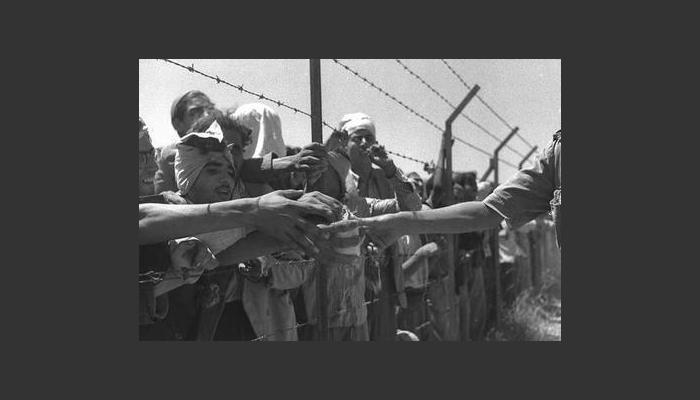
Civilians captured during the fall of Lydda and Ramle around the time of July 12, 1948 and taken to labour camps.
By Yazan al-Saadi | Al-Akhbar | September 29, 2014
Much of the grim and murky circumstances of the Zionist ethnic cleansing of Palestinians in the late 1940s have gradually been exposed over time. One aspect – rarely researched or deeply discussed – is the internment of thousands of Palestinian civilians within at least 22 Zionist-run concentration and labor camps that existed from 1948 to 1955. Now more is known about the contours of this historical crime, due to the comprehensive research by renowned Palestinian historian Salman Abu Sitta and founding member of the Palestinian resource center BADIL Terry Rempel.
The facts are these.
The study – to be published in the upcoming issue of the Journal of Palestine Studies – relies on almost 500 pages of International Committee of the Red Cross’s (ICRC) reports written during the 1948 war, that were declassified and made available to the public in 1996, and accidentally discovered by one of the authors in 1999.
Furthermore, testimonies of 22 former Palestinian civilian detainees of these camps were collected by the authors, through interviews they conducted themselves in 2002, or documented by others during different moments of time.
With these sources of information, the authors, as they put it, pieced together a clearer story of how Israel captured and imprisoned “thousands of Palestinian civilians as forced laborers,” and exploited them “to support its war-time economy.”
Digging up the crimes
“I came across this piece of history in the 1990s when I was collecting material and documents about Palestinians,” Abu Sitta told Al-Akhbar English. “The more and more you dig, the more you find there are crimes that have taken place that are not reported and not known.”
At that time, Abu Sitta went to Geneva for a week to check out the newly-opened archives of the ICRC. According to him, the archives were opened to the public after accusations that the ICRC had sided with the Nazis during World War II. It was an opportunity that he could not miss in terms of seeing what the ICRC had recorded of the events that occurred in Palestine in 1948. It was there he stumbled onto records discussing the existence of five concentration camps run by the Israelis.
He then decided to look for witnesses or former detainees, interviewing Palestinians in occupied Palestine, Syria, and Jordan.
“They all described the same story, and their real experience in these camps,” he said.
One question that immediately struck him was why there were barely any references in history about these camps, especially when it became clearer the more he researched that they existed, and were more than just five camps.
“Many former Palestinian detainees saw the concept of Israel as a vicious enemy, so they thought their experience labouring in these concentration camps was nothing in comparison to the other larger tragedy of the Nakba. The Nakba overshadowed everything,” Abu Sitta explained.“However, when I dug into the period of 1948-1955, I found more references like Mohammed Nimr al-Khatib, who was an imam in Haifa, who had written down interviews with someone from al-Yahya family that was in one of the camps. I was able to trace this man all the way to California and spoke with him in 2002,” he added.
More references were eventually and slowly discovered by Abu Sitta that included information from a Jewish woman called Janoud, a single masters thesis in Hebrew University about the topic, and the personal accounts of economist Yusif Sayigh, helped to further flesh out the scale and nature of these camps.
After more than a decade, Abu Sitta, with his co-author Rempel, are finally presenting their findings to the public.
From burden to opportunity: concentration and labor camps
The establishment of concentration and labor camps occurred after the unilateral declaration of Israel’s statehood on May 1948.
Prior to that event, the number of Palestinian captives in Zionist hands were quite low, because, as the study states, “the Zionist leadership concluded early on that forcible expulsion of the civilian population was the only way to establish a Jewish state in Palestine with a large enough Jewish majority to be ‘viable’.” In other words, for the Zionist strategists, prisoners were a burden in the beginning phases of the ethnic cleansing.
Those calculations changed with the declaration of the Israeli state and the involvement of the armies of Egypt, Syria, Iraq, and Transjordan, after much of the ethnic cleansing had occurred. From that moment, “the Israeli forces began taking prisoners, both regular Arab soldiers (for eventual exchange), and – selectively – able-bodied Palestinian non-combatant civilians.”
The first camp at Ijlil, which was about 13 km northeast of Jaffa, on the site of the destroyed Palestinian village Ijlil al-Qibiliyya, emptied of its inhabitants in early April. Ijlil was predominately made up of tents, housing hundreds and hundreds of prisoners, categorized as POWs by the Israelis, surrounded by barbed wire fences, watchtowers, and a gate with guards.
As the Israeli conquests grew, in turn exceedingly increasing the number of prisoners, three more camps were established. These are the four “official” camps that the Israelis acknowledged and were actively visited by the ICRC.
The study notes:
All four camps were either on or adjacent to military installations set up by the British during the Mandate. These had been used during World War II for the interment of German, Italian, and other POWs. Two of the camps – Atlit, established in July about 20 kms south of Haifa, and Sarafand, established in September near the depopulated village of Sarafand al-Amar in central Palestine—had earlier been used in the 1930s and 1940s to detain illegal Jewish immigrants.
Atlit was the second largest camp after Ijlil, it had the capacity of holding up to 2,900 prisoners, while Sarafand had the maximum capacity of 1,800, and Tel Letwinksy, near Tel Aviv, held more than 1,000.
All four camps were administered by “former British officers who had defected their ranks when British forces withdrew from Palestine in mid-May 1948,” and the camp’s guards and administrative staff were former members of the Irgun and the Stern Gang – both groups designated as terrorist organizations by the British before their departure. In total, the four “official” camps were staffed by 973 soldiers.
A fifth camp, called Umm Khalid, was established at a site of another depopulated village near the Zionist settlement of Netanya, and was even assigned an official number in the records, but never attained “official” status. It had the capacity to hold 1,500 prisoners. Unlike the other four camps, Umm Khalid would be “the fist camp established exclusively as a labor camp” and was “the first of the “recognized” camps to be shut down… by the end of 1948.”
Complementing these five “recognized” camps, were at least 17 other “unrecognized camps” that were not mentioned in official sources, but the authors discovered through multiple prisoner testimonies.
“Many of [these camps],” the authors noted, “[were] apparently improvised or ad hoc, often consisting of no more than a police station, a school, or the house of a village notable,” with holding capacities that ranged from almost 200 prisoners to tens.
Most of the camps, official and unofficial, were situated within the borders of the UN-proposed Jewish state, “although at least four [unofficial camps] – Beersheba, Julis, Bayt Daras, and Bayt Nabala – were in the UN-assigned Arab state and one was inside the Jerusalem “corpus separatum.”
The number of Palestinian non-combatant detainees “far exceeded” those of Arab soldiers in regular armies or bona fide POWs. Citing a July 1948 monthly report made by ICRC mission head Jacques de Reynier, the study states that de Reynier noted, “that the situation of civilian internees was ‘absolutely confused’ with that of POWs, and that the Jewish authorities ‘treated all Arabs between the ages of 16 and 55 as combatants and locked them up as prisoners of war.’” In addition, the ICRC found among the detainees in official camps, that 90 of the prisoners were elderly men, and 77 were boys, aged 15 years or younger. The study highlights the statements by an ICRC delegate Emile Moeri in January 1949 of the camp inmates:
It is painful to see these poor people, especially old, who were snatched from their villages and put without reason in a camp, obliged to pass the winter under wet tents, away from their families; those who could not survive these conditions died. Little children (10-12 years) are equally found under these conditions. Similarly sick people, some with tuberculosis, languish in these camps under conditions which, while fine for healthy individuals, will certainly lead to their death if we do not find a solution to this problem. For a long time we have demanded that the Jewish authorities release those civilians who are sick and need treatment to the care of their families or to an Arab hospital, but we have not received a response.
As the report noted, “there are no precise figures on the total number of Palestinian civilians held by Israel during the 1948-49 war” and estimates tend to not account for “unofficial” camps, in addition to the frequent movement of prisoners between the camps in use. In the four “official” camps, the number of Palestinian prisoners never exceeded 5,000 according to figures in Israeli records.
Taking account of the capacity of Umm Khalid, and estimates of the “unofficial camps,” the final number of Palestinian prisoners could be around the 7,000 range, and perhaps much more when, as the study states, taking into account a November 17, 1948 diary entry by David Ben-Gurion, one of the main Zionist leaders and Israel’s first prime minister, who mentioned “the existence of 9,000 POWs in Israeli-run camps.”
In general, the living conditions in the “official” camps were far below what would be considered appropriate by international law at that time. Moeri, who visited the camps constantly, reported that in Ijlil in November 1948:
“[m]any [of the] tents are torn, that the camp was “not ready for winter,” the latrines not covered, and the canteen not working for two weeks. Referring to an apparently ongoing situation, he stated that “the fruits are still defective, the meat is of poor quality, [and] the vegetables are in short supply.”
Furthermore, Moeri reported that he saw for himself, “the wounds left by the abuse” of the previous week, when the guards had fired on the prisoners, wounding one, and had beaten another.”
As the study shows, the civilian status of the majority of the detainees were clear for the ICRC delegates in the country, who reported that the men captured “had undoubtedly never been in a regular army.” Detainees who were combatants, the study explains, were “routinely shot on the pretense that they had been attempting to escape.”
The Israeli forces seemed to always target able-bodied men, leaving behind women, children, and the elderly – when not massacring them – the policy continued even after there were low levels of military confrontation. All in all, as the Israeli records show and the study cites, “Palestinian civilians comprised the vast majority (82 percent) of the 5,950 listed as internees in the POW camps, while the Palestinians alone (civilian plus military) comprised 85 percent.”
The wide-scale kidnapping and imprisonment of Palestinian civilians tend to correspond with the Israeli military campaigns. For example, one of the first major roundups occurred during Operation Danj, when 60-70,000 Palestinians were expelled from the central towns of Lydda and Ramleh. At the same time, between a fifth and a quarter of the male population from these two towns who were over the age of 15 were sent to the camps.
The largest round-up of civilians came from villages of central Galilee who were captured during Operation Hiram in the fall of 1948.
One Palestinian survivor, Moussa, described to the authors what he witnessed at the time.
“They took us from all villages around us: al-Bi’na, Deir al-Asad, Nahaf, al-Rama, and Eilabun. They took 4 young men and shot them dead… They drove us on foot. It was hot. We were not allowed to drink. They took us to [the Palestinian Druze village] al-Maghar, then [to the Jewish settlement] Nahalal, then to Atlit.”
A November 16, 1948 UN report collaborated Moussa’s account, stating that some 500 Palestinian men “were taken by force march and vehicle to a Jewish concentration camp at Nahlal.”
Maintaining Israel’s economy with “slave labor”
The policy of targeting civilians, particular “able-bodied” men, was not accidental according to the study. It states, “with tens of thousands of Jewish men and women called up for military service, Palestinian civilian internees constituted an important supplement to the Jewish civilian labor employed under emergency legislation in maintaining the Israeli economy,” which even the ICRC delegation had noted in their reports.
The prisoners were forced to do public and military work, such as draining wetlands, working as servants, collecting and transporting looted refugee property, moving stones from demolished Palestinian homes, paving roads, digging military trenches, burying the dead, and much more. As one former Palestinian detainee named Habib Mohammed Ali Jarada described in the study, “At gunpoint, I was made to work all day. At night, we slept in tents. In winter, water was seeping below our bedding, which was dry leaves, cartons and wooden pieces.”
Another prisoner in Umm Khalied, Marwan Iqab al-Yehiya said in an interview with the authors, “We had to cut and carry stones all day [in a quarry]. Our daily food was only one potato in the morning and half dried fish at night. They beat anyone who disobeyed orders.” This labor was interspersed with acts of humiliation by the Israeli guards, with Yehiya speaking of prisoners being “lined up and ordered to strip naked as a punishment for the escape of two prisoners at night.”
“[Jewish] Adults and children came from nearby kibbutz to watch us line up naked and laugh. To us this was most degrading,” he added.
Abuses by the Israeli guards were systematic and rife in the camps, the brunt of which was directed toward villagers, farmers, and lower class Palestinians. This was so, the study said, because educated prisoners “knew their rights and had the confidence to argue with and stand up to their captors.”
What is also interestingly noted by the study is how ideological affiliations between prisoners and their guards, had another effect in terms of the relationship between them. The study, cites the testimony of Kamal Ghattas, who was captured during the Israeli attack in the Galilee, who said:
We had a fight with our jailers. Four hundred of us confronted 100 soldiers. They brought reinforcements. Three of my friends and I were taken to a cell. They threatened to shoot us. All night we sang the Communist Anthem. They took the four of us to Umm Khaled camp. The Israelis were afraid of their image in Europe. Our contact with our Central Committee and Mapam [Socialist Israeli party] saved us .… I met a Russian officer and told him they took us from our homes although we were non-combatants which was against the Geneva Conventions. When he knew I was a Communist he embraced me and said, “Comrade, I have two brothers in the Red Army. Long live Stalin. Long Live Mother Russia”.
Yet, the less fortunate Palestinians faced acts of violence which included arbitrary executions and torture, with no recourse. The executions were always defended as stopping “escape attempts” – real or claimed by the guards.
It became so common that one former Palestinian detainee of Tel Litwinsky, Tewfic Ahmed Jum’a Ghanim recounted, “Anyone who refused to work was shot. They said [the person] tried to escape. Those of us who thought [we] were going to be killed walked backward facing the guards.”
Ultimately, by the end of 1949, Palestinian prisoners were gradually released after heavy lobbying by the ICRC, and other organizations, but was limited in scale and very focused to specific cases. Prisoners of Arab armies were released in prisoner exchanges, but Palestinian prisoners were unilaterally expelled across the armistice line without any food, supplies, or shelter, and told to walk into the distance, never to return.
It would not be until 1955 that most of the Palestinian civilian prisoners would finally be released.
An enduring crime
The importance of this study is multi-faceted. Not only does it reveal the numerous violations of international law and conventions of the age, such as 1907 Hague Regulations and the 1929 Geneva Conventions, but also shows how the event shaped the ICRC in the long run.
Because the ICRC was faced with an Israeli belligerent actor who was unwilling to listen and conform to international law and conventions, the ICRC itself had to adapt in what it considered were practical ways to help ensure the Palestinian civilian prisoners were protected under the barest of rights.
Citing his final report, the study quotes de Reynier:
[The ICRC] protested on numerous occasions affirming the right of these civilians to enjoy their freedom unless found guilty and judged by a court. But we have tacitly accepted their POW status because in this way they would enjoy the rights conferred upon them by the Convention. Otherwise, if they were not in the camps they would be expelled [to an Arab country] and in one way or another, they would lead, without resources, the miserable life of refugees.
In the end, the ICRC, and other organizations, were simply ineffective as Israel ignored its condemnations with impunity, in addition to the diplomatic cover of major Western powers.
More importantly, the study sheds more light on the extent of the Israeli crimes during its brutal and bloody birth. And “much more remains to be told,” as the final line of the study states.
“It is amazing to me, and many Europeans, who have seen my evidence,” Abu Sitta said, “that a forced labor camp was opened in Palestine three years after they were closed in Germany, and were run by former prisoners – there were German Jewish guards.”
“This is a bad reflection of the human spirit, where the oppressed copies an oppressor against innocent lives,” he added. The study essentially shows the foundations and beginnings of Israeli policy towards Palestinian civilians that comes in the form of kidnapping, arrest, and detainment. This criminality continues till this day. One merely has to read the reports on the hundreds of Palestinians arrested prior, during, and after Israel’s latest war on Gaza mid-summer of this year.
“Gaza today is a concentration camp, no different than the past,” Abu Sitta concluded to Al-Akhbar English.
Yazan is a staff writer for Al-Akhbar English. Follow him on Twitter: @WhySadeye
No comments yet.
Featured Video

The KAL Flight 007 Tragedy
or go to
Aletho News Archives – Video-Images
From the Archives
US-Israel War on Iran: The Myth of Limited Warfare
By James Petras :: 04.04.2012
Introduction
The mounting threat of a US-Israeli military attack against Iran is based on several factors including: (1) the recent military history of both countries in the region, (2) public pronouncements by US and Israeli political leaders, (3) recent and on-going attacks on Lebanon and Syria, prominent allies of Iran, (4) armed attacks and assassinations of Iranian scientists and security officials by proxy and/or terrorist groups under US or Mossad control, (5) the failure of economic sanctions and diplomatic coercion, (6) escalating hysteria and extreme demands for Iran to end legal, civilian use-related uranium enrichment, (7) provocative military ‘exercises’ on Iran’s borders and war games designed for intimidation and a dress rehearsal for a preemptive attack, (8) powerful pro-war pressure groups in both Washington and Tel Aviv including the major Israeli political parties and the powerful AIPAC in the US, (9) and lastly the 2012 National Defense Authorization Act (Obama’s Orwellian Emergency Decree, March 16, 2012).
The US propaganda war operates along two tracks: (1) the dominant message emphasizes the proximity of war and the willingness of the US to use force and violence. This message is directed at Iran and coincides with Israeli announcements of war preparations. (2) The second track targets the ‘liberal public’ with a handful of marginal ‘knowledgeable academics’ (or State Department progressives) playing down the war threat and arguing that reasonable policy makers in Tel Aviv and Washington are aware that Iran does not possess nuclear weapons or any capacity to produce them now or in the near future. The purpose of this liberal backpedaling is to confuse and undermine the majority public opinion, which is clearly opposed to more war preparations, and to derail the burgeoning anti-war movement.
Needless to say the pronouncements of the ‘rational’ warmongers use a ‘double discourse’ based on the facile dismissal of all the historical and empirical evidence to the contrary. When the US and Israel talk of war, prepare for war and engage in pre-war provocations – they intend to go to war – just as they did against Iraq in 2003. Under present international political and military conditions an attack on Iran, initially by Israel with US support, is extremely likely, even as world economic conditions should dictate otherwise and even as the negative strategic consequences will most likely reverberate throughout the world for decades to come. … continue
Blog Roll
 Aletho News
- Why are Americans killing and dying for Israel, again?
- Timing of US-Israel attack on Iran bears symbolic meaning in Judaism
- 70 martyrs, 90 wounded in US-Israeli strike on elementary school
- Did Israel Just Forfeit Its ‘Right To Exist’? — Carlson’s Interview with Huckabee
- Trump Starts a Major Regime-Change War with Iran, Serving Neoconservatism and Israel
- The KAL Flight 007 Tragedy
- Why Trump’s war on Iran will fail
- Lebanon: Between sovereignty and the mirage of normalization
- Ukraine Given $43Bln in Proceeds From Russian Assets Frozen by G7 Since 2024 – Estimates
- The military is babying F-35s to hide their true cost to taxpayers
- If Americans Knew
- When Presbyterians Fought Christian Zionism
- Israel starts another war on Iran – Not a ceasefire Day 141
- ‘Terror Was Needed to Make Arabs Leave’: What the Israeli Army Did in 1948, Revealed
- 17,000 Unaccompanied Orphans in Gaza, in World’s Biggest Orphan Crisis
- Israeli leaders want to buy global legitimacy – Not a ceasefire Day 140
- Israel warns of a Ramadan escalation — while doing everything to provoke one
- Democrats Should Release Their 2024 Election Autopsy – and Stop the Gaza Denial
- Israel responsible for 2/3 of press killings worldwide – Not a ceasefire Day 139
- Are the Jews indigenous to Palestine?
- AIPAC Wants to Kill a Bill that would Ensure Israel Complies with Ceasefire
- No Tricks Zone
- Glaciers Worldwide Are Suddendly Surging, Experts Blame Warming!
- Surprising Discovery: Sahara Is Greening…Billions Of Trees Where Once Thought To Be Barren
- New Research Reaffirms Clouds, Aerosols, And Surface Solar Radiation Are ‘Driving The Climate System’
- Germany: Electric Car Catches Fire At Charging Station, Sets Off Local “Inferno”, Widespread Damage
- New Study: Canada’s New Brunswick Was 1°C Warmer Than Today During The Medieval Warm Period
- Coal Power Back In Trend As Globe Tries To Keep Pace With Growing Demand For Power
- New Study: A 4°C Warmer Beaufort Sea Had ‘No Sea Ice’ 11,700 – 8200 Years Ago
- Unfudging The Data: Dutch Meteorological Institute Reinstates Early 20th Centruy Heat Waves It Had Erased Earlier
- German Gas Crisis…Chancellor Merz Allegedly Bans Gas Debate Ahead of Elections!
- Pollen Reconstructions Show The Last Glacial’s Warming Events Were Global, 10x Greater Than Modern
 Aletho News
Leave a comment