Hamas Rocket Launches Don’t Explain Israel’s Gaza Destruction
By Gareth Porter | IPS | September 9, 2014
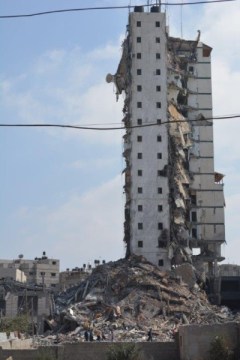 Israel and its supporters abroad have parried accusations of indiscriminate destruction and mass killing of civilians in Gaza by arguing that they were consequences of strikes aimed at protecting Israeli civilians from rockets that were being launched from very near civilian structures.
That defence has already found its way into domestic U.S. politics. A possible contender for the Democratic nomination for president, Sen. Elizabeth Warren, defended her vote for more military aid for Israel during the Israeli assault on Gaza by citing the rocket launch defence.
“[W]hen Hamas puts its rocket launchers next to hospitals, next to schools, they’re using their civilian population to protect their military assets,” said Warren. “And I believe Israel has a right, at that point, to defend itself.”
But although some Hamas rockets were launched near homes or other civilian structures, military developments on both sides have rendered that defence of Israeli attacks on civilian targets invalid.
The rocket launchers for Hamas’s homemade Qassam missiles consist of simple tripods that can be removed in seconds, and the extensive Hamas tunnel network has given it underground launching sites as well as storage facilities for its larger, longer-range Grad and M-75 missiles.
On the other side, the Israeli Air Force possesses air-to-ground missiles that are so accurate that they can destroy a very small target without any damage to civilian structure even if it is very close.
A video released by the Israel Defense Forces (IDF) in a report on Hamas’s “illegal use of civilian infrastructure” last month shows an attack – obviously by an Israeli drone — on an underground rocket launcher only a few metres away from a mosque causing no damage whatever to the mosque.
These technological changes take away any justification for flattening civilian buildings even if a rocket launch site is nearby. In fact, however, the evidence now available indicates that Hamas launch sites are not that close to hospitals, schools and mosques.
The IDF sought in mid-July to use the rocket launcher defence to explain the damage to Al Wafa Rehabilitation and Geriatic Hospital in eastern Gaza City from 15 rockets, which forced the staff to evacuate its patients. An IDF spokesman said the military had “no choice” because rockets had been launched from very near the hospital.
Clearly revealing that the rocket launch justification for the attack was a ruse, however, the spokesman revealed to Allison Degler of Mondoweiss that the alleged launch site was 100 metres from the hospital. That would have been far more space than was needed to strike the launch site without any damage to the hospital whatever.
A report released by the IDF August 19 included an aerial view of Al Wafa Hospital with two alleged rocket launching sites marked at locations that appeared to be much farther from the hospital than the 100 metres claimed by the IDF spokesman.
The IDF nevertheless went so far as to declare on July 21, “Hamas fires rockets from Wafa hospital in the Gaza neighborhood of Shujaiya.”
When the IDF destroyed Al Wafa hospital completely by airstrikes on July 23, it abandoned the pretense that the reason was a Hamas rocket launch site. Instead it released a video purporting to show firing at IDF troops from the hospital.
It turned out, however, the video clips of the firing had been shot during Operation Cast Lead in 2009, not in 2014.
The IDF has continued to suggest that its destruction of public civilian facilities was forced on it by rocket launches from within those facilities. At the end of the Operation Protective Edge the IDF spokesman’s office claimed that 597 rockets had been launched from civilian facilities, of which 160 were allegedly fired from schools, 50 from hospitals, and 160 from mosques.
But those figures were by produced only by pretending that launching sites some distance from the facilities in question were on the premises of the facilities.
An IDF “declassified report” released August 19, aimed at showing that civilian facilities were serving as military infrastructure for Hamas, includes no evidence of any rocket launches on the grounds of any civilian facility.
A very blurry 20-second video appears to show a rocket launch from what is identified as “Abu Nur” school. But it, too, is deceptive. A black streak rises from the area of the school for a little more than a second of the video, but for the entire length of the video two voices declare repeatedly that they saw three rockets launched “from within the school”.
Careful viewing of the footage reveals, however, that the apparent launch comes from outside the wall of the three-story school building rather than from within it.
In three other cases of alleged rocket launches from schools, the IDF provides no visual evidence – only large red dots drawn on an aerial view of the schools.
During the Operation Protective Edge, the IDF openly targeted mosques, claiming they are military targets, demolishing 73 mosques and partially destroying 205 more.
The August 19 IDF report refers to a “rocket cache and gathering point for militants hidden in a mosque” in Nuseirat. But despite frequent repetitions of the notion that Hamas routinely stores rockets in mosques, the IDF has not produced photographic evidence of rocket storage in a single mosque.
Nor has the IDF made public any video evidence of secondary explosions from the destruction of mosques. In a tacit admission that such evidence is lacking, the report instead cites an instance of a “concealed entrance” to a Hamas tunnel located between a mosque and a school.
The most extensive destruction of civilian structures in Operation Protective Edge was the complete leveling of large parts of entire neighbourhoods in the Shujaiya district of Gaza City on July 19. After the United Nations published a map showing the complete destruction of those areas of Shujaiya, the IDF published its own map on August 4 aimed at justifying the destruction.
The map shows that the IDF can’t claim the proximity of Hamas rocket launching sites as the justification for the leveling of many residential blocks in Shujaiya. The Israeli military had identified every home in the devastated neighbourhoods on its map as a “hideout” for Hamas or Islamic Jihad fighters.
The IDF obviously did not have actual intelligence on each of those homes that had been reduced to rubble. The massive designation of houses as “hideouts” indicates the Israelis believed Palestinian fighters were hiding in some of them.
Although the red dots on the IDF map identifying rocket launch sites are too big to estimate accurately the distance between them and the closest houses, only a few such dots appear to be as close as one city block to a house in one of the areas of massive destruction. And all but a few of the homes destroyed are much farther than a block from the alleged launching sites.
An account of the Shujaiya destruction by journalist Mark Perry based on a July 21 U.S. Defence Department report recalls that the IDF fired 7,000 artillery shells at residential areas in the district the night of July 19, including 4,500 shells in the space of just seven minutes.
Such massive and indiscriminate destruction of civilian structures is strictly prohibited by the international laws of war. Israeli officials have frequently said the purpose of IDF military operations in both Lebanon and Gaza was to “deter” their adversaries in the future by imposing heavy costs on the civilian population.
Malaysia Airlines Whodunnit Still a Mystery
By Robert Parry | Consortium News | September 9, 2014
Beyond confirming that Malaysia Airlines Flight 17 apparently was shot down on July 17, the Dutch Safety Board’s interim investigative report answered few questions, including some that would seem easy to address, such as the Russian military radar purporting to show a Ukrainian SU-25 jetfighter in the area, a claim that the Kiev government denied.
Either the Russian radar showed the presence of a jetfighter “gaining height” as it closed to within three to five kilometers of the passenger plane – as the Russians claimed in a July 21 press conference – or it didn’t. The Kiev authorities insisted that they had no military aircraft in the area at the time.
But the 34-page Dutch report is silent on the jetfighter question, although noting that the investigators had received Air Traffic Control “surveillance data from the Russian Federation.”
The report is also silent on the “dog-not-barking” issue of whether the U.S. government had satellite surveillance that revealed exactly where the supposed ground-to-air missile was launched and who may have fired it.
The Obama administration has asserted knowledge about those facts – initially pointing the finger at ethnic Russian rebels using a powerful Buk anti-aircraft missile system supposedly supplied by Russia – but the U.S. government has withheld satellite photos and other intelligence information that could presumably corroborate the charge.
Curiously, too, the Dutch report, released on Tuesday, states that the investigation received “satellite imagery taken in the days after the occurrence.” Obviously, the more relevant images in assessing blame would be aerial photography in the days and hours before the crash that killed 298 people on the flight from Amsterdam to Kuala Lumpur.
In mid-July, eastern Ukraine was a high priority for U.S. intelligence and a Buk missile battery is a large system that should have been easily picked up by U.S. aerial reconnaissance. The four missiles in a battery are each about 16-feet-long and would have to be hauled around by a truck and then put in position to fire.
Just days after the July 17 shoot-down, a source who was briefed by U.S. intelligence analysts told me that the analysts were examining satellite imagery that showed the crew manning the suspected missile battery wearing what looked like Ukrainian army uniforms.
Then, on July 22, at a briefing given to journalists from major U.S. publications, a U.S. intelligence official suggested that a Ukrainian military “defector” might have launched the Buk missile against the airliner, possibly explaining the issue of the uniforms.
The Los Angeles Times reported that “U.S. intelligence agencies have so far been unable to determine the nationalities or identities of the crew that launched the missile. U.S. officials said it was possible the SA-11 [Buk anti-aircraft missile] was launched by a defector from the Ukrainian military who was trained to use similar missile systems.”
The briefers also theorized that the rebels hit Malaysia Airlines Flight 17 by mistake, thinking it was a Ukrainian military aircraft.
Yet, while the U.S. government has released a variety of satellite photos to bolster various allegations lodged against ethnic Russian rebels in eastern Ukraine and the Russian government, the Obama administration has balked at providing satellite imagery relating to the Flight 17 case, instead basing much of its public case on “social media.”
Russian Satellite Images
The Dutch report’s reference to only post-crash satellite photos is also curious because the Russian military released a number of satellite images purporting to show Ukrainian government Buk missile systems north of the eastern Ukrainian city of Donetsk before the attack, including two batteries that purportedly were shifted 50 kilometers south of Donetsk on July 17, the day of the crash, and then removed by July 18.
Russian Lt. Gen. Andrey Kartopolov called on the Ukrainian government to explain the movements of its Buk systems and why Kiev’s Kupol-M19S18 radars, which coordinate the flight of Buk missiles, showed increased activity leading up to the July 17 shoot-down.
The Ukrainian government countered these questions by asserting that it had “evidence that the missile which struck the plane was fired by terrorists, who received arms and specialists from the Russian Federation,” according to Andrey Lysenko, spokesman for Ukraine’s Security Council, using Kiev’s preferred term for the rebels.
Lysenko added: “To disown this tragedy, [Russia] are drawing a lot of pictures and maps. We will explore any photos and other plans produced by the Russian side.” But Ukrainian authorities have failed to address the Russian evidence except through broad denials.
On July 29, amid escalating rhetoric against Russia from U.S. government officials and the Western news media, the Veteran Intelligence Professionals for Sanity called on President Barack Obama to release what evidence the U.S. government had on the shoot-down, including satellite imagery.
“As intelligence professionals we are embarrassed by the unprofessional use of partial intelligence information,” the group wrote. “As Americans, we find ourselves hoping that, if you indeed have more conclusive evidence, you will find a way to make it public without further delay. In charging Russia with being directly or indirectly responsible, Secretary of State John Kerry has been particularly definitive. Not so the evidence. His statements seem premature and bear earmarks of an attempt to ‘poison the jury pool.’”
However, the Obama administration failed to make public any intelligence information that would back up its earlier suppositions.
Then, in early August, I was told that some U.S. intelligence analysts had shifted away from the original scenario blaming the rebels and Russia to one focused more on the possibility that extremist elements of the Ukrainian government were responsible. But then chatter about U.S. intelligence information on the shoot-down faded away.
Given the intense global interest in the tragedy, there were high hopes that the Dutch Safety Board, which is heading up the international investigation, would at least begin clarifying the evidence and shifting through the conflicting claims. However, more than seven weeks after the crash, the preliminary report fails to address any of the evidence regarding who actually fired the missile and from precisely what location.
The Dutch Safety Board promised a final report before the first anniversary of the crash on July 17, 2015. By then, however, the slaughter of those 298 people could well become a cold case with little hope of finding the perpetrators – whoever they might be – and bringing them to justice.
~
Investigative reporter Robert Parry broke many of the Iran-Contra stories for The Associated Press and Newsweek in the 1980s. You can buy his new book, America’s Stolen Narrative, either in print here or as an e-book (from Amazon and barnesandnoble.com).
African-Americans Far more Likely to be Injured by Police than Whites
By Noel Brinkerhoff | AllGov | September 9, 2014
Being a black person in the United States comes with much greater risk than being white when involved in police incidents, federal health reporting statistics show.
Using data from the Centers for Disease Control and Prevention, the Sunlight Foundation examined non-fatal injuries stemming from law enforcement encounters and found a significant gap in how whites and blacks are treated.
From 2001 to 2012, “black people suffered over five times as many nonfatal injuries per capita from law enforcement as white people did cumulatively,” Damian Ortellado wrote for the Sunlight Foundation. For black men, the injury rate per 100,000 people came out to 117, while for white men it was 21 per 100,000. In fact, white men had fewer total injuries than black men despite being involved in five times as many police incidents.
The numbers also showed that the same racial disparity existed among women as well as men, Ortellado found. “Using the same injury estimate to population count methodology yields nearly identical comparisons between black women and white women, where black women receive five times the rate of nonfatal injuries caused by law enforcement when compared to white women,” he wrote.
US bans Europol from releasing its own documents to European officials
RT | September 9, 2014
The United States has instructed Europol, the European Union’s police agency, to withhold its own annual internal data-protection review from EU lawmakers because the report was written without the US Treasury Department’s permission.
Europol drafted the data-protection report “without prior written authorisation from the information owner (in this case the Treasury Department),” according to the US, violating “security protocols” that could “undermine the relationship of trust needed to share sensitive information between enforcement agencies.”
The report, drafted by Europol’s Joint Supervisory Body, outlines how data concerning EU citizens and residents is transferred to the US, according to the EUobserver. The document is mainly known to monitor implementation of the EU-US Terrorist Finance Tracking Program, or TFTP. Basically, the US Treasury Department is quite territorial about how the TFTP is adhering to European data protection compliance.
EU ombudsman Emily O’Reilly said Europol refused to allow her to see the report based on US demands. O’Reilly then confronted US ambassador to the EU Anthony Gardner in July. Gardner confirmed the order.
On Thursday, O’Reilly said she sent a letter to the European Parliament asking the body “to consider whether it is acceptable that an agreement with a foreign government should prevent the Ombudsman from doing her job.”
“If the US says ‘No disclosure’ then it won’t be disclosed, which is ridiculous because we are EU citizens, we vote, we pay taxes, we have EU laws, and we decide what happens on this continent. Nobody else,” Dutch MEP liberal Sophie In’t Veld told EUobserver. In’t Veld first requested the report in 2012.
In’t Veld said there is no top-secret information in the report that should be viewed as overly sensitive.
“There is no operational information, there is no intelligence, there is nothing in the document. So you really wonder why it is kept a secret,” she said.
The TFTP has received scrutiny in the last year after documents supplied by former US government contractor Edward Snowden showed mass spying by the US National Security Agency on citizens and officials across the world, including in the EU.
The Snowden leaks showed the NSA had gained a “back door” entrance into the SWIFT servers – SWIFT being a financial-record sharing program, which revealed the banking details of millions of European citizens, despite the fact that access to this financial data was limited by the TFTP.
Profits Soar As Pentagon Leans on Private Corporations for Special Ops
New research shows how US Special Operations Command is outsourcing many of its most sensitive information activities, including interrogation, drone and psychological operations
By Jon Queally | Common Dreams | September 9, 2014
Private military contractors are reaping billions of dollars in profitable rewards from the U.S. government’s global network of clandestine counter-terrorism and other overseas operations, according to a new report that examines the high-levels of integration between for-profit corporations and the Pentagon’s global military and surveillance apparatus.
The new report—titled US Special Operations Command Contracting: Data-Mining the Public Record—written by researcher Crofton Black and commissioned by the U.K.-based Remote Control Project, shows that “corporations are integrated into some of the most sensitive aspects” of operations conducted by the U.S. Special Operations Command (or USSOCOM). Those activities, according to the report include: flying drones and overseeing target acquisition, facilitating communications between forward operating locations and central command hubs, interrogating prisoners, translating captured material, and managing the flow of information between regional populations and the US military.
“[USSOCOM] is outsourcing many of its most sensitive information activities, including interrogation, drone and psychological operations,” explained Black in a statement. “Remote warfare is increasingly being shaped by the private sector.”
And Caroline Donnellan, manager of the Remote Control project, said, “This report is distinctive in that it mines data from the generally classified world of US special operations. It reveals the extent to which remote control activity is expanding in all its facets, with corporations becoming more and more integrated into very sensitive elements of warfare. The report’s findings are of concern given the challenges remote warfare poses for effective investigation, transparency, accountability and oversight. This highlights the difficulties in assessing the impact and consequences of remote control activity.”
Reviewing its contents for The Intercept on Monday, journalist Ryan Gallagher observed how the unprecedented research documents troubling ways in which these private corporations have engaged in overseas operations. Describing it as a “corporate bonanza” for these contractor, Gallagher reports:
USSOCOM tendered a $1.5 billion contract that required support with “Psychological Operations related to intelligence and information operations.” Prospective contractors were told they would have to provide “military and civilian persuasive communications planning, produce commercial quality products for unlimited foreign public broadcast, and develop lines of persuasion, themes, and designs for multi-media products.” The contract suggested that aim of these “persuasion” operations was to “engage local populations and counter nefarious influences” in parts of Europe and Africa.
A separate document related to the same contract noted that one purpose of the effort was to conduct “market research” of al-Qaida and its affiliates in Libya, Tunisia, Mali, Northern Nigeria, and Somalia. Four American companies eventually won the $1.5 billion contract: Tennessee-based Jacobs Technology and Virginia-based Booz Allen Hamilton, CACI-WGI, and SRA International.
Notably, while some 3,000 contractors provided service in some capacity to USSOCOM, just eight of the contractors earned more than 50 percent of the $13 billion total identified in Black’s report. Those were: Lockheed Martin, L-3 Communications, Boeing, Harris Corporation, Jacobs Engineering Group, MA Federal, Raytheon, and ITT Corporation.
Read the executive summary of the report here. Read the full report here.
Syrian media slams Arab support for new US war in the region
Al-Akhbar | September 9, 2014
Syrian media accused Arab governments Tuesday of giving Washington prior agreement for military action against jihadists, with one daily calling for Damascus to form an alternative alliance with Moscow and Tehran.
The commentary comes ahead of talks in Saudi Arabia on Thursday between Secretary of State John Kerry and US regional allies on joint action to tackle the threat posed by the Islamic State group in both Syria and Iraq.
“Washington, which used the false pretext of weapons of mass destruction to enter the region militarily in 2003 and draw new geopolitical lines… is returning today under a new false pretext, the fight against terrorism,” said the Al-Baath newspaper.
“The Arabs meanwhile, are absent from every decision and are playing secondary roles,” it added.
The Baath party daily was referring to the US-led invasion of Iraq in 2003 in which notoriously the alleged chemical and biological weapons that were used to justify the overthrow of Saddam Hussein’s regime were never found.
Kerry is set to meet foreign ministers from Egypt, Jordan, Iraq, Lebanon, Turkey and the six Gulf Arab states in Saudi Arabia on Thursday.
The talks are part of US efforts to build a coalition to tackle ISIS, which has seized large tracts of territory in both Syria and Iraq, and carried out abuses including the decapitation of Syrians, Iraqis, Lebanese and two American journalists.
On Sunday, the Arab League pledged to take “necessary measures” to confront ISIS, and said it was ready for “international cooperation on all fronts.”
But Syria, and its ally Iran, will not be present at the talks in Saudi Arabia, and Damascus fears efforts to tackle ISIS will involve air strikes on its territory without its permission.
State-run newspaper Al-Thawra warned: “The United States is setting the stage to bring new wars to the region.
“Its local partners are ready to carry out its orders without even knowing the details of the American plan,” it added.
Government daily Tishrin questioned why Kerry and US Defence Secretary Chuck Hagel were coming to the region “when the Arab League has already given its prior agreement for a new war in the region organized by the United States.”
A newspaper called for the formation of an alternative “Russian-Iranian-Syrian coalition” against the jihadists to that being put together by Washington.
“Western and regional governments are excluding the nations that really want to fight terrorism,” it said, charging that the US-led coalition included nations that “support terrorism financially, military and logistically.”
Damascus considers all rebel groups fighting to overthrow President Bashar al-Assad “terrorists” and has long accused the rebels’ supporters, particularly Qatar, Saudi Arabia and Turkey, of funding “terror.”
Similarly, critics opposed to US involvement in the conflict with ISIS have pointed out that Washington in partnership with its Gulf allies, including Saudi Arabia, played a role in the formation and expansion of extremist groups like ISIS by arming, financing and politically empowering armed opposition groups in Syria.
On Monday, a study by the London-based small-arms research organization Conflict Armament Research revealed that ISIS jihadists appear to be using US military issue arms and weapons supplied to the so-called moderate rebels in Syria by Saudi Arabia.
(AFP, Al-Akhbar)
Pentagon: Missile defense ‘kill vehicle’ still plagued with problems after years of failure
RT | September 9, 2014
A Pentagon investigation of the “kill vehicle” warhead, part of a weapons system plagued with years of failed tests, found dozens of quality control problems, according to a new report.
The Pentagon’s inspector general said in the report released Monday that the “kill vehicle,” a warhead meant to intercept missiles, fell short of quality standards in 48 specific cases, including issues with software testing, supply chain demands, and design changes, making the kill vehicle “susceptible to quality assurance failures.”
The warhead, known as the Exoatmospheric Kill Vehicle (EKV) is built by Raytheon Co. and is part of the Ground-based Midcourse Defense (GMD) system led by Boeing Co. EKVs are launched by a Ground Based Interceptor (GBI), “which is designed to engage high-speed ballistic missile warheads in space,” according to Raytheon. The current procurement cost for each GBI is around $75 million, said Missile Defense Agency Director Vice Admiral James Syring in July 2013.
The inspector general report, the first of two on the EKV, said the US Missile Defense Agency has agreed with concerns over the interceptor warhead and has started to address 44 of the 48 issues identified.
The GMD missile defense system was deployed in 2004 even before it completed testing to be able to counter what the George W. Bush administration claimed was a looming missile threat from North Korea.
The EKV finally conducted its first successful missile intercept in June after years of failed attempts.
“A combination of cost constraints and failure-driven program restructures has kept the program in a state of change. Schedule and cost priorities drove a culture of ‘use-as-is’ leaving the EKV as a manufacturing challenge,” the report said.
“With more than 1,800 unique parts, 10,000 pages of work instructions, and 130,000 process steps for the current configuration, EKV repairs and refurbishments are considered by the program to be costly and problematic and make the EKV susceptible to quality assurance failures,” it added.
The Pentagon inspector general wrote that most quality management systems on the weapons program were in compliance, but problems were evident. The report found 15 major and 25 minor quality problems with Raytheon’s EKV work. Boeing’s work on the entire system had six major and one minor problem.
Most of the issues identified in the report have been corrected, the inspector general said, but Raytheon is still working on four issues.
Raytheon has a $636 million development and sustainment contract to produce the EKV, though the Pentagon is seeking one of the major defense contracting firms to develop a more reliable, second generation EKV, Reuters reported. Weapons giants Boeing, Raytheon and Lockheed Martin Corp. are all in the running.
MH17 broke up in mid-air due to external damage – Dutch preliminary report
RT | September 9, 2014
The MH17 crash was a result of structural damage caused by a large number of high-energy objects that struck the Boeing from the outside, the preliminary report into the Malaysia Airlines disaster in Ukraine said.
“Flight MH17 with a Boeing 777-200 operated by Malaysia Airlines broke up in the air probably as the result of structural damage caused by a large number of high-energy objects that penetrated the aircraft from outside,” the Dutch Safety Board said in its preliminary report.
Dutch investigators added that “there are no indications” that the tragedy was triggered “by a technical fault or by actions of the crew.”
‘We need more analysis to investigate the crash” – Malaysian minister
Malaysian Transport Minister Liow Tiong Lai said on Tuesday that more analysis was needed to investigate the crash.
“We want to further analyze the data and the wreckage,” he said, adding that more details were needed so that the authorities “will bring the perpetrators to justice.”
The Malaysia Airlines plane en route from Amsterdam to Kuala Lumpur with 298 people aboard crashed in Ukraine’s Donetsk region on July 17. The majority of those on the plane – which was allegedly shot down – were citizens of the Netherlands.
Plane was ‘split into pieces during flight’
The cockpit voice recorder, the flight data recorder and data from air traffic control all suggest that flight MH17 proceeded as normal until 13:20:03 GMT, after which it ended abruptly.
The cockpit crew made no emergency call, the radio communications with Ukrainian air traffic control shows.
“The final calls by Ukrainian air traffic control made between 13.20:00 and 13.22:02 [GMT] remained unanswered,” the report said.

The plane was “split into pieces during flight,” the investigators said, based on the analysis of the pattern of wreckage on the ground.
The Dutch investigators said that “available images show that the pieces of wreckage were pierced in numerous places.”
The report emphasizes that investigators haven’t yet had the chance to recover the components for forensic investigation.
However, the photos taken from the wreckage “indicated that the material around the holes was deformed in a manner consistent with being punctured by high-energy objects,” the report said. “The characteristics of the material deformation around the puncture holes appear to indicate that the objects originated from the outside the fuselage.”
The fact that the plane was damaged from the outside “also explains the abrupt end to the data registration on the recorders, the simultaneous loss of contact with air traffic control and the aircraft’s disappearance from radar,” the report says.

The report says that the flight recorder was “found damaged but the internal memory module was intact.”
“The external damage found on the [flight data recorder] was consistent with impact damage.”
The radar data from the aircraft shows that “three commercial aircraft were in the same Control Area” as the Malaysia Airlines plane.
“At 13.20 UTC [GMT] the distance between the closest aircraft and MH17 was approximately 30 kilometers,” the document says.

Dutch investigators concluded that the Malaysian airliner was flying “in unrestricted airspace above the restricted area mentioned by the latest NOTAM [Notice to Airmen].” Commercial flights were restricted in the area below the flight level of FL320, MH17 was flying at FL330.
Full report to be released ‘within a year of the crash’ – Dutch Safety Board
Tjibbe Joustra, chairman of the Dutch Safety Board, said that the plane tragedy in eastern Ukraine “shocked the world and raised many questions.”
“The initial results of the investigation point towards an external cause of the MH17 crash,” he said. “More research will be necessary to determine the cause with greater precision. The Safety Board believes that additional evidence will become available for investigation in the period ahead.”
Joustra said that the Dutch Safety Board’s full report will be published in summer 2015, “within one year of the date of the crash.”
In the meantime, the Russian Federal Aviation Agency said that the Dutch report marks the beginning of a thorough investigation of the plane crash.
“The investigation of the crash site and the wreckage should be an important part of this work,” said Oleg Storchevoy, the agency’s deputy head. “[We] need to investigate all the radiolocation data, perform forensic expertise…. Without this information one can’t speak of any preliminary conclusions concerning the tragedy.”
Hillary Clinton’s Friends and the Kissinger of Death
By Nima Shirazi | Wide Asleep in America | September 8, 2014
In Hillary Clinton’s predictable, self-serving, overlong, boilerplate garbage review of Henry Kissinger’s new book, published last week in the Washington Post, she – well, the communications grunt who actually wrote the review – praises a man who should be serving life in prison for war crimes.
While there is no point addressing the majority of the article, nauseating and noxious as it is, a few things stick out. The first is that Hillary Clinton is friends with a whole lot of absolutely despicable people. This is unsurprising, but still gross.
“Kissinger is a friend, and I relied on his counsel when I served as secretary of state. He checked in with me regularly, sharing astute observations about foreign leaders and sending me written reports on his travels,” Clinton writes in the review, echoing a passage from her own recent pre-presidential campaign manifesto, “Hard Choices.”
That book contains myriad references to Clinton’s “valued” and “invaluable friends,” most of whom are rich, powerful or famous public figures – often all three.
Included among these are war criminals Benjamin Netanyahu and Shimon Peres. Clinton writes that she and Netanyahu “worked together as partners and friends.” Peres, she notes in the book, is an “old friend.”
In her role as Secretary of State, Clinton routinely referred to former Israeli Prime Minister and then-current Defense Minister Ehud Barak as her “friend,” “old friend,” and “longtime friend and colleague.” In April 2010, Clinton remarked, “I have known the defense minister for more years than I care to remember. We were both very young, Ehud.”
Barak endearingly replied, “Immediately after your bat mitzvah.” A hearty chuckle was had by all.
Hillary, Hosni and Shimon
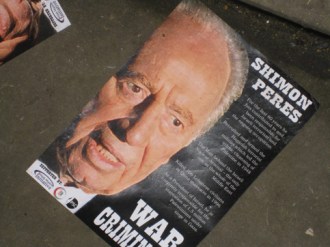 While Netanyahu has, at times, called Clinton “a great friend and a great champion of peace,” Clinton and Shimon Peres have a history of gushing over one another. In early March 2009, Clinton meet with Peres in Jerusalem, describing him as “my dear and old friend” and thanking him “for the extraordinary example that your life sets, as someone who has devoted yourself to the state of Israel, to its security, and to the cause of peace.”
Shimon Peres – who was born Szymon Perski in 1923 in what is now Belarus and immigrated to Palestine in 1934 – procured weaponry for the Haganah during Israel’s ethnic cleansing of Palestine in 1947-48. He was the architect of Israel’s illicit nuclear weapons program and forged close ties with the Apartheid regime in South Africa.
In November 1974, after visiting the leadership in Pretoria, then-Israeli Defense Minister Shimon Peres emphasized to the Knesset the “vitally important” economic, political and military ties between the South Africa and Israel, explaining that “this cooperation is based not only on common interests and on the determination to resist equally our enemies, but also on the unshakeable foundations of our common hatred of injustice and out refusal to submit to it.”
Years later, Peres was acting prime minister during the Israeli bombardment of Lebanon in 1996, including the Qana massacre, in which Israeli warplanes shelled a UN compound sheltering hundreds of displaced civilians, killing 106.
Nevertheless, Hillary Clinton fawned, “I always come away from my times with you both inspired and encouraged to think more deeply and more broadly. And I also am silently challenged by your ceaseless optimism about the future.” In earlier remarks, Clinton said to Peres, “You are an inspiration to me personally, as a person who has dedicated your entire adult life to the State of Israel.” She hailed her presence in Israel as “truly a visit among friends.”
The feelings were mutual. Peres addressed her as “our very dear Hillary,” and expressed sincere gratitude for her “understanding and sympathy and friendship.”
When she returned to Israel 18 months later, Peres hailed “her wisdom, her friendship, her carefulness and caring.” Clinton, again, described Peres as “my friend,” saying it was “a personal pleasure, privilege, and honor to be here with you.”
When the two shared a stage at the Israeli-obsessed Saban Center for Middle East Policy at the Brookings Institute in June 2012, Hillary called Peres her “longtime friend” whom she “so greatly” admires, while Peres expressed his “personal admiration, which is really tremendous” for Clinton.
Back in Jerusalem the following month, Clinton made sure to “be the first friend to wish [Peres] a very happy birthday,” and expressed “such great gratitude how much I appreciate you, our friendship, the work we have done together and the work that we will do together in the future.”
A day before Clinton’s first official visit to Israel as Secretary of State in 2009, she was in Sharm el-Sheik, Egypt. In an interview with Al Arabiya, Clinton effectively dismissed the State Department’s annual report on Egyptian human rights abuses as constructive criticism amongst chums, and declared, “I really consider President and Mrs. Mubarak to be friends of my family.”
In this context, her respect, admiration, and friendship with Kissinger makes a lot more sense.
Kissinger’s Democratic Values and Love of Legitimacy
In her sad stump speech/review of Kissinger’s book, Clinton assures readers that – though they have their differences -she, President Barack Obama, and Kissinger all share the “belief in the indispensability of continued American leadership in service of a just and liberal order.”
Justice. Liberal. Clinton. Obama. Kissinger. Right. Gotcha. But that’s not all.
The review sheds some light on these supposed “shared values” and the politically powerful’s collective view of American imperialism:
During the Cold War, America’s bipartisan commitment to protecting and expanding a community of nations devoted to freedom, market economies and cooperation eventually proved successful for us and the world. Kissinger’s summary of that vision sounds pertinent today: “an inexorably expanding cooperative order of states observing common rules and norms, embracing liberal economic systems, forswearing territorial conquest, respecting national sovereignty, and adopting participatory and democratic systems of governance.”
This system, advanced by U.S. military and diplomatic power and our alliances with like-minded nations, helped us defeat fascism and communism and brought enormous benefits to Americans and billions of others. Nonetheless, many people around the world today — especially millions of young people — don’t know these success stories, so it becomes our responsibility to show as well as tell what American leadership looks like.
Feel free to continue reading once you’ve stopped laughing and caught your breath.
Later, Clinton makes sure to note – in a glowing review of a book by Henry Kissinger, mind you – that “our devotion to human rights and democratic values” are an integral part of what “make[s] us who we are as a nation.” Adhering to such values, Kissinger apparently suggests in his new swag bag doorstop, is what leads to success.
Ok, I’ll wait.
One would be hard pressed to figure out where exactly respecting national sovereignty, an abiding commitment to democratic governance, and standing up for human rights fell into the policy prescriptions of the either the Nixon/Kissinger or Obama/Clinton administrations.
As David Corn succinctly wrote in Mother Jones, outside of Clinton’s twisted mind, Kissinger is best remembered for engaging “in underhanded and covert diplomacy that led to massacres around the globe, as he pursued his version of foreign policy realism. This is no secret.” Corn continues:
- Chile: Nixon and Kissinger plotted to thwart the democratic election of a socialist president. The eventual outcome: a military coup and a military dictatorship that killed thousands of Chileans.
- Argentina: Kissinger gave a “green light” to the military junta’s dirty war against political opponents that led to the deaths of an estimated 30,000.
- East Timor: Another “green light” from Kissinger, this one for the Indonesian military dictatorship’s bloody invasion of East Timor that yielded up to 200,000 deaths.
- Cambodia: The secret bombing there during the Nixon phase of the Vietnam War killed between 150,000 and 500,000 civilians.
- Bangladesh: Kissinger and Nixon turned a blind eye to—arguably, they tacitly approved—Pakistan’s genocidal slaughter of 300,000 Bengalis, most of them Hindus.
And there’s more. Kissinger’s mendacity has been chronicled for years. See Gary Bass’ recent and damning book on the Bangladesh tragedy, The Blood Telegram. There’s Seymour Hersh’s classic, The Price of Power. In The Trial of Henry Kissinger, Christopher Hitchens presented the case against Kissinger in his full polemical style. As secretary of state, Kissinger made common cause with—and encouraged—tyrants who repressed and massacred many. He did not serve the American values of democracy, free expression, and human rights. He shredded them.
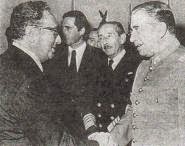
Kissinger and Pinochet
Documents declassified a year ago, upon the 40th anniversary of Salvador Allende’s overthrow in Chile (the other September 11th), “spotlight Kissinger’s role as the principal policy architect of U.S. efforts to oust the Chilean leader, and assist in the consolidation of the Pinochet dictatorship in Chile,” according to the National Security Archive at George Washington University.
Peter Kornbluh, who directs the archive’s Chile Documentation Project, has said, “These documents provide the verdict of history on Kissinger’s singular contribution to the denouement of democracy and rise of dictatorship in Chile.”
In her review, Clinton writes:
For an international order to take hold and last, Kissinger argues, it must relate “power to legitimacy.” To that end, Kissinger, the famous realist, sounds surprisingly idealistic. Even when there are tensions between our values and other objectives, America, he reminds us, succeeds by standing up for our values, not shirking them, and leads by engaging peoples and societies, the sources of legitimacy, not governments alone.
What Clinton of course doesn’t mention is that Kissinger despised legitimate, popular governments, as they too often undermined American domination and exploitation.
After Allende’s inauguration in November 1970, despite prior covert U.S. operations to derail it, Kissinger sent a memorandum to President Nixon warning of “the insidious model effect” of his democratic election.
Kissinger was convinced that the “consolidation of Allende in power in Chile… would pose some very serious threats to our interests and position in the hemisphere” and that “a successful elected Marxist government in Chile would surely have an impact on — and even precedent value for — other parts of the world” that could “significantly affect the world balance and our own position in it.”
He was particularly frustrated that “Allende was elected legally” and “has legitimacy in the eyes of Chileans and most of the world; there is nothing we can do to deny him that legitimacy of claim he does not have it.” Furthermore, Kissinger lamented, “We are strongly on record in support of self-determination and respect for free election” and that Nixon himself was “firmly on record for non-intervention in the internal affairs of this hemisphere.”
“It would thereby be very costly for us to act in ways that appear to violate those principles, and Latin Americans and others in the world will view our policy as a test of the credibility of our rhetoric,” he wrote.
Kissinger immediately outlined a strategy to topple the Allende government.
Following the successful coup and Pinochet’s installation as Chile’s dictator, Kissinger maintained that “however unpleasant they act, this government is better for us than Allende was.” Ignoring appeals to address the severe human rights abuses in Chile, he later told Pinochet himself, “In the United States, as you know, we are sympathetic with what you are trying to do here. We want to help, not undermine you. You did a great service to the West in overthrowing Allende.”
When Nixon complained that “liberal” press was giving him “crap” about the coup, Kissinger was indignant. “In the Eisenhower period, we would be heroes,” he said.
Kissinger knew this would strike chord with his audience of one. Nixon was Vice President when Eisenhower authorized the 1953 CIA-organized coup that overthrew popular Iranian Prime Minister Mohammad Mossadegh for the crime of nationalizing the nation’s oil industry and not buckling to British and American diktat. The coup consolidated U.S.-backed dictatorial power under Mohammad Reza Pahlavi, the Shah, who ruled Iran for the next quarter century.
“By restoring the Shah to power,” Nixon recalled years later, “it meant that the United States had a friend in Iran, a very strong friend, and for 25 years Iran played a role as a peace-keeper in the Persian Gulf area.”
Always valuing imperial interests over democratic and humanitarian values, Nixon made an official pilgrimage to visit the Shah in Iran shortly after the coup. Fifteen years later, as president, Nixon provided weapons systems and military assistance to the Iran on a massive scale, effectively bankrolling the Shah’s prospective $20 billion military build-up. At the time, Massachusetts Congressman Gerry E. Studds called the arms transfers “the most rapid buildup of military power under peacetime conditions of any nation in the history of the world.”
Kissinger himself mused, “[W]e adopted a policy which provides, in effect, that we will accede to any of the Shah’s requests for arms purchases from us (other than some sophisticated advanced technology armaments and with the very important exception, of course, of any nuclear weapons capability).”
In a private meeting with Kissinger on July 27, 1973 at Blair House, the Shah confirmed as much. “I have a friend in the U. S. that is ready to provide anything I need – short of atomic weapons and they are not an issue,” he said during a conversation about acquiring American fighter jets, tanks, and battleships and agreeing to arm Pakistan against India.
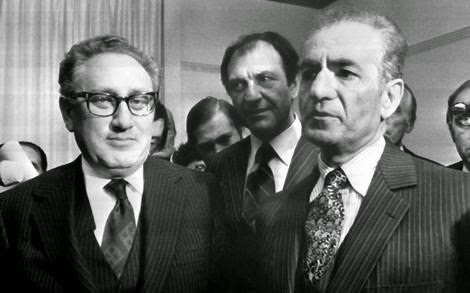
The Nixon White House – and Kissinger in particular – maintained very close relations with the Shah, in turn gaining a dutiful puppet in the region. This was especially beneficial during the 1973 OPEC oil embargo, when Arab members of the petroleum exporting consortium “cut production and stopped oil shipments to the United States and other countries that were backing Israel in the Yom Kippur War.” With the Shah in power, Iran continued production and export to the United States and its allies, including Apartheid South Africa, throughout the embargo and was rewarded handsomely by reaping the windfall of the oil shock.
When the Iranian Revolution finally forced the Shah to flee Iran, it was Kissinger and a cohort of other “influential friends” like Chase Manhattan Bank’s David Rockefeller, former statesman and World Bank president John McCloy, and National Security Adviser Zbigniew Brzezinski who intensively lobbied the Carter administration to eventually admit the Shah to the United States. Carter’s begrudging acquiescence was the main catalyst for the November 4, 1979 takeover of the U.S. Embassy in Tehran.
A month after the seizure of the embassy, Kissinger gave an interview to People Magazine. He had already visited the Shah twice since his arrival. He also insisted that Iranians had no legitimate reason to resent American foreign policy. Admitting that the Shah was “certainly authoritarian,” Kissinger praised his “reforming government” for its supposed economic, education, environmental, and medical advances.
“Not everybody who attacks us is doing so because we supplied a just grievance,” he said, adding that “it must be made clear that challenging the U.S. is not for free. There has to be some penalty for opposing us and some reward for being friendly. Unless we can reestablish that balance, this trend will continue.”
Regarding his belief that the United States was indebted to its former quisling, Kissinger told People, “I have held the position all along that the Shah was a friend of the U.S. for 37 years. Every President, starting with Truman, lauded the Shah’s friendship and his modernizing tendencies and spoke of the gratitude we owed him.” Such a partner deserved “private humanitarian asylum,” Kissinger said. “In light of the Shah’s help to our nation, I felt a duty to help.”
Despite all this, in her review of “World Order,” Clinton remarks that “Kissinger’s analyses of the Asia-Pacific and the Middle East are particularly valuable.”
Atomic Drop
While writing about Kissinger’s diplomatic philosophies and policy prescriptions, Clinton manages to praise herself a lot for her own work as Secretary of State, including what she terms taking “decisive action on challenges such as Iran’s nuclear program.”
As one might expect, this “decisive action” was actually just issuing threats, ultimatums, and imposing “crippling” sanctions upon a country over its refusal to abandon its inalienable right to a domestic nuclear energy program. It wasn’t until she left the administration that the current negotiations got underway.
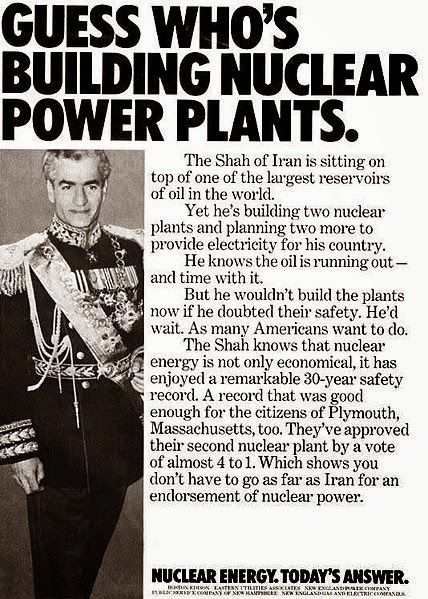
Yet bringing up such a topic in an article about Henry Kissinger is itself ironic as Iran may never have had a nuclear program to begin with were it not for him.
In 1975, during his tenure as Gerald Ford’s Secretary of State, “Kissinger signed and circulated National Security Decision Memorandum 292, titled ‘U.S.-Iran Nuclear Cooperation,’ which laid out the administration’s negotiating strategy for the sale of nuclear energy equipment projected to bring U.S. corporations more than $6 billion in revenue,” reported the Washington Post‘s Danfa Linzer in 2005.
The strategy paper, Linzer wrote, “commended Iran’s decision to build a massive nuclear energy industry,” and argued that Iran needed to “prepare against the time — about 15 years in the future — when Iranian oil production is expected to decline sharply.”
Working alongside other Ford administration officials like Donald Rumsfeld, Dick Cheney and Paul Wolfowitz, Kissinger engaged in “intense efforts to supply Iran with U.S. nuclear technology” and even “tried to accommodate Iranian demands for plutonium reprocessing.” A directive signed by Ford in 1976 offered access to “a complete ‘nuclear fuel cycle’ — reactors powered by and regenerating fissile materials on a self-sustaining basis.”
When asked by Linzer about the potential consequences and hypocrisy of such a deal in light of more recent punitive and preventive policies, Kissinger shrugged. “I don’t think the issue of proliferation came up,” he said, eventually adding, “They were an allied country, and this was a commercial transaction. We didn’t address the question of them one day moving toward nuclear weapons.”
Diplomatic Double Standards
In mid-1969, when he was Nixon’s National Security Adviser, Kissinger outlined what would soon become official American policy regarding Israel’s clandestine nuclear arsenal. Once Israeli nuclear capability came to light – outside of the Nuclear Non-Proliferation Treaty, which Israel refused to sign – the Nixon administration attempted to devise a strategy to deal with it.
A National Security Study delivered to Kissinger in May 1969 by Deputy Assistant Secretary of State for Near Eastern and South Asian Affairs Rodger Davies noted, “Israel has committed to us that it will not be ‘the first to introduce nuclear weapons into the area’, but there are grounds for believing that Israel does not construe production of a weapon to constitute ‘introduction.'” It further stated:
If the possession of nuclear weapons offered an ultimate deterrent for Israel we would perhaps be prepared to conclude that, whatever other disadvantages this development might have, its contribution to Israel’s security, especially with the prospect of continuing Arab hostility, was in the US interest.
Israel wants nuclear weapons, as was both explicit and implicit in our conversations with Rabin, for two reasons: first, to deter the Arabs from striking Israel, and second, if deterrence fails and Israel were about to be overrun, to destroy the Arabs in a nuclear Armageddon.
In a July 19, 1969 memo to the president, Kissinger introduced a new policy option, wring that “while we might ideally like to halt actual Israeli possession, what we really want at a minimum may be just to keep Israeli possession from becoming an established international fact.”
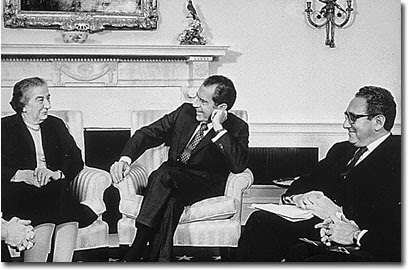
Despite the efforts of Nixon officials to place curbs on the program, they eventually “withdrew step after step from an ambitious plan to block Israeli nuclearization, until they finally acceded, in internal correspondence – the content of the conversation between Nixon and Meir is still classified – to recognition of Israel as a threshold nuclear state,” wrote Amir Oren recently in Ha’aretz, basing his report on newly-declassified documents.
The Nixon advisers concluded that, all things considered, “we cannot force the Israelis to destroy design data and components, much less the technical knowledge in people’s minds, nor the existing talent for rapid improvisation.” Thus, Davies wrote in July, two months before the Nixon-Meir meeting, the lesser evil would be to agree for Israel to “retain its ‘technical option'” to produce nuclear weapons.
“If the Israelis show a disposition to meet us on the nuclear issue but are adamant on the Jericho missiles, we can drop back to a position of insisting on non-deployment of missiles and an undertaking by the Israelis to keep any further production secret,” Davies added.
Such “nuclear ambiguity” has been both official Israeli and U.S. policy ever since President Richard Nixon meeting with Israeli Prime Minister Golda Meir in September 1969. Accordingly, Nixon formally suspended all American inspection of and visitation to Israel’s Dimona nuclear plant in 1970 and ceased demands that Israel join the Nuclear Non-Proliferation Treaty.
When President Obama first met with Netanyahu in May 2009, he confirmed the continuity of the secret agreement, a stance one Senate staffer reportedly described as “call[ing] into question virtually every part of the president’s nonproliferation agenda” by giving “Israel an NPT treaty get out of jail free card.”
The Clinton Doctrine
Hillary Clinton’s review of Henry Kissinger’s new book provided her and her public relations team an opportunity to set the stage for what seems like another inevitable run for president. It affirmed her fealty to American imperialism and hegemony, her reliance on the advice of predecessors, colleagues and friends with demonstrably more appalling records than her own, and her firm commitment to continue the failed and dangerous policies of past administrations, all while standing on the same sanctimony and entitlement that got her where she is today.
From hailing Henry Kissinger as a gritty, truth-telling idealist to her role in the Obama administration’s expansion of the American surveillance state and drone program, the question remains: is there anything about Hillary Clinton that isn’t absolutely terrible?
Featured Video
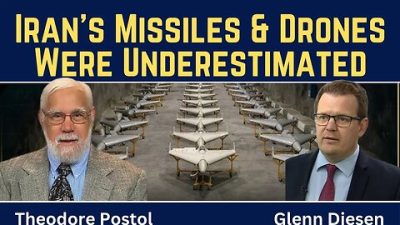
Theodore Postol: Iran’s Missiles & Drones Were Underestimated
or go to
Aletho News Archives – Video-Images
From the Archives
What is the Israeli Lobby in Australia Doing in Interfaith Dialogue?
By Ali Kazak | Dissident Voice | October 11, 2015
For years Israel and its lobby around the world have been trying to normalise their relations with Arabs and Muslims without solving the Palestine Question.
One of the methods they resorted to in the last few years is using human rights and community organizations such as interfaith dialogue and Multiculturalism to achieve this objective and to: isolate the Palestinians, marginalise the Palestine question, end Israel’s isolation, and prevent criticism of Israel, knowing that these organisations will be the first to stand against Israel’s violations, racial and religious discrimination.
The group responsible for this task in Australia is The Australia/Israel & Jewish Affairs Council (AIJAC); its Director of International & Community Affairs, Jeremy Jones is in charge of lobbying religious community organizations, specifically Muslims and Christians. Consequently he convened the Faith Communities for Reconciliation, founding participant in the Australian Partnership of Religious Organisations and the Australian National Dialogue of Christians, Muslims & Jews.
AIJAC is a private political propaganda group. It is recognised as the main Israeli lobby in Australia. It coordinates its activities and works intimately with the Israeli embassy in Canberra and different institutions in Israel. It is privately funded by some Jewish businessmen. It monitors closely Australian politicians, the media, ethnic and religious groups, (especially Arabs and Muslims), unions and academics on their stands towards Israel and the Palestine question. … continue
Blog Roll
 Aletho News
- The Most Important Bet You’ve Never Heard Of
- The killing of three Indonesian soldiers in Lebanon should remind Jakarta that Israel does not want peace
- Defeated and delusional: Netanyahu’s remarks reveal $80bn war failure, says analyst
- Iran’s friends are about to make life much more difficult for Israel and the US
- The war of liberation of the Arab and Islamic peoples expands across the Gulf
- Envoy warns UN on Trump’s threat to ‘obliterate’ Iran’s civilian infrastructure
- The Larak Corridor: Iran’s Rial Gate With No US, No Israel, and No Way Around
- ‘Economic terrorism’: Steel facilities hit again in US-Israeli strike
- ‘War Crime’: Iran condemns attacks on Arak, Ardakan nuclear sites
- Two-thirds of Americans want quick end to Iran war even if goals unmet
- If Americans Knew
- Gaza families reunite years after babies evacuated amid Israel’s war
- International Rescue Committee warns Gaza’s children face grave protection risks
- Iran’s Alleged 47-Year War on America: Debunking the 1,050 American Deaths Canard
- Israel wants US to bomb more of Iran’s civilian structures (113,000 is not enough) – Not a ceasefire Day 173
- Ann Coulter Rips Into Fox News for Iran War Coverage
- Joe Kent Urges Americans To Call White House and Congress To Object To Sending Troops Into Iran
- DNC Resolution to Reject AIPAC Funding Puts Democratic Leaders in the Hot Seat
- Swedish foundation to build 400 schools as over 650,000 Gaza children remain without education for 2 years
- Israeli army admits photshopping image of slain Lebanese journalist
- This is how Israel is systematically killing health workers under the cover of war in Lebanon
- No Tricks Zone
- New Study Finds Warming Saves Lives…Cold Temperatures 12 Times More Deadly Than Excess Heat
- German Science Blog Accuses PIK Climate Institute Of Hallucinating Climate Tipping Points
- Devastating Assessment Of Comirnaty Vaccine By Former Senior Pfizer Europe Toxicologist
- New Study: CO2 Is ‘Effectively Negligible’ As An Explanatory Climate Change Factor Since 2000
- Former Pfizer Toxicologist Dr. Helmut Sterz Tells Bundestag Hearing Pfizer Vaccine Should Have Never Been Approved
- Energy Expert: Germany’s Nuclear Phaseout Was A “500 Billion Euro Mistake”
- New Research: South Australia’s Mid-Holocene Sea Surface Temperatures Were 4°C Warmer Than Today
- Storing Green Energy To Last Germany 10 Days Would Require A 60-Million Tonne Battery
- New Studies: UK Sea Levels Were 4 Meters Higher Than Today During The Mid-Holocene
- Destructive Green New Deal: German Energy And Metal Group Warns Of Drastic Crisis
 Aletho News
