Denied land access, Palestinians miss olive harvest
Ma’an – 29/10/2014
AL-JANIYA (AFP) — Abbas Yousef points wistfully towards his olive trees, which are bearing their annual fruit. Yet again, the 70-year-old Palestinian farmer will be unable to make the autumn harvest.
Yousef’s olive groves lie on land either side of an Israeli settlement in the northern occupied West Bank. For years, he has been denied access by the army, and the settlers have plowed it, uprooting many of his trees.
For the 1,400 residents of al-Janiya — Yousef’s village — attacks by settlers who have uprooted trees and burnt Palestinian farmland have become a daily occurrence, he says.
“Each time I try to get to my olive groves, an Israeli soldier tells me I can’t go, because it’s been designated a ‘closed military zone,'” Yousef says.
“My father planted those trees, seed by seed, and I toiled over the land,” he sighs, pointing to one section of his land, now farmed by settlers.
This year, for the first time since 2000, Yousef was allowed access to his land, but only for two days — not nearly enough time to gather all the olives during the harvest that begins in early October.
When he got there, he found 400 of his trees had been uprooted.
UN figures show that since the start of the year, around 7,500 trees have been damaged or uprooted across the West Bank.
‘Now it’s my land’
Arik Ascherman, president of Israeli rights group Rabbis for Human Rights, says Yousef’s experience is common and in danger of becoming the norm in the West Bank.
“They start by preventing Palestinians from accessing their land, then they cultivate it themselves, and then they say ‘Now it’s my land,'” he explains.
Since Israel took over the West Bank in 1967, 135 Jewish settlements have been built there as well as around 100 unauthorized outposts, which are considered illegal even under Israeli law, UN figures show.
All settlements built on occupied territory are illegal under international law.
Figures compiled by the Yesha Settlers Council show there are some 380,000 Israelis living in the West Bank — a number which has more than tripled in the two decades since the Oslo peace accords were signed in 1993.
The attacks against olive groves, which make up half of all cultivated Palestinian farmland, threaten a crucial source of livelihood.
Olive farming and olive oil production bring in around a quarter of Palestinian agricultural revenue, according to the UN’s top humanitarian official for the occupied territories, James Rawley.
The harvest is increasingly threatened by both settlement building and by Israel’s vast separation barrier — in some parts an eight-meter-high (25 foot) concrete wall — whose construction began in 2002.
Some 85 percent of the barrier’s route runs inside the West Bank, rather than along the internationally recognized Green Line, cutting off Palestinians from 30 percent of their land, according to a UN spokeswoman.
For Ahmed Diwan, a farmer who lives in Biddu village east of Ramallah, the problem is not limited to olives.
He says he has also missed the grape harvest, the almonds, the apples, and vine leaves — “a symbol of Palestinian cuisine” — due to a lack of access to his land.
Diwan holds out little hope for this year’s olive harvest as he packs his farming equipment into his car.
“We’re only allowed access to our olive groves two days this year. We can’t maintain the trees or harvest in that time!”
End of an era?
Israel has granted access to farmers for a total of 37 days so far this year, the UN says.
Even those who do have limited access to their farmland are subjected to violent attacks by settlers, who are often armed.
So far this year, 88 attacks have been recorded and 142 farmers injured, according to the UN.
The elderly Yousef was one of the victims.
“About 50 settlers turned up. We were four farmers, people of around my age. We were no match for them,” he recalls.
“In the end it was the Israeli soldiers who got us out to protect us from the settlers.”
The violence is making “entire villages” which had been self-sufficient for decades dependent on international aid, the UN says.
A disillusioned younger generation is turning away from the age-old family tradition.
“Farming is finished. The young people don’t want to work on the land. They’re scared of being killed by settlers,” Yousef says.
Settler violence against Palestinians and their property is a regular occurrence in the West Bank and East Jerusalem, but settlers are rarely held accountable by Israeli law enforcement.
Ma’an staff contributed to this report.
Israeli forces shoot Palestinian on beach as ceasefire violations in Gaza continue

Al-Akhbar | October 29, 2014
Israeli forces shot and injured a Palestinian man on the beach in the northern Gaza Strip on Wednesday, medical sources said.
Gaza’s health ministry spokesman Ashraf al-Qidra told Ma’an that a 27-year-old man was seriously injured after being shot in the thigh in Beit Lahiya.
The man, identified only by his initials “S.Gh.” was taken to Kamal Udwan hospital.
An Israeli army spokesman confirmed the incident, saying that two Palestinians had “approached the security fence” in the northern Gaza Strip.
Moreover, on Tuesday, 20-year-old Ibrahim Adli Asila, a Palestinian man from northern Gaza, died in Turkey of wounds he sustained in the recent Israeli offensive on the Gaza Strip.
For 51 days this summer, Israel pounded the Gaza Strip – by air, land and sea – with the stated aim of ending rocket fire from the coastal enclave.
More than 2,160 Gazans, mostly civilians, were killed – and 11,000 injured – during seven weeks of unrelenting Israeli attacks in July and August.
The Israeli offensive ended on August 26 with the an Egypt-brokered cease-fire agreement.
The truce calls for reopening Gaza’s border crossings with Israel, which, if implemented, would effectively end the latter’s years-long blockade of the embattled territory.
In addition, the sides agreed to hold further indirect meetings in Egypt to iron out further details of the truce. The meetings were postponed to November in the wake of a deadly attack on security forces in Egypt.
Gaza fishermen continue to suffer
The truce also stipulated that Israel would immediately expand the fishing zone off Gaza’s coast, allowing fishermen to sail as far as six nautical miles from shore, and would continue to expand the area gradually.
However, since the ceasefire was signed, Israeli forces have fired at several fishermen who they say have ventured beyond the newly-imposed limit of six nautical miles.
There have also been widespread reports of the Israeli navy opening fire at fishermen within those limits.
Last week, Israeli naval forces opened fire heavily on a group of Palestinian fishermen before detaining seven off the coast of Gaza City.
The head of the Gaza fishermen syndicate accused Israel of constantly violating the terms of the agreement.
“Since signing the truce, the Israeli army has violated (the agreement) eight times, arresting fishermen and destroying a giant fishing boat, in addition to firing at fishermen on a daily basis,” he said.
There are an estimated 4,000 fishermen in Gaza. According to a 2011 report by the International Committee of the Red Cross, 90 percent are poor, a 40 percent increase from 2008. This change is believed to be a direct result of Israeli limits on the fishing industry.
The eight-year Israeli blockade has severely crippled Gaza’s economy and contributed to the frequent humanitarian crises and hardship for Gaza residents.
Blocking building material
Israel also agreed to allow construction material into Gaza. But two months after the war ended, no building material has entered Gaza due to Israel’s ongoing blockade.
UN chief Ban Ki-moon said earlier this month during a visit to the Gaza Strip that the devastation he had seen was far worse than that caused in the previous Israel-Gaza conflict of winter 2008-2009.
“The destruction which I have seen while coming to here is beyond description. This is a much more serious destruction than what I saw in 2009.”
According to estimates based on preliminary information, as many as 80,000 Palestinians homes were damaged or destroyed during the days of hostilities, a higher figure than was previously thought.
Over 106,000 of Gaza’s 1.8 million residents have been displaced to UN shelters and host families, the UN says.
According to Palestinian Authority, rebuilding Gaza will cost $7.8 billion.
Israel routinely bars the entry of building materials into the embattled coastal enclave on grounds that Palestinian resistance faction Hamas could use them to build underground tunnels or fortifications.
For years, the Gaza Strip has depended on construction materials smuggled into the territory through a network of tunnels linking it to Egypt’s Sinai Peninsula.
A recent crackdown on the tunnels by the Egyptian army, however, has effectively neutralized hundreds of tunnels, severely affecting Gaza’s construction sector.
The threat of unexploded Israeli shells
The Gaza Strip is still littered with a large number of unexploded Israeli shells, one of which has recently killed 4-year-old Mohammed Sami Abu-Jrad from the northern Gaza city of Beit Hanoun.
Although Gaza police explosives teams have been working across the territory to destroy unexploded ordnance and prevent safety threats to locals, lack of proper equipment due to the seven-year Israeli siege as well as lack of resources more generally have hindered efforts.
Even before the most recent Israeli assault, unexploded ordnance from the 2008-9 and 2012 offensives was a major threat to Gazans.
A 2012 report published by the Office of the High Commissioner for Human Rights said that 111 civilians, 64 of whom were children, were casualties to unexploded ordnance between 2009 and 2012, reaching an average of four every month in 2012.
Watch groups have warned that the ordinance can be a particular threat to children, who often think the bombs are toys.
During the 50-day war, according to UN figures, at least 505 Palestinian children were killed.
The UN agency for Palestinian refugees said 138 UNRWA students were killed during the assault and UNRWA spokesperson Christopher Gunness said that an additional 814 UNRWA students were injured and 560 have become orphans due to the Israeli onslaught.
(Al-Akhbar, Ma’an, AFP)
Block the Boat Declares Decisive Victory Over Apartheid Israel

Block the Boat | October 28, 2014
Oakland has made history once again with another BDS victory for Palestine against the Israeli Zim shipping line. This latest round of organizing has been the most momentous and historic. Members of ILWU Local 10 informed Block the Boat organizers that the Zim Beijing which was headed to the Port of Oakland, has been re-routed to Russia to avoid disruptions at the SSA terminal. For the first time ever, an Israeli ship has been completely turned away before reaching its port of destination due to sustained overwhelming community organizing.
The damage to Israel’s credibility can’t be exaggerated–the Zim line, though privately owned, is an Israeli “security asset.” Israel exerts control over the corporation through a “golden share” which it uses to prevent the sale of the company into foreign hands. The Zim line is mandated to be part of Israel’s critical supply chain during protracted military conflicts. The brand and economic impact on Zim has yet to be calculated, but is surely devastating. Goods have been rerouted, and undelivered for months. ILWU workers have honored our pickets and sided with the community against US complicity in Israeli apartheid. Zim has been disrupted and confronted by anti-Zionist protests in Seattle, Tacoma, Los Angeles, Vancouver, New Orleans, New York and Tampa. Ports all over North America are making it clear that Israel can no longer conduct business as usual because Zionism is simply not welcome on our coasts.
Zim‘s Maneuvers
The Zim Beijing, which was scheduled to arrive in Oakland on the morning of Saturday October 25, 2014, instead broke from its heading soon after it reached the north western coast of Mexico on Wednesday, October 22nd, and headed further northwest. Several sources, including Zim’s own online schedule, and port and union authorities confirm that the Beijing’s intended destination was Oakland, but that it changed its itinerary to avoid yet another humiliating defeat. In an article published on 10/26, headlined “Zim Beijing Avoids Oakland” the GulfShip News reported, “The ship was due to call on Saturday, but then delayed its call to today [Sunday]. Reports from Oakland suggest Zim has now decided to cancel the call altogether. Zim has been hit by protests at Oakland in August and September, disrupting its schedules.”
We also tracked the ship via satellite using an online marine tracking service and documented that the ship listed its destination as Oakland just minutes after it left the Panama Canal–the norm for Zim ships on the Asia Pacific line, which stop at either Los Angeles or Oakland before heading to China and Russia. Just days into its 9 day journey from the Canal, however, Zim abruptly removed Oakland from its online schedule, and headed northwest, taking it ever farther from Oakland.
Confronting Global Repression
It is clear that the Zim Beijing diverted course in response to the powerful Block the Boat organizing. In August, Block the Boat organized and inspired a series of historic night and day pickets, which with the support of ILWU workers, prevented the Zim Piraeus from unloading for 4 days, and eventually forced the ship to leave before even a fraction of its cargo could be unloaded. In September, Zim faced another set of pickets that forced the Zim Shanghai to offload in Los Angeles, rather than its intended Oakland destination. The Block the Boat coalition along with the broader Bay Area community has made it clear that we can determine what takes place in our towns. And business with the racist, exclusionary, Zionist state of Israel, which works alongside local and federal law enforcement to repress our communities, will not go unchallenged.
Activists remained focused throughout Zim’s obfuscations, organizing for a large turnout to picket the Beijing whenever it would arrive–Saturday, Sunday, or any day of the coming week. Given the convoluted maneuvers Zim used in August, in which it left the port under the cover of an Israeli consulate press release, only to return to another terminal less than an hour later, organizers now know to be thorough and patient. After tracking the Zim Beijing for several days, Block the Boat prepared for a week of possible pickets by staging a late day march of hundreds on Sunday to the Port of Oakland to show the strength and focus of this movement. It was a warning to Zim to keep going as it reached the 1000-mile mark from Oakland and a promise that the gates would be lined again with unstoppable anti-Zionist picketers if it returned.
As the Beijing sails beyond the horizon, it still bears the destination of Oakland, though it is over 1200 miles away from San Francisco Bay at the time of this statement. Our efforts have paid off; Zim Beijing does not appear to be turning around. Even if it did reverse course and head back to Oakland at this point, it would be a week late, and it would find us once again, prepared to stop it at the port.
BDS Victory
We are declaring a historic victory in our effort to block the Beijing. It is very likely that Zim has been completely prevented from doing any future business at the Port of Oakland. Only time will tell if Zim’s changes to its schedule reflect the real re-routing of its ships, or simply just another ruse to fool opponents of Israeli apartheid. Obviously, here in Oakland, we are ready for Zim’s return any time. Together with our brothers and sisters from Ferguson to Palestine, we are fighting back against state violence and apartheid and we are prepared to bring it down brick by brick, wall by wall, port by port.
@blocktheboat #blocktheboat
Japan to reopen 1st nuclear plant after Fukushima disaster – despite volcano risks
RT | October 28, 2014
A local council has voted to re-open the Sendai Nuclear Power Plant on the outermost western coast of Japan, despite local opposition and meteorologists’ warnings, following tremors in a nearby volcano.
Nineteen out of 26 members of the city council of Satsumasendai approved the reopening that is scheduled to take place from early 2015. Like all of Japan’s 48 functional reactors, Sendai’s 890 MW generators were mothballed in the months following the 2011 earthquake and tsunami.
Satsumasendai, a town of 100,000 people, relies heavily on state subsidies and jobs, which are dependent on the continuing operation of the plant.
But other towns, located within sight of the plant, do not reap the same benefits, yet say they are being exposed to the same risks. A survey conducted by the local Minami-Nippon Shimbun newspaper earlier this year said that overall, 60 percent of those in the region were in favor of Sendai staying shut. In Ichikikushikino, a 30,000-strong community just 5 kilometers away, more than half of the population signed a petition opposing the restart. Fewer than half of the major businesses in the region reported that they backed a reopening, despite potential economic benefits.
Regional governor Yuichiro Ito has waved away the objections, insisting that only the city in which the plant is located is entitled to make the decision.
While most fears have centered around a lack of transparency and inadequate evacuation plans, Sendai is also located near the volcanically active Kirishima mountain range. Mount Ioyama, located just 65 kilometers away from the plant, has been experiencing tremors in recent weeks, prompting the Meteorological Agency to issue a warning. The government’s nuclear agency has dismissed volcanic risks over Sendai’s lifetime as “negligible,” however.
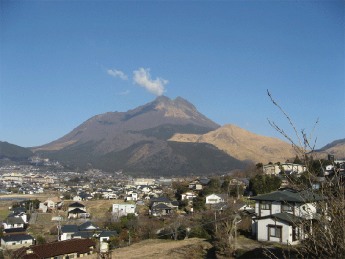
Mount Ioyama (image from blogs.yahoo.co.jp)
Satsumasendai’s Mayor Hideo Iwakiri welcomed the reopening, but said at the ensuing press conference that it would fall upon the government to ensure a repeat of the accident that damaged Fukushima, an outdated facility subject to loose oversight, is impossible.
September’s decision to initiate the return Japan’s nuclear capacity back online was taken by Prime Minister Shinzo Abe, who endorses nuclear production in the country, but has delegated the controversial call on reopening to local councils. Sendai was chosen after becoming the first plant to officially fulfill the government’s new stricter safety rules. It may also have been picked due to its geographical remoteness, and distance from the 2011 disaster area.
The primary reason for Abe’s nuclear drive been the expense in replacing the lost energy that constituted 30 percent of the country’s consumption, which the government says cost Japan an extra $35 billion last year. Japanese consumers have seen their energy bills climb by 20 percent since the disaster as a result.
But another concern remains the state of the country’s aging nuclear plants, which will cost $12 billion to upgrade. Meanwhile plans to build modern nuclear reactors – which were supposed to be responsible for half of the country’s nuclear power by 2030, according to previous government energy plans – have predictably been shelved in the wake of the disaster.
Fukushima dome removal suspended
The painfully slow and calamitous decommissioning of the Fukushima Daiichi plant, in the northeast of the country, had to be halted yet again Tuesday, after the removal of the temporary dome over the damaged Reactor 1 was interrupted by severe winds.
The canopy needs to be taken off so that the radioactive reactor rods, which have been contaminating the soil and water around the plant, can be placed in storage.
But as workers attempted to lift a section of the plastic dome to decontaminate the air inside, a segment of the cover up to six feet was blown off by a severe gust of wind.
Tokyo Electric Power Company, TEPCO, the operator of the shuttered plant, says that the incident has not impacted radiation levels, and hopes to resume operations as soon as possible.
Natural resource exploitation in the Dead Sea area – The case of Ahava
Alhaqhr | October 28, 2014
This is the first in a series of new Virtual Field Visits focusing on the topic of business and human rights. This video will highlight corporate complicity in the exploitation of natural resources in the Dead Sea area of the Occupied Palestinian Territory.
U.S. Sends Planes Armed with Depleted Uranium to Middle East
By David Swanson | War is a Crime | October 28, 2014

The U.S. Air Force says it is not halting its use of Depleted Uranium weapons, has recently sent them to the Middle East, and is prepared to use them.
A type of airplane, the A-10, deployed this month to the Middle East by the U.S. Air National Guard’s 122nd Fighter Wing, is responsible for more Depleted Uranium (DU) contamination than any other platform, according to the International Coalition to Ban Uranium Weapons (ICBUW). “Weight for weight and by number of rounds more 30mm PGU-14B ammo has been used than any other round,” said ICBUW coordinator Doug Weir, referring to ammunition used by A-10s, as compared to DU ammunition used by tanks.
Public affairs superintendent Master Sgt. Darin L. Hubble of the 122nd Fighter Wing told me that the A-10s now in the Middle East along with “300 of our finest airmen” have been sent there on a deployment planned for the past two years and have not been assigned to take part in the current fighting in Iraq or Syria, but “that could change at any moment.”
The crews will load PGU-14 depleted uranium rounds into their 30mm Gatling cannons and use them as needed, said Hubble. “If the need is to explode something — for example a tank — they will be used.”
Pentagon spokesman Mark Wright told me, “There is no prohibition against the use of Depleted Uranium rounds, and the [U.S. military] does make use of them. The use of DU in armor-piercing munitions allows enemy tanks to be more easily destroyed.”
On Thursday, several nations, including Iraq, spoke to the United Nations First Committee, against the use of Depleted Uranium and in support of studying and mitigating the damage in already contaminated areas. A non-binding resolution is expected to be voted on by the Committee this week, urging nations that have used DU to provide information on locations targeted. A number of organizations are delivering a petition to U.S. officials this week urging them not to oppose the resolution.
In 2012 a resolution on DU was supported by 155 nations and opposed by just the UK, U.S., France, and Israel. Several nations have banned DU, and in June Iraq proposed a global treaty banning it — a step also supported by the European and Latin American Parliaments.
Wright said that the U.S. military is “addressing concerns on the use of DU by investigating other types of materials for possible use in munitions, but with some mixed results. Tungsten has some limitations in its functionality in armor-piercing munitions, as well as some health concerns based on the results of animal research on some tungsten-containing alloys. Research is continuing in this area to find an alternative to DU that is more readily accepted by the public, and also performs satisfactorily in munitions.”
“I fear DU is this generation’s Agent Orange,” U.S. Congressman Jim McDermott told me. “There has been a sizable increase in childhood leukemia and birth defects in Iraq since the Gulf War and our subsequent invasion in 2003. DU munitions were used in both those conflicts. There are also grave suggestions that DU weapons have caused serious health issues for our Iraq War veterans. I seriously question the use of these weapons until the U.S. military conducts a full investigation into the effect of DU weapon residue on human beings.”
Doug Weir of ICBUW said renewed use of DU in Iraq would be “a propaganda coup for ISIS.” His and other organizations opposed to DU are guardedly watching a possible U.S. shift away from DU, which the U.S. military said it did not use in Libya in 2011. Master Sgt. Hubble of the 122nd Fighter Wing believes that was simply a tactical decision. But public pressure had been brought to bear by activists and allied nations’ parliaments, and by a UK commitment not to use DU.
DU is classed as a Group 1 Carcinogen by the World Health Organization, and evidence of health damage produced by its use is extensive. The damage is compounded, Jeena Shah at the Center for Constitutional Rights (CCR) told me, when the nation that uses DU refuses to identify locations targeted. Contamination enters soil and water. Contaminated scrap metal is used in factories or made into cooking pots or played with by children.
CCR and Iraq Veterans Against the War have filed a Freedom of Information Act Request in an attempt to learn the locations targeted in Iraq during and after the 1991 and 2003 assaults. The UK and the Netherlands have revealed targeted locations, Shah pointed out, as did NATO following DU use in the Balkans. And the United States has revealed locations it targeted with cluster munitions. So why not now?
“For years,” Shah said, “the U.S. has denied a relationship between DU and health problems in civilians and veterans. Studies of UK veterans are highly suggestive of a connection. The U.S. doesn’t want studies done.” In addition, the United States has used DU in civilian areas and identifying those locations could suggest violations of Geneva Conventions.
Iraqi doctors will be testifying on the damage done by DU before the Tom Lantos Human Rights Commission in Washington, D.C., in December.
Meanwhile, the Obama Administration said on Thursday that it will be spending $1.6 million to try to identify atrocities committed in Iraq . . . by ISIS.
‘Russian distress call’ prompting Swedish sub hunt never existed – sigint source
RT | October 28, 2014
There was no Russian distress call. That’s the opinion of a Swedish signal intelligence (SIGINT) source after a massive $2.8mn military and media sub-hunt consumed the country for a week.
Reports of a Russian distress signal and a grainy-picture were enough to deploy the navy while the media widely concluded the vessel had to be a Russian submarine spooking Stockholm.
The proof of this was an alleged comms intercept, at distress call frequency, between the supposed sub and Kaliningrad base.
But the Dagens Nyheter daily cited a Swedish Intel source who confessed there was no distress call.
Citing freedom of information requests and its own sources, the paper said Sweden’s signal intelligence agency knows nothing about the alleged distress calls, and registered no spikes in communication with Kaliningrad at the time.
“I’d be glad to read about that emergency call myself. But it didn’t happen, this information is incorrect,” the newspaper cites a source as saying.
The navy operation, which was dubbed ‘Hunt for the Reds in October’ by the Swedish media, was reminiscent of the Cold War era, when Swedish warships patrolled the Baltic Sea looking for Soviet submarines.
During the search, many recalled the infamous 1981 incident, when a Russian submarine got stranded near Karlskrona, a major naval base. The incident, which caused serious diplomatic waves, was dubbed ‘Whiskey on the Rocks’ because the S-363 sub in question belonged to the Whiskey-class.
Russia has denied sending any subs to spy on Sweden, or having one suffer an emergency in Sweden’s waters. Sources in the Russian military suggested that the fuss was caused by a sighting of a Norwegian U-boat participating in a joint NATO drill in the Baltics.
The Swedish Navy’s efforts to find the elusive foreign activity cost the country 2.2 million euros ($2.8 million), it reported last week. The operation was the biggest in decades in a nation, where military spending accounts for about 1 percent of GDP and has seen steady cuts during the years of the European economic slowdown.
According to the latest draft budget published in the wake of the naval operation, Sweden plans to increase military spending for 2015 by $93.7 million.
READ: Sweden ready to use force to surface foreign sub as search continues
Israeli mayor storms into al-Aqsa without permission
Al-Akhbar | October 28, 2014
Israeli-occupied Jerusalem’s mayor Nir Barkat forced his way on Tuesday into the al-Aqsa Mosque compound in East Jerusalem under heavy police protection, a Palestinian official said, as Israel continues to restrict the entry of Palestinian worshipers into al-Aqsa for the fifth week in a row.
“We protest this intrusion. Barakat entered the compound under the Israeli police’s protections without permission or a prior request,” Sheikh Azzam al-Khatib, head of the Jordan-run Organization for Muslim Endowments and Al-Aqsa Affairs, told Anadolu Agency.
This is the first time Barkat storms the holy site since assuming office in 2008.
“Barkat took a tour at the compound’s courtyards before leaving,” al-Khatib added.
The intrusion came one day after Palestinian Prime Minister Rami Hamdallah visited the complex.
Hamdallah’s visit came after Palestinian Authority President Mahmoud Abbas warned against Israeli plans to “divide” the holy site.
In an urgent message to the US administration on Sunday, Abbas warned that Israel’s continued provocations at the mosque complex would lead to a “wide-reaching explosion.”
Israel continues to restrict the entry of Palestinian worshipers into al-Aqsa for the fifth week in a row.
Israeli authorities have imposed restrictions on Palestinians seeking to enter the al-Aqsa Mosque compound, denying Muslim men under 40 access to the holy site while facilitating the entry of Zionist settlers of all ages.
In recent months, groups of extremist Zionist settlers – often accompanied by Israeli security forces – have repeatedly forced their way into East Jerusalem’s flashpoint al-Aqsa Mosque complex.
The frequent violations anger Palestinians and occasionally lead to violent confrontations.
For Muslims, al-Aqsa represents the world’s third holiest site.
Israel occupied East Jerusalem during the 1967 Middle East War. It later annexed the holy city in 1980, claiming it as the capital of the self-proclaimed Zionist state – a move never recognized by the international community.
In September 2000, a visit to the site by controversial Israeli leader Ariel Sharon sparked what later became known as the “Second Intifada” – a popular uprising against the Israeli occupation in which thousands of Palestinians were killed.
(Anadolu, Al-Akhbar)
Philly Cop Threatens to Beat Teen for Making Eye Contact
By Carlos Miller | PINAC | October 27, 2014
A Philadelphia cop was caught on video threatening to beat a teenager walking home from school because he had made eye contact with the officer.
“Big man, do we have a problem?” the cop asks. “Because I notice that you keep trying to make eye contact with me. Is there a problem?”
The teens’ response is inaudible.
“Okay, well keep fucking walking,” the cop says. “The next time you look me in my fucking eye, I’m gonna beat the shit out you!”
The video, uploaded to Facebook earlier this month, is only 12 seconds long, but it was enough for his department to discipline him. Or so they say.
The department didn’t go as far as providing his name to the local media who inquired about the officer, so there is a good chance he will receive a slap on the wrist, if anything.
According to NBC Philadelphia:
Police told NBC10 they were aware of the incident and the officer in the video will be disciplined for his actions. However, they also did not reveal when and where the incident occurred or what led to it.
According to a law enforcement source, the officer belongs to the 19th District.
A Philadelphia Police official, who did not want to be identified, also commented on the video.
“The video does not reflect well on the officer,” the official said. “I have no doubt he had good reason to be exasperated but you have to maintain your professional demeanor.”
It isn’t clear if the teen was giving the cop “dehumanizing stares,” which Miami-Dade police used to justify beating a teen who had been carrying a puppy on a beach last year.
Two journalists hit by Israeli rubber bullets while covering protest (VIDEO)
RT | October 28, 2014
An AP photographer and his Swiss colleague were hurt after Israeli border police fired a crowd control grenade at a group of journalists covering Palestinian protests in the West Bank.
The news agency’s Majdi Mohammed and Swiss freelance journalist Lazar Simeonov were injured during the Israeli forces’ suppression of protests, where they deployed rubber-coated bullets, stun grenades and tear gas.
The photographers were working in the West Bank town of Silwad, where Palestinians were protesting after the funeral of a 14-year-old boy, who was killed in an earlier clash with Israeli soldiers.
Mohammed told the Agency that as he was taking pictures, an armored car pulled up behind him and a border policeman stepped out and fired directly at him from a distance of 10 to 20 meters.
The officer fired a round that discharges a number of rubber-coated steel projectiles, which is basically a grenade designed to hurt small groups of people. Simeonov was injured by the same round.
“The impact was so strong that it made me fall to the ground,” Mohammed said. “The policeman aimed straight at us … even though we were clearly a group of media people and there were no protesters at all around us.”
Both journalists reported minor injuries and Simeonov’s camera was also damaged.
AP said it would lodge a protest with the Israeli government. John Daniszewski, AP’s senior managing editor for international news, said the incident showed “outrageous disregard for the safety of journalists” lawfully doing their jobs.
Israeli police spokesman, Micky Rosenfeld, said it was not immediately clear why the border patrol policeman had opened fire on the journalists. He added the police “dispersed hundreds of rioters,” some of whom threw firebombs and stones at the Israeli forces.
Former CBS reporter accuses government agency of bugging her computer
RT | October 27, 2014
A journalist formerly with CBS News claims in her new memoir that a United States “government-related entity” hacked into her computer to conduct surveillance and set her up for possible criminal charges.
Sharyl Attkisson, a former anchor for the CBS Evening News and a multi-time Emmy Award winner, says in her forthcoming book that government spies tried not only to keep track of her digital habits, but to potentially put her in jail.
According to an article published in the New York Post on Monday this week, Attkisson says in her book that she was “shocked” and “flabbergasted” over what was supposedly revealed through a forensics analysis of her laptop conducted in 2013.
Previously, media sources alleged that Attkisson’s March 2014 resignation from CBS News was a result of disagreements she had with the network’s supposed liberal bias. After she announced she was leaving the network earlier this year, Politico writer Dylan Byers reported that unnamed sources said Attkisson “had grown frustrated with what she saw as the network’s liberal bias, an outsize influence by the network’s corporate partners and a lack of dedication to investigative reporting.”
“Feeling increasingly stymied and marginalized at the network, Attkisson began talking to CBS News President David Rhodes as early as last April about getting out of her contract,” Byers added.
Now Attkisson writes in her memoir, “Stonewalled,” that a source “connected to government three-letter agencies” took the reporter’s laptop to be inspected for malware last year and concluded after the fact that it had been compromised by “a sophisticated entity that used commercial, non-attributable spyware that’s proprietary to a government agency: either the CIA, FBI, the Defense Intelligence Agency or the National Security Agency.”
“The intruders discovered my Skype account handle, stole the password, activated the audio and made heavy use of it, presumably as a listening tool,” Attkisson claims she was told.
According to the Post journalists who have read Attkisson’s new book, the former CBS reporter was surprised to see that not only had her computer been hacked to contain keylogging software and other spyware, but was compromised in such a way that secret, classified documents were “buried deep” within her operating system, “In a place that, unless you’re a some kind of computer whiz specialist, you wouldn’t even know exists.”
“They probably planted them to be able to accuse you of having classified documents if they ever needed to do that at some point,” Attkisson said she heard from the unnamed government source who set-up the examination of her laptop.
“This is outrageous. Worse than anything Nixon ever did. I wouldn’t have believed something like this could happen in the United States of America,” Attkisson quoted the source as saying of the analysis.
Currently, Pulitzer Prize-winning investigative reporter James Risen is sought by federal authorities to testify as to the source of classified documents provided to him that later served as fodder for a book he authored about the Central Intelligence Agency’s efforts to disrupt Iran’s nuclear program. Risen, who refuses to disclose the source of the classified files, faces potential jail time if he continues to keep quiet.
Both CBS News and the White House declined to comment to the Post ahead of Monday’s publication,
Nobel Peace Prize laureates call on Obama to release CIA torture report
RT | October 27, 2014
Twelve winners of the Nobel Peace Prize have urged fellow laureate, US President Barack Obama, to release a Senate report on the Central Intelligence Agency’s post-9/11 Rendition, Detention, and Interrogation Program, also known as the torture report.
The laureates revealed late Sunday an open letter that called for “full disclosure to the American people of the extent and use of torture and rendition by American soldiers, operatives, and contractors, as well as the authorization of torture and rendition by American officials.”
The letter, posted on TheCommunity.com, also asked for a concrete plan to close secret international “black site” prisons – used by the US to hide, hold, and interrogate post-9/11 detainees – as well as the US military prison at Guantanamo Bay, where many War on Terror captives languish with few or inconsistent legal maneuvers, if any at all, at their disposal.
The letter was signed by past Nobel winners José Ramos-Horta, Archbishop Desmond Tutu, F.W. De Klerk, Leymah Gbowee, Muhammad Yunus, John Hume, Bishop Carlos X. Belo, Betty Williams, Adolfo Perez Esquivel, Jody Williams, Oscar Arias Sanchez, and Mohammad ElBaradei.
“In recent decades, by accepting the flagrant use of torture and other violations of international law in the name of combating terrorism, American leaders have eroded the very freedoms and rights that generations of their young gave their lives to defend,” the laureates wrote.
“They have again set an example that will be followed by others; only now, it is one that will be used to justify the use of torture by regimes around the world, including against American soldiers in foreign lands. In losing their way, they have made us all vulnerable.”
The letter called on Obama, winner of the 2009 Nobel Peace Prize after less than a year in the White House, to follow principles of international law outlined in the UN Convention Against Torture and the Geneva Conventions.
The US Senate Intelligence Committee’s $40 million investigation into the CIA’s Rendition, Detention, and Interrogation Program – which was active from September 11, 2001 to 2006 – has found that the spy agency purposely deceived the US Justice Department to attain legal justification for the use of torture techniques, among other findings. The investigation and subsequent crafting of the report ran from March 2009 to December 2012.
Of that 6,000-page investigative report, the public will only see a 500-page, partially-redacted executive summary that is in the process of declassification.
According to sources familiar with the unreleased report, the CIA, and not top officials of the George W. Bush administration, are blamed for interrogation tactics that amount to torture based on international legal standards.
The report outlines 20 main conclusions about the CIA’s post-9/11 torture program which, according to the investigation, intentionally evaded White House, congressional, and intra-agency oversight.
~
You can join the laureates’ call by signing a petition to President Obama here.
Featured Video

America Racing to Strategic Defeat in Iran
or go to
Aletho News Archives – Video-Images
From the Archives
Should Europeans ‘Thank’ the Americans for Destroying Nord Stream?
By Robert Bridge | Strategic Culture Foundation | September 29, 2022
With an investigation continuing into the destruction of the Nord Stream gas pipeline that provided energy supplies to Europe from Russia, there appears to be just one prime suspect, and that should surprise nobody.
Following the sabotage of the Nord Stream 1 and 2 gas pipelines, former Polish Foreign Minister Radoslaw Sikorski already seemed to know the identity of the perpetrator when he tweeted out: “Thank you, USA.”
At first glance, it seemed that Sikorski was speaking sarcastically, berating Washington for carrying out an attack that will have severe repercussions for the people of Europe. After all, how could anyone see any good coming from the termination of Europe’s primary source of gas reserves with winter just around the corner? It was Sikorski’s homeland of Poland, after all, that urged its citizens to collect firewood in the face of dwindling gas reserves.
In fact, the Polish diplomat was speaking one-hundred percent literally… continue
Blog Roll
 Aletho News
- Growing insecurity, soaring prices fuel protests in north as regime bans evacuation: Sources
- Iran denies responsibility for ‘depraved’ attack on Kuwait desalination plant
- Bring The Troops Back. End This War Now!
- Can we please stop calling Israel the ‘only democracy in the Middle East’ now?
- US should start removing its troops for Germany, proposes AfD co-leader Chrupalla
- Iran Red Crescent: 600 educational centers attacked in US-Israeli ‘war crimes’
- Russian Oil Tanker Arrives in Cuba Amid U.S. Blockade
- America Racing to Strategic Defeat in Iran: Lt Col Daniel Davis
- FTC Warns Visa, Mastercard, PayPal, Stripe Over Political Debanking
- Russian tanker approaches Cuba despite US oil blockade
- If Americans Knew
- Israeli police block Catholic cardinal from entering Church of the Holy Sepulchre on Palm Sunday
- Israel is assassinating journalists again, more than any other nation, anywhere, ever – Not a ceasefire Day 170
- Over 300 US service members wounded, majority have brain injuries – Not a ceasefire Day 169
- Researchers at Human Rights Watch Resign Over Blocked Report on Palestinian Refugee Return
- Jewish Groups Are Backing a War Americans Don’t Want
- Eric Fingerhut Thinks He’s the President of the Jews
- Top Jewish Philanthropists, Rabbis Urge Israeli President to Take Action Against ‘Jewish Extremists’
- Don’t Be Fooled. Zionist Leaders Have Always Wanted to Control Southern Lebanon
- Israel’s widespread use of torture is a core element of its genocide against the Palestinian people
- In Israel’s War on Iran, Many Middle East US Bases Rendered “All But Uninhabitable”
- No Tricks Zone
- New Study Finds Warming Saves Lives…Cold Temperatures 12 Times More Deadly Than Excess Heat
- German Science Blog Accuses PIK Climate Institute Of Hallucinating Climate Tipping Points
- Devastating Assessment Of Comirnaty Vaccine By Former Senior Pfizer Europe Toxicologist
- New Study: CO2 Is ‘Effectively Negligible’ As An Explanatory Climate Change Factor Since 2000
- Former Pfizer Toxicologist Dr. Helmut Sterz Tells Bundestag Hearing Pfizer Vaccine Should Have Never Been Approved
- Energy Expert: Germany’s Nuclear Phaseout Was A “500 Billion Euro Mistake”
- New Research: South Australia’s Mid-Holocene Sea Surface Temperatures Were 4°C Warmer Than Today
- Storing Green Energy To Last Germany 10 Days Would Require A 60-Million Tonne Battery
- New Studies: UK Sea Levels Were 4 Meters Higher Than Today During The Mid-Holocene
- Destructive Green New Deal: German Energy And Metal Group Warns Of Drastic Crisis
 Aletho News