Sneak and Peek: Government Authority Intended for Terrorism is Used for Other Purposes
By Mark Jaycox | EFF | October 26, 2014
The Patriot Act continues to wreak its havoc on civil liberties. Section 213 was included in the Patriot Act over the protests of privacy advocates and granted law enforcement the power to conduct a search while delaying notice to the suspect of the search. Known as a “sneak and peek” warrant, law enforcement was adamant Section 213 was needed to protect against terrorism. But the latest government report detailing the numbers of “sneak and peek” warrants reveals that out of a total of over 11,000 sneak and peek requests, only 51 were used for terrorism. Yet again, terrorism concerns appear to be trampling our civil liberties.
Throughout the Patriot Act debate the Department of Justice urged Congress to pass Section 213 because it needed the sneak and peak power to help investigate and prosecute terrorism crimes “without tipping off terrorists.” In 2005, FBI Director Robert Mueller continued the same exact talking point, emphasizing sneak and peek warrants were “an invaluable tool in the war on terror and our efforts to combat serious criminal conduct.”
A closer look at the number of sneak and peek warrants issued (a reporting requirement imposed by Congress) shows this is simply not the case. The last publicly available report about sneak and peek warrants was released in 2010; however, the Administrative Office of the US Courts has finally released reports from 2011, 2012, and 2013.
What do the reports reveal? Two things: 1) there has been an enormous increase in the use of sneak and peek warrants and 2) they are rarely used for terrorism cases.
First, the numbers: Law enforcement made 47 sneak-and-peek searches nationwide from September 2001 to April 2003. The 2010 report reveals 3,970 total requests were processed. Within three years that number jumped to 11,129. That’s an increase of over 7,000 requests. Exactly what privacy advocates argued in 2001 is happening: sneak and peak warrants are not just being used in exceptional circumstances—which was their original intent—but as an everyday investigative tool.
Second, the uses: Out of the 3,970 total requests from October 1, 2009 to September 30, 2010, 3,034 were for narcotics cases and only 37 for terrorism cases (about .9%). Since then, the numbers get worse. The 2011 report reveals a total of 6,775 requests. 5,093 were used for drugs, while only 31 (or .5%) were used for terrorism cases. The 2012 report follows a similar pattern: Only .6%, or 58 requests, dealt with terrorism cases. The 2013 report confirms the incredibly low numbers. Out of 11,129 reports only 51, or .5%, of requests were used for terrorism. The majority of requests were overwhelmingly for narcotics cases, which tapped out at 9,401 requests.
Section 213 may be less known than Section 215 of the Patriot Act (the clause the government is currently using to collect your phone records), but it’s just as important. The Supreme Court ruled in Wilson v. Arkansas and Richards v. Wisconsin that the Fourth Amendment requires police to generally “knock and announce” their entry into property as a means of notifying a homeowner of a search. The idea was to give the owner an opportunity to assert their Fourth Amendment rights. The court also explained that the rule could give way in situations where evidence was under threat of destruction or there were concerns for officer safety. Section 213 codified this practice into statute, taking delayed notice from a relatively rare occurrence into standard operating law enforcement procedure.
The numbers vindicate privacy advocates who urged Congress to shelve Section 213 during the Patriot Act debates. Proponents of Section 213 claimed sneak and peek warrants were needed to protect against terrorism. But just like we’ve seen elsewhere, these claims are false. The government will continue to argue for more surveillance authorities—like the need to update the Communications Assistance to Law Enforcement Act—under the guise of terrorism. But before we engage in any updates, the public must be convinced such updates are needed and won’t be used for non-terrorist purposes that chip away at our civil liberties.
Hamas official denies group’s involvement in Sinai attacks
MEMO | October 27, 2014
 Mousa Abu-Marzouk, deputy of the Hamas political bureau, offered his condolences to the families who lost members in the terrorist attack in Abu Zeid, Sinai, on Friday.
Abu-Marzouk said: “We regret hearing about any drop of blood spilt in Egypt or anywhere in the Arab world as such news is very painful.”
In a telephone interview on Egyptian TV show Lazem Nafham, Abu-Marzouk stressed that linking Hamas to the attack in Sinai is an unwarranted claim that lacks any evidence. He said Hamas is a resistance movement that focuses its efforts toward the Israeli occupation and not its brothers in Egypt.
Abu-Marzouk went on to clarify that Hamas’ forces inside the Gaza Strip have increased their security measures to ensure that no activity takes place in Sinai and he asked the Egyptian government to avoid blaming the Palestinian people for actions and events that they have nothing to do with.
Emphasising that Palestinian have no reason to interfere in internal Egyptian affairs, he stressed that no party should accuse Hamas of anything without clear evidence and pointed out that the Palestinians have done nothing short of ensuring Egyptian national security.
“My statements regarding the kidnapping of Egyptian soldiers in Sinai are verified by a trustworthy source,” Abu-Marzouk said. He went on to emphasise that Gaza is the least extremist area in the entire Arab region.
US universities see a rise in pro-Palestine activism

Al-Akhbar | October 27, 2014
Pro-Palestinian activism has risen significantly on US campuses since Israel’s offensive on the Gaza Strip in the summer, according to a Jewish civil society organization.
The New York-based Anti-Defamation League said in a report published Friday that there had been 75 “anti-Israel” events scheduled on US campuses since the beginning of the 2014-2015 academic year, which started in late August or early September at most American universities.
“During the same time period last year, there were only 35 of those events scheduled, marking a 114 percent increase in the number of those events scheduled to take place this year,” the report said.
Israel’s recent offensive in the Gaza Strip began July 7 and lasted for 51 days; it killed more than 2,000 Palestinians, mostly civilians, according to Palestinian health officials. More than 10,000 others were reported injured.
During the previous academic year, student groups at US colleges hosted at least 374 anti-Israel events, the report said.
It said nearly 40 percent of those events were held in support of an international campaign to seek boycott against Israel.
The Boycott, Divestment and Sanctions movement, known by the initials BDS, calls for various forms of boycott against Israel until it ends its occupation of Palestinian lands.
The report also said pro-Palestinian protestors on US campuses drew parallels between Israeli actions in Gaza and the shooting of a black teenager, Michael Brown, by a white police officer in Ferguson, Missouri.
It mentions a particular “die-in” protest at John Jay College in New York, in which many students reportedly chanted slogans such as “from Ferguson to Palestine, Inifada Intifada,” referring to two popular Palestinian uprisings aimed at ending the Israeli occupation.
Brown, an unarmed black teenager, was shot and killed by a white police officer, Darren Wilson, on August 9. His death set off mass protests, which have since continued at various levels in the country.
Earlier this month, The Washington Post reported that more than 500 anthropologists have publicly joined an academic boycott of Israel initiated by the American Studies Association, with another 77 joining anonymously.
(Anadolu)
Harvest of hardship: Yala Swamp land grab destroys Kenyan farmers’ livelihoods
GRAIN | October 23, 2014
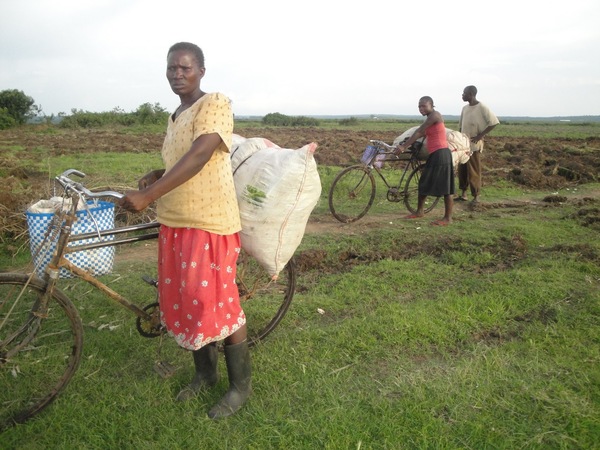
Dominion Farms arrived in Kenya’s Yala Swamp basin in 2004 with big promises. The company claimed it would turn a defunct state demonstration farm into a modern rice plantation, provide locals with good jobs, and build hospitals and schools. The American owner of the company, Calvin Burgess, presented himself as a ‘man of God’, on a mission to bring US-style progress to Africa. The locals, sold on this grand vision, decided – with some hesitation and dissent – to allow Dominion to farm on 3,700 ha of their lands.
But a decade later, the communities have harvested nothing but hardship.
Yala Swamp (Photo: Janak Communications)
“When Burgess came, we did not object to him taking the lands that had already been allocated to the Government years before for the development of an experimental farm,” says Erastus Odindo, a local farmer. “But Dominion Farms has put a fence around much more land than that. The company has taken over all of our community lands without our consent and blocked our access to water.”
Odindo and other local farmers lost nearly all of the lands that they use for grazing their cattle.
“Burgess mocked our farming methods and said we should abandon our traditional cattle breed because it was backwards,” says Odindo. “But now he’s put a fence around our grazing lands and is using the lands for his own local cattle. We are losing doubly because he then sells the cattle on the local market and undercuts us.”
The agreements that Dominion Farms signed with local authorities were for a large scale rice farm. But the company has also gone into cattle, vegetables, bananas and fish.
“The company produces and sells the same foods we local farmers produce,” says Odindo. “First Dominion took our lands and water away from us, and now it is taking our markets. And they are not doing agriculture in a more efficient way than us local farmers. All the machines they have are just for making noise.”
Dominion’s rice farm now extends right up to the edge of Odindo’s village. “When the company sprays pesticides by plane, it comes directly into our homes, poisoning people and contaminating our water supply,” he says. “Workers also face regular exposure to pesticides.”
The local communities accuse Dominion of polluting their soil, water and air, and of badly damaging the area’s biodiversity. They say that it is now difficult to access clean water because of the pollution by pesticides and chemical fertilisers, and that this is damaging the health of mothers and children.
Odindo says that the company’s promises of good jobs have also proven to be a mirage. Most workers are employed on a casual basis, with only a few watchmen hired as permanent staff. Their pay is irregular and sometimes late. “The company hasn’t been paying wages over the past two months and people have been wondering if it’s in financial problems,” says Odindo.
But Dominion still seems intent on grabbing more lands. Having already taken control of all the lands collectively managed by the communities, the company is now aggressively pursuing deals with private land holders. Odindo says that they believe that Dominion is working with Kenyan millionaires to secure land for large agriculture projects, such as a sugar cane plantation that the company is in the initial stages of implementing.
Meanwhile Dominion Farms is also pursuing a new project for a rice plantation in Taraba State, Nigeria, that would be several times the size of its Yala Swamp venture. Odindo hopes that the communities in Nigeria can learn from what his community has gone through and not be duped by Dominion’s promises.
For further information, please contact:
Erastus Odindo: erastusodindo@yahoo.com
Chris Owalla: owallac@ciagkenya.org
(Thanks to Chris Owalla of CIAG-Kenya for his help with this interview)
Obama Increases Nuclear Weapons Production and Research
By Noel Brinkerhoff | AllGov | October 27, 2014
The U.S. nuclear weapons complex is greatly expanding the production of fissile cores to levels not seen since the end of the Cold War three decades ago.
The dramatic increase comes as part of a long-term billion-dollar effort to renew the nuclear arsenal under President Barack Obama, who won the Nobel Peace Prize largely because of his promise to greatly reduce the nation’s stockpile of these weapons—a promise he has not kept.
Instead, the Department of Energy, which oversees the nuclear weapons laboratories, is planning to produce 80 explosive plutonium cores—the key to every warhead—a year by 2030, according to The Guardian. The U.S. hasn’t needed this level of production since it was facing nuclear Armageddon with the former Soviet Union last century.
Over the next decade, the federal government plans to spend $355 billion modernizing the nuclear arsenal even though there are 15,000 cores in reserve in a Texas facility.
“I’ve never seen the justification articulated for the 50-80 pits per year by 2030,” James Doyle, a former scientist in the Nuclear Nonproliferation Division at the Los Alamos National Laboratory, said. Doyle was fired last summer for publishing an article that urged nuclear disarmament, even though the laboratory had approved the article for publication.
The commitment to build more cores stands in stark contrast to Obama’s declaration after taking over the White House in 2009 to cut the stockpile from 5,113 warheads to 1,500 by 2016. Only 309 weapons have been destroyed under his watch. His predecessor, George W. Bush, “cut the nuclear stockpile in half during his eight years in office,” Caty Enders at The Guardian reported.
Plans to expand nuclear weapons production come at a time when the Energy Department is still recovering from a significant accident earlier this year at the nation’s only repository for nuclear weapons waste. The Waste Isolation Pilot Plant in New Mexico has been closed since February, when a drum of radioactive waste exploded and exposed 22 workers to radiation.
To Learn More:
Nuclear Weapons Expansion Pushed in Congress Despite Accidents at Lab (by Caty Enders, The Guardian)
What Happened at WIPP in February 2014 (Department of Energy)
Nuclear Weapons are not Going Away…3,970 Still Deployed (by Noel Brinkerhoff and Steve Straehley, AllGov)
GAO Audit Accuses Obama Administration of Lowballing Cost of Maintaining Nuclear Arsenal (by Noel Brinkerhoff, AllGov)
Merkel angry over calls by business leaders insisting that EU sanctions against Moscow be eased
ITAR-TASS | October 26, 2014
BERLIN – There is growing discontent in the German Chancellery that leaders of key German concerns are making attempts to influence the government’s policy towards Russia, Der Spiegel weekly said on Sunday.
Chancellor Angela Merkel “is angry over numerous calls by leaders of the DAX companies [Germany’s index] that insist the EU sanctions against Moscow be eased”, the weekly said.
“The meeting between businessmen and Russian Prime Minister Dmitry Medvedev in early week aroused less delight,” Der Spiegel said pointing to the session of the Foreign Investment Advisory Council in Russia.
“The last thing we need is companies’ parallel foreign policy,” the weekly said.
German officials, who took part in the meeting in Moscow, informed the German Chancellery and not the German Foreign Ministry about their trip to Russia as is usually done before such visits, Der Spiegel said.
The USA, EU, Canada and Australia have introduced sanctions against Russia over its involvement in the Ukrainian crisis.
Dr. Eberhard Sasse, President of the Chamber of Commerce and Industry for Munich and Upper Bavaria, said in early October Bavaria’s entrepreneurs want Western sanctions against Russia to be lifted.
“We have about 9,000 members in the Chamber of Commerce and Industry, and we all want the sanctions against Russia to be lifted, enabling business relations between our countries to develop further,” he said.
Sanctions as a foreign policy tool do not always produce the desired effect, Sasse said. “Sanctions create uncertainty in business prospects. This is a political tool and not a business tool,” he added.
Russia recognizes Ukraine poll despite violations, doubts
RT | October 27, 2014
It is obvious that the Supreme Rada elections in Ukraine can be considered valid despite a rather harsh and dirty campaign, Russia’s deputy foreign minister has said.
“We expect the official confirmation of the elections result, the information we are getting now is quite controversial. But even now it is obvious that the elections have taken place, despite a hard struggle and dirty tricks,” the Interfax news agency quoted Grigory Karasin as saying.
“The forming balance of forces will probably allow the Ukrainian authorities to deal with some rooted problems in the society,” the senior Russian diplomat added.
Karasin’s words echo an earlier statement from Russia’s UN envoy Vitaly Churkin who described the Ukrainian parliamentary campaign as “dirty and cynical”, but did not exclude the possibility of cooperation between Russian authorities and the new Rada.
The head of the Russian Upper House’s commission for monitoring the situation in Ukraine, Senator Vladimir Dzhabarov told the RIA Novosti news agency that Russian officials would try to cooperate with the freshly elected Ukrainian government despite doubts of its legitimacy.
“The southeast has not voted and there were lots of violations,” he said.
Dzhabarov noted that the new Rada would be much more radical than the previous one and emphasized the fact that the Communist Party of Ukraine did not make it into the parliament. Communists held over 13 percent of seats in the Rada after 2012 polls. The Russian senator said that this was a very surprising fact in a democratic country.
“We will attempt to cooperate in any case. We hope that reason would prevail among our new colleagues,” the senator said. “We cannot but attempt to build cooperation with the Rada because we have common history and we are neighbors.”
He also added that Russian Upper House chair, Valentina Matviyenko, had already sent the Ukrainian parliament an invitation to participate in the November session of the parliamentary assembly of the Russia-led CIS economic and political bloc.
The head of the Federation Council’s Committee for Constitutional Law, Andrey Klishas, promised the Russian parliament would cooperate with Ukrainian politicians who press for an end to the civil war and oppose the neo-Nazi state, and the arbitrariness and mass violations of human rights in Ukraine
“Ukrainians themselves cannot fail to notice the mass violations of human rights during the latest parliamentary campaign. These were the ban of free speech, attacks on opposition candidates, mass violence in the form of the so called ‘popular gatherings,’ even lynch mobs on the side of the pro-fascist political forces,” Klishas told RIA Novosti.
According to latest reports PM Arseny Yatsenyuk’s People’s Front party is ahead of rivals with 21.69 percent of votes, and President’s Petro Poroshenko Bloc is only slightly behind, so far garnering 21.63 percent. The other four parties making it into the Ukrainian parliament are the Samopomosh of Lvov’s Mayor Andrey Sadovy (10.9), Opposition Bloc (9.77), Radical Party of Oleg Lyashko (7.47), and Yulia Tymoshenko’s party Batkivshchina (Fatherland) (5.77).
Militarism and Capital Accumulation
The Pentagon and Big Oil
By James Petras | October 25, 2014
There is no question that, in the immediate aftermath and for several years following US military conquests, wars, occupations and sanctions, US multi-national corporations lost out on profitable sites for investments. The biggest losses were in the exploitation of natural resources – in particular, gas and oil – in the Middle East, the Persian Gulf and South Asia.
As a result some observers speculated that there were deep fissures and contradictory interests within the US ruling class. They argued that, on the one hand, political elites linked to pro-Israel lobbies and the military industrial power configuration, promoted a highly militarized foreign policy agenda and, on the other hand, some of the biggest and wealthiest multi-national corporations sought diplomatic solutions.
Yet this seeming ‘elite division’ did not materialize. There is no evidence for example that the multi-national oil companies sought to oppose the Iraq, Libyan, Afghan, Syrian wars. Nor did the powerful 10 largest oil companies with a net value of over $1.1 trillion dollars mobilize their lobbyists and influentials in the mass media to the cause of peaceful capital penetration and domination of the oil fields via neo-liberal political clients.
In the run-up to the Iraq war, the three major US oil companies, Exxon Mobil, Chevron, Conoco Phillips, eager to exploit the third largest oil reserves in the world, did not engage in Congressional lobbying or exert pressure on the Bush or later Obama Administration for a peaceful resolution of the conflict. At no point did the Big Ten challenge the pro-war Israel lobby and its phony arguments that Iraq possessed weapons of mass destruction with an alternative policy.
Similar “political passivity” was evidenced in the run-up to the Libyan war. Big Oil was actually signing off on lucrative oil deals, when the militarists in Washington struck again – destroying the Libyan state and tearing asunder the entire fabric of the Libyan economy.
Big oil may have bemoaned the loss of oil and profits but there was no concerted effort, before or after the Libyan debacle, to critically examine or evaluate the loss of a major oil producing region. In the case of economic sanctions against Iran, possessing the second largest oil reserves, the MNC again were notable by their absence from the halls of Congress and the Treasury Department where the sanctions policy was decided. Prominent Zionist policymakers, Stuart Levey and David Cohen designed and implemented sanctions which prevented US (and EU) oil companies from investing or trading with Teheran.
In fact, despite the seeming divergence of interest between a highly militarized foreign policy and the drive of MNCs to pursue the global accumulation of capital, no political conflicts erupted. The basic question that this paper seeks to address is: Why did the major MNCs submit to an imperial foreign policy which resulted in lost economic opportunities?
Why the MNCs Fail to Oppose Imperial Militarism
There are several possible hypotheses accounting for the MNC accommodation to a highly militarized version of imperial expansion.
In the first instance, the CEOs of the MNCs may have believed that the wars, especially the Iraq war, would be short-term, and would lead to a period of stability under a client regime willing and able to privatize and de-nationalize the oil and gas sector. In other words, the petrol elites bought into the arguments of Rumsfeld, Chaney, Wolfowitz and Feith, that the invasion and conquest would “pay for itself”.
Secondly, even after the prolonged-decade long destructive war and the deepening sectarian conflict, many CEOs believed that a lost decade would be compensated by “long term” gain. They believed that future profits would flow, once the country was stabilized. The oil majors entry after 2010; however, was immediately threatened by the ISIS offensive. The ‘time frame’ of the MNCs’ strategic planners was understated if not totally wrong headed.
Thirdly, most CEOs believed that the US-NATO invasion of Libya would lead to monopoly ownership and greater profits than what they received from a public-private partnership with the Gaddafi regime. The oil majors believed that they would secure total or majority control. In other words the war would allow the oil MNCs to secure monopoly profits for an extended period. Instead the end of a stable partnership led to a Hobbesian world in which anarchy and chaos inhibited any large scale, long-term entry of MNCs.
Fourthly, the MNCs, including the big oil corporations, have invested in hundreds of sites in dozens of countries. They are not tied to a single location. They depend on the militarized imperial state to defend their global interests. Hence they probably are not willing to contest or challenge the militarists in, say Iraq, for fear that it might endanger US imperial intervention in other sites.
Fifthly, many MNCs interlock across economic sectors: they invest in oil fields and refineries; banking, financing and insurance as well as extractive sectors. To the degree that MNCs’ capital is diversified they are less dependent on a single region, sector, or source for profit. Hence destructive wars, in one or several countries, may not have as great a prejudicial effect as in the past when “Big Oil” was just ‘oil’.
Six, the agencies of the US imperial state are heavily weighted to military rather than economic activity. The international bureaucracy of the US is overwhelmingly made up of military, intelligence and counter-insurgency officials. In contrast, China, Japan, Germany and other emerging states (Brazil, Russia and India) have a large economic component in their overseas bureaucracy. The difference is significant. US MNCs do not have access to economic officials and resources in the same way as China’s MNCs. The Chinese overseas expansion and its MNCs, are built around powerful economic support systems and agencies. US MNCs have to deal with Special Forces, spooks and highly militarized ‘aid officials’. In other words the CEOs who look for “state support” perforce have mostly ‘military’ counterparts who view the MNCs as instruments of policy rather than as subjects of policy.
Seventh, the recent decade has witnessed the rise of the financial sector as the dominant recipient of State support. As a result, big banks exercise major influence on public policy. To the extent that is true, much of what is ‘oil money’ has gone over to finance and profits accrue by pillaging the Treasury. As a result, oil interests merge with the financial sector and their ‘profits’ are as much dependent on the state as on exploiting overseas sites.
Eighth, while Big Oil has vast sums of capital, its diverse locations, multiple activities and dependence on state protection (military), weaken its opposition to US wars in lucrative oil countries. As a result other powerful pro-war lobbies which have no such constraints have a free hand. For example the pro-Israel power configuration has far less ‘capital’ than any of the top ten oil companies. But it has a far greater number of lobbyists with much more influence over Congress people. Moreover, it has far more effective propaganda – media leverage- than Big Oil. Many more critics of US foreign policy, including its military and sanctions policies, are willing to criticize “Big Oil” than Zionist lobbies.
Finally the rise of domestic oil production resulting from fracking opens new sites for Big Oil to profit outside of the Middle East – even though the costs may be higher and the duration shorter. The oil industry has replaced losses in Middle East sites (due to wars) with domestic investments.
Nevertheless, there is tension and conflict between oil capital and militarism. The most recent case is between Exxon-Mobil’s plans to invest $38 billion in a joint venture in the Russian Arctic with the Russian oil grant Rosneft. Obama’s sanctions against Russia is scheduled to shut down the deal much to the dismay of the senior executives of Exxon Mobil, who have already invested $3.2 billion in an area the size of Texas.
Conclusion
The latent conflicts and overt difference between military and economic expansion may eventually find greater articulation in Washington. However, up to now, because of the global structures and orientation of the oil industry, because of their dependence on the military for ‘security’, the oil industry in particular, and the MNCs in general, have sacrificed short and middle term profits for “future gains” in the hopes that the wars will end and lucrative profits will return.
Report: Last Wednesday’s ‘light rail attack’ by Palestinian driver was a car accident
By Celine Hagbard | IMEMC News | October 26, 2014
As Israeli right-wingers continue to gather at the site of the death of a 3-month old baby on Wednesday, reports from the police investigating the incident and eyewitnesses on the scene indicate that the incident was a hit-and-run car accident, not a deliberate attack.
21-year old Abdel Rahman al-Shaludi had been at the clinic earlier on Wednesday complaining of a fever and illness. He had returned home and gone to bed, but then went back out and was driving too fast on a Jerusalem road when he ran into a group of pedestrians with his car.
He tried to flee the scene of the crash, but was shot dead by Israeli police.
While this incident has made media headlines throughout the world, a similar incident this past Sunday, in which two five-year old Palestinian girls walking home from school were hit by an Israeli settler vehicle, killing one and critically wounding the other, has not received much press.
The settler who killed the 5-year old girl also fled the scene of the crash – he was later apprehended by Israeli police, but was not charged with any crime. Israeli police determined (without interviewing any of the numerous Palestinian witnesses who were on the scene) that it was an accident, and no charges were filed.
Abdel Rahman al-Shaludi’s cousin Abed al-Shaludi told reporters with the Israeli paper Ha’aretz, “We believe that he was shot and killed in cold blood and there was no attempt to question him, and hear his side of the story, and that he deserves a funeral like everyone else.” The body of Abdel Rahman al-Shaludi remains in Israeli police custody, and the family has not been able to hold the funeral yet.
The cousin of the deceased man added, “ I still believe that he had an accident. If he wanted to carry out an attack, why did he wait until he got there? The videos don’t show that it was definitely an attack, and he might have lost control of his vehicle. For the Israelis, that’s an attack, and they shoot him to death.”
A video posted on social media, filmed from an angle above the highway, shows the car crossing the center line and hitting pedestrians who were walking in the median.
A statement by the family of the driver, published on the Israeli news website Ynetnews, states, “We are certain that this was a regular car accident. Over the past few days he did not feel well and it could be due to his illness that he lost control of the wheel. Many similar accidents have occurred in many places and there was no suspicion of a terrorist attack.”
“A few days ago a Jewish settler knocked over two girls near Ramallah. He killed one and the other is in serious condition. The police immediately said it was a car accident. In our case they said the opposite in seconds. This is because the driver was an Arab driver. When a Jewish driver was involved in an accident the attitude was different and no one shot him.”
The U.S. government immediately labeled the incident a ‘terrorist attack’, with State Department spokesperson Jen Psaki saying, “The United States condemns in the strongest possible terms today’s terrorist attack in Jerusalem.” She said that the baby who died in the incident was reportedly a U.S. citizen.
In the clashes that have followed Wednesday’s incident, another U.S. citizen child, 14-year old Orwah Hammad from New Orleans, was killed. He was shot in the head by Israeli forces on Friday. … Full article
Coca Cola’s involvement in the Occupation of Palestine
Who Profits | October 26, 2014
The Central Bottling Company (CBC) or Coca Cola Israel is a manufacturer and distributor of soft drinks, dairy products and alcoholic beverages. CBC began its operation in 1967 upon receiving the Israeli franchise of Coca Cola products from Coca Cola International.
Through its fully owned subsidiary – The Central Company for Sales and Distribution, CBC holds a regional distribution center in the Atarot settlement industrial zone. The Atarot distribution center is responsible for marketing the company’s beverages to the Palestinian population of East Jerusalem. Simultaneously, the Palestinian franchisee – The National Beverages Company (NBC) is denied access to East Jerusalem, which therefore constitutes a captive market for the Israeli distributor.
In 2006 CBC purchased Tabor Winery – an Israeli winery that owns vineyards near mount Shifon in the occupied Golan Heights. Grapes from the Shifon vineyards are used in Tabor’s white wines.
CBC also owns Tara (Milco Industries), whose subsidiary, Meshek Zuriel Dairy (81%), holds a dairy farm and a head office in the settlement of Shadmot Mehola in the Jordan Valley.
Israel bans Palestinians from settlers’ buses in West Bank
MEMO | October 26, 2014
Israeli authorities have bowed to pressure from Jewish settlers and ordered a ban on Palestinians from using Israeli-run buses in the West Bank, Israeli daily Haaretz reported Sunday.
According to the paper, Israeli Defense Minister Moshe Ya’alon has issued instructions to the civil administration in the Israeli army to ban Palestinian workers from traveling by Israeli-run buses upon their return from their work places inside Israel to the West Bank.
The ban will go into effect at the beginning of next month, the paper said, noting that it came following intensive pressures from the settlers in the northern West Bank.
The paper said the settlers sought for the past year to prevent Palestinians from travelling in their buses for security reasons.
It noted that the decision contradicts the stance of the Israeli army leadership which asserted that the Palestinian workers do not pose any security risk because they already go through a security check before being given permits to enter Israel.
Palestinians in northern West Bank who work inside Israel need to pass through the Eyal checkpoint near Qalqilya city, where they are subject to security screening.
“Every day in the morning, we pass through Eyal checkpoint for security check, which takes more than two hours,” Ahmad al-Toor, 44, told Anadolu Agency.
“Upon our return, we use settlers’ buses in the West Bank, which pass near our villages,” he added.
“During our return trips, we are subject to frequent harassments by the settlers,” he added. “But standing for additional two hours under security pretexts when we return is too exhausting.”
The Israeli authorities has issued permits to nearly 150,000 Palestinian workers from the West Bank to work inside Israel.
About 500,000 Israelis now live in more than one hundred Jewish-only settlements built since Israel occupied the West Bank and East Jerusalem in 1967. The Palestinians want these areas, along with the Gaza Strip, to establish their future state.
International law views the West Bank and East Jerusalem as “occupied territories,” considering all Jewish settlement building on the land illegal.
Featured Video

America Racing to Strategic Defeat in Iran
or go to
Aletho News Archives – Video-Images
From the Archives
Should Europeans ‘Thank’ the Americans for Destroying Nord Stream?
By Robert Bridge | Strategic Culture Foundation | September 29, 2022
With an investigation continuing into the destruction of the Nord Stream gas pipeline that provided energy supplies to Europe from Russia, there appears to be just one prime suspect, and that should surprise nobody.
Following the sabotage of the Nord Stream 1 and 2 gas pipelines, former Polish Foreign Minister Radoslaw Sikorski already seemed to know the identity of the perpetrator when he tweeted out: “Thank you, USA.”
At first glance, it seemed that Sikorski was speaking sarcastically, berating Washington for carrying out an attack that will have severe repercussions for the people of Europe. After all, how could anyone see any good coming from the termination of Europe’s primary source of gas reserves with winter just around the corner? It was Sikorski’s homeland of Poland, after all, that urged its citizens to collect firewood in the face of dwindling gas reserves.
In fact, the Polish diplomat was speaking one-hundred percent literally… continue
Blog Roll
 Aletho News
- Growing insecurity, soaring prices fuel protests in north as regime bans evacuation: Sources
- Iran denies responsibility for ‘depraved’ attack on Kuwait desalination plant
- Bring The Troops Back. End This War Now!
- Can we please stop calling Israel the ‘only democracy in the Middle East’ now?
- US should start removing its troops for Germany, proposes AfD co-leader Chrupalla
- Iran Red Crescent: 600 educational centers attacked in US-Israeli ‘war crimes’
- Russian Oil Tanker Arrives in Cuba Amid U.S. Blockade
- America Racing to Strategic Defeat in Iran: Lt Col Daniel Davis
- FTC Warns Visa, Mastercard, PayPal, Stripe Over Political Debanking
- Russian tanker approaches Cuba despite US oil blockade
- If Americans Knew
- Israeli police block Catholic cardinal from entering Church of the Holy Sepulchre on Palm Sunday
- Israel is assassinating journalists again, more than any other nation, anywhere, ever – Not a ceasefire Day 170
- Over 300 US service members wounded, majority have brain injuries – Not a ceasefire Day 169
- Researchers at Human Rights Watch Resign Over Blocked Report on Palestinian Refugee Return
- Jewish Groups Are Backing a War Americans Don’t Want
- Eric Fingerhut Thinks He’s the President of the Jews
- Top Jewish Philanthropists, Rabbis Urge Israeli President to Take Action Against ‘Jewish Extremists’
- Don’t Be Fooled. Zionist Leaders Have Always Wanted to Control Southern Lebanon
- Israel’s widespread use of torture is a core element of its genocide against the Palestinian people
- In Israel’s War on Iran, Many Middle East US Bases Rendered “All But Uninhabitable”
- No Tricks Zone
- New Study Finds Warming Saves Lives…Cold Temperatures 12 Times More Deadly Than Excess Heat
- German Science Blog Accuses PIK Climate Institute Of Hallucinating Climate Tipping Points
- Devastating Assessment Of Comirnaty Vaccine By Former Senior Pfizer Europe Toxicologist
- New Study: CO2 Is ‘Effectively Negligible’ As An Explanatory Climate Change Factor Since 2000
- Former Pfizer Toxicologist Dr. Helmut Sterz Tells Bundestag Hearing Pfizer Vaccine Should Have Never Been Approved
- Energy Expert: Germany’s Nuclear Phaseout Was A “500 Billion Euro Mistake”
- New Research: South Australia’s Mid-Holocene Sea Surface Temperatures Were 4°C Warmer Than Today
- Storing Green Energy To Last Germany 10 Days Would Require A 60-Million Tonne Battery
- New Studies: UK Sea Levels Were 4 Meters Higher Than Today During The Mid-Holocene
- Destructive Green New Deal: German Energy And Metal Group Warns Of Drastic Crisis
 Aletho News