Over 1.7 million Gazans isolated from the world after Israel, Egypt close crossings
Al-Akhbar | November 2, 2014
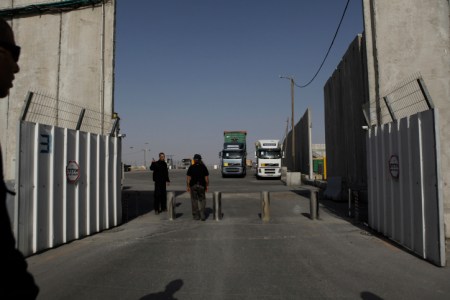
Gaza has become an open-air prison after Israel decided to close two border crossings with Gaza, the army said on Sunday, after a rocket allegedly fired from the Palestinian enclave struck its territory.
The Israeli blockade comes a week after Egypt closed its border with Gaza. With all borders closed, more than one and a half million people in Gaza are now isolated from the outside world. They are prisoners inside the 360 square kilometers that make up the coastal Strip.
“The crossing points for people and goods, Erez and Kerem Shalom, have been closed until further notice except for humanitarian aid,” an army spokeswoman said.
She said that the measure was taken after a rocket fired from Gaza hit Israeli-occupied Palestinian territory on Friday, without causing any casualties or damage.
There was no claim of responsibility from any armed faction in Gaza. A military spokeswoman said forces were still searching for debris.
The projectile struck harmlessly was the first to strike Israeli-occupied territory since September 16, and the second since the end of the Zionist state’s devastating 51-day assault on Gaza.
For 51 days this summer, Israel pounded the Gaza Strip – by air, land and sea – with the stated aim of ending rocket fire from the coastal enclave.
More than 2,160 Gazans, at least 505 of them children, were killed – and 11,000 injured – during seven weeks of unrelenting Israeli attacks in July and August.
The Israeli offensive ended on August 26 with the an Egypt-brokered cease-fire agreement.
However, Israel has violated the terms of the agreement repeatedly ever since.
The agreement calls for reopening Gaza’s border crossings with Israel after an eight-year blockade. Instead, Israel has further sealed the crossings.
The truce also stipulated that Israel would immediately expand the fishing zone off Gaza’s coast, allowing fishermen to sail as far as six nautical miles from shore, and would continue to expand the area gradually.
However, since the ceasefire was signed, Israeli forces have fired at several fishermen who they say have ventured beyond the newly-imposed limit of six nautical miles.
The head of the Gaza fishermen syndicate accused Israel of constantly violating the terms of the agreement.
“Since signing the truce, the Israeli army has violated (the agreement) eight times, arresting fishermen and destroying a giant fishing boat, in addition to firing at fishermen on a daily basis,” he said.
Besides the fishermen, Israeli forces have also fired at other civilians. On Wednesday, Israeli forces shot and injured a Palestinian man on the beach in the northern Gaza Strip.
Furthermore, Gaza is also littered with a large number of unexploded Israeli shells, one of which has recently killed 4-year-old Mohammed Sami Abu-Jrad from the northern Gaza city of Beit Hanoun.
Israel also agreed to allow construction material into Gaza. But two months after the war ended, no building material has entered Gaza due to Israel’s ongoing blockade.
Israel routinely bars the entry of building materials into the embattled coastal enclave on grounds that Palestinian resistance faction Hamas could use them to build underground tunnels or fortifications.
For years, the Gaza Strip has depended on construction materials smuggled into the territory through a network of tunnels linking it to Egypt’s Sinai Peninsula.
A recent crackdown on the tunnels by the Egyptian army, however, has effectively neutralized hundreds of tunnels, severely affecting Gaza’s construction sector.
Egypt leaves Gaza isolated
On Wednesday, Egypt began setting up a buffer zone along its border with the Gaza strip in a move which will see about 800 homes demolished.
It comes in the wake of a suicide car bombing which killed 30 Egyptian soldiers in Sinai last week, the deadliest attack on the military since ousting Egypt’s former president Mohammed Mursi.
Following the bombing, Egypt immediately closed the Rafah crossing into the Gaza Strip, the principal connection between Gaza’s 1.7 million people and the outside world.
In August, Egypt’s authorities have used an attack on the Egyptian military in Sinai as a pretext to start a campaign to destroy lifelines into Gaza. Over 120 tunnels were blown up or filled in.
More than just being the only way for some products to make it into the over 1.5 million Palestinians living in the strip, the Gaza tunnels have become a major source of income for the transporters of goods. Egypt has closed Gaza’s lifelines.
Since the beginning of 2014 until the end of May, Rafah crossing has been opened only 14 out of 120 days, limiting access to humanitarian cases and for other authorized travelers – including foreign nationals and visa holders.
(AFP, Reuters, Al-Akhbar)
No comments yet.
Featured Video

Bombing Hitler’s Hometown
or go to
Aletho News Archives – Video-Images
From the Archives
‘Conspiracy Theory’ Now Fact: Greater Israel Has Arrived
By Kit Klarenberg | Mint Press News | January 28, 2025
Ever since Tel Aviv’s 1948 creation, much has been said and written about ‘Greater Israel’ – the notion Zionism’s ultimate end goal is the forcible annexation and ethnic cleansing of vast swaths of Arab and Muslim lands for Jewish settlement, based on Biblical claims this territory was promised to Jews by God. The mainstream media typically dismisses this concept as antisemitic conspiracy theory, or at most the fringe fantasy of a minuscule handful of extremist Israelis.
In reality … continue
Blog Roll
 Aletho News
- Seizing the Kharg: Washington’s path to defeat in the Persian Gulf
- Iran reports 500 US casualties in strikes on covert US military sites
- Pro-Israel terrorist arrested before assassination of pro-Palestinian activist
- Bombing Hitler’s Hometown
- German journalist threatened with homelessness as German court upholds EU sanctions in landmark free speech case
- US Tells Allies That Ukraine-Bound Arms Could be Sent to Middle East
- Organized terrorism: Iran condemns killing of its diplomats in Lebanon
- Why could Gaza enter the regional war?
- Hamas official rejects Mladenov Plan linking disarmament to Gaza reconstruction
- Two Primary Elections for the Soul of ‘America First’
- If Americans Knew
- Researchers at Human Rights Watch Resign Over Blocked Report on Palestinian Refugee Return
- Jewish Groups Are Backing a War Americans Don’t Want
- Eric Fingerhut Thinks He’s the President of the Jews
- Top Jewish Philanthropists, Rabbis Urge Israeli President to Take Action Against ‘Jewish Extremists’
- Don’t Be Fooled. Zionist Leaders Have Always Wanted to Control Southern Lebanon
- Israel’s widespread use of torture is a core element of its genocide against the Palestinian people
- In Israel’s War on Iran, Many Middle East US Bases Rendered “All But Uninhabitable”
- ‘Burn the lawn’: Israel pursues ‘Rafah model’ in southern Lebanon
- A genocide here, an amputation there
- Reports: Iran mobilizing 1M fighters, Israel-US run low on ammo, Israeli army faces shortage – Not a ceasefire Day 168
- No Tricks Zone
- Devastating Assessment Of Comirnaty Vaccine By Former Senior Pfizer Europe Toxicologist
- New Study: CO2 Is ‘Effectively Negligible’ As An Explanatory Climate Change Factor Since 2000
- Former Pfizer Toxicologist Dr. Helmut Sterz Tells Bundestag Hearing Pfizer Vaccine Should Have Never Been Approved
- Energy Expert: Germany’s Nuclear Phaseout Was A “500 Billion Euro Mistake”
- New Research: South Australia’s Mid-Holocene Sea Surface Temperatures Were 4°C Warmer Than Today
- Storing Green Energy To Last Germany 10 Days Would Require A 60-Million Tonne Battery
- New Studies: UK Sea Levels Were 4 Meters Higher Than Today During The Mid-Holocene
- Destructive Green New Deal: German Energy And Metal Group Warns Of Drastic Crisis
- New Study Documents A 20-Year Pause In Arctic Sea Ice Decline – Driven By Internal Variability
- Wake-up Call: Survey Shows Majority Of Germans Now Favor Postponing Climate Targets!
 Aletho News
Leave a comment