Zionist Attorney-General Refuses to Answer Questions About “Anti-Terrorism” Laws
By Joshua Blakeney | Non-Aligned Media | November 27, 2014
 Recently Israel’s department for her colonies of Australia and Canada dispatched new “anti-terror” legislation which will make it illegal for Australian and Canadian subjects of the Israeli Empire to “condone” so called “terrorism”.
In the above video Australia’s Zionist Attorney-General, George Brandis, can be viewed enabling such farcical anti-free-speech laws to be foisted upon the people of Australia without oversight, by refusing to answer critical questions from senators about the controversial legislation.
That Canada and Australia are governed out of the same colonial office in Tel Aviv was suggested when it was revealed that Prime Ministers John Howard and Stephen Harper had been given the same pro-Iraq-war script to read in 2003 (see below).
US helping Israel boycott Geneva summit on occupied territories – diplomatic sources
RT | November 27, 2014
Switzerland is under diplomatic pressure from Israel, the US, Canada and Australia, which are trying to prevent an international conference in Geneva from taking place in mid-December on Israel’s occupation of Palestinian territories, Haaretz reports.
Delegations from nearly 200 countries are expected to head to Geneva to discuss the situation in the West Bank, Gaza Strip and East Jerusalem. Yet, according to Haaretz, Israeli and Western diplomats are ready to go for broke to prevent the gathering from taking place.
Switzerland, as the main sponsor of the summit, is bearing the brunt of diplomatic pressure from all sides.
Israeli authorities told the media outlet that Palestinians and Arab states are also pressing Swiss officials to send out letters of invitation to the conference within a matter of days, the Israeli daily reported on Wednesday.
It was in early April when Israel announced plans of constructing 700 new houses in occupied East Jerusalem, a move that pushed Palestinian Authority President Mahmoud Abbas to ask 15 international conventions to join them in the name of the Palestinian state.
One of those was the Fourth Geneva Convention (signed 1949, came into force 1950), which specifically addresses protection of civilians in war zones and territories under military occupation.
Washington finally accepted that its efforts to extend peace talks between Israel and the Palestinians have been torpedoed. Several weeks later, Palestinians and the Arab League sent an official request to Switzerland to hold an international conference of the Fourth Geneva Convention signatory states on the issues of the Israeli occupation of the West Bank and East Jerusalem, together with the damage caused by Israel’s armed forces to civilians in Gaza.
The last time the signatories to the Fourth Geneva Convention gathered in regard to the Israeli-Palestinian conflict was in 2001, after the outbreak of the second intifada. That conference was boycotted by Israel and the United States.
After that summit there have been four fruitless attempts to gather the Fourth Geneva Convention on the issue of Israeli-Palestinian relations. Even the bloody Israeli military Operation Cast Lead in the Gaza Strip in 2009 failed to raise broad international support for holding such a conference, according to the Swiss Foreign Ministry at the time.
The necessity to call the new conference has been not evident this time, too, so Swiss diplomats asked every Fourth Geneva Convention signatory separately whether the time had come to hold a summit.
What the Swiss diplomats have proposed is a three-hour conference at an ambassadorial level, no discussions and no media coverage except for a final press statement. The conference is set to be focused on implementation of the international humanitarian law in troubled Israeli-Palestinian relations.
“We made it clear we didn’t want a political event or debate club, or a conference that would blame or criticize one of the sides,” a Swiss diplomat said.
However small the scale of the proposed event is, Israel strongly objected to it. Israeli diplomats reportedly conducted negotiations in Bern and Geneva, trying to persuade Swiss counterparts to call off the initiative and threatening to boycott it anyway.
“They told us that holding the conference would help a one-sided Palestinian move intended to make Israel look bad and attack it in an international forum,” the Swiss diplomat said.
The US and Canada told Switzerland they are going to boycott the conference, too.
“We strongly oppose the convening of the High Contracting Parties to the Geneva Conventions and have made our opposition unmistakably clear,” a spokesman for the US State Department, Edgar Vasquez, told Haaretz.
It is true that the conference will have no authority to make any binding decisions, yet its work could engender further international criticism of Israel’s settlement policy on the occupied Palestinian territories.
Besides that, once Israeli diplomats received an updated draft of the conference’s proposed contents, they found out that the updated draft text had been phrased in a politicized way, directly naming Israel and going into detail on the issue of West Bank settlements.
Israeli Foreign Minister Avigdor Lieberman has reportedly been ringing colleagues around the globe, attempting to talk them into declaring a boycott to the conference. Part of this work has been delegated to Israeli ambassadors worldwide.
With all due support on the part of the US, Canada and Australia, these efforts are likely to be in vain, and the Swiss diplomacy is decisive to go on with the plan and announce the conference officially soon.
The Fourth Geneva Convention prohibits harming those uninvolved in a conflict, be they civilians, wounded soldiers or POWs, as well as obliging the occupying side to maintain human rights and decent living conditions of an occupied civilian population.
Israel joined the convention, but has never ratified it legislatively. The Israeli government regards the West Bank and East Jerusalem as ‘disputed’, not occupied, areas, therefore considering Israeli settlements as not violating the treaty.
Ebola’s Racial Disparity
By Kwei Quartey | FPIF | November 26, 2014
American healthcare workers Nancy Writebol, Kent Brantly, Craig Spencer, and Rick Sacra, as well as NBC cameraman Ashoka Mupko, were all beneficiaries of the medical sophistication of the U.S. hospital system.
All of them contracted Ebola in West Africa and lived to tell the tale, emerging from the hospital Ebola-free and appearing remarkably robust. They benefited from early diagnosis, prompt evacuation to the leading U.S. special isolation centers, and in some cases, treatment with convalescent serum and the experimental drug ZMapp.
The story is quite different for some other high-profile Ebola victims.
Martin Salia, a legal and permanent Maryland resident, was the medical director of Sierra Leone’s Kissy United Methodist Hospital and its only full-time physician. As one of a shockingly small number of doctors in that country—a mere 136 for a population of 6 million—Salia was a rare breed of physician capable of treating anything from orthopedic injuries to myocardial infarction.
In Africa, physician scarcity often precludes the luxurious medical division of labor in the West. I once visited a mid-sized hospital in rural Ghana and foolishly asked the medical director how many other doctors shared his on-call schedule. “There aren’t any other doctors here,” he replied in bewilderment.
Salia, who was deeply religious, believed his calling was to serve the people of Sierra Leone, where Ebola continues to surge. Although he was not working at an Ebola treatment center, Salia could easily have been exposed to the disease through contact with surgical patients.
When Salia first fell ill in early November, his Ebola test returned negative. Three days later, a repeat test came back positive. But unlike white Americans Writebol, Brantly, Spencer, Sacra, and Mupko, Salia was not promptly transferred to the United States.
He began receiving convalescent serum in Sierra Leone, and five days elapsed before he was sent to an Ebola isolation center for treatment in the United States—around a week later into the illness than his white American counterparts. It seems clear that delays in Salia’s diagnosis and treatment resulted in his deterioration to a point beyond repair. By the time he arrived in the United States on November 15, his raging infection had already rendered him too ill to be saved.
But even worse was another Ebola case involving an African physician for whom therapy was withheld outright. Sheik Umar Khan, a Sierra Leonean specialist in viral hemorrhagic fever, was diagnosed with Ebola last July and admitted to the Ebola Treatment Center in Kailahun, Sierra Leone.
The team of physicians from Médecins Sans Frontières (MSF) and the World Health Organization who took care of Khan reportedly “agonized through the night” over whether to administer ZMapp to him.In the end, without discussing it with Khan, they decided against it. “What they really didn’t want to do was kill Dr. Khan with their attempt at therapy,” Armand Sprecher, a public health specialist at MSF, reportedly said.
But surely the converse question should also have been posed: what if they cured Khan? Sprecher, who is involved in procuring drugs for MSF, further offered what from my perspective as a physician was the flimsiest of excuses: that Khan’s virus levels were so high that it was believed the drug would “probably not work.”
So which is it? That the team thought that the ZMapp would do nothing for their patient, or that it would kill him? It cannot be both.
Khan died several days later, and the very ZMapp that had been denied him was later sent to Liberia and used instead for Writebol and Brantly, who recovered admirably (though we cannot say for certain how much ZMapp contributed to their survival). In addition, Spanish officials confirmed that they too had obtained a supply of ZMapp for a third patient—a 75-year-old Spanish priest who died after having been evacuated to Madrid from Liberia.
In the now infamous story of Liberian Thomas Eric Duncan—who died in a Texas hospital after contracting Ebola in Africa—Duncan’s nephew Josephus Weeks has raised the possibility that racial bias entered into the decision to send the febrile man home from the Texas Health Presbyterian Hospital emergency room on September 25. Similar broad ethical questions arise about whether the treatment of Ebola victims is being stratified on criteria of national origin, making some “more equal than others.”
The physicians who have cared for these patients themselves would deny that any racial bias ever consciously entered into their decisions over choice of therapy. That, however, is exactly the trouble. Most racial bias among doctors is unconscious, meaning we must carefully consider whether our medical decisions reflect a double standard in the treatment of our patients—Ebola-infected or otherwise.
Kwei Quartey M.D. is a crime novelist and physician who grew up in Ghana. He is now based in Los Angeles. His fourth novel, GOLD OF THE FATHERS, will be published in February 2016.
The Politics of Thanksgiving Day
By William Loren Katz | November 5, 2014
Thanksgiving remains the most treasured holiday in the United States, honored by Presidents since Abraham Lincoln initiated the Holiday to rouse patriotism in a war that was not going well.
 Thanksgiving has often served political ends. In 2003, in the current age of US Middle East invasions, President George Bush flew to Bagdad, Iraq to celebrate Thanksgiving Day with U.S. troops. He sought to rally the public behind an invasion based on lies. A host of photographers came along to snap him carrying a glazed turkey to eager soldiers. In three hours he flew home, and TV brought his act of solidarity and generosity to millions of US living rooms. But the turkey the President carried to Baghdad was never eaten. It was cardboard, a stage prop.
Thanksgiving 2003 had a lot in common with the first Thanksgiving Day. In 1620 149 English Pilgrims aboard the Mayflower landed at Plymouth and survived their first New England winter when Wampanoug people brought them corn, meat and other gifts, and taught them survival skills. In 1621 Governor William Bradford of Plymouth proclaimed a day of Thanksgiving – not for his Wampanoug saviors but his brave Pilgrims. Through resourcefulness and devotion to God his Christians had defeated hunger.
We are still asked to see Thanksgiving through the eyes of Governor Bradford. But Bradford’s fable is an early example of “Euro think” — an concoction by Europeans that casts their conquest as heroic.
Bradford claims Native Americans were invited to the dinner. A seat at the table? Really? Since Pilgrims classified their nonwhite saviors as “infidels” and inferiors — if invited at all, they were asked to provide and serve and not share the food.
Pilgrim armies soon pushed westward. In 1637 Governor Bradford sent his troops to raid a Pequot village. As devout Christians locked in mortal combat with heathens, Pilgrims systematically destroyed a village of sleeping men, women and children.
Bradford was overjoyed:
“It was a fearful sight to see them frying in the fire and the streams of blood quenching the same and horrible was the stink and stench thereof. But the victory seemed a sweet sacrifice and they [the Pilgrim militia] gave praise thereof to God.”
Years later Pilgrim Reverend Increase Mather asked his congregation to celebrate the “victory” and thank God “that on this day we have sent six hundred heathen souls to hell.”
School and scholarly texts still honor Bradford. The 1993 edition of the Columbia Encyclopedia [P. 351] states of Bradford, “He maintained friendly relations with the Native Americans.” The scholarly Dictionary of American History [P. 77] said, “He was a firm, determined man and an excellent leader; kept relations with the Indians on friendly terms; tolerant toward newcomers and new religions….”
The Mayflower, renamed the Meijbloom (Dutch for Mayflower), continued to carve its place in history. It became one of the first ships to carry enslaved Africans to the Americas.
Thanksgiving Day celebrates not justice or equality but aggression and enslavement. It affirms the genocidal beliefs that destroyed millions of Native American people and their cultures from the Pilgrim landings to the 20th century.
Americans proudly count themselves among the earliest to fight for freedom and independence. On Thanksgiving Americans could honor the first freedom fighters of the Americas – those who resisted foreign invasion – but they were not Europeans, and they started long before 1776.
Long before Pilgrims landed at Plymouth thousands of enslaved Africans and Native Americans united to fight the European invaders and slavers. In the age of Columbus and the Spanish invasion they were led by Taino leaders such as Anacoana a woman poet who was captured and executed at 29; and a man Hatuey who in 1511 led his 400 followers from Hispaniola to Cuba to warn of the foreigners, and was captured and executed the next year.
Before the Mayflower, thousands of runaway Africans and Indians in northeast Brazil had begun to unite in the Republic of Palmaris, a three walled maroon fortress that enabled Genga Zumba’s 10,000 people of color to defeat Dutch and Portuguese armies. Palmares lasted until 1694, almost a hundred years.
These early nonwhite freedom fighters kept no written records, but some of their ideas about freedom, justice and equality found their way into a sacred parchment Americans celebrate each July 4th.
Pope: Door of dialogue with Islamic State should not be closed
MEMO | November 26, 2014
Pope Francis said on Tuesday that although it is “almost impossible” to have a dialogue with the Islamic State, or ISIS, the “door should never be closed”, Anadolu news agency reported.
Speaking to Vatican Radio after his return from a visit to the EU parliament in Strasburg, he said: “I never say all is lost, never. Maybe there cannot be a dialogue but you can never shut a door.”
He continued: “It is difficult, one could say almost impossible, but the door is always open.”
Responding to a question about whether or not it would be possible to communicate with rather than fight the militants, he said: “I repeat what I have said: when you want to stop an unjust oppressor, you must do so with international consensus.”
ISIS has been controlling wide areas in the east of Syria and north and west of Iraq for several months. In June, the organisation, which most of the international community has labelled as terrorist, announced a caliphate with Abu-Baker Al-Baghdadi as its leader.
Despite doubts about the relations between Al-Baghdadi, who was a prisoner in an American facility in Iraq, and the US, the latter has been leading an international alliance against ISIS. Some political experts even argue that ISIS is an American made militant group.
Neocon propagandist frets over Russia’s ‘weaponization of information’
By Maidhc Ó Cathail | RT | November 26, 2014
There was a strong whiff of hypocrisy in the Washington air on November 13 when the National Endowment for Democracy (NED) hosted a discussion of a report entitled ‘The Menace of Unreality: How the Kremlin Weaponizes Information, Culture, and Money’.
The Menace of Unreality is co-authored by Michael Weiss, editor-in-chief of the Interpreter, and Peter Pomerantsev, author of a forthcoming book asserting that Putin’s Russia is a post-modern dictatorship.
Introducing the discussion, NED’s Christopher Walker noted that the US Congress-funded Endowment hadn’t been involved in the production of the report but that it does have “close ties” to Weiss’s online journal and the New York-based think tank that funds it, the Institute of Modern Russia (IMR).
In the course of their report’s self-righteous criticism of the widespread “opaqueness” about who funds think tanks, Weiss and Pomerantsev disclose, in an aside, that their work is “funded by a think tank that receives support from the family of Mikhail Khodorkovsky.” Their critique of the weaponization of money, however, neglects to mention its funder’s conviction for embezzlement and money laundering.
In Washington, Weiss and Pomerantsev were joined in the discussion of their “counter-disinformation” report by an analyst from the Foreign Policy Initiative, a neoconservative advocacy group founded by Robert Kagan and William Kristol, whose earlier Project for a New American Century had played a key role in pushing the lies that led to the US invasion of Iraq.
Inside the report’s cover, which features a reader oblivious to the fact that the broadsheet he’s reading is going up in flames, the Interpreter says it “aspires to dismantle the language barrier that separates journalists, Russia analysts, policymakers, diplomats and interested laymen in the English-speaking world from the debates, scandals, intrigues and political developments taking place in the Russian Federation.”
The similarity between the Interpreter’s stated aspirations and those of the pro-Israel Middle East Media Research Institute (MEMRI) may be more than coincidental. As the liberal Jewish blogger Richard Silverstein observed about a blog in the Telegraph by the Interpreter’s editor-in-chief, “a number of Weiss’claims are based on the notoriously unreliable MEMRI,” which itself claims to bridge “the language gap between the West and the Middle East and South Asia.”
The bio that precedes that June 2011 Weiss blog describes him as “the Research Director of The Henry Jackson Society, a foreign policy think tank, as well as the co-chair of its Russia Studies Centre.”
In addition to a who’s who of neocon luminaries like Kagan and Kristol, the Henry Jackson Society’s international patrons include Ambassador Dore Gold, former permanent representative of Israel to the United Nations, and Natan Sharansky, chair of the executive of the Jewish Agency for Israel.
Weiss’s previous employment at the UK-based, pro-Israel advocacy organization, however, is conspicuously absent from the lengthy “About the Authors” section at the end of the IMR-published, anti-Russia report.
His updated bio, however, reveals that Weiss’ concerns haven’t changed much since his HJS days.
“Weiss has covered the Syrian revolution from its inception, reporting from refugee camps in southern Turkey and from the frontlines of war-torn Aleppo,” the IMR report notes.
As a profile of the neocon Henry Jackson Society observes, its members have been “active proponents of Western intervention in Syria’s civil war.” It singles out a March 2012 piece in the New York Times by Weiss advocating that the US “begin marshaling a coalition for regime change in Syria consisting of countries” like “Britain, France, Qatar, Saudi Arabia and Turkey.”
In an interview with the Jerusalem Post last year, Israel’s previous ambassador to the US Michael Oren admitted that Tel Aviv “always wanted [President] Bashar Assad to go.”
Likewise, one suspects that Weiss’ “set of modest recommendations” on how the West should confront Russia’s supposed “weaponization of information” is motivated at least in part by the challenge Russian media such as RT poses to the monopoly over the narrative of the Syrian conflict coveted by his interventionist friends in the Western media.
Maidhc Ó Cathail is a widely-published writer and political analyst. He is also the creator and editor of the Passionate Attachment blog, which focuses primarily on the US-Israeli relationship.
Humanitarian aid is still a target for the Israeli occupation
By Ibrahim Hewitt | MEMO | November 26, 2014
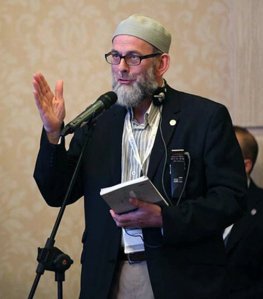 I have been the chair of trustees for 17 of Interpal’s 20 years as a British charity helping Palestinians in desperate need; it is a privilege to be in such a position. Being a trustee has enabled me to meet and work with some wonderful people, including our incredible beneficiaries in occupied Palestine, Jordan and Lebanon. They inspire us as we try to bring a degree of normality to their extraordinarily abnormal situation.It hasn’t been an easy ride. Interpal was declared by the US government in 2003 to be a “Specially designated global terrorist entity”; there was no due process, no investigation and no immediately obvious right to appeal against the decision. We discovered our new status via the BBC website. I called it “gesture politics” at the time, because claims that the US was freezing Interpal’s assets in America were nonsense; we didn’t have any assets there. In fact, the only money we have in the States now is around $100,000 which was confiscated by Citibank as the transfer of funds for our orphans’ programme in Jordan crossed a computer screen in New York. Orphans went without so that American and Israeli egos could be massaged.
A number of investigations and inquiries by Britain’s charity regulator have found no evidence of illegal activity by Interpal, and the US government has offered no evidence to justify its designation. The absence of any police involvement, said one senior Metropolitan Police officer, “is hugely significant”.
The “terrorist” tag originated in Israel, of course, which has a strong interest in blocking any kind of aid to the Palestinians living under its brutal military occupation; if life is made harsh enough, the theory goes, then perhaps the Palestinians will pack up and cross the Jordan into permanent exile. This is known in Zionist jargon as “silent transfer”. After almost 70 years of occupation, the Israelis obviously do not know the Palestinians, or the people who support them.
The UN Relief and Works Agency (UNRWA), whose senior spokesperson, Chris Gunness, has flown over to speak at Interpal’s 20th anniversary symposium in London, is at the forefront of working to keep the Palestinians afloat. Interpal is proud to be a valued partner of UNRWA and has a number of projects in the pipeline to continue such work in the months and years ahead.
Despite having such a high profile link to a UN agency, accusations of supporting “terrorism” have been thrown at Interpal almost since day one, with a claim in a major broadsheet that we “funded the training of suicide bombers” in 1996. A small charity has been seen as an easy target; we are the pebble in the Israeli shoe and just won’t go away. “Interpal,” said one Israeli politician, “is a tough nut to crack.”
The attack on our charity has been relentless which is odd, given our relatively small size. Italian journalist and author Loretta Napoleoni is an expert on “terrorist financing”. She told me that the US and Israeli governments are going after charities like Interpal precisely because they think that we are easy targets and can be shut down, at which point they can claim to be “cutting off terrorist funding”. The reality, she said, is that most of the $3 trillion drugs and terrorist economy is channelled through legitimate businesses, not charities. In 2012, HSBC confirmed that it was going to pay the US authorities $1.9bn (£1.2bn) in a settlement over money laundering. “A US Senate investigation said the UK-based bank had been a conduit for ‘drug kingpins and rogue nations’,” reported the BBC. The bank “admitted having poor money laundering controls and apologised.” There has been no special designation for a bank involved in very serious crime, but a small charity against whom there are only allegations from vexatious complainants face being driven out of existence; our only “crime” is helping Palestinians.
The message from our New York lawyer is that the US Treasury can only do so much about the designation: “It was a political decision and needs a political decision to rescind it.” In other words, the State Department must be involved, which is why Interpal has asked the Foreign and Commonwealth Office a number of times to speak on its behalf. Even though HM Government intervened on behalf of British banks facing legal action in the US, this British charity has been told “you need to raise it yourselves with the Americans”. Individual parliamentarians in both Houses have been very supportive over the years, but of government action there has been none.
Interpal distributes on average around £4 million a year and every penny is accounted for. In the great scheme of things, this is a relatively miniscule amount (Israel gets $8m a day from the US). The bureaucratic system that we have in place makes it ridiculous to suggest that we divert donations for illegal purposes.
The fact that many of the projects Interpal has funded are also funded by USAID doesn’t carry any weight in Washington, and America insists that we should discriminate along political lines in the distribution of our funds; discrimination of any kind is illegal for British charities, and rightly so. We will continue to support Palestinians with humanitarian aid without fear or favour, the only criteria being need.
Many of Interpal’s beneficiaries are women and children. The children of Palestine, Muslims and Christians alike, have had their childhood stolen from them; we should all hang our heads in shame at this. More than 80 per cent of the children in the Gaza Strip suffer from post-traumatic stress. Every time an Israeli jet flies overhead, or a helicopter, or a drone, these children wait for the bombs to follow; that is what they have come to expect. It is a shameful situation.
The recent news that the dedicated surgeon and activist Dr Mads Gilbert has been given a lifetime ban by Israel from entering the Gaza Strip illustrates perfectly the Israeli attitude towards anyone offering humanitarian assistance to Palestinians. It has nothing to do with “terrorism” and everything to do with enforcing an immoral and illegal blockade on the territory. What is being done in the name of “the only democracy in the Middle East” is not only undemocratic but also breaks international law. Israel’s leadership knows this but carries on regardless and with apparent impunity. NGOs and others will do likewise until justice is seen to be done and a free and independent Palestine emerges from the rubble.
This is an edited version of the speech given by Ibrahim Hewitt at Interpal’s 20th anniversary symposium in London on 25th November.
Israel transforms Jerusalem’s suburbs into a “big prison”
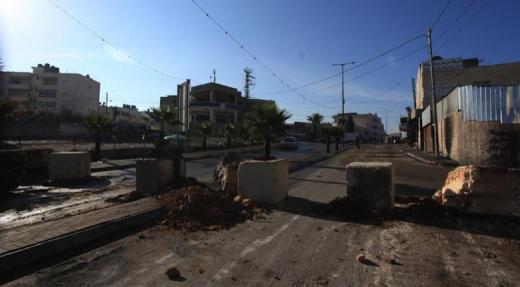
Concrete blocks are placed by Occupation security forces at the entrances to the Palestinian village of al-Ram, northeast of Jerusalem on November 19, 2014. Issam Rimawi – Anadolu Agency
By Mohammed Abdel Fattah | Al-Akhbar | November 26, 2014
Perhaps Israeli prisons can not accommodate more Palestinians, and so Israeli authorities have now chosen to imprison Palestinians inside their villages, especially in the suburbs of Jerusalem. That is part of the collective punishment inflicted on villages, whose residents dared to rise up against the occupation and the discriminatory policies it imposes on Palestinians – such as preventing them from praying at al-Aqsa Mosque, repeatedly storming the mosque, and turning a blind eye on violence and murder of Palestinians at the hands of fanatical Israeli settlers.
Occupied Jerusalem – The Israeli response to a village that revolts is to surround it with concrete barriers and military checkpoints, in addition to using weapons of all types and sizes against young demonstrators. Recently, the occupation forces began to seal off the villages of Hay al-Thawri, Sur Baher and al-Ram in the Jerusalem district after a series of protests against the killing of Ghassan and Uday Abu Jamal, both of whom carried out the recent Knesset operation. Before sealing off these villages, the Israelis encircled and sealed off the village of al-Issawiya, but the concrete barriers were later removed from its entrances following a protest by hundreds of its residents.
Sur Baher, located south of occupied Jerusalem, continues to be closed, hemming in its 27,000 residents. The Israelis tightened the noose around the village by closing its entrances with concrete barriers, leaving only one route for its residents. The people of Sur Baher enter and leave the village through that road, where an Israeli military checkpoint manned by abusive Israeli soldiers regularly mistreat anyone who passes by on foot or in a vehicle. Going in and out of the village presently takes an hour, while Israeli soldiers search every single person from head to toe and search cars from the hood to the trunk.
Students are forced to step out of cars and buses to cross the checkpoint on foot in order to get to school even if that means arriving half an hour late.
The director of the company Sur Baher Buses for Public Transportation, Raafat Nimr, complained that now they have to leave an hour before it is time to pick up students from outside the village to be able to drop them off at school somewhat on time.
He said his and other bus companies have suffered from closing the village and restricting access in and out to one checkpoint as it cut the number of trips buses take from the village in half. This will force the company to close down soon because the cost of “loading passengers increased and there is no longer a large number of trips to make up for it,” he said.
People who do not have a business to take care of outside the village have decided not to leave the village so that they won’t get upset and agitated. For example, Hamza Umaira has not left Sur Baher for a week. Besides, Israeli soldiers at the checkpoint regularly prevent him from going to Jerusalem to pray at al-Aqsa Mosque.
In Hay al-Thawri, where the family of Moataz Hijazi lives, the martyr who carried out the assassination attempt on the life of the extremist rabbi, Yehudah Glick, the situation is as bad as the rest. Like Sur Baher, the Israeli occupation sealed the village twice. The first time after killing Hijazi and the second time after the operation carried out by Ghassan and Uday Abu Jamal. The difference with this neighborhood to others is that it has been encircled with concrete barriers without military checkpoints. This prompts people to take bypass roads, delaying workers and students.
The town facing the worst mistreatment is al-Ram, whose closure affects the residents of the nearby Qalandia refugee camp as they go to and from Ramallah and Jerusalem. In addition to closing the northern entrance to the town with concrete blocks, the closure affects the revenue of businesses located along the road to the northern entrance. The Israeli authorities also closed the Jabaa road adjacent to the town, thereby creating a suffocating traffic jam that takes people two hours to get out of.
Just like the average citizen suffers, medical services suffer too. Turning the Palestinian villages surrounding Jerusalem into “large prisons” obstructs ambulances and prevents them from reaching areas where sick and wounded people need to be taken to hospitals.
Palestinian Red Crescent official, Amin Abu Ghazaleh, said that Israeli occupation forces deal with Red Crescent ambulances as though they are part of the young people’s uprising against them, especially after Israeli ambulances refused to enter Arab areas.
He pointed out that Israeli soldiers did not make it easy for ambulances to enter confrontation areas, treat the injured there or transfer them to hospitals. Instead, they refused to remove any barriers, which increases the rate of field medical treatment.
Residents of the villages facing closure believe that this policy will add to the tension in the city because most of their villages lack basic facilities, such as hospitals and markets.
For his part, political analyst, Fadel Tahboub argues that “Israelis do not want to calm the situation down in Jerusalem, so they continue to close villages and settlers continue to storm al-Aqsa Mosque.”
“The goal of the Israeli occupation is to isolate the Palestinian villages from Jerusalem in order to reduce the Arab population in the city, and to pave the way for annexing them to the West Bank at a later time, completely disconnecting them from occupied Jerusalem,” he concluded.
Catalan leader urges early independence election
RT | November 26, 2014
Catalonian President Artur Mas has called for a “plebiscite election” involving lists of pro-independence parties and civil society members. The poll is viewed as the region’s final battle for separation from Spain, if Madrid does not carry out reform.
Speaking to a crowd of 3,000 people on Tuesday, Mas said he will “act accordingly” if the majority of Catalans are in favor of creating an autonomous state. The leader stressed that any future independence election is entirely up to the region – not Madrid.
The president once again criticized Spanish authorities while meeting with regional political parties and social movements at a conference of some 3,000 participants, titled ‘After November 9: Time to decide, time to draw conclusions.’
Stating that the Spanish government “keeps acting against” Catalonia, Mas said that Madrid acts as a power structure and lacks equal treatment towards the region.
Mas announced that if the central government fails to authorize a full-scale referendum on the region’s independence or does not carry out a constitutional reform, he will call a “plebiscite election,” which would be – essentially – a vote on Catalonia’s independence.
Mas said the election would be the “only” way to allow Catalans to voice their opinion, and would involve a joint list of candidates of all parties, as well as civil society members and experts in favor of a Catalan state.
The president explained that such an election would prompt political parties to question the sovereignty issue, and a list of social activists supporting the plan would be formed. The issue would then be passed on to the region’s parliament.
The leader previously said that this will require “direct and open confrontation” with the Spanish government, but now adds that “it’s now time to use the final instrument to make the poll happen.”
Stating that now is “the most difficult and crucial” period, Mas urged Catalans to stay committed to independence, stressing that the journey should not be abandoned.
Eighty percent of Catalans said “yes” to independence and secession from the central Spanish government in Madrid earlier this month, with over two million Catalans reportedly turning out for the unofficial referendum. The symbolic vote was informal and non-binding, but Spanish prosecutors later said they would file criminal charges against Catalan President Artur Mas in response to the poll.
Featured Video
Meet The Ellisons: Zionists, Technocrats, Moguls
or go to
Aletho News Archives – Video-Images
Frlom the Archives
With apparently fabricated nuclear documents, Netanyahu pushed the US towards war with Iran
By Gareth Porter | The Grayzone | April 29, 2020
President Donald Trump scrapped the nuclear deal with Iran and continued to risk war with Iran based on Israeli Prime Minister Benjamin Netanyahu’s claim to have proven definitively that Iran was determined to manufacture nuclear weapons. Netanyahu not only spun Trump but much of the corporate media as well, duping them with the public unveiling of what he claimed was the entire secret Iranian “nuclear archive.”
In early April 2018, Netanyahu briefed Trump privately on the supposed Iranian nuclear archive and secured his promise to leave the Joint Comprehensive Plan of Action (JCPOA). That April 30, Netanyahu took the briefing to the public in a characteristically dramatic live performance in which he claimed Israel’s Mossad intelligence services had stolen Iran’s entire nuclear archive from Tehran. “You may well know that Iran’s leaders repeatedly deny ever pursuing nuclear weapons…” Netanyahu declared. “Well, tonight, I’m here to tell you one thing: Iran lied. Big time.”
However, an investigation of the supposed Iranian nuclear documents by The Grayzone reveals them to be the product of an Israeli disinformation operation that helped trigger the most serious threat of war since the conflict with Iran began nearly four decades ago. This investigation found multiple indications that the story of Mossad’s heist of 50,000 pages of secret nuclear files from Tehran was very likely an elaborate fiction and that the documents were fabricated by the Mossad itself. … continue
Blog Roll
 Aletho News
- Meet The Ellisons: Zionists, Technocrats, Moguls
- US failures in Iran reveal Russia is key to South Korea’s strategic security
- ‘All ports in Persian Gulf will be legitimate targets if Iranian ports are attacked’
- 40 Years of Endless War, Data Point by Data Point
- Department of War Using Palantir AI to Pick Targets in Iran
- American bases do not protect – they attack the peoples of the Persian Gulf
- ‘We’ve Obliterated Their Missiles’
- Syrian president vows ‘absolute support’ to disarm Hezbollah
- Ukraine attacking Russian gas pipeline to stop deliveries to Europe – Defense Ministry
- ‘Heinous crime’: Iran denounces Israeli assassination of 4 Iranian diplomats in Lebanon
- If Americans Knew
- Israeli strategic plans to “remake the Middle East” from the 1950s and since
- Honoring Gaza’s women who refused to let the world look away
- 97% of victims of war on Iran are Iranian, 98% of victims in war on Gaza are Gazans – Not a ceasefire Day 152
- Early Iran strikes cost $5.6 billion in munitions, Pentagon estimates
- Israel Decided the War, But Trump’s America Fights and Pays the Bill
- Conscientious Objector Group: Phone ‘Ringing Off Hook’ As Huge Mobilization Underway
- U.S. support for Israel continues to plummet, despite media’s best efforts
- Threats and missiles fly, death tolls soar in Iran, Lebanon, Gaza – Not a ceasefire Day 151
- Lebanon: Israel’s White Phosphorous Use Risks Civilian Harm
- Corporate Media Go All Out To Support The US-Israeli War On Iran
- No Tricks Zone
- Destructive Green New Deal: German Energy And Metal Group Warns Of Drastic Crisis
- New Study Documents A 20-Year Pause In Arctic Sea Ice Decline – Driven By Internal Variability
- Wake-up Call: Survey Shows Majority Of Germans Now Favor Postponing Climate Targets!
- Televised! Leading German Political Candidate Tells Schoolchildren CO2 Makes Sun Hotter!
- New Study: A Century Warming Of 1.1°C Is ‘Commonplace’ And ‘Not Unusual’ During This Interglacial
- New Study: ‘Internal Noise’ And Volcanic Forcing Can Trigger 10-15°C Warming Within Decades
- Glaciers Worldwide Are Suddendly Surging, Experts Blame Warming!
- Surprising Discovery: Sahara Is Greening…Billions Of Trees Where Once Thought To Be Barren
- New Research Reaffirms Clouds, Aerosols, And Surface Solar Radiation Are ‘Driving The Climate System’
- Germany: Electric Car Catches Fire At Charging Station, Sets Off Local “Inferno”, Widespread Damage
 Aletho News