EU trying to force Serbia into Russia sanctions club, says senior MP
RT | November 20, 2014
The EU’s attempts to coerce Serbia into joining anti-Russian sanctions are nothing but blackmail, says the head of the State Duma Foreign Affairs Committee.
“Presently the European Union is trying to force Serbia, which is not an EU member, to join their sanctions program. They are practically blackmailing Serbia: either it joins the sanctions against Russia or [the bloc] won’t see it as a country with a chance of joining the EU,” MP Aleksey Pushkov (United Russia) told reporters at a Thursday press conference in Moscow.
“The problem for Serbia is that in any case it has no prospects for joining the EU anytime soon. Even if they join the anti-Russian sanctions now, they would simply succumb to blackmailers and no one would accept them in the EU in one year for doing this,” he added.
The comments came after the EU’s Enlargement Commissioner Johannes Hahn said that Serbia would have to join EU sanctions against Moscow if it wants to be part of the European Union.
“Serbia has taken a legislative commitment within the EU accession negotiations to bring its positions in line with those of the EU. Harmonization includes the tough issues as well, like the tough issue of sanctions against Russia. We are expecting of Serbia to hold on to these commitments,” RIA Novosti quoted Hahn as saying.
This was a radical change of position as just days earlier, after a meeting with Serbian Foreign Minister Ivica Dacic, Hahn assured the press that the EU was not asking Serbia to impose sanctions against Russia. Back then, the commissioner acknowledged that such decisions were a sovereign matter of the Serbian government and the sanctions and Serbian membership in the EU were in no way connected.
Serbian Ambassador to Moscow Slavenko Terzić told Interfax on Thursday that for the moment his country had no intention of joining the sanctions, but in future the question could be raised at the Serbia-EU talks. “It is possible that Serbia would gradually begin to coordinate its position on various international issues with the one of the EU, but today our country is not ready to join the anti-Russian sanctions for many reasons, including because of the fact that Serbia and Russia are strategic allies,” the diplomat noted.
Israeli soldiers protect Jewish settlers attacking Palestinian village
Yesh Din | November 20, 2014
Israeli occupation forces did nothing to stop Jewish settlers from attacking Palestinian villagers, according to videos released by the Yesh Din rights group, showing soldiers pointing guns at Palestinians while Israelis are throwing stones from behind the soldiers.
The soldiers appear to be protecting the masked and armed Jewish settlers from Yitzhar during their attack on Palestinians in the village of Urif in the West Bank on Tuesday.
“IDF soldiers have the obligation, based on international law and High Court of Justice rulings, to protect Palestinian residents from violence, and IDF soldiers have the authority to detain suspects, including Israeli suspects, until the police arrive,” Yesh Din said in a statement.
“The disturbing video footage demands vigorous investigation and the immediate prosecution of the soldiers involved. An examination must also be carried out of whether the soldiers’ commanders bear liability for the conduct of their subordinates,” attorney Emily Schaeffer Omer-Man, legal advisor to Yesh Din’s said.
Violence and Resistance in Palestine
An African American Perspective on Israel/Palestine
By Ajamu Baraka | November 19, 2014
For the many thousands of tourists who fly into Israel/Palestine every year, landing in the modern Ben-Gurion airport in Tel Aviv marks the beginning of a great adventure in the “holy land.” But for members of the “African Heritage” delegation, flying into Ben-Gurion was fraught with tension and foreboding. Before departing the U.S. on October 27, our delegation rehearsed how we would move and act, role-playing what to say and what to avoid when we would face Israel’s first line of defense – its custom officials at the airport.
The normally simple act of landing, showing that prized blue book that is the U.S. passport and passing effortlessly through customs and into the country, was something that we understood might not be automatic for us. And indeed it wasn’t – within an hour of our landing our delegation’s co-leader, a young Palestinian woman, was detained. We later found out that she was interrogated, held overnight, and deported the next day.
As our delegation slowly made its way through Israel’s entry process those first couple of hours at the airport, we did not quite grasp that our experience at the airport would not be the first of the strange dualities that we would experience and witness of life in Israel/Palestine. The gaggle of wide-eyed excited tourists that were happy to be in the country greatly contrasted with our already lived experience of Israel as a police state on guard against all threats, real and imagined.
The delegation and program:
The African Heritage delegation was made up of activists, educators, journalists, clergy, students and folks representing the full spectrum of African American life in all of its diversity. Sponsored by the Interfaith Peace Builders, an organization of dedicated young activists experienced in organizing delegations to Israel/Palestine, the individual members of our delegation had various positions and motivations for being a part of the delegation. But a genuine feeling of solidarity with the plight of the Palestinian people and a desire to better understand the situation in order to share what we observed with our constituencies where we lived and worked emerged as the common denominator that united most of us.
Our ambitious agenda included meetings and visits that took us across the country. From East Jerusalem to “Israel proper” through to the West Bank and down to the Negev desert, we met with peace activists, political activists, clergy, the settler community of Hebron, Palestinian-Arab Bedouin women, and lived with Palestinian families in Bil’in and the Deheisheh refugee camp. It was an exhilarating and emotionally exhausting experience that touched us all in very personal ways.
The never ending conflict?
The deeply troubling impression that I came away with was that a negotiated, relatively “peaceful” resolution of the conflict is impossible and that those individuals who believe that the Israeli state would grant sovereignty and respect the human rights of Palestinians within the context of either a one or two state solution are either naive regarding the nature of Israel’s settler project or fundamentally dishonest.
The obscene level of investment in the infrastructure of repression in the occupied territories along with the most aggressive settlement policies since the 67 war clearly demonstrates that the Israeli state has no interest in a negotiated settlement with Palestinians.
Indeed the “facts on the ground” all point toward policies of permanent control of Palestinian life and land. Those facts include the over six hundred thousand Israeli settlers in the West Bank and settlement expansion into Palestinian East Jerusalem, the so-called security wall that is more an enclosure wall to expropriate Palestinian land, and the emergence over the last 15 years of a right- wing, militarized Israeli civil society symbolized by the popular support given to the governing coalition anchored by the right-wing Lukid party. These facts coupled with the complete collapse of what is referred to as liberalism within Israel, suggest that the current political alignments and power relations shatter any illusions that a domestic constituency strong enough to counter the hegemony of the Zionist positions exist anywhere in Israel.
On the Palestinian side, there are deep divisions among the leadership of Hamas and Fatah, the two main Palestinian organizations, despite the so-called unity government that was established in June of this year. I was struck by the number of people who have lost all faith in the Palestinian authority created out of the Oslo process. Yet at the level of the “people,” Palestinians living in the occupied territories are still united in their steadfast commitment to resist the occupation.
Unity on the issue of Palestinian resistance stems primarily from the daily indignities of life under military occupation and the repressive brutality that is a permanent feature of Palestinian life. Our delegation observed and experienced, if only briefly, life under military occupation as we moved through military checkpoints throughout the country but especially in the West Bank.
In the village of Bil’in, a community in resistance that was documented in the Academy Award nominated film Five Broken Cameras, our delegation was hosted by the village’s popular resistance committee. As part of our visit we were taken down to the separation wall or what many of us call the apartheid wall. Without provocation or warnings of any kind, the delegation suddenly found itself on the receiving end of a barrage of Israeli gas grenades. After having to run back to our cars through gas, we were informed by our hosts that since the authorities were aware that internationals were in the town for the night we should be aware that there was a possibility that soldiers might raid houses that night to arrest us, something that has happened before.
Two days later, we once again experienced the duality of experiences reflected in the lives and positions of Palestinians. In the morning we met with the Holy Land Trust, an organization that is committed to developing what it calls a spiritual, pragmatic and strategic approach to the ongoing conflict. It sees its work of reconciliation between Palestinians and Jews as a viable model for realizing a joint community that respected each other and was committed to justice, political equality and peaceful coexistence. That evening, however, we stayed in the Deheisheh refugee camp, a camp located near Bethlehem that was established after the expulsion of the more than 750,000 Palestinians in the war of 1948 that resulted in the creation of the state of Israel. Our hosts at Deheisheh were clear that for them, peaceful coexistence was impossible in a settler-colonial context that did not allow them to recoup all of the land that they argue was stolen by the Israeli state.
A week after returning from the super-charged, repressive environment that is Israel/Palestine, it is not surprising that Jerusalem is now being consumed by an intensification of violence. From what I observed, the allegations that Israeli settlers lynched Yousuf al-Ramouni, a Palestinian bus driver in Jerusalem that then sparked the retaliatory killing of four Israeli’s, is not surprising nor beyond the realm of possibility. Settler and state violence are central components of the colonial project. And violence as part of Israel’s colonial project has always been strategically deployed. It is used as a means of social control but by manipulating issues to evoke Palestinian resistance it is used to support Israel’s narrative as victim. Israeli Prime Minister Ariel Sharon adroitly used this device to provide the pretext for destroying the last vestiges of the Oslo process and the functionality of the Palestinian Authority. In the aftermath of the disastrous assault on Gaza that resulted in a public relations defeat for Israel and has even led some European governments to recognize a Palestinian state, it appears that the government of Benjamin Netanyahu has gone back to the Sharon playbook. The closure of the A-Aqsa Mosque a few weeks ago had the predictable results of Palestinian Muslim resistance that Israel is attempting to use to its advantage.
The consciously provoked violence in Jerusalem also has another effect. It diverts attention away from political and material basis of the “conflict” – Israel’s brutal occupation and illegal theft of Palestinian land.
As one activist framed the political conundrum: “if a two state solution in which Palestinians were offered the 28% [of the] land mass of historic Palestine with borders between this state and Israel that approximated the 67 green line and a just solution to Palestinian refugees as part of the Oslo process in the 90s, it would have been hard to accept but it might have been viable.” But for this activist and many others in Palestine, it is now clear that the Israeli state never intended to seriously consider establishing a viable Palestinian state or resolving the issue of Palestinian refugees in a just manner.
Difficult as it was, traveling to Palestine and seeing first hand the realities on the ground was a political necessity and an eye opener. One can read about the repression, the growing expressions of racism, and see images from time to time of Israeli brutality, but nothing really prepares you for being thrust into that oppressive reality. And for those of us who reside in oppressive communities where our lives and dignity are also under constant attack, we can feel the humiliation and degradation experienced by Palestinians which after a few days becomes emotionally overwhelming.
During my activist life I have traveled to many of the counties that Western colonial/capitalist leaders characterized as despotic totalitarian states – the old Soviet Union, North Korea, Cuba before 1989 – but in none of those states did I witness the systematic mechanism of population control and scientific repression that I witness in “democratic” Israel. The security walls, towers, checkpoints, and armed settlers created an aura of insecurity and impending assault on one’s dignity at any time. I left that space wondering how anyone with a modicum of humanity and any sense of morality could reconcile living in that environment from the spoils of Palestinian dispossession and degradation and how any nation could support the Israeli political project.
Ajamu Baraka is a long-time human rights activist and veteran of the Black Liberation, anti-war, anti-apartheid and Central American solidarity Movements in the United States.
Hungary to start South Stream construction in 2015 despite western pressure
RT | November 19, 2014
Hungary plans to break ground next year on its stretch of the South Stream pipeline to send natural gas from Russia to Europe. It is in defiance of EU and US calls to halt the project over frosty relations with Moscow.
One major reason Hungary has thrown its support into South Stream is the lack of a better option since the EU-backed Nabucco pipeline, which was supposed to deliver gas from Azerbaijan to Europe, failed.
“Nabucco will not be built and after nearly 10 years of hesitation, and especially in light of the Ukraine situation, we need to act. This is a necessity,” Hungarian Energy Minister Andras Aradszki told Reuters.
Earlier Hungarian Prime Minister Viktor Orban said that Washington is putting pressure on Budapest for cooperating with Russia over energy.
Gazprom’s $45 billion South Stream project will deliver about 64 billion cubic meters of gas to Europe, Russia’s biggest client, without unreliable passage through Ukraine.
Russia is Hungary’s biggest source of natural gas, and in 2013 the country bought 6 billion cubic meters. Hungary hopes the pipeline will be complete by 2017.
Ministers from Russia also confirmed construction will begin in 2015.

“Today the sides confirmed all their commitments signed under the South Stream project,” Russian Foreign Minister Sergey Lavrov said Wednesday after talks with his Hungarian counterpart Peter Szijjarto.
Hungary, along with Slovenia, Bulgaria, and Austria, still support the project despite EU attempts to stall it due to the political rift with Moscow, said Energy Minister Aradszki.
Proponents inside the EU argue the project is critical for EU energy security as it will provide a direct and reliable pipeline to Russia. Opponents argue that it is a step backwards for EU energy independence, as it deepens reliance on neighboring Russia.
On November 4, the Hungarian parliament approved the construction of the South Stream pipeline without European Union agreement.
The EU says South Stream will violate its Third Energy Package, which doesn’t allow one single company to both produce and transport oil and gas.
In September Hungary indefinitely halted gas shipments to Ukraine after securing a new deal with Russian gas major Gazprom, which the West saw as a move towards Russia’s orbit.
In 2013, Russia sold 162.7 billion cubic meters of gas to Europe and expects to sell at least 155 billion cubic meters this year.
READ MORE: Hungary under ‘great pressure’ from US over its energy deals with Russia
Medical associations throw support behind Guantanamo nurse who refused to force-feed
Reprieve | November 19, 2014
Medical groups including the American Nurses Association (ANA) have come out in support of a nurse who refused to force-feed a hunger-striking Guantanamo detainee.
The nurse’s refusal to carry out the practice – which is banned by, among others, the World Medical Association – was revealed by a client of international human rights NGO Reprieve in a letter to his lawyer at the charity.
The ANA wrote last month to Secretary of Defense Chuck Hagel arguing that the nurse should not be punished for his ethical decision not to force-feed hunger-striking detainees at Guantanamo. The unnamed nurse had his deployment cut short after his refusal to force-feed and the military is now considering whether to discharge him honourably, dishonourably, or allow him to continue to serve out the two remaining years of his service. If he is discharged the nurse, who has already served 18 years in the military, will not receive his service, his pension and possibly his veterans’ benefits.
148 men remain detained without charge or trial at Guantanamo Bay. Last summer a mass hunger strike by detainees, peacefully protesting their indefinite detention, brought force-feeding to the world’s attention. In a recent landmark case a US federal judge recently ordered the US government to release video tapes of Reprieve’s client, Abu Wa’el Dhiab, being force-fed. The US government is expected to appeal the decision.
Cori Crider, Strategic Director of Reprieve and attorney for men in Guantanamo, said: “The video footage I have seen shows the grim reality of force-feeding at Guantanamo Bay. In refusing to force-feed, this nurse did nothing other than stand by his professional ethical obligations that have served him well throughout a long career – as the American Nurses Association has rightly recognised. The DOD must not persecute this man for doing the right thing.”
Israel to Admit 6,000 Ukrainian Jewish Refugees
ALRAY | November 17, 2014
The Israeli government plans to provide shelter to 6,000 Jews who were internally displaced by the conflict in Ukraine, Israeli newspaper Maariv reported on Sunday.
The Israeli plan comes in light of the domestic infighting taking place in Ukraine, which is leading to the displacement of hundreds of the country’s Jews, according to Maariv.
Israeli authorities have secretly begun the construction of refugee camps to receive displaced Ukrainian Jews under the supervision of Israeli Minister of Economy Naftali Bennett, said the newspaper.
Maariv, however, did not specify the location of these camps.
The newspaper noted that about 6,000 Jews are currently homeless in eastern Ukraine, and that Israeli authorities paid to ensure their settlement in temporary camps before they’re transferred to Israel.
It was not possible to get official comment from the Israel authorities regarding the report.
Last month, a source close to the project told Israeli newspaper The Jerusalem Post that considerable resources have been allocated to provide Ukraine’s Jews who have been affected by the fighting there with food, clothing and shelter.
US Police Visit Israel to Learn New Strategies
teleSUR | November 17, 2014
Police officers from Chicago, Illinois, in the United States, which is one of the countries with the most militarized police corps, visited Israel, which has one of the most repressive security agencies, to learn “cutting-edge policing strategies and technologies.”
The public security officials attended the Third International Homeland Security Conference held last week in Tel Aviv.
The U.S. delegation was led by the Chicago Police Superintendent Garry McCarthy, who spoke at the conference, according to the Jewish United Fund (JUF), which sent the officials to Israel.
Several areas were addressed during the conference, including cybersecurity, emergency preparedness, counterterrorism and critical infrastructure, such as ports, airports, trains and pipelines.
Both countries have recently been under the radar for the repressive and violent methods that their police corps use against their population.
As an example, United States security agencies have been condemned over the incidents in Ferguson, Missouri, where heavily armed policemen dispersed huge protests and riots that erupted in August after officer Darren Wilson shot and killed Michael Brown, an unarmed teenage African-American boy.
Witnesses assert that Brown had his arms raised before being shot, six times. But Wilson claims he feared for his life after Brown resisted arrest.
Policemen that attended Ferguson to “control” the riots were seen using automatic rifles, camouflage uniforms and tactical equipment. Veterans from the Iraq and Afghanistan wars condemned authorities for that and asserted that the policemen were better equipped and armed than they were when at war in the aforementioned countries.
“Lets remind the officers were facing unarmed angry civilians and that the U.S. soldiers were fighting a regular army and insurgent groups, all of them using heavy weapons,” the veterans said in a joint statement.
On the other hand, Israeli security corps, who are always questioned over their lack of respect toward human and civil rights, have always been criticized for the repressive methods they use against Palestinians.
They use tear gas, rubber bullets and even real bullets to disperse demonstrations, while Palestinians throw rocks. Dozens of videos demonstrate how Israeli policemen and soldiers hit children and unarmed Palestinians.
And most recently, Israeli security agencies have staged several clashes with dozens of Palestinians after agents blocked access to the Al-Aqsa mosque, one of the most holiest sites in the world for Muslims.
However, United States is not the only country that is learning Israeli methods. Agencies from over 60 nations sent representatives to the security conference in the Israeli capital, according to the JUF.
“We will now bring the lessons home; our community should feel secure knowing that the relationships in Chicago and Cook County between homeland security, law enforcement, emergency management and JUF is a testament to the strong relationships, common interests and shared concerns of everyone,” said McCarthy.
High Court will hear case of UK torture and rendition victim
Reprieve | November 19, 2014
A High Court judge has said that a victim of UK rendition and torture can proceed with his claims against the British Government.
In a judgment handed down today, Mr Justice Leggatt found that the court would be “failing in its duty” if it did not deal with the claims of Yunus Rahmatullah, from Pakistan. Mr Rahmatullah was seized by UK forces in Iraq in 2004 and tortured before being handed over to the US and rendered to Bagram prison in Afghanistan, via the notorious Abu Ghraib prison in Iraq. He suffered a further decade of secret US detention before he was finally released in June this year.
The UK long denied any involvement in rendition, before being forced to correct the record in Parliament in 2008, when then-Defence Secretary John Hutton publically admitted that the rendition of Mr Rahmatullah and another man, Amanatullah Ali, had taken place.
The judgment by Mr Justice Leggatt, published this morning, confirms he was unconvinced by the Government’s ‘Foreign Act of State’ argument – the theory that a British court cannot hear cases where the UK has cooperated with another state, in this case the US, in wrongdoing. Mr Leggatt wrote: “If it is necessary to adjudicate on whether acts of US personnel were lawful… in order to decide whether the defendants violated the claimant’s legal rights, then the court can and must do so.”
Today’s judgment follows a recent Court of Appeal ruling that a separate renditions case – Abdul-Hakim Belhaj and anor v Jack Straw and ors – should be heard, despite similar claims by the British Government that doing so would damage US-UK relations.
Kat Craig, legal director at charity Reprieve, which is assisting Mr Rahmatullah, said: “Yunus Rahmatullah suffered some of the most shocking abuses of the ‘war on terror’ – now we know the Government’s attempt to avoid accountability for his ordeal is without merit. The fact is that victims of British rendition and torture, like Yunus, deserve their day in court – the Government must accept this, and be prepared to answer for its past actions.”
Sapna Malik, Partner at Leigh Day said: “The High Court has rightly stated that it would be failing in its duty if it refused to adjudicate upon the allegations made in these claims just because it may be required to make findings about the conduct of US personnel. It is now high time for the British government to abandon its attempts to evade judicial scrutiny of its conduct in operations involving the US in Iraq and Afghanistan, so that justice may finally be served for what has passed and lessons learned for the future.”
I’m confused, can anyone help me? Part Three
RT | November 18, 2014
I’m confused. The first thing I’m confused about is democratic legitimacy after elections are held in war-torn countries.
Western leaders have hailed the recent parliamentary elections in Ukraine, as a great triumph of “democracy.”
Barack Obama said it was “an important milestone in Ukraine’s democratic development.” Top EU officials said it represented “a victory of the people of Ukraine and of democracy.”
Yet large parts of war-torn Ukraine took no part in the vote. Turnout, according to the Ukraine Central Election Commission was just 52.42 percent.
In May’s presidential elections, turnout, according to official figures, was 60.3 percent. They were won by Petro Poroshenko with 54.7 percent of the vote. Again, western leaders hailed the results as a great victory for “democracy.”
Now let’s consider the case of Syria, another war-torn country where there were also important elections this year.
Unlike Ukraine’s elections, leading western politicians did not say the result of Syria’s first multi-candidate presidential election in over forty years represented an “important milestone in Syria’s democratic development”- even though, according to official figures, the turnout was much higher than in Ukraine, at 73.42 percent.
Far from it, the same people who hailed the elections in Ukraine haughtily dismissed the election in Syria as a “farce.”
“This election bore no relation to genuine democracy. It was held in the midst of civil war,” said British Foreign Secretary William Hague.
“Today’s presidential election in Syria is a disgrace,” said US State Department spokesperson Maria Harf.
French Foreign Minister Laurent Fabius called Syria’s election a “fake.” Fabius did not telephone Bashar al-Assad, the winner, to offer his “warmest congratulations” as he did with Poroshenko.
How come one election held in a country divided by war is hailed as a “victory of the people and of democracy” but another election- where the turnout is higher -denounced? Why are Poroshenko and the Ukrainian Prime Minister Yatsenyuk deemed to be the legitimate representatives of the Ukrainian people but Bashar al-Assad, despite his higher level of popular support, denied any kind of democratic legitimacy? I’m confused. Can anyone help me?
At the recent G20 summit in Brisbane, Canadian Prime Minister Stephen Harper told Vladimir Putin to “get out of Ukraine.” Leaving aside the fact that there’s no hard evidence that Russia is in Ukraine – and that Harper didn’t produce any- the statement seems to imply that the Canadian Prime Minister doesn’t like other countries interfering in the affairs of others and believes in state sovereignty and the inviolability of state borders.
But in 2003, Harper was a strong supporter of the US-led invasion of Iraq (and wanted Canada to join in), a clear example of one county “getting” into another. He actually thought it was a “mistake” of the then Canadian government not to take part in the invasion of Iraq. Why is Stephen Harper so concerned about a non-existent Russian invasion of Ukraine, but happy to support a real, actual, and blatantly illegal invasion of Iraq?Does the Canadian Prime Minister support state sovereignty and the inviolability of state borders, or doesn’t he? I’m confused. Can anyone help me?
David Cameron tells us that ISIS poses a “clear and present threat to the United Kingdom.” Yet only last year he was trying desperately to persuade Parliament to vote for air strikes against a secular Syrian government that was fighting ISIS and other radical extremists associated to al Al-Qaeda. Cameron describes ISIS as “an evil against which the whole world must unite,” but even now the British government, in common with other western governments is still working for the violent overthrow of the government in Damascus whose forces are the only ones on the ground in Syria capable of defeating ISIS. If defeating ISIS really was so important, why is the west trying to topple the anti-ISIS Syrian government? Why, if “the whole world must unite” against ISIS, won’t the British and western governments work with the Syrian government? I‘m confused. Can anyone help me?
To coincide with the launch of RT UK, we’ve seen a wave of attacks on RT by self-proclaimed “democrats” and “liberals” in the British media.Some of these attacks have urged Ofcom – the broadcasting regulator – to take action against RT. I always thought that being a “democrat” and “liberal” meant support for alternative voices being heard, not trying to stop people from hearing them. John Stuart Mill, the author of On Liberty, a classic text on liberalism, wrote of the “peculiar evil of silencing the expression of an opinion” and that “all silencing of discussion is an assumption of infallibility.”
So how come western “liberals” want to silence the opinions expressed on RT? Why are those who claim to be anti-censorship, so censorious when it comes to RT? I would have thought people calling themselves “democrats” and “liberals” would welcome a wide variety of news channels for people to watch, yet instead of that supporters of “free speech” are attacking a channel which broadcasts opinions which they don’t agree with it. I’m confused. Can anyone help me?
Western politicians say that they are appalled by the “barbarism” shown by ISIS in the various beheading videos they have released.But if beheading people is so bad (as most people would agree that it is), why is there no similar condemnation of the beheadings which take place in Saudi Arabia? In August, Amnesty International reported a “surge” in beheadings in Saudi Arabia, amounting to at least 23 in three weeks. Why are beheadings by ISIS “savage” but the ones carried out in Saudi Arabia acceptable? I’m confused. Can anyone help me?
Pussy Riot, the Russian punk protest group who were jailed after a demonstration in an Orthodox Cathedral in Moscow are feted as heroes in the West, with a whole range of public figures including the pop star Madonna coming forward to express their support. But there was no such celebrity support for Trenton Oldfield, a protestor who was jailed for six months in Britain after trying to disrupt the Oxford- Cambridge University boat race in 2012. Oldfield said he was protesting against elitism, inequality and government cuts. If Pussy Riot’s cause is deserving of “progressive” support, then why isn’t Oldfield’s? Why are some anti-government protestors who go to jail hailed as heroes, but others totally ignored? I’m confused. Can anyone help me?
You can read I’m confused, can anyone help me Parts One and Two.
Interview with Serena Shim’s Sister
See also, Press TV Reporter Killed in Car Accident Following Threats by Turkish Intelligence, which includes videos of Shim, including one of her last reports before her death.
Featured Video
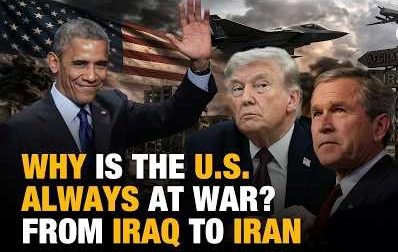
The Source of America’s Wars – Kristol Clear
or go to
Aletho News Archives – Video-Images
From the Archives
Is Israel to blame for the Iraq War?
American Goy | March 10, 2008
I am so tired of this old canard that “Israel had nothing to do with USA’s war with Iraq – in fact, it officially advised America against it”.
Bullshit. … continue
Blog Roll
 Aletho News
- Ceasefire for all or for none: Iran shuts Hormuz over Lebanon attacks
- Strait of Hormuz is Iran’s ‘nuclear weapon’ that forced US retreat: Medvedev
- Energy crisis will last for months – Kremlin envoy
- Europe’s quiet role in the war on Iran
- Forty days that shook the Empire: How Iran turned the tables on US and prevailed
- Netanyahu unilaterally declares Lebanon outside of ceasefire deal
- Israeli leaders: ‘Not a single goal’ achieved in war with Iran
- What on earth just happened? Trump, Iran, and the unlikely ceasefire
- Alberta Bill Would Fine Political Deepfakes $10,000 Without Satire Exemptions
- Iran declares ‘historic victory’ over US, says enemy forced to accept its proposal
- If Americans Knew
- NY Times reports how Netanyahu took the US into Iran War
- A sigh of relief over Iran, but Gaza and Lebanon in dire straits – Daily Update
- Thousands dead and neighborhoods razed to the ground: Aid agencies fear southern Lebanon is becoming the new Gaza
- The war the US is fighting for Israel could cost trillions
- ‘Cigarette Burns, Nail Wounds’: Toddler Tortured in Gaza to Coerce Father
- Trump Says US Sent ‘a Lot of Guns’ to Protesters in Iran
- Israeli forces destroy 17 UN peacekeeper cameras in south Lebanon
- US-Israeli strikes ‘completely destroy’ synagogue in Tehran
- Archbishop for US Military Says Iran War Is Unjust Under Catholic Teaching
- Iranian leaders’ Open Letters to the American People
- No Tricks Zone
- An Inconvenient Tree: Uncovered In Alps… Europe Much Warmer Than Today 6000 Years Ago
- New Study Reports A 60% Slowdown In Greenland’s Ice Loss Rate In The Last Decade
- Low Intensity Tornado Wrecks Major Solar Farm, Creating A Potential Toxic Dump
- New Study Finds Warming Saves Lives…Cold Temperatures 12 Times More Deadly Than Excess Heat
- German Science Blog Accuses PIK Climate Institute Of Hallucinating Climate Tipping Points
- Devastating Assessment Of Comirnaty Vaccine By Former Senior Pfizer Europe Toxicologist
- New Study: CO2 Is ‘Effectively Negligible’ As An Explanatory Climate Change Factor Since 2000
- Former Pfizer Toxicologist Dr. Helmut Sterz Tells Bundestag Hearing Pfizer Vaccine Should Have Never Been Approved
- Energy Expert: Germany’s Nuclear Phaseout Was A “500 Billion Euro Mistake”
- New Research: South Australia’s Mid-Holocene Sea Surface Temperatures Were 4°C Warmer Than Today
 Aletho News