Argentine judge rejects cover-up charges in AMIA case
Press TV – February 26, 2015

An Argentine judge has dismissed cover-up charges against the country’s President Cristina Fernandez de Kirchner in the 1994 AMIA case.
Federal Judge Daniel Rafecas said there were no elements to justify continuation of an investigation on an alleged political effort by President Kirchner to cover up the role claimed to have been played by Iran in the bombing of the AMIA Jewish community center.
The documents against Kirchner failed to meet “the minimal conditions needed to launch a formal court investigation,” the judge added.
Argentina’s Federal Prosecutor Gerardo Pollicita is expected to appeal the ruling.
Pollicita replaced Alberto Nisman who was found dead in the bathroom of his apartment in the capital, Buenos Aires, on January 18.
The initial police report said Nisman had died of a self-inflicted gunshot wound.
Nisman’s death came hours before he was to testify in a congressional hearing about the AMIA attack.
The prosecutor had accused a number of high-ranking Argentine officials including President Kirchner, Foreign Minister Héctor Timerman and lawmaker Andrés “Cuervo” Larroqu of trying to ‘protect Iranians’ in the case.
The Argentinean president has frequently dismissed the claim against Iran, saying the late prosecutor’s allegations were baseless and absurd.
The “real move against the government was the prosecutor’s death…. They used him while he was alive and then they needed him dead. It is that sad and terrible,” the Buenos Aires Herald quoted Kirchner as saying on January 22.
In July 1994, a car bomb exploded at the building of the Argentine Israelite Mutual Association, also known as AMIA, in Buenos Aires. Eighty-five people died and some 300 were injured.
The Israeli regime accuses Tehran of masterminding the terrorist attack. The Islamic Republic of Iran has strongly denied any involvement in the incident.
French PM decries MPs for meeting Assad
Press TV – February 26, 2015
France’s Prime Minister Manuel Valls has slammed a move by three French lawmakers to meet with Syrian President Bashar al-Assad.
“I want to condemn this initiative with the greatest strength,” Valls said on Thursday.
“For parliamentarians to go without warning to meet a butcher…. I think it was a moral failing,” he said.
A French Parliamentary delegation headed by French Senator Jean-Pierre Vial, Chairman of the Syrian-French friendship Committee, met with Assad on Wednesday.
“We met Bashar al-Assad for a good hour. It went very well,” Jacques Myard, an MP from the opposition Union pour un Mouvement Populaire (UMP) party, also said.
The French lawmaker described the trip as “a personal mission to see what is going on, to hear [and] listen.”
According to the Syrian state television, the two sides had discussed “the state of Syrian-French relations, as well as the developments in the Arab world and Europe, especially with regard to terrorism.”
During the meeting, Assad said fighting terrorism demands real political will and belief in the fact that the outcome will be in the interest of all people while the dangers will threaten all countries.
“If this issue could be tackled based on this principle, surely we will soon witness tangible positive results,” added the president.
France cut diplomatic ties with Syria in 2012 and supports the militants in Syria, who seek the removal of Assad from power.
The US and its allies, including France, have been throwing their weight behind Takfiri ISIL militants, currently wreaking havoc on Syria and Iraq, in past years.
Reports say US military instructors trained the militants at a secret base in Jordan in 2012. According to reports, some 1,000 French nationals from a wide range of backgrounds are estimated to have left the European country to join the Takfiri militants in Iraq and Syria. Some 400 of them are thought to be currently operating on the ground, while almost 50 were killed.
Kerry warns Congress about Netanyahu’s Iran speech, says Bibi pushed US to attack Iraq
Press TV – February 26, 2015
 US Secretary of State John Kerry has reminded American officials that Israeli Prime Minister Benjamin Netanyahu, who is against a nuclear deal with Iran, was also in the US in 2002 to push for the invasion of Iraq.
Netanyahu is set to use his next week’s address to a joint session of Congress to condemn a potential nuclear agreement with Iran.
During a House Committee on Foreign Affairs hearing on Wednesday, Kerry warned Congress about the controversial speech.
“The prime minister, as you will recall, was profoundly forward-leaning and outspoken about the importance of invading Iraq under George W. Bush, and we all know what happened with that decision,” Kerry said.
The top US diplomat was referring to testimony on the Middle East that Netanyahu delivered to Congress on Sept. 12, 2002.
During his speech, Netanyahu expressed strong support for Washington to oust former Iraqi dictator Saddam Hussein.
Six months later, the US military bombarded the country.
“I think the choice of Iraq is a good choice, it’s the right choice,” Netanyahu said in 2002. “If you take out Saddam’s regime, I guarantee you that it will have enormous positive reverberations on the region.”
Kerry also said on Wednesday that Netanyahu was wrong about Iran too because he had been “extremely outspoken about how bad the interim agreement was, calling it the ‘deal of the century for Iran.’”
The March 3 speech by Netanyahu has made the Obama administration furious as it comes ahead of crucial nuclear negotiations between Iran and the five permanent members of the UN Security Council plus Germany that are working hard to reach a comprehensive nuclear accord.
Obama’s National Security Adviser Susan Rice said the speech has “injected a degree of partisanship, which is not only unfortunate, I think it’s destructive of the fabric of the relationship.”
Netanyahu, who is trying to put pressure on US officials to stop a final deal, once again defended his trip to Washington on Tuesday, saying he would do everything to prevent the agreement.
“It is my obligation as prime minister to do everything that I can to prevent this agreement. Therefore, I will go to Washington… because the American Congress is likely to be the final brake before the agreement,” he said.
President Obama, Vice President Joe Biden, and John Kerry would not meet with the Israeli leader during his trip.
A number of Democrats announced that they would skip the speech.
Hamas asks the international community to put Jewish State on terror list
Palestine Information Center – February 26, 2015
GAZA – Islamic Resistance Movement, Hamas, asked the international community to put Israel and its leaders on the terror list. The request was voiced after state-backed Jewish settlers set fire to a mosque and a church in the West Bank over two consecutive days.
On Thursday, Hamas leader and former Minister of Awqaf and Religious Affairs, Dr. Ismail Radwan, condemned the arson attack on both sacred sites, saying, “Torching the holy sites and writing anti-Islamic and anti-Christian slogans by Israeli settlers demonstrate that the Israeli occupation constitutes a danger to humanity and to holy places”.
Dr. Radwan called on the international community along with human rights organizations to work on putting Israel on the terror list for its crimes that show hatred and hostility to humanity and holy sites.
The extremist Jewish groups started a fire at dawn Wednesday in a mosque in Jaba town to the west of Bethlehem and did the same thing early Thursday in the Church of Dormition on Mt. Zion in Occupied Jerusalem.
Greek Orthodox Church decries attacks by Jewish settlers
MEMO | February 26, 2015
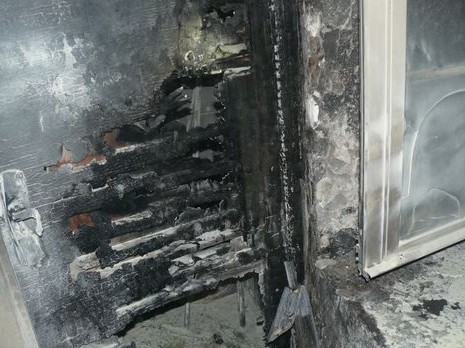
The Patriarch of the Holy City of Jerusalem and all Palestine, Theophilos III, denounced on Thursday what he called “repeated” attacks on Christian and Muslim places of worship in the Palestinian territories by extremist Jewish settlers.
“The targeting of churches and mosques is caused by pervasive racism and hatred,” he said in a statement.
Earlier Thursday, Jewish Settlers set fire to part of a religious school affiliated with Jerusalem’s Greek Orthodox Church, Which they sprayed with anti-Christian graffiti. On Wednesday, settlers torched and sprayed graffiti on a West Bank mosque.
Theophilos III said Christians represented an “integral part” of the Holy Land, its history and its future, going on to assert that the Greek Orthodox Church was one of the world’s most important churches.
“Criminals will not intimidate this church or its flock,” he declared.
He called on government agencies to address repeated settler attacks on places of worship.
Earlier Thursday, The Palestinian Foreign Ministry called on both the Vatican and the international community to protect Islamic and Christian places of worship from what it described as “Jewish extremism.”
“We strongly condemn these acts,” the ministry said in a statement. “Yesterday a mosque near Bethlehem was torched and today a church in Jerusalem [was attacked].”
Extremist Jews, the ministry asserted, continued to attack Muslim and Christian places of worship while the Israeli government did nothing to stop them.
The ministry went on to blame the Israeli government for the trend, calling on the Vatican, the international community and the UN to help protect local religious sites.
On Wednesday, Jewish Settlers set fire to a mosque near the southern West Bank city of Bethlehem, Which Also they covered with anti-Arab and anti-Muslim graffiti.
Several instances of settler attacks on Muslim places of worship have been reported recently, both in the Israeli-occupied West Bank and in the self-proclaimed Jewish state itself.
Cop Assaults Man for Filming Brutality, Stomps Phone to Destroy Evidence — Video Survived
By Cassandra Rules | The Free Thought Project | February 26, 2015
Amherst, MA– University of Massachusetts Amherst student, Thomas Donovan, who is majoring in legal studies and had planned to become a Massachusetts State Trooper, has filed a lawsuit alleging his civil rights were violated after he was pepper sprayed, assaulted, and arrested for filming police brutality.
The officer also repeatedly stomped on his cellphone in an attempt to destroy the evidence and cover up the crime- but the video survived.
The incident took place last March during his neighborhood’s Blarney Blowout parties, an annual tradition attended by thousands and held the weekend before St. Patrick’s Day where Amherst and neighboring towns are full of informal St. Patrick’s Day drinking and festivities.
Last year saw 58 people arrested, 21 of which were UMass students after police in riot gear violently moved in.
During the commotion, Donovan noticed an officer using excessive force while making an arrest, so the student pulled out his cell phone to exercise his First Amendment right to film the incident. Donovan was on the other side of a fence, a safe distance away, and was not interfering with the brutality at all. At this point. An officer wearing full riot gear and carrying a pepper-ball gun— believed to be Officer Andrew Hulse—approached Mr. Donovan to prevent him from filming, the lawsuit states.
Despite the police intimidation, Donovan did not stop filming. He was then pepper-sprayed at close range by another officer. Donovan requested the officer’s name and badge number, but the officer would not identify himself.
Moments later, Officer Jesus Arocho knocked the phone out of his hand and threw him to the ground face first. The phone landed flat on the ground with the camera pointed up and continuing to film.
“Arocho, assisted by Defendant Andrew Hulse, placed Mr. Donovan under arrest. Meanwhile, Mr. Donovan’s phone, which had landed on the ground with the camera facingup, continued to film. It captured the actions of another police officer, Defendant John Doe 3, who walked over to the phone, stood over it, then stomped on it with his boot, several times, in an unsuccessful effort to destroy it.” the lawsuit continued.
Thankfully, Donovan’s phone was inside a shock-resistant protective case and the phone was unharmed. The video, and evidence of this blatant misconduct, was preserved.
Arocho then arrested Donovan on bogus charges of “disorderly conduct” and for “riot, failure to disperse.” These charges were ultimately dropped.
Arocho lied in his police report, stating Donovan was pepper sprayed “as he began to close the distance between himself and the officers.” The complaint points out that this claim is blatantly false as the incident was captured on video.
Donovan ended up spending 5 to 6 hours in a cell, falsely imprisoned, and was denied any assistance removing the pepper spray from his eyes.
Due to the officer’s insane actions, Donovan was suspended from the university, until he contested and won after he was found not to have committed any wrong-doing.
“Defendants knew that it was wrong to stop a civilian from filming police officers in public when the civilian did not interfere with police activity.
Defendants knew that it was wrong to use force against a civilian for filming police officers in public when the civilian did not interfere with police activity.
Defendants knew that it was wrong to arrest a civilian for filming police officers in public when the civilian did not interfere with police activity.
Defendants knew that it was wrong to try to destroy a civilian’s phone merely because it contained video of police officers performing their duties in public.” the complaint asserts.
This year’s Blarney Blowout parties are expected to begin on March 7, but students will be prohibited from hosting guests who are not UMass Amherst students. The University will also be offering “school sanctioned” events this year to monitor the amount of fun being had.
Perhaps a more reasonable course of action would have been to have the militarized police stand down and not bring violence and chaos to celebrations.
Argentine Congress votes to scrap intelligence agency
Press TV – February 26, 2015
Argentine legislators have voted to disband the South American country’s intelligence agency and replace it with a new federal body that will be accountable to the Congress.
The lower house of Congress voted 131 to 71 in favor of the bill, which had already been approved by the Senate.
The measure came after President Cristina Fernandez de Kirchner drafted a proposal last month to dissolve the Secretariat of Intelligence (SI) and set up a new service to be called the Federal Intelligence Agency, after the government said a renegade spy was linked to the death of Argentine prosecutor Alberto Nisman.
Fernandez has said Antonio Stiuso, who for years was the powerful director of operations at the SI, pushed Nisman into filing a formal criminal complaint against her, and was involved in the prosecutor’s death.
On Tuesday, Oscar Parilli, who was appointed as the SI director in December last year, said Stiuso and others had illegally imported electronic goods and other equipment between 2013 and 2014.
Parrilli said the ring made use of a special law that allows the SI to import secret equipment, and illegally imported electronic goods as well as other equipment, without paying taxes or informing customs officials.
Meanwhile, opposition lawmakers have voiced their discontent with the decision to dissolve Argentina’s intelligence body, arguing that the General Attorney’s Office would now be in charge of overseeing all wiretaps.
“The most important issue is the lack of oversight,” opposition lawmaker Manuel Garrido said.
He added, “What worries us is that there has not been, nor will there be proper control.”
Garrido said he offered an alternative bill that incorporated stricter controls, but it was obstructed by the ruling coalition.
Banksy in Gaza: Haunting images among ruins of war
RT | February 26, 2015
The English graffiti artist has taken his politically charged message to the bombed-out neighborhoods of Gaza, where a series of murals amid a backdrop of devastation attempts to give voice to the desperation felt by Palestinians.
The first mural, entitled “Bomb Damage,” appears to be inspired by Rodin’s famous sculpture “The Thinker.” In Banksy’s version, the viewer is struck with the realization that the only possible thing on the mind of the subject is the utter devastation that literally surrounds him.
Another piece, done in the artist’s trademark black, stenciled imagery, shows the silhouettes of children riding an amusement park swing that is shown circling around one of the looming guard stations that punctuate the length of the West Bank barrier, which, upon completion, will be approximately 700 kilometers (430 miles).

Photo from http://www.banksy.co.uk
The artist also provided his personal thoughts on the situation confronting the people of Gaza:
“Gaza is often described as ‘the world’s largest open air prison’ because no one is allowed to enter or leave. But that seems a bit unfair to prisons – they don’t have their electricity and drinking water cut off randomly almost everyday,” Banksy said in a spray-painted statement.
In another painting, in which a huge white kitten appears to toy with a ball of coiled metal, the artist is hurling criticism at the popular Internet meme involving kittens, which attracts so much attention at the expense of more serious issues.
The street artist explained in yet another spray-painted bit of commentary the reaction of a local man to the work, and his response:
“A local man came up and said ‘Please – what does this mean?’ I explained I wanted to highlight the destruction in Gaza by posting photos on my website – but on the internet people only look at pictures of kittens.”

Photo from http://www.banksy.co.uk
In another place, Banksy offered some advice on a concrete wall: “If We Wash Our Hands Of The Conflict Between The Powerful And The Powerless We Side With The Powerful – We Don’t Remain Neutral”.
Finally, the street artist provides a poignant statement in a 2-minute video, where he invites the viewers to “discover a new destination” this year, while providing a brief, yet unforgettable stroll through Gaza.
Banksy, who is widely believed to be Robin Gunningham, an artist from Bristol’s underground art scene, has gone from the streets to the top of the art world. His first film, Exit Through the Gift Shop, labeled as “the world’s first street art disaster movie”, made its debut at the 2010 Sundance Film Festival. In 2014, he was awarded Person of the Year at the 2014 Webby Awards.

Photo from http://www.banksy.co.uk
READ MORE: ‘Complicit in Gaza’s misery’: Pro-Palestine activists shut down UK arms factory
A giant art installation targets predator drone operators
NotABugSplat

In military slang, Predator drone operators often refer to kills as ‘bug splats’, since viewing the body through a grainy video image gives the sense of an insect being crushed.
To challenge this insensitivity as well as raise awareness of civilian casualties, an artist collective installed a massive portrait facing up in the heavily bombed Khyber Pukhtoonkhwa region of Pakistan, where drone attacks regularly occur. Now, when viewed by a drone camera, what an operator sees on his screen is not an anonymous dot on the landscape, but an innocent child victim’s face.

The installation is also designed to be captured by satellites in order to make it a permanent part of the landscape on online mapping sites.
The project is a collaboration of artists who made use of the French artist JR’s ‘Inside Out’ movement. Reprieve/Foundation for Fundamental Rights helped launch the effort which has been released with the hashtag #NotABugSplat


The child featured in the poster is nameless, but according to FFR, lost both her parents and two young siblings in a drone attack.
The group of artists traveled inside KPK province and, with the assistance of highly enthusiastic locals, unrolled the poster amongst mud huts and farms. It is their hope that this will create empathy and introspection amongst drone operators, and will create dialogue amongst policy makers, eventually leading to decisions that will save innocent lives.
State Dept asks for budget to counter RT
RT | February 26, 2015
Citing RT’s influence, Secretary of State John Kerry asked US lawmakers for more money for propaganda and “democracy promotion” programs around the world.
“Russia Today (sic) can be heard in English, do we have an equivalent that can be heard in Russian? It’s a pretty expensive proposition. They are spending huge amounts of money,” Kerry said in the course of the budget hearing on Wednesday, apparently forgetting that Voice of America has been broadcasting in Russian since 1947.
Representative Ed Royce (R-CA), chairing the House Foreign Affairs Committee, opened the hearing with the allegation that “Russia’s military aggression is matched only by its propaganda.”
To Kerry’s approval, Royce went on to claim that “Russia is spending more than $500 million annually to mislead audiences, sow divisions, and push conspiracy out over RT television.”
Royce’s remarks echo the claim made by Broadcasting Board of Governors (BBG) chief Andrew Lack last month, when he listed “Russia Today” (sic) in the same breath as ISIS and Boko Haram as one of the challenges facing his agency.
In reality, RT’s budget for 2015 is less than half the amount cited by Representative Royce – $225 million, according to the current exchange rate, or 13.85 billion rubles. By contrast, the US government media receives $721 million. The BBC World Service, which complained about RT “winning the information war” in January, is funded to the tune of $375 million a year.
In the budget proposal submitted by Kerry, the Department of State is asking for “$639 million to help our friends in Ukraine, Georgia, and Moldova as they seek to strengthen their democracies, withstand pressure from Russia, and to integrate more closely into Europe.” [PDF] Washington is also requesting over $2 billion – described as “a significant increase” – for “democracy, human rights, and governance programs.”
Read more: More money, more problems?
The Foiling of a Coup Plot in Venezuela
By GLORIA La RIVA | CounterPunch | February 25, 2015
A coup plot against President Nicolas Maduro and the Bolivarian Revolution was thwarted this week as a retired Venezuelan Air Force general and 10 military and civilian opposition figures were arrested.
The bombing of the Presidential Palace, the National Assembly, Telesur TV network, the Defense Ministry and other Caracas sites was to take place February 12, the one-year anniversary of violent anti-government attacks known as “guarimbas,” which caused 43 deaths. A Tucano EMB 312 bomber would have been flown by renegade Air Force First Lieutenant José Antich Zapata to destroy the targeted sites.
U.S. spokesperson Jen Psaki and the Venezuelan far-right are dismissing the plot claim, but video evidence, a map of the bombing targets, and other key evidence have been unveiled on national television, with more details promised. Washington’s role in previous plots has been proven before.
According to President Maduro, detained coup leaders have confessed their role. He spoke on national television Sunday morning, to reveal more facts and accuse the United States government of conspiring with coup plotters.
Antich Zapata received U.S. visas for himself and other conspirators from the U.S. embassy in Caracas, for escape from Venezuela in case the plot failed.
Maduro also said that the script of an eight-minute video by the coup group – to air once the government was overthrown – was written with the help of a U.S. embassy advisor.
Rightwing opposition involved
In obvious preparation for the failed coup, three of the most belligerent opposition figures – Maria Corina Machado, Leopoldo Lopez and Antonio Ledezma – issued a “Call for a National Transition Agreement,” on February 11, the day before the overthrow was to take place. Lopez is currently awaiting trial for his role in the violent attacks last February.
The “transition agreement” is a plan for overthrow of the Bolivarian Revolution socialist project, including a demand for felony trials of current government leaders after the “transition,” the privatization of nationalized industries, and the takeover of PDVSA, the state-owned oil industry that has been the source of great social developments in Venezuela since 1999.
As if aware of a pending coup, German embassy representative Jorg Polster issued a letter of warning on February 5 to German citizens residing in Venezuela, to take unusual precautions such as in the event of “political unrest like that which began in the spring of 2014.” The letter suggests the German nationals obtain a two-week supply of food, water and emergency provisions of battery, radio and important documents. The letter also indicates a loss of electricity and Internet access could be a possibility.
National Assembly president Diosdado Cabello and Jorge Rodriguez, mayor of the Libertador municipality of Caracas – both leaders of Maduro’s political high command – also appeared on television, denouncing Julio Borges, leader of the right-wing group, Primero Justicia (“Justice First” in English), as drafting the list of the 20-plus targets to be bombed.
An unfolding plot since January
A series of actions was planned by the counterrevolutionaries to lead up to February 12.
First step was economic destabilization through major corporate hoarding of goods to create empty stores and mass discontent. That has been taking place for weeks, with the right-wing then accusing the socialist government of economic failure.
The government countered with “Operation Dignity,” confiscating the hoarded goods for redistribution at fair prices to the population, and arresting the corporate conspirators.
The second step was internationally-generated false accusations of a “humanitarian crisis” in Venezuela by the U.S. and international allies of Washington.
It is thus no coincidence that on January 24, three right-wing former presidents of Latin American countries, Andres Pastrana of Colombia, Felipe Calderon of Mexico and Sebastian Pinera of Chile came to Venezuela and tried to visit jailed opposition leader Leopoldo Lopez. Afterwards, they demanded his freedom and held a press conference accusing Venezuela of human rights violations.
On February 3, President Maduro warned Washington to stop its interventionist meddling, and accused U.S. officials of trying to bribe current and former government leaders to betray the government.
Via Telesur, he denounced U.S. Vice President Joseph Biden’s recent meetings with various Latin American leaders, in which he told them Maduro’s government would soon fall, and that the Petrocaribe program would be ended. Biden advised them to “keep Venezuela isolated.” Petrocaribe is the Venezuelan program that provides oil to Caribbean nations at a low price.
Telesur as target
Why was Telesur one of the targets to be bombed?
In 2002, when a fascist coup by a sector of the military and corporate opposition overthrew President Hugo Chavez from April 11 to 13, Venezuela’s revolution was new and a people’s media had not yet developed.
In the critical hours of the massive and spontaneous popular mobilization to demand Chavez’s release and return as president, the monopoly corporate media completely blocked out the news. It was clear that the Bolivarian process needed a revolutionary media to transmit vital information to the population.
Since then, dozens of community and television stations have been established; corporate violators of the new Communications Law have had their licenses revoked.
The Telesur network – promoting the integration of Latin America – was proposed 10 years ago by Chavez. It has become a vital conveyor of national and international information with a solid anti-imperialist prospective.
It provided uncensored live coverage and exposed the terror bombing by NATO/U.S. bombing of Libya.
Like the brutal bombing of Serbia’s national TV station, killing scores of journalists who courageously covered the criminal NATO/U.S. bombing of Yugoslavia in 1999, the planned bombing of Telesur was part of the plan to destroy the Revolution and install a fascist coup.
The smashing of this latest plot against Venezuela is a major blow to U.S. imperialism’s attempts to reverse the gains of the Bolivarian revolutionary process in Venezuela, the Cuban Revolution and all progress in Latin America.
Revolutionary mass organizations and the military high command are declaring their unity and defense of Venezuela’s Bolivarian Revolution.
Vladimir Padrino Lopez, the Minister of Defense and Strategic Operational Commander of the FANB, stood with a large group of high-ranking military officers to denounce the military plot. “The Bolivarian Armed Forces reiterates its support and loyalty to President Nicolás Maduro Moros and reaffirms its commitment to the will of the people, with the Plan of the Homeland, in the building of Socialism.”
More than ever, it is vital that international solidarity be mobilized to demand an end to U.S. machinations in Venezuela and all Latin America. Progressive groups and leaders in Latin America are expressing their support for Maduro’s government. From March 5-7, organizations in several cities in the United States plan actions in solidarity with the Venezuelan Bolivarian government and its people in struggle.
The danger is not over. The lessons of Latin America in the 1960s, 1970s and the U.S. war against revolutionary movements everywhere shows that the struggle must continue to defend Venezuela’s gains and oppose U.S. imperialism’s counter-revolutionary schemes.
Featured Video
Theodore Postol: Iran’s Missiles & Drones Were Underestimated
or go to
Aletho News Archives – Video-Images
From the Archives
What is the Israeli Lobby in Australia Doing in Interfaith Dialogue?
By Ali Kazak | Dissident Voice | October 11, 2015
For years Israel and its lobby around the world have been trying to normalise their relations with Arabs and Muslims without solving the Palestine Question.
One of the methods they resorted to in the last few years is using human rights and community organizations such as interfaith dialogue and Multiculturalism to achieve this objective and to: isolate the Palestinians, marginalise the Palestine question, end Israel’s isolation, and prevent criticism of Israel, knowing that these organisations will be the first to stand against Israel’s violations, racial and religious discrimination.
The group responsible for this task in Australia is The Australia/Israel & Jewish Affairs Council (AIJAC); its Director of International & Community Affairs, Jeremy Jones is in charge of lobbying religious community organizations, specifically Muslims and Christians. Consequently he convened the Faith Communities for Reconciliation, founding participant in the Australian Partnership of Religious Organisations and the Australian National Dialogue of Christians, Muslims & Jews.
AIJAC is a private political propaganda group. It is recognised as the main Israeli lobby in Australia. It coordinates its activities and works intimately with the Israeli embassy in Canberra and different institutions in Israel. It is privately funded by some Jewish businessmen. It monitors closely Australian politicians, the media, ethnic and religious groups, (especially Arabs and Muslims), unions and academics on their stands towards Israel and the Palestine question. … continue
Blog Roll
 Aletho News
- The Most Important Bet You’ve Never Heard Of
- The killing of three Indonesian soldiers in Lebanon should remind Jakarta that Israel does not want peace
- Defeated and delusional: Netanyahu’s remarks reveal $80bn war failure, says analyst
- Iran’s friends are about to make life much more difficult for Israel and the US
- The war of liberation of the Arab and Islamic peoples expands across the Gulf
- Envoy warns UN on Trump’s threat to ‘obliterate’ Iran’s civilian infrastructure
- The Larak Corridor: Iran’s Rial Gate With No US, No Israel, and No Way Around
- ‘Economic terrorism’: Steel facilities hit again in US-Israeli strike
- ‘War Crime’: Iran condemns attacks on Arak, Ardakan nuclear sites
- Two-thirds of Americans want quick end to Iran war even if goals unmet
- If Americans Knew
- Gaza families reunite years after babies evacuated amid Israel’s war
- International Rescue Committee warns Gaza’s children face grave protection risks
- Iran’s Alleged 47-Year War on America: Debunking the 1,050 American Deaths Canard
- Israel wants US to bomb more of Iran’s civilian structures (113,000 is not enough) – Not a ceasefire Day 173
- Ann Coulter Rips Into Fox News for Iran War Coverage
- Joe Kent Urges Americans To Call White House and Congress To Object To Sending Troops Into Iran
- DNC Resolution to Reject AIPAC Funding Puts Democratic Leaders in the Hot Seat
- Swedish foundation to build 400 schools as over 650,000 Gaza children remain without education for 2 years
- Israeli army admits photshopping image of slain Lebanese journalist
- This is how Israel is systematically killing health workers under the cover of war in Lebanon
- No Tricks Zone
- New Study Finds Warming Saves Lives…Cold Temperatures 12 Times More Deadly Than Excess Heat
- German Science Blog Accuses PIK Climate Institute Of Hallucinating Climate Tipping Points
- Devastating Assessment Of Comirnaty Vaccine By Former Senior Pfizer Europe Toxicologist
- New Study: CO2 Is ‘Effectively Negligible’ As An Explanatory Climate Change Factor Since 2000
- Former Pfizer Toxicologist Dr. Helmut Sterz Tells Bundestag Hearing Pfizer Vaccine Should Have Never Been Approved
- Energy Expert: Germany’s Nuclear Phaseout Was A “500 Billion Euro Mistake”
- New Research: South Australia’s Mid-Holocene Sea Surface Temperatures Were 4°C Warmer Than Today
- Storing Green Energy To Last Germany 10 Days Would Require A 60-Million Tonne Battery
- New Studies: UK Sea Levels Were 4 Meters Higher Than Today During The Mid-Holocene
- Destructive Green New Deal: German Energy And Metal Group Warns Of Drastic Crisis
 Aletho News