Some Governors want to Cut Taxes for the Rich and Increase Taxes for the Poor
By Noel Brinkerhoff and Danny Biederman | AllGov | February 24, 2015
Call it the reverse Robin Hood tax strategy: Republican governors in several states want to rob from the poor through higher taxes and give to the rich by cutting their taxes.
GOP Governors Paul LePage of Maine, John Kasich of Ohio, Nikki Haley of South Carolina and several others are considering raising so-called consumption taxes, such as those imposed on sales of cigarettes, gasoline, even haircuts and movie tickets, to generate more revenue for their state budgets.
At the same time, they want to slash income taxes, which would benefit wealthy taxpayers the most.
This strategy would, they argue, stimulate business creation and job growth.
But increasing sales taxes usually hurts lower income earners more than the wealthy because the former has to spend more of their earnings on food and necessities.
A new report from the Keystone Research Center and Good Jobs First says this taxation approach by the GOP could create financial problems in the future.
The report cites two national studies to support its claim. One is from the Economic
Policy Institute, which revealed that “one percent of people at the top now claim at least one sixth of all personal income in 38 states, while incomes for the middle class have remained flat,” according to the Keystone report. The second study cited is from The Institute on Taxation and Economic Policy, which found that “in 20 states, the top one percent pay less than half the tax rate of the middle class,” noted Keystone. “On average across the 50 states, the top one percent pay only 60 percent as much in taxes as the middle fifth.”
The report’s warnings may have come too late for several states that have already put the controversial tax juggle into practice.
“The strategy of shifting from income taxes to consumption taxes has caused huge budget shortfalls in Kansas and, more recently, North Carolina, which announced a budget shortfall of nearly half a billion dollars,” Shaila Dewan wrote at The New York Times.
To Learn More:
States Consider Increasing Taxes for the Poor and Cutting Them for the Affluent (by Shaila Dewan, New York Times )
Tax Fairness: An Answer to State Budget Problems (Keystone Research Center and Good Jobs First) (pdf)
Under the Radar, Payroll Tax Increase Hits the Working Poor (by Noel Brinkerhoff, AllGov )
Louisiana Gov. Jindal Proposes Raising Taxes for 80% of State’s Citizens(by Matt Bewig, AllGov )
Kansas Tax Committee Approves Bill to Raise Taxes for Poor and Lower Taxes for Rich (by Matt Bewig, AllGov )
“If you don’t open the door in 5 minutes, we will blow it up”
International Solidarity Movement | February 24, 2015
Hebron, Occupied Palestine – During the night of the February 22nd, Israeli occupation forces raided two homes belonging to the Edies family, in the Al-Khalil (Hebron) neighbourhood of Tel Rumeida. At least thirty soldiers invaded the homes of Yahya Edies and Saleh Edies at around 2:30 am on Sunday morning. Mhammad Edies, one of Yahya’s sons, reported to ISM volunteers that soldiers threatened his family, telling them “if you don’t open the door in 5 minutes, we will blow it up”.
Israeli soldiers ordered the family of twelve, including five children between 5 months and 12 years old, to gather in one room. One of the family’s sons was unable to follow the soldiers’ orders, since he is disabled and cannot move by himself; only after some discussion was he finally allowed to stay in the room he was in. The family was forced to stay inside that room for about an hour as the soldiers ransacked the house, upending furniture, strewing things all over the floor destroying the family’s belongings.

The soldiers upended furniture and destroyed belongings while the Palestinian family was trapped in one room – photo by Mhammad Edies
Israeli forces prevented ISM volunteers from documenting what was happening, pointing their guns and aiming lasers at them, yelling at and detaining those who attempted to leave their house to photograph the raid.
The following morning, a local a human rights activist reported that Israeli occupation forces had raided around 20 houses in Al-Khalil on that same night of the 21st to the 22nd of February alone.
Jewish State forces kill Palestinian teen in Duheisha refugee camp
By Saed Bannoura | IMEMC & Agencies | February 24, 2015
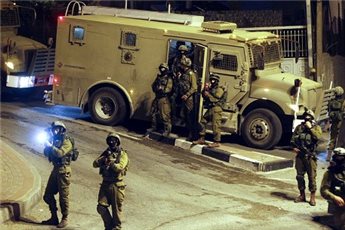 Israeli soldiers invaded the Deheishe refugee camp, in the West Bank district of Bethlehem, shot and killed a Palestinian teen, and wounded several others on Tuesday at dawn.
Medical sources said the slain young man has been identified as Jihad Shehada al-Ja’fary, 19 years of age.
The sources added that al-Ja’fary was shot by a live round that penetrated his left shoulder, and lodged in his chest causing a severe bleeding.
The soldiers prevented Palestinian medics from reaching the seriously wounded man, and he bled to death before the medics managed to move him to the al-Yamama hospital, in Bethlehem.
His body was then moved to the Beit Jala governmental hospital, and will later be moved to a forensic center.
The slain Palestinian was standing on his home’s rooftop, overlooking the main road, when he was shot.
Eyewitnesses said scores of soldiers invaded the camp in an attempt to kidnap a Palestinian, an issue that led to clashes between the soldiers and local youths who hurled stones and empty bottles on them.
The army fired gas bombs, rubber-coated metal bullets and rounds of live ammunition, causing several injuries.
Israeli settlement activities increased by 40% in 2014
MEMO | February 24, 2015
Israeli settlement construction in the occupied Palestinian territories increased by 40 per cent during 2014, Anadolu has reported. According to Israeli NGO Peace Now, which campaigns against illegal settlement construction, Israel started building 3,100 residential units in the Palestinian territories last year. It added that tenders for 4,485 additional residential units were published throughout 2014.
“On 30 January,” notes a Peace Now report, “tenders were issued for 450 more units in the occupied West Bank by the government of Israeli Prime Minister Benjamin Netanyahu.” Between 31 March 2009 and last month, the NGO pointed out, the two governments led by Netanyahu promoted at least 106 construction plans for 13,077 different residential units in 57 settlements.
International law considers the West Bank and East Jerusalem as occupied territories captured by Israel in 1967. All construction of Jewish settlements on the land is illegal. Palestinian negotiators have insisted that the establishment and building of Israeli settlements has to end before the stalled peace talks with Israel can resume.
US Orders PA, PLO to Pay $650 Million for Decade-Old Attacks
Al-Akhbar | February 24, 2015
A US jury on Monday found the Palestinian Authority (PA) liable for six attacks in Jerusalem that killed and injured Americans, awarding victims and their families more than $218 million in damages.
Under the US “anti-terrorism” act, the damages are automatically tripled, meaning that the PA and Palestine Liberation Organization (PLO) are liable to pay more than $650 million.
Israeli authorities welcomed the decision as a “moral victory,” but the Palestinians accused the lawsuit of being politically motivated and vowed to appeal.
The jury reached its verdict following two half-days of deliberations, ending a landmark trial under US district judge George Daniels in New York that lasted more than five weeks.
The six attacks killed 33 people and wounded more than 390 others between January 2002 and January 2004.
The bombings and shootings were carried out by Palestinian resistance movement Hamas and the al-Aqsa Martyrs Brigades — blacklisted as terrorist organizations in the United States — during the second Palestinian uprising against the Zionist state.
The 12-member jury decided unanimously that the PA and PLO were liable on 25 separate counts connected to the six attacks.
They apportioned individual damages ranging from $1 million to $25 million to Americans who were injured or lost loved ones.
The total falls well short of the $1 billion sought by lawyers for 11 plaintiff families when the trial opened in mid-January.
‘Moral victory’ for Israel
Israeli Foreign Minister Avigdor Lieberman welcomed the decision as a “moral victory for the state of Israel and for victims of terrorism.”
“Terrorism is an integral part of the very structure of the Palestinian Authority,” Lieberman said.
US attorney for the plaintiffs, Kent Yalowitz, welcomed the verdict.
“This is a great day for our country, it’s a great day for those who fight terror, we’re so proud of our families who stood up,” he told reporters.
It remains unclear if and how the PA can pay, as it is in serious financial difficulty because Israel has frozen its tax revenues.
Mahmoud Khalifa, Palestinian Authority deputy information minister, expressed dismay at the verdict and vowed to appeal what he called “baseless” charges.
He said the case was politically motivated by “anti-peace factions” in Israel to block a two-state solution to the Israeli-Palestinian conflict.
“We are confident that we will prevail, as we have faith in the US legal system and are certain about our common sense belief and our strong legal standing,” he said in a statement.
The roots of the Israel-Palestine conflict date back to 1917, when the British government, in the now-infamous Balfour Declaration, called for “the establishment in Palestine of a national home for the Jewish people.”
In 1948, with the end of the mandate, a new state – Israel – was declared inside historical Palestine.
In 1988, Palestinian leaders led by Arafat declared the existence of a State of Palestine inside the 1967 borders and the State’s belief “in the settlement of international and regional disputes by peaceful means in accordance with the charter and resolutions of the United Nations.”
Heralded as a “historic compromise,” the move implied that Palestinians would agree to accept only 22 percent, believed to have become 17 percent after massive Israeli settlement building, of historic Palestine in exchange for peace with Israel.
Numerous Palestinian factions, including Hamas, as well as pro-Palestine advocates support a one-state solution in which Israelis and Palestinians would be treated equally, arguing that the creation of a Palestinian state beside Israel would not be sustainable and that it would mean recognizing a state of Israel on territories seized forcefully by Zionists before 1967.
They also believe that the two-state solution, which is the only option considered by international actors, won’t solve existing discrimination, nor erase economic and military tensions.
‘Exaggerated’ testimony
The plaintiffs argued that the PA and PLO should be held responsible for providing material support to the groups responsible for the attacks, blacklisted as a foreign terrorist organizations in the United States.
The court also heard that members of the two groups were on the payroll of the two organizations.
Israeli lawyer Nitsana Darshan-Leitner told reporters in New York that she would leave no stone unturned in forcing the Palestinians to pay.
“We’re going to take steps against their assets, they have assets in the United States, in Israel. We’re going to go after bank accounts and money that they are getting paid on a monthly basis in Israel, for instance.”
Defense attorneys refused to comment after the verdict.
Lawyers for the PA contended during the trial that the leadership should not be held responsible for “crazy and terrible” attacks carried out by people who acted independently.
“There is no conclusive evidence that the senior leadership of the PA or PLO were involved in planning or approving specific acts of violence,” lawyer Mark Rochon argued in court last week.
He said the plaintiffs “exaggerated” testimony to make the Palestinian Authority “look bad” based in part on Israeli intelligence.
The six attacks took place against Hebrew University, in Jaffa Road, King George Street, against the number 19 bus and in French Hills, an illegal Zionist settlement in east Jerusalem.
The trial adds a new dimension to the decades-long Zionist occupation of Palestine and tensions between the Palestinian people and Israel.
Violent practices by Israeli Occupation Forces and illegal settlers against Palestinians are endemic and often abetted by the authorities.
More than 500,000 Israeli settlers live in settlements across the West Bank and occupied East Jerusalem, in contravention of international law.
In 2014, Israeli forces detained 1,266 Palestinian children below the age of 15 in the occupied West Bank and annexed Jerusalem.
According to the PLO, more than 10,000 Palestinian minors in the occupied West Bank and annexed Jerusalem have been held by the Israeli army for varying periods since 2000.
Since September 2000, following the Second Intifada, at least 9,100 Palestinians have been killed by Israelis, including 2,053 Palestinian children, the equivalent of one Palestinian child being killed every three days for the past 14 years.
The verdict came two weeks after the United Nations approved the Palestinian Authority to formally join the International Criminal Court (ICC) on April 1. Although the US claims that the protection of human rights is one of its cornerstones, it slammed the PA’s ICC membership, rejecting the Palestinians’ right to hold Israel accountable for large-scale massacres.
As an ICC member, the PA can open probes into Israeli crimes and rights violations during the Israeli summer assault on Gaza and the period leading up to it.
For 51 days in August, Israel pounded the Gaza Strip by air, land and sea with the stated aim of ending rocket fire from the coastal enclave.
More than 2,310 Gazans, 70 percent of them civilians, were killed, including 505 children, and 10,626 were injured by unrelenting Israeli attacks on the besieged strip.
Israeli PM Benjamin Netanyahu had vowed to push lawsuits in several countries against the PLO in retaliation of the ICC bid.
(AFP, Al-Akhbar)
Vladimir Putin: NATO already supplying weapons to Ukraine, Kiev defeated by Novorossia
Press statement following Russian-Hungarian talks and answers to journalists’ questions
February 17, 2015 – Budapest
[…]
QUESTION: Mr President, what is your assessment of the situation now that two days have passed since the Minsk agreement on a ceasefire took effect? Things do not seem to be going so smoothly, especially when you look at what is happening in Debaltsevo. There, at any rate, there is no ceasefire in place.
VLADIMIR PUTIN: First of all, we place great importance on the agreements reached in Minsk. Perhaps not everyone has noticed this yet, but what is particularly important in these agreements is that the authorities in Kiev are essentially agreeing to carry out far-reaching constitutional reform in order to satisfy demands for independence – call it what you will, decentralisation, autonomy or federalisation – in different parts of the country. This is a very important and very significant decision on the part of Ukraine’s authorities.
But there is another side involved too, and if the Donbass region’s representatives have agreed to take part in this reform, this means that we are seeing some support for progress along this road of developing Ukraine’s statehood.
Of course, the quicker everything is done to end hostilities and withdraw military equipment, the quicker this will put in place the real conditions needed for a political settlement to really go ahead.
As for military operations, I want to say that we have noted overall a substantial drop in activity. But let me note too that last time, when President Poroshenko decided to resume military operations and then stop them, it was not possible to do this immediately. What we do see now though is a clear and big decrease in the amount of shooting and exchange of hostilities along the entire battle line.
Yes, clashes are still taking place around Debaltsevo. But there too the scale and intensity of operations is less than it was before. What is happening there was not unexpected. According to our information, a group of Ukrainian troops were already surrounded there before the meeting in Minsk last week. I spoke about this at the meeting in Minsk. I said that the surrounded troops would try to break out of the encirclement and there would be attempts from the outside too to break through, and the militia, who had got the Ukrainian troops surrounded, would resist these attempts and try to keep the encirclement in place, and this would inevitably lead to further clashes. Another attempt to break through was made this morning, I don’t know what the media have been saying, I have not managed to follow all of the news, but I know that at ten o’clock this morning the Ukrainian armed forces made another attempt to break open the encirclement. It was unsuccessful in the end.
I hope very much that the people responsible in the Ukrainian government will not prevent Ukrainian servicemen from laying down their arms. If they cannot or will not take this important decision and give this order, they should at least not prosecute those who are ready to lay down their arms in order to save their own and others’ lives. At the same time, I hope that militia representatives and the authorities in the Donetsk People’s Republic and Lugansk People’s Republic will not detain these people and will not prevent them from freely leaving the conflict zone and encirclement and returning to their families.
QUESTION (translated from Russian): Mr President, from your words I understand that when the Minsk agreement was signed, and when you took part in the talks, you knew that the ceasefire would not take effect from exactly the moment planned. In other words, it was to be expected that some clashes would continue.
Do you think these clashes will end soon? Are you optimistic about the chances for a lasting ceasefire, or are you a pessimist, because if military clashes do intensify there, the United States could start supplying arms to Ukraine. How you would respond to this, what would Russia do?
VLADIMIR PUTIN: Concerning possible arms supplies to Ukraine, for a start, according to our information, arms supplies are already taking place. There is nothing so unusual about this situation.
Second, I firmly believe that no matter who and which type of weapons are involved, it is never a good thing to supply arms to a conflict zone, but in this particular case, no matter who sends them and what kind of arms are involved, the number of victims might rise of course, but the result would be the same as what we see today.
This would be inevitable because I believe that the vast majority of Ukrainian servicemen do not want to take part in a fratricidal war, even more so far from their own homes, and the Donbass militia has strong motivation to fight for and protect their families.
After all, let me remind you once again that what is happening now is linked to one thing only, namely, to the fact that the government in Kiev decided for a third time to resume military action and use the armed forces. This decision was first taken by Mr Turchinov, who issued the order to carry out what he called an antiterrorist operation. President Poroshenko then decided to resume the military operations, and now this is happening for the third time.
There will be no end to this if the people making the decisions do not realise that there is no hope of resolving the problem through military means. It can be settled only through peaceful means, only through reaching an agreement with this part of their country and guaranteeing these people’s lawful rights and interests.
Let me say that the agreement reached in Minsk offers an opportunity for this to happen. In this respect, I want to note the big role that the French President and the German Federal Chancellor played in reaching a compromise. I think that a compromise solution has been found and could be cemented by a resolution from the UN Security Council. Russia, as you know, has already put forward this initiative. If this happens, the Minsk Agreement would gain the status of international law. If not, it is already a good enough document that should be implemented in full. I am more of an optimist than a pessimist.
Let me say again that the situation is relatively quiet along the whole battle line now. We need to settle the problem of the group that has been surrounded. Our common task is to save the lives of the people trapped in this encirclement and ensure that this issue does not worsen relations between the authorities in Kiev and the Donbass militia.
It is never easy to lose of course and is always a misfortune for the losing side, especially when you lose to people who were yesterday working down in the mines or driving tractors. But life is life and it has to continue. I don’t think we should get too obsessed about these things.
As I said, we need to concentrate on resolving the main task, which is to save the lives of the people there now and enable them to return to their families, and we need to implement in full the plan agreed to in Minsk. I am sure that this is possible. There is no other road to take.
Netanyahu’s claims on Iran nuclear program contradicted Mossad findings – leaked docs
RT | February 23, 2015
Israeli PM Benjamin Netanyahu’s 2012 statement at the UN, in which he warned the world of Iran being too close to making a nuclear bomb, allegedly contradicted his country’s intelligence assessments, according to leaked spy documents.
Netanyahu famously declared to the United Nations General Assembly in September 2012 that Iran was 70 percent of the way to completing its “plans to build a nuclear weapon,” and drew another “red line” at 90 percent, claiming Tehran’s first bomb would be ready “by next spring, at most by next summer.”
However, leaked Mossad documents suggest the country was much further from such development.
According to Spy Cables – a cache of hundreds of leaked secret intelligence papers from all over the world, published by Al Jazeera’s Investigative Unit in collaboration with the Guardian newspaper – at the time of Netanyahu’s statement, Israel’s intelligence service concluded that Iran was “not performing the activity necessary to produce weapons,” estimating that Iran had 100 kilograms of uranium enriched to a level of 20 percent.
“Even though Iran has accumulated enough 5 percent enriched uranium for several bombs, and has enriched some of it to 20 percent, it does not appear to be ready to enrich it to higher levels. It is allocating some of it to produce nuclear fuel for the TRR [Tehran Research Reactor], and the amount of 20 percent enriched uranium is therefore not increasing,” said the secret report, which Mossad shared with South Africa’s State Security Agency a few weeks after the prime minister’s UN speech.
With world leaders worried by a possible nuclear threat, a series of political decisions led to Iran’s consent to neutralize or destroy its enriched uranium under an agreement with the US, Britain, China, Russia, France and Germany – the so-called P5+1 group.
Talks between world leaders on Iran’s nuclear ambitions and uranium enrichment capacity have taken place since sanctions were imposed on Tehran in 2012.
Iran insists it has no nuclear weapons ambitions and seeks enrichment capabilities to develop reactor fuel, and for other peaceful purposes. However, the West believes Tehran has been using its civilian atomic energy program as a cover for developing a bomb.
Since the parties failed to reach a conclusion by the previous deadline of November last year, Iran’s nuclear talks with the six world powers carry on. Iran and P5+1 countries are expected to reach a basic framework agreement by the end of March, with a final accord due by June 30. Netanyahu plans to address the US Congress next month to once again warn against a nuclear compromise with Tehran.
READ MORE: Netanyahu warns America that Iran is an ‘enemy’, not a partner
IPCC ‘s Bogus Evidence for Global Warming
By S. Fred Singer | American Thinker | November 12, 2013
The United Nations Intergovernmental Panel on Climate Change (IPCC) was set up by the United Nations in 1988 and has been trying very hard to demonstrate the threat of a dangerous human influence on climate due to the emission of greenhouse gases. This is in line with their Charter, which directs the IPCC to assemble reports in support of the Global Climate Treaty — the 1992 Framework Convention on Climate Change (FCCC) of Rio de Janeiro.
It is interesting that IPCC “evidence” was based on peer-reviewed publications – but (reluctantly) abandoned only after protracted critiques from outside scientists. E-mails among members of the IPCC team, revealed in the 2009 ‘Climategate’ leak, describe their strenuous efforts to silence such critiques, often using unethical methods.
I will show here that the first three IPCC assessment reports contain erroneous scientific arguments, which have never been retracted or formally corrected, but at least have now been abandoned by the IPCC — while the last two reports, AR4 and AR5, use an argument that seems to be circular and does not support their conclusion. Australian Prof. “Bob” Carter, marine geologist and paleo-climatologist, refers to IPCC as using “hocus-pocus” science. He is a co-author of the latest (2013) NIPCC (Non-governmental International Panel on Climate Change) report “Climate Change Reconsidered-II” www.climatechangereconsidered.org . We also co-authored a critique of the 2013 IPCC-AR5 Summary.
1. IPCC-AR1 (1990)
This first report of the IPCC bases its entire claim for AGW on the fact that both CO2 and surface temperatures increased during the 20th century — although not in lock-step. They assign the major warming of 1910 to 1940 to a human influence — based on a peer-reviewed paper by BD Santer and TML Wigley, which uses a very strange statistical argument. But the basis of their statistics has been critiqued (by Tsonis and Swanson) — and I have demonstrated empirically elsewhere that their conclusion does not hold.
While this faulty paper has never been retracted, it is now no longer quoted as evidence by the IPCC — nor accepted by the overwhelming majority of IPCC scientists: Most if not all warming of the early 20th century is due to natural, not human causes.
2. IPCC AR2 (1996)
This report devotes a whole chapter, #8, to “Attribution and Detection.” Its main feature is what one might call the “invention” of the “Hotspot,” i.e. an enhanced warming trend in the tropical troposphere — never actually observed.
Unfortunately, the “evidence,” as presented by BD Santer, was published only after the IPCC report itself appeared; it contains two fundamental errors. The first error was to argue that the Hotspot is a “fingerprint” of human influence — and specifically, related to an increase in greenhouse gases. This is not true. The Hotspot, according to all model calculations, is simply an atmospheric amplification of a surface trend, a consequence of the physics of the tropical atmosphere.
[Technically speaking, it is caused by increased convective activity whereby cumulus clouds carry latent heat from the surface of the tropical ocean into the upper troposphere. In other words, the Hotspot is not human-caused, but arises from a “moist-adiabatic lapse rate” of the atmosphere. This effect is discussed in most meteorological textbooks and is widely accepted.]
How then did AR2 conclude that a Hotspot exists observationally? This is the second issue: The IPCC selected a short interval in the atmospheric temperature record that showed an increase — while the general trend was one of cooling. In other words, they cherry-picked their data to invent a Hotspot — as pointed out in a subsequent publication by PJ Michaels and PC Knappenberger [see graph below]

The matter of the existence of a Hotspot in the actual tropical troposphere has been the topic of lively debate ever since. On the one hand, DH Douglass, JR Christy, BD Pearson and SF Singer, demonstrated absence of a Hotspot empirically while Santer (and 17[!] IPCC coauthors), publishing in the same journal, argued the opposite. This issue now seems to have been finally settled, as discussed by Singer in two papers in Energy & Environment [2011 and 2013].
It is worth noting that a US government report [CCSP-SAP-1.1 (2006)] showed absence of a Hotspot in the tropics (Chapter 5, BD Santer, lead author). But the report’s Executive Summary managed to obfuscate this result by referring to global atmosphere rather than tropical.
It is also worth noting that while the IPCC-AR2 used the Hotspot invention to argue that the “balance of evidence suggest a human influence,” later IPCC reports no longer use the Hotspot argument.
Nevertheless, one consequence of this unfortunate phrase in AR2 has been the adoption of the Kyoto Protocol, an international treaty to limit emissions of greenhouse gases. Even though Kyoto expired in 2012, it has managed to waste hundreds of billions of dollars so far — and continues to distort energy policies with uneconomic schemes in most industrialized nations.
3. IPCC AR3 (2001)
AR3 attributes global warming to human influences based on the “Hockey-Stick” graph, using published papers by Michael Mann, derived from his analysis of multi-proxy data. The hockeystick graph [bottom graph below] claims that the 20th century showed unusually rapid warming — and thus suggests a strong human influence. The graph also does away with the well-established Medieval Warm Period and Little Ice Age, which were shown in earlier IPCC reports [see top graph below].

It was soon found that the Hockeystick graph was in error and did not deserve continued reliance. Canadian statisticians Steven McIntyre and Ross McKitrick demonstrated errors in Mann’s statistical analysis and in the use of certain tree-ring data for calibration. In fact, they showed that Mann’s algorithm would generate a Hockeystick graph — even if the input data was pure noise. [I served as a reviewer for M&M’s initial paper in Energy & Environment 2003.]
It is worth noting that the IPCC no longer uses the Hockeystick to support human-caused warming, even though AR3 still claims to be at least 66% certain that greenhouse-gas emissions are responsible for 20th century warming.
4. IPCC-AR4 (2007) and AR5 (2013)
Both reports use essentially the same faulty argument in their attempt to support their conclusion of human-caused global warming. Their first step is to construct a model that tries to match the reported 20th-century surface warming. This is not very difficult; it is essentially a ‘curve-fitting’ exercise: By selecting the right level of climate sensitivity and the right amount of aerosol forcing, they can match the reported temperature rise of the final decades of the 20th century, but not the initial decades — as becomes evident from a detailed graph in their Attribution chapter. This lack of agreement is due to the fact that their models ignore major forcings — both from variations of solar activity and from changes in ocean circulation.They then use the following trick. They re-plot their model graph, but without an increase in greenhouse gases; this absence of forcing now generates a gap between the reported warming and unforced model. Then they turn around and argue that this gap must be due to an increase in greenhouse gases. It appears to me that this argument may be circular. Even if the reported late-20th-century surface warming really exists (it is absent from the satellite and radiosonde records), the IPCC argument is not convincing.
It is ironic, however, that IPCC claims increasing certainty (at 90% in AR4 and at least 95% in AR5) for an attribution to human causes, which appears to be contrived. Additionally, while AR4 calculates a Climate Sensitivity (for a doubling of CO2) of 2.0 – 4.5 degC, AR5 expands the uncertainty interval to 1.5 – 4.5 degC. So much for the claim of increased certainty in the IPCC-AR5 Summary.
Yet, while claiming increased certainty about manmade global warming, both reports essentially ignore the absence of any surface warming trend since about 1998. Of course, they also ignore absence of any significant warming in the troposphere, ocean record, and proxy data during the crucial preceding (1979-1997) interval.
Conclusion
In spite of much effort, the IPCC has never succeeded in demonstrating that climate change is significantly affected by human activities — and in particular, by the emission of greenhouse gases. Over the last 25 years, their supporting arguments have shifted drastically — and are shown to be worthless. It appears more than likely that climate change is controlled by variations in solar magnetic activity and by periodic changes in ocean circulation.
[Full disclosure: I have a very small dog in this fight, having demonstrated some time ago that solar-emitted magnetic fields, projected into interplanetary space by the solar wind, modulate the intensity of cosmic rays striking the Earth’s atmosphere; this is no longer a contentious, hot-topic issue. The exact mechanism by which cosmic rays then influence the climate is not known in detail, but current efforts, mainly by a Danish research group, focus on changes in Earth’s cloudiness.]
However, that there is no doubt about the existence of such a solar influence on climate. As shown in the graph below, cosmic-ray intensity (as measured by the radioactive carbon isotope C-14) and terrestrial climate (as measured by the oxygen isotope O-18) correlate in amazing detail over an interval of at least 3000 years (see graph below; the bottom graph is the central section, blown up to reveal detail)

S. Fred Singer is professor emeritus at the University of Virginia and director of the Science & Environmental Policy Project. His specialty is atmospheric and space physics.
US arming Israel with additional 14 stealth fighters
Press TV – February 23, 2015
The United States is set to arm Israel with more fighter jets in a three-billion-dollar agreement signed between Washington and Tel Aviv over the weekend.
The deal includes 14 F-35 stealth fighters made by the US company, Lockheed Martin, at a cost of about $110 million each, Israeli officials announced on Sunday.
Other technological and training elements were also included in the military package.
Israel is expected to receive the fighter jets by the end of next year.
The United States provides Israel with some $8.5 million in military aid per day, adding up to over $3 billion annually.
In November, the Department of Defense announced plans to arm Israel with 3,000 smart bombs as part of Washington’s military aid to Tel Aviv.
In December, American lawmakers passed a bill to deepen Washington’s bonds with Tel Aviv, making Israel a “major strategic partner” of the United States.
The US House of Representatives approved the US-Israel Strategic Partnership Act of 2014, which reflects “the sense of Congress that Israel is a major strategic partner of the United States,” and declares Washington’s “unwavering support” for Israel.
The US military aid to Israel has prompted several demonstrations across the country against such deals.
American protesters argue that the US taxpayer money is used for more Israeli aggression against Palestinians.
Interventionism Kills: Post-Coup Ukraine One Year Later
By Ron Paul | February 22, 2015
It was one year ago last weekend that a violent coup overthrew the legally elected government of Ukraine. That coup was not only supported by US and EU governments — much of it was actually planned by them. Looking back at the events that led to the overthrow it is clear that without foreign intervention Ukraine would not be in its current, seemingly hopeless situation.
By the end of 2013, Ukraine’s economy was in ruins. The government was desperate for an economic bailout and then-president Yanukovych first looked west to the US and EU before deciding to accept an offer of help from Russia. Residents of south and east Ukraine, who largely speak Russian and trade extensively with Russia were pleased with the decision. West Ukrainians who identify with Poland and Europe began to protest. Ukraine is a deeply divided country and the president came from the eastern region.
At this point the conflict was just another chapter in Ukraine’s difficult post-Soviet history. There was bound to be some discontent over the decision, but if there had been no foreign intervention in support of the protests you would likely not be reading this column today. The problem may well have solved itself in due time rather than escalated into a full-out civil war. But the interventionists in the US and EU won out again, and their interventionist project has been a disaster.
The protests at the end of 2013 grew more dramatic and violent and soon a steady stream of US and EU politicians were openly participating, as protesters called for the overthrow of the Ukrainian government. Senator John McCain made several visits to Kiev and even addressed the crowd to encourage them.
Imagine if a foreign leader like Putin or Assad came to Washington to encourage protesters to overthrow the Obama Administration!
As we soon found out from a leaked telephone call, the US ambassador in Kiev and Assistant Secretary of State, Victoria Nuland, were making detailed plans for a new government in Kiev after the legal government was overthrown with their assistance.
The protests continued to grow but finally on February 20th of last year a European delegation brokered a compromise that included early elections and several other concessions from Yanukovych. It appeared disaster had been averted, but suddenly that night some of the most violent groups, which had been close to the US, carried out the coup and Yanukovych fled the country.
When the east refused to recognize the new government as legitimate and held a referendum to secede from the west, Kiev sent in tanks to force them to submit. Rather than accept the will of those seeking independence from what they viewed as an illegitimate government put in place by foreigners, the Obama administration decided to blame it all on the Russians and began imposing sanctions!
That war launched by Kiev has lasted until the present, with a ceasefire this month brokered by the Germans and French finally offering some hope for an end to the killing. More than 5,000 have been killed and many of those were civilians bombed in their cities by Kiev.
What if John McCain had stayed home and worried about his constituents in Arizona instead of non-constituents 6,000 miles away? What if the other US and EU politicians had done the same? What if Victoria Nuland and US Ambassador Geoffrey Pyatt had focused on actual diplomacy instead of regime change?
If they had done so, there is a good chance many if not all of those who have been killed in the violence would still be alive today. Interventionism kills.
Reading the Runes in the Latest Report on Iran’s Nuclear Program
By Peter Jenkins | LobeLog | February 20, 2015
The latest report from the International Atomic Energy Agency on Iran’s nuclear program contains much that is worth emphasizing. Iran is continuing to account for all its declared nuclear material (and the agency appears to have no reason to suspect the existence of undeclared nuclear material). Iran is also continuing to comply fully with the commitments it made to the United States and others on November 24, 2013 and which it has renewed since.
Much of the commentary on the report on Iran will inevitably highlight Iran’s continuing failure to resolve two concerns the IAEA raised in May 2014. I, however, am surprised, that the IAEA director general omits all mention of two Iranian attempts, since the last IAEA report in mid-November, to address those and some other allegations that the IAEA is investigating.
On December 2, Reuters reported that in a statement to the IAEA Iran had rejected accusations that it was stonewalling IAEA investigations. Instead, Iran had affirmed that it had given the IAEA “pieces of evidence” indicating that documents adduced by the IAEA as reasons for concern were “full of mistakes and contain fake names with specific pronunciations which only point towards a certain IAEA member as their forger.” (The member Iran probably had in mind was Israel).
Yet there is no mention whatsoever of this Iranian rebuttal in the latest report, still less any detailed IAEA rebuttal of the rebuttal. Instead, the director general resorts to an exceptionally bland (and in the circumstances misleading) phrase: “Iran has not provided any explanations that enable the Agency to clarify the two outstanding practical measures [concerns].”
In effect Iran is being asked to prove its innocence. But when it tries to do so, the evidence it submits is rejected out of hand because it calls into question the evidence that is being used to justify the suspicion of guilt. Is that consistent with due process?
Also surprising is the omission of any mention of Iran’s offer of access to a suspected nuclear site at Marivan, reported by Reuters on December 11. A controversial annex to the IAEA’s November 2011 report referred to one member state having informed the agency that major high-explosives tests were conducted at Marivan in the first part of the last decade.
Since the IAEA has not taken Iran up on the offer, it presumably believes that a visit to Marivan would serve no useful purpose. If that is the case, do they not owe it to Iran to withdraw the November 2011 charge relating to Marivan? If the agency isn’t arranging a site visit, it should explain to IAEA member states that it considers the information provided by “a member state” to have been unreliable or irrelevant.
I raise these questions not to criticise the IAEA secretariat, which continues to do a first-class job in Iran, as professional and objective as ever. Rather, I want to offset the hue and cry that opponents of a nuclear deal will raise over the reference in the latest report to Iran’s failure to provide explanations. I’m suggesting that there is more to this than meets the eye.
Turning back to the positive, Iran is continuing to allow exceptional access to centrifuge assembly workshops, centrifuge rotor production workshops, and storage facilities. This access has enabled the IAEA to conclude that centrifuge rotor manufacturing and assembly are consistent with Iran’s replacement program for failed centrifuges. In other words, Iran is not manufacturing and diverting rotors to some clandestine enrichment facility.
This is highly significant. Amid the endless furor over the number of centrifuges that Iran should retain under a comprehensive agreement, the public could be forgiven for failing to appreciate that, theoretically, Iran is far more likely to “sneak out”—using a clandestine enrichment facility—than to “break out” under the eyes of IAEA inspectors, using the centrifuges it wants to retain.
I inserted “theoretically” to emphasize that at this point there is no evidence that Iran intends either to break out or to sneak out. And as long as the IAEA retains access to Iran’s rotor manufacturing, assembly, and storage facilities—which it will lose if the opponents of a deal have their way—we can all feel confident of a continuing absence of intention.
In essence, the latest IAEA report contains nothing that would justify the United States and its allies declining to close a deal with Iran in the course of the coming four weeks. I, for one, am rooting for their success.
Peter Jenkins was a British career diplomat for 33 years, following studies at the Universities of Cambridge and Harvard. He served in Vienna (twice), Washington, Paris, Brasilia and Geneva. He specialized in global economic and security issues. His last assignment (2001-06) was that of UK Ambassador to the IAEA and UN (Vienna).
Follow LobeLog on Twitter
Russia offers Iran latest anti-aircraft missile system
Press TV – February 23, 2015
The head of Russian state defense conglomerate Rostec says Moscow has offered Iran its latest Antey-2500 missile defense systems after a deal to supply less powerful S-300 missiles was scrapped under Western pressure.
Tehran is now considering the offer, Russia’s TASS news agency quoted Sergei Chemezov as saying on Monday.
“As far as Iran is concerned, we offered Antey-2500 instead of S-300. They are thinking. No decision has been made yet,” Chemezov said.
There was no immediate response to Chemezov’s comments from Iran.
Under a contract signed in 2007, Russia was obliged to provide Iran with at least five S-300 defense systems.
However, Moscow refused to deliver the system to Iran under the pretext that it is covered by the fourth round of the United Nations Security Council sanctions against Tehran over its nuclear program.
Following Moscow’s failure to deliver the systems, Iran filed a complaint against the Russian arms firm Rosoboronexport with the International Court of Arbitration in Geneva.
The Antey-2500 was developed from the 1980s-generation S-300V system (SA-12A Gladiator and SA-12B Giant). It can engage missiles travelling at 4,500 meters per second, with a range of 2,500 kilometers (1,500 miles), according to the company that makes it, Almaz-Antey.
The S-300 missiles have a 125-mile (200-kilometers) range.
Featured Video
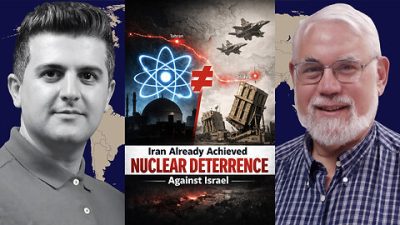
Prof. Ted Postol: Iran Already Achieved Nuclear Deterrence Against Israel
or go to
Aletho News Archives – Video-Images
From the Archives
How the occupied mentality syndrome works
Saudi Arabia on the American chessboard – Part 3
By B. J. Sabri | American Herald Tribune | June 27, 2016
Read part 2: “The occupied mentality Syndrome“
Previously I argued whether Saudi Arabia’s repeated involvements in U.S. interventions and wars stem from free national will or in response to a specific condition. For starters, in Saudi Arabia there is no national will. In Saudi Arabia, the national will is the will of the Al Saud clan. Still, when a major Arab state allies itself with a superpower that committed unspeakable crimes against humanity in almost every Arab country, then something is wrong. This fact alone should compel us to examine the U.S.-Saudi relation for one exceptional reason. As a result of the U.S.-Saudi wars, hundreds of thousands of people in Afghanistan, Iraq, Iran, Libya, Syria, Yemen, and Somalia have lost their lives. Millions became displaced in their own homelands. And millions more rendered refugees.
Attributing the Saudi policies to the bonds of “partnership” with the U.S. is frivolous. There are no bonds between these two thugs except those of business, military deals, secret plots, and wars. Proving this point, bonds such as these have no space for the American and Saudi peoples to share significant cultural or societal exchanges. If partnership is not the reason for the Saudi contribution to the U.S. strategy of empire and imperialism, then another reason must exist.
This leads to three possibilities. … continue
Blog Roll
 Aletho News
- REWRITING THE RISK? INSIDE THE GOVERNMENT’S VACCINE SAFETY MESSAGING
- “Davos Can Really Replace the UN”
- NIAID/NIH and USDA Fund Bioengineered Chimeric Influenza Viruses Built Using Pandemic H1N1 Components: Journal ‘Science Advances’
- Hezbollah hits Israeli warship off Lebanon’s coast, sets it aflame
- Iran slams US strikes on B1 bridge, Mahshahr petrochemical plants as ‘blatant acts of state terrorism’
- In letter to UN chief, Araghchi warns of dire consequences of US-Israeli attacks on Iran’s nuclear facilities
- Why the CIA conspiracy to invade Iran with Kurdish militias failed
- Why Are Upbeat US Claims About Mission to Rescue Pilot ‘Highly Questionable’?
- Aircraft destroyed during US ‘rescue’ of downed F-15 pilot cost more than $100 million each
- Washington University removes professor who condemned US-Israeli war on Iran
- If Americans Knew
- In Iran, Israel-US take aim at “reason, research, and freedom of thought” – Daily Update
- US loses planes over Iran, Israel downgrades Lebanon war goals – Daily Update
- Israel Is Blocking Palestinians from Easter at Church Where Jesus Resurrected
- Plot to assassinate Palestinian activist follows harassment campaign promoted by Zionist groups and elected officials
- Prominent New York synagogue hosts presentation on why U.S. Jews should support the ethnic cleansing of Gaza
- Tapper vs. Piker: Is the CNN Anchor Auditioning for David Ellison?
- Shouldn’t Democrats Be Able to Condemn Genocide?
- Israel-US kill negotiators, destroy civilian structures, but Iran’s military capabilities still largely intact – Daily Update
- ‘War crime’: Global condemnation as Israeli ministers celebrate death penalty law targeting Palestinian prisoners
- 7 Ways Israel Is Turning Lebanon Into Gaza
- No Tricks Zone
- An Inconvenient Tree: Uncovered In Alps… Europe Much Warmer Than Today 6000 Years Ago
- New Study Reports A 60% Slowdown In Greenland’s Ice Loss Rate In The Last Decade
- Low Intensity Tornado Wrecks Major Solar Farm, Creating A Potential Toxic Dump
- New Study Finds Warming Saves Lives…Cold Temperatures 12 Times More Deadly Than Excess Heat
- German Science Blog Accuses PIK Climate Institute Of Hallucinating Climate Tipping Points
- Devastating Assessment Of Comirnaty Vaccine By Former Senior Pfizer Europe Toxicologist
- New Study: CO2 Is ‘Effectively Negligible’ As An Explanatory Climate Change Factor Since 2000
- Former Pfizer Toxicologist Dr. Helmut Sterz Tells Bundestag Hearing Pfizer Vaccine Should Have Never Been Approved
- Energy Expert: Germany’s Nuclear Phaseout Was A “500 Billion Euro Mistake”
- New Research: South Australia’s Mid-Holocene Sea Surface Temperatures Were 4°C Warmer Than Today
 Aletho News