Israel is still banning Gaza students from West Bank universities
MEMO | February 20, 2015
Palestinian students from Gaza are still prevented by Israel from studying at West Bank universities, after an announcement this week to the contrary was retracted as a mistake.
On Wednesday, Israel’s Coordinator of Government Activities in the Territories (COGAT) announced that a quota of 50 students would be permitted to exit Gaza “for the purpose of academic studies” in the West Bank. However, as related by NGO Gisha, the very same evening, COGAT clarified that there had been a “clerical error” in the relevant document, and that there would be no such permits.
The Israeli government has opposed Palestinians from Gaza studying in the West Bank on the grounds of ‘security’. The High Court of Justice has also rejected petitions by human rights groups on the matter, including one filed on behalf of five women studying gender, democracy and law.
In 2009, 21-year-old, Bethlehem University student Berlanty Azzam was arrested at a West Bank checkpoint and immediately returned to the Gaza Strip, after a solider noted Gaza City as the town of residence on her ID.
The ill-fated announcement was included on a list of various measures apparently prepared by Israel to “ease” restrictions. According to reports from COGAT and Palestinian officials, it would appear that the number of merchant permits will rise, as will the type and quantity of goods permitted to exit from Gaza for sale in the West Bank.
Back in November, two truckloads of wooden planks left Gaza for sale in the West Bank, the first time that wood from Gaza has been sold in the West Bank since the blockade was imposed in 2007. The same month, some truckloads of clothes, fish, and agricultural products made the same journey, again for the first time.
This is less indicative of Israeli authorities’ generosity but rather highlights the deception that is the ‘security’ rationale for the restrictions in the first place. Why were Gaza’s farmers allowed to send cucumbers to the West Bank on November 6, 2014 – but not before? Why won’t Israel lift restrictions on exports, save for piecemeal exceptions?
The continued refusal to allow Palestinian students from Gaza to study in West Bank universities is further evidence that Israel’s approach is one based on collective punishment. Worth remembering, the next time someone tries justifying yet another apartheid policy in the name of ‘security’.
UN Peace Coordinator Unwelcome by Palestinians
By Nicola Nasser | Al-Ahram | February 20, 2015
The PLO (Palestine Liberation Organisation) did not object to the appointment of new UN special coordinator for the Middle East peace process Nikolay Mladenov, although he was described by Tayseer Khaled, a member of the PLO’s Executive Committee, as “persona non grata” — not trusted by the Palestinians and nor qualified for the job.
The 15-member UN Security Council unanimously voted to appoint Bulgarian Mladenov, 42, to succeed Holland’s Robert Serry. He would also be the representative of the UN secretary general to the International Quartet (the UN, US, EU and Russia), and personal representative of the UN chief to the PLO and the Palestinian Authority (PA).
Although protocol allows the PLO the right to reject diplomatic representatives to the organisation, observers cannot understand why it accepted Mladenov. There is no convincing answer except a futile desire by the PLO to appease the UN and Secretary General Ban Ki-Moon, at a time when PLO diplomatic efforts are focused on the UN and its agencies.
Mladenov not only failed in a similar mission as UN envoy to Iraq and resigned, he is someone who describes himself — and is described by the leaders of the Israeli occupation — as “a good friend of Israel”. As Bulgarian foreign minister, Mladenov suggested a “military alliance” between Bulgaria and Israel. He has often spoken about his bias towards “Israel’s right to exist” and its right “to defend itself” against Palestinians resisting Israeli occupation. He even admitted to being a Free Mason, served Jewish billionaire George Soros, and publicly advocated the US’s “constructive chaos” policies in the Arab world. In fact, his Jewish origins may be the least controversial aspect of him.
Meanwhile, the occupation state does not hesitate in ignoring the UN, its resolutions and representatives, disregarding and even assassinating them when necessary. Most recently, Israeli Foreign Minister Avigdor Lieberman threatened to “expel” Mladenov’s predecessor Serry as “persona non grata”. Shortly before that, William Schabas, the head of the UN commission investigating the occupation’s recent war on the Gaza Strip, resigned after Israel refused to cooperate with him or allow him to enter the country.
After the UN tolerated the assassination of its first envoy to Palestine, Swedish Count Folke Bernadotte in 1948, at the hands of the Zionist Stern Gang led by Yitzhak Shamir (who later became prime minister of the occupation state), Israel was emboldened to adopt a permanent policy of disregarding the UN without deterrence so far.
In fact, over the past two years the occupation state has carried out a proxy war against the UN. It has facilitated logistics, intelligence, firepower and medical assistance to allow the domination of militias fighting the Syrian regime on its side of the disengagement zone between the liberated and occupied Arab Syrian Golan. This compelled the UN Disengagement Observer Force (UNDOF) to withdraw after its positions were attacked, dozens of its troops kidnapped and their weapons and equipment seized. Until today, the UN has not dared to rectify the situation, which resulted in the collapse of the UN-sponsored ceasefire and rules of engagement between Syria and Israel.
The Middle East is teeming with international peace envoys. The UN has one, so does the US, the EU, Russia, China and the Quartet. Their names change without anything on the ground in occupied Palestine changing. Except for expanding the occupation through settlements under the “peace” umbrella these envoys provide, without any hope that the international community they represent will be able to effect any real tangible change for the present and future of the Palestinian people on the ground.
So what can Mladenov do that his predecessors, the UN, the Quartet, the Arab League and others, couldn’t?
Khaled believes the real test, to remove Palestinian doubts about Mladenov’s role and mission, will be his position on the siege on Gaza and reconstruction there. However, Mladenov’s track record does not indicate there is cause for optimism. Nor does the track record of “UN special coordinators” since the creation of the position in 1994 and the subsequent expansion of its role, as well as the extensive history of choosing UN and US envoys of Jewish origins or related in the first degree to Jews, such as Henry Kissinger, Madeleine Albright, John Kerry, Dennis Ross, Martin Indyk and Quartet representative Tony Blair.
On 6 February, the secretaries general of the UN and Arab League issued a joint statement expressing “deep concern” about conditions in Gaza. They urged Arab and international donors to honour their financial pledges made at the Cairo Conference last October “as soon as possible”, in order to rebuild the Gaza Strip and end the siege there. A few days ago, James Rowley, UN coordinator for humanitarian affairs in the Palestinian territories occupied since 1967, sent out an “urgent call” for these commitments to be fulfilled and an “immediate” lift of the siege on Gaza, because he is “very concerned another conflict will break out” if not.
The Palestinian Foreign Ministry described the statement by the Quartet on 8 February after it met in Munich, Germany, as “short of expectations” because it ignored “all the old-new and evolving truths” of the occupation state.
The Quartet also said it is “deeply concerned” about the “difficult conditions in Gaza where reconstruction needs to be quicker” and urged donors to “pay their financial pledges as soon as possible”. However, it linked this to encouraging both sides to “restart negotiations as soon as possible”.
Restarting talks “as soon as possible”, nonetheless, must await the outcome of general elections in Israel and the US. This means the Palestinian people must wait for another two years in the vain hope of reconstructing Gaza. It is obvious the occupation state is enjoying the luxury of time, making easy the occupation without resistance, as well as building settlements without deterrence.
Before handing over the reins to Mladenov, Serry described the failure of donors to pay their dues as “scandalous” and warned “if there is no progress in the coming months” — not two years — towards a two-state solution, “the reality will be a one state [solution]”: the single state of Israel. Former UN coordinator Terry Rod Larsen said in 2002, “the Palestinian patient is dying in the interim.”
Last December, Serry warned in his report to the Security Council that a war in Gaza “could re-ignite if conditions on the ground do not change” in the besieged Gaza Strip. It is clear that what Serry described as a “deadly diplomatic vacuum” coupled with the ongoing siege on rebuilding Gaza, are an explosive recipe in the besieged Gaza Strip, the outcome and ramifications of which are unpredictable.
The “scandal” of donors not paying their dues to rebuild Gaza, as Serry described it, under the pretext that the PLO government does not control the Gaza Strip, is a green light given by the international community to the occupation state to carry out another military assault on national resistance forces in Gaza.
The scandal of Arabs not paying their pledges at Arab summits to provide the PA with a financial “safety net” amounts to flagrant Arab pressure on the PLO to accept the Quartet’s proposal to restart talks with the occupation state “as soon as possible”.
This is Mladenov’s dual mission as the new UN special coordinator for the Middle East peace process. PLO negotiators continue to wait for a breakthrough by “peace” envoys that are imposed on them and appointed by the US and the UN, although they represent the occupation state. Mladenov is the most recent. He will not change anything on the ground.
Translation by Palestine Chronicle
Nicola Nasser is a veteran Arab journalist based in Bir Zeit, West Bank of the Israeli-occupied Palestinian territories. He can be reached at: nassernicola@ymail.com.
Hamas says no militants crossed into Egypt from Gaza
MEMO | February 21, 2015
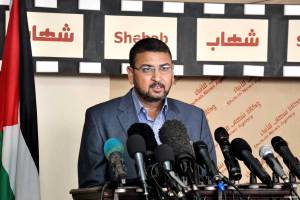
Hamas spokesman Sami Abu Zuhri
Palestinian faction Hamas on Saturday denied reports of militants crossing into Egypt’s Sinai Peninsula from the Gaza Strip.
“There haven’t been any militants crossing [into Egypt from Gaza], especially after the destruction of all underground tunnels and the deployment of [Egyptian and Palestinian] security forces on border,” Hamas spokesman Sami Abu Zuhri said in a statement.
Abu Zuhri called on Arab parties to shoulder their responsibility in standing against any form of “slander and incitement” against the Palestinian people.
He also went on to appeal to scholars and intellectuals to organize a major media campaign to expose what he described as “pro-Israel media”.
On Friday, the United Arab Emirates-based Sky News Arabia reported that the Egyptian army raised the alert level in the country’s eastern Sinai Peninsula following reports that militants from self-styled “Army of Islam” group crossed into Egypt from Gaza.
The Egyptian army has not commented on the report.
Last month, an Egyptian court declared the military wing of Hamas, Izzedine al-Qassam Brigades, a “terrorist organisation.”
Abu Zuhri had described the court verdict as “politically-motivated”, and reiterated that his movement does not interfere in Egypt’s internal affairs.
‘ISIL fight’ spells lucrative arms deals: UK arms maker
Press TV – February 21, 2015

British arms maker BAE Systems boasts lucrative weapons deals as the result of the so-called anti-ISIL fight
British arms manufacturer BAE Systems has boasted hiking demand for its support services of war machines, citing growing engagement of its Arab clients in the so-called anti-ISIL battle.
Speaking to journalists after posting the weapon maker’s 2014 spending, BAE’s Chief Executive Officer Ian King described the rise in demand as a “call to arms” and said, “You cannot let any performance degrade at this time when people are dependent on these assets,” RT reported Friday.
King further said the rise of the ISIL terror group as well as the persisting conflict in Ukraine would mean that governments will keep military spending high on their agenda despite degrading defense budgets due to austerity measures.
“We have a lot of bidding activity going on at the moment and a lot of support activity going on,” he said.
The report comes as some Middle Eastern states, including Saudi Arabia, Qatar, Jordan, Bahrain, have joined the so-called anti-ISIL alliance led by the United States.
This is while some of the parties to the same coalition have been among the staunch supporters of the Takfiri groups operating against Syria over the past few years.

“For the first time in the Middle East, the big Middle East countries are deploying their assets against IS[IL],” King said. “Urgent operational requirements are high, support arrangements are high. It is high up on people’s agendas.”
According to the report, BAE’s support service to Saudi Arabia is its third largest market after Britain and the US. However, there is no evidence that the Saudis have engaged in any strikes against the ISIL terrorist group, which is widely believed to be financed by the US-backed kingdom and its other Persian Gulf rulers.
US admits ISIL established by its allies
The development comes after a former US military official admitted earlier this week that Washington’s Middle Eastern allies established the ISIL as part of a strategy to eliminate the Lebanese Islamic resistance group Hezbollah.
“ISIS got started through funding from our friends and allies,” said retired US general Wesley Clark on Tuesday, using another acronym for ISIL, adding the only group that would fight Hezbollah is ISIL because they are “zealots” and resemble a “Frankenstein.”
‘BAE prosperity at expense of human rights’
Critics, however, insist that BAE’s emerging prosperity comes at the expense of human rights and ethical trading. BAE weaponry is also thought to have fallen into the hands of the ISIL terrorists.
Speaking to RT, Andrew Smith of Campaign Against Arms Trade (CAAT) described the remarks by BAE’s chief as “tasteless.”
“This is yet another tasteless reminder that arms companies like BAE depend on war and conflict in order to make a profit. BAE isn’t concerned about human rights or democracy; many of the governments it sells weapons to are among the most oppressive in the world,” he said.
CAAT had also emphasized in the past that the British government is highly in favor of international weapons trading.
US and Turkey, Pouring Gasoline on the Fire
By Richard Edmondson | Uprooted Palestinians | February 19, 2015
The US and Turkey have come to an agreement under which US military personnel will begin training so-called moderate rebels to fight in Syria. The announcement was made Tuesday. This is not just a foolish move; it is the equivalent of pouring gasoline on a fire.
There are no moderate rebels. The moderate people in Syria support their government. If Obama is really serious about fighting ISIS he should join forces with the Syrian government and with Hezbollah–because they are the “boots on the ground” who are taking the fight to the terrorists.
How will the US know the “moderates” it trains aren’t really ISIS secret agents? That may sound funny, but I’m serious. In a report here we are told that the US has so far “screened” about 1,200 rebel fighters said to have been drawn from “several moderate groups in Syria.”
According to the report, the “screening” process is being headed up by Maj. Gen. Michael Nagata. The plans are to train about 5,000 “moderates” per year, but the process is going slowly because each applicant is supposedly being thoroughly checked. Some 100 US personnel are already in the area setting up three training camps–in Turkey, Qatar, and Saudi Arabia–and eventually about 1,000 US troops are expected to be involved in the program.
Question: how does Nagata know that at least some of the “moderates” being recruited for this effort aren’t in reality deep-cover ISIS operatives? Answer: he doesn’t. And even if they are moderates now, what’s to stop them from going over to the other side once they get their American training and equipment?
We saw an instance, late last year, in which two “moderate” rebel groups who had received US training–Harakat Hazm and the Syrian Revolutionary Front–laid down their weapons and surrendered after coming into military conflict with Al-Nusra. The two groups had been supplied with GRAD rockets and TOW anti-tank missiles. All of this equipment ended up in Al-Nusra’s possession. It is said that Harakat Hazm gave up “without firing a shot,” and that some of its members even defected over to the takfiri militants. These events took place in early November of 2014, and they proved somewhat embarrassing for the Washington Institute for Near East Policy, or WINEP.
In April of 2014, WINEP fellow Jeffrey White published an article in which he referred to Harakat Hazm as “rebels worth supporting.” I discussed White’s piece in a post entitled The Myth of the ‘Moderate’ Rebels, which I put up on October 15 last year. At that time, Harakat Hazm had not yet surrendered to Al-Nusra, but the post included a video about the organization that placed its supposed “moderation” into considerable doubt. Below is that video. Starting at about 1:04 in you will see footage showing five men seated at a table. The one in the center is Salim Idris, former chief of staff of the Free Syrian Army–another supposed “moderate.”
In my article I noted that the best way for the US to defeat ISIS, perhaps the only way, is to join forces with the Syrian government. But this will not happen, I also mentioned, because it runs counter to the wishes of the Zionist lobby in America, which wants to see regime change in Syria.
Now, just months later, one has to wonder: was it Maj. Gen. Michael Nagata who made the decision to give GRAD rockets and TOW missiles to Harakat Hazm? Nagata was already on the job training Syrian rebels in October of last year, and you can go here to see a report filed at that time that offers a little bit of insight into his background. The report doesn’t leave you with a great deal of confidence in him.
Once the initial 1,200 “moderates” have undergone their training, what happens then? Will they simply be wished the best of luck, sent off into Syria, at which point that’s the end of it? Hardly. According to a report here, once they are in Syria, the “moderate” rebels will be given the power to call in US airstrikes, which opens up a host of possibilities, including a scenario in which US air power is manipulated by those on the ground for purpose of attacking rival rebel groups. And this, too, has happened before–in Afghanistan.
How much of our tax dollars are being wasted on this enterprise? How much is being wasted now–and how much will be wasted in the years to come? Another consideration is the chance that all this will escalate. Those who remember history will recall that the Vietnam war started out with just a small number of US “advisers” in the country to train South Vietnamese troops. In 1959, a total of just 760 US personnel were in South Vietnam; in 1960, the number grew to 900. By 1968, America had more than a half million troops stationed in the country.
As mentioned above, one of the US training camps being set up is in Saudi Arabia. The Wahhabist ideology was born in Saudia Arabia, and the kingdom today remains its epicenter. Exactly what sort of persons do you suppose Nagata will be providing training for in his camp there? Perhaps they will include the enlightened followers of a Saudi cleric who recently explained why, in his view, the earth doesn’t rotate. The cleric has been identified as Sheikh Bandar al-Khaibari:
The above video surfaced earlier this week. The following video, below, was posted three months ago and shows Hezbollah leader Hassan Nasrallah discussing, in a somewhat bemused manner, the beliefs of clerics like al-Khaibari:
Not only is the “moderate rebel” a myth, but the notion that Saudi Arabia, Turkey and Qatar are sincere partners in fighting ISIS is also a myth. All three countries have been heavily implicated in providing assistance to the very terrorists the Obama administration claims to be fighting. Due to the low price of oil, filling up gasoline cans is cheap these days.
The only people who attempt to put out fires with gasoline are either, a) the very stupid; or, b) those who only pretend to want to see the fire put out but who in reality are seeking to create a bigger fire.
In a speech given on Thursday, February 19, Obama asserted that the world is “united against the scourge of violent extremism and terrorism.” This is a fairly accurate statement as far as it goes; the vast majority of the world’s people are indeed united on that point. The question, of course, becomes: does Obama really not know who his friends are in this fight?
The Middle East is really not that hard to figure out. The best, the brightest, the most patriotic of the region–these people already know what side they are on; they have joined the ranks of Hezbollah, the Syrian and Lebanese Armies, and the Syrian National Defense Force. They will fight and they will defeat America’s trained proxies, and then when nothing is left but for America to send in its own ground forces, they will fight America as well.
This is the course our leaders are presently headed on–all for Israel.
CIA-planted ‘evidence’ may force IAEA review of alleged Iranian nuclear arms program– report
RT | February 21, 2015
Doctored blueprints for nuclear weapon components supplied to Iran by the CIA 15 years ago could force the IAEA to review its conclusions on Iran’s atomic program, which was potentially based on misleading intelligence, Bloomberg reports.
The details of the Central Intelligence Agency operation back in 2000 were made public as part of a judicial hearing into a case involving Jeffrey Sterling, an agent convicted of leaking classified information on CIA spying against Iran.
“The goal is to plant this substantial piece of deception information on the Iranian nuclear-weapons program, sending them down blind alleys, wasting their time and money,” a May 1997 CIA cable submitted to the court reads.
The intelligence in question pertains to fake designs of atomic components that were transferred to Iran in February 2000.
Now it turns out the International Atomic Energy Agency (IAEA) could be forced to reassess their earlier conclusions regarding Iran’s atomic program, the publication quoted two anonymous Western diplomats as saying. Part of the IAEA’s suspicions about Iran’s alleged nuclear weapons program relies on information provided by multiple intelligence agencies.
“This story suggests a possibility that hostile intelligence agencies could decide to plant a ‘smoking gun’ in Iran for the IAEA to find,” Peter Jenkins, the UK’s former envoy to the Vienna-based agency told Bloomberg. “That looks like a big problem.”
In the latest quarterly report, the atomic watchdog said that the team of experts is still concerned about Iran’s nuclear intentions, prompting an immediate reaction from Israel.
“The agency remains concerned about the possible existence in Iran of undisclosed nuclear-related activities involving military-related organizations, including activities related to the development of a nuclear payload for a missile,” it reads.
Whether or not the revealed CIA secret will change this assessment remains to be seen, but Tehran has always insisted that its atomic energy program is peaceful.
“This revelation highlights the dangers of reliance by the IAEA upon evidence concerning Iran provided to it by third party states whose political agendas are antithetical to Iran,” Dan Joyner, a law professor at the University of Alabama told Bloomberg.
In response to the news, the IAEA told the publication that it conducts thorough assessments of the information it receives and uses. The CIA has so far failed to comment.
In 2013, Iran agreed to an interim deal with Russia, the United States, China, France, Great Britain and Germany under which Tehran would promise to flat-line its nuclear program, in exchange for a loosening of the severe banking and oil sanction earlier imposed by the West.
Belgian nuclear reactors riddled with 16,000 unexplained cracks
By Oliver Tickell | Ecologist | February 18, 2015
The discovery of over 16,000 cracks in two Belgian reactor vessels may have global implications for nuclear safety, says the country’s nuclear safety chief. He and independent experts are calling for the immediate checks of nuclear reactor vessels worldwide.
Thousands of cracks have been found in the steel reactor pressure vessels in nuclear reactors Doel 3 and Tihange 2 in Belgium – vessels contain highly radioactive nuclear fuel cores.
The failure of these components can cause catastrophic nuclear accidents with massive release of radiation.
The pervasive – and entirely unexpected – cracking could be related to corrosion from normal operation, according to leading material scientists Professor Walter Bogaerts and Professor Digby MacDonald.
Speaking on Belgian TV, Professor MacDonald said:
“The consequences could be very severe … like fracturing the pressure vessel, loss of coolant accident. This would be a leak before break scenario, in which case before a fracture of a pipe occurred … you would see a jet of steam coming out through the insulation.
“My advice is that all reactor operators, under the guidance of the regulatory commissions should be required to do an ultrasonic survey of the pressure vessels. All of them.”
Professor Bogaerts added:
“If I had to estimate, I would really be surprised if it … had occurred nowhere else … I am afraid that the corrosion aspects have been underestimated.”
Jan Bens, Director-General of the Belgian nuclear regulator the Federal Agency for Nuclear Control (FANC), has said that this could be a problem for the entire nuclear industry globally – and that the solution is to begin the careful inspection of 430 nuclear power plants worldwide.
An unexplained embrittlement
The problem was discovered in the summer of 2012. Both the Doel 3 and Tihange 2 reactors have been shut down since March 24th, 2014 after additional tests revealed an unexplained advanced embrittlement of the steel of the test sample.
At the time the reactors’ operator, Electrabel, dismissed the cracks as being the result of manufacturing problems during construction in the late 1970’s in the Netherlands – but provided no supporting evidence.
FANC also stated that the most likely cause was manufacturing – but added that it could be due to other causes. Following the further tests FANC has now issued a statement confirming that the additional 2014 tests revealed 13,047 cracks in Doel 3 and 3,149 in Tihange 2.
“In carrying out tests related to theme 2 during the spring of 2014, a fracture toughness test revealed unexpected results, which suggested that the mechanical properties of the material were more strongly influenced by radiation than experts had expected. As a precaution both reactors were immediately shut down again.”
As nuclear reactors age, radiation causes pressure vessel damage, or embrittlement, of the steel mostly as a result of the constant irradiation by neutrons which gradually destroys the metal atom by atom – inducing radioactivity and transmutation into other elements.
Another problem is that hydrogen from cooling water can migrate into reactor vessel cracks. “The phenomenon is like a road in winter where water trickles into tiny cracks, freezes, and expands, breaking up the road”, says Greenpeace Belgium energy campaigner Eloi Glorieux.
“It appears that hydrogen from the water within the vessel that cools the reactor core is getting inside the steel, reacting, and destroying the pressure vessel from within.”
He adds that the findings mean that “the safety of every nuclear reactor on the planet could be significantly compromised … What we are seeing in Belgium is potentially devastating for nuclear reactors globally due to the increased risk of a catastrophic failure.”
Immediate action needed to prevent another catastrophe
On February 15th the nuclear reactor operator, Electrabel (GDF / Suez parent company) announced that it would be prepared to “sacrifice” one of its reactors to conduct further destructive tests of the reactor pressure vessel in order to study this poorly understood and extremely concerning damage phenomenon.
Electrabel’s findings will be submitted to FANC which will organize a new meeting of the international panel of experts to obtain their advice on the results of the new material tests and on the new data.
According to Electrabel, the findings constitute a “Level 1 occurrence on the International Nuclear Event Scale (INES)” but the company emphasises that the event “has no impact whatsoever on the wellbeing or health of the employees, the local residents, or the surrounding area.”
But Glorieux dismisses such complacency: “As we approach the fourth anniversary of the Fukushima-daiichi nuclear disaster, evidence has emerged that demands immediate action to prevent another catastrophe. Thousands of previously unknown cracks in critical components of two reactors point to a potentially endemic and significant safety problem for reactors globally.
“Nuclear regulators worldwide must require reactor inspections as soon as possible, and no later than the next scheduled maintenance shutdown. If damage is discovered, the reactors must remain shut down until and unless safety and pressure vessel integrity can be guaranteed. Anything less would be insane given the risk of a severe nuclear accident”
There are 435 commercial nuclear reactors worldwide, with an average age of 28.5 years in mid 2014. Of these, 170 reactors (44 percent of the total) have been operating for 30 years or more and 39 reactors have operated for over 40 years. As of 2015, Doel 3 has been operating for 33 years; Tihange 2 for 32 years.
Iran Halts New Sensitive Nuclear Centrifuge Tests: IAEA
Al-Akhbar | February 20, 2015
Iran has refrained from expanding tests of more efficient models of a centrifuge used to refine uranium under a nuclear agreement with six world powers, a UN report showed, allaying concerns it might be violating the accord.
An interim accord in 2013 between Iran and the United States, France, Germany, Britain, China and Russia stipulated Tehran could continue its “current enrichment R&D (research and development) practices,” implying they should not be stepped up.
But a UN nuclear agency report in November said Iran had been feeding one of several new models under development, the so-called IR-5 centrifuge, with uranium gas, prompting a debate among analysts on whether this may have been a violation.
A confidential document by the International Atomic Energy Agency (IAEA), distributed among its member states on Thursday and obtained by Reuters, showed the IR-5 had been disconnected.
“The disconnection reflects Iran addressing concerns about its enrichment (of uranium),” said the Washington-based Institute for Science and International Security (ISIS), which closely tracks Iran’s nuclear program.
“The disconnection provides additional confidence that Iran is abiding by its commitments under the Joint Plan of Action,” it said, referring to the 2013 agreement.
International talks have been resumed in Geneva on Friday with the aim of narrowing remaining gaps in negotiations to end Iran’s 12-year standoff with the six powers.
Washington suspects Iran’s nuclear program is designed to develop nuclear weapons; Iran denies this, saying it is for peaceful purposes.
The deal sought by the powers would have Iran accept limits to its uranium enrichment capacity and open up to unfettered IAEA inspections.
In return, Iran would see a lifting of international trade and financial sanctions that hobbled its oil-based economy.
The IAEA document about the UN inquiry, which has run parallel to the big power talks, was issued to IAEA member states only weeks before a deadline in late March for a framework agreement between Iran and the powers.
They have set themselves a deadline for a final deal at the end of June. Two deadlines for a permanent agreement have already been missed since the November 2013 interim deal.
Negotiators are now working toward reaching a political framework by March 31, with the final technical details to be laid out in a comprehensive accord by June 30.
Meanwhile, on Wednesday, Iran’s Supreme Leader Ayatollah Ali Khamenei vowed that his country would resist global sanctions imposed over its nuclear program, saying that Iran might respond to international pressure by cutting back gas exports.
“If sanctions are to be the way, the Iranian nation can also do it. A big collection of the world’s oil and gas is in Iran, so Iran if necessary can hold back on the gas that Europe and the world is so dependent on,” Khamenei said.
Disagreements in the talks between Iran and P5+1 center on the extent of nuclear activities Iran would be allowed to continue and the timetable for the lifting of sanctions imposed on Tehran over its nuclear efforts.
(Reuters, Al-Akhbar)
Defending Ukraine From Russian Imperialism?
By Jason Hirthler | CounterPunch | February 20, 2015
In Bertrand Russell’s A History of Western Philosophy, the philosopher delivered his summarization of the writings of Catholic theologian Thomas Aquinas thusly, “Before he begins to philosophize, he already knows the truth; it is declared in the Catholic faith. If he can find apparently rational arguments for some parts of the faith, so much the better; if he cannot, he need only fall back on revelation. The finding of arguments for a conclusion given in advance is not philosophy, but special pleading.”
American foreign policy is determined in much the same fashion. Valuable objects are desired. Noble justifications are manufactured. Trusting populations are deceived. War is made. Empires do their special pleading on a global scale. For instance, the U.S. and its allies know precisely how they want to portray the Ukrainian conflict to their deluded Western populations. They need only apply the false flags and fashion the nefarious motives—like so many brush strokes—to the canvas of geopolitics.
Both the government and their corporate media vassals know their conclusions in advance. They are simple: Russia is the aggressor; America is the defender of freedom; and NATO is a gallant security force that must counter Moscow’s bellicosity. As the chief pleader in the construction of this fable, the Obama administration has compiled a litany of lies about the conflict that it disseminates almost daily to its press flacks.
One lie is that Putin has a feverishly expansionist foreign policy. No evidence exists for this claim, repeated ad nauseum in the West. The annexation of Crimea hardly seems like an example of such a policy. Crimeans voted overwhelmingly to secede from Ukraine. Russia was quite content with its long-term agreements with Kiev over the stationing of its Black Sea fleet at Sevastopol. It was the Kiev putsch that forced its hand.
There are plenty of signals that Putin has sent a stream of conscripts across the border to battle alongside the besieged “rebel separatists” in the East of Ukraine. But is this a crime of imperialism, sending soldiers to defend communities of ethnic peers under attack? Seems a difficult argument to make.
Moreover, Moscow has long stated that it wouldn’t permit NATO bases on its border—a purely defensive stance. The West knows this, but that is precisely its plan. It also surely knew that by capsizing Kiev and installing a few Westernized technocrats, it would provoke Russia into taking Crimea rather than sacrifice its Black Sea outpost. This cynical baiting permitted Washington to frame its aggression as self-defense, and Moscow’s self-defense as aggression. For context, consider how the U.S. might react if China suddenly toppled Mexico City using local drug lords with the aim of stationing hypersonic glide missiles in Tijuana. For once, Washington’s contempt for diplomacy would be justified.
Another lie is that we know Russia was behind the downing of MH17. Obama repeated this outlandish claim in the pulpit of the United Nations, no less. No proof exists, but plenty of circumstantial evidence seriously undermines the charge—missing air traffic controller (ATC) transcripts, the absence of satellite evidence of Buk anti-aircraft missile launchers in rebel territory, shelling traces on cockpit material, and Ukrainian ATC worker tweets pointing the finger at Kiev, and so on. Yet within hours of the crash, Barack Obama had told the world that Russian-backed separatists were responsible, and that Moscow must be punished. Nobody owns the narrative better than the USA.
A third lie is that the toppling of Viktor Yanukovych was a democratic uprising. Interesting how these always seem to occur wherever America has “strategic interests” in peril. Only then does the fever for representative government seize upon the minds of the rabble. Setting fantasy aside, the most reasonable conclusion, judging not least by admissions from Victoria Nuland and Obama himself, is that the U.S. engineered a coup using fascist thugs in the vanguard, and false flag shootings to drive Yanukovych into hurried exile. Odd how it all occurred when Yanukovych, after prevaricating for a time, discarded his association agreement with the EU for a better Russian offer. (Note likewise how Syria erupted in violence immediately following Bashar al-Assad’s decision to reject a Western-backed Qatari pipeline deal in favor of an Iranian one. In both cases, the inciting incidents were examples of an imperial province defying the diktats of Rome.)
A fourth lie is that Western sanctions against Russia are merited, since they are based on Russian aggression. However, a State Department run by his rhetorical eminence, Secretary of State John Kerry, would never phrase it so bluntly. Instead, we were informed that Russia was being chastened for “violating the sovereignty and territorial integrity of Ukraine,” and because it had worked to, “undermine democratic processes and institutions in Ukraine; threaten its peace, security, stability, sovereignty, and territorial integrity; and contribute to the misappropriation of its assets.” One can just imagine the media flacks in speechless submission as this decree was sonorously recited from on high. None of this puffery removes the fact that the coup was a contemptuous move to bring NATO to the edges of Russia.
Bootlickers Anonymous
My, how the media lemmings fall in line with the official rhetoric. Dutiful to a fault, Western corporate media have performed their servile tasks with aplomb this month. A Thursday Times edition earlier in the month led with the headline, “U.S. and Europe working to end Ukraine fighting.” Saturday morning’s edition led with “U.S. faults Russia as combat spikes in East Ukraine.” A lead in the Economist put it rather more bluntly, “Putin’s war on the West.” Beneath the headline was a Photoshopped image of the Russian President, looking resolute, hand extended with puppet strings dangling from each digit. The op-ed pages of the Washington Post teemed with vitriol, continuing efforts to portray Obama as a latter-day Neville Chamberlain, arch appeaser of transparent tyrants. The “alarmingly passive” White House should be more concerned about how “to keep Vladimir Putin in line.”
This isn’t nuanced propaganda. It isn’t hedging or garden variety bias. It’s flat-out mendacity. Surely these publications have, as none of the rest of us does, the resources to know that the United States, trailed by its milquetoast EU lackeys, is trying to provoke a conflict between nuclear powers in eastern Ukraine. It either wants Russia to quit backing eastern rebels and permit NATO to establish bases on its border, or allow itself to be drawn into a resource-sapping proxy war. The end goal of the former is to divide Moscow from Europe. The goal of the latter is to vastly diminish the federation’s capacity to support its Shiite and Alawite allies in the Middle East, all of who stand in the way of Washington’s feverish dream of regional hegemony. Neither option holds much hope for residents of Donetsk, Luhansk and the surrounding oblasts, or provinces.
Yet the Times leads the Western world in disseminating, in every Starbuck’s in America, the folderol that our high-minded, hand-wringing, and munificent leaders are pursuing peace. This despite the unquenchable imperial ambitions of Russian President Vladimir Putin, who will not cease his provocations until he has resurrected the former glory of the Soviet Union, circa the Stalin era. How soon before the term “Hun” starts circulating? We’ve already got warmongering Senators releasing fake photos and cantankerously arguing that Obama is weak in the face of a world-historical threat.
Howitzers for Peace
Despite hysterical claims that Obama is a dove and tremulous fears that Putin will roll unopposed across the European mainland, the U.S. Congress approved new sanctions on Russia just before Christmas. The Orwellian, “Ukraine Freedom and Support Act” was intended to make sure that Vladimir Putin, “pays for his assault on freedom and security in Europe,” according to co-author of the bill, Senator Larry Corker, the Republican who will soon chair the Senate Foreign Relations Committee.
But what are sanctions without a little lethal aid thrown in? The bill also provided $350 million in such aid to Kiev. That means “anti-tank and anti-armor weapons, crew weapons and ammunition, counter-artillery radars to identify and target artillery batteries, fire control, range finder, and optical and guidance and control equipment, tactical troop-operated surveillance drones, and secure command and communications equipment.”
Now President Obama, tired of the pretense of diplomacy, is said to be weighing a recommendation from the always-helpful Brookings Institute to speed some $3 billion more in military aid to Kiev, including missiles, drones and armored Humvees. Look at this stern-faced collection of the pale and pious, spines erect as they advocate more slaughter in East Ukraine, where the U.N. has condemn both sides of the conflict—Western-backed Ukrainian government and the Russian-supported Novorossiya Army in the East—of indiscriminate shelling, which no doubt accounts for the hundreds of civilian deaths in just the last few weeks. A million have already fled to Russia as shelling from their own nation’s army has destroyed power and medical infrastructure, one of the first steps toward the impoverishment of a region. Couple that physical distress with the economic stress being implemented through Kiev’s agreement with the European Union.
The U.S. has also promised energy aid to Kiev to counter—as the media generally puts it—Russian threats to cut gas supplies. It is rarely noted that Kiev has refused to pay or even schedule payments on its $2 billion past-due invoice on previous deliveries. This is no doubt a Western prescription or precondition of assistance.
Note the staggering disparities here. Kiev owes Russia $2 billion in back payments. Vice President Joe Biden promises $50 million in energy relief, none of which will make it to Moscow. Then the president weighs in with $350 million in military aid and contemplates a staggering $3 billion more. He also offers a piddling $7 million for humanitarian purposes alongside some 46 million in the same bill for border security and the like.
That’s some $3.35 billion to further destroy a fractured Ukrainian society and $57 million to help repair it. Forgive me for being obtuse, but how is this peacemaking? Yet Secretary of State Kerry, Senator John McCain and others in Congress have continuously cast the conflict in defensive terms, producing all manner of fabrication to support the conceit. In the next sound byte, NATO’s Secretary-General Jens Stoltenberg says the alliance wants to double its Response Force to some 30,000 troops. France’s Hollande has called for Ukrainian entry into NATO.
Peace Before the Thaw?
Amid all this belligerent posturing, cameras crisply flashed when Angela Merkel and Francoise Hollande, Vladimir Putin and Petro Poroshenko concluded a second Minsk ceasefire agreement last week, implemented Sunday. It was perhaps a last ditch effort by a temporizing EU to prevent a vicious proxy war, or possibly more insincere diplomatic posturing to provide cover for Western aggression. In any event, Washington was notably absent, but surely it loomed large over the meetings. The core points of the accord include a withdrawal of heavy weapons behind the nominal buffer zone; amnesty for prisoners; withdrawal of foreign militias and disarming of illegal groups; decentralization of areas controlled by Novorossiya Armed Forces, supposedly in the form of constitutional reform; but also Ukrainian control of the Russian border by year’s end. Despite the agreement, the battle for city of Debaltseve continued, with the rebels—or “terrorists” in Kiev parlance—finally emerging victorious yesterday and driving the Ukrainian Army into retreat.
Betting on peace isn’t a smart call in this circumstance. Already radical voices have flared up in Kiev and also in rebel circles declaring their contempt for the agreement. None of the contracting parties in Minsk seem to have control over these groups. Poroshenko himself said he agreed to the first Minsk agreement to let his troops regroup, and he has evidently refused the stipulation of constitutional reform this time around. Nor has Washington shown any serious interest in implementing a peace plan. In fact, the financial outlay by the White House suggests this is no token conflict, but part of a larger imperial strategy that many pundits claim doesn’t exist.
But it does. Look at Carter administration National Security Advisor Zbigniew Brzezinski’s strategic master plan, laid out in his book The Grand Chessboard, among others. Then see how that plan found its apostles in the neoconservative movement, re-articulated in Paul Wolfowitz’s 1992 Defense Planning Guidance for the Clinton administration, and later in the Bush administration’s madcap blueprint for reshaping the Middle East. As ever, the objective is full-spectrum dominance, an arcadia or nightmare, depending on which side of the imperial fence you find yourself.
Jason Hirthler can be reached at jasonhirthler@gmail.com.
NATO invents Russian threats in the Baltic
By Oliver Tickel | The Ecologist | February 19, 2015
Russian President Vladimir Putin will “launch a campaign of undercover attacks to destabilise the Baltic states on Nato’s eastern flank”, the Telegraph reports today – along with all other mainstream news media.
How do we know this? Because the UK’s Defence Secretary Michael Fallon has said so. Lithuania, Estonia and Latvia watch out – the Russian peril is fast coming your way.
“There are lots of worries”, Fallon told the newspaper. “I’m worried about Putin. There’s no effective control of the border, I’m worried about his pressure on the Baltics, the way he is testing NATO, the submarines and aircraft … They are modernising their conventional forces, they are modernising their nuclear forces and they are testing NATO, so we need to respond.”
Covert attack by Russia on the Baltic states is “a very real and present danger”, Fallon insisted. Now where did we hear that before? Ah yes. On 16th December 1998 President Bill Clinton said that that Iraqi President Saddam Hussein presented “a clear and present danger” to the stability of the Persian Gulf and the safety of people everywhere.
We all know where that led: the Iraq war followed a few years later. We also know that the claim was a monstrous untruth: Saddam had no chemical, biological or nuclear weapons. So why should we believe Fallon now? Where is his evidence? He has none. When you already know the truth, who needs evidence?
Fallon – and NATO – should keep their eyes on the ball
But while Fallon’s attention is focused on the imaginary threat to the Baltic states, there is another country that really could be ‘at risk’ – and not because of cyber-attack, invasion by ‘green men’ or a campaign of destabilisation emanating from the Kremlin.
No, the EU, the European Central Bank, the IMF and European finance ministers have already been doing all the destabilisation that’s needed – forcing Greece into a deep programme of austerity that has seen the economy shrink by 25% over five years, the closure of vital public services, mass unemployment and the forced sell-off of public assets.
And now the Greeks – and their newly elected Syriza government – have had enough. This week the Greek prime minister Alexis Tsipras flatly refused to renew the €240 billion ‘bailout’ package, which comes with all the austerity strings, and he today advanced proposals for a ‘six-month assistance package’ free of harsh conditions to give Greece time to renegotiate its debt.
The standoff continues, and will be decided tomorrow by EU finance ministers. It’s not looking good: Germany has already stated that the Greek proposal “does not meet the conditions”. But if the finance minsters don’t agree, then what?
You guessed it: Tsipras will turn to Russia. Earlier this month Tsipras and Putin agreed on a range of bilateral ties, including the construction of a pipeline that would carry Russian natural gas from the Turkish border across Greece to the other countries of southern Europe.
This follows the re-routing of the ‘South Stream’ pipeline, which had been due to cross Bulgaria but was effectively blocked by the EU’s retrospective application of energy market rules, under heavy pressure from the USA. Last November and December Putin negotiated the pipeline’s realignment across Turkey with Turkish President Erdogan – right up to the Greek border.
Following the agreement between Putin and Tsipras, which came complete with an invitation to Moscow on Victory over the Nazis day, 9th May, the pipeline link to the major countries of southern Europe is now complete, at least on paper. And once it’s built, Greece will effectively control – and profit from – that gas supply, and take a strategic position in Europe’s energy landscape.
But Greece is a NATO member!
Greece’s increasingly warm relationship with Russia is already causing concern among other EU and NATO countries. German Defense Minister Ursula von Der Leyen has said that Greece was “putting at risk its position in the NATO alliance with its approach to Russia.”
This provoked a fierce retort from Greek Defense Minister Panos Kammenos who branded the attack as “unacceptable and extortionate” – noting that “Greece was always on the side of the Allies when they pushed back German occupation troops.”
“Statements that replace the EU and NATO’s institutional bodies are unacceptable as blackmailing”, he added. “They undermine the European institutions except if Germany’s aim is to dissolve the European Union and the NATO.”
So if Tsipras’s refinancing proposal is refused tomorrow will Greece quit NATO and the EU, to join the Eurasian Union? Not if Mr Putin gets his way: Greece is worth much more to Russia as an ally within the EU and NATO than outside – where it can veto more trade sanctions against Russia, block the TTIP and CETA trade deals with the USA and Canada, and oppose NATO’s increasing belligerence from within.
But we could see Greece simply renouncing its manifestly unpayable and unjust €320 billion national debt, and quitting the Eurozone straitjacket – while receiving an emergency liquidity package from Russia to support the launch of the New Drachma.
In fact, we could see a re-run of important elements of the Ukraine play of December 2013, when Russia offered a support package under which it would buy $15 billion in bonds from Ukraine, supporting its collapsing currency, and supply it with deeply discounted gas – £268 per cubic metre rather than the maarket price of $400.
A $15 billion purchase of New Drachma denominated Greek bonds would be a superb launch for Greece’s new currency, and would firmly cement Greece’s long term alliance with Russia, providing it with a valuable long term bridgehead into both the EU and NATO.
This move would also give inspiration and confidence to progressive political movements across Europe that take inspiration from Syriza’s fight for economic justice – in Spain, Portugal, Ireland, Italy, the UK and beyond – and bear the powerful message: there is an alternative.
And while NATO, the EU, the USA and their loyal servants, among them the UK’s Michael Fallon, deliberately whip up a fictitious threat in the Baltic, ignoring the real danger they face to the south, the masterly Mr Putin would once again make fools of them all.
Israel to sue Meshaal for closing Ben-Gurion Airport
MEMO | February 20, 2015
The Shurat Hadin legal centre has announced its intention to prosecute the Head of Hamas’s Political Bureau, Khaled Meshaal, as well as other Hamas officials on charges of obstructing air travel at Israel’s Ben-Gurion Airport during the most recent Israeli attack on Gaza.
Israel’s Channel 2 reported that the centre, which specialises in filing lawsuits against Israel’s opponents in American and Canadian courts, has called on all Americans harmed by the obstructed air travel due to the rockets fired at the airport by the Al-Qassam Brigades to contact the centre in order for a lawsuit to be filed in their names.
Channel 2 also quoted Attorney Nitsana Darshan-Leitner, director of Shurat Hadin, saying: “We are trying to find a way to put Khaled Meshaal on trial in the US. The war crimes that he conducted against Israel and its citizens can be heard also in other courts aside from the criminal court in the Hague.” She said that the suit is made possible by the fact that Meshaal holds Jordanian citizenship, and also because the Palestinian Authority (PA) has requested to join the International Criminal Court (ICC).
Darshan-Leitner noted that she is basing her argument on the American law that prohibits attacking American citizens when they are in international airports.
She added: “After we have all these figures we will turn to the American attorney general and demand that he put on trial Meshaal and those who were responsible for the rocket fire from Hamas.”
Stressing that this task should not be difficult because Hamas divided Gaza into regions and placed commanders in charge of each one, meaning it would be easy to determine who is responsible for the regions from which rockets were fired.
New testimonies from Palestinian children subjected to torture in Israeli prisons

IMEMC News & Agencies | February 19, 2015
New testimonies from Palestinian minors have made their way out of Israeli prisons, speaking of the brutal beating and torture of youngsters conducted by Israeli soldiers and investigators.
Hiba Masalha, lawyer of the Palestinian Detainees Committee, who visited a number of children in HaSharon Israeli prison, said that the prisoners suffered incredibly savage treatment and brutality.
According to the PNN, 16-year-old prisoner Mohammed Zidani, from Silwan village, who was detained on the 10th of November, last year, and sentenced to 16 months of prison on January 19 of this year, said that he underwent electric shocks during his detention, for “confessions”.
Ziadni told Masalha that he was driven away from his home at 2 AM by private units and soldiers after they overwhelmingly raided his home, then dragged him to the Mascoubiya detention center, “room number 4”. The child said that, before they reached their destination, they stopped the military jeep bearing them, took him down to the street and started beating him so hard he suffered bruises and contusions all over his body.
In Mascoubiya room number 4, Mohammed said that he was forced to kneel and put his head between the legs, with his hands cuffed to his back and his eyes blindfolded. He was kept in this position for 4 hours. The investigation carried on for about 12 hours. He was given no food and was not allowed to go to bathroom.
Zidani said that during the investigation sessions that used to carry on until after midnight, the investigators beat him on his face and stomach.
During one of the sessions, Mohammed said, the investigator had “a stick shaped machine,” put it on his foot and pressed a button. Mohammed then felt the electric shock invading his body, and had unbearable pain in his foot. The investigator repeated the process three times in a row to “pull confessions out of him.” He started shouting of pain.
The testimony of another child prisoner, Kathem Annous (15) further demonstrates the torture children receive in Israeli jails.
Kathem, from Ras Al-Amoud, in occupied East Jerusalem, has been detained since November 3 of last year, in Hasharom prison. Similar to Mohammed Zidani’s case, he was driven from his home by Israeli soldiers and intelligence, and driven to a nearby settlement handcuffed and blindfolded, and kept for hours in the cold.
One soldier, using his iron-soled shoe, slammed Kathem’s foot, causing him contusions. He was then driven to Mascoubiya detention center.
During the investigation, Kathem was forced to kneel and point his head towards the wall, handcuffed. The investigation took 3 hours, in which Kathem was constantly beaten on his stomach and slapped on the face. He was kept in Mascoubiya for 12 days.
Annous said that he was also beaten by the Nahshon forces on his way to the court, and his handcuffs were very tightened. He mentioned that one time,a Nahshon member attacked him in the waiting room, and started violently knocking his head against the wall, for no reason whatsoever.
Anemic 14-year-old prisoner, Khaled Al-Sheikh, has been imprisoned for 55 days now, and hasnt been allowed to see his parents since then.
Child abuse in Israeli prisons is on the increase. According to Ahrar Center, there are about 300 children detained in Israeli prisons.
Featured Video
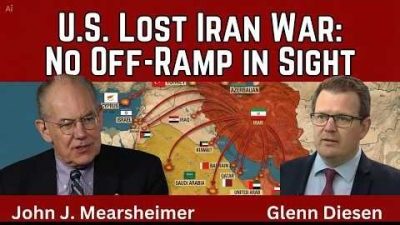
John Mearsheimer: US Already lost Iran war – No off-ramp in sight
or go to
Aletho News Archives – Video-Images
Frlom the Archives
With apparently fabricated nuclear documents, Netanyahu pushed the US towards war with Iran
By Gareth Porter | The Grayzone | April 29, 2020
President Donald Trump scrapped the nuclear deal with Iran and continued to risk war with Iran based on Israeli Prime Minister Benjamin Netanyahu’s claim to have proven definitively that Iran was determined to manufacture nuclear weapons. Netanyahu not only spun Trump but much of the corporate media as well, duping them with the public unveiling of what he claimed was the entire secret Iranian “nuclear archive.”
In early April 2018, Netanyahu briefed Trump privately on the supposed Iranian nuclear archive and secured his promise to leave the Joint Comprehensive Plan of Action (JCPOA). That April 30, Netanyahu took the briefing to the public in a characteristically dramatic live performance in which he claimed Israel’s Mossad intelligence services had stolen Iran’s entire nuclear archive from Tehran. “You may well know that Iran’s leaders repeatedly deny ever pursuing nuclear weapons…” Netanyahu declared. “Well, tonight, I’m here to tell you one thing: Iran lied. Big time.”
However, an investigation of the supposed Iranian nuclear documents by The Grayzone reveals them to be the product of an Israeli disinformation operation that helped trigger the most serious threat of war since the conflict with Iran began nearly four decades ago. This investigation found multiple indications that the story of Mossad’s heist of 50,000 pages of secret nuclear files from Tehran was very likely an elaborate fiction and that the documents were fabricated by the Mossad itself. … continue
Blog Roll
 Aletho News
- ‘We’ve Obliterated Their Missiles’
- Syrian president vows ‘absolute support’ to disarm Hezbollah
- Ukraine attacking Russian gas pipeline to stop deliveries to Europe – Defense Ministry
- ‘Heinous crime’: Iran denounces Israeli assassination of 4 Iranian diplomats in Lebanon
- John Mearsheimer: U.S. Already Lost Iran War – No Off-Ramp in Sight
- UK Parliament Plans ISP Blocking and Age Verification Powers
- World cannot remain silent as US and Israel attack ‘heritage of humankind’: Iran
- Emirati billionaire rebukes US senator over call for Gulf states to join war with Iran
- Op. True Promise 4: Iran’s missile blitzkrieg dismantles US war machine in West Asia
- Aramco CEO warns ‘catastrophe’ imminent if Strait of Hormuz remains shut
- If Americans Knew
- 97% of victims of war on Iran are Iranian, 98% of victims in war on Gaza are Gazans – Not a ceasefire Day 152
- Early Iran strikes cost $5.6 billion in munitions, Pentagon estimates
- Israel Decided the War, But Trump’s America Fights and Pays the Bill
- Conscientious Objector Group: Phone ‘Ringing Off Hook’ As Huge Mobilization Underway
- U.S. support for Israel continues to plummet, despite media’s best efforts
- Threats and missiles fly, death tolls soar in Iran, Lebanon, Gaza – Not a ceasefire Day 151
- Lebanon: Israel’s White Phosphorous Use Risks Civilian Harm
- Corporate Media Go All Out To Support The US-Israeli War On Iran
- US-Israel war on Iran is creating a steady growing number of amputees
- Israel planned this war on Iran for 40 years. Everything else is a smoke screen
- No Tricks Zone
- New Study Documents A 20-Year Pause In Arctic Sea Ice Decline – Driven By Internal Variability
- Wake-up Call: Survey Shows Majority Of Germans Now Favor Postponing Climate Targets!
- Televised! Leading German Political Candidate Tells Schoolchildren CO2 Makes Sun Hotter!
- New Study: A Century Warming Of 1.1°C Is ‘Commonplace’ And ‘Not Unusual’ During This Interglacial
- New Study: ‘Internal Noise’ And Volcanic Forcing Can Trigger 10-15°C Warming Within Decades
- Glaciers Worldwide Are Suddendly Surging, Experts Blame Warming!
- Surprising Discovery: Sahara Is Greening…Billions Of Trees Where Once Thought To Be Barren
- New Research Reaffirms Clouds, Aerosols, And Surface Solar Radiation Are ‘Driving The Climate System’
- Germany: Electric Car Catches Fire At Charging Station, Sets Off Local “Inferno”, Widespread Damage
- New Study: Canada’s New Brunswick Was 1°C Warmer Than Today During The Medieval Warm Period
 Aletho News