Saudi Mercenaries and the Starvation of Yemen
By Thomas C. Mountain | Black Agenda Report | April 15, 2015
The Saudi military is almost entirely staffed by mercenaries. The Saudi jets bombing an air defenseless Yemen are piloted by Pakistanis. Its mid and low level officers are mainly from Jordan and, most ominously for its ability to actually launch a ground invasion, its rank and file soldiers are almost entirely from Yemen.
That’s right, the Saudi army is packed full of Yemeni cannon fodder, which helps explains its ignominious failure in its war with Yemen’s Houthi’s in 2009.
Does anyone really believe that the Yemeni soldiers for hire in the Saudi army are going to willingly, never mind effectively, invade their own country, leaving a trail of destruction in their wake, all the while killing, and being killed by, their Yemeni brothers and sisters?
This may explain the reluctance of the Saudi leadership to launch their promised invasion, especially while the Houthi militia’s are still an effective fighting force on the ground.
Supposedly Egypt is going to send its army to help invade Yemen, never mind Yemen being the graveyard for thousands of Egyptian soldiers in what the late President Nasser called “Egypt’s Vietnam” in the early-mid 1960’s.
The Egyptian army is made up of mostly illiterate conscripts dragooned from the poorest sectors of Egyptian society and has been particularly inept at suppressing the vicious insurgency being waged again President Al Sisi’s regime in the Sinai. If the Egyptian army can’t even control its own territory it certainly doesn’t bode well for any foreign misadventures it may undertake.
Of course, it takes time to prepare the logistics needed to send a large fighting force to invade another country, so Egyptian boots on the ground in Yemen may yet happen, but don’t hold your breath.
If Yemeni artillery and rockets start blasting shipping of the “Saudi led coalition,” a demand being expressed by massive Yemeni demonstrations, Egypt wont have much choice. The “Bab al Mandeb” (so aptly named “the gate of tears”) is so narrow that all shipping traveling through this strategic choke point between the Indian Ocean and the Red Sea have to pass well within range of even light artillery. President Al Sisi has already raised the alarm of the danger if such a disaster should strike, though preventing such is easier said than done.
And all the while starvation spreads through out Yemen, a country already one of the hungriest in the world. Yemen is one of the most food aid dependent countries on the planet, importing by some accounts up to 90% of its food.
The Saudi leadership must figure if they can’t defeat the Yemeni resistance with their air power they will cut off all food supplies and wait for starvation to bring Yemen to its knees?
To help hurry this process up Saudi war planes have already begun bombing major grain depots in Yemen, as all the while the “Saudi led coalition” has prevented all but the equivalent of a couple of truck loads of supplies flown in by the Red Cross. A couple of truck loads to feed a food aid dependent country of almost 25 million in the midst of a barbaric air bombardment?
As the Saudi air force continues to terrorize the Yemeni population with bombs marked “made in the USA” and malnutrition turns to outright starvation, the immediate future for the people of Yemen grows darker by the day.
One thing is certain and that is our world operates under “the rule of law” – the law of the jungle, that is, and any crime, including imposing mass starvation will only be met with acquiescence, if not assistance, as Saudi Arabia’s mercenary army continues its aerial onslaught and enforced starvation against the people of Yemen.
Israel cheers as Obama retreats before Congress on Iran deal
RT | April 15, 2015
Israel said it is pleased with a compromise bill being floated on the Hill, which would give US legislators oversight in the Iran nuclear deal. The White House agreed to the bill adopted by the Senate Foreign Relations Committee.
“We are certainly happy this morning, this is an achievement for Israeli policy… [Prime Minister Benjamin Netanyahu’s] speech in Congress … was decisive in achieving this law, which is a very important element in preventing a bad deal, or at least, in improving the agreement and making it more reasonable,” Yuval Steinitz, Netanyahu’s intelligence, foreign relations and strategic minister, told Israel Radio.
Israel has been opposing US reengagement with Iran, claiming the result of the nuclear negotiations would be a bad deal that would compromise Israel’s national security. Netanyahu made his case in the US through pro-Israeli legislators, who are opposed to US President Barack Obama.
“What was achieved last night in Geneva is not a historic agreement, but a historic mistake,” said Netanyahu, after a preliminary deal paving the way for negotiations was reached in 2013.
Under the 2010 “Comprehensive Iran Sanctions, Accountability, and Divestment Act,” the president can waive sanctions imposed by Congress for a limited time, as a policy measure. However, Senate Bill 615 would remove that option and insist on congressional review of the final nuclear agreement with Iran before any of those sanctions could be waived.
Proposed by Senator Bob Corker (R-Tenn.) and Democrat Robert Menendez (D-NJ), the “Iran Nuclear Agreement Review Act of 2015” envisions a 52-day review period during which the president “may not waive, suspend, reduce, provide relief from, or otherwise limit the application of statutory sanctions with respect to Iran under any provision of law.” The White House can still suspend, waive or remove sanctions imposed by executive order.
If the bill is adopted, then Congress would be able to reject the nuclear agreement with Iran through a joint resolution, preventing Obama from lifting any congressional sanctions and possibly scuppering the treaty.
Iranian officials have said that the preliminary agreement reached in Geneva earlier this month would see most nuclear-related sanctions lifted immediately, while US officials maintain the sanctions would be lifted in phases, depending on Tehran’s compliance. This is one of the issues that still needs to be resolved before the June deadline for the final agreement.
“We have two and a half months more to negotiate, that’s a serious amount of time with some serious business left to do,” Secretary of State John Kerry told reporters Monday, after meeting with the legislators behind closed doors. “We hope Congress listens carefully and asks the questions that it wants. But also give us the space and the time to be able to complete a very difficult task which has high stakes for our country.”
Under the amended text of the bill agreed in committee, Obama would also have to certify to Congress every 90 days that Iran was complying with the final agreement, and submit detailed reports on Iran’s nuclear program, ballistic missile program, and “support for terrorism,” all of which remain thorny issues between Washington and Tehran.
Announcing the preliminary agreement on April 2, Obama said he wanted Congress to play a “constructive oversight role” in the negotiating process. However, the White House has argued that making international agreements is a constitutional prerogative of the executive branch, and that congressional oversight of the Iran deal would set a dangerous precedent. It now appears that Corker-Menendez has enough support from the congressional Democrats to override the veto Obama has been threatening, a senior Democratic aide told the New York Times.
Amendments proposed by several Republican Senators, including presidential hopeful Marco Rubio, could erode the bipartisan support. There were several amendments that would “pull this bill sharply to the right if adopted,” Senator Chris Coons (D-Del) told reporters Tuesday.
With Republicans making up the majority of the Foreign Relations Committee, these amendments could be adopted through a party-line vote. If that happens, Coons cautioned, “I’d drop off of it in a second.”
Read More: Americans don’t want Congress to sabotage Iran deal – new poll
Deindustrialization, NATO-Style
Sixteenth Anniversary of the War Against Yugoslavia: Zastava
By GREGORY ELICH | CounterPunch | April 15, 2015
One of the main features of NATO’s bombing campaign against Yugoslavia in 1999 was the deliberate targeting of factories and manufacturing plants. As a member of a delegation travelling throughout Yugoslavia shortly after the end of the war, I could readily see that such targeting had been methodical and thorough. Wherever we went, there was no military value in the facilities that NATO chose to destroy. Indeed, the common criterion was that state-owned and worker cooperative factories and plants that supported many people were singled out. The apparent intent was to drive much of the population into destitution and make people more amenable to demands to install government eager to do the West’s bidding.
The largest and most significant factory complex in the Balkans was Zastava, producing over 95 percent of the automobiles operating in Yugoslavia. Centrally located in the city of Kragujevac, this diverse factory complex also manufactured tools and machinery.
Workers at Zastava recognized that it was far too tempting a target for NATO planners to ignore. Determined to save their factory, they decided to form a human shield by occupying the factory complex around the clock. Three days after NATO began its war, workers and management issued an open letter which was sent to trade unions abroad and U.S. President Clinton, British Prime Minister Tony Blair, U.S. Secretary of State Madeleine Albright, and other Western leaders. “We, the employees of Zastava and freedom-loving Kragujevac, made a live shield,” the statement proclaimed. “Even at the shift end, even at the alarm sound, the Zastava workers did not leave their workshops, but remained to protect with their bodies what provides for their families’ living, that in which they have built in years-long honest work in order to provide for their better future.” The letter warned NATO leaders, “We want you to know that the attack on our factory shall mean a direct death to thousands of men and women and an enormous spiritual and material loss to their families.”
Letters of support poured in from trade unions in Third World countries, while those in the West remained silent. As the days passed, it became increasingly evident that NATO was systematically destroying factories and work sites. NATO had also wasted little time in demonstrating its contempt for human life. Wisely, the workers at Zastava chose to modify their human shield by moving outdoors and forming a ring around the factory plants, rather than occupying them. Work inside the plants, however, continued.
Shortly after 1:00 AM on April 9, NATO responded to the workers’ letter by sending a volley of cruise missile flying into Kragujevac. Dragan Stankovich, export director for Zastava, was in his apartment when he felt the first detonations, which he likened to a strong earthquake. The sky turned red, and his first thought was to hope that the factory had not been hit. His apartment was close to Zastava, so he walked hurriedly over there. Ten minutes after the first attack, the next wave of missiles struck. “I was very close,” Stankovich told us, “but I couldn’t see the bombs. Only a series of mushroom clouds. You could see the explosion and big fires only. You couldn’t hear anything. Strong light and fire. Like an atomic bomb. Like mushrooms.” The power, assembly, and paint and forging plants were all demolished in the assault. In all, 124 workers were wounded, but miraculously, no one was killed. Ambulances and fire trucks arrived quickly at the scene and retrieved the injured. At the local hospital, a woman, her head bandaged, defiantly told a reporter, “I can only tell Clinton – we will build a new factory. He cannot destroy everything.”
Three nights later, another wave of missiles struck Zastava at 2:45 AM and then yet again ten minutes later. The factories were lightly staffed by this time, and only 16 workers were wounded. As a result of the two attacks, the six largest plants at Zastava lay in ruins. Interestingly, the one plant that manufactured assault rifles was untouched, underlining the fact that NATO’s motivation was the deindustrialization of Yugoslavia. One woman was quoted as saying: “When we saw it burning, we all wept. It was the same feeling as if someone had burned down your home.”
Stankovich told us that the factory complex in Kragujevac employed 28,000 workers, and another 8,000 in associated Zastava factories throughout Yugoslavia, most of which were also bombed. “Of all the catastrophes that befell us,” he said, “we consider the humanitarian catastrophe to be the biggest.” One of the salient aspects of the disaster, he felt, was that workers in many other factories depended on Zastava. There were many plants throughout the nation that supplied components to Zastava. With Zastava in ruins, workers and at these plants and their families, some 200,000 people in all, were left without a means of livelihood.
Zastava’s director, Milosav Djordjevich, ruefully observed, “For the workers, the factory is life. On the nights of the 9th and 12th of April, all our dreams were destroyed in a mere fifteen minutes of bombing.” He told us that he found it difficult to believe that there were people who could inflict death and destruction on others. After months of listening to the gloating of Western leaders over the slaughter they were carrying out, I had no such difficulty.
The power plant supplied electricity, compressed air, hot water and steam for production at Zastava. But its destruction had a wider impact as well, for the plant also provided heat and energy to a large sector of the city. “About 15,000 flats, schools, hospitals, and other institutions depended on the Zastava power plant for their heat,” Stankovich explained. One of the missiles exploded about 20 to 30 meters above the plant, ripping the roof from the building and destroying transformers, turbo-compressors, and the control room. “Smashed,” a worker told us. “Everything was smashed. We have removed everything to be repaired.” Resumption of production at the power plant was an urgent task. Workers had already removed the rubble in this plant by the time of our visit, and two of the eight turbo-compressors had already been repaired. But the destruction of the plant’s transformers sent two tons of highly toxic PCB pyralene pouring onto the ground and into a nearby river.

Offices at Zastava forging plant. Photo: Gregory Elich.
The forging plant was a ruin after being hit four times. When the plant was in operation, components were formed for automobiles, agricultural machinery, and railways. The roof was gone. Mounds of rubble, damaged machinery, and twisted girders confronted us. Scraps of metal debris hung in clumps from isolated and deformed steel bars. The three-story office section of the forging plant had taken a direct hit, and a large section of its façade was blown away. What remained of the upper floors sagged alarmingly. Adjacent to it, the older forging plant presented a stark appearance. The plant’s heavy concrete walls bore the scars from explosions, and its roof was mostly missing. When a missile exploded on the building, concrete columns fell on the heat treatment area, and large chunks of concrete were hurled about, injuring several workers. NATO “had drawings, coordinates, everything,” Djordjevich remarked, “as if they played us with joysticks.”
Djordjevich regarded the paint plant as the pride of Zastava, housing as it did modern robotic production lines. Here, the devastation was even more terrible than in the other plants. It was shocking. Four missiles had left the plant roofless and buried in a carpet of debris. Mountains of twisted and jumbled wreckage rose above the rubble, resembling in some sections abstract sculptures. Djordjevich lovingly described the advanced technology utilized by the plant. “They hit this directly, as you would hit a man in the heart.”
Damage to the automobile assembly line plant was also severe. Merely to clear away the rubble would be a daunting task. Fifty-four workers in this plant were injured when a blast caused the roof to collapse on them. The plant “was very beautiful to see when it was functioning,” Djordjevich told us. “Now look at it. It’s a sorrow to see.”

Zastava automotive paint plant. Photo: Gregory Elich.
It was nearing 9:00 PM, and it had become too dark to view the truck plant and tools factory, both of which had been completely demolished. We were instead taken to the computer center, where the headlights of our vehicles were projected onto the building. It was a ruin. The explosive force of two missiles was so strong that the building was lifted from its foundation before collapsing. Two IBM computers, costing a total of $10 million, were lost. Because the computer center was not operating on the night of the attack, only two people were inside, both hiding in the shelter after the air raid siren had sounded.
In all, destruction at Zastava was estimated to amount to $1 billion, straining the Yugoslav government’s ability to finance its reconstruction. But that did not deter efforts. By January 2000, eighty percent of the rubble had been cleared at Zastava, a monumental endeavor in itself. Before long, small-scale production resumed, which could only have been accomplished through efforts on a heroic scale.
Reconstruction continued, but after CIA-backed regime change in October 2000, the direction of Zastava’s future followed a different path. Hell-bent on privatizing the entire economy, the new government issued an ultimatum to workers at Zastava plants: accept a plan in which two-thirds of the workforce would be laid off, or Zastava would be closed down altogether. “We tried to sharpen our teeth on this one,” privatization minister Aleksandar Vlahovich explained.

Zastava power plant. Photo: Gregory Elich.
In a society where the loss of economic facilities, sanctions, and a privatization program had rendered much of the working population redundant, employees at Zastava worried about the prospects of ever finding employment again. Serbian finance minister Pavle Petrovich contemptuously dismissed their concerns: “It is high time that people learn there won’t be any life support systems anymore.” Workers were left with little choice and acceded to the government’s demands, and those who lost their jobs received a pittance for sustenance.
Zastava was privatized in 2008, and soon after became a subsidiary of Fiat. It eventually was fully owned by Fiat-Chrysler Automobiles. Once ownership passed to Fiat, the Italian firm ignored its pledge not to dismiss workers, and immediately cut the remaining workforce in half. Protesting workers occupied City Hall, to no avail. They were quickly defeated.
With workers mocked as lazy parasites, neoliberal propaganda was in full swing. The government, which had long derided state-owned Zastava for relying on state subsidies, saw no contradiction in offering Fiat monopoly status, subsidies of ten thousand Euros per worker, and subsidies to support sales over for the first year. Fiat was also granted an exemption from paying any taxes whatsoever for a period of ten years, and land was given gratis to Fiat’s foreign component partners. A duty-free industrial zone was created for Fiat, with the government providing cost-free infrastructure. In all, these gifts to Fiat dwarfed any subsidies that state-owned Zastava ever received.
Back in 2001, privatization minister Vlahovich observed, “Zastava became an example, I hope, of tomorrow’s successful restructuring of the whole country.” And so it did, as foreign corporations now dominate the economy, the nation’s workforce subsists on abysmally low wages, and unemployment is at depression levels. For those who once proudly worked at Zastava, their economic rape is complete.
The Ascent of Hillary, the $.2.5 Billion “People’s” Candidate

A Black Agenda Radio commentary by Glen Ford | April 15, 2015
Hillary Clinton just announced that she’s running for president. However, this commentary is not really about her. It’s about a nation of more than 300 million people in which politics has become the sole property and domain of the rich. The rich decided some time ago that Hillary Clinton would be the virtually unchallenged presidential candidate of the Democratic Party. The 48 percent of Americans that express an affinity with the Democratic Party have not yet chosen Clinton. There has been no primary election in any state. But, that does not matter because the selection process that counts occurs in the boardrooms and mansions and private clubs and getaways of the rich. Hillary Clinton and her husband, Bill, have spent virtually their entire adult lives on the millionaires’ campaign circuit, the rich man’s primary. In the process of pleasing the rich, they have become rich, themselves.
Hillary hopes to spend two and a half billion dollars of – mostly – rich people’s money in the 2016 campaign. Wealthy people will be just as generous with the Republican candidate. The outcome on Election Day is absolutely certain: the rich man’s candidate will definitely win, and the people will lose – because they have no candidate in the major parties.
The people are not even in the game; the contest is over before the Democratic Party’s formal selection process even begins. And, when primary season does arrive, it will only be a formality. The menu has already been printed, and Hillary will be the main course for Democrats next year.
Democratic voters can say “Yes” to Hillary, but they can’t say “No,” because the party machinery and the rich men who pay for that machinery will crucify and expel any Democrat who seriously challenges her from the Left.
The Democratic Party’s apologists like to call it a big tent with room for Blacks and browns and gays and labor and peace-loving people. But it’s actually a huge trap designed to contain and politically neutralize the folks who might otherwise turn against the rich. The Party has always been a scam, but at least in the old days it put on a populist show to fool the rank and file into believing that they could actually influence the party’s direction. However, Wall Street is determined that there will be no serious Democratic deviation from the corporate agenda set by Bill Clinton and Barack Obama. Hillary Clinton would represent the third Clinton presidency – which, for Wall Street, is just as good as the two George Bush presidencies. Maybe better, because labor and Blacks and that fuzzy cohort called liberals will all think they won the election, when nothing could be farther from the truth. Rank and file Democrats will see the fait accompli of Hillary’s nomination as a sign of unity among Democrats, when in fact it is the triumph of filthy rich campaign contributors. The rich have shown great solidarity in uniting behind a Democratic presidential candidate. Later on, they will unite around a Republican candidate, too. After that, it won’t matter who wins.
Glen Ford can be contacted at Glen.Ford@BlackAgendaReport.com.
Family of ‘emaciated’ Guantanamo prisoner plead in court for help
Reprieve | April 15, 2015
The family of a hunger-striking Pakistani man detained in Guantanamo Bay has today filed an emergency application with the Islamabad High Court, demanding that the Pakistani government intervene immediately in his case.
Ahmad Rabbani has been on hunger strike for more than two years in protest at his detention without charge or trial in Guantanamo, where he has been held since 2004. An affidavit submitted to the court by human rights organization Reprieve, whose staff recently visited Mr Rabbani, describes the damaging effect on his health of his brutal treatment at the prison – including daily force-feedings and ‘forced cell extractions’ (FCEs).
Mr Rabbani has told his lawyers at Reprieve that his weight has dropped to approximately 40kg, and that he regularly vomits and experiences numbness in his limbs, dizziness and fainting. Mr Rabbani described how his thigh has wasted away to the width of his calf. His lawyers describe him as looking “emaciated” during their latest visit.
The urgent court application demands that the Pakistani government intervene immediately with the U.S. authorities to arrange for the release and repatriation of Mr Rabbani before he either dies or suffers permanent damage to his health. Filed today, the petition is likely to be heard tomorrow (Thurs) in the Court.
The court has previously heard how Mr Rabbani’s constitutional rights to legal defence, fair trial, and humane treatment have all been gravely abused by his detention without charge or trial by the United States – violations which, Mr Rabbani’s lawyers argue, oblige the Pakistani government to take up his case.
Mr Rabbani’s lawyers have also submitted to the court a copy of the US Senate’s recent report into CIA torture, which reveals that his 2002 arrest was a case of mistaken identity. The 2014 report also confirms that Mr Rabbani was initially detained for 540 days in secret CIA jails before his transfer to Guantanamo, and was subjected to a number of violent interrogation methods that have been condemned as torture.
Commenting, Mr Rabbani’s lawyer Alka Pradhan, US Counsel at Reprieve, said: “The US Senate report confirmed that Ahmed Rabbani was the wrong man in the wrong place at the wrong time 13 years ago – and that he was horribly tortured in US secret prisons. But he remains in Guantanamo – and after years of abuse, he is now dangerously ill. Ahmad’s hunger strike is a last desperate cry for help from the Pakistani government. They must now intervene in his case and bring him home.”
Dashcam Videos Show Cop Take Down Suspect By Running Him Over With his Car
By Matt Agorist | The Free Thought Project | April 15, 2015
Marana, AZ — Chilling footage from the dashcams of two police cruisers was released this week that shows an Arizona police officer use his car as a means to take down a suspect.
The first video is from the officer who was simply following the suspect down the street as he walked away. All of the sudden a cruiser passes him at high speeds and runs down the suspect.
The man who was run over by the officer miraculously survived. Mario Valencia, 36, now faces several felony charges, including assault on a police officer.
According to the Associated Press, Marana police Sgt. Chris Warren said Valencia robbed a convenience store in Tucson, broke into a church, invaded a home and stole a car. Valencia drove the stolen car to Marana, just north of Tucson, where he stole a rifle from a Wal-Mart.
In some Orwellian attempt to justify the cop’s actions, Marana police chief Terry Rozema claims the violent takedown by officer Michael Rapiejko likely saved Valencia’s life.
The suspect’s lawyer, however, disagrees, according to RT.
“Everything in the video seems to point towards an obvious excessive use of force. It is miraculous that my client isn’t dead,” attorney Michelle Cohen-Metzger told CNN.
Whether or not this man was actually guilty of a crime was not yet proven in a court of law. Deciding his guilt and punishment was not up to officer Rapiejko. In a civilized society, we have standards that allow for individuals to face their accuser. It’s called due process, and it is specifically in place to prevent this exact scenario of judge, jury, and executioner.
When police feel that they can simply take lives without obeying the rule of law, something has gone terribly awry.
U.S. Citizen Sentenced to Life in Prison for Opposing Egyptian Government

Mohamed Soltan, on hunger strike, gets kiss from his father (photo: Twitter)
By Noel Brinkerhoff | AllGov | April 15, 2015
An American citizen could wind up spending the rest of his life in an Egyptian prison for protesting against the government two years ago.
Mohamed Soltan was arrested in 2013 during demonstrations in Cairo that arose after the military ousted President Mohamed Morsi of the Muslim Brotherhood.
The Egyptian-American was among more than 35 other defendants who received the same sentence. Still others, including Soltan’s father, Salah Soltan, were sentenced to death by the Egyptian court. Soltan’s family intends to appeal.
“The verdict is the latest in a long series of similarly harsh sentences handed down at mass trials of dozens or hundreds of defendants accused of participating in violent protests or riots in the aftermath of the military takeover, often based on only police testimony or cursory evidence,” according to The New York Times.
Soltan was working as a translator for journalists covering the protests and was shot in the arm during a demonstration on August 14, 2013. He was arrested at his home a few days later and has been jailed since, according to the Times. For the past year, he has been on a hunger strike to protest his arrest and detention.
Thousands of Egyptians are still in prison without being tried for opposing the military-backed government, which has been accused of vast human rights abuses.
The verdict also comes at a bad time for President Barack Obama who only last week authorized the release of hundreds of millions of dollars in military aid for Egypt despite the lack of democratic reforms on the part of officials in Cairo.
To Learn More:
American Among Nearly 40 Sentenced to Life in Prison for Egypt Protests (by David Kirkpatrick and Jared Malsin, New York Times )
Ohio State Alumnus Receives Life Sentence in an Egyptian Prison (by Rubina Kapi, The Lantern )
Mohamed Soltan, 36 Others Imprisoned for Life (by Aya Nader, Daily News Egypt)
The Life and Imprisonment of ‘Terrorist’ Mohamed Soltan (by Aya Nader, Daily News Egypt)
Obama Approves Weapons for Egyptian Tyrant (by Noel Brinkerhoff and Danny Biederman, AllGov )
6 Major Corporations that Profit from U.S. Aid to the Egyptian Military (by Noel Brinkerhoff and Danny Biederman, AllGov )
Russia Impinges on Israeli ‘Right’ to Bomb Iran
By Ray McGovern | Consortium News | April 14, 2015
The front page of the neocon flagship Washington Post on Tuesday warned that the Russians have decided, despite U.S. objections, “to send an advanced air-defense system to Iran … potentially altering the strategic balance in the Middle East.”
So, at least, says the lede of an article entitled “Putin lifts 5-year hold on missile sale to Iran” by Karoun Demirjian, whose editors apparently took it upon themselves to sex up the first paragraph, which was not at all supported by the rest of her story which was factual and fair – balanced, even.
Not only did Demirjian include much of Russian Foreign Minister Sergei Lavrov’s explanation of Moscow’s decision to end its self-imposed restriction on the delivery of S-300 surface-to-air missiles to Iran, but she mentioned Israeli Prime Minister Benjamin Netanyahu’s umpteenth warning on Monday about “the prospect of airstrikes to destroy or hinder Tehran’s nuclear program.”
Lavrov noted that United Nations resolutions “did not impose any restrictions on providing air defense weapons to Iran” and described the “separate Russian free-will embargo” as “irrelevant” in the light of the “meaningful progress” achieved by the negotiated framework deal of April 2 in which Iran accepted unprecedented constraints on its nuclear program to show that it was intended for peaceful purposes only.
The Russian Foreign Minister emphasized that the S-300 is a “completely defensive weapon [that] will not endanger the security of any state in the region, certainly including Israel.” Pointing to “the extremely tense situation in the region around Iran, he said modern air-defense systems are vitally important for that country.” Lavrov added that by freezing the S-300 contract for five years, Russia also had lost a lot of money. (The deal is said to be worth $800 million.)
Predictably, former U.S. Ambassador to the United Nations John Bolton told Fox News that the air-defense system would be a “game-changer” for Israel regarding air strikes. According to Bolton, once the system is in place, only stealth bombers would be able to penetrate Iranian space, and only the U.S. has those and was not likely to use them.
The U.S. media also highlighted comments by popular go-to retired Air Force three-star General David A. Deptula, who served as Air Force deputy chief of staff for intelligence, surveillance and reconnaissance until he retired in 2010 to make some real money. Deptula called delivering the S-300 system to Iran “significant, as it complicates the calculus for planning any military action involving air strikes.”
It strikes me as a bit strange that the media likes to feature retired generals like Deptula, whose reputation for integrity are not the best. Deptula has been temporarily barred from doing business with the government after what Air Force Deputy General Counsel Randy Grandon described as “particularly egregious” breaches of post-employment rules. He remains, however, a media favorite.
Adding to his woes, Deptula was also caught with 125 classified documents on his personal laptop – including 10 labeled “Secret,” 14 labeled “Top Secret” and one with the high protection of “Secret, Compartmented Information.” Deptula pleaded ignorance and was let off – further proof that different standards apply to generals like Deptula and David Petraeus.
A More Subdued Tone
The S-300 announcement hit as Secretary of State John Kerry was testifying on Capitol Hill about the framework deal on Iran’s nuclear program. Speaking later to Fox News, Rep. Adam Kinzinger, R-Illinois, professed shock that Kerry did not seem more upset. According to Kinzinger, Kerry actually said, “You have to understand Iran’s perspective.”
And in keeping with Kerry’s tone of sang-froid, State Department spokeswoman Marie Harf, referring to the S-300 deal, said, “We see this as separate from the negotiations [regarding Iran’s nuclear program], and we don’t think this will have an impact on our unity.”
White House press secretary Josh Earnest took the S-300 announcement with his customary, studied earnestness. Referring not only to the decision to deliver the S-300s but also to reports of a $20 billion barter deal that would involve Russia buying 500,000 barrels of oil a day in return for Russian grain, equipment and construction materials, Earnest referred to “potential sanctions concerns” and said the U.S. would “evaluate these two proposals moving forward,” adding that the U.S. has been in direct touch with Russia to make sure the Russians understand – and they do – the potential concerns that we have.”
With respect to the various sanctions against Iran, I believe this nonchalant tone can be seen largely as whistling in the dark. With the S-300 and the barter deals, Russia is putting a huge dent in the sanctions regimes. From now on, money is likely to call the shots, as competitors vie for various slices of the Iranian – and the Russian – pie. Whether or not there is a final agreement by the end of June on the Iranian nuclear issue, Washington is not likely to be able to hold the line on sanctions and will become even more isolated if it persists in trying.
Worse still for the neocons and others who favor using sanctions to punish Russia over Ukraine, the lifting of sanctions against Iran may have a cascading effect. If, for example, the Ukrainian ceasefire holds more or less over the next months, it is possible that the $1.5 billion sale of two French-built Mistral-Class helicopter carrier ships to Russia, concluded four years ago, will go through.
The contract does not expire for two months and Russia’s state arms exporter is trying to work out a compromise before taking France to court. Russian officials are expressing hope that a compromise can be reached within the time left.
And, regarding the outrage among neocons over the audacious idea that Iran should be allowed to defend itself against airstrikes, there is the “exceptional” argument that Israel, United States and their allies should have the unchallenged right to bomb Iran or any other country as they see fit – and that the targeted country should have no right to protect its people, indeed that trying to defend itself is some kind of unacceptable provocation.
There is also the hypocrisy regarding how the neocons like to differentiate between “defensive” and “offensive” weapons when the question is about giving U.S.-backed governments weapons that have dual purposes, that can be used offensively as well as defensively.
For instance, in regard to Ukraine earlier this year, U.S. Assistant Secretary of State Victoria Nuland counseled U.S. officials to portray the delivery of sophisticated U.S. military hardware to the coup regime in Kiev as “defensive,” even though the weapons had an offensive capacity, such as targeting ethnic Russian rebels firing artillery or mortars at Ukrainian troops attacking eastern Ukraine.
According to the German newspaper, Bild, which published an intercepted conversation between Nuland and U.S. officials in Munich, Germany, she said, “I’d strongly urge you to use the phrase ‘defensive systems’ that we would deliver to oppose Putin’s ‘offensive systems.’”
However, NATO Commander and Air Force General Philip Breedlove left little doubt that these “defensive” weapons would help the Ukrainian government pursue its military objectives by enabling more effective concentration of fire. “Russian artillery is by far what kills most Ukrainian soldiers, so a system is needed that can localize the source of fire and repress it,” Breedlove reportedly said.
So, when “defensive” weapons help a U.S.-backed regime kill its opponents, that’s fine. However, if some truly defensive weapons, such as anti-aircraft missiles to protect a country’s cities, go to a nation that Israel might want to bomb, then that is unacceptable.
~
Ray McGovern works with Tell the Word, a publishing arm of the ecumenical Church of the Saviour in inner-city Washington. During his earlier, 27-year career as a CIA analyst, he led the Soviet Foreign Policy Branch and prepared – and briefed – the President’s Daily Brief. He now serves on the Steering Group of Veteran Intelligence Professionals for Sanity (VIPS).
High Court backs university’s decision to ‘postpone’ Israel conference
MEMO | April 15, 2015
Organisers of a conference on Israel and international law have failed in their bid to overturn a decision by the University of Southampton to cancel the event, previously scheduled for this weekend.
On Tuesday, a High Court judge in London rejected the organisers’ application for a judicial review, with the university claiming that the conference had in fact merely been “postponed” due to “security concerns.”
Pro-Israel groups have been pressuring Southampton for months to stop the academic gathering. The legal challenge was launched earlier this month, following the university authorities’ decision to cancel the conference on the grounds of “risks to safety and public order.”
The news comes as a blow to organisers and their supporters, in what has been described by campaigners as an unprecedented attack on academic freedom in the UK.
In a statement released following the High Court decision, organisers expressed disappointment at the decision, but promised that the conference would ultimately take place.
We must continue to protest publicly against the university decision, and use the moral strength of our cause to ensure freedom of speech and academic debate – for our own sakes as well as for others.
In response to efforts by the Jewish Leadership Council, Board of Deputies of British Jews, and Zionist Federation to stop the conference, more than 900 academics, including dozens from Oxbridge, Russell Group universities and Ivy League schools, signed a statement of support.
The list of signatories included more than 30 researchers, lecturers and professors at Southampton itself, with senior officials referring unhappy staff to a “HR hotline.” In addition, more than 10,500 people have signed a public petition condemning the cancellation, and supporting free speech.
The backlash has already prompted a number of Israel advocates to publicly question the wisdom of campaigning for the cancellation of an academic conference. A piece in Ha’aretz described the affair as “a tactical and a moral defeat” for Israel’s defenders.
S-300 in Iran ‘no threat to Israel’: Putin briefs Netanyahu on defensive weapons concept
RT | April 14, 2015
Following Russia’s decision to lift a ban on supplying S-300 missile systems to Iran, the Israeli PM has called President Putin to express his “grave concerns” – and received a detailed explanation of defensive weapons and the logic behind Moscow’s move.
According to a statement released by the Kremlin, Vladimir Putin “gave a detailed explanation of the logic behind Russia’s decision…emphasizing the fact that the tactical and technical specifications of the S-300 system make it a purely defensive weapon; therefore, it would not pose any threat to the security of Israel or other countries in the Middle East.”
The assurances do not appear to have had the desired effect. In a statement released by his office, the Israeli PM expressed “grave concerns regarding the decision,” and told Russia’s president that this step “will only encourage Iranian aggression in the region and further undermine the stability of the Middle East.”
Russia signed an $800 million deal in 2007 to ship five S-300 divisions, which are composed of radars and multiple interception missile launchers, only to postpone the deal three years later, during the presidency of Dmitry Medvedev.
It was done as a sign of solidarity with Western partners who were imposing increasingly tough sanctions against the Islamic Republic – the missile systems themselves were never on the international sanctions list.
The reversal comes amid major progress in the negotiation framework between Iran and six leading world powers over the regulation of the Islamic Republic’s nuclear program, which should produce a final deal this summer.
Moscow believes at this stage there is “no longer need for this kind of embargo,” Russian FM Sergey Lavrov said, reiterating that “from the Russian side it was unilateral and voluntary.” Russia has also started supplying grain, equipment and construction materials to Iran in exchange for crude oil under the so-called “oil-for-goods” barter deal, which had earlier sparked dissatisfaction in the West.
The US officials also seemed displeased with Russia’s latest “non-constructive” moves, with State Department spokesperson Marie Harf however admitting that it did not violate any international norms. “We don’t believe it’s constructive at this time for Russia to move forward with this,” she said, adding that Secretary Kerry had voiced his concerns too.
For its part of the future deal with Iran, the West is promising it will drop some of its sanctions against Tehran – particularly in the oil and financial sectors. However on Tuesday the German foreign minister Frank-Walter Steinmeier warned that it was important to wait until the Iranians fulfill their side of the bargain.
“I’ve told some US senators that they should not now try to unnecessarily impede further negotiations,” he told the media when asked about Russia’s contract in Lubeck in Germany on Tuesday. “But I’ll also say that it is also too early to talk about rewards at this stage.”
Interview with Dr. Basman Alashi in Gaza
By Valeria Cortes | International Solidarity Movement | April 11, 2015
Occupied Palestine – The night of the 17th of July 2014 the Israeli occupation forces bombed the Al Wafaa Hospital, in Shijaia, Gaza Strip. The hospital´s speciality was the rehabilitation of paralyzed patients.
This is the moving testimony of Dr. Basman Alashi, its director:
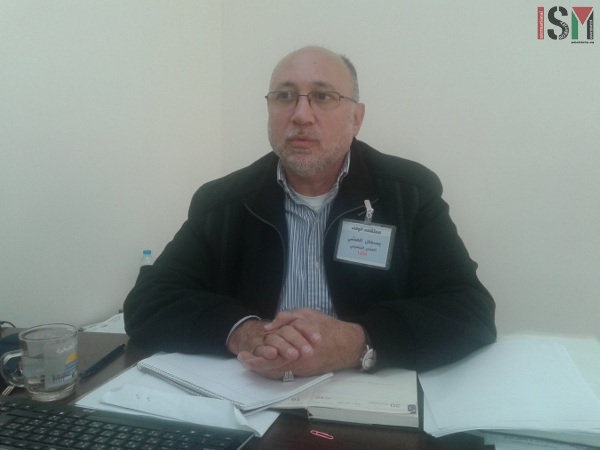
Dr. Basman Alashi
How is it possible to reach the point of bombing a hospital full of patients and medical staff?
“The UN told me that, according to a report from the Israeli occupation forces, the bombing of the hospital was due to the fact that there were weapons within its facilities … I can assure you that this report is completely false; the hospital opened its doors to the international press and to all the foreigners who freely inspected our facilities without finding any weapons at all. Despite all the overwhelming evidence, our hospital was bombed in the middle of the night, with its patients, medical staff, and some international witnesses, still inside the buildings.”
What were the consequences of the bombing by the Zionist occupation forces?
“Whilst under Israeli fire, we evacuated the remaining 17 paralyzed patients that still were inside the hospital. We couldn’t take any medication or equipment; we evacuated them just with sheets. That’s why during a cease-fire we asked the Red Cross to take us to rescue some medicines that were vital for our patients. However the Red Cross refused and we had to go by ourselves. We were only able to stay 45 minutes at the ruins of what was the Al Wafaa Hospital. The bombings continued, and we could only recover a very small amount of medicine, as bombs had destroyed most of it.
Four members of our staff were injured during the bombing. Luckily these weapons of war injured none of the patients. However they did suffer a lot during the emergency evacuation. Four of the paralyzed patients needed oxygen and many of them breathe through tubes, that’s why it was so dangerous to move them from one hospital to another; under conditions of intense aggression, under the attack of lethal weapons used against a defenceless civil population.
We could have lost some of them. It was very hard because we had to evacuate them in regular vehicles, three or four in every vehicle. Luckily we were able to move them all without any loss, due to the heroic efforts of our nurses and hospital staff. Without them all would be dead.
The patients suffered a lot during the Israeli attack on the hospital, some of them still hear the explosions of the bombs and are afraid of the start of another bombing. One of our patients, just 19 years old, refuses to enter to another hospital “the Al Wafa Hospital was bombed, my house was bombed, this hospital will also be bombed” he explained to me, terrified.
We are here to survive, to improve the lives of our children, of our patients. I can’t stand to see a small girl of barely 6 years old, to whom I can’t give the medicines she needs to survive and who can not leave Gaza to receive them. The only thing we want is for them to live with the same freedom as kids from any other place in the world.”
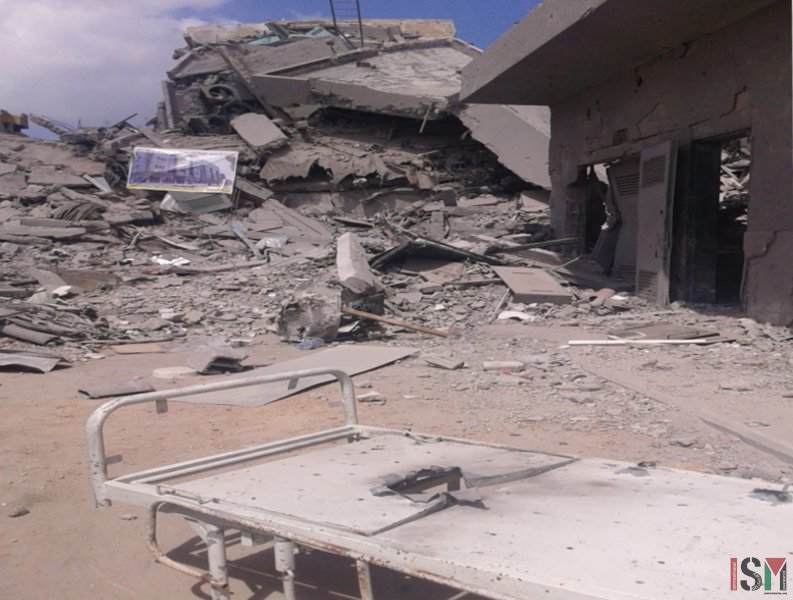
The Israeli occupation forces said that they bombed the hospital because there were weapons inside, this statement was firmly denied by many witnesses. In your opinion, what was the real reason for the attack that left a hospital as big and important as Al Wafaa reduced to rubble?
“The hospital was less than a kilometre from the fence that separates Gaza from the occupied territories. Our facilities had three big buildings, so it was just a military decision, given that those constructions blocked their way for a deeper land incursion. There wasn’t activity from the resistance inside or near the hospital installations.
I challenged the Israeli occupation forces to provide any proof of their reasons to bomb the hospital. They showed me a classified picture where, according to them, there was a rocket launcher from the resistance very near the hospital. However, the picture wasn’t from the hospital, it was from a place located almost five kilometres away. That proves that all the reasons provided by Israel were false. They just fabricated this story to justify the planned destruction of a hospital.
The Israeli occupation forces demanded we evacuate the hospital under fire and, as the facilities were under their control, it was Israel’s duty to protect the buildings. It was their obligation to preserve a hospital with 30 years history and an investment of more than 15 million dollars in equipment. Despite all this, far from protecting it’s medical facilities, they bombed them and destroyed it to the ground.”
The occupation forces point out that the attacks aren’t against the Palestinian people but against Hamas and the resistance. Do you have anything to say against the government of Gaza or the resistance?
“Against the resistance?” – asks the doctor with surprise – “We are the victims!” he clarifies. “In Gaza we have already had 8 years of suffering a terrible blockade by Israel. Our resistance is very basic. Israel has the lead, they have F16 planes, they have the tanks, war ships… they surround us! They deny us the right to defend our children, our women, our land, our homes, our own lives. It’s ridiculous. You corner me, you kill me, and you still ask me not to defend myself. Human beings in this world have the right to defend themselves. We, as Palestinians, have the right to defend our land and our families by all means available. The resistance is a way of defending our lives, it is our right.
Israel has the most powerful and destructive weapons; Israel is the one that the world should control.
Israel has committed genocide in Gaza while the world was looking. It assassinated children playing on the beach. Israel has killed children and women while they were sleeping in their homes and has bombed residential buildings without reason. Thousands of families have been left destroyed or without a home and all this took place before the eyes of the world. That’s why I blame Israel but also the international community.”
What is the situation now regarding the reconstruction of the hospital?
“There are many organizations and countries who want to help us. However, due to the Israeli and Egyptian blockade, they find themselves unable to provide the materials necessary for the reconstruction, or to send to the Gaza Strip the funds necessary for funding this reconstruction. That’s why we started to raise funds through local activities. Even so the amount collected doesn’t cover the 0,01% of the amount needed for the reconstruction of the hospital.
A lot of people all around the world have said to me that they are sorry about what happened to the hospital, and that’s good but we need much more than that to be able to attend our patients and move forward. The blockade is affecting our patients terribly, and it’s impossible for us to provide the medical treatment that they urgently need. They don’t need charity, blankets, or clothes… they need to have the stability to be self-sufficient.
The blockade seriously affects the hospital, as we find ourselves unable to go back to a full medical service like we had before and we are unable to support the rehabilitation and healthy recovery of our patients. Of the 11.000 injured from the last Israeli aggression against Gaza, more than the 50% need rehabilitation. If in one or two years the hospital is not working as it was in the past, there will be an important segment of this population that will be left unable to manage by itself and to contribute to our society, affecting it at all the levels.
What we need from the world more than anything else is an end to the blockade, to allow the entrance of materials for the reconstructions; to allow us to rebuild the homes of our families that were destroyed by Israel. This way there will be peace. But if the blockade continues, peace will be further away every day. We are human; we want a normal life as in every other place in the world. For our kids to be able to grow in a normal house, not in a shelter or a tent, suffering from the cold, without a single blanket to cover them”.
How do you see the current situation and the future of Gaza?
“The people of Gaza are resilient. They live in the most difficult conditions but still smile. The kids keep playing and adapt themselves to all the conditions, but the rest of the world must know that this situation is not normal and for this to end the only solution is to lift the blockade. The blockade must end. It’s not enough to give the people a tent, or some food or a blanket. People need a house, a job, and the possibility of giving their children a good education and to travel abroad if they wish to.
To have the possibility of going to a hospital abroad if their condition requires it. Give us the freedom that the rest of the world enjoys, because we are not different from any other population on the planet. We just want to live in peace if we are given the opportunity and doing it in freedom. But, if that right is denied to us, we will fight until we conquer it… Inshallah!”.
Abiotic methane discovered under the Arctic Ocean
Center for Arctic Gas Hydrate, Climate and Environment (CAGE)
New source of methane discovered in the Arctic Ocean
Methane, a highly effective greenhouse gas, is usually produced by decomposition of organic material, a complex process involving bacteria and microbes.
But there is another type of methane that can appear under specific circumstances: Abiotic methane is formed by chemical reactions in the oceanic crust beneath the seafloor.
New findings show that deep water gas hydrates, icy substances in the sediments that trap huge amounts of the methane, can be a reservoir for abiotic methane. One such reservoir was recently discovered on the ultraslow spreading Knipovich ridge, in the deep Fram Strait of the Arctic Ocean. The study suggests that abiotic methane could supply vast systems of methane hydrate throughout the Arctic.
The study was conducted by scientists at Centre for Arctic Gas Hydrate, Environment and Climate (CAGE) at UiT The Arctic Univeristy of Norway. The results were recently published in Geology online and will be featured in the journal’s May issue.
Previously undescribed
“Current geophysical data from the flank of this ultraslow spreading ridge shows that the Arctic environment is ideal for this type of methane production. ” says Joel Johnson associate professor at the University of New Hampshire (USA), lead author, and visiting scholar at CAGE.
This is a previously undescribed process of hydrate formation; most of the known methane hydrates in the world are fueled by methane from the decomposition of organic matter.
“It is estimated that up to 15 000 gigatonnes of carbon may be stored in the form of hydrates in the ocean floor, but this estimate is not accounting for abiotic methane. So there is probably much more.” says co-author and CAGE director Jürgen Mienert.
Life on Mars?
NASA has recently discovered traces of methane on the surface of Mars, which led to speculations that there once was life on our neighboring planet. But an abiotic origin cannot be ruled out yet.
On Earth it forms through a process called serpentinization.
“Serpentinization occurs when seawater reacts with hot mantle rocks exhumed along large faults within the seafloor. These only form in slow to ultraslow spreading seafloor crust. The optimal temperature range for serpentinization of ocean crust is 200 – 350 degrees Celsius.” says Johnson.
Methane produced by serpentinization can escape through cracks and faults, and end up at the ocean floor. But in the Knipovich Ridge it is trapped as gas hydrate in the sediments. How is it possible that relatively warm gas becomes this icy substance?
“In other known settings the abiotic methane escapes into the ocean, where it potentially influences ocean chemistry. But if the pressure is high enough, and the subseafloor temperature is cold enough, the gas gets trapped in a hydrate structure below the sea floor. This is the case at Knipovich Ridge, where sediments cap the ocean crust at water depths up to 2000 meters. ” says Johnson.
Stable for two million years
Another peculiarity about this ridge is that because it is so slowly spreading, it is covered in sediments deposited by fast moving ocean currents of the Fram Strait. The sediments contain the hydrate reservoir, and have been doing so for about 2 million years.
“This is a relatively young ocean ridge, close to the continental margin. It is covered with sediments that were deposited in a geologically speaking short time period -during the last two to three million years. These sediments help keep the methane trapped in the sea floor.” says Stefan Bünz of CAGE, also a co-author on the paper.
Bünz says that there are many places in the Arctic Ocean with a similar tectonic setting as the Knipovich ridge, suggesting that similar gas hydrate systems may be trapping this type of methane along the more than 1000 km long Gakkel Ridge of the central Arctic Ocean.
The Geology paper states that such active tectonic environments may not only provide an additional source of methane for gas hydrate, but serve as a newly identified and stable tectonic setting for the long-term storage of methane carbon in deep-marine sediments.
Need to drill
The reservoir was identified using CAGE’s high resolution 3D seismic technology aboard research ressel Helmer Hanssen. Now the authors of the paper wish to sample the hydrates 140 meters below the ocean floor, and decipher their gas composition.
Knipovich Ridge is the most promising location on the planet where such samples can be taken, and one of the two locations where sampling of gas hydrates from abiotic methane is possible.
“We think that the processes that created this abiotic methane have been very active in the past. It is however not a very active site for methane release today. But hydrates under the sediment, enable us to take a closer look at the creation of abiotic methane through the gas composition of previously formed hydrate.” says Jürgen Mienert who is exploring possibilities for a drilling campaign along ultra-slow spreading Arctic ridges in the future.
Featured Video
Prof. Ted Postol: Iran Already Achieved Nuclear Deterrence Against Israel
or go to
Aletho News Archives – Video-Images
From the Archives
How the occupied mentality syndrome works
Saudi Arabia on the American chessboard – Part 3
By B. J. Sabri | American Herald Tribune | June 27, 2016
Read part 2: “The occupied mentality Syndrome“
Previously I argued whether Saudi Arabia’s repeated involvements in U.S. interventions and wars stem from free national will or in response to a specific condition. For starters, in Saudi Arabia there is no national will. In Saudi Arabia, the national will is the will of the Al Saud clan. Still, when a major Arab state allies itself with a superpower that committed unspeakable crimes against humanity in almost every Arab country, then something is wrong. This fact alone should compel us to examine the U.S.-Saudi relation for one exceptional reason. As a result of the U.S.-Saudi wars, hundreds of thousands of people in Afghanistan, Iraq, Iran, Libya, Syria, Yemen, and Somalia have lost their lives. Millions became displaced in their own homelands. And millions more rendered refugees.
Attributing the Saudi policies to the bonds of “partnership” with the U.S. is frivolous. There are no bonds between these two thugs except those of business, military deals, secret plots, and wars. Proving this point, bonds such as these have no space for the American and Saudi peoples to share significant cultural or societal exchanges. If partnership is not the reason for the Saudi contribution to the U.S. strategy of empire and imperialism, then another reason must exist.
This leads to three possibilities. … continue
Blog Roll
 Aletho News
- Hezbollah hits Israeli warship off Lebanon’s coast, sets it aflame
- Iran slams US strikes on B1 bridge, Mahshahr petrochemical plants as ‘blatant acts of state terrorism’
- In letter to UN chief, Araghchi warns of dire consequences of US-Israeli attacks on Iran’s nuclear facilities
- Why the CIA conspiracy to invade Iran with Kurdish militias failed
- Why Are Upbeat US Claims About Mission to Rescue Pilot ‘Highly Questionable’?
- Aircraft destroyed during US ‘rescue’ of downed F-15 pilot cost more than $100 million each
- Washington University removes professor who condemned US-Israeli war on Iran
- Russia Warns of Retaliation as UK Authorizes Seizure of Vessels
- Serbia thwarts plot to bomb Russia-Hungary gas pipeline – Vucic
- Al Mayadeen voices solidarity with Dr. Marandi amid death threats
- If Americans Knew
- In Iran, Israel-US take aim at “reason, research, and freedom of thought” – Daily Update
- US loses planes over Iran, Israel downgrades Lebanon war goals – Daily Update
- Israel Is Blocking Palestinians from Easter at Church Where Jesus Resurrected
- Plot to assassinate Palestinian activist follows harassment campaign promoted by Zionist groups and elected officials
- Prominent New York synagogue hosts presentation on why U.S. Jews should support the ethnic cleansing of Gaza
- Tapper vs. Piker: Is the CNN Anchor Auditioning for David Ellison?
- Shouldn’t Democrats Be Able to Condemn Genocide?
- Israel-US kill negotiators, destroy civilian structures, but Iran’s military capabilities still largely intact – Daily Update
- ‘War crime’: Global condemnation as Israeli ministers celebrate death penalty law targeting Palestinian prisoners
- 7 Ways Israel Is Turning Lebanon Into Gaza
- No Tricks Zone
- An Inconvenient Tree: Uncovered In Alps… Europe Much Warmer Than Today 6000 Years Ago
- New Study Reports A 60% Slowdown In Greenland’s Ice Loss Rate In The Last Decade
- Low Intensity Tornado Wrecks Major Solar Farm, Creating A Potential Toxic Dump
- New Study Finds Warming Saves Lives…Cold Temperatures 12 Times More Deadly Than Excess Heat
- German Science Blog Accuses PIK Climate Institute Of Hallucinating Climate Tipping Points
- Devastating Assessment Of Comirnaty Vaccine By Former Senior Pfizer Europe Toxicologist
- New Study: CO2 Is ‘Effectively Negligible’ As An Explanatory Climate Change Factor Since 2000
- Former Pfizer Toxicologist Dr. Helmut Sterz Tells Bundestag Hearing Pfizer Vaccine Should Have Never Been Approved
- Energy Expert: Germany’s Nuclear Phaseout Was A “500 Billion Euro Mistake”
- New Research: South Australia’s Mid-Holocene Sea Surface Temperatures Were 4°C Warmer Than Today
 Aletho News