The Real Nuclear Threat in the Middle East
By Sheldon Richman | Free Association | April 8, 2015
To get a sense of how badly the regime in Iran wants sanctions relief for the Iranian people, you have to do more than contemplate the major concessions it has made in negotiations with the United States and the rest of the P5+1. Not only is Iran willing to dismantle a major part of its peaceful civilian nuclear program, to submit to the most intrusive inspections, to redesign a reactor, to eliminate two-thirds of its centrifuges, to get rid of much of its enriched uranium, and to limit nuclear research — it must do all this while being harangued by the nuclear monopolist of the Middle East — Israel — which remains, unlike Iran, a nonsigner of the nuclear Non-Proliferation Treaty (NPT) and faces no inspections or limits on its production of nuclear weapons.
This is something out of Alice in Wonderland. The Islamic Republic of Iran, born in 1979, has not attacked another country. (With U.S. help, Iraq attacked Iran in 1980.) In contrast, Israel has attacked its Arab neighbors several times since its founding, including two devastating invasions and a long occupation of Lebanon, not to mention repeated onslaughts in the Gaza Strip and the military occupation of the West Bank. Israel has also repeatedly threatened war against Iran and engaged in covert and proxy warfare, including the assassination of scientists. Even with Iran progressing toward a nuclear agreement, Israel (like the United States) continues to threaten Iran.
Yet Iran is universally cast as the villain (with scant evidence) and Israel the vulnerable victim.
You’d never know that Iran favors turning the Middle East into a weapons-of-mass-destruction-free zone (a nuclear-weapons-free zone was first proposed by the U.S.-allied shah of Iran and Egypt in 1974), and beyond that, Iran over a decade ago offered a “grand bargain” that contained provisions to reassure the world about its nuclear program and an offer to recognize Israel, specifically, acceptance of the Arab League’s 2002 peace initiative. The George W. Bush administration rebuffed Iran.
At the last NPT review conference in 2010, Iran renewed its support for the zone, the BBC reported at the time: “Tehran supports the ‘immediate and unconditional’ implementation of the 1995 resolution [to create the zone], declares the [then] president, Mahmoud Ahmadinejad.”
The United States and Israel claim in principle to support having the Middle East free of nuclear weapons — but not just yet. The Israeli government said in 2010 that implementation of the principle could occur “only after peace agreements with all the countries in the region.” ABC News quoted Israeli Prime Minister Benjamin Netanyahu as saying that Israel might sign the NPT “if the Middle East one day advances to a messianic age where the lion lies down with the lambs.”
That is classic Netanyahu demagoguery. As noted, the Arab League in 2002 — and again in 2007 — offered to recognize Israel if it accepted a Palestinian state in the occupied territories and arrived at a “just solution to the Palestinian Refugee problem to be agreed upon in accordance with UN General Assembly Resolution 194.” At that point the Arab countries would “consider the Arab-Israeli conflict ended, and enter into a peace agreement with Israel, and provide security for all the states of the region”; i.e., they would “establish normal relations with Israel in the context of this comprehensive peace.”
Thus Netanyahu’s position is a sham. He could have peace treaties in short order if he wanted to. But, as he said before the recent elections, he will never allow the Palestinians to have their own country.
For its part, the United States “broadly agrees with Israel that conditions for a nuclear-weapons-free-zone do not yet exist in the Middle East,” the BBC reported. In other words, the Obama administration slavishly takes the Israel-AIPAC line.
While politicians and pundits lose sleep over an Iranian nuclear-weapons program that does not exist — are they having nightmares of the United States being deterred by Iran? — they support Israel, the nuclear power that brutalizes a captive population, attacks its neighbors, threatens war against Iran, and refuses to talk peace with willing partners.
China to build $2bn Iran-Pakistan pipeline – media
RT | April 9, 2015
China will reportedly finance the so-called ‘Peace Pipeline’ natural gas pipeline from Iran, home to the world’s second largest reserves, to energy-deprived Pakistan. The project was delayed due to US dissent.
The final deal is to be signed during the long-sought visit of Chinese President Xi Jinping to Islamabad in April, the Wall Street Journal reported on Thursday.
“We’re building it. The process has started,” Pakistani Petroleum Minister Shahid Khaqan Abbasi told the WSJ.
First proposed over 20 years ago, the 1045 mile (1682km) pipeline will transfer gas from Iran’s south to the Pakistani cities of Gwadar and Nawabshah. Karachi, the country’s biggest city of 27.3 million, will also be connected via local energy distribution systems already in place.
Iran has said the 560-mile portion that runs to the Pakistan border is already complete, which only leaves $2 billion needed to build the Pakistani stretch.
The project could cost up to $2 billion if a Liquefied Natural Gas port is constructed at Gwadar. Otherwise, the project to complete the Pakistani pipeline will cost between $1.5 billion to $1.8 billion, the WSJ said. Pakistan is in negotiations with China Petroleum Pipeline Bureau, a subsidiary of Chinese energy major China National Petroleum Corporation, to finance 85 percent of the project. Pakistan will pay the rest.
The original plan envisioned the pipeline continuing to India, but Delhi dropped out due to US pressure in 2009, Tehran claims. Pakistan, a country of 199 million people faces intermittent blackouts in major cities, and Iran is looking for a place to export its soon-to-not-be-banned gas.
Iran has 33.7 trillion cubic meters of gas reserves according to the June 2014 BP Statistical Review of World Energy. According to BP estimates, it has the world’s fourth-largest oil reserves at 157 billion barrels.
US-led sanctions against Iran over its nuclear program have stunted Iran’s oil and gas industry.
Iran’s oil exports have dropped from 2.5 million barrels a day in 2011 to about one million barrels in 2014, according to the US Energy Information Administration (EIA). In March, Iran produced 2.85 million barrels of oil per day, according to data from Bloomberg.
Obama Visits Jamaica, Urges Caribbean Nations to Break from PetroCaribe
By Z.C. Dutka | Venezuelanalysis | April 8th, 2015
Boa Vista – US President Barack Obama arrived today in Jamaica as part of an ongoing effort to persuade the island and its neighbors to reduce dependency on Venezuela’s bilateral PetroCaribe program.
As the first active US president to visit Jamaica in 33 years, the primary goal of Mr. Obama’s trip will be to develop, in coordination with the World Bank, an investment plan in the Caribbean’s energy sector.
Vice-president Joe Biden has alleged that PetroCaribe, founded by Hugo Chavez in 2005, is being used as a “tool of coercion” against the region by the South American nation.
For almost a decade, Venezuela has shipped fuel to 18 nations in the Caribbean and Central America with favorable terms for payment, such as low-interest loans, while investing in community projects including hospitals, schools, highways, and homeless shelters.
Last week, the Bolivarian government, through the Petrocaribe initiative, donated US$16 million to help the government of St. Kitts and Nevis provide for former sugar industry workers.
In January, Biden gathered Caribbean heads of state in Washington as part of his Caribbean Energy Security Initiative, which he claims is seeking clean energy solutions for small island governments. However, the focus of the event was less about environmentalism and more about breaking away from Venezuelan trade.
“Whether it’s the Ukraine or the Caribbean, no country should be able to use natural resources as a tool of coercion against any other country,” he told the leaders in attendance.
Last month, US Secretary of State John Kerry warned of “strategic damage” on Venezuela’s part which could cause “a serious humanitarian crisis in our region.”
According to a Miami Herald report published on March 26th, Venezuela has halved subsidized shipments of crude oil to Cuba and other PetroCaribe member nations from 400,000 barrels per day in 2012, to 200,000 barrels per day.
The article, which claimed to cite a Barclay’s Bank report, has since been refuted by the Venezuelan government.
Venezuelan Foreign Affairs Minister Delcy Rodriguez insisted last week that the information was “not true,” and was being published in a concerted effort to discredit PetroCaribe.
Maintaining that the organization remains “pretty strong” despite sliding oil prices and a contracting economy, Rodriguez said a “war” is being waged against the socialist program, because it “brings solutions to poor people.”
Who’s Protesting in Brazil and Why?
By Bryan Pitts – NACLA – 04/09/2015
Reading the English-language press these days, one could be forgiven for thinking that Brazil is in the throes of a democratic uprising against a singularly corrupt government, a politically incompetent president, and a floundering economy. Since late last year, the center-left Worker’s Party (PT) government headed by President Dilma Rousseff has been rocked by an ever-widening scandal involving over-inflated contracts and kickbacks to government-allied politicians at the state-owned oil giant Petrobrás. Indignant PT militants—rather than lamenting corruption in a party that once ran on its anti-corruption credentials—have tended to attack the media for highlighting PT corruption after ignoring abuses during the 1995-2002 administration of Fernando Henrique Cardoso, as well as similar scandals in state governments controlled by the opposition Party of Brazilian Social Democracy (PSDB).
In part due to the collapse of Petrobrás’s stock, down 67% since the start of September, the Brazilian currency has plunged nearly 40% against the dollar since then. Inflation over the last year has reached nearly 8%, the highest since 2005, inviting Brazilians to nervously recall the hyperinflation of the 1980s and early 1990s. On March 15, nationwide demonstrations organized on social media gathered anywhere from 300,000 to two million protesters in dozens of cities. They brandished signs saying, “Out with the PT!” and demanded Rousseff’s impeachment, although the one-time head of Petrobrás has not been implicated in the kickback scheme and can constitutionally only be impeached for crimes committed during her presidency. In the wake of the demonstrations, the percentage of Brazilians rating her government as “excellent” or “good” dropped to an abysmal 12%, while 64% rated it “poor” or “terrible.” This disapproval rating is the highest for any president since Fernando Collor de Mello’s 68% on the eve of his own impeachment for corruption in 1992. (Incidentally, Collor, now an opposition senator, is one of 47 politicians currently under investigation for their role in the Petrobrás scandal.)
Foreign media outlets have seized on Rousseff’s supposedly lackluster response to the Petrobrás scandal and Brazil’s gloomy macroeconomic outlook to speculate whether the collapse of the PT’s economic and political model, which has relied on cautiously redistributive policies and moderately increased government involvement in the economy, is imminent. Their sense of hope is palpable: “Brazil’s poor turn their back on Rousseff,” one headline gleefully reported on March 16. Another article insisted that the protests’ “cheerfully democratic multitudes” sought contrition from Rousseff for her party’s graft and economic mismanagement, but that the President had so far ignored their indignation. An opinion piece in a British daily expressed hope that “popular dissatisfaction” would persuade Rousseff to take the steps needed to solve Brazil’s economic problems – a reduced role for state credit agencies, increased independence for Petrobrás and monetary authorities, tax reform, brakes on special interests, and increased openness to foreign trade. The New York Times added an editorial on March 20 blasting Rousseff’s foreign policy, which, it suggested, should draw closer to the United States – despite Eric Snowden’s revelations of NSA spying on Rousseff’s communications.
It’s no secret that most foreign correspondents are neither politically well connected nor fluent in Portuguese. Part of the explanation for their bias, then, comes from their dependence upon Brazil’s notoriously one-sided media, owned by a few elite families and corporate groups. The major newspapers are all staunchly anti-government, their reporting on Rousseff’s administration universally negative. The Globo television network dedicated much of its March 15 programming to recruiting attendees for what it called, “peaceful demonstrations against corruption, with women, the elderly, and children asking for democracy and out with Dilma.” Indeed, the Brazilian and foreign press are engaged in an endless echo chamber of self-validation: foreign journalists get their information from anti-government media outlets, which then breathlessly report the foreign “analysis” in order to invalidate their own bias. For example, a March 21 story in the Folha de S. Paulo and Veja reported favorably on the New York Times’ foreign policy editorial. If foreigners say it, it must be true.
Perhaps the most notorious recent example of press bias occurred when Brian Winter, Reuters’ chief Brazil correspondent, interviewed Fernando Henrique Cardoso. Published in Portuguese by Reuters Brasil, the story contained a paragraph admitting that one of the Petrobrás officials involved in the corruption scheme claims that it dated to Cardoso’s administration. The paragraph was followed by a parenthetical note, apparently penned by one of the Brazilian editors, that accidentally remained undeleted: “We can take this part out if you want.” To his credit, Winter didn’t remove the paragraph, but the gaffe shows the inner-workings of the Brazilian branch of an American media outlet, where protecting the opposition and attacking the PT trumps even a casual relationship with the truth. Although the article was hastily corrected (without any indication that it had been modified), it was too late: attentive readers had already posted the gaffe to Twitter, under the hashtag #PodemosTirarSeAcharMelhor.
Amidst predictions of Rousseff’s demise, the mainstream media has consistently downplayed, and occasionally outright ignored, one fact: the social backgrounds of protesters. It is not “the Brazilian people” who are in the streets, but rather a very specific segment of the population whose economic interests are historically opposed to those of the majority. They are largely middle and upper class and, consequently, mainly white. In the 2014 elections they sensed that their time had come to get rid of the PT, only to see their favored candidate, former Minas Gerais PSDB governor Aécio Neves, lose in Brazil’s closest-ever presidential contest. Despite the very real and serious flaws of the current government, this discontent with the PT finds its true source in centuries of elite fear of popular mobilization and a deep resentment of the gains working class people have made since Lula took office in 2003.
Of course, if one asks the demonstrators in the streets why they are protesting, no one will say that it’s because the poor aren’t as poor anymore. Indeed, 44% of demonstrators in Porto Alegre told pollsters that they were attending to speak out against corruption. And, responding to a question that permitted multiple answers, 58% indicated that their greatest disappointment lies with the political class overall, as compared to 44% that identified the PT and 29% Rousseff. A further 78% argued that political parties, including the opposition, should have no role in their movement. Could it be the case that the demonstrations were, in fact, overwhelmingly democratic and targeted primarily at corruption? Several clues indicate that this is not the case.
Although they represented a small minority of demonstrators, a vocal contingent was not satisfied with calls for impeachment. In a chilling scene for those who remember the repression unleashed during Brazil’s 1964-1985 military dictatorship, protesters carried signs emblazoned with slogans like “Military intervention now” and “SOS Armed Forces.” A banner in Rio de Janeiro featured a swastika and read, “Armed Forces, liberate Brazil.” Another read (in English), “Army, Navy, and Air Force. Please save us once again of [sic] communism.” “The best communist is a dead communist. Dilma, Maduro, Hugo, Fidel, Cristina, Lula: the world’s garbage.” Their signs were eerily reminiscent of the media’s enthusiastic response to Brazil’s 1964 coup, when the country’s press overwhelmingly cheered the military’s ouster of João Goulart—another mildly-leftist, so-called “communist” president—as a victory for democracy.
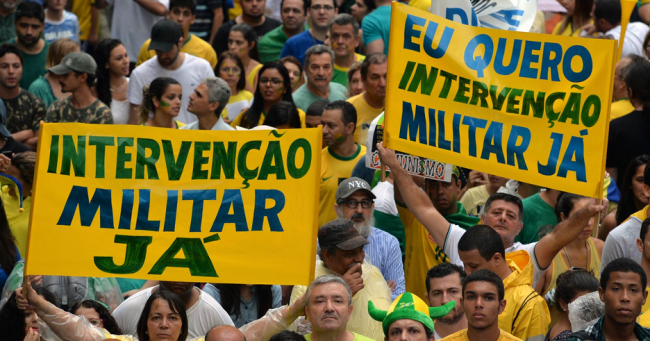
Protesters in São Paulo Plead for a Military Coup, March 15, 2015 (Source: Nelson Almeida / AFP)
In response to the pleas for military intervention, a spokesman for Revoltados ON LINE, a grassroots group that helped organize the protests and has 750,000 Facebook likes, commented, “The people asking for [military] intervention want to remove the PT from power. That is the sole focus. The participation of a variety of groups strengthens the group as a whole.” Though a military coup still looks unlikely, it is widely known that many in the military are incensed with the Rousseff administration over the final report of the National Truth Commission, which blasted the armed forces for torture and disappearances during its rule.
If those waxing nostalgic for dictatorships of yore were in the minority, what of the rest of the protesters? Despite attempts to highlight the supposed multi-class composition of the crowds on March 15, they represented, above all, Brazil’s white, university-educated economic elite. As Gianpaolo Baiocchi and Marcelo K. Silva recently pointed out, in Porto Alegre, nearly 70% of protesters were college-educated, in contrast with 11% of the general population, while over 40% belonged to the top income brackets, which make up but 3% of the population. Photographs confirm this; in a country with a high correlation between skin color and economic class, where over half of the population identifies as black or brown, the crowds had a decidedly lighter hue. A viral Tumblr account poked fun at the similarities with the upper-class, yellow-and-green-clad crowds that attended pricey World Cup matches last year by challenging visitors to determine if the photographs posted came from a March 15 demonstration or the World Cup.
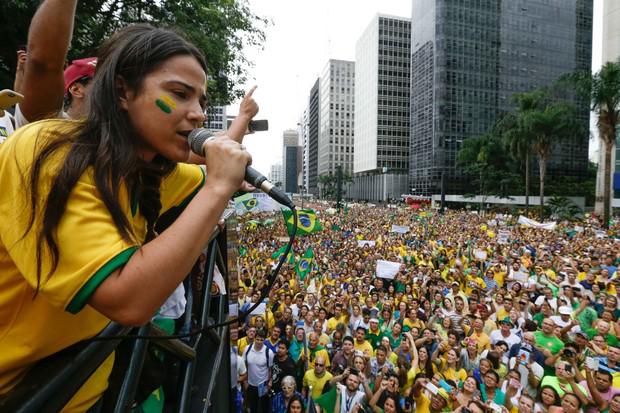
Singer Wanessa Camargo performs the National Anthem for a largely white crowd in São Paulo, March 15, 2015 (Source: Vanessa Carvalho / BPP / AGNEWS)
Of course, the fact that the demonstrations largely consisted of white middle- and upper-class Brazilians does not automatically mean that they were anti-democratic. At the same time, it would be a grave mistake to interpret the class composition of the crowds outside the context of Brazil’s historic inequalities of class, race, and region. What does it mean if the majority of demonstrators demanding the ouster of a moderately redistributive center-left party come from the social classes and regions that have least benefited from its policies? What problems do they see with corruption, the PT, or Rousseff that are insufficient to motivate the working classes or people from the impoverished Northeast of the country to take to the streets?
Since the colonial period, political and economic power has been wielded by a tiny European-descended elite, and since the collapse of the Northeastern plantation sugar economy in the nineteenth century, economic power has been concentrated in the Southeast and South, especially in the coffee and industrial powerhouse of São Paulo—today the epicenter of the opposition. An influx of European immigration in the late nineteenth and early twentieth centuries only heightened the disdain light-skinned, prosperous Southeasterners felt for their mixed-race Northeastern and Northern countrymen and women, and after the 1950s, that prejudice was turned against Northeastern migrants who came to work in the region’s expanding industries. Brazil’s middle class of government bureaucrats, small business owners, and professionals, tied to the landowning and industrial elite by socialization and patronage, has in turn largely identified with elite interests. Whenever Brazilian leaders, be they the populist dictator and later elected president Getúlio Vargas (1930-1945, 1950-1954), or the left-leaning would-be reformer João Goulart (1961-1964), have proposed reforms that would decrease inequality and broaden political representation, they have been ousted by an indignant elite and middle class – at precisely the moments when the minimum wage was growing the fastest.
The leveling results of the last 12 years are striking, if still far short of what Brazil needs to comprehensively address income inequality. In January 2003, the Inter-union Department of Socioeconomic Statistics and Studies (DIEESE) calculated that in order to provide a living wage, the minimum wage should be 6.93 times what it actually was; by February 2015, the ratio had fallen to 4.03. The unemployment rate when Lula took office was 11.2%; today, it is 5.9% (though it has risen from 4.4% in November 2014). At the same time, the gains were not evenly spread out; between 2001 and 2013, the income of the poorest 10% of the population grew at nearly three times the rate of that of the richest 10%. The result was a Gini coefficient that, while still among the highest in the world at 0.527 in 2012, reached its lowest level since 1960. In sum, then, though economic growth between 2003 and 2014 benefited the whole population, it benefited the poor and working class the most, largely as a result of real increases in the minimum wage. As economist Luiz Carlos Bresser Pereira, a cabinet minister under Cardoso, put it, “This hatred [against the PT] is a result of the fact that the government revealed a strong and clear preference for workers and the poor.”
The persistence of prejudice against the poor and Northeasterners manifested itself most clearly on social media in the wake of the 2014 elections—when the Northeast voted overwhelmingly for Rousseff. “These Northeastern sons of bitches need to die in a drought; good-for-nothings, sucking on the government’s teat, ignorant sons of bitches,” read one tweet. “Northeasterners don’t have a brain, they have no culture; it’s the slum of Brazil,” read another. Even former president Cardoso, a one-time leftist sociologist and champion of the struggle against the military dictatorship, grumbled, “The PT relies on the least informed, who happen to be the poorest.” Much like in the United States, in the wake of government efforts to reduce inequality, the wealthy and middle class have reacted with racially inflected charges of laziness, dependency, and ignorance. And so far it has largely been the same social groups who voted for Neves and blasted Northeasterners who have been participating in the demonstrations against Rousseff.
If the March 15 demonstrations expressed the concerns of the middle class and elite, what are the implications for Rousseff’s government? First, despite Rousseff’s dismal approval ratings, the PT’s base of support in the working class and poor is not ready to abandon it. The PT has retained their support through policies like the wildly popular conditional cash transfer program Bolsa Família, the expansion of the federal university system, and race and class-based quotas in college admissions that have yielded tangible improvements in their daily lives. Unless the economy deteriorates to the point where the working class and poor join the demonstrations – and even Brazil’s small leftist press admits that this is not impossible – it’s hard to imagine the protests gaining further traction. Second, despite the common class interests of the demonstrators, a message decrying working class gains is not politically feasible. In the absence of this message, which in fact is the real motivator of the protests, the demonstrators are left in the tenuous position of calling for the ouster of the PT through a legally invalid impeachment, with no agreement at all about, or what should, happen afterwards.
The same groups that organized the March 15 demonstrations are planning another round for April 12. Will they attract working class support? What developments in the Petrobrás scandal might affect their success? Will calls for military intervention become more prominent or fade into the background? One thing remains certain: In the absence of a mass working-class defection from the PT, proof of crimes justifying impeachment, or military interest in a coup, the prospects for a change in government are remote. Yet this is unlikely to dampen the hopes of wealthy and highly educated protesters, who will continue to use corruption as an excuse to protest against the socioeconomic ascension of those they see as their inferiors. As sociologist Jesse de Souza pointedly explains, “What distinguishes Brazil from the United States, Germany, and France, who we admire so much,” isn’t the level of corruption, “but the fact that we accept maintaining a third of the population in subhuman conditions.” The PT governments of the last 12 years made progress toward improving those conditions, but in the process they threatened the Brazilian elite’s deeply ingrained sense of superiority. Whether conscious or not, class and regional prejudice—not corruption—is the driving force behind the demonstrations.
Bryan Pitts is visiting assistant professor of History at Duke University and a Fulbright Scholars postdoctoral fellow at the Instituto de Ciência Política of the Universidade de Brasília (UnB).
Obama’s Legacy Set to Fail in Latin America
By Eva Golinger | TeleSur | April 3, 2015
As Latin America prepares for the upcoming Summit of the Americas in Panama City on May 9-10, the big elephant in the room is not going to be the long awaited reunion of Cuba with the organization, from which it was excluded over fifty years ago under U.S. pressure, but rather President Obama’s latest act of aggression against Venezuela.
The entire region has unanimously rejected Obama’s Executive Order issued March 9, 2015, declaring Venezuela “an unusual and extraordinary threat to U.S. national security and foreign policy” and has called on the U.S. president to rescind his decree.
In an unprecedented statement on March 26, 2015, all 33 members of the Community of Latin American and Caribbean States (CELAC), which represents the entire region, expressed opposition to U.S. government sanctions against Venezuelan officials, referring to them as “the application of unilateral coercive measures contrary to International Law”.
The statement went on to manifest CELAC’s “rejection of the Executive Order issued by the Government of the United States of America on March 9, 2015”, and its consideration “that this Executive Order should be reversed”.
Even staunch U.S. allies such as Colombia and Mexico signed onto the CELAC statement, along with U.S.-economically dependent Caribbean states Barbados and Trinidad, amongst others. This may be the first time in contemporary history that all Latin American and Caribbean nations have rejected a U.S. policy in the region, since the unilateral U.S. blockade against Cuba.
Ironically, President Obama’s justification to thaw relations with Cuba, announced in a simultaneous broadcast with President Raul Castro on December 17, 2014, was primarily based on what he called Washington’s “failed policy” towards the Caribbean island.
More than fifty years of unilateral sanctions and political hostility had only served to isolate the U.S. internationally, while Cuba strengthened its own relations with most countries around the world and gained international recognition for its humanitarian assistance and solidarity with sister nations.
Almost without pause, Obama opened the door to Cuba, admitting Washington’s failure, and then shut it on Venezuela, implementing an almost identical policy of unilateral sanctions, political hostility and false accusations of threats to U.S. national security. Before the region even had time to celebrate the loosening of the noose around Cuba’s neck, it was tightened on Venezuela’s.
Why, the region wondered, would President Obama impose a proven failed policy against another nation in the hemisphere, especially during a period of renewed relations?
Considering the ongoing U.S. war on terrorism that qualifies any alleged threat to U.S. security, by anyone or anywhere, to be a viable target of its vast military power, Venezuela was not about to sit quiet in the face of imminent attack.The South American nation immediately launched an international campaign to denounce Obama’s Executive Order as an act of aggression against a country that poses it no real threat.
President Nicolas Maduro published an Open Letter to the People of the United States in the March 17, 2015 edition of the New York Times alerting readers to the dangerous steps the Obama administration was taking against a peaceful, non-threatening neighboring state. The letter urged U.S. citizens to join calls for Obama to retract his Executive Order and lift the sanctions against Venezuelan officials.
The region reacted quickly. Just 48 hours before Obama’s Executive Order was issued, a delegation of Foreign Ministers from the Union of South American Nations (UNASUR), representing all twelve South American countries, had traveled to Venezuela to meet with government officials, opposition representatives and members of civil society. UNASUR had been mediating dialogue between the government and opposition since anti-government protests erupted last year and caused over 40 deaths in the country and widespread instability. The fact that Obama’s decree came right after UNASUR had reignited mediation efforts in Venezuela was perceived as an offensive disregard of Latin America’s capacity to resolve its own problems. Now the U.S. had stepped in to impose its will. UNASUR responded with a scathing rejection of Obama’s Executive Order and demanded its immediate abolition.
Additionally, countries issued individual statements rejecting Washington’s sanctions against Venezuela and its designation of the South American country as an “unusual and extraordinary threat” to its national security. Argentina considered it “implausible to any moderately informed person that Venezuela or any country in South America or Latin America could possibly be considered a threat to the national security of the United States”, and President Cristina Fernandez made clear that any attempt to destabilize Venezuela would be viewed as an attack on Argentina as well. Bolivian President Evo Morales expressed full support for President Maduro and his government and lashed out at Washington, “These undemocratic actions of President Barack Obama threaten the peace and security of all countries in Latin America and the Caribbean”.
Ecuadorian President Rafael Correa tweeted that the Obama Decree must be a “bad joke”, recalling how such an outrageous action, “reminds us of the darkest hours of our Latin America, when we received invasions and dictatorships imposed by imperialism…Will they understand that Latin America has changed?”
Nicaragua called the Obama Executive Order “criminal”, while wildly popular ex Uruguayan president José Pepe Mujica called anyone who considers Venezuela a threat “crazy”.
Beyond Latin America, 100 British parliamentarians signed a statement rejecting U.S. sanctions against Venezuela and called on President Obama to rescind his Executive Order labeling the country a threat.
More than five million people have signed petitions in Venezuela and online demanding the Executive Order be retracted.
Furthermore, the United Nations G77+China group, which represents 134 countries, also issued a firm statement opposing President Obama’s Executive Order against Venezuela. “The Group of 77+China deplores these measures and reiterates its firm commitment to the sovereignty, territorial integrity and political independence of the Bolivarian Republic of Venezuela… The G77+China calls on the Government of the United States to evaluate and put into practice alternatives of dialogue with the Government of the Bolivarian Republic of Venezuela, under principles of respect for sovereignty and self-determination. As such, we urge that the Executive Order be abolished”.
And then there’s the CELAC statement. The entirety of Latin America has rejected Obama’s latest regional policy, just when he thought he had made groundbreaking inroads south of the border. Unsurprisingly, the White House has miscalculated regional priorities once again, underestimating the importance sovereignty, independence and solidarity hold for the people of Latin America.
While Latin America celebrates the easing of tensions between the U.S. and Cuba, the region will not stand by and let Venezuela come under attack.
If the Obama administration truly wants to be a regional partner, then it will have to accept and respect what Latin America has become: strong, united and bonded by a collective political vision of independence and integration. Any other means of engagement with the region, beyond respectful, equal relations based on principles of non-interventionism, will only have one outcome: failure.
Venezuelan Authorities Link Crashed Plane Carrying Drugs to Mexican Government
By Z.C. Dutka | Venezuelanalysis | April 7th, 2015
Boa Vista – A wrecked plane, discovered on 2 April in a Western region of Venezuela, was carrying nearly a ton of cocaine and was registered with the official fleet of Mexico’s Attorney General’s Office.
Three bodies and 999 kilos of cocaine were found in the Cessna Conquest 441, which crashed on Thursday.
The remains of Norberto Filemon Miranda Perez and Francisco Javier Engombia Guadarrama were confirmed by the Commanding General of Venezuela’s Armed Forces on Saturday.
Miranda Perez, believed to be the pilot, was a regional director of the General Prosecutor’s Aerial Services, a branch of the justice department responsible for investigating federal and state crimes. He held office during the presidency of Felipe Calderon.
The third individual has not yet been identified, though documents naming a Bernardo Lisey Valdez were also found in the wreck.
Built in 1981 in the United States, the aircraft belonged to the Colombian firm Aerotaxi Calamar in the late 1990s, until it passed into Mexican ownership under unknown circumstances, eventually appearing as part of the Attorney General fleet in 2000 under the code XB-KGS.
No records indicating the Cessna’s transfer to private hands have been located, though a photo on jetphoto.com shows what may be the same aircraft in the Benito Juarez airport of Mexico City in 2007, with a new code – indicating new ownership.
According to Venezuelan authorities, the plane may have been downed by military efforts. Information was recorded of a bullet impacting an aircraft of similar characteristics that day, in the nearby region of Apure.
Mexico’s Foreign Ministry released a statement yesterday indicating the government’s intent to collaborate with Venezuelan authorities to uncover the details of the crash.
Another call to arrest climate “deniers”
By Eric Worrall | Watts Up With That? | April 7, 2015
Adam Weinstein, of the Gawker, has added his voice to the growing list of greens, who demand a brutal authoritarian response to the vexing problem of people who have a different opinion.
According to Weinstein;
Man-made climate change happens. Man-made climate change kills a lot of people. It’s going to kill a lot more. We have laws on the books to punish anyone whose lies contribute to people’s deaths. It’s time to punish the climate-change liars.
This is an argument that’s just being discussed seriously in some circles. It was laid out earlier this month, with all the appropriate caveats, by Lawrence Torcello, a philosophy professor at the Rochester Institute of Technology.
Weinstein bases his claim that man made climate change “kills a lot of people” on a WHO page, which estimates that 150,000 people per annum are dying because of climate related extreme weather and other problems, such as crop failure.
However, this claim simply doesn’t stand up to scrutiny. Even the IPCC has failed to establish a link between CO2 and extreme weather. In addition, the rise in CO2 has so far been strongly beneficial for crop yields – satellites have detected a substantial greening of the planet, thanks largely to the fertilisation effect of the rise in atmospheric CO2.
In recent years we have all seen a worrying surge of hate speech against climate skeptics, and a disturbing level of political acquiescence in the face of murderous fantasy and intolerance. These incidents include a government sponsored celebration of climate murder in a theatre production, MSM cartoons celebrating political violence, more cartoons, proposals for soviet style forced “reeducation”, calls for the death penalty, calls for “deniers” to be jailed, wishes for divine retribution against “deniers”, the gruesome 10:10 video fantasy about murdering the children of “deniers”, and prominent environmentalist David Suzuki’s repeated calls for “deniers” to be jailed, here, and here. There have been far too many threats against the liberty and lives of ordinary people, whose crime against humanity is to believe that 18 years with no change in global temperature, might be an indication that the climate “crisis” has been exaggerated.
Russia readies end to Greek food embargo – Economy Minister
RT | April 8, 2015
Russia has drafted a number of proposals that could end the embargo on food products from Greece, Russia’s Economic Development Minister Aleksey Ulyukayev said at a meeting with Greek Prime Minister Alexis Tsipras on Wednesday.
“We’ll be discussing in detail this issue during the meeting of the Russian Prime Minister and his Greek counterpart tomorrow,” Ulyukayev told reporters, as quoted by TASS.
“We’ve prepared a number of proposals regarding the embargo issue for discussion,” the Economy Minister said.
Russia is also considering rescinding food sanctions against Cyprus and Hungary, according to Aleksey Pushkov, head of the Duma Foreign Affairs Committee.
Greece has been hit especially hard by the ban, as more than 40 percent of Greek exports are to Russia. In 2013, more than €178 million in fruits and conserves were exported to Russia, according to the Greek fruit export association, Incofruit-Hellas.
On March 3, Greece sent a letter to the Russian food watchdog Roselkhoznadzor requesting the temporary restrictions on agricultural products such as strawberries, kiwis, peaches, and seafood is lifted.
Up until the ban, Russia had been Greece’s biggest single trading partner worth $12.5 billion (€9.3 billion) by 2013, more than double the 2009 figure.
Russia’s agricultural food ban applies to EU countries and is not due to expire until August 2015, a year after the restrictions were imposed in response to Western sanctions.
Alexis Tsipras, the newly elected PM of Greece,is in Moscow for a two-day visit and meets Russian President Vladimir Putin on Wednesday afternoon. Distancing itself from its other EU members, Athens hopes to strike a chord of cooperation with Moscow.
“Your visit could not have come at a better time, as we must analyze what we could do together to restore the former rate of growth,” Putin said ahead of his meeting with Tsipras.
Tsipras has taken a hard-line stance against EU policies towards Russia,calling the sanctions a ”road to nowhere.”
‘Dangerous process’: Russia warns against US, NATO military instructors in Ukraine
RT | April 8, 2015
A top Russian diplomat has promised that his country would push for removal of all foreign military specialists and illegal paramilitary groups from Ukrainian territory after US confirmed its plans to send about 300 instructors to train pro-Kiev troops.
Moscow is urging the removal of all foreign military formations from Ukraine, including the instructors from the United States and NATO, Deputy Foreign Minister Grigory Karasin said in an interview with the Rossiiskaya Gazeta daily.
“We know that hundreds of US and NATO servicemen are planning to come to Ukraine to train the National Guard. The training camps are being set up not only in western Ukraine, but also in other parts of the country. This is a dangerous process. We would push for all foreign and illegal military units to be removed from Ukraine,” Karasin said.
In mid-March, Pentagon spokesman Col. Steve Warren told the media that about 290 servicemen of the 173 Airborne Brigade will arrive to western Ukraine in late April to train three battalions of the Ukrainian National Guard. The planned location of the exercises was disclosed as the Yavoriv army training center near Lvov.
On Wednesday, Ukrainian PM Arseniy Yatsenyuk promised that his government would sign a number of agreements with NATO concerning military-technical cooperation. These would include a memorandum on communications and intelligence that would pave the way to Ukraine’s deeper participation in NATO’s Partnership for Peace program.
Russia has previously denounced the increasing buildup of NATO forces in Eastern Europe as well as US plans to supply weapons and non-lethal military equipment to Ukraine. The criticism became especially sharp when the House of Representatives in Washington passed a non-binding resolution calling on President Barack Obama to send lethal weapons to Ukraine, despite the ceasefire agreement between pro-Kiev forces and federalists in the east of the country.
Several Russian lawmakers have called the US Congress’ call to send “lethal aid” to Ukraine a threat to the peace process and a direct provocation aimed at Russia.
Ukraine agrees military-technical cooperation with NATO
RT | April 8, 2015
Ukraine will sign a set of agreements with NATO on military-technical cooperation in intelligence, surveillance and other areas, Ukrainian Prime Minister Arseniy Yatsenyuk told his Cabinet.
Kiev and NATO will sign a memorandum on cooperation in “control, communications, intelligence and surveillance” under NATO’s Partnership for Peace program, Yatsenyuk was cited as saying by Tass news agency.
Another document will see the implementation of four trust projects, including military-technical cooperation, communications and new information technologies, the PM added.
“Ukraine must restore its armed forces exclusively following the example of the strongest armies and strongest alliances that fight for peace in the world. In the first place, these are the standards of NATO, and we are moving in this direction,” Yatsenyuk said.
Ukraine is intensifying its ties with NATO in hopes of becoming a full member of the military alliance in five years’ time.
The issue of Ukraine joining NATO was raised by then-President Viktor Yuschenko in 2008, but Kiev’s application to join the alliance was turned downed by the 26 member states.
In 2010, then-President Viktor Yanukovich signed a decree securing Ukraine’s non-aligned status, ruling out NATO membership.
But after Yanukovich was overthrown in a violent coup in February 2014, Ukraine’s non-aligned status was revoked.
The nation will be able to consider NATO membership within five or six years, President Petro Poroshenko said before the New Year.
Various polls conducted in Ukraine suggest that the majority of the population now supports the country becoming a NATO member.
A series of reforms will have to first be implemented for Ukraine to meet NATO standards.
NATO Secretary General Jens Stoltenberg outlined some of the criteria that Ukraine would have to meet before joining the bloc. Firstly, it would have to combat corruption and improve the efficiency of state bodies, he said.
Stoltenberg also said that the possibility of deteriorating relations with Russia should not deter Ukraine from joining the bloc.
Moscow, which has always viewed NATO’s expansion to the east as a threat to its security, warned that it would cut all ties with the alliance if Ukraine joins.
The Ukrainian military has been involved in a deadly conflict with the rebels in the country’s southeastern Donetsk and Lugansk regions, who refused to recognize the regime change in Kiev.
Over 6,000 people have died in Ukraine during a year of violence, which only began to slow after Russia, France and Germany brokered a peace deal between the sides in mid-February.
Read more:
NATO to give Ukraine 15mn euros, lethal and non-lethal military supplies from members
‘Dangerous process’: Russia warns against US, NATO military instructors in Ukraine
Featured Video
The Source of America’s Wars – Kristol Clear
or go to
Aletho News Archives – Video-Images
From the Archives
Is Israel to blame for the Iraq War?
American Goy | March 10, 2008
I am so tired of this old canard that “Israel had nothing to do with USA’s war with Iraq – in fact, it officially advised America against it”.
Bullshit. … continue
Blog Roll
 Aletho News
- Alberta Bill Would Fine Political Deepfakes $10,000 Without Satire Exemptions
- Iran declares ‘historic victory’ over US, says enemy forced to accept its proposal
- Trump Claims Ceasefire, Reopening of Strait of Hormuz Agreement with Iran
- Israeli tank fire killed UN peacekeeper in Lebanon, UNIFIL investigation finds
- Russia, China block Bahrain-sponsored UN resolution on Strait of Hormuz
- The US-Israeli War on Science is an Assault on our Future
- Trump’s Promise to Bomb Iran ‘Like Never Before’ Faces Brutal Logistics — Expert
- Germany seeks to restrict stays abroad for men of fighting age – Berliner Zeitung
- Evidence points to Ukraine being behind TurkStream attempted sabotage, but that should come as no surprise
- Sri Lanka secures supplies of Russia oil – minister
- If Americans Knew
- Thousands dead and neighborhoods razed to the ground: Aid agencies fear southern Lebanon is becoming the new Gaza
- The war the US is fighting for Israel could cost trillions
- ‘Cigarette Burns, Nail Wounds’: Toddler Tortured in Gaza to Coerce Father
- Trump Says US Sent ‘a Lot of Guns’ to Protesters in Iran
- Israeli forces destroy 17 UN peacekeeper cameras in south Lebanon
- US-Israeli strikes ‘completely destroy’ synagogue in Tehran
- Archbishop for US Military Says Iran War Is Unjust Under Catholic Teaching
- Iranian leaders’ Open Letters to the American People
- Trump says Iranians appreciate bombs, WHO warns of nuclear risks – Daily Update
- U.N. experts demand Israel release prominent Gaza doctor after reports of ‘severe torture’
- No Tricks Zone
- An Inconvenient Tree: Uncovered In Alps… Europe Much Warmer Than Today 6000 Years Ago
- New Study Reports A 60% Slowdown In Greenland’s Ice Loss Rate In The Last Decade
- Low Intensity Tornado Wrecks Major Solar Farm, Creating A Potential Toxic Dump
- New Study Finds Warming Saves Lives…Cold Temperatures 12 Times More Deadly Than Excess Heat
- German Science Blog Accuses PIK Climate Institute Of Hallucinating Climate Tipping Points
- Devastating Assessment Of Comirnaty Vaccine By Former Senior Pfizer Europe Toxicologist
- New Study: CO2 Is ‘Effectively Negligible’ As An Explanatory Climate Change Factor Since 2000
- Former Pfizer Toxicologist Dr. Helmut Sterz Tells Bundestag Hearing Pfizer Vaccine Should Have Never Been Approved
- Energy Expert: Germany’s Nuclear Phaseout Was A “500 Billion Euro Mistake”
- New Research: South Australia’s Mid-Holocene Sea Surface Temperatures Were 4°C Warmer Than Today
 Aletho News