Baltimore and the Human Right to Resistance: Rejecting the framework of the Oppressor
By Ajamu Baraka | Black Agenda Report | April 29, 2015
Anti-Black racism, always just beneath the surface of polite racial discourse in the U.S., has exploded in reaction to the resistance of black youth to another brutal murder by the agents of this racist, settler-colonialist state. With the resistance, the focus shifted from the brutal murder of Freddie Gray and the systematic state violence that historically has been deployed to control and contain the black population in the colonized urban zones of North America, to the forms of resistance by African Americans to the trauma of ongoing state violence.
The narrative being advanced by corporate media spokespeople gives the impression that the resistance has no rational basis. The impression being established is that this is just another manifestation of the irrationality of non-European people – in particular, Black people – and how they are prone to violence. This is the classic colonial projection employed by all white supremacist settler states, from the U.S., to South Africa and Israel.
The accompanying narrative is that any kind of resistance that does not fit the narrow definition of “non-violent” resistance is illegitimate violence and, therefore, counter-productive because – “violence doesn’t accomplish anything.” Not only does this position falsely equate resistance to oppression as being morally equivalent to the violence of the oppressor, it also attempts to erase the role of violence as being fundamental to the U.S. colonial project.
The history of colonial conquest saw the U.S. settler state shoot and murder its’ way across the land mass of what became the U.S. in the process of stealing indigenous land to expand the racist White republic from “sea to shining sea.” And the marginalization of the role of violence certainly does not reflect the values of the Obama administration that dutifully implements the bi-partisan dictates of the U.S. strategy of full spectrum dominance that privileges military power and oppressive violence to protect and advance U.S. global supremacy. The destruction of Libya; the re-invasion of Iraq; the civil war in Syria; Obama’s continued war in Afghanistan; the pathological assault by Israel on Palestinians in Gaza and the U.S. supported attack on Yemen by the Saudi dictatorship, are just a few of the horrific consequences of this criminal doctrine.
Race and oppressive violence has always been at the center of the racist colonial project that is the U.S. It is only when the oppressed resist — when we decide, like Malcolm X said, that we must fight for our human rights — that we are counseled to be like Dr. King, including by war mongers like Barack Obama. However, resistance to oppression is a right that the oppressed claim for themselves. It does not matter if it is sanctioned by the oppressor state, because that state has no legitimacy.
No rational person exalts violence and the loss of life. But violence is structured into the everyday institutional practices of all oppressive societies. It is the deliberate de-humanization of the person in order to turn them into a ‘thing’ — a process Dr. King called “thing-afication.” It is a necessary process for the oppressor in order to more effectively control and exploit. Resistance, informed by the conscious understanding of the equal humanity of all people, reverses this process of de-humanization. Struggle and resistance are the highest expressions of the collective demand for people-centered human rights – human rights defined and in the service of the people and not governments and middle-class lawyers.
That resistance may look chaotic at this point – spontaneous resistance almost always looks like that. But since the internal logic of neoliberal capital is incapable of resolving the contradiction that it created, expect more repression and more resistance that will eventually take a higher form of organization and permanence. In the meantime, we are watching to see who aligns with us or the racist state.
The contradictions of the colonial/capitalist system in its current expression of neoliberalism have obstructed the creation of decent, humane societies in which all people are valued and have democratic and human rights. What we are witnessing in the U.S. is a confirmation that neoliberal capitalism has created what Chris Hedges called “sacrificial zones” in which large numbers of black and Latino people have been confined and written off as disposable by the system. It is in those zones that we find the escalation of repressive violence by the militarized police forces. And it is in those zones where the people are deciding to fight back and take control of their communities and lives.
These are defining times for all those who give verbal support to anti-racist struggles and transformative politics. For many of our young white comrades, people of color and even some black ones who were too young to have lived through the last period of intensified struggle in the 1960s and ‘70s and have not understood the centrality of African American resistance to the historical social struggles in the U.S., it may be a little disconcerting to see the emergence of resistance that is not dependent on and validated by white folks or anyone else.”
The repression will continue, and so will the resistance. The fact that the resistance emerged in a so-called black city provides some complications, but those are rich and welcoming because they provide an opportunity to highlight one of the defining elements that will serve as a line of demarcation in the African American community – the issue of class. We are going to see a vicious ideological assault by the black middle class, probably led by their champion – Barack Obama – over the next few days. Yet the events over the last year are making it more difficult for these middle-class forces to distort and confuse the issue of their class collaboration with the white supremacist capitalist/colonialist patriarchy. The battle lines are being drawn; the only question that people must ask themselves is which side they’ll be on.
Israeli forces violently disperse al-Tur rally against road closure
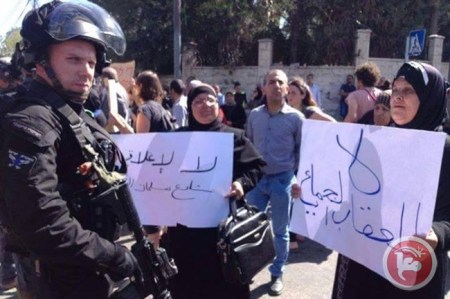
A protester holds a sign reading “No to collective punishment.” (MaanImages)
Ma’an – April 29, 2015
JERUSALEM – Israeli polices forces violently dispersed a Palestinian protest in the occupied East Jerusalem village of al-Tur on Wednesday, amid complaints that authorities’ closure of the village’s main road is a form of “collective punishment” against locals.
Sources told Ma’an that dozens of residents of the neighborhood on the Mount of Olives as well as foreign activists carried out a sit-in on al-Tur’s main street to protest Israeli authorities’ decision to shut down major thoroughfare Suleiman al-Farsi street with two concrete blocks.
The street was closed earlier this week when locals protested against the death of a 17-year-old boy from the area who was shot dead after a scuffle with a soldier at a nearby checkpoint.
Mufid Abu Ghannam, director of a local activist committee, told Ma’an that Israeli forces assaulted protesters on Wednesday and launched stun grenades at sit-in participants, injuring two people with shrapnel in their lower extremities.
Israeli forces also reportedly detained two Palestinian protesters, Amjad al-Shami and Youssef Khuweis.
Abu Ghannam said that even after protesters had dispersed, Israeli forces continued firing stun grenades at people in the area.
Israeli police spokesman Micky Rosenfeld confirmed the incident, saying that police used stun grenades against protesters after they blocked roads in what he called an “illegal demonstration” in which “stones were thrown at police officers who were at the scene.”
Rosenfeld denied any injuries in the incident.
The sit-in on the main street of al-Tur was held concurrently with rallies at five schools in the village, where students carried out sit-ins in school yards in protest against the closure of the village’s entrance.
Suleiman al-Farsi Street is considered the main entrance to the village, and local activists told Ma’an that the closure of the road negatively affected the ability of 3,000 local residents to live normally. The closure also prevents ambulances and fire trucks from reaching the village.
The thoroughfare is also the main road leading to the Suleiman al-Farsi mosque, the village cemetery, and two elementary schools where some 1,200 students attend.
The closure of the roads followed widespread protests against the killing of Muhammad Abu Ghannam on Saturday as he crossed the al-Zayyim checkpoint on foot resulted in widespread protests.
A soldier at the checkpoint reportedly insulted Abu Ghannam’s sister, leading to a scuffle, while Israeli authorities have alleged the boy pulled a knife on the soldier.
Israeli municipal authorities routinely close and block major roads leading into Palestinian neighborhoods of occupied East Jerusalem.
In addition to Al-Tur, another major road into the nearby town of al-Issawiya was also shut closed.
Abu Ghannam was one of three Palestinians shot dead by Israeli forces in the last week.
Although Palestinians in occupied East Jerusalem live within territory Israel has unilaterally annexed, they lack citizenship rights and are instead classified only as “residents” whose permits can be revoked if they move away from the city for more than a few years.
Jerusalem Palestinians face discrimination in all aspects of life including housing, employment, and services, and are unable to access services in the West Bank due to the construction of Israel’s separation wall.
Tensions have been running high in East Jerusalem since last summer when Jewish extremists raided the area and kidnapped and murdered a 16-year-old Palestinian boy, Muhammad Abu Khdeir.
Israeli forces have detained hundreds of Palestinians across East Jerusalem who have taken part in protests, especially against Israel’s summer assault on Gaza, including 600 alone in the two months after Abu Khdeir’s death.
Missile Defense Agency Spent $10 Billion on 4 Projects that were Cancelled
By Noel Brinkerhoff | AllGov | April 29, 2015
The Department of Defense started, then discarded, four massive missile defense projects, wasting $10 billion on technology that wasn’t capable of protecting the United States from foreign attack.
An investigation by the Los Angeles Times identified four programs developed by the Missile Defense Agency (MDA) that did not work as advertised:
The Sea-Based X-Band Radar (SBX), an enormous floating radar ship, was supposed to be able to detect even tiny incoming objects into U.S. airspace from thousands of miles away. SBX, built by Boeing and Raytheon, was going to guide rocket interceptors to enemy ballistic missiles before they could reach U.S. soil. But after a $2.2 billion investment, MDA realized SBX couldn’t distinguish between missiles and decoys. The technology has been mothballed at Pearl Harbor in Hawaii.
The Airborne Laser was going to allow the U.S. to blast enemy missiles using lasers mounted on converted Boeing 747s. But it turned out the lasers couldn’t be fired from long distance, requiring the planes to fly so close to an enemy country that they would be vulnerable to being shot down. So the MDA shut down the project, which cost $5.3 billion, according to the Times’ David Willman.
The Kinetic Energy Interceptor was a rocket that was supposed to be fired from land or from a ship to intercept enemy missiles during their boost phase. However, the interceptor didn’t fit on ships and didn’t have the necessary range to be fired from land. After six years of development and $1.7 billion of investment, the program ended. “No matter how successful tests might one day have been, the system would have had negligible utility,” a National Academy of Sciences review panel said.
The Multiple Kill Vehicle, a cluster of small interceptors that could take out enemy warheads and decoys, never even got a test flight. It burned through nearly $700 million.
“You can spend an awful lot of money and end up with nothing,” Mike Corbett, a retired Air Force colonel who oversaw the agency’s contracting for weapons systems from 2006 to 2009, told the Times. “MDA spent billions and billions on these programs that didn’t lead anywhere.”
Another retired officer, Air Force Gen. Eugene E. Habiger, former head of the U.S. Strategic Command and a member of a National Academy panel that reviewed MDA’s missteps, said the agency failed to analyze alternatives or seek independent cost estimates. Or, as he put it: “They are totally off in la-la land.”
To Learn More:
The Pentagon’s $10-Billion Bet Gone Bad (by David Willman, Los Angeles Times )
Another Missile Defense Test, Another Failure (by Matt Bewig, AllGov )
Reagan’s Star Wars Program…More than $200 Billion Later (by Noel Brinkerhoff, AllGov )
Congress Coughs up $300 Million to Extend Work on Useless Nuclear Waste Plant
By Noel Brinkerhoff and Steve Straehley | AllGov | April 29, 2015
What’s $300 million when a project could end up consuming more than $50 billion over its lifetime? That’s what Congress seems to have said about one of the greatest boondoggles by the Department of Energy (DOE): the Mixed Oxide Fuel Fabrication Facility (MOX).
MOX was conceived more than a decade ago, when the U.S. and Russia were working on converting plutonium into mixed oxide fuel that could be used in commercial nuclear power plants.
The DOE first said it would cost $1.6 billion to build the MOX at the Savannah River Site in South Carolina, which was supposed to open in 2007. It’s now 2015 and the plant is still only 65% complete. The final cost of just building the MOX is projected to be $7.7 billion, according to the Government Accountability Office. A study by The Aerospace Corporation also pointed out that the life-cycle cost of the facility will be $47.5 billion, according to the Project on Government Oversight (POGO).
That’s assuming there would be any reason to operate it because the deal with Russia is now over, and there are no other customers lined up to bring their unwanted plutonium to have it converted.
The project has its critics. Rep. Jim Cooper (D-Tenn.) called the continued funding of the MOX facility a “zombie earmark.” DOE officials are so fed up with the project that they were ready to put it on “cold-standby”—in other words, shut it down.
But backers in Congress, including Sen. Lindsay Graham (R-South Carolina), made sure there was $300 million in the 2014 year-end spending bill for MOX. They even prohibited the Energy Department from using the money to put MOX in cold standby.
Aerospace Corporation’s assessment was based on $500 million per year being appropriated to the project. With the lesser number, it ends up costing more: a life-cycle cost of $114 billion and a completion date of 2100, POGO reported.
What a thoughtful gift for our grandchildren!
To Learn More:
Cost Estimate on Useless Nuclear Facility Skyrockets (Project on Government Oversight)
Energy Dept. Gives up on Expensive Nuclear Waste Plant (by Noel Brinkerhoff, AllGov )
Cleanup of Radioactive Bomb Waste in South Carolina: The Endless Project (by Noel Brinkerhoff, AllGov )
The Government Project that is $6 Billion Over Budget and 10 Years Late (by Matt Bewig, AllGov )
This will make the world sorry it put a CIA death squad in charge of Chernobyl
By Niqnaq | April 29, 2015
 Yatsenyuk inspects forest fire in the exclusion zone. After visiting the zone, the Head of Government told journalists at the airport:
The situation is under control. Fire stations are from Chernobyl at a distance of about 20 km. Our State emergency service actively works to cut off the spread of fire. The localization of the fire involved three aircraft, one helicopter and a significant amount of equipment. There sent forces, including the Ministry of internal Affairs. This fire is the largest since 1992. But we cope, perform, and we will actively inform.
Answering a question about the situation with background radiation Arseniy Yatsenyuk said:
I was informed that the situation is normal; there are no changes in the background radiation level.
———–
The fire encompasses the plutonium burial areas. According to State Emergency Service (GSChS) the fire blazes already near the village. It is 13 km from the station. People are close to panic. The Deputy Director on scientific work of the Museum of Chernobyl, Anna Royal, said:
The fire had already moved in close to Chernobyl, the radioactive waste burial site. There is one of the most polluted places. Nearby the burial of radioactive waste. Plutonium is one of the most dangerous elements that infects the haematopoietic system of a person. As long as nobody touches it, this element is not dangerous. But if in the street the wind and the fire, plutonium particles can rise a meter and be transported over long distances.
Meanwhile, as reported by the interior Minister Arsen Avakov, to extinguish the fire involved the national guard. In Kiev, there are rumors that some deputies of the Verkhovna Rada and members of the government have taken their families out of town.
Iran says seizure of ship a legal matter
Press TV – April 29, 2015
Iran seized a cargo ship in the Persian Gulf because the company operating the vessel owed an outstanding debt to an Iranian private company which it is refusing to pay, an official says.
“A legal complaint by a domestic private company resulted in the seizure of the Marshal Islands-flagged vessel in Iranian waters by the Coast Guard,” head of the Ports and Maritime Organization of Iran Mohammad Sa’eednejad said.
The Coast Guard intercepted the ship belonging to the MV Maersk Tigris on the order of a court in Tehran, he said.
Sa’eednejad said the Iranian company has an outstanding amount of claims against Maersk which it has failed to settle.
“The complaint by a private plaintiff resulted in an order issued on March 17 for the confiscation of assets held by Maersk,” he added.
The ship was sailing in the Iranian waters when it was intercepted by the Coast Guard and diverted toward Larak Island near Bandar Abbas.
The US Navy’s Fifth Fleet in Bahrain dispatched the destroyer USS Farragut and a reconnaissance aircraft to the area following a distress call by the Maersk Tigris, the Pentagon said.
Sa’eednejad said the American forces left the scene when the situation was explained to them.
“It was announced that the issue was a legal dispute between two trade companies and the American forces accepted it,” he told IRNA.
The vessel has been described as a 65,000-tonne container ship and listed as sailing from Saudi Arabia’s Red Sea port of Jeddah, bound for the United Arab Emirates port of Jebel Ali in the Persian Gulf.
It reportedly had 24 crew on board, mostly from eastern Europe and Asia.
In politics as in war, advantage is not enough
By Greg Felton | April 28, 2015
Near the outset of the U.S. Civil War, President Abraham Lincoln made Maj.–Gen. George McClellan General-in-Chief of the Union Amy. McClellan was highly popular among his men and a great organizer who built the Army of the Potomac into a formidable force. Unfortunately for Lincoln, McClellan the meticulous organizer lacked the courage and judgment to be a field commander.
On April 5, 1862, Lincoln ordered McClellan to attack a Confederate force in Yorktown, Va. He had at his disposal 121,500 troops, 44 batteries of artillery and prodigious logistical support. The Confederate contingent in Yorktown, meanwhile, comprised something on the order of 10,000 men. The battle was a rout waiting to happen. It never did. McClellan told Lincoln the enemy was 100,000 strong and refused to attack. This delusion was partly due to Gen. John B. Magruder’s crafty parading of his Confederate soldiers in a circuit to give the illusion of greater numbers and his ordering of logs to be painted black to resemble cannons.
McClellan knew that intelligence estimates of Confederate strength were laughable exaggerations yet he acted as if they were true. Instead of attacking, he chose the do-nothing option of laying siege to Yorktown. In early May, Magruder and the Confederates slipped out to fight another day, leaving McClellan to enter an empty town. He declared victory. The last straw for Lincoln was McClellan’s repeated refusal to hasten after Gen. Robert E. Lee’s retreating army after the Battle of Antietam. On Nov. 5, 1862, Lincoln relieved him of command.
McClellan was an administrator who proved to be more of a coward than a commander, notwithstanding the Washington Post’s risible attempt to rehabilitate him. There may be a lesson here for a certain Canadian leader, one who finds himself at the head of a large force in the run up to a political war.
Two years ago this month, Justin Trudeau was anointed leader of the Liberal Party of Canada, a decision that gave hope to Canadians that somebody might finally put the brakes on Stephen Harper’s totalitarianism.
For one thing, Trudeau has a good pedigree. His father, Pierre Elliot Trudeau, was a respected if not wholly popular prime minister, though his reputation has much improved since his death. Trudeau’s Liberal predecessors, Stéphane Dion and Michael Ignatieff, were, respectively, too bland and too aloof to generate any deep support among the party faithful or offer a viable governing alternative. When you add good looks and youth (41), Justin Trudeau appears to be the ideal prime-minister-in-waiting, especially for young voters.
Opinion polls in the month following Trudeau’s election seemed to confirm that a reversion to Liberal rule was highly likely if not inevitable. In May 2013, voter support for the Liberals had more than doubled since the end of the 2011 election, whereas support for the Harperites had fallen by a third. Some of that Liberal growth even came at the expense of the centre-left New Democratic Party, which lost more than 20% support. Had an election been called at this time, the Liberals would have coasted to majority rule. What a difference two years makes.
By April this year, the Liberals had fallen from 38.6% to 27.6%, and Harper, of all people, was the major beneficiary! The NDP, contrary to expectation, not only did not benefit from Trudeau’s slip but lost ground, confirming that its leader, Thomas Mulcair, is not perceived as a serious rival to Trudeau.
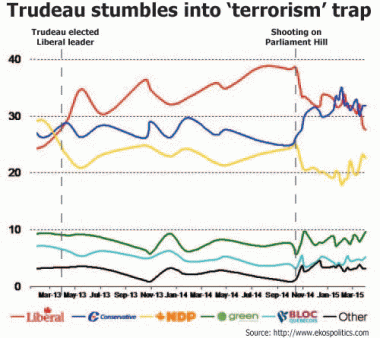 Like McClellan, Trudeau is highly popular. His victory came on the first ballot with 80% of the vote, and Liberal membership grew rapidly almost immediately. Trudeau’s popular appeal really took off in January 2014 and ballooned over the spring and summer.
Then, in mid-October, it all went south. The seminal event was the Oct. 22 shooting of Cpl. Nathan Cirillo, a ceremonial guard on duty on Parliament Hill. It was a bizarre incident, not only because it came out of nowhere, but it received conspicuously comprehensive video coverage. Some of this coverage even managed to catch no fewer than four police cars parked near the site on Parliament Hill with officers standing around as if… waiting for something to happen.
As readers already know, the shooting of Cpl. Cirillo gave Harper the excuse he needed to legislate police-state repression and a host of other unconstitutional measures in the name of “public safety.”
This police-state repression is manifested in Harper’s Protection of Canada from Terrorists Act (Bill C-44) and Security of Canada Information Sharing Act (“Secret Police Act,” Bill C-51) which authorize the state to conduct spying, harassment, arbitrary detention and intimidation and other unconstitutional measures. The main targets are not so much “terrorists” as anyone who criticizes the government, people like environmentalists and Muslim charities. These groups are already subject to malicious audits and have been intimidated into repressing their political activism.
Canada’s McClellan fails test of character
The shooting of Cpl. Cirillo gave Trudeau the perfect opportunity to seize the initiative from Mulcair and the NDP, who represent the Confederacy for analytical purposes: He could condemn the shooting and condemn the Harperites for their conspicuously contrived campaign to demonize the shooter, Michael Zehaf Bibeau, as a terrorist. Moreover, he could call attention to the totalitarian overtones of the shooting and its aftermath.
On the day of the shooting, Trudeau did deliver a speech, but it was stiff and peppered with “values” blathering reminiscent of George W. Bush’s post-Sept. 11 screed. Nevertheless, it had one redeeming virtue—he did not demonize Zehaf Bibeau: “Criminals cannot and will not dictate to us how we act as a nation, how we govern ourselves or how we treat each other. They cannot and will not dictate our values. And they do not get to decide how we use our shared public spaces.”
For his part, Mulcair also steered clear of the terrorism tar pit. On Oct. 29, he also used “criminal” to describe Zehaf Bibeau: “When you look at the history of the individual involved, you see a criminal act, of course. But… I think that we’re not in the presence of a terrorist act in the sense that we would understand it.”
At this point, Mulcair and Trudeau were on the same page regarding the shooting, but Trudeau had a big advantage. His Liberals are far and away richer and more populous than Mulcair’s NDP, and he can tap into overwhelming national hatred for Harper and his anti-terrorism totalitarianism to outmaneuver Mulcair. Since the Bill was announced, Harper’s terrorism smokescreen has lifted and opposition to state totalitarianism tripled in six weeks. Even key business leaders oppose it. All Trudeau had to do was channel this sentiment to become the people’s choice to restore Canada to parliamentary rule.
As expected, Harper and his minions jumped all over Mulcair for daring to be rational, but so did Trudeau! “The RCMP was clear, these were acts of terrorism, [so] these were acts of terrorism,” he said. Instead of lambasting Bill C-51 as unconstitutional and fascist, he tapped into his inner McClellan to adopt the do-nothing approach of proposing amendments that he knew full well would never pass. From a position of strength, Trudeau allowed himself to be outmaneuvered by both Harper and Mulcair thereby placing himself at odds with the electorate and his own party.
Trudeau’s abrupt about-face, and his attack on Mulcair for agreeing with him, makes no sense politically or morally. He does not allow for the possibility that the RCMP might lie, or that it might have abetted the shooting in some way. Currently, Parliament Hill has its own police force, which is loyal to Parliament; Harper wants it replaced by the RCMP, which is loyal to him. The RCMP has even admitted to being party to a smear campaign against former Liberal finance minister Ralph Goodale that helped Harper win his first election. Is it too much of a stretch to suggest that the RCMP came to Harper’s aid again? At any rate, Trudeau had no business taking the RCMP’s judgment on what is or is not “terrorism” at face value.
His uncritical acceptance of the RCMP’s version of events is also disturbing because it raises the possibility that he might have succumbed to political coercion. If so, one of the likely suspects is the Israel Lobby, which has the most to gain from the destruction of Canada’s civil liberties. This view gains credence from Trudeau’s knee-jerk condemnation of the Boycott Divestment and Sanctions campaign, which seeks to isolate Israel politically and economically because of the atrocities it commits in the Middle East. Trudeau claims (wrongly) that the BDS movement, like Israeli Apartheid Week, has no place on Canadian campuses, but this is just standard Lobby propaganda.
Since Trudeau wants to return the Liberals to power, he might have thought it less risky to acquiesce in attacks on Canadians’ constitutional rights than risk offending those who control vast amounts of campaign money and influence. After all, since Harper’s primary loyalty is to Israel, an attack on Harper’s secret-police bill might be construed as an attack on the Lobby. The problem with this scenario, though, is that it is utterly self-defeating—at least half the country and two thirds of Trudeau’s own MPs oppose Bill C-51. Why would Trudeau pick an unnecessary fight with his own party and the voting public unless he lacked the character and confidence to do the right thing?
In the end, Trudeau, like McClellan, succumbed to cowardice. Despite having a decisive advantage over his opponent and Harper set up like a clay pigeon, the expected rout never happened. Instead, Trudeau resorted to timid half-measures and abdicated the role of national saviour-in-waiting to Mulcair. Today, Mulcair and Green Party leader Elizabeth May are the only two national leaders willing to stand up to Harper to defend the Constitution and rule of law. In fact, Green Party support rose by more than 150% over this same period.
Short of a shock caucus revolt, which is distinctly unlikely in an election year, the Liberals are stuck with a McClellan at a time when they need a Ulysses S. Grant.
Prominent counter-insurgency general sued over N. Ireland killing
RT | April 28, 2015
The British Army’s most prominent and decorated counter-insurgent, who helped suppress anti-colonial rebellions in Ireland, Malaya and Kenya, is being sued by the family of a man killed by Irish loyalist paramilitaries in 1973.
General Frank Kitson, now in his late 80s, is accused of negligence, misfeasance in office and breaching Article 2 of the European Convention of Human Rights (ECHR) over the death in the early 1970’s of Eugene Heenan.
Heenan, a construction worker, was killed in east Belfast after a Loyalist threw a grenade into a packed minibus in which he was a passenger.
Heenan’s widow, Mary, is bringing the legal action against Kitson.
As well as being a career soldier, Kitson drew on his vast experience of irregular warfare to author several books on the subject of counter-insurgency and is held to be one of the leading theorists on the subject.
Solicitor Kevin Winters of KRW Law, heading Mary Heenan’s legal team, told the Guardian : “This week we have issued proceedings against the MoD [Ministry of Defence] and Frank Kitson on behalf of our clients, the relatives of Patrick Heenan.
“These are civil proceedings for damages but their core value is to obtain truth and accountability for our clients as to the role of the British Army and Frank Kitson in the counter-insurgency operation in the north of Ireland during the early part of the conflict.”
The case hinges on Kitson’s alleged role in the engagement by security forces of local loyalist militias to meet British strategic aims to contain and disrupt republican groups like the IRA.
Winters also cited elements of Kitson’s own seminal work on counter-insurgency, saying that “manipulation of the rule of law, infiltration and subversion” were tactics which were all “core to the Kitson military of doctrine endorsed by the British Army and the British government at the time.”
The Kitson doctrine also inspired the creation the controversial Military Reaction Force (MRF), a Northern Ireland-based unit of urban Special Forces soldier which operated in Ireland during the 1970s.
The MRF has since been accused of carrying out a number of killings – including civilian bystanders.
While former soldier and loyalist paramilitary Albert Baker was given a life sentence for the murder of Heenan, he later claimed to have links with UK intelligence services.
Mary Heenan’s legal team argue Kitson is liable for the death due to the role of his command and influence in the incident which killed Heenan.
The legal action will be the first in a series by families affected by the actions of loyalist militias during the period.
The Kitson case would be the first which attempted to hold a senior officer individually accountable for a death during the Troubles.
In a statement the MOD said: “The Ministry of Defence has received no official notification of this case, nor are we aware of any evidence which would support the allegations.”
Drones and Apologies
By Robert Fantina | Aletho News | April 28, 2015
The United States government seems extremely proud of its ability to kill people without endangering the lives of the killers. Today they can sit in a comfortable office and, videogame-like, assassinate people thousands of miles away, without the risk of being shot down. In the past, pilots would at least see the explosion, and possibly see burned victims running from the scene, but such unpleasantness is no longer a necessary part of the mass murder called war.
At least 5,000 people have been killed by U.S. drone strikes in the last ten years or so. Estimates of the number of ‘terrorists’ (whatever that means) who have been killed range from a few hundred to a few thousand. The rest are what is commonly known as ‘collateral damage’. Such a pleasant, innocuous term! Objects get damaged in a variety of ways; one might drop a dish when washing it, or perhaps dent their car when getting into a tight parking spot. Collateral damage, to be sure, but really nothing more than an inconvenience.
In U.S. parlance, ‘collateral damage’ means innocent people being killed when the U.S. wanted to kill some intended victim; the others, the ‘collateral damage’, were merely in the wrong place at the wrong time. But, U.S. government officials claim, every effort is made to reduce such ‘damage’. This is probably not all that comforting to the loved ones of innocent people who were merely trying to go to work, school or the store, and who were blown to bits as the U.S. targeted some ‘terrorist’.
As long as we’re discussing the elusive concept of terrorism, let’s try to determine what it means. One definition that is occasionally bandied about is anyone who threatens the national security of the United States. So, someone in Pakistan who, perhaps, has been the victim of U.S. oppression, and has very limited resources to cause any damage whatsoever, is targeted, possibly by some CIA (Central Intelligence Agency; now if one wants to discuss international terrorism, that would be a good place to start) informant. So, once identified and placed on President Barack Obama’s kill list, the drone strike is ready. The victim may be assassinated, and if others happen to die also, well, what’s a little collateral damage among friends?
Mr. Obama broke precedent on April 23, when he admitted that two hostages, Dr. Warren Weinstein and Mr. Giovanni Lo Porto were killed in a drone strike, and issued an apology. Said Mr. Obama: “I take full responsibility for our counter-terrorism operations. In the fog of war… mistakes, sometimes deadly mistakes, can occur… I profoundly regret what happened. On behalf of the US government, I offer our deepest apologies to the families.”
Now, Dr. Weinstein was from the U.S., and Mr. Lo Porto from Italy. Mr. Obama ‘profoundly’ regrets their deaths. Their deaths were the result of a ‘deadly mistake’, which can, he says, occur in the ‘fog of war’.
Let us take just a moment to look at some components of the president’s statement. What war, one wants to know, is being waged? An ill-defined ‘war on terror’ does not answer the question. Fighting so-called terror with genuine terror does not constitute a war; it constitutes terrorism.
More importantly, why has Mr. Obama been mainly silent when at least hundreds, and probably thousands of innocent men, women and children have been killed by drone strikes? Does he not ‘profoundly regret’ those horrific deaths, and the abject suffering their deaths inflicted on their loved ones?
Mr. Obama wasted no time once he became president to start killing people. In 2009, in what is thought to be his first authorized drone strike in Yemen, 14 women and 21 children were killed. Of these thirty-five people, one was suspected of having some connection to al-Qaeda. Where were the sympathetic comments of U.S. spokespeople regarding the other thirty-four? Or were they, perhaps, not considered, because they were probably Muslim, and certainly Yemeni, and therefore not of the same intrinsic value as an Italian citizen, and certainly not on a par with a citizen of that most superior society, the U.S.
The U.S. deems as ‘terrorist’ any individual or group that doesn’t toe its racist, imperial line. And it assigns that designation somewhat arbitrarily. In March, the Obama administration said that Venezuela represented an “unusual and extraordinary threat to the national security and foreign policy of the United States”. This occurred six days after Venezuela put the names of former U.S. president George Bush and his vice-president, Dick Cheney, on a list of U.S. citizens ineligible to visit Venezuela. President Nicolas Maduro said that “We will prohibit visas for individuals who want to come to Venezuela who have violated human rights….” What ‘unusual and extraordinary threat to the national security and foreign policy of the United States’ this move represented was never clarified.
This complex web of circumstances constitutes a significant part of U.S. foreign policy. The U.S. can designate any individual, group or country a terrorist, simply because it wishes to do so. It assigns itself the roles of judge, jury and, with drone strikes, executioner. Those who get in the way are mourned if they are from the West, but dismissed as collateral damage if from the East. And then the U.S. accuses other nations of violating international law, as if it is somehow exempt from such trivialities.
The U.S. uses drones to perpetrate unspeakable terror on Third World countries, all in the sacred name of protecting U.S. interests. That those interests always have more to do with corporate profits than with human rights is a given, proven by history and reinforced by all credible documentation today. The myth of the U.S. as a beacon of peace and liberty, supporting the basic human dignity of the downtrodden, is a fairy tale believed in few places beyond U.S. borders. And innocent people around the world continue to pay with their lives for the violence that is so much a part of U.S. imperialism.
Forest fires heading for Chernobyl nuclear plant – Ukraine Interior Ministry
RT | April 28, 2015
The Ukrainian National Guard has been put on high alert due to worsening forest fires around the crippled Chernobyl nuclear power plant, according to Ukraine Interior Minister Arsen Avakov.
Earlier the country’s emergency ministry said there was no danger posed to the sealed-off power plant from the three forest fire flashpoints in the region.
“The forest fire situation around the Chernobyl power plant has worsened,” a statement on Interior Minister Arsen Avakov’s Facebook page says.
“The forest fire is heading in the direction of Chernobyl’s installations. Treetop flames and strong gusts of wind have created a real danger of the fire spreading to an area within 20 kilometers of the power plant. There are about 400 hectares [988 acres] of forests in the endangered area.”
Avakov says the Ukrainian prime minister has called an emergency meeting on how to tackle the situation. Police and National Guard units are on high alert.
Ukrainian emergency services say 182 people and 34 vehicles have been dispatched to fight the fire. Mi-8 helicopters and three An-32 water dropping airplanes are also working at the scene. The efforts are being coordinated from a mobile emergency headquarters.
Israeli military drill sparks fire on Palestinian farmland
Ma’an – April 27, 2015
TUBAS – A fire sparked by an Israeli military drill swept across thousands of dunams of Palestinian farmland in the northern Jordan valley on Monday, the Palestinian civil defense said.
Some 3,000 to 4,000 dunams of farmland in the Humsa area of eastern Tubas district were affected by the fire after Israeli forces opened fire during a military exercise.
The district of Tubas is one of the West Bank’s most important agricultural centers, and the civil defense said the land had been planted with wheat and barley.
Tubas Governor Rabih al-Khandaqji condemned Israeli “violations” in the area, aimed at “displacing people from their lands and deliberately inflicting grave losses to their resources.”
Civil defense crews arrived from Qalqiliya and Nablus to fight the fire but were prevented from reaching the area as Israel has declared it a closed military zone.
The majority of the Jordan Valley is under full Israeli military control, despite being within the Palestinian West Bank.
According to the Applied Research Institute of Jerusalem, more than 15,000 dunams of land in the Tubas district have been confiscated by Israel for military bases with a further 8,000 dunams seized for illegal Israeli settlements.
14-year-old shot by Israeli forces in Gaza Strip in critical condition
Ma’an – April 28, 2015
 GAZA CITY – A 14-year-old Palestinian is in critical condition and has been transferred to Ramallah for treatment after he was hit by a stray Israeli bullet on Friday at his home in the central Gaza Strip, his family said Tuesday.
The family of Fadi Abu Mandil, 14, said that the teen will undergo surgery in his spine as he is currently unable to walk.
His uncle told Ma’an that the child was hit with a stray Israeli bullet while studying at his home when Israeli forces opened fire on Palestinian farmers.
On Friday medical sources said that the 14-year-old from al-Mughazi refugee camp had been transferred to Shuhada al-Aqsa Hospital in Deir al-Balah city.
Israeli forces were again firing on Gazan farmers on Tuesday, damaging property and forcing farmers to flee their land, and on Sunday, they shot and injured a 37-year-old man.
Israeli forces have repeatedly opened fire on Gazans since the ceasefire agreement signed Aug. 26, 2014 that ended a devastating 50-day war between Israel and Hamas.
In March alone, there were a total of 38 incidents of shootings, incursions into the coastal enclave, and arrests, according to the Palestinian Center for Human Rights.
That was up from 26 incidents through February, and left seven Palestinians injured and one dead.
The attacks come despite Israeli promises at the end of the ceasefire to ease restrictions on Palestinian access to both the sea and the border region near the “security buffer zone.”
Featured Video

America Racing to Strategic Defeat in Iran
or go to
Aletho News Archives – Video-Images
From the Archives
An Expert Military Analysis of War with China
Actually, None is Necessary
By Fred Reed • Unz Review • December 13, 2020
The Correlation of Armed Forces: U.S. goods and services trade with China totaled an estimated $634.8 billion in 2019. Exports were $163.0 billion; imports were $471.8 billion. The U.S. goods and services trade deficit with China was $308.8 billion in 2019. Trade in services with China (exports and imports) totaled an estimated $76.7 billion in 2019. Services exports were $56.5 billion; services imports were $20.1 billion. The U.S. services trade surplus with China was $36.4 billion in 2019.
There is talk within the Washingtoniat of a possible war with China. Steve Bannon, who apparently was dropped on his head as a child, actually favors such a war. We hear the usual shoo-the-boobs alarm about how the Chinese are doing something terrible and we must gird our loins and American values and show them what for, bow wow, woof. The danger is that the current game of who-blinks-first in Asian waters might actually provoke a shooting war. You know the kind of thing: One warship refuses to get out of the way of another, a collision ensues, some retard lieutenant who signed up on waivers opens fire, and we’re off and running. It is not a good idea to let children play with matches.
The said war is discussed either in emotional terms by idiots or in purely naval terms by those familiar with such things, so we hear of the First Island Chain and the Second Island Chain and whose missiles against the other’s missiles and so on. This would be appropriate if we were fighting World War Two again. Which we aren’t. Let’s take a quick-and-dirty look at how such a war might go.
To begin the war, America would overestimate itself and underestimate China. This is doctrine in the Pentagon. … continue
Blog Roll
 Aletho News
- Rethinking America’s greatest threat: Iran vs. Israel-Firsters
- Iran accuses adversaries of false flags to strain Turkey ties
- Poland rules out sending Patriot missiles to US/Israel amid war on Iran
- Tehran approves new Hormuz plan with major restrictions
- No Threat Can Force Iran’s Surrender /Trita Parsi & Lt Cl Daniel Davis
- UK’s New Pandemic Plan Would Turn Big Tech Into a Mass Location Tracking Network
- Growing insecurity, soaring prices fuel protests in north as regime bans evacuation: Sources
- Iran denies responsibility for ‘depraved’ attack on Kuwait desalination plant
- Bring The Troops Back. End This War Now!
- Can we please stop calling Israel the ‘only democracy in the Middle East’ now?
- If Americans Knew
- The Line Between Affinity and Conspiracy
- As Iran targets US military bases, will they be relocated to Israel? Not a ceasefire Day 171
- Will Trump Go Kamikaze?
- Is the University of Florida Shutting Down College Republicans over Israel Criticism?
- Jewish extremist arrested over alleged plot to firebomb Palestinian activist Nerdeen Kiswani’s home
- More than half of Palestinian child detainees have no charges
- The More Murderous Israel Gets, The More We Hear About “Antisemitism”
- Land Day and the Palestinian struggle after 30 months of genocide
- The Iran War Is About Palestine
- Israeli soldiers echo settler ideology, talk of revenge after targeting Palestinians and detaining CNN crew in the West Bank
- No Tricks Zone
- New Study Finds Warming Saves Lives…Cold Temperatures 12 Times More Deadly Than Excess Heat
- German Science Blog Accuses PIK Climate Institute Of Hallucinating Climate Tipping Points
- Devastating Assessment Of Comirnaty Vaccine By Former Senior Pfizer Europe Toxicologist
- New Study: CO2 Is ‘Effectively Negligible’ As An Explanatory Climate Change Factor Since 2000
- Former Pfizer Toxicologist Dr. Helmut Sterz Tells Bundestag Hearing Pfizer Vaccine Should Have Never Been Approved
- Energy Expert: Germany’s Nuclear Phaseout Was A “500 Billion Euro Mistake”
- New Research: South Australia’s Mid-Holocene Sea Surface Temperatures Were 4°C Warmer Than Today
- Storing Green Energy To Last Germany 10 Days Would Require A 60-Million Tonne Battery
- New Studies: UK Sea Levels Were 4 Meters Higher Than Today During The Mid-Holocene
- Destructive Green New Deal: German Energy And Metal Group Warns Of Drastic Crisis
 Aletho News