German Federal Prosecutor ‘investigating’ US actions on drones base
Reprieve | June 2, 2015
The German Federal Prosecutor is reported to have begun investigating a US base in Germany that is used as a ‘hub’ for drone strikes, days after a Yemeni man testified in a Cologne court about the 2012 strike that killed his relatives.
According to a report in Der Spiegel, the Federal Prosecutor’s Office – Germany’s highest prosecuting authority – has launched a ‘monitoring process’ to ascertain whether activities at Ramstein, a US base in Germany, violate international law. The officials have reportedly requested documents from German authorities, including the Ministry of Defence, relating to the base – which was recently revealed to be a ‘hub’ for the facilitation of drone strikes in Yemen and elsewhere. US drone strikes in countries such as Yemen, where the US has not declared war, have killed hundreds of civilians, and are widely regarded as a violation of international law.
The news comes days after a court in Cologne heard testimony from a Yemeni man who lost his relatives in a strike – the first time any court has heard from drone victims. Faisal bin Ali Jaber lost his brother-in-law Salim, an anti-Al Qaeda preacher, and his nephew Waleed, a police officer, to a 2012 US strike on his village of Khashamir. The German case sees Mr bin Ali Jaber – represented by international human rights organization Reprieve and the European Center for Human Rights (ECCHR) – seeking to challenge Germany’s failure to stop the use of Ramstein for US drone strikes. Although the court last week ruled against Mr bin Ali Jaber, judges agreed with his assertion that it is ‘plausible’ the base is central to the launching of the strikes, and gave him immediate permission to appeal their decision.
Commenting, Kat Craig, Mr bin Ali Jaber’s Reprieve lawyer, said: “The civilian impact of the US’ drone wars in Yemen and elsewhere is well-documented – as is the crucial role played by Ramstein in facilitating these illegal strikes. The prosecutor’s move to investigate the use of German soil in violating international law is a crucial first step in lifting the veil of secrecy over the drone programme. For Faisal – and the scores of other people whose relatives were unlawfully killed in drone strikes – this decision is long overdue. Nothing will bring back their loved ones, but a full and proper investigation into the role of Ramstein will finally shed some light on the role of the German government in the drone programme. Our clients hope that, in doing so, Germany will do the right thing and withdraw support for the US’ drone war, once and for all.”
The Israeli war crime that goes unmentioned
By Jonathon Cook | The Blog From Nazareth | June 2, 2015
Here set out in black and white in the Israeli media is a moral conundrum that western politicians, diplomats and international human rights organisations are resolutely failing to address – and one I have been highlighting since 2006.
It was then that Israel implemented for the first time its Dahiya doctrine – turning Lebanon back to the Stone Age. It launched an horrific assault that wrecked Lebanon’s infrastructure, killed 1,300 Lebanese – most of them, as ever in Israel’s wars, civilians – and made refugees of more than a million inhabitants of the country’s south. The exercise has been repeated in Gaza on a regular basis ever since.
Last month the New York Times kindly published an Israeli press release masquerading as a news report that the Israeli army had photographic evidence that Hizbollah was moving its military bases into villages all over south Lebanon. The evidence was paltry to say the least. And the New York Times, quite bafflingly, said it had not been able to “independently verify” the information, as though it lacked reporters in Lebanon who could visit the sites named by its correspondent in far-away Tel Aviv.
The clear implication of the story was that, when the next war with Lebanon arrives, as the Israeli army keeps promising is just around the corner, Israel will be able to blame Hizbollah when its attacks kill mostly civilians.
As Israel’s Haaretz newspaper pointed out – possibly inadvertently – in a headline, the New York Times was doing Israel’s propaganda work for it: “Israel’s secret weapon in the war against Hezbollah: The New York Times”.
Although the NYT’s propaganda role was noted by several observers, no one seemed to make the point that, if Hizbollah is only now moving its bases into these villages, how can one make sense of the prominent justification for the high civilian death toll in Lebanon in 2006? Then Israel argued – and was backed by the UN and others – that the civilian deaths were a result of Hizbollah’s “cowardly blending” with the civilian population by firing rockets from built-up areas, though no evidence was produced at the time.
Look at what Amos Harel, Haaretz’s military correspondent, writes now:
The [New York] Times reports that Hezbollah, as part of the lessons it drew in the Second Lebanon War, in 2006, moved its “nature reserves” – its military outposts in the south – from open farmland into the heart of the Shi’ite villages that lie close to the border with Israel. That in itself is old news.
Tell that to Jan Egeland, who was the United Nations Undersecretary-General for Humanitarian Affairs at the time (and later joined Human Rights Watch), as well as all those who echoed his accusation against Hizbollah of “cowardly blending”.
There is another, even more vital point unnoticed by most observers but highlighted in Harel’s report for Haaretz. One of the problems for those at the receiving end of these savage Israeli attacks has been: how to respond. Or rather: how to respond within the confines of international law. While Israel has been doing most of the killing, western politicians, diplomats and human rights groups like Human Rights Watch and Amnesty International have been more exercised by the efforts of Hizbollah and Hamas to retaliate in kind.
The international law argument supposedly goes something like this: Israel has the right to defend itself and so long as it is aiming for military targets with its precision armaments and acts proportionately then it is within its rights to launch attacks, whether civilians are killed or not.
The argument’s flip side goes like this: However terrible the suffering endured by their respective populations under this barrage, Hizbollah and Hamas have no right to respond with their imprecise rockets, whether they are aiming for a military target or not, because they cannot be sure their rockets will not hit civilians. In short, anything they fire over the border is a war crime by definition.
If that sounds problematic to you, check out my own public engagement with Sarah Leah Whitson of HRW back in 2006 debating this very issue.
The problem when dealing with asymmetrical confrontations is that traditional interpretations of international law are rigged to the advantage of the stronger, better-armed side.
So how does the Israeli army feel about Hizbollah’s efforts to improve its rockets to avoid this international law problem. Haaretz’s Harel explains what his military contacts have been telling him:
Israel is apparently deeply concerned by Hezbollah’s effort to improve the accuracy of its rockets. The organization has in its possession vast numbers of missiles and rockets – 130,000, according to the latest estimates – but upgrading its capability is dependent on improving the weapons’ accuracy, which would enable Hezbollah to strike effectively at specific targets, including air force-base runways and power stations.
In other words, Israel is “deeply concerned” that Hizbollah might soon be able to operate within the terms of international law as laid down by official arbiters like the UN and HRW.
How is Hizbollah trying to upgrade its rockets? Its allies, Iran and Syria’s Bashar Assad, are trying to deliver more sophisticated weapons to it through Syrian territory. How does Israel feel about this? Harel reports: “Israel is upset at the smuggling of weapons by the Assad regime in Syria to Hezbollah.” In fact, we know Israel is “upset” because it keeps violating Syria’s sovereign air space to launch attacks in Syria to stop convoys it claims are transporting such weapons reaching Hizbollah. It is similarly blockading Gaza to make sure upgraded, precise weapons do not get into Hamas’ hands.
So who will be to blame when Israel gets the next war with Lebanon or Gaza it wants and Hizbollah or Hamas respond by firing their imprecise rockets in retaliation? When Israeli civilians die under those rockets, will Hizbollah and Hamas be responsible or will it be Israel’s fault?
We will doubtless hear the answer from the United Nations, Human Rights Watch and the New York Times soon.
Government Wipes Recent Vaccine Injury Data from Website
Recent Rise in Vaccine Victims’ Court Decisions and Concessions Not Reflected in Revised Government Chart
By Sharyl Attkisson | May 31, 2015
In March, the federal government removed the latest vaccine injury court statistics—more than a year’s worth of data—from one of its publicly reported charts. It was an abrupt departure from the normal practice of updating the figures monthly.
Wiping the latest data means the “adjudication” chart on a government website no longer reflects the recent, sharp rise in court victories for plaintiffs who claimed their children were seriously injured or killed by one or more vaccines.
Since January of 2014, twice as many victims have won court decisions than the previous eight years combined. In these court decisions, a judge ruled the evidence showed vaccines “more likely than not” caused the plaintiff’s injuries.
Also on the rise is the number of vaccine injury cases the government has “conceded”: up 55% in a little over one year.
As a result of the recent website changes, neither of these trends is reflected on the current “adjudication” chart.
Since its inception in 2013, the “adjudication” chart included monthly, updated totals. But shortly after publishing the March 2015 chart, the government removed the 2015 and 2014 data, reverting back to outdated statistics from 2013.
The chart appears on the government vaccine court website, which falls under Health Resources and Services Administration (HRSA), an agency of the Department of Health and Human Services (HHS).
In the unusual vaccine court, the government acts on behalf of pharmaceutical companies rather than the public, defending vaccine makers against alleged victims. Money damages are not paid by vaccine companies, but through fees collected from patients on every dose of vaccine.
Older Data Doesn’t Reflect Uptick in Awards to Vaccine Victims
HRSA says vaccine makers had no influence over the decision to revert to older data. The agency said it did so to synch up with a statistic the Centers for Disease Control (CDC) provides for the same chart that is only current through 2013: the number of vaccine doses distributed in US.
“An internal decision was made to ensure that all data was internally consistent… and to update [the chart] only when all relevant data was available,” said HRSA in a statement.
Court decisions won by vaccine victims since 2006
Chart shows (through 2013): 59
Actual number (through April 2015): 165
Concessions won by vaccine victims since 2006
Chart shows (through 2013): 127
Actual number (through April 2015): 198
Vaccine victims paid after settlements since 2006
Chart shows (through 2013): 1388
Actual number (through April 2015): 1488
Only about one injury case for every million doses of vaccines is compensated in vaccine court. Adverse events occur more frequently, according to vaccine warning labels, but rarely end up in the little-known vaccine court. Still, vaccine court statistics can be useful in reflecting trends.
The number of flu vaccine cases conceded by the government since January of 2014 is more than double the previous eight years combined. The adjudication chart only reflects half of the current number.
Concessions won by flu shot victims since 2006
Chart shows (through 2013): 42
Actual number (through April 2015): 88
Total flu shot victims compensated since 2006
Chart shows (through 2013): 1091
Actual number (through April 2015): 1271
The number of Tdap cases conceded since 2014 doubled the previous eight years combined. The adjudication chart shows half the current number.
Concessions won by Tdap vaccine victims since 2006
Chart shows (through 2013): 12
Actual number (through April 2015): 24
Total Tdap cases compensated since 2006
Chart shows (through 2013): 103
Actual number (through April 2015): 129
The number of rotavirus vaccine injury concessions remains tiny—but is quadruple what the current chart reflects.
Concessions won by rotavirus vaccine victims since 2006
Chart shows (through 2013): 1
Actual number (through April 2015): 4
Vaccine Court Stats: Harder to Find
Another recent change made vaccine injury data more difficult to find. The “adjudication” chart used to be the first item that showed up on the statistics page. But that has been replaced by language stating that vaccines are safe and effective.
“Being awarded compensation for your claim does not necessarily mean that the vaccine caused the alleged injury,” adds the government in the statement where the adjudication chart used to be.
Readers are directed to click a link to view the actual vaccine injury statistics. But clicking it only leads back to the statement that vaccines are safe and effective.
To find the statistics, instead of clicking the link, readers must scroll down past it.
According to the government, from 2006 to 2013, over 2.2 billion doses of vaccines were distributed in the U.S. For every 1 million doses, 1 alleged victim was compensated in vaccine court.
Since 1988, over 15,916 claims have been filed in vaccine court. 4,083 were compensated; 9,893 were dismissed. The total amount of money paid to victims is approximately $3.1 billion.
Musk defends receiving $4.9 billion in government support for Tesla, SolarCity and SpaceX
RT | June 1, 2015
Tesla CEO Elon Musk defended the backing his companies get from state and federal sources as legitimate business practices, blasting a newspaper report about government subsidies as “inexcusable” and inaccurate.
According to the report published by the Los Angeles Times over the weekend, Musk’s companies – Tesla, SolarCity and SpaceX – have received an estimated $4.9 billion in government support in total over the years.
The electric entrepreneur didn’t deny the company gets the incentives, however he went on CNBC’s Power Lunch show on Monday, blasting the report as “incredibly misleading and deceptive to the reader.”
“Musk and his companies’ investors enjoy most of the financial upside of the government support, while taxpayers shoulder the cost,” wrote the LA Times, adding that public records show “a common theme running through his emerging empire: a public-private financing model underpinning long-shot start-ups.”
“The article makes it seem as though my company is getting some huge check, which is fundamentally false,” said Musk.
The subsidies have been disclosed in the companies’ filings and public records, but no one has tallied all the various forms of public assistance over time, the paper said. Its estimates of subsidies are based on state and federal records, interviews with local and state officials, credit analysts, and watchdog groups.
According to the LA Times, Tesla Motors has received $2.391 billion in government subsidies, while SolarCity has received $2.516 billion. Space Exploration Technologies (SpaceX), a private company that does not publicly report financial performance, received $20 million in local incentives and rebates for a space launch facility in Texas.
Among the examples cited by the paper was a $750 million solar panel factory in Buffalo, New York, which Musk’s SolarCity leased for $1 a year. The company will also not pay property taxes for a decade, amounting to $260 million in savings.
Tesla is getting $1.3 million from Nevada to build a battery factory near Reno, and has received more than $517 million from other automakers by selling environmental credits, known as carbon offsets.
Though after ten years in business Tesla and SolarCity still operate at a net loss, the stocks of both companies are riding high on future potential, the LA Times reported. … Full article
Why The Netherlands Just Banned Non-Commercial Use Of Monsanto’s Glyphosate-Based Herbicides
By Arjun Walia | Collective Evolution | May 30, 2015
The Netherlands has just become the latest country, following Russia, Mexico, and many others, to say no to Monsanto. The sale and use of glyphosate-based herbicides (the most commonly used herbicides in the world) has just been banned for non-commercial use in the country, effective later this year. This means that people will no longer be able to spray RoundUp on their lawns and gardens and will instead have to find another (hopefully more natural) means of pest control.
This is definitely a step in the right direction.
The move comes as no surprise, considering that the number of countries around the world who are choosing to ban this product is growing at an exponential rate. Bans and restrictions are being implemented due to the fact that glyphosate (the main ingredient in RoundUp) has been directly linked to several major health issues, including: birth defects, nervous system damage, Alzheimers, Parkinson’s, various forms of cancer, and kidney failure. (Sri Lanka recently cited deadly kidney disease as their reason for banning his product. You can read more about that and access the research here.) Indeed, The World Health Organization recently acknowledged the fact that glyphosate can cause cancer, and you can read more about that here.
Not only that, there are multiple environmental concerns associated with the use of this chemical.
What’s even more disturbing is the fact that studies have shown that RoundUp herbicide is over one hundred times more toxic than regulators claim. For example, a new study published in the journal Biomedical Research International shows that Roundup herbicide is 125 times more toxic than its active ingredient glyphosate studied in isolation. You can read more about that here. The eye opening abstract reads as follows:
“Pesticides are used throughout the world as mixtures called formulations. They contain adjuvants, which are often kept confidential and are called inerts by the manufacturing companies, plus a declared active principle, which is usually tested alone. We tested the toxicity of 9 pesticides, comparing active principles and their formulations, on three human cell lines. Glyphosate, isoproturon, fluroxypyr, pirimicarb, imidacloprid, acetamiprid, tebuconazole, epoxiconazole, and prochloraz constitute, respectively, the active principles of 3 major herbicides, 3 insecticides, and 3 fungicides. Despite its relatively benign reputation, Roundup was among the most toxic herbicides and insecticides tested. Most importantly, 8 formulations out of 9 were up to one thousand times more toxic than their active principles. Our results challenge the relevance of the acceptable daily intake for pesticides because this norm is calculated from the toxicity of the active principle alone. Chronic tests on pesticides may not reflect relevant environmental exposures if only one ingredient of these mixtures is tested alone.” (source)
Equally disturbing is the fact that RoundUp has been found in a very high percentage of air and rainfall test samples. You can read more about that here.
Significant concentrations of it have also been found in the urine of people across Europe, you can read more about that here.
One recent study published in the Journal of Environmental & Analytical Toxicology has now proven that animals and humans who consume GMO foods – those that are loaded with glyphosate chemicals, the main ingredient in Monsanto’s RoundUp – have extremely high levels of glyphosate in their urine.
It’s also noteworthy to mention that there are Wikileaks documents showing how the United States planned to “retaliate and cause pain” on countries who were refusing GMOs. You can read more about that story and view those documents here.
It’s troubling to think that so many children are within proximity of and playing on lawns that have been sprayed with this stuff. Cancer is not a mystery, it is not a stroke of bad luck, it’s time for the world to wake up and realize what research has been confirming for years.
More Information on Pesticides & Herbicides Here:
**There are also multiple articles linked within the article above that provide more information**
Scientists Link Autism To These Toxic Chemicals During Fetal Development
Another Groundbreaking Study Emerges Linking Agricultural Pesticides To Autism
Scientists Can Predict Your Pesticide Exposure Based On How Much You Eat
This Is What Happens To Your Body When You Switch To Organic Food
What Parents Need To Know About Monsanto: “By 2025 One In Two Children Will Be Autistic”
Monsanto’s Glyphosate Linked To Birth Defects
Groundbreaking Study Links Monsanto’s Glyphosate To Cancer
New Study Links Gmos To Cancer, Liver/Kidney Damage & Severe Hormonal Disruption
Multiple Toxins From GMOs Detected In Maternal And Fetal Blood
Sources Used:
Law Enforcement Agencies Use Tasers Over 300,000 Times A Year
By Sarah Kaufman | vocativ | June 1, 2015
The use of a Taser in the fatal shooting of a black man by a cop in South Carolina earlier this year has reignited a debate about how safe they are and whether police are relying too heavily on them. Many people, especially residents of North Charleston, S.C., where the shooting occurred, have expressed concern that Tasers pose a health risk to some who are involved in run-ins with police.
Officer Michael T. Slager of the North Charleston Police Department fatally shot Walter L. Scott on April 4 in North Charleston. The incident was recorded on tape by a bystander, and the officer’s use of a Taser was documented as well.
Here’s a look at some of the numbers behind the raging debate over Tasers:
Slager had used his Taser 14 times in five years
The record shows Slager was no stranger to the Taser’s electrical charge, The New York Times reported. He used his Taser six times in 2014 alone, according to police documents. That’s four percent of the department’s total Taser use.
North Charleston’s police deployed Tasers 825 times in four years
That means the department, on average, performed 206 tasings per year. For comparison, The New York Times offered Tyler, Texas, a town similar in population but with 150 fewer police officers. Tyler’s department used Tasers 65 times in the same time period, or roughly only 30 percent of the tasings that occurred in North Charleston.
Over 18,000 law enforcement agencies have Tasers
The weapon is highly prevalent, according to Taser International. But there is no publicly available national standard for law enforcement in using one.
Tasers are used 900 times a day
Taking that data from Taser International and assuming every day is relatively consistent in Taser usage, that’s 328,500 tasings a year.
Tasers have been blamed for over 500 deaths
While Taser International says it has conducted independent studies to verify the weapon’s safety, some medical experts say the electric jolts can pose sometimes fatal threats to a person’s health. According to Amnesty International, Tasers are responsible for at least 500 deaths.
“Grab Anybody!” St. Louis PD Indiscriminately Taser and Arrest People Walking Down Sidewalk
By Matt Agorist | The Free Thought Project | June 1, 2015
St. Louis, MO — Friday night in St. Louis, a peaceful, silent protest was organized to raise awareness and call an end to police brutality. It was referred to on social media as #shutdownbaseball. The protest took place outside of Busch Stadium during a Cardinals game.
The road was already closed off for baseball fans, and the protesters simply held their signs and chalked the sidewalks.
The protest was largely uneventful except for some people becoming upset when they saw a flag being “disrespected.”
According to RevoNews,
It wasn’t until the last 13 remaining protesters started to head home around 11:30pm when things got out of hand. People still motivated to bring attention to their cause had decided to leave the sidewalk and walk in the street. Faced with a myriad of options, when the commands given to leave the roadway were not met Lt Dan Zarrick made the decision to make arrests. What we see in the video below (supplied by the female taser victim) shows what happened after that decision was made.
As the video starts out police are taking people into custody for being in the street. One officer who was blocking the arrests with his bicycle, ordered the crowd to disperse. “Get back,” he says.
Then another officer can be heard screaming, “Grab anybody, they were all in the street!”
As people begin to comply with the first officer’s order to “get back,” they turn and walk away down the sidewalk. But they are quickly met by officers with tasers drawn.
The man in front, wishing not to be tased, side-steps the taser but is quickly hit. Then the woman is tased.
“Oh my god, Oh my god, why did you do that? I didn’t do anything,” pleads the woman just prior to being hit with the taser again.
The cries for help and obvious distress of the woman in the video are disturbing.
Right before the video ends we can her the woman screaming in pain, “Why are you doing this to me? I’m on the ground.”
RevoNews reports that eight of the protesters were arrested. All of them were charged with impeding the flow of traffic and two had an additional charge of resisting arrest. They have all been released.
This small group of people were complying with the original officer’s orders, yet they were met with excessive force. There was absolutely no need for tasers to be deployed. No one was running away; no one was resisting, nor was anyone posing a threat.
According to Missouri state law, impeding the flow of traffic is punishable by “a fine of not less than ten dollars nor more than fifty dollars.” However, these people were met with a large show of force and brought to jail for it. Is that justice?
‘He will pay a heavy price’: Erdogan threatens Turkish editor-in-chief for scandalous report
RT | June 1, 2015
Turkish President Tayyip Erdogan has publicly threatened the editor-in-chief of a Cumhuriyet daily for publishing a report, which showed police discovering weapons ready to be sent to Syrian rebels in trucks belonging to Turkish intelligence.
“This slander and this illegitimate operation against the National Intelligence Organization (MIT) are, in a way, an act of espionage. This newspaper got involved in this espionage activity, too,” Erdogan told the TRT public broadcaster.
The video published on the Cumhuriyet news website on Friday showed Turkish gendarmerie and police officers finding weapons due for dispatch to Syria on trucks belonging to the National Intelligence Organization (MIT).
The Cumhuriyet report said the footage was dated January 19, 2014, and described the arms in the trucks as weapons and ammunition.
The Turkish president said the arms shown in the footage were transported to Turkmens in Syria. He added the numbers of weapons were provided to Cumhuriyet by a “parallel state” – political enemies determined to discredit his government.
“What only matters to them is casting a shadow on Turkey’s image.”
Erdogan promised sanctions against Cumhuriyet’s editor-in-chief, Can Dundar.
“I suppose the person who wrote this as an exclusive report will pay a heavy price for this… I will not let him off lightly,” Erdogan said, apparently referring to Dundar.
Dundar responded to the Turkish president’s lambast on Twitter: “The person who committed this crime will pay a heavy price,” he wrote, adding a link to the Cumhuriyet’s story about Erdogan threatening him.
Reuters also investigated the incident and showed testimony from the gendarmerie and officers. The latter claimed they discovered rocket parts, ammunition, and semi-finished mortar shells that were being transported in trucks accompanied by the country’s state intelligence agency (MIT) to parts of Syria under Islamist control.
At the time of the incident, the Syrian side of the border in Hatay province, neighboring Adana province, was controlled by Ahrar al-Sham, an Islamist group.
The prosecutors said the trucks were searched in several raids by police and the gendarmerie – one in November 2013 and three others in January 2014 – on the orders of prosecutors acting on tip-offs that they were carrying weapons.
“Our investigation has shown that some state officials have helped these people deliver the shipments,” prosecutor Ozcan Sisman, who ordered the search of the first truck on November 7, 2013 told Reuters in May.
Sisman and Takci, another prosecutor, have been arrested and now face charges of carrying out an illegal search. They both deny the charges.
About 30 officers involved in the search on January 1 and the incident on January 19 also face charges, including military espionage and attempts to overthrow the government, according to an April 2015 Istanbul court paper.
EU on Trade Diet While US Feasts
Sputnik | 01.06.2015
While European businessmen continue to lose money and market share due to the anti-Russian sanctions imposed by Brussels under intense pressure from the US, Washington has quietly stepped up its business with Russia.
Europe has found itself in jeopardy. While its businessmen continue to lose money due to the anti-Russian sanctions the EU was compelled to launch amid intense pressure from Washington, the US seems to be boosting its business with Russia.
Trade turnover between the EU and Russia shrank by almost ten percent in the first two months of 2015 year-on-year, while Russian statistics shows that trade between the US and Russia spiked by approximately 6 percent, states German weekly magazine Der Spiegel.
Only last week the US company Bell Helicopter signed an agreement with Russia’s Yekaterinburg-based Urals Civil Aviation Plant (UZGA) for the licensed assembly of the latest modification of its Bell 407GXP light single-engine helicopter.
This is the first time that Bell has handed over the assembly of its helicopters to a foreign partner. Meanwhile, the UZGA plant is part of Russia’s Rostec Corporation, which, together with its CEO Sergey Chemezov is on the list of companies and businessmen sanctioned by Europe.
The Boeing company, the magazine laments, also does not experience any inconveniences from the sanctions and goes on with its joint venture with Russia — Ural Boeing Manufacturing (UBM). The facility was toured in April by US Ambassador to Russia John F. Tefft, who pledged to facilitate the development of cooperation with VSMPO-Avisma, Russia’s major global manufacturer of titanium.
Meanwhile, Germany’s Siemens failed to win a billion-dollar contract for the delivery of modern trains and the construction of a high-speed line from Moscow to the city of Kazan; the $2 billion investment project has gone to China.
“The Americans have exercised great pressure on Europe to impose tough sanctions,” Der Spiegel quotes Frank Schauff, CEO of the Association of European Business in Moscow as saying. “While it is worth mentioning that they themselves extended their trade with Russia last year.”
See also:
‘Seriously Affected’: Russia Sanctions Damaging Germany’s Northern Ports
The hunt for conscripts to the Ukrainian army
The latest recruitment methods in Ukraine | 27. Juni 2015 | www.kla.tv from KlagemauerTV on Vimeo.
The New Cold War | May 31, 2015
The [originally posted] video [which has been sent down the memory hole by Youtube] shot in the city of Kharkiv, eastern Ukraine shows soldiers and police boarding public transport to hunt for young men and issue them military draft notices. But passengers and the bus driver shout at them, eventually forcing them to leave the bus.
Passengers shout, “F*** off!” “What are you telling me? You’ve no right.” “Leave the bus before you are kicked off of it” “Get out!”
In the end, the confused looking soldiers are obliged to leave the bus.
A Ukrainian editor commenting on the film footage writes on Facebook, “One cannot but feel in these past months a certain despair among our pro-Maidan nationalists and patriots. They realize only too well the limited base of support for their agenda and that the patriotic wave in support of their civil war is almost exhausted.
Featured Video
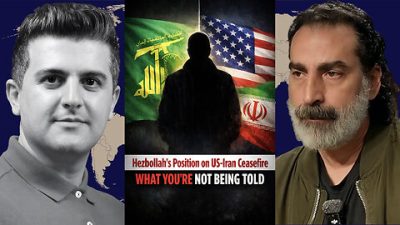
Laith Marouf: Hezbollah’s position on US-Iran ceasefire
or go to
Aletho News Archives – Video-Images
From the Archives
Is Israel to blame for the Iraq War?
American Goy | March 10, 2008
I am so tired of this old canard that “Israel had nothing to do with USA’s war with Iraq – in fact, it officially advised America against it”.
Bullshit. … continue
Blog Roll
 Aletho News
- Israel’s priority lies in destroying chances of peace between Iran, US: Ex-UN nuclear chief
- Ceasefire for all or for none: Iran shuts Hormuz over Lebanon attacks
- Strait of Hormuz is Iran’s ‘nuclear weapon’ that forced US retreat: Medvedev
- Energy crisis will last for months – Kremlin envoy
- Europe’s quiet role in the war on Iran
- Forty days that shook the Empire: How Iran turned the tables on US and prevailed
- Netanyahu unilaterally declares Lebanon outside of ceasefire deal
- Israeli leaders: ‘Not a single goal’ achieved in war with Iran
- What on earth just happened? Trump, Iran, and the unlikely ceasefire
- Alberta Bill Would Fine Political Deepfakes $10,000 Without Satire Exemptions
- If Americans Knew
- Gazans face a triple crisis: severe shortages of water and bread, healthcare in tatters
- NY Times reports how Netanyahu took the US into Iran War
- A sigh of relief over Iran, but Gaza and Lebanon in dire straits – Daily Update
- Thousands dead and neighborhoods razed to the ground: Aid agencies fear southern Lebanon is becoming the new Gaza
- The war the US is fighting for Israel could cost trillions
- ‘Cigarette Burns, Nail Wounds’: Toddler Tortured in Gaza to Coerce Father
- Trump Says US Sent ‘a Lot of Guns’ to Protesters in Iran
- Israeli forces destroy 17 UN peacekeeper cameras in south Lebanon
- US-Israeli strikes ‘completely destroy’ synagogue in Tehran
- Archbishop for US Military Says Iran War Is Unjust Under Catholic Teaching
- No Tricks Zone
- An Inconvenient Tree: Uncovered In Alps… Europe Much Warmer Than Today 6000 Years Ago
- New Study Reports A 60% Slowdown In Greenland’s Ice Loss Rate In The Last Decade
- Low Intensity Tornado Wrecks Major Solar Farm, Creating A Potential Toxic Dump
- New Study Finds Warming Saves Lives…Cold Temperatures 12 Times More Deadly Than Excess Heat
- German Science Blog Accuses PIK Climate Institute Of Hallucinating Climate Tipping Points
- Devastating Assessment Of Comirnaty Vaccine By Former Senior Pfizer Europe Toxicologist
- New Study: CO2 Is ‘Effectively Negligible’ As An Explanatory Climate Change Factor Since 2000
- Former Pfizer Toxicologist Dr. Helmut Sterz Tells Bundestag Hearing Pfizer Vaccine Should Have Never Been Approved
- Energy Expert: Germany’s Nuclear Phaseout Was A “500 Billion Euro Mistake”
- New Research: South Australia’s Mid-Holocene Sea Surface Temperatures Were 4°C Warmer Than Today
 Aletho News