‘Censorship’: UK freezes bank account of Russian news agency, gives no reason
RT | July 13, 2015
Barclay’s bank froze a Rossiya Segodnya news agency account without explaining its reasons. The news first came to light on Monday. The agency’s head Dmitry Kiselyov has called it “censorship.”
“To close the account of one of the world’s leading news agencies is censorship, the direct obstruction of journalists’ work,” Dmitry Kiselyov said. “What kind of press freedom and democracy can Britain claim to have if it prevents one of the world’s largest news agencies from working in the country?”
No formal notification of the move or justification for it was immediately provided. A source in the banking sector told the agency the Exchequer has put Dmitry Kiselyov on an anti-Russian sanctions list, which could have led to the news agency’s account being frozen.
Kiselyov is one of the people subjected to financial and travel sanctions in the EU. These restrictions have been imposed on a number of Russian officials in connection with Moscow’s stance over Ukraine crisis.
The sanctions list, which includes the head of Rossiya Segodnya news agency, was published on March 21. It characterizes Kiselyov as “central figure of the government propaganda supporting the deployment of Russian forces in Ukraine.”
Beneath the Negotiating Endgame in Vienna: Hillary Mann Leverett and Seyed Mohammad Marandi
~
By Flynt Leverett and Hillary Mann Leverett | Going to Tehran | July 12, 2015
As the world waits to see if the P5+1 and Iran can, in fact, conclude a comprehensive nuclear deal, it is important to step back from the not just day-by-day, but minute-by-minute coverage of comings and goings at the Palais Coburg in Vienna and think about what is really at stake in the negotiating endgame. To this end, we post here a very good discussion of these issues by Hillary and the University of Tehran’s Seyed Mohammad Marandi on CCTV’s The Heat, see here or click on videos above. (Like Mohammad, Flynt is currently in Vienna for the nuclear talks.)
The most critical of the remaining issues to be resolved by the parties relate to the terms of a new United Nations Security Council resolution that would negate previous Security Council resolutions dealing with the Iranian nuclear issue, remove Security Council-authorized international sanctions against Iran, and formally start implementation of a comprehensive nuclear deal. As both Hillary and Mohammad point out, underneath discussions about the modalities for removing international sanctions, whether and how to lift the conventional arms embargo against Iran, and related matters are more fundamental issues:
–Can the United States, for its own interests, abandon its increasingly self-damaging quest to dominate the Middle East and adopt a more reality-based strategy toward this critical part of the world?
–Can the United States, for its own interests, finally accept the Islamic Republic of Iran as a legitimate political order representing legitimate national interests, and genuinely come to terms with this already indispensable and still rising actor in the Middle East?
–In the process, can the United States, for its own interests, replace its longstanding reliance on Israel and Saudi Arabia as its key “partners” in the Middle East with a more balanced approach characterized by strategically-grounded diplomacy with all major regional players?
Let’s see what happens in Vienna.
Huckabee’s Use of “Daisy” Ad Totally Undermined by Original
By Sam Husseini | July 12, 2015
Mike Huckabee just released an ad that uses footage from the Johnson “Daisy” ad.
It states in text at the end: “A threat to Israel is a threat to America. Stand with Israel. Reject a nuclear Iran.”
What nobody (according to a Google News search I just did) is noting is that the original ad totally undermines Huckabee’s presumed case.
In the original ad, after zooming into the girl’s eye and showing the countdown and nuclear explosion, it features Johnson’s voice: “These are the stakes: to make a world in which all of God’s children can live, or to go into the dark. We must either love each other. Or we must die.”
See the original ad:
The new Huckabee deformed ad only seems to make sense to some because the entire political establishment — Democrats as well as Republicans — ignores the reality of Israel’s menacing yet unacknowledged nuclear threat to the planet.
The original ad’s subtext was that Goldwater could not be trusted to have his finger on the button. The Huckabee ad seems to poorly attempt to use the same logic on Iran, but it more obviously applies to Netanyahu — and now, Huckabee as they champion Israel’s nuclear domination of the region.
Indeed. These ARE the stakes: to make a world in which ALL of God’s children can live, or to go into the dark. We MUST either LOVE each other. Or we must DIE.
Yemeni Genocide Proceeds Apace, Enjoying World’s Silence
US and ISIS join efforts to kill Yemenis
By William Boardman | Reader Supported News | July 10, 2015
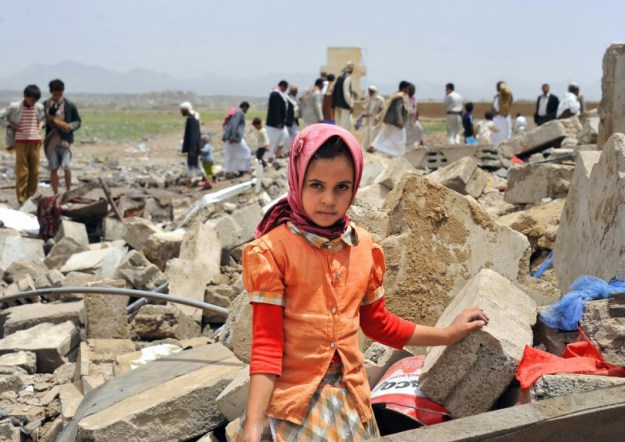
Turns out the United States and the Islamic State, ISIS, are de facto allies of Saudi Arabia and its alliance of dictator states, all bent on exterminating Yemeni Houthis and pretty much any other Yemeni in the neighborhood. This Yemenicide started in earnest in March 2015. After years of US drone strikes proved too slow and ineffective at wiping out people in the poorest country in the Arab world, it was time to expand the arsenal of war crimes. Rarely, in discussions of Yemen, does one hear much about the violations of international law that have reduced the country to its present war-torn and devastated condition.
Failing to acknowledge a foreign policy disaster in Yemen, the Obama administration has chosen instead to trash international law by supporting the criminal, aggressive war that Saudi Arabia’s coalition of police states launched on Yemen on March 26. Now, despite more than three months of Saudi-American terror bombing, the Houthis remain in control of northwest Yemen, their tribal homeland, as well as much of the southeast of Yemen, having overthrown the internationally-installed puppet government, later “elected” without any opponents, of President Abd Rhabbuh Mansur Hadi.
President Obama praised Hadi as his “successful” partner in attacking terrorists, by which Obama meant he was grateful to Hadi for not objecting to the US drone attacks against his own people. Hadi’s legitimacy always depended on foreign puppeteers, and it still does. Having resigned as president, fled the capital, and rescinded his resignation, Hadi fled again, to Saudi Arabia the day before the Saudi blitz began. The official story is that Hadi requested the undeclared Saudi attack on his own country. Hadi remains in the Saudi capital of Riyadh, free to go nowhere while he pretends to head a government-in-exile that is the presently desired fiction of his captor-protectors.
On July 8, from Riyadh, Hadi reportedly proposed a ceasefire in Yemen to start before the month of Ramadan ends July 17. On July 1, UN Secretary-General Ban Ki-moon had called for a “humanitarian halt” in combat “until the end of the holy month of Ramadan.” So far, Hadi’s Saudi controllers have used the muslim holy month to rain increased terror on populated areas of Yemen, killing hundreds of civilians and Houthi fighters, with no accurate count available. July 7 saw the highest death toll in Yemen since the Saudi bombing campaign began. This bland-seeming coverage of the carnage by Reuters is riddled by propaganda deceits:
The United Nations has been pushing for a halt to air raids and intensified fighting that began on March 26. More than 3,000 people have been killed since then as the Arab coalition tries stop the Houthis spreading across the country from the north.
The Iran-allied Shi’ite Houthis say they are rebelling against a corrupt government, while local fighters say they are defending their homes from Houthi incursions. Sunni Saudi Arabia says it is bombing the Houthis to protect the Yemeni state.
The Reuters perspective represents the mainstream consensus, which also typically includes some of the same threads of deceit as these:
- “The UN has been pushing …” No, it hasn’t. The UN as a body has done little to protect the Yemenis, but the Security Council has done less for a country in which civil war has spanned generations. Security Council resolutions are determinedly “evenhanded” in their equal treatment of aggressors and victims. In June 2015, after two months of Saudi bombing, the Security Council expressed its “full support” for an impossibility: “a peaceful, inclusive, orderly and Yemeni-led political transition process that meets the legitimate demands and aspirations of the Yemeni people.”
- “pushing for a halt to air raids …” No, it hasn’t. The air raids are being carried out by the nine UN member states in the Saudi Coalition, including Security Council member Jordan. The US, a permanent Security Council member, has supported the aerial war crime campaign with logistics, in-flight refueling of bombers, intelligence, air-sea rescue, and naval support for the blockade (which is also an act of war).
- “intensified fighting that began on March 26 …” Intensified fighting began long before March 26. Yemen’s civil war has waxed and waned over several decades. What began March 26 was the war crime nexus of bombing civilian targets by the nine-member Saudi Coalition that includes Egypt, Morocco, Jordan, Sudan, UAE, Kuwait, Bahrain, and Qatar. The Houthi rebellion is more than a decade old and gained intensity in the fall of 2014. The Houthis drove out the Yemeni government and now control the western half of the country, where most of the population lived and most of the bombing takes place.
- “the Arab coalition tries to stop the Houthis spreading across the country from the north …” Reuters is just wrong on this. The Houthi spread was a fact, and the “Arab coalition” failed in an ill-conceived campaign. Faced with an army advancing on the ground, the “Arab coalition” has not deployed ground troops. Without serious objection from the international community, the “Arab coalition” attacks military forces in another country with which they are not at war, as well as terror-bombing that country’s civilians with US-made cluster bombs.
- As for spreading “from the north,” that is at best wrong, if not duplicitous. Saudi Arabia has declared the northernmost province of Yemen, Saada, a military zone in which every civilian is a presumed combatant. This is the same bloodthirsty policy that leads the US to count every drone victim as a combatant until proven otherwise. This is the same moral numbness that led the US to establish free fire zones in Viet-Nam, where every living thing was deemed an enemy. This is total war as waged by the powerful, at a distance, against the weak and almost defenseless. This is as bad as any Nazi onslaught of World War II.
- The absurdity of the Reuters characterization is illustrated by another UN Security Council position in support of a “political solution to Yemen’s crisis in accordance with the Gulf Cooperation Council Initiative.” The Gulf Cooperation Council is an oxymoron, in that it includes six of the seven Arab states (not Iraq) on the Persian Gulf who allied determinedly NOT to cooperate with the other Persian Gulf state, Iran. Further, the Security Council absurdly supports the “Gulf Cooperation Council Initiative” when five of the six Gulf Council members (not Oman) are busily bombing Yemen in violation of international law.
- “The Iran-allied Shi’ite Houthis …” There is no evidence of an alliance between Iran and the Houthis, certainly not in any sense equivalent to the overt alliances waging undeclared war on Yemen. The Houthis are Shi’ite muslims, and Iran has almost surely supported them to some extent, but most claims of Iranian involvement in the current fighting are patently over-stated and lack supporting evidence. Reuters here is parroting Arab, American, and Israeli propaganda about the “threat” from Iran.
- “say they are rebelling against a corrupt government …” Who says? Reuters doesn’t say. This is specious journalism. Yemen has a long history of corrupt government, but perhaps the Hadi government allowing US troops to wage war on Yemeni territory, killing Yemenis at will, raised the corruption bar to a new level.
- “local fighters say they are defending their homes …” is worse than specious journalism, it’s pretty much a lie since the main opposition to the Houthis comprises forces loyal to Hadi, as well as cohorts of both Al Qaeda and ISIS.
- “Sunni Saudi Arabia says it is bombing the Houthis to protect the Yemeni state” would be a laugh line were it not such a dark lie. Saudi bombing is destroying the Yemeni state in order to “save” it. The Saudis may be “protecting” the Hadi government, but only in the sense that the Mafia provides protection in a protection racket. The Saudis have longstanding territorial conflicts with the Houthis along the northwest Saudi-Yemeni border. And the Saudis are acting as if they believe their own demonizing propaganda about Iran. Saudi Arabia is more likely bombing the Houthis because they are defenseless and Saudi Arabia doesn’t dare bomb Iran.
Nobody seems to care about Yemen, not even The New Yorker
The widespread, bland disinterest in the unending victimization of Yemenis facing unrelenting, daily crimes against humanity is hardly unique to obtuse observers like Reuters. The New Yorker, which eventually distinguished itself in opposition to the horrors of Vietnam, last published a piece on Yemen on May 1 (according to a site search). That piece conveys the American denial of its own terrorism with a tone of mild distaste suitable to Eustace Tilley, whose monocled default opinion is to blame the victim, as Robin Wright wrote little more than a month after the Saudi-American bombardment began:
The current Houthi rebellion – the seventh – is only the latest. The Houthi clan are Zaydi Muslims, who make up about a third of Yemen’s twenty-six million people. A once powerful people from the rugged northern highlands, they ruled an imamate for a millennium and deeply resented their reduced influence under [former President] Saleh [now a Houthi ally]. Between 2004 and 2010, they fought six other wars against his government….
The quarter-century experiment in uniting Yemen has definitively failed. There is no military solution, and there are unlikely to be any winners out of such a multilayered conflict, whatever the territorial gains….
Last week, the United States dispatched the aircraft carrier U.S.S. Teddy Roosevelt to supplement seven American warships off the Yemen coast. Washington strongly supports a political solution to the conflict in Yemen, but without interested players the risks of unintended consequences increase.
Rhetorically the US may support a “political solution” (to its own liking) and gullible reporters may accept that as some sort of reality. The reality on the ground (and on the water) is that the US supports and participates in endless terror bombing and a naval blockade. That is to say, the US supports and participates in the war crimes that are leading toward mass starvation and human devastation, what the discreet Ban Ki-moon refers to as a “humanitarian crisis” or a “catastrophe,” as if there were no agency causing it.
An editorial July 7 in The New York Times takes the same concerned-but-oblivious-to-the-genocidal-actors tone that reinforces the general pretense that no one is responsible:
Yemen has now been added to the United Nations’ list of most severe humanitarian emergencies, along with South Sudan, Syria and Iraq. It is a tragic distinction, highlighting the peril to 80 percent of the country’s 25 million citizens. The international community, including the United States, is not doing enough to push for an immediate cease-fire in the war that is ravaging the country to make it possible to deliver aid.
Yemen, a poor country, was deeply unstable even before a coalition, led by Saudi Arabia and backed by the United States, started bombing the Houthi rebel movement in late March. Last week, Ban Ki-moon, the United Nations secretary general, declared the situation a “catastrophe.”
Is it possible to commit a long string of war crimes in self-defense?
Having tiptoed up to the edge of US war crimes, the Times retreated. The rest of the editorial comprises little more than helpless hand-wringing, without even hinting at the most effective way to save Yemeni lives: stop the bombing. That means you, “Saudi Arabia … backed by the United States.” Like most of the rest of the world, the Times settled for asking for a reasonable-sounding impossibility, which it then undercut with another wisp of Saudi reality:
What is needed is a permanent political solution that will ensure the Houthis, who have some legitimate grievances and are unlikely to give up, get a significant role in any new government. Negotiations should be started without preconditions. But Saudi Arabia and its allies have appeared intent on forcing the Houthis to surrender, no matter what the cost to civilians and Yemen’s cities and villages.
Well, “Saudi Arabia and its allies” includes the US and others. The Times needs to look in the mirror without flinching. Saudi Arabia and its allies need to stop their bombing.
Ironically, they are not bombing Al Qaeda or ISIS forces in Yemen with anything like the same intensity they’re bombing Yemenis. In fact, Al Qaeda and ISIS are supplementing Saudi-American bombing with their own terror-bombing of Yemenis. For whatever reason, if there is one, the Saudi-American aerial genocide against Yeminis is making most of Yemen a much safer haven for terrorists. Yet this lunatic policy continues without serious opposition apparent anywhere. Who decided that Yemen should be treated as if it were the Haiti of the Arab world?
If any of the umpteen candidates for president of the United States has said anything humane, useful, or even dimly relevant about Yemen, it is hard to find (and I have found nothing). And nowhere have I found any call to establish the appropriate International War Crimes Tribunal to judge the illegality of the multiple, heinous predations of the United States, Saudi Arabia, and their sundry allies, all members in good standing of the world peacekeeping authority.
UNSC Resolution on MH17 Tribunal is Untimely, Irrational – German Lawmaker
By Alexander Mosesov – Sputnik – 11.07.2015
On Friday, a source in the UN Security Council told RIA Novosti that a Malaysian proposal to create a tribunal into the crash eastern Ukraine in 2014 will be discussed next week.
The draft UN Security Council resolution on establishing an international tribunal for those who downed Malaysia Airlines flight MH17 last year in Ukraine is ill-timed, since the Netherlands has not completed its official investigation, a member of the German Bundestag Defense Committee told Sputnik.
Russia’s Permanent Representative to the United Nations Vitaly Churkin said earlier this week that the draft resolution fails to correctly classify the crash, adding that international tribunals have never been created following civilian aircraft crashes.
“I think it makes sense to wait with the tribunal until the investigation is done,” Alexander Neu, the member of the German parliament from the left-wing Die Linke party said.
He stressed that “a parallel process [to the investigation] does not make any sense.”
On July 17, 2014, flight MH17 was en route to Kuala Lumpur from Amsterdam when it crashed in southeastern Ukraine. All 298 people on board the aircraft died.
Independence supporters in southeastern Ukraine and Kiev forces, engaged in fighting in the region, accused each other of causing the tragedy.
According to a September 2014 preliminary report by the Dutch Safety Board, MH17 broke up in the air after being hit by multiple “high-energy” objects from outside the airframe. The final report is due in October.
Earth awaits ‘mini ice age’ in 15 years, solar cycle study suggests
RT | July 12, 2015
Earth is facing the prospect of a ‘mini ice age’ this century, with our sun’s activity projected to fall 60 percent in the 2030s, British astrophysicists say, based on the results of new research that they claim allows exact predictions of solar cycles.
Our planet is just 15 years from a new ‘mini ice age’ that could cause extremely cold winters characterized by the freezing of normally ice-free rivers as well as by year-round snow fields in areas that have never witnessed such climate conditions before, a group of astrophysicists claim.
The scientists could draw such a conclusion based on a new model of the sun’s activity that reportedly enables the researchers to make “extremely accurate predictions” of changes in solar activity.
Although, the fact that the sun’s activity varies within 10-12 year long cycles was first discovered almost two centuries ago, in 1843, all the previously existing explanatory models failed to fully explain the fluctuations within each cycle as well as between the cycles.
Until now, the astrophysicists thought that the variations of the solar activity depended on the dynamo caused by convecting fluid deep inside the sun.
The latest study conducted by a research team from Northumbria University, Newcastle upon Tyne, UK, and led by Professor Valentina Zharkova demonstrated that the variations in the Sun’s activity are caused by two dynamo processes – one deep in the convection zone of the sun and one near its surface.
The research team analyzed three solar activity cycles that cover the period from 1976 to 2008 studying magnetic field activity of the sun during this time by using a technique called principal component analysis of the magnetic field observations from the Wilcox Solar Observatory in California.
The scientists discovered magnetic waves in two different layers of the Solar interior that “fluctuate between the northern and southern hemispheres of the Sun.”
“We found magnetic wave components appearing in pairs, originating in two different layers in the Sun’s interior. They both have a frequency of approximately 11 years, although this frequency is slightly different, and they are offset in time,” said Professor Zharkova.
Later, they also compared their findings concerning the intensity of the Sun’s activity with each year’s data on the average number of sunspots – a strong indicator of solar activity.
As a result, the team managed to create a very accurate model of predicting the solar activity fluctuations.
“Combining both waves together and comparing to real data for the current solar cycle, we found that our predictions showed an accuracy of 97 percent,” said Zharkova.
The study findings were presented at the National Astronomy Meeting in Llandudno on July 9 and published in the Royal Astronomical Society papers.
The model demonstrates that solar activity will fall by 60 percent by 2030 as the magnetic waves inside the Sun will become increasingly more desynchronized during the next two cycles, especially during cycle 26, which covers the decade between 2030 and 2040.
“In cycle 26, the two waves exactly mirror each other – peaking at the same time but in opposite hemispheres of the Sun. Their interaction will be disruptive, or they will nearly cancel each other,” Professor Zharkova said.
“Effectively, when the waves are approximately in phase, they can show strong interaction, or resonance, and we have strong solar activity. When they are out of phase, we have solar minimums. When there is full phase separation, we have the conditions last seen during the Maunder minimum, 370 years ago,” she added.
The Maunder minimum is a name of a period between 1645 and 1715 characterized by prolonged low solar activity as well as by extremely cold winters in Europe and North America as it also correlates with a climatic period between 1550 and 1850 called the ‘Little Ice Age.’
Conspiracy against Syria & Iran initiated in 2007

Introduction by Brandon Martinez – Non-Aligned Media
Here are excerpts from a 2007 report from award winning journalist Seymour Hersh. His report, published in the New Yorker under the heading “The Redirection,” outlines in clear language that the conspiracy to topple the governments of Syria and Iran, specifically by sponsoring terrorist groups as mercenaries against them, was conceived and initiated during the Bush years, and began to take shape in earnest in 2007.
In the past few months, as the situation in Iraq has deteriorated, the Bush Administration, in both its public diplomacy and its covert operations, has significantly shifted its Middle East strategy. The “redirection,” as some inside the White House have called the new strategy, has brought the United States closer to an open confrontation with Iran and, in parts of the region, propelled it into a widening sectarian conflict between Shiite and Sunni Muslims.
To undermine Iran, which is predominantly Shiite, the Bush Administration has decided, in effect, to reconfigure its priorities in the Middle East. In Lebanon, the Administration has coöperated with Saudi Arabia’s government, which is Sunni, in clandestine operations that are intended to weaken Hezbollah, the Shiite organization that is backed by Iran. The U.S. has also taken part in clandestine operations aimed at Iran and its ally Syria. A by-product of these activities has been the bolstering of Sunni extremist groups that espouse a militant vision of Islam and are hostile to America and sympathetic to Al Qaeda.
…
The new American policy, in its broad outlines, has been discussed publicly. In testimony before the Senate Foreign Relations Committee in January, Secretary of State Condoleezza Rice said that there is “a new strategic alignment in the Middle East,” separating “reformers” and “extremists”; she pointed to the Sunni states as centers of moderation, and said that Iran, Syria, and Hezbollah were “on the other side of that divide.” (Syria’s Sunni majority is dominated by the Alawi sect.) Iran and Syria, she said, “have made their choice and their choice is to destabilize.”
Some of the core tactics of the redirection are not public, however. The clandestine operations have been kept secret, in some cases, by leaving the execution or the funding to the Saudis, or by finding other ways to work around the normal congressional appropriations process, current and former officials close to the Administration said.
…
The policy shift has brought Saudi Arabia and Israel into a new strategic embrace, largely because both countries see Iran as an existential threat. They have been involved in direct talks, and the Saudis, who believe that greater stability in Israel and Palestine will give Iran less leverage in the region, have become more involved in Arab-Israeli negotiations.
The new strategy “is a major shift in American policy—it’s a sea change,” a U.S. government consultant with close ties to Israel said. The Sunni states “were petrified of a Shiite resurgence, and there was growing resentment with our gambling on the moderate Shiites in Iraq,” he said. “We cannot reverse the Shiite gain in Iraq, but we can contain it.”
…
This time, the U.S. government consultant told me, Bandar and other Saudis have assured the White House that “they will keep a very close eye on the religious fundamentalists. Their message to us was ‘We’ve created this movement, and we can control it.’ It’s not that we don’t want the Salafis to throw bombs; it’s who they throw them at—Hezbollah, Moqtada al-Sadr, Iran, and at the Syrians, if they continue to work with Hezbollah and Iran.”
In the past year, the Saudis, the Israelis, and the Bush Administration have developed a series of informal understandings about their new strategic direction. At least four main elements were involved, the U.S. government consultant told me. First, Israel would be assured that its security was paramount and that Washington and Saudi Arabia and other Sunni states shared its concern about Iran.
Second, the Saudis would urge Hamas, the Islamist Palestinian party that has received support from Iran, to curtail its anti-Israeli aggression and to begin serious talks about sharing leadership with Fatah, the more secular Palestinian group. (In February, the Saudis brokered a deal at Mecca between the two factions. However, Israel and the U.S. have expressed dissatisfaction with the terms.)
The third component was that the Bush Administration would work directly with Sunni nations to counteract Shiite ascendance in the region.
Fourth, the Saudi government, with Washington’s approval, would provide funds and logistical aid to weaken the government of President Bashir Assad, of Syria. The Israelis believe that putting such pressure on the Assad government will make it more conciliatory and open to negotiations. Syria is a major conduit of arms to Hezbollah.
Top 5 Chemical Weapon Tests The British Conducted On Their Own People
By Stuart J. Hooper | 21st Century Wire | July 9, 2015
How anyone could have ever thought any of this was a good idea is simply unconscionable.
Unfortunately, this article is not satirical. Instead, it documents five, historically factual cases where the British Government thought it would be a great idea to test chemical and biological weapons upon their own people during the Cold War.
1) Zinc Cadmium Sulphide Dispersal
Between 1953 and 1964 around 4600 kilos of zinc cadmium sulphide was dispersed from ships, trucks and airplanes. Scientists knew the chemical concoction had a ‘largely unknown toxic potential’, yet still conducted the experiment around Salisbury in Wiltshire, Cardington in Bedfordshire and Norwich in Norfolk. It was also dispersed across areas of the North Sea and English Channel, where the extent of its effects are entirely unknown. Today, we understand zinc cadmium sulphide to be carcinogenic.

Photo Credit: Ronoldson Slim
2) Bacillus Globigii Dispersal in London’s Subway System
To find out whether the long distance traversal of aerosols through London’s tube system was done through the ventilation system or on board the trains, scientists released the bacteria Bacillus Globigii into the subway system. While some scientists are documented as having reservations about the experiment, it is unknown whether or not any adequate, if any, testing was done on the effects of the bacteria before its release. Today, we know it causes food poisoning, eye infections, and septicaemia.

Photo Credit: Ernest Sealing
3) Black Death Released Off Scottish Coast
Live plague bacteria were released just a few miles from the Isle of Lewis, an island that several thousand people called home. The experiment was thought to be safe as the prevailing wind should have blown the bacteria out to sea, however if the wind were to change direction thousands of innocent lives would have been at risk. It is well documented that at least one fishing vessel travelled through the plague cloud. We need not expand upon the effects of the plague.

Photo Credit: Michael B. Watkins
4) Venezuelan Equine Encephalitis Experiment in The Bahamas
The case of the fishing vessel becoming an unwilling participant in a plague field test meant that future chemical and biological tests were conducted further afield, where scientists knew of areas ‘without restrictions’. British overseas territories (AKA colonies or occupied lands), like the Bahamas, were the new playground. Venezuelan Equine Encephalitis was released near an uninhabited island in the Bahamas by scientists, despite the fact it can cause high fever, long term fatigue, headaches and occasionally death if it were to reach populated shores.

Photo Credit: Caycee Cook
5) Experimental Nerve Gas Dispersal in Nigeria
In Obanaghoro, located in the South of British-occupied Nigeria, scientists spent over a year dispersing experimental nerve agents. The tropical environment was key to what the scientists were trying to test in relation to these particular agents. Again, the extent to which this nerve gas affected local populations and even employed locals, working as a part of the project, is entirely unknown. Sarin is known to have been tested here, which causes loss of bodily function and usually death, while those who survive are likely to suffer brain damage and psychiatric disorders.

Photo Credit: Wikicommons
Conclusion
Ulf Schmidt, Professor of Modern History at the University of Kent who carried out the research exposing all of these cases, said: ‘the government records I’ve been looking at are conspicuously silent on all this’. He went on to say that ‘officials had clearly good reasons as to why the kind of experiments undertaken in Nigeria were strictly prohibited on the British mainland’.
Schmidt’s work has also found that 30,000 secret chemical warfare experiments were carried out between 1945-1989 on more than 14,000 ‘volunteer’ British soldiers. He believes that most of the soldiers were never given enough information to give informed consent. All of these findings and more can be found in the professor’s new book, Secret Science.
Do you believe similar, deadly experiments are still going today?
Follow Stuart J. Hooper here: http://twitter.com/StuartJHooper
***
How the British Government subjected thousands of people to chemical and biological warfare trials during Cold War
During the Cold War, the British Government used the general public as unwitting biological and chemical warfare guinea pigs on a much greater scale than previously thought, according to new historical research.
In more than 750 secret operations, hundreds of thousands of ordinary Britons were subjected to ‘mock’ biological and chemical warfare attacks launched from aircraft, ships and road vehicles.
Up until now historians had thought that such operations had been much less extensive. The new research, carried out by Ulf Schmidt, Professor of Modern History at the University of Kent, has revealed that British military aircraft dropped thousands of kilos of a chemical of ‘largely unknown toxic potential’ on British civilian populations in and around Salisbury in Wiltshire, Cardington in Bedfordshire and Norwich in Norfolk.
Psychologists colluded with CIA to keep ethics code in line with post 9/11 torture needs – damning report
RT | July 11, 2015
The US’s leading professional psychologists’ organization helped justify CIA and Pentagon torture programs, a new 542-page report shows. The psychologists involved later profited from torture-related contracts.
The report, concluded this month, examined the involvement of the American Psychological Association (APA) in the validation of the so-called program of enhanced interrogation, under which terror suspects were subjected to torture at CIA black cites and at the Pentagon’s Guantanamo Bay prison facility.
The document prepared by a former assistant US attorney, David Hoffman, says some of the APA’s senior figures, including its ethics director, pushed to keep the association’s ethics code in line with DoD’s interrogation policies. Other prominent external psychologists took actions that aided the CIA’s torture practices, defending it from growing dissent among its own psychologists.
“The evidence supports the conclusion that APA officials colluded with DoD officials to, at the least, adopt and maintain APA ethics policies that were not more restrictive than the guidelines that key DOD officials wanted,” the report published on Friday by the New York Times said. “APA chose its ethics policy based on its goals of helping DoD, managing its PR, and maximizing the growth of the profession.”
The Hoffman report focuses on the APA’s close ties with the Pentagon and can be viewed as complimentary to last December’s Senate report that exposed the brutality of post 9/11 CIA tactics towards terror detainees, the NYT said. It also gives additional details about how the intelligence agency adopted the enhanced interrogation program and solicited outside advice to stem concerns among its own medical professionals.
The report also describes several instances in which senior figures involved in the program moved into the private sector to get lucrative contracts from the CIA and the Pentagon. For instance, Joseph Matarazzo, a former president of the psychological association and a member of the CIA advisory committee, was asked by Mr Kirk Hubbard (CIA psychologist who was chairman of the agency advisory committee), to provide an opinion about whether sleep deprivation constituted torture. The conclusion was that it did not.
Later, Matarazzo became a partner in Mitchell Jessen and Associates, a contracting company created by James Mitchel and Bruce Jessen to consult with the CIA on their interrogation program. They were instructors for the Air Force’s SERE (survival, evasion, rescue and escape) program, in which US troops are subjected to simulated torture to prepare them for possible capture. They adapted the program’s techniques for use against terror detainees, the report said.
After the Hoffman report was made public, the American Psychological Association issued an apology.
“The actions, policies and lack of independence from government influence described in the Hoffman report represented a failure to live up to our core values,” Nadine Kaslow, a former president of the organization, said in a statement. “We profoundly regret and apologize for the behavior and the consequences that ensued.”
One of the more immediate consequences of the report was the resignation of the APA’s ethics chief, Stephen Behnke, according to the Guardian. The psychologists coordinated the group’s public policy statements on interrogations with a top military psychologist, the report said. He later received a Pentagon contract for training interrogators, without notifying the American Psychological Association’s board.
Kaslow told the newspaper that Behnke’s last day at the APA was July 8, after the association received Hoffman’s report, and that further resignations were likely to follow.
A similarly damning report on the APA’s involvement in US government torture programs was published in April.
Will Greece’s Tsipras Squander Precious Capital?
By Finian Cunningham – Sputnik – 09.07.2015
When Greece resoundingly rejected economic austerity last week, Prime Minister Alexis Tsipras and his government were given a wealth of political capital.
For the second time, including the election of Tsipras’ Syriza party six months ago, the Greek people spoke out democratically – unequivocally and irrefutably – no more austerity and debt slavery.What do the European Union leadership and the Troika of creditors not understand about the word “No”? The Greek people have spoken — twice en masse — that they no longer want to endure imposed poverty in order to bailout the financial oligarchy, both within their own country and in Europe generally. Enough is enough of the prevailing kleptocracy of the creditors under the cynical guise of “financial probity”.
The Greek people have every moral and legal right to repudiate the gargantuan racket of piling up astronomical debt in their name, the proceeds of which go to the financial aristocracy, leaving the people to pick up the bill in the form of generations of enforced immiseration.
This week, Greek premier Alexis Tsipras gave a defiant-sounding speech to the European parliament in Strasbourg. He was greeted with cheers from many parliamentarians, and also jeers from opponents. It was the first occasion for Tsipras to speak publicly in Europe since the historic Greek referendum on July 5. He called for an end to the “austerity laboratory” that his country has been subjected to over the past five years. He hit out at the financial oligarchy in Europe which has plunged all of the EU countries into ruin.
Tsipras also denounced previous corrupt Greek governments, which in cahoots with the European creditors, have saddled the ordinary citizens with some $320 billion debt. He called for social justice and noted that the richest 10 per cent of Greece’s population owns over 50 per cent of the country’s total wealth yet they don’t pay any tax to support society. Tsipras said, with sound reason, that what is known as the “Greek crisis” is actually a “European crisis” requiring a “European solution”.
So far, so good. Then came that sinking feeling. While Tsipras was giving his bravura speech in Strasbourg news emerged that his newly appointed finance minister, Euclid Tsakalotos, had submitted Greek government plans for a new three-year financial bailout from the EU creditors. The new plans include commitments to implement economic reforms on pensions and taxes. That sounds ominously like the Syriza government is preparing to meet the creditors’ demands for more austerity, or what we might call “austerity-lite”.
In the coming days, Athens is to reveal the full details of its “reforms” which will be assessed by the leaders of the EU 28 member states at a summit on Sunday. If the reforms do not go far enough to satisfy demands led by Germany and the Brussels bureaucratic elite, then the latter has allegedly drawn up plans for Greece to be expelled from the euro monetary system — the so-called Grexit.
In other words, it appears that Tsipras and his Syriza government are readying to cave in to ultimatums for more austerity to be imposed on the already devastated Greek population.Such a capitulation runs in the face of Tsipras’ own logic which he eloquently spelled out to the Strasbourg parliament. Austerity is a demonstratively failed policy, he said. It has crippled the Greek economy and has only resulted in ever-more increasing, un-payable debt.
To engage in any further austerity is also reneging on the democratic mandate that the Greek people have bestowed on its government. The people have trenchantly expressed their position — no more austerity and dictate from the EU’s creditors. This position was also supposed to be a “red line” for Tsipras and his government. So how can he contemplate crossing it — and especially after the landslide referendum result last week?
The Syriza government — and not for the first time — appears to be placing its faith in hatching a deal with the banker-dominated EU leadership. It seems willing to repeat the fatal mistakes of past Greek governments by “extending and pretending” a dubious financial bailout for the country in return for “reforms” — which is just a euphemism for more punitive measures on workers’ wages, social security for the unemployed and entitlements for the elderly. We may be sure that the proffered “tax reforms” do not include long-overdue demands on Greece’s wealthy to pay their fair share. Such measures have already been rejected by the EU creditors and the IMF.
Even before the referendum, Syriza was signalling that it was ready to accept, at least in part, the creditors’ dictates. And within hours of the historic vote, Tsipras asked his then finance minister Yanis Varoufakis to resign because Germany and other hardline creditors did not want Varoufakis back at the negotiating table.
That in itself was an extraordinary capitulation to anti-democratic dictate from Berlin and its banker lackeys.
What the Syriza government should be doing is obeying their democratic mandate by placing its faith in the Greek people, not the Brussels bureaucrats and governments who are serving the financial oligarchy.
The Athens government should also rely on the immense solidarity and political strength afforded by the mass of European citizens who support the anti-austerity cause. Syriza could form a formidable anti-austerity, anti-debt bloc with Spain’s Podemos, Germany’s Left Party, Ireland’s Sinn Fein and other leftwing parties across Europe.
Tsipras and his party leadership do not seem to realise that they are the ones who hold the winning cards, not the discredited Brussels elite. By threatening to leave the euro system on the principled stand of repudiating austerity and defaulting on unethical debts, the Tsipras government wields enormous power against the banker oligarchs and their politician-puppets.
Greece has the power to bring to its knees the corrupt anti-democratic cabal and their bankrupt neoliberal capitalism that has hijacked the entire EU bloc. And to then build a more democratic EU from the people, from the bottom up; to build a Europe where democracy, citizens and workers are at last able to exert the proper control over economic and financial resources.Why do you think US President Barack Obama has this week urged Germany’s Angela Merkel to try to keep Greece within the eurozone orthodoxy? Washington is worried that the rotten EU status quo and its NATO alliance could collapse if genuine European democracy were to resurrect from debt slavery, led by Greece.
The haughty, arrogant EU financial tyrants and their political puppets, like Germany’s finance minister Wolfgang Schauble and the unelected arch-bureaucrats Jean-Claude Juncker and Donald Tusk, are prone to lecture Greece about how it has squandered capital down through the years. The feckless, lazy Greeks now have to pay up, so they imply. Yes, Greece did squander capital, it is true, but on the Greek oligarchs who stashed their money in offshore havens and in European banks. The argument that Greek people indulged in reckless spending is an odious myth to justify debt slavery.
However, what appears now to be bitterly ironic is that Alexis Tsipras and his government are about to squander a much more precious capital — the political capital that the Greek people and other ordinary citizens across Europe have invested in them — to stand up for democratic rights and to strike a decisive blow against debt slavery.
Featured Video
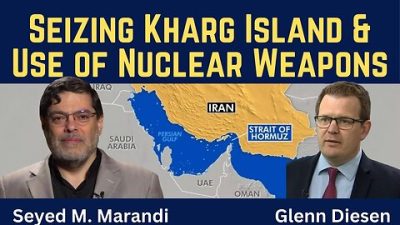
Marandi: Threat of Seizing Kharg Island & the Use of Nuclear Weapons
or go to
Aletho News Archives – Video-Images
Frlom the Archives
Provoking a Path to Persia
The Saban Center’s prescient paper on war with Iran
By Maidhc Ó Cathail | October 20, 2011
In June 2009, the Saban Center for Middle East Policy published “Which Path to Persia?—Options for a New American Strategy toward Iran.” Writing in a tone strikingly reminiscent of the Project for a New American Century’s infamous pre-9/11 paper “Rebuilding America’s Defenses,” the six co-authors noted that, “It seems highly unlikely that the United States would mount an invasion without any provocation or other buildup.” For a think tank specifically established by media mogul Haim Saban to protect Israel, this could prove to be a formidable obstacle impeding their desired march—of U.S. troops—to Tehran.
“In fact, if the United States were to decide that to garner greater international support, galvanize U.S. domestic support, and/or provide a legal justification for an invasion, it would be best to wait for an Iranian provocation, then the time frame for an invasion might stretch out indefinitely,” Saban’s think-tankers ruefully observed.
“With only one real exception, since the 1978 revolution, the Islamic Republic has never willingly provoked an American military response, although it certainly has taken actions that could have done so if Washington had been looking for a fight. Thus it is not impossible that Tehran might take some action that would justify an American invasion. And it is certainly the case that if Washington sought such a provocation, it could take actions that might make it more likely that Tehran would do so (although being too obvious about this could nullify the provocation). However, since it would be up to Iran to make the provocative move, which Iran has been wary of doing most times in the past, the United States would never know for sure when it would get the requisite Iranian provocation. In fact, it might never come at all.”
Seemingly undeterred by Iran’s frustrating unwillingness to provide the requisite provocation, the analysts continued to examine this option… continue
Blog Roll
 Aletho News
- Ukrainian Embassy in Beirut sheltering top Mossad agent
- Palestinian family displaced after settlers violently attack them in Humsa, Jordan Valley
- The EU never learns – except for the wrong lessons
- Iran attacks on UAE leaves RSF militia high and dry
- Hosting Washington’s war: Bahrain faces the consequences
- The US fell for its own Iran propaganda
- Seyed M. Marandi: Threat of Seizing Kharg Island & the Use of Nuclear Weapons
- Is there even an off ramp?
- Michael von der Schulenburg: Europe’s Self-Defeating Iran War Policy
- Sorry, The New Republic, Climate Change Isn’t Causing Somali Migration. Blame Civil Strife and Poverty.
- If Americans Knew
- ‘Of Course’: IDF Drops Case Against Soldiers Accused of Raping Palestinian Prisoner
- Don’t Fall for the Regime Change Talk. Israel Is ‘Mowing the Lawn’ in Iran
- Will Israel and the US wreck the Gulf States along with Iran?
- US so far burned through ‘years’ of munitions in Iran war: Report
- How the Israeli Tail Wags the American Dog
- Outdated intel likely led to deadly U.S. strike on Iranian elementary school, sources say
- Pentagon insider says high U.S official Douglas Feith reported to Netanyahu
- In fond memory of Walid Khalidi, the historian of Palestine
- 6 more Americans killed, as Israel ‘mows the lawn’ in Iran – Not a ceasefire Day 154
- Are we on the precipice of World War III?
- No Tricks Zone
- New Studies: UK Sea Levels Were 4 Meters Higher Than Today During The Mid-Holocene
- Destructive Green New Deal: German Energy And Metal Group Warns Of Drastic Crisis
- New Study Documents A 20-Year Pause In Arctic Sea Ice Decline – Driven By Internal Variability
- Wake-up Call: Survey Shows Majority Of Germans Now Favor Postponing Climate Targets!
- Televised! Leading German Political Candidate Tells Schoolchildren CO2 Makes Sun Hotter!
- New Study: A Century Warming Of 1.1°C Is ‘Commonplace’ And ‘Not Unusual’ During This Interglacial
- New Study: ‘Internal Noise’ And Volcanic Forcing Can Trigger 10-15°C Warming Within Decades
- Glaciers Worldwide Are Suddendly Surging, Experts Blame Warming!
- Surprising Discovery: Sahara Is Greening…Billions Of Trees Where Once Thought To Be Barren
- New Research Reaffirms Clouds, Aerosols, And Surface Solar Radiation Are ‘Driving The Climate System’
 Aletho News