Kiev accused of disrupting prisoner swap agreements
TASS | August 20, 2015
 The Ukrainian side has disrupted the prisoner exchange process three times within the past four weeks, an official in the militia of the self-proclaimed Luhansk People’s Republic (LPR) told a press briefing.
“We have repeatedly made efforts to release our military servicemen from captivity. We handed over to the Ukrainian side the list of Ukrainian prisoners-of-war with the suggestions on prisoner exchanges three times within the past four weeks. However, all our initiatives face hurdles, which leads to the disruption of the prisoner swap process,” Colonel Igor Yashchenko said.
He noted that every time a Ukrainian prisoners-of-war was brought to an appointed place where the exchange was to take place, the Ukrainian side refused to implement the agreements without providing any explanations. The latest unsuccessful attempt to exchange prisoners was made on August 17.
“One gets the impression that the Ukrainian authorities care little about the fate of Ukrainian prisoners-of-war and that they are engaged in some obscure game causing a delay in the exchange process,” the colonel said.
He added that prisoner swap attempts would continue in spite of everything.
Obama Administration Supports Privacy-Invasive “Cybersecurity” Bill
By Mark Jaycox | EFF | August 20, 2015
Right before Congress left for its annual summer vacation the Obama Administration endorsed the Senate Intelligence Committee’s Cybersecurity Information Sharing Act (CISA). EFF opposes the bill because its vague definitions, broad legal immunity, and new spying powers allow for a tremendous amount of unnecessary damage to users’ privacy. Just last week the Department of Homeland Security agreed and criticized CISPA for its lack of privacy protections. More importantly, CISA fails to address the causes of the recent highly publicized data breaches.
The Obama administration’s endorsement is a complete reversal from its previous stance on privacy-invasive cybersecurity bills. In 2012, the White House published a detailed two-page veto threat against CISA’s antecedent, the Cybersecurity Information Sharing and Protection Act (CISPA). In the letter the Administration noted CISPA:
lacks sufficient limitations on the sharing of personally identifiable information between private entities
and that it would
inappropriately shield companies from any suits where a company’s actions are based on cyber threat information identified, obtained, or shared under this bill, regardless of whether that action otherwise violated Federal criminal law or results in damage or loss of life.
The same is true of CISA, which is why the Administration should’ve vetoed the bill. Like CISPA, CISA
- Adds a new authority for companies to monitor information systems to protect an entity’s hardware or software.
- Fails to mandate companies and the government remove unrelated personal information before sharing it with government agencies like the NSA.
- Grants broad legal immunity to companies for sharing more private information with the government than they’re currently permitted to do.
Lastly, CISA, like CISPA, doesn’t address problems identified by recent data breaches like unencrypted files, poor computer architecture, un-updated servers, and employees (or contractors) clicking malware links.
The administration has invested immense capital into looking strong on cybersecurity since January. And instead of publishing another veto threat, the White House Press Secretary urged the Senate to pass CISA. There was no deep analysis as in 2012. There was no explanation about CISA’s own privacy problems. And there was no acknowledgement about the White House’s sudden change in position.
Even though the President wants to sign the bill, the Senate must pass CISA first. Privacy advocates have defeated these “cybersecurity bills” five times in the past five years. In July, users and privacy advocates postponed a vote on CISA after sending over 6 million faxes opposing CISA to Senators during a Week of Action. Unfortunately, the vote was only postponed to mid-September when Congress gets back from vacation.
We must continue the pressure on the Senate to stop this bill. Please join us in continuing to tell our Senators to say no to CISA.
“See Something, Say Something” — Unless It’s Police Brutality
PrivacySOS – August 20, 2015
Today the ACLU of Massachusetts filed suit against two officers from the Massachusetts Bay Transit Authority police department for civil rights violations against our client Mary Holmes. From the ACLU’s website:
In March 2014, Ms. Holmes was at the Dudley Square MBTA station in Roxbury when she saw Officer Jennifer Garvey scream at and shove an older Black woman. The situation worried Ms. Holmes so she tried to calm the woman and asked Officer Garvey to stop being so aggressive. When these efforts failed, she called 9-1-1 for help. In response, Officer Garvey and her partner, Officer Alfred Trinh, pepper-sprayed Ms. Holmes in the face, beat her with a metal baton, and arrested her, handcuffing her hands behind her back while forcing her to the ground.
“The MBTA has signs everywhere telling people ‘if you see something, say something.’ This is exactly what Ms. Holmes did. She saw something wrong, and she spoke out. We need more people to follow Ms. Holmes’ lead and do the same,” said Jessie Rossman, staff attorney at the ACLU of Massachusetts. “Unfortunately, the officers’ reactions are part of a broader, troubling trend, in which police officers mistreat individuals exercising their constitutional rights. It has to stop.”
See something, say something—unless it’s police brutality. That isn’t right. Stay tuned for more news on this lawsuit.
Reply to ‘Hillary Committed No Criminal Act’
By Peter Van Buren | We Meant Well | August 19, 2015
Many supporters of Hillary Clinton say that since she committed no criminal offense, the whole thing about her private email server containing classified material is just partisan sniping.
So as a public service, let’s see if we can sort that out.
The Law
18 USC 1924, which is a law, is titled “Unauthorized removal and retention of classified documents or material.”
The text of the law says, inter alia, “Whoever, being an officer… of the United States, and, by virtue of his office, employment, position, or contract, becomes possessed of documents or materials containing classified information of the United States, knowingly removes such documents or materials without authority and with the intent to retain such documents or materials at an unauthorized location shall be fined under this title or imprisoned for not more than one year, or both.”
The law does not require the possessing person to “know” the information is classified.
This is the statute under which David Petraeus was prosecuted for keeping classified information at home.
The Classified
Two Inspectors General stated Clinton’s email server, located part of the time at her home in New York, and part of the time at a commercial server farm in Colorado, held classified data. Neither site was an authorized location. We’ve long-since established that classified is classified whether it is marked or not. It does not matter who sent the emails; they were on Hillary’s server and thumb drives, making her the “possessor.”
Up to 305 Clinton emails might have classified data, and that out of only five percent of 30,000 messages reviewed. There may be backups available of the 30,000 some messages Clinton deleted.
The Conclusion
Clinton’s possession of classified information on a personal server appears to be a violation of 18 USC 1924. So is transferring that information to the thumb drives held by her lawyer (himself unauthorized to possess high-level classified information.)
There it is. No partisan remarks. No right-wing attacks. Just facts. As a non-lawyer, what am I missing?
Hamas members held hostage by Sinai militant group
Ma’an – August 20, 2015
CAIRO – Four Palestinians kidnapped at gunpoint in Egypt’s Sinai late Wednesday are members of Hamas, Egyptian security officials said, and are being held hostage by the Sinai Province militant group.
Egyptian officials told Ma’an that the four Hamas members were taken hostage by the IS-affiliated group as a bargaining chip to force Hamas to release some 50 Salafists currently imprisoned in Gaza.
The members were identified as Abd al-Basit Abd al-Dayim, Abdullah Said Abdullah Abu Jibbeen, Yasir Fathi Misbah Zanoun and Hussein Khamis al-Thabda.
Negotiations have reportedly begun between Hamas and the militant group, with the involvement of both Palestinian and Egyptian mediators.
Initial investigations suggest the Hamas members were taken to the al-Tuma village south of the city of Sheikh Zuweid.
Sources close to the Sinai Province group — which pledged allegiance to IS in November — have said the four kidnapped Hamas members would be killed if Hamas did not comply with the group’s demands.
The group has claimed responsibility for attacks on Egypt’s army which have killed hundreds of policemen and soldiers since 2013.
The attacks are allegedly in response to the bloody repression launched by the authorities under President Abdel Fattah al-Sisi’s control, which has seen at least 1,400 killed and thousands more jailed.
Since last summer’s devastating war between Hamas and Israel in the Gaza Strip, there have been growing signs of internal unrest between Hamas security forces and other militant groups in the strip, with a string of small-scale explosions.
In June, video footage alleged to be from an IS stronghold in Syria showcased a public challenge by the group against Hamas’ power in Gaza, accusing the Gazan leadership of failing to enforce stringent religious law in the strip.
Prior to the threat, Hamas had reportedly been increasingly challenged by Salafist militant groups in Gaza, with some taking credit for rocket fire into Israel.
Four Palestinians abducted in Sinai after passing Rafah Crossing
MEMO | August 20, 2015
Four Palestinians were abducted on Wednesday evening in Egypt’s Sinai Peninsula just a couple of minutes after passing Rafah Crossing, the Palestinian government in Gaza has reported.
An eyewitness who was on the same bus, said that one or two kilometres after passing the crossing, and just a couple of metres from the Egyptian army checkpoint, a number of masked armed men opened fire on the bus, entered it, called four men by their names and abducted them.
The eyewitness, who preferred to remain anonymous, said that there were 50 Palestinian passengers on the bus and insisted that there were no Egyptian security staff accompanying them.
Normally, Egyptian security staff accompany travellers’ buses from Rafah Crossing to Cairo Airport.
“Although the daily night curfew had started,” the eyewitness said, “the Egyptians insisted that the bus must begin its journey from Rafah to Cairo.”
Normally, Palestinian buses do not travel during the night curfew, which has been imposed on wide swathes of the Sinai Peninsula.
The spokesman of the Palestinian Interior Ministry in Gaza, Iyad al-Buzom, said that: “We are making urgent contacts with the highest levels of Egyptian authorities to follow up on the circumstances of what happened and we urge the Egyptian interior ministry to secure the lives of the kidnapped passengers and free them.”
Meanwhile, Salama Abu-Rbaa, the chief of an Egyptian tribe in Sinai, has accused the Egyptian intelligence services of manipulating the abduction of the Palestinians.
Speaking to a Palestinian news agency, he said that a number of his tribe’s members saw the masked men who abducted the Palestinians exiting an Egyptian armoured vehicle close to the place of the abduction.
He said that he has credible information about the four abductees and their whereabouts, insisting that they are in a military outpost near Al-Arish Sea.
Abu-Rbaa warned of a “demonised” agenda planned by the Egyptian security services, calling for the Palestinians to be careful about such plans.
UN Says Continues to Wait for Saudi Arabia’s Aid to Yemen Pledged in April
Sputnik – 20.08.2015
While four out of five Yemenis require humanitarian assistance amid the airstrikes and ground fighting in the country, UN agencies have still not received the funding from Saudi Arabia of $274 million pledged in April, UN Emergency Relief Coordinator Stephen O’Brien told the Security Council Wednesday.
O’Brien noted the humanitarian assistance alone cannot meet all the needs of an entire country with a population of 26 million people, and that the response plan will only be funded at 33 percent even once the funds from Saudi Arabia are received.
“The civilian population is bearing the brunt of the conflict. A shocking four of out five Yemenis require humanitarian assistance and nearly 1.5 million people are internally displaced… To date only 18 percent, some 282 million US dollars, of the $1.6 billion requested through the Yemen Humanitarian Response Plan has been received. UN agencies have still not received the funding from Saudi Arabia of $274 million pledged in April,” O’Brien said in an open briefing.
Yemen has been engulfed in the military conflict between Houthis, the country’s main opposition faction, and government forces loyal to its president in exile.
A coalition of Arab states, led by Saudi Arabia, has been launching airstrikes on Yemeni areas under control of the Houthi militants since March under the request of the country’s president-in-exile.
The ongoing hostilities in Yemen have claimed the lives of at least 1,900 civilians and more than 4,000 have suffered injuries, according to the United Nations.
Some 21 million are in urgent need of humanitarian aid.
New Aussie Film on Ukraine Civilian Bombings: a PR Disaster for The US / EU
Russia Insider | August 19, 2015
One of the more extraordinary aspects of the Ukraine war has been the brutal war crimes committed against civilians, by and large exclusively by one side: Kiev.
No less extraordinary has been the refusal of the western media to cover this story, thereby leaving most people in the West simply unaware of the extent of the horrors being perpetrated in their name, funded and cheered on by their leaders. Most of the politicians are as misled as the general populace because they also get their facts from the media.
This situation has always struck us here at RI as a political time bomb waiting to go off, because the story is just too big, too ugly, too heart-breaking, and too widespread to be swept under the rug, and there are too many outlets happy to cover it – Russian state media for starters, but also the enormous alternative media. It was just waiting for the right voice and the right tragic personal story to relate, the Rosa Parks of Donbas.
That voice might well be a young Australian amateur filmmaker named Chris Nolan who has been posting excellent short films to Youtube for over a year now, describing the Kiev revolution (Maidan), and the ensuing war.
Nolan is a musician in a rock band in Brisbane who makes the films in his free time using footage he finds on the internet.

Anna Tuv: lost her husband, daughter and arm to Ukraine shell
In his latest film, he tells the story of Anna Tuv who has become a hero in the global anti-Kiev community and in Russia. Tuv lost her husband, two children, and her arm when her house was shelled. She is just one of thousands who suffered similar horrors. Her personal story has become a symbol of the insane criminality being pushed by Kiev, and indirectly by Obama, Merkel and Cameron.
Watch the trailer, it is very well done.
After the Default: A Neoliberal Debt Solution For Puerto Rico
Puerto Rico’s debt crisis will likely lead to the privatization of public enterprises including the electrical power authority and the water agency. The proposed solution reflects the application of neoliberal policies as if they were magic recipes for resolving a most complex situation.
By Carlos Marichal | NACLA | August 18, 2015
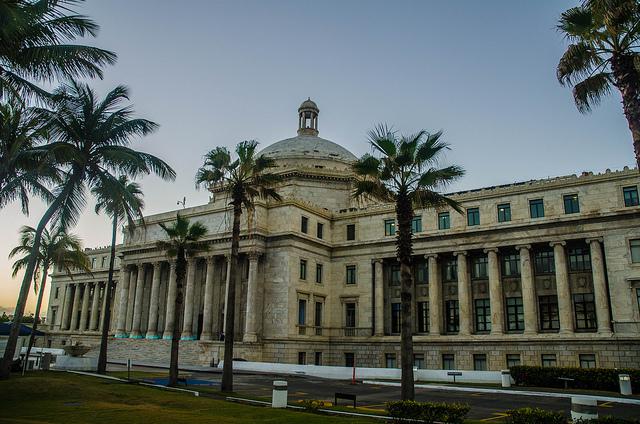
The capitol building in San Juan. Payments on Puerto Rico’s public debt will likely favor large U.S. investment firms at the expense of small local creditors.
(Wayne Hsieh / Creative Commons)
This past June 29, the governor of the Commonwealth of Puerto Rico, Alejandro García Padilla, declared the island’s $72 billion public debt unpayable and said that his government would likely be forced to default on its next round of scheduled payments. A month later, García Padilla’s government did exactly that, paying only $628,000 of the $58 million payment due on its Public Finance Corporation (PFC) bonds.
The inevitability of the default has become a major—and contentious—subject of debate on the island and in the U.S. financial media. New York-based financial information agencies, have warned that the default could pose serious problems for several major U.S. investment firms and money funds. Ominously, the debt crisis also threatens to accentuate the economic and social decline of the island’s population, which has long lived in political, social, cultural, and economic limbo.
In all probability, the fiscal and financial dilemmas faced by García Padilla’s government will be resolved by a proposed debt exchange in which new bonds are issued with terms more favorable to the borrowers—the Puerto Rico financial administration. But not all creditors are likely to be treated equally. The noted Puerto Rican economist, Elías Gutiérrez, has argued that the decision by the Puerto Rican government to suspend payments to PFC bondholders on August 1 was not due to a lack of funds but to the willingness to allow the weakest creditors pay for the lack of foresight shown by fiscal and financial authorities. In other words, the neocolonial relationship between the United States and Puerto Rico will play an important role in the resolution of this crisis.
It is estimated that a significant percentage of PFC bonds were sold to small investors resident in Puerto Rico. The bondholders placed their savings in the public bonds because they had confidence in the longstanding positive debt service record of the Puerto Rican government. Among these small bondholders are cooperatives, small banks, 401K pension funds, retirement funds as well as many individuals.
Gutiérrez argues that the government of García Padilla is following its lawyers’ legal and financial advice, essentially dividing the debtors into separate groups: the most powerful—basically U.S. banks and money funds—which will continue to get full service and payment, while the second group, the weaker local investors, would be forced to accept delays and an unfavorable debt exchange. This outcome is the most likely because big Wall Street firms and banks will take their cases against Puerto Rico to the federal courts and, if precedent is followed, probably win. This has been the case in decisions handed down in recent years by New York courts regarding Argentina’s debt. On the other hand, cooperatives, small savers and Puerto Rican retirees are most likely to lose their cases.
The current Puerto Rican financial crisis is different from the older Latin American debt crises because the public debt incurred by the government of Puerto Rico from 1950 to the 1990s was quite small. Budgets were traditionally balanced and deficits limited. The Government Development Bank, founded in 1942, was long effective in raising finance on good terms for development and infrastructure programs and projects, which helps explain the success of the Puerto Rican economic expansion, at least until the 1970s. The oil crisis of the 1970s hit the local economy hard, but continued emigration to the United States made it possible to avoid social collapse. (While the island now has about 3.5 million inhabitants, there are an estimated five million self-identified Puerto Ricans—either born on the island or of Puerto Rican descent—resident in the United States, with over a million living in New York City.)
Puerto Rico’s public debt began to more closely resemble those in Latin America in the 1990s when the conservative administration headed by Governor Pedro Roselló went on a loan binge, increasing the public debt by over ten billion dollars. Roselló was head of the Partido Nuevo Progresista, which is closely linked to the Republican Party, and while in office led an unsuccessful campaign to make Puerto Rico the 51st U.S. state. He also privatized state companies, reinforced law-and-order programs and negotiated loans for public works that benefitted major companies linked to his party.
Nonetheless, the administrations of the rival Partido Popular, which held office from 2001 to 2009, did not do much better. Aside from accusations of electoral fraud, corruption, and lax handling of public finances, Puerto Rico’s public debt—much of it issued as municipal bonds—rose by another 22 billion dollars.
The champion in the debt game, however, was the conservative government headed by Governor Luis Fortuño between 2009 and 2013, which managed to add on another 17 billion dollars to the public debt in a mere four years. This profligacy is a major cause of the current debt crisis, which cannot simply be ignored, not least because the economy of Puerto Rico has fallen on hard times.
From the 1950s to the late 1970s, Puerto Rico successfully moved away from the old agricultural export model to light industrialization based principally in textiles, and subsequently to investments by U.S. multinationals, particularly in pharmaceuticals and some electronics. This was complemented by expansion of construction and by a tourist boom. But in the 1980s, the economy took a downturn, and unemployment increased.
In the 1990s this trend was temporarily reversed as U.S. companies took advantage of the tax credits available under section 936 of the U.S. Internal Revenue Code, which had been designed specifically to attract mainland investors to Puerto Rico. After 2000, however, these tax breaks were reduced dramatically, and hundreds of factories on the island closed, leading to a notable drop in manufacturing employment and tax income. As a result, local governments increased public spending to maintain the economy and sustain employment.
In recent years, more and more bonds have been issued in large part to refinance the old ones. But the debt game has reached a breaking point. The government of Governor García Padilla recently decided on a new strategy and commissioned a study by former officials at the International Monetary Fund and the World Bank. The officials recommended a debt relief program which includes exchanging old bonds for new ones with a longer period of amortization and lower interest rates.
According to a confidential copy obtained by The New York Times, one of the chief authors of the report, Anne O. Krueger, a former chief economist at the International Monetary Fund, commented: “There is no U.S. precedent for anything of this scale or scope.” This document has been baptized the “Krueger Report,” an ironic choice, considering that as vice president of the IMF in 2001, Krueger recommended that Argentina not be given any debt relief, forcing that nation to default.
A likely sequel to the Puerto Rico debt crisis is the privatization of public enterprises including the electrical power authority and the water agency, which in all probability will be declared bankrupt if Governor García Padilla can convince the U.S. Congress to treat them as if they were private companies and to apply Chapter 11 to them. Of Puerto Rico’s $72 billion in bonds, some $25 billion have been issued by public corporations.
As in so many Latin American nations in the 1980s and 1990s, responses to Puerto Rico’s debt crisis entail privatizations and the application of neoliberal solutions as if they were elements of a magic recipe for a most complex situation. In this case, neoliberalism and neocolonialism appear to have much in common.
Carlos Marichal is professor of economic history at El Colegio de Mexico and author of studies on the history of Latin American debts.
Argentina Creates Indigenous Film School

teleSUR | August 19, 2015
As this year’s Indigenous Film Festival concluded over the weekend, the Argentine Governor of Chaco province, Jorge Capitanich, announced the creation of a national school for indigenous cinema.
“Today we confirm the (creation of) the Indigenous School of Cinema. Its a call on people to their own history, based on what they are capable of doing,” Capitanich said.
Indigenous films aim to portray modern and historic events from the perspective of colonized peoples who continue to suffer from extreme inequality.
The school will be created within the Culture Institute, and its creation falls under Law 26,522 Audiovisual Communication Services.
The Indigenous school will provide training in audiovisual basics and will promote production of local content in the different indigenous communities of Capitanich’s province.
The Indigenous Film Festival began in 2008, with the idea that movies are a social tool that go beyond entertainment and transform reality through social inclusion. The festival supports full rights for the indigenous peoples of the Americas and brings locally produced films to other regions.
Ecuador Opposition Leader Urges Police, Military ‘Rebellion’
teleSUR | August 19, 2015
Ecuadorean opposition leader Carlos Perez called on the Ecuadorean military and police to rebel against the government during an interview with Ecuadorean TV channel TeleAmazonas Tuesday.
“I call on the military, police you must rebel. You cannot blindly follow an illegitimate act, you cannot do this,” Perez told the interviewer from TeleAmazonas. “If I go to prison for saying this, I welcome this.”
Perez was being interviewed together with his partner Manuela Picq. Both were detained during violent protests last week against the government of Rafael Correa in the Ecuadorean capital. Picq’s detention led to scrutiny of her immigration status, which was found to be “irregular.” A judge ruled Monday that Picq — who said she would begin the process to obtain permanent residency — could stay in the country.
Perez called for the rebellion while commenting on a clash Monday between opposition protesters and police in the province of Loja, where police — backed by the military — arrived to clear an illegal roadblock and were attacked with sticks, rocks, and fire bombs. One police officer was later kidnapped, but managed to escape his captors during the night.
Perez’s remarks are likely to generate controversy in the country, given that the failed 2010 coup against the Correa government began as a police rebellion. In June, a disturbing video surfaced that appeared to incite the Ecuadorean police force to join opposition protests against proposed tax increases on Ecuador’s wealthiest sectors.
Perez, who previously served 8 days in prison for interfering in the delivery of public services, was caught on video Thursday calling on his supporters to surround the presidential palace, where government supporters had assembled. Following his remarks, protestors clashed with police, who were blocking access to the area in order to avoid conflict between the sides.
During the interview, the pair accused the government of illegally detaining them during the violent protests. Picq had previously told the El Comercio newspaper that she “was treated like a criminal simply for walking on the street,” however, she then admitted on Tuesday that she physically interfered with police, who were attempting to detain Perez.
President Correa said opposition groups have opted to turn to violence due to the “failure” of the work stoppage called by opposition-aligned groups last week. The political coalition United Front, which supports the government, also said the national action had failed, citing that no work stoppages had taken place and the protests had lower turnout than expected.
The violent tactics of segments of the opposition have come under heavy scrutiny. In a statement, the Ecuadorean ombudsperson’s office said, “Violent acts are incompatible with democracy, which is why we challenge all forms of aggression that violates rights, regardless of where it comes from.”
In an interview with the Andes news agency, Mario Ramos, director of the Andean Center for Strategic Studies said, “We do not have democratic opposition, that must be clear: there is a subversive opposition that is acting against the security of the Ecuadorean state, against democracy, against the Constitution. Let me be clear, this is not a democratic opposition, this is a subversive opposition.”
Featured Video
Prof. Ted Postol: Iran Already Achieved Nuclear Deterrence Against Israel
or go to
Aletho News Archives – Video-Images
From the Archives
How the occupied mentality syndrome works
Saudi Arabia on the American chessboard – Part 3
By B. J. Sabri | American Herald Tribune | June 27, 2016
Read part 2: “The occupied mentality Syndrome“
Previously I argued whether Saudi Arabia’s repeated involvements in U.S. interventions and wars stem from free national will or in response to a specific condition. For starters, in Saudi Arabia there is no national will. In Saudi Arabia, the national will is the will of the Al Saud clan. Still, when a major Arab state allies itself with a superpower that committed unspeakable crimes against humanity in almost every Arab country, then something is wrong. This fact alone should compel us to examine the U.S.-Saudi relation for one exceptional reason. As a result of the U.S.-Saudi wars, hundreds of thousands of people in Afghanistan, Iraq, Iran, Libya, Syria, Yemen, and Somalia have lost their lives. Millions became displaced in their own homelands. And millions more rendered refugees.
Attributing the Saudi policies to the bonds of “partnership” with the U.S. is frivolous. There are no bonds between these two thugs except those of business, military deals, secret plots, and wars. Proving this point, bonds such as these have no space for the American and Saudi peoples to share significant cultural or societal exchanges. If partnership is not the reason for the Saudi contribution to the U.S. strategy of empire and imperialism, then another reason must exist.
This leads to three possibilities. … continue
Blog Roll
 Aletho News
- REWRITING THE RISK? INSIDE THE GOVERNMENT’S VACCINE SAFETY MESSAGING
- “Davos Can Really Replace the UN”
- NIAID/NIH and USDA Fund Bioengineered Chimeric Influenza Viruses Built Using Pandemic H1N1 Components: Journal ‘Science Advances’
- Hezbollah hits Israeli warship off Lebanon’s coast, sets it aflame
- Iran slams US strikes on B1 bridge, Mahshahr petrochemical plants as ‘blatant acts of state terrorism’
- In letter to UN chief, Araghchi warns of dire consequences of US-Israeli attacks on Iran’s nuclear facilities
- Why the CIA conspiracy to invade Iran with Kurdish militias failed
- Why Are Upbeat US Claims About Mission to Rescue Pilot ‘Highly Questionable’?
- Aircraft destroyed during US ‘rescue’ of downed F-15 pilot cost more than $100 million each
- Washington University removes professor who condemned US-Israeli war on Iran
- If Americans Knew
- In Iran, Israel-US take aim at “reason, research, and freedom of thought” – Daily Update
- US loses planes over Iran, Israel downgrades Lebanon war goals – Daily Update
- Israel Is Blocking Palestinians from Easter at Church Where Jesus Resurrected
- Plot to assassinate Palestinian activist follows harassment campaign promoted by Zionist groups and elected officials
- Prominent New York synagogue hosts presentation on why U.S. Jews should support the ethnic cleansing of Gaza
- Tapper vs. Piker: Is the CNN Anchor Auditioning for David Ellison?
- Shouldn’t Democrats Be Able to Condemn Genocide?
- Israel-US kill negotiators, destroy civilian structures, but Iran’s military capabilities still largely intact – Daily Update
- ‘War crime’: Global condemnation as Israeli ministers celebrate death penalty law targeting Palestinian prisoners
- 7 Ways Israel Is Turning Lebanon Into Gaza
- No Tricks Zone
- An Inconvenient Tree: Uncovered In Alps… Europe Much Warmer Than Today 6000 Years Ago
- New Study Reports A 60% Slowdown In Greenland’s Ice Loss Rate In The Last Decade
- Low Intensity Tornado Wrecks Major Solar Farm, Creating A Potential Toxic Dump
- New Study Finds Warming Saves Lives…Cold Temperatures 12 Times More Deadly Than Excess Heat
- German Science Blog Accuses PIK Climate Institute Of Hallucinating Climate Tipping Points
- Devastating Assessment Of Comirnaty Vaccine By Former Senior Pfizer Europe Toxicologist
- New Study: CO2 Is ‘Effectively Negligible’ As An Explanatory Climate Change Factor Since 2000
- Former Pfizer Toxicologist Dr. Helmut Sterz Tells Bundestag Hearing Pfizer Vaccine Should Have Never Been Approved
- Energy Expert: Germany’s Nuclear Phaseout Was A “500 Billion Euro Mistake”
- New Research: South Australia’s Mid-Holocene Sea Surface Temperatures Were 4°C Warmer Than Today
 Aletho News