Gaza water shortage catastrophic: ‘We can’t drink, cook or wash with it’

RT | September 6, 2015
More than 90 percent of the Gaza Strip’s water is undrinkable. The rest is quickly running out. A combination of factors is rapidly depriving the population of this most basic of needs. RT investigated day-to-day life under these conditions.
Just one fresh water source exists today, according to the locals – a coastal aquifer beneath the ground that is shared with Israel and Egypt. But Gaza is situated downstream from Israel, and Palestinians accuse the Jewish state of using the situation to its advantage, employing water deprivation as a tactic against the civilian population.
The grim water statistics are part of a recent UN report on Gaza, which says the strip will become uninhabitable by 2020. A number of reasons compound the problems, according to the document by the United Nations Conference on Trade and Development (UNCTAD).
The Gaza Strip’s GDP dropped 15 percent in 2014, with 72 percent of households suffering extremely low food security and unemployment at a record high of 44 percent. Further stress was added by relentless Israeli assaults. With three military operations in the last six years, coupled with eight years of economic blockade, prospects for recovery are looking very bleak.
The UN says that 500,000 people have been displaced in Gaza as a result of last year’s Israeli operation alone. More than 20,000 Palestinian homes were destroyed, and 148 schools and 15 hospitals and 45 primary health-care centers were severely damaged. Gaza is one of the most densely populated areas in the world.
But worse still is when the populace is deprived of the prime source of life – water. Without it, no reconstruction and no rebuilding of lives can take place. Medicine, sanitation, hygiene and crucial facilities that depend on water all suffer.
RT investigated the extent of the hardship under these conditions.
“We can’t drink it, cook with it, or wash in the kitchen with it… we are forced to buy all the clean water separately,” said Umm Ibrahim Amna Abdel’al, as she stood in her kitchen, little more four bare cement walls and a sink.
A delivery pickup truck trundled through the streets outside with a water tank sitting in the back.
“The last war on Gaza, of course, resulted in the destruction of some of the infrastructure, the water holes and the pumping stations were [heavily hit.] More than 50 percent of the water infrastructure could not be accessed,” said Mahmoud Elkhafif, UNCTAD’s special coordinator for assistance to the Palestinian people.
“Part, of course, vanished,” he added.
RT’s Lizzie Phelan tasted what remains of the Strip’s water for herself: “This coffee tastes like it has salt not sugar in it. That’s because the water that’s used to wash it – like much of Gaza’s water – is contaminated with sea water.”
The woman went on to describe how “tiny kids suffer from cramps and colic” – a syndrome commonly associated with stomach infections.
“See my hand?” she pointed to the irritated skin on her palm. “It is because of the salty water. I have a skin infection. The water is full of salt. It is like sewage.”
And salt isn’t the only problem. The water coming into homes is also full of nitrate – a carcinogen. The levels rose even higher last year, during Israel’s bombardment of sewage pipes and clean water pipes. Now, the two chemicals have mixed.
But even though the water is filthy, Gazans pay exorbitantly for it.
Elkhafif put it bluntly: “Gaza suffers a catastrophic issue with water quality and water supply. And it’s a shame on the world that they are still watching this.”
Unless the situation is resolved, the Strip stands on the brink of a full-scale humanitarian catastrophe much greater than any airstrikes can cause.
Labeling Israeli Settlement Products Not Good Enough
By Stephen Lendman | September 6, 2015
Last spring, 16 European foreign ministers urged EU foreign policy chief Federica Mogherini to require labeling of all Israeli settlement products – so consumers can buy or avoid them at their discretion.
Labeling is “an important step in the full implementation of EU longstanding policy,” they said. At best, it’s symbolic. At worst, a weak-kneed gesture with no meaningful effect on Israel’s economy.
By year-end or sooner, the EU is expected to decide up or down on labeling. Mogherini said “(t)he work is close to being finished but it is still ongoing.” If implemented, it’ll only be a guideline, not mandated policy. Individual EU states can do what they please – showing what’s being considered is a sham, an insult to long-suffering Palestinians.
Some EU nations already intend to require labeling – regardless of what the European Commission decides. “We have to make sure that consumers can distinguish products that come from the territories occupied by Israel,” Luxembourg Foreign Minister Jean Asselborn said.
Over 600,000 Israelis live on stolen Palestinian land – in the West Bank and East Jerusalem. Numbers keep increasing exponentially – Palestinians forcibly displaced from their land for exclusive Jewish development.
Palestinian human rights groups justifiably demand a total boycott of all Israeli settlement products. In 2013, Al Haq prepared a report titled “Feasting on the Occupation: Illegality of Settlement Produce and the Responsibility of EU Member States under International Law.”
“Given that trading in settlement goods amounts to a form of recognition and supports the sustainability of entities that violate peremptory norms of international law, a ban on settlement products… is to be considered amongst those actions that Third Party States should undertake to comply with their customary international law obligations,” it states.
Al Haq director Shawan Jabarin said products from settlements “help to sustain their very existence.”
“As things stand, the EU is doing little more than ticking a box by acknowledging that settlements are illegal. Until they support this rhetoric with action and ensure that no assistance or recognition are provided to settlements, even indirectly, any such criticism will continue to be meaningless.”
The EU is Israel’s largest trading partner. Settlement products represent a minuscule percent of Israeli exports. At the same time, they’re important “for the economic viability of many settlements,” the report said.
Economist Shir Hever said “(t)he significance of ending the import of colony products is much larger than the direct financial effect.”
“It (would be) a strong statement reminding Israel of the illegality of the colonization of the West Bank, and a blow to many Israeli and international companies who have turned the occupation into a source of profit.”
It would be a shot across the bow against all Israeli enterprises – a hopeful first step toward greater boycott and divestment from an apartheid state, aiming for total isolation.
Currently, nothing indicates business as usual changing. The 2000 EU/Israel Association Agreement governs relations between the Parties, including strengthening economic cooperation and trade.
Human rights groups blasted the enhanced partnership – showing EU officials say one thing and do another, effectively supporting Israeli high crimes.
After decades of mass slaughter and destruction, ethnic cleansing, illegal occupation and oppression, as well as international complicity with Israeli ruthlessness, mandated boycott, divestment and sanctions more than ever are essential – continued until Israel:
- recognizes Palestinian self-determination unconditionally;
- strictly observes international laws, norms and standards;
- ends its illegal occupation and Gaza blockade unconditionally;
- ends illegal aggression and all other hostile acts;
- dismantles its Separation Wall;
- frees all Palestinian political prisoners unconditionally;
- grants Israeli Arabs equal rights as Jews;
- ends apartheid racism;
- complies with UN resolution 194, affirming the right of diaspora Palestinians to return to their homes and property or be fully compensated for loss or damage if they prefer;
- recognizes East Jerusalem as Palestine’s exclusive capital within June 1967 borders; and
- gives Palestinians control over their land, borders, air space, coastal waters and resources.
Ending Israeli high crimes against defenseless Palestinians is long overdue. Nothing less than its full observance of international law is tolerable.
Iran’s Growing Questions About The Sanctions
By Kaveh L. Afrasiabi | Eurasia Review | September 5, 2015
Iran’s Supreme Leader, Ayatollah Seyed Ali Khamenei, has instructed the Parliament (Majlis) to review and vote on the nuclear deal reached between Iran and the world powers in July, and has also questioned the parts of the deal, known as Joint Comprehensive Plan of Action (JCPOA) that refer to the suspension rather than annulment of Iran sanctions.
Khamenei’s latest statement, raising questions about the JCPOA, comes at a time when various US officials devote most of their energy assuring the skeptics about the “snap back” and the like, instead of clarifying the nature and timeline of their removal of Iran sanctions; this is not to mention the unpleasant language of military threat that has resurfaced in full fury since the breakthrough agreement in Vienna.
With respect to Iran’s parliamentary approval, Ali Larijani, the powerful speaker of Majlis who was recently in New York for an inter-parliamentary meeting, told an Iranian audience that he foresees a more energetic role by Majlis on the nuclear issue in the near future. Larijani, who backs the deal and is considered an important ally of President Hassan Rouhani, will have his work cut out for him, in light of the strong reservations toward the deal by the majority faction known as the Principalists, some of whom have clashed with the members of the negotiation team who have testified at Majlis.
Henceforth, while President Obama has declared victory by securing the Congressional votes that safeguards the nuclear deal from any derailment by the opponents of the deal, the situation in Iran is turning more complicated and casts a cloud of uncertainty on the JCPOA’s future.
One of the thorny issues is the separate agreement between Iran and the International Atomic Energy Agency (IAEA), which is confidential and is key to resolving the disputes over the so-called “Possible Military Dimension” (PMD) issues and concerns raised by the agency. Since this agreement is confidential, it is unclear if the members of Majlis will be privy to information about it, which might be essential to their ultimate verdict on the agreement.
According to the head of IAEA, Yukiya Amano, the PMD agreement is moving forward with Iran’s submission of substantial new information, and the issue is set to be resolved before the year’s end, assuming a smooth progress. Should the IAEA press for access to certain military sites, then this would certainly complicate the prospect of PMD’s resolution in the next three months. And since the IAEA’s certification of Iran’s compliance is key to the removal of sanctions, the whole issue has raised concerns in Iran that the IAEA might be manipulated by certain powers to refrain from giving Iran a ‘clean bill of health’ in order to linger the cloud of suspicion on Iran’s head and also to delay the sanctions’ relief, which is badly needed for the struggling Iranian economy, in light of the declining oil prices.
From Tehran’s vantage point, it is imperative that the other side provides further guarantees that it will stick to the terms of its obligations under the JCPOA and avoid bad-faith implementation that would erode the trust-building between the two sides. Tehran is certainly disquieted by the “liberal imperialist” American discourse that reinterprets the JCPOA as a means of “containing Iran” and uses it as a hammer to knock down Iranian power in the region.
The earlier expectations of the JCPOA as a prelude for the normalization of US-Iran relations has been to some extent evaporated, replaced instead by a new mood of mutual hostility — that is disfunctional for the vested interests of both sides, given the potential for incremental improvement and even select US-Iran cooperation on regional issues provided by the landmark agreement. Khamenei has questioned the hawkish anti-Iran pronouncements of US officials and former officials, which some view as directed for “domestic consumption” only, stating that such statements carry consequences and must be rebuffed by Iran.
In light of the above-said, the adoption and implementation of JCPOA faces many hurdles including in Iran, where the coming parliamentary elections have added sprinkles of political factionalism to the issue. While it remains to be seen how the critics of JCPOA inside the Majlis will utilize the green light by the Supreme Leader, what is clear however is that U.S. policy-makers have yet to jailbreak from the confines of “containment” strategy and its binary divisions, as a result of which the prospects for a genuine evolution of Iran-U.S. relations continues to remain suspended.
The Guardian: “bomb Assad and save the refugees”
By BlackCatte | OffGuardian | September 4, 2015
The Guardian is currently providing us with a good example of what is often called the “problem-reaction-solution” method of controlling public discourse.
Step One: Find, create, emphasise, or de-contextualise a problem
In this case, the “refugee crisis”, currently screaming from the front pages of most mainstream media outlets. The unanimity and hysteria should immediately alert us to a potential agenda. Yes, of course there are thousands of refugees and their plight is appalling. Yes the way they are being received by the EU is predictably callous and racist. But this is what happens when you start imperialist wars, and even the Guardian admits it’s not new. The MSM has been content to ignore the plight of displaced Libyans since 2011, displaced Iraqis since 2003, displaced Syrians and Ukrainian since 2014.
So we need to ask why the western media are suddenly headlining this ongoing human tragedy? Why the blatant attempts to create mass hysteria through manipulation of basic human emotions – fear (of the alleged incoming hordes of displaced people) and outrage (for their plight)?
Is it because the media and its masters are suddenly discovering their humanity and conscience? Well, it’s always possible, but I think we’d be unwise to make that a first assumption. And in fact, a more likely answer presents itself in the Guardian’s response to the crisis it has chosen this moment to define…
Step 2: Reaction
First thing to note is how, in the media narrative, the plight of these displaced people is entirely removed from any real geopolitical context. Note that nowhere in its prurient and emotive rolling coverage of overturning dinghies, private funerals, mass-marches, tent-camps in shopping malls, endless “personal stories” from unsourced individuals, does the Guardian refer to the fact that western war mongering created this crisis in its entirety.
Likewise, in the latest “Guardian View“, the anonymous author offers only elision, flimsy images of unspecified ‘conflicts’ and ‘repressive and failed states’…
There is a wide arc of conflict-ridden, repressive and failed states running from the Middle East, round the Horn of Africa and along the southern Mediterranean coast. There are tens of millions of people living in that region who might reasonably decide that the only future for them and their families lies in Europe….
He mentions Libya has “unravelled” but avoids discussion of how and why. He implies – without compromising himself enough to actually state – that the Syrian refugees are fleeing Assad, not “coalition” bombs….
The optimism of the Arab spring is spent. Colonel Gaddafi was a tyrant, yet Libya has unravelled violently in the aftermath of his removal. The refusal to intervene against Bashar al-Assad gave the Syrian president permission to continue murdering his people
Apparently in New Guardianspeak drone attacks, air strikes and the funding of insane jihadists = “reluctance to intervene”, and it’s our wimpy pacifism that’s causing all the problems out there – not our bombs, drones and lunatic jihadists.
(Not just in Guardianspeak either – in fact a disturbingly similar “this is because we did nothing” meme is being sold by Boris Johnson in the Telegraph. This ‘coincidence’ of opinion pieces is even more suggestive of a pre-planned agenda rollout).
Which neat bit of reality-inversion leads us nicely on to….
Step 3: Solution
“Much more must be done,” screams the Guardian’s headline. But what does this “more” actually mean? The anonymous author – assigned the task of selling this ‘solution’ to the Guardian’s core readership – sets it out obliquely, but obviously enough.
Although it is essential in discussion of the current crisis to remember the legal distinction between refugees – seeking sanctuary from imminent danger – and the wider category of people who migrate in search of a better future for themselves and their families, it is also important to acknowledge that, in places where economic activity, law and order are breaking down, the line between the two categories is technically and ethically hard to draw.
Translation: the problem isn’t going away until we fix the failed states that the refugees/migrants are fleeing from, and of course…
Since Syria’s plight is the most immediate moral and strategic problem, that is where Europe must begin the search for solutions.
Ah, and what might the ‘solutions’ entail, oh non-agenda-driven anonymous Guardian sage?
The increase in refugee numbers heading for the EU describes a collapse of hope among millions of Syrians, many displaced in neighbouring countries, that their home will be safe again in their lifetime. To begin restoring that hope will inevitably mean international intervention of some kind.
“Intervention of some kind”? By western armed forces you mean? Yes indeed he does…
The establishment of credible safe havens and the implementation of a no-fly zone must be on the table for serious consideration. Russia, as the state with most influence over Assad, must somehow be convinced to rein him in. EU powers must be prepared to spend more of their efforts and resources fostering the conditions for ceasefire.
“Implementing a no-fly zone” in a foreign country is basically a declaration of war against that country. So, by amazing coincidence, the solution to the current refugee crisis being so mercilessly hyped in the media, is the very same war with Syria that the PTB have been trying to sell to the masses since 2012. Incredible isn’t it! And about as convincing as a snake oil salesman turning up at your door day after day touting the same cure for different diseases. Want to save the Kurds? Bomb Syria! Want to stop ISIS? Bomb Syria! Want to save the helpless refugees?…
But this time they are hoping we’ll forget our earlier scepticism and buy it, because we’ll be so scared the ‘disposessed’ hordes will get us…
The need for Europe to develop a coherent account of its place in the wider world has often been discussed as the goal once internal matters are settled, but that moment keeps being deferred. Yet the rest of the world is not waiting. Its fearful dispossessed are rattling Europe’s gates.
Right there is the heart of the message. ‘The EU has to get behind the US agenda, support and even assist with an invasion of Syria, maybe also implement other as yet unspecified legislation to bring us inline with the US – or be swamped by the ‘fearful dispossessed’.’
Fear porn in other words, but carefully laced with faux compassion. Everything else you read or see in the MSM is about planting this idea the collective mind. They are trying to create the meme that the refugee crisis is suddenly (and inexplicably, but never mind that), so huge and so impossible to manage, so threatening to European security, to domestic economies and everything else we care about that bombing Assad and thereby starting a proxy war with Russia actually looks like the better alternative.
This – and not any kind of compassion – is why the MSM is wall-to-wall with increasingly implausible, hysterical and unexamined refugee stories. This is why pictures of a little boy’s funeral “emerge” inexplicably on to the pages of the Guardian. The fact his family were not fleeing from Syria, but from Turkey – a NATO member, currently brutalising its own Kurdish population – is not going to make any difference at all.
It’s not a well-deserved crisis of conscience over displaced people, however much we might like to think it is. It’s the final push to get us to approve the Empire’s longstanding bid to wipe out yet another centre of opposition to its hegemony.
update
If there was the smallest doubt about the real agenda behind the “refugee crisis”media meme it’s been entirely eliminated in the hours since this piece was published. Since then we have had BBC revelations that UK ministers are looking to put British troops on the ground in Syria, followed by Jonathan Freedland in the Guardian, echoing the anonymous editorial quoted above almost word for word.
After a few paras of requisite and formulaic sentiment about poor dead little Aylan Kurdi, and a few more of drivel about how austerity Britain with its 40% cuts in public services will find a magic money well to help the displaced people, Freedland delivers the kicker
Action for refugees means not only a welcome when they arrive, but also a remedy for the problem that made them leave. The people now running from Syria have concluded that it is literally uninhabitable: it is a place where no one can live. They have come to that conclusion slowly, after four years of murderous violence. To make them think again would require action a thousand miles away from the level of the district council, an international effort to stop not just the killers of Isis but also Bashar al-Assad’s barrel bombs.
It doesn’t matter that little Aylan’s family had been living in Turkey for three years, or that the Turks have a worse human rights record than Syria when it comes to the Kurds. It’s irrelevant that the barrel bombs are no more Assad’s than the poison gas the tame media also lied about last time they wanted to prime us for war.
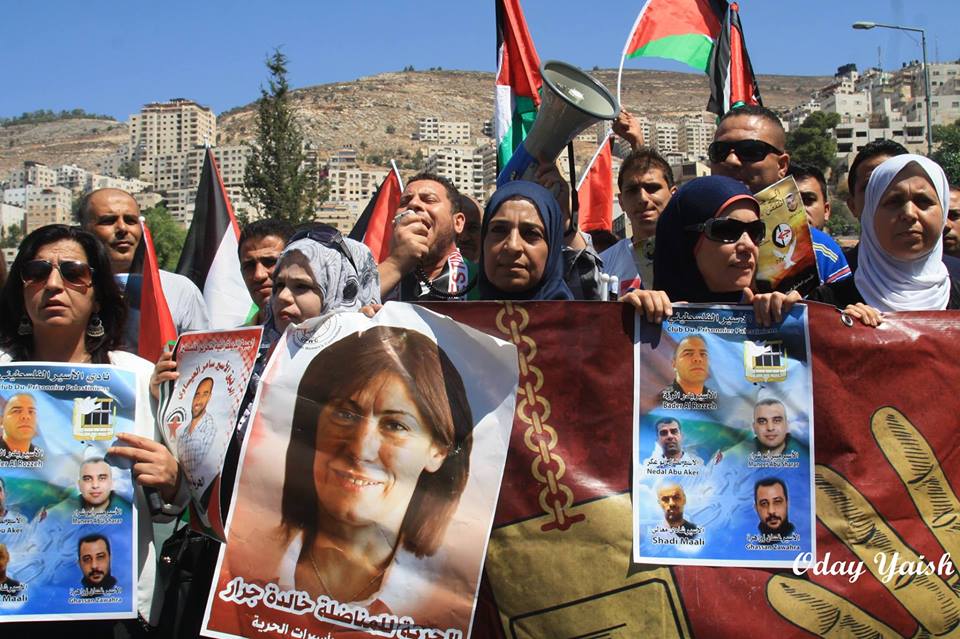
Hunger strikes continue: Protests across Palestine demand freedom, end of administrative detention
Palestinian Prisoner Solidarity Network | September 5, 2015
Nidal Abu Aker, Munir Abu Sharar, Badr al-Ruzza, Ghassan Zawahreh, and Shadi Ma’ali are engaged in the “Battle of Breaking the Chains” for the seventeenth day, continuing in their hunger strike to demand the end of administrative detention. All five are imprisoned by the Israeli military without charge or trial on the basis of “secret evidence” and have launched a hunger strike to demand not only their freedom personally, but an end to the policy that has been used against them.
Several more Palestinian prisoners have joined in the hunger strike and its demands: Bilal Daoud Saifi, who like Abu Aker, Zawahreh and Ma’ali is a Palestinian refugee who lives in Dheisheh refugee camp near Bethlehem, who started his strike on 30 August; Suleiman Eskafi of Al-Khalil, an administrative detainee on strike since 1 September; and Amir Shammas of Al-Khalil, an administrative detainee who previoulsy engaged in a hunger strike, had been promised that his detention would not be renewed, but since has had his detention renewed. In addition, Noor Shoukri Jaber, a Palestinian prisoner sentenced to life imprisonment, began a hunger strike on 2 September in protest of lack of medical care and his arbitrary transfer.

All of the striking prisoners have been thrown into isolation in an attempt to pressure them to end their strike and to stop other prisoners from joining the strike.
The “Battle of Breaking the Chains” is sparking actions of support in various cities in Palestine. A permanent tent of support has been set up at the main entrance of Dheisheh refugee camp, where four of the strikers – and three of its leaders – live, and demonstrations of support have been organized in Nablus, Al-Khalil, Bethlehem city, and Ramallah, among other cities.
Samidoun Palestinian Prisoner Solidarity Network expresses its strongest solidarity with the striking prisoners, and calls for international actions, mobilizations and events to demand their freedom. We cannot wait until these brave strugglers are facing death to act and demand not only their freedom as individuals, but the abolition of administrative detention – on the road to freeing every Palestinian prisoner held in Israeli occupation jails. It is not the case that Israeli military courts are any more legitimate, fair or acceptable than administrative detention – they are just as arbitrary, racist and illegitimate. But administrative detention is a weapon of mass terror used against the Palestinian people, and it is critical to bring this practice to an end. These Palestinian prisoners have put their bodies on the line in order to end administrative detention – and it is imperative that we act to support them. These prisoners’ struggle is not only about their individual freedom – it is part of their struggle for return and liberation for Palestine.
Take Action!
1. Sign on to this statement in support of the prisoners’ demand to End Administrative Detention. Organizational and individual endorsements are welcome – and organizational endorsements particularly critical – in support of the prisoners’ demands and their actions. Click here to sign or sign below:http://bit.ly/EndAdministrativeDetention
2. Send a solidarity statement. The support of people around the world helps to inform people about the struggle of Palestinian prisoners. It is a morale booster and helps to build political solidarity. Please send your solidarity statements to samidoun@samidoun.net. They will be published and sent directly to the prisoners.
3. Hold a solidarity one-day hunger strike in your area. Gather in a tent or central area, bring materials about Palestinian prisoners and hold a one-day solidarity strike to raise awareness and provide support for the struggle of the prisoners and the Palestinian cause. Please email us at samidoun@samidoun.net to inform us of your action – we will publicize and share news with the prisoners.
4. Protest at the Israeli consulate or embassy in your area. Bring posters and flyers about administrative detention and Palestinian hunger strikers and hold a protest, or join a protest with this important information. Hold a community event or discussion, or include this issue in your next event about Palestine and social justice. Please email us at samidoun@samidoun.net to inform us of your action – we will publicize and share news with the prisoners.
5. Contact political officials in your country – members of Parliament or Congress, or the Ministry/Department of Foreign Affairs or State – and demand that they cut aid and relations with Israel on the basis of its apartheid practices, its practice of colonialism, and its numerous violations of Palestinian rights including the systematic practice of administrative detention. Demand they pressure Israel to free the hunger strikers and end administrative detention.
6. Boycott, Divest and Sanction. Hold Israel accountable for its violations of international law. Don’t buy Israeli goods, and campaign to end investments in corporations that profit from the occupation. G4S, a global security corporation, is heavily involved in providing services to Israeli prisons that jail Palestinian political prisoners – there is a global call to boycott it. Palestinian political prisoners have issued a specific call urging action on G4S.
Israeli settlers pepper spraying Palestinians in Hebron attacks
Ma’an – September 5, 2015
HEBRON – Israeli settlers from the illegal settlement of Beit Hadasa in Hebron on Saturday attacked a young Palestinian man with pepper spray, witnesses said.
A Ma’an reporter identified the Palestinian man as Ayman al-Fakhori, and said that he had been transferred to Hebron hospital for medical treatment.
An activist group, Youth Against Settlement in Hebron, released video footage of the incident that appears to show the Palestinian scuffling with masked men and one Israeli soldier.
The masked men, identified by the activist group as settlers, then beat the Palestinian, before one of them sprays pepper spray directly into his face.
The masked men then run from the scene along with the Israeli soldier.
Earlier on Saturday, the official Palestinian Authority news agency Wafa reported another incident of a Palestinian being attacked and pepper-sprayed by Israeli settlers in Hebron.
Wafa identified the Palestinian as Jadawi Hani Abu Haykal, 21.
Abu Hakyal’s family reportedly told Wafa that he was attacked near the illegal Israeli settlement of Tel Rumeida and that his body was left severely bruised.
He was reportedly taken to hospital following the incident.
Settler attacks are a routine occurrence in Hebron, where 700 settlers live in 80 homes in the city center, surrounded by nearly 200,000 Palestinians.
Over 100k sign UK online petition calling for Israeli PM’s arrest
Press TV – September 5, 2015
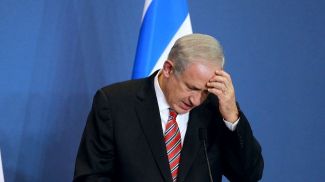 More than 100,000 people in the United Kingdom have now signed a petition demanding the arrest of Israeli Prime Minister Benjamin Netanyahu for war crimes against Palestinians when he visits London later this month.
The petition, which was published on the website of the British Parliament on August 7, calls upon the British government to apprehend the 65-year-old chairman of Israel’s Likud party upon arrival in London next Wednesday for the massacre of thousands of Palestinians during the Israeli military’s 50-day onslaught against the blockaded Gaza Strip last year.
The petition garnered 100,021 signatures as of Saturday morning.
“Under international law, he should be arrested for war crimes upon arrival in the UK for the massacre of over 2,000 civilians in 2014,” the petition says, referring to the Israeli prime minister’s scheduled September visit.
After 10,000 signatures, the British government must respond to the petition, and after 100,000 signatures, it will be considered for debate in the parliament.
The British government has, in return, stated that “under UK and international law, visiting heads of foreign governments, such as Prime Minister Netanyahu, have immunity from legal process, and cannot be arrested or detained.”
Israel started its military campaign against the impoverished Gaza Strip in early July 2014. The offensive ended on August 26, 2014. Nearly 2,200 Palestinians, including 577 children, lost their lives in Israel’s war. Over 11,100 others – including 3,374 children, 2,088 women and 410 elderly people – also sustained injuries.
Slaughtering the Truth and the False Choice of War on Iran
By Nima Shirazi | Wide Asleep In America | September 2, 2015
Even outspoken supporters of the nuclear deal signed between Iran and the P5+1 (the US, UK, France, China, Russia and Germany) rely on myriad entrenched myths and falsehoods about Iran’s nuclear program to make their case. For instance, the constant claim that the agreement “prevents Iran from building a nuclear weapon” is a facile talking point that assumes an Iranian drive for a bomb that has never actually existed.
What the deal – known formally as the Joint Comprehensive Plan of Action – does is, in exchange for removing sanctions, verifiably limit Iran’s nuclear infrastructure by restricting enrichment levels, expanding monitoring access beyond the legal requirements of the Nuclear Nonproliferation Treaty (NPT) and Iran’s safeguards agreements to affirm the peaceful nature of Iran’s nuclear program, a program that has never been found to have ever been militarized.
Nevertheless, advocates of the accord have consistently argued that without this deal, Iran would inevitably race toward producing the bomb it’s never wanted and has prohibited for decades, and as a result, the United States (or Israel) would be forced to bomb Iranian nuclear and military facilities to save the world from the clutches of evil atomic mullahs.
We’ve heard the same thing for decades, that the “clock is ticking” and “time is running out” to attack Iran or force it to capitulate on its legal nuclear program, lest Iran acquire the atomic arsenal that we’ve been told since the mid-1980s is only “a few screwdriver turns” away and right around the corner.
These are bad facts, built upon a two-pronged foundation of alarmism that promotes the supposed inevitably of two things that will never happen: Iran acquiring a nuclear weapon and a U.S./Israeli military attack on Iran. And with bad facts come worse analysis.
In essence, even the deal’s own supporters buy into ahistorical, Netanyahu-inspired narratives of malevolent Iranian intent and prepare their appeals from there. One of the most striking examples of this egregious practice is a recent opinion piece by Anne-Marie Slaughter in USA Today, a publication with a history of terrible reporting and commentary on Iran.
Slaughter surely has impressive credentials. She’s taught at elite universities, including Harvard and Princeton, served for two years as Hillary Clinton’s director of policy planning in the U.S. State Department and currently heads the New America Foundation, an influential center-left think tank in Washington D.C.
With this résumé, it is both shocking and illuminating how little she seems to understand about Iran’s nuclear program. Slaughter refers to “Iran’s illegal nuclear program,” despite the fact that Iran has the inalienable right to a domestic nuclear program as affirmed by the Nuclear Nonproliferation Treaty (NPT). She is also apparently convinced Iran is engaged in a “quest for a nuclear weapon” (alternatively rendered as “Iran’s illegal pursuit of a nuclear weapon”), which it decidedly is not and for which there is no credible evidence.
And that’s not all. Slaughter’s analysis gets a lot more wrong.
Slaughter’s Imaginary Stockpiles
Here’s Slaughter’s opening gambit:
The opponents of the Iran deal are absolutely right about the existence of an alternative. We could bomb Iran. A sustained attack could destroy its nuclear facilities and presumably a large part of its stockpiled plutonium and highly enriched uranium.
For starters, the argument of either a “deal or war” is a wholly false choice, despite Slaughter’s conclusion that, “Like it or not, those are the only two choices we have.”
In fact, with no deal, Iran would still be a member of the NPT, have a comprehensive safeguards agreement with the IAEA, and continue to call for a nuclear weapons free zone in the Middle East, as it has done for decades. An attack on Iran, a sovereign nation that virtually all intelligence agencies on the planet have determined is not pursuing nuclear weapons, would be a undeniable war crime.
But in her second sentence, Slaughter makes a gigantic, and completely inexplicable, error. Iran has exactly zero “stockpiled plutonium and highly enriched uranium.” This is not a controversial issue; anyone who knows absolutely anything about Iran’s nuclear program knows this.
Before it can be stockpiled, plutonium must first be extracted and reprocessed from the spent uranium fuel of an operational nuclear reactor. Iran has never done this and doesn’t even have a reprocessing plant. Iran has literally never extracted plutonium from a reactor core, let alone stockpiled it, as Slaughter claims.
Iran has also never produced, let alone stockpiled, any “highly enriched uranium” (HEU), which is defined by the IAEA as “uranium containing 20% or more of the isotope 235U.” Only when uranium is enriched to about 90% does it become suitable for weaponization. Prior to the implementation of the November 2013 Joint Plan of Action (JPOA), Iran had been enriching uranium to between 3.5% and 5% 235U for use as fuel in nuclear power plants and to about 19.75% 235U for use in medical research reactors. Since the plan went into effect, Iran ceased all enrichment above 5%, diluted or disposed of its entire stockpile of 19.75% LEU, and converted the vast majority of its remaining stockpile of LEU to a form incapable of being weaponized.
Even the Israeli intelligence community, perhaps the entity most hostile to Iran and likely responsible for the murder of five Iranian scientists, doesn’t claim Iran has any stockpiled plutonium or HEU. In a top-secret 2012 memo, the Israeli Mossad assessed that, although Iran maintained a declared stockpile of LEU, “it does not appear to be ready to enrich it to higher levels.” Furthermore, the cable noted that, without a plutonium reprocessing plant in Iran, the plutonium produced as a byproduct of running the heavy water research reactor in Arak (still under construction), “will not be able to be used for weapons.”
No amount of criminal airstrikes can bomb away material that does not exist. With this little grasp of the issues at stake, the fact that Slaughter was a policy adviser to a Secretary of State for two years is a harrowing thought.
Slaughter’s Bad Facts on the Iran Deal
Slaughter’s comprehension of the deal itself – the deal she herself supports – is similarly tenuous. Regarding sanctions relief and specifically the unfreezing of Iranian assets abroad, she writes, “If, in fact, Iran complies with the terms of this deal, stops pursuing a weapon and completely dismantles its nuclear supply chain, then it is entitled to recover the funds.”
Ok, no. This is wrong. As noted already, since Iran isn’t “pursuing a weapon,” it doesn’t actually have anything to stop doing in that regard.
Beyond this, Iran will absolutely not be “dismantling its nuclear supply chain,” which extends from the mining and milling of natural uranium ore to yellowcake conversion to centrifuge manufacturing and storage facilities to enrichment and fuel production. None of these elements of Iran’s program is being dismantled under the deal; rather, unprecedented monitoring and surveillance access is being granted by Iran to the IAEA at every step of the way, a level of inspections and insight unmatched anywhere in the world.
Slaughter’s Obfuscation of U.S. Role in Failed Iran Diplomacy
Later on in her oped, Slaughter engages in quite a bit of fictional storytelling about her past experience in the State Department:
George W. Bush’s administration spent eight years just trying to get Iran to come to the table to negotiate, without success. In 2010, during my first year working as director of Policy Planning under Secretary of State Hillary Clinton, we thought we had a deal with the Iranians to ship most of their highly enriched uranium to Russia, but it promptly collapsed when the Iranian negotiators took it back to the supreme leader, Ayatollah Khamenei. And all the while, the Iranians moved from hundreds of centrifuges to about 20,000, of ever more sophisticated design. Their supply of highly enriched uranium, just one step away from the fuel needed for a bomb, went up and up.
Again, Slaughter pretends that Iran has produced and maintained a supply of “highly enriched uranium.” It hasn’t, and never has. Also, the link she provides to support the absurd claim that the Bush administration was desperate for diplomacy with Iran is a piece of utter propaganda written by Stephen Hadley, a stalwart neocon who served as Bush’s national security adviser.
Slaughter omits the fact that, in 2002 and 2003, diplomacy between Iran and the EU-3 (Britain, France and Germany) resulted in the suspension of Iran’s nascent enrichment program and voluntary adoption of the stringent Additional Protocol, which allowed the IAEA extensive access to Iran’s program for over two years. In that time, the IAEA consistently affirmed that Iran had never diverted any nuclear material to military purposes.
It was only after Iran’s European negotiating partners, at the behest of the Americans, reneged on their promise to offer substantive commitments and respect Iran’s inalienable right to a domestic nuclear infrastructure that talks dissolved and Iran resumed enrichment. The proposal eventually brought to Iran by Western negotiators on August 5, 2005 has been described as “vague on incentives and heavy on demands,” and even dismissed by one EU diplomat as “a lot of gift wrapping around an empty box.”
Nevertheless, since late 2005, Iran has proven willing time and again to engage in negotiations over its nuclear program and the international sanctions regime. Its numerous proposals over the years have consistently reiterated its willingness to officially ban nuclear weapons development through legislation, cap its level and scope of enrichment, immediately convert its enriched uranium to fuel rods “to preclude even the technical possibility of further enrichment” towards weapons-grade material, “to provide unprecedented added guarantees” to the IAEA that its program would remain peaceful, and open its enrichment program to international partnership.
Iran’s offers were routinely rejected by the United States government, which long maintained the irrational position that Iran capitulate to the American demand of zero enrichment on Iranian soil. “We cannot have a single centrifuge spinning in Iran,” declared George W. Bush’s undersecretary of state for arms control Robert Joseph in early 2006. As recently as this past March, Slaughter’s former boss Hillary Clinton was still indicating her preference for “little-to-no enrichment” in Iran.
What made successful diplomacy with Iran possible was not, as so many still erroneously claim, the devastating sanctions imposed on the Iranian people or even the 2013 election of Hassan Rouhani, it was the Obama administration’s eventual abandonment of the “zero enrichment” demand, opening the door for acknowledging (albeit implicitly) Iran’s right to enrich and for negotiations to move forward productively.Perhaps the most curious comment Slaughter makes, however, is about the 2009 P5+1 nuclear swap proposal, in which she claims the United States and its partners offered “to ship most of [Iran’s] highly enriched uranium to Russia.”
Forgive the repetition, but remember, Iran never had any “highly enriched uranium,” so Slaughter is beginning with a completely false premise. Placing the blame on the Iranian leadership for the failure to implement the deal is also disingenuous. Here’s what really happened:
In June 2009, while it was enriching uranium up to 5% LEU only, Iran announced publicly that it required a new stock of nearly 20% LEU to keep the U.S.-built Tehran Research Reactor (TRR) operational and producing vital medical radioisotopes used to treat nearly a million Iranian cancer patients. In advance of the depletion of its reactor fuel, Iran tried to purchase more enriched uranium on the open market under full IAEA supervision.
Despite the safeguarded TRR presenting no proliferation threat, the United States and its European partners prevented any discussion of such a commercial sale. Instead, in October 2009, they offered a “swap” proposal whereby Iran would ship out most of its stockpiled low-enriched uranium to Russia to be enriched to the requisite 19.75%. This would then be shipped to France where fuel rods that could power the TRR would be produced. Iran would then, theoretically, receive those rods a year after shipping out its stockpile.
Iran agreed in principle to this arrangement, with the intention of hammering out mutually acceptable details at a later date. In late 2009, the deal was still in the works. Iran’s then foreign minister Manouchehr Mottaki reiterated that Iran was “willing to exchange most of its uranium for processed nuclear fuel from abroad” in a phased transfer of material with full guarantees that the West “will not backtrack an exchange deal.”
In reviewing the P5+1 offer, the Iranian press reported, “technical studies showed that it would only take two to three months for any country to further enrich the nuclear stockpile and turn it into metal nuclear rods for the Tehran Research Reactor, while suppliers had announced that they would not return fuel to Iran any less than seven months.”
As the parties discussed final terms, Mottaki suggested Iran initially hand over a quarter of its enriched uranium stockpile in a simultaneous exchange on Iranian soil for an equivalent amount of processed fuel for use in the medical research reactor. The remainder of the uranium would then be traded over “several years,” under an agreed upon and internationally supervised framework.
This proposed timetable was immediately rejected by Western powers. An unidentified senior U.S. official was quoted by Voice of America as claiming that the Iranian counter-proposal was inconsistent with the “fair and balanced” draft agreement. Meanwhile, Secretary of State Hillary Clinton, Slaughter’s boss at the time, urged Iran to “accept the agreement as proposed because we are not altering it,” which is the definition of an ultimatum, not a negotiation. Talks predictably fell apart.
When Iran later renegotiated the swap arrangement with Brazil and Turkey in May 2010, the Obama administration angrily rejected the terms and aggressively pushed more sanctions through the UN Security Council.
Slaughter’s History of Support for Military Intervention
Despite her distressing lack of accurate information about Iran’s nuclear program, Anne-Marie Slaughter’s uneasy embrace of the Iran deal is, at minimum, still a welcome departure from her usual militarist posture.
Five years after supporting the invasion of Iraq, Slaughter was annoyed by the “gotcha politics” of being held accountable for her bad judgment, grousing in The Huffington Post that “debate is still far too much about who was right and who was wrong on the initial invasion.”
In 2011, after leaving the State Department, Slaughter lent her full-throated support to the NATO bombing campaign in Libya, extolling herself as a champion of humanitarianism and democracy and then hailing the operation as an unmitigated success. It’s been anything but.
A year later, she was calling for U.S. allies to arm rebel forces against the Assad government in Syria, writing in The New York Times, “Foreign military intervention in Syria offers the best hope for curtailing a long, bloody and destabilizing civil war.”
In 2013, Slaughter openly lamented her support for the invasion of Iraq a decade earlier. “Looking back, it is hard to remember just how convinced many of us were that weapons of mass destruction would be found,” she wrote in The New Republic. “Had I not believed that, I would never have countenanced any kind of intervention on purely humanitarian terms.”
Slaughter said she had learned her lesson. “Never again will I trust a single government’s interpretation of data when lives are at stake, perhaps especially my own government,” Slaughter resolved. “And I will not support the international use of force in a war of choice rather than necessity without the approval of some multilateral body, one that includes countries that are directly affected by both the circumstances in the target country and by the planned intervention.”
Nevertheless, after penning this mea culpa, Slaughter continued busily advocating unilateral American airstrikes on Syria and pushing for Obama to at least threaten military action against Russia in Ukraine. “A US strike against the Syrian government now would change the entire dynamic,” she wrote for Project Syndicate. “It would either force the regime back to the negotiating table with a genuine intention of reaching a settlement, or at least make it clear that Assad will not have a free hand in re-establishing his rule.” Her calls for the U.S. bombing of Syria, and also Iraq, have since intensified.
Just last week, Slaughter again pressed her case for imposing a no-fly zone over Syria, citing “both moral and strategic reasons.” The direct American military intervention, Slaughter suggests, could be conducted “using sea-based missile systems” and “would force Mr. Assad to reconsider his long-term prospects and, most likely, force him to the negotiating table.”
Claiming that military strikes would inevitably follow the (increasingly impossible) Congressional rejection of the Iran deal is its own form of bellicosity. Deal opponents falsely argue that a “better deal,” not bombing and regime change, is their real goal, but that too is ridiculous.
It is indeed unfortunate that intelligent and influential commentators like Slaughter feel the need to resort to their own fear-mongering and false narratives to support a diplomatic initiative whose benefits need no such bludgeon. Real threat reduction over the Iranian nuclear issue would be far better served by an honest appraisal of the facts, examination of hard evidence and a refusal to engage in selective history.
Without these facts at her fingertips, Slaughter winds up promoting the very thing she supposedly seeks to prevent. She supports the deal, but for all the wrong reasons. If her former boss becomes the next commander-in-chief, Slaughter will almost certainly return to a high-powered position in government. Let’s hope she gets her facts straight before then.
Featured Video

Michael von der Schulenburg: Europe’s Self-Defeating Iran War Policy
or go to
Aletho News Archives – Video-Images
Frlom the Archives
Provoking a Path to Persia
The Saban Center’s prescient paper on war with Iran
By Maidhc Ó Cathail | October 20, 2011
In June 2009, the Saban Center for Middle East Policy published “Which Path to Persia?—Options for a New American Strategy toward Iran.” Writing in a tone strikingly reminiscent of the Project for a New American Century’s infamous pre-9/11 paper “Rebuilding America’s Defenses,” the six co-authors noted that, “It seems highly unlikely that the United States would mount an invasion without any provocation or other buildup.” For a think tank specifically established by media mogul Haim Saban to protect Israel, this could prove to be a formidable obstacle impeding their desired march—of U.S. troops—to Tehran.
“In fact, if the United States were to decide that to garner greater international support, galvanize U.S. domestic support, and/or provide a legal justification for an invasion, it would be best to wait for an Iranian provocation, then the time frame for an invasion might stretch out indefinitely,” Saban’s think-tankers ruefully observed.
“With only one real exception, since the 1978 revolution, the Islamic Republic has never willingly provoked an American military response, although it certainly has taken actions that could have done so if Washington had been looking for a fight. Thus it is not impossible that Tehran might take some action that would justify an American invasion. And it is certainly the case that if Washington sought such a provocation, it could take actions that might make it more likely that Tehran would do so (although being too obvious about this could nullify the provocation). However, since it would be up to Iran to make the provocative move, which Iran has been wary of doing most times in the past, the United States would never know for sure when it would get the requisite Iranian provocation. In fact, it might never come at all.”
Seemingly undeterred by Iran’s frustrating unwillingness to provide the requisite provocation, the analysts continued to examine this option… continue
Blog Roll
 Aletho News
- The EU never learns – except for the wrong lessons
- Iran attacks on UAE leaves RSF militia high and dry
- Hosting Washington’s war: Bahrain faces the consequences
- The US fell for its own Iran propaganda
- Seyed M. Marandi: Threat of Seizing Kharg Island & the Use of Nuclear Weapons
- Is there even an off ramp?
- Michael von der Schulenburg: Europe’s Self-Defeating Iran War Policy
- Sorry, The New Republic, Climate Change Isn’t Causing Somali Migration. Blame Civil Strife and Poverty.
- Expert Guts Claims That HPV Vaccine Reduces Cancer Risk
- No evidence Russia sabotaged Baltic cables – Finnish intel
- If Americans Knew
- 6 more Americans killed, as Israel ‘mows the lawn’ in Iran – Not a ceasefire Day 154
- Are we on the precipice of World War III?
- ‘Catastrophic,’ Says UNICEF: 1,100+ Children Killed or Wounded in Mideast Since US-Israel Launched Iran War
- The Unbelievable Madness of Our War With Iran
- World Council of Churches calls on govts to hold Israel accountable for violations of intl law
- How to end the war on Iran that costs US taxpayers $1M per minute – Not a ceasefire Day 153
- Israeli strategic plans to “remake the Middle East” from the 1950s and since
- Honoring Gaza’s women who refused to let the world look away
- 97% of victims of war on Iran are Iranian, 98% of victims in war on Gaza are Gazans – Not a ceasefire Day 152
- Early Iran strikes cost $5.6 billion in munitions, Pentagon estimates
- No Tricks Zone
- New Studies: UK Sea Levels Were 4 Meters Higher Than Today During The Mid-Holocene
- Destructive Green New Deal: German Energy And Metal Group Warns Of Drastic Crisis
- New Study Documents A 20-Year Pause In Arctic Sea Ice Decline – Driven By Internal Variability
- Wake-up Call: Survey Shows Majority Of Germans Now Favor Postponing Climate Targets!
- Televised! Leading German Political Candidate Tells Schoolchildren CO2 Makes Sun Hotter!
- New Study: A Century Warming Of 1.1°C Is ‘Commonplace’ And ‘Not Unusual’ During This Interglacial
- New Study: ‘Internal Noise’ And Volcanic Forcing Can Trigger 10-15°C Warming Within Decades
- Glaciers Worldwide Are Suddendly Surging, Experts Blame Warming!
- Surprising Discovery: Sahara Is Greening…Billions Of Trees Where Once Thought To Be Barren
- New Research Reaffirms Clouds, Aerosols, And Surface Solar Radiation Are ‘Driving The Climate System’
 Aletho News