High Court lifts ban on protests at Israeli drone factory
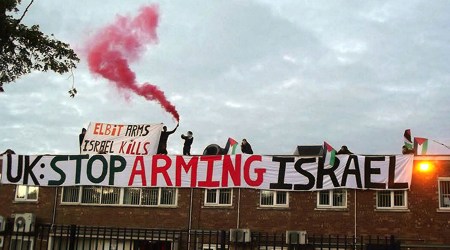
A UK arms factory was recently occupied by nine British activists in protest against the company’s alleged complicity in Israel’s Operation Protective Edge
RT | October 30, 2015
An injunction banning protests from taking place outside a drone factory in Staffordshire has been thrown out by Birmingham High Court. The factory has produced parts for drones used to attack Gaza in 2008, according to Amnesty International.
UAV Engines Limited in Shenstone, owned by an Israeli arms manufacturer Elbit Systems, is one of the world’s leading drone producers. The company says it produces “engines for various size tactical armed unmanned aerial vehicles [UAVs], target drones and single mission platforms.”
Angered by the factory’s unethical behavior, hundreds of protesters have staged demonstrations outside its industrial unit, calling on the manufacturer to stop contributing to the death of Palestinians.
In June, campaigners shut down UAV and another Israeli arms factory in Kent as part of a protest marking the one-year anniversary of the Israeli assault on Gaza.
Soon after, it became illegal for activists to protest within 250 meters of the Shenstone factory. The ban came in the form of a temporary injunction granted by the High Court.
However, Birmingham High Court scrapped the ban on Tuesday, ruling Elbit had failed to disclose information on the history of protests which have taken place at the factory since 2009.
Judge Purle at the High Court said the injunction is dismissed “as if it never existed.”
“I think it inconceivable you would have got the same injunction, possibly even any injunction, if you had disclosed relevant information to me,” she told the court. “Accordingly the injunction I granted on 30 June is dismissed ab initio [from the beginning] and it is as if the injunction never existed.”
‘It shouldn’t have been introduced’
A spokesperson for campaign group Block the Factory said the injunction should not have been imposed in the first place.
“This injunction should never have been imposed.It seems to have been designed to deter protest and campaigning around ending the UK’s deadly arms trade with Israel,” they told IBT.
“It’s Elbit Systems and its arms factories that should be facing a ban, not our protests. Today’s decision will bring even more energy to our campaigning in solidarity with ongoing Palestinian resistance and for a two-way arms embargo on Israel.”
War on Want, a charity fighting against the root causes of poverty and human rights violations, said it is pleased the ban has been lifted.
“It would have been a travesty for people to be criminalized for protesting against the sale of arms that are killing Palestinians. It just goes to show the depths UAV Engines will stoop to in order to protect the profits they make from the sale of deadly drones,” campaigner Ryvka Barnard said.
“We welcome the news that the judge has binned this draconian injunction and we will keep up the fight for an immediate two-way arms embargo between the UK and Israel,” he added.
In July, hundreds of activists protested outside the factory, which led to 19 people being arrested by Staffordshire police.
Photo © londonpalestineaction.tumblr.com / Tumblr
NY protest slams mayor over pro-Israel policy, police brutality
Press TV – October 30, 2015
American activists and protesters have staged a rally in New York City to condemn the stance of Mayor Bill de Blasio on Israel and police brutality in the US.
Pro-Palestine activists from the movement known as the ‘Black Lives Matter,’ likened US police forces in New York to Israeli soldiers in their violence and brutality against Palestinians.
They called for justice for Palestinians facing Israel’s aggression in the occupied territories.
The protesters rallied in front of the Sheraton Hotel in New York’s Times Square, where the city’s mayor was holding a re-election campaign.
At one point, about a dozen activists pushed their way into the lobby of the hotel before being repelled by security, local media reports noted.
The protesters were also angry over police brutality and their treatment of people of color.
Authorities in New York are under fire for the deaths of a number of unarmed citizens at the hands of US law enforcement officers. Most victims are usually African Americans.
Earlier in the day, the New York mayor dismissed the protesters as uninformed.
Blasio launched his re-election campaign toward the 2017 race on Thursday night, reportedly banking a million dollars during the hotel fundraiser, as other reports said the public opinion was evenly split on his job performance.
The event cost as much as some 5,000 dollars for each person in attendance.
Israel Redefines Terrorism
By Stephen Lendman | October 25, 2015
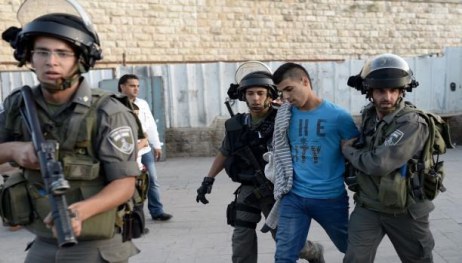
Rogue states make their own rules, mindless of inviolable international laws, norms and standards. On October 19, Israel’s repressive counter-terrorism bill passed its 2nd and 3rd readings – criminalizing legitimate resistance as terrorism, expanding regime authority to counter it extrajudicially.
Any activity can now be called terrorism or terrorist-related, innocent Palestinians subject to possible longterm imprisonment. Charity officials providing aid to anyone linked to or associated with Hamas or legitimate resistance groups can be arrested, charged and prosecuted.
Children wearing clothing bearing the Hamas name face arrest, detention, and grueling interrogations amounting to torture. The law authorizes Big Brother surveillance, more intrusive than already, replicating how the NSA operates, monitoring all phone and online communications.
Israeli Law Professor Yael Berda called the measure “scary and undemocratic…criminalizing an entire population for identifying with an organization that Israel considers terrorist (true or false)” – first introduced in 2011, redrafted several times, never brought to 2nd and 3rd readings until now, required for passage.
It expands the definition of terrorism to virtually anything considered a (real or invented) threat to public safety, well-being, property, infrastructure, the economy, religious sites or the environment.
It makes no distinction between alleged attacks against civilians, soldiers or police. Vandalism against (Israeli) religious sites is now terrorism.
Terrorist organizations are any authorities say so for any reason or none at all. Members or supporters face harsh punishment.
Any alleged terrorist crime incurs “double the penalty set for the same crimes, but no more than 30 years” imprisonment. Administrative detentions (without charges levied or trials) can be ordered more easily than before, subjecting victims to indefinite imprisonment.
Punishment for allegedly intending to conduct a terrorist act is equivalent to committing it. Noted Israeli lawyer, human rights champion Leah Tsemel calls the new law “not…about terrorism. It…remove(s) restrictions from everything to do with opposition to occupation,” criminalizing legitimate resistance.
“When it comes to the occupation, there is no rule of law,” she explained. Israel always operated extrajudicially – now with more police state authority than before.
A passage in the 100-page measure reads as follows:
“The law substantially strengthens and widens the powers of the police and the General Security Services (Shabak or Shin Bet) to suppress any legitimate protest activities against Israeli policies.”
“It also enables the use of ‘secret evidence’ in order to take preventative measures against these activities, which impedes the possibility of objecting to these repressive decisions based on their merits before the judiciary.”
According to Yael Berda, “(y)ou don’t have to do anything to be considered a terrorist. You can publish an article or make a comment in cyberspace, and you will be criminalized.”
“If you are located in the physical environment of terrorist activities, you are guilty.” The measure applies specifically for Palestinians and Arab Israeli citizens – Jews as well for opposing regime authority.
The Association for Civil Rights in Israel (ACRI) denounced the new measure, saying “in its current form, (it) seeks to perpetuate and normalise problematic arrangements that are currently set out in emergency legislation and regulations from the time of the British mandate.”
“(D)efinitions included in the bill are very broad and could apply to people and organizations who are not engaged in terrorism. Such broad definitions give excessive discretion to law enforcement authorities to determine ‘who is a terrorist,’ with potentially serious implications.”
“For example, the definition of ‘terrorist act’ may apply to protests, including ‘disturbances.’ The definition of ‘member of a terrorist organization’ includes people who did not take any active part in the organization. The broad definitions contained in the bill and the draconian powers that it gives to authorities could potentially lead to serious human rights violations.”
The Adalah Legal Center for Arab Minority Rights in Israel condemned the measure, saying it “substantially strengthens and widens the powers of the police and the Shabak to suppress any legitimate protest activities against Israeli policies.”
It’s specifically designed to criminalize legitimate resistance – “to further suppress the struggle of Palestinian citizens of Israel and the pursuit of their political activities in support of Palestinians living under Occupation in the West Bank and the Gaza Strip.”
Humanitarian and cultural activities are vulnerable. So is independent journalism, legitimately criticizing repressive state policies. Its passage assures greater collective punishment – all the more urgency to resist this vile, freedom-destroying regime.
Stephen Lendman lives in Chicago. He can be reached at lendmanstephen@sbcglobal.net.
His new book as editor and contributor is titled Flashpoint in Ukraine: US Drive for Hegemony Risks WW III.
Police Drag Away Japanese Seniors Protesting US Military Base Relocation
Sputnik – 30.10.2015
 Elderly protesters were dragged off by riot police on Thursday after staging a sit-in and blocking a road in protest of the construction of a new US military base in Okinawa.
Hundreds of people participated in the demonstration, sitting or lying on the ground in the road to Camp Schwab in an effort to prevent vehicles transporting building materials from accessing the site.
“Don’t lend a hand in the construction of the military base!” the crowd chanted as they were dragged away.
For two decades the military has been wanting to move the Marine Corps Air Station Futenma Okinawa base further north in Okinawa.
The plan to relocate the installation has drawn protests by tens of thousands of residents who worry about sexual assaults by US service members, violence, and the environmental impact on local ecosystems.
Over 50,000 US military personnel currently reside in Japan, and more than half of those live in Okinawa.
“Don’t the people of Okinawa have sovereignty?” 70-year-old Katsuhiro Yoshida, an Okinawa prefectural assembly member, told the Asahi Shimbun. “This reminds me of the scenes of rioting against the U.S. military before Okinawa was returned to Japan (in 1972). Now we are facing off against our own government. It is so contemptible.”
The current governor of Okinawa, Takeshi Onaga, was elected on the premise that he would not allow the base to be constructed. He made good on that pledge, until Japan’s land ministry announced this week that they were overriding his decision.
“The fact that they forcibly executed this construction, there is nothing but anger,” Takashi Kishimoto from the Okinawa Peace Movement Center told NBC News. “We are outraged at these political tactics which ignore will of the people.”
A poll conducted by the Okinawa Times found that 76% of residents are opposed to the construction of a new base.
Photo © Screen Shot
NATO’s Expensive Expansion
By Brian CLOUGHLEY – Strategic Culture Foundation – 27.10.2015
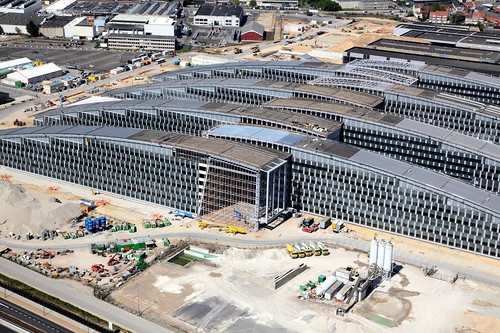
The North Atlantic Treaty Organisation has many secrets, of which one of the most closely guarded is the final cost of its luxurious new headquarters complex in Brussels. As reported last year by Britain’s Daily Telegraph newspaper, the price had climbed to a billion Euros “against a background of Nato pledges to reduce its command structure, agencies and national HQs by 30 per cent in response to savage defence cuts in most of its 28 member states.” According to NATO the final bill was supposed to be 750 million Euros for completion in 2015, but as had to be eventually admitted by NATO, “the project now has a clear way forward to completion in 2016” — with a 30 per cent increase in the price.
But that officially-stated price was not what it seemed, because, as revealed by Germany’s Der Spiegel magazine, “member states had already been sceptical when the consortium won the contract for €460 million [emphasis added] in 2010 . . . [Nato Chief] Anders Fogh Rasmussen is aware of the problem but hasn’t seen fit yet to inform the public about it . . . At a meeting of NATO’s Deputies Committee on December 19 [2013], Rasmussen’s staff asked that the issue be dealt with ‘confidentially’.”
That shabby deceitfulness couldn’t prevent Spiegel from disclosing that the cost had risen to 1.3 billion Euros, “almost three times the €460 million contract awarded in 2010 to replace NATO’s Cold War-era headquarters with a soaring glass-and-steel structure to house some 4,000 staff.” This vastly expensive palace has eight wings which converge “in a glass-covered central hall . . . to ‘symbolise the allies coming together, while glass walls are supposed to represent Nato’s transparency’.”
The designer of this glass castle rhapsodised that “the wing-like profiles of the buildings reinforces [sic] the ideas of consensus, fluidity and aspirations towards peace . . .” But peace doesn’t seem to be what NATO is intent on achieving, any more than it seems to welcome transparency in glass walls or anything else, because a leaked cable from Germany’s ambassador explained that a meeting of NATO representatives “pointed to the disastrous effect on the image of the alliance if construction were to stop and if NATO appeared to be incapable of punctually completing a construction project.”
How transparent. And how prophetic.
Although NATO’s deceit about its incompetence in building its new headquarters is veiled in secrecy, its ambition to expand in territory and military muscle-flexing is open for all to see, and has been for twenty years.
After the Warsaw Pact disbanded in March 1991, NATO, although deprived of any reason to continue in existence, managed to keep going, and in 1999 added Poland, the Czech Republic and Hungary to its 16 members. As the BBC noted, these countries became “the first former Soviet bloc states to join Nato, taking the alliance’s borders some 400 miles towards Russia.”
With good reason Moscow wondered what on earth the US-NATO military alliance might be planning.
The New York Times recorded that the 1999 expansion was “opening a new path for the military alliance” and expressed delight that the ceremony took place in the town of Independence, Missouri, where “the emotional Secretary of State Madeleine K Albright watched the three foreign ministers sign the documents of accession, signed them herself, then held them aloft like victory trophies.” Ms Albright was born Marie Korbelová in Prague and “made no secret today of her joy as her homeland and the two other nations joined the alliance.”
It was the emotional Madeleine Albright who appeared on the US television programme Sixty Minutes on May 12, 1996 and was asked to comment on Washington’s economic sanctions that were savaging Iraq. The interviewer, Lesley Stahl, said that as a result of the punishment “We have heard that a half million children have died. I mean, that’s more children than died in Hiroshima. [90,000 people were killed at Hiroshima. Probably about 20,000 were children.] And, you know, is the price worth it?”
Albright replied that “I think this is a very hard choice, but the price — we think the price is worth it.” (The YouTube recording is nauseating.) Then she was given the US Medal of Freedom by President Obama in 2012. You couldn’t make it up.
In spite of facing no threat whatever from any country in the world, NATO continued to expand around Russia’s borders, inviting Bulgaria, Estonia, Latvia, Lithuania, Romania, Slovakia and Slovenia to join in 2002, which they did two years later.
As President Putin observed in an interview with Italy’s Corriere della Sera “we are not expanding anywhere; it is NATO infrastructure, including military infrastructure, that is moving towards our borders. Is this a manifestation of our aggression?”
Then NATO took wider and more aggressive action in August 2003 when it took “control of the International Security Assistance Force (Isaf) in Afghanistan, its first major operation outside Europe.” Predictably, the war in Afghanistan plunged from crisis to calamity after US-NATO countries agreed in 2005 “to expand the alliance’s role,” including “deployment of thousands more troops in the south.” The result was disaster.
Last December NATO (but not the US) ceased offensive operations in Afghanistan, having sacrificed the lives of over 3,500 soldiers of whom some 2,300 were American. One might imagine that this humiliating defeat might have resulted in a pause for reflection about NATO’s role, purpose and effectiveness, but its new Secretary General, Jens Stoltenberg, is proving as energetically expansive as his predecessor, which is why he was chosen for the job. NATO’s appalling blitz of Libya in 2011, which reduced the country to its present catastrophic chaos, has failed to modify his intriguing belief that “from Afghanistan to Morocco, and many places in between, NATO is helping other countries to defend themselves.” He may have forgotten that Libya is one of the “places in between.”
On 23 October Stoltenberg expressed delight about Obama’s change of policy about keeping troops in Afghanistan, expressing “appreciation for President Barack Obama’s announcement that the United States will maintain its current troop levels in Afghanistan through 2016, and will retain a substantial presence beyond 2016. This important decision paves the way for a sustained presence by NATO Allies and partners in Afghanistan.”
If Stoltenberg had said that he welcomed Obama’s decision because it would result in a better life for the citizens of Afghanistan (which, alas, it will not), then his stance could be understood and applauded. But Stoltenberg welcomed the decision only because it would enable NATO to carry on its expensive expansion. That’s the way that military-associated bureaucrats think about the world. They’ve never risked their lives for any cause — any more than did the evil child-killer Albright — but they’re really happy to engage in exciting martial adventures in which the lives of thousands of soldiers can be placed at risk.
Jens Stoltenberg is the embodiment, the essence — the ultimate epitome — of the sleek, well-manicured, desk-bound, happy non-combat warrior. His peaceful and lucrative career in politics was marked by early anti-Americanism, during the Vietnam War, but over the years the chameleon changed from being an anti-American protester to eventually embracing his present anti-Russian complexion. When he was made head of NATO, President Putin considered him to be a “serious, responsible person” but warned with prescience that “we’ll see how our relations develop with him in his new position.” Both responsibility and relations collapsed.
A few days before his declaration of happiness about NATO’s “sustained presence” in Afghanistan Stoltenberg boasted that “we have doubled the size of the NATO Response Force, making it more ready and more capable, and established a high readiness Joint Task Force, able to move within a matter of days. We have increased our presence in the east, with more planes in the air, more ships at sea and more boots on the ground. We have established six new headquarters in our eastern Allies, with two more on the way.” He told NATO countries that “the time has come to invest more in defence.”
NATO’s threat to Russia is direct and aggressively confrontational. And it’s going to cost member nations a great deal of money. But Mr Stoltenberg is no stranger to expense. As NATO announced : “While Mr Stoltenberg was Prime Minister, Norway’s defence spending increased steadily with the result that Norway is today one of the Allies with the highest per capita defence expenditure.”
Now he has committed Europe’s financially struggling NATO nations, including almost-bankrupt Greece and Spain, to “continue to fund the Afghan national army and security forces” which cost about 12 billion dollars a year.
The huge cost of NATO’s recent and current military manoeuvres in nations circling Russia has not been revealed, presumably because it is as secret as the escalating price of the new NATO headquarters.
Unfortunately it is improbable that Mr Stoltenberg will try to encourage economic prudence or support any attempts to reduce tension with Russia. The Obama-Stoltenberg NATO military alliance has won the battle to expand its presence and its budget. The sword-brandishing will continue — and the cost of the glitzy glass palace will go through the roof.
US used Christian NGO to spy on North Korea
Press TV – October 29, 2015
The United States has used a Christian non-governmental organization (NGO) as a front for an espionage program to spy on North Korea, a new report reveals.
In 2004, the Pentagon launched a secret program to gather intelligence from inside the East Asian country that has long been a source of great concern to Washington, The Intercept reported.
“We had nothing inside North Korea,” one former military official familiar with US efforts in the country told the Intercept. “Zero.”
However, a Christian charity organization called the Humanitarian International Services Group, or HISG, was able to finally make way into North Korea through offering much-needed humanitarian aid to Pyongyang.
According to the NGO’s documents, HISG was established by three friends shortly after the September 11, 2001 terrorist attacks in New York. Under the leadership of Kay Hiramine, the organization set out to provide disaster relief and sustainable development in poor and war-torn countries around the world.
The espionage program was the brainchild of Lieutenant General William “Jerry” Boykin, a senior US Defense Department intelligence official during the George W. Bush administration.
Boykin who was an evangelical Christian, obsessed with finding new and unorthodox ways to penetrate North Korea.
He was assigned with the task of increasing the Pentagon’s ability to conduct intelligence operations independent from the CIA.

Lt. Gen. William “Jerry” Boykin
Boykin improvised a plan to use charities as a cover for espionage operations and this was how HISG was chosen to participate in the program.
In the period between 2004 and 2006, HISG helped coordinate a humanitarian shipment to North Korea.
The charity offered faith-based donations that the North Korean government would occasionally accept to help its population endure the country’s harsh winters.
However, the shipment included concealed compartments of bibles underneath the clothing. The idea was that if the bibles were not discovered, the Pentagon could use the same smuggling method to get military sensors and equipment into the country.
Once they made sure that the bibles entered the country unnoticed, the Pentagon tasked HISG with gathering the intelligence it needed inside North Korea.

HISG CEO Kay Hiramine (L) stands next to former US president George W. Bush
Hiramine’s NGO used unsuspecting Christian missionaries, aid workers, and Chinese smugglers to move equipment into and around North Korea without any of them knowing that they were part of a secret Pentagon operation.
The Pentagon planted “spoofers” and similar devices in the country to disrupt North Korean military devices and radio signals. The report also noted that “[equipment] to measure nuclear anomalies” were scattered throughout the country.
The US even planted shortwave radios that could help a downed pilot to escape in the event of a future conflict with North Korea.
Citing a former US military official and documents reviewed in relation to the case, the report noted that before being dismantled in 2013, Hiramine’s organization had received millions in funding from the Pentagon through a complex web of organizations designed to mask the origin of the cash.
In 2007, President Bush awarded Hiramine with a President’s Volunteer Service Award.
We Must Oppose Obama’s Escalation in Syria and Iraq!
By Ron Paul | October 27, 2015
Today Secretary of Defense Ashton Carter appeared before the Senate Armed Services Committee to outline a new US military strategy for the Middle East. The Secretary admitted the failure of the US “train and equip” program for rebels in Syria, but instead of taking the appropriate lessons from that failure and get out of the “regime change” business, he announced the opposite. The US would not only escalate its “train and equip” program by removing the requirement that fighters be vetted for extremist ideology, but according to the Secretary the US military would for the first time become directly and overtly involved in combat in Syria and Iraq.
As Secretary Carter put it, the US would begin “supporting capable partners in opportunistic attacks against ISIL (ISIS), or conducting such missions directly, whether by strikes from the air or direct action on the ground.”
“Direct action on the ground” means US boots on the ground, even though President Obama supposedly ruled out that possibility when he launched air strikes against Iraq and Syria last year. Did anyone think he would keep his word?
President Obama claims his current authority to conduct war in Iraq and Syria comes from the 2001 authorization for the use of force against those who attacked the US on 9/11, or from the 2002 authorization for the use of force against Saddam Hussein. Neither of these claims makes any sense. The 2002 authorization said nothing about ISIS because at the time there was no ISIS, and likewise the 2001 authorization pertained to an al-Qaeda that did not exist in Iraq or Syria at the time.
Additionally, the president’s year-long bombing campaign against Syrian territory is a violation of that country’s sovereignty and is illegal according to international law.
Congress is not even consulted these days when the president decides to start another war or to send US ground troops into an air war that is not going as planned. There might be notice given after the fact, as in Secretary Carter’s testimony today, but the president has (correctly) concluded that Congress has allowed itself to become completely irrelevant when it comes to such grave matters as war and peace.
I cannot condemn in strong enough terms this ill-advised US military escalation in the Middle East. Whoever concluded that it is a good idea to send US troops into an area already being bombed by Russian military forces should really be relieved of duty.
The fact is, the neocons who run US foreign policy are so determined to pull off their regime change in Syria that they will risk the lives of untold US soldiers and even risk a major war in the region — or even beyond – to escalate a failed policy. Russian strikes against ISIS and al-Qaeda must be resisted, they claim, because they are seen as helping the Assad government remain in power, and the US administration is determined that “Assad must go.”
This is not our war. US interventionism has already done enough damage in Iraq and Syria, not to mention Libya. It is time to come home. It is time for the American people to rise up and demand that the Obama Administration bring our military home from this increasingly dangerous no-win confrontation. We must speak out now, before it is too late!
Police seize BBC journalist’s laptop using special terror power

BBC’s Secunder Kermani
Press TV – October 29, 2015
British police have come under sharp criticism for seizing a personal laptop of a BBC journalist over the suspicion of his alleged links with Daesh or ISIL terrorist group in Syria.
It has emerged that the police seized the laptop belonging to Secunder Kermani earlier this year to ascertain the type of communications he had with a terrorist in Syria.
Kermani has been working for the current affairs program, BBC Newsnight for over one year and has extensively covered British ISIL recruits in the Middle East.
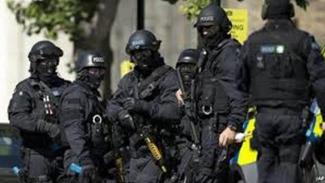
UK’s counter-terrorism squad during a maneuver (File photo)
The police say they used special powers from the counter-terrorism laws in order to read communications between Kermani and a man who featured in his program and had publicly identified himself as a member of the Takfiri terrorist group in Syria.
“While we would not seek to obstruct any police investigation, we are concerned that the use of the Terrorism Act to obtain communication between journalists and sources will make it very difficult for reporters to cover this issue of critical public interest”, Ian Katz, the editor of Newsnight said on Wednesday.
Meanwhile, the British police have come under sharp criticism over the seizure of the laptop. “A hysteria around terrorism” is how Jo Glanville, director of the campaign group English PEN described the incident.
According to a BBC spokesman, the police had every right to use the special power but said “the man featured in Newsnight reports was not a confidential source.”
Orders obtained under the Terrorism Act leave journalists with little or no comeback when police use them to seek access to material. By contrast, a public interest defense has been used in the past to contest attempts by the police.
Federal Appeals Court: US Citizens Can’t Sue FBI Agents For Torture Abroad
By Kevin Gosztola | ShadowProof | October 26, 2015
A federal appeals court decision effectively grants FBI agents involved in terrorism investigations abroad immunity from lawsuits, which allege torture or other constitutional rights violations.
The D.C. Circuit Court of Appeals ruled against Amir Meshal, an American citizen who was detained and tortured by FBI agents in Kenya, Somalia, and Ethiopia, and declined to permit Meshal to pursue damages for what he endured.
According to the federal appeals court [PDF], allowing Meshal to pursue damages would extend Bivens into a new context: the “extraterritorial application of constitutional protections.”
Bivens is a case that created precedent for bringing cases against federal government officials. However, courts have been extremely reluctant to allow plaintiffs to pursue damages when a case may set a precedent or lead to a court intruding upon national security and foreign policy matters.
In Meshal’s case, U.S. agents and foreign officials are accused of working together. A decision would pass judgment on officials working under a “foreign justice system.” Such “intrusion,” the appeals court claimed, could have diplomatic consequences.
The appeals court quoted prior cases and stated:
Allowing Bivens suits involving both national security and foreign policy areas will “subject the government to litigation and potential law declaration it will be unable to moot by conceding individual relief, and force courts to make difficult determinations about whether and how constitutional rights should apply abroad and outside the ordinary peacetime contexts for which they were developed.” Even if the expansion of Bivens would not impose “the sovereign will of the United States onto conduct by foreign officials in a foreign land,” the actual repercussions are impossible to parse. We cannot forecast how the spectre of litigation and the potential discovery of sensitive information might affect the enthusiasm of foreign states to cooperate in joint actions or the government’s ability to keep foreign policy commitments or protect intelligence. Just as the special needs of the military requires courts to leave the creation of damage remedies against military officers to Congress, so the special needs of foreign affairs combined with national security “must stay our hand in the creation of damage remedies. [emphasis added]
Or, more succinctly, the appeals court claims “special factors counsel hesitation” in allowing Meshal to pursue “money damages.”
The appeals court additionally determined Meshal’s citizenship did not override these “special factors.”
In issuing this decision, the appeals court leaves the issue of remedies for torture to Congress or the Supreme Court and makes it virtually impossible for torture survivors to pursue justice when their rights are supremely violated.
Meshal is Detained Incommunicado, Threatened with Transfer to Israel
Meshal was in the Horn of Africa when, on January 24, 2007, Kenyan soldiers captured and interrogated him. He was “hooded, handcuffed and flown to Nairobi, where he was taken to the Ruai Police Station and questioned by an officer of Kenya’s Criminal Investigation Department” and was told that the police had to “find out what the United States wanted to do with him before he could send him back to the United States.” He remained in detention without access to a telephone or his attorney for a week, according to the U.S. District Court of the District of Columbia’s decision.
On February 3, “three Americans,” who turned out to be FBI agents, interrogated Meshal and told him he would be handed over to the Kenyans and remain stuck in a “lawless country” if he did not cooperate. The agents also accused him of “having received weapons and interrogation resistance training in an al Qaeda camp.” Supervising Special Agent Chris Higgenbotham, one of the officials sued, threatened Meshal with being transferred to Israel where the Israelis would “make him disappear.” Meshal was informed that another U.S. citizen he had met in Kenya, Daniel Maldonado, who was also seized by Kenyan soldiers, “had a lot to say about” him and his story “would have to match.”
Meshal was flown by Kenyan officials to Somalia with twelve others on February 9. He was “detained in handcuffs in an underground room with no windows or toilets,” which was referred to as “the cave.” This was allegedly to prevent pressure from Kenyan courts to halt his detention and interrogation by FBI agents.
About a week later, Meshal was transported in handcuffs and a blindfold to Addis Ababa, Ethiopia. He was held there in incommunicado detention for a week before Ethiopian officials started regularly transporting him to a villa with other prisoners where he could be interrogated by FBI agents. He remained in detention for three months and was moved into solitary confinement twice.
Finally, on May 24, he was taken to the U.S. Embassy in Addis Ababa and flown back to the U.S. He was detained for four months and lost eighty pounds. US officials never charged him with a crime.
Appeals Court Skeptical of US Secrecy Arguments (But That Didn’t Matter)
Although the U.S. government did not invoke the “state secrets privilege,” it put forward a “laundry list of sensitive issues” that would allegedly be implicated if Meshal was able to pursue a lawsuit against FBI agents.
The government claimed it would involve “inquiry” into “national security threats in the Horn of Africa region,” the “substance and sources of intelligence,” and whether procedures relating to counterterrorism investigations abroad “were correctly applied.” Also, the government insisted it would require discovery “from both foreign counterterrorism officials, and U.S. intelligence officials up and down the chain of command, as well as evidence concerning the conditions at alleged detention locations in Ethiopia, Somalia, and Kenya.”
The appeals court appropriately asked in their decision, “Why would an inquiry into whether the defendants threatened Meshal with torture or death require discovery from U.S. intelligence officials up and down the chain of command? Why would an inquiry into Meshal’s allegedly unlawful detention without a judicial hearing reveal the substance or source of intelligence gathered in the Horn of Africa?”
“What would make it necessary for the government to identify other national security threats?” the court additionally asked.
Despite recognizing the unfounded basis for claims about how the lawsuit would risk disclosure of sensitive information, the appeals court chose to be overly cautious and dismiss the case as the government urged.
Appeals Court Overlooks Affidavit from Former FBI Agent
The American Civil Liberties Union, which filed the suit on behalf of Meshal, obtained an affidavit from former FBI Agent Donald Borelli, who unequivocally made clear FBI agents are expected to follow the U.S. Constitution when in territories abroad.
“The FBI’s longstanding commitment to respect the Constitution—including when it acts abroad in respect of U.S. citizens—reflects and implements the long established rule that the Constitution applies to and constrains U.S. government action against U.S. citizens abroad,” Borelli maintained.
In fact, Borelli cited a Supreme Court decision in 1957 involving two U.S. citizens, “who were tried and convicted by court-martial based on allegations they murdered service member spouses on U.S. military bases.”
From the Supreme Court’s ruling:
At the beginning we reject the idea that when the United States acts against citizens abroad it can do so free of the Bill of Rights. The United States is entirely a creature of the Constitution. Its power and authority have no other source. It can only act in accordance with all the limitations imposed by the Constitution. When the Government reaches out to punish a citizen who is abroad, the shield which the Bill of Rights and other parts of the Constitution provide to protect his life and liberty should not be stripped away just because he happens to be in another land. This is not a novel concept. To the contrary, it is as old as government. It was recognized long before Paul successfully invoked his right as a Roman citizen to be tried in strict accordance with Roman law.
Citizens like Meshal are supposed to have protection from unreasonable searches and seizures, however, the lower courts are unwilling to check the power of the Executive Branch. They have chosen to wait until the Supreme Court or Congress acts and that gives someone like Meshal an exceedingly small chance of ever winning justice.
Palestinian Teen Killed In Hebron, Second In Three Hours
IMEMC & Agencies – October 29, 2015
The Palestinian Health Ministry has reported, Thursday, that Israeli soldiers shot and killed a Palestinian teenager, in the southern West Bank city of Hebron, the second Palestinian to be killed in the city in less than three hours.
The Ministry said the slain Palestinian has been identified as Farouq Abdul-Qader Seder, 19 years of age.
He was shot dead in the Shuhada Street, close to the Beit Hadassah illegal Israeli colonialist outpost, in the heart of Hebron city.
The Israeli army claimed the Palestinian “carried a knife, and attempted to stab a soldier,” a claim that was strongly denied by eyewitnesses.
Eyewitnesses also said Israeli soldiers, and extremist colonizers attacked the dead body of the slain Palestinian, and opened fire on the home of resident Hajj Mofeed Sharabati.
The army claims several Palestinian activists, of the Independent Human Rights Committee and Youth Coalition against Settlements, “were hiding in the Sharabati home.”
Farid al-Atrash, head of the Independent Committee for Human Rights in the southern part of the West Bank, said the soldiers attacked him and many Palestinians who were with him when they rushed to the scene, where the Palestinian was killed, after hearing gunshots.
“The soldiers attacked us, and we ran to the home of Mofeed Sharabati,” he stated, “The soldiers and fanatic settlers followed us, and attacked us in his home.”
“We are here, and will remain here; we document the Israeli violations; we defend the legitimate rights of the Palestinians to live in peace and dignity,” he added, “The soldiers also fired a gas bomb targeting the Sharabati home, and surrounded it.”
Also Thursday, soldiers shot and killed Mahdi Mohammad Ramadan al-Mohtasib, 23 years of age, near the Ibrahimi Mosque, in Hebron.
The latest fatal shootings on Thursday bring the number of Palestinians, killed by Israeli army fire in occupied Palestine since the beginning of this month to 68, including 14 children.
49 Palestinians were killed in the West Bank, including Jerusalem, 17 in the Gaza Strip, including a mother and her two years of age child, and one in the Negev, the Palestinian Health Ministry said.
The Ministry added that at least 914 have been shot by live Israeli army fire, while 878 were shot with rubber-coated steel bullets.
It also said that 206 Palestinians suffered fractures and bruises after being beaten by Israeli soldiers and extremist settlers, 14 suffered burns due to Israeli gas bombs and concussion grenades, and more than 5000 Palestinians received treatment for the effects of tear gas inhalation.
Shot woman: Israeli police alter story again
By Jonathon cook | The Bog From Nazareth | October 29, 2015
 The official Israeli story about Israa Abed – the Nazareth woman who was shot six times on Oct 9 by Israeli security forces as she stood motionless in a bus station – has changed so many times, it’s difficult to know what to believe any more. By a small miracle she survived the shooting.
I raised many questions about this incident, based on two videos taken by bystanders, in a post on the day she was shot. That post, including the videos, is available here.
Israa is one of Israel’s 1.6 million Palestinian citizens. She lives in Israel, not the occupied territories.
Let’s be clear: the main reason the police have repeatedly revised their account of the events of Oct 9 is because the visual evidence has conclusively refuted their claims. They have been forced to back-pedal.
Without the video, Israa would have been charged with, and probably convicted of, terrorism offences. In line with threats from Israeli prime minister Benjamin Netanyahu, she would also have risked being stripped of her citizenship.
Originally the police said they “neutralised” Israa after she pulled out a knife and stabbed a security guard at the bus station in the city of Afula. When it was clear no one had been injured, the story changed: she had tried without success to stab the guard.
Then it was reported that the police had shot Israa not because of an attempted attack but because she behaved in a threatening manner towards other people at the bus station.
Now, in the latest version, the police say she did not intend to stab anyone. In the video footage, reports the Haaretz newspaper, she can be seen “standing next to a young ultra-Orthodox man without trying to hurt him”.
Instead, the police say she was depressed and / or mentally unstable and pulled out a knife because she wanted to “induce” the security forces to shoot her.
Pause for a second as you digest that argument. According to the police, Israa went to the bus station with the intention of pulling out a knife but not harming anyone, knowing that doing so would be enough to get her shot and maybe killed. And why would she think that? Because she looks Arab (she wears a headscarf), and, like most Palestinian citizens, understands that in any confrontation with the security services that is reason enough for the police to shoot without justifiable cause.
Even more disconcertingly, the Israeli police seem to agree that Israa’s assumptions were warranted.
Further, the claim that Israa wanted to be shot is pretty convenient for the four security staff who, even according to the official account, fired their weapons at a woman who posed absolutely no threat to anyone at the bus station.
Might they be disciplined, or, more properly, punished, for shooting a woman six times for no reason at all? Apparently not. They have been investigated and it has been decided that “there is no reason to take disciplinary measures against them, given the extenuating circumstances of the incident”. One might well ask: what were those “extenuating circumstances”?
Finally, the police are still claiming that Israa pulled out a knife. Given their series of bogus claims till now, there is no reason to assume even this part of their story to be true.
As I noted in my previous post, a video taken seconds after Israa was shot, when she is lying on the ground, appears to show a pair of sunglasses next to her. A man in jeans and T-shirt goes over to her, ignored by police, and kicks away the sunglasses. Who is that man and why is he interfering with evidence? No one seems to be asking these questions, so we are unlikely to get any answers.
www.haaretz.com/israel-news/1.682928
Featured Video
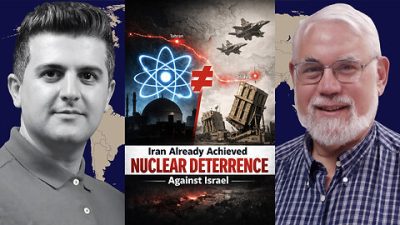
Prof. Ted Postol: Iran Already Achieved Nuclear Deterrence Against Israel
or go to
Aletho News Archives – Video-Images
From the Archives
How the occupied mentality syndrome works
Saudi Arabia on the American chessboard – Part 3
By B. J. Sabri | American Herald Tribune | June 27, 2016
Read part 2: “The occupied mentality Syndrome“
Previously I argued whether Saudi Arabia’s repeated involvements in U.S. interventions and wars stem from free national will or in response to a specific condition. For starters, in Saudi Arabia there is no national will. In Saudi Arabia, the national will is the will of the Al Saud clan. Still, when a major Arab state allies itself with a superpower that committed unspeakable crimes against humanity in almost every Arab country, then something is wrong. This fact alone should compel us to examine the U.S.-Saudi relation for one exceptional reason. As a result of the U.S.-Saudi wars, hundreds of thousands of people in Afghanistan, Iraq, Iran, Libya, Syria, Yemen, and Somalia have lost their lives. Millions became displaced in their own homelands. And millions more rendered refugees.
Attributing the Saudi policies to the bonds of “partnership” with the U.S. is frivolous. There are no bonds between these two thugs except those of business, military deals, secret plots, and wars. Proving this point, bonds such as these have no space for the American and Saudi peoples to share significant cultural or societal exchanges. If partnership is not the reason for the Saudi contribution to the U.S. strategy of empire and imperialism, then another reason must exist.
This leads to three possibilities. … continue
Blog Roll
 Aletho News
- REWRITING THE RISK? INSIDE THE GOVERNMENT’S VACCINE SAFETY MESSAGING
- “Davos Can Really Replace the UN”
- NIAID/NIH and USDA Fund Bioengineered Chimeric Influenza Viruses Built Using Pandemic H1N1 Components: Journal ‘Science Advances’
- Hezbollah hits Israeli warship off Lebanon’s coast, sets it aflame
- Iran slams US strikes on B1 bridge, Mahshahr petrochemical plants as ‘blatant acts of state terrorism’
- In letter to UN chief, Araghchi warns of dire consequences of US-Israeli attacks on Iran’s nuclear facilities
- Why the CIA conspiracy to invade Iran with Kurdish militias failed
- Why Are Upbeat US Claims About Mission to Rescue Pilot ‘Highly Questionable’?
- Aircraft destroyed during US ‘rescue’ of downed F-15 pilot cost more than $100 million each
- Washington University removes professor who condemned US-Israeli war on Iran
- If Americans Knew
- In Iran, Israel-US take aim at “reason, research, and freedom of thought” – Daily Update
- US loses planes over Iran, Israel downgrades Lebanon war goals – Daily Update
- Israel Is Blocking Palestinians from Easter at Church Where Jesus Resurrected
- Plot to assassinate Palestinian activist follows harassment campaign promoted by Zionist groups and elected officials
- Prominent New York synagogue hosts presentation on why U.S. Jews should support the ethnic cleansing of Gaza
- Tapper vs. Piker: Is the CNN Anchor Auditioning for David Ellison?
- Shouldn’t Democrats Be Able to Condemn Genocide?
- Israel-US kill negotiators, destroy civilian structures, but Iran’s military capabilities still largely intact – Daily Update
- ‘War crime’: Global condemnation as Israeli ministers celebrate death penalty law targeting Palestinian prisoners
- 7 Ways Israel Is Turning Lebanon Into Gaza
- No Tricks Zone
- An Inconvenient Tree: Uncovered In Alps… Europe Much Warmer Than Today 6000 Years Ago
- New Study Reports A 60% Slowdown In Greenland’s Ice Loss Rate In The Last Decade
- Low Intensity Tornado Wrecks Major Solar Farm, Creating A Potential Toxic Dump
- New Study Finds Warming Saves Lives…Cold Temperatures 12 Times More Deadly Than Excess Heat
- German Science Blog Accuses PIK Climate Institute Of Hallucinating Climate Tipping Points
- Devastating Assessment Of Comirnaty Vaccine By Former Senior Pfizer Europe Toxicologist
- New Study: CO2 Is ‘Effectively Negligible’ As An Explanatory Climate Change Factor Since 2000
- Former Pfizer Toxicologist Dr. Helmut Sterz Tells Bundestag Hearing Pfizer Vaccine Should Have Never Been Approved
- Energy Expert: Germany’s Nuclear Phaseout Was A “500 Billion Euro Mistake”
- New Research: South Australia’s Mid-Holocene Sea Surface Temperatures Were 4°C Warmer Than Today
 Aletho News