Israelis – Not Muslims – Cheered in Jersey City on 9/11
A Black Agenda Radio commentary by Glen Ford | November 25, 2015
The corporate media don’t like Donald Trump. They used to like him a lot; in fact, Big Business Media are responsible for making this minor multi-millionaire into a household name. But Trump is on their hit list, nowadays, because the Republican presidential candidate insists on telling his own lies, rather than sticking to the list of official lies parroted by corporate media every minute of every day.
Donald Trump told a really “HUGE” – as he would put it – lie when he claimed to have watched thousands of Muslims cheering in Jersey City, New Jersey, as the World Trade Center came down on 9/11. Every corporate news outlet in the country rushed to debunk Trump’s fictitious account. The Washington Post offered psychological theories for why Trump gets away with telling fantastic lies. The New York Times said there was no evidence that Jersey City Muslims cheered the destruction on 9/11. CNN said it never happened. And, they were right.
However, by making only a partial correction of Donald Trump’s prevarication, the corporate media were telling their own lie about what happened on 9/11. There was, in fact, celebration in Jersey City on that fateful morning, and the incident did, briefly, make a major news splash. But the people doing the cheering weren’t Muslims: they were five young Israelis in a white moving van, who were observed in Liberty Park ecstatically taking pictures of themselves framed against the smoking ruins of the Twin Towers. As ABC News reported, the five were later arrested at gunpoint near the New Jersey Giants football stadium. Most U.S. intelligence sources believed the men were Israeli spies, and that their “moving company” was an Israeli intelligence cover. They were detained for a while, and then deported.
“Who is the biggest liar?”
In the year before 9/11 scores of young Israelis posing as “art students” were arrested after penetrating U.S. Defense Department and other classified sites. Both stories made national news. The corporate media could not have avoided running across articles on the “cheering Israelis” when they set about debunking Donald Trump’s “cheering Muslims” account. But, not one of them dare to mention that, yes, some people were seen celebrating 9/11 at Liberty State Park in Jersey City.
I was in a different part of the park on 9/11 morning, alone except for two young Israelis with very expensive cameras, carrying phony New Jersey press credentials, who claimed to be Polish but spoke Hebrew to each other. The two young men were giddy with joy at the destruction that the three of us were observing across the Hudson River.
Later that day, I learned from local and national news outlets about the five Israelis who were dancing with delight about a mile upriver from me and the two other Israelis. Articles about Israelis celebrating 9/11 would have come up in any search to correct Donald Trump’s tall tale – but the corporate media kept that part of the story from the public. They censored their own correction of Donald Trump. So, who is the biggest liar? Trump, who lies to advance his own personal interests, or the U.S. corporate media, who lie to the people on behalf of the State of Israel, and Zionism.
Glen Ford can be contacted at Glen.Ford@BlackAgendaReport.com.
Russia to deploy S-400 missile defense systems to Syria: Defense minister
Press TV – November 25, 2015
Russia will be deploying S-400 missile defense systems to Syria, the Russian defense minister says.
“The S-400 anti-aircraft missile system will be deployed to the Hmeimim airbase,” Sergei Shoigu said on Wednesday, referring to the Russian airbase outside the port city of Latakia in western Syria.
The system is the most advanced one owned by Russia in the field of air defense. The missile system, an upgrade of the S-300 family, is capable of intercepting and destroying airborne targets such as aircraft and ballistic and cruise missiles at distances of up to 400 kilometers (250 miles).
The official’s remarks came a day after the Turkish Air Force shot down a Sukhoi Su-24M Fencer, which they had accused of having violated Turkish airspace. Russia denies the allegation.
Russian presidential press officer Dmitry Peskov also said Russian President Vladimir Putin had agreed with the proposal made by the Defense Ministry to transfer the missile systems to Hmeimim.
Also on Tuesday, Russian media reported that Russian missile cruiser Moskva equipped with the Fort air defense system, similar to S-300, will be stationed off the coast of Syria’s Latakia province.
Since September 30, Russia has been conducting aerial operations against Daesh, al-Nusra Front, and the other terrorist groups that have been sowing fear and destruction among the Syrian country’s civilian population.
Damascus has hailed the Russian military engagement, which came upon the Syrian government’s request saying that since the beginning of the campaign, terrorists had begun to retreat and flee in thousands.
The foreign-sponsored conflict in Syria has thus far claimed the lives of more than 250,000 people and left over one million injured, according to the United Nations.
A US-led coalition has also been pounding purported Daesh positions inside Syria without any authorization from Damascus or a United Nations mandate since last September. The mission has fallen severely short of dislodging the terrorists.
‘Turkish jets gave us no warning before shooting’ – rescued pilot of downed Russian Su-24
RT | November 25, 2015
The navigator of the Russian Su-24 shot down by a Turkish fighter jet on Tuesday insists that his plane did not cross into Turkey’s airspace, and says he was given no visual or radio warning before being fired at.
“It’s impossible that we violated their airspace even for a second,” Konstantin Murakhtin told Russia’s Rossiya 1 channel. “We were flying at an altitude of 6,000 meters in completely clear weather, and I had total control of our flight path throughout.”
As well as denying Ankara’s assertions that the plane was in Turkey’s airspace, Murakhtin also refuted Turkish officials’ claims that the pilots were warned repeatedly.
“In actual fact there were no warnings at all. Neither through the radio, nor visually, so we did not at any point adjust our course. You need to understand the difference in speed between a tactical bomber like a Su-24, and that of the F16. If they wanted to warn us, they could have sat on our wing,” said Murakhtin, who is currently recuperating at Russia’s airbase in Latakia, northern Syria.
“As it was, the missile hit the back of our plane out of nowhere. We didn’t even have time to make an evasive maneuver.”
Turkey violated Syria sovereignty by attacking Su-24 in its airspace – Syrian FM
RT | November 25, 2015
The downing of the Russian warplane, which aggressively violated Syria’s sovereignty, is proof to the world of Turkish support for terrorism. This has been going on for years, the Syrian foreign minister said.
“This incident has shown the world that [Turkish President Recep] Erdogan and his government are helping terrorists in Syria,” Walid Muallem said after meeting Speaker of the Russian Parliament Sergey Naryshkin.
Muallem expressed his condolences over the death of the Russian pilot and later a marine in the incident.
“We express our condolences over the actions of those terrorists, who Erdogan and his government support, who opened fire at the pilot as he was parachuting down. It was no less than a war crime,” he said.
“We are glad that the joint Russian-Syrian military operation resulted in a rescue of the second pilot,” he added.
Naryshkin said the attack on the Russian plane did not reflect what the Turkish people want from its leadership.
“We believe this act was treason by the Turkish leaders against their own people,” he said.
Turkey deliberately attacked the Russian warplane in revenge for the Russian antiterrorist campaign in Syria, according to the Syrian minister.
“The effort to destroy the forces of Islamic State [IS, formerly ISIS/ISIL] and other terrorist groups offended Turkey. That is why they aggressively violated Syria’s sovereignty and attacked the Su-24 in its airspace,” Muallem said.
He added that the results of the Russian campaign contrast the lack of progress demonstrated by the US-led coalition, including Turkey.
“In 18 months the US and its allies have conducted around 6,000 strikes against the terrorists, but they failed to undermine IS capabilities. On the contrary, they became stronger,” the Syrian diplomat said. “What the Russian [Air Force] do in Syria is a hundred times more than the actions of the US and its allies.”
Russia branded Turkey an accomplice of terrorism after the incident. Moscow believes Ankara wants to protect terrorist groups to continue the flow of cheap oil into the country, which profits some Turkish officials and the jihadists. While Moscow continues an effort to form a global coalition to fight against terrorism in the region, it believes the Turks won’t commit to it.
Russian FM Lavrov’s Address Following Downing of Su-24 by Turkey
Sputnik – November 25, 2015
Russian Foreign Minister Sergei Lavrov has addressed journalists following the downing of the Russian Su-24 jet by an air-to-air missile launched from a Turkish F-16.
The Russian minister held a phone conversation with his Turkish counterpart Mevlut Cavusoglu earlier in the day.
“Moscow is not avoiding contacts with Ankara — my phone conversation with the Turkish FM is proof,” Lavrov said.
Turkey’s foreign minister expressed his sincere condolences to Sergei Lavrov, the Russian Foreign Minister said. But the Turkish minister tried to excuse the incident, Lavrov added.
The Turkish minister said that Turkey did not know it was a Russian jet.
“We have serious doubts it was an accident and prepared footage of the jet downing suggests it wasn’t,” Sergei Lavrov said. “It all looks like a planned provocation”.
The incident occurred following the airstrikes by Russian aviation on ISIL oil trucks.
At NATO’s meeting yesterday, strange words concerning Russia’s Su-24 jet tragedy were said. We received no condolences from NATO or the European Union, Sergei Lavrov said.
Let me remind you, Russian warplanes were in Syrian airspace. But even if a Russian jet crosses into Turkish airspace serious questions arise as to why Turkey did not use the emergency communication line with Russia before or after downing the Su-24 bomber jet, the Russian Foreign Minister added.
“I reminded him [Turkish foreign minister] that on Russia’s initiative a hotline between the Russian National Defense Control Center and the Turkish Defense Ministry was established. The line was established at the beginning of the Russian Aerospace Forces operation in Syria, and was used neither yesterday nor before that, which provokes serious questions,” Lavrov told the press.
Ankara has stated it was unaware that the aircraft belonged to Russia.Lavrov also said he recalled a 2012 statement by Turkish President Recep Tayyip Erdogan during the phone talk with Cavusoglu. The Turkish leader said back then that a short violation of airspace was not a pretext to use force.
“I reminded my Turkish colleague of this statement and he could not reply to this either, just repeating that they did not know what kind of aircraft this was,” the Russian minister said.
The minister also wondered if Turkey has coordinated its actions with the United States.
“I wonder whether Turkey consulted the US before downing any jet in the Syrian airspace,” he said.
Russia is still expecting apology from Turkey over the downing of the Russian Su-24 bomber jet over Syria.
“We’re not going to wage a war against Turkey,” Sergei Lavrov said answering a question from a journalist.
According to the Russian foreign minister, “the attitude toward Turkish people has not changed.”
“We have questions only to the current Turkish government,” Lavrov noted.
But Russia will seriously reassess all agreements with Turkey, he added. As for specific measures, we’ve recommended our citizens not to travel to Turkey, Lavrov said.
“In regard to the current level of our relations and agreements that we have concluded with the Turkish government currently in force in Ankara, as the [Russian] president has said, we will seriously reassess and review everything that is going on in our relations taking into count the attack that was delivered against our airplane,” Lavrov said at a press conference.
Too many indicators showing terrorist threats have appeared on Turkish soil, Russian Foreign Minister Sergei Lavrov said Wednesday.
“We cannot leave everything that has happened without a reaction not because we have to respond somehow, that’s not it. Actually there have been too many indicators on Turkish soil that show a direct terrorist threat to our citizens,” Lavrov said at a press conference.
Russia may raise the issue in the UN Security Council of developing an overall understanding on the fight against channels of equipping and financing militants in Syria, Russian Foreign Minister Sergei Lavrov said Wednesday.
“I think that now we will insist on not just a list of members of this group, but also agree on the overall understanding of the channels the terrorists use to get their feedlines and support,” Lavrov said during a press conference.
“We will somehow probably have to deal with certain countries so that this support ends,” Lavrov added.
Russia tried to persuade Turkey to take a more balanced position on the Syrian crisis, Russian Foreign Minister Sergei Lavrov said in an interview with Russian and foreign media.
According to Lavrov, Moscow “did not try to turn a blind eye” to the fact that Islamists are using Turkey as a platform to prepare terrorist acts in Syria and other countries.”We tried to take into account the interests of our Turkish neighbors and tried to explain our positions in a dialogue,” the Foreign Minister said.
“We tried to persuade them to conduct a more balanced policy not aimed only at getting rid of Assad at any cost and thus cooperating with all kinds of extremist groups,” the foreign minister stressed.
Moscow backs the proposal of French President Francois Hollande to close the Turkish-Syrian border, Sergei Lavrov said.
“I think this is the right decision. I hope President Hollande will tell us more about the issue tomorrow. We would be ready to consider all measures that needed for this [closing the border]. By closing the border we will basically thwart the terrorist threat in Syria,” the minister said.
Earlier Russia’s top diplomat cancelled his visit to Turkey after a Russian Su-24 jet was downed over Syria.
“The president clearly stated that this could not but affect Russian-Turkish relations. In this context, it was decided to cancel the meeting between Russia’s and Turkey’s ministers of foreign affairs, which was planned for tomorrow [November 25] in Istanbul,” Sergei Lavrov told journalists on Tuesday.
On Tuesday, a Russian Su-24 jet crashed in Syria. Russian President Vladimir Putin said that the plane was downed over Syrian territory by an air-to-air missile launched by a Turkish F-16 jet, and fell 4 kilometers (2.5 miles) from the Turkish border. Putin described the Turkish attack as a “stab in the back” carried out by “accomplices of terrorists.”
The Su-24 tragedy also claimed the life of a naval infantry soldier, who was killed in the rescue operation, according to the Russian General Staff.
Mastermind of The Bamako Terror Attack Mokhtar Belmokhtar: A CIA Sponsored “Intelligence Asset”?
By Michel Chossudovsky | Global Research | November 22, 2015
In response to the tragic Paris events of November 13, Central Intelligence Agency director John Brennan warned that “ISIL is planning additional attacks… It is clear to me that ISIL has an external agenda, that they are determined to carry out these types of attacks.” (Quoted in Daily Telegraph, November 16, 2015)
Five days later following the CIA Chief’s premonition, the Bamako Radisson Hotel Blu in Mali’s capital was the object of a terrorist attack, resulting in 21 people dead. Following the attack and the taking of hostages by the terrorists, French and Malian special forces raided the hotel. US. Africa Command (AFRICOM) also confirmed that US special forces were involved.
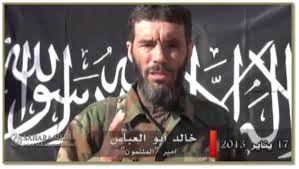 The Bamako terror operation was allegedly coordinated by Mokhtar Belmokhtar (aka Khaled Abu al-Abbas), leader of an affiliate of Al Qaeda in the Islamic Maghreb (AQIM), the Islamist al-Mulathameen (Masked) Brigade, or “Those who Sign with Blood.”
Belmokhtar’s group was created in 2012 in the wake of the war on Libya. His organization has also allegedly been involved in the drug trade, smuggling as well kidnapping operations of foreigners in North Africa. While his whereabouts are said to be known, French intelligence has dubbed Belmokhtar “the uncatchable”.
In June he was reported dead as a result in a U.S. air strike in Libya. His death was subsequently denied.
Based on shaky evidence, The New York Times report below (November 20) concludes that Belmokhtar’s group (together with AQIM) is unequivocally behind the Bamako attacks:
A member of Al Qaeda in Africa confirmed Saturday that the attack Friday on a hotel in Bamako, Mali, had been carried out by a jihadist group loyal to Mokhtar Belmokhtar, an Algerian operative for Al Qaeda. The Qaeda member, who spoke via an online chat, said that an audio message and a similar written statement in which the group claimed responsibility for the attack were authentic. The SITE Intelligence Group, which monitors jihadist groups, also confirmed the authenticity of the statement.
The Qaeda member, who refused to be named for his protection, said that Mr. Belmokhtar’s men had collaborated with the Saharan Emirate of Al Qaeda in the Islamic Maghreb, … In the audio recording, the group, known as Al Mourabitoun, says it carried out the operation in conjunction with Al Qaeda’s branch in the Islamic Maghreb.
The recording was released to the Al Jazeera network and simultaneously to Al Akhbar, … The recording states: “We, in the group of the Mourabitoun [Arabic Rebel Group], in cooperation with our brothers in Al Qaeda in Islamic Maghreb, the great desert area, claim responsibility for the hostage-taking operation in the Radisson hotel in Bamako.” (emphasis added)
The SITE Intelligence Group is presented as an “independent” Washington think tank with a mandate of analyzing data pertaining to Al Qaeda affiliated terror organizations. SITE is also on contract with a number of US government agencies and has close links to US intelligence.
SITE has provided no substantive evidence which supports the authenticity of the online audio chat recording, which is considered as a reliable source. The story could have been planted.
Following the audio release, the Western media in chorus immediately pointed to an act of revenge directed against the French Republic in response to France’s 2013 military intervention in Mali, which had been ordered by President Francois Hollande.
“France saved Mali from al-Qaeda but it never broke terror threat”. “France saved northern Mali from al-Qaeda’s brutal rule … But the country is still beholden to outsiders and, as events at the Radisson hotel have demonstrated, acutely vulnerable to the worst of terrorism” (The Independent, November 20, 2015)
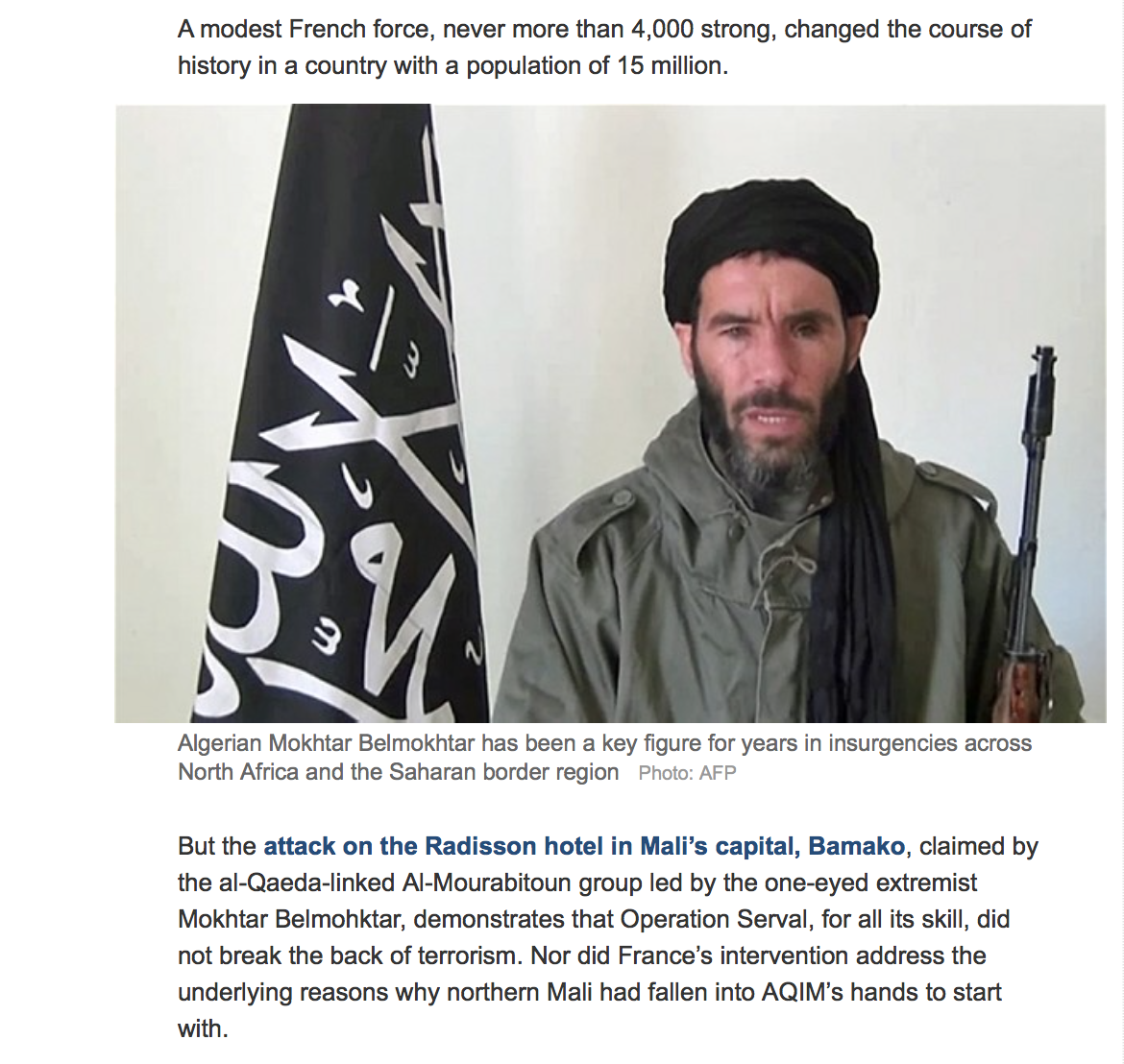
Screenshot The Independent, November 20, 2015
In turn, the French Minister of Defense acknowledged –prior to the conduct of a police investigation– that the authors of the attack were “most likely” led by Mokhtar Belmokhtar’s group in association with Al Qaeda in the Islamic Maghreb (AQIM).
What Defense Minister Jean-Yves Le Drain failed to mention was that both Belmokhtar and AQIM have longstanding links to the CIA, which in turn has a working relationship with France’s General Directorate for External Security, Direction générale de la sécurité extérieure (DGSE).
Casually ignored by the Western media, the leaders of Al Qaeda in the Islamic Maghreb (AQIM) including Belmokhtar were trained and recruited by the CIA in Afghanistan. Acknowledged by the Washington based Council on Foreign Relations (CFR):
Most of AQIM’s major leaders are believed to have trained in Afghanistan during the 1979-1989 war against the Soviets as part of a group of North African volunteers known as “Afghan Arabs” that returned to the region and radicalized Islamist movements in the years that followed. The group is divided into “katibas” or brigades, which are clustered into different and often independent cells.
The group’s top leader, or emir, since 2004 has been Abdelmalek Droukdel, also known as Abou Mossab Abdelwadoud, a trained engineer and explosives expert who has fought in Afghanistan and has roots with the GIA in Algeria. (Council on Foreign Relations, Al Qaeda in the Islamic Maghreb, cfr.org, undated)
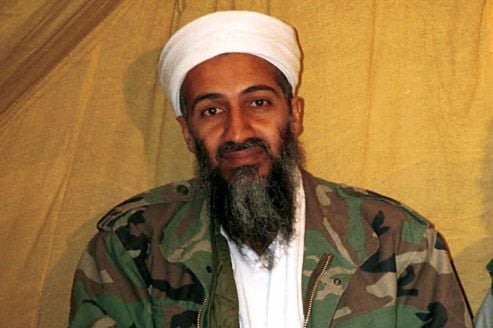 Saudi born terror mastermind Osama bin Laden was recruited in 1979 ironically under the auspices of the CIA. The training, recruitment and indoctrination of Mujahideen launched in 1979 was considered to be “the largest covert operation in the history of the CIA” in response the Soviet Union’s military support of the pro-Communist secular Afghan government of Babrak Kamal.
Al Qaeda in Arabic means “the Base”. What it referred to was the CIA’s “Database” of Mujahideen recruits who were referred to by President Ronald Reagan as “freedom fighters”:
Shortly before his untimely death, former British Foreign Secretary Robin Cook told the House of Commons that “Al Qaeda” is not really a terrorist group but a database of international mujaheddin and arms smugglers used by the CIA and Saudis to funnel guerrillas, arms, and money into Soviet-occupied Afghanistan. (See Pierre-Henri Bunel, Al Qaeda: The Database, Global Research, November 20, 2005, emphasis added)
Mokhtar Belmokhtar: Post Cold War CIA intelligence asset?
The Council on Foreign Relations erroneously describes “Mokhtar Belmokhtar as the one-eyed veteran of the anti-Soviet Afghan insurgency.” (CFR, op cit, emphasis added). Belmokhtar (born in 1972) did not fight in the Soviet-Afghan war (1979-1989). He was recruited in 1991 at the age of 19 in the immediate wake of the Cold War.
CIA recruitment continued in the wake of the Cold War. It was in large part directed against the Russian Federation and the former Soviet Republics as well as the Middle East.
The purpose of this later CIA recruitment was to establish a network of “intelligence assets” to be used in the CIA’s post-cold war insurgencies. Leaders of the Chechen Islamist insurgencies were also trained in CIA camps in Afghanistan and Pakistan, including the notorious leader of the Chechen insurrection Ibn al-Khattab (a citizen of Saudi Arabia).
 Following his training and recruitment and a two year stint in Afghanistan (1991-1993), Mokhtar Belmokhtar was sent back to Algeria in 1993 at age 21 where he joined the Salafist Group for Preaching and Combat (GSPC) (emblem left). The latter was initially part of the so-called Armed Islamic Group (Groupe islamique armé (GIA)) in Algeria which sought to overthrow the secular Algerian Government with a view to installing a theocratic Islamic State.
Supported covertly by the CIA, Belmokhtar fought in Southern Algeria in the civil war opposing Islamist forces and the secular government. He was also instrumental in the integration and merging of “jihadist” forces.
In January 2007, the Armed islamic Group (GIA) which had been prominent in the 1990s, officially changed its name to the Al-Qaeda Organization in the Islamic Maghreb (AQIM).
In turn, as of 2007, the newly formed AQIM established a close relationship with the Libya Islamic Fighting Group (LIFG), which was directly supported by NATO during the 2011 war on Libya, “providing weapons, training, special forces and even aircraft to support them in the overthrow of Libya’s government.” (Tony Cartalucci, The Geopolitical Reordering of Africa: US Covert Support to Al Qaeda in Northern Mali, France “Comes to the Rescue”, Global Research, January 2013).
British SAS Special Forces had also been brought into Libya prior to the onset of the insurrection, acting as military advisers to the LIFG.
In fact, what has unfolded since the war on Libya is the merging of LIFG and AQIM forces. In turn, many of the LIFG operatives have been dispatched to Syria to fight within the ranks of Al Nusrah and the ISIS.
Robert Stephen Ford, US Ambassador to Algeria (2006-2008)
It is worth noting that the 2007 restructuring of jihadist forces in Algeria and the Maghreb coincided with the appointment of Robert Stephen Ford as US ambassador to Algeria in August 2006. Ford had been reassigned by the State Department from Baghdad to Algiers. From 2004 to 2006, he worked closely with Ambassador John Negroponte at the US embassy in Baghdad in supporting the creation of both Shia and Sunni death squads in Iraq.
This project consisted in recruiting and training terrorists modelled on the so-called “Salvador Option” which had been applied by the CIA in Central America. Negroponte as we recall played a central role in supporting the Contras terrorists in Nicaragua as ambassador to Honduras from 1981-1985. For further details see Michel Chossudovsky, “The Salvador Option For Syria”: US-NATO Sponsored Death Squads Integrate “Opposition Forces”, Global Research, May 28, 2012)
The 2006 appointment of Robert Stephen Ford to head the US Embassy in Algeria was timely. It coincided with the consolidation of jihadist groups within Algeria and the Maghreb. It preceded the 2011 US-NATO sponsored insurrections in Libya and Syria.
In 2010, Ford was approved by the US Congress as US Ambassador to Syria. He presented his credentials to president Bashar al Assad in January 2011, barely two months prior to the onslaught of the terrorist insurrection in the border city of Daraa in mid-March 2011. Ford played a central role in assisting the channelling of US and allied support to Syrian “opposition” groups including Al Nusrah and the ISIS.
Concluding Remarks
Belmokhtar’s history and involvement in Afghanistan confirms that from the very outset he was an instrument of US intelligence. While, he operates with a certain degree of independence and autonomy in relation to his intelligence sponsors, he and his organization are bona fide CIA “intelligence assets”, which can be used by the CIA as part of a covert agenda.
There are various definitions of an “intelligence asset”. From the standpoint of US intelligence, “assets” linked up to terrorist organizations must not be aware that they are supported and monitored by Western intelligence.
With regard to Al Qaeda, from the outset in 1979, the CIA chose to operate through various front organizations as well as indirectly through its Saudi, Qatari and Pakistani intelligence partners. CIA’s Milton Beardman who played a central role in the Soviet Afghan war confirms that members of Al Qaeda including Osama bin Laden were not aware of the role they were playing on behalf of Washington. In the words of bin Laden (quoted by Beardman): “neither I, nor my brothers saw evidence of American help”(Michel Chossudovsky, Who is Osama bin Laden, Global Research, September 12, 2001):
Motivated by nationalism and religious fervor, the Islamic warriors were unaware that they were fighting the Soviet Army on behalf of Uncle Sam. While there were contacts at the upper levels of the intelligence hierarchy, Islamic rebel leaders in theatre had no contacts with Washington or the CIA. (Ibid)
Amply documented, Al Qaeda in the Islamic Maghreb (AQIM)and its affiliated groups including the Libya Islamic Fighting Group (LIFG) was serving the interests of the Western military alliance. Confirmed by the Washington Post, June 29, 2011 (See below), France was supplying weapons to the LIFG at the height of NATO’s bombing raids.
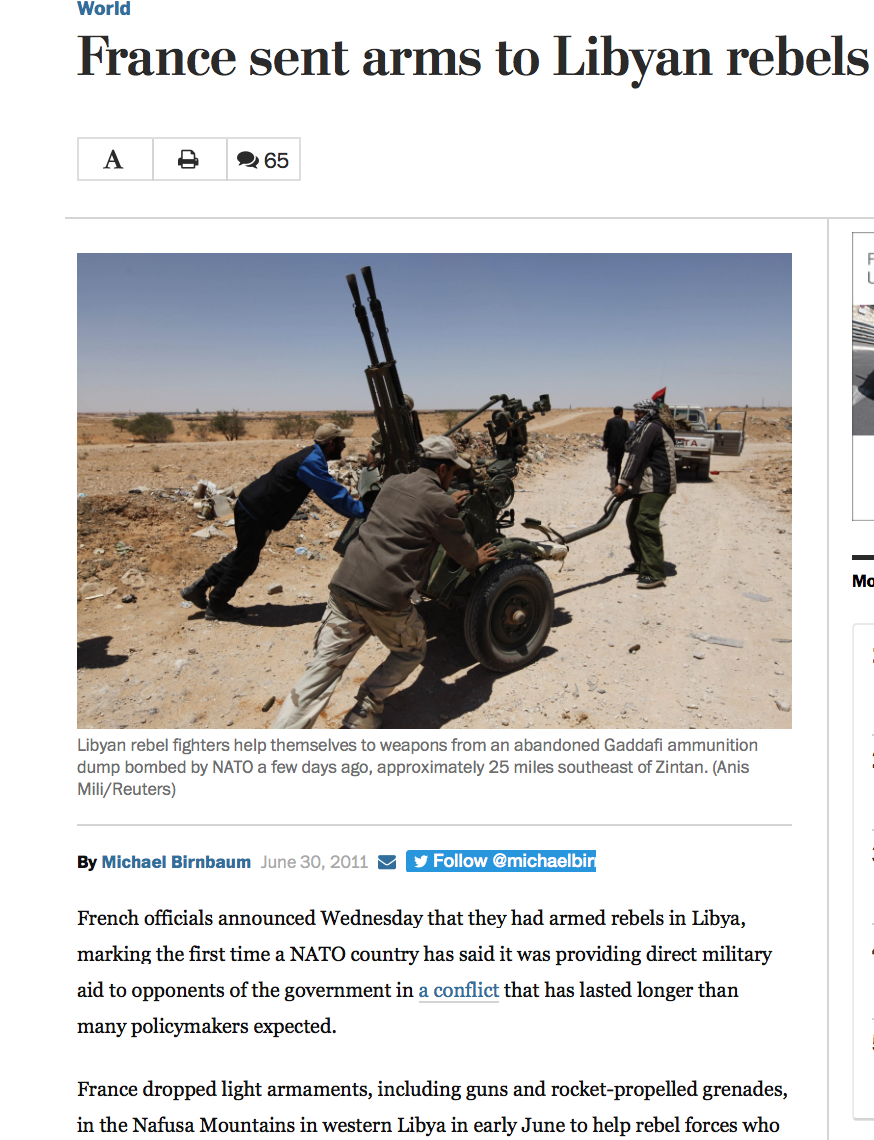
AQIM in turn was receiving weapons from the LIFG, which was supported by NATO. Moreover, LIFG mercenaries had integrated AQIM brigades.
According to alleged Terror Mastermind Mokhtar Belmokhtar, who also coordinated the 2013 In Amenas Mali kidnapping operation:
“We have been one of the main beneficiaries of the revolutions in the Arab world. As for our benefiting from the (Libyan) weapons, this is a natural thing in these kinds of circumstances.” http://www.hanford.gov/c.cfm/oci/ci_terrorist.cfm?dossier=174
Al Qaeda in the Islamic Maghreb (AQIM) is indelibly tied into a Western intelligence agenda. While it is described as ”one of the region’s wealthiest, best-armed militant groups”, financed covertly by Saudi Arabia and Qatar. France’s Canard enchaîné revealed (June 2012) that Qatar (a staunch ally of the United States) has been funding various terrorist entities in Mali:
The original report cites a French military intelligence report as indicating that Qatar has provided financial support to all three of the main armed groups in northern Mali: Iyad Ag Ghali’s Ansar Ed-Dine, al-Qa’ida in the Islamic Maghreb (AQIM) and the Movement for Unity and Jihad in West Africa (MUJWA).
The amount of funding given to each of the groups is not mentioned but it mentions that repeated reports from the French DGSE to the Defense Ministry have mentioned Qatar’s support for ‘terrorism’ in northern Mali. (quoted by Jeune Afrique June 2012)

Qatar is a proxy state, a de facto Persian Gulf territory largely controlled by Washington. It hosts a number of Western military and intelligence facilities.
The Emir of Qatar does not finance terrorism without the consent of the CIA.
And with regard to Mali, the CIA coordinates its activities in liaison with its French intelligence partners and counterparts, including la Direction du renseignement militaire (DRM) and the Direction générale de la sécurité extérieure (DGSE).
The implications are obvious and should be carefully understood by Western public opinion. Inasmuch as Belmokhtar and AQIM are “intelligence assets”, both US and French intelligence are (indirectly) behind the Bamako attacks.
Both US and French intelligence are complicit in the State sponsorship of terrorism.
Cooking the Books for Israel: How The NY Times Plays a Numbers Game
By Barbara Erickson | TimesWarp | November 23, 2015
 Jodi Rudoren today in The New York Times puts up a numbers barrier to hide the reality of Palestinian casualties in the latest spate of violence in Israel and the occupied Palestinian territories. The aim, as usual, is to maintain the claim of Israeli victimhood and to obscure the criminal brutality of the occupation.
In a story about four who died yesterday in alleged attacks in the region, Rudoren writes that more than 90 Palestinians have been killed since Oct. 1, “about half while attacking or trying to attack Israelis and the rest during demonstrations where they clashed with Israeli soldiers.”
We are to believe from this statement that only violent activists have died at the hands of Israeli forces, but in fact, several Palestinians have been killed in circumstances that were anything but “clashes”—at checkpoints, for instance, when trigger happy troops shot and killed unarmed victims. One of the dead was a 73-year-old grandmother on her way to lunch with her sister.
To omit these cases is to ignore the findings of human rights groups that have charged Israel with committing extrajudicial executions in recent weeks, and Rudoren’s statement, in the face of their evidence, is an effort to distort the facts.
The misrepresentations do not end there, however. Rudoren goes on to say, “At the same time, 17 Israeli Jews have been killed and dozens wounded in 70 stabbings, 10 shootings and 10 vehicular attacks.”
Note what is missing here: the number of Palestinians that have been wounded and the attacks against them in Israel, the West Bank and Gaza. Her aim is to minimize the huge discrepancy in casualty counts by omitting the number of Palestinians wounded by Israeli forces and settlers.
Ninety compared to 70 sounds like something approaching parity, but Rudoren has deliberately omitted the logical comparison—the number of injuries. This, according to United Nations data, was 133 Israelis and 9,171 Palestinians injured as of Nov. 16.
We should ask Rudoren and Times editors why this information is missing here, in a context that cries out for full disclosure.
Beyond the full casualty count, the Times could also inform readers of other statistics that illuminate the reality of Palestinian-Israeli relations:
- A weekly average of 150 Israeli military search and arrest operations in the West Bank last year.
- 211 reported incidents of settler violence against Palestinians this year as of Nov. 16. (Actual incidents are daily occurrences throughout the West Bank.)
- 50 Israeli military incursions into Gaza from Jan. 1 to Nov. 16, 2015.
- 481 demolitions of Palestinian-owned structures as of Nov. 16 this year. (This includes homes, animal shelters, cisterns, wells and public buildings such as schools.)
- 601 Palestinians displaced due to demolitions in 2015.
- 6,700 Palestinian political prisoners currently held by Israel.
- 320 Palestinian child prisoners currently in Israeli prisons.
The information for the numbers above comes from the UN Office of Coordination for Humanitarian Affairs and from Addameer, a Palestinian prisoners’ rights organization. The Times, however, ignores their reports and prefers to rely on official Israeli entities. Thus, the numbers Rudoren cites for attacks and casualties are taken from the Israeli Ministry of Foreign Affairs, which has an obvious interest in political spin.
Israel has the first and last word in the Times. The United Nations, Palestinian monitoring groups and human rights organizations are silenced while Israeli official claims are taken as fact. The word “alleged,” for instance, never appears in Rudoren’s piece today. The UN report, however, uses the term frequently, distinguishing between the claims of security forces and verified information.
In short, Times reporting on Palestine and Israel is a disgrace. Numbers are deliberately manipulated, relevant facts are censored, and the result is dishonest journalism, in spite of the newspaper’s lofty claims of providing “the complete, unvarnished truth” and “impartial” reporting. The numbers simply prove them wrong.
Follow @TimesWarp on Twitter.
Cameron must investigate ISIS terror funding by Gulf allies – Lord Ashdown
RT | November 24, 2015
Prime Minister David Cameron must examine financial links between UK-allied Gulf regimes and terror groups, or risk facing awkward questions about Conservative Party links to “rich Arab Gulf individuals,” says former Liberal Democrat leader Paddy Ashdown.
Speaking on ITV’s Lorraine program on Tuesday, Ashdown – who is also a former soldier and has served as an ambassador to Afghanistan and Bosnia – said he is deeply concerned about how terrorism and Islamic State (IS, formerly ISIS/ISIL) are being funded, and the UK government’s response to this.
“Who is arming ISIS, who is providing safe havens for ISIS? To get there you have to ask questions about the arms everyone’s sold in the region, the role of Saudi Arabia in this. I think there are some very big questions and we have to be careful,” Ashdown said.
He said there had been a “failure to put pressure on the Gulf states, especially Saudi Arabia and Qatar, to stop funding the Salafists and Wahhabists,” and said he is worried “about the closeness of the Conservative Party and rich Arab Gulf individuals.”
He hinted the strategic priorities of the UK in Syria are the wrong way around. “I think we should be impatient about the removal of ISIL and I think we should be more patient about the removal of Assad.”
Ashdown’s calls for a proper investigation into terror funding by the West’s Arab allies echo, to some extent, those of Labour Party leader Jeremy Corbyn.
Speaking to the House of Commons last Wednesday, the Labour leader urged Parliament to take more action to clamp down on institutions which provide “vital infrastructure” to the terror group in Syria and Iraq.
Corbyn said one of the main ways to stop IS from functioning is to cut off its resources, suggesting the EU would also need to play a part in suffocating the organization.
“Surely a crucial way to help defeat ISIL is to cut off its funding, its supply of arms, and its trade,” Corbyn said during prime minister’s questions (PMQs).
“Can I press the prime minister to ensure that our allies in the region, indeed all countries in the region, are doing all they can to clamp down on individuals and institutions in their countries who are providing ISIL with vital infrastructure?”
Russia deploys missile cruiser off Syria coast, ordered to destroy any target posing danger
RT | November 24, 2015
Moscow plans to suspend military cooperation with Ankara after the downing of a Russian bomber by Turkish air forces, Russian General Staff representatives said on Tuesday. Further measures to beef up Russian air base security in Syria will also be taken.
Sergey Rudskoy, a top official with the Russian General Staff, condemned the attack on the Russian bomber in Syrian airspace by a Turkish fighter jet as “a severe violation of international law”. He stressed that the Su-24 was downed over the Syrian territory. The crash site was four kilometers away from the Turkish border, he said.
Rudskoy said the Russian warplane did not violate Turkish airspace. Additionally, according to the Hmeymim airfield radar, it was the Turkish fighter jet that actually entered Syrian airspace as it attacked the Russian bomber.
The Turkish fighter jet made no attempts to contact Russian pilots before attacking the bomber, Rudskoy added.
Featured Video
Daniel Davis: U.S. Military Options & War Narrative Collapse
or go to
Aletho News Archives – Video-Images
Book Excerpt
“Vaccines Do Not Cause Autism!” The Science is Settled. Right?
ICAN urges the IACC to actually study infant vaccines and autism
 By Aaron Siri | Injecting Freedom | March 16, 2026
On behalf of ICAN, we just sent a copy of chapter 11 of Vaccines, Amen to the newly appointed members of the federal Interagency Autism Coordinating Committee (IACC).
If you haven’t already read this chapter, you can read the whole thing in the attached letter. I trust that after you read it, you’ll see why the statement “vaccines do not cause autism” is a belief, not science!

IACC Public Comment Letter
1.53MB ∙ PDF file
Includes chapter 11 of Vaccines, Amen
Blog Roll
 Aletho News
- Washington’s War on Cuba Is Older Than You Think
- Daniel Davis: U.S. Military Options & War Narrative Collapse
- Protesters call on Brussels university to cut partnership with Israeli defense-linked firm
- Weapons makers cash in on Trump’s Iran war
- Why Trump’s anti-Iran naval coalition in Strait of Hormuz is doomed to fail
- IRGC says regional energy sites linked to US will be reduced to ashes
- Qatar condemns ‘dangerous’ Israeli attack on gas field
- Iran made ‘unexpectedly substantial’ offer during Geneva talks, US envoys ‘dragged’ Trump into war: Report
- Russia condemns Israel’s attack near Bushehr plant, files complaint
- Russia Strongly Condemns Actions Aimed at Harming Health of Iranian Leadership – Kremlin
- If Americans Knew
- How ignorance, misunderstanding and obfuscation ended Iran nuclear talks
- Israeli media reports grotesque settler attack in West Bank
- UK security adviser attended US-Iran talks and judged deal was within reach
- Tucker Carlson says ‘neocons’ will try to destroy Joe Kent over resignation
- Lebanon death toll exceeds 900, another assassination in Iran, bombing in Gaza – Not a ceasefire Day 159
- Trump’s counterterrorism chief, whose own wife was killed by ISIS, quits over Iran War saying Tehran posed ‘no imminent threat’
- Here’s what US could fund instead of Bibi’s war on Iran
- Israel Killed Over a Dozen Lebanese Paramedics in Three Days, Now Claiming That Ambulances Are “Hezbollah” Targets
- War on Iran: These are the heritage sites devastated by US and Israeli attacks
- Four news stories from Israeli media that illustrate Israeli “justice”
- No Tricks Zone
- Energy Expert: Germany’s Nuclear Phaseout Was A “500 Billion Euro Mistake”
- New Research: South Australia’s Mid-Holocene Sea Surface Temperatures Were 4°C Warmer Than Today
- Storing Green Energy To Last Germany 10 Days Would Require A 60-Million Tonne Battery
- New Studies: UK Sea Levels Were 4 Meters Higher Than Today During The Mid-Holocene
- Destructive Green New Deal: German Energy And Metal Group Warns Of Drastic Crisis
- New Study Documents A 20-Year Pause In Arctic Sea Ice Decline – Driven By Internal Variability
- Wake-up Call: Survey Shows Majority Of Germans Now Favor Postponing Climate Targets!
- Televised! Leading German Political Candidate Tells Schoolchildren CO2 Makes Sun Hotter!
- New Study: A Century Warming Of 1.1°C Is ‘Commonplace’ And ‘Not Unusual’ During This Interglacial
- New Study: ‘Internal Noise’ And Volcanic Forcing Can Trigger 10-15°C Warming Within Decades
 Aletho News