Conscientious Objectors In Their Own Words
By Margaret Brooks | Imperial War Museum
Before the First World War there had never been compulsory military service in Britain. The first Military Service Bill was passed into law in January 1916 following the failure of recruitment schemes to gain sufficient volunteers in 1914 and 1915. From March 1916, military service was compulsory for all single men in England, Scotland and Wales aged 18 to 41, except those who were in jobs essential to the war effort, the sole support of dependents, medically unfit, or ‘those who could show a conscientious objection’. This later clause was a significant British response that defused opposition to conscription. Further military service laws included married men, tightened occupational exemptions and raised the age limit to 50.
There were approximately 16,000 British men on record as conscientious objectors (COs) to armed service during the First World War. This figure does not include men who may have had anti-war sentiments but were either unfit, in reserved occupations, or had joined the forces anyway. The number of COs may appear small compared with the six million men who served, but the impact of these men on public opinion and on future governments was to be profound.
Download the transcript of the interviews.
-
Who were Conscientious Objectors?
Broadly speaking there were four reasons why men objected to armed service during the First World War. The most common ground was a religious one. Pacifism was a time-honoured tenet of the Society of Friends (Quakers), although some Quaker men did enlist. Other individuals, including Christian fundamentalists, took the Bible at its word: ‘Thou shalt not kill’. The next largest group of COs were political activists of the left who saw the First World War as an imperialist war and as an example of the ruling classes making a war that the workers had to fight. The left was split over support for the war and those who opposed it on the radical left were not necessarily pacifists – they reserved the right to fight for a cause in which they believed. Thirdly, there were those who might be termed ‘humanists’, who felt it wrong to kill but not on religious grounds. A former naval rating, for example, had worked as a butcher and became a conscientious objector because, as he said, ‘l know what it is to kill a pig – I won’t kill a man’ (IWM SR 784). The fourth group were those who generally objected to government intervention in their lives; some thought the war had nothing to do with them personally but might have fought if they felt the United Kingdom was directly threatened.
Image – Printed leaflet issued by the No-Conscription Fellowship entitled ‘Why We Object’, from the Private Papers of W Harrison (Documents.163)
Audio – Walter Griffin interview © IWM (IWM SR 9790)
-
The Tribunals
The usual procedure for a CO was to apply to his local tribunal for exemption from military service. Here, Walter Griffin describes a particular line of questioning used at the tribunals. Made up of local prominent figures, the tribunals had been set up earlier to decide on exemptions under the unsuccessful Derby Scheme. They were therefore available after conscription was introduced to assess a CO’s conviction and sincerity. The tribunals’ members were poorly briefed and in many cases merely used the hearings to state their own views. One of IWM’s interviewees was asked his age and, on hearing that he was eighteen, the tribunal chairman said: ‘Oh in that case you’re not old enough to have a conscience. Case dismissed’. The CO was sent to prison. At the tribunal’s discretion exemption could be absolute, from combatant service only, or conditional on undertaking work of national importance; but COs were frequently rejected by the local tribunal or offered an unacceptable position. They could then go before an appeals tribunal and if they were refused again they could appeal to the Central Tribunal in London. Once a CO was refused exemption, he was considered to have enlisted into military service.
Image – Military Service Act 1916, poster (Art.IWM PST 5161)
Audio – Walter Griffin interview © IWM (IWM SR 9790)
-
Alternativist and Absolutist Conscientious Objectors
A problem for the CO was determining where to draw the line in his stance and whether there was a difference in principle between combatant and non-combatant service. Some COs would take on alternative civilian work or enter the military in non-combatant roles in the Royal Army Medical Corps or Non-Combatant Corps, for example. COs in prison were offered so-called ‘work of national importance’ in a scheme put forward by the Home Office. This was generally agriculture, forestry or unskilled manual labour. Other conscientious objectors – known as ‘absolutists’ – refused to do any war-related work or obey military orders.
Image – Munitions workers painting shells at the National Shell Filling Factory No.6 in Chilwell, Nottinghamshire, 1917 (Q 30016)
Audio – Philip Radley interview © IWM (IWM SR 642)
-
Military and Civil Punishments
In practice, having been rejected on appeal a CO was a soldier absent without leave and as such was subject to arrest. COs who entered military service were also arrested for refusing to obey military orders. Over one-third of the 16,000 COs went to prison at least once, including the majority of absolutists who were imprisoned virtually for the duration. At first, COs were sent to military prisons because they were considered to be soldiers. It was a minor triumph for the anti-conscription movement when a mid-1916 Army order ruled that COs who had been court martialled were to be sent to civil prisons. The initial standard sentence was 112 days third division hard labour – the most severe level of prison sentence under English law at that time. This began with one month in solitary confinement on bread and water, performing arduous and boring manual jobs like breaking stone, hand-sewing mailbags and picking oakum. With good conduct remission, most COs served about three months. However, after being released a CO could be immediately arrested again as a deserter, court-martialled and returned to prison. This ‘Cat and Mouse’ treatment had been previously used on the Suffragettes, and as the war went on sentences handed down to COs increased. Over the course of the war, some conscientious objectors were actually taken with their regiments to France, where one could be shot for refusing to obey a military order. Thirty-four were sentenced to death after being court martialled but had their sentences commuted to penal servitude. Here, Howard Marten talks about military field punishments and the outcome of his court martial in France.
Image – Copy negative made from a photomontage and cartoon postcard “A Souvenir of C.O. Settlements 1918” (Q 103096)
Audio – Howard Marten interview © IWM (IWM SR 383)
-
Prison conditions
-
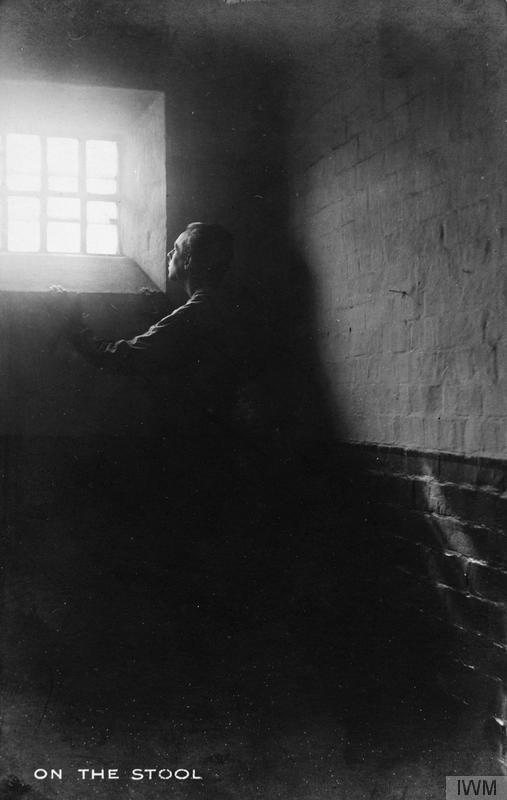
When Harold Bing was in Winchester Prison, there was one wing for male criminal prisoners, one for women and two for conscientious objectors. The conditions for COs were exactly the same as those for criminal prisoners, but COs did succeed in getting prisons to offer a vegetarian diet. Vegetarianism was common among COs, as it had an obvious affinity, particularly with humanitarian pacifism. CO prisoners were allowed a very limited number of censored letters, though one of the COs interviewed by IWM said ‘filling the notepaper was quite an art’ because there was nothing to say after months or years in prison. They had no calendars, no newspapers, and few visits – those visits they did receive were through a grille. They were limited to a few books from the prison library at infrequent intervals, but after a while COs were allowed to have books sent in under the condition that they donate them to the prison library once finished with them. Later CO prisoners were impressed to find prison libraries stocked with titles by William Morris, Sidney and Beatrice Webb and other writers of the left. Here, Bing recalls the constrained and degrading conditions of prison life.
Image – Copy negative made from a postcard of a conscientious objector prison, original caption reads ‘On the stool’ (Q 103094)
Audio – Harold Bing interview © IWM (IWM SR 358)
-
How did conscientious objectors cope in prison?
-
Severe physical brutality towards all COs seems to be a First World War myth. Certainly several of IWM’s interviewees experienced or witnessed very harsh treatment and 73 COs died as a result of physical abuse. The primary punishment – in many cases the most severe – was psychological rather than physical. The most fortunate COs were those who could devise ways to cope with loneliness, doubt, depression and loss of ability to concentrate. Some COs took an active role in challenging the situation in which they found themselves. Some participated in covert activity, described here by Harold Bing. Others coped through mental exercise. One of the COs interviewed by IWM, a musician, played an imaginary piano on his knees and even did some composition. Some COs learned Esperanto, many recited poetry from memory, and several went on long, imaginary, remembered walks. One man held races on the floor between bits of cobbler’s wax and another gained comfort from talking to the spiders on the cell wall and the bolts on its door.
Image – Copy negative made from a conscientious objector postcard depicting the interior of a cell (Q 103669)
Audio – Harold Bing interview © IWM (IWM SR 358)
-
Resistance
-
Some COs openly resisted the system, as described here by Fenner Brockway. Work and hunger strikes were held by COs including Clifford Allen (later Lord Allen of Hurtwood), chairman of the No-Conscription Fellowship, and Sir Francis Meynell. For many COs, the pressures and hardships strengthened their resolve.
Image – Copy negative made from a conscientious objector postcard, original caption reads ‘Ger – inside an’ close yer door!’ (Q 103666)
Audio – Fenner Brockway interview © IWM (IWM SR 476)
-
How were conscientious objectors treated?
-
Whether in prison or not, COs and their families did have a common experience in many respects, especially from the pressures they felt from society. Britain’s public support for the war was almost unanimous and society tended to view men who would not fight – and the men and women who supported them – with suspicion and loathing. To become a conscientious objector in 1916 was a difficult decision, which apparently involved rejecting the whole of conventional British society and everything it stood for. Wartime domestic propaganda made it all too plain that a person was either with the national effort or against it; and if against it, he was by implication either not concerned with the sacrifices of others or was undermining their willingness to serve. The conscientious objector was trapped psychologically: he felt guilty if he shared the soldiers’ ordeal and guilty if he did not. COs were not released until about six months after the end of the war, in order to give most soldiers a head-start when looking for jobs. They were also stripped of the right to vote until 1926. With time most did find a way to fit back into society – some very successfully. None of the COs interviewed by IWM appeared to feel any bitterness about their treatment, but they seem to remain, through their First World War experiences, permanently set apart.
Image – First World War-era cartoon by Frank Holland titled ‘An “Object” Lesson: This Little Pig Stayed at Home’ (Q 103334)
Audio – Clips from interviews with Percy Leonard © IWM (IWM SR 382), Lewis Maclachlan © IWM (IWM SR 565), Dorothy Bing © IWM (IWM SR 555)
This is an abridged version of a longer article, written by Margaret Brooks (former Keeper of the IWM Sound Archive), which appeared in the Imperial War Museum Review, No. 3 (1988).
No comments yet.
Featured Video

Yemen joins the war – Red Sea could be blocked next – Saudi regime at risk
or go to
Aletho News Archives – Video-Images
From the Archives
A superpower and “the world’s sickest warrior state”
By Paul J. Balles | March 8, 2010
Living through five or six major wars has hardened me to what I thought were the extremes of inhuman cruelty and brutality.
Two things made those extremes almost bearable: the brutality always revealed – at least according to the media coverage – the viciousness of the enemy. It was therefore quite understandable when our “brave men and women” pulverized the enemy.
Films of Japanese torturing captive Americans somehow justified holding Japanese Americans in internment camps during World War II; and only a small percentage of Americans found the bombing of Hiroshima and Nagasaki unreasonably vengeful at best, at worst, depraved.
The media giants in America portrayed the North Koreans as barbaric beasts with their captives, quite unlike their southern counterpoints – our allies during the Korean War. No one ever felt the need to explain how the South Koreans were a civilized breed while the North Koreans were absolute savages, at least according to the official line.
In Vietnam, our warriors justifiably (or so the media made us believe) dropped napalm on the North Vietnamese who had the gall to hide in villages and tunnels to ravage our invaders. At least it was accepted practice until some rogue photojournalist filmed a young girl screaming down a Vietnamese road in flames. … continue
Blog Roll
 Aletho News
- America Racing to Strategic Defeat in Iran: Lt Col Daniel Davis
- FTC Warns Visa, Mastercard, PayPal, Stripe Over Political Debanking
- Russian tanker approaches Cuba despite US oil blockade
- Marandi: Yemen joins the war – Red Sea could be blocked next – Saudi regime at risk
- Pro-Palestinian French member of European Parliament denied entry to Canada
- Pakistan to Host US-Iran Talks
- How Indonesia’s tilt toward the US left it stranded in the Strait of Hormuz
- US has no choice but to retreat from Iranian borders: Top commander
- Iran Retaliation Strikes Chemical Plant Near Dimona
- AWACS’ Destruction is a Major Loss for US Military – Ex-DoW Analyst
- If Americans Knew
- Israeli police block Catholic cardinal from entering Church of the Holy Sepulchre on Palm Sunday
- Israel is assassinating journalists again, more than any other nation, anywhere, ever – Not a ceasefire Day 170
- Over 300 US service members wounded, majority have brain injuries – Not a ceasefire Day 169
- Researchers at Human Rights Watch Resign Over Blocked Report on Palestinian Refugee Return
- Jewish Groups Are Backing a War Americans Don’t Want
- Eric Fingerhut Thinks He’s the President of the Jews
- Top Jewish Philanthropists, Rabbis Urge Israeli President to Take Action Against ‘Jewish Extremists’
- Don’t Be Fooled. Zionist Leaders Have Always Wanted to Control Southern Lebanon
- Israel’s widespread use of torture is a core element of its genocide against the Palestinian people
- In Israel’s War on Iran, Many Middle East US Bases Rendered “All But Uninhabitable”
- No Tricks Zone
- New Study Finds Warming Saves Lives…Cold Temperatures 12 Times More Deadly Than Excess Heat
- German Science Blog Accuses PIK Climate Institute Of Hallucinating Climate Tipping Points
- Devastating Assessment Of Comirnaty Vaccine By Former Senior Pfizer Europe Toxicologist
- New Study: CO2 Is ‘Effectively Negligible’ As An Explanatory Climate Change Factor Since 2000
- Former Pfizer Toxicologist Dr. Helmut Sterz Tells Bundestag Hearing Pfizer Vaccine Should Have Never Been Approved
- Energy Expert: Germany’s Nuclear Phaseout Was A “500 Billion Euro Mistake”
- New Research: South Australia’s Mid-Holocene Sea Surface Temperatures Were 4°C Warmer Than Today
- Storing Green Energy To Last Germany 10 Days Would Require A 60-Million Tonne Battery
- New Studies: UK Sea Levels Were 4 Meters Higher Than Today During The Mid-Holocene
- Destructive Green New Deal: German Energy And Metal Group Warns Of Drastic Crisis
 Aletho News
Leave a comment