Confessions of a Daesh Fighter: Target Practice in Turkey
Sputnik – 24.12.2015
A former Daesh militant now held captive by Kurdish forces has told of his experiences fighting for the terrorist organization, including the training he underwent in Turkey before returning to Syria.
A former member of Daesh has told Sputnik Turkey about his experiences as part of the terror group, including the time he spent with the organization in Turkey.
“In August 2014 I trained in Adana under a Daesh commander,” said 20-year-old Abdurrahman Adulhadi. He was captured by the Kurdish People’s Protection Units (YPG) earlier this month in the al-Hol region of eastern al-Hasakah Governorate, northeastern Syria.
“There were 60 of us, and we trained in a village not far from the airport. We got up in the morning and played sport. Once a week we had target practice, they taught us how to use Kalashnikovs, machine guns and other kinds of weaponry.”
“We were trained by Ahmet from Urfa (a city in the South Eastern Anatolia region of Turkey, close to the Syrian border), and a group member called Ibrahim was our interpreter.”
“The training took place in Turkey because the Daesh command thought that it was safer there than in Syria. It wasn’t possible to carry out training in Syria because of airstrikes.”
Adulhadi said that Daesh presented its training facility in Adana to local media as a camp of the Free Syrian Army (FSA), one of many opposition groups the Turkish government allows to have a base in Turkey; the FSA’s base is in the city of Hatay on the Turkish-Syrian border.
“In the media they wrote that we were training in an FSA military camp, but in fact, all 60 of us were members of Daesh. We were Syrian nationals, many of whom in the beginning moved to Turkey to earn some money, and then joined Daesh.”
Having undergone training, Adulhadi said his main responsibility was to persuade more Syrians to join the organization’s preparations in Turkey.
“I made contacts with Syrians on the internet, helped them to get to Turkey and begin training. After I undertook the training, for five months I lived together with a relative who was a Daesh commander in Adana. My task was to meet the new recruits arriving from Syria. After training we sent them to Urfa, and from there – to Raqqa. From Raqqa they distributed themselves across different regions of Syria.”
Daesh in Turkey was provided with arms from Iraq, which were transported across the border in ordinary cars under the pretense of carrying food and other humanitarian supplies.
“Heavy weapons were delivered from Ash-Shaddadi (a town in southern Al-Hasakah Governorate),” said Adulhadi. He explained that he had been sent by a Daesh commander to work for the group’s intelligence service in the town when he was captured by the YPG.
“I spent one night there, and the next night December 11 2015 YPG forces attacked our positions, and took both of us captive. In al-Hol the commander was a Frenchman called Abu Yahya.”
Adulhadi, whose brother is still fighting for the terrorist organization, added that he was left disillusioned by his time with the terrorist organization.
“What I read about Daesh, and what I was faced with in reality were absolutely different things,” he said.
The Free Syrian Army Myth
By Stephen Lendman | December 24, 2015
It’s a phantom army, virtually nonexistent, on paper only, a PR stunt, its so-called “moderates” allied with terrorist groups fighting Assad.
On Wednesday, Fars News (FN) said elements calling themselves the Free Syrian Army (FSA) continue supplying terrorists fighting Assad with weapons.
“The FSA is working side-by-side with al-Qaeda-affiliated groups and supplying them with US-made arms supplied to them by certain Persian Gulf countries like Saudi Arabia and Qatar in order to continue the fight against the Syrian Army,” FN explained.
“FSA worked hand-in-hand with Al-Qaeda affiliates, providing them with necessary supplies and logistics in order for them to continue their battle against the pro-government forces,” citing sources familiar with what’s going on, distinct from phony Western propaganda.
“Necessary supplies like the US-manufactured TOW anti-tank missiles are supplied to the Al-Qaeda groups, including the al-Nusra Front,” through individuals calling themselves FSA representatives, US imperial agents, FN added.
In early December, Syrian forces discovered large caches of weapons, munitions and food supplied by Qatar to terrorist groups – in liberated Lattakia province areas, items marked “A Gift of Qatar’s Government.”
Weapons, munitions and other supplies provided by Saudi Arabia and the UAE were found. The myth of moderate anti-Assad forces persists. Virtually all elements against him are terrorists, including ISIS – fully supported by US-led NATO and regional rogue states.
Separately, Amnesty International turned truth on its head, irresponsibly accusing Russia of killing civilians in Syria – with no verifiable evidence proving it, just pro-Western sources or unnamed ones, allying the group with Washington’s imperial enterprise.
Russian munitions strike terrorist targets with precision accuracy. Photographic evidence proves it, material US-led forces don’t provide.
AI disgracefully accused Russia of “massive(ly) destr(oying)” residential areas, alleging use of banned cluster munitions. A spokesman for UN Secretary-General Ban Ki-moon said “(t)he UN cannot independently confirm” AI’s allegations.
Without mincing words, they’re likely US-sponsored Big Lies, AI reading from the script it’s given. Russia’s Defense Ministry blasted its report, spokesman Igor Konashenkov saying:
“Once again, nothing concrete or new was published, only the same cliches and fakes that we have already debunked repeatedly.”
“The report constantly uses expressions such as ‘supposedly Russian strikes,’ ‘possible violations of international law’ – a lot of assumptions without any evidence.”
“The barrage of lies was aimed at accusing Russian forces of bombing Syrian hospitals. We immediately rejected these claims, presenting comprehensive photographic and video evidence to the public.”
“A characteristic feature of all these allegations is the lack of concrete evidence and references to anonymous witnesses. As for cluster munitions, Russian (aircraft don’t) us(e) them.”
No visual or other evidence proves it “because there are no such weapons at our base. We have a question for Amnesty International.”
“Why did this organization keep silent and turn a blind eye to material, undeniable, real evidence of the use of cluster munitions by the Ukrainian Armed Forces against cities in eastern Ukraine?”
Why does it feature fake reports instead of legitimate ones against criminal states like America and its rogue NATO partners? Why does it fail to denounce their imperial wars, including mass slaughter of civilians?
Why does it destroy what little credibility it may have left by joining the irresponsible Russia-bashing crowd – the one nation above all others doing more to restore peace and stability in war-torn Ukraine and Syria?
Why does it blame Russia for US-led coalition crimes, complicit with ISIS and other terrorist groups it supports?
On Thursday, Russian Foreign Ministry spokeswoman Maria Zakharova denounced AI’s accusations as “lack(ing) facts.”
“The material used in the report can’t be termed as factual data. All this adds to the miserable impression about the work led by human rights activists in Syria.”
“We see a politically motivated approach, constant misinformation on a large scale: some document photos which – it is obvious even without careful analysis – are fake,” likely supplied AI by Washington and/or its key NATO allies.
Russia scrupulously observes fundamental international laws, especially in its anti-terrorism military campaign in Syria, backing up its claims with hard evidence – polar opposite US-led dirty wars, direct or proxy using ISIS and other terrorists as imperial foot soldiers.
Stephen Lendman can be reached at lendmanstephen@sbcglobal.net.
His new book as editor and contributor is titled “Flashpoint in Ukraine: US Drive for Hegemony Risks WW III.”
Unidentified Helicopters Drop off Daesh Terrorists in Afghanistan
Sputnik – 24.12.2015
Afghan authorities are investigating reports that two unidentified helicopters have dropped off Daesh (ISIS/ISIL) terrorists in the Afghan province of Nangarhar, Afghan Senator Haji Lutfullah Baba told the Islamic Republic News Agency (IRNA) on Wednesday.”A number of people in Tor Ghar, Nangarhar Province have contacted me to say that unidentified helicopters have airlifted Daesh militants there,” Iran Front Page reported Baba as having said.
“They asked me to follow up the issue and urge security and military officials to look into the militant movements, which pose a threat to the security of the province and the entire nation.”
A spokesman for the local government in Nangarhar province confirmed reports that the helicopters had dropped off men wearing in black uniforms, and added that similar sightings had also been reported in the provinces of Kunduz, Baghlan and Badakhshan.On December 16 Afghanistan’s Khaama press news agency reported that fierce clashes between Daesh and the Taliban in eastern Nangarhar province had resulted in heavy losses for both sides.
“15 armed opponents have been killed and 36 others wounded in these clashes,” said Ataullah Khogyani, spokesman for the governor of Nangarhar province, who added that four of the dead were Daesh terrorists, and 11 were Taliban.
“Out of the 36 wounded, 11 of them belong to Daesh and 25 others were members of Taliban,” he said, adding that two civilians had also been injured in the clashes.
CNPS: Birth of first European organization against Zionist lobbying
Palestine Information Center – December 24, 2015
 BRUSSELS – European experts and academics have announced the launch of the Center for NGOs and Policy Studies (CNPS) in London and Brussels, which primarily aims to expose Zionist lobbies in Europe and the US.
The announcement was made following a closed meeting held on Wednesday in the Belgian capital Brussels by a galaxy of European experts and academics versed in the field of lobby groups and their influence on policy makers in Europe and the US.
The CNPS, which is considered the first of its kind in this arena, aims, among other things, to delegitimize and blacklist the Zionists lobbies and their institutions, debunk their objectives and activities, and expose their funding sources.
OPEC says low oil prices will continue four more years
Press TV – December 23, 2015
The Organization of the Petroleum Exporting Countries (OPEC) says recovery of global oil prices to above $70 per barrel will not take place for another four years.
According to a report released by OPEC on Wednesday, the organization, which produces a third of the world’s crude, said it foresees a “gradual improvement in market conditions as growing demand and slower than previously expected non-OPEC supply growth eliminate the existing oversupply and lead to a more balanced market.”
The announcement came at a time that the global benchmark oil price touched an 11-year low of $36.04 on Monday, AFP reported.
In its annual World Oil Outlook report, the Organization of the Petroleum Exporting Countries predicted that oil prices will rise to $70.70 for a barrel of crude in 2020 and to $95 in 2040.
According to analysts, the projections represent a sharp drop in market value compared to last year’s report, which predicted a nominal price of $110 for the rest of this decade.
Since one year and a half ago, the global oil market has been rife with various kinds of projections as OPEC largely gave up its past policy of cutting production to support prices, with the price of a barrel of crude plunging more than 60 percent.
Instead of following the traditional policy, the organization aimed to preserve its market shares and push out growing competition from higher-cost shale rock producers in the United States.
According to OPEC’s latest report, shale oil production will only start to “plateau” at 5.6 million barrels per day by 2025 and then decline. It added that low oil prices are only leading to short-term boost in demand.
“The impact of the recent oil price decline on demand is most visible in the short term. It then drops away over the medium term,” noted the organization in its report, which was released at its headquarters in Vienna, Austria.
The report also projected the world’s total crude demand to hit 97.4 million barrels per day by the end of the decade, an increase of 500,000 barrels per day compared to its forecast from last year.
While OPEC projected that the demand for its oil will increase more than previously forecast over the next five years, it added that the figure will still remain below current production levels.
The organization also announced that demand for its crude oil will reach 30.7 million barrels per day by 2020, an increase of about 1.7 million barrels compared to last year’s projections. OPEC is currently pumping 32 million barrels per day.
The organization further stated that it expected its current market share to increase by four points to 37 percent by 2040.
As for trends in the global energy market, OPEC opined that the developing world will account for 63 percent of the total fuel consumption, thus, overtaking industrialized countries of the Organization for Economic Cooperation and Development (OECD).
Natural gas is expected to replace oil and coal, according to OPEC’s report, as the fuel with the largest share of global energy use by 2040, by accounting for close to 28 percent of world demand.
According to OPEC’s forecast, although use of wind and solar energies is set to grow at the fastest rates, their overall market reach will only be around 4 percent in 15 years from now.
Some 100,000 People Flee Homes Amid Clashes Between Ankara, PKK
Sputnik — 24.12.2015
ANKARA – Some 100,000 people have been displaced due to armed clashes between Turkish security forces and militants from the Kurdistan Workers Party (PKK) in the country’s majority-Kurdish southeastern regions, Turkey’s Interior Ministry said on Thursday.
Severe clashes between Ankara forces and PKK militants have been arising sporadically since a July terror attack in the city of Suruc, which killed over 30 people, most of them Kurds. As Kurds killed two Turkish policemen soon after the attack, Ankara launched a military campaign against PKK. The clashes intensified earlier this week in the southeastern city of Diyarbakir.
The Turkish forces’ operations are being carried out in the southeastern districts of Diyarbakir, Silopi, Silvan, Sur and Cizre, where the PKK has a strong presence.
The authorities also declared a police curfew in area most affected by the armed clashes, with a population of 1.3 million civilians.
Over 100,000 of them have been forced to flee their homes due to the ongoing violence and domestic hardships, according to an Interior Ministry report that was cited by the Hurriyet newspaper.
According to the ministry, the security forces have taken control of eight of the 13 high-risk areas where the PKK militants were trying to establish autonomous areas, not controlled by the central government.
The Kurds, Turkey’s largest ethnic minority, are striving to create their own independent state and gain independence from Turkey. The PKK was founded in the late 1970s to promote the self-determination for the Kurdish community. The PKK is designated as a terrorist group by Turkey.
The Kurdish struggle for independence gave rise to a conflict between Ankara and various Kurdish militant groups that has been ongoing since 1984.
UN can’t confirm Amnesty’s ‘remote investigation’ of Russia’s strikes in Syria
RT | December 24, 2015
The UN “cannot independently confirm” information presented in Amnesty International’s report on alleged civilian casualties of Russian airstrikes in Syria. The Russian defense ministry dismissed the paper’s findings as “cliches” lacking hard evidence.
The human rights watchdog’s latest report exposing “Russia’s shameful failure to acknowledge civilian killings” is focused on six attacks in Homs, Idlib and Aleppo provinces, which the NGO pinned on “suspected Russian airstrikes.” Amnesty researched the attacks “remotely”, going as far as to accuse Russia of war crimes by causing “massive destruction” of residential areas through the alleged use of internationally prohibited cluster munitions.
The information presented in the Amnesty International report was alarming, United Nations Secretary General Ban Ki-moon said, noting, however, that the UN cannot verify the NGO’s sources and findings.
“The Secretary General notes with concern Amnesty International report on alleged violations of international humanitarian law resulting of the Russian airstrikes in Syria. The UN cannot independently confirm the cases presented in the report,” Deputy Spokesman for the Secretary-General, Farhan Haq said.
Based on witness accounts gathered via phone interviews, information from local human rights defenders and after reviewing videos and pictures posted online, Amnesty came to the conclusion that at least 200 civilians had been killed in at least 25 Russian airstrikes since the air campaign began.
The Russian defense ministry dismissed the report for its failure to provide any concrete evidence or new factual information whatsoever, besides groundless assumptions and accusations.
“Once again, nothing concrete or new was published, only the same cliches and fakes that we have already debunked repeatedly,” Russian defense ministry spokesman, General-Major Igor Konashenkov, said after reviewing the report.
“The report constantly uses expressions such as ‘supposedly Russian strikes,’ ‘possible violations of international law’ – a lot of assumptions without any evidence,” he noted.
Furthermore Moscow doubts the authenticity of the aerial photos used by Amnesty International and called upon the NGO to at least name the sources of the information it had used in the report.
“The barrage of lies was aimed at accusing Russian forces of bombing Syrian hospitals. We immediately rejected these claims, presenting comprehensive photographic and video evidence to the public. A characteristic feature of all these allegations is the lack of concrete evidence and references to anonymous witnesses,” Konashenkov told reporters.
“As for cluster munitions allegations. Russian aviation are not using them,” the general-major added. He reminded that dozens of international journalists who visited Russia’s Kheimim base in Latakia filmed the jets preparing for sorties but “have never presented footage or asked questions about them because there are no such weapons at our base.”
The general in turn accused the NGO of not covering jihadist atrocities in Iraq and Syria or illegal activities of the Saudi-led coalition in Yemen. Konashenkov told reporters that Amnesty also failed to investigate the use of cluster munitions by Kiev’s troops in eastern Ukraine.
“We have a question for Amnesty International: why did this organization keep silent and turn a blind eye to material, undeniable, real evidence of the use of cluster munitions by the Ukrainian Armed Forces against cities in eastern Ukraine?”
The general-major concluded that such fake reports are manufactured to distract the international community from the four-year civil war in Syria and to divert public attention from real concerns on the ground.
There are indeed some “serious defects” in the credibility of Amnesty’s report, security analyst and former counter-terrorism intelligence officer Charles Shoebridge told RT, suggesting that was rather an emotional call to avoid civilian casualties, than an independent and impartial investigation.
“Of course nobody would say that it is not difficult in Syria’s circumstances to carry out such an [impartial] investigation, particularly since these areas, the targets of Russia’s attacks are of course under the control of rebel and in many cases extremist Islamist groups, which of course very much restricts what local members of the public are allowed to say,” Shoebridge explained.
Shoebridge insists that “some degree of civilian casualties” is almost inevitable from any aerial campaign even with the most precise weapons, but says that even people witnessing the attacks on the ground can’t point to the perpetrator with any degree of certainty.
“People on the ground, particularly doctors that have been interviewed or working inside hospitals dealing with injuries they of course can say these are blast injuries, shrapnel injuries, but they themselves cannot say with any certainty in most respects… It is certainly the case that I think people on the ground will have great difficulty to differentiate in between not only blast that was caused by perhaps the artillery or rocket, or even explosions from car bombs in some cases, but particularly who it is that is dropping bombs on them,” Shoebridge said.
Besides the questionable effectiveness of the “remote investigation technique”, Amnesty’s own credibility and impartiality should be looked at, Shoebridge added.
“It is important to look at the nature of Amnesty itself in terms of the credibility of its reporting. For a large part of this Syria conflict Amnesty, particularly here in its London office, has made no secret of its support for large part of Syria’s rebellion, even at some point a couple of years ago calling – which many people would find bizarre for human rights group – for the arming of Syria’s rebels, even though at the time Syrian rebels were known to be carrying out human rights abuses themselves of very serious nature.”
Turkish forces barely regrouped, far from announced partial withdrawal – Iraqi defense spokesman
RT | December 24, 2015
Despite the announcement of a “partial withdrawal” of Turkish forces from a training camp near the ISIS-controlled northern Iraqi city of Mosul, Ankara has done nothing to follow up on its empty statements, the Iraqi defense ministry says.
“In fact there is no Turkish troop withdrawal. There are just statements from Anakara,” said Iraqi defense ministry spokesman Nasir Nouri Mohammed, TASS reported. According to the spokesman, Ankara’s forces “only slightly relocated near the same positions.”
This cannot even be called a “partial withdrawal,” Nouri Mohammed said, let alone a full withdrawal of the Turkish contingent.
Tensions between the two countries have increased dramatically since Turkey reinforced its military deployment in Iraq with about 150 soldiers backed by artillery and around 25 tanks in a base near the Islamic State (IS, formerly ISIS/ISIL)-controlled northern Iraqi city of Mosul on December 4.
The Iraqi government considered this action as an hostile act in violation of its sovereignty and demanded the immediate withdrawal of Turkish troops.
Nouri Mohammed expressed hope that Turkey would follow up on its promises and will proceed to the “actual withdrawal” of its contingent. Yet, the spokesman reiterated, “no concrete steps” have been taken by Ankara so far.
On Sunday, the president of Turkey, Recep Tayyip Erdogan, announced the withdrawal of military troops from Iraq to reduce tensions following international criticism. The decision to pull out troops also came after Iraq brought the issue to the United Nations Security Council.
Yet despite the announcement made by Erdogan on December 20, Turkish Prime Minister, Ahmet Davutoglu said Tuesday that the troops will remain in Iraq to fight IS militants. According to the PM, Turkish training and equipment mission for Iraq will continue until IS-held Mosul is liberated.
“Within this framework and in line with Iraqi authorities’ demands, we have been providing training and equipment to both the Peshmerga and the local Mosul volunteers. Our support will continue until Mosul is liberated,” Davutoglu said, Hurriyet Daily News reported.
Addressing national assembly members on Tuesday, Turkish defense minister Ismet Yilmaz said that IS is a direct security threat for Turkey.
“Ensuring Iraq’s stability passes from neutralizing Daesh [the Arabic name for IS]. This can only be possible through the recapture of Mosul, which has, in the first place, strategic importance,” he said.
IS captured Iraq’s second-largest city in 2014. The United States and its allies have been carrying out air strikes against Islamist militants in Iraq since August 2014, but are yet to produce any tangible results.
Bethlehem-area village sealed by Israeli military for weeks
Ma’an – December 23, 2015
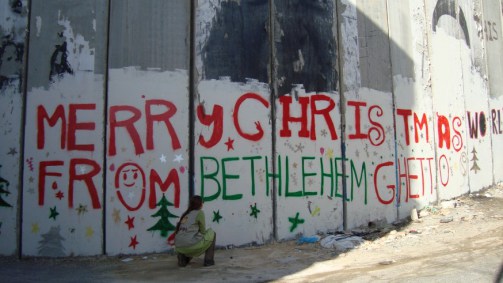
BETHLEHEM – The movement of residents in Ras Al-Wad southwest of Bethlehem has been cut off for weeks by Israeli military forces, locals said Wednesday.
A resident told Ma’an that the forces closed off the main entrance to the small village with large mounds of dirt around three weeks ago, and the road has remained closed since.
The road was used by residents in Ras al-Wad to access a main highway nearby. While they have been able to find an alternate route — a one-way dirt road that connects to the nearby village of Beit Sahour — access to the highway is severely limited, locals said.
“They just don’t want Arabs accessing the highway,” a Ras al-Wad resident told Ma’an.
An Israeli army spokesperson did not have immediate information on the closure of Ras al-Wad, but in the past has told Ma’an that Palestinian towns and roads were sealed in accordance with “security measures” taken in the area.
The isolation faced by Ras al-Wad residents has taken place in Palestinian areas throughout the occupied West Bank and East Jerusalem that have been cut off in recent months.
Following attacks carried out by Palestinian individuals on Israeli military and civilians that began in October and have continued into December, the military has been sealing villages and cities in the area around the attack or hometown of attacker.
In the West Bank, where Palestinian movement is already placed under a myriad of Israeli restrictions, the recent closures have had wide-scale repercussions in what rights groups have termed collective punishment.
The military never contacted residents of Ras al-Wad with warning or reason of the closure, and locals told Ma’an they have no idea how long the dirt mounds will remain in place.
While Palestinians in other areas have removed dirt mounds shortly after their placement, locals told Ma’an that Ras al-Wad residents have yet to remove them.
Ras al-Wad is a relatively quiet village and locals told Ma’an that residents generally avoid confrontation with the military, locals said.
“They’re not confrontational and they’re not political,” a resident told Ma’an. “They would just rather try to live their lives than deal with any trouble.
“No one from the village has gone to move the dirt mounds, everyone here just turned their head and found alternate routes,” the resident continued.
Using the big lie to undermine Palestinian solidarity
By Yves Engler · December 23, 2015
The big lie is a propaganda technique generally employed when telling the truth would be unfavorable to your side. It goes like this: never admit doing any wrong and instead always insist on a story that portrays your side as the good guys. What really happened is irrelevant. The key is repetition. Do it often enough and loudly enough until most people believe you.
While the big lie is most often associated with authoritarian governments, its use is actually quite widespread. For example, the Montreal Gazette recently published a front page article claiming Jewish students at Concordia University were “feeling like the target of a hate campaign.” The reason cited, as far as this writer can tell, was simply that many students were standing in solidarity with Palestinians.
At the end of November, the student group Solidarity for Palestinian Human Rights organized BDS Week. Without citing a single incident of actual racism, the Gazette painted a picture of the discussion series as hateful. Reporter Karen Seidman simply quoted an individual decrying “a hostile environment on campus” and another who denounced “speakers slandering Israeli tactics and spewing hate.”
In her article, Seidman also labeled a referendum held last year in which undergraduates voted to support the boycott, divestment and sanctions (BDS) campaign against Israel as “contentious” and downplayed its significance by saying only “a tiny fraction” of the overall student body participated.
So why is this a big lie?
First, the side favored is portrayed as a victim of “hate” with no evidence presented except criticism of the Israeli state causing hurt feelings. Second, and most important, the article blissfully ignores any historical background that would present Palestinian sympathizers in a positive light or even provide context for what they are doing.
It abjectly fails to even get any comment from any supporter of BDS. The reporter writes that she tried and failed to get a comment from the organizers, but it should surely not be beyond a reporter’s ability to get an alternative pro-BDS voice.
And while portraying a rather modest week of solidarity events as hateful, the reporter also ignores how a well-funded Concordia institute has engaged in an effort to erase Palestinians from historical memory.
In 2011, multibillionaire David Azrieli gave Concordia $5 million to set up the Azrieli Institute of Israel Studies.
The institute established the first minor degree program in Israel studies at a Canadian university.
This wasn’t a disinterested, apolitical donation. Azrieli, an Israeli-Canadian real estate magnate who died last year, was a staunch defender of Israel. He did not hide his affiliation, happily asserting that “I am a Zionist and I love the country.”
During the Nakba, the 1948 ethnic cleansing of Palestine, he was an officer in a largely Anglo-Saxon brigade of the Haganah, a Zionist military force. Led by Major Ben Dunkelman, a Canadian veteran of the Second World War, the Seventh Brigade played a leading role in the infamous Operation Hiram.
Dozens of villages in the north of Palestine were depopulated and destroyed during that offensive.
The operation, initiated in October 1948, included several massacres of Palestinian villagers.
As many as 94 Palestinians were killed in the village of Saliha alone. A Jewish National Fund official, Yosef Nahmani, noted in his diary that between 50 and 60 peasants in Safsaf were killed and buried in a pit after the village’s inhabitants “had raised a white flag.”
In his book The Ethnic Cleansing of Palestine, the Israeli historian Ilan Pappe notes that few brigade names appear in the oral testimonies that have been gathered about the Nakba: “However, Brigade Seven is mentioned again and again, together with such adjectives as ‘terrorists’ and ‘barbarous.’”
Since opening at Concordia, the Azrieli Institute has proven a potent advocate for Israel on campus.
In June, the institute hosted the Association for Israel Studies’ annual conference.
After attending the conference, the right-wing Israeli academic Gerald Steinberg described Azrieli’s $5 million donation as part of a “counterattack” against pro-Palestinian activism at Concordia.
The institute is largely designed to erase Palestinians from their historical connection to their homeland. Its website fails to even mention the word Palestine.
In a December 2014 letter to the Montreal Gazette, Nakina Stratos noted: “Browsing through the website of the Azrieli Institute of Israel Studies, I was not able to find the words ‘Palestine’ or ‘Palestinian people.’ How can an institute that teaches about the history of Israel not mention Palestine on its website? This, to me, intersects with the far-right Israeli narrative, which is a total confiscation of Palestinian history, and an attempt to erase the concept of Palestine from the dictionary of the Middle East.”
But rather than investigate how Palestinian students feel about a richly endowed university institute that erases their existence, the Gazette’s education reporter chose to focus on assertions of persecution by those who would do the erasing.
The perpetrators of oppression and their supporters instead become victims. Those who stand up for the oppressed are portrayed as bullies.
That is the big lie at work.
Egypt Loses $300Mln Monthly Amid Absence of Russian, UK Tourists
Sputnik – 23.12.2015
In November, Russia and the United Kingdom suspended flights to Egypt after a Russian Airbus A321 passenger plane crashed in Egypt as a result of a terrorist attack in October.
“The absence of tourists from Russia and the United Kingdom is costing us $300 million a month. Now the second month like this is coming to an end. The figures show what a serious blow the plane crash has dealt to the Egyptian tourism industry and to our economy in general,” the minister said in an interview with the Russian daily Kommersant.
In November, Adviser to the Egyptian Minister of Tourism Mohamed Yousef said that the loss of Russian and UK tourists would deprive Egypt of 70 percent of its tourist traffic. Tourism constitutes over 11 percent of the country’s GDP and accounts for 14 percent of its total foreign currency earnings.
On October 31, a Russian Airbus A321 crashed in Egypt’s Sinai Peninsula while en route from the Egyptian resort city of Sharm el-Sheikh to St. Petersburg, killing all 224 people on board. The Islamic State (IS, or Daesh in Arabic) terrorist group, which is outlawed in Russia and many other countries, claimed responsibility for the crash.
Featured Video
Theodore Postol: Iran’s Missiles & Drones Were Underestimated
or go to
Aletho News Archives – Video-Images
From the Archives
Wars for Israel: A reminder of who’s giving the marching orders
By Damian Lataan | February 7, 2012
As the West prepares to march off to yet another war in the Middle East, we should perhaps remind ourselves of who is giving the West their marching orders.
In February 2003, just weeks before the US and their allies launched their attack on Iraq and her peoples, a delegation of US congressmen, together with the US Ambassador to the United Nations, John Bolton, a well known pro-Zionist and neoconservative war-hawk, were in Israel at the invitation of the Israeli government then led by Israeli Prime Minister Ariel Sharon.
Addressing the congressmen, Sharon told them ‘that Iran, Libya and Syria should be stripped of weapons of mass destruction after Iraq’. Later, Sharon told John Bolton ‘that Israel was concerned about the security threat posed by Iran, and stressed that it was important to deal with Iran even while American attention was focused on Iraq’. … continue
Blog Roll
 Aletho News
- A New Resistance Front: How Does Syria Factor into the Regional War?
- Gulf states weigh pipeline expansion plans, hoping to bypass Hormuz
- Iran sets up ‘tollbooth’ system in Strait of Hormuz
- Wave 90: IRGC strikes US-linked industrial sites in Gulf
- Iran Says US-Israeli Claims of Its Military Strength Are Wrong
- Trump’s April Fools’ Address to the nation
- The Most Important Bet You’ve Never Heard Of
- The killing of three Indonesian soldiers in Lebanon should remind Jakarta that Israel does not want peace
- Defeated and delusional: Netanyahu’s remarks reveal $80bn war failure, says analyst
- Iran’s friends are about to make life much more difficult for Israel and the US
- If Americans Knew
- Gaza families reunite years after babies evacuated amid Israel’s war
- International Rescue Committee warns Gaza’s children face grave protection risks
- Iran’s Alleged 47-Year War on America: Debunking the 1,050 American Deaths Canard
- Israel wants US to bomb more of Iran’s civilian structures (113,000 is not enough) – Not a ceasefire Day 173
- Ann Coulter Rips Into Fox News for Iran War Coverage
- Joe Kent Urges Americans To Call White House and Congress To Object To Sending Troops Into Iran
- DNC Resolution to Reject AIPAC Funding Puts Democratic Leaders in the Hot Seat
- Swedish foundation to build 400 schools as over 650,000 Gaza children remain without education for 2 years
- Israeli army admits photshopping image of slain Lebanese journalist
- This is how Israel is systematically killing health workers under the cover of war in Lebanon
- No Tricks Zone
- Low Intensity Tornado Wrecks Major Solar Farm, Creating A Potential Toxic Dump
- New Study Finds Warming Saves Lives…Cold Temperatures 12 Times More Deadly Than Excess Heat
- German Science Blog Accuses PIK Climate Institute Of Hallucinating Climate Tipping Points
- Devastating Assessment Of Comirnaty Vaccine By Former Senior Pfizer Europe Toxicologist
- New Study: CO2 Is ‘Effectively Negligible’ As An Explanatory Climate Change Factor Since 2000
- Former Pfizer Toxicologist Dr. Helmut Sterz Tells Bundestag Hearing Pfizer Vaccine Should Have Never Been Approved
- Energy Expert: Germany’s Nuclear Phaseout Was A “500 Billion Euro Mistake”
- New Research: South Australia’s Mid-Holocene Sea Surface Temperatures Were 4°C Warmer Than Today
- Storing Green Energy To Last Germany 10 Days Would Require A 60-Million Tonne Battery
- New Studies: UK Sea Levels Were 4 Meters Higher Than Today During The Mid-Holocene
 Aletho News