BBC Two Show About Hypothetical WWIII ‘Dangerous Provocation’
Sputnik – 04.02.2016
Russian Ambassador to Latvia Alexander Veshnyakov called the World War Three: Inside the War Room (BBC Two) show a ‘dangerous provocation’ that aims to discredit pro-Russian forces in Europe.
The BBC program explores a hypothetical WWIII scenario, where Russia invades Latvia after Russian nationalists boil over their lack of self-determination in Latvia. Russia then launches a nuclear strike on the British military.
“We consider this TV-program a dangerous provocation. I’ve been working in Latvia for 8 years and do not know of any separatist organization here,” Veshnyakov said in an official commentary on the Embassy’s Facebook page.
According to Veshnyakov, the TV program scenario pursues a purely political agenda.
“This scenario is absolutely contrived, going after political goals: first, to engage in an information war to demonize Russia. Second, to justify the needs of the military-political lobby to increase the spending of NATO in Europe more than 4 times. Third, to discredit any political forces in Latvia, in Europe, that treat Russia without bias.”
Relations between Russia and the West worsened in 2014, when the United States, the European Union and some other Western countries accused Moscow of fueling the Ukrainian crisis, and imposed economic sanctions against it.
Russia’s relations with NATO also deteriorated. NATO has been increasing its presence in Eastern Europe since Crimea rejoined Russia in March 2014 following a referendum the West refused to recognize as legitimate, instead blaming Moscow for violating Ukraine’s territorial integrity. Russia has denied the allegations and has repeatedly stated that the bloc’s increased activities near its borders undermine regional and international stability.
NATO-Russia Council’s work was suspended on April 1, 2014, after the alliance’s foreign ministers issued a statement condemning Crimea’s reunification with Russia.
In January, media reports emerged claiming that the alliance was discussing a possible invitation of Russia to the first formal talks since the deterioration of NATO-Russia relations in 2014. NATO chief Jens Stoltenberg had previously brought up the subject of reconvening the NATO-Russia Council to be used as a tool for political dialogue.
‘Dangerous precedent’: Turkey denies Russian observation flight along Syrian border

Antonov An-30 © Wikipedia
RT | February 3, 2016
Turkey has set “a dangerous precedent” by denying an observation flight over its territories bordering Syria, the Russian Defense Ministry said, vowing a “relevant reaction” to Ankara’s violation of its obligations under the international Open Skies Treaty.
The Treaty on Open Skies which came into force in 2002 allows unarmed aerial observation flights over the territories of its 34 signatories, which includes Turkey. However the Russian An-30B plane was banned from conducting its surveillance flight over Turkish territory which was scheduled for February 1-5, without any prior warning.
“After the arrival of the Russian mission to Turkey and the announcement of the desired itinerary, the Turkish military officials refused to allow the inspection flight citing an order from the Turkish Foreign Ministry,” the head of the ministry’s National Nuclear Risk Reduction Center, Sergey Ryzhkov, said in a statement.
This is the first time that Turkey has refused a Russian observation flight over its territory. Since 2006 under the Treaty on Open Skies, Russia conducted approximately two observation flights a year. Turkey has flown over Russian airspace approximately four times a year.
But as tensions between Turkey and Russia intensified following the downing of the Russian jet in November, Ankara has refused the implementation of the treaty.
“The itinerary included the observation of areas adjacent to the Turkish border with Syria, as well as airfields that host NATO warplanes,” Ryzhkov pointed out. A previous statement, issued on February 1, specified that a Russian oversight flight would be conducted along an agreed route. Furthermore, Turkish monitors on board would have the opportunity to control the use of surveillance equipment.
Tensions deteriorated further last week, when neither Ankara nor its NATO allies offered any proof after accusing Russia’s Su-34 bomber of violating Turkish airspace. Moscow sees the latest development as a violation of the treaty and has warned that “relevant action” will occur in response.
“As a result of violations of the requirements of the Treaty and unconstructive actions on the part of Turkey, a dangerous precedent was created of an uncontrolled military activity of an Open Skies Treaty member state,” Ryzhkov said. “We are not going to leave without proper attention and relevant reaction violations of the Open Skies Treaty on the part of the Turkish Republic.”
Konstantin Kosachev, the head of the upper house’s international affairs committee, said that the Turkish violation of the treaty further complicates Russian-Turkish relations.
“This is unfortunate and does not contribute to the exit from this crisis, in which Russian-Turkish relations are currently in. This is a clear violation of Turkey’s international obligations under the Treaty on Open Skies,” he told TASS.
In a separate development the Russian Ministry of Defense announced Tuesday that another group of Russian inspectors would visit Turkish army ranges and get briefed by the Turkish military command, as part of the framework of the 2011 Vienna document aimed at building confidence and security.
Cop Kills Unarmed Man at His Place of Work Over Unpaid Traffic Fines then Gets Huge Promotion

By Claire Bernish | The Free Thought Project | February 2, 2016
Smyrna, GA — After killing Nicholas Thomas on March 24, 2015, under questionable circumstances at the Goodyear store where he was on the job, Smyrna Police Sgt. Kenneth Owens was cleared of any wrongdoing — and is now being promoted to Lieutenant.
“In a release sent to 11Alive News on Tuesday, the Smyrna Police Department confirmed that Owens is being promoted to the rank of Lieutenant effective Monday, February 15, 2016,” the local NBC affiliate reported; and according to that statement, “Sgt. Owens is eligible and qualified for this position as prescribed by departmental policy.”
Considering the questions still surrounding Thomas’ death, his family — as well as many others in the community and elsewhere — would likely beg to differ.
Thomas was working at the Atlanta Goodyear Service Center, when Owens and several other officers came to serve a warrant for an alleged probation violation by the young father — reportedly over traffic violations. Startled by those officers appearance at his workplace, Thomas reportedly jumped into a customer’s Maserati to flee.
“The suspect drove his car toward officers, putting officers in fear for their lives, at which time the officers fired into the vehicle, shooting the suspect,” said Smyrna Police Sgt. Ed Cason the following day, as 11Alive reported at the time.
However, questions arose when the Cobb County Medical Examiner found the bullet had entered Thomas in his upper right back — hardly the location or entry point one would expect if an officer fired into a vehicle because he thought it would run him over.
“Of all the officers there, only one felt his life was threatened,” said Thomas’ family lawyer Mawuli Davis, as The Free Thought Project previously reported. “Unless a car can travel sideways, I don’t know how you can be in fear for your life.”
The Georgia Bureau of Investigation and Cobb County Police Department both asserted the fatal shooting was “justified under the facts and the law.”
That fear of an imminent threat to an officer’s life — the justification for and cause of subsequent no-fault finding in this incident — appear to have been based on Owens’ hypothetical assessment of what Thomas was planning to do.
As Thomas careened around the store’s parking lot, looking for a way out since officers had blocked the only vehicle entry and exit point, Owens and other police jumped out of the way — but he claimed he feared an approaching officer might be struck by the vehicle if Thomas rounded the corner of the store quickly, so he decided to open fire.
Despite these lingering questions surrounding the killing of Thomas, as well as a seemingly loose interpretation of Georgia law, Sgt. Owens will soon be promoted to Lt. Owens — apparently indicating a continuing of the trend of impunity under any circumstances for police in the United States.
And why not? Cops ‘fearing for their lives’ and then killing fleeing motorists seems to be the norm in Police State USA.
Seneca Police Lt. Mark Tiller made the same assertion when he shot and killed 19-year-old Zachary Hammond over the possession of a small amount of marijuana. Officer Ray Tensing was caught on video killing Sam Dubose in a similar fashion. In September, cellphone footage was released showing police murdering 33-year-old John Barry, a mentally ill man who attempted to flee from police during a breakdown.
One of the most disgusting examples of cops claiming to fear for their lives as cars drive off is the case of Officers Derrick Stafford and Norris Greenhouse, Jr., who, in November, opened fire on a car occupied by 6-year-old Jeremy Mardis, killing him and severely injuring his father.
Gerald Caplan: Justifying Paul Kagame’s Repression in Rwanda
By Yves Engler | Dissident Voice | February 2, 2016
The Globe and Mail’s recent coverage of Rwanda has been schizophrenic. While South African-based correspondent Geoffrey York has done important work detailing how Paul Kagame’s government has assassinated its opponents and contributed to violence in Eastern Congo, columnist Gerald Caplan has justified its repression and echoed Kigali’s position on regional conflicts.
At the start of January York reported on two new books describing the totalitarian nature of President Kagame’s regime. “Village informers”, wrote York. “Re-education camps. Networks of spies on the streets. Routine surveillance of the entire population. The crushing of the independent media and all political opposition. A ruler who changes the constitution to extend his power after ruling for two decades. It sounds like North Korea, or the totalitarian days of China under Mao. But this is the African nation of Rwanda – a long-time favourite of Western governments and a major beneficiary of millions of dollars in Canadian government support.”
A year and a half ago York wrote an explosive investigation headlined “Inside the plots to kill Rwanda’s dissidents”, which provided compelling evidence that the regime had extended its assassination program, killing (or attempting to) a number of its former top officials who were living in South Africa. Since the initial investigation York has also reported on Rwandan dissidents who’ve had to flee Belgium for their safety and revealed that Ottawa failed to act after UN and Spanish court investigations concluded Canadian priests Guy Pinard and Claude Simard were killed by soldiers loyal to Kagame in the mid-1990s.
At the end of 2012 York reported on Rwanda reasserting control over the mineral rich Eastern Congo. In one of a number of insightful articles York described how “Rwandan sponsored” M23 rebels “hold power by terror and violence.” The rebel group added “a [new] layer of administrators, informers, police and other operatives” in and around the city of Goma in part to “bolster” its “grip on the trade in ‘blood minerals’.” (In 1996 Rwandan forces marched 1,500 km to topple the regime in Kinshasa and then re-invaded after the Congolese government it installed expelled Rwandan troops. This led to an eight-country war between 1998 and 2003, which left millions dead.)
While York has done what investigative journalists are supposed to do — comfort the afflicted and afflict the comfortable — unfortunately the Globe also publishes regular columns by an author who seems to strive for the exact opposite in the case of Rwanda.
Gerald Caplan recently wrote about political conflict in Burundi, invoking Kagame’s rhetoric of “genocide” all the while ignoring Rwanda’s role in organizing armed opposition to the Burundian government. In support of Kigali’s aggressive regional posture, Caplan continues to repeat Kagame’s rationale for unleashing mayhem in the Congo two decades after the mass killing of Rwandan Tutsi (and Hutu) in 1994. In a 2014 column he wrote: “In the Congo former génocidaires lead a violent anti-Kagame militia dedicated to ‘finishing the work’ of the hundred days.”
In another column Caplan justified the arrest of presidential opponent Victoire Ingabire and criticized the Law Society of Upper Canada after it called for the release of her American lawyer, who was also imprisoned.
And strangely, for a former NDP strategist, Caplan has sought to muzzle media that disagree with the current government’s version of Rwandan history. In 2014 he signed an open letter condemning the BBC documentary Rwanda’s Untold Story and a year earlier wrote a piece about lobbying the University of Toronto to remove the Taylor Report, a program on campus radio, from air because it hosted critics of the Rwandan government.
Caplan has failed to inform readers about his ties to the regime in Kigali. He started an organization with Rwanda’s current Foreign Minister Louise Mushikiwabo and said he stays at her family’s hotel when visiting the country. Caplan has also spoken at a number of events in Kigali and New York organized by the Rwandan government.
So, who to believe? York or Caplan? Is Kagame a saint or dictator?
My money is on the investigative journalist.
Turkish civil servants asked to report ‘insults’ against president & top officials to police
RT | February 3, 2016
The governor’s office in Isparta, southwestern Turkey, has reportedly sent a request to all state institutions in the province instructing staff to report cases of “insulting” President Recep Tayyip Erdoğan and other top officials straight to the police.
Insulting the president is considered a crime in Turkey and the punishment can be up to four years in jail.
“According to Articles 299 and 125 of the Turkish Penal Code [TCK], an action must be taken for the posts [on social media] including insults against our president and other senior government officials, which have increased lately in direct proportion to the increase in terror activities in our country,” the notification, signed by Isparta Deputy Governor Fevzi Güneş on behalf of Isparta Governor Vahdettin Özkan, stated, Today’s Zaman reported.
The government began its crackdown on Kurdish fighters from the Kurdistan Workers’ Party (PKK), outlawed by Ankara, last July. Turkey’s authorities maintain those killed during the security operation in the southeast were all PKK members. According to Turkish human rights groups, however, more than 160 civilians were killed during the government offensive.
President Erdogan has publicly vowed to continue the operation until the area is cleansed of Kurdish militants. Kurds have long been campaigning for the right to self-determination and greater autonomy in Turkey, where they are the largest ethnic minority.
In mid-Januray, Turkey arrested over a dozen academics for signing a declaration denouncing Ankara’s military operations against Kurdish militants. The move came after over 1,200 scholars were under investigation for criticizing the Turkish State. They were accused of allegedly participating in “terrorist propaganda” after signing a declaration condemning military operations against Kurdish rebels in the southeast. Erdogan described the group of academics as “poor excuses for intellectuals.” He insisted human rights violations in the southeast of the country were being carried out by referring to the Kurdish rebels, not by the state.
The day after Erdogan urged prosecutors to investigate academics, who signed the declaration criticizing military action in the country’s mainly Kurdish southeast, Kemal Kilicdaroglu, leader of the main opposition Republican People’s Party’s (CHP), called the Turkish president “a dictator.”
In January, a local Turkish court dismissed Recep Tayyip Erdogan’s appeal against Kilicdaroglu. The Turkish president was seeking damages after the opposition party leader called him a “thief.” Erdogan’s lawyers demanded 200,000 Turkish lire ($66,000) in damages, saying this was an “attack on his personal rights.”
On Monday, an Ankara court sentenced another Turkish politician Hüseyin Aygün, a former deputy from the CHP party, to 14 months in prison for “publicly insulting” Prime Minister Ahmet Davutoğlu. Aygün rejected all accusations, Haber Turk reported.
The Republican People’s Party has repeatedly accused the government of using counter-terror laws to persecute journalists, saying 156 were arrested in 2015, with 484 legal actions launched against journalists and 774 fired during the year.
Aygün was sentenced to nine months in jail for “inciting people to enmity or hatred or denigration,” Müslim Sarı, another former CHP deputy, wrote on his Twitter.
“This ruling is clear evidence that there [is] no freedom of thought and expression in Turkey and judicial independence has ended too,” Sarı said in another tweet.
Late last month, a Turkish court sentenced a female teacher to almost a year in prison for making a rude gesture at Erdogan (when he was prime minister) at a political rally in 2014.
“The situation for freedom of expression is at an all-time low,” Andrew Gardner, Amnesty’s Turkey researcher, told the Times. “Countless unfair criminal cases have been brought, including under defamation and anti-terrorism laws — even children have been remanded in pre-trial detention,” he said.
Over 50 Israeli violations against Journalists in January
There are now 18 Palestinian journalists in Israeli prisons
Palestine Information Center – 3-2-2016
GAZA – The media and press teams that try to cover the Israeli violence in the West Bank, Jerusalem, and Gaza Strip are facing escalating violations at the hands of the Israeli army and Palestinian security forces.
The Palestinian Radio and Television Stations Union documented in its report for January, 2016, more than 45 violations against journalists and media correspondents.
This includes arrests, extension of detention, direct assaults in the field, and prevention from media coverage, in continuous attempts to distort the truth about the Israeli terror against Palestinians.
According to the Union, the arrests, detentions, extension of detentions, summoning to investigations, and breaking into houses during January reached 10 cases.
The Israeli forces arrested the journalist Mujahid al-Sa’adi, correspondent of Palestine Today TV channel, and extended his detention three times so far in January.
In addition, Israeli soldiers arrested the sports journalist at al-Khalil radio channel, Mahmoud al-Qawasmi.
These violations also reached the journalists Mohammed Matar, Musab Shawer, and Abd al-Karim al-Ouiui. In January, the Israeli forces brutality against journalists in the field increased, as the media crews attempted to cover the Palestinian weekly protests.
Nine Israeli assaults, that resulted in injuring two Palestinian journalists, were documented. Seven other press photographers choked on teargas.
Moreover, three cases of harassment and prevention from coverage were documented. Israeli forces also thwarted a press conference in Jerusalem, and a cultural meeting.
The house of Muhanned Halami was also blown up without media coverage. In respect to the incitement campaigns, 11 violations were documented.
The Israeli Shin Bet accused the Palestinian Authority’s media of inciting and encouraging the Palestinian individual operations against Israelis.
A European institute also accused ten journalists and bloggers of being agitators for supporting the Palestinian resistance in their writings.
Regarding the prosecution of journalists on cyberspace, two cases were documented.
Two Facebook pages were closed and a number of pro-Palestinian cartoons were deleted. The Palestinian journalist prisoner, Mohammed al-Qeiq, who has been on a hunger strike for more than 70 days, has suffered ten violations.
These include torture, forced-feeding, handcuffing to hospital bed, and intense presence of security in the hospital where he is staying to prevent his lawyers from talking to him, and continuing his administrative detention in the Israeli jails.
The report stated that there are now 18 Palestinian journalists in the Israeli prisons.
According to the same report, a journalist, Ayman Al-Aloul, and an activist, Ramzy Herzallah, were summoned for interrogation by Gaza security forces who later released them after a brief detention.
Meanwhile, Palestinian Authority forces arrested Momen Abu Duheir and Nablus TV director Salim Swidsan.
PA forces also summoned for interrogation Abdullah Oda, threatened Riham Al-Omary, and assaulted Sami Saa’y.
Washington gives Israel $100 million to uncover Gaza tunnels
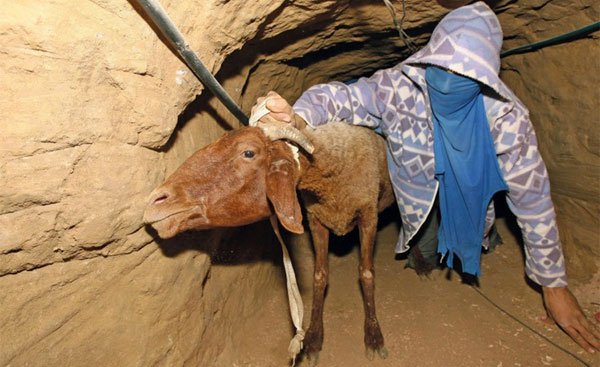
The tunnels are a lifeline for those who live in the beseiged Gaza Strip as they are used to smuggle vital supplies
MEMO | February 2, 2016
Director of Political-Military Affairs at Israel’s Defence Ministry Amos Gilad revealed today that the United States has contributed over $100 million to an Israeli-US technology research project aimed at identifying and locating tunnels on the Gaza Strip border.
In an interview with Army Radio this morning, Gilad stated that intelligence information suggests that there are no such tunnels leading into Israeli territory at the moment.
Defence Ministry official Shalom Gantzer dispelled the fears of Israelis living around the Gaza Strip who have claimed to hear digging noises under their houses, saying that these noises are coming from an electric generator.
Israel’s Channel 10 showed interviews on Saturday with those living near the Gaza border area who had recorded the noises with their mobile phones. They claimed that these noises were the sounds of tunnels being dug from Gaza.
Halt Saudi arms sales immediately, probe civilian attacks in Yemen – MPs
RT | February 3, 2016
A group of MPs have called on the British government to immediately suspend arms sales to Saudi Arabia and have demanded an independent inquiry into the war in Yemen, where British arms are thought to have been used against civilians.
In a letter to Development Secretary Justine Greening, the International Development Select Committee urged the UK to cease opposing an inquiry which aims to examine potential breaches of humanitarian law by the Saudi bombing campaign in Yemen.
It comes after human rights charities and anti-war groups criticized Saudi Arabia for allegedly bombing civilian targets.
The British government has sold £1 billion (US$1.45 billion) worth of arms to the Saudi government in the past year.
Last week a leaked UN report found Saudi Arabia guilty of breaking humanitarian law. In response the Saudi government set up an internal inquiry.
British MPs say the UK should back an independent inquiry. Members of the committee were shocked to hear the UK had hindered efforts to launch such an investigation in September 2015 when it was proposed by the UN.
“We need an independent, international fact-finding mission to uncover the truth. Until then we should cease selling arms to Saudi Arabia,” wrote committee chair Stephen Twigg.
“All parties to this conflict should review their obligations under international law and undertake to put civilians and humanitarian work above other interests.”
MPs said they had been presented with evidence from the head of UNICEF Yemen, who said the Saudi-led coalition had been involved in bombing campaigns which endangered the lives of civilians.
The committee’s letter was welcomed by activist group Campaign Against the Arms Trade (CAAT), which condemned the British government’s actions.
“The humanitarian situation is getting worse and the UK government has been complicit in it. We agree that arms sales need to stop, but they should never have been allowed in the first place.
“Saudi Arabia has a terrible human rights record and has been supported by governments of all political colors for far too long,” said CAAT’s Andrew Smith.
The leaked UN report, obtained by the Guardian last week, found that Saudi airstrikes are breaching international law by hitting civilian targets, including refugee camps, civilian weddings, vehicles, medical facilities and schools.
The UN panel of experts on Yemen used satellite imagery to look at areas before and after bombings, which also targeted an Oxfam warehouse storing equipment for a water project funded by the EU.
Eugenics WMD: Zika Virus Prompts Disturbing New Call For ‘No Child Policy’
By J.R. Smith | 21st Century Wire | January 25, 2016
If you have been watching the news this week you will have seen one story which has been gaining traction in western media coverage, that of the mosquito-borne illness known as the Zika Virus, which authorities are saying will cause birth defects for expecting mothers.
While there are certainly many health risks apparent with this particular pathogen, media outlets and government agencies appear to be pushing one incredible talking point now – asking women ‘not to get pregnant until 2018.’
Latin American officials, led by El Salvador are now urging women not to get pregnant for “up to two years.”
Latin American governments, in conjunction with the UN’s World Health Organization (WHO), are claiming that over the past four months, they have ‘received reports’ of nearly 4,000 cases of microcephaly in newborns – and they are claiming these are all linked to the Zika Virus. This information has served as the chief catalyst for the current wave of fear.
The Washington Post stated this week that:
“The World Health Organization says at least 20 countries or territories in the region, including Barbados and Bolivia, Guadeloupe and Guatemala, Puerto Rico and Panama, have registered transmission of the virus.”
“Although the Zika virus has been documented since the 1940s, it began its assault on Latin America in the past several months. The hardest-hit country has been Brazil, where more than 1 million people have contracted the virus. In the past four months, authorities have received reports of nearly 4,000 cases in which Zika may have caused microcephaly in newborns. The condition results in an abnormally small head and is associated with incomplete brain development. Colombia, which shares an Amazonian border with Brazil, reacted to its own Zika outbreak, numbering more than 13,000 cases, by urging women not to get pregnant in the next several months. Other countries, including Jamaica and Honduras, also have urged women to delay having babies.”
Zika ‘Threat’ Goes Global
If contracted, the Zika Virus is said to have an incubation period of only 5 to 10 days, and authorities are claiming that it’s within this window that mothers are at risk. Some common symptoms include red spots on the skin, intermittent fever, spots on the eyes and later on with persistent pains in muscles, joints and head.
Clearly though, the alarm for a Zika epidemic is already being sounded internationally. This has tremendous potential implications on society.
In the US, the Center for Disease Control and Prevention (CDC), is warning that pregnant women not to travel to 14 countries in Latin America. We were also told that last week, the US recorded the first case of microcephaly “linked to Zika” virus in Hawaii. According to The New York Times, the baby’s mother “might have” been infected when she traveled to Brazil in May last year.
The World Health Organization (WHO) also warned today that the virus will spread to both North America and South America. Based on how easily the US population was whipped into a hysterical haze during the Ebola scare in 2014, it goes without saying that if Zika ‘reproductive’ fears hit the US in a big way it would be a political circus of fear and media manipulation.
It’s not clear exactly how they have come to the conclusion that this apparent epidemic is a result of the Zika Virus, and not through some other combination of factors. Neither journalists nor the world’s scientific community are questioning the current course of public policy on this issue. Why? No one is addressing that it is nearly impossible to make a scientific ruling on these issues in such a short space of time, much less institute government guidelines on reproduction.
Why is Latin America and El Salvador so significant? Social engineers appear to locking horns with the Catholic Church on this issue. The Post adds here:
“Morality says that people shouldn’t have that control” over procreation, Figueroa said. “But the church also isn’t going to say something that runs contrary to life and health.”
This is a first in human history – central government advocating for a universal ban on procreation, and probably the most significant development in social engineering since the outbreak of the AIDs virus in the early 1980’s.
‘No Child Policy’
The public should not underestimate the significance of this latest story. Again, while there are definitely real risks associated with Zika and other related viruses to health and women’s prenatal health, is it premature to call for what amounts to a ‘no child policy’?
It’s only a matter of time before globalists start to link the temperate climate mosquito-based Zika virus with ‘global warming’ aka ‘climate change’ – creating a new multi-faceted international social imperative and empowering the global government narrative necessary in order to “tackle” and “contain” this new multi-faceted threat. Likewise, we can expect the WHO, Bill Gates and the usual suspects to start clamoring for a new vaccine solution to a global Zika crisis.
How this story has escaped critical analysis in the mainstream media and discourse is a testament as to how well the establishment has done in conditioning the public to accept a range of modern eugenics-based ‘population reduction’ policies aimed at population reduction.
US Flexes Muscles, Plans to Quadruple Military Budget in Europe in 2017
Sputnik – February 2, 2016
The US Defense Secretary Ash Carter has announced plans to significantly increase military spending in Europe from US$789 million to US$3.4 billion next year and place more troops and equipment in Eastern Europe and the Baltic States, according to sources.
It follows reports in late 2015 that the US was planning to boost its presence in Europe. According to a defense source quoted in the New York Times : “This is a longer-term response to a changed security environment in Europe. This reflects a new situation, where Russia has become a more difficult actor.”
The US already has 65,000 troops in Europe and has been stockpiling resources in Eastern Europe and the Baltic region for more than a year. Poland has called for a permanent NATO troop presence in the country with President Andrzej Duda suggesting he will use an upcoming summit to commit to the proposal.
Cater told a morning meeting at the Economic Club of Washington Tuesday: “Another near-term investment in the budget is how we are reinforcing our posture in Europe to support our NATO allies in the face of Russia’s aggression. In Pentagon parlance this is called the ‘European Reassurance Initiative’.
“After requesting about US$800 million last year, this year we are more than quadrupling it to a total of UD$3.4 billion in 2017. That’s to fund a lot of things: more rotational US forces in Europe; more training and exercising with our allies; more pre-positioned warfighting gear; and infrastructure improvements to support all this.
“When combined with US forces already assigned to Europe — which are all substantial — all of this, by the end of 2017, will let us rapidly form a highly capable combined ground force that can respond across that theater if necessary,” Carter said.
12,000 Pieces of Equipment
The US Department of Defense announced in November 2015 that equipment from the European Activity Set (EAS) was scheduled to be delivered to Central and Eastern Europe. Approximately 1,400 pieces of equipment will be delivered to sites in Bulgaria, Lithuania and Romania.
Carter announced during a trip to Estonia earlier last year that the US will “temporarily” stage enough vehicles and associated equipment in Central and Eastern Europe to support an armored brigade combat team.
In a statement, the US Defense Department said that NATO said “the placement allows US rotational forces in the region to move more quickly and easily to participate in training and exercises.”The items are part of the European Activity Set, which includes some 12,000 pieces of equipment, including tanks, infantry fighting vehicles and artillery. The EAS equipment will be moved around the region for training and exercises as needed, he said.
Carter also announced that Bulgaria, Estonia, Latvia, Lithuania, Poland and Romania agreed to host company to battalion-sized elements of EAS equipment. Germany already hosts EAS equipment, according to defense sources.
Featured Video

Iran Is Not Our Enemy
or go to
Aletho News Archives – Video-Images
Book Excerpt
“Vaccines Do Not Cause Autism!” The Science is Settled. Right?
ICAN urges the IACC to actually study infant vaccines and autism
 By Aaron Siri | Injecting Freedom | March 16, 2026
On behalf of ICAN, we just sent a copy of chapter 11 of Vaccines, Amen to the newly appointed members of the federal Interagency Autism Coordinating Committee (IACC).
If you haven’t already read this chapter, you can read the whole thing in the attached letter. I trust that after you read it, you’ll see why the statement “vaccines do not cause autism” is a belief, not science!

IACC Public Comment Letter
1.53MB ∙ PDF file
Includes chapter 11 of Vaccines, Amen
Blog Roll
 Aletho News
- Iran made ‘unexpectedly substantial’ offer during Geneva talks, US envoys ‘dragged’ Trump into war: Report
- Russia condemns Israel’s attack near Bushehr plant, files complaint
- Russia Strongly Condemns Actions Aimed at Harming Health of Iranian Leadership – Kremlin
- Israeli Journalist Demands Tucker Carlson and Candace Owens Be Placed in WWII-Style Internment Camps
- No Liability, No Studies, No Accountability: The Vaccine System Aaron Siri Exposed in Federal Court
- No time for losers: Why the war meant to save Israel may destroy it
- Top US Counterterrorism Official Resigns in Protest of Operation Against Iran
- Just Get Out! Now!
- Unpacking glaring contradictions in US-Zionist justifications for war against Iran
- Iranian model of warfare bleeds US dry while Persian Gulf states watch and learn: Analyst
- If Americans Knew
- Lebanon death toll exceeds 900, another assassination in Iran, bombing in Gaza – Not a ceasefire Day 159
- Trump’s counterterrorism chief, whose own wife was killed by ISIS, quits over Iran War saying Tehran posed ‘no imminent threat’
- Here’s what US could fund instead of Bibi’s war on Iran
- Israel Killed Over a Dozen Lebanese Paramedics in Three Days, Now Claiming That Ambulances Are “Hezbollah” Targets
- War on Iran: These are the heritage sites devastated by US and Israeli attacks
- Four news stories from Israeli media that illustrate Israeli “justice”
- CIA Prepares Criminal Referral of Tucker Carlson, as Israel and Its Loyalists Demand His Arrest
- Top US counterterror advisor resigns in protest of “war manufactured by Israel” – Not a ceasefire Day 157
- ‘I Liked the House’: When Israeli Soldiers Turn Palestinian Homes into Barracks
- ‘They Were All I Had’: Lebanese Father Buries Parents, 4 Daughters Killed by Israeli Bombing
- No Tricks Zone
- Energy Expert: Germany’s Nuclear Phaseout Was A “500 Billion Euro Mistake”
- New Research: South Australia’s Mid-Holocene Sea Surface Temperatures Were 4°C Warmer Than Today
- Storing Green Energy To Last Germany 10 Days Would Require A 60-Million Tonne Battery
- New Studies: UK Sea Levels Were 4 Meters Higher Than Today During The Mid-Holocene
- Destructive Green New Deal: German Energy And Metal Group Warns Of Drastic Crisis
- New Study Documents A 20-Year Pause In Arctic Sea Ice Decline – Driven By Internal Variability
- Wake-up Call: Survey Shows Majority Of Germans Now Favor Postponing Climate Targets!
- Televised! Leading German Political Candidate Tells Schoolchildren CO2 Makes Sun Hotter!
- New Study: A Century Warming Of 1.1°C Is ‘Commonplace’ And ‘Not Unusual’ During This Interglacial
- New Study: ‘Internal Noise’ And Volcanic Forcing Can Trigger 10-15°C Warming Within Decades
 Aletho News