Bogus arrest of 12 year old boy in Hebron
International Solidarity Movement | March 3, 2016
Hebron, Occupied Palestine – On the 28th of February around 4:00pm, 12 year old Palestinian boy, Sayed Seder was arrested by 10 heavily armed Israeli soldiers whilst playing football with his friends on the street in front of his family home. The Israeli army claim that he was arrested under allegations he was throwing stones at the guard tower which watches over Al-Shallalah Street and the illegal Israeli settlement that has been built directly behind the street and family home.
Sayed’s father, Abed, went down to confront the soldiers after Sayed’s friends came running up to the family home, explaining to the father what was happening.
When Abed approached the soldiers to ask them what exactly they were arresting his son for, the soldiers responded by informing him that it was because he was seen throwing rocks at the guard tower above. However, the street is lined with a protective type of fencing above the shops roofs that prohibits objects being thrown up or in the most common cases, being thrown down by illegal Israeli settlers who live above. Abed put the argument forward that it would have been pointless for his son to have been throwing stones with this protective barrier in place. Perhaps the logic of this made too much sense and the arresting soldier quickly changed his story and then began to tell Abed his son was being arrested for stealing a settler child’s football whilst pointing to the ball that Sayed and his friends were playing with. Abed informed the soldier that the ball Sayed and his friends were playing with was in fact a ball that he had purchased for Sayed from a shop in Halhoul just recently. The soldier who was evidently lying and knowingly falsely accusing Sayed of the above allegations ignored any more of Abed’s protests and continued to arrest Sayed.

Al-Shallalah street where Sayed was arrested
From this point Sayed was marched to the Shuhada street entrance gate and taken through while his parents and friends were forced to stand back and watch. Sayed was then taken to the local military base on Shuhada street. Upon entering the military base he was reportedly handcuffed and blindfolded. The blindfold remained on for around 30 minutes before being taken off, assuming that it was put on so he could not get a full view of what was happening inside the military compound for security purposes. Sayed alleges that teenage settlers who were allowed into the compound then beat him while the Israeli army simply stood back and did nothing.

Protective fencing installed above Al-Shallalah street and the guard tower
Sayed was later released from custody at around 9pm to Palestinian authorities where he complained of pain in his kidneys. His father arrived shortly after and took Sayed to hospital where doctors examined him. While the doctors could not find physical wounds that would require further attention they did note that Sayed was severely traumatised from the event and was in a state of shock.
Just 3 months ago the Israeli army arrested one of Abed’s other sons who is 10 years old. The reason for the arrest was that he too was suspected of throwing stones at the military. As Abed didn’t believe this and objected he too was arrested with his 10 year old son. They were detained for 6 hours and released without charge.
One significant fact is that Abed’s house backs onto the illegal Israeli settlement of Beit Hadasa. Abed used to sell artisans out of the family home but has had to stop because of ongoing harassment both physical and verbal to himself and to his customers from the settlers that occupy the land next to his home. The front of Abed’s house has been covered in barbed wire by the Israeli military and is adorned with bags of dirty hummus, eggs and other foul items thrown down by the illegal settlers. The army has also boarded up the windows of his family home (without his permission) that overlook Beit Hadasa.

Abed’s home and the illegal Israeli settlement of Beit Hadasa

The barbed wire at the entrance to Abed’s house with rubbish thrown down by settlers
While harassment from the settlers in Hebron is often considered an unfortunate normality to most Palestinians living under occupation, the army’s continued bogus charges and harassment of Abed and his family give one the impression that the Zionist regime is using a tactical ploy to get Abed and his family out of their home for further settlement expansion.
Official: Israel obstructs Jordan agricultural exports to the OPT
MEMO | March 3, 2016
 Israel has been obstructing Jordanian agricultural exports to the Occupied Palestinian Territories under the pretext that Jordanian products do not conform to Israeli specifications, leading to exports completely stopping in 2015 and early 2016, a Jordanian official revealed.
Salah Al-Tarawneh, assistant secretary-general of the Jordanian ministry of agriculture for marketing and information, said in remarks to Quds Press that the Palestinian Authority asked last month to import tomatoes from Jordan but the Israeli side refused to allow their entry under the pretext that they contain viruses.
Al- Tarawneh explained that although the PA has repeatedly asked the Israeli side to increase agricultural trade with Jordan to meet its needs, Israel has continually refused under the pretext that Jordanian products do not conform to Israeli specifications.
According to data from the Jordanian ministry of agriculture, Jordan’s exports of vegetables and fruits to PA controlled areas completely stopped in 2015.
During the same year, Jordan’s agricultural exports to Israel amounted to more than 20,000 tons of vegetables and 5,000 tons of fruit.
Israelis Welcome GCC Statement on Hezbollah: Reflects Rapprochement with Saudis
Al-Manar | March 3, 2016
As soon as the Gulf Cooperation Council blacklisted the Lebanese party of Resistance – Hezbollah – on Wednesday, Zionist mass media welcomed the resolution, considering it “critical and serious,” reflecting a great relief among Israelis who have been seeking to fight Hezbollah from the Arab gate.
Former Zionist foreign minister Tzipi Livni hailed the GCC resolution as “an important step, while Zionist daily Maariv stated that “blacklisting Hezbollah is an achievement that serves Israel.”
Moreover, the entity’s mass media correlated the GCC resolution against Hezbollah with “the ongoing coordination between Saudi Arabia, Israel” which has recently emerged to public through exchanging visits between both parties.
“Arab world is approaching closer to Israel’s stances, which has been revealed through the Saudi delegations’ visit to Israel, as well as when Saudi Arabia decided to blacklist Hezbollah as a terrorist organization,” the presenter of Tonight at Six talk show for Zionist Channel 1 said.
“It is very important and dramatic development,” he added.
For his part, Yoval King, an expert of Arab affairs, said that “it is an important resolution,” recalling that it is not the first time that Gulf states blacklist Hezbollah as a terrorist group.
“They had labeled him as ‘militia’, and announced that violence and provocations he is carrying out in Syria, Yemen and Iraq contradicts with the moral and humanitarian values,” King said.
The Saudi-Zionist coordination witnessed a major shift on the Syrian arena in the face of axis of Resistance, as Zionist sources revealed discussions took place between the armed groups operating in Syria on one hand, and Riyadh and Tel Aviv on the other, about the Syrian developments following the ongoing truce.
“Syrian opposition groups, funded by Qatar, Saudi Arabia and Israel are meeting with their sponsors and discussing with them whether they can make gains in the meantime,” Shmerit Maeir, a Zionist analyst of Arab affairs, said during an interview on the Jewish Channel 2.
“Israel needs a key chair on this table whether through the American players or others, because the bases will now determine whether Hezbollah is allowed to do what the ISIL and Al-Nusra Front are banned from doing. If this really is to happen, we will be facing a major catastrophe,” Maeir stressed.
The Zionist position was symmetrical to the Saudi’s, as it doesn’t rule out the possibility of communicating with the armed groups, like Al-Nusra Front and ISIL in order to coordinate for later steps in Syria.
The GCC, which has been committing a genocide in Yemen since March 2015, held a meeting on Monday during which it blacklisted all Hezbollah affiliated institutions.
President Obama, When It Comes to Human Rights, We Need More Action, Not Words
By Jamil Dakwar | ACLU | March 2, 2016
The Obama administration this week made new pledges and commitments to protect “human rights and fundamental freedoms” to the United Nations in advance of the U.S. re-election to the U.N. Human Rights Council. Yet while the U.S. has used its first six years of HRC membership to advance human rights overseas, its participation has had little direct bearing on human rights at home. Lack of accountability for torture and cooperation with U.N. human rights experts are just two examples of such double standards.
When he took office, President Obama promised to disavow many of the disastrous Bush administration policies, including by closing Guantánamo and ending the use of torture. Obama also promised to reassert U.S. global leadership on human rights by joining the HRC later that year.
While the president issued an executive order on his second day in office ending the CIA’s secret detention and torture program, he declined to support any meaningful measures of accountability for crimes that had taken place. His policy of “looking forward rather than backward,” as well as his administration’s continuing fight against transparency and any attempts to reveal the whole truth about Bush administration torture policies, will undoubtedly stain his human rights legacy.
That’s why it was surprising when the U.S. government released the following statement earlier this week:
“The United States is committed to upholding our international obligations to prevent torture and cruel, inhuman or degrading treatment or punishment. The United States supports the work of the UN Special Rapporteur on Torture and the Committee Against Torture, and in 2015, the United States was proud to become a participant in the Group of Friends of the Convention Against Torture Initiative.”
This kind of rhetoric is emblematic of the Obama administration’s hypocrisy and cherry-picking when it comes to U.S. international legal obligations. The U.S. is obligated under the Convention Against Torture not only to prevent torture and cruel, inhuman, or degrading treatment. It is also obligated to hold accountable those who ordered or perpetrated acts of torture and to provide legal redress to victims. On these fronts, our government’s record has been abysmal. Yesterday Human Rights Watch and the ACLU submitted a response to the U.S. one year follow-up report to the U.N. Committee Against Torture, which details the United States’ failure to meet its legal obligations to fully investigate acts of torture during the Bush administration.
When it comes to torture, the gap between rhetoric and action isn’t limited to the Bush administration’s record. While it is encouraging to see the U.S. expressing support for the U.N. Special Rapporteur on Torture, consider the ways the U.S. has directly prevented this critically important institution from effectively doing its job.
The current special rapporteur on torture, Juan Mendez, is about to end his six-year term. Since the early days of his mandate, he has repeatedly asked to visit U.S. prisons and detention facilities in order to examine the widespread use of solitary confinement, which often causes mental and physical suffering and can amount to cruel, inhuman, or degrading treatment or punishment — even torture. However, the U.S. has consistently stonewalled his requests and has so far failed to provide him with the minimum standards of access required by U.N. protocol for such visits. It is very likely that Mr. Mendez won’t be able to carry out his visit before the end of his term, which is exactly what the U.S. likely intended in delaying and dragging out the process. It’s simply outrageous that the United States won’t provide basic access to its domestic detention facilities, especially given that the U.S. is perhaps the only Western democracy that doesn’t have a permanent and independent monitoring system of all detention facilities.
American leadership on the world stage suffers when the country presents such a stark double standard on human rights and denies independent human rights monitors access to U.S. facilities abroad, like Guantánamo, and here in the United States.
This coming November, the U.S. will be on the ballot for a new three-year-term membership in the U.N. Human Rights Council. The Obama administration has another opportunity to demonstrate to the world that U.S. commitment to the universal prohibition against torture is serious and long-lasting. By upholding U.S. human rights obligations through action in addition to rhetoric, the Obama administration can send a strong message to future presidents that there will be consequences for breaking the law and more effectively press other governments to end torture abroad.
Russia working on ways to protect its internet due to US online dominance – Com. Minister to RT
RT | March 2, 2016
The US government and a handful of corporations working under US jurisdiction have a disproportionately strong influence on the internet. So other countries are mulling ways to protect their web sectors, the Russian communications minister told RT.
“Today, if you have a look at the whole IT global system, you will see that the whole world… is actually totally dominated by a single country and literally by several companies, which have practically monopolized the entire IT system,” Nikolay Nikiforov said.
The issue is not only about market shares of tech giants such as Google and Facebook, but also about the US government’s control of critical elements of the internet’s infrastructure, he said.
One small example is the Internet Corporation for Assigned Names and Numbers (ICANN), which assigns internet domain names. In 2014, the US pledged to hand over control over it from the US Department of Communications to a multi-stakeholder collective, which would include governments, companies, international organizations and individual users. The transition was scheduled to happen in September last year, but was postponed for at least a year.
“This didn’t happen for some reason, and many reasons were voiced. I believe them to be pretty far-fetched,” Nikiforov said.
“With this prolonged monopolization, many countries in the world are working on technical solutions that would protect national segments of the internet from a possible external destructive action. They are creating backup infrastructures, which respond to a disruption – intentional or accidental – and prevent national segments from being blocked,” he added.
The minister said Russia is among the countries heavily investing in the internet and naturally wants to protect this investment.
The issue is not theoretical for Russia. As part of the US-imposed sanctions, several American companies suspended their services in Crimea, which seceded from Ukraine in response to an armed coup in Kiev and rejoined with Russia. Washington called the move illegal and targeted individuals and some sectors of the Russian economy with sanctions.
Google, Apple, PayPal and others cut Crimea from their services. This affected tens of thousands of people, who could no longer properly update the software for their phones, buy apps, use electronic payments for online products and do other basic things.
The minister was speaking in Egypt, which he is visiting to foster business ties. He said Russia and Egypt have agreed to have mobile operators to cut down roaming tariffs, which would benefit Russian tourists visiting the North-African country.
“It’s no secret that overpriced roaming is the reason why many travelers simply don’t use their phones abroad. We are trying to make this problem go away for Egypt and Russia,” he said.
The agreement indicates that Russia may soon lift restrictions on flights to Egypt, which were imposed after a terrorist bomb last October destroyed a plane carrying Russian tourists home from Egyptian resorts.
Mental health professionals protest decision to hold conference in Jerusalem
MEMO | March 2, 2016
 Over 140 psychotherapists, researchers and other mental health professionals have written an open letter to the Society for Psychotherapy Research (SPR) to express dismay at its decision to hold its next international conference in Jerusalem.
In the letter, the group of professionals called for the conference to move locations, explaining that Israel’s policies in the Occupied Palestinian Territories, including house demolitions, movement restrictions and imprisonment without trial, result in “insecurity, despair, helplessness and humiliation”.
“The calamitous impact of Israel’s occupation on the psychological health of the Palestinians is well documented,” read the letter.
The group expressed shock over the organiser’s response to their concerns, which included a promise to assist Palestinian psychotherapy researchers to attend the conference.
“This may ease SPR consciences but it is as nothing weighed against the political message they will be sending by meeting in this beleaguered city,” it added.
Clinton Politics Made Simple
By Craig Murray | March 2, 2016
Oxfam recently published that 62 people own as much as half the population of the entire world. The entire pitch of the Clinton campaign is that this is absolutely fine, provided half of them are black and the appropriate proportions from ethnic minorities.
Identity politics have become well and truly established as the antidote to demands for social progress and for an end to the massive growth in wealth inequality. This is essentially an American development, although the idea that the purpose of feminism is for Emma Watson to get $12 million a film has caught on with at least some British people, and is the whole basis of the political stance of the modern all-American Guardian.
Hillary summed up the psychological trick of the faux egalitarianism in a simple sentence:
“If we broke up the big banks tomorrow … will that end racism? Will that end sexism? Will that end discrimination against the LGBT community?”
It is brilliant rhetoric, a masterpiece of sophistry. Of course breaking up the banks will not directly end these other evils. But neither would ending those things end the appalling level of wealth inequality. It comes directly back to my opening question of whether multi-billionaires are OK as long as they are appropriately representative of black, female and LGBT.
The truth of the matter is that almost everybody who campaigns against wealth inequality is also strongly against racial, gender, religious and sexual inequality. But many of those who focus on identity politics not only have no concern for general equality, but are primarily concerned with the ability of themselves and those like them to propel themselves into the ranks of the elite.
Torn Apart: What Lies Behind Washington’s ‘Plan’ B for Syria
Sputnik – 02.03.2016
Syria may be divided into four parts, the Turkish conservative newspaper Yeni Safak recently reported. According to the article, such a scenario is part of a US plan B if the ceasefire agreement between government and opposition forces fails.
The first area would be controlled by Bashar Assad’s government, including southern Damascus, Homs and Tartus and to the Syrian-Turkish border. The second part is the Kurdish region, including the Kurdish-controlled line east of Aleppo. The third zone is central Idlib controlled by opposition groups. The forth projected part is Daesh-controlled areas as well as Raqqa and Palmyra.
After Daesh is defeated this area would be controlled by the international coalition fighting terrorists, the article in Yeni Safak read.
After a ceasefire deal on Syria was reached Washington announced it was considering a backup plan which should be used if the deal fails. The cessation of fire in Syria commenced on February 27.
According to Yeni Safak, among those supporting the plan B are US Defense Secretary Ashton Carter, Chairman of the Joint Chiefs of Staff Joseph Dunford, and CIA Director John Brennan. They have called for President Barack Obama to pressure Moscow and intensify support for Syrian rebel groups.
In the current context, such stove-piping activity is logic, analyst on Middle Eastern affairs Stanislav Tarasov said.
“The recent events have proved that Turkey’s actual policy toward Syria is aimed at dividing the country. What is more, it is logic in the broad context of the Arab Spring, with the gradual fragmentation of Arab states,” he told Svobodnaya Pressa.
According to him, despite the Geneva peace process, there is still a scenario to divide Syria, and some forces are pushing it now.
“One of the most serious issues is Syrian Kurds. If Assad stays in power it would have to pass a new constitution with a new form of territorial division of Syria. Syrian Kurds are now enjoying support from both the US and Russia. And they are likely to ask for more autonomy,” the analyst pointed out.
The Kurdish question is a big concern for Ankara, he added. If Kurds create their own autonomies in both Syria and Iraq, Turkey will be geographically and politically blocked. Such a prospect is also encouraging the Kurdish Workers’ Party (PKK) to intensify its struggle against Ankara, including for a Kurdish autonomous region in Turkey. Turkish President Recep Tayyip Erdogan cannot let this happen.
This is why, now the Turkish government is testing public attitudes toward this scenario.
As a result, it is clear that despite the course on preventing Syria from disintegration, there are a number of actual processes and contradicting interests in Syria, like it was in Iraq after the US invasion, he concluded.
What is more, he added, some, especially in the Middle East, have insisted that there is no need to destroy Daesh. According to them, only its radical groups should be destroyed, to establish dialogue with its “moderate wing.”
“We are witnessing a trend to legalize Daesh as a pseudo-state formation. Earlier, the US and Turkey proposed a new Sunni state in Daesh-controlled parts of Syria and Iraq,” the analyst said.
He also assumed that if Syria is divided into four parts controlled by different groups difficulties will persist in the implementation of peaceful agreements.
The autonomy of the Syrian Kurdistan is almost an accomplished fact, Semyon Bagdasarov, head of the Center for Middle East and Central Asia Studies, said.
“Syria in its current form is nearing the end. But it’s hard to predict how the country will be divided and which parts will governable and which not,” he said.
Russia is existential threat to US and allies: NATO commander
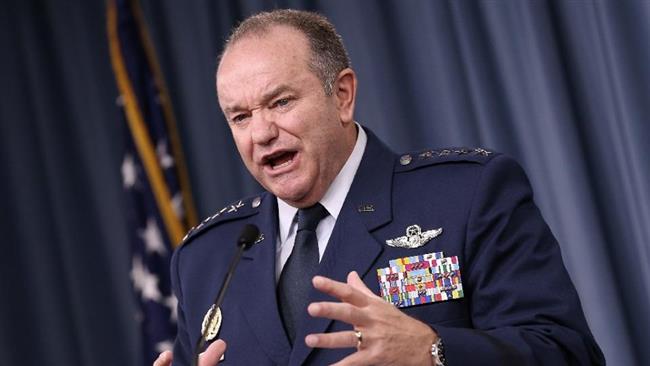
US Air Force General Philip Breedlove
Press TV – March 2, 2016
A top US military official, who is NATO’s military commander, says Russia is an “existential threat” to Washington and its European allies.
In testimony before the US Senate Armed Services Committee on Tuesday, US Air Force General Philip Breedlove accused Russia of choosing to be an adversary and seeking to exert influence over its neighboring states.
“Russia has chosen to be an adversary and poses a long-term existential threat to the United States and to our European allies and partners,” Breedlove said.
“Russia is eager to exert unquestioned influence over its neighboring states in its buffer zone… so has used military force to violate the sovereignty and territorial integrity of Ukraine, Georgia and others, like Moldova,” he added.
Breedlove stressed that Washington needs additional resources in Europe to counter a “resurgent, aggressive Russia.”
“Russia seeks to re-establish a leading role on the world stage. Russia does not just want to challenge the agreed rules of the international order, it wants to re-write them,” he said.
The four-star general, who also heads the US military’s European Command, said he asked for a substantial boost in resources for Europe in the budget for the 2017 fiscal year.
Relations between Washington and Moscow are at their lowest point since the end of the Cold War in 1991, largely due to the Ukraine crisis.
The ties deteriorated after US-backed forces ousted Ukraine’s elected president, Viktor Yanukovych, in February 2014.
The US and its allies accuse Moscow of sending troops into eastern Ukraine in support of the pro-Russian forces. Moscow has long denied involvement in Ukraine’s crisis.
Moscow says Washington is responsible for the escalating tension in Ukraine through sending arms in support of the Ukrainian army.
The US-led military buildup in NATO member states bordering Russia has drawn strong objections from Moscow, followed by warnings of a well-measured response.
The US military deployed hundreds of tanks and thousands of troops to the Baltic states of Latvia, Estonia and Lithuania in order to deter what it described as “Russian aggression.”
US-Russian ties worsen over Syria
Relations between the US and Russia further deteriorated when Moscow launched an air offensive against Daesh terrorists, many of whom were initially trained by the CIA to fight against the Syrian government.
The Russian campaign, analysts say, has broken the backbone of ISIL and other militants, and has provided the government of President Bashar al-Assad an opportunity to defeat the foreign-sponsored terrorist onslaught.
Since March 2011, the United States and its regional allies have been conducting a proxy war against Syria. The years-long conflict has left somewhere between 270,000 to 470,000 Syrians dead and half of the country’s population displaced.
In his testimony on Tuesday, General Breedlove accused Russia of helping President Assad turn the refugee crisis into a “weapon” against the West.
“Together, Russia and the Assad regime are deliberately weaponizing migration in an attempt to overwhelm European structures and break European resolve,” Breedlove told the Senate Armed Services Committee.
Featured Video

Rewriting the risk? Inside the government’s vaccine safety messaging
or go to
Aletho News Archives – Video-Images
Book Review
“Davos Can Really Replace the UN”
Inside the book that maps the architecture behind global governance — from the Epstein files to the Pact for the Future
Lies are Unbekoming | April 1, 2026
On June 13, 2019, the United Nations and the World Economic Forum signed a partnership deal to “accelerate the implementation of the 2030 Agenda for Sustainable Development.” That same evening, WEF president Börge Brende — Norway’s former Foreign Minister — had dinner with Jeffrey Epstein at Epstein’s Manhattan townhouse. The Epstein files, released January 2026, contain an exchange between the two from the previous year. Epstein to Brende: “Davos can really replace the UN. C21, cyber, crypto . genetics… intl coordination.” Brende back to Epstein: “Exactly — we need a new global architecture. World Economic Forum (Davos) is uniquely positioned — public private.”
The next day, the UN General Assembly adopted the framework for restructuring global governance.
That sequence — the partnership signing, the Epstein dinner, the candid admission about replacing the UN with a public-private architecture, and then the formal adoption — opens Jacob Nordangård’s The Digital World Brain. Pages two and three. Footnoted to the UN resolution number, the Epstein files, and the General Assembly record.
I keep coming back to it because it captures what this book does that almost nothing else in the independent research space manages. I’ve followed Jacob’s work for years now and interviewed him about his research. Each book peels back another layer of the same institutional architecture, and each time I think he’s reached the limit of what can be documented, the next one goes further. Nordangård doesn’t speculate. He doesn’t editorialize much. He lays institutional actions next to each other in chronological order and lets the pattern announce itself. … continue
Blog Roll
 Aletho News
- REWRITING THE RISK? INSIDE THE GOVERNMENT’S VACCINE SAFETY MESSAGING
- “Davos Can Really Replace the UN”
- NIAID/NIH and USDA Fund Bioengineered Chimeric Influenza Viruses Built Using Pandemic H1N1 Components: Journal ‘Science Advances’
- Hezbollah hits Israeli warship off Lebanon’s coast, sets it aflame
- Iran slams US strikes on B1 bridge, Mahshahr petrochemical plants as ‘blatant acts of state terrorism’
- In letter to UN chief, Araghchi warns of dire consequences of US-Israeli attacks on Iran’s nuclear facilities
- Why the CIA conspiracy to invade Iran with Kurdish militias failed
- Why Are Upbeat US Claims About Mission to Rescue Pilot ‘Highly Questionable’?
- Aircraft destroyed during US ‘rescue’ of downed F-15 pilot cost more than $100 million each
- Washington University removes professor who condemned US-Israeli war on Iran
- If Americans Knew
- In Iran, Israel-US take aim at “reason, research, and freedom of thought” – Daily Update
- US loses planes over Iran, Israel downgrades Lebanon war goals – Daily Update
- Israel Is Blocking Palestinians from Easter at Church Where Jesus Resurrected
- Plot to assassinate Palestinian activist follows harassment campaign promoted by Zionist groups and elected officials
- Prominent New York synagogue hosts presentation on why U.S. Jews should support the ethnic cleansing of Gaza
- Tapper vs. Piker: Is the CNN Anchor Auditioning for David Ellison?
- Shouldn’t Democrats Be Able to Condemn Genocide?
- Israel-US kill negotiators, destroy civilian structures, but Iran’s military capabilities still largely intact – Daily Update
- ‘War crime’: Global condemnation as Israeli ministers celebrate death penalty law targeting Palestinian prisoners
- 7 Ways Israel Is Turning Lebanon Into Gaza
- No Tricks Zone
- An Inconvenient Tree: Uncovered In Alps… Europe Much Warmer Than Today 6000 Years Ago
- New Study Reports A 60% Slowdown In Greenland’s Ice Loss Rate In The Last Decade
- Low Intensity Tornado Wrecks Major Solar Farm, Creating A Potential Toxic Dump
- New Study Finds Warming Saves Lives…Cold Temperatures 12 Times More Deadly Than Excess Heat
- German Science Blog Accuses PIK Climate Institute Of Hallucinating Climate Tipping Points
- Devastating Assessment Of Comirnaty Vaccine By Former Senior Pfizer Europe Toxicologist
- New Study: CO2 Is ‘Effectively Negligible’ As An Explanatory Climate Change Factor Since 2000
- Former Pfizer Toxicologist Dr. Helmut Sterz Tells Bundestag Hearing Pfizer Vaccine Should Have Never Been Approved
- Energy Expert: Germany’s Nuclear Phaseout Was A “500 Billion Euro Mistake”
- New Research: South Australia’s Mid-Holocene Sea Surface Temperatures Were 4°C Warmer Than Today
 Aletho News