Israeli Army Closes Entrance Of Hebron Emergency Center With Concrete Blocks
IMEMC – April 25, 2016
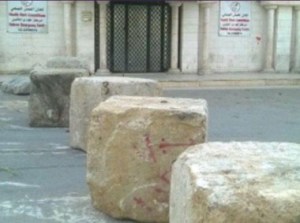 Israeli soldiers closed the main entrance of the Hebron Emergency Center, run by the Hebron Health Committees, by placing concrete blocks, completely sealing it, and deployed dozens of soldiers on its rooftop on Monday morning.
Dr. Ramzi Abu Yousef, director of the Health Work Committees (HWC) in Hebron, said many soldiers occupied the center’s rooftop, and turned it into a military base.
Abu Yousef warned of the consequences of this violation, especially since the center receives hundreds of patients on a daily basis, and added that the center provides its medical services to more than 60,000 Palestinians.
“For years now, the center has been subject to frequent Israeli military violations, including many invasions, and the soldiers even fired gas bombs at it,” Abu Yousef said, “They also repeatedly sprayed it with waste-water mixed with chemicals, in addition to harassing the patients and their families, and the various measures restricting their freedom of movement.”
The HWC voiced an urgent appeal to various human rights groups to intervene, and provide the needed protection to Palestinian health centers, in addition to pressuring Israel into halting its serious violations.
“People who need medical care have the right to receive it, but Israel continues to violate it,” the HWC added, “International Humanitarian Law stresses on the importance of unrestricted access to medical facilities.”
Trust the IDF investigation
By Yossi Gurvitz | Yesh Din | April 25, 2016
The case of Bassem Abu Rahme challenges the army’s claim that it can conduct a serious investigation of itself.
On April 17th 2009, Bassem Abu Rahme was demonstrating against the separation wall in his village, Bil’in. After another demonstrator was hit by crowd-dispersal weapons shot by Israeli security forces, Abu Rahme shouted at the soldiers and Border Policemen that the person was wounded. Seconds later, a person in Israeli uniform (it is unclear whether he or she was an IDF soldier or a Border Policeman) fired a tear gas canister directly into Abu Rahme’s chest; the wound was fatal, and within hours Abu Rahme was dead.
These facts were not, until recently, in contention. Even so, almost seven years after his death, no one has been held responsible for Abu Rahme’s death. Seven years of foot dragging and avoiding investigation (more on that in these two posts). This is what happens when a member of the security forces shoots an unarmed man — who everyone agrees posed no danger to — and the cameras (three of them, actually) document the event – yet are not aimed directly at the shooter.
We do not know who shot Abu Rahme, whether he or she was an IDF soldier or a Border Policeman. We do, however, have forensic evidence pointing to where the shooters stood. According to the ballistics examination, conducted by the IDF itself, “the only possibility of this sort of armament hitting the target is only by direct fire and using a flat angle — in the single digits — no more than three or four angles.” That is, there is no possibility of Abu Rahme being hit by a canister shot according to the orders and hitting him by mistake; even were the canister to ricochet off a fence, it would still be fired directly, contrary to orders.
The Chief of the IDF’s Photo Reconnaissance Department told the Military Police Criminal Investigations Division (MPCID) in 2013 that direct fire of tear gas canisters is forbidden and that it should hold a lineup to determine where each of the shooters stood. The MPCID refrained from doing so.
Last week, Israel’s Supreme Court heard an appeal by Yesh Din and human rights NGO B’Tselem , in which we demanded that the shooter be indicted, or that at least the army indict his commander. The hearing was held ex parte due to a strike by the prosecution. We estimate that the state would have argued that the shooters cannot be identified; and that it would also try to avoid mentioning the fact that the MPCID and the military prosecution did everything in their power to refrain from investigating the case for 15 months, and were forced to open an investigation after our first petition to the High Corut of Justice. The government is likely to claim that the canister that hit Abu Rahme’s chest ricocheted off something – and will play down the fact that even if it did, its own ballistic diagnosis ruled that it was fired contrary to orders.
The government is further likely to argue that it has no clue as to whom it should prosecute, hoping the judges will not think too much of the fact that it strangled the investigation for years. Our demand is simple: even if there is no chance to indict the shooters themselves, and we contend this claim since the MPCID’s failure to investigate rendered the case no longer investigable, the commanders should still bear responsibility.
So far, none of this has happened. The justices decided to rescind the petition, since under the Turkel Commission’s recommendations one may now object to the Attorney General over the military prosecution’s decision – a process that did not exist when we made our appeal. Justice, it seems, will have to keep waiting.
It is important to emphasize this time and again: Abu Rahme was unarmed. He was a danger to no one. He was protesting an injustice in his village – an injustice recognized by the High Court of Justice. And yet, an Israeli security officer, perhaps more than one, fired at a demonstrator in a life-threatening manner and caused his death. We note that one of the suspects said in his interrogation that he never received proper training with the weapon he was using. The commanders of these warriors, who are responsible for their actions, continue dodging this responsibility to this day.
Over the last few weeks, the very well-documented murder in Hebron has been called an exceptional, unrepresentative, and isolated incident by senior IDF and political figures. Every person of conscience should wonder whether this is so; whether the important statement in the case was not made of by Chief of Staff Eizenkot, but rather by Prime Minister Netanyahu, who phoned the father of the shooter and told him (Hebrew) to “trust the IDF investigation.”
What ought an Israeli security officer understand from the prime minister’s remarks? A reasonable interpretation would be: “don’t worry, our investigation will find you acted properly.” This, after all, is the unwritten contract between the government and its soldiers: we send you to do the dirty work of oppressing a civilian population, and in return we will turn a blind eye if you sometimes exceed your orders – unless are caught red-handed, that is. In such a case, we shall regrettably have to begin the investigation show.
Israeli occupation forces kidnap professor near Ramallah
Palestinian Information Center – April 25, 2016
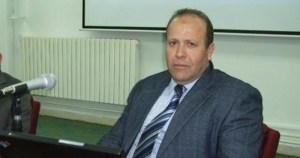 RAMALLAH – Israeli occupation forces (IOF) on Sunday kidnapped Palestinian astrophysicist Imad al-Barghouthi at Nabi Saleh checkpoint, northwest of Ramallah.
Local sources told the Palestinian Information Center that Israeli soldiers at the checkpoint detained Barghouthi and took him to an undeclared place.
Barghouthi, 53, is a professor of theoretical space plasma physics at al-Quds University and has worked for some time at NASA in the United States. His scientific work is widely published internationally in academic journals.
The IOF previously kidnapped him on December 6, 2014 at al-Karama border crossing as he was trying to cross to Jordan in order to attend a scientific conference in the United Arab Emirates.
At the time, he was reportedly interrogated for participating in a mass march against Israel’s war on Gaza.
Copyright © The Palestinian Information Center
Turkey exercises ‘decisive influence’ on Syrian ‘HNC’: Lavrov
Press TV – April 25, 2016
Russian Foreign Minister Sergei Lavrov says Turkey exercises a “decisive influence” on the so-called opposition group High Negotiations Committee (HNC) which is in peace talks with the Damascus government.
Lavrov made the remarks on Monday while commenting on the progress of the latest round of negotiations between the Syrian government and HNC, which began in Geneva on April 13.
Syria peace talks are going on despite the absence of the Saudi-backed opposition as the group’s leaders left the talks on April 19 to protest at what they called escalating violence and restrictions on humanitarian access in Syria.
A ceasefire, brokered by Russia and the US, went into effect on February 27 across Syria. Fighting, however, picked up and left the truce in tatters. Meanwhile, the UN Security Council has agreed on a six-month deadline for drafting a new constitution for the Arab country in line with the proposal of the International Syria Support Group.
“In order to come to terms over six months it is necessary not to slam the door and dig in heels, as several delegates of the so-called Riyadh group have done, Lavrov said, adding that “it’s no secret” that Turkey has a “decisive influence” on them.
“So one should not come for talks with ultimatums but should sit down at the negotiating table and reach an agreement,” Lavrov added, noting that the situation at the UN-brokered talks could have been better if HNC had not left Geneva.
The top Russian diplomat also said that Moscow was preparing a report for the UN Security Council to extend the list of terrorist groups in Syria.
“We are currently collecting information that Jebhat al-Nusra (al-Nusra Front) subjugates groups that seemed to have declared truce and readiness to join ceasefire,” Lavrov said, adding, “We will summarize facts and present them to [the] UN Security Council to adjust terrorist lists.”
Syria has been gripped by foreign-backed militancy since March 2011. Damascus says Saudi Arabia, Turkey and Qatar are the main supporters of the militants fighting the government forces.
According to UN special envoy for Syria Staffan de Mistura, some 400,000 people have lost their lives as a result of over five years of conflict in Syria.
Turkey bars entry to photojournalist on Bild assignment
RT | April 25, 2016
Greek freelance photojournalist Giorgos Moutafis, who was trying to travel through Turkey on an assignment from German tabloid Bild, has been barred from entering the country without explanation.
Moutafis, 38, was denied entry to Turkey after landing in Istanbul on Saturday and sent back to Athens. He was kicked out of the country less than an hour after German Chancellor Angela Merkel left it after visiting a refugee camp in Gaziantep, the newspaper pointed out. He intended to go to Libya from Turkey.
“I was told at the passport control that my name was on a blacklist and that I’m not allowed to enter Turkey. Then my passport was taken from me until the early morning. I had to spend the night in a room in the airport. The reasons why I’m on this list were not explained to me,” Moutafis said.
He added that he entered Turkey six months ago with no problems, and that he cannot explain why he could have been banned since then.
Moutafis is an internationally-acclaimed journalist and filmmaker, who has covered stories for outlets such as Newsweek, TIME, the New Yorker, Der Spiegel, the Guardian, Al Jazeera, CBS, CNN and the BBC, among others. He received the 2014 Press Freedom Award from Reporters Without Borders.
The focus of his work is on the perils of asylum seekers travelling to Europe from the Middle East, but he also reported on the battle for the Kurdish city of Kobani in Syria, which may explain the Turkish authorities’ attitude.
Last week, Turkey barred Volker Schwenck, a journalist working for the TV channel ARD, from entering the country. Ankara cited “security reasons.” Schwenck, who heads the channel’s Cairo bureau, intended to travel to Gaziantep to cover Merkel’s visit.
Turkey’s crackdown on the media is a hot topic in Germany after Merkel failed to oppose the prosecution of a comedian who recited a crude poem criticizing Turkish President Recep Tayyip Erdogan. Ankara had complained that the poem was insulting.
Some 2,000 libel cases have been filed in Turkey against people accused of insulting the president.
Read more:
‘Liberal’ Trudeau joins blood-soaked race for arms deals with Mideast despots
By Finian Cunningham | RT | April 24, 2016
In a remarkable spectacle of money-grubbing over arms deals, this month saw a parade of Western leaders jettisoning any pretense of upholding vaunted “liberal values” to court despotic Mideast regimes.
Justin Trudeau, the Canadian prime minister who sent liberal hearts aflutter when he was elected in November, with his espousal of feminism among other progressive causes, is the latest Western leader to show where real priorities lie. Trudeau signed off on an $11 billion deal with Saudi Arabia to export armored vehicles to the blood-soaked repressive regime.
With astounding cynicism, the 44-year-old Canadian premier said he was duty-bound to fulfill the arms contract drawn up by the previous administration as “a matter of principle” in order to demonstrate that his country’s “word means something in the international community.”
This week also saw US President Barack Obama in Saudi Arabia where he glad-handed King Salman and other Gulf monarchs, lauding them as partners in maintaining regional stability and fighting against terrorism. Conspicuously, Obama made little or no mention of human rights violations in the oil-rich kingdom where mass beheadings are a common method of capital punishment.
Western media talked about “strained relations” between Obama and his Saudi hosts. But underlying the superficial optics it was business as usual. Big business. US military affairs publication Defense One reported that high on Obama’s agenda was securing a $13 billion contract for warships and submarine-hunting helicopters with the House of Saud.
Before Obama touched down in Riyadh, his administration had angered American families by announcing that it would veto a bill going through Congress that could enable relatives of the 9/11 terror attacks to sue the Saudi rulers for their alleged involvement in sponsoring that atrocity. The topic didn’t even arise for discussion during Obama’s visit, indicating the president’s real concerns in meeting the Saudi and other Gulf rulers.
France has also nabbed market share from Western rivals in the Persian Gulf where over the past year Paris has sold billions of dollars’ worth of its Rafale fighter jets to Saudi Arabia, Qatar and the United Arab Emirates.
Similar prevarication over human rights is brazenly shown by the British government of David Cameron in its arms dealing with Saudi Arabia and the wider region. The Saudi-led war in Yemen has been a boon for British sales of bombs and missiles, even though as many as 9,000 Yemenis have been killed over the past year, many of them civilians from aerial bombing by Saudi warplanes.
Britain’s foreign minister, Philip Hammond, has dismissed condemnations by human rights groups in regard to Yemen, claiming that British weapons exports meet tough standards of international law. Britain, like Canada and other Western governments, makes the cynical claim that its military exports are not used for “internal repression” and that if it is proven that weapons are being used to kill civilians in Yemen then trade licenses will be canceled.
So what is Saudi Arabia dropping on Yemen? Cuddly British-made toys?
Duplicity of Western governments doing business with despotic regimes is nothing new. The Middle East’s absolute monarchs have long been a staple of American and other Western so-called “defense industries.” In 2010, the Obama administration signed a $60 billion weapons deal with Saudi Arabia – the biggest in US history.
During the 1980s, Britain under Margaret Thatcher won a comparable mammoth contract with Saudi Arabia known as the Yamamah deal.
Massive arms sales to tyrannical regimes give the real meaning to hackneyed euphemisms spouted by the likes of Obama, Cameron, Hollande and Trudeau, when they cite “regional partners for stability.” What they mean by stability is uninterrupted orders for weapons.
What is new, though, is the lack of discretion in how the West now pursues arms deals in the Mideast.
Western governments are apparently falling over themselves to bid for business. Yet this unseemly rush for arms selling is sharply at odds with not only intensifying repression within Middle Eastern “partner” regimes; it has also become abundantly clear that some of these same regimes are directly responsible for sponsoring terrorism in the region. The case of Saudi Arabia and its sponsorship of Wahhabi terror proxies in Syria, Libya and Iraq is perhaps the most glaring.
Part of the burgeoning Western race for arms business is related to the historical demise of their capitalist economies and the emergence of military industries as key components in whatever remains of gutted manufacturing sectors.
No doubt, critics will point out that Russia is also a major arms supplier to Middle Eastern regimes. According to the Stockholm International Peace Research Institute, Russia is indeed a prominent weapons exporter to the region and globally.
However, there is an important distinction. Western governments never cease to proclaim democracy, human rights and international law as foundational policies. Washington, London, Paris and so on continually invoke such rights as criteria by which they sanction, censure and even invade other countries to ostensibly uphold.
What is therefore more transparent than ever from Western countries soliciting arms deals in the Middle East is their shameless, sordid hypocrisy.
That Canada’s fresh face of “liberal values,” Justin Trudeau, has joined the throng of Western leaders cutting deals with tyrants and dictators just goes to show how cosmetic Western noble pretensions are.
Why should citizens in these countries believe anything that their governments tell them on any issue? Their governments all too evidently do not have a scrap of integrity or principle.
Official Western treachery, duplicity and hypocrisy have become a chronic condition that is no longer veiled by lofty rhetoric, as it once was. So-called liberal values are being stabbed in the back – left, right and center.
Read more:
UK sold Saudis £2.8bn in weapons since outbreak of Yemen war – report
Saudi-led forces enter town after Qaeda exit
Press TV – April 25, 2016
Forces loyal to Saudi-backed ex-president Abd Rabbuh Mansur Hadi and Emirati troops have reportedly overrun Mukalla after al-Qaeda militants left the seaport in southeast Yemen.
Reuters quoted residents as saying that local clerics and tribesmen negotiated with al-Qaeda to exit quietly and that militants withdrew Sunday westward to neighboring Shabwa province.
They said there was no fighting after Saudi-backed units mobilized their forces at Mukalla’s suburbs. However, the official Saudi news agency SPA claimed on Monday that more than 800 al-Qaeda members had been killed.
Around 2,000 pro-Hadi and Emirati troops reportedly advanced into Mukalla, home to an estimated 200,000 people, taking control of its maritime port and airport and setting up checkpoints.
Mukalla has been the center of a rich mini-state that al-Qaeda in the Arabian Peninsula (AQAP) built up over the past year. The group took control of an almost 600-km (370-mile) band of Arabian Sea coastline.
Once faded into irrelevance, AQAP has gone from strength to strength in Yemen since Saudi Arabia began its ferocious military campaign against the impoverished neighbor.
Al-Qaeda and other Takfiri groups such as Daesh have become stronger as Houthis – their arch enemy in Yemen – have come under the heaviest Saudi attacks for more than a year.
The Rai al-Youm newspaper on Monday pointed out that Saudi Arabia had supplied weapons to al-Qaeda militants in the Abyan and Hadhramaut to confront Houthi fighters.
The paper, edited by prominent Palestinian journalist Abdel Bari Atwan, wrote that Saudi Arabia had decided to retake Mukalla from al-Qaeda in the face of rising criticism in the West of the fallout of the invasion.
The decision was also linked to a US congressional motion to hold the Saudi ruling family accountable for potential roles in the September 11, 2001 terrorist attacks, it added.
Pro-Saudi forces, however, retreated from Zinjibar, the capital of Abyan province in south Yemen, after they entered it on Saturday night.
A bomb-laden vehicle exploded Sunday killing seven pro-Hadi militants who had launched an offensive with the help of Saudi air power.
“The withdrawal was decided following information that al-Qaeda was preparing other car-bomb attacks against our troops,” AFP quoted a pro-Hadi officer as saying.
The alleged recapture of Mukalla coincided with UN-brokered peace talks in Kuwait after a ceasefire entered into effect on April 11, but from which Takfiri groups are excluded.
There was no immediate official reaction to the reports from Houthis and their allies who are to hold their fifth day of peace talks on Monday in a bid to end 13 months of war.
More than 9,400 people have been killed and at least 16,000 others injured since Saudi Arabia launched its airstrikes against Yemen last March.
Merkel’s Syria Safe Zone Partition Scheme
By Stephen Lendman | April 24, 2016
Longstanding US/Israeli plans call for redrawing the Middle East map – including partitioning Iraq and Syria, installing pro-Western/Zionist puppet regimes.
Turkey wants a Syria buffer zone to annex border areas between both countries. Weeks earlier, Russian Foreign Minister Sergey Lavrov blasted the idea, saying creating one would “violate every principle of international law and will lead to a substantial, qualitative escalation” of tensions.
In February, John Kerry told Senate Foreign Relations Committee members that establishing a buffer or safe zone in Syria would require up to 30,000 troops to enforce it, according to Pentagon estimates.
Last November, Trump endorsed the idea, saying “(b)uild a big, beautiful safe zone, and you have whatever it is so people can live, and they’ll be happier.”
Hillary Clinton earlier urged establishing a no-fly zone, the same scheme she used to wage US-led NATO aggression on Libya.
Merkel supported the idea. Now she seeks creating “safe zones” on the phony pretext of protecting internally displaced Syrians, saying:
Establish “zones where the ceasefire is particularly enforced and where a significant level of security can be guaranteed.”
Syria and Russia categorically reject the idea, a thinly veiled partition plan, flagrantly violating international law, also aiming to stem the refugee flow caused by Obama’s war – NATO and regional rogue states complicit in his high crime.
On Friday, Syrian chief peace talks negotiator Bashar al-Jaafari minced no words blasting Western and regional regimes for supporting “organized networks of international terrorism,” continuing to send them cross-border into Syria, “sabotaging the rules of international law,” while claiming to support diplomatic conflict resolution.
War without resolution continues. Peace prospects are unattainable as long as Washington demands regime change.
Stephen Lendman can be reached at lendmanstephen@sbcglobal.net.
His new book as editor and contributor is titled “Flashpoint in Ukraine: US Drive for Hegemony Risks WW III.”
Is Hillary Clinton ‘Honest’?
By Robert Parry | Consortium News | April 24, 2016
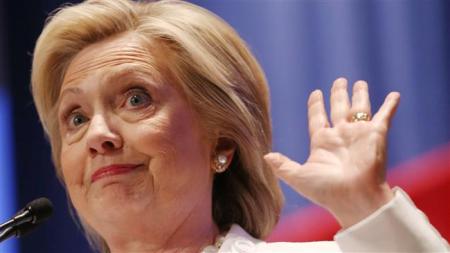
New York Times columnist Nicholas Kristof has offered a curious defense of Hillary Clinton’s “honesty,” refuting the public’s widespread view that she is a liar by narrowly defining what it means to be “honest” and arguing that she is less dishonest than she is a calculating and corner-cutting politician.
Kristof writes, “as we head toward the general election showdown, by all means denounce Hillary Clinton’s judgment and policy positions, but let’s focus on the real issues. She’s not a saint but a politician, and to me this notion that she’s fundamentally dishonest is a bogus narrative.”
Kristof cites, for instance, that half of her campaign statements, as evaluated by PolitiFact, were rated either true or mostly true, comparable to how the group assessed statements by Sen. Bernie Sanders and Sen. Ted Cruz and much better than Donald Trump’s 22 percent. Leaving aside the “conventional wisdom” bias of this mainstream media organization, Kristof does seem to have a point. In a narrow definition of “honesty,” former Secretary of State Clinton may be “truthful” or kind of truthful half the time.
But Kristof misses the larger point that the American people are making when 56 percent of them rate her negatively and many call “crooked” and “dishonest.” They seem to be commenting on her lack of authenticity and perhaps her resistance to sincerely acknowledging major errors in judgment. She only grudgingly apologized for her pro-Iraq War vote and still insists that her bloody “regime change” scheme for Libya was a good idea, even as the once-prosperous North African nation slides into anarchy and deprivation – with the chief beneficiary the head-choppers of the Islamic State.
A Nixonian Quality
Many Americans sense that there is a Nixonian quality to Hillary Clinton – her excessive secrecy, her defensiveness, her rigidity, her unwillingness to acknowledge or learn from mistakes. Even when she is forced into admitting a “mistake,” such as her violation of State Department rules when she maintained a private email server for official correspondence, she acts as if she’s just “apologizing” to close off further debate or examination. As with Richard Nixon, there’s a feeling that Clinton’s apologies and rationales are self-serving, not forthcoming.
Yet, while it’s true that Nixon was a deceitful character – his most famous lie being when he declared “I am not a crook” – I would argue that he had some clear advantages over Clinton as President. He was a much more strategic thinker than she is – and sometimes went against the grain of expectations as encapsulated in the phrase “Nixon goes to China,” meaning that Nixon could open up to communist China precisely because he was viewed as such a hardliner who would never do such a thing but who finally judged that the move was in America’s interests.
While it’s impossible to say whether Clinton would seize unexpected openings as President, she showed none of that creativity, subtlety and courage as Secretary of State. She marched down a straightforward neocon line, doing precisely what Israel’s Prime Minister Benjamin Netanyahu wanted in the Middle East.
Clinton tried to sabotage President Barack Obama’s diplomatic outreach to Iran and favored military solutions to Afghanistan, Libya and Syria. She also followed a rightist approach in backing the 2009 coup in Honduras that ousted an elected progressive president who had offended some of the Honduran oligarchs and outside corporate interests.
Lack of Self-Criticism
In addition, Clinton appears to have learned nothing from her support for the catastrophic Iraq War and has argued against “conflating” her Iraq decision with her Libya decision. But that suggests that she is incapable of learning a lesson from one mistake and applying it to a similar situation, an almost disqualifying characteristic for someone who hopes to become President.
Being a successful President requires extracting painful lessons from one mistake and making sure you don’t make the same mistake again. But Clinton’s personal arrogance or defensiveness (it’s hard to figure out which is dominant) prevents her from that sort of self-criticism.
Indeed, her ritualistic (and politically timed) apology for her Iraq War vote in 2006 came across less than an honest recognition that she had done something horribly wrong than that she had to say something to appease a furious Democratic electorate as she mounted her first run for President against anti-Iraq War candidate Obama.
After losing to Obama and becoming his Secretary of State, she privately hedged her Iraq War apology by saying privately that she thought that President George W. Bush’s “surge” in Iraq was successful and admitting that she had only opposed it in 2007 for political reasons, according to former Defense Secretary Robert Gates in his memoir, Duty.
On Oct. 26, 2009, as Gates — a holdover from the Bush administration — and Clinton joined forces to pressure Obama into approving a similar “surge” for Afghanistan, Gates recalled a meeting in which Clinton made what he regarded as a stunning admission, writing:
“The exchange that followed was remarkable. In strongly supporting the surge in Afghanistan, Hillary told the president that her opposition to the surge in Iraq had been political because she was facing him in the Iowa primary [in 2008]. She went on to say, ‘The Iraq surge worked.’
“The president conceded vaguely that opposition to the Iraq surge had been political. To hear the two of them making these admissions, and in front of me, was as surprising as it was dismaying.” (Obama’s aides disputed Gates’s suggestion that the President indicated that his opposition to the Iraq “surge” was political, noting that he had always opposed the Iraq War. The Clinton team has not challenged Gates’s account.)
But the exchange, as recounted by Gates, indicates that Clinton not only let her political needs dictate her position on an important national security issue, but that she accepts as true the superficial conventional wisdom about the “successful surge” in Iraq, which claimed the lives of about 1,000 American soldiers and a much larger number of Iraqis but failed its principal mission of buying time for the Iraqis to resolve their sectarian differences.
So, when one considers Hillary Clinton’s “honesty” more should be in play than simply whether she accurately describes her policy positions half the time. Honesty, as most people would perceive it, relates to a person’s fundamental integrity, strength of character, readiness to acknowledge mistakes and ability to learn from them. On that measure, the American people seem to have sized up Hillary Clinton pretty well.
[For more on this topic, see Consortiumnews.com’s “Yes, Hillary Clinton Is a Neocon.“]
Investigative reporter Robert Parry broke many of the Iran-Contra stories for The Associated Press and Newsweek in the 1980s. You can buy his latest book, America’s Stolen Narrative, either in print here or as an e-book (from Amazon and barnesandnoble.com).
NYU grad student union votes to boycott Israel
Ma’an – April 24, 2016
A graduate student union at New York University on Friday voted in favor of joining the Boycott, Divestment, and Sanctions movement against Israeli violations of Palestinian human rights.
Two-thirds of the Graduate Student Organizing Committee cast a vote in support of the resolution, which calls on both NYU and its United Automobile Workers union affiliate to divest from all Israeli state institutions — including universities — and corporations “complicit in” Israeli violations.
The resolution proposes that NYU join the movement “until Israel complies with international law and ends the military occupation, dismantles the wall, recognizes the rights of Palestinian citizens to full equality, and respects the right of return of Palestinian refugees and exiles.”
Over 600 union members voted in the referendum, a reportedly larger-than-average turnout for union votes. The 2,000-strong union represents graduate teaching and research assistants at the university.
Some 57 percent of voters made a voluntary individual pledge to participate in the academic boycott against Israel.
The BDS movement has gained momentum over the past year, aiming to exert political and economic pressure over Israel’s occupation of Palestinian territory in a bid to repeat the success of the campaign which ended apartheid in South Africa.
Major actors to join the movement this year include British security giant G4S and French telecom company Orange.
The NYU union’s support of BDS comes after US President Barack Obama in February signed into law an anti-BDS trade agreement reiterating that US Congress “opposes politically motivated actions that penalize or otherwise limit commercial relations specifically with Israel,” referring directly to BDS activities.
The Israeli leadership has widely condemned the BDS movement as antisemitic or carried out from “hatred of Israel,” while proponents of the movement argue divestment measures are necessary in pressuring Israel to end its decades-long military occupation.
Moves inside the US — Israel’s longstanding ally and number one provider of military aid — to criminalize BDS have meanwhile been slammed by human rights defenders as a violation of free speech.
Another Proposed Sham Israeli/Palestinian Peace Conference
By Stephen Lendman | April 24, 2016
The longstanding Israeli/Palestinian peace process is the greatest hoax in modern times, repeating on and off for decades, dead-on-arrival each time, accomplishing nothing.
Obama hopes to lay the groundwork for another round of sham talks after he leaves office. France proposed an international conference in Paris this summer, presenting general ideas and principles only. Solutions remain elusive.
Months of John Kerry’s mediated talks collapsed in April 2014. America is no honest broker, one-sidedly supporting Israel, spurning Palestinian rights.
France’s position is no different. Israel rejects Palestinian self-determination. Liberation depends on resistance, not more talks achieving nothing.
A Paris meeting later this week is expected to involve high-level international diplomats, according to Palestinian ambassador to France Salman al-Harfi.
Israeli and Palestinians representatives aren’t attending. Objectives include agreeing on a way to achieve Palestinian statehood within pre-1967 borders, Jerusalem as a shared capital for both states, and resolving the right of return issue.
Mahmoud Abbas’ draft Security Council resolution condemning illegal Israeli settlements was withdrawn. It wasn’t a serious effort in the first place, having no chance to pass.
Netanyahu criticized the French initiative. Israel rejects Palestinian self-determination. It wants full control over future talks – to manipulate them to its advantage.
It long ago declared Jerusalem its exclusive capital, categorically rejects the right of diaspora Palestinians to return home.
It wants endless war and turbulence. Peace and stability defeat its imperial aims.
On Saturday, it approved stealing another 1,250 acres of privately owned Palestinian land, declared “state land” under full military control.
It’s intended for expanding illegal settlements – more proof Israel wants continued conflict, not peace.
Stephen Lendman can be reached at lendmanstephen@sbcglobal.net.
His new book as editor and contributor is titled “Flashpoint in Ukraine: US Drive for Hegemony Risks WW III.”
Featured Video

Meet The Ellisons: Zionists, Technocrats, Moguls
or go to
Aletho News Archives – Video-Images
Frlom the Archives
The Doctrine of ‘Superior People’: The Bond between Israel and World Zionism
By James Petras :: 09.04.2015
Introduction
The single greatest feat of Israel and its overseas missions has not been material success, or the military conquest of millions of unarmed Palestinians, it has been ideological – the widespread acceptance in the US of a doctrine that claims ‘Jews are a superior people.’
Apart from small extremist rightwing sects who exhibit visceral anti-Semitism and denigrate everything Jewish, there are very few academics and politicians willing to question this supremacist doctrine. On the contrary, there is an incurable tendency to advance oneself by accepting and embellishing on it.
For example, in August 2015, US Vice-President Joseph Biden attributed ‘special genius’ to Jews, slavish flattery that embarrassed even New York’s liberal Jewish intellectuals.
Israel’s dominant role in formulating US Middle East policy is largely a product of its success at recruiting, socializing and motivating overseas Jews to act as an organized force to intervene in US politics and push Israel’s agenda.
What motivates American Jews, who have been raised and educated in the US to serve Israel? After all, these are individuals who have prospered, achieved high status and occupy the highest positions of prestige and responsibility. Why would they parrot the policies of Israel and follow the dictates of Israeli leaders (a foreign regime), serving its violent colonial, racist agenda?
What binds a majority of highly educated and privileged Jews to the most rabidly rightwing Israeli regime in history – a relationship they actually celebrate?
What turns comfortable, prosperous American Jews into vindictive bullies, willing and able to blackmail, threaten and punish any dissident voices among their Gentile and Jewish compatriots who have dared to criticize Israel?
What prevents many intelligent, liberal and progressive Jews from openly questioning Israel’s agenda, and especially confronting the role of Zionist zealots who serve as Tel Aviv’s fifth column against the interest of the United States?
There are numerous historical and personal factors that can and should be taken into account to understand this phenomenon.
In this essay I am going to focus on one – the ideology that ‘Jews are a superior people’. The notion that Jews, either through some genetic, biologic, cultural, historical, familial and/or upbringing, have special qualities allowing them to achieve at a uniquely higher level than the ‘inferior’ non-Jews.
We will proceed by sketching the main outline of the Jewish supremacist ideology and then advance our critique.
We will conclude by evaluating the negative consequences of this ideology and propose a democratic alternative. … continue
Blog Roll
 Aletho News
- Meet The Ellisons: Zionists, Technocrats, Moguls
- US failures in Iran reveal Russia is key to South Korea’s strategic security
- ‘All ports in Persian Gulf will be legitimate targets if Iranian ports are attacked’
- 40 Years of Endless War, Data Point by Data Point
- Department of War Using Palantir AI to Pick Targets in Iran
- American bases do not protect – they attack the peoples of the Persian Gulf
- ‘We’ve Obliterated Their Missiles’
- Syrian president vows ‘absolute support’ to disarm Hezbollah
- Ukraine attacking Russian gas pipeline to stop deliveries to Europe – Defense Ministry
- ‘Heinous crime’: Iran denounces Israeli assassination of 4 Iranian diplomats in Lebanon
- If Americans Knew
- Israeli strategic plans to “remake the Middle East” from the 1950s and since
- Honoring Gaza’s women who refused to let the world look away
- 97% of victims of war on Iran are Iranian, 98% of victims in war on Gaza are Gazans – Not a ceasefire Day 152
- Early Iran strikes cost $5.6 billion in munitions, Pentagon estimates
- Israel Decided the War, But Trump’s America Fights and Pays the Bill
- Conscientious Objector Group: Phone ‘Ringing Off Hook’ As Huge Mobilization Underway
- U.S. support for Israel continues to plummet, despite media’s best efforts
- Threats and missiles fly, death tolls soar in Iran, Lebanon, Gaza – Not a ceasefire Day 151
- Lebanon: Israel’s White Phosphorous Use Risks Civilian Harm
- Corporate Media Go All Out To Support The US-Israeli War On Iran
- No Tricks Zone
- Destructive Green New Deal: German Energy And Metal Group Warns Of Drastic Crisis
- New Study Documents A 20-Year Pause In Arctic Sea Ice Decline – Driven By Internal Variability
- Wake-up Call: Survey Shows Majority Of Germans Now Favor Postponing Climate Targets!
- Televised! Leading German Political Candidate Tells Schoolchildren CO2 Makes Sun Hotter!
- New Study: A Century Warming Of 1.1°C Is ‘Commonplace’ And ‘Not Unusual’ During This Interglacial
- New Study: ‘Internal Noise’ And Volcanic Forcing Can Trigger 10-15°C Warming Within Decades
- Glaciers Worldwide Are Suddendly Surging, Experts Blame Warming!
- Surprising Discovery: Sahara Is Greening…Billions Of Trees Where Once Thought To Be Barren
- New Research Reaffirms Clouds, Aerosols, And Surface Solar Radiation Are ‘Driving The Climate System’
- Germany: Electric Car Catches Fire At Charging Station, Sets Off Local “Inferno”, Widespread Damage
 Aletho News