Human Rights Defender Arrested During Cycling Marathon
International Solidarity Movement | May 15, 2016

Photo Credit: http://www.taz.de
Bil’in, Occupied Palestine – On Friday the 13th of May 2016, the internationally recognized human rights defender and coordinator of the Bil’in popular committee against the wall and settlements, Abdullah Abu Rahma, was arrested during the Alwada Cycling Marathon, which took place in the West Bank Friday. Abdullah Abu Rahma is currently still being held under detention by the Israeli military and his case will be brought to the military court in Ofer Military Base tomorrow.
Abu Rahma, who is from the West Bank village Bil’in, was arrested, after the Alwada Cycling Marathon had reached Bil’in. After reaching Bil’in the attending cyclists were met by approximately 150 heavily armed soldiers, who immediately started showering the cyclists with tear gas and blocked the road, where their route was going. During this attack on the peaceful demonstrating cyclists, Abu Rahma was arrested along with an international activist from Israel. The Israeli activist was released shortly after her arrest.
The Alwada Cycling Marathon’s intention was to demonstrate against the illegal Israeli occupation and the apartheid system, that Israel is enforcing on the Palestinians through a healthy and peaceful cycling route from Ramallah to Bil’in. By Israeli Forces attacking the peaceful demonstration and arresting Abu Rahma, they once again show the world, that they do not accept the right to protest peacefully and that they do not comply with the international law, that does not allow Israeli Forces to be on Palestinian controlled areas, which the area of Bil’in is.
Abu Rahma is an important activist for the village of Bil’in and a symbol of peaceful resistance all over the West Bank. For now, he is left waiting for his next sentence, after he has already been imprisoned for his nonviolent resistance multiple times, and has in the past been charged with both “incitement” and “organizing and participating in an illegal demonstration.” Till now, there has not been declared a charge against him in the current case, but the military court will determine his fate, after having held him in detention for 4 days, even though he did not commit any crime whatsoever.
For more information about friday’s Alwada Cycling Marathon:
https://www.facebook.com/haytham.alkhateeb/posts/10208232017891106?pnref=story
https://www.facebook.com/haytham.alkhateeb/videos/vb.1022320161/10208230395770554/?type=2&theater
Battleground Europe: The Real Reason US Wants to Invest More in Propaganda

© Flickr/ sualk61
Sputnik – May 16, 2016
The United States is contemplating investing into additional propaganda efforts targeted against Russia as mainstream Western media does not seem to be doing a very good job of getting Washington’s message across to Europe and preventing the continent from getting closer to Russia, former US diplomat Jim Jatras told RT.
The analyst was referring to a recent initiative aimed at establishing a new federal agency that will be tasked with countering Russian and Chinese “propaganda.”
The bill, known as Countering Information Warfare Act of 2016, has been in fact designed “to insure that there is no corrective to the information put out by [the US] government and then dutifully picked up by the Western media,” Jatras observed.
American media outlets, he added, “pick up like bulletin boards from government agencies very uncritically and just simply put it out there. And no other points of view are really entertained.”
The initiative is primarily focused on Europe and its warming relations with Russia, he added. US policymakers are apparently concerned that Europeans are increasingly disappointed in Washington’s stance on Russia, with some urging to lift the restrictive measures that were imposed on Moscow following the outbreak of the Ukrainian civil war.
“What I think the fear is, especially if you look at the changing mood in Europe towards, for example, the sanctions on Russia, I think that the people here in Washington feel they are losing that argument,” Jatras said.
The US policymakers’ logic, according to the analyst, is the following:
“Rather than reexamine their policy and think: ‘Well, maybe there is something wrong here, maybe we should change our course,’ they are saying: ‘They just don’t understand us well enough. We just have to make our propaganda better than it has been.'”
The bill, introduced by Senator Rob Portman, has been referred to the Committee on Foreign Relations. If passed, it would create the Center for Information Analysis and Response, armed with a $20-million budget for 2017 and 2018.
“This is especially, it seems, targeted toward Europe where there will be a $20 million over the next two fiscal years made available in the form of grants to unspecified people in Europe that one assumes in the European media to carry a story that is more in line with US policy,” Jatras explained.
Read more:
US, NATO, EU ‘Obsessed’ With ‘Highly Efficient Russian Propaganda’
Peace, Not Russia, Is Real Threat to US Power
By Finian CUNNINGHAM | Strategic Culture Foundation | 16.05.2016
 The monstrous US military budget is a classic illustration of the proverb about not seeing the wood for the trees. It is such an overwhelming outgrowth, all too often it is misperceived.
In recent years, Washington’s military expenditure averages around $600 billion a year. That’s over half of the total discretionary spending by the US government, exceeding budgets for education, health and social security. It’s well over a third of the total world military annual spend of $1.7 trillion.
The incipient military-industrial complex that President Dwight Eisenhower warned of in his farewell speech in 1961 has indeed become a central, defining feature of American society and economy. To talk of «American free-market capitalism» is a staggering oxymoron when so much of the country’s economy is wholly dependent on government-funded militarism.
Or put it another way: if the US military budget were somehow drastically reduced in line with other nations, the all-powerful military-industrial complex and the American state as we know it would collapse. No doubt something better would evolve in time, but the impact on established power interests would be calamitous and therefore is trenchantly resisted.
This is the context for the escalation in Cold War tensions with Russia this week, with the deployment of the US missile system in Romania. The $800 million so-called missile shield is set to expand to Poland over the next two years and eventually will cover all of Europe from Greenland to southern Spain.
Washington and NATO officials maintain that the Aegis anti-missile network is not targeted at Russia. Unconvincingly, the US-led military alliance claims that the system is to defend against Iranian ballistic missiles or from other unspecified «rogue states». Given that Europe is well beyond the range of any Iranian ballistic capability and in light of the international nuclear accord signed last year between Tehran and the P5+1 powers, the rationale of «defense against Iranian rockets» beggars belief.
The Russian government is not buying American and NATO denials that the new missile system is not directed at Russia. The Kremlin reproached the latest deployment as a threat to its security, adding that it would be taking appropriate counter-measures to restore the strategic nuclear balance. That’s because the US Aegis system can be reasonably construed as giving NATO forces a «first-strike option» against Russia.
A couple of things need to be clarified before addressing the main point here. First, European states are chasing Iranian business investments and markets following the breakthrough P5+1 accord signed last July. Germany, France, Italy, Britain and Austria are among the Europeans who have been vying to tap Iran’s huge economic potential. The notion that Iran is harboring a military threat to such prospective partners is ludicrous, as Russian officials have pointed out.
Secondly, the US protestations of innocent intentions towards Russia are a contemptible insult to common sense. They contradict countless statements by Washington, including President Obama and his Pentagon top brass, which have nominated Russia as an aggressive threat to Europe. Washington is quadrupling its military spending in Europe, increasing its troops, tanks, fighter jets, warships and war exercises on Russia’s borders on the explicit basis of «deterring Russian aggression».
In other words, Russia is viewed as a top global enemy – an existential threat – according to Washington. So, the deployment of the US Aegis missile system this week in Eastern Europe is fully consistent with Washington’s bellicose policies towards Russia. It would thus be irrational and foolishly naive to somehow conclude otherwise, that the US and its NATO allies are not on an offensive march towards Russia.
The depiction of Russia as a global security threat is of course absurd. We can also include similar US claims against China, Iran and North Korea. All such US-designated «enemies» are wildly overblown.
Western claims – amplified relentlessly in the Western news media – of Russia «annexing» Crimea and «invading» eastern Ukraine can be easily contested with facts and indeed counterpoised more accurately as belying Washington’s covert regime change in Kiev.
Nevertheless, Western fear-mongering supported by unremitting media propaganda has to a degree succeeded in conflating these dubious claims into a bigger specter of Russia menacing all of Europe with hybrid warfare. It is, to be sure, a preposterous scare story of a Russian bogeyman which has racist undertones and antecedents in Nazi ideology of demonizing Slavic barbarians.
But this demonizing of Russia, as with other global enemies, is a necessary prop for the American military-industrial complex and its essential functioning for the US economy.
The $600 billion-a-year military spend by Washington is roughly tenfold what Russia spends. And yet, inverting reality, Russia is presented as the threat!
The US military budget is greater than the combined budgets of the world’s next nine big military spenders: China, Saudi Arabia, Russia, Britain, France, Germany, India, Japan and South Korea, according to the Stockholm International Peace Research Institute.
Arguably, the US economy as we know it – dominated by Pentagon, corporate, Wall Street and congressional interests – would cease to exist were it not for the gargantuan government-subsidized military budget.
Structurally, the US economy has ossified into a war economy and the only way for this to be maintained is for the US to be continually placed on a war footing, either in the form of a Cold or Hot conflict. Historians will note that out of its 240 years of existence as a modern state, the US has been in war or overseas conflict for more than 95 per cent of its history.
During the former Cold War with the Soviet Union, a recurring theme in Washington was the alleged «missile gap» which purported to portray the US as losing its military edge. This resulted in relentless military expenditure and an arms race that in part led to the collapse of the Soviet Union.
Washington’s self-ordained privilege to run up endless debt (currently nearly $20 trillion) because of its dollar dominance as the world’s reserve currency has permitted the US to escape a day of reckoning for its ruinous military profligacy.
This madcap situation continues to prevail. A quarter of a century after the official end of the old Cold War, US military spending continues at the same profligate, unsustainable pace.
What Washington needs in order to keep the fiasco going is to whip the rest of the world into a frenzy of fear and loathing. That’s why the Cold War with Russia and China has had to be rehabilitated in recent years. Swords cannot be turned into plowshares because the US power interests that command its economy have no use for plowshares.
Russian President Vladimir Putin has on several occasions invited global cooperation on security matters, and with the US in particular. Moscow has also recently said that it does not want to embark on a new arms race. The latter wariness is understandable given the deleterious experience for the Soviet Union from runaway military spending.
However, that is precisely what the US wants and needs to induce: a global arms race which it can then invoke as justification for its own monstrous military.
According to SIPRI, both China and Russia have significantly increased their military budgets, by about 7.5 per cent each in 2015.
Russia may not want to engage in an arms race, mindful of the warping pressure that can inflict on its national resources and development.
But when the US installs a new missile system on Russia’s doorstep, the impetus for Russia to likewise scale up military commitments is onerous.
And that is what Washington is driving at. It is not that Russia is an objective security threat to Washington or its allies. The real threat to Washington is peaceful international relations which would make its military-industrial complex redundant.
It is a disturbing reality that world peace is antithetical to the very foundation of America’s corporate capitalist power.
Shamefully, the world is subjected to the risk of war and even annihilation all for the purpose of maintaining elite American power privileges. And among those who suffer this diabolical injustice are none other than the majority of American citizens, who have to endure poverty and misery while their corporate elite siphon off $600 billion a-year in military obscenity.
Turkish MP tweets of ‘downing another Russian plane’ over basketball match outcome
RT | May 16, 2016
An MP in the Turkish ruling AKP party has tweeted about ‘downing another Russian plane.’ It was his reaction to a Turkish basketball team losing to a Russian outfit in a major game. The politician later said the tweet was a joke.
Islanbul’s Fenerbahce basketball team lost to Moscow’s CSKA 101-96 in overtime in the Euroleague final on Sunday.
“Another Russian jet should be dropped,” Samil Tayyar, MP from Turkey’s ruling AKP party, tweeted following the match.
The phrase was retweeted more than 8,000 times and garnered more than 9,000 ‘likes’. However, not all the retweets were an endorsement, as quite a number of negative and even insulting comments ensued.
On Monday, Tayyar took to Twitter again, explaining that his words were a joke made to “take the heat off.”
In the MP’s opinion refereeing at the CSKA-Fenerbahce match was warped, which influenced the outcome of the game.
Russian-Turkish relation have been frosty since November 24, 2015, when a Turkish F-16 fighter ambushed and downed a Russian Su-24 bomber taking part in anti-terrorist operations in Syrian airspace. One of the pilots was shot dead from the ground after he ejected, allegedly by Turkmen militants fighting Syrian troops.
The operation to rescue the other pilot was successful, but a marine from the rescue party was killed by the militants, who also damaged and later destroyed a Russian Mi-8 transport helicopter on the ground.
Turkey has never apologized for the incident, insisting that the Su-24 violated its airspace. Ankara has recently released the alleged killer of the Russian pilot from custody.
After the attack, Russia introduced a set of economic measures against Turkey, restricted Turkish business activities in Russia, banned employment of Turkish citizens, and canceled all charter flights to Turkey. This move has decreased the flow of Russian tourists to Turkey 10 times. A ban on practically all Turkish food imports was also put in place.
Russia’s agriculture watchdog Rosselkhoznadzor announced plans to halt imports of fruit and vegetables from Turkey this week.
The “basketball incident” is the second of its kind lately. A Russia-Turkey women’s volleyball match in Istanbul in March saw a display of hatred from Turkish fans, who showered the guest team with rubbish. The host team’s coach went as far as flipping the bird to the Russian girls and staff.
Defense Bill Coming This Week: A Boost for War and Tyranny
By Ron Paul | May 15, 2016
For many of us concerned with liberty, the letters “NDAA” have come to symbolize Washington’s ongoing effort to undermine the US Constitution in the pursuit of constant war overseas. It was the National Defense Authorization Act (NDAA) for 2012 that introduced into law the idea that American citizens could be indefinitely detained without warrant or charge if a government bureaucrat decides they had assisted al-Qaeda or “associated forces that are engaged in hostilities against the United States.” No charges, no trial, just disappeared Americans.
The National Defense Authorization bill should be a Congressional mechanism to bind the president to spend national defense money in the way Congress wishes. It is the nuts and bolts of the defense budget and as such is an important oversight tool preventing the imperial executive from treating the military as his own private army. Unfortunately that is no longer the case these days.
Why am I revisiting the NDAA today? Unfortunately since 2012 these bills have passed the House with less and less scrutiny, and this week the House is going to vote on final passage of yet another Defense Authorization, this time for fiscal year 2017. Once again it is a terrible piece of legislation that does great harm to the United States under the guise of protecting the United States.
Unless some last minute changes take place, this latest NDAA will force young women for the first time to register to be drafted into the US military. For the past 36 years, young men have been forced to register with Selective Service when they turn 18 or face felony charges and years in prison. Under a perverted notion of “equality” some people are cheering the idea that this represents an achievement for women. Why cheer when slavery is extended to all? We should be fighting for an end to forced servitude for young men and to prevent it being extended to women.
The argument against a draft should appeal to all: you own your own body. No state has the right to force you to kill or be killed against your will. No state has a claim on your life. We are born with freedoms not granted by the state, but by our creator. Only authoritarians seek to take that away from us.
Along with extending draft registration to women, the latest NDAA expands the neocons’ new “Cold War” with Russia, adding $3.4 billion to put US troops and heavy weapons on Russia’s border because as the bill claims, “Russia presents the greatest threat to our national security.” This NDAA also includes the military slush fund of nearly $60 billion for the president to spend on wars of his choosing without the need to get Congress involved. Despite all the cries that we need to “rebuild the military,” this year’s Defense Authorization bill has a higher base expenditure than last year. There have been no cuts in the military. On the contrary: the budget keeps growing.
The Defense Authorization bill should remain notorious. It represents most of what is wrong with Washington. It is welfare for the well-connected defense contractors and warfare on our economy and on the rest of the world. This reckless spending does nothing to defend the United States. It is hastening our total economic collapse.
Azerbaijan to perform military drills with Turkey, Georgia
Press TV – May 15, 2016
The Republic of Azerbaijan has declared joint military drills with Turkey and Georgia, a move which is likely to increase tensions with neighboring Armenia prior to talks with Yerevan over the disputed region of Nagorno-Karabakh.
“To increase the combat capabilities and combat readiness of the Azerbaijan, Turkey and Georgia, we deemed it worthwhile to carry out joint military exercises,” Azerbaijan’s Defense Minister Zakir Hasanov said on Sunday, without specifying when the exercises would be carried out.
At least 46 people have been killed since April 1, when fighting broke out between Armenia and Azerbaijan over Karabakh.
On Friday, Azerbaijan’s Defense Ministry said an Azeri soldier had been killed by Armenian fire on Thursday.
On the Armenian side, a serviceman died of wounds on Saturday after reportedly being targeted by an Azeri sniper near southwestern Armenian border.
On April 3, Baku announced a “unilateral” ceasefire as a gesture of goodwill, warning, however, that it would strike back if its forces came under attack. Bouts of fighting were reported soon afterward.
The landlocked Karabakh region, which is located in the Azerbaijan Republic but is populated by Armenians, has been under the control of local ethnic Armenian militia and Armenian troops since a three-year war, which claimed over 30,000 lives, ended between the two republics in 1994 through mediation by Russia.
The presidents of the Republic of Azerbaijan and Armenia, as well as diplomats from Russia, the US and France, are to meet in the Austrian capital of Vienna on Monday to discuss the situation in the volatile Nagorno-Karabakh.
NYT Editors Obsessed with Getting Clinton Elected President
By Stephen Lendman | May 15, 2016
She’s recklessly pro-war, pro-business, anti-populist, a threat to world peace and stability. Her deplorable public office record shows she opposes equity, justice, rule of law principles and democratic values.
Her agenda is frightening, electing her president unthinkable, a neocon war goddess, supporting endless conflicts, deploring peace, risking direct confrontation with Russia and China.
Her finger on the nuclear trigger leaves humanity’s fate up for grabs. NYT editors support the most recklessly dangerous US presidential aspirant in modern memory while bashing Trump relentlessly.
He’s over-the-top like all duopoly power presidential aspirants, supporting the same dirty business as usual agenda. Unlike Clinton, he’d rather make money than start WW III.
The Times went to extraordinary lengths to bash his womanizing history, making “unwelcome advances,” conducting “unsettling workplace conduct over decades.”
It assigned unknown numbers of reporters to locate and interview over 50 women who worked with, dated or interacted with him socially “since his adolescence” – without explaining how any of this relates to affairs of state if he’s elected president.
Numerous past presidents had extramarital affairs, including Washington, Jefferson, Franklin Roosevelt, Dwight Eisenhower, Jack Kennedy, Lyndon Johnson and Bill Clinton, among others.
Little or nothing was said about their private lives while campaigning or throughout their tenure.
Instead of focusing solely on issues and where candidates stand, the Times dwelled on where it had no business going. Nothing it reported suggested wrongdoing.
Countless hours spent locating and interviewing dozens of women found nothing more than a “portrait of a wealthy, well-known and provocative man and the women around him, one that defies categorization,” said the Times.
“Some women found him gracious and encouraging.” Some got high-level positions in his enterprises. The Times called it “a daring move for a major real estate developer at the time.”
Who cares if he made “romantic advances.” He didn’t rape or molest anyone. “A lot of things get made up over the years,” he said. “I have always treated women with great respect. And women will tell you that.”
About all the Times could conclude was saying he had power and women he came into contact with didn’t. He had and still has “celebrity… wealth (and) connections.” Some women sought his help with their careers and stuck with him.
The lengthy article isn’t worth the time or trouble to read. It reveals more about the Times’ deplorable agenda than Trump’s.
Political reporting should focus solely on issues and pinning down candidates on where they stand. America’s money-controlled system features horse-race journalism.
Duopoly power is ignored. So is a sham political process too debauched to fix. Whether Trump or Clinton succeeds Obama, ordinary people lose.
The biggest unreported issue is avoiding global nuclear war. With Trump there’s a chance, likely little at best with Clinton.
Stephen Lendman lives in Chicago. He can be reached at lendmanstephen@sbcglobal.net.
His new book as editor and contributor is titled Flashpoint in Ukraine: US Drive for Hegemony Risks WW III.
Student Arrested, Loses Scholarship for Speaking Kurdish

Pinar Cetinkaya was not allowed to return to her dorm because she was accused of being a suicide bomber. | Photo: DHA
teleSUR – May 15, 2016
A Kurdish student lost her scholarship and housing for speaking Kurdish to her parents and was released after being questioned for terrorist propaganda.
Her roommates called police after hearing her speak Kurdish on the phone, the only language that her parents understand.
“We’ve had several fights over the same issue in the past few months,” Pinar Cetinkaya told Dogan news agency, adding that she did not expect them to take it so far. “I’m facing a very big injustice. They played with my life, with my future.”
Cetinkaya, a 20-year-old college student, lived on the street for two days after being kicked out. When she returned to gather her belongings, she was not allowed to enter and treated as a suicide bomber, reported DHA on Friday.
She said she has never engaged in terrorist activity and was victim of ethnic discrimination.
Since the Turkish government broke a ceasefire with the Kurdish militant PKK in July, it has cracked down on university students for alleged terrorist propaganda. “Some universities have become separatist terrorist organization camps,” said President Recep Tayyip Erdogan in a university speech on Friday. “Do not tolerate these organizations using force.”
On Jewish projection…
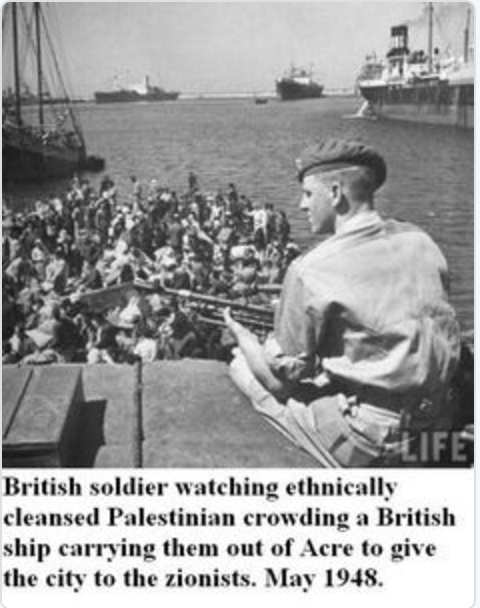
By Gilad Atzmon | May 15, 2016
The Israeli fear of being thrown into the sea is a projection.
The Israelis are afraid of being pushed into the sea because they themselves pushed the Palestinians into the sea (picture above). The Israelis tend to attribute their own genocidal inclinations to Arabs (in particular) and Goyim (in general).
‘Jewish fear,’ as such, is self-inflicted — the more brutal the Israelis are, the more fearful they become of the possibility that the Palestinians may be equally murderous. Similarly, the more the Jew hates the ‘goy,’ the more the Jew is mortified by the possibility that the goy may also express some animosity in return.
Jewish fear better be grasped as a war against terror within. Jews are too often tormented and haunted by their own racism and supremacy which they attribute to others by means of projection.
Featured Video

No Threat Can Force Iran’s Surrender /Trita Parsi & Lt Cl Daniel Davis
or go to
Aletho News Archives – Video-Images
From the Archives
What is the Israeli Lobby in Australia Doing in Interfaith Dialogue?
By Ali Kazak | Dissident Voice | October 11, 2015
For years Israel and its lobby around the world have been trying to normalise their relations with Arabs and Muslims without solving the Palestine Question.
One of the methods they resorted to in the last few years is using human rights and community organizations such as interfaith dialogue and Multiculturalism to achieve this objective and to: isolate the Palestinians, marginalise the Palestine question, end Israel’s isolation, and prevent criticism of Israel, knowing that these organisations will be the first to stand against Israel’s violations, racial and religious discrimination.
The group responsible for this task in Australia is The Australia/Israel & Jewish Affairs Council (AIJAC); its Director of International & Community Affairs, Jeremy Jones is in charge of lobbying religious community organizations, specifically Muslims and Christians. Consequently he convened the Faith Communities for Reconciliation, founding participant in the Australian Partnership of Religious Organisations and the Australian National Dialogue of Christians, Muslims & Jews.
AIJAC is a private political propaganda group. It is recognised as the main Israeli lobby in Australia. It coordinates its activities and works intimately with the Israeli embassy in Canberra and different institutions in Israel. It is privately funded by some Jewish businessmen. It monitors closely Australian politicians, the media, ethnic and religious groups, (especially Arabs and Muslims), unions and academics on their stands towards Israel and the Palestine question. … continue
Blog Roll
 Aletho News
- The war of liberation of the Arab and Islamic peoples expands across the Gulf
- Envoy warns UN on Trump’s threat to ‘obliterate’ Iran’s civilian infrastructure
- The Larak Corridor: Iran’s Rial Gate With No US, No Israel, and No Way Around
- ‘Economic terrorism’: Steel facilities hit again in US-Israeli strike
- ‘War Crime’: Iran condemns attacks on Arak, Ardakan nuclear sites
- Two-thirds of Americans want quick end to Iran war even if goals unmet
- Trump to Give “Important Update on Iran” Wednesday in Prime-Time Speech
- Theodore Postol: Iran’s Missiles & Drones Were Underestimated
- Iran To Target Military Industrial-Tech Complex That Facilitated Gaza Genocide
- Collapsing Empire: The Resistance Disarms ‘Israel’
- If Americans Knew
- Israel wants US to bomb more of Iran’s civilian structures (113,000 is not enough) – Not a ceasefire Day 173
- Ann Coulter Rips Into Fox News for Iran War Coverage
- Joe Kent Urges Americans To Call White House and Congress To Object To Sending Troops Into Iran
- DNC Resolution to Reject AIPAC Funding Puts Democratic Leaders in the Hot Seat
- Swedish foundation to build 400 schools as over 650,000 Gaza children remain without education for 2 years
- Israeli army admits photshopping image of slain Lebanese journalist
- This is how Israel is systematically killing health workers under the cover of war in Lebanon
- Carrying life under fire: Israeli invasion of Lebanon leaves pregnant women facing deadly risks
- Champagne all around for the new death penalty (for Palestinians) law – Not a ceasefire Day 172
- Why are Palestinian books struggling to be seen on Amazon?
- No Tricks Zone
- New Study Finds Warming Saves Lives…Cold Temperatures 12 Times More Deadly Than Excess Heat
- German Science Blog Accuses PIK Climate Institute Of Hallucinating Climate Tipping Points
- Devastating Assessment Of Comirnaty Vaccine By Former Senior Pfizer Europe Toxicologist
- New Study: CO2 Is ‘Effectively Negligible’ As An Explanatory Climate Change Factor Since 2000
- Former Pfizer Toxicologist Dr. Helmut Sterz Tells Bundestag Hearing Pfizer Vaccine Should Have Never Been Approved
- Energy Expert: Germany’s Nuclear Phaseout Was A “500 Billion Euro Mistake”
- New Research: South Australia’s Mid-Holocene Sea Surface Temperatures Were 4°C Warmer Than Today
- Storing Green Energy To Last Germany 10 Days Would Require A 60-Million Tonne Battery
- New Studies: UK Sea Levels Were 4 Meters Higher Than Today During The Mid-Holocene
- Destructive Green New Deal: German Energy And Metal Group Warns Of Drastic Crisis
 Aletho News