Egypt to try 67 people for assassinating top prosecutor
Press TV – May 9, 2016
Egyptian authorities have referred dozens of people to trial over the last year’s assassination of the country’s top prosecutor.
Prosecutor General Nabil Sadek sent 67 people to the criminal court on Sunday, without mentioning the exact date of the trial.
Sadek said in a statement that all the defendants were members of the outlawed Muslim Brotherhood movement, who “conspired” with members of the Palestinian resistance movement Hamas to assassinate Public Prosecutor Hisham Barakat in a bomb attack in the Cairo suburb of Heliopolis in late June 2015.
In March, Egyptian Interior Minister Magdy Abdel Ghaffar told a news conference in Cairo that both Muslim Brotherhood and Gaza-based Hamas were involved in the assassination.
The Hamas, however, has strongly rejected the allegation, calling it as “baseless.”
“Hamas calls on all parties in Egypt not to involve Palestinian factions in their internal differences,” Hamas spokesman Sami Abu Zuhri said in a press release on March 7, hours after Ghaffar’s comments.
There have been no credible claims of responsibility for the bombing that killed the 64-year-old state prosecutor just outside his house on June 29.
Erdogan Continues to Squeeze Power Into His Hands
By Salman Rafi Sheikh – New Eastern Outlook – 10.05.2016
Erdogan’s dream to revive Turkey’s ‘lost status’ as the most powerful Muslim country cannot be materialized, he and his advisers seem to believe, without first fundamentally altering Turkey’s own political system and this alteration is, he believes, incomplete without making him powerful. Hence, Erdogan’s emphasis on ‘constitutionally’ introducing presidential form of government in Turkey to concentrate all power into his personality. It is ironic to see the emphasis on this system coming at a time when Erdogan himself is Turkey’s president. However, the power-drive he is riding is likely to cost Turkey a lot in terms of political stability. Already Turkey is facing enormous difficulties due to its bad policies on the external front; and now the reported rift between Erdogan and Turkey’s prime minister is going to add fuel to the fire. In simplest terms, resignation of Turkey’s PM has made Erdogan the head of state, of the government and, of course, the party. What a tremendous way of becoming the head of ‘everything’! Any yet Erdogan continues to claim that Turkey is a ‘democracy.’
While Erdogan’s current constitutional status supposes him to act in a ‘neutral’ manner, his extremely narrowly self-defined political behaviour tends to defy Turkey’s constitution in the most ridiculous way. Despite the fact that Erdogan had picked Davutoglu’s concept of ‘Neo-Ottomanism’ as a means to re-establish Turkey’s relations with the former territories of Ottoman Empire, stretching from the Middle East, North Africa to the Balkan and Black Sea regions, they seem to have developed serious differences with regard to the changes in domestic political system that should precede the implementation of this new foreign policy outlook. For Erdogan, this change in the foreign policy—a policy that is aimed at reviving Turkey’s position of power in the region— and the objectives it envisages cannot be effectively materialized unless a strong centre is created.
That Erdogan is squeezing power into his own hands is evident from the statement Davutoglu gave after the crisis talks with the president failed. He was reported to have said that one important reason for stepping down was a decision by the party’s executive (Erdogan) to take away his (prime minister’s) authority to appoint provincial party leaders.
However, this is not only the reason. The rift is deep-rooted in two different visions that both of them have with regard to taking Turkey out of crisis. While Davutoglu believed in the way of dialogue with the Kurds, Erdogan believed in creating a strong presidency. As such, While Davutoglu spoke of the possibility of resuming peace talks with the Kurdistan Workers’ Party (PKK) if it withdrew armed fighters from Turkish territory, Erdogan said it was out of the question for the peace process to restart. Further disagreements took place after Davutoglu expressed opposition to the pre-trial detention of journalists accused of spying and academics accused of voicing support for the PKK.
For some, the reason for this crisis goes even deeper. The fact of the matter is that Erdogan had hand-picked his PM. Davutoglu did not, as such, have any strong base within the AKP’s structure. While this is yet another instance of how strong Erdogan continues to be and how explicitly he continues to defy his constitutional role, it also shows how creepy and fragile Turkey’s politics is becoming. This fragility is also showing its signs in some other aspects of polity too. The Turkish lira and the country’s stock market have fallen in recent days as investors shuddered at the prospect of a protracted leadership battle in a $720bn economy plagued by inflation, high foreign debt, a five-year long war on its border with Syria and a violent insurgency in its big cities.
This instability is, as a result of Davutoglu’s exit, likely to creep into Turkey’s relations with the West, particularly the EU, and damage it to a considerable extent. The reason why this is likely to happen is the rapport the Turkish PM had built with the EU and the deals he had made with regard to re-settlement of refugees.
Within the parameters of Turkey’s domestic politics, Davutoglu’s success in easing down Turkey’s relation with the EU meant—or it could be taken as such—that he was acquiring a relatively bigger stature than that of Erdogan—a sense that could have went against Erdogan’s push for presidential form of government.
It was this sense of ‘political status’ that was at the heart of problems between the PM and the President. And it is for this reason that Erdogan had to remind Davutoglu as well as Turkey’s public the true ‘hand-picked’ status of the prime minister. Addressing a group of local leaders on Wednesday, Erdogan was quoted as explicitly stating, “What matters is that you should not forget how you got to your post, what you should do there and what your targets are.” Given such an authoritarian stance, Davutoglu’s exit is going to put at risk Turkey’s ties with the West, which sees Erdogan with skepticism bordering on derision. Erdogan’s palace coup to ease out Davutoglu will only be seen in the West as a leap forward in the direction of authoritarianism.
Ironically, this is precisely what this development is all about. By paving the way for a more ‘sober’ and politically obedient and passive prime minister, Erdogan has underscored his own political power, putting himself in an ‘un-challengeable’ position, but indirectly also allowing Turkey to drift into experiencing an Ottoman-era type political tyranny. While Davutoglu dreamt of re-establishing Turkey’s relations with former territories of Ottoman Empire through his brain-child concept of ‘Neo-Ottomanism’, for Erdogan, this concept is incomplete without first turning his personality into the modern day ‘Sultan.’ Hence the question: will Turkey’s drift into ‘Ottomanism’ lead to its fall on the lines of the Ottoman Empire too? This question, as political behaviour of Erdogan and his team reveals, does not seem to have crossed their mind.
Salman Rafi Sheikh is a research-analyst of International Relations and Pakistan’s foreign and domestic affairs.
Russia slams Turkey’s ‘unconstructive role’ in latest round of Syria talks
Press TV – May 10, 2016
Russia’s Deputy Foreign Minister Gennady Gatilov has slammed Turkey’s “unconstructive role” in the latest round of indirect talks between the warring sides to the crisis in Syria.
He said Ankara influenced the main opposition group to withdraw from the negotiations.
Gatilov made the remarks in an interview with the Russian Izvestia daily published on Tuesday.
“It is a pity that the foreign players, and important regional [players such] as Turkey, continue to play an unconstructive role in this process,” Gatilov stated.
The Russian official said Turkey made the foreign-backed High Negotiations Committee (HNC) to suspend participation in the UN-brokered discussions.
Gatilov expressed Moscow’s opposition to the Saudi-backed HNC’s withdrawal from the Geneva talks. “We condemn their action and do not support.”
The peace talks, which began in Geneva, Switzerland, on April 13, were brought to a halt after the HNC walked out of the discussions in protest at what it called the Syrian government’s violation of a ceasefire in the Arab country.
Damascus dismissed the accusation, saying the truce was violated by foreign-backed militants.
The nation-wide cessation of hostilities, brokered by Moscow and Washington, was introduced in February in a bid to facilitate dialogue between rival parties in Syria.
However, renewed violence in recent weeks in some parts of Syria, especially the northwestern city of Aleppo, has left the ceasefire in tatters and torpedoed the peace talks.
Elsewhere in his remarks, the Russian deputy foreign minister highlighted a shift in Washington’s stance on the future of Syrian President Bashar al-Assad, saying the issue is no longer a prerequisite for the peace negotiations.
Gatilov said it is up to the Syrian nation to decide the fate of President Assad.
On Monday, Russian Foreign Minister Sergei Lavrov and US Secretary of State John Kerry held a phone conversation, during which they underlined the need for the continuation of discussions between the Syrian authorities and the opposition.
“Lavrov again pointed to the need for the anti-government formations oriented at Washington to separate from the terrorist groups as soon as possible and to thwart the replenishments to extremists through the territory of Turkey,” the Russian Foreign Ministry said in a statement.
The Donald’s Foreign Policy
It sure trumps Hillary
By Philip Giraldi • Unz Review • May 10, 2016
Coming off a string of victories in the so-called Acela state primaries two weeks ago, GOP presidential candidate presumptive Donald J. Trump made what he described as a major foreign policy speech. Critics have blasted the effort as being short on details and long on generalities but, as ever, one’s perspective pretty much depends on what one expects or wants to hear. I admire Trump for two reasons. First is his uncompromising stance on illegal immigrants, which I fully support, and second is his willingness to challenge Republican orthodoxy on foreign policy by condemning the Iraq War and opposing nation building and military intervention overseas.
I wanted to hear two things on foreign policy: that Donald Trump is indeed committed to military non-intervention in other countries except in those rare instances where vital national interests are at stake and also that the United States would pursue a course of positive engagement with Vladimir Putin and Russia. I was not disappointed.
Trump actually used the words “peace” and “peaceful” a number of times, something that has been missing from GOP rhetoric for many years. He said that he would “view the world through the clear lens of American interests,” something that he went on to describe as “America First,” adding “Our goal is peace and prosperity, not war and destruction… war and aggression will not be my first instinct.” Paraphrasing John Quincy Adams, Trump concluded that “The world must know that we do not go abroad in search of enemies, that we are always happy when old enemies become friends, and when old friends become allies.”
Trump observed that there has been a fixation with policies that are both “foolish and arrogant” that have “led to one foreign policy disaster after another” in places like Iraq, Syria, and Egypt. “It all began with the dangerous idea that we could make western democracies out of countries that had no experience or interest in becoming a western democracy. We tore up what institutions they had and then were surprised at what we unleashed: civil war.”
This is all good common sense, lambasting the twin plagues of military intervention and democracy promotion, the two false idols that have respectively driven the foreign policies of the GOP and the Democrats. Trump’s comments in those specific areas could have been made by Ron Paul.
Trump went on to observe that “our actions in Iraq, Libya and Syria have helped unleash ISIS.” I would have added that the power vacuums that we have created actually gave birth to ISIS. Regarding Russia and China, he said “We desire to live peacefully and in friendship with Russia and China. We have serious differences with these two nations and must regard them with open eyes. But we are not bound to be adversaries. We should seek common ground based on shared interests…I believe an easing of tensions and improved relations with Russia…is possible.”
On the negative side, Trump took obligatory swipes at Iran and the nuclear agreement negotiated by the Obama Administration, but he did not say that he would seek to terminate the arrangement and the only line he drew was that “Iran cannot be allowed to have a nuclear weapon,” far less vitriolic than the neocon and conventional Republican demand that Tehran not have the “capability” to do so, which is a threshold that has already been passed and which many have viewed as a carte blanche justification of an immediate attack by the U.S.
Regarding Israel, Trump engaged in the usual American politician speak regarding “the one true democracy in the Middle East” that also serves as a “force for justice and peace.” He also has stated that he would be “neutral” in negotiating peace between the Israelis and Palestinians and turned around to endorse continued expansion of Israeli settlements on Arab land. Hopefully he knows better about what is going on in the Middle East or will have advisers who know better and are not afraid to speak the truth. At least he didn’t invite Israeli Prime Minister Benjamin Netanyahu to move in down the hall in the White House on Inauguration Day, which Hillary Clinton has de facto done.
And speaking of Hillary, comparing her record and promises with the Trump speech demonstrates the differences between the two. David Stockman has noted that Hillary “wants to use government to make government great again” while The Donald wants “to use government to make America great again.” Hillary is indeed the favorite candidate of the Welfare-Warfare State Leviathan, a monster that seeks to dominate overseas while simultaneously stripping Americans of their liberties at home.
Hillary’s record is one of unmitigated belligerency. She enthusiastically supported her President-husband’s devastation of the Balkans in the 1990s, a “police action” in which she repeatedly lied about being “under fire” when she arrived on a visit. And she also signed on to the invasions of Afghanistan in 2001 and Iraq in 2003 carried out by the George W. Bush Administration.
As Secretary of State, Hillary was the driving force behind “surges” of U.S. forces in Afghanistan, in demanding the attacks on Libya and the overthrow of its leader and in the arming of jihadis in Syria to bring about regime change. Bombing Libya was indeed a Hillary project, initiated at her insistence in spite of misgivings by President Barack Obama. The Libyan fiasco led to government arsenals being looted with the weapons making their way to arm local militias and also to Islamic militants in Central Africa. It is widely believed that the four Americans killed in Benghazi in 2012 were killed while arranging for weapons transfers to the “moderate rebels” in Syria. If success as a diplomat is measured by the ability to destabilize entire regions, Hillary certainly takes center stage as the finest Secretary of State since Madeleine Albright, who famously declared that killing half a million Iraqi children through sanctions was “worth it.” Albright is currently regarded as Hillary’s closest foreign policy adviser.
Like several of the other women who have surrounded the president as top level advisers, Hillary is an enthusiastic advocate of the “R2P” doctrine, “responsibility to protect.” That means that the Washington can intervene in a foreign country even if that nation’s government in no way threatens the United States. The intervention is based on humanitarian grounds, allegedly to protect the local citizens against their own leaders, but it ironically and inevitably winds up killing mostly civilians in far greater numbers than would have otherwise been the case if there had been no military action. Libya and Syria are perfect examples of R2P on steroids.
Hillary has a team of strongly pro-Israel foreign policy advisers and she has frequently expressed her hostility towards Iran, which she has threatened to “obliterate.” One of her campaign videos includes “Iran seeks the destruction of Israel, Iran is a leading sponsor of terror in the region, Iran is flouting international law with its ballistic missile tests and its threats against our allies and partners.” None of the assertions are actually true.
Regarding the threat from Russia, Hillary has inevitably likened President Vladimir Putin to Adolph Hitler. She and her neocon acolyte Victoria Nuland were the driving forces behind cranking up the unrest in Ukraine, which eventually exploded into yet another pastel revolution that quickly became mired in corruption before dissolving into something approaching anarchy, which prevails to this day. She nevertheless wants to provide lethal arms to Kiev and also wants to expedite both Ukraine and Georgia joining NATO, even though it is a given that such action would provoke a major crisis with a nuclear armed and militarily quite capable Russia.
Hillary sees the conflict in Syria as an additional opportunity to confront Moscow, just like in the heady days of the Cold War, so she advocates a no-fly zone as a way for American and Russian flyboys to go head to head and is firm in her demand to replace Bashar al-Assad no matter what. She is one tough lady and she wants to make sure than everyone knows it. And of course her role model is Benjamin Netanyahu, who, she has promised, will be invited to join her in Washington as soon as her administration begins work in January.
So if one is concerned with foreign policy the choice between Donald and Hillary is no choice at all. Hillary may have the resume but it is essentially a bad one. If Trump does even a little of what he pledges to do he is a much better deal for the American people, as well as for most of the world, than is Hillary Clinton.
America’s Two-Faced Policy on Iran
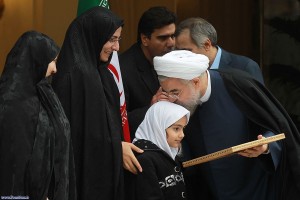
Iran’s President Hassan Rouhani celebrates the completion of an interim deal on Iran’s nuclear program by kissing the head of the daughter of an assassinated Iranian nuclear engineer
By Alastair Crooke | Consortium News | May 9, 2016
In an article entitled “Why America needs Iran in Iraq,” former U.S. Ambassador to Iraq Zalmay Khalilzad argues that “the chaos in Baghdad, culminating in the temporary occupation of the parliament by followers of Shiite Islamist cleric Muqtada al-Sadr, is undermining the war against the Islamic State; weakening Iraq’s economy; and accelerating the country’s disintegration.
“Without cooperation between the United States, Iran and Iraq’s top Shiite cleric, Ayatollah Sistani, the crisis could very well lead to the collapse of the entire political system set up in Iraq during the temporary U.S. occupation … To prevent this, Washington needs Tehran’s help. And Iran should be as motivated to seek stability [in Iraq] as much as Washington, because” Khalilzad asserts, “Iran, currently is losing favour in Iraq.”
Putting aside the questionable implication that Iran might somehow, through co-operation with America, raise its standing amongst Iraqis, Khalilzad’s presumption that Iran should now attend to America’s needs in Iraq, coupled with Secretary of State John Kerry’s insistence that Iran should help America to end the conflict in Syria too, throw into sharp relief the paradox inherent at the heart of U.S. diplomacy towards Iran, Russia (and China also).
This approach has been dubbed the “middle way” by former special adviser to the Assistant Secretary of State, Jeremy Shapiro: the U.S. Administration has no desire for an all-out confrontation with these three states. They are militarily hard nuts, and there is not much appetite for yet more military confrontation amongst a weary and wary American public (to the continuing frustration of the neocons).
More prosaically, the global financial system is now so brittle, so delicately poised, that it is not at all certain that the prospect of conflict would give the lift to America’s flagging economy that war generally is supposed to give. It might just snap the financial system, instead — hence the Middle Way.
Shapiro points out the obvious contradiction to this two-track approach: the U.S. no longer can ignore such powerful states. Its window of absolute, unchallenged, uni-polar power has passed. America needs the help of these states, but at the same time, it seeks precisely to counter these states’ potential to rival or limit American power in any way.
And America simply ignores the core complaints that fuel the tensions between itself and these states. It simply declines to address them. Shapiro concludes that this foreign policy approach is unsustainable, and bound to fail: “This dual-track approach, condemning Russia [or Iran] as an aggressor one day, [whilst] seeking to work with Moscow [or Tehran] the next … would [ultimately] force ever-greater confrontation.”
The ‘Middle Way’
In a sense, the U.S. approach towards Iran seems to be mirroring the so-called “middle way” policy which the U.S. Administration pursues towards Russia, whereby the putative “reset” with Russia was set aside (when President Vladimir Putin assumed the Presidency for the second time), and Obama – rather than seek outright confrontation with Russia – ruled that America however, would only co-operate with Russia when it suited it, but the U.S. would not deign to address Russia’s core issues of its “outsider” status in Europe, or its containment in Asia — or its concerns about a global order that was being used to corner Russia and to crush dissenter states who refused to enter the global order on America’s terms alone.
And Obama did little to drawback the NATO missile-march towards Russia’s borders (ostensibly, it may be recalled, to save Europe from Iranian missiles).
Ostensibly, too, the JCPOA (Joint Comprehensive Plan of Action) could have been America’s “reset” with Iran. Some, including a number of prominent Iranian politicians, thought it was.
But National Security Advisor Susan Rice was very explicit to Jeffrey Goldberg in The Atlantic that this was never intended: “It is assumed, at least among his critics, that Obama sought the Iran deal because he has a vision of a historic American-Persian rapprochement. But his desire for the nuclear agreement was born of pessimism as much as it was of optimism.
“The Iran deal was never primarily about trying to open a new era of relations between the U.S. and Iran,” Susan Rice told [Goldberg]. “It was far more pragmatic and minimalist. The aim was very simply to make a dangerous country substantially less dangerous. No one had any expectation that Iran would be a more benign actor.”
And so, we see a similar pattern, the possibility of a real “reset’ with Iran is pre-meditatively set aside (as per Rice), whilst the dual-track approach of condemning Iran for its ballistic missile tests (which have nothing to do with JCPOA), and its support for Hizbullah, are condemned one day, whilst Iran’s help in Iraq and Syria is being demanded on the next day.
At the same time, Iran’s core dispute with the U.S. – its complaints that exclusion from the international financial system is not being ameliorated as JCPOA was supposed so to do – are not being addressed. Rather they are being met with a shrug that implies “did they really expect anything else?”
Well, some (but by no means all) Iranian politicians had done just that: they had raised the Iranian public’s expectations that all sanctions – other than specific U.S. sanctions – would be lifted. They rather bet their credibility on it, as it were, and may pay a political price eventually.
And as NATO deploys a further 4,000 troops in the Baltic states and Poland, on Russia’s border, so too the U.S. Congress continues its figurative advance on Iran’s frontiers.
Here is Iran’s (conservative) Keyhan newspaper: “The draft of a new resolution has been presented to the US Congress in which Iran is accused of creating tension in the Persian Gulf, and the US Government has been urged to confront Iran and impose new sanctions against our country. Randy Forbes, a Republican member of the US House of Representatives, has drafted a resolution, which if passed by the Congress, condemns Iran’s military presence in the Persian Gulf as a provocation” (emphasis added)
Shapiro’s specific warning about the “middle way” approach was that “political and bureaucratic factors on both sides would force ever-greater confrontation.” But this is not the only risk, nor does it even constitute being the biggest risk (besides that of having undermined those in Iran and Russia who had put their “hat in the ring” of contemplating Entente with the United State).
America’s Bad Faith
Rather, it is by making this policy approach quite general to those states which have taken on themselves the burden of being the symbol for a non-Western, alternative vision (Russia, Iran and China, inter alia), that a perceived breach of the spirit of the JCPOA (at the least), will have wider repercussions.
Russia and China both spent political capital in order to help persuade Iran to sign up to the JCPOA: Will they not wonder whether America is to be trusted? China has complicated negotiations in hand with America on trade and financial issues, whilst Russia has been trying to resolve ballistic missile, as well as Ukraine sanctions issues, with America.
Is it not a straw in the wind for the consequences to this policy when a prominent Russian commentator, Fyodor Lukyanov, who is not at all hostile to rapprochement with the West, writes in End of the G8 Era that using Russia’s prospective inclusion in the G8 as an instrument of pressure on Russia is pointless?:
“The G8 reflected a certain period of history when Russia really wanted to be integrated into the so-called Extended West. Why it did not happen? Something went wrong? This is another topic. The most important thing is that it did not happen at all … it seemed (in the 1990s) that this membership would not mean just participation in yet another club, but a strategic decision aimed at the future.
“However, the desirable future did not come, and probably won’t come. It is obvious now, that the world does not develop in the direction of the Western model. So, now we have what we have, and there is no reason to restore the G8.”
May this general sentiment come to be reflected in Iran too, as the sanctions-lifting issue drags on? Did the U.S. then “win one over Iran” through the JCPOA accord – as the shrugs of U.S. shoulders at Iranian complaints, might imply? Was Iran just naïve? Did they really think that the U.S. was simply going to empower Iran financially?
It is pretty clear that the Supreme Leader understood the situation precisely — he had, after all some experience of U.S. non-compliance with agreements from the Lebanese hostage negotiations of the 1980s.
But what has Iran lost by the JCPOA? A few Iranians may have had their fingers burned in the process, but Iran achieved three important things: the world now knows that it was not Iran that was the impediment to a nuclear deal; the deal has transformed Iran’s public image – and created an opening – with the rest of the world (including Europe); and it has, in the process, constructed and strengthened strategic political and economic ties with Russia and China.
But most important of all, the rift within Iran that stemmed from the sense amongst some Iranian orientations, that President Ahmadinejad’s rhetoric was a principal obstacle to normalizing with the West, has been addressed: an Iranian government, with a Western-friendly face, has been given, and seen to have been given, the full chance to negotiate a solution to the nuclear issue. Whatever the final outcome, that boil has been lanced.
No, the Iranian leadership has not been naïve.
Alastair Crooke is a British diplomat who was a senior figure in British intelligence and in European Union diplomacy. He is the founder and director of the Conflicts Forum, which advocates for engagement between political Islam and the West.
An American Original: John Kerry – From His Remarkable Recent Commencement Address At Northwestern University To The Remarkable Career That Made It Possible

By John Chuckman | Aletho News | May 9, 2016
John Kerry is, besides many other unpleasant things, a rather ridiculous man, and he has managed to prove that proposition time and time again.
He used his recent commencement address at Northwestern University to attack Donald Trump. It is difficult to understand why young graduates at one of America’s better universities would want to hear political boiler plate from a key member of a failed and dying administration, rather than the usual vaguely inspiring stuff about the future, but that is what the graduating class got for their student fees.
I suppose, as so often is the case in America, the empty prestige of having someone with a big job speak, even when they have nothing to say, mattered. After all, Hillary Clinton has collected countless millions doing exactly the same thing for audiences at investment banker and defense contractor banquets in recent years.
Well, the part of Trump on which Kerry focused was his proposal for a wall with Mexico.
I don’t like walls myself, and it is my belief that even if elected Trump, for many reasons, will not succeed in emulating the Emperor Hadrian. Still, you might expect from the point of view of a Secretary of State, supposedly gazing upon the world’s countries with an impartial, god-like eye, that if it is okay for Israel to keep building walls, and it has several new ones underway right now, all built on other people’s property, why can’t others? The reasoning in both cases, and in all other cases such as those in Kerry’s contemporary Europe where new walls of various forms are frantically being built, is the same: we need to stop unwanted people crossing the border.
Can anyone even imagine Kerry – this man who, once not long ago, reminisced over Champagne toasts about some distant relative or another of his who was allegedly part-Jewish (truly, has grovelling by a Secretary of State reached such levels before? I would have expected his entire audience either to choke or throw up) – ever saying a single word to Israel about its walls, walls which go far beyond serving Israel’s border fears to literally chopping up and destroying the land which supports millions of other people? It would be as though Trump were demanding a series of walls inside Mexico to balkanize the entire country and then set about building them himself with America’s armed forces. Now that would be utterly ridiculous, not to say criminal, but Israel’s doing just that is never called ridiculous or criminal, and it certainly is never questioned by Kerry.
And then, as though in an effort to reclaim the stature of his address from just political campaign boiler plate, Kerry’s rhetoric drifted off to the subject of a future borderless world.
Now that is an old idea that appeals greatly to me, but I know very well that Kerry is being dishonest here. The world in fact, not all that long ago, pretty much was borderless. It was precisely the rise of the modern nation state in the 19th century which killed off that amiable concept requiring no passports or visa or permissions for moving about. Of course, we are talking about precisely the kind of modern nation state which Kerry has lovingly served in expanding its power and influence over others for his entire adult life.
Kerry’s dishonesty extends into what he even means by a “borderless world.” Now, I have always believed the Apostle Paul in emphasizing deeds rather than words, so If we are to judge by Kerry’s actual acts and those of predecessor Secretaries of State such as Hillary Clinton or Madeleine Albright or Henry Kissinger, and not by the State Department’s regularly-broadcast, doubtful advertising claims, John Kerry’s concept of a “borderless world’ is one in which the United States runs everyone’s affairs, rendering the borders of individual countries meaningless.
Now, that is a concept which very much does not appeal to me, nor does it appeal, I suspect, to a great many of the world’s seven billion people and their governments.
Just recently, this dishonest and generally unpleasant man has put an ultimatum to the government of Syria, making threats that if he doesn’t see what he wants by the beginning of August, there will be serious consequences. That certainly sounds to me like a Mafia Don speaking, demanding payment of protection money from some business, or else.
John Kerry has no business telling the government of Syria to do anything, much less to dissolve itself. It is, and has been, a reasonably popular government, one which receives the support of a majority of Syrians in polls and elections. Among other reasons for its popularity is President Assad’s defence of religious minorities. Syria’s citizens form an elaborate quilt of various religions, and they know their rights to worship as they please are protected in a region of the world where that is not common. Some of Mr. Kerry’s closest working associates in the region cannot say the same thing, and indeed they include associates who are quite violent towards people of differing faiths.
The proxy forces which Kerry and his predecessor, Hillary Clinton, have supported for five years in tearing Syria apart consist literally of various gangs of intolerant extremists and cut-throats. Boy, when it comes to double-speak, John Kerry is your man.
By what right does he do this? None, except that might makes right. America has supported terror in Syria, supplying weapons, platoons of cut-throats, and training while supporting the thugs of Turkey and Saudi Arabia in their logistics of destruction, all while pretending in State Department advertisement after advertisement that it opposes terror. And we’ve only just learned that Hillary Clinton supported the transfer of supplies of deadly Sarin nerve gas from Gadhafi’s stockpiles in wrecked Libya (another stunning State Department achievement) through a secret pipeline (read: Turkey) to the cut-throats in Syria where it was promptly used to kill civilians in the hope of blaming Assad and creating a casus belli for the United States (or, as Obama put it in his elliptical language, responding to Assad crossing a red line).
But John Kerry still hasn’t got what he wants in Syria, so now we have a new threat. Why is Kerry so determined to topple the government of Syria? Because Assad is an independent-minded leader, one who does not immediately say “yes, sir,” to every whim of Washington’s, and if there is anything which recent history teaches us, it is that the outfit Kerry serves has no tolerance for the independent-minded. So as to emphasize the point, Washington has left behind a trail of death and destruction in the region – perhaps a million dead and millions made refugees – all of it aimed at getting rid of inconvenient independent leaders.
This intolerance by Washington of independent-mindedness is strongly supported – supported is actually much too feeble a word, demanded being more apt, and demanded regularly over heated phone lines – by the government of America’s colony in the region, the same government to whom Kerry fears even saying so much as a word about its many walls criss-crossing other people’s land.
Quite a disgusting business I think which somehow manages to be converted by our press into “foreign policy,” just as one of its authors, John Kerry, manages to be converted into a “diplomat.’
Kerry was a rich boy who, after graduating university, started his political ascent by spending four months in Vietnam, busying himself with shooting peasants in the back from an armored speedboat racing up and down rivers. He wanted to gain some war “creds” for an anticipated political career. Apart from his killings in Vietnam, he made such a muck of things, leaving behind colleagues who had only contempt for his false heroics and self-promotion. Then our man Kerry, having returned home and seeing how badly the Vietnam War was regarded by people, decided to add some new “creds” to his resume, anti-war ones. So, no matter how the political winds turned in the future, John-boy was covered. He appeared with some anti-war demonstrators, once throwing his filthily-earned medals into a bin, from which they were later quietly retrieved for him.
As to Kerry’s actual attitude towards America’s dirty colonial wars, we have the testimony of his whole career in the Senate, as a Presidential candidate, and finally as Secretary of State, faithfully serving and supporting them.
Kerry’s campaign, in running for President in 2004, was so unbelievably dreary and empty of all meaning, that the American people actually re-elected the most disliked president in the country’s history, George Bush. That feat stands as a remarkable testimonial to John Kerry’s talents.
The only big thing Kerry seems ever to have done that was genuinely successful was marrying the woman who inherited the Heinz Ketchup and Pickle Fortune. That made him wealthy beyond his dreams, perhaps planting in his brain fanciful thoughts of an ambitious young George Washington marrying the widow, Martha Custis, said to have been the wealthiest woman in the American colonies.
When John Kerry says anything on any topic, his listeners would be wise to consider the source, for even though he walks around in the appointed robes of America’s Secretary of State, he is pretty much a life-long, ambitious, and dishonest failure.
How narratives killed the Syrian people
By Sharmine Narwani | RT | March 23, 2016
On March 23, 2011, at the very start of what we now call the ‘Syrian conflict,’ two young men – Sa’er Yahya Merhej and Habeel Anis Dayoub – were gunned down in the southern Syrian city of Daraa.
Merhej and Dayoub were neither civilians, nor were they in opposition to the government of Syrian President Bashar al-Assad. They were two regular soldiers in the ranks of the Syrian Arab Army (SAA).
Shot by unknown gunmen, Merhej and Dayoub were the first of eighty-eight soldiers killed throughout Syria in the first month of this conflict– in Daraa, Latakia, Douma, Banyas, Homs, Moadamiyah, Idlib, Harasta, Suweida, Talkalakh and the suburbs of Damascus.
According to the UN’s Independent International Commission of Inquiry on Syria, the combined death toll for Syrian government forces was 2,569 by March 2012, the first year of the conflict. At that time, the UN’s total casualty count for all victims of political violence in Syria was 5,000.
These numbers paint an entirely different picture of events in Syria. This was decidedly not the conflict we were reading about in our headlines – if anything, the ‘parity’ in deaths on both sides even suggests that the government used ‘proportionate’ force in thwarting the violence.
But Merhej and Dayoub’s deaths were ignored. Not a single Western media headline told their story – or that of the other dead soldiers. These deaths simply didn’t line up with the Western ‘narrative’ of the Arab uprisings and did not conform to the policy objectives of Western governments.
For American policymakers, the “Arab Spring” provided a unique opportunity to unseat the governments of adversary states in the Middle East. Syria, the most important Arab member of the Iran-led ‘Resistance Axis,’ was target number one.
To create regime-change in Syria, the themes of the “Arab Spring” needed to be employed opportunistically – and so Syrians needed to die.
The “dictator” simply had to “kill his own people” – and the rest would follow.
How words kill
Four key narratives were spun ad nauseam in every mainstream Western media outlet, beginning in March 2011 and gaining steam in the coming months.
– The Dictator is killing his “own people.”
– The protests are “peaceful.”
– The opposition is “unarmed.”
– This is a “popular revolution.”
Pro-Western governments in Tunisia and Egypt had just been ousted in rapid succession in the previous two months – and so the ‘framework’ of Arab Spring-style, grass roots-powered regime-change existed in the regional psyche. These four carefully framed ‘narratives’ that had gained meaning in Tunisia and Egypt, were now prepped and loaded to delegitimize and undermine any government at which they were lobbed.
But to employ them to their full potential in Syria, Syrians had to take to the streets in significant numbers and civilians had to die at the hands of brutal security forces. The rest could be spun into a “revolution” via the vast array of foreign and regional media outlets committed to this “Arab Spring” discourse.
Protests, however, did not kick off in Syria the way they had in Tunisia and Egypt. In those first few months, we saw gatherings that mostly numbered in the hundreds – sometimes in the thousands – to express varied degrees of political discontent. Most of these gatherings followed a pattern of incitement from Wahhabi-influenced mosques during Friday’s prayers, or after local killings that would move angry crowds to congregate at public funerals.
A member of a prominent Daraa family explained to me that there was some confusion over who was killing people in his city – the government or “hidden parties.” He explains that, at the time, Daraa’s citizens were of two minds: “One was that the regime is shooting more people to stop them and warn them to finish their protests and stop gathering. The other opinion was that hidden militias want this to continue, because if there are no funerals, there is no reason for people to gather.”
With the benefit of hindsight, let’s look at these Syria narratives five years into the conflict:
We know now that several thousand Syrian security forces were killed in the first year, beginning March 23, 2011. We therefore also know that the opposition was “armed” from the start of the conflict. We have visual evidence of gunmen entering Syria across the Lebanese border in April and May 2011. We know from the testimonies of impartial observers that gunmen were targeting civilians in acts of terrorism and that “protests” were not all “peaceful”.
The Arab League mission conducted a month-long investigation inside Syria in late 2011 and reported:
“In Homs, Idlib and Hama, the observer mission witnessed acts of violence being committed against government forces and civilians that resulted in several deaths and injuries. Examples of those acts include the bombing of a civilian bus, killing eight persons and injuring others, including women and children, and the bombing of a train carrying diesel oil. In another incident in Homs, a police bus was blown up, killing two police officers. A fuel pipeline and some small bridges were also bombed.”
Longtime Syrian resident and Dutch priest Father Frans van der Lugt, who was killed in Homs in April 2014, wrote in January 2012:
“From the start the protest movements were not purely peaceful. From the start I saw armed demonstrators marching along in the protests, who began to shoot at the police first. Very often the violence of the security forces has been a reaction to the brutal violence of the armed rebels.”
A few months earlier, in September 2011, he had observed:
“From the start there has been the problem of the armed groups, which are also part of the opposition… The opposition on the street is much stronger than any other opposition. And this opposition is armed and frequently employs brutality and violence, only in order then to blame the government.”
Furthermore, we also now know that whatever Syria was, it was no “popular revolution.” The Syrian army has remained intact, even after blanket media coverage of mass defections. Hundreds of thousands of Syrians continued to march in unreported demonstrations in support of the president. The state’s institutions and government and business elite have largely remained loyal to Assad. Minority groups – Alawites, Christians, Kurds, Druze, Shia, and the Baath Party, which is majority Sunni – did not join the opposition against the government. And the major urban areas and population centers remain under the state’s umbrella, with few exceptions.
A genuine “revolution,” after all, does not have operation rooms in Jordan and Turkey. Nor is a “popular” revolution financed, armed and assisted by Qatar, Saudi Arabia, the US, UK and France.
Sowing “Narratives” for geopolitical gain
The 2010 US military’s Special Forces Unconventional Warfare manual states:
“The intent of US [Unconventional Warfare] UW efforts is to exploit a hostile power’s political, military, economic, and psychological vulnerabilities by developing and sustaining resistance forces to accomplish US strategic objectives… For the foreseeable future, US forces will predominantly engage in irregular warfare (IW) operations.”
A secret 2006 US State Department cable reveals that Assad’s government was in a stronger position domestically and regionally than in recent years, and suggests ways to weaken it: “The following provides our summary of potential vulnerabilities and possible means to exploit them…” This is followed by a list of “vulnerabilities” – political, economic, ethnic, sectarian, military, psychological – and recommended “actions” on how to “exploit” them.
This is important. US unconventional warfare doctrine posits that populations of adversary states usually have active minorities that respectively oppose and support their government, but for a “resistance movement” to succeed, it must sway the perceptions of the large “uncommitted middle population” to turn on their leaders. Says the manual (and I borrow liberally here from a previous article of mine):
To turn the “uncommitted middle population” into supporting insurgency, UW recommends the “creation of atmosphere of wider discontent through propaganda and political and psychological efforts to discredit the government.”
As conflict escalates, so should the “intensification of propaganda; psychological preparation of the population for rebellion.”
First, there should be local and national “agitation” – the organization of boycotts, strikes, and other efforts to suggest public discontent. Then, the “infiltration of foreign organizers and advisors and foreign propaganda, material, money, weapons and equipment.”
The next level of operations would be to establish “national front organizations [i.e. the Syrian National Council] and liberation movements [i.e. the Free Syrian Army]” that would move larger segments of the population toward accepting “increased political violence and sabotage” – and encourage the mentoring of “individuals or groups that conduct acts of sabotage in urban centers.”
I wrote about foreign-backed irregular warfare strategies being employed in Syria one year into the crisis – when the overwhelming media narratives were still all about the “dictator killing his own people,” protests being “peaceful,” the opposition mostly “unarmed,” the “revolution wildly “popular,” and thousands of “civilians” being targeted exclusively by state security forces.
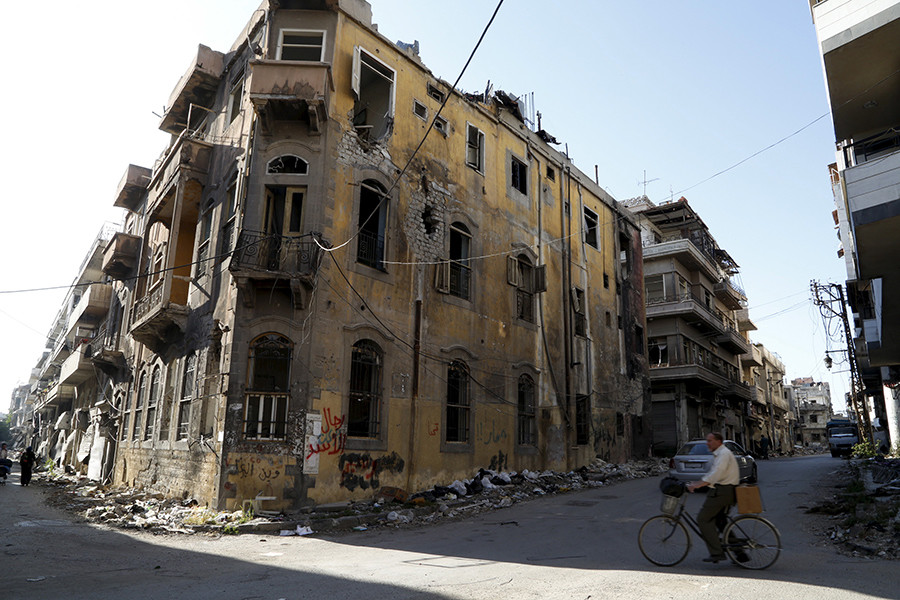
A man rides a bicycle near a building damaged during the Syrian conflict between government forces and rebels in Homs, Syria May 13, 2014 © Omar Sanadiki
Were these narratives all manufactured? Were the images we saw all staged? Or was it only necessary to fabricate some things – because the “perception” of the vast middle population, once shaped, would create its own natural momentum toward regime change?
And what do we, in the region, do with this startling new information about how wars are conducted against us – using our own populations as foot soldiers for foreign agendas?
Create our own “game”
Two can play at this narratives game.
The first lesson learned is that ideas and objectives can be crafted, framed finessed and employed to great efficacy.
The second take-away is that we need to establish more independent media and information distribution channels to disseminate our own value propositions far and wide.
Western governments can rely on a ridiculously sycophantic army of Western and regional journalists to blast us with their propaganda day and night. We don’t need to match them in numbers or outlets – we can also employ strategies to deter their disinformation campaigns. Western journalists who repeatedly publish false, inaccurate and harmful information that endanger lives must be barred from the region.
These are not journalists – I prefer to call them media combatants – and they do not deserve the liberties accorded to actual media professionals. If these Western journalists had, in the first year of the Syrian conflict, questioned the premises of any of the four narratives listed above, would 250,000-plus Syrians be dead today? Would Syria be destroyed and 12 million Syrians made homeless? Would ISIS even exist?
Free speech? No thank you – not if we have to die for someone else’s national security objectives.
Syria changed the world. It brought the Russians and Chinese (BRICS) into the fray and changed the global order from a unipolar one to a multilateral one – overnight. And it created common cause between a group of key states in the region that now form the backbone of a rising ‘Security Arc’ from the Levant to the Persian Gulf. We now have immense opportunities to re-craft the world and the Middle East in our own vision. New borders? We will draw them from inside the region. Terrorists? We will defeat them ourselves. NGOs? We will create our own, with our own nationals and our own agendas. Pipelines? We will decide where they are laid.
But let’s start building those new narratives before the ‘Other’ comes in to fill the void.
A word of caution. The worst thing we can do is to waste our time rejecting foreign narratives. That just makes us the ‘rejectionists’ in their game. And it gives their game life. What we need to do is create our own game – a rich vocabulary of homegrown narratives – one that defines ourselves, our history and aspirations, based on our own political, economic and social realities. Let the ‘Other’ reject our version, let them become the ‘rejectionists’ in our game… and give it life.
Sharmine Narwani is a commentator and analyst of Middle East geopolitics. She is a former senior associate at St. Antony’s College, Oxford University and has a master’s degree in International Relations from Columbia University. You can follow her on Twitter at @snarwani
Sheikh Raed Salah begins nine-month prison term for “incitement”
Samidoun Palestinian Prisoner Solidarity Network – May 9, 2016
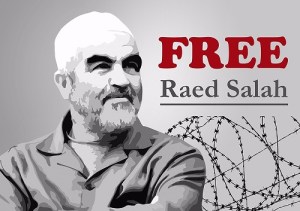 Sheikh Raed Salah, Palestinian leader of the Islamic Movement in Israel, began a nine-month jail term for “incitement” on Sunday, 8 May. He arrived at the jail with dozens of supporters, and said that “this prison sentence will not deter us from maintaining the defence of [Jerusalem’s] Al-Aqsa Mosque.”
Since 1996, Salah is the leader of the northern wing of the Islamic Movement, which organizes Palestinian citizens of Israel. Israeli prime minister Benjamin Netanyahu ordered the movement banned last year, sparking widespread protest and condemnation. Salah has been imprisoned in the past for incitement and related charges; this imprisonment is related to a 2007 rally against Israeli construction work near Al-Aqsa Mosque.
Salah arrived for his sentence at Beersheba prison, and was then transferred to Nafha prison by Israeli occupation forces. He has repeatedly stated that his imprisonment is an attempt to shut down Palestinian defense of Al-Aqsa from attacks by settlers and the Israeli government.
He served as mayor of Umm al-Fahm between 1987 and 2001. In 2010, he participated in the Gaza Freedom Flotilla aboard the Mavi Marmara, the ship attacked by Israeli special forces who killed ten Turkish and American activists, as the armed forces took over the ship and prevented it from breaking the siege of Gaza.
In 2011, Salah was targeted during a visit to the UK for deportation and exclusion. Arrested in the UK, he was kept in the country until March 2012 fighting the charges, which he eventually defeated in a significant court victory.
Bir Zeit University student arrested in night raid, student leader banned from Ramallah and Bir Zeit
Samidoun Palestinian Prisoner Solidarity Network – May 9, 2016

Palestinian engineering student Alaa Assaf was arrested by Israeli occupation soldiers after they raided her family’s home in Bir Zeit, north of Ramallah, in an early-morning armed attack on the home.
Assaf, a student in the Faculty of Engineering and Information Technology at Bir Zeit University, was formerly a member of the university’s student council from 2014-2015. Recent elections at the university were won by the Islamic Bloc; dozens of students associated with the Islamic Bloc, the leftist Progressive Democratic Pole, and other active student organizations have been arrested by the Israeli occupation forces.
At the same time, Asmaa Qadah, the secretary of Bir Zeit student council’s cultural committee, was banned from entering Ramallah and Bir Zeit for five months. Qadah was previously held under administrative detention without charge or trial for several months. The ban on Qadah’s entering Bir Zeit and Ramallah obviously interferes with her ability to study, attend classes, and participate in the university. Her graduation – originally scheduled for July 2016 – was already delayed due to three months of arbitrary imprisonment.

Alaa Assaf was among at least 14 Palestinians arrested in late-night/early-morning raids by Israeli occupation forces in home invasions.
Students and faculty at several Palestinian universities have been targeted for arrest, including students at Bir Zeit University, Al-Quds University, and Palestine Polytechnic University. Student offices were raided by Israeli occupation forces who invaded Al-Quds University, while astrophysics professor Imad Barghouthi is imprisoned without charge or trial under administrative detention.
samidoun@samidoun.ca
Palestine’s reality: Al Nakba commemoration and the right of return or the return of the Faisal-Weizmann Agreement?

By Ahmad Moussa | American Herald Tribune | May 8, 2016
A recent conversation on security and peace between former security personnel of Saudi Arabia and Israel respectively, two weeks before Al Nakba commemoration shows that the attitude of the past on Palestine remains after 68 years.
Al Nakba is a series of events that led to the ethnic cleansing of Palestine and the Palestinians on May 15th, 1948. This is a day to remember the displacement and dispossession of 750,000 Palestinian people into refugee camps in neighboring countries; generations of whom continue to reside in these camps, others are scattered across the world in diaspora and many more internally displaced.
As the Palestinians across the world are on the verge of commemorating these events that happen to continue today in a process that is a form of incremental genocide, the Washington Institute for Near East Policy (WINEP) has recently engaged two former security personnel of Saudi Arabia and Israel respectively in a conversation related to security and peace in the Middle East. Setting aside that the said institute is a think tank that was founded by pro-Israel political figures, it is no surprise for Palestinians that an institution of this kind hosts such a choice for a duo to discuss the two topics of peace and security when both entities are serious human rights violators as well as exporters of terrorism and war; especially in the direct or indirect connection to Palestine and the Palestinians.
First and foremost, the timing of the said conversation between the two representatives of the security apparatuses of both entities reminds us that understanding the historical context is truly important for understanding the contemporary circumstances. As the events and planning took place leading up to the execution of the Nakba of 1948, there was an annulled agreement that took place prior known as the Faisal-Weizmann Agreement of 1919. This was an agreement that was signed at the Paris Peace Conference between Emir Faisal of Hejaz and Chaim Weizmann who was leader of the World Zionist Organization eventually leading to him becoming the first President of Israel. This agreement is significant in the fact that it reminds the Palestinians about the enabling and co-conspiring of the Arabs in the region and the role they played against the interests of the Palestinians; an example of which is the following:
Dr. Weizmann argued that Palestine was designed to solve “a world-wide problem” and therefore “the rights which the Jewish people has been adjudged in Palestine do not depend on the consent, and cannot be subjected to the will of the majority of its present inhabitants.” He maintained that “the Balfour Declaration and the Mandate have definitely lifted Palestine out of the context of the Middle East and linked it up with the world-wide Jewish community and the world-wide Jewish problem.” Thus the Zionists refused to let the British grant the Palestine Arabs any role in setting immigration quotas or in influencing other aspects of the development of the Jewish national home. Weizmann’s contempt for the first Arab delegation to London was apparent in his one discussion with them at the Colonial Office, in which he adopted the attitude “of a conqueror handing to beaten foes the terms of peace.”
Today’s Saudi Arabia’s role in relation to the nature of its engagement with the State of Israel, represents the same co-conspiring agenda and essence of the Faisal-Weizmann agreement under the guise of peace and security- in pursuit of self interest and Zionist led terror against the Palestinians. For example, during the latest military campaign against the Gaza Strip by the State of Israel known as Operation Protective Edge- Prime Minister Netanyahu emphasised the fact that “renewed relations” were built as a result of Saudi Arabia along with other Gulf countries engaging in security cooperation to quell the Palestinian resistance during those events.
Furthermore, the rise of the Islamic State and their reign of terror in the region has unsettling connections with these two entities. The Islamic State’s rise and political patterns in the region are leaning towards the affirmation of the Faisal-Weizmann Agreement given that this group’s reign of terror has not targeted any of these entities and have the same enemies that are “branches of the same tree”. Moreover, the group wants to abolish the Sykes-Picot Agreement which in many ways has been historically perceived as having been in the way and the obstacle of the Faisal-Weizmann Agreement. Most importantly, aside from the damage and destruction the Islamic State has done to the Palestinians both in Iraq and Syria, the Islamic State is attempting to exploit the Palestinian cause which also serves the Saudi-Israeli security interests.
And yet, with all this historical context at hand, including the horrendous human rights records of both Saudi Arabia and Israel along with an already outrageous military expenditure towards the State of Israel by the United States- the United States is granting Israel the largest military aid package in history, while simultaneously, Saudi Arabia is receiving a 15 billion dollar military arms package deal from Canada.
In Jeff Halper’s new book “War against the People” he sharply states: “In an endless war on terror, we are all doomed to become Palestinians.” The Washington Institute for Near East Policy is a political entity that enables this doom. It is an institute with residues of the pro-Israel lobby that played a pivotal role in dragging the United States into founding the global war on terror that has produced more global insecurity, the rise of the Islamic State and a push for war against Iran with no end in sight- all whilst simultaneously continuing the memoricide and erasure campaign against Palestine and the Palestinians through a nostalgic revivalism of what was embedded within the Faisal-Weizmann Agreement- demonstrated through this latest discussion between the Saudi-Israeli security personnel. This is what Palestine is trying to show the world. This is part in parcel of the Nakba in continuum.
Marking Al-Nakba 68: Events Around the World for Palestinian Return
Samidoun | May 8, 2016
Events and actions are being organized around the world to mark the 68th anniversary of the Nakba, the expulsion of the Palestinian people from their homes and lands in order to create a Zionist settler-colonial state on the land of Palestine. These events both remember over 68 years of Palestinian struggle, steadfastness, and resistance, but also support the ongoing struggle for Palestinian refugees’ return and the liberation of Palestine.
The imprisonment of Palestinians has always been a tool of the colonial project in Palestine, meant to maintain occupation, apartheid and oppression and criminalize the existence and resistance of Palestinians. From the martial law imposed in 1948 on the Palestinians who remained in the 78% of historic Palestine occupied at that time, to the imprisonment of 7,000 Palestinian political leaders, journalists, and freedom fighters today, the imprisonment of Palestinians and their leaders has always been part and parcel of the Nakba.
Samidoun Palestinian Prisoner Solidarity Network is directly involved in Nakba events in several cities internationally and supports mobilizations around the world on this critical day. Numerous events will be taking place throughout occupied Palestine and in the refugee camps of Lebanon, Jordan and Syria.
This list focuses on international events organized by Palestinian communities in exile and diaspora and solidarity movements. In order to add your city’s event to the list below, please email samidoun@samidoun.net or message us on Facebook. This page will be updated regularly!
AUSTRALIA
 Sydney
Saturday, 14 May – Palestine Will Be Free Panel, Facebook: https://www.facebook.com/events/1558629097769523/
12 pm, part of the Socialism for the 21st Century Conference, University of Sydney.
Sunday, 15 May – Commemorating the Nakba Demonstration: 68 Years On, Facebook: https://www.facebook.com/events/1402030143429918/
1 pm, Town Hall, Sydney. Organized by Palestine Action Group Sydney
Brisbane
Friday, 13 May – Al Nakba 2016 Vigil. Facebook: https://www.facebook.com/events/1528327857474082/
 6 pm, King George Square, Brisbane. Organized by Justice for Palestine Brisbane.
SOUTH AFRICA
Johannesburg
Sunday, 15 May – Nakba 1948: Palestinian Catastrophe and Israeli Ethnic Cleansing
1 pm, Zoo Lake, Jan Smuts Avenue, Johannesburg. Organized by Women’s Boat to Gaza, BDS South Africa, Media Review Network, Palestine Solidarity Alliance, South African Jews for a Free Palestine, Food for the Soul
SPAIN
 Madrid
Saturday, 14 May – Performance at School of Decolonization. Facebook: https://www.facebook.com/events/1557093397918178/
5:00 pm, Puerta del Sol, Madrid.
Saturday, 14 May – Demonstration followed by performances, dance and Palestinian, African and Latin American food. Facebook: https://www.facebook.com/events/1557093397918178/
6:00 pm, Glorieta de Marques de Vadillo – General Ricardos – Luisa Munoz, followed by La Kupula sala.
Sunday, 15 May – Nakba demonstration for Boycott, Divestment and Sanctions. Facebook: https://www.facebook.com/events/1557093397918178/
1:30 pm, Puerta del Sol, Madrid.
Sunday 15 May – Anniversary of the Palestinian Nakba
5:30 pm, Recinto Ferial, Alcobendas, Madrid, Spain.
Includes collaborative mural, debate with Majed Dibsi, Palestinian journalist and political analyst, theatrical action, photo exhibition. Organied by Madrid Para Todos, the Global Campaign to Return to Palestine, CJA and Alco Sanse en Lucha
 Barcelona
11 May – 15 May – Series of events organized by the Coalició Prou Complicitat amb Israel (CPCI). Facebook:
https://www.facebook.com/events/1613965512264082/
Wednesday, 11 May – Seminar: Why is it important to break ties with Israel? Ways toward a just peace. 7 pm, Aula Magna, Faculty of Geography and History, University of Barcelona. With Raji Sourani, Riya Hassan, and Blanca Campos. Moderated by David Bondia and joined by Catalan municipalities who have adopted BDS.
Thursday, 12 May – Raji Sourani at Catalonia Parliament. 4 pm, Parliament of Catalonia.
Friday, 13 May – Hope Award to recognize individuals and groups defending Palestine. 7 pm, Palau Robert, Passeig de Gracia 107, Barcelona. Organized by the Palestinian Community of Catalonia, and hosted by actress Rosa Boladeras.
Saturday, 14 May – Film Screening, “The Land Speaks Arabic.” 6 pm, La Sedeta, Carrer de Sicilia 321, Barcelona, with the participation of Riya Hassan, BNC. Organized by Sodepau and Association Helia.
Sunday, 15 May – Demonstration for Palestine – Long live Palestine! 6 pm, Plaza Catalonia.
 GERMANY

Berlin
Sunday, 15 May – Nakba Day Demonstration, Facebook: https://www.facebook.com/events/226921581019252/
3:00 pm, Karl-Marx-Platz, Berlin. Organized by the Nakba-Tag-Bundnis
Stuttgart
Saturday, 7 May – Palestine Nakba Day
1 pm – 6 pm, Schlossplatz, Stuttgart. With speakers George Rashmawi, Shir Hever, Attia Rajab, Reiner Weigand, Annette Groth, and performers Aeham Ahmed, Muhammad Tamim, Yalla Dabke. Organized by Palestine Solidarity Committee Stuttgart and the Palestinian Community of Stuttgart.
NETHERLANDS
 Rotterdam
Saturday, 14 May – Demonstration in Commemoration of the Nakba. Facebook: https://www.facebook.com/events/701962599944259/
2 pm – 4 pm, between Markthal and Hoogstraat, organized by Palestijnse Gemeenschap Nederland, Aidoun-Group Nederland, al Awda, Palestijnse Vrouwenunie, het Samenwerkingsverband Rotterdam voor Gaza and Nederlands Palestina Komitee
Groningen
Saturday, 14 May – Demonstration in Commemoration of the Nakba
1 pm – 3 pm, on the Grand Market by the town hall, organized by Palestijnse Gemeenschap Nederland, Aidoun-Group Nederland, al Awda, Palestijnse Vrouwenunie, het Samenwerkingsverband Rotterdam voor Gaza and Nederlands Palestina Komitee
Den Haag
Event TBA, http://www.palestina-komitee.nl/agenda/1226
 Nijmegen
Event TBA, http://www.palestina-komitee.nl/agenda/1226
Amsterdam
Saturday, 14 May – Demonstration in Commemoration of the Nakba
1 pm – 4 pm, on the Dam and the Spui, organized by Palestijnse Gemeenschap Nederland, Aidoun-Group Nederland, al Awda, Palestijnse Vrouwenunie, het Samenwerkingsverband Rotterdam voor Gaza and Nederlands Palestina Komitee
Sunday, 15 May – Forum on the Nakba, 1948-2016. Facebook: https://www.facebook.com/events/1107523392631820/
3 pm, International Institute for Research and Education, Lombokstraat 40, Amsterdam. With speakers Mohammed Matter, Hatem Bazian, Amin Abou Rashed, Mohammad Altamary, Sami Shabib and Saleh Salayma, Sarah, and Khouloud Ajarma. Organized by Back to Palestine
DENMARK
 Copenhagen
Series of events from May 9-May 15
Organized by the Nakba Initiative (Democratic Palestine Committees in Denmark, Boykot Israel, FN Forbundet, Human Rights March, Palaestina Orientering) Facebook: https://www.facebook.com/events/1701774023414034/, https://www.facebook.com/events/231959850498870/
Monday, 9 May – Palestinian film screenings, 5 pm – 9 pm, Verdenskulturcentret, Norre Alle 7, 2200 Norrebro
Tuesday, 10 May – History of Al-Nakba – presentation by Professor Nur Masalha of the University of London, 7 pm – 9:30 pm, Verdenskulturcentret, Norre Alle 7, 2200 Norrebro
Wednesday, 11 May – Palestinian culture and music, with dabkeh dance and traditional music performed by Nassim al-Dogom, 6 pm – 9 pm, Verdenskulturcentret, Norre Alle 7, 2200 Norrebro
Friday, 13 May – Demonstration for justice for Palestine, remembering the Nakba of 1948. Facebook: https://www.facebook.com/events/231959850498870/ , 3 pm – 5 pm, Radhusplads, Copenhagen. With speakers: Trine Petrou Mach, Bilal al-Issa, Gerd Berlev, and music with Nassim al-Dogom,
 BELGIUM

Brussels
Saturday, May 14 – Rally to Commemorate the Palestinian Nakba, Facebook: https://www.facebook.com/events/1062648220458440/
1 pm – 4 pm, Place de la Monnaie, Brussels, Belgium. Organized by the Palestinian Community of Belgium.
Maasmechelen
Sunday, 15 May – Movie Screening for Al-Nakba: 5 Broken Cameras. Facebook: https://www.facebook.com/events/629274427223623/
6:30 pm, Valkeniersplein 19B, Maasmechelen. Organized by the Palestine Committee Maasmechelen.
Antwerp
Sunday, 15 May – Silent Wake to Commemorate Al-Nakba, Facebook: https://www.facebook.com/events/1720577544889621/
7:00 pm, Koning Albertpark, Kiosk, Antwerp, Belgium. Organized by Antwerp for Palestine.
FRANCE
 Marseille
Saturday, 14 May – What Road for Palestine? Marking the Palestinian Nakba, discussion with Khaled Barakat. Facebook: https://www.facebook.com/events/1735832763364560/
6:30 pm, Manifesten, 59 Rue Thiers, 13001 Marseille. Organized by the General Union of Palestinian Students (GUPS) Aix-Marseille and Generation Palestine Marseille
Lyon
Saturday, 14 May – Demonstration to Support the Palestinian People, Facebook: https://www.facebook.com/events/1564176307216565/
2:30 pm, Place Bellecour, 69002, Lyon
SWEDEN
Stockholm
Friday, 13 May – Palestinian Family Dinner and Evening Facebook: https://www.facebook.com/events/1689505781301901/ 7 pm – 10 pm, Byblos Restaurant, Storgatan 75, Huvudsta Centrum. Organized by the Palestinian Association in Stockholm.
Saturday, 14 May – Palestinian Cultural Festival 2016, Facebook: https://www.facebook.com/events/490506727788987/
11:30 am – 6 pm, Hallunda Folkets Hus, Borgvagen 1, 145 69 Norsborf (Stockholm)
Malmo
Sunday, 15 May – Demonstration in memory of the Nakba, Facebook: https://www.facebook.com/events/890420817746611/
12:30 pm, Gustav Adolfs Torg, Malmo. Organized by Malmo Palestine Network
Sunday, 15 May – Public Meeting on Palestinian Right of Return
3 pm, Studieframjandet, Ystadgatan 53 (following demonstration). Organized by Group 194
 ITALY
ITALY

Milan
Friday, 6 May – Nakba – The Catastrophe after 68 Years. Facebook: https://www.facebook.com/events/1062237983822251/
7:30 pm, CSOA Lambretta, Milan. Featuring a speech by Rajeh Zayed and concert by Al-Raseef. Organized by UDAP (Arab Palestinian Democratic Union.)
Sunday, 15 May – Commemoration of the Palestinian Nakba. Facebook: https://www.facebook.com/events/777360559031857/
3 pm, Piazza Gabrio Rosa, Milan. Organized by Fronte Palestina, Palestina Rossa, Global Campaign to Return to Palestine
Redona
Monday, 16 May – Nakba 1948-2016, the Catastrophe Continues Facebook: https://www.facebook.com/events/1720129394926553/
8:30 pm, Qoelet di Redona. Presentation by Nandino Capovilla, Pax Christi. Presented by Gruppo Iabbok.
PORTUGAL
 Lisbon
Tuesday, 17 May – 68 Years of Nakba, Solidarity with Palestine. Facebook: https://www.facebook.com/events/1678654302395719/
6:30 pm – 8 pm, Espaco Bento Martins, J.F. Camide, Largo das Pimenteiras, 6A (Junto ao Colegio Militar). Speeches by Hikmat Ajjuri, Pezarat Correia, Jorge Cadima.
AUSTRIA
 Vienna
Saturday, 14 May – Groovy Palestine, Alternative Music from Palestine on Nakba Day, Facebook: https://www.facebook.com/events/605375089624773/
7 pm, OKAZ, Gusshausstrasse 14/3, 1040 Vienna. Includes discussion and performance by Jowan Safadi, Palestinian musician, followed by DJ sets by Kolonel Blip, El Captagon and Neva-i Solomon. Organized by OKAZ, Österreichisch Arabisches Kulturzentrum
IRELAND
Belfast
Thursday, 12 May – BADIL Speaking Tour on Palestinian Refugees
Time and Location TBA. More info: http://www.ipsc.ie/press-releases/nakba-week-badil-speaking-tour-on-palestinian-refugees. Organized by Ireland Palestine Solidarity Campaign.
Sunday, 15 May – Tesco, Stop Trading With Israel Nakba Vigil 2016. Facebook: https://www.facebook.com/events/1738915249676703/
2 pm, Tesco, 2 Royal Ave, Belfast. Call on Tesco to boycott Israeli goods.
 Cork
Cork
Monday, 9 May – BADIL Irish Speaking Tour on Palestinian Refugees. Facebook: https://www.facebook.com/events/124262787978021/
7 pm, Quay Co-Op, 24 Sullivan’s Quay, Cork. With speakers Lubnah Shomali and Nidal al-Azzah from BADIL. Organized by Ireland Palestine Solidarity Campaign. Tour info: http://www.ipsc.ie/press-releases/nakba-week-badil-speaking-tour-on-palestinian-refugees
Limerick
Tuesday, 10 May – BADIL Irish Speaking Tour on Palestinian Refugees. Facebook: https://www.facebook.com/events/1603383736655913/
7 pm, Perys Hotel Limerick, Glentworth Street, Limerick. With speakers Lubnah Shomali and Nidal al-Azzah from BADIL. Organized by Ireland Palestine Solidarity Campaign. Tour info: http://www.ipsc.ie/press-releases/nakba-week-badil-speaking-tour-on-palestinian-refugees
Dublin
 Wednesday, 11 May – BADIL Speaking Tour on Palestinian Refugees. Facebook: https://www.facebook.com/events/1804239273138237/
6:15 pm, Academy Plaza Hotel, 10-14 Findlater Place, Dublin. With speakers Lubnah Shomali and Nidal al-Azzah from BADIL. Organized by Ireland Palestine Solidarity Campaign. Tour info: http://www.ipsc.ie/press-releases/nakba-week-badil-speaking-tour-on-palestinian-refugees
Saturday, 14 May – March and “Moving Gallery” for Palestinian Refugees. Facebook: https://www.facebook.com/events/1157920480940081/
2 pm – 3 pm, St. Stephen’s Green (Grafton St Entrance), Dublin 2. March down Grafton St to the Spire. Organized by the Ireland Palestine Solidarity Campaign.
Derry
Friday, 13 May – BADIL Speaking Tour on Palestinian Refugees.
7 pm, UNISON Building, Clarendon St, Derry. With speaker Lubnah Shomali from BADIL. Organized by Ireland Palestine Solidarity Campaign.
 CHILE
CHILE

Valdivia
Wednesday, 11 May- Al-Nakba, 68 Years of Exile. Facebook: https://www.facebook.com/events/1403070739992193/
6 pm, Sala Auditorium, Austral University of Chile, Valdivia, Chile. With speaker Karmach Elias, Nakba survivor born in Palestine in 1948. Organized by Arab Youth for Palestine Valdivia.
CANADA
Montreal, Quebec
 Saturday, 14 May – Nocturnal Demonstration to Commemorate the Nakba; Facebook: https://www.facebook.com/events/1522138648094029/
7 pm – midnight, Station Metro Mont-Royale, Montreal. Organized by Palestinian and Jewish Unity (PAJU), Solidarity for Palestinian Human Rights – UQAM (SPHR-UQAM) and Tadamon
Sunday, 15 May – Palestinian commemoration festival, Facebook: https://www.facebook.com/events/927354794008542/
11 am – 5 pm, Concordia University, 1455 boulevard de Maisonneuve W., Montreal. With Palestinian cultural show, dance, music and children’s activities.
Toronto
Tuesday, 10 May – Personal stories of Palestinian Nakba Survivors. Facebook: https://www.facebook.com/events/1539654333004677/
7 pm, Beit Zatoun, 612 Markham St, Toronto. Part of the North America Nakba Tour, organized by Free Palestine Movement and Al-Awda Coaliation and co-presented in Canada by the Palestinian Canadian Congress and Canada Friends of Sabeel.
 Sunday, 15 May – Commemoration of the Palestinian Nakba, Facebook: https://www.facebook.com/events/214844732229034/
2 pm – 5 pm, Celebration Square, Mississauga. Organized by the National Committee to Commemorate the Nakba 68 – Toronto
Sunday, 15 May – Toronto Palestinian Film Festival Nakba Commemoration, Facebook: https://www.facebook.com/events/997858870282775/
2 pm, Beit Zatoun, 612 Markham St, Toronto. Film Screening of Encounter with a Lost Land with director Maryse Gargour over Skype. Organized by TPFF, Palestinian Canadian Congress, Students for Justice in Palestine – Ryerson.
Winnipeg
Sunday, 15 May – Commemoration of Al-Nakba 1948-2016, Facebook: https://www.facebook.com/events/487890394740895/
1 pm – 4 pm, Memorial Park, Winnipeg, Manitoba. Including commemoration, community voices, Palestine dance, flag making and film screening. Organized by Winnipeg Coalition Against Israeli Apartheid, Canadian Palestinian Association, Canada Palestine Support Network, Independent Jewish Voices, Peace Alliance Winnipeg
 Ottawa
Sunday, 8 May – Personal Stories of Palestinian Nakba Survivors. Facebook: https://www.facebook.com/events/966654723404454/
7 pm, Ben Franklin Place, Chamber Hall, 101 Centrepoint Dr, Ottawa. Part of the North America Nakba Tour, organized by Free Palestine Movement and Al-Awda Coaliation and co-presented in Canada by the Palestinian Canadian Congress and Canada Friends of Sabeel.
Kitchener
Wednesday, 11 May – The Exiled Palestinians. Facebook: https://www.facebook.com/events/1708770512722607/
6:45 pm, Forest Hill United, 121 Westmount St. E., Kitchener, Ontario. Part of the North America Nakba Tour, organized by Free Palestine Movement and Al-Awda Coaliation and co-presented in Canada by the Palestinian Canadian Congress and Canada Friends of Sabeel.
London, ON
Thursday, 12 May – Personal Stories of Palestinian Nakba Survivors. Facebook: https://www.facebook.com/events/1609037986088608/
7 pm, MAC Youth Centre, 366 Oxford St E, London. Part of the North America Nakba Tour, organized by Free Palestine Movement and Al-Awda Coaliation and co-presented in Canada by the Palestinian Canadian Congress and Canada Friends of Sabeel.
UNITED STATES

New York
Sunday, 15 May – Nakba Day March for Resistance and Return, Facebook: https://www.facebook.com/events/1720235081568888/
1:30 pm, Rally at City Hall Park before march over Brooklyn Bridge to Cadman Plaza for activities. Organized by NY4Palestine coalition.
Chicago
Sunday, May 8 – Nakba commemoration, with speakers, and entertainment and a children’s program, Facebook: https://www.facebook.com/events/510727702462408/
1:30 pm – 6:30 pm, speakers including Dr. Ahmad Tibi, Debkeh performances, Palestinian food and fashion show; Prayer Center of Orland Park, 16530 104th Ave, Orland Park, Illinois. Hosted by American Muslims for Palestine – Chicago.
 Minneapolis
Sunday, 15 May – Al-Nakba Protest. Facebook: https://www.facebook.com/events/260517614279372/
1 pm, Loring Park, Minneapolis. Initiated by Anti-War Committee with many endorsers.
Oakland/Bay Area
Sunday, 15 May – George Jackson in the Sun of Palestine. Facebook: https://www.facebook.com/events/551591961667213/
4 pm, Uptown Auto Body and Fender, 401 26th Street, Oakland. Remember the Nakba, Black Panthers and Indigenous Resistance. Art exhibition and performance highlighting a multimedia exhibition, curated by Greg Thomas. Organized by Art Forces and AROC.
Baltimore
 Sunday, 15 May – Nakba Day 2016 – Performances by Ryan Harvey and Kareem Samara. Facebook: https://www.facebook.com/events/232554823767805/
6 pm, Location TBA. Check Facebook, organized by Baltimore – Palestine Solidarity.
Tampa
Saturday, 14 May – Still Walking: Nakba 68, Facebook: https://www.facebook.com/events/1717651068510404/
5 pm – 8 pm, Joe Chillura Courthouse Square. 600 E Kennedy Boulevard, Tampa, FL. Street theatre and reenactment of the Nakba of 1948. March from Joe Chillura Courthouse Park past Jose Marti Park, to the Immigration Statue in Centennial Park.
Knoxville
Sunday, 15 May – Nakba Day Poetry Reading. Facebook: https://www.facebook.com/events/1695026577430712/
12 pm, Market Square, Knoxville, Tennessee. Palestinian poetry read by friends, poets and community members.
 San Diego
Saturday, 14 May – Commemorating 68 Years of Al-Nakba. Facebook: https://www.facebook.com/events/1585392255108855/
5 pm, Balboa Park, 1549 El Prado, San Diego. Includes Palestinian dinner, talk by Dr. Jamal Nassar, music by Naima Shalhoub, testimonies of Nakba survivors. Organized by Nakba Committee (includes Jewish Voice for Peace, KARAMA, BDS San Diego, PAWA SD and CAIR)
Albuquerque
Saturday, 7 May – Commemorating Al-Nakba with Nadia Ben-Youssef. Facebook: https://www.facebook.com/events/488400578020681/
11 am – 1:30 pm, Albuquerque Center for Peace and Justice, 202 Harvard Drive SE, Albuquerque. With speaker Nadia Ben-Youssef of Adalah.
UK
List of activities below via Palestine Solidarity Campaign Nakba Week Schedule. Additional events below.
 Tue 3 – Dr. Christos Giannou, A Surgeon in the Siege of Shatila, Guilford
Tue 3 – Prof. Manuel S. Hassassian, Palestinian Ambassador to the UK, Milton Keynes
Wed 4 – Mahmoud Zawahra, Nottingham
Fri 6 – Film screening: The Lab (dir. Yotam Feldman), Wolverhampton
Fri 6 – Mahmoud Zawahra, Cardiff
Sat 7 – Prof. Karma Nabulsi, Palestine, Freedom of speech and Prevent, Luton
Sat 7 – Nakba presentation, Bradford upon Avon
Sat 7 – Tower Hamlets-Jenin Friendship Association Stall for Nakba, London E3
 Sat 7 – Nakba commemorative vigil, Hereford
Sat 7 – Sabrina Tucci, Ecumenical Accompaniment Programme, Birmingham
Sat 7 – Nakba stall, Bradford
Sun 8 – Sponsored Walk for Palestine, Bristol
Sun 8 – Olive & PSC present- Palestine: A Journey Through The Culture, London NW10
Sun 8 – Nakba Week stall, Peterborough
Mon 9 – Live music, poetry & film screening, Tatreez Cafe, London N16
Mon 9 – Tim Sanders and Mahmoud Zawahra, Tower Hamlets, London E2
Mon 9 – Film Screening: Nakba, Bristol
Mon 9 – Eat for Palestine, Fundraiser, Norwich
Tue 10 – Nakba, Round Table Discussion with Prof. Karma Nabulsi, Parliament
Tue 10 – Film screening: Jaffa, the Orange’s Clockwork (dir. Eyal Sivan), London W4
Tue 10 – Screening of Miko Peled, The General’s Son, London SW9
 Tue 10 – Mahmoud Zawahra, Oxford Town Hall
Wed 11 – Film screening: Five Broken Cameras, Wellingborough
Wed 11 – Awad Abdelfattah (National Democratic Assembly / Balad), London N15
Wed 11 – Kate Cargin, Living Under Military Occupation, Norwich
Wed 11 – Dr Khader Abu-Hayyeh, Nakba survivor, Hastings
Thu 12 – Haya al Farra (Palestinian Mission), Darlington
Thu 12 – Jafar Ramini, The Catastrophe that is Palestine, Salisbury
Thu 12 – Film screening: Life in Occupied Palestine (by Anna Baltzer, JVP), Exeter
Fri 13 – Film screening: The Time That Remains (dir. Elia Suleiman), SOAS, London WC1
Fri 13 – The Israel lobby and the European Union, Report Launch, London NW1
Fri 13 – Film screening: When I Saw You (dir. Annemarie Jacir), Shrewsbury
Fri 13 – Film screening: Palestine Blues (dir. Nida Sinnokrot), Hereford
Sat 14 – Day-School Conference: Prof Nur Masala, Awad Abdelfattah & more, London WC1
Sat 14 – Palestinian Forum in Britain, Nakba anniversary protest, London W8
Sat 14 – Remember the Nakba in quiet contemplation, Lancaster
Sat 14 – Nakba commemoration, Sheffield Town Hall
 Sat 14 – Mahmoud Zawahra, Portsmouth
Sat 14 – Friends of Al Aqsa: Palestine Exhibition and Fun Day, Edinburgh
Sat 14 – The Nakba: Palestine Exodus, Video Conference with survivors, Bristol
Sat 14 – Nakba stall, Kettering
Sun 15 – Nakba stall, Northampton
Sun 15 – Interpal: Nakba Tube Trail, London E17
Sun 15 – Nakba Day, Lest We Forget, Kingston upon Thames
Sun 15 – Rafeef Ziadah, We Teach Life Sir album launch, Birmingham
Sun 15 – Nakba Day Vigil, Manchester
Sun 15 – Nakba Day, ‘Registered Alive’, with Maxine Peake, Ahmed Masoud & more, London N1
Islington
 Friday, 13 May – Evening for Palestine. Facebook: https://www.facebook.com/events/942198729227447/
7 pm, Hargrave Hall, Hargrave Road, Islington. Palestinian music, food, short film and talks by Palestinian youth. Organized by CADFA.
Manchester
Saturday, 14 May – Nakba Day Commemoration. Facebook: https://www.facebook.com/events/1140770009308235/
12 pm – 9 pm, Piccadilly Gardens, Live Feed from Gaza, talks, music, drama and poetry. 9 pm, Film screening and music.
London
Monday, 16 May – Book Launch and Seminar, “Mapping My Return, A Palestinian Memoir,” by Salman Abu Sitta. Facebook: https://www.facebook.com/events/210407026005655/
6:30 pm, Khalili Lecture Theatre, SOAS, London. Organized by Palestinian Return Centre and Palestine Solidarity Campaign.
Saturday, 21 May – Nakba Narratives 2016 Annual Dinner. Facebook: https://www.facebook.com/events/1595195460797894/
6 pm, Royal Nawaab London. Annual dinner for Interpal with speakers Majdi Aqil, Ang Swee Chai, Yvonne Ridley, Ibrahim Hewitt.
Cambridge
Monday, 16 May – Nakba Talk – One Democratic State with Awad Abdelfattah and Karl Sabbagh. Facebook: https://www.facebook.com/events/580838385418582/
7:30 pm, Friends Meeting House, Jesus Lane, Cambridge. Event chaired by Dr Ruba Salih (Reader at SOAS) and supported by One Democratic State (ODS) and Cambridge Palestine Solidarity Campaign.
Israel forces open fire on Palestinian farmers in southern Gaza
Ma’an – May 8, 2016
GAZA – Israeli forces on Sunday morning opened fire on Palestinians farmers in the southern Gaza Strip, local sources said.
Locals told Ma’an Israeli forces deployed east of Khan Yunis opened fire on farmers, preventing them from reaching their lands. No injuries were reported.
An Israeli army spokesperson said they could not confirm the incident.
The incident comes after Israeli forces targeted the southern region of the small Palestinian territory with airstrikes for four consecutive days beginning Wednesday evening. Several were injured and a Palestinian woman was killed by Israeli shelling.
Israel said airstrikes were launched in response to Palestinian resistance groups targeting its troops with mortar rounds in an attempt to thwart Israeli military excavation activities in search of Hamas-made tunnels. However, Israel’s regular incursions inside Gaza’s border areas were perceived by many as the instigator of the hostilities.
The exchange was seen as an unusual escalation of violence in the Gaza Strip since a 2014 ceasefire was brokered after Israel’s devastating 50-day assault on the besieged coastal enclave that left some 2,200 dead and 11,000 injured.
Hamas, Gaza’s de facto ruler, had widely observed the 2014 ceasefire; Israeli Defense Minister Moshe Yalon in March said Hamas “hasn’t fired a bullet” since the war, and following Thursday’s hostilities, Israeli newspaper Haaretz quoted a senior Israeli army officer as saying that Hamas had even been instrumental in preventing terrorist attacks and rocket fire directed at Israel.
However in the almost two years since the ceasefire was declared, regular violations have been committed on the Israeli side.
Israeli bulldozers frequently enter Gaza territory, carrying out land-leveling and excavation operations while accompanied by military vehicles, with four such incursions recorded by the UN between April 26 and May 2.
On a near daily basis, the Israeli army fires “warning shots” on Palestinian fisherman, farmers, and shepherds entering the Israeli-enforced “buffer zone,” implemented after Israel imposed a blockade on the Gaza Strip a decade ago.
Due to the high frequency of the attacks, live fire often goes unreported.
While Israel typically cites security concerns when targeting Palestinian agricultural areas, the Palestinian Center for Human Rights has reported in the past that fishermen are often targeted when they pose no threat.
Approximately 35 percent of Palestinian agricultural land in Gaza is inaccessible without high personal risk, according to the center.
In 2015, Israeli naval forces opened fire on Palestinian fishermen at least 139 times, killing three, wounding dozens, and damaging at least 16 fishing boats, according to the UN Agency for the Coordination of Humanitarian Affairs (OCHA).
Israeli forces also regularly open fire on Palestinian protesters during Friday demonstrations held along Gaza’s border, with injuries sustained by live fire and rubber-coated steel bullets reported nearly every week. At least 25 Palestinians have been shot dead by Israeli forces in Gaza clashes since the beginning of October, according to UN documentation.
Featured Video
Theodore Postol: Iran’s Missiles & Drones Were Underestimated
or go to
Aletho News Archives – Video-Images
From the Archives
What is the Israeli Lobby in Australia Doing in Interfaith Dialogue?
By Ali Kazak | Dissident Voice | October 11, 2015
For years Israel and its lobby around the world have been trying to normalise their relations with Arabs and Muslims without solving the Palestine Question.
One of the methods they resorted to in the last few years is using human rights and community organizations such as interfaith dialogue and Multiculturalism to achieve this objective and to: isolate the Palestinians, marginalise the Palestine question, end Israel’s isolation, and prevent criticism of Israel, knowing that these organisations will be the first to stand against Israel’s violations, racial and religious discrimination.
The group responsible for this task in Australia is The Australia/Israel & Jewish Affairs Council (AIJAC); its Director of International & Community Affairs, Jeremy Jones is in charge of lobbying religious community organizations, specifically Muslims and Christians. Consequently he convened the Faith Communities for Reconciliation, founding participant in the Australian Partnership of Religious Organisations and the Australian National Dialogue of Christians, Muslims & Jews.
AIJAC is a private political propaganda group. It is recognised as the main Israeli lobby in Australia. It coordinates its activities and works intimately with the Israeli embassy in Canberra and different institutions in Israel. It is privately funded by some Jewish businessmen. It monitors closely Australian politicians, the media, ethnic and religious groups, (especially Arabs and Muslims), unions and academics on their stands towards Israel and the Palestine question. … continue
Blog Roll
 Aletho News
- The killing of three Indonesian soldiers in Lebanon should remind Jakarta that Israel does not want peace
- Defeated and delusional: Netanyahu’s remarks reveal $80bn war failure, says analyst
- Iran’s friends are about to make life much more difficult for Israel and the US
- The war of liberation of the Arab and Islamic peoples expands across the Gulf
- Envoy warns UN on Trump’s threat to ‘obliterate’ Iran’s civilian infrastructure
- The Larak Corridor: Iran’s Rial Gate With No US, No Israel, and No Way Around
- ‘Economic terrorism’: Steel facilities hit again in US-Israeli strike
- ‘War Crime’: Iran condemns attacks on Arak, Ardakan nuclear sites
- Two-thirds of Americans want quick end to Iran war even if goals unmet
- Trump to Give “Important Update on Iran” Wednesday in Prime-Time Speech
- If Americans Knew
- Gaza families reunite years after babies evacuated amid Israel’s war
- International Rescue Committee warns Gaza’s children face grave protection risks
- Iran’s Alleged 47-Year War on America: Debunking the 1,050 American Deaths Canard
- Israel wants US to bomb more of Iran’s civilian structures (113,000 is not enough) – Not a ceasefire Day 173
- Ann Coulter Rips Into Fox News for Iran War Coverage
- Joe Kent Urges Americans To Call White House and Congress To Object To Sending Troops Into Iran
- DNC Resolution to Reject AIPAC Funding Puts Democratic Leaders in the Hot Seat
- Swedish foundation to build 400 schools as over 650,000 Gaza children remain without education for 2 years
- Israeli army admits photshopping image of slain Lebanese journalist
- This is how Israel is systematically killing health workers under the cover of war in Lebanon
- No Tricks Zone
- New Study Finds Warming Saves Lives…Cold Temperatures 12 Times More Deadly Than Excess Heat
- German Science Blog Accuses PIK Climate Institute Of Hallucinating Climate Tipping Points
- Devastating Assessment Of Comirnaty Vaccine By Former Senior Pfizer Europe Toxicologist
- New Study: CO2 Is ‘Effectively Negligible’ As An Explanatory Climate Change Factor Since 2000
- Former Pfizer Toxicologist Dr. Helmut Sterz Tells Bundestag Hearing Pfizer Vaccine Should Have Never Been Approved
- Energy Expert: Germany’s Nuclear Phaseout Was A “500 Billion Euro Mistake”
- New Research: South Australia’s Mid-Holocene Sea Surface Temperatures Were 4°C Warmer Than Today
- Storing Green Energy To Last Germany 10 Days Would Require A 60-Million Tonne Battery
- New Studies: UK Sea Levels Were 4 Meters Higher Than Today During The Mid-Holocene
- Destructive Green New Deal: German Energy And Metal Group Warns Of Drastic Crisis
 Aletho News