Lawmaker hints at US role in turmoil around Russian borders
RT | July 21, 2016
The recent violent events in Turkey, Armenia and Kazakhstan could have been provoked by special services “from across the ocean,” a Russian MP working on the committee in charge of Eurasian integration has commented.
“In my opinion these are all links in one chain. The events in Turkey, Armenia and in Aktobe, Kazakhstan, are all connected and were all provoked from abroad. I think that special services from across the ocean are dealing with these issues, destabilizing the situation in these countries,” the deputy chair of the State Duma Committee for Eurasian Integration and Commonwealth of Independent States, Kazbek Taisayev, told Life news portal.
The MP said that Western nations were not interested in a calm situation near Russian borders and took steps to prevent such developments.
“As soon as we start a normal dialogue with our neighbors, something immediately happens in these countries,” he said.
“We need to unite our efforts, I think that we have enough political will to render mutual help to poor nations,” Taisayev stated.
The comment came shortly after a group of radical nationalists stormed and captured a police station in Armenia’s capital, Yerevan, killing one policeman and taking several more hostage. The attackers demanded the release of Armenian opposition figure Jirayr Sefilyan, who was detained last month after authorities reportedly uncovered a plot to seize several buildings and telecommunication facilities in Yerevan.
The standoff continues and on Wednesday night Armenian police used tear gas to dissolve a rally of Sefiyan’s supporters in central Yerevan.
In early June, a group of radicals raided two gun shops, hijacked a bus and attacked a military base in the city of Aktobe, Kazakhstan, killing at least five people and wounding 10 more. Police fought off the terrorists, killing four of them and arresting seven more.
This week two people allegedly connected with radical Islamist groups opened fire at a police station in Kazakhstan’s largest city, Almaty, killing seven people and injuring nine more. President Nursultan Nazarbaev has called the attack an act of terrorism.
On July 15, an attempted military coup took place in Turkey. A large group of military officers attempted to seize power, displacing President Recep Tayyip Erdogan. However, their plans were thwarted by police and thousands of ordinary people who took to the streets of Ankara and Istanbul. According to Turkish authorities 246 government supporters and at least 24 coup plotters were killed during the conflict. Thousands of Turkish military and law enforcement personnel were arrested and fired in the large-scale purge that followed these events.
On Wednesday, Erdogan announced the introduction of a state of emergency in Turkey for three months.
Erdogan and the government have said that the attempted coup was masterminded by Muslim cleric Fethullah Gulen who is currently living in the United States. Ankara also demanded Gulen’s extradition.
READ MORE:
Protesters clash with police in Yerevan amid ongoing hostage situation
5 killed, 9 injured in Almaty terrorist attack on police station (GRAPHIC)
Brazilian Prosecutor Declares Dilma Rousseff Not Guilty of Budgetary Maneuvers

By Desirée Mota and Sophie-Anne Baril | Council on Hemispheric Affairs | July 20, 2016
On July 14, Brazilian Prosecutor Ivan Claudio Marx reported that the delaying of payments to banks made by President Dilma Rousseff’s administration does not constitute a crime of responsibility.[1] Marx stated that the maneuvers, known as fiscal pedaling, were “a violation of the contract between the government and the banks but not a crime.”[2] The prosecutor’s report even advised terminating the criminal case on Rousseff’s accounting practices and requested a new investigation into illegal payments made by the government without congressional approval.[3]
In 2015, Brazil Attorney General Luís Inácio Adams affirmed that delays in transfers from the National Treasury to public banks, which had to be disbursed from Brazil’s own reserves to pay for social programs, also occurred in past governments and were not considered irregular by the Union Accounts Court (TCU).[4] This action, intended to momentarily relieve the fiscal framework of the country, is one of the main accusations the opposition used to carry out the illegal impeachment against President Rousseff. The Brazilian Constitution states that an impeachment can only be carried out if the President commits crimes of responsibility, which Rousseff is not guilty of.
Marx’s report poses an obstacle to the senators and government officials supporting the impeachment. Earlier in July, a board of experts, tasked with investigating the accusations against Brazilian President Dilma Rousseff, found no proof of her direct involvement with the country’s fiscal budgetary maneuvers.[5] Following the release of another report absolving Rousseff, the Workers’ Party Senator Gleisi Hoffmann has filed a request to invite the Federal Prosecutor to speak in the Senate, where the impeachment process is being tried.[6] Additionally, she has asked senators to close the impeachment probe.[7] Following Congresswoman Hoffmann, Senator Lindbergh Farias, also from the Workers’ Party, stated that “this process is discredited once and for all” and further recommended the House to stop leading the impeachment forward.[8]
As evidence finding Rousseff not guilty for budget manipulations continues to be released, the international criticism on the impeachment process is mounting. Congressman Alan Grayson, who serves on the United States House of Representatives’ Foreign Affairs Committee, has stated his concerns over the threats that President Rousseff’s impeachment poses to Brazilian democracy.[9] Similarly, a group of French congressmen have released a manifesto condemning the impeachment process.[10] The outcome, however, is still very much at play. As international criticism on the impeachment process increases, this new report only further affirms the illegitimate nature of the impeachment proceedings against Rousseff.
[1]Brazil Prosecutor Says Rousseff’s Accounting Tricks Are Not A Crime. Accessed July 18, 2016 http://www.bloomberg.com/news/articles/2016-07-14/brazil-prosecutor-says-rousseff-s-accounting-tricks-not-a-crime
[2] Brazil Senators Push to End Impeachment Against Rousseff. Telesur. Accessed July 18, 2016. http://www.telesurtv.net/english/news/Brazil-Senators-Push-to-End-Impeachment-Against-Rousseff-20160716-0006.html
[3] Ibid.
[4] AGU Diz Que Pedaladas Fiscais Foram Adotadas Por Governos Anteriores. G1. http://g1.globo.com/politica/noticia/2015/07/agu-diz-que-pedaladas-fiscais-foram-adotadas-por-governos-anteriores.html
[5] Dilma Rousseff Found Not Guilty of Budgetary Maneuvers. COHA. Accessed July 18, 2016 http://www.coha.org/dilma-rousseff-found-not-guilty-of-budgetary-maneuvers/
[6] Com Decisão do MP, Senadores vão pedir para Paralisar Impeachment. Agência Brasil 247. Accessed July 18, 2016 http://www.brasil247.com/pt/247/brasilia247/244093/Com-decis%C3%A3o-do-MP-senadores-pedir%C3%A3o-para-paralisar-impeachment.htm
[7] Ibid.
[8]Ibid.
[9] Grayson’s statement on Brazilian President’s impeachment. Congressman Grayson. Accessed July 18, 2016. http://grayson.house.gov/index.php/newsroom/press-releases/435-grayson-s-statement-on-brazilian-president-s-impeachment
[10] Dilma Rousseff victime d’une basse manoeuvre parlementaire. Le Monde Idées. July 13, 2017. Accessed July 18, 2016. http://www.lemonde.fr/idees/article/2016/07/13/dilma-rousseff-victime-d-une-basse-manoeuvre-parlementaire_4969141_3232.html
Featured Photo: YouTube
To download a PDF version of this article, click here.
Amnesty No More
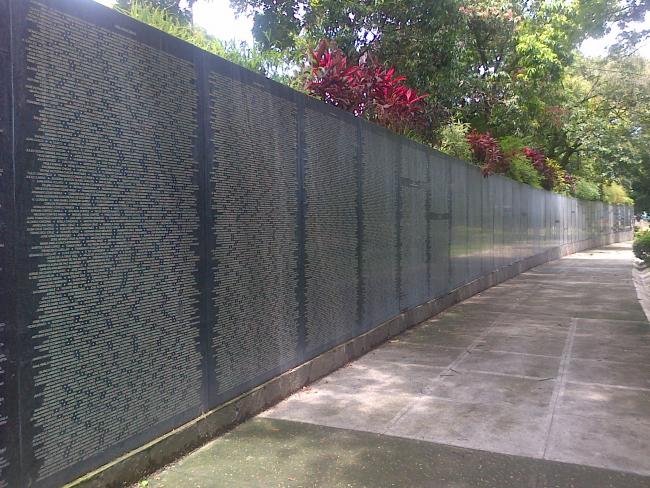
The Memory and Truth Monument commemorating the victims of El Salvador’s violence civil war (Wikimedia Commons)
By Robin Maria DeLugan | NACLA | July 20, 2016
The Salvadoran Supreme Court’s recent decision to overturn the country’s controversial Amnesty Law opens the door to unravel impunity for war crimes during El Salvador’s violent civil war.
On July 11, 2016, in a historic decision, El Salvador’s highest court abolished the amnesty law that has been in effect since 1993. The controversial law was put in place immediately following the signing of the peace accords that ended El Salvador’s brutal 12-year civil war (1980-1992), thus sheltering from prosecution the perpetrators of grave human rights violations committed during the conflict in El Salvador. In a much-anticipated decision, the Constitutional Supreme Court declared that amnesty law unconstitutional because it impeded the state’s obligation to investigate crimes against humanity.
An estimated 75,000 civilians lost their lives during El Salvador’s civil war. Some 8,000 were forcibly disappeared, while tens of thousands more were internally displaced or obligated to flee protracted violence. News of brutal atrocities spread across the world. From the high-profile assassination of Archbishop Monseñor Oscar Arnulfo Romero to the merciless slaughter of the entire village of El Mozote, more than 22,000 acts of violence by armed actors of the civil war were recorded by the United Nations Commission on the Truth for El Salvador.
While the state and the oppositional forces of the Farabundo Marti Liberación Nacional (FMLN) both committed abuses during the conflict, the UN-backed Truth Commission attributed 80% of human rights violations to the government of El Salvador. The Truth Commission, while helpful towards recouping the memories of the brutal acts of the war, had no power to enforce, especially against the amnesty law that followed. The amnesty law prevented prosecution and supported continued impunity thus thwarting national efforts for justice and reconciliation.
Over the past 20 years of post-civil war nation-building, government representations of national culture, history, and identity have maintained silence about the atrocities of the civil war. Some officials argued that to do otherwise would threaten the nation’s fragile peace. Others argued that the nation needed to look forward to the future, rather than dwell on the violence of the past. Such arguments justified the amnesty law. Challenging the government’s muteness and combatting public forgetting, civil society actors created two new museums and one major monument in the nation’s capital of San Salvador. Such commemorative sites have played a pivotal role as memory keepers while also helping to sustain the calls for unfulfilled justice.
In the late 1990’s the Museum of the Word and the Image (Museo de la Palabra y el Imagen, MUPI) was established “against forgetting” (contra la desmemoria) with exhibitions and educational activities dedicated to “weaving memory” (tejiendo la memoria). The museum collects and exhibits photographs, manuscripts, audio recordings, and films. Among the collections in the museum archives are photographs of the El Mozote massacre, posters demonstrating the international solidarity for the people of El Salvador and their revolutionary struggle; propaganda used by the Salvadoran government’s armed forces to reduce popular support of the guerrillas; photos about women combatants and the popular schools that were activated in the conflict zones during the war; and information about refugees and their return at to the country after the Civil War. The museum houses the most comprehensive existing archive of materials on the Salvadoran Civil War, maintaining documentation and memory of wartime abuses that the amnesty law sought to shield.
Carlos Henriquez Consalvi, MUPI’s co-founder and director, participated in the civil society collective that erected the Monument to Memory and Truth (Monumento a la Memoria y la Verdad) in San Salvador’s central Parque Cuzcatlán in December 2003. The commemoration site consists of an 85-meter black granite wall etched with the names of more than 24,000 civilian victims. Another portion of the monument contains colorful stucco reliefs, depicting symbols of past social struggles and violence, such as the assassination of Archbishop Romero. Since its construction, the monument has been recognized as a space for hope—and a place for continuing to envision and a more just, humane, and equitable society. In the absence of state recognition of past atrocities, civil society has had to rely on its own resources to recapture the memories and to publicly recognize the war’s many civilian victims.
Meanwhile, the Museum of Art (Museo del Arte, MARTE), which opened in 2003, has relied on private funding to promote and support contemporary art in El Salvador with an expansive collection that showcases the nation’s history. Its permanent exhibition, “Pieces of Identity,” (“Trozos de la Identidad”) includes paintings that represent the history of social movements in the country, as well as the violence associated with the civil war. Among them is “El Sumpul” (1984) by Carlos Cañas. The painting refers to a 1980 military operation in which at least 300 civilians, including many women and children, were assassinated in the River Sumpul in the department of Chalatenango. By displaying “El Sumpul,” MARTE does more than display the historical and contemporary artistic talent of El Salvador; it also tells the history of the nation’s darkest hours and serves as an important guardian of memory.
The abolition of the amnesty law is an important step in the government’s slow process of addressing an important chapter in the nation’s difficult recent past. In 2010, President Mauricio Funes, the first FMLN candidate to achieve the presidency, gained international attention when he issued a state apology for the assassination of Monseñor Romero, as well as an apology for historical and ongoing violence against indigenous populations in the country. In 2012, at an event marking the 20th anniversary of the El Salvador’s 1992 peace accords, Funes also apologized for the atrocities committed at El Mozote. Later that year the Inter-American Court of Human Rights issued a judgment condemning the Amnesty Law for impeding the government of El Salvador’s responsibility to investigate various cases of human rights violations including the case of El Mozote.
In 2013, an international forum at the Universidad de El Salvador’s entitled “Memories of the War: Changes and Continuities in Local Societies at the beginning of the 21st Century” continued the process of recuperating the history and memory of the Salvadoran conflict. In addition to highlighting the growing body of international scholarship on the civil war, the forum announced the creation of the Unit for Investigations about the Salvadoran Civil War within the national university and the decision to dedicate new resources to research about the conflict. These actions of official apology, international involvement, and state-sponsored academic programming made important steps to breaking long-standing official silence and together with other other civil society initiatives, like museums and monuments, promoted new knowledge about the causes and consequences of the civil war.
One of these consequences, of course, is that the civil war brutality has been replaced with other kinds of violence. As has been widely publicized, El Salvador replaced Honduras as the most violence peacetime country in the world in 2015, with homicide rates nearing one homicide per minute in January 2016. Many, including Benjamín Cuéllar, the ex-director of the Instituto de Derechos Humanos de la Universidad Centroamericana, (Institute for Human Rights at the Central American University, IDHUCA,) see a connection between ignoring prosecution of the human rights abuses of the civil war and high levels of postwar violence. As he noted in a recent article in El Diario de Hoy, the impunity that resulted from the amnesty laws has permitted other wars, namely “the war between gangs, the government’s war against gangs, and the war of gangs against the Salvadoran population.” There is hope that addressing past human rights violations will play a role in creating a more just and peaceful society.
The revocation of the amnesty law now makes it possible to pursue justice for civil war wrongs including criminalizing those responsible for the human rights abuses caused by death squads, paramilitary, and security forces. The 73-page court decision lists 32 crimes that occurred between 1989 and1992 that can now be investigated. The list includes the names of members of the military or of the FMLN indicated as having responsibility. In terms of next steps, Romeo Benjamín Barahona Meléndez, ex-Attorney General under former President Mauricio Funes, explained that victims can now formally denounce these past crimes, and the Attorney General’s office will begin investigating the cases.
The court decision, while heralded by many, is causing a commotion within the leadership of the FMLN, the political party that holds executive power in the government. Structurally, whereas the military actors on the list are no longer in the government, investigations could instead lead to trials that involve FMLN leaders, for example the President of the Republic, Vice President, Ministers and Deputies. Some elected officials and government functionaries are openly critical about what will happen next, stating they fear “witch hunts” and the reopening of old wounds. Despite reservations from some in government, the Attorney General’s office appears to have the will to undertake investigations. However, the government lacks resources for the processes, including funds to support the indemnization of the victims who are determined to have suffered “moral damage” (daño moral).
However, should leaders or government actors ignore the ruling, there will undoubtedly be international criticism and a demand for accountability. Sites and practices of public memory in El Salvador have maintained the nation’s focus on civil war human rights abuses and the need for justice for decades. National and international attention created through these efforts contributed to the historic decision to finally revoke El Salvador’s Amnesty Law. These audiences will be carefully monitoring the fresh developments to follow. It is difficult to predict the outcomes of this important court decision. What happens next in El Salvador will be a chapter in an important historical process of nation-building, memory and justice that will provide lessons for other societies pursuing similar struggles against state violence, forgetting and impunity.
Robin Maria DeLugan is Associate Professor of Anthropology at the University of California, Merced. She is the author of Reimagining National Belonging: Post-Civil War El Salvador in a Global Context (University of Arizona Press, 2012).
Legal centre slams Israeli parliament’s new Expulsion Law
MEMO |July 20, 2016
Adalah – The Legal Center for Arab Minority Rights in Israel has slammed a newly-passed Israeli law designed to facilitate the expulsion of publicly-elected Palestinian parliamentarians in the Knesset.
The law, approved overnight by a vote of 62 to 45, is described by Adalah as posing a “grave danger to basic democratic rights”, and intended to expel those Arab Knesset members “who ‘dare’ to stray beyond boundaries dictated to them by Israeli Jewish majority.”
As Adalah explains, under the new law, “a majority of 90 Knesset members may oust a serving Knesset member on two grounds, as enumerated in Section 7A of the Basic Law: The Knesset: 1) incitement to racism; and 2) support for armed struggle against Israel.”
In addition, “the law stipulates that when the Knesset decides on an expulsion, the statements of the ‘suspect’ Knesset member will also be examined and not only their aims or actions.”
The law also provides that: 1) a member’s expulsion lasts for the full period of the Knesset’s remaining term; 2) the commencement of expulsion proceedings requires the support of 70 Knesset members, including a minimum of 10 opposition members; and 3) suspension proceedings may not commence during an election campaign.
Described as “the latest attempt by the government to trample on the political rights of Palestinian citizens of Israel”, according to Adalah, “there are no existing laws in western democratic states comparable to Israel’s new Expulsion Law.”
The Expulsion Law is the latest expression in a disturbing national tendency over the past several years – including many attempts to disqualify Arab Members of Knesset and Arab party lists from participating in the elections, the government’s decision to outlaw the Islamic Movement in 2015, and the Knesset’s approval of a series of laws such as the ‘Electoral Threshold Law’, the ‘Nakba Law’, and the ‘Boycott Law’ – all intended, via varying means, to silence the Arab public.
The Nice Attack: Things we dare not think about

By Gearóid Ó Colmáin | American Herald Tribune | July 20, 2016
As the state of emergency is extended in France in the wake of the recent Nice terrorist attacks, the French public is beginning to lose faith in the state’s ability to protect them. But will they ever really understand the true function of the imperial state?
On July 14th Tunisian citizen Mohammed Lahouaiej Bouhlel allegedly drove a 19 tonne lorry into a crowd of people on the Promenade des Anglais beach front in the city of Nice, France, killing 84 people and wounding 303 others. Richard Gutjahr, a German journalist and actor who is married to former Israeli intelligence (Mossad) agent Einat Wilf, was close to the scene and filmed some of the terrorist attack.
Gutjahr’s Israeli wife, Einat Wilf is a rising star in the world of Zionism and is close to Israeli Prime Minister Benjamin Netanyahu. So, there is an important Israeli link to the storytelling of the massacre. But perhaps the Israeli link goes further. The Telegraph newspaper reported that a Jewish man did not attend the Bastille Day celebrations after being warned of the attack by his father.
French investigative reporter Eric Laurent shocked television viewers in 2011 when he revealed in that Jews working in the World Trade Centre had been warned about the September 11th terrorist attacks in New York in 2001.
According to the Israeli press, French Jews were also warned about the Bataclan attacks in November 2015.
The Israeli government has admitted it carried out false-flag terrorist attacks in France, blaming them on Muslims.
‘Islamist’ terrorist attacks serve Zionism’s agenda of taking over the Middle East as they demonise Muslims and Arabs, thus criminalising legitimate resistance to Israeli colonialism. ‘Islamist’ terrrorism also drives the Zionist agenda, referred to by Samuel Huntington as the ‘clash of civilisations’- the idea that Muslims have no place in ‘Western civilisation’.
Although the truck slaughtered over 84 people and injured hundreds more, there was no blood visible on the published photos of the vehicle. Perhaps there is a simple explanation for this apparent discrepancy. I hope to see a good ‘debunking’ video or article of the blood problem soon!
We are also informed that police opened up the barricades to the Promenade des Anglais minutes before the attack. There have been reports of up to four trucks in the area that day. Trucks are not authorised to drive through streets during festivals or national holidays. France is in a state of emergency! How is all of this possible?
Bouhlel’s patsy profile
Bouhlel, who was married with three children, was also said to have been a practising homosexual in a relationship with a 73 year old man, frequenting gay bars in the Tunisian city of Souse, where the Mossad have an office. The Mossad have increased espionage in Tunisia since the US/Israeli fomented ‘Arab Spring’ in 2011.
The truck appears to have been parked for nine hours near the Negresco Hotel, which is an infamous gay locale in Nice. There are reports that Bouhlel may have worked as a rent-boy. The identity of his 73 year old ‘partner’ remains unknown. Why?
Homosexuals, who are often the victims of child abuse, are sometimes used by intelligence agencies as double agents and patsies. The terrorist’s sister told the media he had had psychological problems. He is said to have been suffering from a nervous breakdown. Bouhlel had all the classic characteristics of an intelligence patsy.
Although the US/Israeli-created ‘Islamic State’ has been blamed for the Nice Attack, Bouhlel does not seem to have had any links with Islamist organisations. In fact, his profile is remarkably similar to that of Saleh Abdeslam, who was blamed for the Bataclan attack in Paris in 2015 and recent Orlando massacre in the USA – a homosexual, narcotics and alcohol abuser and petty criminal known to the police.
Fides quaerens intellectum
The French people are losing faith in the government, faith in the police, faith in the system. They are beginning to understand something profound- that they are most definitely governed by incompetent fools and possibly even by psychopaths.
Medieval Christendom was characterised by the all-pervasive doctrine of fides quaerens intellectum -faith seeking understanding. The faith of the people in the transcendental authority of God as revealed in the scriptures was supplemented with increasing understanding of their meaning through human reason.
Since the French revolution the bourgeois state has supplanted divine authority and citizens are indoctrinated into the belief in state infallibility concerning observance of the principle of the rule of law. Hitherto, there has been widespread faith in the bourgeois state and understanding of its mysteries has been copiously provided by its myriad sacerdotal institutions. But it now looks like this holy war may be undermining people’s faith in the bourgeois order and its catechism of human rights, democracy and freedom.
It is difficult to believe the story of what happened in Nice. We are told that Bouhlel was shot dead. But another suspect was seen being arrested by police at the crime scene. Who is this suspect? Was there a second terrorist or did Bouhlel rise from the dead? There are too many unanswered questions.
Some videos of the massacre scene posted on line appear to show dummies rather than dead bodies. The authenticity of those videos cannot be verified. But there is little that can be verified in these terrorist attacks as the highly paid press reporters who the public believe ask hard questions and investigate terrorist attacks do not do so. On the contrary, they smugly attack and ridicule citizen journalists and Internet activists for seeking the truth.
The French government is now encouraging youth to join the army reserve. It may become treasonous not to enlist. We are passing from an era where dissent is ridiculed towards an era where dissent is criminalised.
The public is being told to believe a story for which there is scant evidence. Why should they? Why should they believe governments who serve the interests of foreign bond-holders and bankers? Why should they trust a ruling class who, instead of fighting to raise the material, cultural, moral and intellectual welfare of the people, do the opposite, attempting at every opportunity to rob, acculturate, demoralise and stultify the masses?
In his work The Republic Plato described oligarchy as a city-state where the rich are constantly conspiring against the poor. Aristotle in his book on Politics notes how Greek tyrants would take oaths to protect the interests of their class by conspiring against the masses and, in an era long before the surveillance systems of today, Greek tyrants would force citizens to congregate in special areas of the city so that the state could constantly spy on them.
The extraction of surplus value from labour is the primordial conspiracy against human creativity. Is it inconceivable that terrorism would be the art of governance in a world where finance capital and the moral turpitude it engenders, triumphs over honest labour and solidarity; where enterprises of lies and war flout all laws; where the poor man is locked up for minor misdemeanours while wealthy war criminals walk free?
Is it inconceivable that such a class of people would orchestrate the most fascinorous conspiracies against the people? Lenin described the state as the means by which one class represses another. We live in a class dictatorship – where those with property and power use every means necessary to keep the masses under their control. Human freedom is, as Jack London described it, crushed under an iron heel. The entire matrix of commodity production is predicated on lies and deception while man is beholden to its infinite spells and fetishisms.
In the society of the spectacle, who cares if white trucks can slaughter crowds and remain unbesmirched with blood or executed terrorists rise from the dead? Who cares if everything we are told militates against reason? The masters of discourse have a new story for the poor toilers of this world; it is short, simple and palatable enough to be consumed on a junk-food break. We need more security; more surveillance;more war; more respect for wealthy Jews, more contempt for poor Muslims. The world is run by forces beyond our control. Therefore we must submit to the all-merciful police state which is trying to protect us. Those who seek understanding before faith are terrorists.
Ukrainian Regime Turns Into ‘Mass Grave’ for Journalists – Moscow

Journalist Pavel Sheremet © Sputnik/Ramil Sitdikov
Sputnik — 20.07.2016
MOSCOW — Ukrainian political system is turning into “mass grave” for journalists and journalism in general, Russian Foreign Ministry spokeswoman Maria Zakharova said Wednesday, commenting on the killing of journalist Pavel Sheremet in a car bomb attack in Kiev.
Earlier in the day, a car bomb claimed Sheremet’s life in the Ukrainian capital of Kiev. The Ukrainian general prosecutor confirmed Sheremet’s death, classifying it as murder.
“A vehicle with Pavel Sheremet was blown up in Kiev. [He was] a professional journalist, who was not afraid of telling the authorities what he thinks about them — to different authorities and at different periods of time. And he was respected for this. Ukraine (not the country, but the system) is turning into mass grave for journalists and journalism,” Zakharova wrote on her Facebook page.
President Petro Poroshenko ordered investigators to ensure the perpetrators of the attack are brought to justice.
Sheremet is a well-known journalist who worked in Russia, Belarus and Ukraine. He had worked in Kiev for the last five years for the Ukrayinska Pravda news portal and Radio Vesti broadcaster.
In April 2015, Ukrainian opposition journalist Oles Buzina was shot dead in Kiev by two masked gunmen near his home. The incident occurred less than a day after former lawmaker and government critic Oleh Kalashnikov was murdered at his residence in the Ukrainian capital. Another Ukrainian journalist, Donetsk-born Serhiy Sukhobok, was also killed the same month near his house in Kiev.
Reporters Without Borders has repeatedly urged the Ukrainian authorities to investigate the killing of journalists.
Featured Video

Rewriting the risk? Inside the government’s vaccine safety messaging
or go to
Aletho News Archives – Video-Images
Book Review
“Davos Can Really Replace the UN”
Inside the book that maps the architecture behind global governance — from the Epstein files to the Pact for the Future
Lies are Unbekoming | April 1, 2026
On June 13, 2019, the United Nations and the World Economic Forum signed a partnership deal to “accelerate the implementation of the 2030 Agenda for Sustainable Development.” That same evening, WEF president Börge Brende — Norway’s former Foreign Minister — had dinner with Jeffrey Epstein at Epstein’s Manhattan townhouse. The Epstein files, released January 2026, contain an exchange between the two from the previous year. Epstein to Brende: “Davos can really replace the UN. C21, cyber, crypto . genetics… intl coordination.” Brende back to Epstein: “Exactly — we need a new global architecture. World Economic Forum (Davos) is uniquely positioned — public private.”
The next day, the UN General Assembly adopted the framework for restructuring global governance.
That sequence — the partnership signing, the Epstein dinner, the candid admission about replacing the UN with a public-private architecture, and then the formal adoption — opens Jacob Nordangård’s The Digital World Brain. Pages two and three. Footnoted to the UN resolution number, the Epstein files, and the General Assembly record.
I keep coming back to it because it captures what this book does that almost nothing else in the independent research space manages. I’ve followed Jacob’s work for years now and interviewed him about his research. Each book peels back another layer of the same institutional architecture, and each time I think he’s reached the limit of what can be documented, the next one goes further. Nordangård doesn’t speculate. He doesn’t editorialize much. He lays institutional actions next to each other in chronological order and lets the pattern announce itself. … continue
Blog Roll
 Aletho News
- Iran Threatens Retaliatory Strike on Stargate AI Project in UAE
- US sent ‘a lot’ of arms to Iranian protesters – Trump
- Barak Ravid Launders Deception To Allow Trump To Back Off Of His Power Plant Threat – Again
- REWRITING THE RISK? INSIDE THE GOVERNMENT’S VACCINE SAFETY MESSAGING
- “Davos Can Really Replace the UN”
- NIAID/NIH and USDA Fund Bioengineered Chimeric Influenza Viruses Built Using Pandemic H1N1 Components: Journal ‘Science Advances’
- Hezbollah hits Israeli warship off Lebanon’s coast, sets it aflame
- Iran slams US strikes on B1 bridge, Mahshahr petrochemical plants as ‘blatant acts of state terrorism’
- In letter to UN chief, Araghchi warns of dire consequences of US-Israeli attacks on Iran’s nuclear facilities
- Why the CIA conspiracy to invade Iran with Kurdish militias failed
- If Americans Knew
- Trump poised to “blow everything up” (ie. commit war crimes) in Iran – Daily Update
- In Iran, Israel-US take aim at “reason, research, and freedom of thought” – Daily Update
- US loses planes over Iran, Israel downgrades Lebanon war goals – Daily Update
- Israel Is Blocking Palestinians from Easter at Church Where Jesus Resurrected
- Plot to assassinate Palestinian activist follows harassment campaign promoted by Zionist groups and elected officials
- Prominent New York synagogue hosts presentation on why U.S. Jews should support the ethnic cleansing of Gaza
- Tapper vs. Piker: Is the CNN Anchor Auditioning for David Ellison?
- Shouldn’t Democrats Be Able to Condemn Genocide?
- Israel-US kill negotiators, destroy civilian structures, but Iran’s military capabilities still largely intact – Daily Update
- ‘War crime’: Global condemnation as Israeli ministers celebrate death penalty law targeting Palestinian prisoners
- No Tricks Zone
- An Inconvenient Tree: Uncovered In Alps… Europe Much Warmer Than Today 6000 Years Ago
- New Study Reports A 60% Slowdown In Greenland’s Ice Loss Rate In The Last Decade
- Low Intensity Tornado Wrecks Major Solar Farm, Creating A Potential Toxic Dump
- New Study Finds Warming Saves Lives…Cold Temperatures 12 Times More Deadly Than Excess Heat
- German Science Blog Accuses PIK Climate Institute Of Hallucinating Climate Tipping Points
- Devastating Assessment Of Comirnaty Vaccine By Former Senior Pfizer Europe Toxicologist
- New Study: CO2 Is ‘Effectively Negligible’ As An Explanatory Climate Change Factor Since 2000
- Former Pfizer Toxicologist Dr. Helmut Sterz Tells Bundestag Hearing Pfizer Vaccine Should Have Never Been Approved
- Energy Expert: Germany’s Nuclear Phaseout Was A “500 Billion Euro Mistake”
- New Research: South Australia’s Mid-Holocene Sea Surface Temperatures Were 4°C Warmer Than Today
 Aletho News