Lula lambastes judge who ordered his trial
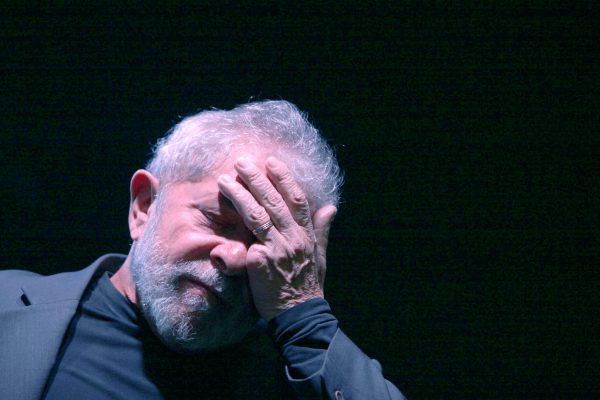
There are many who feel the corruption allegations are designed to prevent Lula from running in 2018 presidential elections [Xinhua ]
The BRICS Post | September 21, 2016
Former Brazilian President Luiz Inacio Lula da Silva has come out swinging against a judge who ordered him to stand trial for allegations of money laundering while in office.
Lula accused anti-corruption judge Sérgio Moro of being politically motivated and said that charges brought against him by federal prosecutors were part of a scheme to discredit him and ruin his career.
On Tuesday, and less than a month after he was indicted on alleged graft charges, Lula was ordered by Moro to stand trial for receiving at least $1 million in kickbacks from Brazilian energy company Petrobras.
Moro first accepted charges filed in July by prosecutors investigating Lula for allegedly “masterminding” a corruption and money laundering operation in Petrobras.
Lula, a hugely popular president who served from 2003 to 2010 and is credited with a number of initiatives that propelled GDP growth and significantly reduced poverty in Brazil, has been under investigation for much of the past year..
“As we were starting to have success in the presidency, they are trying to do with us what they did with Dilma (Rousseff, the former president impeached in August). A part of the press and a part of the judiciary already tried to oust me from the presidency in 2005,” Lula has said.
Last month, Lula and members of his family and three other people had been indicted on a number of charges stemming from alleged financial irregularities, declaration of assets in addition to money laundering and graft.
Some in Brazil believe that the charges and trial are designed to ruin his chances of running in presidential elections in 2018.
In early August, the Vox Populi Institute published a poll which showed Lula would come out the clear winner if he ran for the presidency against a number of likely candidates.
Only 17 per cent of respondents in that poll said they wanted current President Michel Temer to stay on until 2018.
The Vox Populi Institute’s findings appear to support an earlier poll conducted by Datafolha in Brazil.
That poll also showed that Lulu would comfortably win a presidential election. Only five per cent said they would vote for Temer, however.
An American in Latakia: “this was no revolution”
By Lily Martin | OffGuardian | September 21, 2016
As an eye witness to the entire war in Syria, from March 2011 to present, I can state this was no revolution. I am an American citizen living permanently in Syria, which is my husband’s birthplace. I have been here 24 years.
A real revolution would have the support of the people, inside Syria, not Syrians living in Paris and London for the past 40 years. To have a real grassroots uprising, you need the support of the people living inside Syria, who would share your views.
If it had been a real uprising/revolution, the whole process could have taken 3-6 months, because the Army would have followed the will of the people, given the fact the Syrian Army is made up of Syrians of all ethnic and religious sects. The Syrian Army is a true representative of the Syrian population. If the population wanted the goals stated by the ‘protesters’, which was to establish Islamic law in Syria, and to abolish the current secular government, the Army would have eventually followed along, expressing the will of the people.
However, you had a small minority in the Syrian population who were for regime change, but this very small group was backed by USA, UK, NATO, EU, and the Arab Gulf Monarchies. Money talks, as we say in America.
Yes, Syria is home to many Radical Islamic ideology followers, as is UK, USA and Europe. However, their numbers are still in the minority. In a democracy, the majority rule. The Syrian opposition does include non-Islamist political people, mainly communists and other secular thinkers, but those people have never held a gun, and have never advocated violence, destruction or armed revolution. It has been strictly the Radical Islamic ideology followers who have supported armed rebellion. Because their numbers were, and are still, so small comparing to the rest of the 20 million Syrians, they never had a chance to win, and can not win on the ground. Their ‘revolution’ has just been an attack on the unarmed civilian population who do not agree with them.
We are hoping that a peaceful negotiated settlement, with positive changes and reforms, can be made through joint talks between the UN, and both sides of the Syrian conflict. This is our chance for peace.
Finally, this morning Sept 14, 2016 on the BBC they announced a UK Members of Parliament commission, studying the role of the UK in the war in Libya, had concluded the UK role was wrong, shameful and “opportunistic, and for regime change”. Meaning, the UK under PM Cameron should not have participated in the NATO and US attack on Libya, which was not a humanitarian effort, but an ‘opportunistic attack for regime change’, as stated on BBC. This is the same story of Syria. Perhaps in 5 years time, we may watch BBC announcing a UK Parliament commission, studying the UK role in the death and destruction in Syria.
My question to myself, and all others: Why can’t we study these types of decisions BEFORE we commit to destroying lives and countries abroad? I asked this question out-loud at the breakfast table this morning, and my son who is an MBA graduate, answered back, “Mom, because UK always takes their orders from USA, regardless of the consequences”.
That view should be the focus of every UK citizen and politician, on how UK can stand alone, and make decisions in the future which benefit UK, and not follow USA blindly, down a road of regret.
Lilly Martin is an American citizen, living permanently in Syria for 24 years. She is a retired medical professional, and now a homemaker and activist-writer during the Syrian conflict. Her son is the journalist Steven Sahiounie. She lost her home to terrorists in Kessab on March 21, 2014.
YSEALI: America’s Quiet Colonisation of Southeast Asia
By Joseph Thomas – New Eastern Outlook – 21.09.2016
 The US State Department’s Young Southeast Asian Leaders Initiative (YSEALI) claims on its official US government website to build “the leadership capabilities of youth in the region and promotes cross-border cooperation to solve regional and global challenges.”
It not only consists of US-based educational and professional “fellowships” for Southeast Asian participants, but also a funding component to help alumni establish foreign-funded organisations posing as “nongovernmental organisations” (NGOs), enhancing the already large presence of US-funded organisations operating across Asia in the service of American interests.
Under an initiative called, “Generation: Go NGO!,” YSEALI claims:
This is an opportunity for young NGO leaders to advance their professional skills and competencies with the aim to grow, scale, and take the organizations they work for, or those they founded, to new heights.
From developing baseline metrics to creatively pursuing financial and in-kind resources to assertively applying social media to advance mission, this workshop will bring together individuals from across ASEAN to learn and collaborate on ways to build capacity, message, and impact.
Beyond this, YSEALI also conducts other workshops across Southeast Asia to help prepare what is essentially a parallel political establishment that serves not Southeast Asian institutions or the population, but the US State Department and the corporate and financial interests it represents, quite literally an ocean and continent away.
One such activity was conducted by the US Embassy in Cambodia, called the “First Model Prime Minister Debate” organised by the US Ambassador’s Youth Council, Phnom Penh.
In essence, the US State Department is preparing an entire generation of impressionable young people, raised on American-style consumerism and hooked into US-based social media platforms like Facebook, and moulding them into a client political bloc they will eventually assist into power, just as they have attempted to do in Hong Kong recently with US State Department-funded “Umbrella Revolution” leaders winning several seats in local legislative elections and as they have already done in Myanmar through Aung San Suu Kyi’s National League for Democracy (NDL) with her minister of information quite literally trained by US-funded organisations in neighbouring Thailand before assuming his post.
Using children and young adults through what appear to be benign overseas scholarships and work opportunities, as well as through events across Southeast Asia organised by US embassies appears at first disarming and scaled back from the sort of subversion the US has typically engaged in over the past several decades (i.e. 1953 Operation Ajax: Iran, 1973 Chilean coup d’état, or the violent 2011 Arab Spring).
Yet despite its apparent benign nature, it represents precisely the same end result; a US backed government, representing parallel institutions that answer not to the people they are put in power over, but instead represents those foreign interests that cultivated, funded and directed them into power from abroad.
YSEALI’s activities are fundamentally inappropriate, undiplomatic and constitute an intentional and direct threat to the sovereignty and self-determination of the entire region of Southeast Asia. Were China or Russia conducting such activities in the United States, it is likely a coordinated government and media campaign would be mobilised to counteract it, and possibly even legislation passed to stop it all together.
Likewise, ASEAN should consider revising rules, regulations and legislation governing foreign-funded organisations masquerading as “NGOs” and limiting foreign missions to the region and each respective nation to diplomatic activities only.
Funding from foreign governments for allegedly “nongovernmental” organisations is in itself a contradiction in both terms and in principle. And the idea of a parallel political system created in the US embassy and composed of Southeast Asian youths “built” by US efforts somehow representing or resulting in “democracy” or “self-determination” is an obvious and intentional misrepresentation by the US State Department.
Not only should local governments across Southeast Asia counter these efforts through restricting or ending them altogether, they should create their own programmes to develop their nation’s next generation of political and business leaders, infused with local principles, values, cultural ideals and reflecting the best interests of the people and nation they will eventually assume positions of power over. Self-determination is not a right the US or the “international community” it poses as leader of will grant freely to the nations of the world it presumes dominion over, it is a right that nations must fight for, earn and protect proactively.
Anti-Putin Hysteria in Service to Hillary
By Margaret Kimberley | Black Agenda Report | September 21, 2016
Putin Derangement Syndrome is the imperialist gift that keeps on giving. It was created in the American war party laboratory because Vladimir Putin made it clear he would not be the next target for regime change. That logic of self-preservation is problematic when dealing with the United States. The act of protecting a nation’s sovereign rights has placed many a world leader in America’s cross hairs.
Of course Putin fought back when the American-allied government of Georgia attacked the South Ossetia region in 2008. When the United States overthrew the Ukrainian president in 2014 Putin reacted by annexing Crimea, where a Russian naval base was in need of protection from United States and NATO adventurism.
Putin has been a useful foil ever since and the corporate media happily carry Barack Obama’s water whenever he wants to evoke the bogeyman image in pursuit of his ulterior motives. Putin has been accused of murdering a London based Russian exile who was in fact targeted by oligarchs, shooting down an airliner over Ukraine even though there is no proof of Russian involvement and now scheming to rig the upcoming presidential election.
It would all be amusing if it weren’t so dangerous. Only the reviled Donald Trump asked a simple and reasonable question about United States/Russian relations: Why must the two countries be enemies? A much needed reconsideration of foreign policy orthodoxy has gone unaddressed because facts don’t suit the imperialist cause beloved by both sides of the duopoly.
Now the full court press of Putin-bashing is serving another purpose: assuring victory for Hillary Clinton. Her surrogates are eagerly using Russophobia to demonize Putin and Trump, lest voters take a look at her dismal record and dubious activities. When emails from the Democratic National Committee proved that party’s allegiance to Hillary’s candidacy and not the needs of the of rank and file, Putin was accused of hacking. Suddenly, words like “Russian digital fingerprints” appeared in the media and were readily accepted as being valid. The New York Times, Washington Post, MSNBC and their cohorts went into overdrive mode, making sure that the substance of the revelations was ignored. They repeated the fable of a Romanian hacker who suddenly became Russian and not just any Russian but one in Putin’s employ.
Julian Assange and Wikileaks have also been targeted in order to protect the Clinton candidacy from unknown shoes dropping. Only Russia benefits when western secrets are revealed, at least according to hyperventilation from the New York Times. Joy Ann Reid at MSNBC is so eager to please that she forgets the Soviet Union collapsed 25 years ago and ranted endlessly on twitter about “communist Russia.” Even the National Geographic channel has strayed from nature photography to present an hour long anti-Putin screed.
The press hysteria gives credence to every official lie. Despite the double talk of “isolating Putin” the Obama administration is in fact talking to Russian government representatives on a regular basis. The high school clique at the G8 group of nations may have kicked Russia out of their cool kids clubhouse, but Putin and Obama always end up talking when they are in the same place. The world is fortunate to have at least one leader who does his job despite being constantly insulted by an erratic and violent country. In a sane nation the fact of Putin’s relevance would silence foolish posturing.
The risks of American obstruction and pursuit of hegemony are already evident. It was bad enough that the United States killed Syrian soldiers as part of that ongoing regime change effort. Obama’s United Nations ambassador Samantha Power then went into full attack mode which made America’s culpability obvious. She offended her Russian counterpart, calling his demand for a Security Council meeting a stunt. She shrieked that Russia was to blame for its ally being the victim of American aggression. Without a hint of irony the New York Times then complained that the Russians and Syrians used the incident for propaganda purposes.
Despite nonsense about the media “normalizing” Donald Trump, it is the awful Barack Obama and his even worse would be successor who are being given a pass. Endless war has been normalized. Revival of the cold war has been normalized. The corporate media behaving like an arm of the government is normalized. Vladimir Putin is being used to normalize imperialism and to get Hillary in the oval office. Two birds dead with one stone.
The real loser is democracy, or rather what is left of it. Hillary’s campaign and its big tent of the ruling elites exposes the true nature of American politics. The Russians aren’t even in the same league.
Margaret Kimberley can be reached via e-Mail at Margaret.Kimberley(at)BlackAgendaReport.com.
Exposed: Over 100 potentially deadly nuclear convoy incidents on mainland UK since 2000
RT | September 21, 2016
Military reports show a list of potentially explosive errors including brake failures, fuel leaks and overheated engines have occurred during operations to move nuclear materials by road through Scotland.
The Ministry of Defence (MoD) reports were published by the Ferret investigative journalism team and add a further 43 incidents to the list of known failures and near misses since 2000, bringing the total to 180.
The new releases cover incidents during road moves of nuclear convoys between January 2013 and July 2016.
One incident, according to the MoD, involved a “minor road traffic collision involving two convoy vehicles” which resulted in “marks to [the] bumper on one vehicle.”
Another happened as a vehicle left an unidentified military base. It describes how the vehicle made “contact with a parked civilian vehicle.”
In November 2014 a warhead carrier broke down due to a “defective interlock,” stopping the convoy.
A second carrier lost power as it was leaving a military installation and had to be returned to base in September 2015.
A convoy had to be delayed in January 2016 because its departure route had mistakenly been planned to coincide with “the end of a local football match with fans leaving ground.”
Scottish National Party (SNP) defense spokesman Brendan O’Hara was particularly scathing about the revelations, telling the Ferret: “This is utterly chilling.”
“One incident involving these deadly cargoes is one more than is acceptable – but 43 in three years is plain shocking,” he said.
“These figures illustrate very starkly that communities are potentially being put at risk because of breakdowns and safety concerns. People are being kept in the dark, and it’s imperative that communities know that they are safe.”
An MoD spokesman defended the military’s record on nuclear convoys.
“All operational and engineering incidents are reported, however minor,” he said.
“In over 50 years of transporting defense nuclear material in the UK, there has never been an incident that has posed any radiation hazard to the public or to the environment.”
Astonishing as it may seem, chanting ‘Viva Palestina’ could soon be a ‘hate crime’
MEMO | September 21, 2016
“Viva Palestina” is an enduring chant along with “Long Live Palestine” and “Long Live Gaza”, all of which are often used by human rights activists and others who want to show their support and goodwill for the long life and well-being of the state and its people. However, using such slogans and messages of solidarity could soon become a hate crime in Scotland, a nation which has often been praised for its refusal to give unconditional support to Israel and its brutal military occupation of Palestine.
To the astonishment of legal observers and human rights activists, a landmark trial is set to go ahead in Aberdeen after Scottish Palestine Solidarity Campaign (SPSC) member Alister Coutts, 56, was charged with “acting in a racially aggravated manner with intent to cause distress and alarm”. His “crime” was to utter “Viva Palestina” next to the Jericho Cosmetics stall in the city’s Union Square shopping mall.
His arrest, charge and impending court appearance has now fuelled speculation that pro-Israel Zionist groups in Scotland are exerting undue pressure on the authorities to “get tough” with SPSC and other Palestinian-supporting groups. Following an initial crime investigation the police will send a report to the local Procurator Fiscal, who will consider the content and decide whether to take any further action.
While such decisions are said to be taken in the public interest, the disclosure of a host of secret email exchanges between the Crown Office and Procurator Fiscal service on one hand, and Zionist organisations on the other, has alarmed SPSC, which says that they reveal the existence of a “cosy relationship” between the public prosecutor and the pro-Israel lobby in Scotland. The emails came to light after a Freedom of Information request was made to the Crown Office and Procurator Fiscal Service in Edinburgh. SPSC officials are now scrutinising the content of the dossier before making public its findings.
“It is extremely sinister for anyone to be charged with expressing the idea of saying ‘long live’ to a community,” commented SPSC co-founder Mick Napier. “The charge therefore seems to have a patina of wishing harm to the Palestinian people. If so, this is certainly breaking new ground in the Scottish legal system; that by saying ‘Viva Palestina’ you are considered to be attacking someone.”
After Coutts had said “Viva Palestina” a policeman arrived and ordered him to leave the shopping mall, a request which, his defence team will argue, was in itself illegal. As soon as he stepped outside, he was handcuffed, held for seven hours and charged.
“He is now deemed to be a racist for saying Viva Palestina in the vicinity of a cosmetics stall,” Napier pointed out. “In the meantime, we are examining what some might regard as the overly-chummy emails.”
The trial, expected to commence next month, comes amidst the backdrop of a nationwide campaign by SPSC against the Israeli-linked cosmetics firm Jericho SkinCare. The group accuses the firm of using minerals extracted from the Dead Sea on the coast of the illegally-occupied West Bank, which is Palestinian territory. SPSC notes that the extraction and commercialisation of resources from an occupied territory breaches UN conventions and it has launched a boycott campaign against a number of cosmetic firms linked to the practice and is lobbying for them to be removed from Scottish shopping centres.
According to Canadians for Justice and Peace in the Middle East (CJPME), Dead Sea products are linked closely to the commercial viability of Israel’s illegal settlements and are targeted as part of the global boycott movement. The organisation has produced a fact sheet outlining the legal position. Jericho SkinCare’s website states that the company’s products are “based on Dead Sea minerals”.
A Crown Office spokesman said that he was unable to comment on ongoing criminal cases [sic] but added: “The Crown Office and Procurator Fiscal Service corresponds with many community and faith groups, particularly in relation to the impact of hate crime in their communities. All prosecution decisions are taken following an independent and thorough assessment of the available evidence.”
Let’s see what this translates to in practice.
Dozens Of Israeli Soldiers Invade Bil’in, Storm Homes And Confiscate Laptops
IMEMC News | September 21, 2016
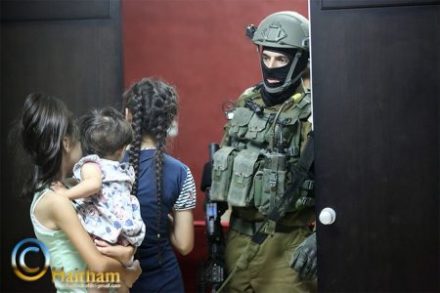
Dozens of Israeli soldiers invaded, approximately at 2:30 after midnight, the village of Bil’in in the central West Bank district of Ramallah, broke into and searched several homes and confiscated hard discs from a number of laptops.
Most of the invaded homes belong to nonviolent activists, senior members of the Popular Committee against the Wall in Bil’in, including Dr. Rateb Abu Rahma, his brother Abdullah Abu Rahma, in addition to Ahmad Abu Rahma Mohammad al-Khatib, Ashraf Abu Rahma and photojournalist Haitham Khatib.
Photojournalist Khatib said four military jeeps and two army trucks, carrying around six soldiers, invaded the village and started searching homes before confiscating hard disks from a number of laptops.
“The soldiers just said they will be the property back, but no one believes this,” he said, “They took my car before and never returned it; they are just lying.”
Coordinator of the Popular Committee in Bil’in, Dr. Rateb Abu Rahma, denounced the latest military invasion, and the searches of homes, in addition to the illegal confiscation of private property.
Abu Rahma added that the escalating Israeli violations will not be able to stop the nonviolent, popular resistance, in the village.
The protests in Bil’in started approximately twelve years ago, and kept going despite the ongoing excessive use of force and escalating violations, including night raids, home invasions and curfews, and despite the death of several nonviolent activists on the hands of the Israeli military.
The villages managed to regain 1200 Dunams of orchards, out of 2300 Dunams illegally confiscated and isolated by Israel for the construction of the Wall and the illegal colonies.
Washington’s Hawks Push New Cold War
By Alastair Crooke | Consortium News | September 20, 2016
Does the failure of the U.S.-backed, major insurgent August “push” on Aleppo – and the terms of the consequent ceasefire, to which some in the U.S. only irascibly agreed – constitute a political defeat for the U.S. and a “win” for Russia?
Yes, in one way: Moscow may, (just may) have cornered America into joint military air attacks on Al Qaeda in Syria, but in another way, one would have to be somewhat cautious in suggesting a Russian “win” (although Foreign Minister Sergey Lavrov’s diplomacy has been indeed tenacious).
Secretary of State John Kerry’s Syria agreement with Lavrov though, has sparked virtual open warfare in Washington. The “Cold War Bloc,” which includes Defense Secretary Ash Carter and House Speaker Paul Ryan, is extremely angry.
The Defense Department is in near open disobedience: when asked in a press teleconference if the military would abide by the terms of the agreement and share information with the Russians after the completion of the seven-day ceasefire, Lt. Gen. Jeffrey Harrigian, the commander of the U.S. Air Forces Central Command, which is directing the bombing campaign in Iraq and Syria, responded: “I think … it would be premature to say we’re going to jump right into it. And I’m not saying yes or no.”
But President Obama wants to define some sort of a foreign policy historical “legacy” (and so does Kerry). And the President probably suspects (with good cause possibly) that his legacy is set to be trashed by his successor, whomsoever it be – the minute he steps down from office.
In brief, the Establishment’s dirty washing is hanging on the line in plain sight. And it does not look great: Ash Carter, whose Department would have to work jointly with Russia in Syria, last week at Oxford University, accused Russia of having a “clear ambition” to degrade the world order with its military and cyber campaigns.
House Speaker Paul Ryan called Russian President Vladimir Putin an “adversary” and an “aggressor” who does not share U.S. interests. There is a U.S. media blitz in train, with powerful forces behind it, which paints Putin as no possible partner for the U.S.
Obama’s Will
Only in the coming days will we see whether Obama still has the will and clout to make the Syria ceasefire agreement stick. But the agreement did not appear out of the blue. One parent was the failure of America’s military “Plan B” (itself a response to the failed February ceasefire), and the other “parent” was Kerry’s wringing of a further concession from Damascus: Obama supposedly agreed to the separation of U.S. insurgent proxies from Al Qaeda (the former Nusra Front now called Jabhat Fateh al-Sham), and to their joint targeting, in return “for the what the Obama administration characterized as the ‘grounding’ of the Syrian air force in the current agreement,” as Gareth Porter has reported.
The U.S. and its Gulf allies – in pursuit of Plan B – had invested enormous effort to break Damascus’ operation to relieve Aleppo from the jihadists’ hold in the northeastern part of the city. The two sides, here (Russia and U.S.), were playing for high stakes: the U.S. wanted its Islamist proxies to take Aleppo, and then to use its seizure by the jihadis as political leverage with which to force Russia and Iran to concede President Bashar al-Assad’s ouster. Plan B, in other words, was still all about “regime change.”
Aleppo, Syria’s second largest city, has from the outset of this conflict been strategically pivotal – its loss would have pulled the rug from under the Syrian government’s guiding objective of keeping the mass of the urban population of Syria within the state’s orbit.
America’s long-standing objective thus would have been achieved – albeit at an indescribable price paid by the inhabitants of western Aleppo, who would have been overrun by the forces of Al Qaeda. Thus, the Syrian government’s recovery of all Aleppo is a major strategic gain.
In the end, however, the U.S. and its Gulf allies did not succeed: their much vaunted Plan B failed. And in failing, the insurgents have sustained heavy loss of life and equipment. Indeed, such are the losses, it is doubtful whether a “push” on this scale could again be mounted by Qatar or Saudi Arabia (despite the post-Aleppo “push” in Hama) .
In spite of the failure of Plan B, the U.S. was not ready to see Al Qaeda isolated and attacked. It wanted it protected. The U.S. ambiguity towards the jihadists of being “at war with the terrorists”; but always maneuvering to stop Syria and Russia from weakening the jihadists was plain in the letter sent by the U.S. envoy to the Syrian opposition Michael Ratney to opposition groups backed by the United States.
The first letter, sent on Sept. 3, after most of the Kerry-Lavrov agreement had already been hammered out, “makes no reference to any requirement for the armed opposition to move away from their Al Qaeda allies, or even terminate their military relationships, and thus implied that they need not do so,” Porter wrote.
A second letter however, apparently sent on Sept. 10, reverses the message: “We urge the rebels to distance themselves and cut all ties with Fateh al-Sham, formerly Nusra Front, or there will be severe consequences.”
Will it happen? Will the agreement be observed? Well, the Syrian conflict is but one leg of the trifecta that constitutes the “new” Cold War theatre: there is the delicate and unstable situation in Ukraine (another leg), and elsewhere NATO is busy building its forces on the borders of the Baltic Republics (the third leg). Any one of these pillars can be wobbled (intentionally) – and crash the delicate political framework of all the others.
Demonizing Russia
Which brings us to the complex question of the current demonization of Russia by the Cold War Bloc (which includes Hillary Clinton) in the U.S. presidential election campaign.
Gregory R. Copley, editor of Defense & Foreign Affairs has described the situation as one in which the U.S. Establishment is deliberately and intentionally “sacrificing key bilateral relationships in order to win [a] domestic election,” adding “in my 50 odd years covering the US government, I have never seen this level of partisanship within the administration where a sitting president actually regards the opposition party as the enemy of the state.”
In short, the stakes being played here – in demonizing Russia and Putin – go well beyond Syria or Ukraine. They lie at the heart of the struggle for the future of the U.S.
There is practical evidence for such caution – for, three days before the Syrian artillery was scything the ranks of Ahrar al-Sham near Aleppo on Sept. 9 to close the chapter on America’s Plan B – (and four days before Ratney’s letter to the Syrian insurgents telling them to separate from Al Qaeda “or else”), Ukrainian President Petro Poroshenko in addressing the Ukrainian parliament, the Rada in Kiev, was eviscerating the Minsk II accords, brokered by German Chancellor Angela Merkel and French President Francois Hollande as the only possible political solution to the Ukrainian civil war.
“Moreover, in a difficult dialogue,” Poroshenko said (see here and here), “we have convinced our western allies and partners that any political settlement must be preceded by apparent and undeniable progress on security issues: a sustainable ceasefire, withdrawal of Russian troops and equipment from the occupied territories, disarmament of militants and their family – and finally the restoration of our control over our own border” (emphasis added.)
Poroshenko, in other words, unilaterally turned the accord on its head: he reversed its order completely. And just to skewer it further, he told Parliament that any decision would be “exclusively yours” and nothing would be done “without your co-operation” – knowing full well that this Ukrainian parliament never wanted Minsk II in the first place.
And Kiev too is deploying along the entire borders of Donetsk and Lugansk. (A description of the military escalation by Kiev can be seen visually presented here).
Is Poroshenko’s U-turn the American “revenge” for Russia’s “win” in Syria – to heat up Ukraine, in order to drown President Putin in the Ukraine marshes? We do not know.
U.S. Vice President Joe Biden has boasted: “I think I tend to be in more direct conversation, for longer periods of time with the President [Poroshenko], than with my wife. (Laughter.) I think they both regret that (Laughter).”
Is it possible that Biden was not consulted before Poroshenko made his annual address to the Rada? We do not know, although within 48 hours of Poroshenko’s making his Rada address, Defense Secretary Ash Carter was in London, recommitting to Ukraine’s sovereignty and territorial integrity, as he signed a “bilateral partner concept” with the Ukrainian defense minister.
Provoking Russia
What we do know however, is that this is – and is intended to be – a direct provocation to Russia. And to France and Germany, too. Within a week, however, Poroshenko was backtracking as “coincidentally” a new IMF loan was being floated for Kiev, just as the German and French Foreign ministers insisted on the Minsk formula of “truce – special status – elections in Donbass – control of the border” be respected – and as the Donetsk and Lugansk leadership unexpectedly offered a unilateral ceasefire.
But Poroshenko’s “backtrack” was itself “backtracked” by Sept. 16, when the French and German visiting Foreign Ministers were reportedly told that Ukraine’s government now refused to implement the Minsk accord as it stood, as it now insists that the order be fully reversed: “truce – control of the border – elections.”
The American bitter internal election “civil war” is now shaking the pillars of the tripod on which America’s – and Europe’s – bilateral relations with Russia stand. It would therefore seem a stretch now for Obama to hope to prevail with any “legacy strategy” either in the Middle East or Ukraine that is contingent on cooperation with Russia.
The U.S. Establishment seems to have come to see the very preservation of the global status quo as linked to their ability to paint Trump as President Putin’s instrument for undermining the entire U.S. electoral system and the U.S.-led global order.
To the world outside, it seems as if the U.S. is seized by a collective hysteria (whether genuine, or manufactured for political ends). And it is not clear where the U.S. President now stands in this anti-Russian hysteria having likened Putin to Saddam Hussein, and having accused the Republican nominee of trying to “curry favor” with the Russian president – for having appeared on “Larry King Live” which is now broadcast by Russia Today.
But the bigger question is the longer-term consequence of all this: some in the “Hillary Bloc” still hanker for “regime change” in Moscow, apparently convinced that Putin’s humiliation in either Syria (not so likely now), or in Ukraine, could see him deposed in the March 2018 Russian Presidential elections, for a more Atlanticist, more “acceptable” leader.
It is unadulterated wishful thinking to imagine that Putin could be displaced thus – and more likely, Ukraine (with its prolific ‘kith and kin’ ties to Russians) used as a lever to “humiliate” President Putin will prove counter-productive, serving only to harden antagonism towards the U.S., as ethnic Russians die at the hands of rightist Ukrainian “militia.”
But it is certainly so that this campaign is strengthening the hand of those in Russia who would like to see President Putin taking a less “conciliatory line” towards the West. So, we may be heading towards more troubled waters.
Alastair Crooke is a former British diplomat who was a senior figure in British intelligence and in European Union diplomacy. He is the founder and director of the Conflicts Forum, which advocates for engagement between political Islam and the West.
US coalition Predator drone spotted at time & place of Syria aid convoy attack – Russian military
RT | September 21, 2016
The Russian Defense Ministry says that a US coalition drone was in the vicinity of a humanitarian convoy when it was attacked outside Aleppo. According to the Russian military, the unmanned aircraft was a Predator drone.
“On the evening of September 19, in that specific region, a drone belonging to the international condition, which had taken off from the Incirlik air base in Turkey, was flying at a height of 3,600 meters and traveling at around 200 kilometers per hour,” said Russian Defense Ministry spokesman Igor Konashenkov.
“The object was in the area around the town of Urm Al-Kubra, where the convoy was a few minutes before it caught fire,” Konashenkov added. “It left after about 30 minutes.”
The Defense Ministry spokesman said he wanted to point out that, as was the case with the tragedy on September 17 which saw US-led coalition airstrike kill and injure 200 people, the Russians would not be making any unfounded allegations.
“Only the owners know what exactly the drone was doing at this particular area at that exact time,” he added.
Moscow says it has provided all the data it possesses regarding the attack on the convoy, which was carrying aid to rebel-held areas in Aleppo, Russian Foreign Minister Sergey Lavrov said at a UN Security Council meeting on Wednesday.
“There was another unacceptable provocation on September 19 – the shelling of a humanitarian convoy near Aleppo,” he said. “I am confident that such coincidences require serious analysis and an investigation.”
On September 19, a humanitarian convoy consisting of 31 trucks was attacked while heading to Aleppo. According to the Red Cross, 20 civilians and one aid worker died as a result. Initial reports claimed the convoy had been targeted by an airstrike. Later the UN said all it could confirm was that the convoy was attacked.
On Tuesday, the Russian Defense Ministry reiterated that neither it nor the Syrian military had launched airstrikes on the convoy.
“Russian and Syrian warplanes did not carry out any airstrikes on a UN humanitarian aid convoy in the southwest of Aleppo,” Konashenkov said in a statement. He added that the military had studied video footage of the convoy, which appeared to rule out that an airstrike took place.
“We have closely studied the video footage from where the incident took place and we did not find any signs of any ammunition having hit the convoy. There are no craters, while the vehicles have their chassis intact and they have not been severely damaged, which would have been the case from an airstrike,” Konashenkov said.
“All of the video footage demonstrates that the convoy caught fire, which strangely happened almost at exactly at the same time as militants started a large-scale offensive on Aleppo.”
Featured Video
No Threat Can Force Iran’s Surrender /Trita Parsi & Lt Cl Daniel Davis
or go to
Aletho News Archives – Video-Images
From the Archives
An Expert Military Analysis of War with China
Actually, None is Necessary
By Fred Reed • Unz Review • December 13, 2020
The Correlation of Armed Forces: U.S. goods and services trade with China totaled an estimated $634.8 billion in 2019. Exports were $163.0 billion; imports were $471.8 billion. The U.S. goods and services trade deficit with China was $308.8 billion in 2019. Trade in services with China (exports and imports) totaled an estimated $76.7 billion in 2019. Services exports were $56.5 billion; services imports were $20.1 billion. The U.S. services trade surplus with China was $36.4 billion in 2019.
There is talk within the Washingtoniat of a possible war with China. Steve Bannon, who apparently was dropped on his head as a child, actually favors such a war. We hear the usual shoo-the-boobs alarm about how the Chinese are doing something terrible and we must gird our loins and American values and show them what for, bow wow, woof. The danger is that the current game of who-blinks-first in Asian waters might actually provoke a shooting war. You know the kind of thing: One warship refuses to get out of the way of another, a collision ensues, some retard lieutenant who signed up on waivers opens fire, and we’re off and running. It is not a good idea to let children play with matches.
The said war is discussed either in emotional terms by idiots or in purely naval terms by those familiar with such things, so we hear of the First Island Chain and the Second Island Chain and whose missiles against the other’s missiles and so on. This would be appropriate if we were fighting World War Two again. Which we aren’t. Let’s take a quick-and-dirty look at how such a war might go.
To begin the war, America would overestimate itself and underestimate China. This is doctrine in the Pentagon. … continue
Blog Roll
 Aletho News
- Theodore Postol: Iran’s Missiles & Drones Were Underestimated
- Iran To Target Military Industrial-Tech Complex That Facilitated Gaza Genocide
- Collapsing Empire: The Resistance Disarms ‘Israel’
- Suicide Should Not Be a Government Service
- Rethinking America’s greatest threat: Iran vs. Israel-Firsters
- Iran accuses adversaries of false flags to strain Turkey ties
- Poland rules out sending Patriot missiles to US/Israel amid war on Iran
- Tehran approves new Hormuz plan with major restrictions
- No Threat Can Force Iran’s Surrender /Trita Parsi & Lt Cl Daniel Davis
- UK’s New Pandemic Plan Would Turn Big Tech Into a Mass Location Tracking Network
- If Americans Knew
- Ann Coulter Rips Into Fox News for Iran War Coverage, Compares to False Rigged 2020 Election Reporting
- Joe Kent Urges Americans To Call White House and Congress To Object To Sending Troops Into Iran
- DNC Resolution to Reject AIPAC Funding Puts Democratic Leaders in the Hot Seat
- Swedish foundation to build 400 schools as over 650,000 Gaza children remain without education for 2 years
- Israeli army admits photshopping image of slain Lebanese journalist
- This is how Israel is systematically killing health workers under the cover of war in Lebanon
- Carrying life under fire: Israeli invasion of Lebanon leaves pregnant women facing deadly risks
- Champagne all around for the new death penalty (for Palestinians) law – Not a ceasefire Day 172
- Why are Palestinian books struggling to be seen on Amazon?
- The Line Between Affinity and Conspiracy
- No Tricks Zone
- New Study Finds Warming Saves Lives…Cold Temperatures 12 Times More Deadly Than Excess Heat
- German Science Blog Accuses PIK Climate Institute Of Hallucinating Climate Tipping Points
- Devastating Assessment Of Comirnaty Vaccine By Former Senior Pfizer Europe Toxicologist
- New Study: CO2 Is ‘Effectively Negligible’ As An Explanatory Climate Change Factor Since 2000
- Former Pfizer Toxicologist Dr. Helmut Sterz Tells Bundestag Hearing Pfizer Vaccine Should Have Never Been Approved
- Energy Expert: Germany’s Nuclear Phaseout Was A “500 Billion Euro Mistake”
- New Research: South Australia’s Mid-Holocene Sea Surface Temperatures Were 4°C Warmer Than Today
- Storing Green Energy To Last Germany 10 Days Would Require A 60-Million Tonne Battery
- New Studies: UK Sea Levels Were 4 Meters Higher Than Today During The Mid-Holocene
- Destructive Green New Deal: German Energy And Metal Group Warns Of Drastic Crisis
 Aletho News