The West’s Media Delusions
By James W Carden | Consortium news | November 23, 2016
In a wide ranging and necessary survey of Russian political programming, Dr. Gilbert Doctorow, himself a frequent guest on those shows, observes that:
“The charges — that Russian media are only an instrument of state propaganda directed at the domestic population to keep Russian citizens in line and at foreign audiences to sow dissent among Russia’s neighbors and within the European Union — are taken as a matter of faith with almost no proofs adduced. Anyone who questions this ‘group think’ is immediately labeled a ‘tool of Putin’ or worse.”
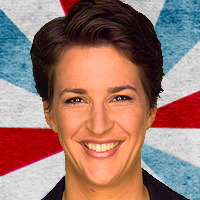
MSNBC host Rachel Maddow
Dr. Doctorow has launched an important conversation in light of the release of yet another alarmist media report, this time by a British neoconservative group named (oddly) after a long deceased Democratic Senator from Washington State (Henry “Scoop” Jackson), which seeks to stifle debate on Russia policy in the West by smearing dissenters from the Russia-bashing conventional wisdom as “Putin’s useful idiots.”
Doctorow’s experience with the Russian media therefore serves a double use: to combat willful Western misconceptions of the Russian media landscape as well as to serve as a useful point of comparison with U.S. media outlets and their coverage of Russia.
If we take the example of the purportedly liberal cable news outlet MSNBC, we find, paradoxically, that the hard-right neoconservative stance toward Russia goes virtually unopposed. Regarding Russia, in comparison with their principal center-left cable news rival CNN, which, to its credit occasionally makes room for the minority “detente” point of view, MSNBC leaves about as much room for dissent as the Soviet-era Pravda – actually, perhaps less.
New McCarthyism
As it happens, there was a similar disparity when it came to the way the two networks covered the U.S. presidential election. While CNN went about bringing much needed balance to its coverage, albeit in the most inept way possible – by hiring paid flacks from each of the campaigns to appear alongside actual journalists, MSNBC (like Republican rival FOX News) wholly dispensed with any pretense of objectivity and served as little more than as a mouth piece for the disastrous Clinton campaign.
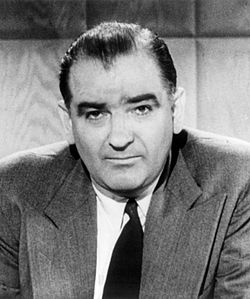
Sen. Joseph McCarthy, R-Wisconsin
As such, the “liberal” network found itself in the vanguard of the new McCarthyism which swept the 2016 campaign, but which has, in fact, been a feature of the American debate over Russia policy since at least the beginning of the Ukraine crisis in late 2013 – if not earlier.
Examples abound, but perhaps the most striking case of the neo-McCarthyite hysteria which MSNBC attempted to dress up as its legitimate concern over U.S. national security was a rant that Rachel Maddow unleashed on her audience in June when Maddow opened her show with a monologue dedicated to the proposition that Donald Trump was in league with Vladimir Putin.
Maddow, in her signature smarter-than-thou tone, informed readers that the “admiration” between Putin and Trump “really is mutual. I mean, look at this headline, ‘Putin praises Trump. He’s brilliant and talented person.’ ‘Putin praises bright and talented Trump.’ ‘Vladimir Putin praises outstanding and talented Trump.’ There was some controversy over how to exactly translate Putin’s remarks, but Putin took care to flatter Donald Trump publicly, exactly the way Donald Trump likes to be flattered, and that’s apparently enough for Donald Trump, that`s all he needs to hear, that`s all he needs to know, to tell him, how great Vladimir Putin is.
“Putin likes Trump, he must be smart, must be great. So, that is the very, very unusual context here, that you have a Republican presidential nominee who is very, very susceptible to flattery. It`s the most powerful thing in the world to him. If you compliment him, he will never forget it and that`s kind of all he needs to know about you.”
Maddow went on in this vein for quite a while longer (meaning: little actual content but lots of “very, very’s” and eye-rolling). But her central insight, such as it was, was little more than a regurgitation of Democratic National Committee talking points. To no one’s surprise, Maddow’s accusations were repeated almost verbatim in the press releases issued by the Clinton campaign which accused Trump of being little more than a Russian fifth columnist.
Maddow’s evidence-free, innuendo laden June rant took on an added importance because she was the messenger. After the risible, self-important sports journalist Keith Olbermann left the network in 2011, Maddow took over as the network’s house intellectual. So her words carry weight with its viewers in a way, say, Mika Brzezinki’s do not.
Nevertheless at no point at which I am aware did Maddow ever host a guest who pushed back against the still unproven charges that the Russian government had interfered in the U.S. election or that Donald Trump was, in the words of former CIA functionary Mike Morell, an “unwitting agent of the Kremlin” – never mind that as recently as Nov. 15, Senate Foreign Relations Committee Chairman Bob Corker admitted he had “no proof” of Moscow’s interference in the U.S. election.
While it is unclear whether MSNBC’s Joy Reid is seen as “serious” a voice as Maddow, it is unquestionable that she has emerged as the network’s most enthusiastic practitioner of the new McCarthyism.
Days before the election Reid hosted Newsweek’s increasingly unhinged Kurt Eichenwald and former Naval officer Malcolm Nance who has repeatedly and without evidence claimed the Wikileaks-Podesta emails were fake.
Why, asked Reid, are the Russians backing Trump? As if that assertion was beyond dispute. Well, said Eichenwald, “They hate Hillary Clinton…” Oh. Reid then went on to wonder why the FBI is down-playing the intelligence community’s allegedly deep concern that Russia was interfering in the election.
Putin-Bashing
Days later, right after the election, Reid re-assembled a panel featuring Nance, the reliable Putin critic Nina Khrushcheva and Esquire’s Charles Pierce to reinforce the message that MSNBC had been pushing since the summer: that the Russian government had its hand on the scale of the U.S. election. Pierce, in particular, was apoplectic.
That Reid’s roundtable featured Pierce made a good deal of sense. Throughout the campaign, Pierce has been determined to draw a direct link between the Trump campaign and Putin. A sample of his output helps tell the tale. On July 24, Pierce published “Donald Trump’s and Vladimir Putin’s Shared Agenda Should Alarm Anyone Concerned About Democracy” in which Pierce speculated that “Trump seems increasingly dependent on money from Russia and from the former Soviet republics within its increasingly active sphere of influence.”
In his offering of Sept. 9, Pierce protested that “It’s not ‘red-baiting’ to be concerned about Russian interference in our elections.” Pierce, perhaps moved to madness by The Nation editorial “Against Neo-McCarthyism,” sounded as though he were channeling the ghost of James Jesus Angleton, asking, “Are we supposed to believe that Donald Trump really went on RT television by accident? That nobody on his staff knew that the Russian government’s American network picks up Larry King’s podcast?”
About a month before the election, on Oct. 11, Pierce informed readers of the once-great Esquire, “Vladimir Putin Is Determined to See Trump in the Oval Office.” Still worse, according to Pierce, “There is little question now that Vladimir Putin is playing monkey-mischief with the 2016 presidential election, and that the Trump campaign is the primary beneficiary of that.”
All of the aforementioned is to demonstrate that the American media’s much touted pluralism is little more than a fiction when it comes to reporting on Russia. The diversity of Left-Right voices on the political spectrum that Doctorow has encountered in Moscow indicates that the widespread perception that Moscow’s political culture is monolithic compared to that of the Washington’s is, at the very least, challengeable.
James W Carden is a contributing writer for The Nation and editor of The American Committee for East-West Accord’s eastwestaccord.com. He previously served as an advisor on Russia to the Special Representative for Global Inter-governmental Affairs at the US State Department.
EU resolution on ‘Russian propaganda’ is attack on media freedom & stinks of hypocrisy

By Danielle Ryan | RT | November 24, 2016
There’s news. There’s fake news. And then there’s “pseudo” news, which according to the European Parliament, encompasses any Russian media which doesn’t adhere to a Western narrative and neglects to present an entirely pro-EU perspective on world events.
In a completely bonkers move this week, the EU Parliament approved a resolution to counter “Russian propaganda” and the “intrusion of Russian media” into the EU. The resolution was adopted with 304 MEPs voting in favor, 179 MEPs voting against it and 208 abstaining. The most bizarre part, however, is that the resolution lumped Russian media in with Islamist propaganda of the kind spread by terror groups like the so-called Islamic State. Thus Russian media is put on the same level with videos of ISIS beheadings and incitements to mass murder.
According to the resolution, Russian media exists to “undermine the very notion of objective information or ethical journalism,” and one of its methods is to cast all other information “as biased or as an instrument of political power.”
The real hypocrisy here is that this last part almost exactly describes how Brussels regards any media critical of its own actions. The resolution criticizes channels like RT for casting other news sources as biased or as instruments of political power while smearing anyone who associates with the Russian media as Kremlin puppets, bought and paid for by Vladimir Putin — and yet the irony appears completely lost on them.
Act as I say, not as I do
The totally barmy resolution also “notes with regret” that Moscow uses meetings with EU counterparts only for propaganda purposes, rather than for establishing a “real dialog” with Brussels. Another statement ripe with irony, given Brussels just a couple of weeks ago hosted an EU-Russia summit, the aim of which was to foster “mutual understanding” between Russia and the EU — without inviting any representatives of the Russian government. Instead, they asked obscure and practically unknown opposition figures with zero power or influence inside Russia. As noted by RT columnist Bryan MacDonald, this would be like Brussels hosting a summit to discuss the future of the United States and inviting the Green Party’s Jill Stein while ignoring the two parties that actually hold power. Under Brussels’ own definition, one could easily argue that the EU is trying to “undermine political cohesion” in Russia just as it accuses Moscow of doing in Europe.
Unfortunately, this ludicrous report is not a one-off. It appears to be part of an all-out attack on the Russian media coming from every angle. One of the most surprising developments comes from the organization Reporters Without Borders (RSF), which apparently prides itself on protecting journalists and press freedom worldwide. RSF has declared that it will no longer give interviews to any reporters from the Rossiya Segodnya group, which includes RT and the Sputnik news agency.
Similarly, a couple of weeks ago US State Department spokesman John Kirby refused to acknowledge an RT reporter as being on an equal footing with other journalists in the briefing room. Kirby point blank refused to treat Gayane Chichakyan as being “on the same level” because she represented a “state-owned” outlet — despite AP reporter Matt Lee stepping in to defend her.
Now, while RT may be state-funded, one very much doubts that Kirby would chastise a reporter from, say, the virulently anti-Russia BBC, whose Trust members are all appointed by the Queen on the advice of UK government ministers. He probably also doesn’t worry too much about US government-funded media like the CIA-founded RFE/RL, which operates for the exclusive purpose of undermining the Russian government and spreading pro-US information. Around the same time as Kirby’s comment, RT’s video agency Ruptly was banned from attending a Pentagon media event because the agency is a “Russian propaganda platform.”
Now, if RT was spreading false information, all these concerned think tankers, government agencies, and politicians might have a point. But you would be hard-pressed to turn on RT any day of the week and hear one of its anchors spreading blatant lies. You might hear a different editorial slant than you would on CNN, but in a world dominated by Western corporate media, alternative viewpoints are necessary and refreshing.
McCarthyism goes global
Meanwhile, the British Parliament is set to hear another report denouncing public figures for their alleged links to Russia and the Russian media. Neo-McCarthyism has indeed gone global. The British report, cautiously and tastefully named ‘Putin’s Useful Idiots’ was written by Andrew Foxhall of the notorious neocon think tank the Henry Jackson Society. The report challenges the credibility of politicians or public figures who appear sympathetic to Russia and proposes a crackdown on such individuals.
The British report even suggests news laws which could force politicians to declare all of their media appearances, presumably so those who appear on the likes of RT can be smeared as Kremlin agents and Putin’s puppets.
This is incredible and truly worrying. What is going on here should not be confused with anything to do with protecting democracy and the credibility of journalism. In fact, what the EU is doing is engaging in an all-out attack on journalism, much the same way they would accuse unfriendly governments of cracking down on the spread of information that did not suit the prevailing narrative. But dangerously, they are doing it under the guise of concern for democratic principles and values.
These people are suggesting it is nothing short of treasonous to hold an opinion that goes against the acceptable government-sanctioned consensus. In any other part of the world, this is the kind of mentality and action that Brussels and London criticize as a severe violation of media freedom and nothing short of state repression.
If the European project is solid as a rock, surely Brussels has nothing to worry about. But if a couple of Russian media outlets present such a grave threat to its existence, there must be some serious cracks in the foundations. Ultimately, it speaks to the fragility of the union that the EU so quickly throws its “values” out the window when the going gets tough.
Danielle Ryan is an Irish freelance writer, journalist and media analyst. She has lived and traveled extensively in the US, Germany, Russia and Hungary. Her byline has appeared at RT, The Nation, Rethinking Russia, The BRICS Post, New Eastern Outlook, Global Independent Analytics and many others. She also works on copywriting and editing projects. Follow her on Twitter or Facebook or at her website http://www.danielleryan.net.
Russia Tests Train-Based Nuclear System: President Trump Can Prevent Arms Race
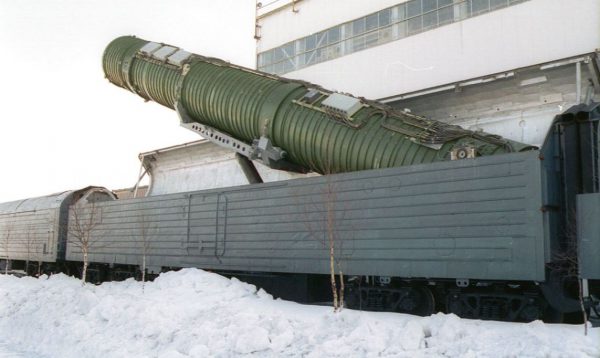
By Peter KORZUN | Strategic Culture Foundation | 24.11.2016
The US is mulling a major overhaul of its nuclear triad. The Air Force is working on a new version of the intercontinental ballistic missile (ICBM) and the Long Range Strike-Bomber (LRS-B) program. The Navy is studying the plans to replace the Ohio-class submarines. According to the Center for Strategic and Budgetary Assessments, the plans to recapitalize the nuclear triad will cost more than $700 billion over the next 25 years.
Former Secretary of Defense William Perry has warned that the US is on the «brink» of kicking off a new nuclear arms race that will elevate the risk of nuclear apocalypse to Cold War levels.
Moscow has no choice but to respond.
Russia has successfully conducted its first test of an Intercontinental Ballistic Missile (ICBM) designed for the upcoming Barguzin railway-based strategic nuclear offensive system. It was an «ejection» test with a missile leaving a container.
The launch trials were carried out at the Plesetsk spaceport two weeks ago, paving the way for further flight tests to be carried out in 2017.
Colonel-General Sergei Karakayev, commander of Russia’s Strategic Missile Forces, told reporters that the new railway-based missile system would be ready for deployment in early 2017.
Previously, Yuri Solomonov, the Chief Designer of the Moscow Institute of Thermal Technology (MITT), promised that the first ejection test will take place «in the beginning of the fourth quarter of 2016».
The first five Barguzin railroad systems may become operational by 2020 to remain in service till 2040. Moscow plans to deploy five of the Barguzin trains beginning in 2019.
Each Barguzin-armed train will carry six RS-24 Yars ICBMs ready for launch within minutes. The missile’s maximum range is 11,000 km (6,800 mi). It has at least 4 MIRVs with 150–250 kiloton warheads. The speed is over Mach 20 (24,500 km/h; 15,220 mph; 6,806 m/s). Guidance is inertial with GLONASS. Accuracy is 150-200 m.
Disguised as a freight train, the moving platform cannot be spotted either by satellite or electronic surveillance. It is worth mentioning that the Russian railways are ranked second longest globally. In general, the combat system can pass up to 1,000 kilometers daily. It is extremely difficult to locate it on route. With relatively lightweight Yars missiles on board, there will be no tell-tale signatures such as three locomotives in the old train-based systems decommissioned by 2005.
The system is created as a counterbalance to NATO’s ballistic missile defense (BMD), which is able to launch Tomahawk long-range cruise missiles, in addition to interceptors. The planned deployment of the system is also a response to the challenge posed by the US Prompt Global Strike (PGS) concept which envisions the capability to deliver a precision-guided conventional strike at any target in the world within one hour with hypersonic weapons.
Both – the BMD and the PGS – are considered as destabilizing factors by Russia. The Barguzin is an answer that does not violate the provisions of the 2010 New START Treaty.
There is another milestone event related to strengthening Russian nuclear strategic deterrent. The eighth Knyaz (Prince) Pozharsky Borei-class nuclear-powered submarine will be laid down at the Sevmash shipyard in Russia’s northern town of Severodvinsk on Dec. 23. Knyaz Pozharsky submarine will be the last of the eight Borei-class submarines and the fifth of the advanced A-batch.
The submarine carries 16 Bulava intercontinental ballistic missiles. The MIRVed missile carries 6 re-entry vehicles with a yield of 150 each. The operational range is 8,000-8,300 km (5,000 – 5,100 mi).
All these developments make one remember that Russia and the US – the two nations that account for more than 90 % of world strategic nuclear potential – have to make a very important decision about the future of arms control. The New START Treaty expires by 2021 without any prospects for a new agreement coming into force. President Putin and President Trump are the ones to rectify the situation.
There are many things that complicate the already complex problem: the future of the INF Treaty, US conventional strike superiority, NATO tactical weapons (B61-12) capable of striking Russian territory the same way strategic weapons do, the refusal of other nuclear states to join the arms control process, you name it.
Since the US withdrew from the 1972 ABM Treaty, ballistic missile defense has become the main obstacle on the way of achieving progress. BMD capability that would make the Russian deterrent less credible because the US would be able to degrade Russian second strike retaliatory capability.
The New START mentions the interaction of offensive and defense arms but contains no limitations. No doubt, Russia will raise the issue as a prerequisite for any discussions on what to do about arms control. The new US president will have to think long and hard if he wants to proceed with this highly destabilizing system that can make all future efforts to gain progress go down the drain.
The US does maintain an inactive stockpile that includes near-term hedge warheads that can be put back into operational status within six to 24 months. Extended hedge warheads can be made ready within 24 to 60 months. And it preserves some of this upload capability on its strategic delivery vehicles. This is a problem the New START does not address.
In 2002 the US pulled out of the ABM Treaty setting a precedent as it was the first time that a superpower withdrew from an arms control agreement. What if the United States decides to withdraw from the New START or any other treaty it may have with Russia? If it does, it would be able to return warheads from storage back to missiles (upload capability), and build up its strategic potential by several thousand warheads in several months at most. Russia’s apprehensions are justified. Will the new US administration be able to respect the other side’s concerns?
According to its provisions, the New START treaty can be extended for 5 years more but from Russia’s perspective there are concerns that should be taken into account before the issue hits the arms control agenda.
With Russian and US militaries maintaining no regular contacts, there is a danger of hair trigger alert – another problem for the two nations to address.
Having assumed power on January 20, Donald Trump will inherit the downturn in Russia-US relations and growing nuclear tensions and uncertain future for arms control.
Mr. Trump has said many positive things and there is each and every reason to hope for progress on such issues as Syria, for instance. It’s logical to expect that the present downturn in the bilateral relationship will be reversed. But so far, nothing has been said by Donald Trump and the members of his team about the revival of nuclear cooperation. Perhaps, binding agreements on the capabilities of BMD systems or limitations on existing and emerging long-range, precision-guided conventional offensive weapons and reductions in substrategic nuclear arms could help achieve gradual progress.
«The risk of a nuclear conflict may be higher today than at any time since the 1980s», warns Andrew Kuchins, a Russia expert at Washington’s Georgetown University and former head of Carnegie Moscow Center, in a forthcoming report on US-Russian relations. «Unfortunately, societies and political establishments … seem in large part unaware that this truly existential threat has [returned]».
There may be cooperation in some areas of mutual interest but no real reversal of the dangerous downturn in the relationship is possible without progress in arms control. With the new US administration in office, it may be expedient for the experts to take the bull by the horn and start discussions. With Mr. Trump’s victory, there is a chance that should not be missed.
EU Politicians are Convinced that Tanks are the Best Remedy for Social Disparity
By Jean Perier – New Eastern Outlook – 24.11.2016
 Following in the wake of the White House policy, European political elites have been stepping up their groundless propagandistic rhetoric about the growing military threat of Russia, Iran, China, which is aimed at achieving further militarization of Europe at the expense of the social benefits of its citizens.
In his recent speech at an event hosted by the German Marshall Fund of the United States, NATO‘s Secretary General Jens Stoltenberg announced that he expects a 3% real increase in defence spending in Europe and Canada, however, he added, other than the US, only four NATO members are currently spending 2% of GDP on defence.
Against the background of a string of upcoming election campaigns in the EU, it’s really not that hard to predict how Europeans are going to take the announcement that their governments are planning to increase their military budgets. The most likely scenario is that a number of EU states will vote for their own version of Trumpxit, which means that an outsider candidate will have more chances than those from the ruling elites. As the living conditions of an ever increasing number of Europeans continue to deteriorate, it’s highly unlikely that EU citizens are going to tolerate new military expenditures.
The data provided by the Eurostat shows that in 2015, around 25 million children, or 26.9% of the population aged 0 to 17, in the European Union were at risk of poverty or social exclusion. A total of six member states saw a third of all children being at risk of poverty or social exclusion, these are Romania (46.8%), Bulgaria (43.7%), Greece (37.8%), Hungary (36.1%), Spain (34.4%) and Italy (33.5%).
According to the Guardian, having a child while living in a rental accommodation has become unaffordable for young families in two–thirds of the UK. The most inaccessible place for those wanting to start a family was London, with a two-bedroom rental there costing 60% of the average income for someone in their 20s and 44% for someone in their 30s. This was followed by the south-east, south-west and the east. At the same time, the number of families with children living in emergency accommodations in England rose by 45% in the last 12 months, reaching the highest level in 12 years.
In turn, the Fabian Society says the Tory’s social cuts will increase the number of kids living in poverty by 75% over the next 15 years in the UK, the Daily Mirror notes. Moreover, Berlin has already announced that social disparity will be steadily growing throughout the upcoming decade in Germany.
The Finish Yle notes that the number of children living in poor families has tripled over the last two decades. What is striking is that even those families where both parents are employed full time are unable to earn an adequate revenue.
Ever since 2008, the deepening social crisis in the EU has been making local citizens feel increasingly frustrated with their elected officials. At the same time, local political elites are reluctant to address the most pressing problems of their population, instead they prefer to increase military spending and cut social benefits provided to the poor.
The chain of events, namely the Brexit and the Trumpxit shows the growing frustration of the hard-working people that are still unable to provide decent childhood for their children. And it doesn’t take a genius to know that the ruling elites are going to face a bitter electoral defeat in Germany, France, the Netherlands and Austria. There’s really no way they can win.
Trump’s Possible Path Out of Ukraine Crisis
By Jonathan Marshall | Consortium News | November 24, 2016
If Donald Trump wants to make a decisive and constructive mark on U.S. foreign policy early in his presidency, there’s no better place to start than by helping to end the brutal war in Ukraine that has claimed some 10,000 lives.
The Obama administration helped ignite that war by attempting to yank Ukraine out of Russia’s orbit and into the Western security and economic sphere. Working alongside the European Union, Washington fanned mass street protests that led to a violent putsch against Kiev’s elected government in February 2014. Moscow responded by annexing (or, depending on your point of view, reunifying with) Russian-speaking Crimea, which is also headquarters of Moscow’s Black Sea Fleet, and backing pro-Russia separatists in the eastern regions of Donetsk and Luhansk.
Since then, the two sides have fought to a bloody stalemate. Besides killing thousands of civilians, the war has sunk Ukraine’s economy and fostered rampant corruption. U.S. and E.U. sanctions have dragged down Russia’s economy and derailed cooperation between Washington and Moscow in other theaters. Rising tensions between NATO and Russia have greatly raised the odds of an accidental military confrontation between the world’s two largest nuclear powers.
The best hope for Ukraine — and renewed East-West cooperation — is the Minsk Protocol, signed by Ukrainian, Russian, and European parties in the capital of Belarus on Sept. 5, 2014. The agreement provided for a ceasefire, an exchange of prisoners, and a framework for a political settlement based on giving the Donetsk and Luhansk regions a “special status.”
That agreement broke down amid renewed fighting until the parties signed the Minsk-2 Agreement on Feb. 12, 2015. It provided for constitutional reforms, elections in the two republics, and restoration of Ukrainian sovereignty over its borders. But Kiev has made no serious move to recognize the special status of its breakaway regions, and the two sides have engaged in sporadic hostilities ever since.
Final Words
Presidents Obama and Putin exchanged what may have been their final, desultory words on the subject at the Asia-Pacific Economic Cooperation summit in Peru this month. Obama “urged President Putin to uphold Russia’s commitments under the Minsk agreements,” while a Russian spokesman said the two men “expressed regret that it was not possible to make progress in Ukraine.”
As current foreign policy messes go, however, the Ukrainian imbroglio may offer the greatest opportunities for a rewarding cleanup. Doing so will require both sides to acknowledge some fault and find creative ways to save face.
Fortunately, President-elect Trump has created an opening for such a settlement by reaching out to Putin during the election campaign and explicitly declining to bash Russia for its annexation of Crimea (which followed a hastily arranged referendum in which the official results showed that 96 percent of the voters favored leaving Ukraine and rejoining Russia).
There are also small signs of progress that give hope. A limited demilitarization accord signed in September led to a mutual retreat by the Ukrainian army and pro-Russia separatists from a small city in eastern Ukraine. The withdrawal was verified by observers from the Organization for Security and Cooperation in Europe (OSCE), a party to the Minsk accords. Meanwhile, Ukraine, Germany, France and Russia are working on a new roadmap to strengthen the ceasefire.
Conditions for Peace
In a June 2015 interview with Charlie Rose, Putin laid out clear and reasonable conditions for making the Minsk accord stick:
“Today we primarily need to comply with all the agreements reached in Minsk … At the same time, I would like to draw . . . the attention of all our partners to the fact that we cannot do it unilaterally. We keep hearing the same thing, repeated like a mantra – that Russia should influence the southeast of Ukraine. We are. However, it is impossible to resolve the problem through our influence on the southeast alone.
“There has to be influence on the current official authorities in Kiev, which is something we cannot do. This is a road our Western partners have to take – those in Europe and America. Let us work together. … We believe that to resolve the situation we need to implement the Minsk agreements, as I said. The elements of a political settlement are key here. There are several. . . .
“The first one is constitutional reform, and the Minsk agreements say clearly: to provide autonomy or, as they say, decentralization of power. . .
“The second thing that has to be done – the law passed earlier on the special status of . . . Luhansk and Donetsk, the unrecognized republics, should be enacted. It was passed, but still not acted upon. This requires a resolution of the Supreme Rada – the Ukrainian Parliament – which is also covered in the Minsk agreements. . . .
“The third thing is a law on amnesty. It is impossible to have a political dialogue with people who are threatened with criminal persecution. And finally, they need to pass a law on municipal elections on these territories and to have the elections themselves. All this is spelled out in the Minsk agreements. . . .
“I repeat, it is important now to have a direct dialogue between Luhansk, Donetsk and Kiev – this is missing.”
Future of Crimea
Any lasting settlement will also require some compromise over Crimea, which Putin has vowed never to relinquish.
As Ray McGovern, the CIA’s former chief Russia analyst, has noted, the annexation of Crimea did violate a pledge that Russia made in 1994 — along with Great Britain and the United States — “to respect the independence and sovereignty and existing borders of Ukraine,” as a precondition to Ukraine giving up its nuclear weapons. Of course, the United States and the E.U. had already violated the same pledge by supporting a coup d’état against the country’s elected government.
McGovern cited other “extenuating circumstances, including alarm among Crimeans over what the unconstitutional ouster of Ukraine’s president might mean for them, as well as Moscow’s not unfounded nightmare of NATO taking over Russia’s major, and only warm-water, naval base at Sevastopol in Crimea.”
In support of annexation, Russian and Crimean authorities also pointed to the hasty referendum that was held in Crimea in March 2014, which resulted in 96 percent support for reunification with Russia, a relationship dating back to the Eighteenth Century. Subsequent polls of Crimean opinion, conducted by Western firms, have largely confirmed support for the 2014 referendum on rejoining Russia. But the referendum did not have international observers and was not accepted by the United States and other Western nations.
Condemning the annexation in a soaring speech about the “rule of law” and America’s dedication to universal principles, President Obama contrasted Crimea with Kosovo, which NATO forcibly broke away from Serbia in 1999.
Obama said, “Kosovo only left Serbia after a referendum was organized not outside the boundaries of international law, but in careful cooperation with the United Nations and with Kosovo’s neighbors. None of that even came close to happening in Crimea.”
Actually, none of that came close to happening in Kosovo, either. Obama’s story was a myth, but it confirmed the powerful legitimacy offered by popular referenda, like those in Great Britain over Scottish independence or Brexit.
Yet, as part of a permanent settlement of the larger Ukraine crisis, the Minsk signatories could agree to hold another, binding referendum in Crimea under international supervision to decide whether it stays under Russian rule or returns to Ukraine.
To get Russia’s buy-in, the United States and its European allies should agree to lift sanctions if Moscow abides by the referendum and other terms of the Minsk accord. They should also agree to rule out the incorporation of Ukraine into NATO, the original sin that sowed the seeds of crisis between Russia and the West. Russia, in turn, could agree to demilitarize its border with Ukraine.
Obstacles to Settlement
President Putin has signaled his willingness to compromise in several ways, including firing his hardline chief of staff, Sergei Ivanov, and welcoming the presence of armed observers from OSCE to monitor the Minsk agreement.
But major obstacles still impede progress. One is President Petro Poroshenko’s stalling in the face of opposition to the Minsk accord by Ukrainian nationalists. Kiev needs to be given a firm choice: go it alone, or compromise if it wants continued economic support from the United States and Western Europe. The Obama administration has quietly urged the Poroshenko government to honor the Minsk agreement, but has never put teeth behind its entreaties.
The other major obstacle is hostility from militarist hardliners in the West who propose arming Ukraine to ratchet up conflict with Russia. Prime examples include the State Department’s chief policy maker on Ukraine, Victoria Nuland; former NATO Commander Gen. Philip Breedlove, who became infamous for issuing inflated warnings about Russian military operations; Senate Armed Services Committee Chairman John McCain; and Stephen Hadley, Raytheon board member and former national security adviser to President George W. Bush, who chairs the Orwellian-named United States Institute for Peace.
But Trump will have great leeway as commander-in-chief to reject their advice and set a new direction for NATO’s policy on Ukraine and Russia more generally. He has everything to gain by breaking the cycle of political conflict with Moscow.
An ally in the Kremlin will immeasurably improve his chances of making deals in the Middle East, finding a way out of Afghanistan, and managing China.
The next few months should tell us whether Trump has the independence, imagination, and gumption to do the right thing.
Jonathan Marshall is author or co-author of five books on international affairs, including The Lebanese Connection: Corruption, Civil War and the International Drug Traffic.
Photo-Story: Mini walking tour of occupied Hebron
International Solidarity Movement | November 24, 2016
Hebron, Occupied Palestine – After our afternoon school run today, two of us took a walk around a small part of Al Khalil.
The photos are sort of a mini-walking tour of some of the stolen Palestinian land, streets, homes and shops, roadblocks and checkpoints.
Note the diagonal iron bars on the shops. These are welded in place to keep their Palestinian owners from re-entering their own shops and businesses. Above the shops are now illegal colonial Zionist settlers living in the once owned homes of Palestinians.
On some of the streets Palestinians are prohibited from walking. And no Palestinian vehicles allowed.
Al Khalil is unique in that the illegal colonial settlers live right in the city among the Palestinians (of course with colonial Zionist Israeli Occupation Forces and walls and fences to “protect” them and many of these Zionists carry their automatic weapons with them as well.
Most illegal colonial settlements are separated or outside of the Palestinian villages, town, and cities (and generally an army base within or next to it. Currently there are over 600,000 living in these settlements in the West Bank and construction of new and expansion of existing ones continues!

Gate locking access to the Abu Haykal family land, now deemed an ‘archaeological site’ by Israeli forces

A typical road-block

Ghost Street – in the process of ethnic cleansing of all Palestinian residents

Diagonal metal bar is welded to doors in order to keep shops and homes permanently closed

Entrance to a typical checkpoint

Left side of the fence for illegal colonial settlers, right side for Palestinians – often littered with trash by the settlers

Another road-block preventing Palestinian freedom of movement
Academic among 7 Palestinians from West Bank kidnapped by Israeli forces
Palestine Information Center – November 24, 2106
 WEST BANK – The Israeli occupation army (IOF) kidnapped seven Palestinians, including an academic, from West Bank provinces at dawn Thursday.
A PIC news correspondent said the IOF rolled into the An-Najah Campus dormitory in al-Maajin neighborhood, in western Nablus, and wreaked havoc on the apartment of lecturer Issam Rashed al-Ashqar, 57, before they kidnapped him and seized his car.
Al-Ashqar, an ex-prisoner, is a lecturer at the Physics Department at An-Najah University. He had previously been sentenced to several prison-terms, mostly in administrative detention, without charge or trial. He has also been diagnosed with health disorders.
The Israeli occupation army further kidnapped the two Palestinian citizens Amjad Abu Sbeih and Yazen al-Basiti from their own family homes in Jerusalem’s Old City.
The IOF stormed Jenin’s western towns of Anin and Zabouba and cracked down on Palestinian drivers in the eastern outskirts of the city.
A PIC reporter quoted eyewitnesses as stating that the IOF kidnapped the citizen Abdul Nasser Mohamed Yassin, 42, from Anin village after they ravaged his home and subjected the family to intensive questioning.
A military checkpoint was pitched by the IOF near the main entrance to Zabouba town.
The campaign culminated in the abduction of other Palestinians from Nablus, al-Khalil, and Bethlehem’s town of Beit Fajjar.
Featured Video
Prof. Ted Postol: Iran Already Achieved Nuclear Deterrence Against Israel
or go to
Aletho News Archives – Video-Images
From the Archives
How the occupied mentality syndrome works
Saudi Arabia on the American chessboard – Part 3
By B. J. Sabri | American Herald Tribune | June 27, 2016
Read part 2: “The occupied mentality Syndrome“
Previously I argued whether Saudi Arabia’s repeated involvements in U.S. interventions and wars stem from free national will or in response to a specific condition. For starters, in Saudi Arabia there is no national will. In Saudi Arabia, the national will is the will of the Al Saud clan. Still, when a major Arab state allies itself with a superpower that committed unspeakable crimes against humanity in almost every Arab country, then something is wrong. This fact alone should compel us to examine the U.S.-Saudi relation for one exceptional reason. As a result of the U.S.-Saudi wars, hundreds of thousands of people in Afghanistan, Iraq, Iran, Libya, Syria, Yemen, and Somalia have lost their lives. Millions became displaced in their own homelands. And millions more rendered refugees.
Attributing the Saudi policies to the bonds of “partnership” with the U.S. is frivolous. There are no bonds between these two thugs except those of business, military deals, secret plots, and wars. Proving this point, bonds such as these have no space for the American and Saudi peoples to share significant cultural or societal exchanges. If partnership is not the reason for the Saudi contribution to the U.S. strategy of empire and imperialism, then another reason must exist.
This leads to three possibilities. … continue
Blog Roll
 Aletho News
- NIAID/NIH and USDA Fund Bioengineered Chimeric Influenza Viruses Built Using Pandemic H1N1 Components: Journal ‘Science Advances’
- Hezbollah hits Israeli warship off Lebanon’s coast, sets it aflame
- Iran slams US strikes on B1 bridge, Mahshahr petrochemical plants as ‘blatant acts of state terrorism’
- In letter to UN chief, Araghchi warns of dire consequences of US-Israeli attacks on Iran’s nuclear facilities
- Why the CIA conspiracy to invade Iran with Kurdish militias failed
- Why Are Upbeat US Claims About Mission to Rescue Pilot ‘Highly Questionable’?
- Aircraft destroyed during US ‘rescue’ of downed F-15 pilot cost more than $100 million each
- Washington University removes professor who condemned US-Israeli war on Iran
- Russia Warns of Retaliation as UK Authorizes Seizure of Vessels
- Serbia thwarts plot to bomb Russia-Hungary gas pipeline – Vucic
- If Americans Knew
- In Iran, Israel-US take aim at “reason, research, and freedom of thought” – Daily Update
- US loses planes over Iran, Israel downgrades Lebanon war goals – Daily Update
- Israel Is Blocking Palestinians from Easter at Church Where Jesus Resurrected
- Plot to assassinate Palestinian activist follows harassment campaign promoted by Zionist groups and elected officials
- Prominent New York synagogue hosts presentation on why U.S. Jews should support the ethnic cleansing of Gaza
- Tapper vs. Piker: Is the CNN Anchor Auditioning for David Ellison?
- Shouldn’t Democrats Be Able to Condemn Genocide?
- Israel-US kill negotiators, destroy civilian structures, but Iran’s military capabilities still largely intact – Daily Update
- ‘War crime’: Global condemnation as Israeli ministers celebrate death penalty law targeting Palestinian prisoners
- 7 Ways Israel Is Turning Lebanon Into Gaza
- No Tricks Zone
- An Inconvenient Tree: Uncovered In Alps… Europe Much Warmer Than Today 6000 Years Ago
- New Study Reports A 60% Slowdown In Greenland’s Ice Loss Rate In The Last Decade
- Low Intensity Tornado Wrecks Major Solar Farm, Creating A Potential Toxic Dump
- New Study Finds Warming Saves Lives…Cold Temperatures 12 Times More Deadly Than Excess Heat
- German Science Blog Accuses PIK Climate Institute Of Hallucinating Climate Tipping Points
- Devastating Assessment Of Comirnaty Vaccine By Former Senior Pfizer Europe Toxicologist
- New Study: CO2 Is ‘Effectively Negligible’ As An Explanatory Climate Change Factor Since 2000
- Former Pfizer Toxicologist Dr. Helmut Sterz Tells Bundestag Hearing Pfizer Vaccine Should Have Never Been Approved
- Energy Expert: Germany’s Nuclear Phaseout Was A “500 Billion Euro Mistake”
- New Research: South Australia’s Mid-Holocene Sea Surface Temperatures Were 4°C Warmer Than Today
 Aletho News