US Public Discourse Slipping Further from Reality
By Richard Edmondson | Fig Trees and Vineyards | January 23, 2017
Rep. Mike Rogers (R-Alabama) is the latest example of a member of Congress who seems to be slipping further and further from reality. Rogers has introduced a bill entitled “The American Sovereignty Restoration Act of 2017”–which sounds good until you get to the fine print.
The bill is aimed at eliminating US membership in the United Nations, which Rogers sees as a threat to US sovereignty. It also would end US support for UN agencies such as UNESCO and the World Health Organization, and would even have the UN headquarters kicked out of New York.
Personally, I am not a big fan of the UN. It has been used often as a political tool to support US foreign policy objectives, for instance in 2011 when it authorized a no-fly zone over Libya–and so for this reason I have some doubts as to whether Rogers’ bill will pass. But this is neither here nor there. Where things get really crazy is when you look at the congressman’s reasoning behind the bill.
According to RT, Rogers’ bill, officially HR 193, was motivated by the UN Security Council resolution adopted last month criticizing Israeli settlements. I have already discussed HR 11, a bill introduced specifically in response to that Security Council resolution and which was approved by a vote 342-80, and HR 193 seems to have been similarly motivated. Or at least partly, at any rate–for the RT report makes note of the fact that the Alabama congressman introduced an earlier version of the bill back in 2015.
“Why should the American taxpayer bankroll an international organization that works against America’s interests around the world?” Rogers is said to have asked at that time. “The time is now to restore and protect American sovereignty and get out of the United Nations.”
A little more from the RT report:
Later, in June 2015, Rogers had introduced his document – then named HR 1205, but essentially the same USExit idea he’s proposing now.
“The UN continues to prove it’s an inefficient bureaucracy and a complete waste of American tax dollars.” Rogers went on to name treaties and actions he believes “attack our rights as US citizens.” These included gun provisions, the imposition of international regulations on American fossil fuels – but more importantly, the UN attack on Israel, by voting to grant Palestine the non-member state ‘permanent observer’ status.
“Anyone who is not a friend to our ally Israel is not a friend to the United States.”
So in Rogers’ delusional thinking, it is the UN, and not Israel or its US Lobby, which threatens the sovereignty of the United States.
American funding to the UN comes to approximately $8 billion per year, that’s in mandatory payments as well as voluntary contributions. This makes up about 22 percent of the UN’s overall budget.
By contrast, US funding of Israel presently comes to about $3.8 billion per year (in direct aid). Presumably, if Rogers’ bill passes, the $4.2 billion difference will then be available to pass along to Israel. I’m not saying that’s what will happen, but worth keeping in mind is that in September of last year, Obama signed a $38 billion aid package to the Jewish state, and Obama wasn’t even on good terms with the Israeli leadership. Imagine what largess may flow under a Trump administration.
As I said before, the US is often able to pressure other nations and thereby use the UN as a political tool to advance its own foreign policy objectives, so from that standpoint one might argue that the $8 billion per year was an investment which brought back a return.
By contrast, if the money goes to Israel, the opposite will be the case: for it is Israel which uses the US as a political tool, not the other way around.
If we continue to be ruled by people like Rogers, our national sovereignty will eventually disappear. We will become a nation governed in total by a foreign power.
Ukraine Leader’s Remarks on Minsk Pact Contradictory – Lavrov
Sputnik – 23.01.2017
Ukrainian President Petro Poroshenko’s recent remarks concerning the pace of the Minsk agreements’ implementation and security issues contradict the agreements themselves and highlight Kiev’s efforts to evade them, Russian Foreign Minister Sergey Lavrov said Monday.
On Sunday, Poroshenko gave a speech during Ukrainian Unity Day celebrations, stating that the government will not proceed in implementing the Minsk agreements and amending the Ukrainian constitution until security issues are settled in war-torn eastern Ukraine. The latter includes restoring Ukrainian army control over the country’s border with Russia, which is currently controlled by the Donbas militias.
“We hope that these EU countries that act as guarantors of the Minsk agreements… in Paris and Berlin would pay attention to this inappropriate statement by President Poroshenko, who is trying to wriggle out of his commitments,” Lavrov said.
The Russian side had voiced its concern with Poroshenko’s remarks on Ukraine halting the implementation of political reforms needed to settle the east Ukrainian conflict, he added, stressing that such a position is in direct contradiction with the terms of the Minsk accords which state that control over the Russian-Ukrainian border can only be restored after Kiev gives a special status to the Donbas region.
In 2014, Kiev authorities launched a military operation against militias in the Donbas region. In 2015, the two sides reached a ceasefire deal brokered by the leaders of the Normandy quartet including Russia, France, Germany and Ukraine in Minsk. Throughout 2016, the Normandy Four and the Organization for Security and Co-operation in Europe (OSCE) have been stressing the need to implement Minsk provisions but Kiev has stalled in giving a special status to Donbas as specified in the agreement. Ceasefire violations have continued.
The Last Days of Obama: Napoleonic Maneuvers at the Security Council
By Caleb Maupin | New Eastern Outlook | 23.01.2017
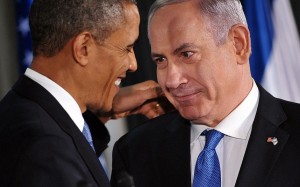 It seemed to come almost out of nowhere. The United States usually protects Israel from critical resolutions at the UN Security Council. However, in a dramatic move, the US abstained and a resolution criticizing recent settlement activity was passed by the 15-member body.
But this was not the end. John Kerry, Obama’s former Secretary of State, gave a lengthy address a few days later. Kerry’s speech was not so different from the statements of previous leaders, both Democrats and Republicans. He defended Israel’s existence, and denounced almost all forces actively opposing Israel.
However, Kerry harshly criticized specific Israeli policies. While Kerry’s speech defending the UN abstention uttered the standard, mildly critical, pro-Israeli talking points, it did contain some words that, taken out of context and spread throughout the internet, could and did indeed make a lot of Israelis and Zionists very angry. The most quoted one was: “If the choice is one state, Israel can either be Jewish or democratic, it cannot be both.”
Kerry was alluding to the fact that if Palestinians are absorbed into Israel in a “one state solution” but Israel remains a “Jewish State” this will not be democratic. According to Kerry, under such circumstances Palestinians would be second class citizens, i.e. non-Jews in a Jewish state.
Immediately, Kerry’s speech was decried by Israelis. Netanyahu fired back, as did the entire pro-Israeli blogosphere. The Republican and Likud Party aligned voices escalated the shrill accusations that Obama was a secret Muslim, a member of the Muslim brotherhood, a terrorist sympathizer, a Neo-Nazi, a Communist, and everything else he has been called for 8 years straight.
Meanwhile, Israel did not stop its settlement activity, and was not really affected at all by the resolution. The billions of dollars in US aid to Israel continued. Obama has left the office on January 20th, and is now replaced by Donald Trump, who claims to be more pro-Israel than Obama. The UN Security Council is not taking any specific action to halt the settlement activities condemned in its resolution.
Nothing really changed, but a lot of dramatic, heated words were exchanged between the USA and its closest Middle Eastern ally. Why did this happen?
Napoleon & Obama: “I Come to Restore Your Rights”
In 1798, the French militarist Napoleon Bonaparte, who seized power in the aftermath of the revolution and eventually became Emperor, set out to conquer Egypt. He issued a proclamation saying:
People of Egypt! You will be told by our enemies that I am come to destroy your religion. Believe them not. Tell them I am come to restore your rights, punish your usurpers, and revive the true worship of Mohammed. Tell them that I venerate, more than do the Mamelukes, God, his prophet, and the Koran.
Among the people of Egypt and Syria, as well as the entire Arab world, there was deep hatred for the British and Ottoman empires, who functioned as Napoleon’s rivals. Napoleon hoped that he could convince Muslims throughout the region to support him, and on this basis that he could defeat their hated colonial enemies, and conquer the region for France.
Napoleon was lying. He was not an adherent of the Islam faith. Some speculate that he may have been a freemason, and became familiar with the Koran and Islam due to their inclusion in Masonic rituals. Regardless, years later, Napoleon explained the proclamation to his fellow French Christians saying:
A change of religion, inexcusable for the sake of private interests, becomes comprehensible when immense political results are involved…. Do you think the Empire of the East and perhaps the subjugation of the whole of Asia was not worth a turban and some loose trouser? The state of feeling in the army was such that it would have undoubtedly lent itself to a joke.
Barack Obama, like Napoleon Bonaparte, is not a Muslim. As offensive and heretical as some evangelical Christians and Catholics may consider the teachings of the United Church of Christ and Reverend Jeremiah Wright, they are not Islamic in any conceivable way. Barack Obama was married in a church. He has been photographed drinking wine and eating hot dogs.
Obama’s middle name is “Hussein.” As a child, while living in Indonesia, he attended an Islamic elementary school. Obama apparently did meet with the Palestinian-American professor Edward Said. With all of this to cite as evidence, the allegation that he was a “secret Muslim” has not vanished.
The endless, semi-hysterical attacks on Obama for having alleged links to Islam certainly had an impact outside of US borders. This impact may not have been accidental. Writing in the Atlantic Monthly in 2007, the self-described conservative Andrew Sullivan considered the colorful background of the future president to be an asset:
What does he offer? First and foremost: his face. Think of it as the most effective potential re-branding of the United States since Reagan. Such a re-branding is not trivial—it’s central to an effective war strategy… The next president has to create a sophisticated and supple blend of soft and hard power to isolate the enemy, to fight where necessary, but also to create an ideological template that works to the West’s advantage over the long haul. There is simply no other candidate with the potential of Obama to do this.
Sullivan’s widely read and cited article said:
If you wanted the crudest but most effective weapon against the demonization of America that fuels Islamist ideology, Obama’s face gets close. It proves them wrong about what America is in ways no words can.
The USA certainly had a lot of credibility to regain as the Bush era came to an end. The unilateral invasion of Iraq had been widely opposed, not just in the Middle East, but even among NATO states. Bush had gone as far as to say “this crusade, this war on terrorism, is going to take a while.” The word “crusade” doesn’t exactly bring up pleasant feelings among Muslims around the world.
Meanwhile, the federal agencies of the United States flew into a very Islamophobic mode after the 9/11 attacks. The leaders of a religious charity known as the “Holy Land Foundation” were imprisoned for nothing other than running soup kitchens for Palestinian children. Mosques across the United States were then and continue to be widely surveilled.
His Middle Name is “Hussein”
Voices like Andrew Sullivan’s hoped that Obama’s background could restore the credibility of the USA in the eyes of Muslims. But this was just the tip of the iceberg. What came about in the first term of the Obama administration? In 2011 the world watched the “Arab Spring.” Across the Middle East, impoverished people rose up against their governments.
Analysts often argue that the Arab Spring was spawned by the global financial crisis and the regional drought. Throughout the Arab world, crops failed, water was scarce, and impoverished people piled into the cities facing dire economic conditions. The uprisings that eventually erupted were predictable. Such conditions are known to spark unrest.
But the world did not see a repeat of the 1979 Iranian Revolution, where the Persians toppled a western puppet dictator under the slogans of “Not Capitalism but Islam” and “War of Poverty Against Wealth.” The western capitalist apparatus was ready. The Arab Spring was immediately redirected to serve their ends. Social media outlets based in western countries, and the global apparatus of pro-American NGOs swung into action.
With a commander-in-chief who most people in the Middle East had a favorable opinion of, the forces of global power were able to ensure that the revolt did not become an uprising against western capitalism. No new anti-imperialist regimes were born. Rather, the opposite happened.
In Egypt, the pro-US regime of Hosni Mubarak fell, but what replaced it? First, Egypt elected Mohamed Morsi, a leader of the CIA-linked Muslim Brotherhood. Morsi was then toppled by a military coup d’etat. Now General Sisi, a top military leader under Mubarak, is in power.
The US backed Saudi regime was allowed to crush the uprisings within its own borders. Ayatollah Nimr Al-Nimr, a Shia cleric who led protests demanding civil liberties and religious freedom in the country was eventually beheaded for his role in the Arab spring. Saudi troops poured into Bahrain to keep the monarchy in power and crush the Shia majority that demanded their rights. In the aftermath of the revolt, Yemen staged a sham election in which Mansour Hadi, a Saudi puppet, was the only candidate on the ballot. Yemen is now torn apart by war, as many Yemenis reject Hadi’s pro-Saudi and Pro-US regime.
The energy and momentum of the Arab Spring, amplified and directed by the western TV networks along with Twitter and Facebook, went toward targeting two anti-imperialist, socialist governments. Gaddafi’s Libya had the highest life expectancy in Africa. Syria’s Bashar Assad presides over a centrally planned economy, supports Palestinian resistance, and is aligned with Iran, Russia and China.
In both Libya and Syria the United States began actively working to transform the Arab Spring into a successful regime change operation. Though the faces promoted on western television were often middle class, secular young people who dreamed of American consumerism while mouthing words about “democracy,” the brute force behind the Syrian and Libyan “revolutions” were religious extremists.
Based from the Syrian and Libyan countryside, forces linked to Al-Qaeda and the Muslim Brotherhood were joined by many foreign Jihadist fighters from throughout the region. The forces who toppled the Libyan government and continue to fight against the Syrian Arab Republic are dominated by those who adhere to Wahabbism, the ideology of Saudi Arabia and Osama Bin Laden. These deeply religious forces, working to topple anti-imperialist governments, happily took guns and funding from a country led by a man who went to a Muslim school, met with Edward Said, and whose middle name happened to be “Hussein.”
Imagine what could have happened in the region, if the wave of uprisings had taken place while George Bush “the crusader” was still in office. Obama’s presidency played a decisive role in manipulating and redirecting the events of 2011.
Netanyahu vs. Obama: A Made For TV Drama
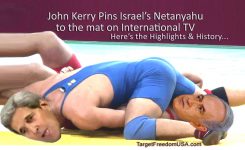 It is not uncommon for celebrities to clash with each other in the public arena. Often, these fights are not spontaneous, but intentionally provoked, or even planned, in order to generate publicity for both parties involved. For example, long before running for President, Donald Trump captured the attention of news headlines by having a spat with TV personality Rosie O’Donnell.
The perceived tension between Benjamin Netanyahu and Barack Obama has the looks of a “made for TV drama.” It is a prolonged public spat that is mutually beneficial to both parties. Do they actually dislike each other when the cameras are not rolling? Who knows.
While Obama and Netanyahu have butted heads, the US aid to Israel has not decreased or been cut off. Under Obama, the United States has worked to topple the Baathist Syrian government, one of Israel’s primary regional opponents. Israel has supported the regime change efforts with airstrikes in Syria targeting the anti-ISIS fighters of the Hezbollah organization.
The 2011 NATO intervention in Libya, championed loudly from the White House, toppled the Islamic Socialist government that had a long record of opposing Israel and arming Palestinian resistance.
Obama boasts that he has ended Iran’s peaceful nuclear energy program, and is making Israel safer from a supposed Iranian threat in the process. While there is occasionally criticism of Israel’s settlement activities, they continue unabated.
However, Obama’s clash with Netanyahu plays well for him, and the United States, in the Arab world. Throughout the Middle East, Netanyahu and Tel-Aviv are the most hated villains. Obama’s trading of nasty words with Israeli leaders raises the credibility of the United States. It gives the United States a kind of distance from Israel on the international stage, while US support remains key and keeps flowing in without pause. Obama’s Department of Justice has even conducted raids against pro-Palestinian activists.
Netanyahu benefits from the spat as well. Fear and hatred of Palestinians, Muslims, and Arabs has been key in securing the recent electoral victories of the Likud Party. If Netanyahu looked like he was friendly toward someone who attended an Islamic elementary school, or had the middle name “Hussein” this would discredit him in the eyes of his base.
Despite the fact that Israel receives billions of dollars from the United States, as well as weapons and other assistance, Netanyahu looks as if he is not afraid to bite the hand that feeds him. Fighting with Obama allows Netanyahu to look like a brave, fearless, true believer in the Zionist cause.
“Don’t Forget About Obama!”
Though many Israelis and supporters of Israel in the United States dislike Donald Trump, he has presented himself during the campaign as a pro-Israeli hardliner. His speech to the American Israeli Public Affairs Committee was a repetition of standard pro-Israeli talking points, saying:
“When you live in a society where the firefighters are the heroes, little kids want to be firefighters… In Palestinian society, the heroes are those who murder Jews.”
Trumps statements about banning Muslim immigration haven’t exactly been popular in the Arab world. Statements like “Islam hates us” don’t go over so well either.
The fear among certain forces in the United States is that Trump could alienate the many Muslim allies of the United States in the Arab world. Wall Street oil companies make lots of money from the various autocratic regimes in Qatar, Kuwait, Saudi Arab, UAE, and elsewhere. Pentagon weapons manufacturers also make lots of money from selling their hardware to these regimes.
Like Napoleon’s strategy in Egypt, efforts to portray Obama as sympathizer with Muslims and Arabs haven’t exactly worked out so well. While the elites within the US aligned Gulf States and some of extremists forces who have poured into Syria have bought into the idea Obama is a trustworthy ally, many people in the region have not. The Syrian government has not fallen. Iran has not really been weakened.
The economic problems and other factors that fueled the discontent of 2011 have not vanished. There is no guarantee that the oil bankers of the United States will keep their grip over this vastly important territory. Certain sectors harbor real fear that Trump’s brash tone could now ruin everything. [emphasis added]
The last minute moves at the UN Security Council, publicly invoking Israel’s wrath, was a message to the Arab world. It was a desperate, final attempt to say: “Whatever Trump does, don’t forget about Obama! Not all Americans are hardline supporters of Israel! Not everyone in Washington hates the Arabs! Muslims of the world, keep trusting us, don’t turn against America!”
Caleb Maupin is a political analyst and activist based in New York. He studied political science at Baldwin-Wallace College.
Theresa May must explain Trident malfunction ‘cover up,’ say opponents
RT | January 23, 2017
Labour and the Scottish National Party (SNP) say Prime Minister Theresa May must explain why Parliament was not told about a failed Trident missile test before a crucial vote on whether to renew Britain’s aging nuclear weapons program.
Downing Street confirmed on Monday morning that May knew about the malfunction before MPs voted on the system’s renewal.
A spokesperson said the incident occurred on former PM David Cameron’s watch, but admitted May had known about it.
The incident, in which a test fired missile veered towards the United States, was not reported until Sunday, but occurred only weeks before a key Commons vote on Trident renewal.
The spokesperson confirmed the crew of the nuclear submarine involved, HMS Vengeance, were “certified” to continue operating.
The vote went overwhelmingly in favor of renewal after May lobbied hard for the UK’s nuclear deterrent.
Almost immediately after Downing Street’s confession, a statement on behalf of David Cameron’s former media team denied any cover up had taken place.
A spokesman claimed it was “entirely false to suggest David Cameron’s media team covered up or tried to cover up the Trident missile test,” according to the Huffington Post.
The Cameron team also criticized claims of a cover-up made by defense committee chair Julian Lewis earlier on Monday.
“We are disappointed that Julian Lewis would make these claims with no evidence.”
Leading figures in both parties are set to use the incident, which occurred in June 2016 just weeks before a House of Commons vote on renewal, to attack the government. News of the missile malfunction only emerged on Sunday.
The SNP is committed to opposing it on the basis of safety and security, as the nuclear submarine fleet is based in Scotland.
The Labour leadership is opposed to nuclear weapons, but the majority of its parliamentary party is in favor of renewal.
SNP defense spokesman Brendan O’Hara told the BBC there are political and operational issues which must be addressed, but warned “this is not a national security issue.”
“The government can’t, as they love to do, hide behind the national security smokescreen. The public, who are paying over two hundred thousand million pounds [US$249 billion] for this renewal, have a right to know if it works or not,” O’Hara said.
Labour’s Shadow Defense Secretary Nia Griffiths said a full explanation is due, while Shadow Chancellor John McDonnell said it is “extremely worrying” that parliament had not been informed of the incident.
Likewise former Labour Defense Minister Kevan Jones told Labour List, “If there are problems, they should not have been covered up in this ham-fisted way. Ministers should come clean if there are problems and there should an urgent inquiry into what happened.”
In a car-crash interview on Sunday with the BBC, May refused to disclose whether she knew about the incident ahead of the vote on Trident. MPs ruled in favor of renewal by 472 votes to 117.
Instead she opted to say she had complete faith in Trident and that she thought “we should defend our country,” with repeated references to Labour leader Jeremy Corbyn’s opposition to Trident.
Senior military figures have also weighed in, with former head of the Royal Navy Lord West of Spithead writing in the Daily Mail that this had been a cover-up “worthy of North Korea.”
“The decision to withhold news last summer that a Trident missile test experienced some kind of problem – ironically, almost certainly minor – is both bizarre and spectacularly stupid,” West said in an opinion piece, urging Defense Secretary Michael Fallon to step up and explain.
Senior Tories have been attempting a fightback on the issue, with Business Minister Greg Clark telling Sky News “It’s been the long-standing policy not to comment on tests of weapons systems and, if that’s the approach that you take, I think we have to abide by that approach.”
This argument somewhat falls down on the fact that successful tests are regularly reported, including with video of the launches.
Tory head of the Defense Committee Julian Lewis said as much in his intervention early on Monday.
“This sort of event is one that you can’t play both ways … whenever they work, which is 99 percent of the time, films are released of them working,” he said.
Lewis said someone should be held to account for the decision.
“I always think with something like this it is better to lay it on the line … In the end you have always got to assume that something like this will come out,” Lewis said.
Read more:
Karl Rove’s Prophecy

Karl Rove. Credit: Jay Godwin/Wikimedia Commons
Karel van Wolferen • Unz Review • January 23, 2017
In a famous exchange between a high official at the court of George W. Bush and journalist Ron Suskind, the official – later acknowledged to have been Karl Rove – takes the journalist to task for working in “the reality-based community.” He defined that as believing “that solutions emerge from your judicious study of discernible reality.” Rove then asserted that this was no longer the way in which the world worked:
We’re an empire now, and when we act, we create our own reality. And while you’re studying that reality – judiciously, as you will – we’ll act again, creating other new realities, which you can study too, and that’s how things will sort out. We’re history’s actors . . . and you, all of you, will be left to just study what we do. (Ron Suskind, NYTimes Magazine, Oct. 17, 2004).
This declaration became popular as an illustration of the hubris of the Bush-Cheney government. But we could also see it as fulfilled prophecy. Fulfilled in a manner that no journalist at that time would have deemed possible. Yes, the neoconservatives brought disrepute upon themselves because of the disaster in Iraq. Sure, opposition to the reality Rove had helped create in that devastated country became a first rung on the ladder that could lead to the presidency, as it did for Barack Obama. But the neocons stayed put in the State Department and other positions closely linked to the Obama White House, where they became allies with the liberal hawks in continuing ‘spreading democracy’ by overthrowing regimes. America’s mainstream news and opinion purveyors, without demurring, accommodated the architects of reality production overseen by Dick Cheney.
This did not end when Obama became president, but in fact with seemingly ever greater eagerness they gradually made the CIA/neocon-neoliberal created reality appear unshakably substantial in the minds of most newspaper readers and among TV audiences in the Atlantic basin. This was most obvious when attention moved to an imagined existential threat posed by Russia supposedly aimed at the political and ‘Enlightenment’ achievements of the West. Neoconservatives and liberal hawks bent America’s foreign-policy entirely to their ultimate purpose of eliminating a Vladimir Putin who had decided not to dance to Washington’s tune so that he might save the Russian state, which had been disintegrating under his predecessor and Wall Street’s robber barons.
With President Obama as a mere spectator, the neocon/liberals could – without being ridiculed – pass off as a popular revolution the coup d’état they fomented in the Ukraine. And because of an unquestioned Atlanticist faith, which holds that without the policies of the United States the world cannot be safe for people of the Atlantic basin, the European elites that determine policy or comment on it joined their American counterparts in endorsing that reality.
As blind vassals the Europeans have adopted Washington’s enemies as their own. Hence the ease with which the European Union member states could be roped into a system of baseless economic sanctions against Russia, much to the detriment of their own economic interests. Layers upon layers of anti-Russian propaganda have piled up to bamboozle a largely unsuspecting public on both sides of the Ocean.
In the Netherlands, from where I have been watching all this, Putin was held personally responsible in much of the media for the shooting down of a Malaysian airliner flying over the Ukraine, which killed 298 people. No serious investigation was undertaken. The presentation of ‘almost definitive’ findings by the joint investigation team under Dutch leadership has neither included clues supplied by jet fighter cannon holes in the wrecked fuselage nor eyewitness stories, which would make the government in Kiev the prime suspect. Moscow’s challenging the integrity of the investigation, whose agreed-upon rules included publication of findings only if Kiev agreed with them, were met with great indignation by the Dutch Foreign and Prime Ministers.
As the fighting in Syria reached a phase when contradictions in the official Washington/NATO story demanded a stepping back for a fresh look, editors were forced into contortions to make sure that the baddies stayed bad, and that no matter how cruel and murderously they went about their occupation in Aleppo and elsewhere, the jihadi groups fighting to overthrow the secular Assad government in Damascus remained strictly labeled as moderate dissidents worthy of Western support, and the Russians as violators of Western values. Architects of an official reality that diverges widely from the facts you thought you knew must rely on faits accompli they achieve through military or police violence and intimidation, in combination with a fitting interpretation or a news blackout delivered by mainstream media.
These conditions have been widely obtained in the Atlantic basin through a gradual loss of political accountability at top levels, and through government agencies protected by venerated secrecy that are allowed to live lives of their own. As a result American and European populations have been dropped into a fantasy world, one under constant threat from terrorists and an evil dictator in Moscow. For Americans the never ending war waged by their own government, which leaves them with no choice but to condone mass murder, is supposedly necessary to keep them safe. For Europeans, at least those in the northern half, the numerous NATO tanks rolling up to the border of the Russian Federation and the massing of troops in that area are an extra guarantee, on top of the missiles that were already there, that Vladimir Putin will restrain his urges to grab a European country or two. On a smaller scale, when every May 4th the 1940-45 war dead are remembered in the Netherlands, we must now include the fallen in Afghanistan as if they were a sacrifice to defend us against the Taliban threat from behind the Hindu Kush.
Ever since the start of this millennium there has been a chain of realities as prophesied by Karl Rove, enhanced by terrorist attacks, which may or may not have been the work of actual terrorists, but whose reality is not questioned without risking one’s reputation. The geopolitical picture that they have helped build in most minds appears fairly consistent if one can keep one’s curiosity on a leash and one’s sense of contradiction sufficiently blunt. After all, the details of the official reality are filled in and smoothed out all the time by crafty campaigns produced in the PR world, with assistance from think tanks and academia.
But the question does reappear in one’s thoughts: do the politically prominent and the well-positioned editors, especially those known for having once possessed skeptical minds, actually believe it all? Do those members of the cabinet or parliament, who can get hot under their collar as they decry the latest revelation about one or other outrage committed by Putin, take seriously what they’re saying? Not all of them are believers, I know that from off the record conversations. But there appears to be a marked difference between the elite in government, in the media, in prominent social positions, and ordinary people who in these recent times of anguish about populism are sometimes referred to as uneducated. Quite a few among the latter appear to think that something fishy is going on. This could be because in my experience the alert ones have educated themselves, something that is not generally understood by commentators who have made their way through the bureaucracy of standard higher education.
A disadvantage of being part of the elite is that you must stick to the accepted story. If you deviate from it, and have your thoughts run rather far away from it, which is quite inevitable once you begin with your deviation, you can no longer be trusted by those around you. If you are a journalist and depend for your income on a mainstream newspaper or are hired by a TV company, you run the risk of losing your job if you do not engage in self-censorship.
Consequently, publications that used to be rightly known as quality newspapers have turned into unreadable rags. The newspaper that was my employer for a couple of decades used to be edited on the premise that its correspondents rather than authorities were always correct in what they were saying. Today greater loyalty to the reality created in Washington and Langley cannot be imagined. For much of northern Europe the official story that originates in the United States is amplified by the BBC and other once reliable purveyors of news and opinion like the Guardian, the Financial Times and the (always less reliable) Economist.
Repetition lends an ever greater aura of truth to the nonsense that is relentlessly repeated on the pages of once serious publications. Detailed analyses of developments understood through strings of false clues give the fictions ever more weight in learned heads and debates in parliament. At the time of writing, the grave concern spread across the opinion pages on my side of the Atlantic is about how Putin’s meddling in upcoming European elections can be prevented.
The realities Rove predicted have infantilized parliamentary debates, current affairs discussion and lecture events, and anything of a supposedly serious nature on TV. These now conform to comic book simplicities of evil, heroes and baddies. They have produced a multitude of editorials with facts upside-down. They force even those who advise against provoking Moscow to include a remark or two about Putin being a murderer or tyrant, lest they could be mistaken for traitors to Enlightenment values or even as Russian puppets, as I have been. Layers of unreality have incapacitated learned and serious people to think clearly about the world and how it came to be that way.
How could Rove’s predictions so totally materialize? There’s a simple answer: ‘they’ got away with momentous lies at an early stage. The more authorities lie successfully the more they are likely to lie again in a big way to serve the purposes of earlier lies. The ‘they’ stands for those individuals and groups in the power system who operate beyond legal limits as a hydra-headed entity, whose coordination depends on the project, campaign, mission, or operation at hand. Those with much power got away with excessive extralegal use of it since the beginning of this century because systems of holding the powerful to account have crumbled on both sides of the Atlantic. Hence, potential opposition to what the reality architects were doing dwindled to almost nothing. At the same time, people whose job or personal inclination leads them to ferret out truth were made to feel guilty for pursuing it.
The best way, I think, to make sense of how this works is to study it as a type of intimidation. Sticking to the official story because you have to may not be quite as bad as forced religious conversion with a gun pointed at your head, but it belongs to the same category. It begins with the triggering of odd feelings of guilt. At least that is how I remember it. Living in Tokyo, I had just read Mark Lane’s Rush To Judgment, the first major demolishing in book form of the Warren Report on the murder of John F. Kennedy, when I became aware that I had begun to belong to an undesirable category of people who were taking the existence of conspiracies seriously. We all owe thanks to writers of Internet-based samizdat literature who’ve recently reminded us that the pejorative use of the conspiracy label stems from one of the greatest misinformation successes of the CIA begun in 1967.
So the campaign to make journalists feel guilty for their embarrassing questions dates from before Dick Cheney and Rove and Bush. But it has only reached a heavy duty phase after the moment that I see as having triggered the triumph of political untruth.
We have experienced massive systemic intimidation since 9/11. For the wider public we have the absurdities of airport security – initially evidenced by mountains of nail-clippers – reminding everyone of the arbitrary coercive potential that rests with the authorities. Every time people are made to take off their belts and shoes – to stick only to the least inane instances – they are reminded: yes, we can do this to you! Half of Boston or all of France can be placed under undeclared martial law to tell people: yes, we have you under full control! For journalists unexamined guilt feelings still play a major role. The serious ones feel guilty for wanting to ask disturbing questions, and so they reaffirm that they still belong to ‘sane’ humanity rather than the segment with extraterrestrials in flying saucers in its belief system. But there is a confused interaction with another guilty feeling of not having pursued unanswered questions. Its remedy appears to be a doubling down on the official story. Why throw in fairly common lines like “I have no time for truthers” unless you feel that this is where the shoe pinches?
You will have noticed a fairly common response when the 9/11 massacre enters a discussion. Smart people will say that they “will not go there”, which brings to mind the “here be dragons” warning on uncharted bits of medieval maps. That response is not stupid. It hints at an understanding that there is no way back once you enter that realm. There is simply no denying that if you accept the essential conclusions of the official 9/11 report you must also concede that laws of nature stopped working on that particular day. And, true enough, if you do go there and bear witness publicly to what you see, you may well be devoured; your career in many government positions, the media and even academia is likely to come to an end.
So, for the time being we are stuck with a considerable chunk of terra incognita relating to recognized political knowledge; which is an indispensable knowledge if you want to get current world affairs and the American role in it into proper perspective.
Mapping the motives of those who decide “not to go there” may be a way to begin breaking through this disastrous deadlock. Holding onto your job is an honorable motivation when you have a family to maintain. The career motivation is not something to scorn. There is also an entirely reasonable expectation that once you go there you lose your voice publicly to address very important social abuse and political misdeeds. I think it is not difficult to detect authors active on internet samizdat sites who have that foremost in mind. Another possible reason for not going there is the more familiar one, akin to the denial that one has a dreadful disease. Also possible is an honorable position of wishing to preserve social order in the face of a prospect of very dramatic political upheaval caused by revelations about a crime so huge that hardly anything in America’s history can be compared to it. Where could such a thing end – civil war? Martial law?
What I find more difficult to stomach is the position of someone who is worshiped by what used to be the left, and who has been guiding that class of politically interested Americans as to where they can and cannot go. Noam Chomsky does not merely keep quiet about it, but mocks students who raise logical questions prompted by their curiosity, thereby discouraging a whole generation studying at universities and active in civil rights causes. One can only hope that this overrated analyst of the establishment, who helps keep the most embarrassing questions out of the public sphere, trips over the contradictions and preposterousness of his own judgments and crumples in full view of his audience.
The triumph of political untruth has brought into being a vast system of political intimidation. Remember then that the intimidater does not really care what you believe or not, but impresses you with the fact that you have no choice. That is the essence of the exercise of brute power. With false flag events the circumstantial evidence sometimes appears quite transparently false and, indeed could be interpreted as having been purposeful. Consider the finding of passports or identity papers accidentally left by terrorists, or their almost always having been known to and suspected by the police? What of their death through police shooting before they can be interrogated? Could these be taunting signals of ultimate power to a doubting public: Now you! Dare contradict us! Are the persons killed by the police the same who committed the crime? Follow-up questions once considered perfectly normal and necessary by news media editors are conspicuous by their absence.
How can anyone quarrel with Rove’s prophecy. He told Suskind that we will forever be studying newly created realities. This is what the mainstream media continue to do. His words made it very clear: you have no choice!
A question that will be in the minds of perhaps many as they consider the newly sworn in president of the United States, who like John F. Kennedy appears to have understood that “Intelligence” leads a dangerously uncontrolled life of its own: At what point will he give in to the powers of an invisible government, as he is made to reckon that he also has no choice?
Karel van Wolferen is a Dutch journalist and retired professor at the University of Amsterdam. Since 1969, he has published over twenty books on public policy issues, which have been translated into eleven languages and sold over a million copies worldwide. As a foreign correspondent for NRC Handelsblad , one of Holland’s leading newspapers, he received the highest Dutch award for journalism, and over the years his articles have appeared in The New York Times , The Washington Post , The New Republic , The National Interest , Le Monde , and numerous other newspapers and magazines.
Will TPP End Up Dead Without the US?
Sputnik – 23.01.2017
President Donald Trump said that the US will start pulling out of the 12-nation Trans-Pacific Partnership (TPP) trade agreement to protect American jobs and kick-start economic revival.
In a statement issued after Trump’s January 20 inauguration, the White House named the planned withdrawal from the TPP as a major priority for the new administration’s effort to bring down unemployment and breathe new life into the stagnant US economy.
“This strategy starts by withdrawing from the Trans-Pacific Partnership and making certain that any new trade deals are in the interests of American workers,” the White House release stated.
The TPP seeks to remove barriers to trade among its 12 signatories, which together account for 40 percent of the world’s economy: Australia, Brunei, Canada, Chile, Japan, Malaysia, Mexico, New Zealand, Peru, Singapore, the United States and Vietnam.
During his presidential campaign, Trump has repeatedly criticized the TPP and expressed the desire to shift the focus from global trade to national economic development in order to support the US economy.
Warning about the catastrophic impact the TTP pact, initiated by the Obama Administration, could have on the US economy, Donald Trump is committed to negotiating “fair trade deals” that would benefit American manufacturers and workers.
The restrictions on Asian imports proposed by Donald Trump are part of his strategy to revive domestic production and give up on the “global division of labor.”
TPP a boon to transnational corporations
The TPP began as an expansion of the Trans-Pacific Strategic Economic Partnership Agreement signed by Brunei, Chile, New Zealand and Singapore in 2005. Beginning in 2008, Australia, Canada, Japan, Malaysia, Mexico, Peru, the United States and Vietnam joined the discussion for a broader agreement, bringing the total number of countries participating in the negotiations to twelve and accounting for up to 40 percent of the global GDP.
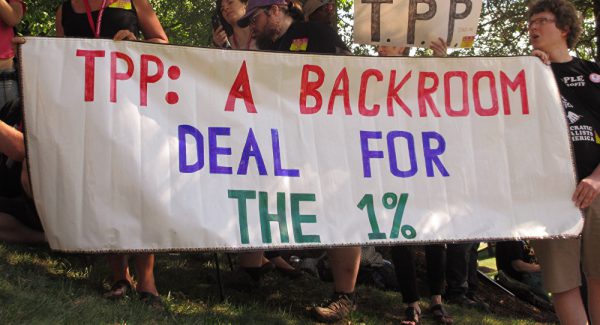
The signing of the TPP deal led to mass-scale protests in many of the participating nations with the critics describing the agreement as an attempt to set the rules of the global economy to favor multinational corporations over domestic producers.
This, they warned, would negatively impact the situation of the domestic labor markets of the participation countries.
The TPP trade agreement consists of chapters on a range of issues dealing with trade barriers, intellectual property rights, human rights and government regulations across a host of industries, such as agricultural goods, pharmaceuticals and manufacturing.
It favors large multinational corporations which want to impose their regulations on foreign competitors.
The TPP deal also undermines domestic companies, laws, regulations and institutions with an extra-judicial Investor-State Dispute Settlement (ISDS) that stacks the deck in favor of multinational corporations.
US pivot away from Asia
In its push for the TPP, the Obama Administration was also governed by political considerations. Defense Secretary Ashton Carter said that the agreement was meant to strengthen Washington’s alliances with the key Southeast Asian nations.
“Obama planned to create an expanded free trade zone in Asia and the Pacific US companies would benefit from,” Sergei Lukonin, a senior expert on Chinese politics and economics in Moscow, told RT.
“The TPP could also be used by the US as a counterbalance to China. If Washington gives up on its leading role in the region, this would strengthen Beijing’s hand in the ongoing talks on the Comprehensive Regional Economic Partnership,” Lukonin noted.
He added that America’s withdrawal from the TPP would undermine its reputation in the region.
“With the United States out, the Asian nations will have to reconsider their military alliances with Washington,” Lukonin said.
Sergei Silvestrov, a Moscow-based economic expert, said that Washington’s withdrawal from the TPP would complicate its relations with Australia, New Zealand and other countries where the TPP is now being ratified.
Silvestrov added that without the United States the TPP would become meaningless as the US and Japan alone account for a hefty 80 percent of the TPP countries’ trade turnover.
Vietnam has already responded to Trump’s statement by suspending its ratification of the TPP deal, while Australian Prime Minister Malcolm Turnbull remains all set to speed up the ratification process.
Japan has been alarmed the most by the prospect of a US withdrawal from the TPP. Prime Minister Shinzo Abe pinned much hopes on the deal that would open the US market to Japanese exports. He will try to remedy the situation during an upcoming visit to Washington.Aside from the negative response from America’s Asian partners, Donald Trump will face serious opposition from transnational corporations. With the globalization process advanced as it is, it will take a country more than just canceling a single agreement to protect its domestic market.
Back to the roots
It still looks like President Trump worries more about America’s economic woes than he does about the political fallout his decision to withdraw from the TPP could create in the world, RT wrote.
During his election campaign he promised to fight unemployment and stand up for the interests of ordinary Americans and now is the right time for him to start practicing what he preached while on the stump.
Meanwhile, Donald Trump is also committed to renegotiating another trade deal, the North American Free Trade Agreement (NAFTA), which was signed by the United States, Canada and Mexico in 1994.
Trump’s Foreign Policy: An Unwise Inconsistency?
By Ron Paul | January 23, 2017
Throughout the presidential campaign, Donald Trump’s foreign policy positions have been anything but consistent. One day we heard that NATO was obsolete and the US needs to pursue better relations with Russia. But the next time he spoke, these sensible positions were abandoned or an opposite position was taken. Trump’s inconsistent rhetoric left us wondering exactly what kind of foreign policy he would pursue if elected.
The President’s inaugural speech was no different. On the one hand it was very encouraging when he said that under his Administration the US would “seek friendship and goodwill with the nations of the world,” and that he understands the “right of all nations to put their own interests first.” He sounded even better when he said that under Trump the US would “not seek to impose our way of life on anyone, but rather to let it shine as an example. We will shine for everyone to follow.” That truly would be a first step toward peace and prosperity.
However in the very next line he promised a worldwide war against not a country, but an ideology, when he said he would, “unite the civilized world against radical Islamic terrorism, which we will eradicate from the face of the Earth.” This inconsistent and dangerous hawkishess will not defeat “radical Islamic terrorism,” but rather it will increase it. Terrorism is not a place, it is a tactic in reaction to invasion and occupation by outsiders, as Professor Robert Pape explained in his important book, Dying to Win.
The neocons repeat the lie that ISIS was formed because the US military pulled out of Iraq instead of continuing its occupation. But where was ISIS before the US attack on Iraq? Nowhere. ISIS was a reaction to the US invasion and occupation of Iraq. The same phenomenon has been repeated wherever US interventionist actions have destabilized countries and societies.
Radical Islamic terrorism is for the most part a reaction to foreign interventionism. It will never be defeated until this simple truth is understood.
We also heard reassuring reports that President Trump was planning a major shake-up of the US intelligence community. With a budget probably approaching $100 billion, the intelligence community is the secret arm of the US empire. The CIA and other US agencies subvert elections and overthrow governments overseas, while billions are spent spying on American citizens at home. Neither of these make us safer or more prosperous.
But all the talk about a major shake up at the CIA under Trump was quickly dispelled when the President visited the CIA on his first full working day in office. Did he tell them a new sheriff was in town and that they would face a major and long-overdue reform? No. He merely said he was with them “1000 percent.”
One reason Trump sounds so inconsistent in his policy positions is that he does not have a governing philosophy. He is not philosophically opposed to a US military empire so sometimes he sounds in favor of more war and sometimes he sounds like he opposes it. Will President Trump in this case be more influenced by those he has chosen to serve him in senior positions? We can hope not, judging from their hawkishness in recent Senate hearings. Trump cannot be for war and against war simultaneously. Let us hope that once the weight of the office settles on him he will understand that the prosperity he is promising can only come about through a consistently peaceful foreign policy.
#StopCETA: Thousands protest EU-Canada trade deal in demos across Europe
RT | January 22, 2017
Protesters in more than a dozen European states have taken to the streets in scheduled demonstrations against the yet-to-be-approved CETA trade agreement, charging it will result in the loss of jobs, lower safety standards, and grant freer rein to corporations.
“The people and the planet are not merchandise,” read a banner carried at the front of a column of demonstrators in Madrid.
In Dublin, protesters dressed as politicians from the ruling Fine Gael party handed over a “blank check” to a man dressed as a “corporation,” wearing a skull mask.
A procession of 130 tractors and as many as 18,000 people marched through the heart of Berlin before symbolically handing over a petition at the German agricultural ministry. The demonstration, organized by Germany’s Green Party and environmentally-conscious farmers wasn’t exclusively aimed at CETA, but the treaty received prominent mentions in the list of complaints.
Other notable rallies, documented on social media, were staged in Paris, Madrid and several other Spanish cities, Ourense in Portugal and Brussels.
TTIP, and TiSA, two other unratified pro-free trade treaties were also condemned.
The broad coalition of anti-globalists, environmentalists and labor movements that was behind what they called the Decentralized Day of Action against CETA, which had been negotiated for seven years, prior to being signed last October, outlined three main objections to CETA, the Comprehensive Economic and Trade Agreement.
The first was regulatory harmonization between Canada and the EU which would mean goods are produced to the same standard, and can be easily imported without additional certification.
“With the excuse of improving trade between the countries, regulations designed to protect the environment, workers’ rights, public services and consumer standards, will be reduced to the minimum common denominator,” said StopCETA.net.
The second is the additional legal protection given to foreign investors.
“Multinational corporations will have the right to sue governments if laws or regulations are introduced that cause them loss of profits,” continued the organizers.
And the third argument focused on the secrecy of the treaty, which was negotiated behind closed doors, and which will need to be ratified by the European Parliament this spring, before being approved by the national legislatures of the 28 EU member states.
Proponents of CETA argue that it will boost trade between Canada and Europe by 20 percent, and annually add €12 billion to the EU economy and €8.4 billion to Canada’s economy.
After several decades in which trade barriers were removed by governments with scant consultation with the public, there’s been growing resistance to new agreements from both above and below.
The Transatlantic Trade and Investment Partnership (TTIP), a deal similar to CETA, but involving the much larger US economy, has also been met with fierce public resistance in Europe, and Donald Trump has signaled that dismantling TTIP is one of his priorities as President of the US.
The Trade in Services Agreement (TiSA) that plans to open up the service industries of 23 mostly developed countries to foreign companies and individuals, has gone through 21 rounds of negotiations since 2013, with no final document published yet, and no deadline for the end of talks.
Some 1,000 People Participated in Anti-NATO Protest in Northeastern Italy
Sputnik – 22.01.2017
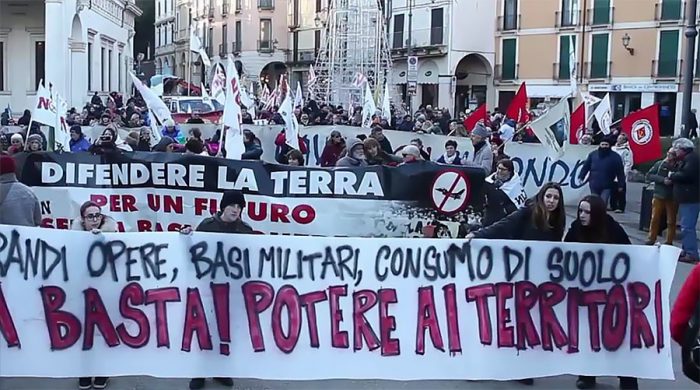
VICENZA – About 1,000 protesters participated on Saturday in a demonstration against NATO bases and major infrastructure projects of the local authorities, such as construction of a motorway and a railway for high-speed trains, in the city of Vicenza, located in northeastern Italy.
According to a RIA Novosti correspondent, the march was headed by the No Dal Molin Movement, opposing a US airbase located in the north of the city. The protesters carried a huge banner, saying “Protection of land for the future without military bases.”
“Until the people do not mobilize, until they put pressure on the government to expel the US military from our territory, politicians will do nothing as they are not interested in it. Politicians should be forced to give us an answer, and now they do not want to do this at the moment,” one of the march’s organizers Francesco Pavin told RIA Novosti.
The demonstration was sanctioned by local authorities and was accompanied by a police escort.
There are a total of four NATO bases in the Vicenza area.
During his presidential campaign, US President Donald Trump repeatedly stated that the United States should decrease the support of other NATO member states and protect only those members of the alliance, who “fulfill their obligations” in respect to Washington.
Belgrade Breathes Easier As Trump’s Win Marks End to Clinton-Era Interventionism
Sputnik – 22.01.2017
Donald Trump’s election victory has brought an end to the Clinton era of intervention in Serbia’s internal affairs, including the murky web of connections between NGO’s in the US and abroad, experts told Sputnik Srbija.
When the US election results were announced in November 8, representatives of Serbia’s NGO elite were in attendance at Belgrade’s Crown Plaza Hotel, where the US Embassy had organized a get-together.
In a straw poll conducted of those present, Hillary Clinton was the clear winner, and her defeat was greeted with disbelief and disappointment by those who have grown used to getting support from American government and non-government organizations.
Political analyst Branko Radun told Sputnik Srbija that supporters of Clinton among Serbia’s pressure groups can be divided into two groups – those who were thinking with their heads, and those who were thinking with their wallets.
“I would divide the pro-Clinton elite in two. The first group is parties, NGO’s, the media and individuals which are ideologically close to American liberals and Democrats and are connected with them in various ways, including ideologically. The second group is parties, organizations and individuals which following the overthrow of Milosevic got used to a situation whereby we have a pro-Clinton elite. In order to survive on the political scene, they made compromises and deals with domestic ‘Clintonistas’ and with the global elite, comprised above all of American Democrats, that liberal, pro-Soros global elite,” Radun said.
Radun said that changes to Serbia’s political situation will take some time to become clear.
“These changes will come in phases. Firstly, of course, there will be a change in the structure of the State Department, so those who have links there will immediately feel the change. Others, who may have ties to other structures, will feel the changes later. I think those changes don’t seem dramatic and visible at the moment.”
Analyst Dejan Vuk Stankovic said that Serbian NGO’s have had good reason to promote liberal American values in Serbia, thanks to funds from organizations such as US AID, the National Democratic Institute (NDI) and the International Republican Institute (IRI). The NDI and the IRI are affiliated with the Democratic and Republican parties, respectively.
“This is an interesting network of individuals, the non-governmental sector, some opposition parties, I would not rule out that there are also some people within the current governing structures. But in general, (they are) the post-Milosevic political elite and the remnants of their media and NGO, their open or hidden allies in the robes of civil society or independent societies of journalists, lawyers and so on,” Stankovic said.
“I think the choice of Trump is not good news for NGO beneficiaries of American grants. This does not mean that there won’t be any, there will be, but on a much smaller scale. I doubt that Trump will have any particular engagement with what Democrats were engaged in when in power. That political work which had various forms of subversion: the preparation for and the destruction of political regimes via the non-government sector with the help of opposition parties. I think Trump will put politics in some kind of official context, as a politician he will be without ideological vices. He will hold negotiations in the way in which business deals are made.”
Radun said that despite the disappointment in some quarters, a Clinton victory would not have benefited Serbia. In fact, a Clinton administration was likely to raise tensions in the Balkans by inflaming the situation in Kosovo and neighboring Bosnia.
“First of all, pressure on Republika Srpska would have increased and in the direction of its suppression. There would also have been an attempt to complete the constitution of Kosovo as an independent state. On the other hand, with Trump somehow we start from scratch. The situation is uncertain, but compared to the other side (Clinton), which would certainly have been negative, uncertainty is better because with uncertainty you have a chance,” said Radun.
US drone strikes in Yemen, absolutely atrocious: Analyst
Press TV – January 22, 2017
Separate US drone attacks have killed four people in the southwestern Yemeni province of Bayda. The United States carries out drone attacks in Yemen and several other countries, claiming to be targeting al-Qaeda elements, but, local sources say civilians have been the main victims of the attacks. The drone strikes in Yemen continue alongside the Saudi military aggression against the impoverished conflict-ridden country.
A radio host and political commentator says US drone strikes are “absolutely atrocious,” adding that Washington is directly involved in Yemen’s war when it is “actively dropping bombs” on the war-torn country.
“I do not think a lot of the people in the United States even realize that United States is actually bombing Yemen. They think that the United States is simply supplying arms to Saudi Arabia, but the fact is United States is actually in there bombing people themselves with these drone strikes,” Max Igan told Press TV in an interview on Sunday.
He noted that it is “pretty outrageous” and “terrible” that the drone strikes are going on at the time of US presidential transition.
The commentator further argued that if US President Donald Trump wants to deescalate the war on terror and try to bring about stability and peace to the Middle East, he should stop the drone strikes.
Elsewhere in his remarks, Igan criticized the Western media for not reporting anything about the war and the dire humanitarian situation in Yemen.
“It is one of the most unreported wars that we have seen in modern history. Nobody really realizes what is going on there, we do not hear anything about it on the media … we are not hearing about this war and it is an ongoing human rights catastrophe. There are so many people suffering in Yemen, it is almost impossible to get aid to these people and the arms just keep getting poured in there and the bombs just keep getting dropped and the media is not reporting anything about it,” he said.
He concluded by saying that there needs to be some sort of an organization in the world that can do something to stop this ongoing onslaught of the Yemeni people.
Trump has Opportunity to End Obama/Clinton Weapons Sales to Anti-Woman Tyrants
I attended the women’s rights rally in Portland, Oregon, today to support women worldwide and urge Trump to end Obama and Hillary Clinton’s record weapons deals with the most repressive state for women in the world, the totalitarian dictatorship of Saudi Arabia.
In 2010, the Clinton state department organized the biggest weapons sale in US history. The sale was to strongman Abdullah Abdullaziz, who had women executed as punishment for being raped. The Kerry state department followed the deal with a sale of almost a billion dollars worth of illegal cluster bombs to the dictator. Obama approved both deals.
Bloomberg reports Clinton’s weapons sales to woman-oppressing dictators increased dramatically after the tyrants ‘donated’ to what Harper’s magazine calls the Clintons’ ‘slush fund’, the Clinton Foundation.
An unfortunate aspect of much of the current anti-Trump upheaval around the country is that similar actions were not undertaken when policies Democrats would or will oppose if Trump carries them out were not opposed by Democrats when Obama and Hillary Clinton performed them.
However, this is largely because the general public is kept ignorant of most of these policies. Such actions, Dr. Chalmers Johnson has noted, are “kept secret” from the US-American public.
Respected analysts this week highlighted the disparity between Obama’s treatment in the neoliberal press and his actual record.
John Pilger quotes a typically sycophantic example of a description of Obama, this one from The Guardian:
“But the grace. The all-encompassing grace: in manner and form, in argument and intellect, with humour and cool … [He] is a blazing tribute to what has been, and what can be again … He seems ready to keep fighting, and remains a formidable champion to have on our side … The grace … the almost surreal levels of grace …”
Nicolas J S Davies outlines the reality: Obama, whose political career has been sponsored by, among many other similar elements, lethal weapons manufacturer General Dynamics, “has increased U.S. military spending beyond the post-World War II record set by President George W. Bush. Now that Obama has signed the military budget for FY2017, the final record is that Obama has spent an average of $653.6 billion per year, outstripping Bush by an average of $18.7 billion per year (in 2016 dollars).
In historical terms, after adjusting for inflation, Obama’s military spending has been 56 percent higher than Clinton’s, 16 percent higher than Reagan’s, and 42 percent more than the U.S. Cold War average…”
Under Obama, “… the U.S. and its allies dropped 20,000 bombs and missiles in his first term. In his second term, they have dropped four times that number, bringing the total for Obama’s presidency to over 100,000 bombs and missiles striking seven countries, surpassing the 70,000 unleashed on five countries by George W. Bush.”
Pilger notes Obama ordered an average of 72 explosive devices to be planted and detonated every day in 2016.
Davies continues that Obama has used the US’s Central American model of favoring proxy-armies and death-squads over sending in US troops, and has thus provided arms and ignited and fueled conflicts that have killed hundreds of thousands around the world.
But the strategy has also included “a massive expansion of U.S. special operations forces, now deployed to 138 different countries, compared with only 60 when Obama took office.”
Pilger notes this “amounted to a full-scale invasion of Africa.”
Highlighting what these US operations and hegemonic expansion mysteriously achieve, Oxfam this week released a report noting that about 8 people now control as much wealth as half the world’s population. This is down from 16 people within the past year or so, and around 70 people before that.
Within the US, while thousands of the poorest people in places like Detroit had their water turned off in violation of the universal declaration of human rights, Obama allocated a trillion dollars to the nuclear arsenal, in violation of legal obligations and agreements.
And while he has refused to prosecute torturers and war criminals from the Bush Jr. regime (let alone his own), he has waged a campaign of persecution against those who have exposed torture and war crimes.
Amnesty International and other groups note a highlight of Obama’s presidency was his recent commutation of the sentence of US political prisoner Chelsea Manning, who released documents exposing some US war crimes. But the commutation came after an offer from another, higher-value whistle-blower and political prisoner, Julian Assange, to accept extradition to the US in exchange for clemency for Manning.
Others note Obama has deported millions of people and increased military aid to human rights violators like Israel and Saudi Arabia more than any other president.
While at least some Democrats would express opposition to these actions if they were performed by Trump, this cannot necessarily be called hypocrisy, since the US and Western propaganda model (corporations dumping billions into favored media outlets to overwhelm the market) prevents the vast majority of them from knowing Obama undertook the actions himself.
This is not new. Similar demonstrations expressing disgust were carried out by Democrats and others during the inauguration of Bush Jr., but not in opposition to policies carried out by Clinton such as his genocide in Iraq that killed some 500,000 children, his support for terrorist Paul Kagame in Rwanda, which has contributed to the deaths of millions, or Clinton’s aggression against Yugoslavia.
Continuing to illustrate how these and other crimes are “kept secret” from or distorted for the US and Western public, Reuters this week said the US/NATO aggression against Yugoslavia was carried out in response to Serbia “killing about 10,000 ethnic Albanian civilians there.”
But Noam Chomsky and other US/Western propaganda analysts note that according to the West’s own monitors, including the British Parliamentary inquiry into the matter, this is a reversal of the chronology.
In the year before the US/NATO attack, about 2,000 people were killed due the conflict in Yugoslavia, with more killings attributed to the KLA – the terrorist-integrated guerilla force backed by the US and Western countries – than to the Serbs. Before the US/NATO attack, the killings had mostly subsided, but the KLA continued to carry out provocations to, as it stated, try to instigate NATO intervention on its behalf.
Wesley Clarke, the NATO commander at the time, said bombing Yugoslavia would cause more deaths and atrocities than would occur without Western bombing. Others agreed, but, with Hillary Clinton’s urging, Bill Clinton began bombing the country, leading to the “about” 10,000 deaths Reuters this week says the bombing was a response to.
The Reuters article also mysteriously fails to mention that if the US had intervened to prevent atrocities, it would not have been supporting what Dr. Michael Parenti, in a book on the topic written under the supervision of Balkan experts, notes were worse atrocities carried out by Turkey (against the Kurds) and other regimes around the world.
Through countless similar distortions and omissions, the US/Western propaganda model thus continues to keep Democrats uninformed and thus complacent or supportive of politicians who carry out actions Democrats sometimes vehemently oppose when the same actions are planned or carried out by Republicans.
Comparable dynamics are also true in reverse.
Robert J. Barsocchini is an independent researcher and reporter whose interest in propaganda and global force dynamics arose from working as a cross-cultural intermediary for large corporations in the film and Television industry. His work has been cited, published, or followed by numerous professors, economists, lawyers, military and intelligence veterans, and journalists. Updates on Twitter.
Featured Video
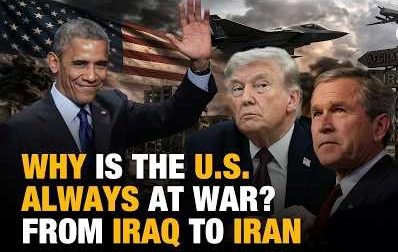
The Source of America’s Wars – Kristol Clear
or go to
Aletho News Archives – Video-Images
From the Archives
Is Israel to blame for the Iraq War?
American Goy | March 10, 2008
I am so tired of this old canard that “Israel had nothing to do with USA’s war with Iraq – in fact, it officially advised America against it”.
Bullshit. … continue
Blog Roll
 Aletho News
- Alberta Bill Would Fine Political Deepfakes $10,000 Without Satire Exemptions
- Iran declares ‘historic victory’ over US, says enemy forced to accept its proposal
- Trump Claims Ceasefire, Reopening of Strait of Hormuz Agreement with Iran
- Israeli tank fire killed UN peacekeeper in Lebanon, UNIFIL investigation finds
- Russia, China block Bahrain-sponsored UN resolution on Strait of Hormuz
- The US-Israeli War on Science is an Assault on our Future
- Trump’s Promise to Bomb Iran ‘Like Never Before’ Faces Brutal Logistics — Expert
- Germany seeks to restrict stays abroad for men of fighting age – Berliner Zeitung
- Evidence points to Ukraine being behind TurkStream attempted sabotage, but that should come as no surprise
- Sri Lanka secures supplies of Russia oil – minister
- If Americans Knew
- Thousands dead and neighborhoods razed to the ground: Aid agencies fear southern Lebanon is becoming the new Gaza
- The war the US is fighting for Israel could cost trillions
- ‘Cigarette Burns, Nail Wounds’: Toddler Tortured in Gaza to Coerce Father
- Trump Says US Sent ‘a Lot of Guns’ to Protesters in Iran
- Israeli forces destroy 17 UN peacekeeper cameras in south Lebanon
- US-Israeli strikes ‘completely destroy’ synagogue in Tehran
- Archbishop for US Military Says Iran War Is Unjust Under Catholic Teaching
- Iranian leaders’ Open Letters to the American People
- Trump says Iranians appreciate bombs, WHO warns of nuclear risks – Daily Update
- U.N. experts demand Israel release prominent Gaza doctor after reports of ‘severe torture’
- No Tricks Zone
- An Inconvenient Tree: Uncovered In Alps… Europe Much Warmer Than Today 6000 Years Ago
- New Study Reports A 60% Slowdown In Greenland’s Ice Loss Rate In The Last Decade
- Low Intensity Tornado Wrecks Major Solar Farm, Creating A Potential Toxic Dump
- New Study Finds Warming Saves Lives…Cold Temperatures 12 Times More Deadly Than Excess Heat
- German Science Blog Accuses PIK Climate Institute Of Hallucinating Climate Tipping Points
- Devastating Assessment Of Comirnaty Vaccine By Former Senior Pfizer Europe Toxicologist
- New Study: CO2 Is ‘Effectively Negligible’ As An Explanatory Climate Change Factor Since 2000
- Former Pfizer Toxicologist Dr. Helmut Sterz Tells Bundestag Hearing Pfizer Vaccine Should Have Never Been Approved
- Energy Expert: Germany’s Nuclear Phaseout Was A “500 Billion Euro Mistake”
- New Research: South Australia’s Mid-Holocene Sea Surface Temperatures Were 4°C Warmer Than Today
 Aletho News
