Assad’s fate ‘to be decided by Syrian people,’ says Tillerson
RT | March 30, 2017
At a news conference in the Turkish capital, US Secretary of State Rex Tillerson appeared to suggest the end of Bashar Assad’s presidency was no longer a prerequisite for a way out of the Syrian crisis, in a U-turn from Washington’s long-held policy.
“I think the … longer term status of President Assad will be decided by the Syrian people,” said Tillerson at a joint conference with Turkish Foreign Minister Mevut Cavusoglu on Thursday, AFP reported.
Under President Barack Obama, the United States made Assad’s departure one of its key objectives. The Syrian armed opposition also insisted upon the longtime leader’s resignation as one of the conditions during the Astana peace talks.
Tillerson added that there were no major disagreements between Turkey and the US over the NATO allies campaigns against Islamic State (IS, formerly ISIS/ISIL).
“There’s no space between Turkey and the US and our commitment to defeat Daesh [Arabic acronym for IS], to defeat ISIS,” he said.
However, this was met with disagreement from Cavusoglu, who complained about US support for the Syrian Kurdish YPG militia, considered a terrorist group by Ankara.
“It is not good or realistic to work with a terrorist group while fighting another terrorist group,” Cavusoglu said, adding that Turkey expected “better cooperation” with the US over this issue.
Turkey said it is interested in supporting the operation to take the IS stronghold of Raqqa, but not if the Kurdish militia is involved, AP reports.
The Turkish authorities consider the YPG, or the People’s Protection Units, to be a Syrian faction of the Kurdistan Workers Party (PKK), a banned Kurdish movement that has been fighting for autonomy in southeastern Turkey since the 1980s.
Years of negotiations between the Syrian government and opposition, as well as representatives from Moscow, Washington, Tehran, and other powers, have failed to bring an end to the Syrian crisis. The Astana talks launched in January, which hoped to bring all the key sides to the negotiating table, have stalled since the Syrian opposition pulled out in mid-March.
Russian FM Lavrov’s March 29, 2017 interview with National Interest Magazine
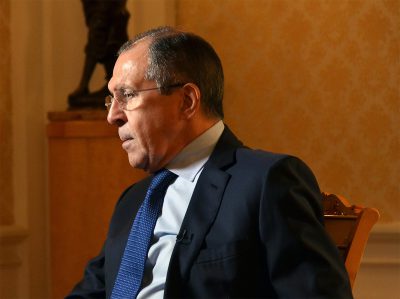
Question: I’d like to start by asking you about your forthcoming meeting with US Secretary of State Rex Tillerson, we’ve read in the press that the two of you may be meeting soon.
Sergey Lavrov: So they say.
Question: Could you perhaps tell us about your expectations and goals in dealing with Secretary Tillerson?
Sergey Lavrov: Well, after the American election, soon after Election Day President Putin and President-elect Trump talked over the phone. It was a good but very general discussion touching upon the key issues in our relations, and of course the key international issues. And they agreed that they would continue being in touch and after the inauguration they talked again, and they reconfirmed the need to look for ways which would be effective in handling international problems. And of course to see what could be done to bring the bilateral relations to normalcy. They also agreed that Mr. Rex Tillerson and I would look into the agenda in some more details, and would also discuss the preparation for the presidential meeting which should take place when both countries, both leaders feel comfortable.
And we met with Rex in mid-February in Bonn on the margins of the G-20 ministerial meeting, and covered quite a lot of the bilateral agenda. I briefed him about the relationship on bilateral issues with the Obama administration, the problems which accumulated during that period. We did not go into the substance of this, I just briefed him so that his team, which is still being assembled, could take a look at these issues and determine what kind of attitude they would have on them. And we discussed Syria, Iran, the Korean Peninsula, the Middle East in general, relations between Russia and the West, it was a very general, but rather substantive discussion, obviously it was the first contact and Mr. Rex Tillerson is just getting into the shoes of his new capacity. We discussed the possibility of personal meeting and have been continuing these discussions. As soon as we finalize them it will be announced.
But my feeling is that from the point of view of personal relationship, we feel quite comfortable. I feel quite comfortable, I believe Rex had the same feeling, and our assistants should work closer but of course this could only be done when the team in the State Department is complete.
Question: Of course. If I could follow up on your answer there, you mentioned bringing normalcy to the U.S.-Russia relationship. What do you think “normal” is?
Sergey Lavrov: “Normal” is to treat your partners with respect, not to try to impose some of your ideas on others without taking into account their own views and their concerns, always to try to listen and to hear, and hopefully not to rely on a superiority complex, which was obviously the case with the Obama administration. They were obsessed with their exceptionality, with their leadership. Actually the founding fathers of the United States, they also spoke of their leadership, and they believed that the American nation was exceptional, but they wanted others just to take the American experience as an example and to follow suit. They never suggested that the United States should impose, including by force, its values on others.
And the Obama administration was clearly different. Actually, long before Ukraine, long before Crimea, in early December 2012, there was an OSCE ministerial meeting in Dublin. And Hillary Clinton was Secretary of State and was the head of the delegation, we had a bilateral meeting with her, she was trying to persuade me on something which was a difficult issue on the agenda, but I recall this situation because in the margins of this ministerial meeting she attended a meeting in the University of Dublin, and she delivered a lecture in which she said something like: “We are trying to figure out effective ways to slow down or prevent the move to re-Sovietize the former Soviet space.” December 2012.
What kind of action she was considering as the move to re-Sovietize the space, I really couldn’t understand. Yes, there were discussions about Ukraine, about Kazakhstan, Belarus and Russia, forming the Customs Union, and if this was the reason, then of course it showed very obviously the real attitude of the Obama administration to what was going on in the former Soviet space and the area of the Commonwealth of Independent States, its obvious desire to take over this geopolitical space around Russia without even caring what Moscow might think.
This was the reason for the crisis in Ukraine, when the U.S. and European Union bluntly told the Ukrainians: either you are with us, or you are with Russia against us. And the very fragile Ukrainian state couldn’t sustain this kind of pressure, and what happened- happened: the coup, and so on and so forth (if you want I can discuss this in some detail later). But my point is that they considered normal that the people in Obama’s team should call the shots anywhere, including around such a big country as the Russian Federation. And this is absolutely abnormal in my view.
At the same time, when we visited Venezuela with our naval ships, they were raising such hell, as if no one could even get closer to what they believe should be their backyard. This mentality is not adequate for the twenty-first century. And we of course notice that President Trump is emphasizing the need to concentrate on U.S. interests. And foreign policy for him is important as long as it serves the United States’ interests, not just some messiah projects doing something just for the sake of showing that you can do it anywhere. It’s irrational, and in this he certainly holds the same position as we do in Moscow, as President Putin does, that we don’t want to meddle in other people’s matters. When the Russian legitimate interests are not, you know involved.
Question: You just mentioned at the end of your statement that the United States shouldn’t meddle in others’ affairs, and obviously many Americans today feel that Russia has meddled in American affairs, in the 2016 election. Your government has denied that. But how do you explain what happened in the United States? Do you feel that Russia had any involvement or any responsibility at all for what transpired?
Sergey Lavrov: I believe that these [are] absolutely groundless accusations – at least I haven’t seen a single fact that this was substantiated. I believe these accusations were used as an instrument in the electoral campaign, which for some reasons seemed to the Democratic Party to be an efficient way to raise support among the American people, playing on their feelings that no one shall meddle with American affairs. This is a Russophobic instrument. It was a very sad situation because we never wanted to be unfriendly with the American people, and apparently the Obama administration, the elite in the Democratic Party, who made every effort during the last couple of years to ruin the very foundation of our relationship, decided that the American people should be brainwashed without any facts, without any proof. We are still ready to discuss any concerns of the United States.
As a matter of fact, in November 2015, long before this hacker thing started, we drew the attention of the U.S. administration to the fact that they kept hunting Russian citizens suspected in cybercrime in third countries, and insisting on them being extradited to the United States, ignoring the treaty on mutual legal assistance which exists between Russia and the United States, and which should be invoked in cases when any party to this treaty has suspicions regarding the citizen of another one. And this was never done.
So what we suggested to them in November 2015, that we also don’t want to see our citizens violating law and using cyberspace for staging all kinds of crimes. So we would be the last one to try to look aside from them. We want them to be investigated and to be disciplined. But since the United States continued to avoid invoking this treaty on legal assistance, we suggested to have a meeting between the Justice Department and the Russian prosecutor-general, specifically at the expert level, on cybercrime. To establish confidential, expert, professional dialogue to exchange information.
They never replied; when we reminded them that there was a request, they orally told us that they were not interested, but in December 2016, more than one year after our request was tabled, they said, “Okay, why don’t we meet?” But this came from Obama administration experts, when they already were on their way out, some technical meeting took place, it was not of any substance but at least they responded to the need to do something about cyberspace.
And of course on cybercrimes the discussions in the United Nations are very telling. When we are leading the debate on negotiating an instrument which would be universal and which would be mandatory for everybody, the U.S. is not really very much eager, and is not very enthusiastic.
Speaking of meddling with others’ matters, there is no proof that Russia was in any way involved either in the United States, or in Germany, or in France, or in the United Kingdom – by the way, I read yesterday that the Swedish prime minister is becoming nervous that they also have elections very soon and that Russia would 100 percent be involved in them. Childish, frankly speaking. You either put some facts on the table or you try to avoid any statements which embarrass you, even if you don’t believe this is the case.
It’s embarrassing to see and to hear what we see and hear in the West, but if you speak of meddling with other countries’ matters, where facts are available—take a look at Iraq. It was a very blunt, illegal intervention, which is now recognized even by Tony Blair, and those who were pathetically saying that they cannot tolerate a dictator in Iraq. Take a look at Libya, which is ruined, and I hope still has a chance to become one piece. Take a look at Syria, take a look at Yemen: this is the result and the examples of what takes place when you intervene and interfere. Yes, I’m sure you can say about Ukraine, you can say about Crimea, but for this you have to really get into the substance of what transpired there.
When the European Union was insisting that President Yanukovych sign an association agreement, including a free-trade zone with zero tariffs on most of the goods and services crossing the border between Ukraine and the European Union, and at that point it was noted that Ukraine already had a free-trade area with Russia, with some different kind of structure, but also with zero tariffs. So if Russia has zero tariffs with Ukraine, Ukraine would have the same with European Union but we have some protection, under the WTO deal with the European Union, so the only thing we said: guys, if you want to do this, we would have to protect our market from the European goods which would certainly go through Ukraine to Russia, trying to use the zero-tariff arrangement. And the only thing suggested, and Yanukovych supported, is to sit down the three—Ukraine, EU and Russia—and to see how this could be handled. Absolutely pragmatic and practical thing. You know what the European Union said? “None of your business.”
Then-President of the European Commission Mr. Jose Manuel Barrosso (my favorite) stated publicly that we don’t meddle with Russia’s trade with China, so don’t meddle with our deal with Ukraine. While the situation is really very different and the free-trade area argument was absolutely ignored. And then Mr. Yanukovych asked for the signature of this deal to be postponed, for him to understand better what will be the consequences—for his industry, for his finances, for his agriculture—if we would have to protect ourselves from potential flow of cheap goods from Europe. That’s so, and then the coup was staged, in spite of the fact that there was a deal between Yanukovych and the opposition, witnessed by Germany, France and Poland.
Next morning, this deal was torn apart under the pretext that Yanukovych disappeared, and therefore all commitments were off. The problem is that he did not leave the country, he was in another city of the country. But my main point is that the deal which they signed with him was not about him; it was about his agreement to go to early elections – and he would have lost these elections – but the deal started by saying, “We agree to create a government of national unity.”
And next morning, when they just tore apart this deal, Mr. Arseniy Yatsenyuk then a leader in Ukraine’s Batkivshchyna party and others who signed the deal with the President, they went to this Maidan, to the protestors, and said, “Congratulations, we just created the government of the winners.” Feel the difference: “government of national unity” and “government of the winners”. Two days later, this parliament, which immediately changed their position, announced that the Russian language is no longer welcome.
A few days later, the so called the Right Sector, the group which was an instrument in the violence in Maidan—they said that Russians have nothing to do in Crimea, because Russians would never honor the heroes of Ukraine, like Bandera and Shukhevych, who were collaborating with Nazis. These kinds of statements led to the people in the east of Ukraine just to say: “guys, you did something unconstitutional, and we don’t believe this is good for us”, so leave us alone, let us understand what is going on in Kiev, but we don’t want any of your new ideas to be imposed on us. We want to use our language, we want to celebrate our holidays, to honor our heroes: these eastern republics never attacked anyone. The government announced the antiterrorist campaign in the east, and they moved the regular army and the so-called voluntary battalions in the east of Ukraine. This is not mentioned by anyone. They are called terrorists—well, they never attacked a person.
And investigations of what actually happened on that day of the coup is going nowhere, the investigation of the murder in Odessa on the second of May, 2014, when dozens of people were burned alive in a trade-union office building, is moving nowhere. Investigation of political murders of journalists and opposition politicians is not moving anywhere. And they basically passed amnesty for all those who were on the part of the opposition during the coup. And they prosecute all those who were on the part of the government.
But even now they want to prosecute Yanukovych in absentia, but one interesting thing maybe for your readers to compare: there was a deal on the twenty-first of February, next morning they said, Yanukovych is not in Kiev, so our conscience is clean and we do what we please, in spite of the commitment to national unity. About the same time there was a coup in Yemen. President Hadi fled to Saudi Arabia. Not to some other city in Yemen, but he fled abroad.
More than two years passed, and the entire progressive international community, led by our Western friends, insists that he must be brought back to Yemen and that the deal which he signed with the opposition must be honored by the opposition. My question is why Ukraine’s situation is treated differently from the situation in Yemen. Is Yemen a more important country? Are the deals which you sign and the need to respect your word and your deals, more sacred in Yemen than in Ukraine? No answer.
Sorry for getting into all these details, but people tend to forget, because they’re being brainwashed every day with very simple phrases like “Russia is aggressor in Ukraine,” “annexation of Crimea” and so on and so forth, instead of laboring your tongues, people should go there. Those who go to Crimea, see for themselves how the people live there, and they understand that all these hysterical voices about violation of human rights, about discrimination vis-à-vis Crimean Tatars, is a lie.
Question: Maybe coming back, just for a moment, to the U.S. election, and setting aside the question of evidence, because your government has its perspective, the U.S. intelligence community has its perspective—I don’t think those differences are likely to be reconciled. Setting that question aside, many Americans believe that Russia did interfere in the election; it’s contributed to a particular political climate in the United States. Do you view that as an obstacle to the U.S.-Russia relationship, and do you believe there is anything that Russia can or should do to try to address these widespread concerns?
Sergey Lavrov: You said a very interesting thing. You used the word “perspective.” You said, “Russia has its own perspective; the American intelligence community has its own perspective.” Perspective is something which many people have. We speak about facts, about proofs. And with all these perspectives, these hearings which sometimes are shown on CNN, on Russian TV, I haven’t heard any, any proof. Except the confirmation that the FBI and the NSA started watching what the Trump team is doing sometime in July. I heard this recently.
And I take this as acceptance by those who were doing this, for whatever reason, and they clearly said that this was not because of the suspicion that he had something to do with Russia but this was a routine process during which they find a trace leading to the Trump headquarters. Fine, this is a fact: they admitted that they started this. So what? If by admitting this they make their perspective regarding Russia a fact, I cannot buy this.
And then you said, they have their own perspective, and that the American people believe Russia had something to do with the American elections. Categories like perspective and belief are not very specific. And we speak about some very serious accusations. I understand that in the West, people who indeed profess Russophobic feelings, and unfortunately they are—they used to be very powerful, they are still very powerful even when they lost the elections: and Russophobic trends are obviously seen even in the Republican camp. You know, it’s very easy to find some external threat and then to put all the blame on this particular external threat.
When in 2014 the Malaysian plane was shot down over Ukraine, two days later I think, in the UN Security Council, when we insisted on adopting a resolution demanding further investigation, the American officials said yes, we believe investigation must be held, but we already know the result.
What about the presumption of innocence? The same happened on Litvinenko, the poor guy who was poisoned in London, when from the very beginning they said, we will have an investigation but we know who did it, and they never made this trial public. And they never accepted the offer of assistance which we were ready to provide. And so on and so forth.
Now, yesterday, this terrible murder of the Russian and Ukrainian citizen, who used to be an MP in Russia, and did not stay in the current parliament, and President Poroshenko two hours after the guy was murdered says that this was a terrorist attack from Russia—who also blew up the munition depot near Kharkov. It was said a few hours later by the president of a democratic country, whom our American and European friends call a beacon of democracy. I thought democracy was about establishing facts when you have suspicions.
And democracy is about division of power, and if the the chief executive takes upon himself the functions of the legal system, of the judicial system, that does not fit with my understanding of how Western democracy works. We’re ready to discuss anything, any facts, I mean. We’re ready to assist in investigations of whatever issues our partners anywhere might have. Whether this is going to be an obstacle to normal relations, I don’t think so. I believe the Russian people, at least if we are asked, I would say no, if it depends on us. I understand that there are some people in the United States who want this to become an obstacle, and who want to tie up the team of President Trump on the Russian issue, and I believe this is very mean policy, but we see that this is taking place.
What can Russia do to help? Unfortunately, not much. We cannot accept the situation, but some absolutely artificial hysterical situation was created by those who severed all of the relationship—who dropped the deal on the Bilateral Presidential Commission between Moscow and Washington with some twenty-plus working groups, a very elaborate mechanism of cooperation—and then after they have done this, after they prevent the new administration from doing away with this absolute stupid situation, to ask us to do something? I don’t think it’s fair.
We said what we did, that we are ready to work with any administration, any president who would be elected by the American people. This was our line throughout the electoral campaign, unlike the acting leaders of most European countries who were saying absolutely biased things, supporting one candidate, unlike those who even bluntly warned against the choice in favor of the Republican candidat, and this somehow is considered normal. But I leave this on the conscience of those who said this and then immediately chickened out and then started praising the wisdom of the U.S. electorate.
We said that we would be ready to come back to the relationship and to develop the relationship with the United States to the extent, and to the depths, to which the administration is ready to go. Whatever is comfortable for our partners, we will support and provide it. We talk on the basis of mutual respect and equality, trying to understand the legitimate interest of each other and to see whether we can find the balance between those interests. We will be ready to cover our part of the way, as President Putin said, but we will not be making any unilateral steps. We offered cooperation on very fair terms, and we will judge by the deeds of course.
Question: Perhaps we can pivot to international affairs. In the United States there’s been discussion of a new Cold War; you, for your part, recently talked about a post-West international order, which as you may imagine is not something that many in the United States and other Western countries would readily embrace. In fact, some may even be strongly inclined to resist the emergence of a post-West order. What do you think a post-West order is, and do you think that it makes confrontation between Russia and the United States, or Russia and the West, inevitable?
Sergey Lavrov: Well first, I don’t believe that we are having another Cold War. Ideologically, we’re not different, we’re not apart. Yes, there are nuances in how the countries in the West and Russia and its neighbors are run. But all in all the basis is democracy, which is elections, basically, and organizing the system, the way you respect the opposition and it’s also market economy. Again with «give and take» you know in some countries the state is much more involved in economy than in others but this happened in France some time ago, in the UK some time ago, so this is all secondary details, I would say. There’s no ideological differences as far as democratic principles and market economy are concerned. Second, these days, unlike the days of the Cold War, we have much clearer common threats, like terrorism, like chaos in the Middle East, like the threat of the proliferation of weapons of mass destruction. This was never the case during the Cold War days, which was a very negative balance with sporadic conflicts in periphery. This time we have global universal threats, not sparing anyone and this is what we witness almost daily, with these terrorist attacks in the Middle East and Europe, there was one in the United States, and so on and so forth.
So this absolutely makes it necessary to reassess where we are and what kind of cooperative structure we need. Post-West system, post-West order: I mentioned this term in Munich at the Munich Security Conference, and I was really surprised that people immediately made me the author, the coiner of this term, because the title of the conference contained “post-West order”—with a question mark, yes. I put the question mark aside for one very simple reason: if we all agree that we cannot defeat terrorism, organized crime, drug trafficking, climate change without a universal coalition, if we all agree that this is the case, and I believe we do, then it would certainly be necessary to recognize that the world is different, compared to the many centuries than when the West was leading with culture, philosophy, military might, economic systems, and so on and so forth.
We all have, China, the whole Asia-Pacific region, which President Obama, by the way, said is the place where the U.S. would be shifting, which in itself means that he was not thinking of the West order but post-West order. And, of course, Latin America, Africa, which is hugely underdeveloped but has the potential with resources and labor, young and vigorous, still untapped. Secretary of State Rex Tillerson just a few days ago in Washington convened a coalition to fight terrorism—sixty-eight countries if I am not wrong, double the number of the countries in the West. This meeting was post-West order, or a manifestation of post-West order. So I don’t believe the Western countries should be really offended or should feel that their contribution to the world civilization has been underestimated—not at all. It’s just the time when no one can do it alone, and that’s how we feel. It’s a polycentric world. Call it multipolar, call it polycentric, call it more democratic—but this is happening. And economic might, financial might and the political influence associated with all this, they’re much more evenly spread.
Question: Let’s zero in on Syria. You mentioned the terrorism issue and certainly the struggle with ISIS is an important focus for the U.S., for Russia. There has been, as I’m sure you’re aware, some skepticism in the United States about Russia’s role in Syria. President Donald Trump, when he was a presidential candidate, certainly referred many times to a desire to work with Russia in Syria. How do you envision the opportunities and constraints on the U.S. and Russia in working together in Syria, and do you have any specific new ideas about how to do that?
Sergey Lavrov: First, when this coalition was created by the Barack Obama administration (the coalition which was convened in Washington just a few days ago) it was understood that out of sixty-some countries only a few would be actually flying air force and hitting the ground. Others were mostly political and moral support, if you wish, solidarity show—which is fine, it’s important these days as well to mobilize the public opinion in as many countries as you can. We were not invited. The Iranians were not invited. Some others were not invited, who I believe should be important partners in this endeavor. But this was motivated by some ideological considerations on the part of the Barack Obama administration. I just don’t want to go into the reason for why they assembled this particular bunch of people.
But what I can attest to is that one year into the creation of this coalition, it was very sporadically using the air force to hit some ISIL positions. They never touched the caravans who were smuggling oil from Syria to Turkey and, in general, they were not really very active. This changed after we responded to the request of President Assad, who represents, by the way, a legitimate government –member of the United Nations. After we joined, President Vladimir Putin and President Barack Obama spoke in New York in September 2015, and President Putin clearly told him that we would be doing this and we were ready to coordinate, and they agreed to have these deconfliction discussions, which did not start soon actually, not through our fault. But when we started working there the U.S.-led coalition became much more active. I don’t want to analyze the reason for this. I’m just saying before we moved there with our air force, the U.S. coalition was very rarely hitting ISIL positions and almost never hitting the positions of Jabhat al-Nusra, which many people believe has been spared just in case at some point they might be needed to topple the regime. And this feeling, this suspicion, is still very much alive these days, when Jabhat al-Nusra already twice changed its name, but it never changed its sponsors who continue to pump money and whatever is necessary for fighting into this structure. And people know this. So when we moved there, at the request of the government, we suggested to the U.S. to coordinate our efforts. They said, “No, we can only go for deconfliction,” and deconfliction procedures were developed and are being applied quite well, but we believed it was a shame that we couldn’t go further, and coordinate targets and what have you. And then my friend, John Kerry, who was very sincere in his desire to overcome the ideological—not ideological, but to overcome some artificial barriers, and to indeed start military coordination—we spent almost from February 2016 to September 2016 when, eventually, we had a deal to separate the armed groups, with whom the U.S. and the allies cooperate, from ISIL and Jabhat al-Nusra, and then to coordinate the targets and basically to strike only those targets which would be acceptable to both Russians and the Americans. Quite a few people really understood the quality of this deal.
I put myself in the shoes of those who were criticizing us for hitting wrong targets. You remember, there was so much criticism. So the deal we reached with Kerry, when none of us could strike unless the other supports, was solving this problem. And the fact that the Pentagon just disavowed what Kerry did, and Obama could not overrule the Pentagon, meant for me only one thing: that he, the president of the United States, Barack Obama, was motivated by the desire to have some revenge on Russia, for whatever reason and for whatever situation, rather than to capitalize over the deal reached between John Kerry and us, to make the war against terror much more efficient in Syria. But let God judge him.
Now, whether we have an opportunity to resume the cooperation: yes we do. Yes, President Donald Trump said that fighting terrorism is his number one international goal, and I believe this is absolutely natural. We will be sharing this approach, I am sure, and it’s also, in this sense, coming back to our first question which we discussed, about intervention in other parts of the world, terrorism is a universal threat. So when you interfere to fight terrorist manifestations, it’s in the interest of your country. It’s another matter that you have to be faithful to international law. And the coalition, of course, led by the United States, was never invited to Syria. We were, Iran was, Hezbollah was. Still, the Syrian government, while complaining that the coalition were there uninvited, they said, “If and since you’re going to coordinate with Russians, with those who fight ISIL and Nusra, we take it as this is what you want, to defeat terrorism, not to do anything else in Syria.” So deconfliction procedures continue to be applied.
You might have heard that the chief of general staff of the Russian Army, General Gerasimov, met with General Dunford.
Question: Twice, I understand.
Sergey Lavrov: Twice, at least, and they talked over the phone. And this is something the military discussed. I assume that if their discussions go beyond deconfliction, I don’t want to speculate, this would be a welcome sign that we can really do what is necessary to bring about the situation when everyone who confronts ISIL and Nusra on the ground acts in coordination. If not under the united command—this, I think is unachievable—but in a coordinated manner.
The Turks have troops on the ground. Iran, Hezbollah are invited by the government. Russian air force with some ground special military police helping keep law and order in the Sunni quarters of Aleppo and Damascus, the military police from Russia is largely composed of Russian Sunnis from the northern Caucasus—Chechens, Ingush and others.
The U.S. Air Force and the coalition air force; U.S. special forces on the ground. Apparently there are French and U.K. special forces on the ground. The military groups who are part of the so-called Free Syrian Army, the military armed groups who are part of the Kurdish detachments—there are so many players: I listed all those who declare that ISIL and Nusra are their enemies. So some harmonization is certainly in order, and we are very much open to it.
When the United States dropped from the deal, which we negotiated with John Kerry, we shifted to look for some other opportunities and we had the deal with Turkey later—which was later supported by Iran—which brought about some kind of cessation of hostilities between the government and a group of armed opposition. And we created, in Astana, a parallel track supportive of the Geneva negotiations concentrating on mechanisms to monitor the cessation of hostilities, to respond to violations, also to build up confidence by exchanging prisoners, and so on and so forth.
It is not welcome by quite a number of external players who try to provoke and encourage the radicals, radical armed groups in Syria, to make trouble and to stage some terrorist attacks. They launched a huge offensive now in the northern part of the Hama province, and they basically coordinate with Jabhat al-Nusra, under its new name. So it’s also a game for influence in Syria, unfortunately, which prevails in the minds of the people who promote such an approach, rather than the need to get united to fight terrorism, and then to have a political deal. It’s the fight for influence on the battleground, and this is unfortunate. We don’t need this now. What we need is to strengthen the cessation of hostilities and to support strongly the political process in Geneva, concentrated on the new constitution, which would be accompanied by a division of power between the government, the opposition, all ethnic groups, then elections and so on and so forth. But all this would be absolutely meaningless if people sacrifice the fight against terror for the sake of their goal, their obsession, with regime change.
Question: In Iran, the Trump administration seems to have signaled an intent to try to enforce the Iran nuclear deal, the JCPOA, more strictly, perhaps to be more assertive in challenging Iran’s regional role. And I’d be curious about your reaction to that and the degree to which Russia could work with, or not work with, the United States on either of those things. Then there is Ukraine. Clearly a very complex problem, the Minsk Process I think to many outside observers really seems to have stalled. Is that process dead? Is there any way to move forward?
Sergey Lavrov: On Iran, the Joint Comprehensive Plan of Action was a product of collective work—it’s a compromise. But the key things were never compromised. It’s a compromise which allows for all of us, with the help of the International Atomic Energy Agency, to be sure that Iran’s nuclear program is going to be peaceful, that all the elements which cause suspicion would be removed, and handled in a way which gives us all certainty and gives us control over the implementation of those arrangements.
I don’t think that the Trump administration is thinking in the same terms as the slogans during the campaign, that Iran is the number one terrorist state; we don’t have a single fact to substantiate this claim. At least when we were facing a huge terrorist threat, when we were under terrorist attack in the 1990s in the northern Caucasus, we detected and discovered dozens and hundreds of foreign terrorist fighters from very close neighborship to Iran, but not from Iran at all. And we know that the political circles in quite a number of countries were really encouraging these terrorist groups to go into the northern Caucasus. Iran had never challenged the sovereignty of the Russian Federation, never used its own links with Muslim groups to provoke radicalism and to create trouble. What we do now with Iran and those that cooperate with us and the Syrian army is fighting terrorists in Syria. Iran is a powerful player on the ground, legitimately invited by the government. Iran has influence over Lebanese Hezbollah, which is also legitimately on the ground. And if we all want, you know, to topple, to defeat terrorists in Syria, there should be some coordination. I have already touched upon this.
The IAEA regularly reports on this Joint Comprehensive Plan of Action implementation. The latest report once again confirmed that there are no violations of the part of Iran, and that the deal is being implemented in line with the commitments of Tehran and all others. It’s another matter that the steps which were promised in return to the implementation, namely sanctions relief, are not being undertaken by all Western participants as fast and as fully as was promised. But that’s another matter.
On the Minsk agreements, I believe that the Ukrainian government and President Poroshenko personally want them dead. They want them dead in a way which would allow them to blame Russia and the people in the east of Ukraine. They certainly encountered huge opposition from the radicals, and the radicals believe that this government is weak enough just to wait it out and to have either early elections or to have another Maidan. The biggest mistake of President Poroshenko, I am convinced, was that after he signed this agreement in February 2015 in Minsk, and he came back with the success, with the support of Germany, France, then the Security Council in New York endorsed this deal, and he should have used this moment to impress upon his parliament, upon the opposition, that this was a good deal supported by the European Union, where he wanted to join.
Instead, he started apologizing in front of his opposition when he got back to Kiev saying, you should not think this is serious, I did not commit myself to anything in the legal way—in the legally binding way—this is not what you read. And so on and so forth. He cornered himself in the situation of an absolutely irresponsible politician who signed one thing and who was saying that this is not what he signed one week later when he came back. The opposition felt that this was his weakness and they started carving out of his position anything which was still reasonable. The fact that every day he is in contact with President Vladimir Putin, they talk over the phone sometimes, they talk on the margins of the meetings of the Normandy Format when the leaders have their meetings; the last one was in October in Berlin last year. But my impression is that he tries to be constructive, to find ways to come back to the Minsk implementation. But the next day he comes back to Kiev or goes abroad, and goes public saying things which are absolutely aggressive and are absolutely unfair.
One very simple example: the Minsk agreement, they provide for preparation for elections on the special status of these territories, the status itself is listed in the deal, and the law on this special status is already adopted by the Rada, but it is not in force. Then amnesty, because you don’t want to have a «witch hunt», and the constitutional confirmation that this special status is permanent. That was all. And after this is done, the Ukrainian government restores full control over the entire Russian-Ukrainian border. They are saying now: no elections, no special status, no constitutional change, no amnesty, until we first take control of the border. But everyone can read the Minsk agreement—it’s only three pages. And it says absolutely clearly that the border transfer is the last step, and everyone understood why when this was negotiated. Because if you just under these circumstances, with all these animosities, with all these so-called voluntary battalions, Azov, Donbass and all the radicals, not reigned in by the government—when you just say, okay, take the border and we trust you that will do everything else, these people would just be victims. They will be suffocated and burned alive like the people in Odessa. So the political guarantees are crucial, and Germany, France and others understood this very well, just like the Americans understood this very well, because we did have parallel track—parallel to the Normandy Format—with the U.S. and we are ready to revive it again.
But one very simple example. October 2015, Paris: the Normandy leaders meet. And there is very specific discussion regarding the law on special status. The logic and sequence of the Minsk agreement is that you first have the special status, and then you have elections. Because people would normally want to know what kind of authority those for whom they are going to vote would have. Poroshenko said, no, we first have to have elections. Then I, Poroshenko, would see whether the people elected are to my liking. And if they are, then, we will give them the special status.
Which is rather weird. But still, we decided just to move forward, we would be ready to have some compromise on this thing, in spite of the fact that it was absolutely clearly spelled out in the Minsk agreement. And then the former foreign minister of Germany, who was participating in the meeting, Frank-Walter Steinmeier, who is now president of Germany, he said, why don’t we have a compromise formula which would mean that the law on the special status is adopted, but it enters into force on the day of elections temporarily, and it would enter into force, full fledged, on the day when the OSCE reports that elections were free and fair, and in line with democratic OSCE standards?
Everyone says okay. Poroshenko says okay. One year later, in October 2016 in Berlin, the same group of people, the leaders with the ministers. And President Putin is saying the formula of Steinmeier is still not embodied in any papers, in the Contact group process, because the Ukrainian government refuses to put in on paper. Poroshenko said, well, but it is not what we agreed, and so on and so forth. And then Putin said, well this is Mr. Steinmeier, ask him about his formula, and he reiterated this formula: temporary entry into force on the day of elections, full entry into force on the day the OSCE confirms they were free and fair. Merkel said the same, Hollande said the same, that this was absolutely what we agreed.
And then Poroshenko said, okay, let’s do it. October 2016 is almost half a year ago. And we are still not able, because of the Ukrainian government opposition in the contact group, to fix this deal on paper. So I can go for a long time on this one, but I am sure that those people who are interested can go and who follow the developments in Ukraine, they understand why we are not at the point of Minsk implementation.
The Ukrainian government wants to provoke the other side to blink first and to say, enough is enough, we drop from the Minsk deal. That’s why the economic blockade, that’s why the prohibition for the banks to serve the population in the east. By the way, in the Minsk agreements, two years ago we discussed the difficulties in banking services for this part of Ukraine and Germany and France committed themselves to organizing mobile banking, and they failed because they could never get cooperation from the Ukrainian authorities.
Well, I leave it to your readers to study what is going on, what is happening in Ukraine, Syria and elsewhere.
http://www.mid.ru/en/foreign_policy/news/-/asset_publisher/cKNonkJE02Bw/content/id/2710445
Why US Inquiry Into Russia’s Alleged Meddling in Election Reached Deadlock
Sputnik – March 30, 2017
It appears that the inquiry into Russia’s alleged interference in the 2016 presidential elections has finally stalled. Apparently, the problem is that new inconvenient truths regarding the inappropriate handling of intelligence information on Trump’s team continue to emerge.
The investigation into an alleged Russian interference in the 2016 presidential campaign has seemingly reached a deadlock.
Democrats have recently accused Republican Chairman of the House Intelligence Committee Devin Nunes of deliberately stalling the inquiry by canceling the committee’s meetings and urged him to recuse himself from the investigation.
On Monday night Rep. Adam B. Schiff called upon Nunes to remove himself from the inquiry.
“This is not a recommendation I make lightly, as the Chairman and I have worked together well for several years; and I take this step with the knowledge of the solemn responsibility we have on the Intelligence Committee to provide oversight on all intelligence matters, not just to conduct the investigation,” Schiff said in an official statement.
A Democratic chorus echoed Schiff on Tuesday.
“An investigation is only as credible as those who lead it. Chairman Nunes sacrificed his credibility & must recuse himself,” Rep. Kathleen Rice tweeted March 28.
The Democratic Party members Rep. Terry Sewell and Rep. Jackie Speier also issued statements calling upon Nunes to step aside or even to resign.
However, the chairman of the House Intelligence Committee signaled Tuesday that he would neither recuse himself nor resign and told CNN that the investigation “moves forward just like it was before.”
Still, it appears that it wasn’t the cancellation of the committee’s hearings involving former acting attorney general Sally Yates, FBI Director James Comey and NSA Director Michael Rogers that prompted deep concerns within the Democratic camp.
Apparently, the root of the matter lies in Nunes’ revelations regarding an illegal dissemination of “incidentally” collected intelligence on Donald Trump and his team.
Speaking to journalists last week, Nunes confirmed that the intelligence community “incidentally collected information about US citizens involved in the Trump transition.”
While the “incidental” gathering of sensitive information on US citizens is technically legal, the dissemination of such data is completely inappropriate, Mollie Hemingway of the Federalist pointed out while commenting on Nunes’ press conference.To make the situation even worse, none of the surveillance material collected on Trump’s team was connected to Russia or the investigation of Russian activities.
“Details about US persons associated with the incoming administration, details with little or no apparent foreign intelligence value, were widely disseminated in intelligence community reporting,” Nunes told reporters March 22, “Finally, I want to be clear, none of this surveillance was related to Russia or the investigation of Russian activities or of the Trump team.”
“When an administration is spreading around reports of political and personal discussions, failing to mask that information, and the information itself isn’t of foreign intelligence value, you have the makings of a huge scandal,” Hemingway highlighted.
To add to the Democrats’ confusion, Nunes announced Tuesday that he will not unveil — at least for a period of time — who exactly provided him with the intelligence reports revealing that Trump and his associates were subjected to incidental intelligence monitoring.
Currently, two separate investigations are going on, conservative media outlet Washington Examiner explains.
The first one pertains to alleged Russian meddling in the US 2016 presidential campaign; the second one is a “potentially illegal handling of intelligence information on US persons by the intelligence community or the Obama administration.”
It is understandable that Nunes needs to take his time to look into both issues, the media outlet pointed out.
Moscow has repeatedly refuted groundless claims that the Russian government could have interfered in the US presidential election, calling attention to the fact that the US failed to present any evidence to confirm its allegations.
House Science Committee Hearing on Climate Science
By Judith Curry | Climate Etc. | March 29, 2017
My testimony at the House Science Committee Hearing on Climate Science: Assumptions, Policy Implications and the Scientific Method.
The text of my written testimony is here [Curry house science testimony mar 17]. I really enjoyed preparing this testimony, it provided me an opportunity to reflect on my writings over the past 7 years and synthesize them into an essay on the philosophy of climate science, including what went wrong and why, and some suggestions for fixing these problems.
I realize that this essay is a bit esoteric, but in my opinion these are the kinds of issues that need to be understood and confronted.
My verbal testimony attempted a simplified synthesis. The text of my verbal remarks:
I thank the Chairman and the Committee for the opportunity to offer testimony today.
Prior to 2010, I felt that supporting the IPCC consensus on human-caused climate change was the responsible thing to do. That all changed for me in November 2009, following the leaked Climategate emails, that illustrated the sausage making and even bullying that went into building the consensus.
I came to the growing realization that I had fallen into the trap of groupthink in supporting the IPCC consensus. I began making an independent assessment of topics in climate science that had the most relevance to policy. I concluded that the high confidence of the IPCC’s conclusions was not justified, and that there were substantial uncertainties in our understanding of how the climate system works. I realized that the premature consensus on human-caused climate change was harming scientific progress because of the questions that don’t get asked and the investigations that aren’t made. We therefore lack the kinds of information to more broadly understand climate variability and societal vulnerabilities.
As a result of my analyses that challenge the IPCC consensus, I have been publicly called a serial climate disinformer, anti-science, and a denier by a prominent climate scientist. I’ve been publicly called a denier by a U.S. Senator. My motives have been questioned by a U.S. Congressman in a letter sent to the President of Georgia Tech.
While there is much noise in the media and blogosphere and professional advocacy groups, I am mostly concerned about the behavior of other scientists. A scientist’s job is to continually challenge their own biases and ask “How could I be wrong?” Scientists who demonize their opponents are behaving in a way that is antithetical to the scientific process. These are the tactics of enforcing a premature theory for political purposes.
There is enormous pressure for climate scientists to conform to the so-called consensus. This pressure comes from federal funding agencies, universities and professional societies, and scientists themselves. Reinforcing this consensus are strong monetary, reputational, and authority interests. Owing to these pressures and the gutter tactics of the academic debate on climate change, I recently resigned my tenured faculty position at Georgia Tech.
The pathology of both the public and scientific debates on climate change motivated me to research writings on the philosophy and sociology of science, argumentation from the legal perspective, the policy process and decision making under deep uncertainty. My analyses of the problems in climate science from these broader perspectives have been written in a series of posts at my blog Climate Etc. and also in 4 published journal articles. My reflections on these issues are summarized in my written testimony.
The complexity of the climate change problem provides much scope for disagreement among reasonable and intelligent people. Why do scientists disagree about the causes of climate change? The historical data is sparse and inadequate. There’s disagreement about the value of different classes of evidence, notably the value of global climate models and paleoclimate reconstructions. There’s disagreement about the appropriate logical framework for linking and assessing the evidence. And scientists disagree over assessments of areas of ambiguity and ignorance.
Policymakers bear the responsibility of the mandate that they give to panels of scientific experts. In the case of climate change, the UN Framework Convention on Climate Change framed the problem too narrowly. This narrow framing of the climate change problem essentially pre-ordained the conclusions from the IPCC assessment process.
There are much better ways to assess science for policy makers than a consensus-seeking process that serves to stifle disagreement and debate. Expert panels with diverse perspectives should handle controversies and uncertainties by assessing what we know, what we don’t know, and where the major areas of disagreement and uncertainties lie.
Let’s make scientific debate about climate change great again.
This concludes my testimony.
Top French banks, insurer financing Israeli settlements: NGO
Press TV – March 29, 2017
Several human rights organizations have exposed the complicity of four major French banks and an insurance company in financing Israeli settlements in the occupied Palestinian territories.
The revelation was made in a Wednesday report titled “Dangerous Liaisons: French banks and Israeli settlements” on the website of the Paris-based International Federation for Human Rights (FIDH), an international human rights NGO with 184 member organizations from 112 countries.
The banks of BNP Paribas, Societe Generale, Credit Agricole and Groupe BPCE as well as AXA insurance firm hold shares in or are involved with Israeli banks, which are an “essential political tool in the creation of the settlements (and) finance construction,” the report read.
The five companies are further involved with businesses that help settlement development through the building of “housing, factories, the installation of telephone and internet connections, or surveillance equipment,” it added.
Additionally, the report, which was co-authored by a number of other human rights groups, including the France-Palestine Solidarity Association (AFPS), held France responsible for indirectly supporting the Israeli settlement enterprise by allowing the institutions to finance businesses involved in the construction activities.
“The French government must bring pressure to bear on the banks and insurance companies, demanding that they bring all their support to an end,” the report concluded.
Meanwhile, FIDH Vice President Maryse Artiguelong expressed frustration at the French groups’ involvement “in this illegal activity just to make a bit more money,” adding, “(They) are seeking profit at any cost.”
Moreover, Didier Fagart, an AFPS member, urged the French groups to “withdraw their money from Israeli businesses with a connection to the settlements.”
“French banks cannot say they don’t know what is going on. They must make the right decision,” Fagart said.
Emboldened by the support of US President Donald Trump’s administration, the Tel Aviv regime has given the go-ahead to the construction of many settler units in the occupied territories.
Israel’s settlement expansion defies United Nations Security Council Resolution 2334 adopted in December 2016 that condemned the settlements as a “flagrant violation of international law.
Over half a million Israelis live in over 230 settlements built since the 1967 occupation of the Palestinian territories.
The continued expansion of Israeli settlements is one of the major obstacles to the establishment of peace in the Middle East.
Poll: Majority of Jewish Israelis oppose ending 50-year military occupation
Ma’an – March 28, 2017
BETHLEHEM – A new poll was released by the Jerusalem Center for Public Affairs on Tuesday, revealing that the majority of Israelis oppose any Israeli withdrawal from the occupied West Bank, while 79 percent of Israelis believe its important to maintain a unified Jerusalem under Israeli control, in contradiction to longstanding international peace negotiations and international law.
The poll, which was conducted among 521 Jewish Israelis over the age of 18, is said to represent the adult Jewish Israeli opinion on the decades-long Israeli-Palestinian conflict.
According to the poll’s findings, Israeli support for a military withdrawal from the West Bank, now in its 50th year under Israeli occupation, has gradually decreased in the last 12 years, with the percentage of those supporting a withdrawal as part of a peace agreement declining from 60 percent in 2005 to just 36 percent in 2017.
When it came to completely withdrawing from the entirety of the occupied West Bank, 77 percent of Israelis opposed such a move. Meanwhile, regarding the withdrawal from the territory — but excluding large Israeli settlements blocs constructed in Palestinian territory in violation of international law — the majority of Israelis (57 percent) still opposed it.
However, opposition to an Israeli withdrawal from the Palestinian territory slightly subsided (44 percent) if the illegal settlement blocs were annexed into Israeli territory and a future Palestinian state remained demilitarized.
Concerning the Jordan Valley, a crucial area of the Palestinian territory and any future Palestinian state, an overwhelming 81 percent of Israelis said that it was important for the Israeli government to exercise continued sovereignty over the area.
The poll also revealed that Israelis have a committed and long-term expectation of maintaining full security control over the occupied West Bank, with 76 percent of those polled expressing their approval of Israeli authorities continuing to control the West Bank owing to various security concerns.
Meanwhile, 79 percent of Israelis believe its important to maintain a unified Jerusalem under Israeli control, with 52 percent opposing any division of Jerusalem into “Jewish and Arab sectors.” When the status of occupied East Jerusalem and its potential incorporation into an independent Palestinian state as the capital was added to the questioning, the opposition to dividing Jerusalem increased to 59 percent.
The vast majority of Israelis (83 percent) opposed transferring Al-Aqsa Mosque — known as the Temple Mount among Jews — to Palestinians.
The fate of Jerusalem has been a focal point of the Israeli-Palestinian conflict for decades, with numerous tensions arising over Israeli threats regarding the status of non-Jewish religious sites in the city, and the “Judaization” of East Jerusalem through settlement construction and mass home demolitions.
With a backdrop of routine Israeli military violence and the escalation of Israel’s illegal settlement enterprise in the Palestinian territory, Palestinians have become disillusioned by attempts at solving the decades-long conflict, with many expressing their lack of hope in any political solution.
The Israeli government has also streamlined bills that many critics have said is specifically aimed at a gradual annexation of the occupied West Bank.
Last month, the Knesset passed the outpost Regularization law, which states that any settlements built in the West Bank “in good faith” — without knowledge that the land upon which it was built was privately owned by Palestinians — could be officially recognized by Israel pending minimal proof of governmental support in its establishment and some form of compensation to the Palestinian landowners.
Meanwhile, right-wing Israeli Knesset members have also spearheaded a bill to annex the massive Maale Adumim settlement. Maale Adumim is the third largest settlement in population size, encompassing a large swath of land deep inside the occupied West Bank’s Jerusalem district. Many Israelis consider it an Israeli suburban city of Jerusalem, despite it being located on occupied Palestinian territory in contravention of international law.
While members of the international community have rested the solution to the Israeli-Palestinian conflict on the discontinuation of illegal Israeli settlements, Israeli leaders have instead called for an escalation of settlement building in the occupied West Bank, and with some having advocated for its complete annexation.
A number of Palestinian activists have criticized the two-state solution as unsustainable and unlikely to bring durable peace, proposing instead a binational state with equal rights for Israelis and Palestinians.
Iran UN ambassador calls for destruction of all nuclear weapons
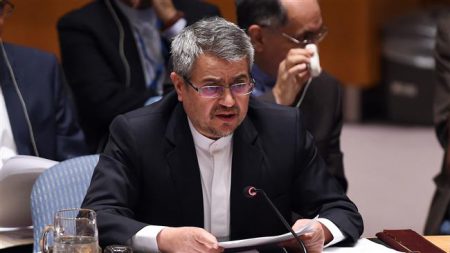
Iran’s ambassador to the UN Gholamali Khoshroo
Press TV – March 29, 2017
Iran’s ambassador to the UN Gholamali Khoshroo has called for the total eradication of nuclear weapons.
Khoshroo reiterated Iran’s call during a UN conference aimed at creating a nuclear weapons ban treaty in New York on Tuesday.
“Iran, as a victim of chemical weapons, strongly feels the danger posed by the existence of weapons of mass destruction and is determined to engage actively in international diplomatic efforts to save humanity from the menace of nuclear weapons,” he said.
Khoshroo stressed that Iran is committed to its Non-Proliferation Treaty (NPT) obligations, which include negotiations based on effective nuclear disarmament measures.
He added that several countries continue to ignore international calls and treaties for nuclear disarmament and even continue to increase their nuclear stockpiles. “They do not have political determination to abandon doctrines of nuclear deterrence and nuclear terror,” he went on to say.
Iran’s UN ambassador noted that boycotting the talks by many countries, including the US, shows that the world’s nuclear powers are by no means committed to the eradication of nuclear arms. Britain and France were also among the some 40 countries that did not join the talks.
“We note that prohibition of nuclear weapons must be accompanied by the elimination of such weapons. There can be no doubt that without complete abolition of nuclear weapons, there will be no absolute guarantee against the danger of nuclear war and the use of such weapons,” Khoshroo added.
UK, France sign deal to jointly develop new missiles
Press TV – March 29, 2017
Britain and France have signed an agreement to jointly develop long range missiles for future use by their navies and air forces.
British Minister for military purchases Harriett Baldwin and her visiting French counterpart Laurent Collet-Billon agreed in London on Tuesday to invest €50 million ( £43 million) each to begin a three-year concept phase for the project.
Dubbed the Future Cruise/Anti-Ship Weapon program, arms manufacturer MBDA would explore options to replace and improve existing naval and air force weapons systems over the next 10 years, according to a statement by the UK ministry of defense.
The concept phase is focused on determining the designs of the future weapons and cutting the risks to a minimum before heading to the next stage in the cooperation, the statement added.
Beside costs, both sides also agreed to freely use one another’s “national technology expertise, trials and test facilities.”
“As demonstrated by having Europe’s largest defense budget, the UK is committed to European security and we will continue to collaborate on joint defense programs across the continent,” Baldwin said.
Collet-Billon also hailed the agreement, calling it “the backbone of our ‘one complex weapon’ initiative.”
Formed by a merger of French Aérospatiale-Matra Missiles, Italian Alenia Marconi Systems and British Matra BAe Dynamics, MBDA already produces Storm Shadow/ SCALP EG long-range cruise missiles for the British and French air forces.
In late February, the two sides signed a £146 million deal to upgrade the £790,000 missile, which has a range of approximately 560 kilometers (300 nautical miles).
According to the British defense ministry, France is “the UK’s most important European Ally” and together, the two countries accounted for almost half of all military spending in Europe.
As London prepares to leave the European Union (EU) following last year’s July referendum, British officials have reassured their allies in Paris that nothing can undermine their military alliance.
“This is a day-to-day, intense partnership that has never been affected by whatever French or British-bashing was going on in either country in the last five years,” said Claire Chick, head of military affairs at the London-based Franco-British Council.
Why US Missile Defense May Trigger Development of ‘Satellite Killers’ in Russia
Sputnik – March 29, 2017
The US global missile defense system will threaten virtually all low Earth orbit spacecraft within the next 10-12 years, Russian experts Alexey Fenenko and Konstantin Sivkov told RIA Novosti. The experts suggested that one of the solutions to counter the threat is the development of similar systems by Russia.
The US anti-ballistic missile defense (ABM) system is likely to pose a real threat to the Russian low-altitude spacecraft in the near future, experts told RIA Novosti. They believe it may prompt Russia to begin developing similar systems.
Speaking at the Conference on Disarmament in Geneva, the Russian General Staff’s Deputy Chief Lt. Gen. Viktor Poznikhir warned that virtually all low Earth orbit space will soon fall within the US global missile defense system’s killing zone.
That means that the space activities of any country, including Russia and China, will be under threat, Gen. Poznikhir highlighted.
Speaking to RIA Novosti, Alexey Fenenko, Associate Professor at Moscow State University’s World Politics Department, emphasized that the US missile defense system will really threaten the Russian orbital grouping of satellites in the next 10-12 years.
“This could become a threat in just 10-12 years, but Russia, unfortunately, has yet to take action; meanwhile China is developing its own anti-satellite weapons, and we will have to do the same,” Fenenko said.
According to Fenenko, the US continues to conduct tests of anti-satellite weapons within the framework of the country’s ABM program.
“The first time they tested it was in 1985; the second test was conducted in 2008. In addition, the US national space strategy of 2006 stressed the necessity of creating weapons able to destroy an adversary’s satellites as part of US missile defense [capabilities],” the Russian academic explained.
He also recalled that within the framework of its Prompt Global Strike project, the US carried out several unsuccessful attempts to test the so-called “space weapon” — low Earth orbit vehicles. However, following a series of unsuccessful tests, Washington has shifted its focus to anti-satellite systems (ASAT).
Russian military expert and First Vice President of the Academy of Geopolitical Studies Konstantin Sivkov echoes Fenenko, suggesting that the threat posed by the US missile defense may prompt Moscow to develop a system which would be able to hit US low Earth orbit spacecraft at a distance of thousands of kilometers.
“The Americans have carried out tests of their SM-3 missile, and they have managed to shoot down a satellite. We need to create our own missile systems,” Sivkov told RIA Novosti.
He specified that Russia needs to design systems which would be able to shoot down satellites at a distance of hundreds or thousands of kilometers.
“The S-500 [Prometey anti-ballistic missile system] was designed as a missile defense system for the theater of war; we need a system that would hit satellites in quasi-stationary orbit drifting a few thousand kilometers above the Earth,” Sivkov suggested.
Sivkov emphasized that Russia is currently not involved in developing these systems; however, according to the military analyst, the US efforts to bolster its missile defense may force Russia to kick off such a project.
Previously, in his January interview with RIA Novosti, Sivkov drew attention to US Air Force Gen. John E. Hyten’s calls for “deterrence in space.”
Gen. Hyten claimed that “in the not-so-distant future” Moscow and Beijing will be able to threaten US spacecraft.
“We have to prevent that and the best way to prevent war is to be prepared for war. So the United States is going to do that, and we’re going to make sure that everybody knows we’re prepared for war,” Hyten said in his speech at Stanford University’s Center for Security and Cooperation.
Stressing that Hyten’s claims bear no relation to reality, Sivkov warned that the Pentagon is about to start a new arms race.
“In fact this is the way to justify the beginning of the large-scale militarization of space by the United States, under the pretext of a Russian or Chinese threat,” the Russian expert stressed.
Featured Video
John Mearsheimer: US Already lost Iran war – No off-ramp in sight
or go to
Aletho News Archives – Video-Images
Frlom the Archives
70 Neocons Petition Congress To Effectively Allow Israel To Say When The US Should Attack Iran
By Damian Lataan | January 10, 2014
Seventy senior Israeli-centric neoconservatives have written an open letter to Congress imploring them to do more to ensure Iran complies with the conditions of any agreement finally reached with the P5+1 over Iran’s nuclear program.
While the neocons are ostensibly asking Congress to ensure compliance, it is clear that their real aim is to convince members of Congress to support the bill currently passing through the Senate which calls for tighter sanctions against Iran in the event of any waywardness on Iran’s part.
The neocons are eager to see the bill currently passing through the Senate with enough support to make it veto-proof, not so much because they are concerned about Iran’s so-called nuclear weapons program – there’s still not a skerrick of hard evidence that Iran has a nuclear weapons program – but, rather, because embedded within the bill is this clause:
… if the Government of Israel is compelled to take military action in legitimate self-defense against Iran’s nuclear weapon program, the United States Government should stand with Israel and provide, in accordance with the law of the United States and the constitutional responsibility of Congress to authorize the use of military force, diplomatic, military, and economic support to the Government of Israel in its defense of its territory, people, and existence…
Essentially, the clause is an automatic trigger for the US to attack Iran at any time the Israelis choose to launch a first strike – regardless of whether President Obama is in favour or not.
Partial list… continue
Blog Roll
 Aletho News
- ‘Heinous crime’: Iran denounces Israeli assassination of 4 Iranian diplomats in Lebanon
- John Mearsheimer: U.S. Already Lost Iran War – No Off-Ramp in Sight
- UK Parliament Plans ISP Blocking and Age Verification Powers
- World cannot remain silent as US and Israel attack ‘heritage of humankind’: Iran
- Emirati billionaire rebukes US senator over call for Gulf states to join war with Iran
- Op. True Promise 4: Iran’s missile blitzkrieg dismantles US war machine in West Asia
- Aramco CEO warns ‘catastrophe’ imminent if Strait of Hormuz remains shut
- What If Iran Says No?
- Trump Threatens to ‘Hit’ Iran ‘Twenty Times Harder’ Over Strait of Hormuz Oil Flows
- Spare the hypocrisy: Baghaei slams Ursula’s support for US
- If Americans Knew
- Israel Decided the War, But Trump’s America Fights and Pays the Bill
- Conscientious Objector Group: Phone ‘Ringing Off Hook’ As Huge Mobilization Underway
- U.S. support for Israel continues to plummet, despite media’s best efforts
- Threats and missiles fly, death tolls soar in Iran, Lebanon, Gaza – Not a ceasefire Day 151
- Lebanon: Israel’s White Phosphorous Use Risks Civilian Harm
- Corporate Media Go All Out To Support The US-Israeli War On Iran
- US-Israel war on Iran is creating a steady growing number of amputees
- Israel planned this war on Iran for 40 years. Everything else is a smoke screen
- The wrong question about the war in Iran
- ‘Your Tax Dollars Being Used to Raise Your Gas Prices’: US-Israel Bomb Major Iranian Oil Depots
- No Tricks Zone
- New Study Documents A 20-Year Pause In Arctic Sea Ice Decline – Driven By Internal Variability
- Wake-up Call: Survey Shows Majority Of Germans Now Favor Postponing Climate Targets!
- Televised! Leading German Political Candidate Tells Schoolchildren CO2 Makes Sun Hotter!
- New Study: A Century Warming Of 1.1°C Is ‘Commonplace’ And ‘Not Unusual’ During This Interglacial
- New Study: ‘Internal Noise’ And Volcanic Forcing Can Trigger 10-15°C Warming Within Decades
- Glaciers Worldwide Are Suddendly Surging, Experts Blame Warming!
- Surprising Discovery: Sahara Is Greening…Billions Of Trees Where Once Thought To Be Barren
- New Research Reaffirms Clouds, Aerosols, And Surface Solar Radiation Are ‘Driving The Climate System’
- Germany: Electric Car Catches Fire At Charging Station, Sets Off Local “Inferno”, Widespread Damage
- New Study: Canada’s New Brunswick Was 1°C Warmer Than Today During The Medieval Warm Period
 Aletho News