French presidential candidate Le Pen predicts death of EU
Press TV – March 26, 2017
France’s far-right presidential candidate Marine Le Pen says the European Union will “die” and she vows to save France from globalization.
During a Sunday campaign rally in Lille, Le Pen said that the upcoming elections will be the next stage in a global popular rebellion.
“The European Union will die because the people do not want it anymore … arrogant and hegemonic empires are destined to perish,” she added.
She stressed that the time has arrived to overcome globalists, and added that her main rivals in the French presidential elections, conservative Francois Fillon and centrist Emmanuel Macron, were both guilty of treason because of their pro-EU and pro-market stances.
Le Pen added that she would replace the EU with a different Europe which she said would be called “the Europe of the people.”
“It must be done in a rational, well-prepared way,” she said in interview with Le Parisien daily. “I don’t want chaos. Within the negotiation calendar I want to carry out … the euro would be the last step because I want to wait for the outcome of elections in Germany in the autumn before renegotiating it,” she added.
McCain: ‘New World Order Under Enormous Strain’ Without US, EU Leadership
Sputnik – 27.03.2017
US Senator John McCain said on Friday that the world desperately needs the US and Europe to unite once more to preserve globalism.
The current chairman of the armed services committee in the US Senate said that Washington should restore cooperation with the EU — long one of America’s “most important alliances.”
The remarks came at the Brussels Forum, a conference organized by the transatlantic think tank German Marshall Fund. The globalist ideologue, who once was a presidential candidate for the Republican Party, has once again put himself in direct opposition to President Trump by saying that it is essential for the allies to develop more connectivity and cooperation.
“I trust the EU,” he said, elaborating that EU and NATO were “the best two sums in history” and have maintained global peace for the last 70 years.
“We need to rely on NATO and have a NATO that adjusts to new challenges.”
Earlier in January the new US President Donald Trump complimented the UK on its “smart” decision to withdraw from the EU and dubbed NATO an “obsolete” coalition.
McCain said he supported Trump’s calls on Europe to increase defense spending for NATO, but added that Americans should “also appreciate the fact that over 1,000 young [European] people have given their lives in Afghanistan or Iraq.”
“I don’t know what price tag you put on that,” he said. “That’s quite a contribution I would say, if you ask their mothers.”
McCain hesitated to prejudge Trump’s presidency based on his first months in office but said that he should fill intelligence gaps and address what the Senator believes was Russia’s attempts to influence the outcome of the US election in November.
McCain also accused Russia of trying to influence approaching elections in France and Germany, and the president of Russia Vladimir Putin in particular in trying to restore the Russian empire, despite providing no evidence for those allegations.
Russia’s banking system has SWIFT alternative ready
RT | March 23, 2017
If the Society for Worldwide Interbank Financial Telecommunication (SWIFT) is shut down in Russia, the country’s banking system will not crash, according to Central Bank Governor Elvira Nabiullina. Russia has a substitute.
“There were threats that we can be disconnected from SWIFT. We have finished working on our own payment system, and if something happens, all operations in SWIFT format will work inside the country. We have created an alternative,” Nabiullina said at a meeting with President Vladimir Putin on Wednesday.
She also added that 90 percent of ATMs in Russia are ready to accept the Mir payment system, a domestic version of Visa and MasterCard.
Izvestia daily reported that as of January 2016, 330 Russian banks had been connected to the SWIFT alternative, the system for transfer of financial messages (SPFS).
In 2014 and 2015, when the crisis in relations between Russia and the West were at their peak over Crimea and eastern Ukraine, some Western politicians urged disconnecting Russia from SWIFT.
In November 2015, Nabiullina said the SPFS was close to being completed.
The central bank’s website says the system was established “as an alternative channel for interbank cooperation with the aim of ensuring the guaranteed and uninterrupted provision of services for the transmission of electronic messages on financial transactions.”
At present, the system has some drawbacks. It doesn’t work from 9pm to 5am Moscow time and costs up to five cents per wire transfer, which is regarded expensive.
Japanese scientists reject lifting of ban on military research at universities
RT | March 26, 2017
The influential Science Council of Japan (SCJ) adopted a statement rejecting research at civilian institutions for military purposes. It comes in response to government investment in dual-use technologies.
The SCJ, which was created in 1949 as an independent body representing academia, warned Japanese universities and research institutions against participating in military-related research, the Japan Times reported. In a statement adopted by the council’s executive body on Friday, it said taking grants from the defense ministry would compromise scientific independence.
It comes after 10 months of deliberation by a 15-member committee, which was formed in May 2016 to consider whether the long-held opposition to military research should be overturned. The SCJ previously rejected military research in 1950, and again in 1967.
The policy statement carries no legal force, but the council’s opinion carries great weigh in Japanese scientific circles and the government.
The council was called to revise its policy, after Japan’s Defense Ministry boosted its funding of research into dual-use technologies, which can have both civilian and military applications. The funding almost doubled for 2017 to $96 million, compared to the previous year, according to The Asahi Shimbun.
The decision to reject military research came earlier in March. At the meeting on Friday, the council’s board debated on whether to adopt the statement directly or submit it to the SCJ General Assembly, which is to convene next month. The executives chose the former.
Japanese academia remains reluctant to deal with military technologies for historical reasons. Imperial Japan rounded up scientists to participate in the war effort during World War II.
Read more:
Iran announces sanctions on 15 US companies

Press TV – March 26, 2017
Iran has announced retaliatory sanctions on 15 American companies over their support for Israeli crimes and terrorism two days after Washington imposed bans on nearly a dozen foreign companies or individuals for aiding the Islamic Republic.
The Iranian Foreign Ministry said in a statement that these companies have directly and/or indirectly collaborated with the Israeli regime in committing its savage crimes in occupied Palestine, thrown their weight behind the regime’s terrorist acts or contributed to the expansion of illegal Israeli settlements in Palestinian territories in flagrant violation of UN Security Council Resolution 2334.
Therefore, any transactions with these companies and businesses shall be prohibited, their assets shall be subject to freezing, and no visas shall be issued for individuals holding positions in or associated with these corporations, the statement further noted.
The ministry also said Washington’s unilateral bans were imposed on Tehran “under fabricated pretexts,” censuring the restrictive measures as a violation of “international law” as well as the spirit and text of the 2015 nuclear deal, known as the Joint Comprehensive Plan of Action (JCPOA).
On Friday, the US State Department said Washington had sanctioned 30 foreign companies or individuals for transferring sensitive technology to Iran for its missile program or violating export controls on Iran, North Korea and Syria.
The statement further emphasized Iran’s resolve to develop its peaceful missile power as part of the nation’s “inalienable” right to enhance its deterrence and defense might in the face of threats.
The US sanctions targeted 11 companies or individuals from China, North Korea or the United Arab Emirates for transferring technology to Iran that it claimed could boost the country’s ballistic missile program.
Here is the list of the sanctioned US corporations:
– Beni Tal security company has collaborated with the Israeli military in the suppression of Palestinian people.
– United Technologies has sold Black Hawk military helicopters to the Israeli regime which have been used to bomb occupied territories and Palestinian refugee camps.
– Raytheon has supplied Israel with technologically advanced military weapons that have been used against Palestinian people during the Gaza war.
– ITT Corporation has provided the Israeli military with equipment it has used to stage nightly raids in Palestinian villages and refugee camps.
– Re/Max has been involved in illegal real estate transactions in Israeli settlements across occupied Palestinian territories.
– Oshkosh Corporation has been supplying the Israeli military with parts for armored vehicles used to restrain the Palestinian population.
– Magnum Research Inc. has collaborated with Israeli military industries in the manufacturing of firearms and military equipment.
– Kahr Arms has provided spare parts and developed light weapons used by the Israeli army in cooperation with the regime’s military industry.
– M7 Aerospace LP, purchased by US subsidiary of the Israeli military contractor Elbit Systems, has been active in the production and development of Israeli radar and missile systems.
– Military Armament Corporation has provided services and equipment linked to the weapons used by Israeli police.
– Lewis Machine and Tool Company has provided weapons spare parts and services to the Israeli military’s arms industry.
– Daniel Defense has provided the Israeli military’s arms industry with spare parts and services for weapons manufacturing.
– Bushmaster Firearms International has provided the Israeli military’s arms industry with spare parts and services for weapons manufacturing.
– O.F. Mossberg & Sons has supplied Israel with weapons, which are used by the regime’s military and police forces in the crackdown on Palestinian civilians.
– H-S Precision, Inc. has provided the Israeli regime with weapons manufacturing technology.
The Iranian Foreign Ministry stated that the list could expand to include more entities.
US Presence in Korea Drives Instability
By Ulson Gunnar – New Eastern Outlook – March 25, 2017
US and European interests continue to portray the government and nation of North Korea as a perpetual security threat to both Asia and the world. Allegations regarding the nation’s nuclear weapon and ballistic missile programs are continuously used as justification for not only a continuous US military presence on the Korean Peninsula, but as justification for a wider continued presence across all of Asia-Pacific.
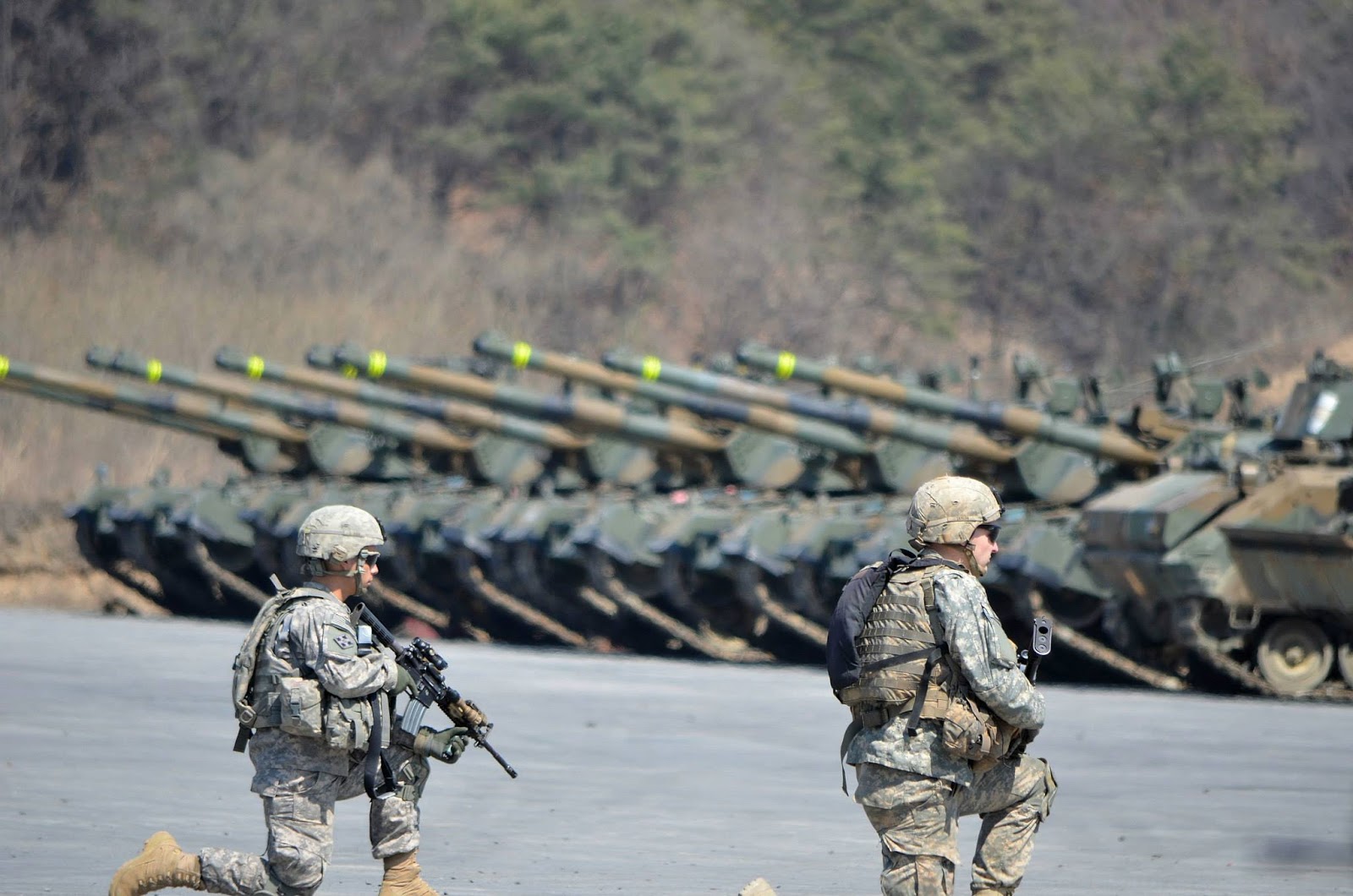
In reality, what is portrayed as an irrational and provocative posture by the North Korean government, is in fact driven by a very overt, and genuinely provocative posture by the United States and its allies within the South Korean government.
During this year’s Foal Eagle joint US-South Korean military exercises, US-European and South Korean media sources intentionally made mention of preparations for a “decapitation” strike on North Korea. Such an operation would be intended to quickly eliminate North Korean military and civilian leadership to utterly paralyze the state and any possible response to what would most certainly be the subsequent invasion, occupation and subjugation of North Korea.
The Business Insider in an article titled, “SEAL Team 6 is reportedly training for a decapitation strike against North Korea’s Kim regime,” would report:
The annual Foal Eagle military drills between the US and South Korea will include some heavy hitters this year — the Navy SEAL team that took out Osama bin Laden, Army Special Forces, and F-35s — South Korea’s Joon Gang Daily reports.
South Korean news outlets report that the SEALs, who will join the exercise for the first time, will simulate a “decapitation attack,” or a strike to remove North Korea’s leadership.
To introduce an element of plausible deniability to South Korean reports, the article would continue by stating:
Pentagon spokesman Cmdr. Gary Ross later told Business Insider that the US military “does not train for decapitation missions” of any kind.
Yet this is a categorically false statement. Throughout the entirety of the Cold War, US policymakers, military planners and operational preparations focused almost solely on devising methods of “decapitating” the Soviet Union’s political and military leadership.
In more recent years, policy papers and the wars inspired by them have lead to documented instances of attempted “decapitation” operations, including the 2011 US-NATO assault on Libya in which the government of Muammar Qaddafi was targeted by airstrikes aimed at crippling the Libyan state and assassinating both members of the Qaddafi family as well as members of the then ruling government.
Similar operations were aimed at Iraq earlier during the 2003 invasion and occupation by US-led forces.
Regarding North Korea more specifically, entire policy papers have been produced by prominent US policy think tanks including the Council on Foreign Relations (CFR) devising plans to decimate North Korea’s military and civilian leadership, invade and occupy the nation and confound North Korea’s capacity to resist what would inevitably be its integration with its southern neighbor.
A 2009 report titled, “Preparing for Sudden Change in North Korea,” lays out policy recommendations regarding regime change in North Korea. It states in its description:
The authors consider the challenges that these scenarios would pose–ranging from securing Pyongyang’s nuclear arsenal to providing humanitarian assistance–and analyze the interests of the United States and others. They then provide recommendations for U.S. policy. In particular, they urge Washington to bolster its contingency planning and capabilities in cooperation with South Korea, Japan, and others, and to build a dialogue with China that could address each side’s concerns.
Preparations for these documented plans which include provisions for invasion, occupation and the eventual integration of North Korea with South Korea have been ongoing for years with the most recent Foal Eagle exercises being merely their latest, and most blatant manifestation.
The aforementioned Business Insider article would also report:
Yet a decapitation force would fit with a March 1 Wall Street Journal report that the White House is considering military action against the Kim regime.
The SEALs boarded the USS Carl Vinson aircraft carrier and should arrive in South Korea on Wednesday, Joon Gang Daily reports.
South Korea has also made efforts toward a decapitation force, and international calls for action have increased in intensity after North Korea’s latest missile test, which simulated a saturation attack to defeat US and allied missile defenses.
While US-European and South Korean media platforms continue claiming such preparations are being made in reaction to North Korean military programs, careful analysis of North Korea and South Korea’s respective economic and military power reveal immense disparity and North Korea’s military capabilities as solely defensive with any first strike against its neighbors almost certainly leading to retaliation and the nation’s destruction.
North Korea’s nuclear arsenal and its expanding ballistic missile capabilities serve then only to raise the costs of any first strike carried out against it by US and South Korean forces. Claims that preparations by US and South Korean forces to carry out these first strikes are in response to North Korean provocations mirror similar political deceit that surrounded and clouded debate and analysis regarding US aggression in North Africa and the Middle East over the past two decades.
Ultimately, regardless of what political leaders in Washington or Seoul claim, the historical track record of the United States and its allies speaks for itself. Its annual military exercises and its adversarial approach to negotiations and relations with North Korea serve only to further drive tensions on both the peninsula and across the wider Asia-Pacific region.
For the United States, the perpetuation of instability helps justify its otherwise unjustifiable presence in a region literally an ocean away from its own borders. And while Washington cites “North Korean” weapons as a pretext for its continued presence in South Korea, its decades-spanning policy of encircling and attempting to contain neighboring China serves as its actual purpose for remaining involved in Korea’s affairs.
Provocative policies coupled with equally provocative military preparations including these most recent exercises openly aimed at North Korea’s leadership, guarantee continued instability and thus continued justification for a US presence in the region.
Washington’s careful cultivation of tensions on the peninsula serve as just one of many intentionally engineered and perpetuated conflicts across the region. Knowing well that nations targeted by US subversion and provocations will make preparations to defend against them, and possessing the media platforms to portray these preparations as “provocations” in and of themselves, the US has persuaded entire swaths of both its own population and those in regions inflicted by instability it itself drives, that Washington alone possesses the ability to contain such instability with its continued, extraterritorial presence.
In reality, the true solution for establishing peace and prosperity in these inflicted regions is for the US to simply withdraw.
Syria Will Fire Scuds at Israel in Response to Airstrikes
Sputnik – 26.03.2017
The Syrian government has announced that it will retaliate should Israel continue to conduct airstrikes on Syrian territory.
Any further airstrikes on Syrian territory will be met with deadly force and retaliation strikes deep within Israeli soil, they said.
According to the message, delivered via Russian mediators, attacks on Syrian military objects will be met with Scud missiles launched at Israeli military bases. If Israel attacks civilian infrastructure, Syrian missiles will be fired at Israel’s Haifa port and petrochemical plant. The missiles will be launched without any prior notice, the statement said.
The notice follows Syrian President Bashar al-Assad’s March 20 statement that protecting its borders is the right and obligation of every nation.
“Syria’s forceful response to the Israeli attacks changed the rules of the game,” said Syrian Ambassador to the UN Bashar al-Jaafari. He added that the threatened response is “appropriate and in line with Israel’s terrorist operation,” and that Israel “will now think a million times [before striking again].”
On March 17, Israeli military reported several airstrikes on Syrian territory; they were followed by several anti-aircraft missiles launched at Israeli warplanes flying over Syrian territory. One of the missiles was reportedly intercepted by Israel’s Arrow missile defense system. However, Syrian authorities claim they successfully downed an Israeli plane not far from Damascus.
Following the incidents, Israel threatened to conduct strikes specifically to destroy Syrian anti-air batteries.
According to Israeli leadership, the airstrikes are aimed at fighting advanced weapons smuggling to Hezbollah in Lebanon across Syrian territory.
“Our politics is very consistent,” Israeli Prime Minister Benjamin Netanyahu said in the wake of the airstrikes. “When we know about an attempt to smuggle weapons to Hezbollah, we do whatever we can to prevent this from happening, provided we have sufficient information and capabilities to react.”
According to media reports, during his meeting with Russian President Vladimir Putin, Netanyahu vowed to continue fighting attempts to smuggle weapons to Hezbollah through Syria. Netanyahu denied reports that he was told to cease military operations in Syria.
Israel and Syria have not engaged in any kind of serious military confrontation since civil war broke out in Syria six years ago. The sporadic, over-the-border fire is dismissed by Israeli authorities. There are about 800 Soviet-made Scud missiles, capable of delivering half a ton of explosives, located in Syria.
How US Flooded the World with Psyops
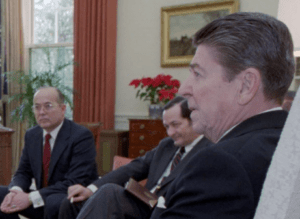
John Poindexter, Walter Raymond Jr. and Ronald Reagan. (Photo credit: Reagan presidential library)
By Robert Parry | Consortium News | March 25, 2017
Newly declassified documents from the Reagan presidential library help explain how the U.S. government developed its sophisticated psychological operations capabilities that – over the past three decades – have created an alternative reality both for people in targeted countries and for American citizens, a structure that expanded U.S. influence abroad and quieted dissent at home.
The documents reveal the formation of a psyops bureaucracy under the direction of Walter Raymond Jr., a senior CIA covert operations specialist who was assigned to President Reagan’s National Security Council staff to enhance the importance of propaganda and psyops in undermining U.S. adversaries around the world and ensuring sufficient public support for foreign policies inside the United States.
Raymond, who has been compared to a character from a John LeCarré novel slipping easily into the woodwork, spent his years inside Reagan’s White House as a shadowy puppet master who tried his best to avoid public attention or – it seems – even having his picture taken. From the tens of thousands of photographs from meetings at Reagan’s White House, I found only a couple showing Raymond – and he is seated in groups, partially concealed by other officials.
But Raymond appears to have grasped his true importance. In his NSC files, I found a doodle of an organizational chart that had Raymond at the top holding what looks like the crossed handles used by puppeteers to control the puppets below them. Although it’s impossible to know exactly what the doodler had in mind, the drawing fits the reality of Raymond as the behind-the-curtains operative who was controlling the various inter-agency task forces that were responsible for implementing various propaganda and psyops strategies.
Until the 1980s, psyops were normally regarded as a military technique for undermining the will of an enemy force by spreading lies, confusion and terror. A classic case was Gen. Edward Lansdale — considered the father of modern psyops — draining the blood from dead a Filipino rebel in such a way so the dead rebel’s superstitious comrades would think that a vampire-like creature was on the prowl. In Vietnam, Lansdale’s psyops team supplied fake and dire astrological predictions for the fate of North Vietnamese and Vietcong leaders.
Essentially, the psyops idea was to play on the cultural weaknesses of a target population so they could be more easily manipulated and controlled. But the challenges facing the Reagan administration in the 1980s led to its determination that peacetime psyops were also needed and that the target populations had to include the American public.
The Reagan administration was obsessed with the problems left behind by the 1970s’ disclosures of government lying about the Vietnam War and revelations about CIA abuses both in overthrowing democratically elected governments and spying on American dissidents. This so-called “Vietnam Syndrome” produced profound skepticism from regular American citizens as well as journalists and politicians when President Reagan tried to sell his plans for intervention in the civil wars then underway in Central America, Africa and elsewhere.
While Reagan saw Central America as a “Soviet beachhead,” many Americans saw brutal Central American oligarchs and their bloody security forces slaughtering priests, nuns, labor activists, students, peasants and indigenous populations. Reagan and his advisers realized that they had to turn those perceptions around if they hoped to get sustained funding for the militaries of El Salvador, Guatemala and Honduras as well as for the Nicaraguan Contra rebels, the CIA-organized paramilitary force marauding around leftist-ruled Nicaragua.
So, it became a high priority to reshape public perceptions to gain support for Reagan’s Central American military operations both inside those targeted countries and among Americans.
A ‘Psyops Totality’
As Col. Alfred R. Paddock Jr. wrote in an influential November 1983 paper, entitled “Military Psychological Operations and US Strategy,” “the planned use of communications to influence attitudes or behavior should, if properly used, precede, accompany, and follow all applications of force. Put another way, psychological operations is the one weapons system which has an important role to play in peacetime, throughout the spectrum of conflict, and during the aftermath of conflict.”
Paddock continued, “Military psychological operations are an important part of the ‘PSYOP Totality,’ both in peace and war. … We need a program of psychological operations as an integral part of our national security policies and programs. … The continuity of a standing inter-agency board or committee to provide the necessary coordinating mechanism for development of a coherent, worldwide psychological operations strategy is badly needed.”
Some of Raymond’s recently available handwritten notes show a focus on El Salvador with the implementation of “Nation wide multi-media psyops” spread through rallies and electronic media. “Radio + TV also carried Psyops messages,” Raymond wrote. (Emphasis in original.) Though Raymond’s crimped handwriting is often hard to decipher, the notes make clear that psyops programs also were directed at Honduras, Guatemala and Peru.
One declassified “top secret” document in Raymond’s file – dated Feb. 4, 1985, from Secretary of Defense Caspar Weinberger – urged the fuller implementation of President Reagan’s National Security Decision Directive 130, which was signed on March 6, 1984, and which authorized peacetime psyops by expanding psyops beyond its traditional boundaries of active military operations into peacetime situations in which the U.S. government could claim some threat to national interests.
“This approval can provide the impetus to the rebuilding of a necessary strategic capability, focus attention on psychological operations as a national – not solely military – instrument, and ensure that psychological operations are fully coordinated with public diplomacy and other international information activities,” Weinberger’s document said.
This broader commitment to psyops led to the creation of a Psychological Operations Committee (POC) that was to be chaired by a representative of Reagan’s National Security Council with a vice chairman from the Pentagon and with representatives from the Central Intelligence Agency, the State Department and the U.S. Information Agency.
“This group will be responsible for planning, coordinating and implementing psychological operations activities in support of United States policies and interests relative to national security,” according to a “secret” addendum to a memo, dated March 25, 1986, from Col. Paddock, the psyops advocate who had become the U.S. Army’s Director for Psychological Operations.
“The committee will provide the focal point for inter-agency coordination of detailed contingency planning for the management of national information assets during war, and for the transition from peace to war,” the addendum added. “The POC shall seek to ensure that in wartime or during crises (which may be defined as periods of acute tension involving a threat to the lives of American citizens or the imminence of war between the U.S. and other nations), U.S. international information elements are ready to initiate special procedures to ensure policy consistency, timely response and rapid feedback from the intended audience.”
Taking Shape
The Psychological Operations Committee took formal shape with a “secret” memo from Reagan’s National Security Advisor John Poindexter on July 31, 1986. Its first meeting was called on Sept. 2, 1986, with an agenda that focused on Central America and “How can other POC agencies support and complement DOD programs in El Salvador, Guatemala, Honduras, Costa Rica and Panama.” The POC was also tasked with “Developing National PSYOPS Guidelines” for “formulating and implementing a national PSYOPS program.” (Underlining in original)
Raymond was named a co-chair of the POC along with CIA officer Vincent Cannistraro, who was then Deputy Director for Intelligence Programs on the NSC staff, according to a “secret” memo from Deputy Under Secretary of Defense Craig Alderman Jr. The memo also noted that future POC meetings would be briefed on psyops projects for the Philippines and Nicaragua, with the latter project codenamed “Niagara Falls.” The memo also references a “Project Touchstone,” but it is unclear where that psyops program was targeted.
Another “secret” memo dated Oct. 1, 1986, co-authored by Raymond, reported on the POC’s first meeting on Sept. 10, 1986, and noted that “The POC will, at each meeting, focus on an area of operations (e.g., Central America, Afghanistan, Philippines).”
The POC’s second meeting on Oct. 24, 1986, concentrated on the Philippines, according to a Nov. 4, 1986 memo also co-authored by Raymond. “The next step will be a tightly drafted outline for a PSYOPS Plan which we will send to that Embassy for its comment,” the memo said. The plan “largely focused on a range of civic actions supportive of the overall effort to overcome the insurgency,” an addendum noted. “There is considerable concern about the sensitivities of any type of a PSYOPS program given the political situation in the Philippines today.”
Earlier in 1986, the Philippines had undergone the so-called “People Power Revolution,” which drove longtime dictator Ferdinand Marcos into exile, and the Reagan administration, which belatedly pulled its support from Marcos, was trying to stabilize the political situation to prevent more populist elements from gaining the upper hand.
But the Reagan administration’s primary attention continued to go back to Central America, including “Project Niagara Falls,” the psyops program aimed at Nicaragua. A “secret” Pentagon memo from Deputy Under Secretary Alderman on Nov. 20, 1986, outlined the work of the 4th Psychological Operations Group on this psyops plan “to help bring about democratization of Nicaragua,” by which the Reagan administration meant a “regime change.” The precise details of “Project Niagara Falls” were not disclosed in the declassified documents but the choice of code-name suggested a cascade of psyops.
Other documents from Raymond’s NSC file shed light on who other key operatives in the psyops and propaganda programs were. For instance, in undated notes on efforts to influence the Socialist International, including securing support for U.S. foreign policies from Socialist and Social Democratic parties in Europe, Raymond cited the efforts of “Ledeen, Gershman,” a reference to neoconservative operative Michael Ledeen and Carl Gershman, another neocon who has served as president of the U.S.-government-funded National Endowment for Democracy (NED), from 1983 to the present. (Underlining in original.)
Although NED is technically independent of the U.S. government, it receives the bulk of its funding (now about $100 million a year) from Congress. Documents from the Reagan archives also make clear that NED was organized as a way to replace some of the CIA’s political and propaganda covert operations, which had fallen into disrepute in the 1970s. Earlier released documents from Raymond’s file show CIA Director William Casey pushing for NED’s creation and Raymond, Casey’s handpicked man on the NSC, giving frequent advice and direction to Gershman. [See Consortiumnews.com’s “CIA’s Hidden Hand in ‘Democracy’ Groups.”]
Another figure in Raymond’s constellation of propaganda assets was media mogul Rupert Murdoch, who was viewed as both a key political ally of President Reagan and a valuable source of funding for private groups that were coordinating with White House propaganda operations. [See Consortiumnews.com’s “Rupert Murdoch: Propaganda Recruit.”]
In a Nov. 1, 1985 letter to Raymond, Charles R. Tanguy of the “Committees for a Community of Democracies – USA” asked Raymond to intervene in efforts to secure Murdoch’s funding for the group. “We would be grateful … if you could find the time to telephone Mr. Murdoch and encourage him to give us a positive response,” the letter said.
Another document, entitled “Project Truth Enhancement,” described how $24 million would be spent on upgrading the telecommunications infrastructure to arm “Project Truth, with the technical capability to provide the most efficient and productive media support for major USG policy initiatives like Political Democracy.” Project Truth was the overarching name of the Reagan administration’s propaganda operation. For the outside world, the program was billed as “public diplomacy,” but administration insiders privately called it “perception management.” [See Consortiumnews.com’s “The Victory of Perception Management.”]
The Early Years
The original priority of “Project Truth” was to clean up the images of the Guatemalan and Salvadoran security forces and the Nicaraguan Contras, who were led by ousted dictator Anastasio Somoza’s ex-National Guard officers. To ensure steady military funding for these notorious forces, Reagan’s team knew it had to defuse the negative publicity and somehow rally the American people’s support.
At first, the effort focused on weeding out American reporters who uncovered facts that undercut the desired public images. As part of that effort, the administration denounced New York Times correspondent Raymond Bonner for disclosing the Salvadoran regime’s massacre of about 800 men, women and children in the village of El Mozote in northeast El Salvador in December 1981. Accuracy in Media and conservative news organizations, such as The Wall Street Journal’s editorial page, joined in pummeling Bonner, who was soon ousted from his job. But such efforts were largely ad hoc and disorganized.
CIA Director Casey, from his years crisscrossing the interlocking worlds of business and intelligence, had important contacts for creating a more systematic propaganda network. He recognized the value of using established groups known for advocating “human rights,” such as Freedom House.
One document from the Reagan library showed senior Freedom House official Leo Cherne running a draft manuscript on political conditions in El Salvador past Casey and promising that Freedom House would make requested editorial “corrections and changes” – and even send over the editor for consultation with whomever Casey assigned to review the paper.
In a “Dear Bill” letter dated June 24, 1981, Cherne, who was chairman of the Freedom House’s executive committee, wrote: “I am enclosing a copy of the draft manuscript by Bruce McColm, Freedom House’s resident specialist on Central America and the Caribbean. This manuscript on El Salvador was the one I had urged be prepared and in the haste to do so as rapidly as possible, it is quite rough. You had mentioned that the facts could be checked for meticulous accuracy within the government and this would be very helpful. …
“If there are any questions about the McColm manuscript, I suggest that whomever is working on it contact Richard Salzmann at the Research Institute [an organization where Cherne was executive director]. He is Editor-in-Chief at the Institute and the Chairman of the Freedom House’s Salvador Committee. He will make sure that the corrections and changes get to Rita Freedman who will also be working with him. If there is any benefit to be gained from Salzmann’s coming down at any point to talk to that person, he is available to do so.”
By 1982, Casey also was lining up some powerful right-wing ideologues to help fund the “perception management” project both with money and their own media outlets. Richard Mellon Scaife was the scion of the Mellon banking, oil and aluminum fortune who financed a variety of right-wing family foundations – such as Sarah Scaife and Carthage – that were financial benefactors to right-wing journalists and think tanks. Scaife also published the Tribune Review in Pittsburgh, Pennsylvania.
A more comprehensive “public diplomacy” operation began to take shape in 1982 when Raymond, a 30-year veteran of CIA clandestine services, was transferred to the NSC. Raymond became the spark plug for this high-powered propaganda network, according to an unpublished draft chapter of the congressional Iran-Contra investigation that was suppressed as part of the deal to get three moderate Republican senators to sign on to the final report and give the inquiry a patina of bipartisanship.
Though the draft chapter didn’t use Raymond’s name in its opening pages, apparently because some of the information came from classified depositions, Raymond’s name was used later in the chapter and the earlier citations matched Raymond’s known role. According to the draft report, the CIA officer who was recruited for the NSC job had served as Director of the Covert Action Staff at the CIA from 1978 to 1982 and was a “specialist in propaganda and disinformation.”
“The CIA official [Raymond] discussed the transfer with [CIA Director] Casey and NSC Advisor William Clark that he be assigned to the NSC as [Donald] Gregg’s successor [as coordinator of intelligence operations in June 1982] and received approval for his involvement in setting up the public diplomacy program along with his intelligence responsibilities,” the chapter said. Gregg was another senior CIA official who was assigned to the NSC before becoming Vice President George H.W. Bush’s national security adviser.
“In the early part of 1983, documents obtained by the Select [Iran-Contra] Committees indicate that the Director of the Intelligence Staff of the NSC [Raymond] successfully recommended the establishment of an inter-governmental network to promote and manage a public diplomacy plan designed to create support for Reagan Administration policies at home and abroad.”
War of Ideas
During his Iran-Contra deposition, Raymond explained the need for this propaganda structure, saying: “We were not configured effectively to deal with the war of ideas.”
One reason for this shortcoming was that federal law forbade taxpayers’ money from being spent on domestic propaganda or grassroots lobbying to pressure congressional representatives. Of course, every president and his team had vast resources to make their case in public, but by tradition and law, they were restricted to speeches, testimony and one-on-one persuasion of lawmakers. But President Reagan saw the American public’s “Vietnam Syndrome” as an obstacle to his more aggressive policies.
Along with Raymond’s government-based organization, there were outside groups eager to cooperate and cash in. Back at Freedom House, Cherne and his associates were angling for financial support.
In an Aug. 9, 1982 letter to Raymond, Freedom House executive director Leonard R. Sussman wrote that “Leo Cherne has asked me to send these copies of Freedom Appeals. He has probably told you we have had to cut back this project to meet financial realities. … We would, of course, want to expand the project once again when, as and if the funds become available. Offshoots of that project appear in newspapers, magazines, books and on broadcast services here and abroad. It’s a significant, unique channel of communication” – precisely the focus of Raymond’s work.
On Nov. 4, 1982, Raymond, after his transfer from the CIA to the NSC staff but while still a CIA officer, wrote to NSC Advisor Clark about the “Democracy Initiative and Information Programs,” stating that “Bill Casey asked me to pass on the following thought concerning your meeting with [right-wing billionaire] Dick Scaife, Dave Abshire [then a member of the President’s Foreign Intelligence Advisory Board], and Co. Casey had lunch with them today and discussed the need to get moving in the general area of supporting our friends around the world.
“By this definition he is including both ‘building democracy’ … and helping invigorate international media programs. The DCI [Casey] is also concerned about strengthening public information organizations in the United States such as Freedom House. … A critical piece of the puzzle is a serious effort to raise private funds to generate momentum. Casey’s talk with Scaife and Co. suggests they would be very willing to cooperate. … Suggest that you note White House interest in private support for the Democracy initiative.”
The importance of the CIA and White House secretly arranging private funds was that these supposedly independent voices would then reinforce and validate the administration’s foreign policy arguments with a public that would assume the endorsements were based on the merits of the White House positions, not influenced by money changing hands. Like snake-oil salesmen who plant a few cohorts in the crowd to whip up excitement for the cure-all elixir, Reagan administration propagandists salted some well-paid “private” individuals around Washington to echo White House propaganda “themes.”
The role of the CIA in these initiatives was concealed but never far from the surface. A Dec. 2, 1982 note addressed to “Bud,” a reference to senior NSC official Robert “Bud” McFarlane, described a request from Raymond for a brief meeting. “When he [Raymond] returned from Langley [CIA headquarters], he had a proposed draft letter … re $100 M democ[racy] proj[ect],” the note said.
While Casey pulled the strings on this project, the CIA director instructed White House officials to hide the CIA’s hand. “Obviously we here [at CIA] should not get out front in the development of such an organization, nor should we appear to be a sponsor or advocate,” Casey said in one undated letter to then-White House counselor Edwin Meese III as Casey urged creation of a “National Endowment.”
But the formation of the National Endowment for Democracy, with its hundreds of millions of dollars in U.S. government money, was still months down the road. In the meantime, the Reagan administration would have to line up private donors to advance the propaganda cause.
“We will develop a scenario for obtaining private funding,” NSC Advisor Clark wrote to Reagan in a Jan. 13, 1983 memo, adding that U.S. Information Agency Director “Charlie Wick has offered to take the lead. We may have to call on you to meet with a group of potential donors.”
Despite Casey’s and Raymond’s success in bringing onboard wealthy conservatives to provide private funding for the propaganda operations, Raymond worried about whether a scandal could erupt over the CIA’s involvement. Raymond formally resigned from the CIA in April 1983, so, he said, “there would be no question whatsoever of any contamination of this.” But Raymond continued to act toward the U.S. public much like a CIA officer would in directing a propaganda operation in a hostile foreign country.
Raymond fretted, too, about the legality of Casey’s ongoing role. Raymond confided in one memo that it was important “to get [Casey] out of the loop,” but Casey never backed off and Raymond continued to send progress reports to his old boss well into 1986.
It was “the kind of thing which [Casey] had a broad catholic interest in,” Raymond shrugged during his Iran-Contra deposition. He then offered the excuse that Casey undertook this apparently illegal interference in domestic politics “not so much in his CIA hat, but in his adviser to the president hat.”
Peacetime Propaganda
Meanwhile, Reagan began laying out the formal authority for this unprecedented peacetime propaganda bureaucracy. On Jan. 14, 1983, Reagan signed National Security Decision Directive 77, entitled “Management of Public Diplomacy Relative to National Security.” In NSDD-77, Reagan deemed it “necessary to strengthen the organization, planning and coordination of the various aspects of public diplomacy of the United States Government.”
Reagan ordered the creation of a special planning group within the National Security Council to direct these “public diplomacy” campaigns. The planning group would be headed by Walter Raymond and one of its principal outposts would be a new Office of Public Diplomacy for Latin America, housed at the State Department but under the control of the NSC. (One of the directors of the Latin American public diplomacy office was neoconservative Robert Kagan, who would later co-found the Project for the New American Century in 1998 and become a chief promoter of President George W. Bush’s 2003 invasion of Iraq.)
On May 20, 1983, Raymond recounted in a memo that $400,000 had been raised from private donors brought to the White House Situation Room by U.S. Information Agency Director Charles Wick. According to that memo, the money was divided among several organizations, including Freedom House and Accuracy in Media, a right-wing media attack organization.
When I wrote about that memo in my 1992 book, Fooling America, Freedom House denied receiving any White House money or collaborating with any CIA/NSC propaganda campaign. In a letter, Freedom House’s Sussman called Raymond “a second-hand source” and insisted that “this organization did not need any special funding to take positions … on any foreign-policy issues.”
But it made little sense that Raymond would have lied to a superior in an internal memo. And clearly, Freedom House remained central to the Reagan administration’s schemes for aiding groups supportive of its Central American policies, particularly the CIA-organized Contra war against the leftist Sandinista regime in Nicaragua. Plus, White House documents released later revealed that Freedom House kept its hand out for funding.
On Sept. 15, 1984, Bruce McColm – writing from Freedom House’s Center for Caribbean and Central American Studies – sent Raymond “a short proposal for the Center’s Nicaragua project 1984-85. The project combines elements of the oral history proposal with the publication of The Nicaraguan Papers,” a book that would disparage Sandinista ideology and practices.
“Maintaining the oral history part of the project adds to the overall costs; but preliminary discussions with film makers have given me the idea that an Improper Conduct-type of documentary could be made based on these materials,” McColm wrote, referring to a 1984 film that offered a scathing critique of Fidel Castro’s Cuba. “Such a film would have to be the work of a respected Latin American filmmaker or a European. American-made films on Central America are simply too abrasive ideologically and artistically poor.”
McColm’s three-page letter reads much like a book or movie pitch, trying to interest Raymond in financing the project: “The Nicaraguan Papers will also be readily accessible to the general reader, the journalist, opinion-maker, the academic and the like. The book would be distributed fairly broadly to these sectors and I am sure will be extremely useful. They already constitute a form of Freedom House samizdat, since I’ve been distributing them to journalists for the past two years as I’ve received them from disaffected Nicaraguans.”
McColm proposed a face-to-face meeting with Raymond in Washington and attached a six-page grant proposal seeking $134,100. According to the grant proposal, the project would include “free distribution to members of Congress and key public officials; distribution of galleys in advance of publication for maximum publicity and timely reviews in newspapers and current affairs magazines; press conferences at Freedom House in New York and at the National Press Club in Washington, D.C.; op-ed circulation to more than 100 newspapers …; distribution of a Spanish-language edition through Hispanic organizations in the United States and in Latin America; arrangement of European distribution through Freedom House contacts.”
The documents that I found at the Reagan library did not indicate what subsequently happened to this specific proposal. McColm did not respond to an email request for comment about the Nicaraguan Papers plan or the earlier letter from Cherne (who died in 1999) to Casey about editing McComb’s manuscript. Freedom House did emerge as a leading critic of Nicaragua’s Sandinista government and also became a major recipient of money from the U.S.-funded National Endowment for Democracy, which was founded in 1983 under the umbrella of the Casey-Raymond project.
The more recently released documents – declassified between 2013 and 2017 – show how these earlier Casey-Raymond efforts merged with the creation of a formal psyop bureaucracy in 1986 also under the control of Raymond’s NSC operation. The combination of the propaganda and psyop programs underscored the powerful capability that the U.S. government developed more than three decades ago for planting slanted, distorted or fake news. (Casey died in 1987; Raymond died in 2003.)
Over those several decades, even as the White House changed hands from Republicans to Democrats to Republicans to Democrats, the momentum created by William Casey and Walter Raymond continued to push these “perception management/psyops” strategies forward. In more recent years, the wording has changed, giving way to more pleasing euphemisms, like “smart power” and “strategic communications.” But the idea is still the same: how you can use propaganda to sell U.S. government policies abroad and at home.
Investigative reporter Robert Parry broke many of the Iran-Contra stories for The Associated Press and Newsweek in the 1980s.
NATO troops head for Poland ‘to deter Russian offensive actions’
RT | March 25, 2017
At least 1,350 American, British and Romanian soldiers have been sent to Poland from a base in Germany. US commanders said that the troops were ready “to deter Russian aggressive actions.”
The US, British and Romanian soldiers left the Rose Barracks military base in Vilseck, western Germany, for Poland where they are expected take part in NATO’s mission. The troops are “fully prepared to deter Russian offensive actions,” US Colonel Patrick Ellis said at the departure ceremony on Saturday.
“As a result of Russia’s aggressive actions and in light of the changing and evolving security environment, at the Warsaw summit in July 2016 NATO members agreed to strengthen our deterrence and defensive posture,” US Major General Timothy P. McGuire said.
The NATO group is to be stationed in the town of Orzysz, 220 kilometers northeast of the capital, Warsaw, according to Reuters.
NATO troops in Estonia
Also on Saturday, NATO’s heavy armored vehicles of the French armed forces were delivered to Estonia, according to a video published by the General Staff of the Estonian Defense Forces.
France’s heavy armored vehicles include Leclerc tanks and VBCI infantry fighting vehicles, as well as dozens of VAB armored vehicles, a spokesman of the 1st Infantry Brigade said, according to the Kuulutaja newspaper.
The UK is to deliver Challenger 2, Titan and Trojan tanks to Estonia as well as self-propelled artillery mounts AS90, Warrior infantry fighting vehicles and reconnaissance drones, he added.
The battalion will be stationed in the military town of Tapa and will interact with the first infantry brigade of the Estonian Defense Forces.
The alignment of forces in Estonia is planned to finish in early April. By that time, Estonia is to host 800 soldiers from the UK and around 300 soldiers from France. The French group is to spend some eight months in the Baltic country. After that, Danish soldiers are expected to replace them.
NATO leaders agreed to deploy four multinational battalions to Poland as well as Estonia, Lithuania and Latvia on July 8 at the summit in Warsaw.
Russia has repeatedly criticized NATO’s military buildup along its borders, seen as a threat to national security.
In February, Russian President Vladimir Putin blamed NATO for provoking a conflict with Moscow and using its “newly-declared official mission to deter Russia” as a pretext.
Speaking at the Munich Security Conference in February, Russian Foreign Minister Sergey Lavrov noted that “NATO’s expansion has led to an unprecedented level of tension over the last 30 years in Europe.”
Moscow has condemned the new US ground-based missile defense system in Eastern Europe and increased presence of NATO vessels in the Black Sea.
US Imposes Sanctions Against 8 Russian Companies – US State Department
Sputnik – 25.03.2017
WASHINGTON – The United States has imposed sanctions against eight Russian companies in connection with the Iran, North Korea, and Syria Nonproliferation Act (INKSNA), US State Department representative told Sputnik on Saturday.
“Penalties are being applied to eight Russian entities as a result of a regular, periodic review of specific activities as required by the Iran, North Korea, and Syria Nonproliferation Act,” the representative said.
The representative also stressed that these sanctions “are separate from the broader economic sanctions that have been in place since 2014” in connection with the Crimea’s reunification with Russia and the conflict in eastern Ukraine.
The United States imposed sanctions on 150th Aircraft Repair Plant, Aviaexport, Bazalt, Kolomna Design Bureau of Machine-Building (KBM), Rosoboronexport (ROE), Ulyanovsk Higher Aviation Academy of Civil Aviation (UVAUGA), Ural Training Center for Civil Aviation (UUTsCA), Zhukovskiy and Gagarin Academy (Z&G Academy).
Israel bans annual Nakba march
Ma’an – March 25, 2017
BETHLEHEM – Israeli police have refused to grant a permit for the annual March of Return this year organized by Palestinians to commemorate the Nakba, or “catastrophe,” alongside Israeli independence day, Israeli media reported on Thursday.
According to Israeli newspaper Haaretz, Israeli police claimed that the event was refused due to their inability to provide police presence necessary for a march expected to be attended by 25,000 Palestinian citizens of Israel and their supporters, saying that “it’s unfortunate that the organizers decided to conduct the march exactly on the day of Independence Day, when there are hundreds of approved events throughout the country.”
The march, which has been held for 18 consecutive years, is aimed at highlighting the internationally-recognized right of Palestinians who remain refugees or internally displaced to return to their homes and villages in Israel, a right which is upheld in United Nations Resolution 194.
Each year, the march is launched from a site of a Palestinian village destroyed by Israeli forces in 1948.
Muhammad Bassam, an attorney from the Israeli rights group Adalah, reportedly said that if the permit for the march was not granted by Israeli police, the group would appeal to Israel’s Supreme Court. “The police decision is very strange and raises concerns that the refusal to approve the event is politically motivated,” he said.
Others pointed out to Haaretz that the organizers had already discussed the march with local police in the Israeli coastal city of Nahariya in order to launch the march from the destroyed Palestinian village of al-Kabri.
The Nahariya police had toured the planned route of the march two weeks prior, Haaretz reported, with the police already setting the police requirements for the march, leading some to suspect that the permit rejection was politically motivated.
The March of Return is usually held on Israel’s independence day to commemorate the Nakba, referring to the mass expulsion of Palestinians from their homes and villages during the 1948 Arab-Israeli war that established the state of Israel.
The official commemoration of the Nakba is held on May 15 and is observed by millions of Palestinians and rights activists around the world.
Some 750,000 Palestinians were expelled from their lands in 1948 and were scattered across refugee camps in the occupied West Bank, the Gaza Strip, Jordan, Lebanon, and Syria, according to the United Nations Relief and Works Agency (UNRWA). Today, there are over five million Palestinian refugees who remain displaced from their original homes and villages following the mass expulsion that occurred almost 70 years ago.
Featured Video

Michael von der Schulenburg: Europe’s Self-Defeating Iran War Policy
or go to
Aletho News Archives – Video-Images
Frlom the Archives
Who Rules America?
The Power Elite in the Time of Trump
By James Petras | Axis of Logic | September 6, 2017
Introduction
In the last few months, several competing political, economic and military sectors – linked to distinct ideological and ethnic groups – have clearly emerged at the centers of power.
We can identify some of the key competing and interlocking directorates of the power elite:
- Free marketers, with the ubiquitous presence of the ‘Israel First’ crowd.
- National capitalists, linked to rightwing ideologues.
- Generals, linked to the national security and the Pentagon apparatus, as well as defense industry.
- Business elites, linked to global capital.
This essay attempts to define the power wielders and evaluate their range of power and its impact. … continue
Blog Roll
 Aletho News
- Michael von der Schulenburg: Europe’s Self-Defeating Iran War Policy
- Sorry, The New Republic, Climate Change Isn’t Causing Somali Migration. Blame Civil Strife and Poverty.
- Expert Guts Claims That HPV Vaccine Reduces Cancer Risk
- No evidence Russia sabotaged Baltic cables – Finnish intel
- The Strategic Folly of a (Serious) US Ground Invasion of Iran
- US-Israeli war of aggression on Iran meant to reshape region: Omani FM
- Iran Does Not Consider Israel Party to Talks to Need Mediators With It – Ambassador
- Macron’s aircraft carrier and warplanes to the Persian Gulf is a dangerous vanity project
- Meet The Ellisons: Zionists, Technocrats, Moguls
- US failures in Iran reveal Russia is key to South Korea’s strategic security
- If Americans Knew
- Are we on the precipice of World War III?
- ‘Catastrophic,’ Says UNICEF: 1,100+ Children Killed or Wounded in Mideast Since US-Israel Launched Iran War
- The Unbelievable Madness of Our War With Iran
- World Council of Churches calls on govts to hold Israel accountable for violations of intl law
- How to end the war on Iran that costs US taxpayers $1M per minute – Not a ceasefire Day 153
- Israeli strategic plans to “remake the Middle East” from the 1950s and since
- Honoring Gaza’s women who refused to let the world look away
- 97% of victims of war on Iran are Iranian, 98% of victims in war on Gaza are Gazans – Not a ceasefire Day 152
- Early Iran strikes cost $5.6 billion in munitions, Pentagon estimates
- Israel Decided the War, But Trump’s America Fights and Pays the Bill
- No Tricks Zone
- New Studies: UK Sea Levels Were 4 Meters Higher Than Today During The Mid-Holocene
- Destructive Green New Deal: German Energy And Metal Group Warns Of Drastic Crisis
- New Study Documents A 20-Year Pause In Arctic Sea Ice Decline – Driven By Internal Variability
- Wake-up Call: Survey Shows Majority Of Germans Now Favor Postponing Climate Targets!
- Televised! Leading German Political Candidate Tells Schoolchildren CO2 Makes Sun Hotter!
- New Study: A Century Warming Of 1.1°C Is ‘Commonplace’ And ‘Not Unusual’ During This Interglacial
- New Study: ‘Internal Noise’ And Volcanic Forcing Can Trigger 10-15°C Warming Within Decades
- Glaciers Worldwide Are Suddendly Surging, Experts Blame Warming!
- Surprising Discovery: Sahara Is Greening…Billions Of Trees Where Once Thought To Be Barren
- New Research Reaffirms Clouds, Aerosols, And Surface Solar Radiation Are ‘Driving The Climate System’
 Aletho News