U.N. says Gaza is ‘de-developing’ even faster than expected, but omits main cause
By Kathryn Shihadah | If Americans Knew | July 16, 2017
The United Nations has often provided valuable reports on the situation in the Palestinian Occupied Territories (although in at least one case the UN removed such a report following pressure from Israel and the United States – see this, this, and this).
The UN’s latest report on the region, “Gaza Ten Years Later,” contains much valuable, factual information. However, parts of the report exhibit a troubling lack of proportionality. This flaw is then maintained in quoted comments on the UN report by National Public Radio journalist Daniel Estrin.
Below is the NPR news story on the UN report, with comments in Italics that discuss some of its statements:
U.N. Says Gaza Is ‘De-Developing’ Even Faster Than Expected, by Merrit Kennedy, NPR
Five years ago, the U.N. warned that Gaza is expected to be unlivable by 2020. A new report now says conditions are deteriorating there even faster than it forecast.
“What needed to happen has not happened, and the indicators are accelerating instead of slowing down,” Robert Piper, the U.N. Coordinator for Humanitarian Aid and Development Activities in the Occupied Palestinian Territory, told NPR’s Daniel Estrin.
“In a nutshell, Gaza continues to de-develop in front of our eyes,” Piper adds. “From health care, to unemployment, to energy, to access to water, across all of these fields, Gaza’s 2 million people are seeing faster and faster decline in their living conditions.”
The population of Gaza, a 130-square-mile strip of land on the Mediterranean, is growing faster than projected, while infrastructure and services haven’t been able to keep up. The population is now forecast to reach 2.2 million people in 2020, up from the 2012 projection of 2.13 million.
The UN report, and the NPR discussion, correctly highlight the rapid pace at which Gaza is moving toward humanitarian disaster. However, as the discourse continues, a moral equivalence fallacy begins to emerge. Daniel lists three sources of Gaza’s trouble:
“Many of the problems stem from the Hamas takeover of Gaza 10 years ago, Israel and Egypt’s blockade of Gaza and the Palestinian Authority’s recent reduction of electricity to Gaza to pressure its rival Hamas,” Daniel reports.
What’s wrong with this picture?
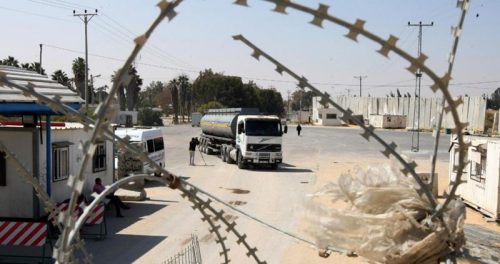
Undoubtedly, Hamas’ feud with the PA is part of the problem; so are the electricity shortage and the closed crossing to Egypt. But placing these factors on par with Israel’s now ten-year-long blockade ignores the facts—some of which are spelled out in the UN report:
Israel retains full control of all movement of people and goods to and from Gaza by sea, air and land, with the exception of a 12 km strip of border with Egypt…Following the expulsion of the PA by Hamas in the summer of 2007, the Israeli Government declared Gaza “hostile territory” and, again citing security concerns, announced a number of new sanctions and restrictions on the access and movement of people and goods, ultimately amounting to a blockade by sea, air and land. Many of the restrictions imposed then, are still in place. (Italics added)
It is worth taking a moment to discuss the question of Hamas, which continues to be a scapegoat for Gaza’s ongoing crisis. Hamas’ complicated rivalry with, and appropriation of power from, Fatah and the PA–and its reputation as a terrorist organization–need to be challenged.
Hamas won a democratic election in Gaza and the West Bank (in spite of the US spending $2.3 million to support Fatah and Israeli obstruction), and was promptly discredited by the US and the EU. Israel commenced sanctions only 3 days after the election. These reactions were nothing short of collective punishment by world superpowers, simply because the “wrong” party won. The charge that Hamas is nothing but a terrorist group, and Palestinians elected Hamas leaders to destroy Israel, shows a profound misunderstanding of Hamas and its rise to power.
Neve Gordon explained in this excellent 2006 article that “the organization’s popularity in the Occupied Territories actually stems from its being seen as the voice of Palestinian dignity and the symbol of the defense of Palestinian rights at a time of unprecedented hardship, humiliation, and despair…In other words, Hamas was elected not only because it is considered an alternative to the corrupt Palestinian Authority, but also because Israel created the conditions that made it an indispensable social movement.”
Back to the de-development of Gaza. In his discussion of the Gaza crisis, Daniel also neglects to mention the three assaults by Israel in 2008, 2012, and 2014. The UN report does mention them, but the description is problematic:
In addition to the impact of the violent Hamas takeover and ensuing Israeli measures imposed in 2007, three rounds of armed hostilities between Israel and Hamas – with the most devastating round in 2014 – have dealt repeated blows to the Gazan economy and damaged essential infrastructure.
These words may be technically accurate: yes, Hamas took over Gaza amid violence; yes, Israel imposed “measures” in 2007; yes, there have been three rounds of “armed hostilities”—but the statement is egregiously inequitable. It is absurd to suggest that the Hamas takeover was equally as damaging to Gaza as the three deadly assaults by Israel were. And the portrayal of the hostilities as though between two equal, evenly-matched armies when Israel has the latest weaponry and Gaza is essentially unarmed, is patently false. Here is a more precise description of the lopsided outcome of the hostilities, found further along in the UN report:
The first major round of hostilities broke out on 27 December 2008 and lasted for more than three weeks. During this time, nearly 1,400 Palestinians and 13 Israelis18 were killed and some 60,000 homes were damaged or destroyed…The second major escalation of hostilities began on 14 November 2012 and lasted for one week, in which 174 Palestinians, including 107 civilians, and six Israelis, of which three were civilians, were killed, and some 10,000 homes damaged. The latest, and most devastating round of hostilities, took place between 8 July and 26 August 2014. During these 51 days, 2,251 Palestinians, including at least 146 civilians, and 71 Israelis, of whom five were civilians, were killed, and 171,000 homes were damaged.
The death toll after three “rounds of hostilities” was 3,825 Palestinians and 90 Israelis. The total number of homes damaged was 241,000—all Palestinian. In addition, schools, hospitals, and power plants were decimated. This is not a description of the aftermath of “war,” but of blitzkrieg.
The NPR story goes on to mention in passing Israel’s regulation of the border—without acknowledging the seriousness of the closure and how it affects any attempts at reconstruction. He even equates Israel’s meddling with Egyptian actions, although Egypt shares only a 7-mile border vs. Israel’s which is 32 miles long and a much greater object of hostility. Here is the statement:
Israel maintains tight control over the movement of people and goods from all sides of Gaza, aside from the 7-mile-long border Gaza shares with Egypt, which is rarely open.
The UN report describes more fully the impact the closure is having on efforts to rebuild over the last three years. This is not just “tight control”—it is crippling restriction on building materials and other critical supplies:
[Restrictions] imposed on the Strip continue to significantly impact the daily lives of Gaza’s inhabitants and the efforts of the international community to implement humanitarian and development projects. Israel considers many materials needed for these projects to be ‘dual-use’ and posing security concerns, thus subjecting them to severe import restrictions. These include construction materials, raw material for the productive sectors, including wood and pesticides, medical equipment and water pumps necessary to deal with seasonal flooding.
It is worth noting that Israeli limitation of imports included (in 2010, and is mostly still in place) wood for construction, cement, iron, tarps (for roofs on huts), fishing rods, farm animals, many spare parts for farming equipment, notebooks, pens, pencils, and toys.
The NPR report then moves on to the topic of water:
By the end of 2017, the U.N. projects Gaza’s only water aquifer will be depleted. The damage could be irreversible by 2020 due to salt water entering the aquifer. That would be “catastrophic,” the report says, and the “living and health conditions of the people of Gaza can only further deteriorate, exposing the population to water-borne illnesses, and other threats.”
The U.N. had previously said that the aquifer would be depleted by 2016, earlier than the current projection. Piper says this small piece of positive news is more akin to “re-arranging the deck chairs on the Titanic than really having much to celebrate.”
This is objectively true—although the image of “deck chairs on the Titanic” makes the Gaza situation sound more like a movie trailer than a humanitarian crisis. Let’s add some detail from the UN report to shed light on the reality:
Access to safe drinking water in Gaza through the public water network plummeted [after 2000]…As a result, reliance on water tanks, containers and bottled water rose from 1.4% to 89.6%…Having to rely on water trucking comes at a high cost on consumers, as trucked water is 15-20 times more expensive than water from the network. This particularly impacts the most vulnerable who are often poor and unemployed and do not have access to piped network water. Trucked water is also unregulated and unreliable in terms of quality.
This gives us a clearer picture of not only the expense but also the continued risk posed as the public water network becomes unusable. People of Gaza pay a premium for water that may or may not be safe.
Israel has an obligation to the people of Gaza which should be part of any conversation about the crisis. A number of prominent human rights organizations have determined that whether Gaza is considered occupied, in armed conflict with Israel, or under Israel’s control, international law demands that Israel solve the water crisis.
NPR then moves on to waste water, describing the nightmare scenario that is happening today:
At the same time, the amount of poorly treated sewage dumped into the sea is increasing, now equivalent to 43 Olympic size pools daily. That is expected to increase by almost 10 percent by 2020, which could have “significant environmental consequences,” the report warns.
The U.N. says new water treatment facilities need to be constructed to address the water crisis. However, Israel is limiting imports on many of the materials needed for construction because it says they could be used for military purposes.
Electricity is another critical need in Gaza. The NPR report continues:
And any future new [sewage treatment] plants would require a steady electrical supply, which at the moment is highly uncertain.
In fact, “an 11-year-old child has not experienced more than 12 hours of electricity in a single day in his/her lifetime,” according to the report. It says that in the most pessimistic 2020 estimate, only 25 percent of Gaza’s electricity demand would be met.
The economy of Gaza, its employment figures, and health care provisions are also notable. NPR reports:
The economy in Gaza has significantly declined in the last decade, with per capita GDP decreasing by 5.3 percent between 2006 and 2016. The report describes Gaza’s economic trajectory as “de-development,” even as the occupied West Bank has seen 48.5 percent growth in per capita GDP between 2006 and 2016.
Gaza’s unemployment rate is at more than 40 percent, according to the latest figures. It’s particularly severe for 20-24 year olds, at 60.3 percent, and for women, at 64.4 percent.
The number of doctors, nurses and hospital beds has also not been able to keep pace with the growing population. The report says, “while the population has doubled since 2000, the number of functioning primary health care clinics has decreased from 56 to 49.”
Given these “unacceptable” conditions, Piper acknowledges that for some, Gaza would already be deemed unlivable. “For many of us, we’d say that threshold is well and truly passed,” he said. “How do you manage in these sorts of conditions?”
In the report, Piper states: “It is profoundly unjust and inhuman to put Gaza’s civilians through such an ordeal.” He calls them “the victims of various policies by many different actors.”
When there is a victim, there is also a perpetrator. Gaza’s often goes almost unnamed. We must not forget who it is or rest until the humanitarian crisis is averted.
But at least NPR reported on the humanitarian crisis in Gaza, unlike most other mainstream news organizations, including the New York Times, ABC, CBS, NBC, CNN, MSNBC and Fox News.
RELATED:
On 50th Anniversary of Israeli Occupation, Palestinian Opinions Largely Ignored
The Illusion of Balance: NPR’s coverage of Mideast deaths doesn’t match reality
Ambassador Yakovenko’s comment on the situation in Syria
Ambassador’s view | RT | July 16, 2017
We believe that the current round of Geneva talks is off to a better start due to the participation of all the main opposition platforms – the Riyadh, Moscow, and Cairo groups.
The constitutional reform and the fight against terrorism are priorities, but not forgetting about two other issues (running the country prior to the adoption of a new constitution and holding elections). Eventually, the constitution should reflect the concerns of all ethnic, religious, and political groups of Syria without exception. This is the only way to ensure the stable functioning of the Syrian state and prevent the spread of [the] terrorist threat. Meanwhile, the current constitution provides for a broad range of opportunities to expand the participation of opposition representatives in running the state. We actively support the efforts of UNSG Special Envoy for Syria Staffan de Mistura to encourage the Syrian parties to engage in a productive conversation on constitutional reforms.
The success of agreements on de-escalation zones, particularly one in southwest Syria signed by Russia, the US, and Jordan on July 7, will make the fight against terrorism more efficient. This opportunity is real now, because the very concept of de-escalation zones provides for separation of the armed opposition from ISIS, Al-Qaeda, Jabhat Al-Nusra, and other UN-proscribed terrorist groups. They also help normalize relations between the government forces and the armed opposition. The conditions are thus created for their stopping fighting each other and joining forces against the terrorists. Russia will contribute to this process.
Among other things, the agreements on de-escalation zones provide for stepping up practical cooperation between Moscow and Washington. Our joint efforts to enforce ceasefire in southwest Syria will be coordinated by the Monitoring Center, which Russia, the United States, and Jordan have agreed to establish in Amman. This center will maintain direct contact both with the opposition groups and representatives of the Syrian government. Basically, we keep the doors open to cooperation on further development of the de-escalation concept, while maintaining regular contact with the other key players that can influence developments in Syria. All in all, the July 7 agreement reached between Russia, the US, and Jordan shows that, despite differences in our positions and interests, cooperation is possible for common good. Let’s build on this to make further progress in dealing with jihadist aggression that distorted the entire Syrian situation.
Dr Alexander Yakovenko, Russian Ambassador to the United Kingdom of Great Britain and Northern Ireland, Deputy foreign minister (2005-2011). Follow him on Twitter @Amb_Yakovenko
Most Britons oppose UK arms sales to Saudi Arabia: Poll
Press TV – July 16, 2017
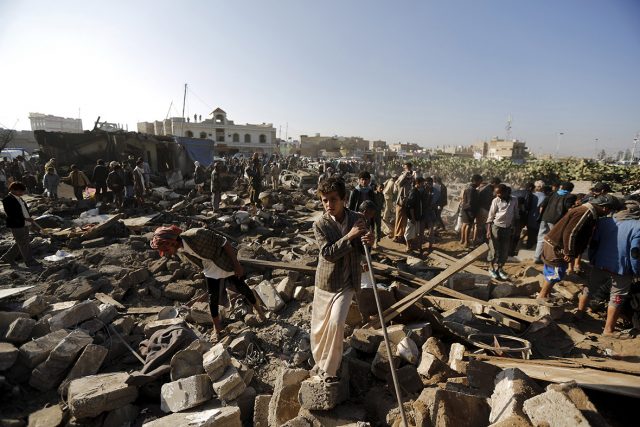
A majority of the British public believes the UK must end arms sales to Saudi Arabia over its large-scale slaughter of civilians in Yemen, according to a new poll.
An exclusive poll conducted by BMG Research for The Independent has found that 58 percent of people say it is wrong for Britain to supply billions of pounds of weapons to Saudi Arabia.
The poll also shows that 64 percent of the public want the government of Prime Minister Theresa May to release a suppressed report into Saudi Arabia’s funding of extremism in Britain, even if it damages relations with Riyadh.
On Wednesday, UK Home Secretary Amber Rudd cited national security reasons for not publishing a report commissioned by former Prime Minister David Cameron that shows the majority of foreign funding for extremism in the UK came from Saudi Arabia.
The survey underscores the public’s deep concern about the UK’s close relationship with an autocracy embroiled in a devastating war in Yemen.
The UK has licensed 3.3 billion pounds worth of weapons since the beginning of Saudi Arabia’s war on Yemen in March 2015.
The United Nations and other international organizations have accused the Saudi-led coalition of bombing hospitals, schools and wedding parties in Yemen.
The UN has declared Yemen a “humanitarian catastrophe,” with sanitation systems destroyed and at least 300,000 people infected with cholera.
The opposition to weapons sales has extended into the government, with key Conservative lawmakers thought to be debating privately for arms sales to be halted.
“This just shows how fast the Conservatives are moving away from public opinion,” said Tom Brake, a Liberal Democrat lawmaker. “Instead of giving the Saudis a stern talking to, ministers are flogging them arms.”
Last week, the UK High Court ruled that London’s weapons sales to Riyadh are not against the law.
The ruling came despite the judges conclusion that there was “a substantial body of evidence suggesting that the [Saudi-led] coalition committed serious breaches of international humanitarian law in the course of its engagement in the Yemen conflict”.
Saudi Arabia has been bombing Yemen since March 2015 in a bid to restore Yemen’s former President Abd Rabbuh Mansur Hadi, a Riyadh ally, to power. Yemen’s crisis began after Hadi stepped down as president and refused to negotiate power-sharing with the country’s Houthi Ansarullah movement.
I’ve studied Larsen C and its giant iceberg for years – it’s not a simple story of climate change
By Adrian Luckman | The Conversation | July 12, 2017
One of the largest icebergs ever recorded has just broken away from the Larsen C Ice Shelf in Antarctica. Over the past few years I’ve led a team that has been studying this ice shelf and monitoring change. We spent many weeks camped on the ice investigating melt ponds and their impact – and struggling to avoid sunburn thanks to the thin ozone layer. Our main approach, however, is to use satellites to keep an eye on things.
We’ve been surprised by the level of interest in what may simply be a rare but natural occurrence. Because, despite the media and public fascination, the Larsen C rift and iceberg “calving” is not a warning of imminent sea level rise, and any link to climate change is far from straightforward. This event is, however, a spectacular episode in the recent history of Antarctica’s ice shelves, involving forces beyond the human scale, in a place where few of us have been, and one which will fundamentally change the geography of this region.
Ice shelves are found where glaciers meet the ocean and the climate is cold enough to sustain the ice as it goes afloat. Located mostly around Antarctica, these floating platforms of ice a few hundred meters thick form natural barriers which slow the flow of glaciers into the ocean and thereby regulate sea level rise. In a warming world, ice shelves are of particular scientific interest because they are susceptible both to atmospheric warming from above and ocean warming from below.

Note Larsen A and B have largely disappeared.
AJ Cook & DG Vaughan, 2014, CC BY-SA
Back in the 1890s, a Norwegian explorer named Carl Anton Larsen sailed south down the Antarctic Peninsula, a 1,000km long branch of the continent that points towards South America. Along the east coast he discovered the huge ice shelf which took his name.
For the following century, the shelf, or what we now know to be a set of distinct shelves – Larsen A, B, C and D – remained fairly stable. However the sudden disintegrations of Larsen A and B in 1995 and 2002 respectively, and the ongoing speed-up of glaciers which fed them, focused scientific interest on their much larger neighbour, Larsen C, the fourth biggest ice shelf in Antarctica.
This is why colleagues and I set out in 2014 to study the role of surface melt on the stability of this ice shelf. Not long into the project, the discovery by our colleague, Daniela Jansen, of a rift growing rapidly through Larsen C, immediately gave us something equally significant to investigate.
Nature at work
The development of rifts and the calving of icebergs is part of the natural cycle of an ice shelf. What makes this iceberg unusual is its size – at around 5,800 km² it’s the size of a small US state. There is also the concern that what remains of Larsen C will be susceptible to the same fate as Larsen B, and collapse almost entirely.
Our work has highlighted significant similarities between the previous behaviour of Larsen B and current developments at Larsen C, and we have shown that stability may be compromised. Others, however, are confident that Larsen C will remain stable.
What is not disputed by scientists is that it will take many years to know what will happen to the remainder of Larsen C as it begins to adapt to its new shape, and as the iceberg gradually drifts away and breaks up. There will certainly be no imminent collapse, and unquestionably no direct effect on sea level because the iceberg is already afloat and displacing its own weight in seawater.
This means that, despite much speculation, we would have to look years into the future for ice from Larsen C to contribute significantly to sea level rise. In 1995 Larsen B underwent a similar calving event. However, it took a further seven years of gradual erosion of the ice-front before the ice shelf became unstable enough to collapse, and glaciers held back by it were able to speed up, and even then the collapse process may have depended on the presence of surface melt ponds.
Even if the remaining part of Larsen C were to eventually collapse, many years into the future, the potential sea level rise is quite modest. Taking into account only the catchments of glaciers flowing into Larsen C, the total, even after decades, will probably be less than a centimetre.
Is this a climate change signal?
This event has also been widely but over-simplistically linked to climate change. This is not surprising because notable changes in the earth’s glaciers and ice sheets are normally associated with rising environmental temperatures. The collapses of Larsen A and B have previously been linked to regional warming, and the iceberg calving will leave Larsen C at its most retreated position in records going back over a hundred years.
However, in satellite images from the 1980s, the rift was already clearly a long-established feature, and there is no direct evidence to link its recent growth to either atmospheric warming, which is not felt deep enough within the ice shelf, or ocean warming, which is an unlikely source of change given that most of Larsen C has recently been thickening. It is probably too early to blame this event directly on human-generated climate change.
Why Moscow Resents US for Its ‘Blackmail’ Demands for Return of Russian Property
Sputnik – 16.07.2017
Washington’s conditions for the return of Russia’s diplomatic property in the US are nothing but blackmail, according to Vladimir Dzhabarov, first deputy chairman of the Russian Upper House’s International Affairs Committee.
In an interview with the Russian news network Zvezda, Vladimir Dzhabarov, first deputy chairman of the Russian Upper House’s International Affairs Committee, slammed the White House’s conditions for the return of Russia’s diplomatic property in the US as blackmail.
On Thursday, Deputy Assistant to the US President Sebastian Gorka said that the US may return two diplomatic compounds confiscated by the Obama administration to Moscow, if it sees “acts of good faith” from the Kremlin, similar to the recently brokered ceasefire in Syria.
By considering a release of the Russian diplomatic compounds that have remained sealed since December, Washington wants to leave the door open for rapprochement with Russia, Gorka said in an interview with CNN.
Commenting on the matter, Dzabarov stressed that the situation in Syria has nothing to do with diplomatic property, and that Washington should return it to Russia “without any preconditions.”
“Talking about certain conditions to be made in exchange for having access to diplomatic property looks like trading and even blackmail,” Jabarov said.
He warned that Russia may respond in kind to Sebastian Gorka’s statement.
“We have the right to retaliate unless the situation changes. We can do so because correlating our right to our own property with our political steps is the wrong move,” Jabarov said.
His remarks were preceded by Moscow’s warning that it is preparing a “tough response” to the move.
“We assume that this issue can be solved in a civilized way, within the framework of the law and probably humanely, given the emotions roiling in Washington,” Russian Foreign Ministry spokeswoman Maria Zakharova said on air of the program “60 Minutes” on Rossiya 1 television channel.
She added that Russia had “different ways” to settle the issue, and that it would not give up its interests.
On Friday, the Russian Foreign Ministry warned that Russia is ready to expel US diplomats in response to Washington’s failure to return its diplomatic property in New York and Maryland.
“If the US partners do not understand differently, we will at some point have to act in this direction,” Zakharova said at her weekly briefing, noting that the “long pause” on the issue has “dragged on.”
The issue was also addressed by Russia’s Foreign Minister Sergei Lavrov, who said at a joint news conference with the EU’s foreign policy chief Federica Mogherini on Tuesday that Moscow is “outraged” over the fact that Washington has not yet resolved the situation with Russian diplomatic property in the US, adding that Moscow is working out its response to the US actions.
In December 2016, the administration of former president Barack Obama imposed a set of punitive measures against Russia over Moscow’s alleged meddling in the US presidential election and harassment of US diplomats stationed in Russia.
The sanctions included the closure of Russian diplomatic compounds in Washington and New York, which the White House claimed had been used as a cover for Russian spying activities in the United States.
Featured Video

Marandi: US attacked world’s largest gas field & Iran declares economic war
or go to
Aletho News Archives – Video-Images
Book Excerpt
US Axis of Aggression in Gulf
By Finian Cunningham | Strategic Culture Foundation | August 15, 2019
When Washington announced a few weeks ago the formation of a maritime “international coalition” to “protect shipping” in the Persian Gulf, many observers were skeptical. Now skepticism has rightly turned to alarm, as the proposed US-led “coalition” transpires to comprise a grand total of just three nations: the US, Britain and Israel.
The term “coalition” has always been a weasel word used by Washington to give its military operations around the world a veneer of international consensus and moral authority. If the US goes ahead with deploying forces in the Persian Gulf the guise of “coalition” is threadbare. It will be seen for what it is: naked aggression.
Iran promptly warned that if the US, Britain and Israel move on their intention to deploy in the Persian Gulf, it will not hesitate to defend itself from a “clear threat”. … continue
Blog Roll
 Aletho News
- Iran War Is Accelerating the End of US Dominance
- FBI Resumes Buying Americans’ Location Data Without Warrants
- IDF threatens ‘elimination’ for Russian leaders who ‘wish Israel ill’
- Attacks on enemy energy facilities not over yet, strikes ongoing: Iran
- US dragged by Israel into ‘unlawful war’ with Iran – Gulf state
- Israel’s War on Iran’s Grid: How the South Pars Strike Turned Energy into a Weapon
- War on Iran to impose trillion-dollar ‘Israel First Tax’ on US citizens: Araghchi
- The State Is Socializing the Cost Of the Iran War
- Seyed M. Marandi: U.S. Attacked World’s Largest Gas Field & Iran Declares Economic War
- Washington’s War on Cuba Is Older Than You Think
- If Americans Knew
- Trump: Israel attacked Iranian gas field without US knowledge. No more such attacks!
- America’s friends must help extricate it from an unlawful war
- Democratic Nat’l Committee’s Kneejerk Backing of Israel Is Political and Moral Failure
- Major revelations from former counterterrorism chief Joe Kent’s extensive interview
- More than half of Palestinian child detainees have no charges
- Grieving Parents in Iran Spend Every Night at the Graves of Their Children, Killed by U.S. Strike
- War on Iran spins out of control, Palestine struggles – Not a ceasefire Day 160
- How ignorance, misunderstanding and obfuscation ended Iran nuclear talks
- Israeli media reports grotesque settler attack in West Bank
- UK security adviser attended US-Iran talks and judged deal was within reach
- No Tricks Zone
- Energy Expert: Germany’s Nuclear Phaseout Was A “500 Billion Euro Mistake”
- New Research: South Australia’s Mid-Holocene Sea Surface Temperatures Were 4°C Warmer Than Today
- Storing Green Energy To Last Germany 10 Days Would Require A 60-Million Tonne Battery
- New Studies: UK Sea Levels Were 4 Meters Higher Than Today During The Mid-Holocene
- Destructive Green New Deal: German Energy And Metal Group Warns Of Drastic Crisis
- New Study Documents A 20-Year Pause In Arctic Sea Ice Decline – Driven By Internal Variability
- Wake-up Call: Survey Shows Majority Of Germans Now Favor Postponing Climate Targets!
- Televised! Leading German Political Candidate Tells Schoolchildren CO2 Makes Sun Hotter!
- New Study: A Century Warming Of 1.1°C Is ‘Commonplace’ And ‘Not Unusual’ During This Interglacial
- New Study: ‘Internal Noise’ And Volcanic Forcing Can Trigger 10-15°C Warming Within Decades
 Aletho News
