The Saudis Are Bombing Their Own People And Nobody’s Talking About it
Geopolitics Alert | July 8, 2017
For the past 60 days, the Saudis have imposed a devastating siege on the Shiite town of Awamiya. And of course, mainstream western media remains silent.
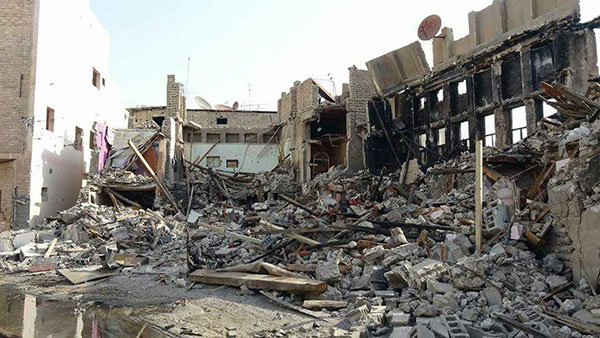
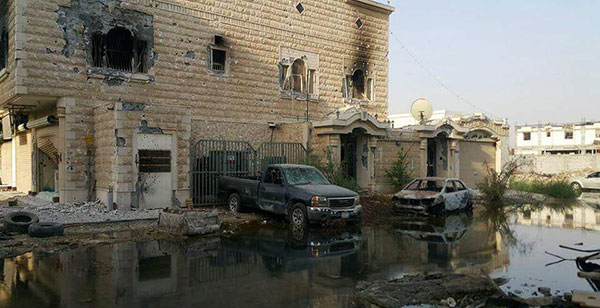
These photos aren’t from Yemen, they’re from the Saudi Arabian eastern town of Awamiya. Where Saudi forces are waging war against an oppressed shia minority. Saudi Arabia adheres to the extreme fundamentalist and intolerant sect of Wahhabism. Making it the country’s religious majority. This ideology is also enforced through state tactics. Which make it illegal to publicly carry out any religious practice or teaching that conflicts with Wahhabism. Even other Muslims (especially Shiites) are considered infidels by the Saudi government. And thus, all religious minorities in Saudi Arabia remain an extremely oppressed group; often lacking the same health care, public services, and wages granted to their Wahhabi counterparts; if not facing death.
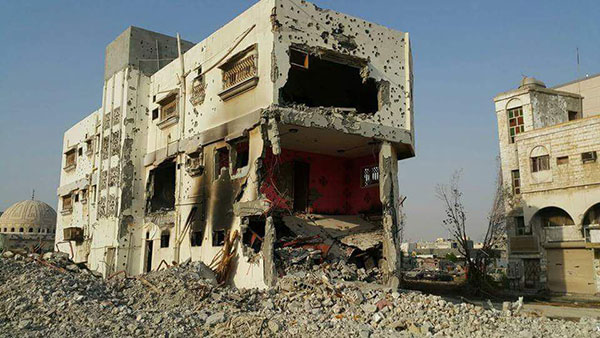
While the majority of Saudi citizens adhere to Wahhabi principles, many towns in the eastern province of Qatif– like Awamiya– hold a Shia majority. Where they’ve been essentially doomed to live in “ghettos” as second class citizens. But the Saudi oppression of Shiites and other religious minorities goes way beyond just economic devastation. In fact for the past two months Saudi forces have held Awamiya under siege, destroyed buildings with bombs and shelling, and set up barricades to control free movement. This is likely a response to Shia citizens calling for basic human rights.
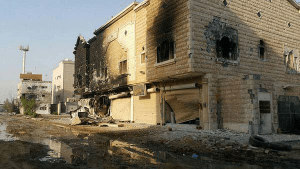
In videos posted to social media, it looks like Saudi security forces are using white phosphorus to drive-out citizens from their homes. Residents also report that Saudi forces are shelling homes and buildings with .50 caliber weapons. In one instance, a building was set on fire and Saudi police refused to allow firetrucks to pass through the barricades.
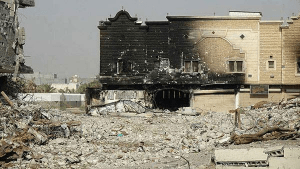
It’s been confirmed that a number of people have died as a result of gunfire. But it’s unclear exactly what the death toll could be since Saudi Arabia severely restricts media access. When the Saudi-run state media are reporting the numbers, they surely can’t be trusted.
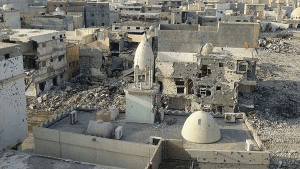
Of course, instead of reporting on the Saudis brutal repression, mainstream media has framed the story (in the few articles available) as though the Saudi security forces are simply clashing with an armed Shiite “militant” uprising. Which ultimately places the Saudi security forces in the “good guy” category just simply trying to keep order.
This however completely whitewashes the fact that the Shiite population in Saudi Arabia has been brutally repressed since the Kingdom’s formation. It also completely ignores the fact that the Saudis are using American-supplied weapons to kill their own people. Which if we look at Syria, this was supposedly the west’s entire reason for their intervention against Bashar al-Assad. “Assad is bombing his own people” the headlines still read to this day.
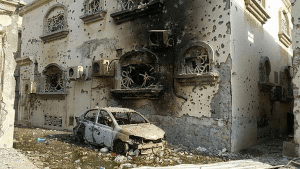
The happenings in Qatif only further demonstrate not only the Saudis’ intolerant disregard for human life, but also their genocidal tendencies as they move further towards an apartheid state within their own borders.
SEE ALSO:
Amid Yemen’s Cholera Outbreak, Saudi Airstrikes Destroy Desalination Plant
Saudis Target Home in Yemen (Again), Killing About a Dozen Civilians
US-Russia ceasefire deal on Syria holding – for now
By M K Bhadrakumar | Indian Punchline | July 10, 2017
The ceasefire brokered between Russia, US and Jordan in south western Syria seems to be holding for the time being. The Russian President Vladimir Putin has said that he saw a new level of pragmatism in the US approach to Syria. President Donald Trump put his weight behind the ceasefire deal, posting on Twitter on Sunday, “Now it is time to move forward in working constructively with Russia.”
As for the US Secretary of State Rex Tillerson, the agreement “is our first indication of the U.S. and Russia being able to work together in Syria.” The National Security Advisor HR McMaster called the ceasefire a “priority” for Washington and acknowledged that the Trump administration is “encouraged by the progress made to reach this agreement (with Russia).”
So far so good. But there is good reason to harbor anxiety and keep the fingers crossed. Evidently, there isn’t much enthusiasm in the US media regarding Trump’s deal with President Vladimir Putin. And if Senator John McCain’s reaction to the Syria deal is any indication, there aren’t going to be many takers in Washington for the idea of Trump having anything to do with Putin at all. The air out there is simply toxic.
Equally, the past experience during the Obama administration (in the pre-civil war era before Trump’s victory) has been that what the US president and state secretary said might not be the last word for the US intelligence and defence establishment. The well-known ex-CIA analyst Ray McGovern has written an insightful piece in Consortiuim News on how the entrenched interest groups who thrive on wars might have an altogether different agenda of their own in the Syrian conflict. McGovern highlights a December 2016 interview with Boston Globe newspaper where the former state secretary John Kerry openly admitted that his efforts to deal with the Russians had been thwarted by none other than the then-Defense Secretary Ashton Carter. Incredible, isn’t it?
Then, there are other factors too. Tehran, for example, has given a delayed response to the US-Russia deal. It took 72 hours for the Iranians to say something at all – by the way, Saturday and Sunday are working days in Tehran. Even the best spin must take note that the Iranian reaction has been rather lukewarm.
Now, I haven’t seen any reaction to the US-Russia deal on Syria so far from Damascus or from the Hezbollah. On its part, Israel of course has outright rejected the Russian-American deal and has reserved the right to act independently. Curiously, there has been a vicious attack on state secretary Rex Tillerson in Bloomberg. It seems Tillerson has upset the Israeli lobby by piloting the deal with Russia on Syria and emerging as Trump administration’s point person on Russia.
While it is understandable that the Trump administration and Moscow have hyped up the development and would like to project the Syria deal as a ‘breakthrough’ in Russian-American relations, what cannot be overlooked is that there are multiple actors with interests of their own who are stakeholders in the Syrian situation. And, they are not going to bow out just like that in deference to the US and Russian wishes/advice.
In fact, Tillerson himself has since spoken harshly about President Bashar Al-Assad, categorically ruling out any US/Western financial support for Syria’s reconstruction so long as he remains in power in Damascus. On the contrary, it seems unlikely that the Syrian government forces and their allies will be stopped on their tracks in their military campaign to regain control over the entire country. True, the Russia air support is vital for their campaign to make rapid progress, but then, this is a two-way street, and Russia too cannot do without its allies in Syria.
Finally, Russian diplomacy has a history of overreaching. It is extremely unlikely that Russia’s allies in Syria are going to feel thrilled over the ‘breaking news’ that King Salman of Saudi Arabia is heading for Russia this month, and that Moscow feels excited that the Saudi-Russian relations are poised for a historic makeover. Of course, Russia has an impressive record of coping with contradictions in its foreign policies, but this is going to be one hell of a contradiction to reconcile – keeping Saudi Arabia and Iran equally content as allies and convincing them both that Russia is each one’s steadfast ally too. So, fasten seat belts – air pockets lie ahead.
Only the News That Fits: How American Media Erase Palestine – Even Alternative Media

Abdul-Rahman Mahmoud Barghouthi, 18 months. Photo from IMEMC.
By Alison Weir | If Americans Knew | July 10, 2017
An 18-month-old died in Palestine Friday. The cause of death was teargas inhalation from an Israeli invasion of his village two months ago.
It wasn’t a major invasion; just another of the routine ones that happen almost every day in the West Bank. U.S. media call these “incursions,” when they bother to mention them. Which is rarely.
The toddler’s name was Abdul-Rahman Mahmoud Barghouthi, a name that feels incongruously long for his short life.
When he was injured, Israeli soldiers held up an ambulance rushing to him, forcing medics to go to his home on foot and carry him back to the ambulance in their arms – a 60 minute round trip.
In the past three months, Israelis have killed 18 Palestinians, including an eight-year-old and 10-year-old, and Palestinians have killed two Israeli soldiers.
So far, I don’t see any US mainstream news media mentioning the end of Abdul’s short life, the final two months likely infused with pain. If an 18-month-old Israeli child had been killed by Palestinians, I suspect there would be headlines, and the President would go on CNN [LOL] and condemn the killers.
Perhaps Palestinians are killed so often that to the media it’s just not newsworthy, a little like the old saying that ‘dog bites man’ is not news, while ‘man bites dog’ is news. Israelis killing Palestinian children is not news. However, it is literally news to most Americans, since they so rarely hear about it.
My personal experience in writing about this issue for more than a decade and a half illustrates the very American tale of media omission on Palestine. Just last week another episode showed that the saga continues.
I’ve written about this sort of thing before, on more than one occasion.
The first time I wrote about tiny dead Palestinian children was 15 years ago. I described small deaths and quoted the words of poet Shawqi Baghdadi:
I remember the children
As dead angels
And injured sparrows
God was sad
A few years later I wrote about Palestinian toddlers killed by Israeli drones, and a few years later about Palestinian children shot in the head. I wrote stories about dead Palestinian mothers, such as Anatomy Of A Cover-Up: When A Mother Gets Killed Does She Make A Sound? and “Just Another Mother Murdered.” The titles give you the gist.
I could write stories like this over and over, if I could bear it. Because the deaths keep coming, and the misery and the cruelty, and the media keep ignoring so much of it.
And that’s the point of this story. Americans need to know important facts that they aren’t learning in the very filtered reporting we get. We need to know what’s happening in Palestine, and we need to know what’s enabling this in the U.S. The latter stories are even more covered up.
Until we expose and break through the media bias and omission, the children will keep dying, and the tragedy and carnage and injustice will grow and spread.
In the past I’ve conducted media studies that document the disparity in reporting on Palestinian deaths compared to Israeli deaths, and have deconstructed news reporting. Through the years I’ve periodically written articles describing the flawed system of reporting on Palestine, including a chapter for a Project Censored book on the subject.
This time I’d like to give a few small, personal anecdotes – one from last week.
In 2001 a reporter for the Gannett news chain interviewed me at length about what I had just seen firsthand in Gaza and the West Bank at the height of the Second Intifada, and about the founding of If Americans Knew. Gannett is a major chain and this would have been a significant breakthrough for information on Palestine to get to the general public. The reporter sent a photographer to take pictures of me and told me his feature was about to come out.
But it never did. The reporter later told me a higher-up had killed the story, saying it was “missing something.” He hadn’t explained what.
Another time a journalist at the other end of the media scale, a reporter working for a small town newspaper, wrote a similar story about me. It, too, was killed by a higher-up. The reporter told me this was the first time that had ever happened to him.
Awhile later, a letter I had written about Palestine had gone through the usual editorial process and was slated to be published in the Washington Post. At the last minute it, too, was blocked by a superior.
Most recently, Truthout, a progressive website with a large readership that publishes much excellent work, accepted an article I had submitted about government monitoring of Palestine activism. My piece went through the standard editing and fact-checking, and the next day the article was published on the website. Briefly. It was quickly removed when higher-ups saw it and the staff then told me courteously and apologetically it wasn’t “the right fit for Truthout.”
I asked what this meant, exactly, but haven’t heard back. We’ve now published the article on our blog.
Naturally, news organizations can’t publish everything that’s submitted to them, and all have the right to decide what they will publish and what they won’t.
But it’s unusual for pieces that have gone through the usual channels and passed the standard hurdles to suddenly get killed for unidentified reasons. And it’s disturbing when this fits into a pattern of news filtering that has life and death consequences, and has gone on year after year after year.
Many news media are telling us more than they used to about Palestine, but they continue to leave out important aspects. Sometimes a half truth is a whole lie.
Meanwhile, Israel and its partisans have rewritten the governmental definition of “antisemitism” to include criticism of Israel and embedded this new Israel-centric definition in governments and law enforcement agencies around the world, so that eventually articles like this one may be banned as “hate speech.”
But you won’t learn that in Truthout.
Alison Weir is executive director of If Americans Knew, president of the Council for the National Interest, and author of Against Our Better Judgment: The Hidden History of How the U.S. Was Used to Create Israel.
Committee: Convicted Israeli terrorists receive support from Israeli state

Ma’an – July 10, 2017
RAMALLAH – Amid what the Palestinian Committee of Prisoners’ Affairs has described as a “frenetic Israeli campaign” against Palestinian authorities’ payment of allowances to prisoners of Israel and their families, the committee published a list on Monday of Israelis convicted of murdering Palestinians and anti-Palestinian extremist organizations, who have received financial and legal support from the state of Israel.
Committee head Issa Qaraqe has accused the Israeli government of “supporting Jewish terrorists and their extremist organizations both financially, socially, and legally through organizations authorized by the Israeli government,” calling Israel “the biggest funder of official terrorism in the Middle East.”
A large number of the criminals mentioned on the list were convicted and received life sentences, “but only served only five to seven years in Israeli jails,” according to the committee. Additionally, the Israelis used “deceitful methods” to bypass law and pardon certain criminals, some of them before ever entering a prison cell, the statement added.
Rights groups have meanwhile documented the discriminatory and racist manner in which the Israel Prison Service (IPS) classifies its prisoners, specifically “to violate the rights of Palestinian prisoners defined as ‘security’ prisoners, while at the same time providing benefits to Jewish prisoners also defined as ‘security’ prisoners,” as legal NGO Adalah put it.
The Jewish Underground movement
The first item on the committee’s list was the Jewish Underground, a right-wing terror organization that carried out and plotted a string of attacks in the 1980s, with some of its members being decorated officers in the Israeli army and widely respected in the Israeli settler community.
Members of the group were convicted in 1985 of committing of a number of attacks — marking the first time a group of Israeli Jews were convicted of being part of a terrorist organization.
Among the Jewish Underground’s crimes were car bombings targeting Palestinian mayors: Nablus Mayor Bassam al-Shakaa lost both of his legs, Ramallah Mayor Karim Khalaf lost a foot, and al-Bireh Mayor Ibrahim al-Tawil was saved when the device planted in his car was discovered.
The defendants also plotted to blow up the Dome of the Rock in Jerusalem, attempted to murder three Palestinian college students in Hebron, and booby-trapped Palestinian buses with bombs.
Menachem Livni, Shaul Nir, and Uziah Sharabaf received life sentences defined as lasting 24 years, while the others received terms of imprisonment ranging from three to nine years. Twenty members were released after less than two years, and none served more than five years. The three life sentences were commuted three times, finally to 10 years. With time off for good behavior, they were released in 1990.
The committee’s statement said that all have received monthly benefits, by order of Israeli law, from the Israeli Social Affairs Ministry and from Israeli National Insurance.
Three of the members of the group currently work at Israeli prime minister’s office. Nathan Nathanson, convicted of involvement in the car bombings against the Palestinian mayors, has since been employed as a political adviser for Israeli Education Minister and chairman of the Jewish Home party Naftali Bennett.
One of the three original founders of the cell, Yehuda Etzion, is the founder and current chairman of the right-wing Jewish group Hai Vekayam, dedicated to allowing Jewish prayer in the Al-Aqsa Mosque compound.
A number of others have since become heads of settlement councils, according to the committee’s statement.
Dani Eizman, Michal Hillel, and Gil Fox
The second group of “Jewish terrorists,” according to the prisoners’ affairs committee, consisted of Dani Eisman, Gil Fox, and Michal Hillel, who were convicted for the 1985 kidnapping and murder of taxi driver Khamis Tutanji, a Palestinian resident of Israel. They were each sentenced to life in prison, but released after serving between five and seven years.
The three also received the usual benefits from the Israeli Ministry of Social Affairs and Israeli National Insurance while in prison.
The case was cited in a report, which indicated that unlike Jewish prisoners who are citizens of Israel and perpetrated acts against Arabs or Palestinians based on ideological motives, Palestinian prisoners who are citizens of Israel have yet to receive any real commutation of their sentence or early release.
David Ben-Shimol
David Ben-Shimol fired an anti-tank missile at a Palestinian bus in 1985, killing one person and injuring dozens. He was sentenced to life, serving only 11 years of his sentence. He also received benefits while in prison, according to the statement.
Ami Popper
After Ami Popper massacred seven Palestinians in 1990, he was found guilty of seven counts of murder and initially handed seven life sentences, before seeing his sentence commuted to 40 years.
He has reportedly been granted furlough more than 100 times in the 18 years since his conviction, marrying three times while in prison custody. He fathered six children while in custody, according to the prisoners’ committee.
The statement said in addition to the usual social benefits, his family has been the recipient of financial support from far-right Israeli NGO Honenu, which is reportedly indirectly funded from tax deductible US donations.
Zeev Wolf and Gershon Hershkovich
Zeev Wolf and Gershon Hershkovich were convicted of hurling a hand grenade at a market in Jerusalem in November 1992, killing one Palestinian and injuring 20 others, according to the statement which didn’t provide further details on the attack. They were released after serving six years and a half in prison, and received social benefits while in prison.
Yoram Shkolnik
Israeli settler Yoram Shkolnik shot and killed Moussa Suleiman Abu Abha multiple times at close range while the Palestinian was blindfolded, bound hand and foot, and guarded by Israeli soldiers after allegedly attempting to detonate a hand grenade in 1993. Shkolnik’s life sentence was later reduced.
In addition to the allowances Shkolnik received from the Israeli National Insurance and the Social Affairs Ministry, the prisoners’ committee said the Israeli government “gave him a grant to start a project of his own,” without providing additional details.
Nachshon Wales
According to the committee, Nachshon Wales was sentenced to life in prison for killing a Palestinian woman in August 1990 while she was tending her olive grove. His sentence was twice commuted, and he was released after serving 11 years. He currently works as a security guard in an illegal Israeli settlement, according to the committee.
Bat Ayin Underground
Members of terrorist organization Bat Ayin were convicted of parking a booby-trapped car in the yard of a Palestinian girls school in East Jerusalem in 2002. Some of the defendants remain in custody, receiving social benefits as well as financial support from the right-wing settler organization Elad, according to the committee, as well as from Honenu.
Dawabsha murderers
The committee’s statement also mentioned the two Israelis convicted of murder for the 2015 deadly arson attack that killed three members of the Palestinian Dawabsha family in the occupied West Bank.
Amiram Ben-Uliel was charged with three counts of murder, while a minor was charged as an accessory to murder and unnamed by Israeli media due to gag orders on the identities of underage Israeli suspects.
The prisoners’ committee’s statement named Yoram Stenhil to have been found guilty of firebombing and killing the Dawabsha family, though it could not immediately be confirmed if this was referring to the minor convicted in the case alongside Ben-Uliel.
Stenhil, in addition to receiving social benefits from the state, allegedly also is funded by Honenu and received 600,000 shekels ($169,000) in one year, according to the statement.
Yigal Amir
After being convicted for the 1995 murder of Israeli Prime Minister Yitzhak Rabin, Yigal Amir was given a life sentence and remains in prison. He has since been married in custody and is allowed to meet with his wife in prison. He receives social benefits and has been receiving “generous donations from extremist right-wing Jewish groups,” including Honenu, the statement said.
Elor Azarya
Israeli soldier Elor Azarya shot dead Abd al-Fattah al-Sharif in Hebron in March 2016 after the young Palestinian had already been shot and incapacitated by another Israeli soldier for allegedly attempting a knife attack. Azarya was convicted of manslaughter and sentenced to 18 months in prison.
The sentence has been appealed by both the prosecution and the defense for being both too lenient and too harsh.
According to the prisoners’ committee, Azarya has continued to receive his salary from the Israeli army, while his father founded a charitable organization and named it after him. The organization has so far received more than 8 million shekels ($2.25 million) in donations, according to the committee.
Bus 300 Affair
Ehud Yatom, a former member of Israeli Knesset and former deputy chief of Israeli general intelligence, was among members of the Shin Bet involved in the Bus 300 Affair of 1984 in which Shin Bet members executed two Palestinian bus hijackers.
Yatom expressed pride over “smashing their skulls” with rocks after capturing them alive.
Yatom, Shimon Malka, and Yosi Genswar were convicted but did not go to jail due to a full presidential pardons.
Honenu organization
The committee’s statement also listed the aforementioned Honenu organization for offering financial and legal support to extremist Israelis who have been convicted or are on trial for terror attacks against Palestinians. The group, which raises funds in the US, also receives approximately 6 million shekels ($1.69 million ) from the Israeli government every year, according to the committee.
Dr. Goldstein organization
Dr. Goldstein organization, named after the US-born Israeli settler Baruch Goldstein who massacred 29 Palestinians inside Hebron’s Ibrahimi Mosque in 1994, “attempts to perpetuate the terrorist Goldstein as a national hero,” the committee said, adding that the group receives direct and indirect financial support from the Israeli government.
Rehavam Zeevi organization
The prisoners’ committee also identified the Rehavam Zeevi organization as an example of Israeli state-sponsored anti-Palestinian extremism. The organization was named after the right-wing Israeli politician who was assassinated by Palestinian gunmen affiliated to the Popular Front for the Liberation of Palestine.
Zeevi was known for establishing the extremist Moledet (Homeland) party that advocates for the population transfer of Palestinians from the West Bank and the Gaza Strip to neighboring Arab countries.
According to the committee, the group receives direct support from the Israeli government.
Court rules Britain’s arms sales to Saudi Arabia are ‘lawful’, despite destruction of Yemen
RT | July 10, 2017
London’s High Court has ruled that UK arms sales to the Saudi Arabian regime are “lawful” in response to a judicial review brought by the Campaign Against the Arms Trade (CAAT).
The case hinged on the question of whether the UK failed to suspend sales in line with legal obligations, given the Saudi’s current war in neighboring Yemen, which has been waged in part using British manufactured military equipment.
Documents cited in court showed that civil servants had, in fact, recommended that sales should no longer go ahead, but ministers had ignored the advice.
“This is a very disappointing verdict, and we are pursuing an appeal,” Andrew Smith of Campaign Against Arms Trade said.
“If this verdict is upheld then it will be seen as a green light for government to continue arming and supporting brutal dictatorships and human rights abusers like Saudi Arabia that have shown a blatant disregard for international humanitarian law.”
CAAT’s lawyer, Rosa Curling, said: “Nothing in the open evidence, presented by the UK government to the court, suggests this risk does not exist in relation to arms to Saudi Arabia.
“Indeed, all the evidence we have seen from Yemen suggests the opposite: the risk is very real. You need only look at the devastating reality of the situation there.”
CAAT, who have said they will appeal, had argued that the UK’s continued sales are a breach of international law while the EU’s common council also insists that sales to nations where violations of the law might occur must be halted.
In the last two years, the UK has licensed the sales of £3 billion (US$3.86 billion) worth of arms to the Saudi government, with which Britain is a longstanding ally.
Arm sales have included Typhoon and Tornado jets and the UK has had military personnel embedded in Saudi headquarters throughout the Yemen conflict, which has raged since 2015.
The British government maintains that the personnel are there to support adherence to international law and advice on rules of engagement.
Both Royal Air Force (RAF) and Royal Artillery (RA) personnel have been deployed to train the Saudi military during the war.
The conflict – which has been accompanied with a blockade of major ports – has drastically worsened the humanitarian situation in the already-impoverished gulf nation.
The UN says 17 million people in Yemen are at imminent risk of famine, while dwindling medical supplies and lack of trained medical personnel have led to epidemics.
Leading humanitarian organizations, including the Red Cross, have named the aerial bombing campaign and blockade as the main causes behind the ongoing cholera epidemic in the capital, Sanaa, that has already claimed some 200 lives, while over 11,000 cases of the disease have been registered.
Iran Deputy FM: US-Russia Deal Could Be Extended to All Syria
Al-Manar | July 10, 2017
Iran’s Foreign Ministry Spokesman Bahram Qasemi here on Monday described the US-Russia agreement to declare truce in some regions in Syria as ‘ambiguous’.
Speaking in his weekly press conference, Qasemi underscored that the US should stop bombarding Syria if Washington is keen on stabilizing ceasefire in the Arab county.
‘If the US-Russia agreement could be extended to all Syria and pave the way for stabilizing ceasefire, it will be definitely fruitful, he said, adding that there is ambiguity in the agreement regarding recent US measures in Syria,’
Commenting on the executive guarantee of the agreement for achieving truce in the regions which have not been discussed during Syrian peace talks in the Kazakh capital, Astana, he said, ‘Iran neither assures the deal nor has a comment in this respect.’
Qasemi reiterated that Iran, Russia and Turkey enjoy active presence in Astana meeting on Syria.
Qasemi underscored that Iran and the Russian federation have special relations and are constantly negotiating the Syrian issue.
Israeli forces shoot teargas and rubber coated steel bullets at the 6th anniversary demonstration of Kafr Qaddum
International Solidarity Movement | July 9, 2017
Hebron, occupied Palestine – On Friday 7th of July the residents of Kafr Qaddum gathered for their weekly demonstration marking its 6th anniversary, which was repressed by the Israeli forces shooting teargas, stun grenades and rubber-coated steel bullets at demonstrators. Israeli forces approached the demonstrators in a jeep and were seen on a hill next to the road connecting Kafr Qaddum and the Israeli settlement. Towards the end of the demonstration Israeli forces also forced their way into a Palestinian house to use it as a vantage point to aim at the demonstrators.
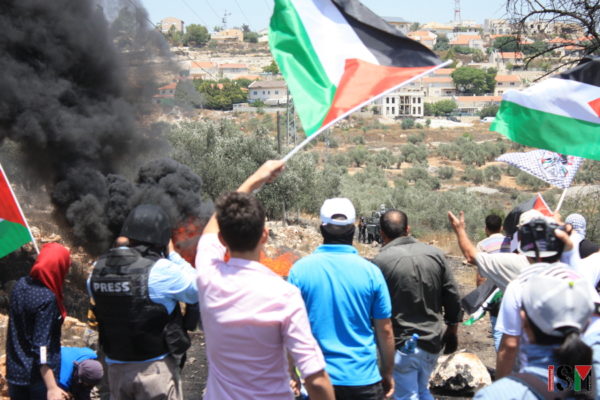
Kafr Qaddum peaceful demonstration
After the afternoon prayers at 1 pm, the people of Kafr Qaddum started their non-violent demonstration marching towards the illegal Israeli settlement of Kedumim. Soon after, the Israeli forces welcomed the demonstrators by shooting rubber-coated steel bullets and teargas. Halfway through the demonstration, an elderly Palestinian man was shot in the head with a rubber-coated steel bullet while taking cover from the shooting. Towards the end of the demonstration, an additional five Palestinians and a Korean activist were injured by the Israeli forces. Those who were injured were taken to receive treatment.
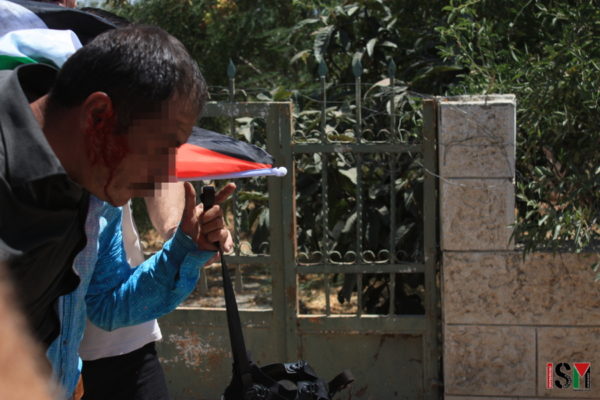
One of the Palestinians injured by Israeli forces gun-shots is brought to receive treatment
According to information provided by the Israeli military spokesperson to Ma’an news, no Israeli army forces were present at the demonstration, but instead it was the Israeli police that repressed the non-violent demonstration. This however is not true, as later during the demonstration Israeli army soldiers were seen at a nearby hill, and soon replaced the police on the road with more jeeps and an armored personnel carrier. The soldiers then proceeded to fire rubber-coated steel bullets at protesters and activists, and threw several stun grenades in an attempt to disperse the demonstration. Israeli soldiers also forced their way into a house and took up positions on the balcony overlooking the road.
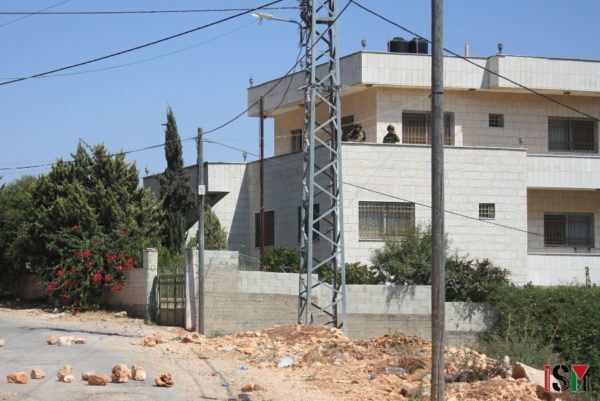
Israeli forces inside a civilian Palestinian home aiming at protestors
Terror in Europe – Why Terrorists Are Allowed to Strike
By Ulson Gunnar – New Eastern Outlook – 09.07.2017
The London Bridge terror attack saw a repeat of a now familiar narrative in which every suspect involved had been long-known to both British security and intelligence agencies.
The London Telegraph in an article titled, “Khuram Butt, Rachid Redouane and Youssef Zaghba named: Everything we know about the London Bridge terrorists,” would reveal:
The ringleader of the London Bridge massacre never bothered to hide his violent, extremist views. Khuram Butt was so brazen that he openly posed with the black flag of the so-called Islamic State in Regent’s Park in the centre of London for a Channel 4 documentary, entitled The Jihadis Next Door.
Butt and other extremists linked to the banned terror group al-Muhajiroun were even detained by police for an hour over the stunt in 2015 but were released without being arrested.
The al-Muhajiroun terror group is headed by British-based extremist, Anjem Choudary, who for years helped fill the ranks of militant groups fighting governments the US and UK sought to overthrow in Libya, Syria and beyond. Choudary inexplicably escaped the consequences of his open advocacy and material support for known terrorist organizations for years, with the London Guardian in an article titled, “Anjem Choudary: a hate preacher who spread terror in UK and Europe,” going as far as speculating he did so because he was actually an informant or operative working for the British government.
The article would also admit that Butt was under investigation by British intelligence up to the day of the attack:
MI5 and counter-terrorism officers began an investigation into Butt, which remained ongoing even as the 27-year-old launched his terror attack on London Bridge. Butt, who was wearing an Arsenal shirt and a fake bomb strapped to his chest, was shot dead by police on Saturday night.
A second suspect, Rachid Redouane, was repeatedly brought to the attention of police who ignored warnings he was an extremist and a member of the so-called “Islamic State.”
The Telegraph reports that a third suspect, Youssef Zaghba, was also known to police:
He was reportedly arrested at Bologna airport in March 2016 trying to get to Syria and was also understood to be on an Italian anti-terror watch list.
The fact that these three suspects evaded capture and were able to carry out their attack despite being known and even monitored actively by British security and intelligence agencies lends even further credibility to the notion that they and others like them work for the British government, not against it.
Unable to Reach Syria, West’s Dogs of War Bite Local Population
Networks like al-Muhajiroun and the extremists they cultivate help fill the ranks of “moderate rebel” groups the US, UK, other European nations including France, as well as regional allies like Turkey, Jordan, Saudi Arabia, United Arab Emirates and Qatar are arming, funding and providing direct military support for in Libya, Syria, Yemen and beyond.
This fact goes far in explaining why extremists are allowed – for years – to openly advocate violence and recruit members into what is essentially a terrorist organization operating under the nose of British security and intelligence agencies – if not with their collective and eager complicity.
While these terrorists are labeled “moderate rebels” when fighting abroad, they are only labeled as such by the Western media out of necessity in an attempt to differentiate them from the extremists that are in fact fighting the West’s proxy war for it in places like Syria.
Suspects like Youssef Zaghba even attempted to travel to Syria to fight among the ranks of Western-backed militant groups – and failing to do so – participated in armed violence in the UK instead. Had he traveled onward to Syria, it would have been innocent Syrians instead of innocent British civilians terrorized, attacked, maimed and killed.
A Strategy of Terror and Tension
And despite the reality of the US and UK along with other European and Persian Gulf allies openly fueling terrorism at home and abroad, in the wake of tragic events like in London, Manchester, Paris, or Brussels, the very government organizations clearly responsible for presiding over these terrorists and their networks, sometimes for months and even years before an attack, are granted even more power to address a problem of their own intentional creation.
These organizations are able to do so in plain sight of the public specifically because of another conflict they openly orchestrate, pitting the general public against one another along lines of “anti-Islamic” fervor versus social justice advocates.
What both sides of this manufactured and intentionally perpetuated divide fail to realize is that Muslims are dying by the tens of thousands in places like Syria actively fighting against extremism springing not from Islam or the Qu’ran, but from the Pentagon, Westminster, Paris, Brussels, Riyadh, Ankara and Doha. It is not a clash of civilizations, but a manufactured conflict designed to perpetually fill the ranks of mercenaries abroad while exploiting their violence at home to procure more power and wealth through fear, anger and hysteria.
With wars in Afghanistan, Iraq, Syria, Yemen and beyond adding up to trillions for defense contractors and including weapon systems designed to fight them, with the F-35 joint strike fighter alone topping one trillion US dollars and as the West continues to openly act with impunity when and where it pleases despite violating the very international law it claims it is upholding globally, it is clear that, for now, this strategy is working.
If and when the general public understands the truth of why their lives are put in danger and their nation’s resources are being squandered abroad instead of at home for building their own futures, this strategy will be less successful. Until then, it appears that simplistic propaganda still works in convincing the public that governments like in London are simply incapable of arresting terrorists who appear regularly on TV, in the media and who openly operate in public with apparent and otherwise inexplicable impunity.
Why The European Community (“the EU”) Must Collapse
By Robin Mathews | American Herald Tribune | July 8, 2017
The simple reason for the coming collapse of what we call the European Union is the essentially unjust, unequal, undemocratic, and punitive nature of its basic legal structure. The EU Commission and other arms of the (unelected) bureaucracy work happily in that structure, increasing anti-democratic tensions. Their connection with the Imperial Globalizers is almost flagrant. But the source of trouble lies in The European Court of Justice, the Community’s (apparently) highest authority.
The explanation of the truth is revealed by Dieter Grimm, a former member of the German Federal Constitutional Court. In his role there he had (between 1987 and 1999) to meet EU incursions into the German Constitution and its defenses of democratic freedoms. On March 29, 2017, he explained the situation at the invitation of the College de France. (“Quand le juge dissout l’electeur” – Le Monde diplomatique, July, 2017, p. 19). (Narrowly translated, that means “When the judge erases the voter”.)
Very much of German response and (guarded) acceptance of EU “treaty-making” is marked by what is called the “as long as” clause in German ratifications. That clause states that “as long as” all fundamental rights are not guaranteed by the European Community, all new treaties must submit to strict respect for the sovereignty of the German people as written in their fundamental law. That most powerful nation in the European Union declares, in fact, that the European Community is structured as a threat to fundamental human rights and freedoms. Not much more needs to be said.
The present situation explains the (apparent) flailing of new political formations in Europe (and Britain), trying for a grasp on power. Since the tendency of EU national governments has been acceptance of undemocratic power in the Community, and since the mainstream media and “respected” commentators support the undemocratic basis of the Community, the first resistances have been eruptive, uncertain, belligerent. UKIP in England, Marine Le Pen’s National Party in France, The Five Star Movement in Italy and other like formations have not been welcomed in “acceptable” circles.
They are deemed, condescendingly, to be “populist movements”. The word takes its meaning from a nineteenth century, U.S. Party wishing to broaden democracy, to nationalize some infrastructure (i.e. Railways), to limit private ownership of land, and to use a graduated tax system. The term ‘populist’ was also used of a movement in Russia (very early) seeking increased collectivism. Clearly the smell of democracy hangs about the word “populist”. And so the persistent use of the word as a pejorative says much. With all their faults, the “populist” parties in Europe began the demand for action to work against what might fairly be called “creeping fascism” in that Community.
The whole fake target – immigration and immigrants – might be seen, among the new political forces, to be a simple matter of their racism and inhumanity. Except for one thing – the wealthy, the coddled corporations, and international capital want a borderless Europe in order to move low-wage earners from poorest countries across the Community to help force down living standards … and raise profits. That fact becomes obscured by the unique problem caused with the flood of immigrants pressing for acceptance in Europe as a result of the ravages left by Western countries seeking “regime change” in the Middle East.
“Good” political activities, according to the Mainstream Press and its owners are ones like that of Matteo Renzi in Italy (Centre Left) which recently tried to reduce democratic responsibility of the elected by referendum – and was rejected. Or like Emmanuel Macron’s new French “En Marche” Party, a neo-liberal force that also wants to bridle democracy, in France. Macron, like Renzi in Italy, has announced he is willing to go to referendum in his attack on democracy – if he can’t get what he wants through France’s National Assembly. (Both, of course, put forward the claim to want to streamline democracy and speed it up.) The surge of support for Macron in France was almost a desperation measure after the “Socialist” government of Francois Hollande sold out completely to the European Commission and international capital. Macron’s solution is no solution … as time will tell.
In England, Labour Leader Jeremy Corbin points to the biggest symptom of “creeping fascism” in Britain, calling it the folly of “The Austerity State”… the situation in which the general population is increasingly undefended and subjected to ‘precarious’ living, while the wealthy are coddled, corporations are given free rein, and international capital is the de facto legislator. In confronting The Austerity State and vowing to change it, Jeremy Corbin (specifically) and the British Labour Party he leads are climbing in popularity, as the European population – misled by the European Commission, its bureaucratic back-up, and their ‘owned’ media – is finally coming to a slow understanding about where real power resides in European “government”.
Plainly, most economic and trade initiatives in Europe spring (primarily) from profit-seeking corporations, banking institutions, and others in the investment community – not from forces desiring the well-being of all Europeans. And so conflict is assured until national governments in the Community are formed by forces truly representing the larger population … which address the fundamental weakness expressed in basically flawed inter-Community treaty-making.
Briefly – history tells all:
From the time of the Marshall Plan (at the end of the Second World War) the U.S. set about to re-create Europe as a gigantic marketplace. The creation of NATO (1949) furthered a U.S./European integrated military led by the U.S.A. NATO and U.S. corporate interests worked to encourage the establishment of a European Union. The cry to the public was that an integrated Europe would end the costly and destructive history of war-making there, a noble aspiration that caught the popular imagination.
But integral to the communitarian cry was the unending ambition of the global imperialists, of “dark” government, of ‘the deep State’ – whatever name is chosen for the (in fact) fascist One Per Cent – the ambition to be, in fact, the real government of Europe and to exploit its wealth and population.
Dieter Grimm puts the matter simply. What he calls “the democratic deficit” of the Union is no longer in doubt and is based upon the transformation of Europe by treaties. The European Court of Justice regards inter-community treaties as the foundation of a European Constitution. It apparently (from what base and/or source of influence?) sees its role as the maker of a European Constitution … through treaty-making – without first demanding that all treaties are based in the protection of fundamental Rights and Freedoms.
Apparently an unique situation in Europe, the condition Dieter Grimm describes is, of course, not unique. Across the world, forces of Imperial Globalization (call it what you will) have been shaping so-called Free Trade treaties (with the apparent close co-operation of “democratic” governments in power) which shift sovereign power away from the elected representatives of the people and their carefully constructed court systems to various forms of faceless, “irresponsible”, privately-appointed decision-making bodies. Those bodies oversee the gigantic raid made by private corporations upon populations helpless to prevent the massive grabbing which results from claims that the country in question is interfering with the right of the private corporations to exploit wealth and people.
Stripping a people of its fundamental human rights and freedoms clears the way for a world of corporate decision making in which all criteria of effectiveness and efficiency are the criteria of the capitalist entrepreneur. In Europe, cooperation between the Globalizers and supine governments is eating at the fundamental protections of working people, structures to insure universal health care and security in old age … and is proposing to “release” people entering the labour market from any defensive organizations so they will be free (as they were in the slave days of the Industrial Revolution) to – singly and freely as independent entities – negotiate with corporations the terms of their employment.
We remember … if the Court doesn’t … that in 2005 the unelected ruling forces in Europe produced a three-volume proposed Constitution for Europe, one which legitimized the neo-liberal structure growing in place. France and Holland rejected it by referendum and, effectively, killed it. Undaunted, the bureaucrats largely resurrected its intentions in the 2007 Treaty of Lisbon. The Treaty did not need referendum approval and was signed into being by all member States, including the governments of France and Holland – flying in the face of what was clearly a democratic expression of the popular will. In 2009 the Treaty of Lisbon came into force. Dieter Grimm argues that the European Court of Justice is “constitutionalizing” treaties … arguing for and accepting them as ‘basic law’, superior to all national law and national Constitutions. Germany, for one, disagrees.
In short, at least since 1964 (the Treaty of Lisbon being merely another nail in the coffin of European Union democracy) the European Court of Justice has ruled that all treaties (and, indeed, all Court of Justice rulings) take precedence over national laws and Constitutions. But since that process is constructing, in Jeremy Corbin’s words, an “Austerity State” which is plainly unjust, unequal, undemocratic, and punitive to the larger European population, it cannot survive.
Failing an internal reconstruction of the Community – which seems (at present) almost impossible, European Union national populations – sooner or later – will elect governments that set in motion the clause in the European rule-book that begins exit from the Union. Then Britain’s much berated Brexit, voted to begin Britain’s withdrawal from the European Community, will become the rule, rather than – as it is now – the highly criticized exception.
Robin Mathews is Professor emeritus at Simon Fraser University in Vancouver.
Western Media Blasts Trump After Meeting With Putin

© Sputnik/ Michael Klimentyev
Sputnik – July 9, 2017
The first meeting between Vladimir Putin and Donald Trump at the G20 summit in Hamburg evoked a wave of criticism from Western media, as a number of notable news outlets blasted the US President for his conduct during negotiations.
At least several prominent newspapers took a dim view of President Trump’s handling of this meeting, claiming that the Russian leader apparently managed to outplay and outsmart his US counterpart.For example, Die Welt stated that it was clear to all professional observers that the meeting resulted in Trump’s capitulation.
In an apparent effort to underscore Trump’s relative inexperience in foreign affairs, the newspaper claims that the “political pro” Putin knocked out the newbie US President “by the book.”
The article’s author also emphasized the fact that Putin paused for a moment before shaking Trump’s already extended hand.
The Guardian adds that while US politicians apparently felt relieved that Trump managed to avoid “a major gaffe” during the meeting, it was “hardly cause for celebration.”
“It’s an indication of how rapidly our standards are falling when we’re reasonably pleased that President Trump has not made an obvious error,” Thomas Countryman, former US acting undersecretary for arms control and international security, remarked.
Meanwhile the New York Times insists that the meeting with Putin was probably the best part of the summit for Trump, who apparently found himself increasingly ostracized by other delegates.
“The talks with Mr. Putin oddly turned into a bright spot for Mr. Trump on the first full day of the gathering, where the United States found itself increasingly ostracized by other Group of 20 members on major issues, including climate change, immigration and trade,” the newspaper says.
The Los Angeles Times criticized the way Trump discussed the issue of Russia’s alleged meddling in the 2016 US presidential election, arguing that the US President should’ve been more assertive in his inquiries on the subject.
The news website Vox even took this issue up a notch by outright saying that “Putin got Trump to buy his fake news on election interference and to offer a weak endorsement of upcoming sanctions.”
Interestingly enough, the article’s author insisted that “the entire US intelligence community believes the Kremlin mounted a sophisticated campaign” to help Trump win the election, even though this assessment was made only by four out of 17 US intelligence agencies.
Stating that the US leader did not even properly prepare for the meeting, unlike his Russian counterpart, Vox claimed that “Trump — the dealmaker — got outplayed by Putin.”
Featured Video

Iran Is Not Our Enemy
or go to
Aletho News Archives – Video-Images
Frlom the Archives
The 52 Major Jewish American Organizations and Israel Celebrate Passover with the Slaughter of 25 Muslim, Christian and Secular Palestinians
By James Petras • Unz Review • April 8, 2018
Introduction
As of April 7, nearly three thousand unarmed Christian, Muslim and secular Palestinians have been wounded, over three dozen are in critical condition and at least twenty-five unarmed protestors, including children have been assassinated by hundreds of Israeli snipers and heavily armed troops shooting tank shells into crowds of civilians protesting their decades of incarceration by the racist Israeli state.
The Israeli government praised the ‘restraint and morality’ of the IDF, as did the fifty-two Major Jewish American Organizations (MJAO) who largely control the US Congress. These grotesque massacres began during the Christian Holy Week on Good Friday and Easter, coinciding with the Jewish Passover. The self-righteous officials of the MJAO and their relatives and friends broke matzos at joyful Seders as the blood of Palestinians soaked into ground at the fence containing the largest open-air prison camp in history, Gaza.
While tribal loyalties bonded the Israeli and Jewish American leaders, the politicians of the Western oligarchic electoral regimes refrained from criticizing the shocking display of brute force and even defended Israel’s cold blood mass killings of Palestinian civilians in their Gaza prison.
This paper will discuss and analyze the reasons for Israel’s willing Western accomplices and the centrality of its fifth column in the United States. … continue
Blog Roll
 Aletho News
- Israeli Journalist Demands Tucker Carlson and Candace Owens Be Placed in WWII-Style Internment Camps
- No Liability, No Studies, No Accountability: The Vaccine System Aaron Siri Exposed in Federal Court
- No time for losers: Why the war meant to save Israel may destroy it
- Top US Counterterrorism Official Resigns in Protest of Operation Against Iran
- Just Get Out! Now!
- Unpacking glaring contradictions in US-Zionist justifications for war against Iran
- Iranian model of warfare bleeds US dry while Persian Gulf states watch and learn: Analyst
- IRGC orders ‘defeated’ US to evacuate industrial facilities in region
- Hegseth’s call for ‘no mercy’ to Iranians deemed war crime
- Iran War Exposes Limits of US Military Power – Journalist
- If Americans Knew
- Trump’s counterterrorism chief, whose own wife was killed by ISIS, quits over Iran War saying Tehran posed ‘no imminent threat’
- Here’s what US could fund instead of Bibi’s war on Iran
- Israel Killed Over a Dozen Lebanese Paramedics in Three Days, Now Claiming That Ambulances Are “Hezbollah” Targets
- War on Iran: These are the heritage sites devastated by US and Israeli attacks
- Four news stories from Israeli media that illustrate Israeli “justice”
- CIA Prepares Criminal Referral of Tucker Carlson, as Israel and Its Loyalists Demand His Arrest
- Top US counterterror advisor resigns in protest of “war manufactured by Israel” – Not a ceasefire Day 157
- ‘I Liked the House’: When Israeli Soldiers Turn Palestinian Homes into Barracks
- ‘They Were All I Had’: Lebanese Father Buries Parents, 4 Daughters Killed by Israeli Bombing
- Israel and its supporters are causing attacks on Jewish institutions. Case in point: Michigan synagogue tragedy.
- No Tricks Zone
- New Research: South Australia’s Mid-Holocene Sea Surface Temperatures Were 4°C Warmer Than Today
- Storing Green Energy To Last Germany 10 Days Would Require A 60-Million Tonne Battery
- New Studies: UK Sea Levels Were 4 Meters Higher Than Today During The Mid-Holocene
- Destructive Green New Deal: German Energy And Metal Group Warns Of Drastic Crisis
- New Study Documents A 20-Year Pause In Arctic Sea Ice Decline – Driven By Internal Variability
- Wake-up Call: Survey Shows Majority Of Germans Now Favor Postponing Climate Targets!
- Televised! Leading German Political Candidate Tells Schoolchildren CO2 Makes Sun Hotter!
- New Study: A Century Warming Of 1.1°C Is ‘Commonplace’ And ‘Not Unusual’ During This Interglacial
- New Study: ‘Internal Noise’ And Volcanic Forcing Can Trigger 10-15°C Warming Within Decades
- Glaciers Worldwide Are Suddendly Surging, Experts Blame Warming!
 Aletho News