Harvard Crimson ad asks if anti-BDS Harvard profs “only care about certain lives”

If Americans Knew | August 30, 2017
A full-page advertisement in today’s Harvard Crimson asks, “Do some Harvard Professors only care about certain lives?” (View ad here and at the end of this post.)
The ad refers to a statement signed by 71 Harvard professors in the health, medical, and life sciences fields that opposed the international academic boycott of Israel.
Their statement was subsequently featured in a full-page Boston Globe advertisement in May paid for by the New England Chapter of the American Jewish Committee (AJC).
The AJC ad featured the headline “Could an academic boycott of Israel put a child’s life at risk?” accompanied by a photo of a small child in an oxygen mask. The AJC ad and professors’ statement opposed the boycott on the ground that it could interfere with potentially life-saving collaborative research and then indirectly lead to loss of life.
Today’s Crimson ad, placed by the nonprofit organization If Americans Knew, says that since the professors cared about potential loss of life, they expected that the professors would also be willing to sign a statement against the direct, ongoing loss of life caused by Israel.
Accordingly, If Americans Knew sent each professor who had signed the AJC statement a letter documenting the ongoing harm being done to Palestinian children by Israeli policies and asked them to sign a statement urging Israel “to engage in active measures to support the safety of Palestinian children.”
The letter to the professors included information with clickable links documenting Israeli actions harming children. The information is also included in today’s Crimson ad:
-
Palestinian children are being shot, imprisoned by the thousands, and subjected to what amounts to torture by the Israeli military (Human Rights Watch, Defence for Children International)
-
Israeli military incursions, occupation and blockade are depriving Palestinian children of basic necessities of life, making hundreds of thousands homeless and tens of thousands orphans (United Nations Relief & Works Agency, Al-Amal Institute for Orphans)
-
Palestinian children in Gaza are suffering severe psychological trauma, malnutrition, stunting, and depression due to Israel’s 10-year blockade and bombing attacks (UNICEF)
-
Palestinian children are being denied desperately needed medical care, with Israel at times preventing children in Gaza suffering excruciating and sometimes fatal health problems from traveling to outside hospitals (Physicians for Human Rights – Israel)
The Crimson ad names all 71 Harvard professors who signed the anti-boycott statement, and reports that none would sign the statement asking Israel to support the safety of Palestinian children.
The ad concludes:
In the 80s, many Harvard faculty members supported campus boycott and divestment initiatives aiming to pressure companies to cut ties with apartheid South Africa, so it’s disappointing that some can’t see the urgency of the boycott movement today.
We hope these professors will take the time to look into Israel’s treatment of Palestinian children and reconsider where they stand.
The ad refers readers to iakn.us/globe-ad to see citations for the statements regarding Israeli actions.
(An additional 31 professors from other universities also signed the AJC anti-boycott statement.)
Text of the statement concerning Palestinian children that the professors declined to sign:
We, the undersigned, urge Israel to engage in active measures to support the safety of Palestinian children, including ending the practice of imprisoning and torturing Palestinian minors, allowing medical supplies and life necessities into Palestinian areas, permitting Palestinian children to leave those territories to seek necessary medical treatment, desisting from military invasions in which large numbers of children are killed and injured, and adhering to international conventions regarding the rights of children, noncombatants and populations under occupation.


UN Secretary General arrives in Gaza, refuses to meet families of prisoners
Palestine Information Center – August 30, 2017
GAZA – UN Secretary General Antonio Guterres arrived Wednesday morning in the besieged Gaza Strip after he visited Israel and the occupied Palestinian territories as part of his first regional itinerary.
According to the Palestinian Information Center in Gaza, Guterres and his entourage were allowed by Israel into Gaza through the Beit Hanoun (Erez) border crossing.
Meanwhile, families of Palestinian prisoners in Israeli jails have been rallying since the morning near the Beit Hanoun crossing in protest at Guterres’s refusal to meet with them upon his arrival in Gaza.
The UN chief had held several meetings with officials from the Palestinian Authority and Israel after he arrived last Sunday in the occupied territories, coming from Kuwait.
Guterres, who refused to meet with relatives of Palestinian prisoners, met last Monday with families of Israeli captives being held in Gaza and expressed his sympathy with them.
The Prisoner Committee in Gaza slammed Guterres for refusing to talk and listen to the families of Palestinian prisoners in Israeli jails and ignoring their suffering, calling on him to reconsider his “inhumane position,” especially since the occupied Palestinian people are “the true victims of Israel’s terrorism.”
According to the UNRWA, the UN secretary-general will read today a statement in one of its schools in Beit Lahia city, north of Gaza, before leaving soon on the same day.
More Misleading Russia-gate Propaganda
By Robert Parry | Consortium News | August 29, 2017
There is an inherent danger of news organizations getting infected by “confirmation bias” when they want something to be true so badly that even if the evidence goes in the opposite direction they twist the revelation to fit their narrative. Such is how The Washington Post, The New York Times and their followers in the mainstream media are reacting to newly released emails that actually show Donald Trump’s team having little or no influence in Moscow.
On Tuesday, for instance, the Times published a front-page article designed to advance the Russia-gate narrative, stating: “A business associate of President Trump promised in 2015 to engineer a real estate deal with the aid of the president of Russia, Vladimir V. Putin, that he said would help Mr. Trump win the presidency.”
Wow, that sounds pretty devastating! The Times is finally tying together the loose and scattered threads of the Russia-influencing-the-U.S.-election story. Here you have a supposed business deal in which Putin was to help Trump both make money and get elected. That is surely how a casual reader or a Russia-gate true believer would read it – and was meant to read it. But the lede is misleading.
The reality, as you would find out if you read further into the story, is that the boast from Felix Sater that somehow the construction of a Trump Tower in Moscow would demonstrate Trump’s international business prowess and thus help his election was meaningless. What the incident really shows is that the Trump organization had little or no pull in Russia as Putin’s government apparently didn’t lift a finger to salvage this stillborn building project.
But highlighting that reality would not serve the Times’ endless promotion of Russia-gate. So, this counter-evidence gets buried deep in the story, after a reprise of the “scandal” and the Times hyping the significance of Sater’s emails from 2015 and early 2016. For good measure, the Times includes a brief and dishonest summary of the Ukraine crisis.
The Times reported: “Mr. Sater, a Russian immigrant, said he had lined up financing for the Trump Tower deal with VTB Bank, a Russian bank that was under American sanctions for involvement in Moscow’s efforts to undermine democracy in Ukraine. In another email, Mr. Sater envisioned a ribbon-cutting ceremony in Moscow. ‘I will get Putin on this program and we will get Donald elected,’ Mr. Sater wrote.”
But the idea that Russia acted “to undermine democracy in Ukraine” is another example of the Times’ descent into outright propaganda. The reality is that the U.S. government supported – and indeed encouraged – a coup on Feb. 22, 2014, that overthrew the democratically elected Ukrainian President Viktor Yanukovych even after he offered to move up scheduled elections so he could be voted out of office through a democratic process.
After Yanukovych’s violent ouster and after the coup regime dispatched military forces to crush resistance among anti-coup, mostly ethnic Russian Ukrainians in the east, Russia provided help to prevent their destruction from an assault spearheaded by neo-Nazis and other extreme Ukrainian nationalists. But that reality would not fit the Times’ preferred Ukraine narrative, so it gets summarized as Moscow trying “to undermine democracy in Ukraine.”
Empty Boasts
However, leaving aside the Times’ propagandistic approach to Ukraine, there is this more immediate point about Russia-gate: none of Sater’s boastful claims proved true and this incident really underscored the lack of useful connections between Trump’s people and the Kremlin. One of Trump’s lawyers, Michael Cohen, even used a general press email address in a plea for assistance from Putin’s personal spokesman.
Deeper in the story, the Times admits these inconvenient facts: “There is no evidence in the emails that Mr. Sater delivered on his promises, and one email suggests that Mr. Sater overstated his Russian ties. In January 2016, Mr. Cohen wrote to Mr. Putin’s spokesman, Dmitri S. Peskov, asking for help restarting the Trump Tower project, which had stalled. But Mr. Sater did not appear to have Mr. Peskov’s direct email, and instead wrote to a general inbox for press inquiries.”
The Times added: “The project never got government permits or financing, and died weeks later. … The emails obtained by The Times make no mention of Russian efforts to damage Hillary Clinton’s campaign or the hacking of Democrats’ emails.”
In other words, the Russia-gate narrative – that somehow Putin foresaw Trump’s election (although almost no one else did) and sought to curry favor with the future U.S. president by lining Trump’s pockets with lucrative real estate deals while doing whatever he could to help Trump win – is knocked down by these new disclosures, not supported by them.
Instead of clearing the way for Trump to construct the building and thus – in Sater’s view – boost Trump’s election chances, Putin and his government wouldn’t even approve permits or assist in the financing.
And, this failed building project was not the first Trump proposal in Russia to fall apart. A couple of years earlier, a Moscow hotel plan died apparently because Trump would not – or could not – put up adequate financing for his share, overvaluing the magic of the Trump brand. But one would think that if the Kremlin were grooming Trump to be its Manchurian candidate and take over the U.S. government, money would have been no obstacle.
Along the same lines, there’s the relative pittance that RT paid Gen. Michael Flynn to speak at the TV network’s tenth anniversary in Moscow in December 2015. The amount totaled $45,386 with Flynn netting $33,750 after his speakers’ bureau took its cut. Democrats and the U.S. mainstream media treated this fact as important evidence of Russia buying influence in the Trump campaign and White House, since Flynn was both a campaign adviser and briefly national security adviser.
But the actual evidence suggests something quite different. Besides Flynn’s relatively modest speaking fee, it turned out that RT negotiated Flynn’s rate downward, a fact that The Washington Post buried deep inside an article on Flynn’s Russia-connected payments. The Post wrote, “RT balked at paying Flynn’s original asking price. ‘Sorry it took us longer to get back to you but the problem is that the speaking fee is a bit too high and exceeds our budget at the moment,’ Alina Mikhaleva, RT’s head of marketing, wrote a Flynn associate about a month before the event.”
Yet, if Putin were splurging to induce Americans near Trump to betray their country, it makes no sense that Putin’s supposed flunkies at RT would be quibbling with Flynn over a relatively modest speaking fee; they’d be falling over themselves to pay him more.
So, what the evidence really indicates is that Putin, like almost everybody else in the world, didn’t anticipate Trump’s ascendance to the White House, at least not in the time frame of these events – and thus was doing nothing to buy influence with his entourage or boost his election chances by helping him construct a glittering Trump Tower in Moscow.
But that recognition of reality would undermine the much beloved story of Putin-Trump collusion, so the key facts and the clear logic are downplayed or ignored – all the better to deceive Americans who are dependent on the Times, the Post and the mainstream media.
Investigative reporter Robert Parry broke many of the Iran-Contra stories for The Associated Press and Newsweek in the 1980s.
Making stuff up on Twitter is the new ‘journalism’ — and we deserve it
By Danielle Ryan | RT | August 30, 2017
On Monday, The Guardian published a story which should have surprised no one: Information pushed aggressively on Twitter by anti-Trump conspiracy theorist duo Louise Mensch and Claude Taylor came from a hoaxer who duped Taylor in an email.
Taylor, a former White House staffer under Bill Clinton, tweeted out “fake details of criminal inquiries” related to Donald Trump which did not exist and were “invented” by a hoaxer claiming to work for the New York attorney general.
Mensch, a former conservative member of parliament in the UK and now a self-styled journalist, helped Taylor to spread the information on Twitter, while also claiming to have separate sources to back it up.
Conning the con artists
Among the details provided by the hoaxer was a false allegation that Trump’s inactive model agency in New York is being investigated for sex trafficking. The Guardian reports the hoaxer fed information to Taylor by email, acting out of frustration over the “dissemination of fake news” by Taylor and Mensch.
According to the hoaxer, Taylor did not try to verify her identity and did “no vetting whatsoever” to confirm her information was correct. Nor did he try to seek confirmation from a second source, a standard practice in journalism. Instead, the hoaxer claims Taylor “asked leading questions to support his various theories” and asked her to verify his suspicions.
When approached by The Guardian, Taylor, whose Twitter handle ironically remains @TrueFactsStated, admitted he was duped, tweeting: “As a ‘citizen journalist’ I acknowledge my error and do apologize.”
Mensch, for her part, has doubled down. She posted a rebuttal to The Guardian report, claiming she has her own sources (who she claims to know personally) and insisted she did not base her reporting on any interactions with the hoaxer in question. She claims the allegation that Trump’s model agency is being investigated for sex trafficking is “entirely true,” and ongoing.
La La land
Writing for FAIR, Adam Johnson laid out a series of outlandish and unsubstantiated claims Mensch has made on Twitter. Among other things, Mensch believes Russia is controlling the public WiFi networks in her neighborhood, that Anthony Weiner’s latest sexting scandal was a setup by a Russian hacker and that Vladimir Putin had something to do with the March 22 terror attack in London. She also believes misspelled hashtags on Twitter are Russian “active measures,” that the Kremlin funded riots in Ferguson, and that Steve Bannon may get the death penalty for espionage. Finally, thanks to The Guardian’s reporting exposing the hoax Taylor fell for, Mensch now apparently believes the newspaper is a front for the Russian FSB.
Mensch often claims to have “sources” to back up her random claims, but I imagine any legitimate source in their right mind would steer well clear of Mensch given the reputation she has garnered for peddling absolute nonsense.
Taylor is almost as bad. He hasn’t gained quite the notoriety of Mensch, but has been touted as a legitimate source of information on Trump by many, including a raging Keith Olbermann.
If Mensch and Taylor were just a pair of random trolls on Twitter, they wouldn’t be much of a problem. Their fantastical claims would remain irrelevant and would be kept to the confines of Twitter’s loony bin.
But Mensch and Taylor sadly are not irrelevant. Between them they boast nearly half a million followers on Twitter. Mensch has been propped up by mainstream media and praised by some high-profile figures, including former Democratic National Committee head Donna Brazile and Harvard law professor Laurence Tribe. She has appeared as a guest on US political talk shows and has even been given op-ed space in the New York Times.
Thankfully, Mensch’s star has started to fade, and she has gradually been called out by numerous publications for her lunacy. Slate called her a “paranoid bard” who has created a “cottage industry of conspiracies.” A piece in the National Review lamented her “bastardized relationship with reality.” Commentary Magazine wrote that she has “a habit of seeing Russians behind every darkened corner” — and BuzzFeed called her out for branding innocent people as Russian agents.
My personal favorite, though, is the Daily Beast article about Twitter’s “conspiracy queen” which quotes a Republican political consultant calling Mensch “unbelievably toxic” and a former intelligence officer calling her “batshit crazy” and a “fruit loop of the highest order.”
Mensch is a fanatical tweeter. Since I opened her profile little over an hour ago, there have been 38 new tweets and retweets posted. Consider this: Mensch, a woman now widely panned for spreading totally unverified information, has been verified by a blue tick on Twitter — but the social media platform has refused to verify Julian Assange — a man who has distributed millions of authentic, consequential documents and broken countless legitimate stories through WikiLeaks.
Rot from the top
The rise in prominence of conspiracy theorists like Mensch and Taylor speaks volumes about today’s political climate and the state of journalism.
Legitimized by the mainstream, Taylor and Mensch built a massive following of loyal supporters who will not abandon them for anything. As I type, their devoted fans are tweeting them support and thanking them for their hard work.
This is pure and utter madness. But the fish rots from the head down.
Mensch and Taylor benefit greatly from the lowering of standards across the entire media industry. The problem is not simply that anyone can wake up and post wild claims on the internet. That has always been the case.
The problem is that through unbridled sensationalism, naked bias, a focus on speed over accuracy, less emphasis on basic fact-checking, an increased willingness to rely on anonymous government sources and a need to attract readers with the most clickbait-y headlines — the news media has helped create an appetite for exactly what Taylor, Mensch and their ilk provide: Unadulterated nonsense. What’s more, when people believe (rightly) that they can’t trust the real media, they go looking for alternatives and fall victim to charlatans and opportunists.
A good example of how the media has helped in this regard comes from a Washington Post story published last year claiming that Russia hacked the US power grid through a facility in Vermont. The Post later had to backtrack on the story, which turned out to be untrue. It was later revealed the newspaper did not even contact that Vermont utilities in question to confirm the information. The fact that it was light on evidence and sourcing didn’t matter. The story had everything the public wanted and everything the Post wanted to give the public: sensational, scary and highly click-worthy claims about Russia.
Today’s political and media climate encourages rabid devotion to one’s cause over debate, balance, and self-restraint. It is not simply enough to dislike Donald Trump and oppose him politically. You must hate him with a fiery passion and denounce him from the rooftops with a guttural scream. You must believe he kicks puppies and eats babies for breakfast. You must find the pundit that hates him the most, latch onto their wagon and pledge allegiance for the rest of time.
The case of Taylor and the hoaxer goes to show just how easily many people will believe a story if they desperately want to believe it. This is not a phenomenon of the left or right. If a story appears to confirm for a group what they think they already know, they will eat it up, no questions asked.
Taylor was no exception – literally. A hoaxer mailed him false information, and because he wanted to believe it, he asked no questions.
He didn’t try to verify it. He didn’t try to find a second source. He didn’t even try to confirm the identity of the woman feeding him this information. He broke every rule in the book because he so badly wanted the information to be true.
This is the kind of “journalism” Taylor and Mensch’s followers are signing up for. But if the “real” media makes no effort to take a long hard look in the mirror, then this is exactly the kind of replacement they deserve.
Read more:
Ukrainian security services snatch Russian journalist from street to deport her
RT | August 30, 2017
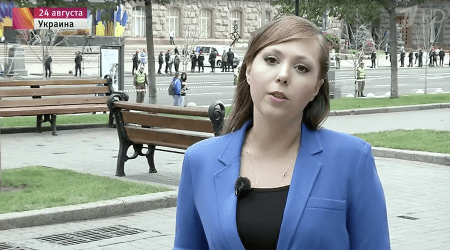
Russian television correspondent Anna Kurbatova has been detained by the Ukrainian security services in Kiev. The journalist, who works for Russia’s Channel 1, will be deported for “smearing” Ukraine, according to a security services spokesperson.
The incident occurred in the city center of the Ukrainian capital on Wednesday. Kurbatova was “grabbed by unknown assailants, forced into a car and driven away,” according to Channel 1.
The Russian authorities are closely monitoring the situation to learn more about the fate of the journalist.
“At the moment we don’t have information, but, undoubtedly, we’ll do our best to clarify the situation,” Russian presidential spokesman Dmitry Peskov told reporters.
Russia’s Foreign Ministry is also trying to clarify the situation around the correspondent’s detention.
“The Russian Foreign Ministry and Russian diplomatic institutions abroad are looking into the disappearance of a Channel 1 journalist in Ukraine,” Russian Foreign Ministry spokeswoman Maria Zakharova told TASS.
The Russian embassy in Kiev has sent requests to the Ukrainian security services as well as a note to Ukraine’s Foreign Ministry, urging them to clarify the incident and immediately release the journalist, RIA Novosti reported.
A spokesperson for the Security Service of Ukraine (SBU) confirmed that the journalist was detained by the organization’s operatives. Kurbatova will be deported from Ukraine to Russia and the SBU is currently preparing the paperwork, according to the spokesperson.
“Russian propagandist Anna Kurbatova will be forcibly returned to the Russian Federation. Ukraine is a constitutional state, its security services operate strictly within the legal framework. All necessary documents for her deportation are being prepared at the moment. It will happen to everyone who dares to smear Ukraine,” the spokesperson said in a Facebook post.
Russian Commissioner for Human Rights Tatyana Moskalkova has contacted her Ukrainian counterpart following the incident to determine whether the security services are following legal procedures.
“I’ve just sent a request to my colleague Valeria Lukyanova asking her about the location [of the journalist], her health condition and the consular visit, i.e. whether all the conventions are being observed if she has been detained by law enforcement,” Moskalkova told Interfax.
“I’m outraged and deeply worried about the treatment of journalists. Freedom of speech is protected not only by states’ constitutions, but also by international legal acts, journalists worldwide are independent and have immunity.”
Ahead of the incident, the journalist received threats in connection with her reporting on Ukraine’s Independence Day, according to Channel 1. Following her report, Kurbatova was placed on the list of “enemies of Ukraine” on the notorious Mirotvorets (Peacemaker) website. The website accuses the journalist of “anti-Ukrainian propaganda” and “manipulating socially-important information.”
Just before the incident, Kurbatova had prepared a new report on the ill-treatment of journalists in Ukraine, which has not yet been aired.
It’s not the first time a Russian journalist has become a target for the Ukrainian security services. Earlier in August, a journalist for the All-Russia State Television and Radio Broadcasting Company (VGTRK), Tamara Neresyan, was deported following an apparently similar incident.
“I was detained in the street and promptly brought to the main SBU office, where I was questioned for three hours. They confiscated my phone, it was done very roughly, nearly breaking my arms. Following the questioning they read me a resolution of the SBU that I would be deported and barred from re-entry for three years,” Neresyan told Rossiya 24 TV channel.
UK Secures ‘Permanent’ Naval Base ‘East of Suez’ in Oman
Sputnik – August 30, 2017
In the UK, parliament may still be in summer recess, but government ministers aren’t resting. Defense Minister Michael Fallon jetted to Oman August 28 to cement a number of military agreements with the Sultanate’s leaders. The inking represents a continuation of a longstanding and rarely examined “special relationship” between the two countries.
During his two day visit, Fallon met with Sayyid Badr bin Saud bin Harub Al Busaidi, Oman’s Minister Responsible for Defense Affairs, in Muscat. The pair signed a “Memorandum of Understanding and Services Agreement” that secures UK use of naval facilities at Duqm Port — a multi-million dollar joint venture between the two countries.
An official statement issued by the Foreign & Commonwealth Office said the “booming” Port complex would provide “significant opportunity” for the two countries’ “defense, security and prosperity agendas,” and serve as a home from home for the UK’s flagship aircraft carrier, HMS Queen Elizabeth.
“This agreement ensures British engineering expertise will be involved in developing Duqm as a strategic port for the Middle East, benefiting the Royal Navy and others. Oman is a longstanding British ally and we work closely across diplomatic, economic and security matters. Our commitment to the Duqm project highlights the strength of our relationship,” Fallon said.
The Defense Minister’s visit gained virtually no recognition in the UK media — while the traditional paucity of official government business to report on over the summer arguably makes the story a prime candidate for press coverage, radio silence on UK-Oman relations is a seemingly enduring mainstream editorial policy.
Declassified British government files reveal the oil-rich Gulf state’s leader Sultan Qaboos bin Said al Said — one of the longest serving unelected rulers in the world — was brought to power in a 1970 palace coup planned by UK foreign intelligence service MI6, and sanctioned by then-Prime Minister Harold Wilson. The Sultan has absolute power in governance, and is also the country’s Prime Minister and Minister of Defense, with total authority over Oman’s judicial and legal systems.
Ever since the coup, Oman has proven a most faithful ally to the UK, hosting a number of major British intelligence and military operations.
For example, UK spying agency GCHQ has three separate bases in the country — codenamed Timpani Guitar and Clarinet — that feed off various undersea cables passing through the Strait of Hormuz to the Arabian Gulf. In the process, the bases intercept and process a vast volume of emails, telephone calls and web traffic generated in the region, which is then shared with the US’ National Security Agency.
Moreover, UK troops have long trained Omani armed forces, and in May 2016 it was announced the UK would increase its number of training teams in Oman from 34 to 45 in 2017.
US Marine Live-Fire Range to Be Constructed on ‘Pristine’ Land in Guam
Sputnik – 29.08.2017
Guam will soon be the site of a US military live-firing range to support Marines relocating from Okinawa, following an $87 million contract that was awarded to Black Construction Corp last week.
Between 2022 and 2026 there are plans for about 4,100 Marines to relocate from Okinawa to Guam. This drawdown is part of a 2013 agreement between Japan and the US for Washington to reduce its footprint on Okinawa, which houses most of the United States’ military bases in Japanese territory.
Andersen Air Force Base will situate the complex near what community members say is the last pristine area on the island: a wildlife refuge that will have to be partially closed when the range is in use.
Col. Brent Bien, who oversees US Marine activity in Guam, said in a statement, “We are committed to Guam, and our forward presence here will play an essential role in strengthening the military’s ability to maintain regional security and protect the nation’s interests in the Pacific.”
One of the groups opposing the range’s construction is Prutehi Litekyan, who has been reaching out to local political leaders to put a halt to what spokeswoman Sabina Perez called a “toxic legacy.”
Guam congresspeople Sen. Fernando Esteves (R-Yona), Speaker Benjamin Cruz (D-Tumon) and Vice Speaker Therese Terlaje (D-Yona) have expressed support for the group.
“No amount of money can compensate for the permanent destruction, loss of access and other adverse impacts to Guam’s historic sites,” Terlaje said on Friday. “One hundred eighty-seven acres of limestone forests, endangered species and fishing areas that are part of this particular live-fire training range project.”
“The Department of Defense has not kept its promises to avoid these adverse impacts to Guam and in fact continues to expand its control over lands and waters of Guam and the Marianas,” she added, according to AP.
Perez said the group is trying to schedule meetings with military officials, and Terlaje is appealing to Gov. Eddie Calvo to meet with federal officials to try and avoid the range’s potential impact
The complex is expected to be complete by November 2020.
US test-drops second gravity nuclear bomb in five months
Press TV – August 29, 2017
The US has carried out a second flight test of a newly upgraded nuclear free-fall bomb in five months at the Tonopah Test Range in the state of Nevada which it says is designed to “meet national security requirements.”
The test of the B61-12 bomb, which was the second of the upgraded B-61 variant, was dropped by an F-15E Fighting Falcon jet on August 8. The second qualification flight test for the nuclear weapon was completed by the US Air Force and the National Nuclear Security Administration (NNSA), with the first one having been successfully conducted in March.
“The B61-12 life extension program is progressing on schedule to meet national security requirements,” acting NNSA deputy administrator for defense programs Phil Calbos said in a statement on Tuesday.
“These realistic flight qualification tests validate the design of the B61-12 when it comes to system performance.”
According to an NNSA statement, during the test, the bomb’s non-nuclear components, such as the arming and fire control system, radar altimeter, rocket motors and weapons control computer, as well as the aircraft’s capability to deliver the weapon were reviewed.
The first production of the bomb is scheduled for March 2020.
The US military’s recent test came amid simmering tensions between the US and North Korea over Pyongyang’s nuclear tests.
The second test of the nuclear bomb could indicate that Washington is speeding up its rearmament program the editor-in-chief of National Defense magazine, Igor Korotchenko, warned.
“The fact of the test of this modification of the nuclear bomb indicates that the US continues an accelerated rearmament program of its tactical nuclear arsenal in Europe, as well as that both Washington and Brussels are considering the scenario of a limited nuclear war in Europe,” Korotchenko said.
Back in April, the US Air Force announced that it had test-dropped an upgraded gravity nuclear bomb to see whether its aircraft can carry the deadly weapon.
US President Donald Trump has called for the US to “greatly strengthen and expand its nuclear capability,” though he criticized former President Barack Obama administration’s costly modernization program during the election campaign.
Back in February, the US Navy test-fired four Trident ll D nuclear-capable ballistic missiles from a submarine in the Pacific Ocean.
Israel’s failure to attract major oil companies is a massive blow to its ambitions
New Khaleej | August 28, 2017
Israel has managed to beat its Mediterranean neighbours in the development of its offshore gas industry over the past two decades by discovering 10 gas fields, specifically in the northern waters adjacent to Cyprus and Lebanon. Initially, Israel was concerned with developing the Tamar field, which has about 282 billion cubic metres of gas, and the Leviathan field, which has about 500 billion cubic metres.
Since Spring 2013, gas has been produced from the Tamar field to supply local power stations. Negotiations are underway with neighbouring countries to export Leviathan gas, not to mention changing most of the local power stations to use two types of fuel, gas and oil, rather of depending on only one type, as was the case in the past, either coal or oil.
However, the Israeli gas industry faltered in December 2014, when Israel’s then Antitrust Commissioner accused the Noble Energy-Delek consortium of monopolising all discoveries in accordance with the agreements signed by the gas authorities, as well as monopolising internal gas supplies and the prices of gas and electricity. This resulted in disagreements within the Knesset (Israeli parliament) and civil society over this lawsuit; Prime Minister Benjamin Netanyahu took part, as he considered it a matter of “national security”. The issue was ultimately referred to the courts.
However, middle ground was found in order to rescue the gas industry from the repercussions of the chaos caused by the cancellation of memorandums of understanding for export to neighbouring countries, and the fears of international oil companies about working in Israel due to the fact that approval needed to be obtained from multiple parties, even after the signing of agreements. They were also discouraged by the contradiction in the official institutions’ privileges and the extent of competition in working in Israel compared to other countries.
Some of the largest law firms and public relations companies, especially in the US, have been involved in these disputes. Solutions were reached, with the consortium countries giving up their shares in some relatively small fields, especially in the neighbouring Karish and Karan fields, which are considered the closest to Lebanese waters (about 10 miles away).
Most importantly, the first licensing cycle was announced in September 2016 and began last November. The names of the winning companies were announced on 17 March this year. The agreements with the consortium led by Noble Energy were reached through bilateral talks.
The main objective of the first licensing cycle was the development of 24 offshore blocks adjacent to the Tamar and Leviathan discoveries. The size of some sectors is about 400 square kilometres, while the depth of the water is between 1,500 and 1,800 metres. The cycle aimed to attract international oil companies in an attempt to benefit from their technical expertise and their marketing, industrial and financial capabilities. It also aimed to begin a new era of experience between Israel and the international oil companies, especially after the antitrust authority complaints and changes in the Arab boycott laws.
This was followed by an attempt to break through the boycott in one of the most important economic sectors in the Middle East. Opening this relatively large number of maritime sectors all at once was accompanied by Israel’s interest in the discovery of crude oil in commercially volume in deep geological strata. This was after evidence emerged that oil could be found. Official sources said at the time that independent research bodies estimated the amount of oil that could be found amounted to about 6.6 billion barrels, in addition to 2,137 billion cubic metres of gas.
“Companies operating in Israel [Noble Energy and Delek] are not allowed to participate in the tender, in order to encourage competition,” said Israeli Energy Minister Yuval Steinitz.
The concerned Israeli authorities tried to make the first licensing cycle successful, but to no avail. The energy minister and ministry officials participated in large-scale promotional conferences in London, Houston and Singapore, as well as an “information room” for companies, but did not achieve their goals.
Only four companies have announced their interest, namely Greece’s Energean, Italy’s Edison, an Israeli company that has not been named and Spain’s Repsol. As a result of this low turnout, both in terms of number and significance, and because Repsol is the only one with a prestigious position within the European oil companies, there has also been news in the oil industry about trying to attract international companies to work in Israel, specifically Exxon Mobil, but no agreement has been reached yet.
Due to the scarcity of companies that have shown an interest in participation, especially given the large number of sectors offered to companies and the failure to reach agreements with international companies, the date of the session was extended to 21 April and the results were announced in July. However, with the failure to attract many or important companies, even after the extension, it seems clear that the session will be extended further, perhaps to the first quarter of 2018.
The lack of interest from the major oil companies in the Israeli gas industry has been a massive blow to Israel’s ambitions to attract those with large capital, specialisms and experience in the development of deep offshore fields, and which have the necessary connections to new large market routes (a dilemma Israel faces despite its attempts with Turkey, Greece and Italy). It has also hindered Israel’s desire to compete with Egypt (with the discovery of Eni in the Zohr gas field), in order to become a regional centre for the gas industry in the east Mediterranean.
Translation by MEMO
Netanyahu uses fake “ancient” coin to justify settlements in West Bank
Palestine Information Center – August 29, 2017
NAZARETH – A coin that was celebrated by Israeli Prime Minister Benjamin Netanyahu as evidence of a historical Jewish link to the West Bank has been found to be fake replica.
Numerous media outlets reported last week on the find of a rare 2,000-year-old half-shekel coin by an eight-year-old girl, Hallel Halevy, in the Israeli illegal settlement of Halamish in the West Bank.
The find excited many Israelis who argued it provided evidence of the historical Jewish connection to the West Bank, usually referred to as Judea and Samaria by Israelis.
 Among those lauding the find, Netanyahu claimed in a Facebook post that “the “2,000-year-old silver coin” was used during the Second Temple period in Jewish history which lasted between 530 BCE and 70 CE.
“This exciting discovery is additional evidence of the deep connection between the people of Israel and its land – to Jerusalem, to our temple, and to the communities in Judea and Samaria,” Netanyahu wrote in his post.
However, on Sunday it was revealed that not only was the coin not ancient, but also was in fact a replica souvenir, regularly made at the Israel Museum, where a small mint at the Youth Wing of the museum is used to create the coins during annual Hanukkah activities organized as part of an educational program for children.
“There is no chance that it is authentic, it is not an ancient coin,” Haim Gitler, chief curator of archaeology and the curator of numismatics at the Israel Museum told The Times of Israel on Sunday. “Even to call it a coin is to exaggerate what it is,” he added.
Netanyahu deleted his Facebook post shortly after that. However, social media users were quick to comment on the news, with many ridiculing Netanyahu mistaking the replica for a historical artifact.
Featured Video

The First Pyrrhic Victory of the Vietnam War
or go to
Aletho News Archives – Video-Images
Frlom the Archives
The 52 Major Jewish American Organizations and Israel Celebrate Passover with the Slaughter of 25 Muslim, Christian and Secular Palestinians
By James Petras • Unz Review • April 8, 2018
Introduction
As of April 7, nearly three thousand unarmed Christian, Muslim and secular Palestinians have been wounded, over three dozen are in critical condition and at least twenty-five unarmed protestors, including children have been assassinated by hundreds of Israeli snipers and heavily armed troops shooting tank shells into crowds of civilians protesting their decades of incarceration by the racist Israeli state.
The Israeli government praised the ‘restraint and morality’ of the IDF, as did the fifty-two Major Jewish American Organizations (MJAO) who largely control the US Congress. These grotesque massacres began during the Christian Holy Week on Good Friday and Easter, coinciding with the Jewish Passover. The self-righteous officials of the MJAO and their relatives and friends broke matzos at joyful Seders as the blood of Palestinians soaked into ground at the fence containing the largest open-air prison camp in history, Gaza.
While tribal loyalties bonded the Israeli and Jewish American leaders, the politicians of the Western oligarchic electoral regimes refrained from criticizing the shocking display of brute force and even defended Israel’s cold blood mass killings of Palestinian civilians in their Gaza prison.
This paper will discuss and analyze the reasons for Israel’s willing Western accomplices and the centrality of its fifth column in the United States. … continue
Blog Roll
 Aletho News
- Top US Counterterrorism Official Resigns in Protest of Operation Against Iran
- Just Get Out! Now!
- Unpacking glaring contradictions in US-Zionist justifications for war against Iran
- Iranian model of warfare bleeds US dry while Persian Gulf states watch and learn: Analyst
- IRGC orders ‘defeated’ US to evacuate industrial facilities in region
- Hegseth’s call for ‘no mercy’ to Iranians deemed war crime
- Iran War Exposes Limits of US Military Power – Journalist
- Even The Neo-Cons Admit The Iran War Is Failing
- Inside the Caucasus Drone Corridor Fueling Tensions With Iran
- ‘Not our war’: Trump’s naval coalition to reopen Strait of Hormuz dead in the water
- If Americans Knew
- Top US counterterror advisor resigns in protest of “war manufactured by Israel” – Not a ceasefire Day 158
- ‘I Liked the House’: When Israeli Soldiers Turn Palestinian Homes into Barracks
- ‘They Were All I Had’: Lebanese Father Buries Parents, 4 Daughters Killed by Israeli Bombing
- Israel and its supporters are causing attacks on Jewish institutions. Case in point: Michigan synagogue tragedy.
- These are the casualties and cost of the war in Iran 2 weeks into the conflict
- Chicago Teachers Union accuses AIPAC of swaying elections with ‘dark money’
- Predictions of another 9/11, amid Israel-US killing spree – Not a ceasefire Day 157
- As US-Israel war on Iran rages, Gaza faces massive dust storm – Not a ceasefire Day 156
- No let-up in attacks on Gaza as Israel takes on Iran, Lebanon – Not a ceasefire Day 155
- ‘Of Course’: IDF Drops Case Against Soldiers Accused of Raping Palestinian Prisoner
- No Tricks Zone
- Storing Green Energy To Last Germany 10 Days Would Require A 60-Million Tonne Battery
- New Studies: UK Sea Levels Were 4 Meters Higher Than Today During The Mid-Holocene
- Destructive Green New Deal: German Energy And Metal Group Warns Of Drastic Crisis
- New Study Documents A 20-Year Pause In Arctic Sea Ice Decline – Driven By Internal Variability
- Wake-up Call: Survey Shows Majority Of Germans Now Favor Postponing Climate Targets!
- Televised! Leading German Political Candidate Tells Schoolchildren CO2 Makes Sun Hotter!
- New Study: A Century Warming Of 1.1°C Is ‘Commonplace’ And ‘Not Unusual’ During This Interglacial
- New Study: ‘Internal Noise’ And Volcanic Forcing Can Trigger 10-15°C Warming Within Decades
- Glaciers Worldwide Are Suddendly Surging, Experts Blame Warming!
- Surprising Discovery: Sahara Is Greening…Billions Of Trees Where Once Thought To Be Barren
 Aletho News