Russia announces deal on safe zone in Syria’s Homs
Press TV – August 3, 2017
The Russian army says it has reached a deal with foreign-backed militants in Syria to create a new de-escalation zone in the country’s northern parts of Homs province.
Russian military spokesman Igor Konashenkov made the announcement on Thursday, saying that new safe zone will span 84 towns and villages populated by more than 147,000 people in Homs.
The official noted that a ceasefire was to take effect in the area at 12:00 p.m. local time (0900 GMT) on Thursday.
The zone is the third to be established in Syria under a Russian-led initiative aimed at halting clashes in four key conflict zones between Syrian government forces and anti-Damascus militants.
Last Saturday, the warring sides agreed on a deal declaring Eastern Ghouta as a de-escalation zone.
Russia, along with Iran and Turkey, brokered the deal for establishing four de-escalation zones in mainly militant-held areas of Syria during ceasefire talks in the Kazakh capital city of Astana in May.
The plan, which came into effect at midnight on May 5, calls for the cessation of hostilities between militant groups and Syrian government forces.
It covers the northwestern Syrian province of Idlib, northeastern areas of the western coastal province of Latakia, western areas of Aleppo province and northern parts of Hama province.
The parties to the Astana talks are now working on the details of the deal.
Syria has been fighting different foreign-sponsored militant and terrorist groups since March 2011. UN Special Envoy for Syria Staffan de Mistura estimated last August that more than 400,000 people had been killed in the crisis until then.
US sanctions won’t stop Russia’s pipeline project to Europe – analysts
RT | August 3, 2017
The latest US sanctions targeting Russia’s oil and gas sector will cause Gazprom some headaches in building the new gas pipeline to Germany, experts say. However, US restrictions are unlikely to stop the project.
“The price of any project automatically increases,” Tatiana Mitrova, director of the Skolkovo Energy Center told Reuters.
“Gazprom’s relationships with partners, subcontractors, and equipment and service providers are very complicated. They will all ask for a risk premium,” she added.
“This, however, does not mean that Nord Stream-2 won’t be built,” said Katja Yafimova of the Oxford Energy Institute.
However, while Gazprom’s major partners in the projects – ENGIE, OMV, Shell, Uniper, and Wintershall – are likely to accept the risks, smaller contractors will be more cautious.
“Not all partners can afford to see things through with Gazprom,” said Valery Nesterov, an analyst at Moscow-based Sberbank CIB.
It is still unclear whether the US President will enforce the restrictive measures. While Trump signed off on the new sanctions on Monday, he did so reluctantly, calling them “significantly flawed.”
“Unless Trump takes a really sharp turn, it is highly unlikely that companies that are supplying pipeline goods are going to be punished in the next year or so,” Richard Nephew, a former US deputy chief of sanctions told Reuters.
At the same time, Gazprom’s long-term projects can be affected.
“A lot of companies are now thinking: ‘I’ve got maybe 12, maybe 18 months in which I can do some stuff but after that maybe I won’t’,” he added.
The Nord Stream-2 pipeline plans to double the delivery capacity of Russian natural gas to Germany from the current 55 billion cubic meters of gas per year.
Trump Battles the CIA: The Korea Ban & Bad Signs in the Market
By Caleb Maupin – New Eastern Outlook – 02.08.2017
The ban on travel to the Democratic People’s Republic of Korea is primarily an attack on the people in the northern part of the Korean Peninsula. It is a move to further isolate the DPRK, and prevent tourist dollars from flowing in, while also preventing fraternization between Americans and citizens of the country. However, the State Department’s decision also has another target in the crosshairs, one much closer to Washington DC.
According to reports in the press, roughly 5,000 US citizens visit the DPRK each year. Most are tourist youth attracted to the mystique and adventure of traveling to a country so widely demonized in the US media. Communist organizations send political delegations and Christian sects such as the Mennonites often send missionaries and aid workers. However, one can be sure that among the 5,000 people who visit the country each year is more than a few American spies, posing as tourists.
When one looks over the recent history of Americans being arrested in North Korea prior to the tragic death of Otto Warmbier, the reasons for the arrest almost always indicate activities that could be described as espionage. Merrill Newman, for example, was a former member of the US military’s “White Tigers” division during the Korean War. The 85 year old man was arrested in the DPRK as he wore a ring with the insignia of this anti-DPRK fighting and intelligence unit. After being arrested he confessed to participating in some of the war crimes against the Korean people during the 1950-1953 war. Newman stated “I did not realize North Korea was still at war” after his eventual release.
The State Department ban on travel to the DPRK is far more extreme than the widely challenged ban on travel to Cuba, enacted as part of the blockade. Officials say that any American who visits DPRK will automatically have their passport invalidated. The constitutionality of such an extreme ban is likely to be challenged.
In the meantime, however, any efforts by the CIA to gather information inside North Korea, or to manipulate or maneuver within its internal affairs, are greatly limited.
Two divisions of the US Federal Government that have long been at odds in issues of foreign policy have been the military and the Central Intelligence Agency. The nature of the two entity’s work lays the basis for their constant disagreement and conflict. The new State Department policy has essentially declared that the DPRK will be handled with military operations, not with “color revolutions,” plots of a coup, manipulation of the youth, or the other shenanigans carried out by the intelligence agencies.
A Longstanding Fight – CIA vs. Pentagon
The US military brass is trained at West Point, and though a great deal of history and background is provided, the focus of their training is military science and the “art of war.” Meanwhile, the Central Intelligence Agency’s administrators come from Harvard, Yale, and Princeton, and are trained in the subtle art of expanding US influence and quietly neutralizing those who challenge it.
The favorite word of those who extol the military and disfavor the CIA is “strength.” The strategies favored by the Pentagon involve demoralizing opponents of US power with “shock and awe” style crushing of enemies. The mass bombing campaigns in Vietnam and Korea did not win credibility and respect for the US internationally, and this was not their intention. The same can be said for Bush’s unilateral invasion of Iraq. The Pentagon does not concern itself with winning friends and influencing people, but with blowing things up, and its favored foreign policy reflects this.
The CIA, on the other hand, tends to favor soft power, negotiations, and internal subversion of global rivals, all done covertly, with the USA looking like a benevolent “Mr. Nice Guy” on the surface. The CIA favors arming and training third party proxies to fight their enemies, while waging a fierce battle in the field of public relations and propaganda.
The clash between the military and the intelligence agencies has played out dramatically in recent US history. It is widely understood that John F. Kennedy began enacting policies that overwhelmingly favored the CIA prior to his death. Kennedy resisted the efforts to escalate military involvement in Vietnam, while funding and emphasizing CIA-linked operations like the Peace Corps. Kennedy’s often quoted the phrase “those who make peaceful revolution impossible make violent revolution inevitable” stated the CIA’s exact strategy for fighting Communism during the Cold War. The CIA favored “reforms” in US aligned third world regimes that made Marxist-Leninist revolution less appealing, while also presenting the US as a benevolent, charitable country that did not seek to intervene in other countries domestic affairs. The CIA worked to make sure that the hands of the USA during the rise of military dictatorships and the toppling of pro-Soviet world leaders were well hidden.
Prior to Kennedy’s assassination, a hard, right-wing mass movement against him, involving the John Birch Society and many Pentagon linked political figures, called the “Camelot” President a traitor and Soviet agent. Many sections of the military thought Kennedy’s “soft power” strategy for confronting Communism, and his ultimate refusal to invade Cuba with US troops after the CIA’s failed “Bay of Pigs” operation, showed weakness. Films like “Dr. Strangelove” widely mocked the well-known fanaticism of the military brass, which distrusted the intelligence agencies and the ability of politicians to make military decisions. Kennedy’s subtle alliance with the Civil Rights Movement, though inconsistent and widely criticized by activists, also threatened a military brass packed with the sons of wealthy southern families.
After the death of Kennedy, the US military seemed to be on top in the power struggle. Richard Nixon’s electoral victory in 1968, and his “secret plan” to win the Vietnam War with massive bombing, showed the military and its allies as the dominant force in setting policy.
But the demoralizing and unpopular war in Vietnam reversed this by the mid-1970s. Nixon found himself listening and depending more on the advice of Henry Kissinger, opening relations with the People’s Republic of China, and eventually being driven from office. Jimmy Carter took office in 1976 calling himself a “student” of CIA strategist Zbiegniew Brzezinski. Under Reagan, the CIA got stronger, with CIA chief George H.W. Bush rising to be Vice President and eventually Reagan’s successor as commander-in-chief.
The often repeated narrative that the US military’s escalation of the arms race was the key factor in defeating the USSR is said with absolute defensiveness by the Pentagon’s right-wing allies. Though the “strong man Reagan” explanation is more widely understood among the US public, within the circles of power in the USA, the CIA takes more credit.
Under the direction of Brzezinski, who boasted that he “gave the USSR a Vietnam” by funneling money and weapons to insurgents in what he called the “Afghan trap,” the CIA manipulated political situations in Eastern Europe causing unrest and a crisis that eventually toppled the USSR. The CIA widely credits itself for terminating the Soviet Union by manipulating internal problems and applying less blatant forms of external pressure.
The CIA is not a “Conservative” Organization
Many leftists and anti-war activists assume that the CIA is staffed with jingoistic conservatives due to the nature of the job. While the rank-and-file of “the company” may attract a more rightist crowd of Mormons and military types, the leaders of the CIA are not conservative in any sense of the word.
John Brennan, the director of the CIA under Barack Obama admits that he voted for Communist Party Presidential Candidate Gus Hall in the 1976 Presidential election. Brennan was stationed in Riyahl for many years, and at the time of his appointment, many voices came forward to allege that he had actually converted to the Wahabbi brand of Islam. The allegations remain unproven.
The CIA strategist who was most influential between the 1960s and the 1990s was Zbiegnew Brzezinski. To call Brzezinski conservative would be deeply mistaken. Zbeignew’s daughter, Mika Brzezinski is a host on liberal leaning MSNBC’s TV program “Morning Joe.”
Brzezinski developed the art of propaganda, presenting the USA to the world as the homeland of Beatles Music, the paintings of Jackson Pollack, and sexual hedonism. In Eastern Europe, Brzezinski’s policies convinced millions of alienated young people that overthrowing the Marxist-Leninist governments would transform their countries into Disneyland playgrounds packed with consumer goods and never ending rock and roll concerts.
In Afghanistan, Brzezinski worked with a young Saudi billionaire named Osama Bin Laden to fight against the People’s Democratic Party. With US made weapons and funding, complimented by heroin revenue, the insurgents poured acid on women’s faces and hanged literacy campaign volunteers. Brzezinski’s slick propaganda work convinced the world that these Wahabbi extremists were actually Che Guevara-esque freedom fighters, battling the “Soviet Empire” for freedom. CBS news was even caught airing staged, fake battle footage.
The figure known as George Soros has become a favored talking point of right-wing activists in the USA. They present him as the sinister bank-roller of leftist activism. Long before Soros was promoting Democrats and Liberals in the USA, he was bank-rolling CIA supported anti-Communist “color revolutions.” Soros is known to have funded anti-communist, pro-capitalist and pro-western protest movements in the USSR, Czechoslovakia, Yugoslavia, and elsewhere.
During the Cold War, the CIA launched a program called the “Congress for Cultural Freedom.” The program funded the art of Jackson Pollack, as well as the Trotskyist magazine Partisan Review. The CIA also launched a project called MK-Ultra which involved distributing hallucinogenic drugs on college campuses.
Obama’s Administration – The White House Stood With Langley
Barack Obama’s grandparents were prominent executives of the Bank of Hawaii. Obama’s grandmother Madelyn Dunham, actually became the first female Vice-President of the bank. The Bank of Hawaii was key in transferring money to US intelligence operations across Asia.
Obama’s mother, Ann Dunham, was married to Lolo Soetoro, a figure in Indonesia who openly supported the 1965 CIA backed coup d’etat against President Sukharno. Soetoro eventually became a military officer under US backed dictator Suharno. It should be noted that the 1965 coup, which Obama’s grandparent’s Bank of Hawaii was involved in financing, was particularly bloody, and involved mass slaughter of ethnically Chinese people. Some estimate that as many as 500,000 people died.
Obama’s family connections aside, his Presidency was very much favorable to the CIA’s strategy for international relations. Obama’s middle name is Hussein. He attended an Islamic elementary school as a child. Long before becoming President, Obama famously had a meeting with Palestinian scholar Edward Said. He maintained a hostile war of words with Israeli Prime Minister Benjamin Netanyahu.
One is reminded of how Napoleon Bonaparte sent out proclamations saying he was a Muslim as he attempted to seize Syria and Egypt for France. To the Arab world, a key region in US foreign policy strategy, Obama gave the illusion of possibly being a Muslim and an ally against Israel.
The fact that a dark skinned man, whose middle name was “Hussein” occupied the White House probably played a key role during the Arab Spring. The uprisings of youth in Islamic countries did not become a repeat of the 1979 Islamic Revolution of Iran, where western capitalism was replaced by a government proclaiming “war of poverty against wealthy” and “Not capitalism but Islam.”
The USA was able to maneuver within the Arab spring to topple the Islamic Socialist government of Libya, and to reduce the Baath Socialist country of Syria to civil war and chaos. Meanwhile, the US backed autocracies in Saudi Arabia, Bahrain, and elsewhere remained thoroughly intact. The continuation of the Yemeni revolution against a pro-Saudi regime now faces an onslaught of bombs and foreign troops.
The establishment of diplomatic relations between the USA and Cuba, with friendly words while intel operatives worked behind the scenes to plot social media unrest with a “Cuban Twitter,” fits the CIA playbook and strategy completely. The JCPOA negotiations with Iran fit into a similar strategy.
In the final weeks of the Obama administration, desperate “Mr. Nice Guy” maneuvers to increase the credibility of the USA on the global stage were carried out. John Kerry gave a speech criticizing Israel, and the US did not protect Israel from a harshly worded resolution at the UN Security Council.
Trump Stands With The Pentagon
Even before Trump took office, his presidential campaign was loaded with subtle hostility to the CIA. Trump castigated the results of US foreign policy, specifically in Syria and Libya where the CIA had been instrumental. During his debate with Hillary Clinton he criticized the funding of rebels in Syria. He repeatedly said that the policies of Obama and Secretary of State Hillary Clinton had created ISIS.
Trump repeated perspectives that would be popular with the military. The key word repeated in Trump’s foreign policy speeches was “strength.” The idea that a huge military budget and direct military interventions make the USA look stronger as a country has long been a talking point of the military brass, against proponents of soft-power and subtle influence.
At times, Trump seemed to be contradictory when talking about foreign policy. It is no secret that among rank-and-file soldiers, and the white, working class, rural communities they often originate in, right-wing isolationist sentiments are widespread. Trump appealed to those sentiments when talking about the bad results of “toppling regimes” and employing the slogan “America First.”
At the same time, he appealed to the Pentagon’s calls for strength, saying that Obama’s “red line” around chemical weapons had “meant nothing.” It may sound contradictory to favor isolationism, while criticizing a president for not making good on threats to attack a country, but it fits into his overall appeal to sentiments within the military.
At the same time that Trump critiqued foreign policy and echoed isolationist talking points, he consistently called for an increase in military spending. In Trump’s foreign policy rhetoric, the isolationism of rank and file soldiers, the Generals’ lust for strength, and the military-industrial complex’s desire for more profits were all re-assured.
The spat between Trump and the CIA is no secret, and is widely acknowledged, even in mainstream US media. The intelligence agencies continue to repeat, without proof, that Trump received assistance from “Russian meddling” in the 2016 elections. A series of leaks from within the administration have found their way to the press.
The Trump administration fought back first by dramatically crippling the CIA’s operations in the Middle East. The executive order banning travel from 6 countries was widely called a “Muslim ban” in the US press. In reality, it targeted all citizens, Muslim or not, from 6 specific countries. (Note: The ban originally included 7 countries, but Iraq was removed from the list.)
Sudan, Iran, Syria, Yemen, Libya, and Somalia are all the site of ongoing conflicts, and in each of these countries US intelligence agencies are working to influence and coordinate with certain forces. As was pointed out by an opponent of the ban on FOX news, the “travel ban” prevents the CIA from rewarding those who do its bidding with visas. A key “soft power” bribe has been taken away from the CIA for its operations in the Middle East.
Trump ultimately shut down the CIA’s training program for anti-government fighters in Syria, according to reports. Trump has accused Obama of wiretapping him during the Presidential campaign.
Trump has even discussed designating the Muslim Brotherhood, an organization that works closely with the CIA around the world, as a Foreign Terrorist Organization. The Muslim Brotherhood was key in undermining and fighting against Arab Socialism during the cold war. More recently, the Muslim Brotherhood was key in aiding US activities to manipulate the Arab spring, and the create turmoil in Libya and Syria.
The Turkish government, which draws its support from the Muslim Brotherhood, is far less friendly to the United States than just a few years ago. The current spat between Saudi Arabia and the Muslim Brotherhood-supporting state of Qatar may reflect difference within the power structure about relations to the Muslim Brotherhood and its use in the fight against independent governments.
Despite presenting himself as an isolationist, Trump ultimately did what Obama was unwilling to do, and launched direct US attacks on the Syrian government. Many in his base were furious, and even longtime hawks like Ann Coulter denounced Trump’s move. However, the more well connected members of the Republican establishment praised it, using the military’s favorite word, calling the bombing a demonstration of “strength.”
As Donald Trump remains President of the United States, the press is solidly against him. This should be no surprise as the US Central Intelligence Agency, not the Pentagon, is primarily involved with influencing media. From the days of “Project Mockingbird” to today, the CIA works very hard to influence and craft public opinion, especially on issues of foreign policy. The flow of ‘anonymous leaks’ from the intel community into the press reflects the longstanding relationship between the intelligence agencies and the media.
The Specter of Economic Crisis, Greatest Danger to Trump
 Right now, spending in the USA is down. Wal-Marts are shutting their doors, and suburban malls, which employed thousands, are becoming a thing of the past. The post-2008 “new normal” of low wage retail jobs replacing good paying jobs for the next generation is rapidly fading away, as retail itself is being pushed aside by online shopping. Jeff Bezos outstripped Bill Gates as the richest man in the United States in terms of directly traceable assets.
Meanwhile, home ownership is still declining. The basic ability of American families to own houses has widely been eroded, home ownership has not been restored to anywhere near the pre-2008 levels. In neighborhoods across the USA, family homes are not being resold to American families, but to renting institutions.
As property values remain low and home ownership drops in suburban and rural areas, another aspect of the “new normal,” the “prosperous urban centers” hopping with young workers in high tech jobs, are also seeing a new decline in property values. Unemployment is low, but so are wages.
In the unfolding atmosphere of eroded spending power and decreasing incomes, banks in the USA are now cutting back lending. When banks stop lending, it is generally based on an understanding that bad times are ahead and they may not be able to collect.
Between 2000 and 2008, Alan Greenspan and the Federal Reserve did everything possible to hold off a crash. Greenspan legalized all kinds of previously illegal credit card and housing mortgage lending, in order to keep the US public spending money they did not have. While the spending power of the US public was drastically reduced by deindustrialization, automation, and shifts in the global economy, Greenspan spent his final years working tireless to keep sales up. Many will recall how George W. Bush urged Americans who wanted to help their country in the aftermath of 9/11 to “go shopping.”
Greenspan’s maneuvers worked only until 2008. With deregulated banking laws, Americans could keep buying houses and maxing out their credit cards, keeping the economy that faced turmoil from 2001 afloat, until the “bubble burst.”
Alan Greenspan was a high ranking member of the Council on Foreign Relations, a think tank often described as “the CIA’s brain.” He did not make his decisions in isolation, but most likely consulted with other figures in the intelligence community about the need to hold off the crisis as long as possible. Greenspan’s decision to legalize credit and keep the public spending, and temporarily hold off the crisis, was not a decision he made by himself.
As the economy crashed and burned in 2007 and 2008, Bush and his cronies, widely viewed as soft on big money, packed their bags, and Barack Obama was able to ride to the White House almost on a white horse, presented as the savior who offered “hope and change.” Greenspan’s efforts did not prevent a the financial crisis, but enabled it to come at a more convenient time, with less political fallout.
However, the political situation facing the USA is far different today. The intelligence community and a large section of the rich and powerful are adamantly opposed to Donald Trump’s presidency, there may not be any specific motivation to work to hold off a financial catastrophe.
If a financial crash were to occur again, Donald Trump would be the ideal scapegoat. The fallout could be blamed on his unpopular presidency which is already routinely ridiculed and demonized by the press.
Will Trump Come Out On Top?
The fact that Trump’s “infrastructure week” contained so few concrete actions may not have hurt Trump at the moment, but a failure to vastly improve the lives of the rust-belt working class that voted for him could be the ultimate undoing of his presidency.
As Trump battles the intelligence community, and seems to side with the Pentagon, he is facing an uphill battle. Allies of the Pentagon brass are disappointed and opponents of Trump are emboldened. However, Trump has proven that he has the ability to unpredictably reverse circumstances that are hostile to him, and come out victorious. The unexpected 2016 elections results are the most concrete example.
If anything was proven by Trump’s surprise victory or the Brexit vote, as well as the rise of Jeremy Corbyn and Scottish Nationalism in the UK, it is that anti-establishment sentiments are stronger and deeper than ever in western countries. People in the west realize that things are deeply wrong and are looking for answers. The answers offered by the status quo, often answers that are engineered and delivered in coordination with the intelligence community, are proving to be unsatisfactory.
In the age of easy access to information, the intelligence community may have both an advantage and disadvantage in the face of their opponents in the US power structure. On the one hand, their deceptions and crafting of public opinion can be more widely and cheaply disseminated than ever before. However, an audience that once had nowhere else to look can easily find alternative views, and debunk their claims. The economic decline and rising police state repression are making the US public more and more partisan toward opposing the establishment and entrenched power that the CIA’s propaganda activities seek to defend.
Trump and his allies in the Pentagon are in a weaker position as they face off with the Intelligence Community, however, the underlying shift in public opinion and the changes in the global economy give them a competitive edge.
Rep. John Duncan, Conservative Peace Proponent, Will Not Seek Reelection to US House

By Adam Dick | Ron Paul Institute | August 1, 2017
Rep. John J. Duncan, Jr. (R-TN) announced on Monday that he will not seek reelection in 2018 to the United States House of Representatives. In addition to being one of the longest-serving Republican members of the House (representing the second district of Tennessee since 1988), Duncan, who argues that being antiwar is a conservative position, is also one of the House’s strongest proponents for peace.
In his April of 2015 editorial “A Return to The Peace Party,” Duncan lamented the Republican Party drifting toward being a war-supporting party and argued that it should revert to its past position as the peace party. “When I was a teenager,” Duncan wrote, “I remember reading a publication from the Republican National Committee that said, ‘Democrats start wars, Republicans end them.’” Duncan wrote in the editorial that he not only thought the party’s shift toward hawkishness is wrong but also declared, “I think it is a recipe for defeat if my Republican party becomes known as a party favoring permanent, forever wars — war without end.”
Duncan elaborated on his editorial’s analysis in an in-depth C-SPAN interview the next month.
Duncan has also spoken up in the House against war, including in a June of 2015 speech in which Duncan proclaimed, “there has been nothing conservative about our policy of permanent, forever, endless war in the Middle East,” and in March of 2014 when he advised in a speech in opposition to US intervention in Ukraine that, “We don’t need to be sending billions to Ukraine, and we especially should not escalate this situation into some type of military confrontation.”
Duncan has cast votes in opposition to US wars and sanctions, including when he was one of only six House Republicans to vote in October of 2002 against authorizing the US commencing a war against Iraq and one of only three House members to vote last week against legislation imposing and expanding sanctions against Iran, North Korea, and Russia.
Duncan voted against the Iraq War despite the strong support in his district for starting the war. “When I pushed that button to vote no on that war,” Duncan is quoted in a Knoxville News Sentinel article regarding his vote, “I thought I might be ending my political career. I’m not trying to over-dramatize it. I really thought I might be.”
That vote did not end Duncan’s political career. But, 15 years and eight elections later, Duncan himself has decided to leave the House.
Commenting this week regarding his work in the House in a statement about his decision to not seek reelection, Duncan wrote, “During my time in Congress, I’ve worked as hard as I can to fight for what I believe in – fiscal conservatism, smaller government, and a more humble foreign policy that puts America first.”
Duncan is a member of the Advisory Board of the Ron Paul Institute for Peace and Prosperity.
A Blacklisted Film and the New Cold War
By Robert Parry | Consortium News | August 2, 2107
Why is the U.S. mainstream media so frightened of a documentary that debunks the beloved story of how “lawyer” Sergei Magnitsky uncovered massive Russian government corruption and died as a result? If the documentary is as flawed as its critics claim, why won’t they let it be shown to the American public, then lay out its supposed errors, and use it as a case study of how such fakery works?

Film director Andrei Nekrasov
Instead we – in the land of the free, home of the brave – are protected from seeing this documentary produced by filmmaker Andrei Nekrasov who was known as a fierce critic of Russian President Vladimir Putin but who in this instance found the West’s widely accepted Magnitsky storyline to be a fraud.
Instead, last week, Senate Judiciary Committee members sat in rapt attention as hedge-fund operator William Browder wowed them with a reprise of his Magnitsky tale and suggested that people who have challenged the narrative and those who dared air the documentary one time at Washington’s Newseum last year should be prosecuted for violating the Foreign Agent Registration Act (FARA).
It appears that Official Washington’s anti-Russia hysteria has reached such proportions that old-time notions about hearing both sides of a story or testing out truth in the marketplace of ideas must be cast aside. The new political/media paradigm is to shield the American people from information that contradicts the prevailing narratives, all the better to get them to line up behind Those Who Know Best.
Nekrasov’s powerful deconstruction of the Magnitsky myth – and the film’s subsequent blacklisting throughout the “free world” – recall other instances in which the West’s propaganda lines don’t stand up to scrutiny, so censorship and ad hominem attacks become the weapons of choice to defend “perception management” narratives in geopolitical hot spots such as Iraq (2002-03), Libya (2011), Syria (2011 to the present), and Ukraine (2013 to the present).
But the Magnitsky myth has a special place as the seminal fabrication of the dangerous New Cold War between the nuclear-armed West and nuclear-armed Russia.
In the United States, Russia-bashing in The New York Times and other “liberal media” also has merged with the visceral hatred of President Trump, causing all normal journalistic standards to be jettisoned.
A Call for Prosecutions
Browder, the American-born co-founder of Hermitage Capital Management who is now a British citizen, raised the stakes even more when he testified that the people involved in arranging a one-time showing of Nekrasov’s documentary, “The Magnitsky Act: Behind the Scenes,” at the Newseum should be held accountable under FARA, which has penalties ranging up to five years in prison.
Browder testified: “As part of [Russian lawyer Natalie] Veselnitskaya’s lobbying, a former Wall Street Journal reporter, Chris Cooper of the Potomac Group, was hired to organize the Washington, D.C.-based premiere of a fake documentary about Sergei Magnitsky and myself. This was one the best examples of Putin’s propaganda.
“They hired Howard Schweitzer of Cozzen O’Connor Public Strategies and former Congressman Ronald Dellums to lobby members of Congress on Capitol Hill to repeal the Magnitsky Act and to remove Sergei’s name from the Global Magnitsky bill. On June 13, 2016, they funded a major event at the Newseum to show their fake documentary, inviting representatives of Congress and the State Department to attend.
“While they were conducting these operations in Washington, D.C., at no time did they indicate that they were acting on behalf of Russian government interests, nor did they file disclosures under the Foreign Agent Registration Act. United States law is very explicit that those acting on behalf of foreign governments and their interests must register under FARA so that there is transparency about their interests and their motives.
“Since none of these people registered, my firm wrote to the Department of Justice in July 2016 and presented the facts. I hope that my story will help you understand the methods of Russian operatives in Washington and how they use U.S. enablers to achieve major foreign policy goals without disclosing those interests.”
Browder’s Version
While he loosely accused a number of Americans of felonies, Browder continued to claim that Magnitsky was a crusading “lawyer” who uncovered a $230 million tax-fraud scheme carried out ostensibly by Browder’s companies but, which, according to Browder’s account, was really engineered by corrupt Russian police officers who then arrested Magnitsky and later were responsible for his death in a Russian jail.
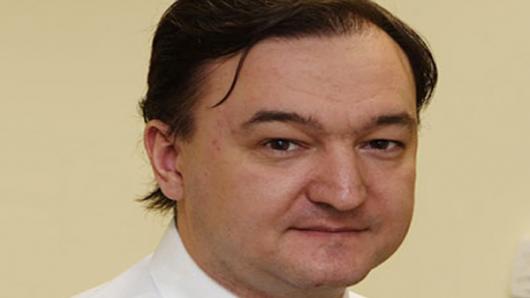
Sergei Magnitsky
Browder’s narrative has received a credulous hearing by Western politicians and media already inclined to think the worst of Putin’s Russia and willing to treat Browder’s claims as true without serious examination. However, beyond the self-serving nature of Browder’s tale, there are many holes in the story, including whether Magnitsky was really a principled lawyer or instead a complicit accountant.
According to Browder’s own biographical description of Magnitsky, he received his education at the Plekhanov Institute in Moscow, a reference to Plekhanov Russian University of Economics, a school for finance and business, not a law school.
Nevertheless, the West’s mainstream media – relying on the word of Browder – has accepted Magnitsky’s standing as a “lawyer,” which apparently fits better in the narrative of Magnitsky as a crusading corruption fighter rather than a potential co-conspirator with Browder in a complex fraud, as the Russian government has alleged.
Magnitsky’s mother also has described her son as an accountant, although telling Nekrasov in the documentary “he wasn’t just an accountant; he was interested in lots of things.” In the film, the “lawyer” claim is also disputed by a female co-worker who knew Magnitsky well. “He wasn’t a lawyer,” she said.
In other words, on this high-profile claim repeated by Browder again and again, it appears that presenting Magnitsky as a “lawyer” is a convenient falsehood that buttresses the Magnitsky myth, which Browder constructed after Magnitsky’s death from heart failure while in pre-trial detention.
But the Magnitsky myth took off in 2012 when Browder sold his tale to neocon Senators Ben Cardin, D-Maryland, and John McCain, R-Arizona, who threw their political weight behind a bipartisan drive in Congress leading to the passage of the Magnitsky sanctions act, the opening shot in the New Cold War.
A Planned Docudrama
Browder’s dramatic story also attracted the attention of Russian filmmaker Andrei Nekrasov, a well-known critic of Putin from previous films. Nekrasov set out to produce a docudrama that would share Browder’s good-vs.-evil narrative to a wider public.
Nekrasov devotes the first half hour of the film to allowing Browder to give his Magnitsky account illustrated by scenes from Nekrasov’s planned docudrama. In other words, the viewer gets to see a highly sympathetic portrayal of Browder and Magnitsky as supposedly corrupt Russian authorities bring charges of tax fraud against them.
However, Nekrasov’s documentary project takes an unexpected turn when his research turns up numerous contradictions to Browder’s storyline, which begins to look more and more like a corporate cover story. For instance, Magnitsky’s mother blames the negligence of prison doctors for her son’s death rather than a beating by prison guards as Browder had pitched to Western audiences.
Nekrasov also discovered that a woman who had worked in Browder’s company blew the whistle before Magnitsky talked to police and that Magnitsky’s original interview with authorities was as a suspect, not a whistleblower. Also contradicting Browder’s claims, Nekrasov notes that Magnitsky doesn’t even mention the names of the police officers in a key statement to authorities.
When one of the Browder-accused police officers, Pavel Karpov, filed a libel suit against Browder in London, the case was dismissed on technical grounds because Karpov had no reputation in Great Britain to slander. But the judge seemed sympathetic to the substance of Karpov’s complaint.
Browder claimed vindication before adding an ironic protest given his successful campaign to prevent Americans and Europeans from seeing Nekrasov’s documentary.
“These people tried to shut us up; they tried to stifle our freedom of expression,” Browder complained. “[Karpov] had the audacity to come here and sue us, paying high-priced libel lawyers to come and terrorize us in the U.K.”
The ‘Kremlin Stooge’ Slur
A pro-Browder account published at the Daily Beast on July 25 – attacking Nekrasov and his documentary – is entitled “How an Anti-Putin Filmmaker Became a Kremlin Stooge,” a common slur used in the West to discredit and silence anyone who dares question today’s Russia-hating groupthink.
The article by Katie Zavadski accuses Nekrasov of being in the tank for the Kremlin and declares that “The movie is so flattering to the Russian narrative that Pavel Karpov — one of the police officers accused of being responsible for Magnitsky’s death — plays himself.”
But that’s not true. In fact, there is a scene in the documentary in which Nekrasov invites the actor who plays Karpov in the docudrama segment to sit in on an interview with the real Karpov. There’s even a clumsy moment when the actor and police officer bump into a microphone as they shake hands, but Zavadski’s falsehood would not be apparent unless you had somehow gotten access to the documentary, which has been effectively banned in the West.
In the documentary, Karpov, the police officer, accuses Browder of lying about him and specifically contests the claim that he (Karpov) used his supposedly ill-gotten gains to buy an expensive apartment in Moscow. Karpov came to the interview with documents showing that the flat was pre-paid in 2004-05, well before the alleged hijacking of Browder’s firms.
Karpov added wistfully that he had to sell the apartment to pay for his failed legal challenge in London, which he said he undertook in an effort to clear his name. “Honor costs a lot sometimes,” the police officer said.
Karpov also explained that the investigations of Browder’s tax fraud started well before the Magnitsky controversy, with an examination of a Browder company in 2004.
“Once we opened the investigation, a campaign in defense of an investor started,” Karpov said. “Having made billions here, Browder forgot to tell how he did it. So it suits him to pose as a victim. … Browder and company are lying blatantly and constantly.”
However, since virtually no one in the West has seen this interview, you can’t make your own judgment as to whether Karpov is credible or not.
A Painful Recognition
Yet, in reviewing the case documents and noting Browder’s inaccurate claims about the chronology, Nekrasov finds his own doubts growing. He discovers that European officials simply accepted Browder’s translations of Russian documents, rather than checking them independently. A similar lack of skepticism prevailed in the United States.
In other words, a kind of trans-Atlantic groupthink took hold with clear political benefits for those who went along and almost no one willing to risk the accusation of being a “Kremlin stooge” by showing doubt.
As the documentary proceeds, Browder starts avoiding Nekrasov and his more pointed questions. Finally, Nekrasov hesitantly confronts the hedge-fund executive at a party for Browder’s book, Red Notice, about the Magnitsky case.
The easygoing Browder of the early part of the documentary — as he lays out his seamless narrative without challenge — is gone; instead, a defensive and angry Browder appears.
“It’s bullshit,” Browder says when told that his presentations of the documents are false.
But Nekrasov continues to find more contradictions and discrepancies. He discovers evidence that Browder’s web site eliminated an earlier chronology that showed that in April 2008, a 70-year-old woman named Rimma Starova, who had served as a figurehead executive for Browder’s companies, reported the theft of state funds.
Nekrasov then shows how Browder’s narrative was changed to introduce Magnitsky as the whistleblower months later, although he was then described as an “analyst,” not yet a “lawyer.”
As Browder’s story continues to unravel, the evidence suggests that Magnitsky was an accountant implicated in manipulating the books, not a crusading lawyer risking everything for the truth.
A Heated Confrontation
In the documentary, Nekrasov struggles with what to do next, given Browder’s financial and political clout. Finally securing another interview, Nekrasov confronts Browder with the core contradictions of his story. Incensed, the hedge-fund executive rises up and threatens the filmmaker.
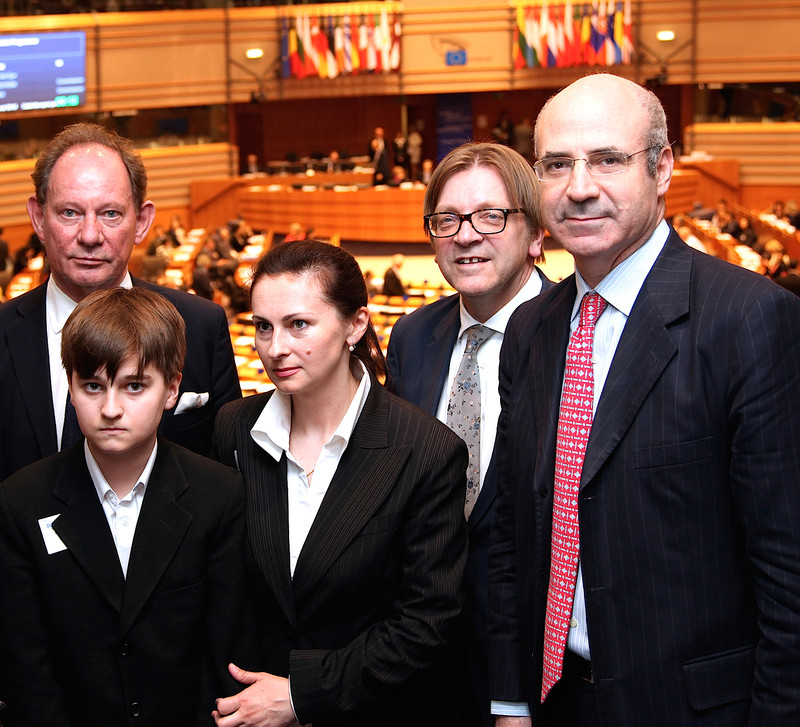
William Browder (right) with Magnitsky’s widow and son,
along with European parliamentarians.
“I’d be very careful going out and trying to do a whole sort of thing about Sergei [Magnitsky] not being the whistleblower, it won’t do well for your credibility on this show,” Browder said. “This is sort of the subtle FSB version,” suggesting that Nekrasov was just fronting for the Russian intelligence service.
In the pro-Browder account published at the Daily Beast on July 25, Browder described how he put down Nekrasov by telling him, “it sounds like you’re part of the FSB. … Those are FSB questions.”
But that phrasing is not what he actually says in the documentary, raising further questions about whether the Daily Beast reporter actually watched the film or simply accepted Browder’s account of it. (I posed that question to the Daily Beast’s Katie Zavadski by email, but have not gotten a reply.)
The documentary also includes devastating scenes from depositions of a sullen and uncooperative Browder and a U.S. government investigator, who acknowledges relying on Browder’s narrative and documents in a related case against Russian businesses.
In an April 15, 2015 deposition of Browder, he, in turn, describes relying on reports from journalists to “connect the dots,” including the Organized Crime and Corruption Reporting Project (OCCRP), which is funded by the U.S. government and financial speculator George Soros. Browder said the reporters “worked with our team.”
While taking money from the U.S. Agency for International Development and Soros, the OCCRP also targeted Ukraine’s elected President Viktor Yanukovych with accusations of corruption prior to the Feb. 22, 2014 coup that ousted Yanukovych, an overthrow that was supported by the U.S. State Department and escalated the New Cold War with Russia.
OCCRP played a key role, too, in the so-called Panama Papers, purloined documents from a Panamanian law firm that were used to develop attack lines against Russian President Vladimir Putin although his name never appeared in the documents.
After examining the money-movement charts published by OCCRP about the Magnitsky case, Nekrasov notes that the figures don’t add up and wonders how journalists could “peddle these wooly maths.” He also observed that OCCRP’s Panama Papers linkage of Magnitsky’s $230 million fraud and payments to an ally of Putin made no sense because the dates of the Panama Papers transactions preceded the dates of the alleged Magnitsky fraud.
The Power of Myth
Nekrasov suggests that the power of Browder’s convoluted story rested, in part, on a Hollywood perception of Moscow as a place where evil Russians lurk around every corner and any allegation against “corrupt” officials is believed. The Magnitsky tale “was like a film script about Russia written for the Western audience,” Nekrasov says.
But the Browder’s narrative also served a strong geopolitical interest to demonize Russia at the dawn of the New Cold War.
In the documentary’s conclusion, Nekrasov sums up what he had discovered: “A murdered hero as an alibi for living suspects.” He then ponders the danger to democracy: “So do we allow graft and greed to hide behind a political sermon? Will democracy survive if human rights — its moral high ground — is used to protect selfish interests?”
But Americans and Europeans are being spared the discomfort of having to answer that question or to question their representatives about the failure to skeptically examine this case that has pushed the planet on a course toward a possible nuclear war.
Instead, the mainstream Western media has hurled insults at Nekrasov even as his documentary is blocked from any significant public viewing.
Despite Browder’s professed concern about the London libel case that he claimed was an attempt “to stifle our freedom of expression,” he has sicced his lawyers on anyone who might be thinking about showing Nekrasov’s documentary to the public.
The documentary was set for a premiere at the European Parliament in Brussels in April 2016, but at the last moment – faced with Browder’s legal threats – the parliamentarians pulled the plug. Nekrasov encountered similar resistance in the United States. There were hopes to show the documentary to members of Congress but the offer was rebuffed. Instead a room was rented at the Newseum near Capitol Hill.
Browder’s lawyers then tried to strong arm the Newseum, but its officials responded that they were only renting out a room and that they had allowed other controversial presentations in the past.
“We’re not going to allow them not to show the film,” said Scott Williams, the Newseum’s chief operating officer. “We often have people renting for events that other people would love not to have happen.”
In an article about the controversy in June 2016, The New York Times added that “A screening at the Newseum is especially controversial because it could attract lawmakers or their aides.”
One-Time Showing
So, Nekrasov’s documentary got a one-time showing with a follow-up discussion moderated by journalist Seymour Hersh. However, except for that audience, the public of the United States and Europe has been essentially shielded from the documentary’s discoveries, all the better for the Magnitsky myth to retain its power as a seminal propaganda moment of the New Cold War.
After the Newseum presentation, a Washington Post editorial branded Nekrasov’s documentary Russian “agit-prop” and sought to discredit Nekrasov without addressing his many documented examples of Browder’s misrepresenting both big and small facts in the case.
Instead, the Post accused Nekrasov of using “facts highly selectively” and insinuated that he was merely a pawn in the Kremlin’s “campaign to discredit Mr. Browder and the Magnitsky Act.”
Like the recent Daily Beast story, which falsely claimed that Nekrasov let the Russian police officer Karpov play himself, the Post misrepresented the structure of the film by noting that it mixed fictional scenes with real-life interviews and action, a point that was technically true but willfully misleading because the fictional scenes were from Nekrasov’s original idea for a docudrama that he shows as part of explaining his evolution from a believer in Browder’s self-exculpatory story to a skeptic.
But the Post’s deception – like the Daily Beast’s falsehood – is something that almost no American would realize because almost no one has gotten to see the film.
The Post’s editorial gloated: “The film won’t grab a wide audience, but it offers yet another example of the Kremlin’s increasingly sophisticated efforts to spread its illiberal values and mind-set abroad. In the European Parliament and on French and German television networks, showings were put off recently after questions were raised about the accuracy of the film, including by Magnitsky’s family.
“We don’t worry that Mr. Nekrasov’s film was screened here, in an open society. But it is important that such slick spin be fully exposed for its twisted story and sly deceptions.”
The Post’s arrogant editorial had the feel of something you might read in a totalitarian society where the public only hears about dissent when the Official Organs of the State denounce some almost unknown person for saying something that almost no one heard.
It is also unlikely that Americans and Europeans will get a chance to view this blacklisted documentary in the future. In an email exchange, the film’s Norwegian producer Torstein Grude told me that “We have been unsuccessful in releasing the film to TV so far. ZDF/Arte [a major European network] pulled it from transmission a few days before it was supposed to be aired and the other broadcasters seem scared as a result. Netflix has declined to take it. …
“The film has no other release at the moment. Distributors are scared by Browder’s legal threats. All involved financiers, distributors, producers received thick stacks of legal documents (300+ pages) threatening lawsuits should the film be released.” [Grude sent me a special password so I could view the documentary on Vimeo.]
The blackout continues even though the Magnitsky issue and Nekrasov’s documentary have become elements in the recent controversy over a meeting between a Russian lawyer and Donald Trump Jr. [See Consortiumnews.com’s “How Russia-gate Met the Magnitsky Myth.”]
So much for the West’s vaunted belief in freedom of expression and the democratic goal of encouraging freewheeling debates about issues of great public importance. And, so much for the Post’s empty rhetoric about our “open society.”
Investigative reporter Robert Parry broke many of the Iran-Contra stories for The Associated Press and Newsweek in the 1980s.
View the film: https://swprs.org/the-magnitsky-act/
Rutherford Institute Asks Virginia Supreme Court to Prohibit Police From Using License Plate Readers as Surveillance Tool to Track Citizens
Rutherford Institute | August 2, 2017
RICHMOND, Va. — Denouncing the fact that Americans cannot even drive their cars without being enmeshed in the government’s web of surveillance, The Rutherford Institute has asked the Virginia Supreme Court to prohibit Virginia police from using license plate readers as surveillance tools to track drivers’ movements. Mounted next to traffic lights or on police cars, Automated License Plate Readers (ALPR), which photograph up to 3,600 license tag numbers per minute, take a picture of every passing license tag number and store the tag number and the date, time, and location of the picture in a searchable database. The data is then shared with law enforcement, fusion centers and private companies and used to track the movements of persons in their cars. There are reportedly tens of thousands of these license plate readers now in operation throughout the country. It is estimated that over 99% of the people being unnecessarily surveilled are entirely innocent. In challenging the use of license plate readers by Fairfax police, Rutherford Institute attorneys argue that Fairfax County’s practice of collecting and storing license plate reader data violates a Virginia law prohibiting the government from amassing personal information about individuals, including their driving habits and location.
The amicus brief in Neal v. Fairfax County Police Department is available at www.rutherford.org.
“We’re on the losing end of a technological revolution that has already taken hostage our computers, our phones, our finances, our entertainment, our shopping, our appliances, and now, it’s focused its sights on our cars,” said constitutional attorney John W. Whitehead, president of The Rutherford Institute and author of Battlefield America: The War on the American People. “By subjecting Americans to surveillance without their knowledge or compliance and then storing the data for later use, the government has erected the ultimate suspect society. In such an environment, there is no such thing as ‘innocent until proven guilty.’”
Since 2010, the Fairfax County Police Department (FCPD) has used Automated License Plate Readers (ALPR) to record the time, place, and driving direction of thousands of drivers who use Fairfax County roads daily. License plate readers capture up to 3,600 images of license tag numbers per minute and convert the images to a computer format that can be searched by tag number. This information, stored in a police database for a year, allows the police to determine the driving habits of persons as well as where they have been. In 2014, Fairfax County resident Harrison Neal filed a complaint against FCPD asserting its collection and storage of license plate data violates Virginia’s Government Data Collection and Dissemination Practices Act (Data Act), a law enacted because of the fear that advanced technologies would be used by the government to collect and analyze massive amounts of personal information about citizens, thereby invading their privacy and liberty. The lawsuit cited a 2013 opinion by Virginia Attorney General Ken Cuccinelli that ALPR data is “personal information” that the Data Act forbids the government from collecting and storing except in connection with an active criminal investigation. Despite this opinion, FCPD continued its practice of collecting and storing ALPR data in order to track the movements of vehicles and drivers. In November 2016, a Fairfax County Circuit Court judge ruled that license plate reader data was not “personal information” under the Data Act because license tag numbers identify a car and not a person. In weighing in on the case before the Virginia Supreme Court, Rutherford Institute attorneys refute the lower court ruling and argue that the history of the Data Act affirms its prohibition on the collection and maintenance of ALPR data by the government.
The Rutherford Institute, a nonprofit civil liberties organization, provides legal assistance at no charge to individuals whose constitutional rights have been threatened or violated and educates the public on a wide spectrum of issues affecting their freedoms.
Opposition journalist investigated for ‘treason & terrorism’ in Ukraine
RT | August 2, 2017
Ukraine’s Security Service have launched an investigation into a journalist and blogger whom they accuse of treason as well as his alleged attempts to violate the country’s territorial integrity via publications critical of the government in Kiev.
The Security Service of Ukraine (SBU) released a statement Wednesday, reporting that it had “ended the activity” of a journalist from the Zhitomir region in central Ukraine, who they claim worked on the “instructions of Russian curators” and “prepared and distributed anti-Ukrainian materials.”
“Since 2014 the journalist had been writing tendentious articles at the request of the Russian government propaganda news agencies,” the agency said without releasing the name of the suspect.
His work has had a “manipulative influence on the readers’ minds” and threatened “the sovereignty and independence of our state,” the SBU claimed.
The blogger, identified by the Ukrainian media as Vasily Muravitsky, was publishing his articles on at least six websites, the SBU said, adding, that the man initially signed his work under his real name, but started using aliases after that.
The journalist’s works also allegedly contained “calls to incite national enmity within the country and between Ukraine and neighboring friendly states,” the security agency added.
If found guilty the opposition journalist may face up to 15 years in prison, according to Ukrainian authorities.
The Russian foreign ministry has condemned the persecution of the journalist, saying in a statement the investigation of the blogger is “just another episode of the campaign led by Kiev and aimed at violent suppression of the opposition journalists and total cleansing of Ukraine’s information sphere for the benefit of the ruling regime.”
“The mass closure of Russian news and internet media outlets as well as persecution and oppression of the Ukrainian journalists conducted on a large scale are blatant violations of the fundamental principles of the freedom of expression that lie at the core of the civilized approach to the media and are embodied in the key documents of the UN, OSCE and the Council of Europe,” the statement said.
The ministry further called on member states of the OSCE and the Council of Europe as well as other international organizations to join Russia in condemning “Kiev’s barbaric and criminal policy towards media.”
US Regime Change in Venezuela: The Truth is Easy if You Follow the Money
By Tony Cartalucci | Land Destroyer | July 31, 2017
Venezuela’s ongoing crisis is not driven by political ideology – it is not a battle of socialism versus capitalism or dictatorship versus democracy – it is the result of two centers of political power possessing opposing interests and colliding geopolitically.
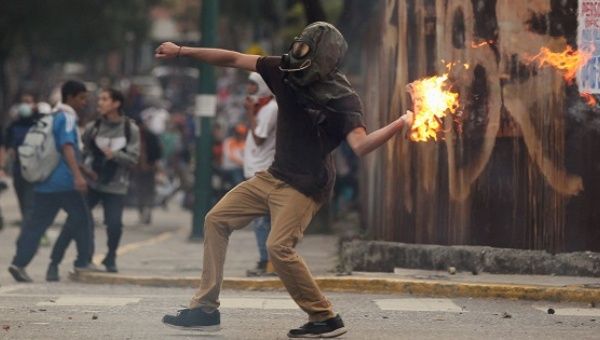
The nation of Venezuela is currently under the control of Venezuelans who derive their support, wealth, and power from Venezuela itself – its people and its natural resource. This political order also receives aid and support from Venezuela’s economic and military partners both in the region and around the globe.
The opposition opposed to the current political order and seeking to supplant it represents foreign interests and more specifically, the United States and its European allies.
The Opposition is Pro-Washington, Not “Pro-Democracy”
As early as 2002, US-backed regime change targeting then Venezuelan president Hugo Chavez, sought to violently overthrow Venezuela’s political order and replace it with one obedient to Washington. Current leaders of the opposition were not only involved in the 2002 failed coup, many are documented to have received political and financial support from the United States government ever since.

Maria Corina Machado, founder of Sumate, an alleged Venezuelan election monitoring group, funded by the US National Endowment for Democracy (NED), meeting with US President George Bush who presided over the failed coup attempt against President Hugo Chavez.
This includes several founders of the opposition party, Primero Justicia (Justice First), including Leopoldo Lopez, Julio Borges, and Henrique Capriles Radonski. The latter of the three has been prominently featured in Western media coverage lately.
US State Department documents reveal that the department itself along with US-funded fronts posing as nongovernmental organizations (NGOs) have been providing Venezuela’s opposition with support.
This includes a report titled, “Status of Capriles and Sumate Cases,” referring to the above mentioned Henrique Capriles Radonski and Sumate, a US National Endowment for Democracy (NED) funded front posing as an election monitor.

Currently, NED’s own website features an extensive list of activities it is engaged in within Venezuela’s borders. It includes leveraging human rights for political gain, electoral manipulation, building opposition fronts, and expanding pro-opposition media. While each activity is labelled with benign titles, it is clear that none of these activities are done impartially, and as State Department documents reveal, these activities are done specifically for the benefit of the US-backed opposition.
Wall Street and Washington’s Open Conspiracy
After the death of Chavez in 2013, US-based special interests openly conspired to finally overturn the political order he built. Corporate-financier policy think tank, the American Enterprise Institute (AEI) created a checklist of US foreign policy goals it sought to achieve in Venezuela. They included:
- The ouster of narco-kingpins who now hold senior posts in government
- The respect for a constitutional succession
- The adoption of meaningful electoral reforms to ensure a fair campaign environment and a transparent vote count in expected presidential elections; and
- The dismantling of Iranian and Hezbollah networks in Venezuela
In reality, AEI is talking about dismantling entirely the obstacles that have prevented the US and the corporate-financier interests that direct it, from installing a client regime and extracting entirely Venezuela’s wealth while obstructing, even dismantling the geopolitical independence and influence achieved by Chavez in Venezuela, throughout South America, and beyond.
The think tank would continue by stating:
Now is the time for US diplomats to begin a quiet dialogue with key regional powers to explain the high cost of Chávez’s criminal regime, including the impact of chavista complicity with narcotraffickers who sow mayhem in Colombia, Central America, and Mexico. Perhaps then we can convince regional leaders to show solidarity with Venezuelan democrats who want to restore a commitment to the rule of law and to rebuild an economy that can be an engine for growth in South America.
By “Venezuelan democrats,” AEI means proxies created, funded, and directed by Washington, including Primero Justicia and the street mobs and paramilitary units it commands.
More recently, another Wall Street-Washington policy think tank, the Brookings Institution, would publish in a paper titled, “Venezuela: A path out of crisis,” a 5-point plan toward escalating the crisis in Venezuela (emphasis added):
1. The United States could expand its assistance to countries that until now have been dependent on Venezuelan oil, as a means to decrease regional support for and dependence on the Maduro government.
2. The United States could increase monetary assistance to credible civil society organizations and nongovernmental organizations able to deliver food and medicines to Venezuelans. By doing so, the United States should make clear that international pressure aims to support democracy, not punish the Venezuelan people.
3. The United States could support efforts by the opposition in Venezuela to build an “off-ramp” that would split moderate elements of the government away from hardliners, encouraging the former to acquiesce to a transition to democracy by lowering their costs of exiting government.
4. The United States could coordinate with international institutions such as the International Monetary Fund (IMF) to offer financial incentives for holding free and fair elections in 2018, and for the opposition to unify and compete in those elections. Such coordination would also involve developing and publicizing a credible plan to restart Venezuela’s economy.
5. As a last resort, the United States could consider raising economic costs to the government through an expanded sanctions regime that aims to limit Venezuelan earnings from oil exports and block further financing. This policy is risky, given that the Maduro government would be able to more credibly shift blame for the economic crisis onto the United States, and should be accompanied by well-publicized efforts to deliver humanitarian aid through credible civil society and nongovernmental organizations.
While the Western media attempts to frame Venezuela’s crisis as a result of “socialism” and “dictatorship,” it is clear by reading the West’s own policy papers that it is owed instead to a systematic assault on Venezuela’s sociopolitical stability and economic viability, spanning decades.
Venezuela is not the first nation in South America that the United States has sought to overturn by undermining its economy.
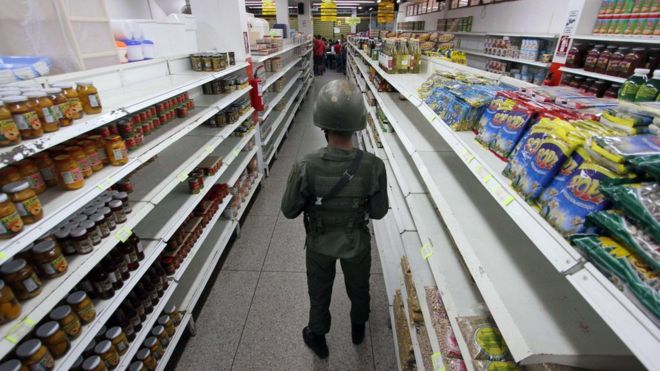
Within the CIA’s own online archives under a section titled, “CIA Activities in Chile,” it is admitted that in the 1970s, similar tactics were used to undermine and overturn the government of Chile. It states specifically: (emphasis added):
According to the Church Committee report, in their meeting with CIA Director Richard Helms and Attorney General John Mitchell on 15 September 1970 President Nixon and his National Security Advisor, Henry Kissinger, directed the CIA to prevent Allende from taking power. They were “not concerned [about the] risks involved,” according to Helms’ notes. In addition to political action, Nixon and Kissinger, according to Helms’s notes, ordered steps to “make the economy scream.”
These Cold War attitudes persisted into the Pinochet era. After Pinochet came to power, senior policymakers appeared reluctant to criticize human rights violations, taking to task US diplomats urging greater attention to the problem. US military assistance and sales grew significantly during the years of greatest human rights abuses. According to a previously released Memorandum of Conversation, Kissinger in June 1976 indicated to Pinochet that the US Government was sympathetic to his regime, although Kissinger advised some progress on human rights in order to improve Chile’s image in the US Congress.
Considering America’s extensive list of interventions, wars, and occupations it is currently involved in worldwide and the manner in which each was presented to the public – with ideology and humanitarian concerns used to manipulate public perception, and considering Venezuela’s opposition is a documented recipient of US support, it is clear that yet another intervention is under way, this time in South America.
Unipolar vs Multipolar
In a world moving toward multipolarism and greater decentralization on all levels, Venezuela’s collapse and a victory for Washington would undo an increasingly balanced distribution of geopolitical power – both in South and Central America, as well as across the world.
As a major oil producing nation, US control over its people and natural resources would further allow the US and its allies to manipulate energy prices toward achieving future goals – particularly in terms of encircling, isolating, and dismantling other centers of political power dependent on oil production for economic prosperity.

One needs not be a fan of “socialism” to understand that the ultimate outcome of Venezuela’s collapse will be a further concentration of power in Washington and Wall Street’s hands. Such power, regardless of whatever ideology it is superficially wielded behind, will always be abused. Regardless of the alleged form of government a nation may take, as long as it is a step away from unipolar globalization, it is a step in the right direction.
The crisis in Venezuela is not one of socialism versus capitalism or dictatorship versus democracy – it is one of hegemony versus national sovereignty, of centralized unipolar power versus an increasingly multipolar world.
A sovereign and independent Venezuela allowed to pursue its own destiny is one in which its own people will naturally seek to decentralize and distribute power. While the current government may not provide the ideal conditions to accomplish this, conditions under a US client regime – as US-wrecked Libya, Afghanistan, or Iraq prove – would be significantly less ideal.
For geopolitical analysts, moving away from ideological talking points and examining the actual government and opposition, their interests, associations, and funding, as well as their base motives reveals a much simpler and consistent narrative, one that any analyst could discern, and a discernment that will stand the test of scrutiny and time. Those entrenched in left/right ideology risk being betrayed by the government’s floundering desperation and the true nature of an opposition that most certainly is not “capitalist” or “pro-democracy.”
‘No Time For Shallow Diplomacy Christians’ In The Religious War On Churches In The Holy Land
By Stuart Littlewood | American Herald Tribune | August 2, 2017
A month ago, after reading a desperate cry for help from the National Coalition of Christian Organisations in Palestine (NCCOP) addressed to the World Council of Churches, I emailed eight churches in my locality asking whether that heart-rending appeal had trickled down to them at parish level.
If not, I hoped to find out where the break in communications occurred, as this wasn’t the first time churches in the Holy Land had sought support from Western Christendom. Previous appeals were largely ignored and left to civil society for action.
Now, say the Palestinians, the situation is “beyond urgent”. So had the NCCOP’s latest plea actually arrived on the desks of parish priests in my neighbourhood? And if so, how were grass-roots Christians responding?
I included a link to the actual crisis document, which should have made every churchman sit up, and a gentle reminder that their faith and their job of work are rooted in the Holy Land. “So what are the chances, I wonder, of seeing concerted action from Western churches before it’s too late? And what part can local parishes play?”
The key point was this: it’s beyond urgent. So are our spiritual leaders, those upstanding ‘men of the cloth’, mobilising their troops?
Only one of the eight replied — the local Catholic vicar-general — who dismissed the subject in two sentences. So there you have it. If this local bunch are representative of the Christian community in the UK, they don’t give a four-X for their brothers and sisters in the Occupied Palestinian Territories. And they are utterly indifferent to the fact that the place where Christianity was born is being stolen from under their noses.
If that’s a wrong interpretation, and Christians in the West do actually wish to help, the issue is straightforward enough. Churches in Palestine are asking churches here to call things as they are: to recognize Israel as an apartheid state in terms of international law and the UN report which says so. They are concerned that States and churches are still dealing with Israel on a business-as-usual basis, as if the situation were normal, and ignoring the criminal reality of military occupation.
Churches came together in opposition to apartheid in South Africa and helped end it. Why haven’t they done the same in Palestine?
They ask us to unequivocally condemn the Balfour Declaration as unjust, and they rightly demand that the UK asks forgiveness and compensates the Palestinian people for their losses. Theresa May’s government, however, plans to celebrate the centenary of the Balfour Declaration “with pride” and has invited Mr Netanyahu to the fun.
Clearly Mrs May, God-fearing churchgoer that she is, needs to feel the heat of His wrath. The woman is so arrogant that her government intends to appeal against the recent decision by the Royal Courts of Justice defending our right to boycott Israel.
End the ‘Ecumenical Deal’, put interfaith dialogue through the wringer
The Palestinians want us to take the strongest possible stand against any theology or group that seeks to justify the occupation. That means of course challenging our religious dialogue partners and withdrawing from those partnerships if they won’t condemn Israel’s brutal occupation.
But I can hear our canting clerics muttering: “Oh dear, no, no, no. We mustn’t upset our interfaith colleagues. That would never do.”
Churches that sell their holdings or otherwise divest from companies that profit from the occupation of Palestinian lands often take years of agonising confab to reach such a commonsense position. But they needn’t think just moving their money is enough. A recent example is the Mennonite Church USA, where it took (they say) a three-person writing team and a 10-member reference group working intensely during the past two years and consulting widely across the church and with Palestinian and Jewish partners, to come up with a modest proposal. And to sugar the divestment pill they declared that “the legacy of Jewish suffering is intertwined with the suffering of Palestinians”. What the Palestinians had to do with Jewish suffering or ever did to deserve having their lands and homes confiscated, isn’t explained. But it is used to provide an excuse to call on Mennonites to strengthen relationships with Jewish communities.
Why? Can they not understand that you have to be consistent in boycotting Israel? It involves boycotting the people who also support and advocate for Israel including those who fail to condemn the Zionist regime’s vile policies that hurt our Palestinian friends. As George Galloway has said, you simply don’t engage with them.
Christians who cannot grasp what is really going on out there, and don’t see what is needed to stop it, might find Robert Cohen’s excellent article Brace Yourselves for Costly Palestinian Solidarity helpful in pointing towards proper, meaningful action.
He explains why the Christian-Jewish dialogue needs re-setting. Central to the problem is the so-called Ecumenical Deal, a reluctance to question Jewish support for Israel for fear of unpicking decades of interfaith reconciliation following the Holocaust. We appear to have cast ourselves in the self-defeating role of repenting for age-old Christian anti-Jewishness. Breaking out of it and criticising Israel would be seen as a re-emergence of that anti-Jewishness.
I’m not aware of Christian anti-Jewishness although continuing failure on the part of Jewish leaders to condemn the cruel policies of the Israeli regime, aka ‘the Jewish State’, is surely asking for it. Does anyone inside or outside the bubble of the Church seriously buy into this repentence stuff? From outside, among people who would never set foot in a church again but still call themselves Christians because they were brought up according to the Christian code, it looks pathetic.
Christians in Palestine, says Cohen, despair of our Church leaders’ endless hiding behind the cover of political neutrality and their unwillingness to offend their religious dialogue partners. Consequently, he predicts, Jewish-Christian dialogue “is about to go through the wringer”.
Time for some ‘really uncomfortable conversations’
Pressing the re-set button means “refusing to allow your local Jewish communal leadership to set the boundaries of permissible debate on Israel”. It also means “listening to the Christian voice under occupation before the Jewish voice living comfortably, with full equal rights, many thousands of miles from that same occupation”.
Operating the wringer, of course, will be followed by a distinct chill in relationships forcing Church leaders, local ministers and their congregations, as well as the Jewish leaders they have dialogue with, out of their comfort zone. Good. As Rebecca Vilkomerson, Jewish Voice for Peace, recently wrote in Haaretz, after 70 years of dispossessing and expelling Palestinians, 50 years of Israeli military occupation and 10 years of blockading Gaza, it is time for Jewish communities “to have some really uncomfortable conversations”.
Palestinians say no to ‘shallow diplomacy’ but it’s all they’re likely to get
How does the World Council of Churches react to those urgent pleas from Palestine?
They will study and analyse. “As we at the WCC consider our plans for 2018 and beyond, we want churches in Palestine to know that their perspective is heard and it is vitally important,” said the WCC’s general secretary. “We will continue with the same passionate spirit to work on specific objectives, strategies and partners for advocacy to end the occupation and to work for just peace in Palestine and Israel.”
The WCC’s Commission of the Churches on International Affairs has been asked to contribute a thorough analysis of the changing political landscapes and dynamics in the Holy Land with an eye toward developing a more specific advocacy strategy that works through nations and organizations with significant influence.
WCC has also started an online campaign, Seek #JusticeAndPeace in the Holy Land, which features profiles of peacemakers and various cries for justice.
WCC also plans to “explore theological reflections, studies and projects that will bring a perspective on just peace in the Holy Land from all parts of the world”, and strengthen communication about the situation in Palestine so that it can “help churches and other ecumenical partners address their constituencies and governments in a more systematic way”. This includes developing a set of principles and practices of responsible pilgrimages of justice and peace to the Holy Land.
Will the Palestinian churches be impressed? Their cry for help stated specifically: “We stand in front of an impasse and we have reached a deadlock. Despite all the promises, endless summits, UN resolutions, religious and lay leader’s callings, Palestinians are still yearning for their freedom and independence, and seeking justice and equality.”
They stressed that religious extremism is on the rise, with religious minorities paying a heavy price. “We need brave women and men who are willing to stand in the forefront. This is no time for shallow diplomacy Christians.”
When I called the Church of England press office yesterday they didn’t think any response had been made. Such concern, then. And when I ran through the members of the WCC’s Central Committee I noticed the two representatives from the Church Of England were both based in Europe. How helpful is that?
The power of hope
Christianity sometimes has great trouble telling right from wrong and doing something about it. The Holy Land is a case in point. Evil reigns there. Christianity across the world cowers. What would Christ say to that?
I know what Michel Sabbah says. He is a former Catholic Patriarch of Jerusalem, a courageous man of the front line and one of the great heroes of the struggle.
“The current situation is hopeless. In reality, there are no signs of hope at all for the Palestinian people. In spite of that, we hope.
We hope because we are Christians, and God is present.
We hope because we believe in the fundamental goodness of the human being, Israeli and Palestinian. Human goodness will prevail at the end upon the human power of evil.We hope because Palestinians are persevering in claiming their rights.
It is a source of hope that we never gave up….We hope because among Israelis, there are people who are trying to work with Palestinians for what is right. And there are an increasing number of movements for peace, strong in will….
If we had no hope we would not live. Hope is life, and history gives us hope. What is right will prevail.”
Michel Sabbah
Catholic Patriarch Emeritus
I fear that if he pins any hopes on the wets of the Western churches he’ll be disappointed. But he already knows that, surely.
Iran, Iraq, Russia hold meeting in Moscow
IRNA – August 2, 2017
Deputy Foreign Ministers of Russia, Iran and Iraq held meeting here on Wednesday to consider situation in the Middle East, crises in Iraq and Syria and trilateral coordination.
Mikhail Bogdanov, Hossein Jaberi Ansari and Nazar Khairallah kicked off the meeting in the venue of Foreign Ministry Protocol Hall in the presence of their accompanying delegation as well as Iran’s Ambassador to Moscow Mehdi Sanayee.
The latest developments in the region, especially coordination to reduce tensions and crises in the region with the aim to increase stability and peace were topics of agenda.
Before holding the joint meeting, Bogdanov met separately with Jaberi Ansari and Nazar Khairallah and discussed different issues with them.
Bogdanov and Jaberi Ansari in their 4-hours meeting discussed a collection of issues concerning West Asia and North Africa, situations in Syria, Yemen, Libya, Iraq, Iraqi Kurdistan, Palestine, crisis in relations between Qatar and Saudi Arabia and other international and regional issues.
Intra-Syrian talks in Astana and Geneva, Syrian humanitarian needs and the issue of rebuilding Syria were among issues discussed in the meeting.
Featured Video
NATO’s War of Choice – The Sabotage of the Istanbul Negotiations
or go to
Aletho News Archives – Video-Images
From the Archives
National Security Archive Publishes Key Records on Infamous MKULTRA Program
Agency Sought Drugs and Behavior Control Techniques to Use in “Special Interrogations” and Offensive Operations
Edited by Michael Evans | National Security Archive | December 23, 2024
Washington, D.C. – Today, the National Security Archive and ProQuest (part of Clarivate) celebrate the publication of a new scholarly document collection many years in the making on the shocking secret history of the CIA’s mind control research programs. The new collection, CIA and the Behavioral Sciences: Mind Control, Drug Experiments and MKULTRA, brings together more than 1,200 essential records on one of the most infamous and abusive programs in CIA history.
Under code names that included MKULTRA, BLUEBIRD and ARTICHOKE, the CIA conducted terrifying experiments using drugs, hypnosis, isolation, sensory deprivation, and other extreme techniques on human subjects, often U.S. citizens, who frequently had no idea what was being done to them or that they were part of a CIA test.
Today’s announcement comes 50 years after a New York Times investigation by Seymour Hersh touched off probes that would bring MKULTRA abuses to light. The new collection also comes 70 years since U.S. pharmaceutical giant Eli Lilly & Company first developed a process to streamline the manufacture of LSD in late 1954, becoming the CIA’s chief supplier of the newly discovered psychoactive chemical central to many of the Agency’s behavior control efforts.
Highlights of the new MKULTRA collection include… continue
Blog Roll
 Aletho News
- John Mearsheimer: The Case for a Nuclear Iran
- The Founder Who Turned Against Root Canals
- Israel displaces last two families from Al Khalayel valley, Al Mughayyir
- Israeli Opposition Leader Endorses Greater Israel
- Islamic Jihad: Trump’s peace board is a “theatrical stunt detached from reality”
- The Head Of A CIA Cutout Admits To Meddling In Iran To Fuel Unrest
- Iran warns Trump against decisions based on false information
- Pentagon sets deadline for Anthropic to lift AI restrictions on autonomous weapons systems, mass domestic surveillance
- Trump’s military buildup against Iran on Netanyahu’s behalf is a gambit doomed to fail
- Big League War
- If Americans Knew
- Are the Jews indigenous to Palestine?
- AIPAC Wants to Kill a Bill that would Ensure Israel Complies with Ceasefire
- Former Israeli PM, in Epstein Files, Dreamed of Israeli Eugenics and Pretty Converts
- Israeli settlers join ‘safari’ tour of Palestinian prisoners
- Flooding in Gaza amid rumors of war; fire in West Bank – Not a ceasefire Day 138
- Fourteen Countries Condemn Huckabee’s Support for Israel Taking Over Most of the Middle East
- Israeli Soldiers Killed Gaza Aid Workers at Point Blank Range in 2025 Massacre: Report
- Israel’s insidious network to propagandize American Christians
- Israel’s Best-Kept Secret: Palestinian Resistance Never Agreed to Disarm
- Trump officials plan to build 5,000-person military base in Gaza, files show
- No Tricks Zone
- Surprising Discovery: Sahara Is Greening…Billions Of Trees Where Once Thought To Be Barren
- New Research Reaffirms Clouds, Aerosols, And Surface Solar Radiation Are ‘Driving The Climate System’
- Germany: Electric Car Catches Fire At Charging Station, Sets Off Local “Inferno”, Widespread Damage
- New Study: Canada’s New Brunswick Was 1°C Warmer Than Today During The Medieval Warm Period
- Coal Power Back In Trend As Globe Tries To Keep Pace With Growing Demand For Power
- New Study: A 4°C Warmer Beaufort Sea Had ‘No Sea Ice’ 11,700 – 8200 Years Ago
- Unfudging The Data: Dutch Meteorological Institute Reinstates Early 20th Centruy Heat Waves It Had Erased Earlier
- German Gas Crisis…Chancellor Merz Allegedly Bans Gas Debate Ahead of Elections!
- Pollen Reconstructions Show The Last Glacial’s Warming Events Were Global, 10x Greater Than Modern
- Germany’s Natural Gas Storage Level Dwindles To Just 28%… Increasingly Critical
 Aletho News