Saudi forces set ablaze Shia homes in restive Awamiyah
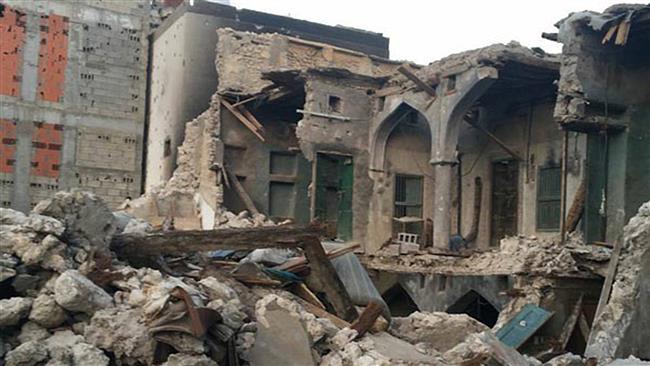
An al-Alam photo shows rubble caused by the Saudi demolition of Awamiyah, Eastern Province, Saudi Arabia.
Press TV – August 1, 2017
Saudi forces have set fire to homes belonging to Shia residents in the besieged town of Awamiyah that has been the scene of a heavy-handed regime crackdown on the minority community.
Based on local reports, Saudi forces have thrown Shia citizens out of their homes and then torched their properties.
Awamiyah, situated in Eastern Province, has long been a flashpoint between the Saudi kingdom and the inhabitants complaining of discrimination.
It has witnessed renewed deadly clashes between the military and residents since May, when Saudi forces began razing the town’s old quarter, known as al-Mosawara.
Saudi authorities claim that Mosawara’s narrow streets have become a hideout for militants suspected of being behind attacks on security forces in Eastern Province.
The UN, however, said Saudi Arabia was erasing cultural heritage and violating human rights through Mosawara’s demolition.
Karima Bennoune, the UN special rapporteur in the field of cultural rights, said Saudi authorities ignored repeated pleas by the world body to halt the destruction.
“These destructions erase the traces of this historic and lived cultural heritage and are clear violations of Saudi Arabia’s obligations under international human rights law,” Bennoune said, accusing the Saudi forces of “irreparably burning down” historic buildings and forcing residents to flee their homes.
Leilani Farha, the UN special rapporteur on the right to adequate housing, also warned that the Saudi move “constitutes a forced eviction under international human rights law.”
Additionally, Ali al-Dubisi, the head of the Berlin-based European Saudi Organization for Human Rights, said the Saudi forces were following a scorched-land policy in Awamiyah, launching rocket attacks and shelling residential buildings and civilians who are resisting Saudi pressures to evacuate.
Since February 2011, Saudi Arabia has stepped up security measures in Shia-dominated Eastern Province, which has been rocked by anti-regime demonstrations, with protesters demanding free speech, the release of political prisoners, and an end to economic and religious discrimination.
The government has suppressed pro-democracy movements, but they have intensified since January 2016 when Saudi Arabia executed respected Shia cleric Sheikh Nimr al-Nimr.
Turkey, US accuse each other of terror sponsorship in Syria
Press TV – August 1, 2017
Turkey and the United States have been accusing each other of supporting various terrorist groups in Syria.
Brett H. McGurk, the US special envoy to the international coalition against the Daesh terrorist group, has suggested that Turkey facilitates al-Qaeda terrorists in Syria’s Idlib Province.
He said in a speech delivered at a Washington-based think tank on July 29 that Idlib has turned into a “safe zone for al-Qaeda terrorists on the Turkish border,” asking “why and how” a deputy to al-Qaeda’s leader had allegedly managed to travel to the Syrian province.
He said it might not be the best approach for some partners of the US “to send tens of thousands of weapons and turn their faces to the other side as foreign fighters enter this area,” according to reports.
The US, McGurk reportedly said, intended to work with Turkey to have the border closed to recruited militants.
Ankara has strongly denounced McGurk’s “provocative” remarks, accusing Washington of terror sponsorship in Syria by supporting the Kurdish People’s Protection Units (YPG), which Ankara views as the Syrian branch of the Kurdistan Workers’ Party (PKK), a militant group that has been fighting the central Turkish government since 1984.
“Our reaction to the statements of Brett McGurk, in which he associated Turkey with the presence of terrorist organizations in Idlib, was brought to Mr. McGurk’s attention at a high-level démarche, and his statements, which could be characterized as provocative, were protested,” Turkish media on Monday quoted Foreign Ministry spokesperson Huseyin Muftuoglu as saying.
Muftuoglu also said that the US had to end its support for the Kurdish Democratic Party, aka PYD.
A Turkish Foreign Ministry official, who asked not to be named, also told Hurriyet Daily News that Foreign Ministry Deputy Undersecretary Sedat Onal had urged the US envoy to “correct” his statements.
The official added that Onal warned that such remarks could harm mutual cooperation between Turkey and the US, which is seeking cooperation with Ankara for the post-Daesh period in Syria.
Syria has been gripped by militancy since March 2011, when a section of the opposition in the country took up arms against President Bashar al-Assad. A vast mix of foreign terrorists soon blended with the armed opposition, joining the fight against the Syrian government.
Going Soft on Corporate Crime a Bipartisan Affair
By Russell Mokhiber | CounterPunch | July 31, 2017
Donald Trump is not a fan of the Foreign Corrupt Practices Act (FCPA), the law that says it’s illegal for any person — corporate or human — to bribe overseas.
Trump has called the FCPA “a horrible law” and has said that the law “puts us at a huge disadvantage.”
And you could argue that the Trump Justice Department’s first two FCPA enforcement cases reflect Trump’s point of view.
Both were declinations — despite the fact that the companies disclosed illegal overseas payments and agreed to disgorge illegally gained proceeds.
Some are using the cases to ask the question — is Trump soft on corporate crime?
As the lawyers say, let’s stipulate for the record that he is.
But let’s also remember that going soft on corporate crime was perfected by the Democrats.
The Obama Justice Department, for example, regularly used declinations — five in Obama’s last year in office — and non prosecution agreements — 22 over the eight years of his administration — to settle corporate FCPA matters.
And since September 2015, when the Obama administration put out the Yates memo calling for more prosecutions of individual executives, there have been 20 FCPA corporate prosecution agreements — yet not one individual has been charged in connection with those cases.
There are those in the get tough on corporate crime camp — like David Uhlmann, former head of the Environmental Crimes Section at the Justice Department and now a University of Michigan Law professor — who argue that if a corporation commits a serious crime, then a corporation should be convicted.
We’re talking guilt — as in guilty pleas.
For environmental crimes, that has been the practice.
Over the past fifteen years, 93 percent of major corporate criminal environmental cases ended with public companies pleading guilty to their crimes.
Same for antitrust corporate crimes.
Over the past fifteen years, 74 percent of major corporate criminal antitrust cases ended with public companies pleading guilty to their crimes.
But only 29 percent of corporate criminal FCPA cases were settled with guilty pleas.
And only 8 percent of securities fraud cases have been settled with guilty pleas.
Why?
You might ask — maybe these corporations weren’t guilty?
Not likely, because in almost every one of these cases — no matter the type of soft settlement — deferred prosecution, non prosecution, declination — the company admits to illegal wrongdoing.
The companies admit to their criminal wrongdoing in documents that are now publically available on a new web site — the Corporate Prosecution Registry — created by University of Virginia Law School Professor Brandon Garrett.
And what do we learn from this comprehensive corporate crime database?
That there is a two tier system of corporate criminal justice — one for the smaller, politically less well connected companies — which generally are forced to plead guilty to their crimes — and one for large, politically well connected public companies — which generally enter into softer alternative resolutions — declinations, non prosecution agreements and deferred prosecution agreements.
Or if they are forced to plead guilty, it’s not the parent forced to plead guilty but some unit that won’t be adversely affected by any debarment or other collateral sanction that might follow.
The dominant corporate narrative — driven by the corporate crime defense law firms — is that big public companies — especially banks and financial institutions — even if they commit the crimes, can’t withstand the brunt force trauma of a guilty plea.
They say — the company will be driven out of business. Innocent shareholders will lose money and innocent workers lose their jobs. A corporate guilty plea is the equivalent of the corporate death penalty.
Not true.
Top corporate crime prosecutors and defense attorneys — they’re interchangeable and regularly swap places via the revolving door — are expert at crafting guilty pleas that avoid these consequences.
That’s why when prosecutors want to, they can get guilty pleas — even for big banks — who for years dodged any personal or corporate criminal liability for causing the 2008 financial collapse.
Burned by that public criticism, the Obama Justice Department in May 2015, thought it was necessary to throw the public a bone.
And they did just that by forcing Citigroup, JP Morgan Chase, The Royal Bank of Scotland, UBS and Barclays to plead guilty to felonies in connection with a conspiracy to fix foreign exchange markets.
Why doesn’t the Justice Department demand felony guilty pleas from parents in more big corporate crime cases?
Power and money. The big companies don’t want to plead guilty even when they are guilty. They have corporate reputations to protect. And they have the power and money to hire the best corporate criminal defense law firms to get the job done.
The lawyers’ marching orders?
For the corporate parent, anything but a guilty plea.
Move down the corporate crime ladder from guilty plea to deferred prosecution to non prosecution to declination.
In the parallel Securities and Exchange Commission (SEC) case, move down the ladder from admission to no admission with a neither admit nor deny consent decree.
In a World Bank proceeding, move down the ladder from a debarment to a reprimand or a conditional non-debarment agreement.
Some say that it was Obama’s slippery slide down the corporate crime ladder — he hit bottom with not one executive or bank criminally charged for the 2008 financial meltdown — that fueled the populist revolt that helped Trump take the White House.
We don’t want to become Brazil, a country battered by wave after wave of corporate crime and corruption.
It’s time to restore a modicum of corporate criminal justice that will deliver tangible deterrence.
Let’s start by moving back up the ladder of corporate justice.
If a company commits a felony, it should plead guilty to a felony.
No more deferrals, non prosecutions and declinations in major corporate crime cases.
Russell Mokhiber is the editor of the Corporate Crime Reporter..
Featured Video
NATO’s War of Choice – The Sabotage of the Istanbul Negotiations
or go to
Aletho News Archives – Video-Images
From the Archives
National Security Archive Publishes Key Records on Infamous MKULTRA Program
Agency Sought Drugs and Behavior Control Techniques to Use in “Special Interrogations” and Offensive Operations
Edited by Michael Evans | National Security Archive | December 23, 2024
Washington, D.C. – Today, the National Security Archive and ProQuest (part of Clarivate) celebrate the publication of a new scholarly document collection many years in the making on the shocking secret history of the CIA’s mind control research programs. The new collection, CIA and the Behavioral Sciences: Mind Control, Drug Experiments and MKULTRA, brings together more than 1,200 essential records on one of the most infamous and abusive programs in CIA history.
Under code names that included MKULTRA, BLUEBIRD and ARTICHOKE, the CIA conducted terrifying experiments using drugs, hypnosis, isolation, sensory deprivation, and other extreme techniques on human subjects, often U.S. citizens, who frequently had no idea what was being done to them or that they were part of a CIA test.
Today’s announcement comes 50 years after a New York Times investigation by Seymour Hersh touched off probes that would bring MKULTRA abuses to light. The new collection also comes 70 years since U.S. pharmaceutical giant Eli Lilly & Company first developed a process to streamline the manufacture of LSD in late 1954, becoming the CIA’s chief supplier of the newly discovered psychoactive chemical central to many of the Agency’s behavior control efforts.
Highlights of the new MKULTRA collection include… continue
Blog Roll
 Aletho News
- John Mearsheimer: The Case for a Nuclear Iran
- The Founder Who Turned Against Root Canals
- Israel displaces last two families from Al Khalayel valley, Al Mughayyir
- Israeli Opposition Leader Endorses Greater Israel
- Islamic Jihad: Trump’s peace board is a “theatrical stunt detached from reality”
- The Head Of A CIA Cutout Admits To Meddling In Iran To Fuel Unrest
- Iran warns Trump against decisions based on false information
- Pentagon sets deadline for Anthropic to lift AI restrictions on autonomous weapons systems, mass domestic surveillance
- Trump’s military buildup against Iran on Netanyahu’s behalf is a gambit doomed to fail
- Big League War
- If Americans Knew
- Are the Jews indigenous to Palestine?
- AIPAC Wants to Kill a Bill that would Ensure Israel Complies with Ceasefire
- Former Israeli PM, in Epstein Files, Dreamed of Israeli Eugenics and Pretty Converts
- Israeli settlers join ‘safari’ tour of Palestinian prisoners
- Flooding in Gaza amid rumors of war; fire in West Bank – Not a ceasefire Day 138
- Fourteen Countries Condemn Huckabee’s Support for Israel Taking Over Most of the Middle East
- Israeli Soldiers Killed Gaza Aid Workers at Point Blank Range in 2025 Massacre: Report
- Israel’s insidious network to propagandize American Christians
- Israel’s Best-Kept Secret: Palestinian Resistance Never Agreed to Disarm
- Trump officials plan to build 5,000-person military base in Gaza, files show
- No Tricks Zone
- Surprising Discovery: Sahara Is Greening…Billions Of Trees Where Once Thought To Be Barren
- New Research Reaffirms Clouds, Aerosols, And Surface Solar Radiation Are ‘Driving The Climate System’
- Germany: Electric Car Catches Fire At Charging Station, Sets Off Local “Inferno”, Widespread Damage
- New Study: Canada’s New Brunswick Was 1°C Warmer Than Today During The Medieval Warm Period
- Coal Power Back In Trend As Globe Tries To Keep Pace With Growing Demand For Power
- New Study: A 4°C Warmer Beaufort Sea Had ‘No Sea Ice’ 11,700 – 8200 Years Ago
- Unfudging The Data: Dutch Meteorological Institute Reinstates Early 20th Centruy Heat Waves It Had Erased Earlier
- German Gas Crisis…Chancellor Merz Allegedly Bans Gas Debate Ahead of Elections!
- Pollen Reconstructions Show The Last Glacial’s Warming Events Were Global, 10x Greater Than Modern
- Germany’s Natural Gas Storage Level Dwindles To Just 28%… Increasingly Critical
 Aletho News